
1.
INTRODUCTION
El Niño is an extensive warming of the upper ocean in the tropical eastern Pacific lasting three or more seasons. The Southern Oscillation is a widespread interannual oscillation in sea-level atmospheric pressure between one region near northern Australia and one in the central Pacific. These related phenomena, together called ENSO, are the largest short-term climate variations. The TOGA Program was designed to study seasonal-to-interannual variability and predictability around the globe, with an emphasis on ENSO. Available resources limited the program largely to studies of ENSO in the tropical Pacific region. Before the TOGA Program, observing systems were inadequate to recognize the warm phase of ENSO—associated with El Niño—until it was well underway. At the conclusion of the program, a tropical Pacific observing system had been established and predictions of ENSO were being made with some skill. This report reviews the accomplishments and legacies of the TOGA Program, and then makes recommendations for further progress in predicting seasonal-to-interannual variations in climate around the globe.
The climate of a location refers to more than just the local long-term average of the annual cycles of temperature and precipitation. It includes other quantities, such as winds, humidity, and cloudiness. It includes places other than the surface, such as the upper atmosphere and the oceans. It includes other surface conditions, such as the presence of snow and ice (glaciers and sea ice), soil moisture, and vegetation cover. Furthermore, climate information now includes the variability of all these conditions, such as the frequency of storms, the range and frequency of extreme conditions, and the variations from year to year.
Since the late eighteenth century, it has been accepted that the climate of the earth has undergone dramatic changes, but until recently it was thought that those changes occurred over periods of thousands of years and longer. We now recognize that climate varies on all time scales. This recognition has led to a transformation, as well as to confusion, in how we use the term “climate”. For lack of a better term, we will consider a measure of the current state of the climate system to be an average over a period that includes several weather systems, i.e., an average over many weeks or longer. Climate variations, also
called anomalies, are differences in the state of the climate system from normal conditions (averaged over many years) for that time of year. Short-term climate variations are periods of a few months up through a few years that are unusually warm or cool (or wet or dry). The TOGA (Tropical Oceans and Global Atmosphere) Program was the first organized effort to study, understand, and predict the year-to-year variations of the climate system.
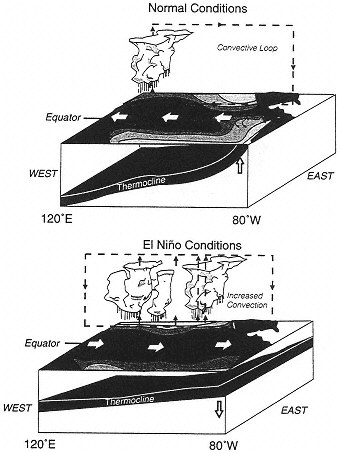
Figure 1. Schematic of ENSO. Contours indicate isotherms, with the increasingly darker fields near the equator showing increases in temperature. The top panel illustrates normal conditions in the tropical Pacific Ocean, while the lower one illustrates the warm phase of ENSO. (Courtesy of M. McPhaden, NOAA/PMEL.)
EL NIÑO AND THE SOUTHERN OSCILLATION (ENSO)
In the western tropical Pacific, the sea surface is always warm (around 29°C), the sea-level pressure is low, and the precipitation is heavy (see Figure 1). In the eastern Pacific, some ten to fifteen thousand kilometers to the east, the situation is very different. There the water is normally cool (21°C to 26°C), the sea-level pressure is high, and the precipitation is low. The cold water in the region of the equatorial eastern Pacific (the “cold tongue”) persists throughout the year but is warmest in April. This normal gradient in sea surface temperature along the equator is associated with westward winds. Although seasonal variations of this pattern occur, conditions are usually warm and wet in the west, and cool and dry in the east.
Occasionally, however, the warm pool in the western tropical Pacific begins to spread eastward. Accompanying these changes in sea surface temperature, the regions of low sea-level pressure and heavy rainfall move eastward with the warm pool, and the eastern and central Pacific become warm and rainy while the western Pacific becomes somewhat cooler and drier. The earliest recognition of these changes was an awareness of unusually warm water appearing from the north, off the coast of Peru, as an enhancement of the normal
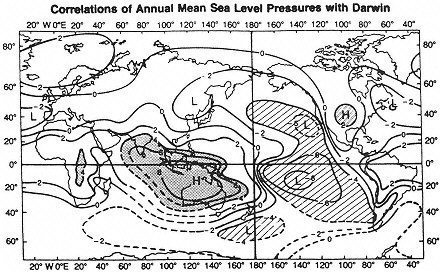
Figure 2. Correlations of annual-mean sea-level pressure with the pressure at Darwin, Australia. (From Trenberth and Shea 1987, reprinted by permission of the American Meteorological Society.)
Christmas warming. This warming of the coastal waters off Ecuador and Peru became known as El Niño. Later, it was recognized that the warming off Peru is part of a far more extensive warming, which extends across the entire tropical Pacific.
The Southern Oscillation is a widespread positive correlation of sea-level pressure anomalies centered near northern Australia that surround the warm pool in the western Pacific and extends considerably into the Indian Ocean, with anomalies of opposite sign centered east of Tahiti in the eastern and central Pacific (see Figure 2). These aspects of the Southern Oscillation have been known for more than 70 years (Walker 1924). However, not until the work of Bjerknes in the 1960s was it recognized that the expansion or contraction of the warm pool and the decreased or increased pressure in the central Pacific could both be part of a common phenomenon, now called ENSO (El Niño and the Southern Oscillation). A complete review has been provided by Philander (1990).
The term El Niño is still associated with the warm phase of ENSO. The cold phase is referred to sometimes as La Niña. Although these terms are common in the literature, the preferred designations are warm phase and cold phase of ENSO, referring to the temperature anomalies of tropical Pacific sea surface temperature; anomalies in other places may have opposite sign and different timing.
CONCEPT OF THE TOGA PROGRAM
Even the seemingly trivial prediction that conditions for each season or month will be close to that period's climatological mean has great social and economic value. All of us make plans based on the expectation of the normal progression of the seasons. Especially around the tropical Pacific, however, some years are significantly different from normal, confounding reasonable expectations and making planning for the near future especially difficult. Before the TOGA Program formally began at the start of 1985, the tropical Pacific and its overlying atmosphere were so poorly observed that it was impossible to detect even the largest warm phase of ENSO we have seen so far—in 1982–83—until it was well underway.
Although several programs conducted in the 1960s and 1970s gathered data on various atmospheric and oceanic aspects of the tropical Pacific Ocean, not until the early 1980s did the importance of ENSO became more generally appreciated. Research indicated correlations between the Southern Oscillation and the climate of the middle latitudes, thereby raising hopes that predictions of variations in the Southern Oscillation, and more generally of ENSO, would lead to useful predictions of middle-latitude climate. It was from this hope that the
idea for the TOGA Program arose. When the TOGA Program formally closed at the end of 1994, we could obtain, using a computer and a telephone, information on the state of the surface and subsurface tropical Pacific for the prior day. As a result of the TOGA Program, not only can we access observations of current conditions in the tropical Pacific, but we can also skillfully predict aspects of the evolution of those conditions a year in advance.
PURPOSE OF THIS REPORT
The purpose of this report is to take a careful retrospective look at the TOGA Program from a U.S. perspective, to examine its elements and organization, to see what it has accomplished and where it has fallen short, to document the legacies it has left, and to present the opportunities it has created for programs to follow. The progress of the TOGA Program within the United States has been amply documented, from the original scientific plan (NRC 1983), through its implementation strategy (NRC 1986), to a mid-life review (NRC 1990), with an examination of the role of TOGA within the World Climate Research Programme (NRC 1992), and a review of the TOGA Observing System (NRC 1994a). This report joins its predecessors in the process of documenting and reviewing the TOGA Program. A set of scientific review papers on TOGA will be published in 1997 as a special issue of the Journal of Geophysical Research.
Different audiences will look to this document for different reasons. Those seeking a quick overview might read just the Summary and the bold-faced synopses at the beginning of each chapter and the beginnings of the sections of chapter 3. Policy makers will want to read the Summary, chapter 1, chapter 2, the last section of chapter 4, chapter 6, and chapter 7. Those interested in technical issues regarding ENSO should concentrate on chapters 2, 3, and 4. Researchers and program managers seeking to guide future work on short-term climate variations would profit from reading the entire report. The TOGA Panel intends that graduate students, among others, not only be able to read this report, but also that they be able to develop a picture of the breadth of the science and organization associated with a “big science” effort that was deeply connected to international programs. This intention has required judgments about how much material to include, in addition to the particulars of the U.S. TOGA Program. While this document is fundamentally about the U.S. contribution to the TOGA Program, completeness and continuity required that a coherent story be told, even though more has been included than can be attributed to the U.S. efforts designated for TOGA.
While the orientation of this document is fundamentally retrospective, it is designed to have an impact on future programs currently being planned to extend TOGA. The advisory structure provided by the NRC, in the form of the
Advisory Panel for the TOGA Program, was an important element in developing the program. The panel helped hold to the program together, raised the visibility of the program when TOGA had to contend with ups and downs of funding, and served as a community representative for dealing with the agencies and with the large community of TOGA scientists. The management structure of TOGA evolved into a set of national and international entities that cared for the funding and performance of the program and coped with the wide variety of obstacles that inevitably arise in a program of this size and complexity. And finally, the community of scientists provided the inexhaustible creativity and enthusiasm that carries any program through those periods when progress seems impossible.
The end of the ten-year TOGA Program is a milestone in global climate research. It is the first major element of the World Climate Research Programme to reach its conclusion, and marks significant progress toward a more interdisciplinary view of the global climate system. TOGA accomplished much. The program oversaw the building of an observing system for the tropical Pacific Ocean. It sponsored a series of process experiments, culminating in the massive TOGA COARE (Coupled Ocean-Atmosphere Response Experiment) field program. TOGA participants demonstrated the predictability of seasonal-to-interannual climate variations, developed prediction systems to exploit this predictability, and used these systems to predict climate variations in and over the tropical Pacific Ocean. The infrastructure and management tools of TOGA combined achievements in observations, modeling, and process experiments into a whole greater than the sum of the parts. Indeed, part of the success of TOGA was the forging of links between the various modeling and observational activities, and recognizing their mutual interdependence. The TOGA experience can therefore be viewed as a guide for existing programs and a prototype for the future.
For any climate program of finite duration, the challenge is to extract from the program what is most useful and enduring, and to discard what has proven unworkable. The useful parts should then be transformed and institutionalized into permanent observing, modeling, and prediction efforts. This report will aid in addressing this challenge. It will review the scientific basis upon which the TOGA Program was formed and will describe the progress in conducting process studies, in building an observing system, in fostering coupled atmosphere-ocean modeling, and in developing theory and techniques for making short-term (i.e., a season up to a couple of years in advance) climate predictions. This report will also examine the human, technological, and organizational means by which TOGA's progress has occurred. The newly opened possibilities for the application of climate prediction will be described as they relate to ENSO prediction. The scientific accomplishments and the changes in the


