
Appendix I
Detailed Assessment of User Needs in Alaska
As discussed in Chapter 5, some geographic regions of the United States have environmental conditions and user needs that vary significantly from the national norm. However, the federal system for providing aviation weather services is based on conditions and needs that prevail in much of the nation. Alaska, more than any other region of the United States, seems to have an aviation environment that differs from national norms. Therefore, the committee was formed with two members from Alaska, an aviator and a climatologist. In addition, seven committee members met for 3 days in Alaska to consider how the special needs of this region illustrate the difference between national and regional needs for aviation weather services. This appendix contains additional information that supports the findings and recommendations on regional requirements that appear in Chapter 5.
During its visit to Alaska, the committee used Anchorage as a central gathering point. Committee members met with officials from local offices of the Federal Aviation Administration (FAA), National Weather Service (NWS), and National Transportation Safety Board (NTSB). The committee also held a group discussion about Alaskan aviation weather with personnel from several Alaskan air carriers, professional and industry associations connected with Alaskan aviation, the Alaskan Department of Transportation, and the Alaska Air National Guard. (Participants in this discussion axe included in Appendix C.)
The most demanding aspects of Alaskan aviation manifest themselves in the small communities outside Anchorage. Accordingly, committee members and staff dispersed individually to communities throughout Alaska: to Barrow, Bethel, Deadhorse, Dillingham, Juneau, Kodiak, and Valdez. At Juneau and Dillingham, they also participated in local flights to some of the outlying villages. They spoke informally with the pilots, dispatchers, pilot briefers, passengers, and others who deal on a daily basis with the impact of Alaskan weather on aviation operations. The aviators in these locations provide service to village airfields that often consist of little more than a gravel runway and a wind sock. Even more rigorous are wilderness hunting/fishing, medical evacuation, and search and rescue missions to destinations that have no support services whatsoever. The challenges faced by the pilots who fly these types of missions are in many ways similar throughout the country.
Factors that Define Regional Variability
As noted above, this appendix uses Alaska as an extreme example of how regional environmental conditions and user needs may vary from national norms. The following factors are of particular significance in describing regional characteristics:
- geography and weather patterns;
- transportation systems;
- other elements of the regional infrastructure;
- cultural differences;
- economic factors;
- regulatory factors; and
- FAA and NWS organization and operations.
A discussion of the manner in which each of these factors is relevant to Alaska appears below.
Geography and Weather Patterns
In absolute terms, Alaska has an enviable number of aviation weather assets such as weather observation sites, weather radar installations, and Flight Service Stations (FSSs).1 However, the adequacy of these assets is tremendously diminished by the sheer size of the state. As shown in Figure I-1, the state capital is over 550 miles from Anchorage, the major city, and 850–1150 miles from the
state's east and north coasts. The land area of Alaska exceeds the combined area of Texas, California, and Montana. As a result, the geographic density of aviation weather facilities is much less than the density of equivalent facilities in the contiguous 48 states. For example, Alaska's 3 NWS forecast offices are together responsible for a total area of over 1,260,000 square miles. The NWS's Alaska Regional Office calculated that the average area of responsibility of these offices is 10 times larger than the national average.
In addition to its large size, Alaska has a well-earned reputation for climatic extremes and weather fluctuations that impact all modes of transportation. Even during the summer, aviation is restricted by freezing levels that are often less than 7,000 feet. Bemuse most of the small aircraft operating in Alaska are not certified to operate in icing conditions, the freezing level serves as an upper limit on aircraft altitude whenever the atmosphere contains enough moisture to create an icing hazard. This limit on altitude is particularly important in mountainous regions where the terrain is higher than the freezing level. This situation restricts many pilots to mountain passes that can become very dangerous in the presence of unexpected adverse weather. Improved icing forecasts would improve the ability of pilots to avoid mountainous terrain by flying at higher altitudes (in cases where their aircraft have the ability to operate at altitudes that exceed the height of mountains along their flight path). Improved forecasting would also enable more flights under instrument flight rules (IFR) by aircraft that have limited anti-icing capability
Many of Alaska's small communities depend upon aviation for basic transportation. For reasons discussed in the following section on transportation systems, there are no roads between many near-by communities, and it is, therefore, impractical for clusters of communities to share a regional airport. As a result, Alaska has a large number of aviation destinations. Like the size of Alaska, the sheer number of airfields complicates the process of continually producing accurate and up-to-date terminal observations and forecasts. In fact, the NWS generates terminal forecasts for only 15 percent (36 of 239) of the airports in
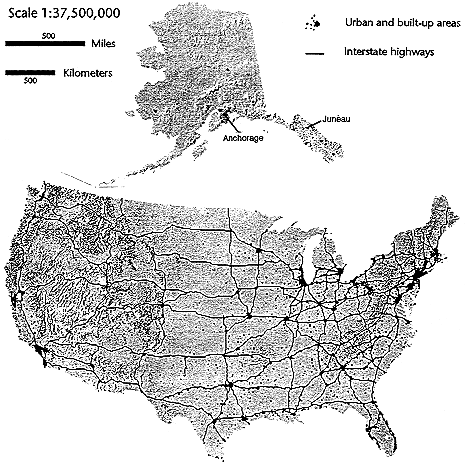
Figure I-1.
Geographic extent of Alaska and the contiguous 48 states.
Alaska that receive scheduled passenger service by major, regional, or commuter air carriers. In the other 49 states, however, the NWS produces terminal forecasts for 88 percent (462 of 524) of the airports that receive scheduled passenger service (NWS, 1994; RAA, 1995).
Satellite imagery is an indispensable tool for NWS forecasters to monitor weather conditions in remote regions where no ground-based observations are available. The availability of high-quality imagery, however, is more limited for Alaska than for other parts of the United States. Geostationary weather satellites, which orbit above the equator, do not get a good view of highlatitude areas such as Alaska. Although polar-orbiting weather satellites do provide excellent imagery of highlatitude regions, they pass overhead only once every 6 hours or so. This frequency is too low for the fast-changing weather conditions that many parts of Alaska often experience.
Even over short distances, Alaska features a variety of terrain and terrain-induced microclimates. As a result, existing weather information systems are often unable to provide accurate information on current or forecast weather conditions along low-altitude flight paths. For example, three scheduled air carriers and several air taxis provide service between the town of Dillingham and Togiak, a village located 35 miles to the north. Most of the flights are by aircraft flying under visual flight rules (VFR). Three lines of hills about 2,000 feet high separate Togiak from Dillingham. There are no communities or weather observing stations to monitor weather conditions in the two valleys between the hills. It is not unusual for low clouds to prevent pilots of VFR aircraft from flying over the hills. When that happens, they fly through lowlevel passes in each line of hills. In order to determine if weather conditions in these passes are safe, an experienced pilot is chosen to make the first flight of the day; if unacceptable weather is encountered, the pilot reverses course. Otherwise, the pilot proceeds on and reports weather conditions via radio. This type of situation is common along many of Alaska's flight paths.
The military often uses the same approach on search and rescue missions in Alaska because there generally are few sources of good information regarding flight conditions, especially during the harsh weather conditions that accompany many such missions. A C-130 is often dispatched as the lead aircraft to observe weather conditions and report back to the rescue helicopter, which is more susceptible to adverse weather.
Mountainous terrain can generate locally hazardous conditions, such as turbulence, windshear, and downdrafts, that the existing aviation weather system may not detect or predict. Pilots can prevent these conditions from causing accidents by flying at higher altitudes. However, this is not always possible with some general aviation aircraft became of icing conditions or aircraft performante limitations at high altitudes. Accidents also occur whim pilots see signs of hazardous mountain weather but fail to recognize the implied hazard or lack the piloting skills to avoid it. Options for reducing general aviation accidents in mountainous terrain include deployment of additional weather sensors, improved forecast techniques, and better training of general aviation pilots who fly in mountainous terrain (Kelley et al, 1995; Lamb and Baker, 1995).
Active volcanoes, which are present in both Alaska and Hawaii, place special requirements on aviation forecasters. Volcanic ash plumes can seriously damage aircraft that fly through them. As a result, volcanic eruptions can seriously disrupt air traffic, especially in Alaska when ash plumes intersect trans-Pacific flight routes. Fuel reserves may greatly restrict the options available to aircraft that are already in the air when eruptions occur. Became many of Alaska's 42 active volcanoes are located in remote, uninhabited areas, meteorologists must rely on satellite imagery to detect, track, and project the movement of ash plumes. In order to be effective, this means that meteorologists must be able to distinguish ash plumes from normal clouds of water vapor (Kelley et al, 1995).
Transportation Systems
The Alaskan intercity road system consists of a limited network of state roads in the eastern half of the state. Paved roads extend from Canada to Anchorage, Fairbanks, and the seaports of Seward and Valdez. There is also a gravel road to Prodhoe Bay on the North Slope. However, Alaska has no federal or interstate highways. In fact, there are no paved intercity roads of any kind in the north or west. The state capital of Juneau is also inaccessible by road from either Canada or the rest of Alaska. Mountains, permafrost, harsh weather, and environmental regulations (which were not in effect when most of the U.S. interstate highway system was built) would make it extremely difficult and expensive to expand the current road system to serve a significantly larger fraction of Alaska's communities.
Although many Alaskan towns and villages do have local roads, cars and trucks are solely for use in town. Coastal communities can import motor vehicles by barge during the summer. Otherwise, they are brought in as air freight. The manager of the Dillingham FSS reported paying about 50 cents per pound to have his new car flown in.
As already mentioned, many communities are accessible by ship during the summer. In addition, travel via snowmobile is feasible during the winter. During the spring and fall, however, 70–75 percent of Alaska's communities are completely isolated except by air. Ice
blocks ship traffic, and there is not enough snow for snowmobiles. Thus, as a matter of necessity, Alaska has developed a transportation network of small aircraft to meet the needs of its outlying towns and villages. This transportation network features an extremely atypical reliance on low-level VFR aircraft. Although adverse weather suppresses VFR flights for much of the year, activity blossoms during good (or marginal) weather to make up for lost time. During the summer months, about 95 percent of all flights in Alaska are VFR. Even if they have IFR capabilities, many small aircraft operate under VFR because most airfields do not have the IFR approaches and official weather observations that are needed for IFR operations.
In lieu of a comprehensive road system, the state of Alaska has funded the construction and maintenance of 450 airfields throughout the state. The state assumed this responsibility because local communities, which may have only a few hundred inhabitants, do not have the financial resources to construct or maintain airfields. Despite the small size of many local populations, these airfields are justified by the lack of any other transportation alternatives. The situation is analogous to small towns in the rest of the country that rely on state governments to build and maintain intercity roads.
Most of Alaska's airfields have gravel runways and very limited facilities. Only 3 of the 450 airfields are financially self-sufficient; operation of the others is a significant financial undertaking. Just keeping the airfields plowed during the winter is a big challenge—snow removal consumes 97 percent of the funds allocated for maintenance and operation of rural Alaskan airports. At present, the state of Alaska views airport maintenance and operations—not aviation weather services—as its primary focus and its most important contribution to Alaskan aviation. Alaska views aviation weather services as a federal responsibility, and it does not follow the precedent set by nine states (including Virginia, Minnesota, Wisconsin, Iowa, and Pennsylvania) that have decided to operate their own weather observation and dissemination systems.
Although the state of Alaska made six separate attempts to establish state-operated aviation weather observation and/or dissemination systems during the early 1980s, the task of installing, operating, and maintaining aviation weather facilities and equipment proved to be more challenging and costly than anticipated. Each attempt resulted in almost total failure. Ultimately, the state donated most of the navigation beacons it acquired to the FAA and local governments. In addition, most of the communications equipment purchased during these attempts was put into storage due to lack of funds. While in storage, the majority of this equipment became obsolete and is no longer suitable for installation under current rules of the Federal Communications Commission. Although the Alaska Department of Transportation and Public Facilities recognized that weather services needed to be improved in order to reduce the aviation accident rate in Alaska, these efforts had very little lasting impact on the state's aviation safety or efficiency (DOTPF, 1995).
Like the rest of the United States, Alaskan aviation depends heavily on the hub-and-spoke system. Regional air carriers provide scheduled service from the major population centers (Anchorage, Juneau, and Fairbanks) to the larger towns. Small air carriers and air taxis operate from these towns to provide service to surrounding villages. Typical seating capacity in most of the aircraft serving these villages is about six, including the pilot, and many aircraft have removable seats to facilitate a variable mix of cargo and passengers. Typical cargo varies from groceries and household goods to tools and other industrial supplies. Typical passengers include villagers going to town for the day and high school athletes flying to a neighboring town for a game.
Alaska once had over 30 traditional FSSs. The FAA is replacing these facilities with 3 centralized AFSSs and 14 part-time or seasonal FSSs. This means that pilots will be less likely to find an FSS on their flight path, especially during the winter months, when seasonal FSSs will be closed. The consolidation of the FSSs also means that fewer FSS employees live in the areas they serve; FSS employees will rotate between the AFSSs and the part-time/seasonal FSSs. This is likely to hinder the development of mutual understanding between aviators and flight service specialists regarding the difficulties and challenges that each profession faces. Rotarion of FSS employees will also make it difficult for flight service specialists to gain an in-depth understanding of the local area around each FSS.
Understanding local conditions is particularly important in areas where complex topography leads to the formation of localized updrafts and downdrafts and, hence, to the formation of complex patterns of visibility, winds, turbulence, and icing. Local flight service specialists, who are familiar with local weather patterns and topography, are more likely to be able to provide accurate, detailed guidance for these areas than flight service specialists who are stationed at an AFSS hundreds of miles away or who rotate into a seasonal FSS for only a few months.
Based on the committee's investigation of Alaskan aviation weather services, it seems that the level of services has degraded over the last 20–30 years. Part of the degradation in aviation weather services has been caused by factors beyond the control of the FAA and NWS. For example, the Department of Defense and the U.S. Coast Guard have reduced the number of sites that produce weather observations from about 80 to less than 30. There
are also far fewer oil and mineral exploration sites producing weather reports than there were at the height of Alaska's oil boom. Nonetheless, the Alaskan aviators seem to have a valid concern that changes in the FSS system are contributing to this degradation. For example, local aviators in Bethel were disappointed that their airfield, which serves as a hub for 30 outlying villages, would lose its FSS while other airports, with less air traffic, would keep theirs (as a part-time or seasonal FSS). Although the control tower at Bethel will provide an ongoing FAA presence, local users did not believe that this justified shutting down the FSS, and they had little confidence that they would receive an equal or better level of service without the FSS.
Other Elements of the Regional Infrastructure
Long distance telephone lines in Alaska are sometimes quite limited outside of major cities. As a result, contacting remote FSSs and NWS offices via long distance is chancy and time-consuming even if toll-free telephone numbers are available (as they are for calling AFSSs). For example, one committee member who was ready to travel from Anchorage to Kodiak was delayed by weather conditions in Kodiak. While waiting for his flight to depart, he visited the airline dispatcher in Anchorage. The dispatcher reported that it was difficult to contact the NWS office in Kodiak, so he obtained his weather information from the National Aviation Weather Advisory Unit in Kansas City, Missouri, and from unofficial sources in Kodiak. During the remainder of the flight delay, the committee member tried telephoning the Kodiak NWS office himself. Over a period of 1 1/2 hours, the circuit was either busy or there was no answer.
Consolidation of FSSs in Alaska will increase the impact of limited long distance telephone capabilities in remote villages by increasing the number of communities that must use long distance telephone calls to contact an FSS. This situation also affects pilots in the air because phone lines often form part of the communications link between en route pilots in remote areas of the state and FSSs.
Cultural Differences
The outlying communities of Alaska attract rugged individuals with a tendency to rely on themselves and do things their own way rather than "by the book." This attitude sometimes manifests itself in aviation, especially when pilots are confronted by a situation that offers only two options: breaking the rules or not flying. For example, many VFR pilots in Alaska tend to fly whether or not they have weather information. As already noted, in many cases adequate weather information is simply not available for their route or destination. However, even if Alaskan VFR pilots are aware of reports of adverse weather information, some of them decide to take off anyway. For many routes and destinations, available weather information is often incorrect or subject to change, so pilots may decide to see for themselves, hoping that the actual weather will be acceptable upon arrival. In addition, FSS pilot briefings for Alaska so often contain the disclaimer that VFR flight is not recommended that this warning has little credibility with most VFR pilots. The frequency of this disclaimer seems to be a reflection of uncertainties in the available aviation forecasts and the government's desire to limit its liability in weather-related crashes of VFR aircraft. However, pilots have learned that weather conditions are often acceptable despite this disclaimer and, as a result, many pilots ignore it, even when the recommendation may be warranted.
Some of the most important factors that determine the safety of a particular flight are the pilot's skill, experience, and willingness to comply with Federal Aviation Regulations, even when the pilot believes that they are overconservative. During their short stay in Alaska, committee members witnessed several instances in which pilots had to assess the weather and decide themselves whether to push the limits—and increase company revenues—or adopt a conservative course of action. The committee saw both types of responses. Because pilots often make these decisions in the air or on remote runways where company management is not in a position to directly influence their decision, air carriers and air taxis that especially value safety must take special care to select pilots who are most likely to value safety and regulatory compliance above expediency.
The Chairman of the Alaska Aviation Safety Foundation—who is a member of this committee—estimates that flight plans are fried for considerably less than one-half of general aviation flights in Alaska.2 Furthermore, between 1983 and mid-1994, there was no record of a pilot weather briefing for 67 percent of all flights that resulted in an aircraft accident (Berman, 1995).3 This situation is being exacerbated as local FSSs close or shift to seasonal or part-time status. Many pilots end up flying without obtaining weather briefings or filing flight plans rather than deal with a flight briefer in a distant FSS, especially if they have a hard time making a long distance telephone connection because the lines are busy.
Winter weather in Alaska requires frequent plowing of runways to keep them open. It is essential for ground crews to communicate with the FSS network to advise pilots on current runway conditions and warn them when plows are on the runways. Plows are often operated by local residents who speak English as a second language and tend to avoid unnecessary contact with outsiders.4 However, at many remote runways, there is no one else to report runway conditions. As a result, obtaining current and accurate information on runway conditions is often difficult. For example, the Bethel FSS worked hard to establish good relationships with runway maintenance crews in outlying villages. The closure of the Bethel FSS meant that its responsibilities would be transferred to the AFSS in Kenai, 350 miles to the east. The FSS staff at Bethel doubted that maintenance crews at local villages would effectively communicate runway conditions to the strangers in Kenai.
The harsh weather, difficulty of travel, and relative lack of creature comforts in many towns far from Anchorage discourage federal regulators and other officials from maintaining an effective presence at many remote aviation facilities in Alaska. Although some FSS staff, such as those at Bethel, argued against closing their facilities, this position was not unanimous. Other FSS staff favor consolidation of FSSs in Alaska so they will be transferred out of the outlying communities to an AFSS in a larger community. This desire to leave Alaska's remote communities seems to be a driving consideration for these individuals, and it may contribute to their sense of complacency about how well the system is actually meeting the needs of local aviators.
The FAA's standardized recruiting procedures have discouraged employment of local residents. In addition, these procedures do not include training on localized meteorological conditions for specific FSSs. Greater reliance on local residents to staff FSSs would reduce the relocation expenses that the government currently pays when outsiders are transferred to remote FSS locations. Because of the high cost of transportation in Alaska, these expenses can be substantial.
Economic Factors
Small air carriers and air taxis operating VFR flights essentially decide for themselves whether to dispatch a flight, and it is up to the pilot to determine if weather conditions en route and at the destination meet legal minimums. During periods of low ceiling and visibility, VFR operations cease and passengers and freight accumulate at airports. However, if one airline or air taxi is willing to falsely claim that minimum ceiling and visibility conditions exist, it can initiate flight operations on its own authority. This situation then faces competing air carriers and air taxis with a difficult decision: either they follow suit and operate in unsafe weather, or they lose business. Many prospective passengers are primarily interested in getting to their destination, especially if they do not know enough about the weather to determine for themselves if it is safe to fly or if they assume the government would not allow a commercial aircraft to take off in unsafe conditions. Given a choice between camping out in the airport or getting on an airplane, many passengers will choose the latter option and let the pilot worry about the weather. Furthermore, in the case of two air carriers that have contracts to deliver U.S. mail, the U.S. Postal Service will transfer mail from the airline that is waiting for legal weather to the airline that has chosen to initiate operations in violation of Federal Aviation Regulations.5 In this kind of economic environment, consistently following the rules can result in bankruptcy.
Individual committee members participated in three flights that took off when reported weather conditions en route or at the destination were either marginal or below the minimum ceiling and visibility required to land. The economic imperatives were so strong that in each case the operators decided that the risk of having to turn back (if weather failed to improve) was worth the chance to complete the flight (if the weather did improve). In all three cases, the flights were completed. However, in one case, the committee member onboard—an experienced pilot—did not necessarily agree that weather conditions were consistently above required minimums. The pilot of this VFR flight almost turned back because of the low ceiling–approximately 500 feet—but he decided to proceed when a pilot ahead of him assured him that weather conditions were satisfactory.
In another case, an airline station manager tried for 2 hours to decide if the weather at the destination airport was satisfactory. Weather conditions at the originating
airfield were free, but his agent reported low clouds and haze at the destination, and the Automated Weather Observing System (AWOS) at the destination reported marginal and worsening visibility. He finally decided to dispatch a flight when his agent reported that a competitor had just landed. It turned out that the weather was excellent throughout the flight, except in the immediate vicinity of the destination, but the station manager had no way to determine en route weather or verify conditions at the destination without dispatching a plane to find out. He could not count on receiving a weather report from the pilot of the competing airline. Even though pilot reports are often the best—or only—source of weather information en route and at outlying destinations, the intense competition evident in the aviation industry serving many local villages discourages public distribution of pilot reports. Commercial pilots tend to radio weather conditions back to their company offices, and this information is not usually distributed to FSSs or other companies.
Although air carriers sometimes train and certify weather observers at their own expense and station them at larger airports to augment weather observations that are otherwise available, each airline tends not to distribute its observations to other air carriers because of competitive pressures and liability concerns. Air carriers want to insulate themselves from any possible liability for weather-related accidents that another airline might experience.
Obtaining up-to-date observations from automated weather stations via telephone is discouraged by the cost of making long distance telephone calls. The station manager for one small airline claimed it had the largest telephone bill in Alaska, largely because of its frequent calls to automated weather stations. He was glad to have an AWOS unit available at one of the air fields he served, and he would like to see AWOS or Automated Surface Observing System (ASOS) units installed at more locations. However, he did not consider calling the local FSS or a central AFSS, which has a toll-free telephone number, to be a timely or effective means for obtaining comprehensive and up-to-date observations from automated weather stations.
Regulatory Factors
Aircraft accidents impact the public, the aviation community, and the FAA. The FAA sometimes increases regulatory enforcement in response to an increase in aircraft accidents. Some Alaskan aviators report that enforcement, however, often seems to focus more on auditing the quality and completeness of airline records rather than the more important but harder-to-address issue of how to prevent VFR pilots from using unsafe practices such as failing to file flight plans or flying below minimum conditions of ceiling and visibility. Unfortunately, it is virtually impossible to legally prove that pilots are flying in conditions below minimums. Even when other pilots or FSS staff observe a VFR pilot taking off into a low ceiling, the offending pilot can claim that he encountered a small break in the clouds that allowed him to depart legally. In fact, some pilots have a reputation for this behavior. If they operate as independent air taxis, there is no corporate authority to restrain such behavior. As already discussed, the inability to enforce regulations effectively means that small air carriers and air taxis that do follow the rules are likely to suffer economically.
Regulations also discourage conscientious pilots who encounter low ceilings or visibility from reporting those conditions accurately. If they do, it is possible for the FAA to impose sanctions for flying below minimums, even for the short time it takes to reverse course or otherwise exit the unsafe condition. Although the FAA does not usually impose sanctions in these situations, making an accurate report places a pilot's license and livelihood in the hands of the FAA and requires a level of trust that sometimes does not exist.
FAA and NWS Organization and Operations
The FAA is highly centralized, and regional FAA administrators have no authority to develop and implement regional solutions to regional concerns. None of the FAA personnel who work at the regional offices reports to the regional administrator except for the administrative and logistics staff. The air traffic services, regulatory, and other professional staff report directly to FAA headquarters. Regional administrators must rely on the cooperation of these staff members if they desire to address regional problems. Regional administrators themselves report to the Associate Administrator for Administration, who is also responsible for budget, accounting, and human resources. Key FAA functions such as air traffic services, regulation and certification, and research and acquisitions are the responsibility of other associate administrators. Although the FAA's centralized organization helps to ensure that FAA policies are uniform throughout the United States, it complicates the process of addressing regional issues. No one below the level of the FAA Administrator has the authority to force resolution of differences that may exist between the staffs of different associate administrators.
Standardization allows procedures developed for and lessons learned in one facility to be adopted immediately throughout the system. Standardization also greatly simplifies the oversight and inspection process. However, a high degree of standardization limits the ability to adapt to varying regional or local conditions, raises costs by pro-
viding features where they may not be needed, and limits experimentation and innovation (DOT, 1994).
It seems that some aspects of the federal aviation weather system in Alaska are driven more by budgetary considerations than the desire to maximize the safety and efficiency of Alaskan aviation. In some cases, the government has initiated system improvements reluctantly, only after repeated criticism by users, rather than as a result of its own initiative. This is especially true with regard to the location and performance specifications of automated weather systems. In some cases, the FAA has sited AWOS and ASOS units based more on the availability of electrical power and telephone service than on operational aviation or meteorological considerations, and users sometimes have had difficulty in locating (or relocating) ASOS units to provide observations that accurately depict conditions at the location of interest (e.g., the airport runway and approach). Also, as discussed in Appendix E, the NWS stopped commissioning its ASOS units for several months during late 1994 and early 1995 to correct deficiencies in installed units and improve the ability of the NWS logistics system to supply spare parts and complete ASOS repairs in a timely fashion. In addition, the FAA stopped commissioning its ASOS units during 1995 in response to concerns expressed by air traffic controllers about ASOS performance.
The Alaska Regional Office of the NWS, on the other hand, has shown commendable initiative with regard to upgrading aviation weather services. Most significantly, the office is in the process of developing an Alaskan Aviation Weather Unit that, when fully implemented in January 1996, will provide a full-time meteorological center to support Alaskan aviation. The Alaska Regional Office is coordinating the development of this unit with the National Aviation Weather Advisory Unit in Kansas City, Missouri. The Alaskan Aviation Weather Unit will generate weather products that the NWS has not previously generated for Alaska. The Alaska Regional Office plans to deliver these products to FSSs and to NWS offices.
Impact of Regional Variability on the Level of Available Information
The overall impact of Alaska's regional variability in environmental conditions and user needs is significant. Simply put, in many cases the national aviation weather system is not capable of providing individual pilots and other users in Alaska with the same level of weather information that pilots generally receive in the contiguous 48 states. This is particularly true for VFR flight operations, which include many small, scheduled air carriers and air taxis that provide the only means of public transportation to most of Alaska's communities.
In many respects, IFR operations in Alaska are no different than elsewhere in the United States. Major airports in Alaska have excellent radio navigation and weather reporting systems to support IFR operations during takeoff and landing. En route, IFR aircraft typically fly at high altitudes, so they are unaffected by low-altitude weather conditions. (The major exception, as previously noted, is the prevalence of freezing levels at or below 7,000 feet. This often prevents small aircraft that are susceptible to icing from flying above the weather, even if they are instrumented for IFR flight operations.) However, there is sometimes an imbalance between aviation weather and navigation systems. Air carriers find it necessary to supplement federal aviation weather services by providing their own certified weather observers at some airports—including the state capital of Juneau—where the level of economic activity justifies the additional expense. This remedy is not economically feasible for air fields at small communities that have radio navigation systems but lack the certified weather observations needed to satisfy regulatory requirements for IFR flight operations. As a result, the radio navigation systems at these airfields are of minimal utility.
As already noted, many regions of Alaska experience rapidly changing weather patterns. FSSs typically were built at airports with unobstructed views of the runway. This helped mitigate the impact of changes in the weather, especially at airports with no control towers. However, FSSs are closing at many airports. It will be difficult for remote AFSSs to provide the same level of detailed, upto-date information previously supplied by FSSs.
Most of the small villages in Alaska have no certified weather observations (from human observers or automated systems). As a result, the air carriers and air taxis that service these destinations have established informal sources for weather information to help them decide if the weather conditions (e.g., ceiling and visibility) at the destination will allow a safe landing. Each operator typically uses its own local business agents to provide this information. Because most of these observations are produced by untrained observers working without instruments, there is a good deal of variability between the observations reported by different operators. During marginal weather conditions, the level of variability may be enhanced if one operator's business agent is especially eager for a flight to get through. Agents sometimes report that visibility, ceiling, or runway condition are better than they really are if they are waiting for delivery of a paycheck, relative, or shipment of groceries that may have been sitting in an airport for several days waiting for the weather to clear.
As noted in Appendix E (page 83), ''FAA policy is that the performance of combined automated systems must be equal to or better than manual observation capability'' (FAA, 1994). However, Alaskan aviators—like many aviators in the rest of the United States—generally view automated observations as a poor substitute for human observations. Currently available automated surface weather observing systems (i.e., AWOS and ASOS) cannot accurately describe some meteorological conditions of interest to aviators. ASOS, which is more advanced than AWOS, cannot detect or report the presence of weather phenomena such as thunderstorms, hail, volcanic ash, snow fall, snow accumulation, or ground fog (NOAA, 1993). ASOS and AWOS also cannot distinguish localized or directional weather conditions. For example, automated systems sometimes report clear visibility if visibility overhead is clear, even though horizontal visibility along the ground (from blowing snow) is almost zero. These systems also cannot characterize specific conditions over airport approaches: they cannot report that ceiling and visibility are adequate to approach a runway from one direction, but low clouds are obscuring the approach from the other direction. The same situation occurs in mountain passes, where pilots need specific information about weather conditions along the flight path. In these situations, having an untrained human observer can be more valuable than having an automated system.
Automated systems have a reputation for unreliability and inaccuracy among many users interviewed by the committee, and the committee encountered some NWS staff at Alaskan field offices who shared this assessment. Furthermore, there is usually no way for individual users to determine the accuracy of individual readings, so users end up questioning the accuracy of virtually all automated observations. During its stay in Alaska, the committee encountered several local users, including an NWS meteorologist, who reported their personal frustration with automated observing systems that generated ceiling, visibility, and/or wind speed readings that were inconsistent with visual observations. For example, aviation weather users in Bethel noted that the AWOS unit at Hooper Bay suffered from a dirty lens. This unit would report visibility of 0.75 miles, even though actual visibility exceeded 10 miles. The automated station at St. Marys was also malfunctioning—a committee member verified that telephoning the St. Marys station was useless because the audio report was unintelligible. Another committee member observed the AWOS unit in Barrow produced wind readings that varied by as much as 20 miles per hour from NWS readings taken with traditional weather-station observing equipment. This unit also reported several cloud layers when the observed sky was clear. Based on their past experience, local users did not expect these problems to be corrected in a timely fashion.
Despite such problems, users generally do believe the trends shown by automated stations. During marginal weather, a dispatcher may telephone the destination's automated weather station every few minutes to assess ceiling and visibility trends while talking to the agent at the destination to get a human perspective.
Also, users value automated systems that have been installed at locations that previously offered no weather observations. These systems are a valuable source of basic data such as temperature, altimeter settings, and wind speed and direction, and they produce official weather reports to meet regulatory requirements for IFR operations.
Options for Improving Regional Services
Most of the unmet needs of Alaska users of aviation weather services concern the observation and dissemination of weather information. Options for improving observations and dissemination are listed in the following sections. Each of these options has advantages and disadvantages. None, by itself, will fully respond to current needs. Chapter 5 discusses a process by which the FAA can take the lead in working with the NWS, responsible federal and state government agencies, the aviation industry, airport operators, pilots' professional organizations, and local communities to agree on an appropriate plan of action.
Weather Observations
In remote and mountainous regions, the primary operational weather need is for more low-level en route and terminal weather observations and forecasts. Options for increasing the availability of certified weather observations in Alaska and other regions with special needs include the following:
- Increase the role that states play in providing weather observations.
- Train more certified human observers. Possible sources include airport maintenance workers, resident airport managers, Air National Guard units, state patrol offices, emergency medical technician units, village public safety officers, or other local village residents. It might also be feasible to set up a volunteer organization modeled after volunteer fire departments to provide this service.
- Establish one or more classifications of weather observers who would be trained and certified to provide partial weather observations (see Chapter 3, page 24). These observers would be able to provide
- essential information such as ceiling, visibility, temperature, barometric pressure, runway condition (at airport locations), and precipitation.
- Establish a network of informal weather observers. Uncertified observers could make "ground reports" just as pilots, who are generally not certified to make official weather observations, currently make pilot reports.
- Make better use of NWS staff, tower controllers, and flight service specialists assigned to airfields in remote locations. At locations where the workload does not justify the existence of a separate NWS field office, airport tower, and FSS, it may be feasible to establish a joint office with a multidisciplinary staff to provide a mix of services tailored to the needs of the local community.
- Increase the use of local residents as weather observers and flight service specialists. Local residents are familiar with local weather patterns, and they do not feel as isolated from the outside world as many outsiders do when they are transferred to remote duty stations.
- As an alternative to maintaining the few remaining FSSs in outlying areas, implement a more-numerous system of mini-FSSs modeled after the Community Aerodrome Radio Stations that Canada operates in northem Canada to take weather observations, file local airport advisories, provide en route weather information, and pass en route position reports. These stations also offer walk-in weather information and flight planning services. They do not provide formal pilot briefings or file flight plans, but these services are available by phoning the nearest FSS. The stations are contractor-operated facilities, which reduces their costs, and many of them are staffed by local residents who are formally trained and certified as weather observers and radio operators.
- Extend the hours that contract observers make observations.
- Encourage better use and reporting of pilot reports by general aviation and scheduled air carrier pilots, perhaps by implementing an incentive program.
- Implement a system of collecting synoptic weather observations from air carrier pilots on selected routes.
- Pass a "good Samaritan" law at the state level to absolve from liability individuals who provide informal weather observations in good faith.
- Install more automated weather observing units. For example, current plans call for installing AWOS and ASOS units at 100 sites in Alaska. However, most of the state's 450 airfields will still lack automated (or human) certified weather observations.
- Augment ASOS and AWOS units at selected destinations and key en route points with video cameras to provide flight service specialists, pilots, and flight dispatchers in local communities with an up-to-date view of the observation site. This would enable remote users of automated observing systems to examine the location, extent, direction of motion, and type of cloud conditions in the vicinity of the observing site. Video cameras would also allow users to validate the objective data produced by automated weather stations subjectively.6
- Establish a system to repair automated weather observing units more quickly when they malfunction, and, if immediate repair is impossible, to allow manual observations to override the automated system until repairs can be made.
Dissemination
The efficient dissemination of accurate weather information is also a key concern in regions with special needs, especially for VFR pilots. Options to improve dissemination include the following:
- Maximize radio and television broadcasting of aviation weather programs produced by local public television stations.
- Increase the number of radio navigation beacons that transmit transcribed aviation weather information.
- Establish a system of wide-coverage VHF repeaters to disseminate transcribed aviation weather information.
- Establish a dedicated weather broadcast network to relieve the demand on FSS operators for weather information and provide preflight weather information via handheld aviation transceivers.
- Establish a broad-area satellite radio broadcast to transmit current weather information.
- Routinely distribute relevant weather maps by telefax, especially to airline and air taxi dispatchers in outlying areas.
- Distribute high-quality satellite imagery received by the NWS to FSSs and other users to make appropriate use of this resource.
- Reprogram dissemination systems to retain and report data, including pilot reports, long enough for users to determine trends en route and at their destinations. For some remote regions, it may be prudent to retain data for extended periods of time (with the caveat that it may be out of date) rather than to dump old data as soon as it exceeds a preset retention period. Routine purging of data may make sense in a data-rich environment, but it can be counterproductive in regions where the primary source of information is unscheduled observations, such as pilot reports.
In the Alaskan aviation community, hand-held VHF aviation transceivers are more common than modem-equipped computers. Thus, in regions such as Alaska, information dissemination schemes that rely on radio transmissions are more likely to be widely useful than computer-based systems such as the Direct User Access Terminal Service.
References
Berman, B. 1995. Personal communication from Benjamin A. Berman, National Transportation Safety Board, to Alan Angleman, January 18, 1995.
DOT (Department of Transportation). 1994. Air Traffic Control Corporation Study—Report of the Executive Oversight Committee to the Department of Transportation. Washington, D.C.: DOT.
DOTPF (Alaska Department of Transportation and Public Facilities). 1995. White Paper on Weather by the State Aviation Weather Station Program.
FAA (Federal Aviation Administration). 1994. Aviation Weather System Plan. Washington, D.C.: FAA.
Kelley, H., et al. 1995. Operations and research utilizing polar satellite data for airborne volcanic ash discrimination. Pp. 98–100 in Sixth Conference on Aviation Weather Systems, held January 15–20, 1995 in Dallas, Texas. Boston: American Meteorological Society.
Lamb, M., and S. Baker. 1995. Flight hazards of microscale mountain weather. Pp. 128–129 in Sixth Conference on Aviation Weather Systems, held January 15–20, 1995 in Dallas, Texas. Boston: American Meteorological Society.
NOAA (National Oceanic and Atmospheric Administration). 1993. Automated Surface Observing System Guide for Pilots. Washington, D.C.: NOAA.
NWS (National Weather Service). 1994. Weather Service Operations Manual. Chapter D-21, Aviation Terminal Forecasts. July 11, 1994. Silver Spring, MD: NWS.
RAA (Regional Airline Association). 1995. 1995 Annual Report of the Regional Airline Association. Washington, D.C.: RAA.


