




Below is the uncorrected machine-read text of this chapter, intended to provide our own search engines and external engines with highly rich, chapter-representative searchable text of each book. Because it is UNCORRECTED material, please consider the following text as a useful but insufficient proxy for the authoritative book pages.
ALLOCATING FEDERAL FUNDS FOR SCIENCE AND TECHNOLOGY Committee on Criteria for Federal Support of Research and Development National Academy of Sciences National Academy of Engineering Institute of Medicine National Research Council NATIONAL ACADEMY PRESS Washington, D.C. 1995 i
NOTICE: The project that is the subject of this report was approved by the Governing Board of the National Research Council, whose members are drawn from the councils of the National Academy of Sciences, the National Academy of Engineering, and the Institute of Medicine. The members of the committee responsible for the report were chosen for their special competences and with regard for appropriate balance. This report has been reviewed by a group other than the authors according to procedures approved by a Report Review Committee consisting of members of the National Academy of Sciences, the National Academy of Engineering, and the Institute of Medicine. The National Academy of Sciences is a private, nonprofit, self-perpetuating society of distin- guished scholars engaged in scientific and engineering research, dedicated to the furtherance of science and technology and to their use for the general welfare. Upon the authority of the charter granted to it by the Congress in 1863, the Academy has a mandate that requires it to advise the federal government on scientific and technical matters. Dr. Bruce Alberts is president of the National Academy of Sciences. The National Academy of Engineering was established in 1964, under the charter of the National Academy of Sciences, as a parallel organization of outstanding engineers. It is autonomous in its adminis- tration and in the selection of its members, sharing with the National Academy of Sciences the responsibil- ity for advising the federal government. The National Academy of Engineering also sponsors engineering programs aimed at meeting national needs, encourages education and research, and recognizes the superior achievements of engineers. Dr. Harold Liebowitz is president of the National Academy of Engineering. The Institute of Medicine was established in 1970 by the National Academy of Sciences to secure the services of eminent members of appropriate professions in the examination of policy matters pertaining to the health of the public. The Institute acts under the responsibility given to the National Academy of Sciences by its congressional charter to be an adviser to the federal government and, upon its own initiative, to identify issues of medical care, research, and education. Dr. Kenneth I. Shine is presi- dent of the Institute of Medicine. The National Research Council was established by the National Academy of Sciences in 1916 to associate the broad community of science and technology with the Academyâs purposes of furthering knowledge and advising the federal government. Functioning in accordance with general policies determined by the Academy, the Council has become the principal operating agency of both the National Academy of Sciences and the National Academy of Engineering in providing services to the government, the public, and the scientific and engineering communities. The Council is administered jointly by both Academies and the Institute of Medicine. Dr. Bruce Alberts and Dr. Harold Liebowitz are chairman and vice chairman, respectively, of the National Research Council. Support for this project was provided by the Department of Defense (under Contract No. N00014-95-C-0314), the National Institutes of Health (under Contract No. N01-OD-4-2139, Task Order #4), the National Science Foundation (under Grant No. OPS-9528889), and the Basic Science Fund of the National Academy of Sciences. Any opinions, findings, and conclusions or recommendations expressed in this material are those of the authors and do not necessarily reflect the views of the National Science Foundation. Library of Congress Catalog Card Number 95-71602 International Standard Book Number 0-309-05347-1 Additional copies of this report are available from: National Academy Press 2101 Constitution Avenue, NW Box 285 Washington, DC 20055 800-624-6242 202-334-3313 (in the Washington Metropolitan Area) B-680 Copyright 1995 by the National Academy of Sciences. All rights reserved. Printed in the United States of America
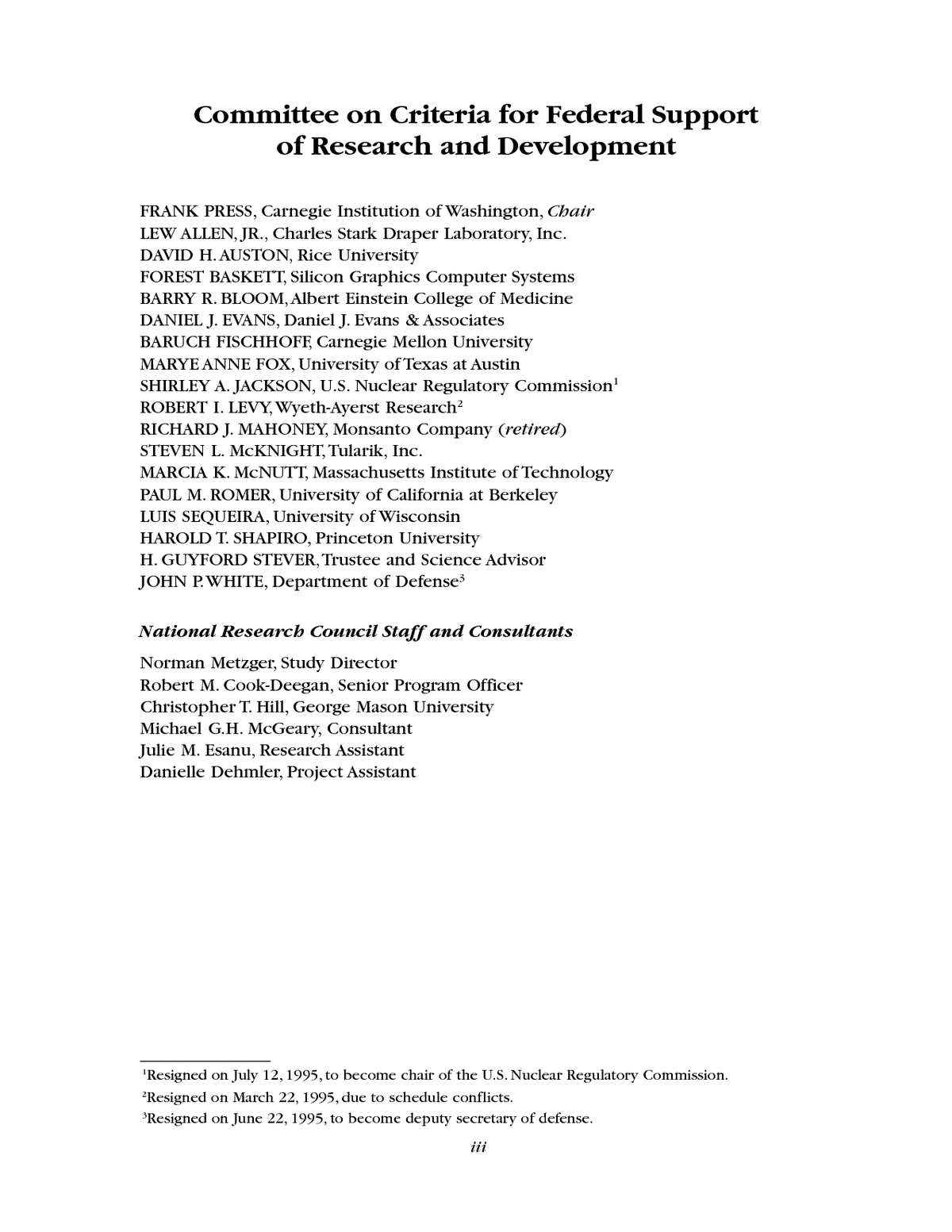
Committee on Criteria for Federal Support of Research and Development FRANK PRESS, Carnegie Institution of Washington, Chair LEW ALLEN, JR., Charles Stark Draper Laboratory, Inc. DAVID H. AUSTON, Rice University FOREST BASKETT, Silicon Graphics Computer Systems BARRY R. BLOOM, Albert Einstein College of Medicine DANIEL J. EVANS, Daniel J. Evans & Associates BARUCH FISCHHOFF, Carnegie Mellon University MARYE ANNE FOX, University of Texas at Austin SHIRLEY A. JACKSON, U.S. Nuclear Regulatory Commission1 ROBERT I. LEVY, Wyeth-Ayerst Research2 RICHARD J. MAHONEY, Monsanto Company (retired) STEVEN L. McKNIGHT, Tularik, Inc. MARCIA K. McNUTT, Massachusetts Institute of Technology PAUL M. ROMER, University of California at Berkeley LUIS SEQUEIRA, University of Wisconsin HAROLD T. SHAPIRO, Princeton University H. GUYFORD STEVER, Trustee and Science Advisor JOHN P. WHITE, Department of Defense3 National Research Council Staff and Consultants Norman Metzger, Study Director Robert M. Cook-Deegan, Senior Program Officer Christopher T. Hill, George Mason University Michael G.H. McGeary, Consultant Julie M. Esanu, Research Assistant Danielle Dehmler, Project Assistant 1 Resigned on July 12, 1995, to become chair of the U.S. Nuclear Regulatory Commission. 2 Resigned on March 22, 1995, due to schedule conflicts. 3 Resigned on June 22, 1995, to become deputy secretary of defense. iii
Preface In a report accompanying funding for the National Institutes of Health for Fiscal Year 1995, the Senate Appropriations Committee requested a study from the National Academy of Sciences, the National Academy of Engineering, and the Insti- tute of Medicine. The study was to address âthe criteria that should be used in judging the appropriate allocation of funds to research and development activities, the appropriate balance among different types of institutions that conduct such research, and the means of assuring continued objectivity in the allocation process.â The study originated from the Appropriations Committeeâs concern âthat at a time when there is much opportunity to understand and cure disease, funding for health research supported by NIH in the next fiscal year is held to below the inflation rate for medical research due to budget constraints. Similarly, other Federal research agencies are confronted with constrained resources resulting from the virtual freeze in discretionary outlays.â The charge was daunting when it was requested by the Appropriations Com- mittee and is even more so now. With a yearâs passage, the concern with a âvirtual freeze in discretionary outlaysâ seems an understatement. The efforts by both the Administration and the Congress to reduce the federal deficit have prompted pro- posals to cut programs, consolidate or abolish agencies, and even do away with whole departments. The federal research and development enterprise has not been exempt from examination, nor should it be. Since the end of World War II, this enterprise has become vast and complex, and it accounts for a significant part of the discretionary outlays of the federal government. It is thus important that the nature and structure of federal support for research and development, as well as the ben- efits it brings, be understood to assure that as budgets are reduced, the strengths of U.S. science and technology are maintained, while the anachronistic or weak as- pects are pruned. The Committee on Criteria for Federal Support of Research and Development approached its task with realism about the budget pressures, an eagerness to pro- vide advice that could guide both the Executive Branch and Congress, and a con- cern for fairness in evaluating the many parts of the enterprise. The committeeâs membership reflected these aims, including individuals who perform federally funded research, who use the results in industry and other sectors, who have been involved in shaping federal research and development programs in the past, and who are students of the research and development enterprise. The committeeâs realism about budget pressures was matched by its realism about the reportâs immediate impact on current budgets. It is the committeeâs hope that this report will serve well both the executive and legislative branches as they grapple with the very hard decisions that will have to be made over many budget cycles, in a politically and fiscally difficult environment. The theme of the committeeâs report is continuance in the face of change. Continuance builds on the spectacularly successful results of postwar federal invest- v
vi / PREFACE ments in research and development. By any measure, these investments have been recouped many times over in contributing to a strong and globally competitive U.S. economy, hastening the end of the Cold War, providing continuing national security against new enemies, advancing the fight against disease, improving our environ- ment, and producing revelations about ourselves, our world, and our cosmos. Change comes in acknowledging that the federal research and development enter- prise must adapt to a new world. The Cold War is over. Global competition is both economic and military, involving many more nations than did the past bipolar confrontation of nuclear superpowers. These problems create opportunities. In- deed, science and technology will be even more important in the future than they are today. Change is also reflected in the very doing of science, as computers and high-speed communication networks expand access to databases and facilities throughout the world and enable daily collaboration among scientists and engineers separated by great distances. Over time, institutions and programs have been created that no longer serve us well. Even good programs and institutions must give way to successors that are better and are more closely linked to new national needs. These are painful mes- sages. Some of the committeeâs members have built their professional lives through programs and institutions that may not survive application of the principles the committee proposes for judging future expenditures. At the same time, the commit- tee believes strongly that failure to make these choices will prove costly, serving neither the nation nor the scientific community. That said, the committee appreci- ates that its principles for judging programs and institutions are, by necessity, gen- eral and must be given more specificity when applied to particular programs and institutions. As a practical matter, the committee did not offer specific details for implementing the judgments that must be made. The committee believes that those who must make the decisions and execute them should be given the latitude to apply these principles sensibly. The report is short, and deliberately so. Part I offers the committeeâs recom- mendations, with sufficient elaboration to enable readers to understand them. The four supplements included in Part II give details underlying the recommendations. These supplements are not mere appendixes, but provide background critical to understanding this brief report. For example, Supplement 2 shows how the com- mittee derived a new budget index it calls federal science and technology (FS&T). The committee believes that these federal funds best define the public investment in the science and technology base that is essential for maintaining U.S. health, pros- perity, and security. In addition to the facts and analyses provided in the supplements, the commit- tee relied on other means for arriving at its judgments, including more than 35 letters received from individuals in leadership positions in industry, academia, and scientific societies; a number of outreach meetings held around the country; several commissioned papers; communications through an Internet home page; briefings by senior government officials whose agencies are collectively responsible for most of the federal research and development budget; and discussions with many indi- viduals in the Administration and Congress. The committee is grateful to all who took the time to provide assistance and in doing so not only tutored us, but also showed their concern for the future of the U.S. research and development enter- vi
PREFACE / vii prise. The individuals who assisted the committee and the background papers prepared for it are acknowledged in Appendixes C and D, respectively. Some will think it politically unwise that we recommend a process and guidelines for identifying activities that can be reduced or eliminated and for reallocating the savings to ones more essential to preserving U.S. leadership in science and technology. We have been told that our advice will be only partially followedâthat the cuts will be made but that the savings will not be reallocated to federal science and technology. Perhaps. But we see no alternative. We can only hope that the case we have made is convincing, and trust that our recommen- dations to maintain U.S. strength in science and technology will be accepted. The committee believes that the political wisdom that created the remarkably successful U.S. research and development enterprise will endure, driven by the U.S. publicâs strong and abiding support for federal science and technology. This report results from the work of many people. I especially thank the committee itself. It had what some believed a near-impossible task. Whether it succeeded is for others to judge. I shall always be grateful to these extraordinarily accomplished and able people for the care, intelligence, and above all the time they gave to wise and experienced judgments about a federal role that is so vital to the nationâs future. Finally, I know I speak for all the committee members in acknowl- edging our indebtedness to the staffâconsummate professionals who know as much about science policy issues as any in Washington, and without whose partici- pation the report would be much diminished. Frank Press Chair Committee on Criteria for Federal Support of Research and Development vii
Contents Part IâImproving the Allocation Process for Federal Science and Technology Determining Principles for Allocating Federal Funds 3 Conclusions, Recommendations, and Discussion 8 Looking to the Future 30 Endnotes 32 Part IIâSupplements: Background and Rationale 1 The Evolution and Impact of Federal Government Support for R&D in Broad Outline 41 2 Federal Funds for R&D and FS&T 51 3 Current Processes for Allocating Federal R&D Funds 62 4 Interactions Between Federal and Industrial Funding and the Relationship Between Basic and Applied Research 70 Endnotes 82 Appendixes A Senate Report Language for the Prospective Study 87 B Committee and Staff Biographical Information 88 C Acknowledgments 93 D List of Commissioned Background Papers 95 E Acronyms 96 ix
