
3—
Programs to Increase the Technological Competitiveness of U.S. Shipyards
Introduction
This chapter assesses current and proposed programs that invest in ship design and production-related research and identifies appropriate changes that might improve contributions to an internationally competitive U.S. shipbuilding industry. Federal programs to aid the U.S. shipbuilding industry can be classified as either financial or technological. Historically, financial programs, such as subsidies for construction, have been the principal means of helping U.S. commercial shipbuilders compete with foreign firms. In the early 1980s, however, such programs were cancelled by President Reagan, and emphasis was given by the administration and the yards to reinvigorating the U.S. Navy fleet. As of 1994, U.S. shipbuilding firms had not contracted for an oceangoing vessel for world commerce in more than a decade. Most shipbuilding research had been funded by the Navy, and it addressed issues unique to naval ships. Within the past two years, with declining defense budgets, U.S. government assistance to the industry has taken the form of government-industry R&D partnerships. (Chapter 1 outlined the history of U.S. government shipbuilding assistance programs in greater detail.)
This chapter evaluates selected recent and proposed federal and joint government-industry programs:1 ARPA's MARITECH program, Technology
Reinvestment Project (TRP), and Simulation-Based Design (SBD) program; the NSRP program; the Navy Manufacturing Technology Program (MANTECH) and its spinoff, the Navy Best Manufacturing Practices (BMP) program; the Naval Sea Systems Command's (NAVSEA) Sealift Ship Technology Development Program and Affordability Through Commonality program; the ONR Surface Ship Technology Program; standards activities, including those of the American Society for Testing and Materials (ASTM) and the ISO; and the MARAD National Maritime Resource and Education Center. Information about these programs was provided through written documentation, briefings from program managers and others, and the experience of committee members. Of these programs, only MARITECH is specifically intended to assist U.S. shipbuilders in becoming internationally competitive. However, the committee assessed all related programs to determine the extent to which they contribute toward that objective. The principal objective of the committee's assessment of the programs was to look at their overall objectives and their intended results. A detailed program review of the actual performance of the programs toward achieving stated goals was not made. The question asked was "If the programs met their goals, would they make a difference?" (Appendix D further details these programs.)
As chapters 1 and 2 showed, the challenge to shipbuilders will be substantial for the next decade. For the next five to ten years, U.S. shipbuilders will almost certainly lag behind foreign world-class competitors on the combined basis of overall cost, material availability, and delivery schedule because of the great differences between the methods and circumstances of foreign and U.S. shipbuilders.
Chapter 2 concluded that for U.S. shipbuilders to become commercially viable on a cost basis their business processes must be changed, including marketing, bidding and estimating, sourcing, and management systems. Labor forces will also need to be reduced under any likely forecast. Additional investments will be needed in system technologies, production processes, and product design. In some cases, significant capital investments will be needed to improve efficiency. Table 2-2 summarized these findings for each of the four technology categories important to the commercial competitiveness of U.S. industry.
The following sections assess shipbuilding assistance programs. Each program is considered for implications in the four technology areas shown in Table 2-2. Care has been taken in the evaluation to consider program goals and accomplishments in view of the mission and structure of each program. Some of the programs covered below are strongly oriented to defense applications, some seek secondarily to achieve commercial benefits (e.g., via a dual-use orientation), and some are targeted specifically at commercial advances. These differences are appropriately taken into account.
Maritime Systems Technology and the Technology Reinvestment Project
In March of 1993, President Clinton announced a new set of technology initiatives to integrate defense and commercial industrial bases in the post-Cold War era. The TRP was to be the primary vehicle for promoting dual-use technologies to pursue this goal. TRP is overseen by the Department of Defense's ARPA, although most of the contract awards are administered by other government agencies, both within and outside the Department of Defense. TRP awards were to be made on a competitive basis and were to target a set of technology areas that would change each year. In the first competition, TRP focus areas included shipbuilding, and of the 212 awards totaling $470 million, two (representing a total of $23.7 million) were made to shipbuilding.
The MARITECH program, begun in 1993, is structured much like TRP but is aimed exclusively at shipbuilding. MARITECH is funded separately from the main TRP program. The program has as an independent focus area with its own line item in the federal budget. MARITECH funding was $30 million in fiscal year 1994 and $40 million in 1995; the administration has called for $50 million per year for fiscal years 1996 to 1998.
MARITECH and TRP projects are innovative public-private partnerships. They have several critical characteristics:
- They fund technology applications and demonstrations that are expected to find commercial uses within two to five years after completion. Development of new technology applications and transfer of foreign know-how to U.S. yards are both encouraged.
- They are based on government-industry collaboration, and at least one-half of a project's resources must come from the private-sector partner. There is duplication of effort (up to five teams in the overlapping area of 40,000-DWT tanker design), and the immediate effort is to help individual teams, not the overall shipbuilding industry.
- Funding is awarded based on an open competition that is outside the FAR process and can use new government agreements that allow flexibility in "contracting" to reduce the complexity of the program. This strategy also allows key information developed to remain proprietary.
- They require that proposal teams be vertical alliances of shipbuilders and other interested industrial partners.
As of March 1995, the TRP and MARITECH programs together have awarded $49.5 million in funds for 22 separate projects that are applicable to shipbuilding. Money was awarded to the teams—which usually included one U.S. shipyard—that were "most effective in identifying a real market need, an innovative design concept to service that market, and a competitive approach for the detailed design and construction process that could be implemented in the near
TABLE 3-1 MARITECH and TRP Projects, by Primary Technology Area
|
|
Business Process Technologies |
System Technologies |
Production Process Technologies |
Product Technologies |
Other |
|
Number of projects addressing the technology area |
2 |
1 |
2 |
17 |
0 |
|
Dollar value of projects ($1,000) |
$4,600 |
$1,600 |
$14,500 |
$28,800 |
$0 |
|
(% of total dollars) |
9% |
3% |
29% |
58% |
0% |
term.'' The cost-match from private-sector participants allowed the inclusion of in-kind contributions, so the overall cash outlays the programs represent are actually twice their reported dollar amount. The first MARITECH projects were completed in the fall of 1995.
Table 3-1 and 3-2 show how the 22 TRP and MARITECH projects address the four technology areas examined in Chapter 2. Table 3-1 shows the projects by primary technology area, and Table 3-2 illustrates the degree to which projects may have more than one technology-area goal. Thus, in Table 3-2, projects are counted in more than category, as appropriate, and the dollar values for individual projects are distributed among the various technology areas they address, according to available project documentation.
Although MARITECH is quite young, several observations can already be made about its approach. First, MARITECH is funded at a scale significant enough to make a genuine contribution to the industry's development if the program is well designed and carried out. Second, MARITECH is directed at areas that the committee believes have some commercial importance, including the area of business processes and technologies. Even those projects that address product technologies have the purpose of ship design for marketing rather than for development of enhanced system capabilities. MARITECH also supports the teaming of experienced foreign yards and U.S. yards. This should allow the transfer of valuable experience to U.S. builders, for example, with regard to doing business with worldwide suppliers. Finally, MARITECH encourages industry investment and other market-shaped industry activities. In short, MARITECH appears to be well designed to support other government and private efforts to help the U.S. shipbuilding industry reenter the international commercial market.
The program is structured so that shipbuilders invest as much in the program as the government does in anticipation that, because they are spending their own funds, shipbuilders will only do work important to them and that they will
TABLE 3-2 MARITECH and TRP Projects, by Both Primary and Secondary Technology Areas
|
|
Business Process Technologies |
System Technologies |
Production Process Technologies |
Product Technologies |
Other |
|
Number of projects addressing the technology areaa |
8 |
6 |
6 |
20 |
0 |
|
Dollar value of projects ($1,000) |
$10,080 |
$6,560 |
$7,200 |
$25,660 |
$0 |
|
% of total dollars |
20% |
13% |
15% |
52% |
0% |
|
a All projects that address the technology area, whether primarily or secondarily, are counted for that technology area. The actual total number of projects is 22. |
|||||
implement the results of the research in their efforts to become internationally competitive. Investment by the government in MARITECH should be considered a temporary effort to encourage shipbuilders to invest their own funds in technology development. Additionally, some critics of the program question spending public funds to develop proprietary information in projects that sometimes reflect a duplication of effort. The proprietary nature of the program has the advantage of encouraging industry participation in individual projects, but it does not encourage joint efforts between shipyards to improve the total health of the U.S. shipbuilding industry. There should be significant results from individual projects that can be of benefit to all shipbuilders but would not compromise the originating shipbuilder's competitive position. These results should be made available to all U.S. shipbuilders, perhaps in a cooperative forum, such as the NSRP (discussed below).
In addition to the programs for MARITECH and TRP, ARPA has a program on simulation-based design aimed at developing a system to integrate the resources of ship design and acquisition in real-time to improve both ship design and construction processes. This program is funded for $70 million over a six-year period. The program is intended to contribute to the important area of business processes; however, with regard to shipbuilding process simulation in particular, such modeling is better and more easily developed in incremental steps based on current business processes, than as a single, massive computerized system.
National Shipbuilding Research Program
The NSRP is another federally funded but industry-directed effort. The 1970 amendments to the Merchant Marine Act of 1936 directed MARAD to establish a collaborative program with the U.S. shipbuilding industry as an efficient way to
develop and maintain a competitive industrial base for national security. During the 1980s, the program was funded by the U.S. Navy; currently, funding is provided by ARPA. In the 1980s, NSRP's objective was to reduce the cost of naval ship construction. In the 1990s, NSRP's mission evolved to helping the U.S. shipbuilding and repair industry achieve and maintain global competitiveness in quality, time, cost, and customer satisfaction.
NSRP operates under the auspices of the Society of Naval Architects and Marine Engineers (SNAME), under whose bylaws firms can meet and address shared technical concerns in an environment free of antitrust constraints. Currently, NSRP comprises eight panels: facilities and environmental effects; surface preparation and coatings; design/production integration; human resource innovations; marine industry standards; welding; industrial engineering; and education and training.
Annual funding for the NSRP has not been steady. From 1982 to 1984, government provided more than $4 million annually—a figure that dropped to as low as $0.5 million in 1988. Recently, funding has increased, with $2.8 million in 1994. To date most research funds have been used to catch up to foreign competitors rather than to gain a competitive advantage. NSRP projects always have a public summary (although details may be withheld on a proprietary basis by researchers). One feature of conducting the work under government contracts is ensuring that program results are placed in the public domain. Placing information in the public domain, however, also makes it available to international competitors. In fact, Spanish shipbuilders have cited NSRP technology as important for their reentry into the international shipbuilding marketplace (Sarabia and Gutierrez, 1992).
Although the intent and accomplishments of NSRP are desirable, the funding level of the program constrains any significant contributions to the development of the U.S. commercial industry. Moreover, the recent emphasis has been largely on building U.S. Navy ships.
TABLE 3-3 MANTECH Projects, by Primary Technology Area
|
|
Business Process Technologies |
System Technologies |
Production Process Technologies |
Product Technologies |
Other |
|
Number of projects addressing the technology area |
0 |
8 |
27 |
6 |
3 |
|
Dollar value of programs ($1,000) |
$0 |
$9,960 |
$63,286 |
$12,923 |
$5,010 |
|
% of total dollars |
0% |
11% |
69% |
14% |
5% |
Manufacturing Technology Program
The U.S. Navy's MANTECH program is intended to increase the reliability of Navy weapons systems, reduce their costs, and improve the responsiveness of the industrial base to Navy needs by means of joint efforts with defense contractors. Navy needs include risk reduction, technology development, the dissemination of dual-use technologies for commercial purposes, and the transfer of developed techniques and technologies to ongoing defense production. MANTECH has six centers of excellence. These are in the areas of automated manufacturing, composites, electronics manufacturing, metalworking technology, Navy joining, and shipbuilding technology.
The committee identified 61 current Navy MANTECH projects with applications to shipbuilding. Of these, 17 are judged by the committee to be structured for defense needs and have little application to commercial shipbuilding; 44 are judged to be relevant to shipbuilding for world commerce; four are judged to have high commercial potential (Appendix D). Projects relevant to commercial shipbuilding represent funding of about $90 million annually, although the projects are largely focused on naval applications, so the value to commercial shipbuilding has been limited. These projects cover such areas as intelligent welding, plasma spray using computer numerical control (CNC), automated propeller optical measurement, propeller adaptive machining, automated LAN-integrated paperless factory modernization, computer-integrated focused factory management, and computer-aided manufacturing system engineering.
Tables 3-3 and 3-4 summarize the emphases of the 44 MANTECH projects using the committee's analytical framework. Note that, like Table 3-1, Table 3-3 classifies projects only by primary technology area; and, like Table 3-2, Table 3-4 classifies projects by all identifiable technology area goals, distributing dollar
TABLE 3-4 MANTECH Projects, by Both Primary and Secondary Technology Areas
|
|
Business Process Technologies |
System Technologies |
Production Process Technologies |
Product Technologies |
Other |
|
Number of projects addressing the technology areaa |
3 |
8 |
27 |
6 |
20 |
|
Dollar value of programs ($1,000) |
$650 |
$9,310 |
$63,786 |
$12,423 |
$5,010 |
|
% of total dollars |
1% |
10% |
70% |
14% |
5% |
|
a The projects address multiple technology areas, as here indicated. The actual total of these projects addressing commercial shipbuilding needs is 44. |
|||||
values for individual projects among all relevant technology areas according to available project documentation.
The evidence indicates that MANTECH is not likely to be a significant contributor to the competitiveness of the U.S. shipbuilding industry—as indeed this program was not designed to be. The stated purpose of MANTECH is to support manufacturing needs to improve the nation's ability to provide affordable military equipment and to sustain that equipment cost effectively. Less than 1 percent of the program's total budget is devoted to business-process technologies, the area that needs the greatest development for the reemergence of a commercial shipbuilding industry. At the same time, it should be recognized, as was clarified in Chapter 2, that developing business-process technologies strictly by means of government support would be very difficult. Business technologies must be forged in significant part through actual competition in commercial markets (as is arranged to some extent, for example, in the MARITECH program). MANTECH clearly emphasizes production-process technologies, but the committee found that U.S. shipbuilders need the least improvement in that area.
Best Manufacturing Practices
In the BMP program, which was established and funded as part of the Navy MANTECH program, the objective is not to push the state of the art but rather "to identify the best practices used in industry, to encourage industry to share these practices among themselves, and to work together toward a common goal of high efficiency and improved product reliability." BMP is thus intended to identify and disseminate best industry practices to U.S. shipbuilders. Beyond encouraging the use of existing and newly developing technologies in a broad range of industries, from defense manufacturing industries to hotels, BMP provides "noncompetitive means to address common problems." To address the growing demand for BMP briefings, training, and information, four satellite resource centers are being established around the nation. One BMP project of particular note is the Program Manager's Workstation, an expert system designed to assist with program management, reduction of technical risk, and improved efficiency. This system could be classified as a business-process technology.
Although BMP originated informally under the MANTECH program, it is now funded separately for $4 million in fiscal year 1995; and $2 million is now budgeted annually for the program.
To date, however, no commercial shipyard has invited BMP to describe their practices. BMP may be judged successful in support of commercial shipbuilding in the event it affects yard management decisions to a productive end. At this time, the value of the program cannot be assessed. The BMP program has potential, but it is not currently structured to transfer foreign-yard practices to U.S. shipbuilders.
Naval Sea Systems Command Mid-Term Sealift Ship Technology Development Program
The Strategic Sealift Technology Development Program is a broad based R&D effort managed by NAVSEA. The program goal is to develop new concepts and technologies that can be applied to future sealift ships and merchant ships to enhance their operational capability and efficiency while simultaneously reducing the life-cycle cost, particularly the acquisition cost, of ships capable of performing the sealift mission.
The technologies/developments addressed by the program include total ship concepts, alternatives for achieving quick convertibility of lift on/lift off cargo ships to roll on/roll off cargo ships and vice versa, improvements in ship production and design for production methods, better hydrodynamics, improved ship propulsion, equipment to increase cargo loading and unloading rates (including merchant ship replenishment), manning reduction concepts, improved structural configurations and materials, and logistics-over-the-shore (LOTS) improvements. The long-term efforts will also enhance Joint Service LOTS operations. This program heavily involves U.S. industry, particularly shipyards, and includes participation by the U.S. Coast Guard and MARAD to assure that the potential benefits of technologies to commercial ship design and shipbuilding are realized. The three primary focus areas are (1) mid-term sealift improvements (post 2000), (2) long-term improvements (2010–2020) and (3) a merchant-ship naval augmentation program.
The total appropriated and planned funding for this program for fiscal years 1993–1997 is about $55 million, less than 1.5 percent of the Sealift Ship Acquisition Program through fiscal year 1999. However, the projects are mostly in the area of new materials and product technologies, which are not critical to international competitiveness.
Affordability Through Commonality Program
NAVSEA's Affordability Through Commonality Program is "committed to developing generic build strategies, new ship architectures, and working with industry to incorporate shipyard production processes into naval ship design." The objective is to design, build, and operate a fleet that is affordable within the constraints of future budget restrictions and that maintains standards of performance and reliability. In particular, the emphasis is on commonality, that is, the development of standard units that can be used in a variety of applications. The program's budget was $17 million for fiscal year 1995.
While this program appears to be worthwhile for defense goals, its almost exclusive focus on the Navy makes it generally inapplicable for commercial purposes. The standard units being developed, such as standard habitability
modules for U.S. Navy ships, will have little commercial application. However, the element of the program using commercial, off-the-shelf equipment for U.S. Navy combat ships will strengthen the U.S. supplier base for commercial shipboard equipment.
Office of Naval Research Surface Ship Technology Program
ONR has many projects for improving the performance and production of Navy ships that are applicable to commercial ships. Examples include projects on the advanced double hull, affordable composite structures, and advanced electrical systems.
Projects under the ONR Surface Ship Technology Program are generally targeted at technologies, such as composites and fuel cells, that will yield products for the next generation of ships, rather than for any segment of today's commercial shipbuilding market. Thus, although they are important to the Navy, these technologies are generally not critical for companies reentering the international commercial shipbuilding market. To date, none of these technologies promises breakthrough market penetration. As was stated in Chapter 2, any new technology with the potential for market penetration requires the capability of moving technology quickly through design and production to gain an advantage in the international market.
In general, the defense-oriented research programs assessed here have been valuable in solving specific problems related to U.S. Navy ships and in helping U.S. shipbuilding companies improve quality or reduce costs. But, like the results of other defense-oriented U.S. government programs, the fruits of Navy-sponsored research over the past decade have, in general, not transferred easily to the commercial world. Thus, funding for these programs, as they are currently structured, is not much of a contribution to the competitiveness of U.S. shipbuilders trying to enter commercial markets.
ONR efforts to observe and report on shipbuilding technology in Europe and Asia are important and relevant, however, especially when they are directed towards business practices.
Shipbuilding Standards
The role of standards in the competitive success of a capital goods industry is not well understood in the United States. Some recent studies, most noticeably a 1994 study by the Office of Technology Assessment (Garcia, 1992), pointed out that standards are a method by which a market is maintained; therefore, the country that sets the standard is likely to have a greater impact on the market than countries that follow the standard. Although not formally structured, joint efforts
are made through the ASTM, SNAME, and the NSRP to develop a complete and usable set of shipbuilding standards. This is an industry-led, government-supported program. It is difficult to put a dollar value on this program because most of the work is done on a "volunteer" basis. However, the salary and travel costs of the volunteers, from both industry and government, are mostly paid by their employers. Standards are important, although they will provide no competitive advantage against foreign yards, which—because of their market success—are in the position of setting international standards. However, it is important that U.S. shipbuilders become familiar with and capable of producing ships to international standards, especially ISO standards.
For this reason, it is important that the United States is represented by the current chair of the ISO Technical Committee on Ships and Marine Technology (ISO TC-8) and by the chairs of three subcommittees, Life Saving and Fire Protection, Marine Environment Protection, and Piping and Machinery. This connection provides information to U.S. shipbuilders on changes in international standards and ensures that U.S. practices are considered in developing standards.
An example of the detrimental effect of the lack of leadership in standards came in the 1960s when international standards were set for containers. In spite of the fact that 95 percent of the world's containers at that time were owned by two U.S. companies, international standards on size excluded existing containers.
National Maritime Resource And Education Center
MARAD recently established the National Maritime Resource and Education Center as an information source and facilitator for the maritime industry. The center is intended to help U.S. shipbuilding and allied industries improve international competitiveness and will provide relevant expertise, information, and reference material on commercial shipbuilding. Short-term goals will be establishing a Marine Industry Standards Library, assisting companies that wish to be qualified to ISO 9000 for quality assurance, conducting seminars and training, communicating with the U.S. Coast Guard to implement consensus standards in lieu of regulations, providing support to ISO TC-8, coordinating with ARPA on the MARITECH program, updating MARAD Guideline Specifications to include international standards and reflect metric dimensions, developing a three-dimensional computer-aided design library, and providing information on marine environmental protection. These short-term goals represent an ongoing effort to acquire and maintain marine standards; develop and conduct seminars and workshops on such topics as standards, regulations, and environmental concerns; and provide other information to industry. The center also addresses issues of business-processes and systems technologies—the areas that appear to be most critical to enhancing the competitiveness of U.S. commercial shipbuilding.
Summary
An overview of existing programs is shown in Figure 3-1, which identifies the number of programs that address each technology area, and in Figure 3-2, which identifies the amount of money spent to develop each technology area. Although the programs appear to address all four areas of technology identified by the committee, the money invested heavily favors product technology for naval ships, with little investment by the government in business-process technology.
The greatest emphasis on business processes is in the MARITECH and BMP programs. The NSRP and the Navy Manufacturing Technology programs emphasize shipyard production processes; and the ONR Surface Ship Technology program, the Mid-Term Sealift Ship Technology Development program, and the Navy's Affordability Through Commonality program emphasize product technologies, although the last two are intended to improve shipyard production processes.
The lack of emphasis on business-process technology in these government programs may be appropriate from the standpoint of their intended purpose. Only the MARITECH and TRP programs, the National Maritime Resource and Education Center, and, to a certain extent, the NSRP, are intended to enhance international competitiveness in commercial shipbuilding. The principal purpose of the other programs is to improve the effectiveness of U.S. Navy ships through reduced cost and improved performance.
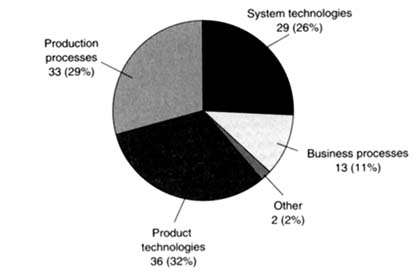
FIGURE 3-1
Number of programs addressing technology areas.
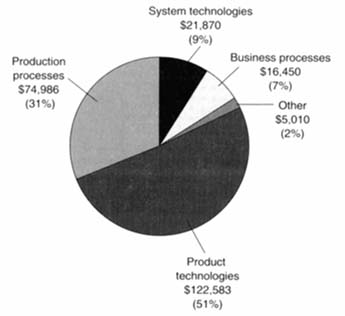
FIGURE 3-2
Dollar amounts (in thousands) invested in each technology area.
The emphasis on product technology for naval ships is in keeping with the goals of most existing programs, many of which are U.S. Navy programs intended to increase the fighting ability of ships. Programs that are directed solely at military capability are not included in Figures 3-1 and 3-2, but those that could benefit both military and commercial ships, such as projects on double-hull structure and improved propulsion, are included.
The relative levels of support for business and other technology areas are difficult to characterize easily. Although business-process technologies are the most critical for the future competitiveness of U.S. firms, improvement in this area must come mostly from companies investing their own funds and energies, as was made clear in Chapter 2. Similarly, although government investment in production processes is significant, shipbuilders will need to invest many times that amount to implement newly developed production technologies. In short, government can provide leadership in technology development, but industry must play a much greater role in carrying developments through. The committee was encouraged by discussions with the leaders of several shipyards that such investments are now being made. Continued investment will be necessary, however, because the U.S. shipbuilding industry has a long way to go.
References
Garcia, L. 1992. Global Standards; Building Blocks for the Future, OTA-TCT-512. Washington, D.C.: Office of Technology Assessment.
Sarabia, A., and R. Gutierrez. 1992. A return to merchant ship construction: The international impact of NSRP and American technology. Journal of Ship Production 8(1): 28-35.


