
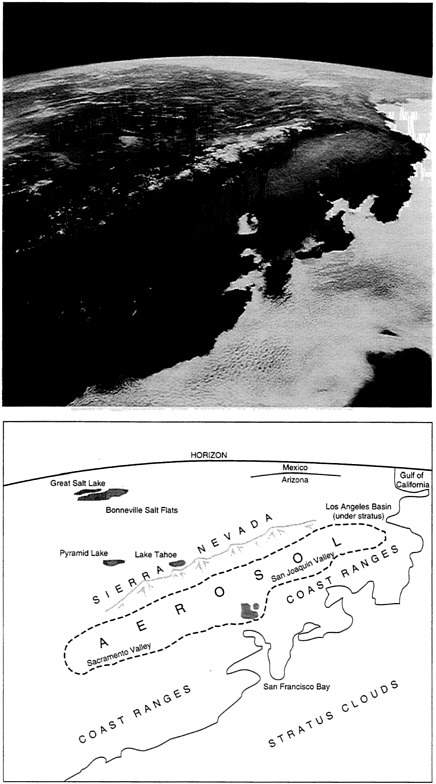
AN EXAMPLE OF A REGIONAL AEROSOL DISTRIBUTION
This NASA shuttle photograph (opposite page), taken on a March morning in 1994, and the explanatory diagram show a regional "haze" inland from the coast of California. While no chemical analysis is available, the haze is a widespread aerosol from sources that probably include smoke particles from biomass combustion and cities in the region. The enhanced albedo due to the haze causes sunlight to be reflected upward and thereby to fail to reach the ground. This constitutes a "direct climate forcing."
The aerosol cloud is visible from the northern extremity of the Sacramento Valley on the left to the Bakersfield area of the San Joaquin Valley on the right, a distance of about 600 kilometers. The Sierra Nevada mountains and the coastal range bound the aerosol-laden valley.
The photograph also shows coastal stratus clouds that extend along the coast and penetrate into the San Francisco Bay region. The albedo of these clouds, which can be influenced by anthropogenic aerosols, clearly controls the albedo of the oceanic portion of this view.
(Shuttle photograph SS062-86-066, courtesy of the Earth Science Branch, NASA/Johnson Space Center, Houston, Texas)

Cover art by Carrie Mallory. Ms. Mallory received her Bachelor of Fine Arts degree from the Cooper Union. She draws on the natural world and the effects of age on man-made objects for many of her themes. She has exhibited at a number of juried shows in the Northern Virginia area and has provided art for several NRC report covers. The art for this cover involved transferring an original photograph to an already cracked lithograph stone and adding texture with traditional litho crayons. As expected, the stone cracked further during the printing process, yielding only a few prints before disintegrating completely.
National Academy Press
2101 Constitution Avenue, N.W. Washington, D.C. 20418
NOTICE: The project that is the subject of this report was approved by the Governing Board of the National Research Council, whose members are drawn from the councils of the National Academy of Sciences, the National Academy of Engineering, and the Institute of Medicine. The members of the committee responsible for the report were chosen for their special competences and with regard for appropriate balance.
This report has been reviewed by a group other than the authors according to procedures approved by a Report Review Committee consisting of members of the National Academy of Sciences, the National Academy of Engineering, and the Institute of Medicine.
The National Academy of Sciences is a private, nonprofit, self-perpetuating society of distinguished scholars engaged in scientific and engineering research, dedicated to the furtherance of science and technology and to their use for the general welfare. Upon the authority of the charter granted to it by the Congress in 1863, the Academy has a mandate that requires it to advise the federal government on scientific and technical matters. Dr. Bruce M. Alberts is president of the National Academy of Sciences.
The National Academy of Engineering was established in 1964, under the charter of the National Academy of Sciences, as a parallel organization of outstanding engineers. It is autonomous in its administration and in the selection of its members, sharing with the National Academy of Sciences the responsibility for advising the federal government. The National Academy of Engineering also sponsors engineering programs aimed at meeting national needs, encourages education and research, and recognizes the superior achievements of engineers. Dr. Harold Liebowitz is president of the National Academy of Engineering.
The Institute of Medicine was established in 1970 by the National Academy of Sciences to secure the services of eminent members of appropriate professions in the examination of policy matters pertaining to the health of the public. The Institute acts under the responsibility given to the National Academy of Sciences by its congressional charter to be an adviser to the federal government and, upon its own initiative, to identify issues of medical care, research, and education. Dr. Kenneth I. Shine is president of the Institute of Medicine.
The National Research Council was organized by the National Academy of Sciences in 1916 to associate the broad community of science and technology with the Academy's purposes of furthering knowledge and advising the federal government. Functioning in accordance with general policies determined by the Academy, the Council has become the principal operating agency of both the National Academy of Sciences and the National Academy of Engineering in providing services to the government, the public, and the scientific and engineering communities. The Council is administered jointly by both Academies and the Institute of Medicine. Dr. Bruce M. Alberts and Dr. Harold Liebowitz are chairman and vice chairman, respectively, of the National Research Council.
Support for this project was provided by the Department of Agriculture, the Department of Energy, the Environmental Protection Agency, the Office of Naval Research of the Department of Defense, the Air Force Office of Scientific Research, the National Aeronautics and Space Administration, the National Oceanic and Atmospheric Administration, and the National Science Foundation under Grant No. ATM-9316824. Any opinions, findings, and conclusions or recommendations expressed in this publication are those of the author(s) and do not necessarily reflect the views of the above-mentioned agencies.
Library of Congress Catalog Card Number 96-67382
International Standard Book Number 0-309-05429-X
Additional copies of this report are available from:
National Academy Press
2101 Constitution Avenue, NW Box 285 Washington, DC 20055 800-624-6242 202-334-3313 (in the Washington Metropolitan Area)
B-705
Copyright 1996 by the National Academy of Sciences. All rights reserved.
Printed in the United States of America
PANEL ON AEROSOL RADIATIVE FORCING AND CLIMATE CHANGE
JOHN H. SEINFELD (Chair),
California Institute of Technology, Pasadena
ROBERT CHARLSON,
University of Washington, Seattle
PHILIP A. DURKEE,
Naval Postgraduate School, Monterey, California
DEAN HEGG,
University of Washington, Seattle
BARRY J. HUEBERT,
University of Hawaii, Honolulu
JEFFREY KIEHL,
National Center for Atmospheric Research, Boulder, Colorado
M. PATRICK MCCORMICK,
Langley Research Center, National Aeronautics and Space Administration, Hampton, Virginia
JOHN A. OGREN,
Climate Monitoring and Diagnostics Laboratory, National Oceanic and Atmospheric Administration, Boulder, Colorado
JOYCE E. PENNER,
Lawrence Livermore National Laboratory, Livermore, California
VENKATACHALAM RAMASWAMY,
Geophysical Fluid Dynamics Laboratory, National Oceanic and Atmospheric Administration, Princeton, New Jersey
W. GEORGE N. SLINN,
Pacific Northwest Laboratories, Richland, Washington
Staff
DAVID H. SLADE, Senior Program Officer
DORIS BOUADJEMI, Administrative Assistant
BOARD ON ATMOSPHERIC SCIENCES AND CLIMATE
JOHN A. DUTTON (Chair),
Pennsylvania State University, University Park
ERIC J. BARRON,
Pennsylvania State University, University Park
WILLIAM L. CHAMEIDES,
Georgia Institute of Technology, Atlanta
CRAIG E. DORMAN,
Department of Defense, Washington, D.C.
FRANCO EINAUDI,
Goddard Space Flight Center, Greenbelt, Maryland
MARVIN A. GELLER,
State University of New York, Stony Brook
PETER V. HOBBS,
University of Washington, Seattle
WITOLD F. KRAJEWSKI,
The University of Iowa, Iowa City
MARGARET A. LEMONE,
National Center for Atmospheric Research, Boulder, Colorado
DOUGLAS K. LILLY,
University of Oklahoma, Norman
RICHARD S. LINDZEN,
Massachusetts Institute of Technology, Cambridge
GERALD R. NORTH,
Texas A&M University, College Station
EUGENE M. RASMUSSON,
University of Maryland, College Park
ROBERT J. SERAFIN,
National Center for Atmospheric Research, Boulder, Colorado
Staff
WILLIAM A. SPRIGG, Director
H. FRANK EDEN, Senior Program Officer
MARK D. HANDEL, Senior Program Officer
DAVID H. SLADE, Senior Program Officer
ELLEN F. RICE, Reports Officer
DORIS BOUADJEMI, Administrative Assistant
THERESA M. FISHER, Administrative Assistant
MARK BOEDO, Project Assistant
COMMISSION ON GEOSCIENCES, ENVIRONMENT, AND RESOURCES
M. GORDON WOLMAN (Chair),
The Johns Hopkins University, Baltimore, Maryland
PATRICK R. ATKINS,
Aluminum Company of America, Pittsburgh, Pennsylvania
JAMES P. BRUCE,
Canadian Climate Program Board, Ottawa, Ontario
WILLIAM L. FISHER,
University of Texas, Austin
JERRY F. FRANKLIN,
University of Washington, Seattle
GEORGE M. HORNBERGER,
University of Virginia, Charlottesville
DEBRA KNOPMAN,
Progressive Foundation, Washington, D.C.
PERRY L. MCCARTY,
Stanford University, California
JUDITH E. MCDOWELL,
Woods Hole Oceanographic Institution, Massachusetts
S. GEORGE PHILANDER,
Princeton University, New Jersey
RAYMOND A. PRICE,
Queen's University at Kingston, Ontario
THOMAS C. SCHELLING,
University of Maryland, College Park
ELLEN SILBERGELD,
University of Maryland Medical School, Baltimore
STEVEN M. STANLEY,
The Johns Hopkins University, Baltimore, Maryland
VICTORIA J. TSCHINKEL,
Landers and Parsons, Tallahassee, Florida
Staff
STEPHEN RATTIEN, Executive Director
STEPHEN D. PARKER, Associate Executive Director
MORGAN GOPNIK, Assistant Executive Director
GREGORY SYMMES, Reports Officer
JAMES MALLORY, Administrative Officer
SANDI FITZPATRICK, Administrative Associate
SUSAN SHERWIN, Project Assistant
Foreword
As this report was receiving its final editing, Working Group I of the Intergovernmental Panel on Climate Change released its Summary for Policy Makers (IPCC, 1995b). The first section of the IPCC summary ("Greenhouse gas concentrations have continued to increase") documents the increase of greenhouse gases with arguments that are now almost universally accepted in the scientific community. The second section ("Anthropogenic aerosols tend to produce negative radiative forcings") quantifies the "direct" negative forcing of anthropogenic aerosols as a global average of 0.5 watts per square meter, and suggests that there is also an ''indirect" negative forcing of a similar magnitude. The remainder of the IPCC summary presents evidence that supports its view that aerosol radiative forcing plays a fundamental role in global climate change. The National Research Council's Panel on Aerosol Radiative Forcing and Climate Change agrees with the IPCC findings.
The United States has taken a leading role in investigating the aerosol effect. Recent federal funding, at a level of about one-half percent of the U.S. Global Change Research Program, has supported efforts to provide preliminary estimates of the mechanisms, magnitudes, uncertainties, and environmental consequences of aerosol radiative forcing. As the following report points out, however, there is much to be done before the scientific community can confidently advise those charged with developing policy and legislation on the significance and timing of this climate-perturbing
problem. For example, currently even the composition and the spatial patterns of aerosol distribution are, in large part, tentative due to the paucity of basic measurements. Model descriptions of the process of aerosol formation, the environmental behavior of aerosols, and their effect on the dynamics of climate are all somewhat conjectural. The research that has been carried out in this country and abroad, however, is sufficient to support the main findings of the IPCC Working Group I and this panel: that aerosol radiative forcing of climate is not only an interesting scientific issue but also is likely to play a significant role in our future climate.
John Seinfeld
Chair
Panel on Aerosol Radiative
Forcing and Climate Change
List of Tables
|
Table 1.1 |
Comparison of Climate Forcing by Aerosols with Forcing by Greenhouse Gases (GHGs): Fundamental Differences in Approach to Determination and Nature of Forcing |
|||
|
Table 1.2 |
Source Strength, Atmospheric Burden, Extinction Efficiency, and Optical Depth for Various Types of Aerosols |
|||
|
Table 1.3 |
Estimates of Direct Climate Forcing (W m-2) by Anthropogenic Aerosols |
|||
|
Table 1.4 |
Key Anthropogenic Aerosol Types, Associated Forcing Mechanisms, and Status of Understanding |
|||
|
Table 2.1 |
Global Models Currently Used to Study Aerosol Forcing: (A) Atmospheric General Circulation Models for Aerosol Forcing Calculations; (B) Global and Synoptic Models for Chemical Transport of Aerosols |
|||
|
Table 2.2 |
Satellite Instruments |
|||
|
Table 2.3 |
Aerosol Properties Needed at Continuous Monitoring Sites |
|||
|
Table 2.4 |
Categories of Sites to Monitor Intensive Properties |
|||
|
Table 3.1 |
Sensitivity Calculations for a Sulfate Aerosol Layer Below Clouds |
|||
|
Table 3.2 |
Sensitivity Calculations for an Aerosol Layer Above Lowest Cloud Layer |
|||
|
Table 3.3 |
Factors Contributing to Estimates of the Direct Forcing by Anthropogenic Sulfate (A) and Biomass Burning (B) Airborne Particles, Estimated Ranges, and Resulting Uncertainty Factors (for estimates of changes in reflected solar radiation) |
List of Figures
|
Figure 1 |
Organizational structure of the ICARUS program. |
|||
|
Figure 1.1 |
Estimated Northern Hemisphere and regional anthropogenic sulfur emissions over the past century. |
|||
|
Figure 2.1 |
General components of an integrated aerosol-climate research program. |
|||
|
Figure 2.2 |
Direct and indirect forcing mechanisms associated with sulfate aerosols. |
|||
|
Figure 2.3 |
Observations of continental haze by LITE (Lidar In-Space Technology Experiment). |
|||
|
Figure 2.4 |
Ship tracks off the coast of Northern California. |
|||
|
Figure 3.1 |
Sensitivity of aerosol forcing for an aerosol layer below cloud. |
|||
|
Figure 3.2 |
Sensitivity of aerosol forcing for an aerosol layer above lowest cloud layer. |
|||
|
Figure 3.3 |
Qualitative indications of current radiative forcing uncertainties for indirect effects (separately for marine and continental clouds) and for direct effects (separately for organic and inorganic aerosols) and a qualitative indication of the uncertainty goal (to be defined by USGCRP) for the first phase of ICARUS research. |
|||
|
Figure 3.4 |
Qualitative indication of relative ICARUS research priorities for different topics, with the differences from Figure 3.3 resulting from weighting the uncertainties of Figure 3.3 with USGCRP "strategic" and "integrating" priorities; here, the weighting has been by assumed amounts. |
|
Figure 3.5 |
Qualitative indication of relative funding priorities (resource allocations) for the indicated broad research topics, with the differences from Figure 3.4 (research priorities) resulting from weighting these research priorities with costs to perform the research; here, the weighting has been by assumed amounts. |
|||
|
Figure 3.6 |
Plot of the uncertainties listed in Table 3.3A for sulfate aerosols, with a qualitative indication of the level to which the uncertainty could be set as a goal for the first phase of ICARUS research. |
|||
|
Figure 3.7 |
Qualitative indication of research priorities for direct radiative effects of sulfate aerosols, derived from Figure 3.6 (uncertainties) by weighting with such factors as mentioned in the text. |
|||
|
Figure 3.8 |
Qualitative indication of the relative costs to reduce the uncertainties shown in Figure 3.6, consistent with the research priorities shown in Figure 3.7, accounting for the cost of performing the research (e.g., a prorated portion of satellite costs to measure backscattered radiation). |
|||
|
Figure 3.9 |
Qualitative indication of the relative contributions from different processes to current uncertainty in the atmospheric lifetime of aerosol sulfate, with a qualitative indication of the level to which the uncertainty could be set as a goal for the first phase of ICARUS research. |
|||
|
Figure 3.10 |
Qualitative indication of funding priorities to reduce the uncertainties shown in Figure 3.9. |
|||
|
Figure 4.1 |
Organizational structure of the ICARUS program. |


