
Page 24
5
Operator Ergonomics, Selection, Training, and Motivation
Poor operator performance is a principal weakness of existing passenger screening systems and a potential weakness of future systems (Fobes, 1995). Currently, personnel at screening checkpoints are required to perform tasks for which human beings are not well suited. These tasks are performed under conditions that degrade whatever performance capabilities they do have and for wages that may be competitive only with entry-level wages in the fast-food industry. The screener of carry-on baggage, for example, is required to identify sometimes faint indications of infrequently appearing target items. These objects may take an almost infinite number of shapes and orientations in a wide variety of baggage types. An abundance of research on tasks requiring signal detection under conditions of sustained attention confirms that acceptable levels of performance on such tasks are difficult to achieve, even under the best working conditions (Davies and Parasuraman, 1982; Mackie, 1987).
The conditions under which these tasks are performed at airport screening checkpoints are likely to degrade low performance levels even further. In a recent survey of passenger screening personnel, the top five problems identified by respondents all related to the abuse of screening personnel by passengers, air carrier personnel, and others (Dennison, 1995). The low pay and stressful working conditions lead to a high and costly rate of employee turnover. A large provider of passenger screening services reported that the company hired 20,000 people in 1994 to staff 8,000 screening positions (Dennison, 1995).
The successful implementation of a passenger screening method or system requires a program of laboratory and field research to address issues regarding the effectiveness of screening operators. This chapter addresses implementation issues that involve (1) the performance of system operators, (2) the application of the principles of ergonomics1 in the design of screening systems, and (3) the selection, training, and motivation of system operators.
RELATIONSHIP BETWEEN PAY AND PERFORMANCE
The low wages currently paid to operators of passengerand baggage-screening systems has been raised frequently as an issue related to poor operator performance. An explicit or implicit assumption is that higher wages will attract better people to these jobs, which, in turn, will lead to better operator performance. However, increased pay alone is not likely to improve operator performance significantly. A substantial body of evidence suggests that any direct link between pay and performance is tenuous at best and is probably insignificant compared to more powerful determinants of operator performance (Guzzo, 1988; Guzzo et al., 1985; Hertzberg, 1968; Lawler, 1971, 1981). The best result that can be expected from higher wages is less turnover among operators (a severe problem in itself), which could lead to opportunities to implement better selection, training, and motivation methods.
Because the lack of a relationship between higher pay and better performance is counterintuitive, figure 5-1 and the following discussion are offered as a simplified framework for understanding this relationship. Figure 5-1 also serves as a structure for understanding why operator ergonomics, selection, training, and motivation must be addressed in combination in order to enhance job performance. Based on the summaries of research findings referenced above, figure 5-1 shows that attaining job effectiveness involves the application of two types of factors—those that attract and keep people on the job (maintenance factors) and those that lead to acceptable or enhanced performance on the job (performance factors).
Maintenance factors attract people to jobs and keep them on the job long enough to permit performance factors to operate. As shown in figure 5-1, compensation (wages and benefits) is only one of several maintenance factors and, as a consequence, it is indirectly related to performance. Higher levels of some factors can compensate for lower levels of other factors in providing a sufficiently attractive combination to keep a person on the job. For example, higher levels of pay might make up for poor working conditions or the low status of the job or organization.
Performance factors lead to acceptable levels of job performance or serve as avenues for enhancing performance beyond existing levels. One of the most important and powerful of these factors is the design of the job or task. As
1 Ergonomics refers to the design of systems in such a way that their operational requirements are compatible with the human capabilities and limitations of their operators.
Page 25
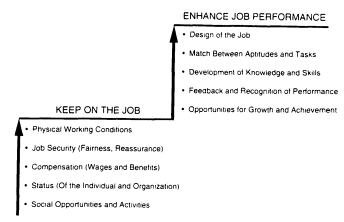
FIGURE 5-1 Factors that influence job performance.
discussed earlier, performance is greatly influenced by the extent to which the job and task requirements are compatible with the capabilities and limitations of the employee. The objective of ergonomics is to assure this compatibility. Another important factor, particularly in light of the seemingly large individual differences in aptitudes among screening personnel, is the match between the aptitudes of the employee and the skill requirements of the job. This match is a function of the procedures employed for selecting and assigning personnel to specific jobs. Also, to the extent to which they can be incorporated into the job, recognition of performance, opportunities for feelings of achievement, and opportunities for growth can serve to enhance performance. An example of an opportunity for growth was given by D. Issacharoff of El Al Airlines in his presentation to the panel. He told the panel that personnel hired by the company that performs passenger screening for El Al Airlines are given the opportunity to advance to jobs with the airline. In the United States, passenger screening personnel are often employees of a contractor company, and, generally, they do not have the opportunity to advance beyond a supervisory role at security checkpoints.
Thus, the relationship between pay and performance is an indirect one. Adequate pay provides a foundation for realizing adequate or enhanced levels of performance, but a combination of performance factors must be present as well. For example, if the effectiveness of a passenger screening system depends on certain operator aptitudes, then increased wages will not result in increased levels of performance, if the employee does not have these aptitudes to begin with.
ERGONOMICS IN SYSTEM DESIGN
According to data provided by the FAA (1995), operator performance in conducting passenger screening using current systems and procedures is not uniformly effective. Applying the principles of ergonomics in the design of screening systems and procedures is a possible avenue to improving the performance of current and future systems. The allocation of functions between machine and operator, in particular, will have a significant influence on the effectiveness of future systems. This allocation will dictate the specific tasks to be performed by the operator and the manner in which the operator must perform them. The goal is to ensure that functions assigned to humans are compatible with human capabilities. If they are not, then assigned functions will not be performed well, even if the best personnel selection, training, and motivation approaches are employed.
The resolution of issues related to ergonomics will be critical to the success of new passenger screening systems. In an apparent paradox, as screening systems become more automated, human factors are likely to become even more critical to success. Human operators will perform the difficult and complex tasks that cannot be automated. Increased automation will also introduce a host of new human factors issues that must be addressed (see, for example, Rasmussen, 1986; Wiener, 1987; Reason, 1990). One such issue deals with effectively integrating available information for screening and alarm resolution decisions. Which of the variety of techniques available for use in data integration and display will be most effective for passenger screening? Another issue will be the design of calibration, testing, and maintenance systems that are likely to be more complex for more highly automated systems.
Ergonomics issues can be addressed by applying existing knowledge, by conducting research in laboratory and field settings, and by incorporating appropriate measures in system test and evaluation programs. To realize the benefits of these efforts for any specific system, however, these issues must be integrated into the system development process. The FAA can ensure that system developers address critical human factors issues by incorporating appropriate and sufficiently sensitive measures of human performance in suitable system test protocols. These test protocols must be designed and employed to evaluate and qualify systems prior to their implementation, and they should be specified in advance to system developers.
The importance of ergonomics in system effectiveness is illustrated by the inadequate design of existing systems. Current systems for screening carry-on baggage continue to suffer from human factors issues that were not and have not been addressed properly. In an example cited by a workshop participant, the effectiveness of current screening systems can be jeopardized by pressures imposed by management on operators to increase the rate of passenger screening (Dennison, 1995). Other data from the FAA show that the overall detection effectiveness of existing human-machine screening systems is lower than desirable (FAA, 1995). According to
Page 26
an official of one of the largest providers of screening services in the United States, examples of inadequacies in existing baggage-screening systems include the following (Dennison, 1995):
· The display does not provide the operator with adequate size reference (i.e., all bags, regardless of size, appear about the same size on the screen).
· Equipment controls are insufficiently distinguishable by shape and location coding to permit operation without looking at the control panel.
· Data integration and image-processing techniques have not been sufficiently exploited to provide enhancements for image interpretation.
· Equipment design forces operators to position themselves improperly to view the display.
· Work force constraints (e.g., the requirement to rotate personnel among all positions at specified time intervals) limit the ability of management to assign security personnel to tasks in accordance with their abilities.
· Passengers, airport staff, air carrier employees, and others sometimes subject security personnel to abuse.
Important steps have been taken by the FAA to ensure that critical and high-priority issues related to the enhancement of operator performance in security systems are addressed systematically. The FAA has initiated a program of ergonomics research and development that parallels, and is integrated with, the development of new technologies and systems. The human factors program should remain a high priority for the general FAA aviation security program because operator performance is important to the overall effectiveness of security systems. In addition, improvements in operator performance can result in immediate improvements in the passenger screening systems themselves.
OPERATOR SELECTION, TRAINING, AND MOTIVATION
To complement the effective design of systems and procedures and to assure acceptable levels of operator performance, the following steps are required for developing personnel selection, training, and motivation methods:
· Develop and apply selection methods to ensure that operators have the necessary aptitudes for the tasks to be performed.
· Develop and administer training systems that provide operators with the needed knowledge and skills.
· Incorporate elements into the system (e.g., ongoing performance measurement and assessment procedures) that enhance rather than degrade operator motivation and job satisfaction.
MEASURING OPERATOR PERFORMANCE
A critical element of an effective program of operator ergonomics, selection, training, and motivation is a set of techniques for measuring operator performance. Measurement will also help the FAA and air carriers to determine the effectiveness of current and future screening systems. The following are some areas that require performance measurement methods:
· assessment of the effect of prototype screening systems, equipment, and procedures on operator performance
· development of criteria for validating operator selection and placement methods
· development of criteria for evaluating the effectiveness of operator training techniques, methods, and programs
· on-line monitoring and evaluation of the effectiveness of security screening systems and personnel
· provision of feedback to individual operators on overall performance and diagnoses of weaknesses
The FAA has initiated a promising research and development program that will lead to the development of techniques for measuring operator performance. These techniques include provisions for electronically inserting target objects in operational screening systems. This program, initiated in 1991, is a focus of the FAA human factors program in 1996.
POTENTIAL OPERATOR CONCERNS WITH SPECIFIC SCREENING TECHNOLOGIES
Imaging Technologies
Imaging technologies produce images of individuals and objects concealed under clothing. Operators are required to interpret images using current imaging technologies. Therefore, the methods used for selecting, training, and motivating operators should be similar to those used for preparing operators of current x-ray baggage-screening equipment. The time available for an operator to decide whether an individual should be allowed to pass or should be held for further screening is short, perhaps no more than six seconds. This is the approximate time currently required for clearing a carry-on bag through the screening equipment. The short time available emphasizes the importance of proper operator selection and training in obtaining and interpreting images.
For imaging technologies, alarm resolution probably will involve either taking additional images (e.g., from different angles) or having a more experienced viewer or supervisor
Page 27
interpret the initial image. Alarm resolution may not require more skill than that required for interpreting the initial image. In fact, the decision to screen a passenger further could result in more time for image interpretation and could offer a chance for less experienced screeners to practice image interpretation.
Trace-Detection Technologies
The use of trace-detection technologies in passenger screening settings may involve person-to-person contact or direct contact between the detection equipment (e.g., trace-chemical sensor) and an individual. As with current screening techniques, operators may feel intimidated by some people they are required to screen. Technologies that require even closer interaction between the operator and the passenger are likely to exacerbate this problem.
Automated trace-detection technologies, where a person is brushed with an air stream or is required to touch a portion of the equipment, do not impose additional requirements on operators. As in current passenger screening techniques, operators generally will become involved only after an alarm is triggered. More skilled operators are required for maintaining sophisticated chemical-identification systems in acceptable operating condition than for current airport checkpoints.
Nonimaging Electromagnetic Technologies
Changes in these passenger screening devices, including improvements to current technologies and the development of new approaches, are likely to be transparent to both passengers and operators. Security-screening operators will benefit from technologies that will allow them to quickly identify the item that caused the alarm by providing them better information about the type and location of the item.
SUMMARY
Ensuring the satisfactory performance of system operators involves applying ergonomics in the design of screening systems and in developing effective techniques and procedures for selecting, training, and motivating system operators. The resolution of ergonomics issues will enhance the capabilities of current technologies and will be critical to the successful implementation of new passenger screening systems. Improved personnel selection, training, and motivation methods will complement the effective design of systems and procedures and will assure acceptable levels of operator performance. The human factors program of the FAA is a key effort in improving operator performance.


