
National Material Metrics for Industrial Ecology*
Iddo k. Wernick and Jesse H. Ausubel
Industrial ecology studies the totality of material relations among different industries, their products, and the environment. Applications of industrial ecology should prevent pollution, reduce waste, and encourage reuse and recycling of materials. By displaying trends, scales, and relations of materials consumed, emitted, dissipated, and discarded, metrics can expose opportunities to improve the performance of industrial ecosystems.
Metrics can indicate environmental performance at all levels: factory, firm, sector, nation, and globe. National metrics focus attention on collective behavior, particularly in a large country such as the United States whose economy sums the actions of more than 250 million people and 3 million for-profit corporations. The federal government assembles national data on a vast array of activities. The need is for a coherent set of metrics that enables efficient diagnosis of national environmental conditions and provides help in considering strategies for the future.
The need to develop environmental metrics is particularly strong for materials. National materials consumption indicates the structure of national industrial activity and its extent. Environmentally important industries such as mining, forestry, agriculture, construction, and energy production can be evaluated based on their material requirements and outputs. Despite their ubiquity and close association with environmental quality, materials have received little systematic analysis, particularly as compared with energy. This inattention stems in part from the heterogeneity of materials used in the modern economy and the myriad enterprises involved in transforming, processing, and disposing of materials and goods.
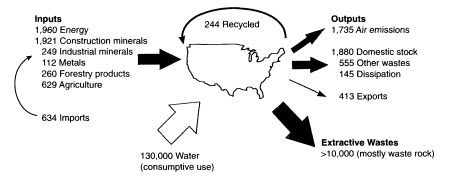
Figure 1
U.S. materials flows, circa 1990. All values are in million metric tons per year. Consumptive water use is defined as water that has been evaporated, transpired, or incorporated into products and plant or animal tissue and is therefore unavailable for immediate reuse. For a detailed description of this figure and data sources see Wernick and Ausubel (1995).
With the help of the Bureau of Mines, we have developed an environmentally oriented framework for characterizing material flows in the United States.1 Choosing metrics requires a grasp of the diversity and enormity of U.S. materials flows (Figure 1). Our framework considers primarily three components: inputs to the economy (including imports), outputs (including exports), and extractive wastes. We aim for comprehensiveness in this framework in the sense that we do not want to "lose" materials and would eventually hope to record the complete materials balance. Our choice of inputs and outputs as major categories derives from the simplest of materials-flow models. We group extractive wastes separately because they represent immense mobilizations of materials readily distinguished from commodities, products, and other wastes. We use previously published data for all the values indicated and generally adhere to existing classifications.
We segment inputs into energy, construction minerals, industrial minerals, metals, forestry products, and agricultural products. We class outputs as domestic stock,2 atmospheric emissions, other wastes, dissipation, and recycled materials. Imports and exports represent the masses of major individual commodities and classes of commodities crossing U.S. borders. Extractive wastes include residues from the mining and oil and gas industries. We account for water in Figure 1 but not in the material metrics because the weight and omnipresence of this resource would obscure what remains. We also omit consumption of atmospheric oxygen for biological respiration and in industrial processes.3 We do not explicitly consider manufactured chemical products, but do include the mass of feed stocks used for organic and inorganic chemical production.
Materials have the advantage of offering a single unit of measure, weight, that allows for direct comparison across a broad range of material types. Kilo-
grams and tons can hide variables such as volume, land disturbance, toxicity,4 and other environmentally important qualities associated with materials that weight measures do not reflect. Nevertheless, weight does provide a reasonable starting point for appreciating the structure and scale of major activities affecting national environmental quality.
National material metrics do not obviate the need for monitoring environmental variables locally. Rather, they complement smaller-scale metrics that underscore the spatial distribution of problems and needs. In this respect, they resemble national economic indicators, such as gross domestic product (GDP). In addition, national materials metrics offer the prospect of capturing environmentally significant trends and relations not captured in the current regulatory framework, which tends to emphasize reporting by media, especially air and water, rather than along the functioning of the economic system.
National Material Metrics
We propose eight general classes of metrics to indicate the current status and salient trends in national materials use as they influence environmental performance (Table 1). Most address either the productivity or the efficiency of resource use. Others indicate trends in the size and composition of materials use. Some metrics offer a means for quantifying aggregate environmental changes resulting from current national activities. Although some of the metrics are novel, others are already employed but gain meaning from the more systematic context. Although imperfect, this initial classification is intended to stimulate subsequent inquiry into the development of material metrics and the logic sustaining them.
Absolute National and Per Capita Inputs
The total mass of materials consumed by a nation, or individual members of its population, offers an indicator that tangibly values resource use. The components of the total differ in kind (and often in the accuracy of the supporting data), but their sum provides a benchmark for environmental management.
In 1990, each American mobilized on average about 20 metric tons of materials, or over 50 kg/day. The breakdown in Figure 2 equates with Figure 1 on national flows at the level of the individual American. This sum may be similar in other industrial nations. For example, estimates of Japanese materials use in 1990 total 52 kg per capita per day, a number closely comparable to the U.S. estimate (Gotoh, 1997).
The dynamics of per capita resource use as well as the efficacy of various policy initiatives aimed at affecting it could be gauged by comparing this number over time and across nations. More detailed metrics would look at consumption of classes of materials, such as energy fuels or agricultural minerals, and environmentally significant individual materials, such as lead.
TABLE 1 National Material Metrics
|
|
|||||
|
|
Metric |
Dimensions |
Formula |
Environmental Significance |
|
|
Total per capita inputs |
|
Metric tons/Capita |
Aggregate consumption of all materials classes and individual material classes per capita |
Benchmarking national resource use |
|
|
Input composition |
Fuel ratio |
Dimensionless |
Consumption ratio for coal:oil:natural gas |
CO2 emissions, cleanliness of the energy system |
|
|
|
Nonrenewable organics ratio |
Dimensionless |
Consumption quantity for nonrenewable organics/total hydrocarbon consumption |
Petrochemical pollution, character of solid waste |
|
|
|
Structural materials ratio |
Dimensionless |
Consumption ratio of metals, ceramics, and polymers in all finished products and structures |
Gross shifts in materials use, materials efficiency and cyclicity, mining and processing waste, energy use |
|
|
|
Agricultural ratios |
Dimensionless |
Consumption ratio of food to feed crops, rice and legume ratio to total agricultural produce |
Land use, methane emissions, nitrogen fixation rates |
|
|
Input intensities |
Intensity of use |
Million metric tons (MMT) of inputs/ $106 GDP |
Material consumption quantity for selected input materials/ GDP in constant dollars |
Relationship of resource use to economic activity |
|
|
|
Agricultural intensity |
Dimensionless |
Fertilizer, pesticide, and agricultural minerals consumption/Total crop production |
Materials efficiency, eutrophication of water bodies, topsoil erosion, chemical dissipation |
|
|
|
Decarbonization |
MMT of carbon inputs/$106 GDP |
Carbon inputs/GDP in constant dollars |
Relationship of carbon emissions to economic activity |
|
|
Recycling indices |
"Virginity" index |
Percentage |
Consumption of all virgin materials/Total material inputs |
Materials efficiency and cyclicity, mining and processing waste, energy use |
|
|
|
|||||
|
|
Metric |
Dimensions |
Formula |
Environmental Significance |
|
|
|
Metals recycling rate |
Percentage |
Quantity of recycled and secondary metals consumption/Total metals consumption |
Materials efficiency and cyclicity |
|
|
|
Renewable net carbon balance |
Percentage |
Forest growth/Forest products harvested |
Global carbon balance of sources and sinks, land use, ecosystem disruption |
|
|
Output intensities |
Green productivity |
Percentage |
Quantity of solid wastes/Quantity of total solid physical outputs |
Materials efficiency and cyclicity |
|
|
|
Intensity of use for residues |
MMT/$106 GDP |
Generation quantity for selected materials waste streams/GDP in constant dollars |
Relationship of waste generation to economic activity |
|
|
Leak indices |
Dissipation index |
Percentage |
Quantity of materials dissipated into the environment/Total material outputs |
Materials efficiency and cyclicity, media contamination |
|
|
|
Nutrient and metals loadings |
mg/liter and kg/km2 |
Concentrations of pollutants in water bodies, and land deposition of nutrients and heavy metals/Defined area |
Materials monitoring and accounting, media contamination |
|
|
Environmental trade index |
|
MMT |
Net mass value of waste and emissions generated from foreign trade in manufactured products and raw resources |
Domestic resource consumption, domestic environmental burden caused by exported goods |
|
|
Mining efficiency |
Mining wastes |
Dimensionless |
Quantity of wastes generated/ Ton of finished product |
Solid wastes, acid mine drainage |
|
|
|
By-product recovery |
Dimensionless |
Total by-product recovery/Total output |
Materials efficiency, solid wastes |
|
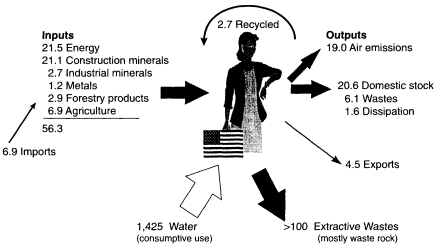
Figure 2
Per capita material flows, United States, circa 1990. All values are in kilograms per day. See caption for Figure 1 for further explanation.
Composition of Material Inputs to the National Economy
With economic development and technical change, the demand for materials evolves. Input composition reveals economic structure and dynamics and helps anticipate environmental consequences.
For example, environmental import attaches to the evolving ratio of the three fossil fuels used for energy, coal, oil, and gas, or in more elemental terms to the balance of hydrogen and carbon used to power and heat the nation (Marchetti, 1989; Nakicenovic, 1996). Although not used for energy, nonrenewable organic materials derived from petroleum and natural gas such as petrochemicals, plastics, asphalt, fibers, and lubricants comprise an appreciable fraction, about 6 percent, of total hydrocarbon consumption (Bureau of Mines, 1991a). The endpoints for these materials matter environmentally and as such merit their own distinct measure as a fraction of all hydrocarbon consumption.
The choice of structural materials indicates trends relevant to national environmental performance as well. Demand for properties in industrial and consumer goods influences selection among the major classes of structural materials: metals, ceramics and glasses, and polymeric materials including wood (Ashby, 1979). These materials range widely in their ability to bear loads, resist fracture, and operate in harsh thermal conditions. They also differ in typical densities (Figure 3). Similarly, they possess varying environmental attributes such as the energy needed, waste generated, and toxins released to the environment during extraction and processing. Comparing the energy needs for processing an equal
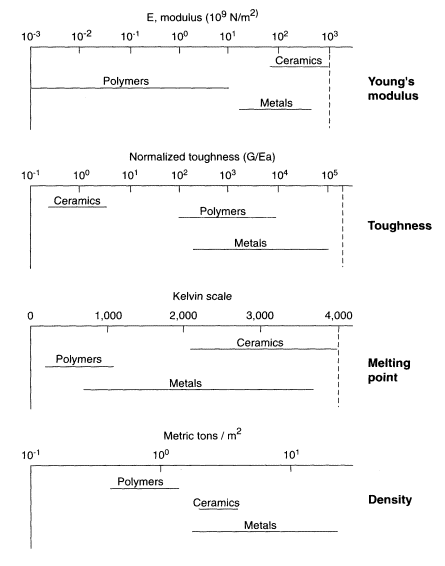
Figure 3
Range of physical properties for structural materials. Young's modulus is a measure of material elasticity. Toughness is a measure of resistance to fracture. Toughness is measured in units of joules per square meter of fracture surface (G) and is here normalized to Young's modulus (E) times atomic size (a). SOURCE: After Ashby (1979). Other sources include Carter and Paul (1991) and Hodgman (1962).
mass of aluminum, steel, cement, and polystyrene yields an approximate ratio of 85:10:2:1 (Agarwal, 1990; Hocking, 1991). Of course, materials rarely substitute for one another in products in a 1:1 mass ratio.
Historically, substantial scientific and engineering effort has been directed at improving the properties of metal alloys. Future gains may come in the area of polymers stiffened in the direction of loading, ceramics toughened to resist fracture, and composite materials designed to accentuate the best qualities (i.e., light, strong, and tough) of each material class. Although advanced materials may be difficult to reprocess, recyclability is not the single measure of environmental friendliness. This property must be weighed against gains derived from shifting to materials that perform functions using less mass, require less energy to process, and generate less incidental waste.
The composition of the food we consume, directly or indirectly, impacts the environment. Reduced national meat consumption accompanied by a rise in fruit, grain, and vegetable consumption diminishes the acreage used for grazing and feed in favor of less land-extensive crops. Cultivation of legumes and rice affects nitrogen fixation rates and atmospheric methane concentrations, respectively. Fertilizer and pesticide use rates are tailored to specific crops. In this case as with the others, input composition metrics clarify the environmental dimension of varying the mix of materials society consumes and shed light on paths for future development.
Intensities of Use
Intensity-of-use metrics show the evolution of individual materials used in the national economy by indexing primary, as well as finished, materials to GDP (Figure 4; also, see Malenbaum, 1978). These measures inform policy choices relating to natural resources by helping to gauge developmental status and to define realistic goals that integrate economic growth and improved environmental quality. In the energy sector, the declining intensity of carbon use, ''decarbonization," of the U.S. economy relative to economic activity as well as energy use has been well established (Figure 5).
Intensity-of-use metrics also can show physical resource efficiency. For example, in 1990, the ratio of agricultural produce (e.g., grain, hay, fruit, and vegetables) to fertilizer inputs (e.g., nitrogen compounds and phosphates) was roughly 10:1 (Bureau of Mines, 1991b; United States Department of Agriculture, 1992). The ratio of food actually consumed by humans to mineral inputs is considerably lower. Other sectors using raw inputs as well as auxiliary materials for production (e.g., iron ore, coke, and lime for steel; wood and chemicals for paper) could apply similar environmental performance measures.
"Virginity" and Recycling Indices
A virginity, or raw materials, index measures the ratio of national raw materials use to total national inputs. It monitors the distance a society must go to stop
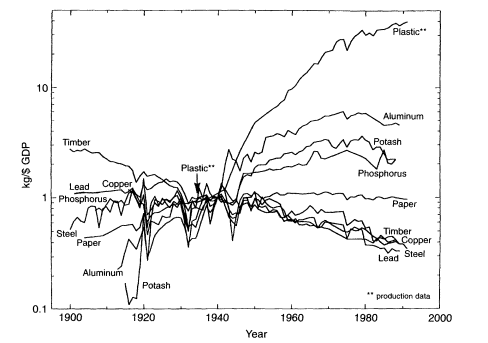
FIGURE 4
Materials intensity of use in the United States, 1900-1990. This metric conveys the evolving materials requirements of an economy over time. Consumption data are indexed to annual GDP in constant 1982 dollars. (For example, in 1900, U.S. phosphate consumption was 1,515,425 metric tons and gross national product was $261.5 billion, equivalent to about 5.8 metric tons per million dollars GDP. In 1990, 4,692,919 metric tons of phosphate were consumed and GDP was $4,120 billion, equivalent to about 11.2 metric tons per million dollars GDP.) All intensity-of-use values are normalized to unity at 1940 with the exception of plastics, which is indexed to 1942. SOURCES: Modern Plastics Magazine (1960); Bureau of the Census (1975, 1992). Data on U.S. production of plastics resin are from Broyhill, Statistics Department, Society of the Plastics Industry, Washington, D.C., personal communication, August 20, 1993.
extracting materials from the earth and sustain itself through its above-ground materials endowment and recycling. For 1990, recycled material accounted for about 5 percent of all inputs to the U.S. economy by weight (Rogich, 1993). Impeding the increase of this fraction are the heterogeneity of materials in the waste stream, industrial demand for materials with highly specific properties, and cumbersome regulations. These factors combine to shrink the pool of resources that can be used as inputs to production (Frosch, 1994; Wernick, 1994).
Among specific materials of interest are metals and wood. The fraction of secondary to total metals consumption indicates both the efficiency of metals
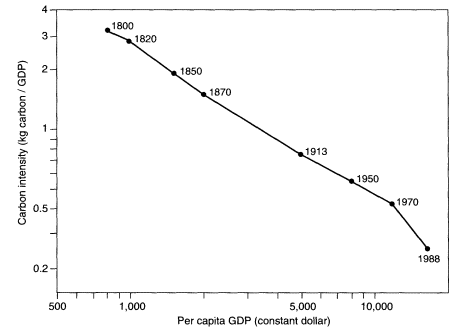
Figure 5
Diminishing carbon intensity of per capita GDP in the United States, 1800-1988. Carbon intensity is carbon consumed for energy divided by annual GDP in constant 1985 dollars. SOURCE: After Gruebler and Fujii (1991).
reuse from new scrap generated within industry and the success in recycling old scrap recovered from obsolete products such as automobiles. Recycling today accounts for over half the metals consumed in the United States (Figure 6; Rogich, 1993). However, recovery remains below 10 percent for arsenic, barium, chromium, and other biologically harmful metals listed in the Toxic Release Inventory (Allen and Behmanesh, 1994). The difference between annual forest growth and removal of growing stocks offers a simple measure of incremental changes in forest volume.5 For the period 1970-1991, U.S. forests gained an average of over 150 million cubic meters of timber annually, augmenting existing timber volume at an annual rate of about 0.7 percent (United States Department of Agriculture, 1992).
Waste (Emission) Intensities
Waste intensities measure residuals and emissions per unit of output in physical or economic terms. Corporate practice increasingly evaluates the ratio of wastes to total firm output, including products and salable by-products (3M Cor-
poration, 1991) and seeks uses for wastes (Ahmed, 1993; Edwards, 1993) as efficiency measures. National indicators would assess "green" productivity by evaluating the amount of materials considered as waste against various output categories. Figure 7 shows long-term trends of U.S. municipal solid-waste (MSW) generation, sulfur dioxide emissions, and emissions of nitrogen oxides indexed to economic activity. Industrial wastes are strong candidates for analysis using this metric. However, dry weight data on industrial wastes rarely exist or are hard to obtain (United States Congress, Office of Technology Assessment, 1992).
Leak Indices
Leak indices measure the ratio of outputs emitted and dissipated to total outputs, thereby quantifying the proportion of materials lost to further productive use and dispersed into the environment. Applying this measure allows for easier identification and isolation of "holes" in the system and focuses efforts to plug them.
Geographical information on nutrient and heavy-metals loadings aids improvement of accounts of dissipated materials. National efforts in this area are
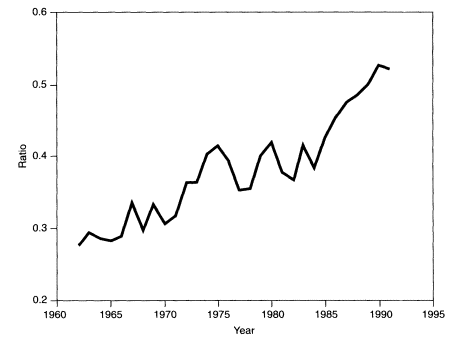
Figure 6
Ratio of secondary to primary metal consumption, United States, 1962-1991. SOURCE: Rogich (1993).
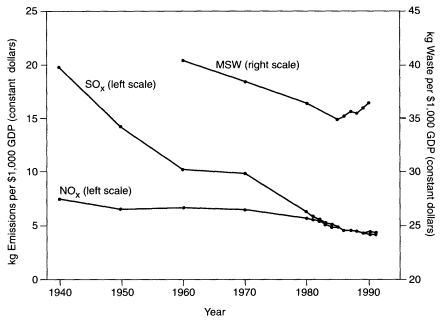
Figure 7
Waste intensities in the United States, 1940-1990. Municipal solid-waste (MSW) discards, and sulfur dioxide and nitrogen oxide emissions, indexed to GDP in constant 1987 dollars. SOURCES: Bureau of the Census (1975, 1994).
well established but incomplete. The National Oceanic and Atmospheric Administration (1993) estimates coastal discharges of nutrients (nitrogen, phosphorus), heavy metals (e.g., arsenic, lead, cadmium), and petroleum hydrocarbons in U.S. estuaries in the National Coastal Pollution Discharges Inventory. Estimates of inland nutrient discharges and metals deposition rates are sparse at best. Extending these measures to the entire nation would be laborious but worthwhile from the perspective of national environmental management.
Environmental Trade Index
An environmental trade index indicates the degree to which the nation is retaining or displacing pollution through international trade. Exporting raw materials consumes national resources and scars the domestic landscape. Using domestic industry to convert imported materials into finished goods and prepare indigenous materials for export can damage the environment in other ways. Despite intense interest in the monetary balance of U.S. foreign trade, the environ-
mental profile of trade flows has received scant attention until recently, in the context of trade with Mexico.
By weight, commodities dominate trade. The mass of manufactured products traded contributes little to the total but may be responsible for domestic waste generation and discharges to the environment. During 1990, exports were dominated by agricultural products (33 percent), coal (23 percent), and chemicals (10 percent), all goods associated with domestic pollution. In the same year, crude oil and petroleum products accounted for over 60 percent of U.S. imports by weight, with metals and minerals accounting for another 20 percent (Bureau of the Census, 1993). We lack ready means to assess how the spatial redistribution of economic functions would affect environmental quality.
Extractive Waste Ratios
Extractive waste ratios measure resource efficiency in the mining industry. Recalling Figure 1 confirms the massiveness of wastes generated in this sector. Rock removed to expose mineral and ore bodies accounts for most of this waste. This material may be harmless, but exposing raw earth to wind and water can raise local acidity levels and allows for transport of trace elements. The sheer amounts of materials mobilized in mining and the economic incentive to minimize wastes combine with environmental objectives to advocate metrics of efficiency. Geological characteristics primarily determine overburden and tailings generated, but judgmental variables also affect mine wastes. One measure, subject to some physical constraints, is the amount of mine wastes per ton of mineral or ore mined, or primary metal produced. A separate useful measure, already used at the company level, looks at other inputs such as water and energy use per ton of finished product (Chiaro and Joklik, 1997). Measures of the recovery of by-products (e.g., methane in coal seams, sulfuric acid from smelter emissions, and metals from flue dusts) provide further examples of environmental indicators for the mining and mineral processing sector.
Discussion
Industry operates and people behave within a system that evolves to satisfy human wants and uses a dynamic set of means to achieve them. As a discipline, industrial ecology discourages reducing the system to components and examining them in strict isolation. The challenge for national material metrics, as well as other national environmental metrics, is to quantify and integrate relevant data that elucidate the primary structure and development of the system from an environmental perspective.
National material metrics rely on empirical data. Various agencies of the federal government collect relevant data for one purpose or another. However,
unless coordinated, the data do not fully support existing metrics and limit the scope for future ones. Procedural changes aimed at synchronizing data collection among various federal departments and agencies to build a single base (year) would amplify the benefits of existing collection efforts. Equally important from an environmental perspective is the development of standardized definitions for classifying material commodities to erase confusion leading to omissions and double counting of material components.
Accurate data on wastes are the hardest to obtain. Companies collect little or no data for many waste streams due to the actual or perceived absence of economic value. High disposal costs and regulatory requirements have improved waste accounting practices at many firms, but wastes have yet to receive the respect that marketability confers. Among the main goals of industrial ecology is exploring potential markets for waste materials. Currently, the dearth of reliable information available for wastes is one of the factors blocking progress. Better information would improve the market climate for wastes and at the same time help to develop metrics that assess their relative impact nationally.
Although improved national environmental metrics go hand in hand with better databases, metrics are not meant simply to compile information. Their purpose is to embed the data in a context that recognizes the larger system and is relevant to how it works. Good environmental indicators exist, but too often remain detached from each other and from an unambiguous framework. Appropriate metrics should correlate individual indicators and clarify the relation of each one to the whole. To illustrate, citing fertilizer usage rates without reference to agricultural productivity is misleading and causes unwarranted alarm. Conversely, extolling the environmental virtue of a lighter consumer product without examining the life-cycle implications of its fabrication and disposal is premature. To enhance their value and minimize misuse, commentary and interpretation should accompany the publication of metrics.
To adequately respond to complex questions of environmental performance requires both context and an array of metrics. For example, is the nation beginning to "dematerialize," that is, effectively decouple overall materials consumption from continued economic growth? For the U.S. energy sector the answer has been in the affirmative. Efficiency gains and the shift away from heavy manufacturing have modified the traditional relation between energy consumption and economic growth in the United States. Single indicators (i.e., kilowatt hours consumed/$GDP) elegantly illustrate this development. To have similar confidence regarding materials will require a more elaborate set of measures that are sensitive to the diverse structure of contemporary materials use and the many forces affecting its dynamics (Wernick et al., 1996). National materials metrics would refine how such questions are articulated and provide the basis for more convincing answers than are now available.
Looking to the future, national materials metrics help order the national research agenda for materials science and engineering (National Academy of Sci-
ences, 1989). At over 50 kg per day per American, even the rough profile developed here demonstrates the need for meshing environmental and materials research. Metrics highlight the locations and relative urgency of incorporating environmental goals into materials research programs. Significantly, these goals often overlap with factors affecting the bottom line such as reducing inputs, improving efficiency, recycling, and complying with environmental regulations.
Future materials fluxes, including both products and by-products, may even exceed contemporary ones in size. To make them environmentally compatible, we need better methods for analyzing their current condition and anticipating future changes. To achieve the goal of a more circular economy, society needs to consider its materials legacy as a dowry to future generations, rich in valuable ore. By capitalizing on the "mines above ground" or scrap piles for materials, wastes from extraction and disposal grow dispensable. We can imagine an industrial ecosystem in which emissions, including carbon and water vapor, are captured and complex waste streams are separated to recover the value and utility of their components. The discipline of creating national materials metrics is a useful start to creating a consistent, realistic long-range technical vision.
Acknowledgments
We are indebted to Donald Rogich, Jim Lemons, and Grecia Matos at the Bureau of Mines for data and ideas on materials taxonomy.
Notes
-
1.
In this paper we draw on other work by the authors (Wernick and Ausubel, 1995) that contains detailed data supporting the metrics presented here.
-
2.
Domestic stock refers to materials embedded in structures and products not discarded for a period longer than 1 year.
-
3.
We include atmospheric nitrogen fixed into NOx emissions as well as for ammonia production. We omit estimates of the mass of soil eroded during agricultural operations.
-
4.
A clear example of this is annual total U.S. dioxin and furan emissions, which are counted in kilograms rather than tons, yet have considerable environmental impact (Thomas and Spiro, 1995).
References
Agarwal, J. C. 1990. Minerals, energy, and the environment. Pp. 389-395 in Energy and the Environment in the 21st Century, J. W. Tester, D. O. Wood, and N. A. Ferrari, eds. Proceedings of a conference held at Massachusetts Institute of Technology, Cambridge, Mass., March 26-28, 1990.
Ahmed, I. 1993. Use of Waste Materials in Highway Construction. Park Ridge, N.J.: Noyes Data Corp.
Allen, D. T., and N. Behmanesh. 1994. Wastes as raw materials. Pp. 69-89 in The Greening of Industrial Ecosystems, B. R. Allenby and D. J. Richards, eds. Washington, D.C.: National Academy Press.
Ashby, M. F. 1979. The science of engineering materials. Pp. 19-48 in Science and Future Choice, Vol. I, P. W. Hemily and M. N. Özdas, eds. North Atlantic Treaty Organization. Oxford, England: Clarendon Press.
Birdsey, R. A., A. J. Plantinga, and L. S. Heath. 1993. Past and prospective carbon storage in United States forests. Forest Ecology and Management 58:33-40.
Bureau of Mines. 1991a. Minerals Yearbook 1991. Washington, D.C.: U.S. Government Printing Office.
Bureau of Mines. 1991b. Mineral Commodity Summaries. Washington, D.C.: Bureau of Mines.
Bureau of the Census. 1975. Historical Statistics of the United States, Colonial Times to 1970. Washington, D.C.: U.S. Government Printing Office.
Bureau of the Census. 1992. Statistical Abstract of the United States: 1992, 112th ed. Washington, D.C.: U.S. Government Printing Office.
Bureau of the Census. 1993. Statistical Abstract of the United States: 1993, 113th ed. Washington, D.C.: U.S. Government Printing Office.
Bureau of the Census. 1994. Statistical Abstract of the United States: 1994, 114th ed. Washington, D.C.: U.S. Government Printing Office.
Carter, G. F., and D. E. Paul. 1991. Materials Science and Engineering. Materials Park, Ohio: The Materials Information Society.
Chiaro, P., and F. Joklik. 1997. Environmental strategies in the mining industry: One company's experience. Pp. 165-181 in The Industrial Green Game: Implications for Environmental Design and Management, D. J. Richards, ed. Washington, D.C.: National Academy Press.
Edwards, G. H. 1993. Consumption of Glass Furnace Demolition Waste as Glass Raw Material. Paper presented at the National Academy of Engineering Workshop on Corporate Environmental Stewardship, Woods Hole, Mass., August 10, 1993.
Frosch, R. A. 1994. Industrial ecology: Minimizing the impact of industrial waste. Physics Today 47(11):63-68.
Gotoh, S. 1997. Japan's changing environmental policy, government initiatives, and industry responses. Pp. 234-252 in The Industrial Green Game: Implications for Environmental Design and Management, Washington, D.C.: National Academy Press.
Gruebler, A., and Y. Fujii. 1991. Inter-generational and spatial equity issues of carbon accounts. Energy 16(11/12):1397-1416.
Hocking, M. B. 1991. Paper vs. polystyrene: A complex choice. Science 251:504-505.
Hodgman, C. D. 1962. Handbook of Chemistry and Physics, 44th ed. Cleveland, Ohio: Chemical Rubber Publishing Company.
Malenbaum, W. 1978. World Demand for Raw Materials in 1985 and 2000. New York: McGraw-Hill.
Marchetti, C. 1989. How to solve the CO2 problem without tears. International Journal of Hydrogen Energy 14(8):493-506.
Modern Plastics Magazine. 1960. Vol. 37, No. 5.
Nakicenovic, N. 1996. Freeing energy from carbon. Daedalus 125(3).
National Academy of Sciences. 1989. Materials Science and Engineering for the 1990s. Washington, D.C.: National Academy Press.
National Oceanic and Atmospheric Administration (NOAA). 1993. Point Source Methods Document. Strategic Environmental Assessments Division. Silver Spring, Md.: NOAA.
Rogich, D. G. (and staff). 1993. Materials Use, Economic Growth, and the Environment. Paper presented at the International Recycling Congress and REC'93 Trade Fair, Geneva, Switzerland. Washington, D.C.: Bureau of Mines.
Thomas, V. M., and T. J. Spiro. 1995. An estimation of dioxin emissions in the United States. Toxicological and Environmental Chemistry 50:1-37.
3M Corporation. 1991. Challenge '95: Waste Minimization. St. Paul, Minn.: 3M Corporation.
United States Congress, Office of Technology Assessment. 1992. Managing Industrial Solid Wastes from Manufacturing, Mining, Oil and Gas Production, and Utility Coal Combustion. OTA-BP-O-82. Washington, D.C.: U.S. Government Printing Office.
United States Department of Agriculture. 1992. Agricultural Statistics 1992. Washington, D.C.: U.S. Government Printing Office.
Wernick, I. K. 1994. Dematerialization and secondary materials recovery: A long run perspective. Journal of the Minerals, Metals, and Materials Society 46(4):39-42.
Wernick, I. K., and J. H. Ausubel. 1995. National materials flows and the environment. Annual Review of Energy and Environment 20:462-492.
Wernick, I. K., R. Herman, S. Govind, and J. H. Ausubel. 1996. Materialization and dematerialization: Measures and trends. Daedalus 125(3).


