
Measuring Environmental Performance through Comprehensive River Studies
Richard Strang and Louis Sage
The objective of the Clean Water Act is to restore and maintain the chemical, physical, and biological integrity of the nation's waters. Recently, an intergovernmental task force was established to coordinate and improve the collection and evaluation of monitoring data used in making decisions on water resources. One of the task force's initial activities was to estimate the relative amounts of money spent on water pollution abatement and ambient water-quality monitoring. The task force concluded that for every dollar invested in programs and infrastructure designed to reduce water pollution, less than two-tenths of one cent was spent to monitor the effectiveness of such abatement programs (Intergovernmental Task Force on Monitoring Water Quality, 1992).
Summarizing this state of affairs, the task force stated that "although we have spent more than $500 billion on water pollution abatement since the 1970s, we are currently unable to document adequately the effectiveness of these investments in achieving the objectives of the Clean Water Act and other Federal and State legislation related to water quality" (Intergovernmental Task Force on Monitoring Water Quality, 1992). To continue progress toward achieving the nation's water-quality objectives, more emphasis must be placed on water-quality evaluations and the information such studies can provide about improvements that have been achieved and the issues that remain to be addressed.
Application of the Quality Management Process
The quality management process (QMP) is being used effectively today by the manufacturing sector to control and continually improve performance and
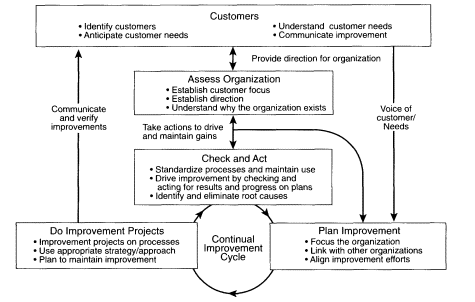
Figure 1
The quality management process.
product quality. QMP can serve as a valuable model for addressing water-quality issues. One of the most important features of QMP is the continual improvement cycle, which is intended to accomplish continuous improvements in management systems. The cycle has four phases: planning, doing, checking, and acting. Each phase of this cycle, from designing and implementing projects to checking for improvements, can play an essential role in finding solutions to water-quality issues.
Eastman Chemical, the 1993 Malcolm Baldrige National Quality Award winner, has applied QMP to every aspect of its business, including its water-quality management systems. Figure 1 is a schematic representation of QMP. Eastman organizations that are responsible for water-quality near Eastman facilities have carefully considered the customers for their work. These customers include plant management, the public, employees, the board of directors, stockholders, and state and federal regulatory authorities. Communications between customers and Eastman water-quality organizations are encouraged and help provide the organizations with direction. Conflicting demands often make finding resolutions difficult but do serve to focus attention on important issues.
Based on an understanding of their mission and the demands of their customers, the Eastman water-quality organizations enter the continual improvement cycle and plan improvement projects. These projects range from spill prevention
training to waste minimization initiatives and the construction of improved waste treatment facilities. Efforts are made to link with other Eastman organizations and to align with other environmental improvement projects. Projects are then implemented, and customers are informed of the anticipated improvements.
The next step in the cycle is to check for improvements resulting from the water-quality initiatives. For many industries that practice QMP, this check step is accomplished by reviewing readily available measures, such as discharge monitoring reports, that might provide data on improvements in compliance with discharge permits. These measures are also used by Eastman. However, Eastman has gone beyond these measures and now makes periodic river studies an important feature of its water-quality management system.
Eastman has turned to a third party, the Academy of Natural Sciences (ANS) of Philadelphia, to conduct these studies. The academy, founded in 1812, is a world-renowned, nonprofit institution dedicated to environmental research and natural-history education. Over the years, ANS has completed a total of 15 river studies at Eastman's four major plant sites.
These river studies include the collection of chemical, physical, and biological data at locations upstream and downstream of the manufacturing facilities. Special attention is placed on evaluating the resident populations of algae, aquatic plants, noninsect macroinvertebrates, insects, and fish. Through the years, the design of the river assessment has evolved from an emphasis on species richness to a balance between population dynamics and community interactions. These changes are consistent with the early assessments yet allow for more robust program designs that support rigorous statistical analyses.
Results of the river studies have been communicated to Eastman's customers, including the public and regulatory authorities. It is through this communication that the benefits of the studies are realized. Improved understanding of water-quality issues is then incorporated into the next iteration of the continual improvement cycle.
River-Study Fundamentals
ANS river studies are designed to assess the overall health of a river that receives discharges from a facility. Much like a medical checkup, certain indicators are evaluated as the basis for the assessment. The studies focus on components of biological communities that have been shown to be the most sensitive indicators of environmental quality (Schindler, 1987). If abnormalities are detected in one or more of the indicators, additional more-focused studies are recommended. To be properly implemented, the third-party reviews need to be scheduled every 4 to 5 years, depending on the nature of the commercial operation.
The indicators are represented by groups of organisms that reflect different functions in the aquatic community. These groups have varying strengths and weaknesses that, when properly assembled in a program, can be complementary
in the overall assessment. This information is supplemented with water-chemistry and physical data collected at the time of the biological collections.
Studies for Eastman Chemical facilities include an assessment of the species composition and relative abundance of algae and diatoms as a measure of the base of the food chain. Insect macroinvertebrates are quantitated to provide information on the biomass of this important fish food resource. The insects are excellent indicators, providing acceptable rigor for statistical testing against a variety of environmental parameters. Noninsect macroinvertebrates, or epibenthic fauna, such as mussels and crawfish support themselves by filtering food particles from the water or by scavenging. Many of these organisms remain in one spot as adults and thus reflect the water-quality of a particular area. The organisms most universally associated with a river, fish, reside at the top of the food chain and thus reflect the health of the community through all the links in that chain. The fish community represents the official report card on the health of the river to the majority of the general public. Because fish are mobile and are attracted to specific habitats, they are less randomly distributed than other aquatic life. Therefore, the presence or absence of a given fish species downstream of a discharge may not be as meaningful as a similar observation related to macroinvertebrates. Fish, however, are an excellent biological group for assessing the effect of water-quality on growth rate. This can be done through inspection of their ear bones, a procedure termed otolith analysis. Fish are also useful for assessing body burdens of river pollutants.
A special challenge in developing a program for a third-party review is to employ state-of-the-science methods while maintaining a database that allows for long-term trend analysis. Such a database allows investigators to examine questions that relate to the rate of change in the composition of the biological community, the age structure of populations, as well as more generic questions relating to local and regional point and nonpoint discharges.
ANS's first work with Eastman was a 1965 study for the Tennessee Eastman Division, which examined a wide variety of habitats to identify as many species as possible in each river reach. Organisms included in this first study were algae, macroinvertebrates, insects, protozoans, and fish. After determining the number of species, the assemblage was sorted according to the pollution tolerance of each group. Based on these groupings, a comparative index was developed from other rivers in the mid-Atlantic region to establish the health of the South Fork Holston River.
During the more recent studies for Tennessee Eastman and Arkansas Eastman, ANS has placed greater emphasis on acquiring quantitative data by determing such things as catch of organisms per unit of effort and the number of specimens per unit of habitat, and through sample replication. These data are then used in statistical tests and to calculate biotic indices. For insect macroinvertebrates, for example, ANS developed a computerized database that includes information on the lowest
practicable taxonomic level of each specimen and on functional feeding groups such as predator, shredder, scraper, filterer, and gatherer. With this database, analyses can be conducted to determine taxa richness, abundance, ShannonWiener diversity, community evenness, the relative balance of functional feeding groups, and Hilsenhoff's index of pollution tolerance. The latter weighs each taxon's pollution tolerance score by that taxon's proportional abundance in the collection (Hilsenhoff, 1987). Although there has been an effort to extend the database's level of quantification, and the collection effort has been refined and replicated, many elements have remained consistent, allowing for comparison of past and present conditions.
Case Studies
Each of the Eastman facilities faces a different set of water-quality challenges, which are reflected in the corresponding differences in the role of the river studies in the QMP check phase for each facility. These differences are best characterized by comparing the situations at the Eastman divisions in Kingsport, Tenn., and Batesville, Ark.
Tennessee Eastman Division
Tennessee Eastman Division began operations in 1920 and has grown to become one of the largest manufacturing facilities in the United States. The plant occupies over 1,000 acres, has over 400 manufacturing buildings, and employs some 12,000 people.
Water-quality issues in the vicinity of the plant are extremely complex. The watershed for the South Fork Holston River, which flows past the facility, is regulated by a series of five dams. The nearest of these, Fort Patrick Henry Dam, is less than 3 miles upstream of the facility. At one time, there were 42 point-source discharges along the 5-mile reach of river that flows through the Kingsport community (Tennessee Department of Public Health, 1977). Today, the major discharges include cooling water and treated process waste water from Tennessee Eastman, as well as other discharges from a munitions manufacturer, a paper manufacturing plant, and a domestic waste-water treatment facility. All of these discharges occur along a 2-mile reach of the river.
In 1970, the South Fork Holston River was one of the four most polluted major Tennessee rivers (Thackston et al., 1990). According to Thackston et al., at this time, biochemical oxygen demand (BOD) loadings from all point sources in Kingsport were as high as 137,000 lb/day.
During the first ANS study for Tennessee Eastman Division in 1965, it became apparent that specific determinations of the causes of observed water-quality problems were impossible because of the proximity of the numerous point-source dis-
charges and the added complication of river flow regulation immediately upstream of Kingsport. Because of these physical constraints, ANS studies have focused on documenting changes in water-quality brought about by investments in water protection by area facilities responsible for discharges into the river.
Thackston et al. 1990 assert that improvements in water-quality downstream of Kingsport are a success story for Tennessee. ANS studies conducted in 1965, 1974, 1977, 1980, and 1990 confirm this claim, with comprehensive data on the increases in species diversity from the improved water-quality conditions. By 1990, BOD was reduced to less than 6,000 lb/day.
Arkansas Eastman Division
Construction of Arkansas Eastman began in 1975, and the facility was in full operation in early 1977. Today, the manufacturing operation occupies 40 acres and employs approximately 700 people. The plant's design was conceived at a time when attitudes toward the environment were heavily influenced by events such as Earth Day, the creation of the U.S. Environmental Protection Agency, and the passage of the Clean Water Act. Lessons learned at Eastman's facility in Tennessee on the protection of water-quality were incorporated into the design of the Arkansas plant.
Arkansas Eastman is located in a rural area; the nearest point source on the White River is over 9 miles upstream. The facility is equipped with an activated-sludge waste-water treatment plant and an incinerator for the combustion of concentrated wastes. All runoff from manufacturing areas is collected and routed through a large holding basin. If an accident were to happen, chemical spills or deluge water could be captured and prevented from reaching the river.
ANS conducted the first of its river studies for Arkansas Eastman in 1974 and 1976, before the facility began to operate. These studies were designed to provide baseline data. Later studies, conducted in 1980 and 1991, involved data collection upstream and downstream of the Arkansas Eastman discharge. Unlike the work in Tennessee, which sought to document improvements in water-quality, the studies in Arkansas were intended to evaluate critically any changes in water-quality that could be attributed to Arkansas Eastman's presence. To date, the studies reflect positively on the water-quality management system at Arkansas Eastman. The data indicate no adverse impacts due to plant operations.
Results and Discussion
The ANS studies provide both qualitative and quantitative data on the health of aquatic communities near Eastman facilities. Information on species diversity has been collected throughout the 25-year history of the program. This information is particularly useful for comparing trends in water-quality with changes in management systems.
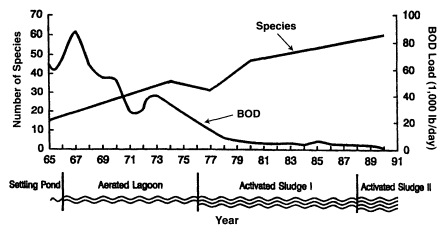
Figure 2
Tennessee Eastman Division waste-water treatment capability and corresponding Eastman BOD load to the South Fork Holston River compared with the numbers of species of invertebrates and fish at a location downstream of Kingsport, Tennessee, 1965-1990.
Tennessee Eastman Division
Historical information on Tennessee Eastman Division's waste-water treatment capability and BOD loading to the South Fork Holston River is provided in Figure 2. In 1966, Eastman converted from the use of simple settling ponds to biological waste-water treatment with aerated lagoons. From the late 1960s to the early 1970s, company efforts focused on minimizing waste streams and eliminating waterborne discharges. Combustion units with energy-recovery boilers were constructed to incinerate wastes that were isolated from manufacturing processes. By the early 1970s, these activities resulted in a 65 percent reduction in the Tennessee Eastman BOD loading to the South Fork Holston River.
Data on aquatic invertebrates and fish collected at a location downstream of all Kingsport area point-source discharges, before and after this BOD load reduction, showed a 140 percent increase in the total number of species of invertebrates and fish, from 15 species in 1965 to 36 species in 1974.
In 1976, Tennessee Eastman Division again improved its waste-water treatment capability by installing an activated-sludge treatment system. This change, combined with continued emphasis on waste minimization, resulted in additional improvements that amounted to a 96 percent reduction in Tennessee Eastman's BOD loading between 1967 and the early 1980s. Other point sources in the Kingsport area also achieved load reductions during this period. As a result, there was a 210 percent increase in the total number of species of invertebrates and fish, from 15 species in 1965 to 47 species in 1980.
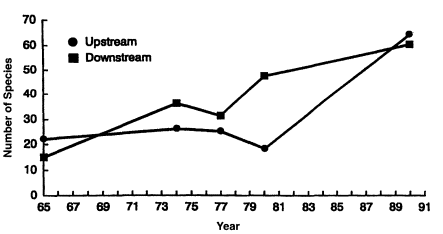
Figure 3
Comparison of the total number of fish and invertebrate species at locations upstream and downstream of the Kingsport area point-source discharges, 1965-1990.
In 1988, Tennessee Eastman Division began operating a new $90 million advanced activated-sludge waste-water treatment plant. Subsequently, compared with 1967 levels, the Tennessee Eastman BOD load to the river was reduced by 99 percent. This new technology produced only a 3 percent change in load reduction compared with the activated-sludge system used throughout the 1980s. ANS scientists were surprised to find dramatic increases in the number of insect and fish species, from 47 species in 1980 to 60 species in 1990, which could not be accounted for by the relatively small reduction in BOD. Altogether, there was a 300 percent increase in the number of fish and invertebrate species between 1965 and 1990.
After verifying that collection techniques and river conditions during the studies were similar enough to make the data comparable, the researchers focused on possible changes upstream of the point-source discharges to explain the observed changes. Figure 3 compares data on total fish and invertebrate species for locations upstream and downstream of Kingsport during the 1965-1990 study period. Increases in species diversity downstream of Kingsport from 1965 to 1980 can be attributed to BOD load reductions resulting from cleaner point-source discharges. Little change took place during this period at the upstream station, which is located between Tennessee Eastman Division property and Fort Patrick Henry Dam. However, increased species diversity observed at this location in the 1990 study indicates improved conditions that are not associated with the Kingsport area point-source discharges. The change in conditions at the upstream station apparently also resulted in improvements at locations farther downstream.
Arkansas Eastman Division
ANS conducted baseline studies of the White River in 1974 and 1976 before manufacturing operations started at Arkansas Eastman Division. These studies were aimed at generating data for use in comparison with future studies and to assess the natural variability in resident populations of aquatic life.
The 1980 and 1991 ANS studies used three types of analysis to assess the potential effects of Eastman operations on the White River: comparisons of the 1980 and 1991 data with baseline data from 1974 and 1976; comparisons of upstream and downstream data; and comparisons of left-bank and right-bank data. These analyses were designed to show evidence of impact due to discharges by Arkansas Eastman, for example if the biological parameters at sampling locations or over time changed in a pattern consistent with exposure to point-source pollution.
Table 1 shows the number of noninsect macroinvertebrate, insect, and fish species collected at stations immediately upstream and downstream of the Arkansas Eastman discharges to the White River. These and other data collected during the studies on species richness and abundance show differences among the sampling locations, but the observed patterns are not consistent with a negative effect from the Eastman facility. All indications are that the water-quality management systems in place at Arkansas Eastman are successfully protecting the White River.
Summary
ANS river studies have made significant contributions to Eastman's ''plan, do, check, and act" approach to improving and maintaining water-quality management systems. The case studies for Tennessee Eastman and Arkansas Eastman illustrate the importance of developing and understanding the effects that water-quality initiatives have on the resources they are meant to protect. For Arkansas Eastman management, the studies provide reassurance that the systems in place to protect the White River are functioning as planned. At Tennessee Eastman, the
TABLE 1 Comparison of Numbers of Aquatic Species Upstream(up) and Downstream (down) of Arkansas Eastman
|
|
1974 |
1976 |
1980 |
1991 |
||||
|
Taxon |
Up |
Down |
Up |
Down |
Up |
Down |
Up |
Down |
|
Macroinvertebrates |
4 |
3 |
14 |
9 |
8 |
8 |
16 |
17 |
|
Insects |
43 |
45 |
30 |
24 |
37 |
30 |
47 |
58 |
|
Fish |
20 |
16 |
— |
— |
27 |
34 |
42 |
48 |
studies document the improvements in water-quality brought about by years of investment in point-source controls. However, the Tennessee studies also indicate that investment in such controls and the corresponding improvement in water-quality can reach a point of diminishing returns. Further improvements in water-quality, in these situations, can only be achieved when the remaining issues, such as nonpoint-source pollution, are understood and addressed.
References
Hilsenhoff, W. L. 1987. An improved biotic index of organic stream pollution. Great Lakes Entomology 20:31-39.
Intergovernmental Task Force on Monitoring Water Quality. 1992. Ambient Water Quality Monitoring in the United States: First Year Review, Evaluation and Recommendations. Report to the Office of Management and Budget. Washington, D.C.: U.S. Government Printing Office.
Schindler, D. W. 1987. Detecting ecosystem responses to anthropogenic stress. Canadian Journal of Fisheries and Aquatic Sciences 44 (Suppl. 1):6-25.
Tennessee Department of Public Health. 1977. Water Quality Management Plan for the Holston River Basin. Nashville, Tenn.: Division of Water Quality Control.
Thackston, E. L., W. R. Miller, D. Durham, and L. R. Richardson. 1990. Tennessee Environmental Quality Index 1970-1990. Nashville, Tenn.: Tennessee Conservation League Report.


