
Accounting for Natural Resources in Income and Productivity Measurements
Robert C. Repetto, Paul Faeth, and John Westra
Sustainable development has been defined variously as (a) living on nature's income instead of depleting its capital, (b) meeting the needs of today's population without compromising the ability of future generations to meet theirs, and (c) managing natural, human, and financial assets to increase human health and well-being over the long term. By whatever definition, moving toward sustainable development is clearly in the vital interest of societies everywhere.
Trouble arises when the indices by which we try to measure improvements in living standards ignore the loss of natural resources and the services that they provide. Policy makers, who inevitably rely on these flawed measures of economic development, can get very misleading signals, leading to temporary improvements in consumption that are "purchased" by permanent losses in wealth and productive capacity.
The fundamental definition of income encompasses the notion of sustainability. In accounting and economic textbooks, income is defined as the maximum amount that can be consumed in a given period without reducing the amount of possible consumption in a future period (Hicks, 1946). Business income is defined as the maximum amount that a firm could pay out in current dividends without reducing net worth. This income concept encompasses not only current earnings but also changes in asset levels: Capital gains represent income increase and capital losses income reduction. The depreciation account reflects the fact that unless the capital stock is maintained and replaced, future consumption possibilities will inevitably decline.
Environmental problems may grow progressively worse not only from depletion but also from degradation. If the world economy continues to expand at historical rates, doubling in size every 20-25 years, the biosphere will suffer
increasing ecological damage, unless the use of resources and the discharge of emissions per unit of output fall as fast as the economy grows. This inescapable fact directs attention to a neglected dimension of economic productivity: productivity in the use of the environment. Conventional measures of productivity change are misleading indicators because they do not account for environmental inputs and outputs, which may be as large as other factors of production.
In this paper we explore two methods for incorporating natural resources into conventional economic performance indicators. The first, natural resource accounting (NRA), is, simply put, a methodology that extends accepted notions of income and depreciation to the stock of natural resources, treating such resources as depreciable assets. The second, multifactor productivity (MP), can be extended to bring in measures of environmental inputs and outputs. The first example provided in this paper looks at adjustments to the national accounts using NRA as a way to measure the economic value of resource depletion in Indonesia. The second example, assessing or analyzing agricultural systems, employs NRA to value soil and water depletion, and also measures off-site damages to account for environmental performance in a larger economic sense. The third example incorporates health costs into MP measures of the electric power industry to arrive at an estimate of productivity change under regulations limiting harmful emissions.
National Income and Natural Resource Accounting
The aim of national income accounting is to provide an information framework suitable for analyzing the performance of the economic system. The current system of national accounts reflects the economic concerns that were dominant when the system was developed, particularly the theories of John Maynard Keynes and his contemporaries. The great aggregates of Keynesian analysis—consumption, savings, investment, and government expenditures—are carefully defined and measured. But Keynes and his contemporaries were preoccupied with the Great Depression and the business cycle—specifically, with explaining how an economy could remain for long periods of time at less than full employment. During the Great Depression, commodity prices were at an all-time low. Thus, as Keynesian analysis largely ignored the productive role of natural resources, so does the current system of national accounts.
An earlier generation of classical economists had regarded income as the return on three kinds of assets: natural resources, human resources, and invested capital (land, labor, and capital, in their vocabulary). But natural resource scarcity played little part in nineteenth-century European economics—resources were available and prices were falling. Neoclassical economists from whose work traditional Keynesian and most contemporary economic theories are derived virtually ignored natural resources, focusing on human resources and invested capital. After World War II, when these theories were applied to problems of eco-
nomic development in the Third World, human resources were also left out on the grounds that labor is always ''surplus," and development was seen almost entirely as a matter of savings and investment in physical capital. Ironically, low-income countries, which are typically most dependent on natural resources for employment, revenues, and foreign exchange earnings, are instructed to use a system for national accounting and macroeconomic analysis that almost completely ignores their principal assets.
The result today is a dangerous asymmetry in the way we measure, and hence the way we think about, the value of natural resources. Man-made assets—buildings and equipment, for example—are valued as productive capital. As they wear out, a depreciation charge is taken against the value of production that these assets generate. This practice recognizes that a consumption level maintained by drawing down the stock of capital exceeds the sustainable level of income. But customary accounting methods do not value natural resource assets in this manner: their loss entails no debit charge against current income that would account for the decrease in potential future production. A country could exhaust its mineral resources, cut down its forests, erode its soils, pollute its aquifers, and hunt its wildlife and fisheries to extinction, but measured income would not be affected as these assets disappeared.
The United Nations System of National Accounts (SNA) is the standard framework for measuring a country's macroeconomic performance. The SNA includes stock accounts that identify assets and liabilities at particular points in time and flow accounts that keep track of transactions (e.g., expenditures on goods and services, payments to wage and profit earners, and imports and exports of goods and services) during intervals of time. These national accounts have become the basis for virtually all macroeconomic analysis, planning, and evaluation. Supposedly, they represent an integrated, comprehensive, and consistent framework. Unfortunately, they do not.
Although capital formation is assigned a central role in economic theories, natural resources are not treated like other tangible assets in the system of national accounts. Activities that deplete or degrade natural resources are not recorded as consuming capital, nor are activities that increase the stock of natural resources defined as capital formation. According to the United Nations Statistical Office, ". . . nonreproducible physical assets such as soil or the natural growth of trees . . . are not included in the gross formation of capital, due to the fact that these assets are not exchanged in the marketplace" (United Nations, 1975).
On the other hand, the SNA does classify as gross capital formation expenses incurred in "improving" land for pastures, developing or extending timber-producing areas, or creating infrastructure for the fishing industry. Such actions contribute to recorded income and investment, although they can destroy valuable natural resource assets through deforestation, soil erosion, and overfishing. No record is kept or appears in the national income and investment accounts of this loss of capital as natural resources are used beyond their capacity to recover. The
accounts thereby create the illusion of rising national income when in fact national wealth is being depleted.
A Case Study of Indonesia
Indonesia provides an illustration of the potential for NRA, following the depletion method developed in a World Resources Institute (WRI) report (Repetto et al., 1989). Over the past 20 years, Indonesia has drawn heavily on its considerable natural resource endowment to finance development expenditures. Revenues from production of oil, gas, hard minerals, and timber and other forest products have offset a large share of government development and routine expenditures. Resource extraction contributes more than 43 percent of gross domestic product (GDP), 83 percent of exports, and 55 percent of total employment. Indonesia's economic performance from 1965 to 1986 is generally judged to have been successful: its per capita GDP growth averaged 4.6 percent per year, a rate exceeded by only a handful of low- and middle-income countries and far above the average for those groups. Gross domestic investment (GDI) rose from 8 percent of GDP in 1965, at the end of the Sukarno era, to 26 percent of GDP (also well above average) in 1986, despite low oil prices and a difficult debt situation (World Bank, 1988).
Estimates derived from the Indonesian case study illustrate how much this evaluation is affected by keeping score more correctly. Table 1 compares the GDP at constant prices with the net domestic product (NDP), derived by subtracting estimates of net natural resource depreciation for only three sectors: petroleum, timber, and soils. It is clear that conventionally measured GDP substantially overstates net income and its growth rate, because it does not account for consumption of natural resource capital. In fact, although the GDP increased at an average annual rate of 7.1 percent from 1971 to 1984, the period covered by this case study, the adjusted estimate of NDP rose by only 4 percent per year. If 1971, a year of significant additions to petroleum reserves, is excluded, the respective growth rates from 1972 to 1984 are 6.9 percent and 5.4 percent per year for gross and net domestic product, respectively.
The overstatement of income and its growth rate may actually exceed these estimates considerably because the estimates cover only three natural resources—petroleum, timber, and soils—on only one island, Java. Other important exhaustible resources that have been exploited over the period, such as natural gas, coal, copper, tin, and nickel, have not yet been included in the accounts, and neither has the depreciation of such renewable resources as nontimber forest products and fisheries. When complete depreciation accounts are available, they will probably, on balance, show a greater divergence between gross output and net income.
Other important macroeconomic estimates are even more distorted. Table 2 compares estimates of gross and net domestic investment (NDI), the latter reflecting depreciation of natural resource capital. NDI is central to economic plan-
TABLE 1 Comparison of GDP and NDP in 1973 Rupiah (billions)
|
|
Net Capital Consumption in Natural Resource Sectors |
|
||||
|
Year |
GDPa |
Petroleum |
Forestry |
Soil |
Total Net Capital Consumption |
NDP |
|
1971 |
5,545 |
1,527 |
-312 |
-89 |
1,126 |
6,671 |
|
1972 |
6,067 |
337 |
-354 |
-83 |
-100 |
5,967 |
|
1973 |
6,753 |
407 |
-591 |
-95 |
-279 |
6,474 |
|
1974 |
7,296 |
3,228 |
-533 |
-90 |
2,605 |
9,901 |
|
1975 |
7,631 |
-787 |
-249 |
-85 |
-1,121 |
6,510 |
|
1976 |
8,156 |
-187 |
-423 |
-74 |
-684 |
7,472 |
|
1977 |
8,882 |
-1,225 |
-405 |
-81 |
-1,711 |
7,171 |
|
1978 |
9,567 |
-1,117 |
-401 |
-89 |
-1,607 |
7,960 |
|
1979 |
10,165 |
-1,200 |
-946 |
-73 |
-2,219 |
7,946 |
|
1980 |
11,169 |
-1,633 |
-965 |
-65 |
-2,663 |
8,506 |
|
1981 |
12,055 |
-1,552 |
-595 |
-68 |
-2,215 |
9,840 |
|
1982 |
12,325 |
-1,158 |
-551 |
-55 |
-1,764 |
10,561 |
|
1983 |
12,842 |
-1,825 |
-974 |
-71 |
-2,870 |
9,972 |
|
1984 |
13,520 |
-1,765 |
-493 |
-76 |
-2,334 |
11,186 |
|
Percent |
7.1 |
|
|
|
|
4.0 |
|
average |
||||||
|
annual |
||||||
|
growth |
||||||
|
a From the Indonesian Central Bureau of Statistics. SOURCE: Repetto et al. (1989). |
||||||
ning in resource-based economies. Countries such as Indonesia that are heavily dependent on exhaustible natural resources must diversify their asset base to preserve a sustainable long-term growth path. Extraction and sale of natural resources must finance investments in other productive capital. It is therefore relevant to compare the figures for GDI with those representative of natural resource depletion. If gross investment is less than resource depletion, the country is drawing down, rather than building up, its asset base and using its natural resource endowment to finance current consumption. If net investment is positive, but not enough to equip new workers with at least the capital per worker of the existing labor force, then increases in output per worker and income per capita are unlikely. In fact, the results from the Indonesian case study show that the adjustment for natural resource asset changes is large in many years relative to GDI. In 1971 and 1974, the adjustment is positive, due to additions to petroleum reserves.1 In most years during the period, however, the depletion adjustment offsets a good part of gross capital formation. In some years, net investment was negative,
implying that natural resources were being depleted to finance current consumption expenditures.
Such an evaluation should flash an unmistakable warning signal to economic policy makers that they are on an unsustainable course. An economic accounting system that does not generate and highlight such evaluations is deficient as a tool for analysis and policy in resource-based economies.
The same holds true for the evaluation of performance in particular economic sectors, such as agriculture. Almost three-quarters of the Indonesian population lives on the fertile but overcrowded inner islands of Java, Bali, and Madura, where lowland irrigated rice paddies are intensively farmed. In the highlands, population pressures have brought steep hillsides into use for cultivation of maize, cassava, and other annual crops. As hillsides have been cleared of trees, erosion has increased, to the point where it now averages over 60 tons per hectare per year, by WRI estimates.
Erosion's economic consequences include loss of nutrients and soil fertility as well as increased downstream sedimentation in reservoirs, harbors, and irrigation systems. Increased silt concentrations affect fisheries and downstream water users. Although crop yields have improved in the hills because farmers have used better seed and more fertilizers, estimates indicate that the annual depreciation of soil fertility (calculated as the value of lost farm income) is about 4 per-
TABLE 2 Comparison of Gross Domestic Investment and Net Domestic Investment in 1973 Rupiah (billions)
|
Year |
GDIa |
Resource Depletionb |
NDI |
|
1971 |
876 |
1,126 |
2,002 |
|
1972 |
1,139 |
-100 |
1,039 |
|
1973 |
1,208 |
-279 |
929 |
|
1974 |
1,224 |
2,605 |
3,829 |
|
1975 |
1,552 |
-1,121 |
431 |
|
1976 |
1,690 |
-684 |
1,006 |
|
1977 |
1,785 |
-1,711 |
74 |
|
1978 |
1,965 |
-1,607 |
358 |
|
1979 |
2,128 |
-2,219 |
-91 |
|
1980 |
2,331 |
-2,663 |
-332 |
|
1981 |
2,704 |
-2,215 |
489 |
|
1982 |
2,783 |
-1,764 |
1,019 |
|
1983 |
3,776 |
-2,870 |
906 |
|
1984 |
3,551 |
-2,334 |
1,217 |
|
a From the Indonesian Central Bureau of Statistics. b Includes depletion of forests, petroleum, and the cost of erosion on the island of Java. SOURCE: Repetto et al. (1989). |
|||
cent of the value of crop production—the same percentage as annual production increases. In other words, these estimates suggest that current increases in farm output in Indonesia's uplands are being achieved almost wholly at the expense of decreases in future output. Because the upland population is unlikely to be smaller in the future than it is now, soil erosion represents a transfer of wealth from the future to the present. By ignoring the future costs of soil erosion, the sectoral income accounts significantly overstate the growth of agricultural income in Java's highlands.
Natural Resource Accounting and Agriculture
In recent years, a number of researchers have struggled to define sustainable agriculture. Most of these definitions encompass elements of agricultural productivity maintenance, farm profitability, and reduction of environmental impacts, but they have been qualitative, not quantitative. Also, most definitions of agricultural sustainability have failed to incorporate productivity of the natural resource base when calculating agricultural productivity. The notion of agricultural sustainability has therefore been of considerable conceptual utility but only limited operational usefulness to policy makers and researchers attempting to determine how various policies and technologies affect agricultural resources.
A Natural Resource Accounting Framework for Agriculture
An NRA framework differs from conventional financial and economic accounting in some significant ways (Faeth, 1993). In conventional accounting, the financial value (net farm income) of a production program to farmers takes into account current and future transfer receipts but ignores environmental costs. Using the NRA framework, net farm income is defined to include the value of changes in soil productivity, the farmer's principal natural asset. This definition is consistent with business and economic accounting standards, which incorporate asset formation and depreciation in measures of income. By contrast, the same farming technique's economic value to society (net economic value) includes environmental costs that farmers' activities impose on others, such as damages related to surface water, but ignores transfer payments.
Tables 3 and 4 present examples of this NRA methodology. The tables compare net farm income and net economic value per acre for a predominantly corn-soybean rotation in Pennsylvania, with and without allowances for natural resource depreciation. Column 2 of Table 3 shows a conventional financial analysis of net farm income per acre per year. The gross operating margin ($75) (crop sales less variable production costs) is shown in the first row. Because conventional analyses make no allowance for natural resource depletion, the gross margin and net farm operating income are the same. Government subsidies ($16) are added to obtain net income ($91).
TABLE 3 Net Farm Income: Conventional versus Natural Resource Accounting (dollars per acre per year)
|
Item Accounting |
Conventional Accounting |
Natural Resource |
|
Gross operating margin |
75 |
75 |
|
Less soil depreciation |
— |
24 |
|
Net farm operating income |
75 |
51 |
|
Plus government commodity subsidy |
16 |
16 |
|
Net farm income |
91 |
67 |
When a soil depreciation allowance is included, the gross operating margin is adjusted ($24) to obtain net farm income ($51). The depreciation allowance is an estimate of the present value of future income losses due to the impact of crop production on soil quality. The same government payment is added to determine net farm income ($67).
Net economic value (Table 4, column 3) subtracts $49 as an adjustment for off-site costs of soil erosion (such as sedimentation, impacts on recreation and fisheries, and effects on downstream water users).2 Net economic value also includes the on-site soil depreciation allowance, but excludes income support payments. Farmers do not bear the off-site costs directly, but these are real economic costs attributable to agricultural production and should be considered in calculating net economic value to society. Subsidy payments, by contrast, are a
TABLE 4 Net Economic Value: Conventional versus Natural Resource Accounting (dollars per acre per year)
|
Item Accounting |
Conventional Accounting |
Natural Resource |
|
Gross operating margin |
75 |
75 |
|
Less soil depreciation |
— |
24 |
|
Net farm operating income |
75 |
51 |
|
Less off-site costs of soil erosion |
— |
49 |
|
Net farm income |
75 |
2 |
transfer from taxpayers to farmers, not income generated by agricultural production, and are therefore excluded from net economic value calculations.
Case Studies
WRI has published a series of six case studies that explicitly examined sustainable agricultural practices, including on- and off-farm economic measures of agricultural sustainability (Faeth et al., 1991; Faeth, 1993). These include two case studies of alternative corn-soybean production systems in Pennsylvania and Nebraska, rice-wheat-maize production systems in India, lowland irrigated rice in the Philippines, and a comparison of upland and lowland wheat production in Chile. Each study is based on actual field trials.
These studies applied an NRA framework to quantify the financial, economic, fiscal, and environmental costs and benefits of various agricultural practices. Within this framework, we accounted for the value of long-term soil productivity changes and off-site surface water damages for alternative farming practices. We also analyzed the financial value to farmers and the economic value to society of each farming practice under five policy scenarios.
In the Pennsylvania case study, organic farming practices proved superior to conventional practices agronomically, environmentally, and economically. Resource-conserving production practices cut production costs by 25 percent, eliminated chemical fertilizer and pesticide use, reduced soil erosion by more than 50 percent, and increased yields after completion of a transition from heavy chemical use. In addition, increasing water retention reduced off-site damages by $30 per acre per year, and reducing erosion forestalled a 30-year yield decline with a present value of more than $124 per acre.
In Nebraska, low-chemical-input alternatives to the predominant corn-soybean rotation were found to be economically competitive and environmentally superior. Three different regimens for the corn-soybean rotation (herbicide and fertilizer use, fertilizer use only, and an organic treatment) yielded farm incomes and net economic values that differed by no more than $2 per acre per year.
In northwest India, heavy electricity subsidies for tubewell irrigation are resulting in the depletion of groundwater at the rate of 0.8 meter per year. The value of this loss in terms of future pumping costs represents almost 15 percent of gross operating margin, and when it is included in financial calculations, water-conserving farming practices are seen to be much more profitable. In the Philippines, when the health-care costs for farmers who apply unregulated, subsidized pesticides are accounted for, scheduled spraying of pesticides is much less profitable than integrated pest management or biocontrol methods. And in Chile, where poor farmers use soil-degrading production practices on steep hillsides, soil-conserving practices are more profitable than traditional methods.
Several important conclusions emerged from this research:
- Economic analysis that excludes the value of productivity changes of natural resources or externalities will overstate the value of resource-degrading practices and understate the value of resource-conserving practices.
- Resource-conserving production practices can be economically and financially superior to, or competitive with, conventional practices.
- Failure to account for the degradation and depletion of natural resources can mask their true economic value, thus justifying policies that diminish sustainability and result in significant economic and fiscal losses.
A Sectoral Study of Agriculture
WRI completed a major national economic analysis of agricultural sustainability in the United States in 1995. This study applied an NRA framework to analyze the economic and environmental impacts of alternative policies and production systems (Faeth, 1995). After compiling agronomic data from experiments, field trials, and producer records for alternative production systems in 10 regions of the United States, WRI evaluated these alternative systems, as well as the predominant systems for a given region, using a biophysical soil and crop model to determine soil erosion rates, long-term crop yields, nutrient loss, potential groundwater contamination from nitrates, and soil carbon sequestration. This information, together with financial and energy analysis and economic valuation of environmental impacts, makes the database supporting this project the single most complete collection of information yet available on "sustainable" production systems.
The economic model that resulted from the WRI study is the most comprehensive and empirically based policy tool yet developed for analysis of agricultural sustainability in the United States. To date, no national economic model has used such extensive information on alternative production systems, the environmental impact of predominant and alternative farming systems, or the economic value of natural resource impacts.
The research plan involved four steps:
- collecting and organizing existing agronomic data on predominant and alternative3 production systems,
- calculating crop budgets and simulating the environmental characteristics for each predominant and alternative production system,
- reprogramming an existing economic policy model to incorporate alternative production systems and physical and economic accounts for natural resource impacts of both predominant and alternative systems and establishing an economic baseline for the adapted model, and
- using the adapted model to test alternative policy scenarios and undertake sensitivity analysis.
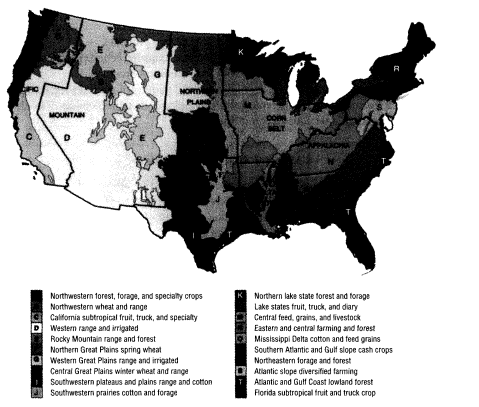
Figure 1
Land resource regions (LRRs) as of January 1984. SOURCE: Faeth (1995).
The database developed for this project encompasses predominant and alternative production systems for major crops in each of the 10 U.S. Department of Agriculture (USDA) production regions (Figure 1). Crops covered in the database include corn, sorghum, barley, oats, wheat, rice, soybeans, cotton, and hay. All alternative systems that our agronomic team could identify for which experimental or field data exist were included in the database. Predominant systems were identified using the Cropping Practices Survey (Daberkow and Gill, 1989) developed by the National Agricultural Statistical Service and Economic Research Service (ERS) and the Farm Costs and Returns Survey developed by the National Agricultural Statistical Service.
The data collected in the course of this study included basic agronomic data such as crop yield, input use, crop sequence, and field operations. These data provided a solid foundation for deriving estimates of various characteristics of each farming system, including cost of production, soil erosion rates, leachate contamination, and soil carbon sequestration. All data or estimates used for this
analysis were based on experimental or field data and the USDA's Erosion Productivity Impact Calculator (EPIC) (Williams and Renard, 1985).
As with WRI's case studies, the USDA's EPIC model was used to estimate soil erosion rates, short- and long-term crop yields, nutrient runoff, potential groundwater contamination, and soil carbon sequestration for each production system in each region. These representative estimates were based on the principal land resource regions (LRRs) for each of the 10 U.S. production regions and the predominant soils in those LRRs (Figure 1). The analysis was disaggregated into 48 LRRs for agronomic and environmental evaluation.4
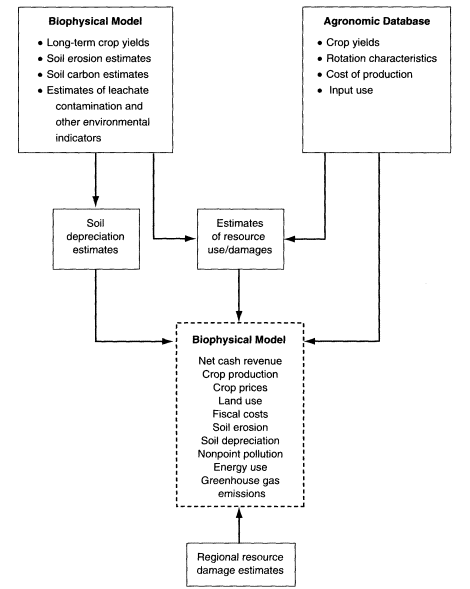
The U.S. Math Programming (USMP) model (House, 1987), developed by the ERS over the past decade for national economic policy analysis, was adapted for use in this study. In collaboration with ERS, WRI produced an NRA version of the USMP model by extending it to include alternative commodity production systems, soil depreciation allowances, soil carbon sequestration, energy budgets, and regional natural resource damages (Figure 2). Prior to this effort, the model covered predominant production practices only and did not include any environmental impacts.
Using the completed NRA version of the USMP model, WRI tested a variety of agricultural policy scenarios for the 1995-1996 farm bill discussions. The analysis estimated several variables for each policy scenario for each region, including commodity production, commodity prices, farm income, net economic value of agricultural production, fiscal cost of income support, value and level of agricultural trade, land use, gross soil erosion, value of soil depreciation, value of soil carbon sequestered, and value of off-farm surface water impacts.
The analysis was done from the standpoint of maximizing farmers' incomes over the long term, with postsolution calculations of public welfare (Chandler et al., 1981), because farm production decisions are made by farmers, not policy makers. To estimate the value of production to the farmer, we calculated net farm income, incorporating gross operating margin, a soil depreciation allowance for changes in soil productivity, and commodity program payments. The value of off-site resource damages was excluded because farmers do not pay these.
Public welfare was estimated by calculating the net economic value of production, using gross operating margin, a soil depreciation allowance, the value of off-site surface water damages (because society absorbs the costs of these damages), and the value to society of soil carbon sequestration (because mitigating global warming benefits society as a whole). Income support was excluded because these transfer payments do not alter the net economic value.
Through the analysis described above, the revised USMP model can identify the optimal technologies for each policy scenario and estimate their potential extent of use as determined by relative profitability. In this way, estimates can be generated of the physical extent and economic value of natural resource impacts for a given policy and technology mix.
The adapted model was first used to develop a standard baseline scenario reflecting the Food, Agriculture, Conservation and Trade Act of 1990 and production practices as of 1992, the last year for relevant national surveys. This baseline was then extended to take into account alternative production practices and long-term changes in soil productivity. Finally, the extended model was used to test a variety of policies, including different levels of flexibility and green-payment options for improving the environmental performance of agricultural policy.
The results of this study demonstrate that a reduction in agriculture's impact on the environment is both possible and economically advantageous. Only alternative production practices that improve farmers' bottom line are assumed to be adopted, and the alternatives represented are being used by small numbers of farmers or being developed and field tested by agricultural scientists. Many of these practices reduce production costs by improving input-use efficiency. Such alternative production practices could greatly help farmers conserve resources, improve productivity and profits, and reduce fiscal costs. Policy changes that remove the biases against such production practices would allow further improvement and save taxpayers money.
The extended baseline scenario implies that if farmers fully accounted for the cost of long-term soil productivity changes and if alternative production practices were fully available, soil erosion and its off-site costs would go down significantly. In the extended baseline, soil erosion is reduced nationally by 7 percent and damages by 10 percent. Soil depreciation cost estimates are relatively small, compared with other calculated production costs, and they are actually negative for production practices leading to yields estimated to increase over time. The larger effect in the baseline extension comes from including the alternative practices in the set of practices that the model can choose from. Many alternative practices turn out to be very competitive financially and come into the extended baseline model solution based solely on relative profits even though they also provide environmental benefits.
Policy analysis showed that green-payment options to subsidize conservation also help to improve environmental performance, but not all green-payment programs would work equally well, environmentally or fiscally. Targeted subsidies adjusted to account for the value of regional damages achieve lower program costs and have the greatest benefits.
Environmental performance increases with increasing commodity program flexibility. For the scenario we tested with the highest degree of flexibility, the indicators of environmental performance were nearly the same as for the best green-payment case. Two changes account for the environmental results under increased flexibility: both the acreage in production and the use of monocultural practices decline as flexibility increases.
Productivity Measurement in the Electric Power Industry
Productivity growth has long been an important concern of economists, industrialists, and government officials because it is recognized as the key to business profitability and economic welfare. The apparent lag in productivity growth in the U.S. economy, relative to other industrial countries and to our own past record, has generated many diagnoses and diverse policy prescriptions.
These concerns emerge from conventional measurements of productivity change that encompass only marketed outputs and inputs. Labor productivity, for example, measures output per worker. A broader measure, multifactor productivity (MP) (sometimes also called total factor productivity), measures output per unit of an index of labor, capital, and intermediate materials inputs. In this analytical framework, productivity change is defined as the difference between the growth rate of output and that of the index of inputs.
Almost no attempt has been made to measure environmentally related outputs (such as emissions) or inputs (such as natural resource services) that are not marketed or to assess their significance for economic productivity. What follows is an exploratory step in that direction, using the private electric power industry in the United States as an example. (For an update of this study and two additional cases including the pulp and paper and agriculture sectors, see Repetto et al., 1996.)
A typical 500-MW coal-fired power plant produces more than just 3.5 billion kWh of electricity per year. The 1.5 million tons of coal and 0.15 million ton of limestone it uses as inputs reappear in some form as outputs. Emissions to the atmosphere include 1 million tons of carbon in the form of carbon dioxide, 5,000 tons of sulfur as sulfur dioxide, 10,000 tons of nitrogen oxides formed largely from air drawn into the combustion process, and a variety of other compounds. Solid outputs include 140,000 tons of ash and 193,000 tons of scrubber sludge, which contain 5,000 and 40,000 tons of sulfur, respectively.
A more general measure of economic productivity, recognizing the conservation of matter and energy, would assess the extent to which the industrial transformation of materials has yielded outputs with greater economic benefits—or lower economic costs—than the costs of the inputs. Many of the power plant's unmarketed outputs have economic significance. Airborne sulfur emissions, for example, affect human health, plant growth, and the durability of materials. As recent experiments with marketable emissions rights indicate, the extent to which such outputs are marketed is largely an institutional arrangement. Productivity measures restricted to a subset of economically significant inputs and outputs can misrepresent technological progress in the industry.
As a step toward a broader measure, we developed an index of atmospheric emissions by weighting each of three pollutants (sulfur and nitrogen oxides and particulate matter) according to their estimated economic significance, defined as
the marginal damages caused by an additional ton emitted in 1987. Kilowatt hours generated per unit of emissions, a single-factor measure of environmental productivity, improved much more rapidly than capital, labor, or energy productivity between 1970 and 1987. The index of emissions fell by 30 percent over this period, while electricity output increased. Had emissions per kilowatt hour remained at the 1970 level, the electric power industry would have emitted 10 million more tons of sulfur dioxide in 1987 than it did.
If the electric utility produces both kilowatt hours and emissions, a MP measure can be constructed incorporating the changing output mix. The share of emissions in total output should be measured in economic terms using their ''shadow prices" (i.e., estimates of the marginal damages to the economy occasioned by an additional ton of each pollutant). Such estimates are hard to obtain, because damages vary across the country and are not reflected in market transactions. As the best available approximations, we used estimates prepared by U.S. Environmental Protection Agency and reviewed by the Office of Management and Budget. Their best estimate of marginal damage costs for sulfur dioxide emissions in 1987 is $637 per ton, with a range of $290 to $1,612. Damages to health, materials, agriculture, and visibility are included in the total, but contributions to acidic deposition or climate change are not. Analogous numbers for particulate matter and nitrogen oxides are $2,550 and $230 per ton, respectively.5
Using these shadow prices to estimate the value of emissions in each year,6 the cost of emissions as unpriced outputs of the electric power industry in the 1980s was about as large as the cost of labor to the industry. Hence, emissions have as great a weight as labor in a generalized productivity index.
In summary, productivity growth in the private electric power industry during these years appears two to three times as high if its progress in reducing economically damaging emissions is taken into account. In addition, productivity in the industry increased more rapidly in the 1970s, when emissions were being reduced more rapidly, than it did in the 1980s, when the rate of decline was more modest. This is contrary to the conclusions of conventional MP measurements, which do not incorporate environmental imports (Table 5).
Although this is a preliminary exploration, it suggests that technologies that reduce environmental damages contribute significantly to economic productivity. They do not merely raise production costs. The example also suggests that it is important to measure environmental dimensions of productivity to avoid one-sided assessments.
Conclusion
Economic indicators and analyses that count the cost of environmental protection but ignore the cost of environmental degradation and the loss of natural assets mislead both public and private decision makers. The problems with productivity measurement, for example, have led to serious misunderstandings about
TABLE 5 Estimates of Multifactor Productivity in the Electric Power Industry (percent per year)
|
|
|
Incorporating Emission |
|
|
Period |
Conventional Measure |
Index Aa |
Index Bb |
|
1971-1985 |
-0.38 |
0.62 |
0.33 |
|
1971-1979 |
-1.10 |
0.26 |
-0.18 |
|
1980-1985 |
0.69 |
1.17 |
1.10 |
|
a Index A assumes that marginal damages were constant in real terms. Refer to footnote 6 for more information. b Index B assumes that marginal damages increased in real terms in proportion to gross national product. Refer to footnote 6 for more information. SOURCES: Jorgenson and Fraumeni (1990) and U.S. Environmental Protection Agency (1994). |
|||
the effects of environmental policies on the economy and distortions in the policy making process. As productivity declined during the 1970s, economic studies claimed that environmental regulations were responsible for up to half of the productivity decline observed in pollution-intensive industrial sectors.
This and similar findings continue to resonate in current environmental policy debates. Behind efforts to weaken environmental laws or their enforcement lies the belief that such regulations impose costly burdens on the economy, stifling innovation and lowering productivity. However, the conclusion that environmental regulations have reduced the rate of productivity growth is an artifact of a basic flaw in the way productivity is measured, as the case presented here for the electricity sector demonstrates.
Similarly, the failure to include natural resource stocks in national accounts leads to the mistaken notion that their depletion contributes to income growth. Again, this follows from a key omission in an important economic indicator.
The series of studies reviewed here show that when economic indicators are restructured to include environmental gains and losses, the results will lead to conclusions that support the economic efficacy of environmental policy: pollution control can increase productivity by reducing environmental damages; wise use of natural resources makes economic sense; and the elimination of commodity subsidies is fiscally as well as environmentally sound.
Notes
-
additions to petroleum reserves in these years was considerably larger than all categories of depletion combined, leading to negative depreciation. One way of resolving this apparent anomaly would be to account separately for additions and subtractions from natural resource assets. Real capital gains (as distinct from those resulting from price changes) can be accounted for as gross income and gross capital formation. This is consistent with our earlier definition of income because additions to resources during the current year augment the amount that could be consumed currently without reducing potential consumption in future years. This is obvious in the case of forest growth but less obvious for mineral discoveries, because current discoveries may leave less to be discovered later on. However, insofar as additions to mineral reserves reflect advances in the technology of exploration or extraction, the total potential resource base will have expanded.
-
6.
Because year-by-year estimates of marginal damages were not available, two alternative assumptions were used to extrapolate the marginal damages backward in time to 1970. The assumptions reflect two offsetting trends: in earlier years, emissions were greater, so marginal damages should have been higher, but the size of the economy was smaller, so that damages should have been smaller, also. The first assumption, therefore, was that marginal damages were constant over the period in real terms (Index A of Table 5). The alternative was that marginal damages increased in real terms in proportion to real GNP (Index B of Table 5). Alternative estimates of MP were made reflecting these assumptions.
References
Chandler, W., J. Fortuny-Amat, and B. McCarl. 1981. The potential role of multilevel programming in agricultural economics. American Journal of Agricultural Economics 63(1):521-531.
Daberkow, S., and M. Gill. 1989. Common crop rotations among major field crops. Pp. 34-39 in Agricultural Resources: Inputs Situation and Outlook Report. Report No. AR-15. Washington, D.C.: Economic Research Service, U.S. Department of Agriculture.
Faeth, P., ed. 1993. Agricultural Policy and Sustainability: Case Studies from India, Chile, the Philippines and the United States. Washington, D.C.: World Resources Institute.
Faeth, P. 1995. Growing Green: Enhancing the Economic and Environmental Performance of U.S. Agriculture. Washington, D.C.: World Resources Institute.
Faeth, P., R. Repetto, K. Kroll, Q. Dai, and G. Helmers. 1991. Paying the Farm Bill: U.S. Agricultural Policy and the Transition to Sustainable Agriculture. Washington, D.C.: World Resources Institute.
Hicks, J. R. 1946. Value and Capital: An Inquiry into Some Fundamental Principles of Economic Theory. Oxford: Oxford University Press.
House, R. 1987. USMP Regional Agricultural Model (GAMS version guide), Unpublished mimeo, Economic Research Service, Washington, D.C.
Jorgenson, D., and B. Fraumeni. 1990. Productivity and U.S. Economic Growth: 1979-1985, unpublished discussion paper for the Harvard Institute of Economics, Harvard University, Cambridge, Mass.
Repetto, R., W. Magrath, M. Wells, C. Beer, and F. Rossini. 1989. Wasting Assets: Natural Resources in the National Income Accounts. Washington, D.C.: World Resources Institute.
Repetto, R., D. Rothman, P. Faeth, and D. Austin. 1996. Has Environmental Protection Really Reduced Productivity Growth? We Need Unbiased Measures. Washington, D.C.: World Resources Institute.
Ribaudo, M. 1989. Water Quality Benefits from the Conservation Reserve Program. Agricultural Economic Report No. 606. Washington, D.C.: Resources and Technology Division, Economic Research Service, U.S. Department of Agriculture.
United Nations. 1975. A System of National Accounts. New York: United Nations.
U.S. Environmental Protection Agency. 1994. National Air Pollution Emission Trends, 1900-1993. Washington, D.C.: Office of Air Quality Planning and Standards, U.S. Environmental Protection Agency.
Williams, J. R., and H. G. Renard. 1985. Assessments of soil erosion and crop productivity with process model (EPIC). Pp. 68-102 in Soil Erosion and Crop Productivity, R. F. Follett and B. A. Stewart, eds. Madison, Wis.: American Society of Agronomy.
World Bank. 1988. World Development Report. Oxford: Oxford University Press.


