
4
The Nature of Primary Care
Primary care can be a rewarding and challenging enterprise. Its position in relation to the body of health care was characterized in 1961 in the now classic paper ''The Ecology of Medical Care." This report by White and his colleagues (White et al., 1961) found that for every 1,000 adults, 750 people perceived a personal illness of some sort in a given month and 250 people sought care from a health care professional. Few of these patients were seen by specialists or hospitalized, and only a tiny fraction made their way to academic centers where most medical teaching and research take place. Primary care could be considered the care provided to these 250 individuals—care that is positioned between self-care and the remainder of the clinical enterprise. Primary care also includes carefully defined efforts to promote health and prevent disease in the entire population in coordination with public health activities.
On the one hand, the problems presented to primary care physicians are sufficiently important for patients to seek help. On the other hand, most of the problems are resolved at the level of primary care and typically do not result in referral, consultation, or hospitalization. Indeed, problems that can be resolved at the primary care level are known to constitute the bulk of the contemporary clinical enterprise.
The committee learned through site visits, public testimony, and workshops that primary care is neither so easy that anyone can do it, nor so difficult that no one can do it. The knowledge base required in primary care includes elements from the biomedical, behavioral, and social sciences, clinical epidemiology, and biostatistics, but the base required in primary care is not merely the sum of existing specialty knowledge found in medicine and nursing. Some of these
elements are shared with public health (e.g., epidemiology and biostatistics), and many are shared with other fields of medicine. Primary care practice uses a unique blend of these knowledge bases, skills, and communication style. This chapter, without attempting to be exhaustive, describes further the content and characteristics of primary care.
Content Of Primary Care
The Large Majority of Health Care Needs
The committee's definition of primary care stresses that primary care clinicians address a large majority of the problems people bring to the health care system. The content of primary care has been described in multiple ways, and the committee examined data from national surveys conducted in the United States and other countries. Glimpses of primary care can be appreciated by considering reasons for visits and the range of problems addressed by various clinicians.
The National Ambulatory Medical Care Survey (NAMCS) samples office visits to physicians and provides information on type of physician, the patient's stated reason for visit, the diagnosis, interventions, and so forth. Rosenblatt et al. (1995) using NAMCS data from 1989 and 1990 has characterized the content of nonreferred ambulatory visits to office-based physicians in the United States as diagnostic clusters. These clusters incorporate the problems people choose to bring to the health care system. They have remained stable over time and approximate the content of primary care practice.
The 20 diagnostic clusters shown in Table 4-1 (in rank order by frequency) incorporate just over half of nonreferred visits to U.S. physicians. They cover a spectrum of conditions that are not confined to a particular organ system, gender, or age group. They include acute and chronic problems, diseases and syndromes, mental health concerns and trauma, and visits focused on prevention. All of the clusters reflect problems whose solutions could have a considerable impact on the health of individuals and for which people expect expert care. They are neither trivial in their importance nor simple in terms of their diagnosis and management.
Figure 4-1 shows the portion of care for these clusters that is provided by three types of physicians: family physicians, internists, and pediatricians. Other physicians provide the remaining 10 percent or so of visits associated with a given diagnostic cluster. These specialties include orthopedists for sprains, strains, low back pain, and degenerative joint disease, and obstetricians for general medical examinations and urinary tract infections.
Although the NAMCS data display the most common diagnostic clusters, the distribution of visits by cluster cannot convey the level of complexity or severity of problems seen in primary care. Some indication of this complexity has been provided by Barondess (1982), who reviewed consecutive visits to his practice of
TABLE 4-1 Diagnosis Clusters That Make Up the Majority of Nonreferred Ambulatory Visits to U.S. Office-Based Physicians, NAMCS, 1989–1990
|
Rank |
Cluster Title |
Percent |
Cumulative Percent |
|
1. |
General medical examination |
7.2 |
7.2 |
|
2. |
Acute upper respiratory tract infection |
6.2 |
13.4 |
|
3. |
Hypertension |
4.4 |
17.8 |
|
4. |
Prenatal care |
4.3 |
22.1 |
|
5. |
Acute otitis media |
3.5 |
25.6 |
|
6. |
Acute lower respiratory tract infection |
2.7 |
28.3 |
|
7. |
Acute sprains and strains |
2.7 |
31.0 |
|
8. |
Depression and anxiety |
2.5 |
33.5 |
|
9. |
Diabetes mellitus |
2.1 |
35.6 |
|
10. |
Lacerations and contusions |
1.9 |
37.5 |
|
11. |
Malignant neoplasms |
1.7 |
39.2 |
|
12. |
Degenerative joint disease |
1.7 |
40.9 |
|
13. |
Acute sinusitis |
1.6 |
42.5 |
|
14. |
Fractures and dislocations |
1.6 |
44.1 |
|
15. |
Chronic rhinitis |
1.5 |
45.6 |
|
16. |
Ischemic heart disease |
1.4 |
47.0 |
|
17. |
Acne and diseases of sweat glands |
1.3 |
48.3 |
|
18. |
Low back pain |
1.2 |
49.5 |
|
19. |
Dermatitis and eczema |
1.2 |
50.7 |
|
20. |
Urinary tract infection |
1.1 |
51.8 |
|
* The estimated number of visits for 1989–1990 (the denominator) is 1,297,334 (in thousands). This is based on 74,390 survey visits. All relative standard errors are less than 30%. SOURCE: Rosenblatt et al., 1995. |
|||
general internal medicine over a 20-day period. He divided the clinical problems that he saw into several broad categories—cardiovascular, psychiatric, gastrointestinal, infectious, and so forth. Barondess concluded that about 10 percent of patients seen in each category of problems had major and often life-threatening disease, some acute and some chronic, some with complications and some without. In addition, within each organ system, some patients had an unusually complex disorder. Overall, he reported that a large number of these patients required sophisticated and complex clinical judgments "related to the identification, clinical course, potential complications, and management of a large number of major organic diseases" (p. 736). Such problems may require the judicious use of available technologies and efforts to enhance comfort and functional status and to forestall hospitalization.
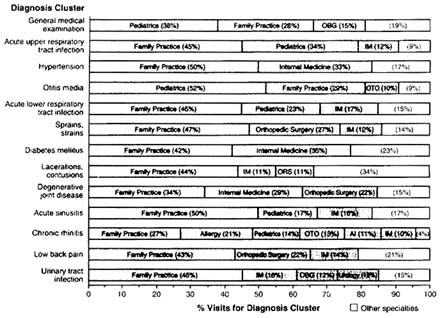
FIGURE 4-1 Physician specialties providing care for generalist-dominant diagnosis cluster, NAMCS 1989–1990 (all specialties are listed that accounted for ≥ 10% of visits for that condition). All relative standard errors are ≤ 30%. AI = allergy and immunology; Internal Medicine (IM) = general internal medicine; OBG = obstetrics and gynecology; ORS = orthopedic surgery; OTO = otolaryngology; Pediatrics = general pediatrics. Unlabeled cells represent other specialties. SOURCE: Rosenblatt et al., 1995.
Episodes of Primary Care
To measure accurately the effects of primary care, data systems and research methods must be able to reflect the co-occurrence of health problems and the longer time frames needed to evaluate the integrative functions of primary care—comprehensiveness, continuity, and coordination. However, in primary care, recording the content of care using standard coding systems such as the International Classification of Diseases or the Diagnostic and Statistical Manual (for mental health) is inadequate because of the complex interplay among diagnostic categories and other clinical or social problems a patient may often simultaneously experience. Current U.S. databases, such as those provided by NAMCS, are by design cross-sectional analyses of single visits and thus cannot capture episode information.
These databases compile diagnostic data from the point of view of visits to clinicians reflecting the practitioner perspective rather than the perspective of the
patient in terms of the variety of problems that a given patient brings to the health care system and the services of clinicians who care for those problems over a period of time.
Because of such limitations in coding, attempts have been made to describe primary care in terms of episodes. The term episode of care refers to a problem or illness in a patient during the time from its first presentation to a clinician until the completion of the last encounter for that same problem or illness, whether this covers a short period of, for example, several weeks or a much longer time (Lamberts et al., 1993). The concept of episodes of care is discussed in more detail in Chapter 8 with respect to research applications.
The Netherlands Transition Project, which uses the International Classification of Primary Care (ICPC), provides detailed information on the content of family practice in the form of episodes of care for age- and sex-specific groups (Lamberts and Wood, 1987; Lamberts et al., 1993; Lamberts and Hofmans-Okkes, 1996). By distinguishing reasons for encounter, diagnoses, and interventions and displaying them for such groups, the Project provides a wealth of information about the distribution of interventions, comorbidities, and rates of referral in enrolled primary care populations. The committee undertook data analyses using both national databases and data provided by several large HMOs to see whether the European approach could be used to understand how primary care is delivered in the United States.
The use and sequencing of interventions and the complex interplay in primary care of comorbidities can be understood using ICPC and methods that are well suited to primary care. This methodology is now used in several European countries; however, the committee found very little comparable work in the United States to elucidate primary care in this promising manner (Klinkman and Green, 1995). The committee undertook a data exercise using U.S. data from national surveys and data collected from several large integrated health care delivery systems to approximate the Dutch analyses as a means of understanding what range of personal health care needs appear to be met here by primary care. This effort is briefly reviewed in the Appendix.
Characteristics Of Primary Care
The complexity of primary care requires that its description include a variety of attributes. Participants at a workshop organized by the Institute of Medicine (IOM) committee in January 1995 explored the science base of primary care and described research needed to strengthen that knowledge base (Appendix C). The six aspects of primary care were emphasized.
- Excellent primary care is grounded in both the biomedical and the social sciences.
- Clinical decisionmaking in primary care frequently differs from that in referral specialties.
- Primary care has at its core a sustained personal relationship between patient and clinician.
- Primary care does not consider mental health separately from physical health.
- Opportunities to promote health and prevent disease are intrinsic to primary care practice.
- Primary care is information intensive.
Biomedical and Social Sciences
Biomedical Sciences
Biomedical knowledge is as important in primary care as it is in secondary or tertiary care. Primary care draws from biology to provide diagnostic, prognostic, and therapeutic services to help acutely and chronically ill patients. Biomedicine incorporates a range of sciences including physics, chemistry, molecular and cellular biology, and clinical epidemiology. Few conditions are now completely understood at all levels ranging from the molecular to the behavioral, although such understanding seems achievable in the future.
Social Sciences and the Humanities in Primary Care
Beyond the knowledge of disease is knowledge of the patient as a human being. Humanism is a core area of primary care practice. Defined knowledge, skills, and attitudes contribute to a good clinical process in several core areas: the medical interview, behavioral medicine, and medical ethics.
Behavioral sciences. The management of many primary care problems, especially in the context of family and community, leans heavily on the social sciences. Theories of behavior change help primary care clinicians to
- involve individuals in their own care,
- improve compliance with therapeutic regimens,
- understand causes and utilize effective interventions to reduce substance abuse, and
- integrate the family in dealing with illness and health.
Knowledge from the social sciences and theories regarding social support and confidence in one's ability to change behavior in dealing with a particular problem—called self-efficacy—can also be applied to many primary care conditions. Such knowledge and theories include those relating to occupationally
related problems and disorders emanating from the stresses of living and to the adoption of health-promoting behaviors.
Communication. A core skill for the primary care clinician is expertise in communication and, in particular, the medical interview. The behavioral sciences can contribute to effective skills in sequencing the interview, organizing information, eliciting and responding to patients, understanding verbal and nonverbal communication, and engaging the patient's participation as an ally in the therapeutic plan (Lipkin et al., 1984).
Medical ethics. The primary care clinician is an agent of the patient and his or her welfare, but ethical dilemmas often present themselves. Such issues require working skills in applying sometimes conflicting ethical precepts related to bringing about benefit, avoiding harm, enhancing patient autonomy, and increasing the aggregate well-being of a panel of patients under the clinician's care as well as that of an individual patient. As is true for clinicians in any field of medicine, these issues require not only compassion but also skills drawn in part from the humanities. They include a range of concerns such as accommodating or resisting end-of-life decisions; assisting and intervening when necessary with problems involving patients and their families; adopting appropriate roles when disagreements arise about insurance coverage or the confidentiality of patient information; using genetic and diagnostic tests; and deciding to use or not use life-sustaining technologies.
Evidence-Based Medicine
Biomedical knowledge in primary care requires that research evidence be applied to individual patients using an approach that has come to be called evidence-based medicine. A large portion of the research evidence comes from basic research and from randomized clinical trials. Applying such information in the primary care setting is particularly challenging because such studies typically restrict their choice of subjects to those who do not have multiple problems or are of a specific age or gender.
In addition to knowledge derived from the basic and biomedical sciences and randomized clinical trials, primary care clinicians use results of population-based epidemiological studies that examine risk factors for disease and information from outcomes and effectiveness studies of treatments used by community-based clinicians. Clinicians supplement their knowledge of mechanisms of disease and therapies and their clinical experience with information about the probabilities that (a) particular screening or diagnostic tests will be useful, (b) a patient has a given illness, and (c) such an illness will progress or improve. This, in the aggregate, is evidence-based medicine, and it requires that clinicians be proficient
in searching the literature and in critically appraising that literature using formal rules of evidence (Evidence-Based Medicine Working Group, 1992).
Clinical Decisionmaking
General Observations
Rosser (1996) and Sox (1996) have suggested that primary care clinicians differ from specialists in their approach to clinical decisionmaking. The additional information available to primary care clinicians but not to specialists affects the development of hypotheses to explain conditions, influences the ordering of probabilities, and either enlarges or constrains the options for response. Primary care clinicians, in contrast to referral specialists, must consider a very broad range of possibilities, often at an earlier time in the natural history of their patients' problems, and they must tolerate unavoidable uncertainty when diagnosis is not possible. Some problems never resolve, some are never diagnosable, and some never require further intervention; they simply persist as part of the environment in which a patient-clinician relationship continues. What may appear as a lack of precision in diagnosis by primary care clinicians is often appropriate, given the nature of the problems presented to primary care clinicians.
Influence of Different Clinical Roles
The overall care process. According to Sox (1996), different clinical roles in primary care and referral practice affect decisionmaking throughout the care process. The specialist is often asked to focus on a single problem, whereas the primary care clinician is often required to deal with multiple problems simultaneously. Indeed, comorbidity is virtually a constant in primary care practice; a typical primary care patient has an active problem list of about six problems. This factor often precludes assignment of causal relationships with any certainty, and it constrains therapeutic options that would otherwise be available to manage a single disease or problem.
Furthermore, the referral specialist often sees patients for a single visit and has only limited knowledge of the patient's background or history; by contrast, the primary care clinician often has an ongoing relationship with the patient and has relevant knowledge of the patient's history and situation. The specialist is frequently expected to reach an immediate and definitive resolution of a health concern; the primary care clinician can observe the patient over time, watching for evolution that indicates greater (or lesser) importance or urgency. Common concerns such as fatigue, headache, or insomnia require that the primary care clinician assess the situation, estimate its immediate seriousness, and, in many instances, provide reassurance to the patient even if a diagnosis of disease cannot
be made at that time. Prognosis in primary care requires a knowledge of the person, community, and family as well as the importance of the symptom or concern. Utilizing this information enables the primary care clinician to determine whether early action can do more harm than good and whether watchful waiting is indicated.
Use of diagnostic tests and procedures. Sox (1996) compares the reasoning by both kinds of clinicians to explain why primary care clinicians may order fewer diagnostic tests than referral physicians. If primary care clinicians tend to refer when tests are equivocal or symptoms do not resolve with observation or treatment, a referral practice would be enriched with patients who have intermediate probabilities of disease—that is, the diagnostic puzzles of medicine. Said differently, referral practice consists of patients with a higher probability of having particular diseases than would be expected in primary care practices.
This circumstance may lead both to a different approach to testing and to a different frequency and selection of tests in primary care as compared to the patterns in referral practice. For one thing, diagnostic tests and procedures have different performance characteristics depending on the prevalence of conditions in the tested population. Tests that could be of great help to a primary care clinician might lack the precision required in specialty practice, and tests that help a specialist might cause more harm than good in primary care practice.
Consequently, the choice and interpretation of tests in primary care practice would logically be expected to differ from testing in specialty practice. For example, a test that measures the sedimentation rate of red blood cells is relatively nonspecific, but it helps to rule out significant disease if the result is negative. This is of more value in primary care than in specialty care. By contrast, invasive tests that carry some risk of morbidity and even mortality may be of more value in specialty practice where the probability of disease is higher.
Personal Aspects of Primary Care
Primary care has at its core a partnership between patient and clinician; that partnership is meant to encourage active patient participation, sharing of information and responsibility, and joint goal setting and decisionmaking. The contributions of primary care to effective health care systems are not achievable in the absence of trust between primary care clinicians and their patients.
Patients' views of primary care are expressed through their decisions about whether and when to bring a problem to the attention of clinicians. The reasons people give for seeking care—the symptom or concern—and the degree to which these problems are addressed during a patient visit are negotiated during the encounter between clinician and patient. This negotiation may be direct or unspoken. Some questions may be left unanswered, some problems unexplored.
When addressing patient health problems, diagnosis may be critically important
or irrelevant to the care that is given, and diagnostic codes often fail to capture the content of a visit and the important contributions of primary care. For example, providing emotional support, information, and accurate assessment of a condition may be of great importance. At times, the most important task is simply to listen as a patient shares his or her burden, and the most powerful intervention may be the interest shown in the patient and the problem the patient is concerned about.
Health care choices can be critical for a patient. From the patient's perspective health care is complex and perplexing, both in terms of how to navigate the system to obtain appropriate care and in terms of what choices exist and how to go about making them. Considerations such as whether to act now or wait, choose a surgical procedure, or embark on a lifetime course of medication are fraught with uncertainty.
Surveys have repeatedly shown that patients want information about diseases, treatments, and their benefits and risks. For clinicians to be able to frame risks and benefits accurately and to recommend interventions also requires them to have good knowledge of their patients and their patients' goals and preferences.
The fields of decision analysis, risk communication, and health behavior have all contributed to a better understanding of how to assess and convey information in primary care practice; work by Mulley, Wennberg, and others in the area of shared decisionmaking has been especially influential (Mulley, 1991; Kasper et al., 1992). Mort (1996) reported on the use of interactive laser disc technology as a decision support tool for patients. This technique combines narrative and patient testimonials in ways that permit viewers to hear from patients who have made different choices and experienced different outcomes. The narrative tailors estimates of risk and benefits to help patients consider difficult decisions such as hormone replacement therapy, prostate surgery, and surgical alternatives for early-stage breast cancer.
Patients come to primary care with their own belief systems, however, based in the context of their family, community, and culture. A lack of awareness or insensitivity to the patient's background reduces the likelihood that the goals of primary care will be achieved. Two recent studies demonstrate this point.
Western clinicians typically view informed consent and advanced care planning as having great importance and potential to benefit their patients; moreover, their patients usually expect such information and input into decisionmaking. Carrese and Rhodes (1995) documented the potential of cross-cultural misunderstanding involving beliefs that speech itself has the power to help or to harm. Among traditional Navajo, discussing and thinking about negative information is viewed as potentially harmful. Understanding this cultural preference has clear implications for how a clinician should discuss with Navajo patients the need for prenatal care or immunizations, the options and risks for a treatment or surgical procedure, or advance directives concerning life-sustaining therapies. In a second
example, Blackhall et al. (1995) found that Korean Americans and Mexican Americans were less likely than European Americans to believe that patients should be told of a terminal prognosis. They suggested that physicians ask their patients if they wish to receive such information and make decisions themselves or if they prefer that their families handle such matters. Primary care clinicians must be aware of these preferences on the part of their patients and insofar as possible act accordingly. The personal aspects of primary care also include the important area of self care. Most symptoms are self-evaluated and self-treated without the help of health professionals (White et al., 1961), and a vital function of primary care is to increase self-care competence so that patients can become active partners in health care (Sobel, 1994; Vickery and Lynch, 1995). By providing information, answering questions, and helping patients find other resources for help, primary care clinicians can foster knowledgeable and confident self care.
Mental Health and Physical Health
In a paper prepared for the IOM committee deGruy has documented the inability to separate mental and physical health states (see Appendix D).1 Mental distress, symptoms, and disorders are usually embedded in a matrix of explained or unexplained physical symptoms as well as acute and chronic medical illnesses. When a patient with a mental disorder presents to a primary care clinician, it is usually by means of a physical complaint. Primary care patients with mental diagnoses—whether or not they meet formally defined diagnostic criteria—show profound functional impairment. Wells and colleagues (1989) demonstrated, for example, that depressed patients had functional impairments comparable to patients with chronic medical conditions such as chronic obstructive pulmonary disease, diabetes, coronary artery disease, hypertension, and arthritis (see also Wells and Sturm, 1995). Patients with mental diagnoses also have consistently higher medical utilization rates than their unaffected counterparts.
Primary care clinicians frequently are required to deal with mental symptoms as part of a physical problem. For example, two-thirds of primary care patients with a psychiatric diagnosis have a significant physical illness that precedes the psychiatric diagnosis. Chronic medical illnesses increase the likelihood of depression by two- to threefold. Primary care patients do not view their mental diagnoses as something apart from their general health, and they frequently will not tolerate clinicians' doing so. One-third to one-half of primary care patients refuse referral to a mental health professional even when a diagnosis of an important mental illness is present. The future of primary care obviously requires
|
1 |
Material included in this section is referenced in Appendix D, Mental Health Care in the Primary Care Setting. |
learning more about the utility of recognizing and managing mental health problems as an inseparable component of practice.
Recognized biases in recording mental health problems often occur because of reimbursement disincentives for clinicians and stigmatization of patients. These biases, whether attributable to underrecognition or underreporting by primary care clinicians, produce remarkable underestimates of mental health problems and subsequent care for these problems in primary care; for example, the diagnostic cluster of depression and anxiety accounts for only about 2.5 percent of nonreferred ambulatory visits according to the NAMCS data (see Table 4-1). By contrast, other sources estimate that 10 to 20 percent of the general population will consult a primary care clinician for a mental health problem in the course of a year. The proportions of pediatric primary care patients with significant psychosocial or psychosomatic problems are about 15 percent and 8 percent, respectively. Overall, 10 to 40 percent of primary care patients have a diagnosable mental disorder (this does not imply, however, that it would be desirable to recognize or treat all of these).
All in all, the committee views the indivisibility of mental and physical health as very significant for the future of primary care and for the ultimate health and well-being of patients and populations. The topic is addressed in more depth in the following chapter.
Health Promotion And Disease Prevention
Although society has long espoused the need for preventive as well as curative medicine, only recently has prevention been incorporated into primary care on a scientific basis. In 1974 the Lalonde report, A New Perspective on the Health of Canadians, estimated the burden of disease and concluded that about 40 percent of this burden was the result of personal behaviors and modifiable risk factors (Lalonde, 1974). Thus, effective screening programs aimed at well-designed preventive care were recognized as potentially fundamental components of primary care. The immediate responses to this report were twofold: (1) to examine modifiable risk factors more systematically, especially those attributable to personal behaviors; and (2) to develop strategies that could detect problems at the level of primary care, where early intervention could lead to superior results for patients and the population as a whole.
Given the large number and variety of possible preventive services that primary care clinicians might offer their patients, a systematic approach to selection is essential. The principles of screening applicable to the primary care setting have been carefully crafted and include such considerations as seriousness and prevalence of possible target conditions, the value of early detection, and the availability of adequate, acceptable, and affordable tests and treatments. The U.S. Preventive Services Task Force (1989, 1996) has continued the systematic evaluation of clinical prevention strategies, and now primary care clinicians have
a host of scientifically supported recommendations to forward to their patients and implement in their practices.
Another goal of prevention is to maintain function in the presence of unavoidable impairment in children and adults of all ages. Accomplishing this often involves dealing with complex problems that require clinicians to coordinate care across different settings, to involve family and community in meaningful ways, and to develop and pass along anticipatory guidance for children and families.
Increased opportunities to develop preventive strategies in primary care and to coordinate them with public health efforts using a systems approach are elucidated by Welton et al. (Appendix F). Currently, the interface between primary care and public health is irregular and undefined, but achievable linkages exist that could improve community and population health and lead to the achievement of public health goals. As with the issues of mental health noted above, the coordination of primary care personal services with public health programs is examined in more detail in Chapter 5.
The Power of Information
The knowledge base that is relevant to a large majority of the problems that people bring to their primary care clinicians is large and constantly evolving. Similarly, the databases that ought to be developed and maintained for patients registered and seen in primary care practices are sizeable and expanding. In the past, many clinicians interested in primary care declined to enter primary care practice because of the intimidating prospects of not being able to manage the information challenges. That situation is changing.
The computer revolution has matured to the point that useful applications of information systems and computer-based patient records—technologies not previously available in any meaningful way—are now poised for wide implementation into primary care practice; indeed, computer-based systems and telecommunications are likely to become key elements of the primary care infrastructure. Management functions of such electronic information technologies include those related to registering patients, making appointments, and handling financial elements of practice. More important, however, are the growing numbers of clinically useful applications, which provide profiles of practice patterns, produce reminders for needed services, and open up access to support systems of various kinds. Although these advances are relevant for both primary and specialty care, they hold special promise for primary care, where the information and coordination needs are greater.
Summary
No health care system can be complete without primary care, the nature of
which has been examined in this chapter in terms of the large majority of personal health care needs of patients and with respect to several key characteristics. In the United States, the time is right for primary care, as understood by this committee, to undergo more systematic and creative development and to expand as the foundation of health care delivery. Primary care is amenable to improvement through the methods of science, the implementation of key supporting infrastructures such as information systems, and the use of relevant principles of management and organization.
What has been described about the nature of primary care in this chapter has implications for the actual delivery of primary care (discussed in Chapter 5), for the existing supply of primary care clinicians (Chapter 6), and for health professions education (Chapter 7). An understanding of the nature of primary care also raises questions that cannot now be answered because of the inadequacy of the current knowledge base. These topics are the basis of the committee's conclusions and recommendations about needed research in primary care that are described in Chapter 8.
Appendix: Data On The Majority Of Personal Health Care Needs
As noted in the main text, the Netherlands Transition Project of the Department of Family Practice at the University of Amsterdam (Lamberts et al., 1993; Lamberts and Hofmans-Okkes, 1996) uses episodes of care to characterize age-and sex-specific patterns of care. These data yield considerable insights into the types of conditions, diagnoses, and reasons for visit for the Dutch population. The information and the episode-based approach can also provide insights for the U.S. population, not with standing the fact that the Dutch population is both considerably smaller and far more homogeneous than that in the United States. Apart from the value of the information with respect to indicating the incidence and prevalence of conditions seen by primary care practitioners, the Netherlands Project data point the way to using a form of episode analysis that may be useful here for both epidemiologic and research purposes.
To explore this possibility, the committee engaged in a data collection and analysis effort based on national survey information and specially generated information from selected health maintenance organizations and managed care entities (Hofmans-Okkes and Lamberts, 1995). This appendix presents a brief explanation of the Netherlands Transition Project approach and gives an illustrative set of data on one age-sex cohort (women ages 25 to 44); it also includes a short discussion of the analyses done using U.S. data.
Description of Data
The Netherlands Transition Project
The Dutch data shown in the first set of tables in this appendix include episode-oriented information for 15,158 enrolled women between the ages of 25 to 44 (of whom 11,570 had visited their family physician at least once in the relevant year). The information here is given for illustrative purposes; similar data are available on women in all other age categories (e.g., 75 years or older), on men of all age groups, and children.
For making inferences about diagnoses, reasons for encounter, and other specific elements of episodes of care, the Transition Project uses the International Classification of Primary Care (ICPC); the ICPC is specifically designed by the World Organization of Family Doctors to characterize primary care episodes (Lamberts and Wood, 1987; Lamberts et al., 1993). This classification scheme uses three main elements: (1) the patient's reason(s) for encounter; (2) the diagnostic label assigned to the episode of care; and (3) the diagnostic and therapeutic interventions by the primary care clinician, including referrals to specialists. It maps well to the International Classification of Diseases (ICD) tenth edition and reasonably well to the ICD-9-CM, which is the ninth edition with clinical modifications.
The tables in this appendix present data in terms of the ''top 20s," that is, the first (or top) 20 diagnoses or reasons for encounter among women in this age group. Typically, analyses involving the top 20s will account for a proportion of episodes of care that exceed, often by wide margins, 30 percent of all episodes. Thus, the top 20 new episodes give a global impression of the magnitude and diversity of acute personal health care needs; the top 20 old episodes indicate the burden of chronic illness and long-term episodes or follow-up (including for health maintenance and preventive care). The information on interventions reflects the processes of care; for enrolled populations in plans or health care systems that rely heavily on primary care practitioners, the information on referrals suggests what portion of care cannot be or customarily is not handled by those in primary care.
The Dutch data are presented for the following types of enumerations:
- diagnostic labels—for "new" episodes—i.e., episodes of care for reasons that have not surfaced previously for these patients (Table 4A-1);
- diagnostic labels for "old" episodes—i.e., episodes of care that have been ongoing for some period of time (Table 4A-2);
- patients' reasons for encounter at the start of a new episode (Table 4A-3);
- patients' reasons for encounter during follow-up (Table 4A-4);
- diagnostic and therapeutic interventions (Table 4A-5); and
- referrals to specialist care (Table 4A-6).
TABLE 4A-1 Top 20 New Episodes for Women Ages 25–44 Years
|
New Episodes |
N |
Inca |
% |
|
Pap smear |
1,313 |
86.6 |
3.6 |
|
URI (head cold) |
1,299 |
85.7 |
3.6 |
|
No disease |
1,295 |
85.4 |
3.6 |
|
Sinusitis acute/chron |
788 |
52.0 |
2.2 |
|
Pregnancy confirmed |
730 |
48.2 |
2.0 |
|
Family planning/oral contraceptive |
703 |
46.4 |
1.9 |
|
Low back complaint excl radiation |
654 |
43.1 |
1.8 |
|
Urogenital candidiasis proven |
556 |
36.7 |
1.5 |
|
Contact dermatitis/other eczema |
520 |
34.3 |
1.4 |
|
Muscle pain/fibrositis |
517 |
34.1 |
1.4 |
|
General weakness/tiredness |
512 |
33.8 |
1.4 |
|
Excessive ear wax |
439 |
29.0 |
1.2 |
|
Adverse effect med agent proper dose |
388 |
25.6 |
1.1 |
|
Cystitis/other urin infect NOS |
379 |
25.0 |
1.0 |
|
Acute bronchitis/bronchiolitis |
351 |
23.2 |
1.0 |
|
Menstruation excessive/irregular |
347 |
22.9 |
1.0 |
|
Vaginitis/vulvitis NOS |
344 |
22.7 |
1.0 |
|
Dermatophytosis |
334 |
22.0 |
0.9 |
|
Acute laryngitis/tracheitis |
321 |
21.2 |
0.9 |
|
Neck sympt/complaint excl headache |
320 |
21.1 |
0.9 |
|
Total top 20 |
12,110 |
|
33.5 |
|
a Inc = incidence per 1,000 patients per year; NOS = not otherwise specified. SOURCE: Hofmans-Okkes and Lamberts, 1995. |
|||
Data on the 15,158 women studied are presented in three ways. First are given the raw counts (labeled N) of episodes, interventions, or referrals. Second appears information on incidence (Inc) or rates per 1,000 enrolled persons per year for episodes, interventions, or referrals. Third are percentages (%), which show how much of the entire health care experience is accounted for by the 20 episodes, reasons for encounter, interventions, or referrals. Other information includes the total number of episodes (interventions, etc.) in the top 20 listing and the total percentage of all episodes represented by the top 20; from these two figures, the grand total of episodes (interventions, etc.) can be calculated.
The U.S. Data
The committee examined information from the National Ambulatory Medical Care Survey (NAMCS) (Schappert, 1994) and the National Health Interview Survey (NHIS) (Adams and Benson, 1992) in much the same way for the same
TABLE 4A-2 Top 20 Old Episodes for Women Ages 25–44 Years
|
Top 20 Old Episodes for Women 25–44 |
N |
Ratea |
% |
|
Family planning/oral contraceptive |
1,440 |
95.0 |
17.4 |
|
Pap smear |
378 |
24.9 |
4.6 |
|
Family planning/IUD |
276 |
18.2 |
3.3 |
|
Pregnancy confirmed |
170 |
11.2 |
2.1 |
|
Contact dermatitis/other eczema |
152 |
10.0 |
1.8 |
|
Uncomplicated hypertension |
148 |
9.8 |
1.8 |
|
Irritable bowel syndrome |
133 |
8.8 |
1.6 |
|
Hayfever/allergic rhinitis |
129 |
8.5 |
1.6 |
|
Migraine |
116 |
7.7 |
1.4 |
|
Asthma |
110 |
7.3 |
1.3 |
|
No disease |
102 |
6.7 |
1.2 |
|
Depressive disorder |
101 |
6.7 |
1.2 |
|
Feeling anxious/nervous/tense |
96 |
6.3 |
1.2 |
|
Abnormal Pap smear |
94 |
6.2 |
1.1 |
|
Relation problem partners |
91 |
6.0 |
1.1 |
|
Complaints of infertility |
88 |
5.8 |
1.1 |
|
Low back complaint excl radiation |
84 |
5.5 |
1.0 |
|
Acne |
76 |
5.0 |
0.9 |
|
Other diseases female genital system |
75 |
4.9 |
0.9 |
|
Hyperventilation |
74 |
4.9 |
0.9 |
|
Total top 20 |
3,933 |
|
47.5 |
|
a Rate = per 1,000 patients per year; IUD = intrauterine device. SOU RCE: Hofmans-Okkes and Lamberts, 1995. |
|||
sex-age cohort for years during the late 1980s and early 1990s. In this case, however, the top 40 diagnoses are used. In addition, the committee requested and received special episode data runs from three managed care organizations (of six approached; these three were the only ones able to produce the requested episode-oriented information from their internal records). The NHIS and NAMCS data were used to provide baseline indicators of episodes per person per year and the diagnoses, conditions, and reasons for seeking health care that relate to those episodes. In this sense, they provide a proxy for "the large majority of personal health care needs" as understood by this committee. NHIS information cannot be subdivided into new and follow-up episodes; information from NAMCS and the private managed care organizations can be so classified. None of these data sets employs the ICPC approach to labeling diagnosis or reason for encounter, so information is not strictly comparable to the Dutch data.
TABLE 4A-3 Patient Reason for Encounter for New Episodes for Women Ages 25–44 Years
|
Reason at Start of Episode |
N |
Ratea |
% |
|
Cough |
1,395 |
92.0 |
3.5 |
|
Pap smear |
1,349 |
89.0 |
3.4 |
|
General weakness/tiredness |
1,089 |
71.8 |
2.7 |
|
Headache |
1,000 |
66.0 |
2.5 |
|
Sympt/complaint throat |
933 |
61.6 |
2.3 |
|
Local swelling/papul/lump/mass |
900 |
59.4 |
2.3 |
|
Low back complaint excl radiation |
836 |
55.2 |
2.1 |
|
Other localized abdominal pain |
792 |
52.2 |
2.0 |
|
Local redness/erythema/rash |
681 |
44.9 |
1.7 |
|
Sympt/complaint pelvis |
543 |
35.8 |
1.4 |
|
Neck sympt/complaint excl headache |
512 |
33.8 |
1.3 |
|
Fever |
495 |
32.7 |
1.2 |
|
Question of pregnancy |
479 |
31.6 |
1.2 |
|
Ear pain/earache |
473 |
31.2 |
1.2 |
|
Pruritis |
451 |
29.8 |
1.1 |
|
Menstruation excessive/irregular |
429 |
28.3 |
1.1 |
|
Other sympt/complaint vagina |
426 |
28.1 |
1.1 |
|
URI (head cold) |
411 |
27.1 |
1.0 |
|
Sympt/complaint sinus (incl pain) |
405 |
26.7 |
1.0 |
|
Feeling anxious/nervous/tense |
403 |
26.6 |
1.0 |
|
Total top 20 |
14,002 |
|
35.3 |
|
a Rate = per 1,000 patients per year. SOURCE: Hofmans-Okkes and Lamberts, 1995. |
|||
Results
The Netherlands Transition Project
Because these data are presented mainly for illustrative and heuristic reasons, they are not discussed in detail. The information in Table 4A-1 indicates that, among women of child-bearing age in this Dutch study cohort, the top 20 diagnoses account for one-third of all new episodes for this cohort of patients. Thus, they had, on average, 2.4 new episodes per year (total of 36,150 episodes among 15,158 women). Among the top 20 entries, as might be expected, pregnancy and family planning episodes appear frequently, as do certain health maintenance diagnoses (e.g., Pap smears); other important diagnoses involve infectious disease (e.g., upper respiratory and genitourinary tract). For example, the incidence of upper respiratory infections was almost 86 per 1,000 persons; by
TABLE 4A-4 Patient Reason for Encounter for Follow-up Care for Women Ages 25–44 Years
|
Reason During Follow-up |
N |
Ratea |
% |
|
Med exam/health evaluation/partial (reproductive functions) |
3,051 |
201.3 |
10.7 |
|
Family planning/oral contraceptive |
1,100 |
72.6 |
3.9 |
|
Med exam/health evalua/partial (cardiovascular problems) |
872 |
57.5 |
3.1 |
|
Medication/prescript/injection (reproductive functions) |
836 |
55.2 |
2.9 |
|
Medication/prescript/injection (psychological problems) |
599 |
39.5 |
2.1 |
|
Pap smear |
509 |
33.6 |
1.8 |
|
Feeling anxious/nervous/tense |
420 |
27.7 |
1.5 |
|
Provide initial episode ongoing (psychological problems) |
417 |
27.5 |
1.5 |
|
Therap counseling/listening |
399 |
26.3 |
1.4 |
|
General weakness/tiredness |
392 |
25.9 |
1.4 |
|
Headache |
389 |
25.7 |
1.4 |
|
Other localized abdominal pain |
378 |
24.9 |
1.3 |
|
Low back complaint excl radiation |
357 |
23.6 |
1.3 |
|
Med exam/health, evaluation/partial (musculoskeletal problems) |
314 |
20.7 |
1.1 |
|
Provide initial episode ongoing (female genital) |
278 |
18.3 |
1.0 |
|
Advice/health education (psychological problems) |
276 |
18.2 |
1.0 |
|
Provide initial episode ongoing (reproductive functions) |
274 |
18.1 |
1.0 |
|
Advice/health education (reproductive functions) |
264 |
17.4 |
0.9 |
|
Cough |
259 |
17.1 |
0.9 |
|
Med exam/health evaluation/partial (skin problems) |
259 |
17.1 |
0.9 |
|
Total top 20 |
11,643 |
|
41.0 |
|
a Rate = per 1,000 patients per year. SOURCE: Hofmans-Okkes and Lamberts, 1995. |
|||
TABLE 4A-5 Top 20 Diagnostic and Therapeutic Interventions for Women Ages 25–44 Years
|
Interventions |
N |
Ratea |
% |
||||
|
Med exam/health evalua/partial |
42,248 |
2,787.2 |
39.4 |
||||
|
Medication/prescript/injection |
21,621 |
1,426.4 |
20.2 |
||||
|
Advice/health education |
18,300 |
1,207.3 |
17.1 |
||||
|
Therap counseling/listening |
3,742 |
246.9 |
3.5 |
||||
|
Referral to other physician/specialist |
3,251 |
214.5 |
3.0 |
||||
|
Blood test |
3,117 |
205.6 |
2.9 |
||||
|
Urine test |
2,661 |
175.6 |
2.5 |
||||
|
Histology/cytology |
2,601 |
171.6 |
2.4 |
||||
|
Referral to nurse, physical therapist |
2,303 |
151.9 |
2.1 |
||||
|
Diagnostic radiology/imaging |
1,512 |
99.7 |
1.4 |
||||
|
Microbio/other immunol test |
962 |
63.5 |
0.9 |
||||
|
Excision/biopsy/removal/cautery |
646 |
42.6 |
0.6 |
||||
|
Incision/drainage/aspiration |
553 |
36.5 |
0.5 |
||||
|
Repair/suture/cast/prosthet. device |
537 |
35.4 |
0.5 |
||||
|
Dressing/compression/packing |
517 |
34.1 |
0.5 |
||||
|
Administrative procedure |
350 |
23.1 |
0.3 |
||||
|
Local injection/infiltration |
299 |
19.7 |
0.3 |
||||
|
Cathet/intubat/dilat/instrument |
251 |
16.6 |
0.2 |
||||
|
Other diagnostic procedures |
235 |
15.5 |
0.2 |
||||
|
Other laboratory test NOS |
209 |
13.8 |
0.2 |
|
|||
|
Total top 20 |
105,915 |
|
98.8 |
||||
|
a Rate = per 1,000 patients per year; NOS = not otherwise specified. SOURCE: Hofmans-Okkes and Lamberts, 1995. |
|||||||
contrast, the incidence of acute laryngitis and tracheitis was only about 21 per 1,000 individuals.
A comparison of information in Tables 4A-1 and 4A-2 indicates that the annual rate of continuing episodes drops by almost four-fifths (to about 0.54 old episodes per woman per year, based on 8,280 episodes among 15,158 women). Thus, women in the age group had, on average, 2.9 episodes overall in one year (2.4 new and 0.5 follow-up episodes).
The top 20 episodes of care account for nearly one-half of the continuing care for this group. Several of the diagnoses appear in both new and ongoing episodes. Among them are family planning and pregnancy (which have rates of 95.0, 18.2, and 11.2 per 1,000 enrolled women); Pap smears and abnormal Pap smears (rates of 24.9 and 6.2 per 1,000, respectively); and "no disease." More striking, however, is the substantial change in the frequency of certain episodes, in particular a move away from acute infections and a shift toward a variety of
TABLE 4A-6 Top 20 Types of Referrals to Specialist Care for Women Ages 25–44 Years
|
Referrals |
N |
Ratea |
% |
|
Gynecologist |
893 |
58.9 |
27.6 |
|
Surgeon |
381 |
25.1 |
11.8 |
|
Dermatologist |
354 |
23.4 |
10.9 |
|
Ophthalmologist |
225 |
14.8 |
7.0 |
|
E.N.T. surgeon |
223 |
14.7 |
6.9 |
|
Neurologist |
176 |
11.6 |
5.4 |
|
Internist |
170 |
11.2 |
5.3 |
|
Orthopedic surgeon |
133 |
8.8 |
4.1 |
|
Ambulatory mental health |
131 |
8.6 |
4.0 |
|
Plastic surgeon |
113 |
7.5 |
3.5 |
|
Psychiatrist |
99 |
6.5 |
3.1 |
|
Other referrals |
71 |
4.7 |
2.2 |
|
Abortion clinic |
65 |
4.3 |
2.0 |
|
Cardiologist |
40 |
2.6 |
1.2 |
|
Urologist |
34 |
2.2 |
1.1 |
|
Pulmonologist |
26 |
1.7 |
0.8 |
|
Rheumatologist |
22 |
1.5 |
0.7 |
|
Dental surgeon |
16 |
1.1 |
0.5 |
|
Gastroenterologist |
15 |
1.0 |
0.5 |
|
Allergist |
12 |
0.8 |
0.4 |
|
Total top 20 |
3,199 |
|
98.9 |
|
a Rate = per 1,000 patients per year. SOURCE: Hofmans-Okkes and Lamberts, 1995 |
|||
chronic conditions. Among the latter are hypertension, irritable bowel syndrome, and asthma; quite notable is the rate of affective mental disorders (depressive disorders and anxiety, nervousness, and tension, which have rates of 6.7 and 6.3, respectively).
"Reasons for encounter," shown in Tables 4A-3 and 4A-4, are different from the diagnoses enumerated in Tables 4A-1 and 4A-2. They reflect the issues that brought these women to their primary care practitioner, and thus they are couched less in diagnostic terms than in terms relating to symptoms or signs. (The exception are Pap smears in Table 4A-3 for new episodes and Pap smears as well as a variety of specific services such as medications and health education in Table 4A-4 for follow-up.)
The top 20 entries account for about one-third and two-fifths, respectively, of the reasons for which patients seek new or follow-up care. Reasons for encounter involving follow-up comprise large numbers of requests for interventions (Table 4A-4). Clinically and epidemiologically, patterns similar to those
for episodes can be seen in Tables 4A-3 and 4A-4. For instance, there is a shift from acute symptoms (for new episodes) to either chronic conditions or health maintenance services (for old episodes).
Finally, Tables 4A-5 and 4A-6 are concerned with the interventions used to manage the conditions presented by women in the age group. Of a total of about 107,200 discrete diagnostic and therapeutic interventions recorded, the top 20 shown in Table 4A-5 constituted nearly 99 percent; said differently, for all intents and purposes, these 20 classes of interventions describe the content of primary care. By far the most frequent involved examination, medications, and health education and counseling (see Table 4A-5), with incidence rates, per 1,000 enrolled women in this age group, of more than 2,787 examinations, 1,426 medication prescriptions or injections given, and 1,207 instances of health education and advice. Various laboratory tests were the next most common types of interventions, together with referrals to other types of physicians or primary care providers.
The referrals away from primary care to specialist care (which totaled 3,235) are shown in Table 4A-6. The top 20 entries here account for virtually all possible referrals. By far the most frequent specialty was gynecology, with a referral rate of about 59 per 1,000 women. Other commonly used specialists were surgeons of various types (including general surgery; ophthalmology; ear, nose, and throat; orthopedics; and plastic surgery) and mental health specialists.
The U.S. Data
Table 4A-7 provides information on the new and follow-up "episodes" for U.S. women 25 to 44 years of age, based on the various sources of U.S. information available to the committee (Hofmans-Okkes and Lamberts, 1995). The order of types of episodes is somewhat arbitrary, in that it groups preventive services, various types of gynecologic or obstetric services, a broad set of acute upper respiratory conditions, widely prevalent chronic conditions, and a wide array of other conditions that proved to be important in at least one of these data sets. The data are shown as rates per 1,000 women.
The NHIS data suggest that women in this age group have a total of 2.8 episodes per year on average, although the breakdown between new and follow-up care cannot be done with these data. By contrast, the NAMCS data are lower, suggesting that, overall, 2.1 episodes per woman occur per year (0.9 new, 1.2 follow-up). This split does not map to that seen in the Dutch data, but doubtless the narrower emphasis in the NAMCS data (essentially only physician offices) and differences in data recording and coding account for some of the discrepancy.
Information from the three managed care organizations is about as diverse as that from the two U.S. national surveys. The total rate of episodes from Organization A appears to be nearly 3.7 per enrolled woman per year, with a rate of new episodes approximating that of the total for the Transition Project or the NHIS.
TABLE 4A-7 Rates of Episodes of Care per 1,000 Women Ages 25–44 Years, by Diagnosis
|
|
|
NAMCSb Rates of Episodes |
Organization A Rates of Episodes |
Organization B Rates of Episodes |
Organization C Rates of Episodes |
||||
|
Reason for Encounter |
NHISa Episodes |
New |
Follow-up |
New |
Old |
New |
Old |
New |
Old |
|
Checkup |
801 |
60 |
140 |
291 |
213 |
168 |
68 |
76 |
33 |
|
Pregnancy |
|
68 |
350 |
106 |
81 |
54 |
66 |
12 |
5 |
|
Contraception |
|
17 |
23 |
35 |
9 |
12 |
|
5 |
|
|
Abortion |
23 |
|
|
|
|
|
|
|
|
|
Vaginitis/candidiasis |
20 |
17 |
12 |
25 |
8 |
18 |
14 |
10 |
3 |
|
Menstrual problems |
16 |
|
|
41 |
14 |
5 |
|
3 |
|
|
Breast problems |
25 |
9 |
12 |
17 |
6 |
5 |
|
2 |
|
|
Other female genital problems |
122 |
68 |
105 |
|
|
|
|
|
|
|
Upper respiratory and viral infections |
346 |
94 |
35 |
223 |
74 |
94 |
37 |
85 |
35 |
|
Sinusitis (acute and chronic) |
|
26 |
23 |
77 |
|
36 |
23 |
58 |
16 |
|
Bronchitis (acute) |
42 |
17 |
12 |
52 |
18 |
16 |
10 |
44 |
8 |
|
Otitis media |
28 |
9 |
|
17 |
7 |
|
|
18 |
|
|
Chronic obstructive pulmonary disease, including asthma |
15 |
|
12 |
|
|
5 |
|
10 |
3 |
|
Hypertension |
57 |
9 |
23 |
|
9 |
|
|
4 |
2 |
|
Diabetes |
29 |
|
12 |
|
4 |
|
|
4 |
2 |
|
Thyroid problems |
20 |
|
|
|
|
|
|
1 |
2 |
|
Obesity |
|
|
23 |
|
|
|
|
|
|
|
Low back conditions |
75 |
9 |
35 |
36 |
3 |
12 |
8 |
22 |
4 |
|
Rheumatism |
44 |
9 |
12 |
59 |
8 |
5 |
|
17 |
3 |
|
Injuries, dislocations, sprains, fractures |
112 |
9 |
|
73 |
|
|
|
35 |
|
|
Dermatitis |
|
9 |
|
29 |
|
10 |
8 |
10 |
|
|
Other skin conditions |
108 |
26 |
|
53 |
|
26 |
|
24 |
|
|
Headache (nonmigraine) |
|
|
|
28 |
|
6 |
|
10 |
3 |
|
Migraine |
|
|
12 |
|
|
5 |
|
9 |
2 |
|
Refraction problems |
|
|
|
44 |
39 |
24 |
6 |
|
|
|
Other central nervous system disorders |
48 |
9 |
12 |
|
|
|
|
|
|
|
Allergy and allergic rhinitis |
|
9 |
12 |
20 |
|
7 |
|
14 |
4 |
|
Weakness, fatigue |
|
|
|
16 |
|
|
|
5 |
|
|
Depression |
|
|
12 |
|
|
20 |
17 |
2 |
|
|
Other psychiatric or psychologic conditions |
30 |
|
|
|
|
|
|
|
|
|
|
|
NAMCSb Rates of Episodes |
Organization A Rates of Episodes |
Organization B Rates of Episodes |
Organization C Rates of Episodes |
||||
|
Reason for Encounter |
NHISa Episodes |
New |
Follow-up |
New |
Old |
New |
Old |
New |
Old |
|
Cystitis |
29 |
9 |
|
|
|
|
17 |
42 |
6 |
|
Other urinary systems conditions |
54 |
17 |
12 |
45 |
19 |
16 |
11 |
30 |
9 |
|
Other gastrointestinal conditions |
51 |
9 |
|
44 |
|
|
|
12 |
|
|
Adverse effects of medications |
|
9 |
12 |
|
|
|
|
2 |
|
|
All listed conditions |
2,780 |
850 |
1,165 |
2,856 |
806 |
903 |
660 |
1,103 |
196 |
|
NOTE: Rates are for episodes of care for 1,000 persons per year; conditions include the top 40 diagnoses in at least one dataset; some groupings have been made. a NHIS = National Health Interview Survey. b NAMCS = National Ambulatory Medical Care Survey. SOURCE: Hofmans-Okkes and Lamberts, 1995; NHIS and NAMCS data originate from unpublished information made available to the committee by Peter Franks, Carolyn Clancy, Paul Nutting and analyzed by Inge Hofmans-Okkes and Henk Lamberts. Organizational data from three managed care plans were analyzed by Inge Hofmans-Okkes and Henk Lamberts. |
|||||||||
Total episodes rates for Organizations B and C are considerably lower and different in the split between new and follow-up episodes.
In terms of diagnosis, the ''top 20" approach used for the Dutch data could not be applied entirely, as the specifics differ considerably. Not surprisingly, of course, the basic classes of problems that appear to be prevalent in this cohort are the same—for example, in the case of new episodes, pregnancy and family planning issues and an array of infectious disease symptoms. The NAMCS data also indicate something of the shift in problems between new episodes and follow-up care.
Comment
This data exercise had two purposes. One was to determine what information on episodes of care pertinent to the entire U.S. population might be gleaned from various federal (public sector) sources and from private sector health care organizations. The other was to shed some light, if possible, on the epidemiology of "the great majority of health care needs" that the committee points to in its definition of primary care. The data from the Netherlands Transition Project were used as a analytic prototype. Inferences about the U.S. population should be made only cautiously from the Dutch data for two reasons: (1) the considerable differences in the racial, ethnic, and other characteristics of the two populations, and (2) the more advanced methods used in the project to classify episodes and code them in terms of diagnosis or reason for encounter.
Several lessons might be drawn. First, the available information in the United States does not lend itself at present to episode-of-care analysis. To the extent an episode orientation will be important in the future for research, policy, health care delivery, or population statistics purposes, this may be a drawback to appropriate data collection, analysis, and decisionmaking. In that regard, therefore, the committee was of the view that high priority might well be given to developing structures and computer-based methods (e.g., computer-based patient records) that would permit either the public sector (for national statistics or for its own health care programs) and the private sector to create and analyze episodes of care in adequate detail. Second, the "great majority of health care needs" is broad indeed, especially when both new and follow-up episodes are considered. Third, according to the Dutch data, diagnostic labels for episodes and reasons for visit or encounter as provided by patients differ considerably. This underscores the significance of adequate and complete communication between patient and practitioner, an aspect of care related to the committee's notion of a "sustained partnership" and a cornerstone of the traditional "art of care" element of high quality of care.
References
Adams, P.F., and Benson, V. Current Estimates from the National Health Interview Survey, 1991. Vital and Health Statistics, Series 10 184(Dec.):1–232, 1992.
Barondess, J.A. Content and Process in Ambulatory Care. American Journal of Medicine 73:735–739, 1982.
Blackhall, L.J, Murphy, S.T., Frank, G., et al. Ethnicity and Attitudes Toward Patient Autonomy. Journal of the American Medical Association 274:820–825, 1995.
Carrese, J.A. and Rhodes, L.A. Western Bioethics on the Navajo Reservation: Benefit or Harm? Journal of the American Medical Association 274:826–829, 1995.
Evidence-Based Medicine Working Group. Evidence-Based Medicine: A New Approach to Teaching the Practice of Medicine. Journal of the American Medical Association 268:2420–2425, 1992.
Hofmans-Okkes, I., and Lamberts, H. Episodes of Care and the Large Majority of Personal Health Care Needs: Is the New IOM Definition of Primary Care Reflected in U.S. Primary Care Data? Paper commissioned by the Institute of Medicine Committee on the Future of Primary Care, 1995.
Kasper, J.F., Mulley, A.G., and Wennberg, J.E. Developing Shared Decision-making Programs to Improve the Quality of Health Care. Quality Review Bulletin 18:183–190, 1992.
Klinkman, M.S., and Green, L.A. Using ICPC in a Computer-based Primary Care Information System. Family Medicine 27:449–456, 1995.
Lalonde, M. A New Perspective on the Health of Canadians. Ottawa: Ministry of National Health and Welfare, 1974.
Lamberts, H., and Hofmans-Okkes, I. Characteristics of Primary Care. Episode of Care: A Core Concept in Family Practice. Journal of Family Practice 42:161–167, 1996.
Lamberts, H., and Wood, M., eds. International Classification of Primary Care (ICPC). Oxford:Oxford University Press, 1987.
Lamberts, H., Wood, M., and Hofmans-Okkes, I.M., eds. The International Classification of Primary Care in the European Community With a Multilanguage Layer. Oxford: Oxford University Press, 1993.
Lipkin, M., Jr., Quill, T.E., Napodano, R.J., et al. The Medical Interview: A Core Curriculum for Residencies in Internal Medicine. Annals of Internal Medicine 100:277–284, 1984.
Mort, E.A. Clinical Decision-making in the Face of Scientific Uncertainty: Hormone Replacement Therapy as an Example. Journal of Family Practice 42:147–151, 1996.
Mulley, A.G., Jr. A Patient Outcomes Orientation: The Committee View. Pages 63–72 in Medicare: New Directions in Quality Assurance. Proceedings . M.S. Donaldson, J. Harris-Wehling, and K.N. Lohr, eds. Washington, D.C.: National Academy Press, 1991.
Rosenblatt, R.A., Hart, J., Gamliel, S., et al. Identifying Primary Care Disciplines by Analyzing the Diagnostic Content of Ambulatory Care. Journal of the American Board of Family Practice 8:34–45, 1995.
Rosser, W.W. Approach to Diagnosis by Primary Care Clinicians and Specialists: Is There a Difference? Journal of Family Practice 42:139–144, 1996.
Schappert, S.M. National Ambulatory Medical Care Survey: 1991 Summary. Vital and Health Statistics, Series 13 116(May):1–110, 1994.
Sobel, D.S. Partners in Health: Empowering the Patient in Health Care. Presented at the Annual Convention of the American Hospital Association and Texas Hospital Association, Dallas, August 8–10, 1994.
Sox, H.C., Jr. Decision-making: A Comparison of Referral Practice and Primary Care. Journal of Family Practice 42:155–160, 1996.
U.S. Preventive Services Task Force. Guide to Clinical Preventive Services: An Assessment of the Effectiveness of 169 Interventions . Baltimore: Williams and Wilkins, 1989.
U.S. Preventive Services Task Force. Guide to Clinical Preventive Services: An Assessment of the Effectiveness of 169 Interventions . 2d ed. Baltimore: William and Wilkins, 1996.
Vickery, D.M., and Lynch, W.D. Demand Management: Enabling Patients to Use Medical Care Appropriately. Journal of Occupational and Environmental Medicine 37:551–557, 1995.
Wells, K.B., Stewart, A., Hays, R.D., et al. The Functioning and Well-Being of Depressed Patients: Results from the Medical Outcomes Study. Journal of the American Medical Association 262:914–919, 1989.
Wells, K.B., and Sturm, R. Care for Depression in a Changing Environment. Health Affairs 14(3):78–89, 1995.
White, K.L., Williams, T.F., and Greenberg, B.G. The Ecology of Medical Care. New England Journal of Medicine 265:885–893, 1961.


