
4
School Health Services
INTRODUCTION
Common Elements of School Health Services
Although a universally accepted definition of the term ''school health services" has not been adopted, the School Health Policies and Programs Study (SHPPS) has described school health services as a "coordinated system that ensures a continuum of care from school to home to community health care provider and back" (Small et al., 1995). The goals and program elements of school health services vary at the state, community, school district, and individual school levels. Some of the factors that contribute to these variations include student needs, community resources for health care, available funding, local preference, leadership for providers of school health services, and the view of health services held by school administrators and other key decisionmakers in the school systems.
There is similarity, however, in the types of services offered from one school system to the next, which is likely the result of several factors. A majority of states have state school nurse consultants, many of whom have distributed sample policy and procedure manuals from their state department of health or education or both, to guide the development and delivery of health services in local settings. The National Association of School Nurses has defined roles and standards for school nurses (Proctor et al., 1993) and provides a system for disseminating information and
training to nurses who practice in schools. The American School Food Service Association has recently released standards for school foodservice and nutrition practices (American School Food Service Association, 1995). Similarly, organizations such as the National Association of School Psychologists, the American School Counselor Association, and the National Association of Social Workers have published position statements and standards for their professions. The American School Health Association (ASHA), through its interdisciplinary committees, has studied the advantages and disadvantages of different services, the organization and delivery of services, and the roles of various school health service providers. Subsequently, ASHA publications have brought this information to the attention of state and local health and education agencies. The American Academy of Pediatrics, working closely with national representatives of the school health services sector as well as the community health system, periodically updates a school health manual, School Health: Policy and Practice , that serves both as another unifying force and as an informal mechanism for ensuring local program quality (American Academy of Pediatrics, 1993). Within this document are the following seven goals of a school health program:
|
Goal 1 |
Ensure access to primary health care.1 |
|
Goal 2 |
Provide a system for dealing with crisis medical situations. |
|
Goal 3 |
Provide mandated screening and immunization monitoring. |
|
Goal 4 |
Provide systems for identification and solution of students' health and educational problems. |
|
Goal 5 |
Provide comprehensive and appropriate health education. |
|
Goal 6 |
Provide a healthful and safe school environment that facilitates learning. |
|
Goal 7 |
Provide a system of evaluation of the effectiveness of the school health program. |
Goals 1–4 and 7 are of particular relevance to school health services.
Recently, findings from national surveys conducted by the Division of Adolescent and School Health (DASH) of the Centers for Disease Control and Prevention (CDC), the Office of School Health at the University of Colorado Health Sciences Center in Denver, and other groups show that most schools do provide some type of school health services and that a degree of consistency does exist in the kinds of services delivered from one school system to the next. According to SHPPS (Small et al., 1995), 86 percent of all middle or junior high and senior high schools provide some type of school health services (first aid, screening, medication administration), although 32 percent of all middle/junior and senior high schools do not have a dedicated health services facility, such as a separate health room or clinic. SHPPS reports that most school districts require screening and follow-up in at least one grade, with vision (96 percent), hearing (95.4 percent), and scoliosis (88.2 percent) being the most common of the required screenings. Almost all districts keep student health records on file and monitor student immunization status, and most districts also keep student medical emergency and medical information forms on file.
The University of Colorado Health Sciences Center's survey, entitled A Closer Look, examined a systematic random sample of public school districts nationwide for the 1993–1994 school year (Davis et al., 1995). One goal of the survey was to determine the type of health services provided in schools, types of school health services personnel, methods of governance and financing, organizational structures for the delivery of services in and outside of school, and barriers to services. The Closer Look survey provided the profile of the types of school health services currently delivered across the country, as shown in Table 4-1.
According to A Closer Look, two health services appear to be provided almost universally by school districts, first aid (98.7 percent) and administration of medications (97.1 percent). Other commonly provided services include such health screenings as height, weight, vision, and hearing (86.8 percent); child abuse evaluations and follow-up (82.8 percent); and evaluation of emotional or behavioral problems (80 percent). The three next most commonly provided services are for children with special needs: monitoring of vital signs (77.7 percent), application and cleaning of dressings (76.8 percent), and development of the health component of the Individualized Education Plan (75.6 percent). In view of the health problems cited in earlier chapters of this report, it is interesting to note that only slightly more than half of the districts were found to provide mental health counseling and nutrition counseling, and less than 40 percent con-
TABLE 4-1 Health Services Provided in the Schools
|
Type of Service |
Percentage of Districts Providing Service |
|
Administer first aid |
98.7 |
|
Administer medication |
97.1 |
|
Provide screening (height/weight) vision, hearing |
86.8 |
|
Child abuse evaluation and follow-up |
82.8 |
|
Evaluate emotional or behavioral problems |
80.0 |
|
Monitor vital signs |
77.7 |
|
Clean and change dressings |
76.8 |
|
Health component of Individualized Education Plan (IEP) |
75.6 |
|
Case management for chronic health problems |
58.1 |
|
Provide nutritional counseling |
57.5 |
|
Provide mental health counseling |
56.2 |
|
Conduct cardiovascular screenings |
49.6 |
|
Provide complex nursing care to students with special needs |
49.6 |
|
Employee wellness programs |
48.6 |
|
Physical fitness screenings |
45.2 |
|
Perform urinary catheterizations |
40.2 |
|
Conduct health risk appraisals to determine life-style practices |
35.7 |
|
Process worker's compensation claims |
33.4 |
|
Provide immunizations at school |
33.3 |
|
Physical exams |
33.1 |
|
Provide family counseling |
31.8 |
|
Tube feedings |
28.1 |
|
Irrigations |
25.3 |
|
Perform dental services |
24.3 |
|
Conduct alcohol and drug screenings |
23.9 |
|
Health component of Individualized Family Service Plan (IFSP) |
21.4 |
|
Administer or monitor oxygen |
20.7 |
|
Provide alcohol and drug treatment |
16.3 |
|
Provide physicals, other primary health care services for school employees |
14.4 |
|
Provide prenatal care |
10.4 |
|
Collect and test blood samples |
9.3 |
|
Throat cultures |
6.6 |
|
Provide prenatal testing |
4.6 |
|
Other |
16.6 |
|
SOURCE: From Davis et al., 1995. |
|
duct health risk appraisal to determine life-style practices. The committee has not attempted to reconcile these figures with those reported by SHPPS, which states that 89.2 percent of senior high schools and 84.4 percent of middle or junior high schools provide individual counseling. The latter figures could refer to counseling with primarily an academic focus, which schools may be more inclined to offer, although there is certainly overlap between academic and mental health problems. Data from A Closer Look indicate that the types of services available to students do not appear to vary substantially by the size of the school district.
The Need for School Health Services
Since schools bring large numbers of students and staff together, prudence dictates that—as in any workplace—a system must be in place to deal with such issues as first aid, medical emergencies, and detection of contagious conditions that could spread a group situation. Unlike other workplaces, however, a system must also be established in schools to provide routine administration of medications, since students—especially young students—may not be able to assume this responsibility themselves, and concern for substance abuse has led to policies in most schools that prohibit older students from administrating their own medication. Laws pertaining to special education students2 require that schools provide the services necessary for these students to receive an appropriate education. Such services might include monitoring vital signs, changing dressings, catheterization, tube feeding, or administering oxygen. The school must also provide services to non-special education students with chronic health problems—such as asthma, diabetes, and seizures—in order that they can be educated. Schools have little or no choice in providing such services, for they are dictated either by legislative mandate or by precautions pertaining to risks and liability.
Services such as screenings and immunizations are also widely accepted as belonging in the schools, with the motivation having to do more with access, efficiency, and economies of scale than with liability. Since schools are where children spend a significant portion of their time, schools are seen by many observers as the logical site for services that are based on public health principles of population-based prevention. There is some debate, however, about the relative benefits and disadvantages of a population-based versus a selective high-risk approach, which targets
preventive services only toward children at high risk. The population-based approach has the advantage of producing a large potential impact on the population as a whole, but a major disadvantage is that the benefits are frequently very small for the individual. Another potential disadvantage is that all interventions have a finite risk of unintended adverse side effects, which are also amplified along with benefits in the population-based approach, possibly resulting in an unfavorable benefit-risk ratio. Depending on the health issue, one approach may be superior to the other, or a combination of the two may be appropriate. For example, the National Cholesterol Education program recommends a population-based approach for implementing dietary guidelines for children, combined with a high-risk approach to blood lipid screening targeted only at children considered at risk based on family history (Starfield and Vivier, 1995).
Further, schools are strategically positioned to serve in the public health battle against the resurgence of infectious diseases, such as tuberculosis and hepatitis. Another feature of school health services—one that is often overlooked—is its potential for expanding the knowledge base. School health services can be a rich source of data for studying the relation between health status and learning capacity, and for assessing unmet needs and monitoring the health status of children and adolescents.
Given the above needs and benefits, a basic health services program must be in place in all schools. The issues currently generating much discussion and debate, however, are the role of the school in providing access to primary care, the appropriate lead agency for the more traditional basic school health services, the advantages and disadvantages of a population-focused versus a high-risk approach to the delivery of health services in schools, and the need to develop an integrated system of school health services.
The role of the school in providing access to primary care is a particularly difficult and critical issue. Since schools are a public system whereas health care is predominately private, there appears to be a fundamental mismatch between the two systems. Many students already have their own source of primary care, but a significant and growing segment of the student population does not. Those students without access to primary care are usually poor and are often at greatest risk of academic failure.
Special Needs Due to Poverty
Chapter 1 of this report documents some of the major problems facing children and adolescents in this country—the new social morbidities, changing family structures, limited access to health care, and lack of health
TABLE 4-2 Relative Frequency of Health Problems in Low-Income Children Compared with Other Children
|
Health Problem |
Relative Frequency in Low-Income Children |
|
Low birthweight |
Double |
|
Delayed immunization |
Triple |
|
Asthma |
Higher |
|
Bacterial meningitis |
Double |
|
Rheumatic fever |
Double–triple |
|
Lead poisoning |
Triple |
|
Neonatal mortality |
1.5 times |
|
Postneonatal mortality |
Double–triple |
|
Child deaths due to accidents |
Double–triple |
|
Child deaths due to disease |
Triple–quadruple |
|
Complications of appendicitis |
Double–triple |
|
Diabetic ketoacidosis |
Double–triple |
|
Complications of bacterial meningitis |
Double–triple |
|
Percentage with conditions limiting school activity |
Double–triple |
|
Lost school days |
40 percent more |
|
Severely impaired vision |
Double–triple |
|
Severe iron-deficiency anemia |
Double |
|
SOURCE: Starfield, 1982, 1992. |
|
insurance. Poverty is the common denominator among many of these problems.
Research has identified an explicable link between poverty and health outcomes. Children in poverty are much less likely than their affluent peers to receive an excellent or very good health rating, and they visit their health care provider fewer times in a year. Low-income families, facing routine pediatric care costs that consume a large fraction of their annual income, may decide they cannot afford health care until their children's treatment leads to unnecessary hospitalization and valuable days lost from school (see Table 4-2). For example, preventable hospitalizations for pneumonia, asthma, and ear, nose, and throat infections are up to four times higher for poor children than for who are not poor children (Center for Health Economics Research, 1993). Poor children are also more likely to be limited in school or play activities by chronic health problems and to suffer more severe consequences than their more affluent peers when afflicted by the same illness (Newacheck et al., 1995).
Relative Frequency of Health Problems in Low-Income Children Compared with Other Children
It is estimated that as many as 12 million children under the age of 18 have no health insurance, or approximately 17 percent of all children in that population (American Medical Association Council on Scientific Affairs, 1990). Millions more have inadequate plans that fail to cover even basic preventive services, such as immunizations (National Health Education Consortium, 1992). Although progress has been made in establishing publicly financed community health centers in inner cities and rural areas, school-age youth rarely visit these facilities until their health problems reach crisis stage. Although Medicaid is intended to provide services for poor children, variations in state Medicaid policies have left almost 40 percent of children who live in poverty without access to basic primary and preventive care (Solloway and Budetti, 1995). Possible changes in the system imply even greater uncertainty about the role Medicaid will play in providing universal coverage for poor children and adolescents (Newacheck et al., 1995).
Absenteeism among students is clearly associated with school failure (Wolfe, 1985). Research has shown that students who miss more than 10 days of school in a 90-day semester have trouble remaining at their grade level (Klerman, 1988). In particular, children who are poor are two to three times more likely to miss school due to their illnesses (Starfield, 1982). Indeed, children with health problems are disproportionately poor students on the verge of academic failure. Youth frequently must miss valuable class time in order to get care for their illnesses during the regular office hours of public and private health professionals. In fact, a recent study found that students utilizing public clinics missed entire days of school per appointment (Kornguth, 1990). Thus, "health-related risk factors often set in motion a cycle of absenteeism and school failure" (Lewis and Lewis, 1990). Studies have also found that people living in poverty are twice as likely to have mental health problems; hence, low-income children are especially affected by the absence of accessible mental health care (Starfield, 1982).
Given these findings, it appears that the lack of accessible primary care has a high cost, in terms of both health and education outcomes. Providing primary care to needy students at the school site has been proposed to be efficient and cost-effective in the long run, in order to improve academic performance and detect health problems early before they require more expensive treatment. Then the difficult question naturally follows: Would all students, not only those in poverty, benefit from availability of convenient, accessible basic primary care services at school, provided by professionals specially trained to deal with their age level? In
their studies of school-based health centers (SBHCs) in northern California, Brindis and coworkers found that a higher proportion of students who already had conventional private insurance or health maintenance organization (HMO) coverage utilized the SBHC than those without other coverage, suggesting that ease of access and an understanding staff are perhaps more important factors in utilization than the mere lack of other source of care (Brindis et al., 1995). (The surprisingly greater rate of utilization for students who already have insurance may possibly be attributed to their greater awareness of the importance of health care, parental encouragement, or understanding how to access the system.) Also, many working parents apparently appreciate the convenience of their children being able to receive basic health care at school (U.S. General Accounting Office, 1994b). If the school is seen as the most effective site for providing a set of basic primary services, how can these services be organized? Who will pay? How will these services be connected with the traditional "core" services of the school? These are questions without easy answers—or possibly, with different answers depending on the community. Some of these issues are considered in greater depth later in this chapter.
OVERVIEW OF BASIC SCHOOL SERVICES
The following section provides a summary of typical services found in the school setting. These services tend to be the most common and basic, although many schools may not provide all of the services described in this section. For the sake of organization, services have been divided into three categories: health care services, mental health or pupil services, and nutrition and foodservice. It should be emphasized that boundaries between categories are not sharp, and considerable overlap and interaction among services exist.
For each category, there is a description of the service, information about the personnel who provide the service, and a review of some of the important issues in that field. Much of the material in this section came from the discussion at the committee's third meeting and was contributed by representatives of various professional organizations who served on a panel on services at that meeting. The committee has not attempted to assess the professional standards, recommended student-professional ratios, or other issues in this section for validity or adequacy; instead, this section is intended simply to transmit the contributed information. For further details, the professional organizations can be contacted directly.3
Additional information may also be obtained from the University of Colorado School Health Resource Services project, which maintains an extensive reference collection of profiles of school health services programs from school districts throughout the country.
Health Care Services
Nurses and Nurse Practitioners
Services Provided. School nurses are the traditional "backbone" of school health services and are often the only health care providers at the school site on a regular basis. As mentioned earlier in this chapter, standards for school nursing have been established by the National Association of School Nurses. The school nurse typically provides population-based primary prevention and health care services, including
-
physical and mental health assessment and referral for care;
-
development and implementation of health care plans for students with special health care needs;
-
health counseling;
-
mandated screenings, such as vision, hearing, and immunization status;
-
monitoring the presence of infectious conditions among students and enforcing public health precautions to prevent spread of infections and infestations;
-
skilled nursing services for students with complex health care needs;
-
case management of students with chronic and special health care needs;
-
outreach to students and their families;
-
interpretation of the health care needs of students to school personnel;
-
development and implementation of emergency care plans and provision of emergency care and first aid;
-
serving as liaison for the school, parents, and community health agencies;
-
collaboration with other school professionals—particularly counselors, psychologists, and social workers—to address the health, developmental, and educational needs of students; and
-
for nurse practitioners only, the provision of primary care, including prescribing medications when allowed under the State Nurse Practice Act.
The traditional model for school nursing provides for a school nurse, typically in an office or health room, with or without an aide. The National Association of School Nurses and other organizations in the National Nursing Coalition for School Health have prepared and distributed standards of nursing practice that guide the services nurses deliver in schools (Proctor et al., 1993). A single nurse may also be shared among several schools. In School Health: Policy and Practice, the American Academy of Pediatrics has analyzed the various nurse staffing patterns which are listed in Table 4-3.
Personnel. The professional training required for school nurses varies, depending on location and changing economic conditions. The American Academy of Pediatrics (1993) reported in 1993 that only 38 states required school nurses to be registered nurses, and only 19 required the attainment of specific school nurse certification. SHPPS found that although only 8 percent of all states required school nurses to be certified through the American Nurses Association or the National Association of School Nurses, 62 percent of states offered their own certification for school nurses. Of those states offering certification, 66 percent required it for employment as a school nurse. Health aides are employed in 76 percent of states, but only 8 percent of these states required prior technical training for health aides (Small et al., 1995). The Closer Look investigation reports similar findings.
In some school districts, school nurses are employees of the school system; in others, school nurses are provided by the local health department or another agency. The National Association of School Nurses recommends a ratio of one school nurse per 750 students. In recent years, there has been interest in expanding the school nursing function through the use of nurse practitioners, nurses with additional training (generally at the master's level) who are certified by state laws to provide a range of primary care services. School-based nurse practitioners can perform physical examinations, prescribe certain medications with physician protocols, and frequently serve as the anchor provider in school-based clinics. The drive for independence from physicians has characterized the nurse practitioner movement (Clawson and Osterweis, 1993); however, school-based nurse practitioners usually have a backup relationship with a licensed physician in the community. Other graduate programs prepare school nurses for administrative and management roles, as well as for mental health positions in schools.
TABLE 4-3 Nursing Staffing Patterns for School Health Services
|
Model |
Advantages |
Disadvantages |
|
Nurse aide alone |
Cost: with appropriate backup, systems might be able to meet basic and required needs (e.g., immunization records and first aid) |
Requires outside resources; special education needs will not be met |
|
Aide with nurse |
Frees nurse to meet more important needs |
Increases costs if ratio is too ''rich" |
|
Nurse-teacher |
Potential for increasing integration of health services and health education |
Costs may be difficult to justify; half of job is usually sacrificed |
|
School nurse |
Readily available resource for children, teachers, parents |
Costs for services may be difficult to justify in traditional programs |
|
Public health nurse |
Costs to district may be lower than district-supplied nurses |
Services to schools diluted by other tasks |
|
Nurse practitioner |
Costs for services obtained may be cost-effective; meets more special education needs on-site (potentially decreases unnecessary referrals); better problem definition; potential for generating income for services provided |
Should have some form of physician backup (may increase costs); role change difficult; requires time and training; expanded services may conflict with existing sources of care |
|
SOURCE: Adapted from Nader, 1993. Reprinted with permission from Pediatrics in Review. |
||
Important Issues. The emergence of the nurse practitioner role has broadened the possible functions of school nurses. However, budget constraints have led to the elimination of school nursing in some school districts. In other districts, a single nurse is shared among several schools, with health aides, clerical staff, or volunteers serving when the nurse is not available. Concern has been raised that the absence of a trained health care provider
on-site could lead to unfortunate consequences in an emergency situation or in the supervision of students with special health care needs.
Burdens and responsibilities of school nurses are expanding as the increasing numbers of students with special needs and students without adequate health care and health insurance increase. School nurses must keep up with changing practices and procedures, but sometimes education in the specialty of school nursing is not readily available. In 1995, the Southern Council on Collegiate Education for Nursing, an affiliate of the Southern Regional Education Board (SREB), conducted a survey of 450 institutions with college-based nursing programs in SREB states4 to examine the programs of study available for school nursing. Less than 5 percent of respondents offered such programs, and less than 1 percent of faculty have school nurse practitioner credentials (Strickland, 1995).
Another issue of importance to school nursing is the linkage of nursing services to other school health providers in order to form an integrated services team. Continued examination is also needed of the relative value of such primary prevention efforts as appropriate screenings for vision, hearing, growth, and eating disorders; early identification of individual students at risk for physical and mental health problems; development and implementation of safety programs; and case management of students with chronic diseases. Finally, of special concern to school nurses is the tailoring of school health services to local community needs through the formation of school or community planning councils and the use of needs assessments to guide planning efforts. These concerns and other priority issues were the topic of an invitational conference on school nursing in 1994, which called for more appropriate and greater access to educational opportunities for school nurses, the support of additional outcomes-based research, and the need for further policy development regarding the role of the school nurse in supervising unlicensed assistive personnel in the care of students (National Nursing Coalition for School Health, 1995).
Physicians
Services Provided. While the number and role of "school physicians," per se have declined over the years, physicians have increasingly been assuming roles as consultants and advocates. Physicians are involved in schools and school health programs from many vantage points, including
serving as public health officials to university teachers and researchers and as generalist and specialist providers of direct patient services. The services they provide include consultation on health policy, health curricula, and evaluation of programs and services; direct consultation regarding individual patients or groups of patients; and participation in provision of health services at the school site. Asthma specialists have set up asthma education programs, orthopedic surgeons have set up scoliosis screening and sports medicine programs, and pediatricians have advocated for and helped to develop sexuality education and health education programs. With the recent emphasis on education for all students with disabilities, the diagnosis of conditions and review of programs for these students have become additional responsibilities. Community primary care physicians (pediatricians and family physicians) frequently interact with the schools' health programs as linkages to ancillary services for their patients' medical, learning, and behavioral problems. They also assist with assessing community health needs and resources and devising mechanisms to coordinate school and community services.
Personnel. The training and certification of physicians who interact with the schools depends on their own discipline and specialty rather than standards of the school health program. Many pediatric residencies now offer community pediatrics experiences that often include school health. New residency requirements, which were put into effect in 1996, specify a defined community pediatrics experience in order for a program to meet American Academy of Pediatrics Board requirements. Physicians are typically not employees of the school system; instead, their services are usually provided by contractual agreements with hospitals, universities, clinics, and HMOs. Insurance and malpractice issues usually dictate that their source of employment be able to handle such coverage for physician activities routinely.
Important Issues. As described in Chapter 2, physicians have been active in school health programs to varying degrees since the mid-nineteenth century. The boundaries between private medical practice and school health programs, which arose during the period of the National Education Association–American Medical Association alliance from the 1920s to the 1960s, are now beginning to disappear, and schools are receiving increased attention as strategic sites for health promotion and access points for primary care. In order to meet these demands, expanded and improved education in school health is needed in the medical and residency education of physicians. In addition, mechanisms and incentives are needed for effectively involving community providers of primary and
secondary health care with school programs, both in direct provision of care and in consultative roles.
Innui (1992) has pointed out that there is a social contract between the public and the medical field; optimal medical practice and research should not be thought of as ends in themselves but rather as means to sustaining the health of the population. Physicians, especially pediatricians, meet this social contract by working in the societal domain outside the usual practice setting; work in or for schools is a prime example. There is a strong subset among those concerned with the future of the medical field who believe that it is an increasingly important responsibility of medicine to prepare physicians to work in the social domain, including schools (Elias et al., 1994).
Dentists
Earlier in this century, many schools had established dental clinics, but in recent years schools have typically provided only a low level of dental services. Still, dental health needs are pressing. Dental services often are not covered by insurance, and families postpone seeking preventive treatment until more expensive services are necessary. Many children and young people, especially in disadvantaged and rural areas, have no access to a family dentist. As a result, a few school-based clinics have added dental services to their protocols.
A 1992 survey of 87 school districts selected as exemplary models for school health programs, conducted by the National School Boards Association, revealed that about one-half provided some type of dental services (Poehlman and Manager, 1992). A follow-up survey (with a 35 percent response rate) showed that most of the activity was located in elementary schools. Three-fourths of the schools with dental services provided screening at the school, about one-fourth also offered teeth cleaning, and one in ten gave fluoride rinses or sealants for the prevention of tooth decay. Actual treatment was provided in more than one-third of the schools with dental programs, while education for dental health was offered in two-thirds. In some schools, toothbrushes and toothpaste were distributed. In others, local dentists gave presentations, contributed their services at schools, or accepted referrals with low or no fee. In some communities, a local service club was active in providing funds for school dental services.
Although from a national perspective the oral health of children has probably never been better, it is estimated that about 80 percent of dental caries of school-age children exist in approximately 20 percent of the population—most of whom are lower-income subgroups (National Institute of Dental Research, 1995). Health examination surveys conducted by
the National Center for Health Statistics found that the most significant problems detected among U.S. children were "dental problems" (Starfield, 1992). The National Institute of Dental Research of the National Institutes of Health conducts a variety of research and demonstration studies and carries out periodic surveys concerning the oral health of school children. However, there do not appear to be dedicated, coherent funding streams for school dental services; rather, dental services, if they exist at all, are typically provided on a local ad hoc basis, often involving volunteers and donated or reduced-cost services.
Services for Students with Special Needs
In 1975, Congress enacted the landmark Education of the Handicapped Act, which in 1990 was renamed the Individuals with Disabilities Education Act (IDEA). The act requires free and appropriate education for all children with disabilities, including those with physical or mental disorders, in the least restrictive setting from birth through age 21.
Federal law holds all state and local education agencies responsible for formulating Individualized Education Plans for all students with disabilities and for providing the special education and related services they require. These services include everything from physical and speech therapy and psychological services to intensive nursing care and case management. Congress annually appropriates funds to help state and local education agencies carry out this mandate, but many of the costs for special education services must be financed from state and local government revenues.
Examples of professionals providing these specialized services, in addition to school nurses, consulting physicians, and dietitians include the following:
-
Physical therapists emphasize the remediation of, or compensation for, mobility, gait, muscle strength, and postural deficits. According to the American Physical Therapy Association, 3 percent of the association's members work in schools.
-
Occupational therapists focus on remediation of or compensation for perceptual, sensory, visual motor, fine motor, and self-care deficits. More than one-third of the membership of the American Occupational Therapy Association work in the schools.
-
Speech, language, and hearing therapists provide special education and related services and work closely with teachers and parents to help children overcome communication problems. More than one-half of the members of the American Speech, Language, and Hearing Association work in schools. Speech, language and hearing problems represent
-
25 percent of children's primary disabilities in schools; another 50 percent of children with other primary disabilities have speech, language, and hearing problems as additional disabilities.
-
Audiologists are certified professionals who specialize in the identification and management of children's hearing impairments in the school setting. According to the Education Audiology Association, approximately 1,000 audiologists are employed by school districts across the country.
An issue of general concern in special services is the lack of trained professionals who are interested in working in the schools, for often case loads are greater and salaries lower than in other health care settings. As a result, these services sometimes are provided by paraprofessionals and assistants, under the supervision of a professional. Another issue is that eligibility of students for these services is determined by the state and/or local school system, based on recommendations of a team that may or may not include professionals in the special services fields. Further, although the special education law appears to be an entitlement, in fact, not all students with disabilities are served. Those with emotional disturbances are neglected; among those identified, less than one-third received social work, psychological, or other counseling services. Knitzer (1989) estimated that only 19 percent of students with serious emotional problems are being served.
Mental Health or Pupil Services
These services typically include school psychology, counseling, and social work, as well as the health services personnel (e.g., physicians and nurses) previously described. There is considerable overlap and collaboration among these fields, with their mutual emphasis on maximizing students' potential and addressing students' academic, psychological, and social problems. School psychologists tend to focus on special learning and behavior problems, school counselors on academic and career-related guidance, and school social workers on family and community factors that influence learning. In today's climate of limited resources, lack of funding has sometimes resulted in extremely high ratios of students to providers, making these services not fully available or accessible.
School Psychologists
Services Provided. Services provided by school psychologists can be categorized as follows:
-
Consultation: Collaborate with teachers, parents, and other school personnel about learning, social, emotional, and behavioral problems.
-
Education: Provide educational programs on classroom management strategies, parenting skills, substance abuse, and teaching and learning strategies.
-
Research: Evaluate the effectiveness of academic programs, behavior management procedures, and other services provided in the school setting.
-
Assessment: Work closely with parents and teachers, using a variety of techniques, to evaluate academic skills, social skills, self-help skills, and personality and emotional development.
-
Intervention: Work directly with students and families to help solve conflicts related to learning and adjustment. Provide psychological counseling, social skills training, behavior management, and other interventions.
School psychological services are one of the related services designated by the Individuals with Disabilities Education Act to be available to students with disabilities who are in need of special education. School psychologists also work with other targeted school-related groups, such as Head Start.
Personnel. School psychologists are found in all 15,000 local education agencies in all states and territories, as well as in U.S. Department of Defense schools. Most are employed by the local education agency; cooperatives are also found in rural areas and areas that have many small school systems. The National Association of School Psychologists (NASP) recommends a ratio of one school psychologist for every 1,000 students, but the actual national average is closer to 1:2,100. Funding often comes from a combination of streams, including such federal sources as IDEA, the Elementary and Secondary Education Act (ESEA), and Head Start. Medicaid can be used to fund school psychological services for Medicaid-eligible children with disabilities. All school psychologists are required to be certified and/or licensed by the state in which services are provided, and requirements vary from state to state. NASP offers a national certification that requires a master's or higher degree in school psychology, an extensive internship in a school setting, a passing score on the National School Psychology exam, and continuing professional education. The ESEA legislation of 1994 defined school psychology standards.
Important Issues. School psychology has long been perceived as a marginal, special education assessment service rather than as a full system of mental health or education services for the mainstream, although this
situation appears to be changing. Policymakers are beginning to recognize that education reform requires attention to the social-emotional barriers to learning. School psychologists maintain that increased expertise is necessary to deal with greater cultural diversity and educational demands of a technological workplace, as well as interdisciplinary teamwork. However, retraining and professional development are often supported inadequately within state and local budgets. Although gains have been made in the understanding and practice of school psychology, there is currently no office or program within the U.S. Department of Education, or any other federal agency, to support ongoing research in this area. Much remains to be learned about the relationship between psychological and other student-related services and student academic performance or other outcomes.
School Counselors
Services Provided. School counselors are specialists who assist students, school staff, parents, and community members in problem-solving and decisionmaking on issues involving learning, development, and human relations. Counseling can take place in individual, small group, or large group settings. Counselors provide services, from one-on-one counseling on a student's individual problems to large group sessions with teachers to explore effective cooperative learning strategies. Traditionally, school counseling has been associated with career and vocational guidance. School counselors typically advise students in course selections, career options, college application procedures, and school-to-work programs. School counselors are increasingly called upon to work on interdisciplinary teams with school nurses, psychologists, social workers, and other school staff.
Personnel. Counselors are usually employed by the school district. They typically have an education background with additional training in the behavioral sciences, counseling, theory, and skills related to the school setting. Through the American School Counselor Association, which has 13,000 members, standards and ethics have been developed for the profession. Each state has its individual certification requirements and laws pertaining to the practice of school counseling. Many states prescribe a ratio of one counselor for every 500 students, although the ratio is much higher, more than 1:1,000 in some states. School counselors are found at levels K-12, but they are less prevalent at the elementary level.
Important Issues. There is a perception among school counselors that they are underutilized and have been stereotyped by the fact that the
school counseling movement originated with vocational guidance as its focus. Given schools counselors' background in human behavior and human relations, their role is likely to continue to expand and overlap with those of other pupil services personnel. Another issue for school counselors is the balance between providing help to children from difficult family situations while at the same time respecting private family matters.
School Social Workers
Services Provided. School social workers consider themselves the link among the home, school, and community. Although school social workers and school counselors frequently perform similar tasks, the counselor's focus tends to be inward on the internal functions and programs of the school, whereas the social worker's focus tends to be outward on the family and community context. Social workers regularly deal with discipline and attendance problems, child abuse and neglect, divorce and family separation, substance abuse, and issues involving pregnancy and parenting, suicide, and even family finances. Services provided by school social workers include the following:
-
individual and group counseling;
-
support groups for students and parents;
-
crisis prevention and intervention;
-
home visits;
-
social-developmental assessments;
-
parent education and training;
-
professional case management;
-
information and referral;
-
collaboration with other pupil services personnel and with community agencies;
-
advocacy for students, parents, and the school system;
-
coordination of programs such as Head Start, mentoring, and peer counseling; and
-
school staff development and policy development, such as discipline and attendance policies.
Social work is also considered a "related service" that students are entitled to under IDEA. ESEA recognized school social workers as part of pupil services teams serving students in Title I programs, Even Start, Safe and Drug-Free Schools, and related legislated programs.
Personnel. The National Association of Social Workers (NASW) estimates that nationwide there are at least 13,000 school social workers. Most of
them are employed by the educational system, although some are employed by community agencies. Funding is at least partially provided by ESEA Title I and IDEA funds in most districts. School social workers typically possess a master's degree in social work. As of June 1995, more than 30 states require school social work certification by their educational agency, and some states also require licensure by their social work licensing board. The National Teachers Examination contains a section on school social work, and the NASW has developed a voluntary school social work specialist credential for those with advanced training and experience.
Important Issues. Coordination of social work services provided by outside community agencies with those provided by the school is an important matter. School social workers believe they are better attuned to address situations involving the educational goals of the schools, since they are located within the system. As with other pupil services personnel, school social work is often threatened by budget cuts during a time of financial constraints. Another issue is the challenge of interpreting to educators how social work services can contribute to improving the educational performance of students.
Mechanisms for Providing Mental Health and Pupil Services
Pupil Personnel Teams. This term typically refers to a team composed of the school social worker, guidance counselor, nurse, and psychologist. The team meets with the principal and selected teachers to review "cases" and ensure that everyone is working together to address the needs of students and their families. The major pupil personnel agencies have joined together to form the National Alliance of Pupil Services Organizations, whose mission is to promote interdisciplinary approaches to their professions and to support integrated service delivery processes (National Alliance of Pupil Services Organizations, 1992). The group's policy statement spells out the roles for its 2.5 million professional constituents: "School-based pupil services personnel, who are responsible for delivering education, health, mental health, and social services within school systems, comprise a critical element which forms a natural bridge between educators and community personnel who enter schools to provide services. … They can serve to mediate, interpret, and negotiate between other school personnel and persons entering the school from the outside."
Adelman and Taylor (1997) promote the creation of a Resource Coordinating Team, which would focus on identifying resources rather than individual cases. This team "provides a necessary mechanism for enhancing systems for coordination, integration, and development of interven-
tion … ensures that effective referral and case management systems are in place, [works on] communication among school staff and with the home … [and] explores ways to develop additional resources.'' The Resource Coordinating Team includes, in addition to pupil personnel team members, special education and bilingual teachers, dropout counselors, and representatives from relevant community agencies.
As mentioned previously, budget cuts have forced many school systems to cut back on pupil personnel staff, particularly in disadvantaged communities. Social workers and psychologists are often shared between schools, which increases demands on their time and prevents their working in teams. An approach that has been tried in some needy areas is for outside agencies, with funding separate from the school budget, to put together teams and locate them in schools.
Student Assistance Programs. Many schools have Student Assistance Programs that were developed initially to help students who were abusing alcohol or other drugs. These programs, funded through the Drug Free Schools Act, are modeled after the successful Employee Assistance Programs in industry that were established to assist workers with alcohol problems. Just as the employee programs have steadily enlarged their range of services, the Student Assistance Programs movement has also expanded its scope to address the variety of problems that interfere with student learning. Students exhibiting problems might be referred to external mental health professionals or to internal support groups and counseling organized by the school. Problems addressed include such divergent topics as substance abuse, absenteeism, weight management, reentry to school after treatment in a detoxification center, and the difficulties of being a child of alcoholics or divorced parents.
Nutrition and Foodservice
Services Provided. School food and nutrition services vary significantly from school to school depending on the perceived needs, resources, and priorities of schools and communities. School food- and nutrition services can be categorized as follows:
-
federally supported, nonprofit school lunches, breakfasts, and snacks, including those for students with special health care needs;
-
for-profit food programs, including snack bars, school stores, vending machines, á la carte items sold in school cafeterias, and special functions for students or staff;
-
nutrition education activities integrated with classroom instruction;
-
nutrition screening, assessments, and referral; and
-
foodservice provided for nonschool populations, including child care, Head Start, elderly feeding, summer feeding, and contract services that meet the needs of local communities.
The National School Lunch Act established the National School Lunch Program (NSLP) in 1946, both to prevent the malnutrition that was discovered in army recruits and to provide an outlet for farm surpluses. In 1970, Congress established uniform national income guidelines for free and reduced-price meals. The School Breakfast Program (SBP) was authorized as a pilot in 1966 and made permanent in 1975. All lunches and breakfasts served under the NSLP and SBP are subsidized by the U.S. Department of Agriculture (USDA) in the form of cash reimbursements and commodities. All students are eligible to participate, although varying prices are charged based on the student's income and family size. Students whose family incomes are 130 or percent less of the poverty level qualify for free meals, whereas students with family incomes between 130 and 185 percent of the poverty level qualify for reduced-price meals. The price for paid meals is established by the local school district. There is no federal mandate for schools to provide these school lunch or school breakfast programs, although a few states have legislation requiring schools to make lunch and/or breakfast available to students.
Nationwide, almost 60 percent of students eat the school lunch and about 15 percent eat the school breakfast (Food Research and Action Center, 1996). In announcing its "Healthy Kids: Nutrition Objectives for School Meals" initiative in June 1994, the USDA stated that the National School Lunch Program is available in 95 percent of public schools, which are attended by 97 percent of public school children, and that about 59 percent of all public school children participate (USDA, 1994). A 1993 U.S. General Accounting Office (GAO) study reported that 6,400 private schools, about 30 percent of the total, also offer the NSLP (U.S. GAO, 1993b). There are major differences among states in the percentage of students who eat school meals. USDA data for school year 1993 show a high of 80.5 percent of Louisiana students eating the school lunch and a low of 40.1 percent of New Jersey students doing so (USDA, 1994). In New Jersey, 53.2 percent of school lunches were served free to students, while 63.1 percent were served free in Louisiana. The average of 26 million school lunches served each day is about 1 million less than the participation rate in 1979, prior to major federal funding cuts in the 1980s.
More than 6.5 million students in almost 65,000 schools participate in the SBP, a number that has grown consistently (Food Research and Action Center, 1996). The SBP may never achieve the same level of participation as the NSLP, since almost 60 percent of students report eating breakfast at
home (Burghardt and Devaney, 1993). However, many students who do not eat at home do not have access to the SBP either because it is not offered at their school or because transportation and class schedules do not allow time to eat. Studies confirm that on any given day, 12 to 26 percent of students come to school without having eaten anything (Burghardt and Devaney, 1993; Sampson et al., 1995). A significantly greater proportion of students skipping breakfast failed to achieve dietary adequacy for nearly every nutrient studied, compared to students who ate breakfast (Sampson et al., 1995). Schools that are not yet offering the SBP or those in which transportation or other problems hinder participation may want to reexamine their needs and how difficulties might be overcome.
Many school cafeterias offer individual food items that students may purchase in addition to or instead of the school lunch or breakfast. These foods are described as á la carte options. Other foodservice options, such as vending machines, school stores, and snack bars, are often made available. These are sometimes operated by the school nutrition and foodservice department but are most often operated by the school principal or a school organization designated by the principal. Foods sold outside the reimbursable school lunch and school breakfast are not subject to USDA nutrition standards, with the exception that no carbonated beverages, water ices, hard candies, or chewing gum may be sold in the foodservice area (USDA, 1986). These restrictions do not apply to other areas of the school.
The use of the school cafeteria as a "laboratory" in which students can learn about foods and nutrition and practice decisionmaking skills learned in the classroom was called for by Congress in the Nutrition Education and Training (NET) Program. The NET Program was designed to "teach children, through a positive daily lunchroom experience and appropriate classroom reinforcement, the value of a nutritionally balanced diet, and to develop curricula and materials for training teachers and school foodservice staff to carry out this task" (P.L. 95-166, Child Nutrition Act as amended November 10, 1977). The provision of healthful meals in an environment that promotes healthy eating enhances the ability of the health education curriculum to achieve several of the performance indicators called for by the National Health Education Standards—including indicator 3, "to demonstrate the ability to practice health-enhancing behaviors and reduce health risks,'' and indicator 6, "to demonstrate the ability to use goal setting and decision-making skills to enhance health."
Consensus on the importance of integrating nutrition screening, counseling, and referral as integral components of health services is growing. At this time, few school nutrition and foodservice departments have adequate staff to provide these services. Other school health service provid-
ers (on-site or contracted) may be responsible for screening students for nutrition problems, making referrals to qualified nutrition professionals, and providing support and reinforcement for the nutrition care provided (American Dietetic Association et al., 1995).
Meals for students with special health care needs are an increasing aspect of school foodservice and nutrition programs. Although the cost of food is similar to that in regular programs, labor and administrative expenses make these meals more costly. If nutrition goals are part of an Individualized Education Plan, special education funds may be provided for costly food products and counseling. Medicaid is another potential source of funds. The family may not be charged for additional costs of meeting the dietary requirements of students with special needs.
The foodservice operation in many schools is responding to community needs, forging new partnerships, and generating new revenue by providing services for populations outside the school. Using existing space, equipment, and personnel, schools can often provide meals for elderly feeding, summer feeding, child and adult day care, and other community groups. Some schools have even developed large catering operations for public events.
Personnel. As early as the 1930s, major teacher training institutions established a curriculum in school foodservice. When the National School Lunch Act was passed in 1946 and school foodservice and nutrition emerged as a profession, dietitians and home economists were the early leaders (Frank et al., 1987). At the present time, USDA has no specific requirements for school foodservice and nutrition program directors or managers. A 1993 survey by the National Food Service Management Institute found that 2.6 percent of directors had less than a high school education, 38.8 percent had a high school diploma, 19.9 percent had taken some college courses, 23.3 percent had a college degree, and 15.5 percent had earned a graduate degree (Sneed and White, 1993). According to SHPPS, few states or local school districts have established standards for school foodservice directors, and only 2.8 percent of directors are registered dietitians (Pateman et al., 1995). If nutrition screening, assessments, and counseling are provided by the school, consulting dietitians, nurses, or public health staff are often used.
Important Issues. There is consensus today that school nutrition and foodservices are important to learning readiness, health promotion, and disease prevention (National Research Council, 1989; U.S. Department of Health and Human Services, 1988, 1991). The Healthy People 2000 goals call for at least 90 percent of school lunch and breakfast services to be consistent with the Dietary Guidelines for Americans and for at least 75
percent of schools to provide nutrition education from preschool through grade 12 (U.S. Department of Health and Human Services, 1991). School nutrition can also have an effect on the goal to reduce the incidence of being overweight to a prevalence of no more than 15 percent among adolescents and on the goal to increase calcium intake so that at least 50 percent of youth and young adults consume three or more servings daily of calcium-rich foods.
Children's cognitive, behavioral, and physical performance is impaired by poor nutrition (Center on Hunger, Poverty, and Nutrition Policy, 1993; Centers for Disease Control, 1996; Meyers et al., 1989). Awareness of these findings is important for school administrators and teachers, who are likely to view nutrition as a priority only to the extent that it facilitates their primary mission—education (American Dietetic Association et al., 1995).
However, despite the clear connection of nutrition to health and of health to education, there is a wide variance in the priority placed on school nutrition and foodservice across the country. Students today have increasing food options at school. The School Nutrition Dietary Assessment study found that the most prevalent option was still a lunch brought from home, although vending machines, school stores, snack bars, and á la carte food items offered in addition to the school meal are increasingly available. Some of these choices contained as little as 20 percent of the recommended dietary allowances (RDAs) for certain nutrients, and none was equal in nutritional value to school lunches that met the USDA-mandated goals of one-third of the RDAs for key nutrients. School lunch participants ate more fruits and vegetables and drank more milk than did nonparticipants and were more likely to get their carbohydrates from grain and grain mixtures than were nonparticipants, whose carbohydrate sources were more likely to be sweetened beverages and salty snacks (Gordon and McKinney, 1995).
The USDA has published regulations requiring schools to plan menus with the goal of having no more than 30 percent of calories from fat and 10 percent of calories from saturated fat in the average meal selected by all students over a week. These standards will not apply to á la carte foods served in the cafeteria or to foods sold in snack bars, school stores, or vending machines. The regulations became effective in the 1996–1997 school year. Prior to the issuing of the USDA's recommendations, the School Nutrition Dietary Assessment study found that in 44 percent of school lunch programs, students had at least one menu option with no more than 30 percent of its calories from fat, but in only 1 percent of schools did all available school lunch menus have this low fat level.
Many intervention studies have focused on environmental changes and have shown promising results in lowering the fat content of meals
selected by students (Ellison et al., 1989; Nicklas et al., 1989; Simons-Morton et al., 1991; Snyder et al., 1994; Whitaker et al., 1993). The Child and Adolescent Trial for Cardiovascular Health (CATCH), a multicenter school-based health promotion program funded by the National Heart, Lung, and Blood Institute, tested the effectiveness of the Eat Smart School Nutrition Program in four states in 96 public elementary schools with more than 5,000 students (Perry et al., 1990). Data collected on this baseline measurement cohort during the period 1991 to 1994 show that in intervention school lunches, the percentage of calories from fat decreased significantly more (38.7 to 31.9 percent) than in controls (38.9 to 36.2 percent). The level of student self-reported daily energy intake from fat also was significantly reduced in intervention schools (32.7 to 30.3 percent) compared to controls (32.6 percent to 32.2 percent) (Luepker et al., 1996).
Policy decisions are important to maximizing program influence on current and future eating behaviors of students. Among the policies that local schools and communities must address in order to achieve a school nutrition and foodservice program that meets national goals are those that relate not only to nutrition standards but also to consideration of student preferences, purchasing practices, production methods, professional development of school nutrition staff, team building for school staff and community members, development of eating environments that provide optimum time, space, support for healthful choices, positive supervision, and role modeling (American School Food Service Association, 1994). Policies are also necessary to guard against such problems as those that recently arose in the New York City schools, where foodservice management was reorganized after criticism that it approved shipments of outdated meat and covered up outbreaks of food poisoning (Rousseau, 1995).
Funding for school meals also has major implications for program outcomes. Private funds raised by the community financed the first programs in the late 1800s and early 1900s. Local boards of education later added the program to their budgets, and limited federal support, primarily through work programs in the 1930s, provided subsidies that encouraged schools to provide school lunches. The first specific federal legislation was the National School Lunch Act of 1946, which provided an incentive to local schools to operate nutritionally sound programs. It was not until the 1960s that additional funding was provided for schools with large numbers of low-income children.
In the 1980s, federal support for school nutrition programs declined significantly. Adjusted for inflation, federal funding for school lunch is only 58 percent of its initial 1946 level (Citizens' Commission on School Nutrition, 1990). Local and state funding has also declined, and school nutrition and foodservice programs in many communities are expected to
operate as businesses with no local support. SHPPS reported that 29 percent of all middle or junior and senior high schools were expected to generate funds beyond the costs of the program.
Profit-making has become pervasive in the school nutrition and foodservice environment. SHPPS reported that more than one-third (37.2 percent) of schools reported that they have been contacted by a fast-food company interested in providing food for students, and foodservice management companies have increased their focus on the school market. Operating in such an environment, school nutrition programs are under great pressure to attract student customers even if it means compromising the nutrition integrity of meals or á la carte offerings. Decisions on food offerings often are based on the food item's profit margin rather than on its nutritional profile. Some observers maintain that such decisions send the message that it is acceptable to compromise health for financial reasons, a message inconsistent with classroom education (American Dietetic Association, 1991). The degree to which students' nutritional intake and lifelong eating behaviors are influenced by this environment and by the local, state, and federal policies that impact the environment merits further study.
Policies that promote universal access to healthful meals are widely viewed as important to the health of children and youth (American Dietetic Association et al., 1995; National Health Education Consortium, 1993; Nestle, 1992). However, the increase in for-profit options in schools has not only encouraged students to make selections that are not covered by nutritional standards, but also emphasized the social distinctions between students with unlimited dollars to spend on for-profit foods of their choice and students receiving free or reduced-price meals or those from working poor families who can afford only the price of the paid meal. A USDA study identified 4.1 million eligible low-income students who did not apply for free or reduced-price meals; stigma has been cited as a possible reason (Abt Associates, 1990).
Children's recognition of the importance of healthful eating is increasing. A 1994 Gallup survey of students between the ages of 9 and 15 found that 97 percent agreed that a balanced diet is very important for good health, 96 percent liked eating different types of foods, and 87 percent agreed that eating smaller amounts of a variety of foods is better than eating large amounts of only a few. Yet one-half the respondents (51 percent) said they skip breakfast and 28 percent skip lunch (International Food Information Council, 1995).
The dynamic nature of school nutrition and foodservice requires directors and managers with strong skills in financial and program management that include the ability to provide services for students with special health care needs, to coordinate the instructional component with
health educators and teachers, and to serve as an effective member of the school—community health team. Strong inservice programs for food-service assistants are critical to successful implementation.
Increased understanding by school administrators and other community leaders of the relationship between the school nutrition and food-service program and children's health and education will lead schools and communities to establish expectations consistent with community values and resources and to implement policies that maximize outcomes.
EXTENDED SERVICES
The term "extended services" is used here to refer to the rapidly growing area of services that go beyond traditional basic school health services. Extended services often target individual students with limited access to services and students at risk, are usually supported with funds from outside the educational budget, and typically involve collaboration between the school and personnel from community agencies. The design of extended services programs often relies on research related to the prevention and/or management of high-risk behaviors of children and youth (e.g., the importance of individual attention, on-site diagnosis and treatment, confidentiality, and effectiveness of therapeutic protocols). Much of the information in this section is adapted from a paper on extended services that can be found in Appendix D.
Questions are sometimes raised about whether extended services go beyond the basic mission of the schools. The committee believes that these services should not be the sole—or even major—responsibility of the schools but require leadership and cooperation from other community agencies and providers. In examples described in this section and in Appendix D, extended services are not another responsibility that must be shouldered by the school; instead, the school is considered by community agencies and providers as a partner and an effective site for provision of needed services—services that will ultimately advance the primary academic mission of the school. This view is consistent with that of a recent report from the Committee for Economic Development (1994), which states:
Schools are not social service institutions; they should not be asked to solve all our nation's social ills and cultural conflicts. States and communities must lift the burden of addressing children's health and social needs from the backs of educators. They must, of course, arrange needed services for children and their families, often in collaboration with the schools. But other state and community agencies should pay for and provide these services so that schools can concentrate on their primary mission: learning and academic achievement.
School-Based Health Centers
School-based health centers—also called school-based clinics—are a response to the growing health needs and decreasing access to health services of many students. There are now about 650 SBHCs in almost all parts of the country, and the number continues to grow rapidly. SBHCs are most frequently located in inner city high schools, but they are also increasingly found in middle and elementary schools. According to SHPPS, at least one SBHC exists in 11.5 percent of all school districts (Small et al., 1995).
An SBHC consists of one or more rooms within a school building or on the property of the school that are designated as a place where students can go to receive primary health services. An SBHC is more than a school nursing station; students can receive on-site diagnosis and treatment services from one or more members of an interdisciplinary team of clinicians that may include physicians, nurse practitioners, nurses, social workers, health aides, and similar professionals. Examples of provided services include physical examinations, treatment for minor injuries and illnesses, screening for sexually transmitted diseases (STDs), pregnancy tests, and psychosocial counseling. Usually outside agencies—health departments, hospitals, medical schools, schools of nursing, or social service agencies—manage the SBHC and employ the practitioners; these agencies often keep the SBHC open or serve as backup after school hours and during weekends, summers, and other vacations. Service providers in SBHCs are typically selected—often self-selected—for their interest in working with children and young people in such a setting. Studies have shown that SBHCs remove barriers to care and are particularly suited to meet adolescents' needs for trust and confidentiality (U.S. General Accounting Office, 1994b).
For secondary schools with SBHCs, some of the most frequently provided services to students are listed in Table 4-4 (Santelli et al., 1995). Most SBHCs also provide health education and health promotion in the clinic, the classroom, for staff, and even for the community. A majority of SBHCs offer health education in classrooms in clinic schools, and most run group counseling sessions in reproductive health care, family problems, asthma control, dealing with depression, and other relevant subjects. It is not always clear how these services interface with the school and whether they complement or duplicate existing school programs.
In some communities, a school-based health services program provides care for more than one school. A mobile van is equipped to go from school to school to provide physical examinations, ambulatory services, immunizations, and referrals for more comprehensive medical and dental care. For example, Baltimore has a mobile van program operated by
TABLE 4-4 Services Offered by School Base Health Centers to Students
|
Service |
Percentage of Clinics Offering Service |
|
Nutrition education |
97 |
|
Injury treatment |
94 |
|
Physicals |
88 |
|
Sports physicals |
83 |
|
Prescriptions |
82 |
|
Pregnancy testing |
81 |
|
Laboratory services |
81 |
|
Immunizations |
78 |
|
Gynecological exams |
70 |
|
Medications dispensed |
70 |
|
Social work services |
69 |
|
Chronic illness management |
68 |
|
Outreach |
58 |
|
Job counseling |
25 |
|
Day care for children of students |
15 |
|
Street outreach |
13 |
|
SOURCE: Adapted from Santelli et al., 1995. |
|
the University of Maryland School of Nursing and supported through special project funds from the state governor's office.
The average expenditure reported by SBHCs in 1993 was approximately $150,000; approximately $30,000 more was reported spent from in-kind or matching funds (Hauser-McKinney and Peak, 1995). The total of both amounted to $163 per enrolled student and $64 per student visit. Sources of funding included Maternal and Child Health (MCH) Title V block grants, Medicaid, Title XX (social services), Drug-Free Schools, and Title X (family planning). The Robert Wood Johnson Foundation (RWJ) has been instrumental in providing support for SBHCs through its School-Based Adolescent Health Care and Making the Grade initiatives.
Instructive "case studies" of a collection of SBHCs—including discussions of clinic origin, staffing, facilities, services, costs, impact, and ongoing concerns for each SBHC—are found in School-Based Clinics That Work (U.S. Department of Health and Human Services, 1993b). Healthy Caring, a process evaluation of RWJ's School-Based Adolescent Health Care Program, also provides useful lessons for further SBHC initiatives (Marks and Marzke, 1993). The National Health and Education Consortium has prepared a report providing information about SBHCs at the elementary school level (Shearer and Holschneider, 1995) and a primer for community health professionals to use in establishing elementary school-linked health centers (Shearer, 1995).
Other Extended Services
Mental Health Centers
One of the most important unmet needs of young people is mental health counseling. In addition, mental health and behavioral problems are sometimes associated with or aggravated by underlying biomedical factors. The demand for mental health services has led to the development of school clinics that have a primary function of screening and treatment for psychosocial problems (Adelman and Taylor, 1991). In some communities, mental health services are provided in a school center by personnel employed by community mental health agencies. Such a center is usually not labeled a "mental health" facility but is presented as a place where students can go for all kinds of support and remediation. A number of universities also have collaborative arrangements for internship experiences in schools for pre-professional students preparing to enter mental health counseling.
A network of school-based mental health programs has been organized by the School Mental Health Project of the Department of Psychology at the University of California in Los Angeles, which is working closely with the Center for School Mental Health Assistance being developed at the University of Maryland at Baltimore. These groups are establishing a national clearinghouse for school mental health that will provide continuing education, research, and technical assistance to enhance local school mental health programs and improve practitioner competence.
Cities in Schools
Cities in Schools, a national nonprofit organization that operates in more than 100 communities, brings health, social, and employment services into schools to help high-risk youngsters (Cities in Schools, 1988; Leonard, 1992). Each local entity has its own version, but in general the program involves "brokering" community social service and juvenile corrections agencies in the provision of case management services within the school building. In most programs, a case manager is assigned to each high-risk child, and local businesses arrange for mentoring and apprenticeship experiences. A wide array of partnerships has been established through the Cities in Schools program, involving Boys Clubs of America, VISTA, United Way, and the Junior League.
School-Based Youth Service Centers
School-based youth service centers provide a wide range of activi-
ties—including health services, counseling, recreation, and educational remediation—to needy adolescent students. Some centers deliver services on-site whereas others focus on coordination and referral to other community agencies. In 1988, Kentucky's school reform initiative called for the development of youth service centers in high schools in which more than 20 percent of the students were eligible for free school meals. In New York City, the Beacons program, created by the city's youth agency, supports community-based agencies to develop "lighted school houses" that offer a wide range of activities for young people and are open from early morning until late at night, as well as during weekends and summers (Dryfoos, 1994a).
Family Resource Centers
Family Resource Centers deliver, either at the school site or by referral to community providers, a set of comprehensive services—including parent education, child care, counseling, health services, home visiting, and career training—to students of all ages and their families (Igoe and Giordano, 1992). Funds are provided through various federal and state programs and private sources, such as the United Way. Some centers are located in school buildings; others are based in the community. A few states have passed legislation that appropriates funds for Family Resource Centers, including California, Connecticut, Florida, Kentucky, North Carolina, and Wisconsin (Kagan, 1991). Kentucky's legislation mandates that every elementary school with more than 20 percent of its students eligible for free lunch must have a Family Service Center (Dryfoos, 1994a).
Comprehensive Multicomponent Programs: Full-Service Schools
A number of school-based interventions have been initiated that address an array of interrelated issues, based on the premise that prevention approaches must be more holistic if they are to be successful. Many of the extended services discussed above are integrated into these efforts. Examples of services include family counseling, case management, substance abuse counseling, student assistance, parenting education, before- and after-school activities, youth programs, health care, and career training. Programs are typically put together by an outside organization that provides a full-time coordinator and other services to the school in order to implement all the separate pieces of the package.
Sometimes the term "full-service school" is applied to the most comprehensive models, although the definition of what constitutes full-service varies from place to place. The vision of a full-service school calls for restructured academic programs integrated with parent involvement and
a wide range of services for students and families—health centers, family resource rooms, after-school activities, cultural and community activities, and extended operating hours. The term full-service schools is more reflective of an overall philosophy than of a particular type of delivery model or system. Students and families need a variety of services located in a variety of settings, and the key is networking school and community services to form an easily navigated, user-friendly, accessible system. Full-service schools strive to become a ''village hub," in which joint efforts of the school and community agencies create a rich and supportive environment for children and their families (Dryfoos, 1994a).
Regional Approaches for Small School Districts
Approximately 85 percent of local school districts receive assistance from regional cooperative agencies, thereby allowing them to pool resources for health services, staff development, care of students with special needs, purchase of supplies, and technical assistance. A 1993 report of an investigation of these agencies' involvement in school health indicated considerable interest and activity in the delivery of school health services, including primary care. In light of the fact that 76 percent of school districts have a total enrollment of 2,500 students or less, a regional approach to the delivery of school health-related services is needed in such areas and has already been established in some situations (Igoe and Stephens, 1994).
RESEARCH ON SCHOOL HEALTH SERVICES
Basic School Health Services
Over the past three decades, research on traditional basic school health services has focused on four primary areas:
-
workforce issues (Bachman, 1995; Basco, 1963; Chen, 1975; Crowley and Johnson, 1977; Dungy and Mullins, 1981; Forbes, 1965; Frels, 1985; Goodwin and Keefe, 1984; Hilmar and McAtee, 1973; Johnson et al., 1983; Kalisch et al., 1983; Lewis et al., 1974; Lowis, 1964; McKaig et al., 1984; Oda et al., 1979; Piessens et al., 1995; Thurber et al., 1991);
-
organization, governance, and financing (Davis et al., 1995; Eisner, 1970; Howell and Martin, 1978; Igoe and Giordano, 1992; Meeker et al., 1986; Miller and Shunk, 1972; Patterson, 1967; Ratchick, 1968; Risser et al., 1985; Russo et al., 1982; Rustia et al., 1984; Small et al., 1995; Thurber et al., 1991; Yankauer and Lawrence, 1961);
-
student health needs (Bricco, 1985; Bryan, 1970; Cauffman et al.,
-
1969; Center for Health Economics Research, 1993; Cook et al., 1985; Korup, 1985; O'Neil et al., 1985; Spollen and Davidson, 1978; Starfield, 1992; U.S. Department of Health and Human Services, 1993a,b); and
-
the effectiveness of various screening tests and other interventions (Appelboom, 1985; Bricco, 1985; Brown et al., 1985; Frerichs, 1969; Goldberg et al., 1995; Harrelson et al., 1969; Jenne, 1970; Lewis and Lewis, 1990; MacBriar et al., 1995; Marcinak and Yount, 1995; Oda et al., 1985; Proctor, 1986; Risser et al., 1985; Roberts et al., 1969; Tuthill et al., 1972; Yankauer and Lawrence, 1961).
By far, the largest area of basic school health services research has been related to workforce, organization, and governance issues, particularly to the role, functions, and relationships of school health personnel to school administrators, classroom personnel, and others. Although much of this work has concentrated on nursing services, research has also examined dentists, physicians, school health assistants, counselors, social workers, and psychologists. Until the 1975 passage of the Education of the Handicapped Act (later renamed the Individuals with Disabilities Education Act) and the introduction of school-based student health centers around the same time, school-employed health service personnel limited their services to case finding and referral. Diagnosis and treatment services were the purview of primary care providers located in community health facilities. Consequently, the established line of authority for school health services, which frequently had clinicians reporting to nonclinicians in the school's chain of command, was rarely problematic. However, as increasing numbers of students have come to school in need of primary care and/or with special health needs that require clinical nursing care, the importance of closer links to the established community health system, both private and public, has become more apparent. For example, at least 40 percent of respondents to a survey involving supervisors of school nurses reported that they had no clinical preparation in the delivery of health services although they were expected to supervise complex nursing care, including tracheal suctioning, administration of medications, nasogastric tube feedings, and dressing changes (Igoe and Campos, 1991).
A nationwide investigation of the experiences of students with special health care needs, The Collaborative Study of Children with Special Needs, funded by the Robert Wood Johnson Foundation in the 1980s, recommended greater involvement of health care professionals in the planning and implementation of services (Robert Wood Johnson Foundation, 1988). Another nationwide investigation of the needs of children and youth with chronic illness (Hobbs et al., 1983) addressed the need to establish policies that would improve the quality of health care available at school for these
students. Policies covering the administration of medication and homebound students were given particular attention.
Another organization and workforce issue concerns the need for integrated school health services in which nurse, social worker, foodservice personnel, and others work together collaboratively as a team. Linked to this issue is the continuing evidence that well-prepared school health assistants paired with school nurses can, under supervision, manage basic services, which frees up nurses for more complex care and responsibilities befitting their preparation (Fryer and Igoe, 1996; Russo et al., 1982).
Traditionally, school health services have been the responsibility of local districts. Given the large number of small- and medium-size school districts—76 percent of districts have a total student enrollment of 2,500 students of less—a regional plan may potentially even out some of the maldistribution of school health services from one district to the next in a state as well as among states (Igoe and Stephens, 1994). The feasibility of a regional approach to the organization and delivery of school health services has been investigated by Igoe and Stephens (1994). Educational Service Agencies (ESAs) are intermediate educational agencies that act as cooperatives in approximately 85 percent of the nation's school districts, servicing such needs as staff development, bulk purchasing, and delivery of related services to students with special health needs. In the study, ESA administrators were contacted to determine their involvement in school health. Although the response rate was only about 50 percent, administrators reported being involved in a wide variety of school health activities, including traditional basic school health services, and they predicted increasing involvement in years to come. Another interesting qualitative finding was that ESA directors had considerable skill in identifying and negotiating financing arrangements for a variety of school services from both state and local education agencies. Based on the finding, the investigators recommended that ESAs may have untapped potential for devising new plans for financing school health services.
The issue of financing for school health services received almost no attention until the introduction of nurse practitioners and primary care into schools in the 1970s. Current efforts in this regard are described later in this chapter. However, one national school health demonstration project conducted from 1980 to 1985 did investigate financing for school health and primary care in schools and deserves mention (DeAngelis, 1981). According to Meeker and colleagues (1986), most school health service programs have sole-source financing provided by either a health or an education agency. An alternative approach recommended by the investigators is multisource financing, which involves both health and education agencies as well as other organizations that provide such services as primary care.
Some of the traditional population-focused basic school health services (e.g., screenings) have come under scrutiny. Although there has been little debate about the value of school-based screenings for vision and hearing, the value of growth screenings is uncertain. Furthermore, there is increasing evidence to suggest that scoliosis screening fails to meet the general criteria for screenings and therefore should no longer be recommended (Berg, 1993; Goldberg et al., 1995). Remaining to be evaluated with respect to mass screenings are such issues as the market value of these services and the value of a population-based approach versus a high-risk approach in which only those students needing screenings receive them at school.
Although investigations of the outcomes of traditional basic services have been limited, some of this work was well designed for its day, and the findings have influenced the development and evolution of school health services. For example, Basco (1963) conducted the first large-scale evaluation of school nurse activities. That study's finding of the need to better utilize the nurse's clinical and managerial skills has been confirmed on numerous occasions. Roberts and colleagues (1969) studied absence and attendance patterns of 2,000 students and developed a statistical model to use in evaluating the effects of changes in nursing practice on the functional state of students. By 1972, the focus of school health services research became further focused on students, and Lewis et al. (1974) explored the outcomes in situations in which students were empowered to become active participants in their own care during encounters with school nurses.
During the 1970s and 1980s, one principal area of research had to do with the effectiveness of the school nurse as a primary care provider, and another area of research concerned students with special health care needs. Three large studies during this period yielded valuable results: the Brookline Project, which investigated the developmental readiness of children (Levine et al., 1977); the Collaborative Study of Children with Special Needs (Walker, 1992); and the Vanderbilt study (Hobbs et al., 1983), which investigated the needs of students with chronic diseases. The Vanderbilt study established universal recommendations about the needs of students with chronic health conditions related to the pain they experience, the persistent sense of uncertainty that accompanies chronic health conditions, and the need for appropriate homebound policies and proper medication administration in the schools. Building on this work, Palfrey et al. (1992) developed Project School Care, which provided a comprehensive set of resources for schools regarding the management of students with special health needs.
Research on School-Based Health Centers and Other Extended Services
Since school-based health centers and other extended services are a relatively new phenomenon, research on and evaluation of these programs are in the early stages. Many of these initiatives are special demonstration projects in a limited number of schools scattered throughout the country. A more complete discussion of selected findings from these initiatives is found in the background paper in Appendix D.
Much of the research has focused on school-based health centers. Studies over the past decade have shown that SBHCs can be implemented successfully in schools, enrolling substantial percentages of students (Dryfoos, 1994b; Kirby, 1994). SBHC users were reported to have received adequate care in a cost-effective manner and to be very satisfied with both the quality of the services and the caregivers. Research has documented that the services are used by youth who need them the most. Studies have also described the organization and functioning of SBHCs, as well as the barriers encountered and strategies for overcoming them. More challenging has been the conduct of studies on the impacts of SBHCs in terms of reducing risky behavior and improving long-term health and educational outcomes. Also, since many findings pertain to specialized initiatives dealing with targeted groups, it is not clear how generalizable the findings are to other settings and populations. Methodological difficulties in conducting research on school health programs are discussed further in Chapter 6. In spite of these limitations, it is possible to glean some interesting insights from existing studies, as described in the following sections.
Utilization Studies
A basic measure of program utilization is the number and fraction of students in a school enrolled in the SBHC. Typically, enrollment involves the submission of a form indicating parental consent to use the SBHC. Non-enrolled students can be treated for emergencies but then must go through the enrollment process. A related measure is the percentage of enrollees who actually use the facility.
Advocates for Youth reports that in 1993, about two-thirds of the students in the schools that responded were enrolled in their SBHCs, and 75 percent of them utilized the program over the reporting year (Hauser-McKinney and Peak, 1995). A survey supported by the Robert Wood Johnson Foundation of 19 schools showed identical proportions (Kisker et al., 1994a, 1994b).
Clinics responding to the Advocates for Youth survey reported that about 60 percent of enrolled students were female. One-third of the en-
rollees were African American, one-third white, 20 percent Latino, and the rest Asian, Native American, and other. Most reports show that although clinic users tend to mirror the student population in regard to race or ethnicity, females are more likely to use clinics, especially if reproductive health care is offered.
A study of a sample of students from nine Baltimore school-based clinics compared enrollees with non-enrollees (Santelli et al., 1996). It found that those enrolled were significantly more likely to have had health problems, came from families on Medicaid, were in special education, and were African American. Those who did not enroll reported a variety of reasons for their decision, primarily being satisfied with their current provider.
Enrollees in SBHCs show very different patterns of use. In one school-based clinic in Los Angeles, within a year, 5 percent of enrollees had made no visits, 41 percent had visited once, 39 percent had made two to five visits, 8 percent made six to ten visits, and 6 percent had used the clinic more than ten times (Adelman et al., 1993). Users reported ease of access as the most important reason for using the facility in the school and perceived the care provided as helpful and confidential. Nonusers said they did not use the clinic because they did not need it or were concerned about lack of confidentiality. In this sample, frequent clinic users were more likely to score high on indices of psychological stress. The investigators concluded that "an on-campus clinic can attract a significant number of students who otherwise would not have sought out or received such help" (Adelman et al., 1993).
Students who report higher rates of high-risk behaviors, such as substance abuse and early initiation of sexual intercourse, appear to be more likely to use school-based clinics than are other students. A study of students in four schools in Oregon showed a consistent and significant association between number of clinic visits and number of preexisting high-risk health behaviors (Stout, 1991). Only one-third of those students who reported no risk behaviors used the clinics as compared to more than two-thirds of the highest-risk students. In a study in Delaware, frequent users (three or more times) of school wellness centers were more likely than nonusers to report having engaged in such high-risk behaviors as suicide attempts, substance abuse, unprotected sexual activity, and eating-related purging (National Adolescent Health Resource Center, 1993).
Users of Denver's three high school clinics made an average of three visits per year (Wolk and Kaplan, 1993). However, a small number of students (11 percent) made 15 or more visits per year, accounting for 40 percent of all patient visits. These frequent visitors were significantly more likely to be females and to have lower grade point averages. Some 23 percent of the frequent visitors were diagnosed with mental health
problems at the time of their initial visit, compared to 4 percent of the average users. By the end of the school year, 61 percent of all visits by frequent users were for mental health-related issues compared to 10 percent of all visits by the average users. High-risk behaviors—particularly unprotected sexual activity and use of alcohol and drugs (but not tobacco)—were significantly more prevalent among frequent users. It is important that most of the frequent users initially sought help for acute medical problems, at which time they were identified as students in need of mental health counseling. Many practitioners believe that the provision of comprehensive services in SBHCs offers a means for troubled students to enter into counseling and treatment for psychosocial problems. Youth are concerned about the stigma of attending a program specifically labeled "mental health," but are willing to participate if the program deals with broader health concerns.
The RWJ evaluation reports on the characteristics of the population of students in schools with SBHCs (rather than of students who used the clinics) (Kisker et al., 1994a). In these 19 schools, 15 percent were non-Hispanic white, 44 percent Hispanic, and one-third African American. One-fourth of the youths stated that their parents had not completed high school, and another one-third of the students said their parents had no post-secondary education. One in five families was on welfare, and one-third received free or reduced-price school lunches. In the 1992 follow-up survey, 30 percent of the health center school students reported that their families had no health insurance, 20 percent were covered by Medicaid, 31 percent had private insurance or belonged to an HMO, and the remaining 19 percent did not know what type of coverage they had.
Outcome Data
In the early 1980s, the potential of using SBHCs clinics as an integral part of pregnancy prevention efforts was stimulated by the publication of data from a study in St. Paul, Minnesota, which showed a decline in pregnancy rates in schools with clinics (Edwards et al., 1980). However, a later examination of birth rates showed large year-to-year fluctuations and no impact of the clinics (Kirby et al., 1993). In fact, a review of the other earlier studies showed mixed results for an array of behavior impact measures (Kirby, 1994). The studies that found positive effects on high-risk behaviors were offset by those that found negative effects or, more likely, no effects.
In general, studies have confirmed that the presence of a clinic in a school has no effect on the rates of sexual intercourse and little effect on contraceptive use, unless the clinic offers a visible pregnancy prevention program. A study that compared two schools with clinics that dispensed
contraceptives on-site with two schools in which contraceptives were prescribed but not dispensed found few differences in contraceptive use. The only significant variable related to use was the greater number of contacts the students had with the clinic staff (Brindis et al., 1994).
Some initiatives targeting sexual behaviors are showing promising results, however. For example, the first evaluation of the California Healthy Start initiative presented data on 40 different grantees, including, 8 youth service programs, 5 of which are school-based clinics. Adolescent clients of programs that had an explicit goal of reducing teen pregnancy were found to have initiated sexual activity much less often and to have used a reliable form of contraception much more often (Wagner et al., 1994). Among teenagers in pregnancy prevention programs, about 45 percent were found to be sexually active after six months, a significant decrease from the proportion at intake (77 percent).
One of the most systematic outcome studies of SBHCs to date—the outcomes evaluation of the RWJ School-Based Adolescent Health Care Program—showed that although SBHCs provided access to care and increased students' health knowledge significantly, no reduction in high-risk behaviors could be measured (Kisker et al., 1994b). The SBHC users showed little or no difference relative to the comparison sample in sexual activity or use of alcohol, tobacco, and marijuana. These results are consistent with other interventions to reduce high-risk behavior, which generally have found that increased knowledge has little effect unless the environment and perceived norms are changed. Further, since clients of SBHCs tend to be students with greater problems and higher rates of risky behaviors than other students, it may not be reasonable to expect that an occasional clinic visit would turn their lives around.
Although results are sometimes inconclusive, other studies have shown generally positive effects of SBHCs and other extended services on absenteeism, behavior, and academic performance and on the use of hospital emergency rooms (McCord et al., 1993; Santelli et al., 1996; Wagner et al., 1994). The findings of a GAO study of six programs targeted at students at high risk for school failure are summarized in Table 4-5 (U.S. GAO, 1993a).
Cost-Benefit Studies
Several studies have estimated the cost-benefit ratio for SBHCs. One study estimated that if young people in New York State received early preventive care through school clinics, $327 million could be saved annually in hospitalizations for delivery of teen pregnancies, low-birthweight babies, and such chronic diseases as asthma (New York State Department of Health, 1994). A cost-benefit analysis of three California school-based
TABLE 4-5 Illustrative School-Linked Services Outcomes
|
Name |
Target Population |
Services |
Outcomes |
|
Project Pride, Joliet, Ill. |
Grades 9–12 girls from AFDC families |
Pre-employment training Tutoring Academic and personal counseling Linkage to primary health and social services |
28.8% of group still in high school, compared to 25.6% of control group 44.1% of group completed high school, compared to 37.8% of control group Data on attendance not reported |
|
Focus on Youth |
Grades K–12 |
Case management Counseling for alcohol or drugs Mentoring Primary health care Teen pregnancy case work Parenting services Job training or placement Mental health counseling Legal aid Recreation Shelter |
Dropout rates for students enrolled in program from two schools, 12.8 and 8.8% compared with state estimated dropout rates for those schools of 66.4 and 49.3%, respectively Grade point averages climbed more rapidly than non-focus students, but over time both maintained a "C" Absenteeism varied greatly, making conclusion difficult |
clinics compared the costs for the school services with the estimated cost in the absence of the school clinic (Brindis et al., 1995). Variables used included reduced emergency room use, pregnancies avoided, early pregnancy detection, and detection and treatment of the common STD, chlamydia. The ratios of savings to costs ranged from $1.38 to $2.00 in savings per $1.00 in costs, suggesting that the school clinic services were a good investment.
Potential Strengths and Weaknesses of School-Based Health Centers
The Johns Hopkins University Child and Adolescent Health Policy Center has recently published a report that analyzes the existing research on SBHCs and summarizes their strengths and weaknesses in improving access to primary care for adolescents (Santelli et al., 1995). This report defines primary care as having the following characteristics: ''first contact, continuous, comprehensive, coordinated, community-oriented, family-centered, and culturally competent." The potential strengths and weaknesses of SBHCs in providing primary care identified by the report are outlined in Table 4-6.5
Research Needs
Many fundamental questions remain unanswered about SBHCs and other extended services. One of the most basic regards the relative advantages and disadvantages (in terms of quality, cost, and effectiveness) of providing primary care and social services at schools compared to providing these services at other sites in the community—for example, private physicians offices, other managed care providers, community clinics, or youth centers—or compared to not providing these services at all, as a function of the needs and characteristics of students and the community. A related question has to do with how the quality and effectiveness of SBHCs and other extended services should be defined and measured.
If SBHCs are indeed found to be a promising approach for many communities, then a broad research agenda will be needed to examine the implementation and dissemination of effective models. Greater understanding is needed about the best strategies for managing, staffing, and integrating the SBHC with the overall school program. Questions that must be addressed include: How does this activity get off the ground?
TABLE 4-6 Potential Strengths and Weaknesses of School-Based Health Centers
|
Type of Primary Care |
Strengths |
Weaknesses |
|
First-contact care |
This type eliminates many barriers to access, reaches underserved, low-income, and high-risk populations, and often is the sole source of care. Successful in serving males, usually a more difficult group to reach. |
Tight budgets restrict operation hours and days, resulting in access problems. |
|
Continuous care |
Continuous care can serve as "health care homes." |
High turnover of personnel prevents long-term relationships between students and staff. Coverage must be arranged during summer, other vacations, evenings, and weekends. |
|
Comprehensive care |
A wide range of essential health services are usually provided. A variety of services to meet the physical, mental, and social needs of adolescents are provided. Adolescents use them for a variety of needs. |
Little research has evaluated the adequacy and quality of the apparently wide range of services provided against the actual needs of the populations served. The scope of provided services is largely a function of funding. Provider availability may dictate scope of services offered. Many SBHCs are unable to provide a full range of reproductive health care services on site. Many centers are not able to employ full-time providers. |
|
Coordinated care |
Data management information and outcome analysis systems are increasingly being used. Some programs have successfully coordinated services with managed care organizations. |
Difficulties are faced in coordinating care with other community providers. Little coordination occurs with managed care organizations. |
|
Type of Primary Care |
Strengths |
Weaknesses |
|
Community-oriented care |
Integrating a community or population perspective can meet the needs of all children and adolescents, involve the community in planning and governance, and provide an impetus for community needs assessment and resource mapping. |
Few are able to expand their services beyond the student population. |
|
Family-centered care |
This type meets health care needs without disrupting everyday family functions. Limited data suggest popularity with parents and families. Efforts made to respect both confidentiality of clients and right of the family to be informed. Creative ways of involving families are being developed. |
This type usually does not provide care to the entire family, thus limiting the gathering of family information and the development of client management strategies. |
|
Culturally competent care |
Culturally competent care provides care for culturally diverse populations. |
Few data exist to allow assessment of cultural competence. A shortage of adequately trained bilingual or bicultural providers exists. |
|
SOURCE: Adapted from Santelli et al., 1995. |
||
Who calls the initial meeting, and what should be the lead agency in managing the program? What is the most cost-efficient staffing mix? How can SBHCs and backup referral agencies coordinate scheduling and other arrangements? What are the implications of an SBHC for health programs and health services personnel already at the school?
Studying the impacts and outcomes of SBHCs will be a long-term process. To begin this effort, however, uniform data collection standards and protocols should be established as soon as possible, not just for SBHCs but for other school health services providers as well. This will facilitate further research and allow data from various sources to be compared or
aggregated as appropriate. An example of data inconsistency is the definition of what constitutes a "visit" with a school health provider. Some may consider this to include even a brief, spontaneous "drop-in" encounter. Others limit the term to a formal scheduled appointment. Still others may attempt to describe and categorize the nature of the visit. Such lack of standardization in data collection makes research and evaluation, including studies of cost-effectiveness, difficult. The committee does not believe that the costs associated with uniform data management will be an issue. Software packages are becoming easily available for record-keeping in school health services. For example, an electronic management information system called School Health Care Online!!! is already widely used in SBHCs; this system produces routine reports on utilization of services and serves as a basis for internal quality control (see Table 4-7) (Kaplan, 1995). The system is designed to collect information about the physical and mental health, health screening, and risk behaviors of clients, as well as epidemiologic, administrative, billing, and program outcome data. The software is set up to produce more than 100 preprogrammed reports, including linked files listing referrals, follow-up information, and statistical reports on users, immunizations, case management, and health screening.
MATCHING LEVEL OF SERVICES TO NEEDS
The question arises, how can a community determine whether only basic services are needed at a school or whether the situation calls for school-based primary care for students and other family services? Some states are beginning to define specific levels of services and assist local districts in matching these levels to needs at individual schools.
Missouri has described three levels of services, beginning with a core set of generalized services for schools with only minimal needs (Missouri School Children's Health Services Committee, 1993). Each succeeding level includes the services of the previous level, along with additional necessary services. Figure 4-1 illustrates this model.
Connecticut has defined five levels of services, with recommendations for matching school and community characteristics to level of services. This model is outlined in Box 4-1. Appendix G-3 describes in detail levels II through V, those levels beyond basic school health services. The Connecticut State Department of Public Health and Addiction Services will work with local communities in assessing their existing services and needs and developing the most appropriate level of services.
Florida enacted the Funding for School Health Services Act in 1990. This legislation provides funds for joint projects between county public health units and local school districts, particularly in areas where there is
TABLE 4-7 School Health Care ONLINE!!! Data Collection and Management Capabilities
|
Demographics |
|
Student and parent demographics |
|
Usual source of acute, primary, and emergency care |
|
Visit Statistics |
|
Type of service provided |
|
Diagnoses and procedure codes |
|
Laboratory tests |
|
Morbidity data |
|
Prescriptions and other treatments Follow-up and referral dates and comments |
|
Productivity |
|
Provider mix |
|
Complexity of user mix |
|
Provider time |
|
Follow-up or referral tracking |
|
Tickler system for follow-up |
|
Referral tracking and completion rates |
|
Billing |
|
HCFA, Medicaid, private insurance billing |
|
Sliding scale and fixed fee |
|
Accounting modules |
|
Medical Case Management |
|
Detailed problem-specific interdisciplinary tracking and follow-up |
|
Clinical status and outcome assessment |
|
Follow-up prioritization |
|
Problem List |
|
Active, inactive, and resolved problems and status for problem resolution |
|
Health Screening |
|
User-defined health screening criteria |
|
Reports of normal, abnormal, and follow-up |
|
Immunizations Automated immunization capture and documentation |
|
Report of recommended and delinquent immunizations |
|
Clinical Information |
|
Measurements: height, weight, blood pressure |
|
Past medical history, allergies |
|
Medications prescribed Other treatments |
|
Utilities |
|
Imports and exports |
|
User-defined variables |
|
Research statistical package interface |
|
Health Education |
|
Individual and group health |
|
Education interventions |
|
NOTE: HCFA = Health Care Financing Administration. |
|
SOURCE: Kaplan, 1995. |
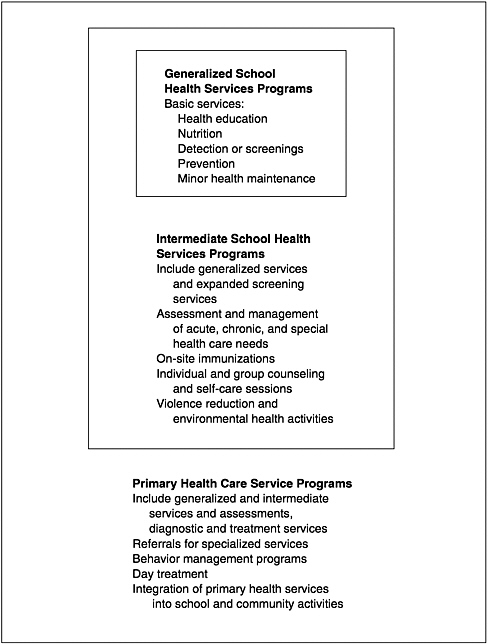
|
BOX 4-1 Connecticut Models Connecticut Statewide Plan for Ensuring Primary Health Care, Substance Abuse and Mental Health Services for All Students I. PHILOSOPHY Every child or adolescent should have access to high-quality primary health care, substance abuse, and mental health services in his or her school. The design of services delivered in the school will be based on student needs. II. MODELS OF SERVICE DELIVERY LEVEL I: Basic School Health Services This model should be in place in each of Connecticut's 998 public school buildings and available to all 478,300 (estimated) students age 3-21 years. The model addresses mandated basic school health but is not an enhancement of services to youth in need.
LEVEL II: Increased Basic School Health Services The school's volume of need is greater than can be met in Level I. Additional staff, including local pediatricians, would be added to meet the identified needs of the student population. More of the same types of service would be provided as outlined in Level I. LEVEL III: Enhanced Clinical Services Services beyond Level I and II may include the following:
|
LEVEL IV: School-Based Health Center (SBHC) Satellite Services This model is designed for schools with student populations under 500 in high-need areas; hours of operation would be part-time and based on student need. Staff would have the same background as those described in Level V and would travel to smaller school sites to provide services. Administratively, staff would be connected to a larger school's full-time SBHC located in the same school district. LEVEL V: School-Based Health Center This model is a full-time licensed comprehensive primary health care facility located within or on the grounds of a school. It is staffed by a multidisciplinary team (nurse practitioner, M.D. backup, MSW social worker, administrator, support staff, and appropriate ancillary health professions) who have particular expertise in working with children and adolescents. It provides a wide range of primary health care, substance abuse, mental health, and social services and prevention activities. It is operated by a community-based agency and works in partnership with school services. This model is for schools with high need and a student population in excess of 500 students. SOURCE: State of Connecticut Department of Public Health and Addition Services. |
a high incidence of medically underserved children, low-birthweight babies, infant mortality, or teenage pregnancy. The following three models are specified as eligible for funding; in addition to these models, funding may also be available for other locally developed programs comparable to these three but designed to meet the particular needs of the community:
-
A basic health care program for an elementary, middle, and high school feeder system, with trained school health aides in each school, a full-time nurse to supervise the aides in the elementary and middle schools, and one full-time nurse in the high school—emphasis is on screenings, assessment, record reviews, and coordinating health services for students with parents or guardians and other agencies in the community.
-
Student support services teams that include one half-time psy-
-
chologist, one full-time nurse, and one full-time social worker—three such teams are funded per grant, with one team working at each of an elementary, middle, and high school that are part of one feeder school system. Teams are to coordinate all activities with the school administrator and guidance counselor. Emphasis is on health, behavioral, and learning problems, with referrals made to community providers for serious problems or extended services, such as drug or alcohol abuse and STD treatment.
-
Full-service schools, in which personnel from the Department of Health and Rehabilitative Services provide services to students and families on school grounds—such services may include nutritional services, medical services, aid to dependent children, parenting skills, counseling for abused children, and education for the students' parents or guardians.
In summary, progress is being made on the process of describing various configurations of services and in suggesting how these might be matched to particular community characteristics, but more research is needed on the outcomes and effectiveness—including cost-effectiveness—of these arrangements. Further, local districts will continue to need technical assistance in assessing their needs and in selecting and designing a service delivery system appropriate for them.
CONFIDENTIALITY OF STUDENTS' HEALTH AND EDUCATION RECORDS
Providing health care in an educational setting requires consideration of separate and sometimes conflicting standards about clients' rights to obtain health care and requirements for educators and health care providers to protect the privacy of their clients' records. Moreover, since the student population includes both minors and those who have reached the age of majority, each group requires a different procedure in order for schools to comply with legal guidelines about access to health care and confidentiality of records. In most states, the age of majority is 18, but in a few it is 19 (English et al., 1995). These variables create a complex matrix of overlapping and contradictory requirements for health care providers in school settings who provide services to children and adolescents, some of whom have developmental delays that require guardianship past the age of majority (Larson, 1992).
Further adding to the complexity are varying state regulations regarding the age at which youth can obtain certain types of health care, such as preventive care, diagnosis and treatment of sexually related conditions, mental health services, and drug or alcohol treatment services. For example, some states have enacted statutes that specifically allow minors who have reached a designated age (ranging from 14 to 16) to
authorize their own health care (Office of Technology Assessment, 1991). Most states allow minors, beginning at the age of 12 to 14, to obtain diagnostic and treatment services for specified sexually related conditions (such as sexually transmitted diseases) without parental consent. In addition, health care providers are mandated by varying state and professional legal requirements to disclose information about a student's intent to harm herself or himself or others and about various types of child abuse.
When schools provide health care, they often file health records as part of the students' cumulative educational records. This is particularly important and necessary to facilitate audits by official health agencies of school systems' compliance with immunization and other public health requirements and to allow orderly transfer of student records to other schools and colleges. However, the Family Educational Rights and Privacy Act of 1974 (Buckley Amendment) guarantees that parents and guardians will have access to school records. Further, to fulfill their responsibilities, teachers and guidance counselors may have access to students' educational records. Therefore, the privacy of records for students who may have the legal right to authorize their own health care and receive specified confidential services may be jeopardized if the health record becomes part of the educational record.
Electronic storage and transmission systems raise additional questions about the privacy of student health records and about sharing of information among individual schools, school districts, public health departments, social service agencies, and individual health care providers from both the public and the private sectors. New questions have also emerged since school systems have been authorized to bill Medicaid and private insurers. Insurance billing raises questions about the extent to which parent or guardian and age-of-majority client permission is needed to share information with departments of health and social services and with billing services in order to determine eligibility for benefits and provide documentation of insurance-reimbursable services provided at school.
Although client health and social service records may belong to the agency where the data are collected, the individual (parent or guardian, in the case of a minor) maintains the right of control over the information in the records. In most situations, parents and students who have the right to control their own medical records and authorize their own treatment are merely asked to sign a consent to share information between individual health care providers and between agencies. In both medical and educational cultures, this is a well-established and frequently used way to authorize the sharing of medical information so as to facilitate less fragmented care, prevent redundant diagnostic services, and avoid treat-
ments that in combination are harmful. Further, broad-based sharing of information can be essential for assessing community needs, monitoring the provision of services, and evaluating programs (Soler et al., 1993). Although most parents and clients are willing to give permission to share health records, this may be problematic when there is an issue related to mental health, drug use, or a sexually related condition. Further, some parents and guardians express concern for the consequences if such information—or information about health problems discovered at the school, such as asthma or seizures—might be obtained by their insurer.
If health records stored at school and health records compiled by outside health care professionals providing school services have the same high level of access as educational records, the privacy of families and adolescents may be compromised. The committee therefore believes that when state law eliminates the parental consent requirement for making specified counseling and treatment accessible to students, access to related medical records at school needs to be held to the same standards of confidentiality observed in other health care settings in communities in that state. In other words, confidentiality of school health records should be given high priority. Confidential health records of students should be handled and shared in a manner that is consistent with the handling of health care records in nonschool health care settings in the state.
FINANCING OF SCHOOL HEALTH SERVICES
Overview
As emphasized throughout this report, schools provide a nearly universal access point to the school-age population, and some countries utilize schools as an integral part of the community's health care delivery system (World Health Organization, 1995). In the United States, however, education is a public system that is primarily under local control while the health care system operates in the private sector, making it difficult to integrate the two systems. Thus, the lack of a consistent funding base has been a barrier to establishing school-based services. Within the educational establishment, there is little ownership of the responsibility for students' health, except when health is a substantial barrier to school attendance and achievement. Establishing the links between health and learning is one way to increase the interest in funding health programs from educational dollars (Barrett et al., 1983; Hack et al., 1991; Lewit et al., 1995). However, there is little consensus within the educational community about the fate of school health services when hard choices must be made about appropriating limited resources. Thus, there is a need to look beyond the education budget for dependable support for school services.
Currently, there are sources of external funds for school-affiliated services, but many of these sources tend to be transient and categorical. External funds are often designated for establishing ''model programs" that test the feasibility and effectiveness of interventions on small populations of students for short periods of time. Some external funds are for politically charged services such as family planning, diagnosis and treatment of sexually related conditions, and programs for teen parents. External funding to provide ongoing health services designed to address identified needs of the overall student population and to monitor student outcomes is rare. The result is a often patchwork of "here today and gone tomorrow" funding for short-term, problem-specific and/or population-specific services.
Some federal funds authorized by Congress are available for health services, some funds are entitlements; others require periodic reauthorization. Health care for eligible children living in poverty can be reimbursed by Title XIX (Medicaid's Early and Periodic Screening, Diagnostic, and Treatment Program [EPSDT]); maternal and child health services are financed by Title V; health care of educationally disadvantaged children is funded by Title I of the Elementary and Secondary Education Act; specialized health services for children with disabilities are mandated but only partially financed by the Individuals with Disabilities Education Act; services to prevent Human Immunodeficiency Virus (HIV) infections and hepatitis B infections are funded by cooperative agreements with the Centers for Disease Control and Prevention of the U.S. Department of Health and Human Services (DHHS); drug use can be addressed with funds from the Safe and Drug-Free Schools and Communities Act; and model comprehensive school health programs that may include health services may be supported by grants from the U.S. Department of Education.
States often funnel the federal funds to schools through state departments of health, human services, and/or education. State tax funds may be added to federal money or dispersed separately for health services. For example, some states provide financial support to schools for health screening, tobacco use prevention, health care for children and families living in poverty, dental health care, or models of integrated health and social services delivery. Various states have also developed special initiatives and funding for school services; examples include California's Healthy Start and Florida's Full-Service Schools (Dryfoos, 1994a; Schlitt et al., 1994; Shearer and Holschneider, 1995).
Locally, funds may be available from service clubs, volunteer health organizations (such as the American Cancer Society, March of Dimes, and the American Red Cross), and private providers of health care. Managed care systems are emerging and evolving as centerpieces of health care delivery in communities throughout the United States. Arrangements for
sharing responsibility for the health care of students who are members of managed care systems are being negotiated locally in some areas (Zimmerman and Reif, 1995). The economy of providing services at school is being explored, and agreements are being created to share capitated rates, responsibilities, and records between personnel who provide school-affiliated services and providers of services within the managed care systems.
Numerous private foundations offer grants to study specific health problems of the school-age population or to provide health services for students. The grants may be given directly to school systems, public health systems, private health care agencies, colleges, universities, academic health centers, or a combination of agencies. As with funds from the various levels of government, the duration of funding is varied, problem specific, and undependable if needed to provide consistent staffing for health services.
A consistent and adequate funding base for school health services is needed in this atmosphere of fragmentation and uncertainty. Some possible strategies for achieving this are discussed below.
Medicaid
The Medicaid program, also known as Title XIX of the Social Security Act, has become the primary source of financing medical care for poor children. The program is administered by the Health Care Financing Administration within DHHS, in conjunction with state government agencies. Within broad federal guidelines and minimum eligibility standards, each state sets its own policies regarding benefits, eligibility, and health care provider reimbursement. Financing is also jointly shared by the federal and state governments, with the federal share ranging from 50 to nearly 80 percent, depending on the state's per capita income. In most states, schools receive only the federal share of reimbursement for health services for eligible students.
Historically, eligibility for the program was tied to requirements for receiving welfare (Aid to Families with Dependent Children or Supplemental Security Income for elderly and disabled). In 1989, however, Congress mandated that states cover low-income pregnant women and children under age 6 who live in families making less than 133 percent of the federal poverty level, an income level that is higher than regular Medicaid eligibility levels in nearly all states.
In 1990, Congress required states to provide Medicaid coverage to all children ages 6 to 19 living in families earning up to 100 percent of the poverty level. But federal law permits states to phase in coverage of these
children on a year-by-year basis, which means that all poor adolescents will not be covered by Medicaid until the year 2002.
Currently, states have the option of providing Medicaid benefits to children from families with earnings that exceed the federal poverty level. Furthermore, children with disabilities from families with higher income levels than allowed by the individual states may qualify for Medicaid coverage when their medical costs are excessive. In calculations to establish Medicaid eligibility, the cost of medical services already incurred is subtracted from the family's income and resources, allowing families with high medical costs to be eligible for Medicaid when their incomes would otherwise exceed the eligibility limit.
As required in federal law, all state Medicaid programs cover hospitalization, physician services, laboratory and x-ray services, family planning, and Early Periodic Screening, Diagnostic, and Treatment services for children under the age of 21. In addition to the option of extending coverage to families above the poverty level, states can also provide such other services as prescribed drugs, dental services, inpatient psychiatric care, case management, and transportation.
The EPSDT component of Medicaid was originally designed to provide comprehensive health screening for poor children, as well as subsequent diagnosis and treatment services for conditions found during the screening exams. Comprehensive screening included not only basic health, vision, hearing, and dental components but "anticipatory guidance" that could include counseling services, case management, and health prevention. Although federal law mandated EPSDT services for Medicaid eligible children and adolescents, most states have not accomplished the goal of screening all who are eligible.
The potential of Medicaid as a funding source for school-based services is ambiguous. Standards for qualifying as a Medicaid provider are rigorous and billing procedures can be complex. The possibility that Medicaid will be transferred to the states in the form of block grants presents further challenges and opportunities, since states may have more flexibility but fewer dollars. In many states, Medicaid enrollees are being required to obtain coverage through managed care. Many HMOs and other managed care providers may not include preventive services, mental health services, and health screening as part of the package. In some places, school health service providers may have to negotiate with multiple managed care plans for students in their schools. One proposal has been to create "school health resource partnerships" among districts, health providers, and community agencies to address the financial viability of school health service programs in a managed care environment. (Brellochs, 1995). States would require that managed care plans participate as a condition of licensure.
Many of the services required by disabled children protected by IDEA are medically necessary, but state Medicaid and education agencies have not always agreed about the responsibility for paying for health services delivered to disabled Medicaid-eligible children in school settings. However, many state health and education officials are recognizing the financial benefits to be gained by charging Medicaid for health services provided during the school day, and more than half of the states have obtained waivers that allow school systems to bill Medicaid for services such as speech, occupational, and physical therapy; nursing services; psychological and counseling services; audiological services; and assessments, thus freeing up some special education funds for other uses.
School-Based Health Insurance
A major obstacle for many students in receiving health care is the fact that they lack health insurance but do not qualify for Medicaid assistance. A program in Florida is tackling this problem by providing health insurance for all school children. The School Enrollment-Based Health Insurance (SEBHI) concept was proposed in 1988 to provide low-cost, comprehensive health insurance to families who did not qualify for Medicaid and could not afford private insurance (Freedman et al., 1988). SEBHI represents an alternative to employer-based health insurance by using the school system to create large groups to negotiate health insurance policies. SEBHI contains several attractive features. First, families with school-aged children represent approximately 66 percent of the uninsured families (Sulvetta and Swartz, 1986). These families are targeted through the SEBHI model. Second, school districts can be used to create large pools of uninsured individuals who represent a significant market share in the group health insurance market. Third, school-based insurance coverage for children is more portable. Because the school district is the grouping mechanism, coverage will not be disrupted if a parent changes or loses his or her job.
Several factors served as impetus for the implementation of the SEBHI concept. As mentioned earlier in this chapter, between one-fifth and one-sixth of children under 18 have no health insurance. Nearly two-thirds of these children live in families with incomes above the federal poverty level, making some of them ineligible for government-sponsored health programs. Employee-based health insurance coverage, which covers approximately two-thirds of all children who have private insurance, declined from 71 to 63 percent in 1990. Only 55 percent of all United States jobs, and 35 percent of low-wage jobs, include health insurance benefits (Employee Benefit Research Institute, 1993).
A SEBHI demonstration program was implemented in Volusia
County, Florida, in 1991. Its purpose is to encourage children in low-income families to use pediatric primary care services by reducing financial barriers to care. The SEBHI benefit package includes well-child visits and immunizations with no co-payment required. Other benefits with minimal co-payments include inpatient care, maternity benefits, mental health services, prescriptions, physical therapy, and emergency services and transportation.
All children who are not eligible for Medicaid are eligible for participation in the demonstration. Subsidized premiums are offered so that financial concerns will not be a barrier to families who want to enroll their children. The National School Lunch Program is used as a method to verify family income for insurance premium subsidy. Subsidized premiums are based on family income so that families with incomes below 100 percent of the federal poverty level receive fully subsidized premiums; those with incomes between 101 and 135 percent of the poverty level pay $2.50 per child per month; those between 136 percent and 185 percent of the poverty level pay $13 per child per month; and those at 186 percent of the poverty level or above pay the full premium of $46 per child per month.
A key feature of the program is the provision of care through the private sector. The program is not intended to extend Medicaid coverage or to provide health care as a variation of the current Medicaid system for children in Florida. In the SEBHI demonstration, care is provided through a health maintenance organization using both staff physicians and contract physicians in private practice. Prior to implementing the demonstration, it was presumed that a generous benefit package, the provision of free or greatly reduced health insurance premiums, and the availability of care within a private HMO would result in more low-income children making primary care visits. The market penetration of the program among the targeted uninsured children has exceeded 50 percent. Health care services in the early stages of the demonstration were provided at other community sites, but the project directors are now working with the HMO to move a set of widely used services to the school site in order to widen participation.
Given the continued erosion of employer-based health insurance, the SEBHI concept is an interesting and relevant approach for providing health insurance to previously uninsured children. The large numbers of uninsured school-age children make the school a useful grouping mechanism that is not dependent on the parents' employment status. In addition, it is clear that financial barriers to health care use must be removed, and the SEBHI model addresses this factor through the provision of free or greatly reduced insurance premiums.
However, results of the SEBHI demonstration indicate that attention
must also be paid to addressing nonfinancial barriers to health care use. Factors such as length of time of program enrollment, the child's age and gender, the premium amount, and the child's race and ethnicity influence both the likelihood of health care use and health care use rates after reducing or removing financial barriers to care (Shenkman et al., 1996).
Nonfinancial barriers to health care use are perhaps more complex than financial barriers. For example, some minorities experience deep sociopolitical disenfranchisement within our society. It is often argued that in the face of poverty, crisis, and feelings of alienation, some minority parents may not place a high priority on taking their children for primary and preventive care (Murray-Garcia, 1995). Moreover, minority parents often face the significant barrier of receiving health care within a system that they feel is not sensitive to their cultural needs. These issues are deeply rooted in our society and not easily addressed. However, future efforts at providing health services within a comprehensive school health program must combine innovative financing strategies like the SEBHI concept with strategies to break down cultural, nonfinancial barriers to health care to ensure that all children receive pediatric health care services.
Financing for School-Based Health Centers
Several recent reports have analyzed financial issues associated with school-based health centers (Brellochs and Fothergill, 1993; Perino and Brindis, 1994; Schlitt et al., 1994; U.S. Department of Health and Human Services, 1993a; U.S. GAO, 1994a, 1994b; Zimmerman and Reif, 1995). A recent policy paper from the Making the Grade project, the national SBHC initiative sponsored by the Robert Wood Johnson Foundation, reviews recent events that have had a major—and mostly negative—impact on funding for SBHCs (Rosenberg and Associates, 1995). The collapse of federal health care reform, which had included provisions for large-scale grants for SBHCs, and the election of a fiscally conservative Congress imply that states and local communities cannot rely on federal funds for expanding SBHCs. Although Medicaid had been a potential means of expanding support for SBHC services, this source is uncertain because of possible Medicaid spending caps and state control of the allocation of block grants. Further, states are responding to fiscal pressures by assigning Medicaid clients to managed care systems; SBHCs that learned how to implement Medicaid billing systems may now encounter difficulty in collecting reimbursement for students enrolled in a Medicaid managed care plan. Also, SBHCs have not been included in any federal or state definition of "essential community providers." Therefore, SBHCs are not entitled automatically to any special treatment given to "safety net" ser-
vices, and other designated essential community providers, such as community health centers, are not required to interact with SBHCs.
The Making the Grade policy paper (Rosenberg and Associates, 1995) discusses possible funding strategies in the current restrictive political and fiscal climate. The paper suggests that since limited resources preclude the expansion of SBHCs into every community or school that might desire one, decisions and priority setting must occur, preferably at the state level. Decisions about where clinics should be located and supported might be based on a combination of factors including community income, insurance status, access to primary care, and age level of school. The paper considers several possible approaches to funding, but perhaps the most promising is the "pooled fund" approach in which the state assumes direct responsibility for the overall program and funds it through a global budget paid directly to each SBHC. The state determines each center's operating costs and provides support through funds pooled from a variety of sources, including Medicaid funds, Maternal and Child Health (Title V) funds, other federal funds, and state and private sector funds.
SBHCs increasingly are looking to managed care organizations as possible partners, not only to secure stable funding but also to move SBHCs into the health care mainstream and improve care coordination for children (Alpha Center, 1995). Partnering has its barriers, however, including demonstrating the quality and effectiveness of school-based services and instituting more sophisticated billing and information systems. Also, many of the services provided by SBHCs, such as mental health counseling or behavior modification aimed at preventing teen pregnancy or AIDS (Acquired Immunodeficiency Syndrome), have not been reimbursable medical procedures. Although managed care understands the value of such preventive services, students do not stay in plans long enough for a managed care organization to recoup the benefits. Still, SBHCs can market themselves to managed care organizations as being uniquely positioned to provide the convenient care that parents—particularly working parents—are seeking for their children and to help managed care meet Medicaid mandates to screen a certain percentage of adolescents. Likewise, managed care organizations need to consider the development of plans in which a combination of health and social support services are provided and to recognize the potential role that schools could play to improve health outcomes for health plan beneficiaries.
Nonprofit Intermediary for Contracting Services
Both public and private health care delivery systems in the United States are undergoing rapid changes. As a result of the development and consolidation of large managed care organizations, there are new busi-
ness arrangements for individuals and groups of health practitioners, new service delivery systems, and renewed interest in more cost-effective sites for service delivery.
At the same time, there is increasing demand for health services for students during the school day. School systems have had to provide specialized physical health care procedures, physical and occupational therapy, speech and language therapy, audiological services, and mental health counseling as a result of the federal legislation requiring free public education for children with disabilities (P.L. 94-142, Education for All Handicapped Children Act, 1975). Initially, this legislation contained provisions for funding, but federal funding currently covers less than 10 percent of costs for mandated special education services. Since school districts continue to be mandated to provide these services, most costs are paid out of education funds; this is sometimes called the "encroachment" of special education costs into the general education budget.
Until recently, insurers (private insurers and Medicaid health coverage) have not been approached on a large scale to contribute to the cost of health care at school for their beneficiaries. A few school systems are now making claims to private insurers as well as to Medicaid. There is an opportunity to further explore "externalizing" school health personnel into a private corporate structure for the purpose of contracting health services at school sites to the school system or managed care organizations, or to both. For example, the Department of Pediatrics of the University of Texas Health Sciences Center at Galveston has formed a nonprofit corporation to address the problems of the city's low-income, high-risk children, youth, and families, which is funded by contractual arrangements with school systems, Medicaid, and other health insurance claims. A joint partnership venture was launched, stimulated by the private practicing community, that included a previously existing Teen Health Center managed by private practitioners, the health district, the school district, the state Department of Human Services, and a consultant from the University Health Sciences Center. The corporation employs nurses and nurse practitioners and serves as a clinical teaching site for medical students and residents in pediatrics (Barnett et al., 1992).
In making such contractual arrangements, several factors must be considered. If there is only one managed care organization in the area that has members who are also students in a coterminous school system, then school-affiliated health services and/or school-based clinics could be wholly contracted to that organization. In this way, care at school becomes part of the larger full-service health care system, and barriers to sharing health information would be less cumbersome. However, if there are multiple managed care organizations in the community served by the school, the contractual arrangements would be more complicated and
would have to take into consideration changes in membership among the students during a given school year. The major obstacles appear to be establishing rates for services and cost allocation among managed care organizations and school systems. Differentiating health services from educational services is often difficult when a student's health status is interwoven with the necessity for costly and individualized educational services.
Both the consolidation of existing health professional staff into a nonprofit corporate unit for contracting services and the negotiation of school-based health services delivery through managed care organizations could enhance revenues to school districts, first by offsetting the cost of currently employed health professional services by selling those services to managed care organizations and second by having the cost of school-based clinics borne by managed care organizations rather than schools.
Other Funding Strategies
In the recent report How to Fund Public Health Activities, the Partnership for Prevention6 suggested three possible approaches for providing stable and adequate funding for public health services (Meyer and Regenstein, 1994). The report also analyzes the advantages and disadvantages of each approach. These approaches are also relevant for school health services. Adapted for school health, these approaches are as follows:
-
A surcharge on health care payers—including private employer and employee premium contributions, beneficiary contributions from Medicare and the Department of Veterans Affairs, and similar sources—could be put into a fund, either at the federal or state level, to be disbursed to community or school providers of school health services. It is estimated that a 1 percent surcharge would raise about $4 billion, a 2 percent surcharge would raise about $8 billion, and so on. This option offers the advantage of spreading costs broadly across society, and funding would keep pace with overall health care spending since it would reflect a percentage of insurance premiums. A disadvantage is that this approach would exacerbate the current cost shift in which those paying for insurance are subsidizing those without coverage.
-
The addition of school health services to standard benefit packages —under this option, both public and private insurance benefit packages would designate school health services as "covered services." The insurers themselves would not directly reimburse those who provide the services but would send the reimbursement to a fund set up for school health services. This option amounts to making school health services a "mandated benefit" for all health coverage. It is estimated that establishing the cost of this new benefit at 1 percent of premiums would raise nearly $9 billion. This approach would also spread the cost broadly; in addition, establishing school health services as a covered service should help insulate it from the uncertainties of the political and administrative processes. Disadvantages of this approach include the cost shift problem of option 1. In addition, if "school health'' coverage were a fixed dollar amount, the approach would be regressive, consuming a greater proportion of the premium of a low-cost plan.
-
Excise taxes and penalties on products or processes that affect health might include taxes on alcohol and tobacco products, gasoline, and ammunition, as well as penalties on polluters. An advantage to this approach is that it accomplishes two goals—financing school services and discouraging the use of products and practices linked to health problems. A limitation of this approach is that the revenue base will shrink if the tax is successful in reducing consumption. In addition, excise taxes are not as broad and progressive as the system-wide health contribution described in options 1 and 2.
FIRST STEPS FOR A COMMUNITY IN ESTABLISHING SCHOOL SERVICES
In this section, the committee uses the American Academy of Pediatric's seven "goals" for school health programs, listed at the beginning of this chapter and repeated below, to organize the discussion of specific questions and actions that a community might consider in establishing an appropriate set of school health services within a comprehensive school health program.
|
Goal 1 |
Ensure access to primary health care. |
|
Goal 2 |
Provide a system for dealing with crisis medical situations. |
|
Goal 3 |
Provide mandated screening and immunization monitoring. |
|
Goal 4 |
Provide systems for identification and solution of students' health and educational problems. |
|
Goal 5 |
Provide comprehensive and appropriate health education. |
|
Goal 6 |
Provide a healthful and safe school environment that facilitates learning. |
|
Goal 7 |
Provide a system of evaluation of the effectiveness of the school health program. |
Before examining the steps implied by each goal, the following basic premises should be emphasized. Regardless of program structure or community characteristics, programs should be based upon a thorough assessment of community needs and resources, and this assessment should involve all stakeholders who will be impacted by the program—parents, students, educators, health and social services providers, insurers, and business and political leaders.7 Who should convene and administer this process—the school system, health department, or other community entity—will depend on the situation; the crucial requirement is strong and committed leadership in the convening organization. Programs and services should be preventively oriented and family centered, avoid duplication, and be based on best practices gained from research.
Although schools represent relatively barrier-free systems for reaching children and youth about health issues, communities should recognize that not all populations may be comfortable with the school setting and school personnel (Chaskin and Richman, 1992). If this is the case, then steps must be taken to interact with those populations in ways with which they are comfortable, either by utilizing a more neutral setting or by altering the school environment to provide a climate with more trust.
Ensure Access to Primary Health Care
The school health service should be considered an integral part of a community's preventive health system. Utilizing the school health service for screening and detection of problems, follow-up, and the coordination or provision of services can make the community's primary care system more efficient, effective, and accessible. Although the extent of services provided at the school site will differ from one community to another, mechanisms must be developed so that school health services are coordinated with the community's mainstream health services to ensure efficiency, continuity, and quality of care (American Academy of Pediatrics, 1994).
The following are initial steps that a community might take to ensure student access to primary care:
-
Identify sources of health care in the community.
-
Identify needs of population and barriers to health care—are they geographic, financial, cultural, or other?
-
Determine where and for what reason students have utilized a health care facility in the past year.
-
Consider the range of school-affiliated services needed on or near a school site and how they might be provided and supported.
-
Set up communication systems between providers of care and the school health service (e.g., phone or fax for referrals, feedback, follow-up).8
Deal with Crisis Medical Situations
Every day in this country, medical crises occur at schools. A teacher may suffer a myocardial infarction, or a student may fall from playground or gym equipment, be burned in a lab fire, be lacerated by broken glass, or fall on a discarded needle in a schoolyard. The effects of community violence spread to schools; suicides, homicides, and intentional and non-intentional injuries affect school populations. In addition, children may have seizures, suffer acute attacks of asthma, develop complications from diabetes, be technically dependent on fragile medical devices, and be transported in wheelchairs on school buses on dangerous country roads or busy freeways.
Procedures must be in place to deal with such crisis situations, including awareness of 911 access to community emergency medical services, standing medical orders for triage and first aid, and guidelines for contacting parents. Broad training of school personnel and older students in cardiopulmonary resuscitation (CPR) and first aid procedures is necessary, as is implementing school accident prevention programs (American Academy of Pediatrics, 1993). The recent Institute of Medicine (IOM) report Emergency Medical Services for Children (IOM, 1993) calls for teachers, coaches, and day care workers, along with parents, to receive the highest
priority in education and training for safety and accident prevention, CPR, and first aid, and use of the community emergency medical system.
The following are initial questions that a community can ask to ensure that a system is in place to deal with potential crisis medical situations:
-
Does a school-based emergency system or plan exist? What are its provisions?
-
Are school personnel informed of access to the emergency medical care system of the community?
-
Are school personnel trained in first aid and CPR?
-
What school accident prevention and accident reporting systems are in place? Who reviews these reports? How is information from these reports used to modify existing risks for students?
-
How are community providers of emergency medical care services involved in education and training of school-based health personnel and other school staff?
-
Are school medical consultants available for establishing triage, guidelines for need or immediacy of referrals, or standing orders as deemed necessary?
Carry Out Mandated Screening Programs
Screening is the process of using a relatively simple test to identify those who may have a particular problem. Unfortunately, screening programs are ineffective unless procedures are in place for ensuring follow-up of identified problems. Certain mandates for screenings are old and outdated, and statutory requirements should be reviewed for scientific validity.9 In a climate where resources are scarce, a balance may have to be struck between population-based screenings and targeted interventions for high-risk groups, as mentioned earlier in this chapter (Starfield and Vivier, 1995).
Overviews of screening recommendations are found in such publications as School Health: Policy and Practice from the American Academy of Pediatrics (1993) and Principles and Practices of Student Health, Volume II (Wallace et al., 1992b). The value of any screening program must be based on criteria outlined in Box 4-2.
As mentioned previously, Medicaid reimbursement for school-based
|
BOX 4-2 Criteria for a Useful and Effective Screening Program Disease Undetected cases of the disease must be common (high prevalence), or new cases must occur frequently (high incidence). The disease must be associated with adverse consequences, either physical or psychological (morbidity). Treatment Treatment must be available that will effectively prevent or reduce morbidity from the disease. There must be some benefit from this treatment before the disease would have become obvious without screening; that is, there must be an early intervention benefit. Screening Test The ideal test detects all subjects who have the disease (high sensitivity) and correctly identifies all who do not (high specificity). Low sensitivity results in missed cases (false-negative results), and low specificity yields many false-positive results. Another measure of effectiveness is its positive predictive value, or the number of true-positive results divided by the total number who fail the test. A good test is simple, brief, and acceptable to the person being screened. The test must be reliable, that is, repeat testing will yield the same results. Screener The screener must be well trained; experience is important, particularly if judgments must be made. Target Population To reduce inefficiency, the screening should be focused on groups in which the undetected disease is most prevalent or in which early intervention will be most beneficial. Referral and Treatment All of those with a positive screening test must receive a more definitive evaluation and, if indicated, appropriate treatment. The ultimate measure of effectiveness is a reduction in morbidity from early intervention among those with positive screening test results. This depends on the successful treatment of those in need. Cost–Benefit Ratio Cost includes all expenses of screening, referral, and treatment, including administrative costs and the cost plus anxiety that result from false-positive results. The benefit is the reduction in morbidity from early intervention among those with true-positive results who are in need of treatment. This benefit is hard to quantify in dollars and may vary among communities. Greater efficiency at any level will improve this ratio. Program Maintenance The need for improvements in program efficiency is determined by periodic review of research on the value of each screening program and an assessment of program effectiveness within the community. Local review also allows community leaders to make reasonable decisions as to the allocation of limited resources for screening. Local politicians can also be influenced to increase these resources when it can be shown that monies are being spent wisely. SOURCE: Adapted from American Academy of Pediatrics, 1993. |
Early and Periodic Screening, Diagnosis, and Treatment services is a possible means for expanding resources to provide screening programs for all students. However, Medicaid reimbursement is not an easy process, and possible changes in the system make Medicaid an uncertain future source of funding for screenings.
The following initial questions should be raised in establishing effective screening programs:
-
What screening programs are mandated, and what are the outcomes?
-
Are screening practices aligned with current research, knowledge, and technology? (Consider frequency of procedure and any gender-specific procedures.)
-
What mechanisms exist to ensure that identified problems are followed up and treated?
-
Do other sources—private health care, health fairs—duplicate school screening efforts? How is information, both positive and negative results, shared among systems? How is confidentiality maintained?
Provide Systems for Identification and Solution of Students' Health and Educational Problems
The school alone cannot identify and solve all problems that affect its students. However, a team approach utilizing the many resources within the school and community can lead to greater progress than will be achieved by separate, isolated efforts. Methods of problem identification from both within and outside the school, tracking of student problem resolution strategies, and suggested categories of classification of problem resolution have been described by the American Academy of Pediatrics (1993).
An example of whether a community is meeting student's health and education needs would be the correction of visual defects identified through routine school screening. Data from one large urban district in southern California, however, illustrate the difficulties involved in assessing whether follow-up and correction are occurring. Data at the district level, drawn from nurses' monthly reports of screening activities, suggested that only about one-half of students failing vision screening actually received care. However, an in-depth review, including parental phone interviews of two school clusters, found that closer to 85 percent of parents had followed through with the referral but did not inform the school (nor did the providers of care) (Nader, 1995). This situation points out the need for improved communication between parents and/or providers and the school. The targeting of 15 percent of those children still needing
referral is a much more feasible task than attempting to define barriers to care for a presumed 50 percent of students found to fail a vision screen.
Other health and educational problems may be much more difficult than visual defects to diagnose, follow up, and treat, particularly problems deriving from mental health conditions and family circumstances. Utilizing the full range of mental health, social work, and family services professionals—both school and community based—is essential in dealing with the most complex problems. It may be that the solution required for certain communities is a full set of comprehensive family and social services made available at the school or accessed through the school. Interestingly, informal feedback from such programs suggests that for families needing mental health and social services, it is often physical health concerns that prompt them initially to seek help and make contact with the program.
In developing its Guidelines for Adolescent Preventive Services (GAPS), the American Medical Association has recognized the broad range of health, mental health, and behavioral concerns that affect students' ability to learn and develop into healthy adults (American Medical Association, 1992). GAPS provides recommendations for the systematic, routine health care of adolescents and calls for annual preventive visits to a primary provider for all adolescents between the ages of 11 and 21. These visits should address not only physical health problems but also psychosocial difficulties such as depression, substance abuse, and risky sexual behavior. The detailed GAPS recommendations are found in Appendix E.
The initial implementation of GAPS recommendations in many communities may be limited by such problems as cost, access, and insufficient numbers of primary providers trained or interested in providing these services. Questions have also been raised about how willing adolescents would be to discuss sensitive issues with a relative stranger—a physician seen only once a year. A more feasible approach, especially in communities with limited resources, might be a strong prevention program for all students, offered in a large group setting in school, with mechanisms for individual peer and professional counseling and referral to specialized providers when warranted. GAPS defines primary care providers not only as physicians but as those who work with physicians in the primary care setting, including nurses, health educators, and other allied health professionals. In many communities, certain GAPS-recommended procedures might be adapted to local needs and carried out more efficiently by appropriately trained school-based personnel—school nurses and nurse practitioners, physicians assistants, school counselors and psychologists—in the school setting. At the time of writing this report, the American School Health Association is working with the American Medical Asso-
ciation to explore ways in which some GAPS recommendations might be performed by the school nurse.
Initial questions that a community should ask to improve identification and resolution of students' problems include the following:
-
How are problems currently identified and tracked?
-
Do community sources of services interact with school services? Do community providers utilize school resources to track students, follow up on identified problems, or give feedback to schools on referrals received from schools? How is confidentiality maintained?
-
What method exists to involve and empower families to work on resolution of identified problems?
-
For students and families requiring an array of services, is there a centralized, user-friendly point of access?
-
Are students, families, primary providers, and the school aware of the GAPS recommendations? What steps have been taken to adapt GAPS to the local community?
Provide Comprehensive and Appropriate Health Education
Health services personnel can be involved in classroom health education, both in developing the instructional program and perhaps in delivering classroom lessons. Health education can also be carried out on an individual or group basis by school health services personnel outside the classroom. In fact, health services personnel often may be more knowledgeable and comfortable with sensitive topics and may be more accessible for confidential discussions with students than are teachers or others working in a classroom situation.
Since utilization of a school health room or clinic is a simulation of a relatively barrier-free health care system, it could become a laboratory where students can learn skills to assess their own needs and become more informed consumers of health care services. Studies have shown that children's use of the school health room mirrors adults' use of community health care services (Nader and Brink, 1981).
Initial questions that should be addressed by a community in beginning to implement a coordinated approach to health education include the following:
-
What are the content and scope of current health education? Have topics been identified through a needs assessment to be the most important issues for the community and particular age groups? What is the acceptance of the program by students?
-
Does health education cut across all aspects of the school—class-
-
room instruction; health room or clinic; parent involvement; school environment; school nutrition; physical education; and health policies on smoking, drinking, drugs, or violence?
-
How are health and mental health services personnel involved in the classroom instructional program and in individual and group health education?
-
What is the comfort level of school service providers in working with children and adolescents, particularly in dealing with a complex or controversial topic? What referral mechanisms are established when problems are identified?
Provide a Healthful and Safe School Environment That Promotes Learning
As discussed in Chapter 2, the school environment is comprised of the broad areas of the physical, psychosocial, and policy environment. A range of issues is involved; included are policies regarding the possession of drugs and alcohol, the existence of a supportive nurturing atmosphere, and the presence of environmental hazards and pollutants. Staff wellness is also an important aspect of the environment, as is safety, including safety in pedestrian, bicycle, and school bus transportation to and from school.
Initial questions to consider in improving the school environment include the following:
-
Are policies in place that will lead to an environment that is free of tobacco, alcohol, drugs, and violence? What disciplinary measures are taken for violation of these policies? What support groups or services are available for students who are already participating in these prohibited behaviors?
-
How might communication and mutual respect and support be promoted among students, families, and staff?
-
Is the school clean, safe, secure, and free of hazards and sources of pollution? How can community efforts—for example, community watch or cleanup programs—promote a clean and safe campus?
-
Are the school lunch and breakfast programs, as well as other foods available at school, following up-to-date nutrition guidelines and reinforcing classroom health instruction?
-
Are health promotion programs available to school staff?
Provide a System of Evaluation of the Effectiveness of the School Health Program
Improved evaluation of school health programs is critical, both for
strengthening programs and for maintaining accountability, and communities must be prepared to allocate sufficient resources to evaluation. Chapter 6 discusses the level of evaluation that might be appropriate for local programs. It may be that individuals and relevant agencies within the community have expertise in evaluation, but many communities are likely to need technical assistance in developing the necessary evaluation methodologies and strategies (American Academy of Pediatrics, 1994).
Suggested initial steps and questions to improve evaluation of local programs include the following:
-
Consider evaluation in the context of improving the health and educational status of children and youth in the community.
-
Establish a district school health coordinating council to oversee the evaluation system, if one does not already exist.
-
What data are available to document students' current health status and needs? What new data should be collected?
-
What are the goals and specific objectives that the community would like to achieve through the program?
-
Do local agencies have evaluation expertise, or will technical assistance be required to help assess needs and develop evaluation strategies and methodologies?
SUMMARY OF FINDINGS AND CONCLUSIONS
Although the scope of school health services varies from one school district to another, many common elements exist throughout the country. Most schools provide screenings, monitor student immunization status, and administer first aid and medication. Schools are also required to provide a wide range of health services for students with disabilities and special health care needs.
There is agreement that a core set of services is needed in schools, but the topic currently generating a great deal of discussion is the role of the school in providing access to extended services that go beyond traditional basic services, such as primary care, social, and family services. The committee believes that extended services should not be the sole—or even the major—responsibility of the schools; instead, the school should be considered by other community agencies and providers as a partner and a potentially effective site for provision of needed services—services that will ultimately advance the primary academic mission of the school.
Although the demands and complexity of basic school services have increased, these services are often supervised by education-based administrators who have no clinical preparation in the delivery of health ser-
vices. Thus, it is important to develop closer links between the school and community health systems and to encourage greater involvement of community health care professionals in the planning and implementation of basic services. School-based health centers and other extended services are a relatively new phenomenon, and research in this area is in the early stages. Studies have shown that SBHCs provide access to care for needy students and increase students' health knowledge significantly. However, it has been difficult to measure the impact of SBHCs on students' health status or high-risk behavior, such as sexual activity or drug use. This is consistent, however, with other interventions to reduce high-risk behavior—increased knowledge has little effect unless the environment and perceived norms are changed. The committee believes that access, utilization, and possibly a reduction in absenteeism may be more appropriate measures of the impact of SBHCs than change in health status or high-risk behavior.
RECOMMENDATIONS
School health services should be formally planned, and the quality of services should be continuously monitored as an integral part of the community public health and primary care systems.
In the planning process, school health services should be considered an integral part of the overall community public health and primary care system. The range of services actually provided at the school site must be determined locally, based on community characteristics and needs. Special concerns should be emphasized about two areas of services that a significant proportion of students need—mental health or psychological counseling and school foodservice. The committee believes that mental health and psychological services are essential in enabling many students to achieve academically; these should be considered mainstream, not optional, services. The committee also believes that the school foodservice should serve as a learning laboratory for developing healthful eating habits and should not be driven by profit-making or forced to compete with other food options in school that may undermine nutrition goals.
Many questions remain unanswered about school services, particularly questions regarding the relative advantages, disadvantages, quality, and effectiveness of providing extended services at the school rather than at other sites in the community. Thus the committee recommends the following:
Research should be conducted on school-based services, particularly on the organization, management, efficacy, and cost-effectiveness of extended services.
In order to facilitate school health research of all kinds, all school health providers should immediately institute uniform data collection protocols and standards.
So that the privacy of families and adolescents be maintained, the committee recommends the following:
Confidentiality of health records should be given high priority by the school. Confidential health records of students should be handled and shared in the school setting in a manner that is consistent with the manner in which health records are handled in nonschool health care settings in the state.
The lack of a consistent and adequate funding base has been a barrier to establishing school health services. Thus, the committee recommends the following:
Established sources of funding for school health services should continue from public health, agriculture, and education funds, and new approaches must be developed.
Strategies that have shown promise and should be further explored include billing Medicaid for services to eligible students, developing school-based insurance groupings, forming alliances with managed care organizations and other providers, instituting special taxes, and placing surcharges or special premiums on existing insurance policies.
REFERENCES
Abt Associates. 1990. Final Report: Study of Income Verification in the National School Lunch Program . Arlington, Va: Abt Associates.
Adelman, H., and Taylor, L. 1991. Mental health facets of the school-based health center movement: Need and opportunity for research and development. Journal of Mental Health Administration 18:272–283.
Adelman, H., and Taylor, L. 1997. Addressing barriers to learning: Beyond school-linked services and full-service schools. American Journal of Orthopsychiatry 67(3):408–421.
Adelman, H., Barker, L., and Nelson, P. 1993. A study of a school-based clinic: Who uses it and who doesn't? Journal of Clinical Child Psychology 22(1):52–59.
Alpha Center. 1995. State Initiatives in Health Care Reform. Washington, D.C.: Alpha Center, September/October, No. 14.
American Academy of Pediatrics. 1993. School Health: Policy and Practice , 5th ed., P.R. Nader, ed. Elk Grove Village, Ill.: American Academy of Pediatrics.
American Academy of Pediatrics. 1994. Principles to Link By: Integrating Education Health and Human Services. The National Consensus Building Conference Final Report, Centers for Disease Control and Prevention. Washington, D.C.: U.S. Department of Health and Human Services.
American Dietetic Association. 1991. Position of the American Dietetic Association: Competitive foods in schools. Journal of the American Dietetic Association 93:334–336.
American Dietetic Association, Society for Nutrition Education, and American School Food Service Association. 1995. Joint position of American Dietetic Association, Society for Nutrition Education, and American School Food Service Association: School-based nutrition programs and services. Journal of American Dietetic Association 95(3):367–369.
American Medical Association. 1992. Guidelines for Adolescent Preventive Services. Chicago: American Medical Association, Department of Adolescent Medicine.
American Medical Association Council on Scientific Affairs. 1990. Providing medical services through school-based health programs. Journal of School Health 60(3):87–91.
American School Food Service Association. 1994. Creating Policy for Nutrition Integrity in Schools. Alexandria, Va.: American School Food Service Association.
American School Food Service Association. 1995. Keys to Excellence: Standards of Practice for School Foodservice and Nutrition. Alexandria, Va.: American School Food Service Association.
Appelboom, T.M. 1985. A history of vision screening. Journal of School Health 55(4):138–141.
Bachman, J. 1995. A university's response to a need for school nurse education. Journal of School Nursing 11(3):20–22, 24.
Barnett, S.E., Niebuhr, V.H., Baldwin, C., and Levine, H. 1992. Community-oriented primary care: A process for school health intervention. Journal of School Health 62(6):246–248.
Barrett, D.C., Radke-Yarrow, M., and Klein, R.E. 1983. Chronic malnutrition and child behavior: Effects of early caloric supplementation on social and emotional function at school age. Developmental Psychology 18(4):541–556.
Basco, D. 1963. Evaluation of school nursing activities. Nursing Research (Fall):211–212.
Berg, A.O. 1993. Screening for adolescent idiopathic scoliosis: A report from the United States Preventive Services Task Force. Journal of the American Board of Family Practice 6(5):497–501.
Brellochs, C. 1995. School health services in the United States: A 100-year tradition and a place for innovation. Paper prepared by School Health Policy Initiative, Montefiore Medical Center, New York, N.Y., May.
Brellochs, C., and Fothergill, K., eds. 1993. 1993 School Health Policy Initiative Special Report: Current Issues of Comprehensive School-Based Health Centers. New York: Columbia University School of Public Health.
Bricco, E. 1985. Impacted cerumen as a reason for failure in hearing conservation programs. Journal of School Health 55(6):240–241.
Brindis, C., Starbuck-Morales, S., Wolfe, A.L., and McCarter, V. 1994. Characteristics associated with contraceptive use among adolescent females in school-based family planning programs. Family Planning Perspectives 26:160–164.
Brindis, C., Kapphanhn, C. McCarter, V., and Wolfe, A. 1995. The impact of health insurance status on adolescents' utilization of school-based clinic services: Implications for health reform. Journal of Adolescent Health Care 16:18–25.
Brown, J.O., Grubb, S.B., Wicker, T.E. and O'Tuel, F.S. 1985. Health variables and school achievement. Journal of School Health 55(1):21–23.
Bryan, D.S. 1970. Skin problems of school age children and youth—A nursing responsibility? Journal of School Health 40(October):437–439.
Burghardt, J.A., and Devaney, B.L. 1993. The School Nutrition Dietary Assessment Study: Summary of Findings. Princeton, N.J.: Mathematica Policy Research.
Burghardt, J.A., and Devaney, B.L., eds. 1995. American Journal of Clinical Nutrition 61(1):Suppl.
Cauffman, J.G., Affleck, M., Warburton, E.A. and Schultz, C.S. 1969. Health care of school children: Variations among ethnic groups. Journal of School Health 39(5):296–304.
Center for Health Economics Research. 1993. Access to Health Care: Key Indicators for Policy. Princeton, N.J.: Robert Wood Johnson Foundation.
Center on Hunger, Poverty, and Nutrition Policy. 1993. Statement on the Link Between Nutrition and Cognitive Development in Children. Medford, Mass.: Tufts University School of Nutrition.
Centers for Disease Control and Prevention. 1996. Guidelines for school health programs to promote healthy eating. Morbidity and Mortality Weekly Report 45(RR-9).
Chaskin, R.J., and Richman, H.A. 1992. Concerns about school-linked services: Institution-based versus community-based models. In The Future of Children: School Linked Services, R.E. Behrman, ed. Los Altos, Calif.: Center for the Future of Children, David and Lucille Packard Foundation 2(1):107-117, Spring.
Chen, S.C. 1975. Role relationships in a school health interdisciplinary team. Journal of School Health 45(3):172–176.
Cities-in-Schools. 1988. Fact Sheet and Questions About Cities-in-Schools . Washington D.C.: Cities-in-Schools.
Citizens' Commission on School Nutrition. 1990. White Paper on School Lunch Nutrition. Washington, D.C.: Center for Science in the Public Interest.
Clawson, D.K., and Osterweis, M., eds. 1993. The Roles of Physician Assistants and Nurse Practitioners in Primary Care. Washington, D.C.: Association of Academic Health Centers.
Committee for Economic Development, Research and Policy Committee, ed. 1994. Putting Learning First: Governing and Managing the Schools for High Achievement. Washington, D.C.: Committee for Economic Development.
Cook, B.A., Schaller, K. and Krischer, J.P. 1985. School absence among children with chronic illness. Journal of School Health 55(7):265–267.
Crowley, E.A., and Johnson, J.L. 1977. Multiprofessional perceptions of school health: Definition and scope. Journal of School Health 47(Sept):398–404.
Davis, M., Fryer, G.E., White, S. and Igoe, J.B. 1995. A Closer Look: A Report of Select Findings from the National School Health Survey 1993–1994. Denver: Office of School Health, University of Colorado Health Sciences Center.
DeAngelis, C. 1981. The Robert Wood Johnson Foundation National School Health Program: A presentation and progress report. Clinical Pediatrics 20:344–348.
Dryfoos, J. 1994a. Full-Service Schools: A Revolution in Health and Social Services for Children, Youth, and Families. San Francisco: Jossey-Bass.
Dryfoos, J. 1994b. Medical clinics in junior high school: Changing the model to meet demands. Journal of Adolescent Health 15(7):549–557.
Dungy, C.I., and Mullins, R.G. 1981. School nurse practitioners: Analysis of questionnaire and time/motion data. Journal of School Health 51(Sept):475–478.
Edwards, L.E., Steinman, M.E., Arnold, K.A., and Hakanson, E.Y. 1980. Adolescent pregnancy prevention services in high school clinics. Family Planning Perspectives 12(1):7.
Eisner, V. 1970. Health services under the Elementary and Secondary Education Act. Journal of School Health 40(Nov.):464–466.
Elias, M.J., Kress, J.S., Gager, P.J., and Hancock, M.E. 1994. Adolescent health promotion and risk reduction: Cementing the social contract between pediatricians and the schools. Bulletin of the New York Academy of Medicine 71(1):87–110.
Ellison, C., Capper, A., Goldberg, R., Witschi, J., and Stare, F. 1989. The environmental component: Changing food service to promote cardiovascular health. Health Education 16(2):285–297.
Employee Benefit Research Institute. 1993. Source of Health Insurance and Characteristics of the Uninsured: Analysis of the March 1992 Current Population Survey. Issue Brief No. 133, January.
English, A., Matthews, M., Extavour, K., Palamountain, C., and Yang, J. 1995. State Minor Consent Statutes: A Summary. Cincinnati, Ohio: Center for Continuing Education in Adolescent Health, Children's Hospital Medical Center.
Food Research and Action Center. 1996. School Breakfast Score Card: A Status Report on the School Breakfast Program 1995-1996 (Sixth Edition). Food Research and Action Center. Washington, D.C. p. 2.
Forbes, O. 1965. The role and functions of the school nurse as perceived by 115 public school teachers from three selected counties. Journal of School Health 34:101–106.
Frank, G., Vaden, A., and Martin, J. 1987. School health promotion: Child nutrition programs. Journal of School Health 57:451–460.
Freedman, S., Klepper, B., Duncan, P., and Bell, S. 1988. Coverage of the uninsured and underinsured: A proposal for school enrollment-based family health insurance. New England Journal of Medicine 381(July):843–847.
Frels, L. 1985. Employment trends of school personnel and staff 1980–1990. Journal of School Health 55(4):142–144.
Frerichs, A.H. 1969. Relationship of elementary school absence to psychosomatic ailments. Journal of School Health 39(2):92–95.
Fryer, G.E., and Igoe, J.B. 1995. Report: A relationship between availability of school nurses and child well–being. Journal of School Nursing 11(3):12–16, 18.
Fryer, G.E., and Igoe, J.B. 1996. Functions of school nurses and health assistants in U.S. school health program. Journal of School Health 66(2):55–58.
Goldberg, C.J., Dowling, F.E., Fogarty, E.E., and Moore, D.P. 1995. School scoliosis screening and the United States Preventive Services Task Force: An examination of long-term results. Spine 20(12):1368–1374.
Goodwin, L.D., and Keefe, M.R. 1984. The views of school principals and teachers on the role of the school nurse with handicapped students. Journal of School Health 54(3):105–109.
Gordon, A., and McKinney, P. 1995. Sources of nutrients in students' diets. American Journal of Clinical Nutrition 61(S):232–240.
Greenhill, E.D. 1979. Perceptions of the school nurse's role. Journal of School Health 49:368–371.
Hack, M., Breslau, N., Weissman, B., Aram, D., Klein, N., and Borawski, E. 1991. Effect of very low birth weight and subnormal health size on cognitive abilities at school age. New England Journal of Medicine 325(4):231–237.
Harrelson, O.A., Ferguson, D.G., Killian, G.P., and Zimmer, I. 1969. Comparison of hearing screening methods. Journal of School Health 39(March):161–164.
Hauser-McKinney, D., and Peak, G. 1995. Update 1994: Advocates for Youth, Support Center for School-Based and School-Linked Health Care . Washington, D.C.: Advocates for Youth.
Hilmar, N.A., and McAtee, P.A. 1973. The school nurse practitioner and her practice: A study of traditional and expanded health care responsibilities for nurses in elementary schools. Journal of School Health 43(7):431–441.
Hobbs, N., Perrin, J.M., and Ireys, H.T. 1983. Summary of Findings and Recommendations: Public Policies Affecting Chronically Ill Children and Their Families. Nashville, Tenn.: Vanderbilt University Institute for Public Policy Studies.
Howell, K.A., and Martin, J.E. 1978. An evaluation model for school health services. Journal of School Health 48(Sept.):433–441.
Igoe, J.B., and Campos, E.L. 1991. Report of a national survey of school health nurse supervisors. School Nurse 6:8–20.
Igoe, J.B., and Giordano, B. 1992. Expanding School Health Services to Serve Families in the 21st Century. Washington, D.C.: American Nurses Publishing.
Igoe, J.B., and Stephens, R. 1994. School health activities within educational service agencies. Unpublished final report submitted to the Robert Wood Johnson Foundation.
Innui, T.S. 1992. The social contract and the medical school's responsibilities. In The Medical School's Mission and Population Health: Medical Education in Canada, the United Kingdom, the United States and Australia, K. White and J. Connelly, eds. New York: Springer-Verlag.
Institute of Medicine. 1993. Emergency Medical Services for Children . Washington, D.C.: National Academy Press.
Institute of Medicine. 1994. Defining Primary Care: An Interim Report . Washington, D.C.: National Academy Press.
International Food Information Council. 1995. The healthy attitude of today's kids. In Food Insight: Current Topics in Food Safety and Nutrition . Washington, D.C.: International Food Information Council Foundation, May/June.
Jenne, F.H. 1970. Variations in nursing service characteristics and teachers' health observation practices. Journal of School Health 40:248–250.
Johnson, J.L., Spellman, C.R., Cress, P.J., Sizemore, A.C. and Shores, R.E. 1983. The school nurse's role in vision screening for the difficult-to-test student. Journal of School Health 53(6):345–350.
Kagan, S.L. 1991. United We Stand: Collaboration for Child Care and Early Education Services. New York: Teachers College Press.
Kalisch, B.J., Kalisch, P.A., and McHugh, M. 1983. School nursing in the news. Journal of School Health 53(9):548–553.
Kaplan, D. 1995. School HealthCare ONLINE!!!. Denver: National Center for School-Based Health Information Systems, Children's Hospital, Version 4.1.
Kirby, D. 1994. Findings from other studies of school-based clinics. Presentation given at Meeting on Evaluation sponsored by the Robert Wood Johnson Foundation, Washington, D.C., September 23.
Kirby, D., Resnick., M.D., Downes, B. Kocher, T., Gunderson, P., Potthoff, S., Zelterman, D., and Blum, R.W. 1993. The effects of school-based health clinics in St. Paul on school-wide birth rates. Family Planning Perspectives 25:12–16.
Kisker, E.E., Brown, R.S., and Hill, J. 1994a. Healthy Caring: Outcomes of the Robert Wood Johnson Foundation's School-Based Adolescent Health Care Program. Princeton N.J.: Mathematica Policy Research.
Kisker, E.E., Marks, E.L., Morrill, W.A., and Brown, R.S. 1994b. Healthy Caring: An Evaluation Summary of the Robert Wood Johnson Foundation's School-Based Adolescent Health Care Program. Princeton, N.J.: Mathematica Policy Research.
Klerman, L. 1988. School absence—A health perspective. Pediatric Clinics of North America 35:1253–1269.
Kornguth, M.L. 1990. School illnesses: Who's absent and why? Pediatric Nursing 16:95–99.
Korup, U.L. 1985. Parent and teacher perception of depression in children. Journal of School Health 55(9):367–369.
Knitzer, J. 1989. Collaborations Between Child Welfare and Mental Health: Emerging Patterns and Challenges. New York: Bank Street College of Education.
Larson, C.S. 1992. Confidentiality. In The Future of Children: School Linked Services, R.E. Behrman, ed. Los Altos, Calif.: Center for the Future of Children, David and Lucille Packard Foundation 2(1):131–134, Spring.
Leonard, W. 1992. Keeping kids in school. Focus: June 4–5.
Levine, M.D., Palfrey, J.S., Lamb, G.A., Weisberg, H.I., and Bryk, A.S. 1977. Infants in a public school system: The indicators of early health and education need. Pediatrics 60(4 pt 2):579–587.
Lewis, C., and Lewis, M.A. 1990. Consequences of empowering children to care for themselves. Pediatrician 17:63–67.
Lewis, C.E., Lorimer, A., Lindeman, C., Palmer, B.B., and Lewis, M.A. 1974. An evaluation of the impact of school nurse practitioners. Journal of School Health 44(6):331–335.
Lewit, E.M., Schuurmann-Baker, L., Corman, H., and Shiono, P.H. 1995. The direct cost of low birth weight. In The Future of Children: Low Birth Weight , R.E. Behrman, ed. Los Altos, Calif: David and Lucille Packard Foundation 5(1):35–56, Spring.
Lowis, E.M. 1964. An appraisal of the amount of time spent on functions by Los Angeles city school nurses. Journal of School Health 34:254–257.
Luepker, R.V., Perry, C.L., McKinlay, S.M., Nader, P.R., Parcel, G.S., Stone, E.J., Webber, L.S., Elder, J.P., Feldman, H.A., Johnson, C.C., Kelder, S.H., and Wu, M. 1996. Outcomes of a field trial to improve children's dietary patterns and physical activity: The Child and Adolescent Trial for Cardiovascular Health (CATCH). Journal of the American Medical Association 275(10):768–776.
MacBriar, B.R., Burgess, M. Kottke, S. and Maddox, K. 1995. Development of a health concerns inventory for school-age children. Journal of School Nursing 11(3):25–29.
Marcinak, J.F., and Yount, S.C.W. 1995. Evaluation of vision screening practices of Illinois pediatricians. Clinical Pediatrics 34:353–357.
Marks, E.L., and Marzke, C.H. 1993. Healthy Caring: A Process Evaluation of the Robert Wood Johnson Foundation's School-Based Adolescent Health Care Program. Princeton, N.J.: Mathtech.
McCord, M.D., Klein, J.D., Foy, J.M., and Fothergill, K. 1993. School-based clinic use and school performance. Journal of Adolescent Health 14:91–98.
McKaig, C., Hindi-Alexander, M., Myers, T.R. and Castiglia, P. 1984. Implementation of the school nurse practitioner role: Barriers and facilitators. Journal of School Health 54(1):21–23.
Meeker, R., DeAngelis, C., Berman, B., Freeman, H.E., and Oda, D. 1986. A comprehensive school health initiative. Image 18:86–91.
Meyer, J.S., and Regenstein, M. 1994. How to Fund Public Health Activities . Washington, D.C.: Partnership for Prevention.
Meyers, A.F., Sampson, A.D., Weitzman, M., Rogers, B.L., and Kayne, H. 1989. School breakfast program and school performance. American Journal of Diseases and Children 143:1234.
Miller, D.F., and Shunk, S. 1972. A survey of elementary school health services with emphasis on preparation for emergency care procedures of sick and injured students. Journal of School Health 42(2):114–117.
Missouri School Children's Health Services Committee. 1993. Opening doors to Improved Health for Missouri's School Age Children: Recommendations of the Missouri School Children's Health Services Committee. Jefferson City: Missouri Department of Health.
Murray-Garcia, J. 1995. African-American youth: Essential prevention strategies for every pediatrician. Pediatrics 96:132–137.
Nader, P.R. (ed.) 1993. School Health: Policy and Practice. Elk Grove Village, Ill.: American Academy of Pediatrics.
Nader, P.R. 1995. San Diego Unified School District, personal communication.
Nader, P.R., and Brink, S.G. 1981. Does visiting the school health room teach appropriate or inappropriate use of health services? American Journal of Public Health 71:416–419.
National Adolescent Health Resource Center Evaluative Review. 1993. Findings from a Study of Selected High School Wellness Centers in Delaware. University of Minnesota, Division of General Pediatrics and Adolescent Health.
National Alliance of Pupil Services Organizations. 1992. Mission statement. Washington, D.C. December 9.
National Health Education Consortium. 1992. Creating Sound Minds: Health and Education Working Together. Washington, D.C.: National Health Education Consortium.
National Health Education Consortium. 1993. Eat to Learn, Learn to Eat: The Link Between Nutrition and Learning in Children. Washington, D.C. National Health Education Consortium.
National Institute of Dental Research. 1995. Personal communication.
National Nursing Coalition for School Health. 1995. School health nursing services: Exploring national issues and priorities. Journal of School Health 65(9):370–389.
National Research Council. 1989. Diet and Health: Implications for Reducing Chronic Disease Risk. Washington, D.C.: National Academy Press.
Nestle, M. 1992. Societal barriers to improved school lunch programs: Rationale for recent policy recommendations. School Food Service Research Review 16(1):5–10.
Newacheck, P.W., Hughes, D.C., English, A., Fox, H.B., Perrin, J., and Halfon, N. 1995. The effect on children of curtailing Medicaid spending. Journal of the American Medical Association 274(18):1468–1471.
New York State Department of Health. 1994. Unpublished data from School Health Division. Albany: New York State Department of Health.
Nicklas, T., Forcier, J. Farris R., Hunter, S., Webber L., and Berenson, G. 1989. Heart Smart School Lunch Program: Vehicle for cardiovascular health promotion. American Journal of Health Promotion 14(2):91–100.
Oda, D.S., Barysh, N., and Setear, S.J. 1979. Increasing role effectiveness of school nurses. American Journal of Public Health 64:591–595.
Oda, D.S., DeAngelis, C., Berman, B., and Meeker, R. 1985. The resolution of health problems in school children. Journal of School Health 55(3):96–98.
Office of Technology Assessment, Congress of the United States. 1991. Adolescent Health. Washington, D.C.: U.S. Government Printing Office.
O'Neil, S.L., Barysh, N., and Setear, S.J. 1985. Determining school programming needs of special population groups: A study of asthmatic children. Journal of School Health 55(6):237–239.
Palfrey, J.S., Haynie, M., Porter, S., Bierle, T., Cooperman, P., and Lowcock, J. 1992. Project school care: Integrating children assisted by medical technology into educational settings. Journal of School Health 62(2):50–54.
Palfrey, J.S., Mervis, R.C., and Butler, J.A. 1978. New directions in the evaluation and education of handicapped children. New England Journal of Medicine 298(15):819–824.
Pateman, B.C., McKinney, P., Kann, L., Small, M.L., Warren, C.W., and Collins, J.L. 1995. School food services. Journal of School Health 65(8):327–332.
Patterson, J. 1967. Effectiveness of follow-up of health referrals for school health services under two different administrative patterns. Journal of School Health 37:687–692.
Perino, J.P., and Brindis, C. 1994. Payment for Services Rendered: Expanding the Revenue Base of School-Based Clinics. San Francisco: Center for Reproductive Health Policy Research, Institute for Health Policy Studies, University of California.
Perry, C., Stone, E., Parcel, G., Ellison, R., Nader, P., Webber, L., and Luepker, R. 1990. School-based cardiovascular health promotion: The Child and Adolescent Trial for Cardiovascular Health (CATCH). Journal of School Health 60(8):406–413.
Piessens, P., King, M.C., Ryan, J., Millette, B., Sheetz, A., Douglas, J.B., and Rissmiller, P.N. 1995. A statewide institute to delivery professional development programs to school health personnel in Massachusetts. Journal of School Health 65(5):176–180.
Poehman, B., and Manager, A. 1992. Comprehensive School Health Programs Project: Listings of schools provided. Alexandria, Va: National School Boards Association.
Proctor, S.E. 1986. Evaluation of nursing practice in schools. Journal of School Health 56(7):272–275.
Proctor, S.T., Lordi, S.L., and Zarger, D.S. 1993. School Nursing Practice Roles and Standards. Scarborough, Maine: National Association for School Nurses.
Ratchick, I. 1968. Evaluation of school health services for disadvantaged children under Title I, Elementary and Secondary Education Act. Journal of School Health 38:140–146.
Risser, W.L., Hoffman, H.M., Bellah, G.G., and Green, L.W. 1985. A cost–benefit analysis of preparticipation sports examinations of adolescent athletes. Journal of School Health 55(7):270–273.
Robert Wood Johnson Foundation. 1988. Serving Handicapped Children: A Special Report. Princeton, N.J.: Robert Wood Johnson Foundation.
Roberts, D.E., Basco, D., Slome, C., Glasser, J.H., and Handy, G. 1969. Epidemiologic analysis in school populations as a basis for change in school nursing practice. American Journal of Public Health 59(12):2157–2167.
Rosenberg and Associates. 1995. Issues in Financing School-Based Health Centers: A Guide for State Officials. Washington, D.C.: Making the Grade National Program Office, George Washington University.
Rousseau, R. 1995. R and I's school giants: Marketing and motivating are keys to excellence. Restaurants and Institutions Report (September):18–30.
Russo, R.M., Harvey, B., Kukafka, R., Supino, P., Freis, P.C., and Hamilton, P. 1982. The use of community health aides in a school health program. Journal of School Health 52:425–427.
Rustia, J., Hartley, R., Hansen, G. Schulte, D., and Spielman, L. 1984. Redefinition of school nursing practice: Integrating the developmentally disabled. Journal of School Health 54(2):58–62.
Sampson, A., Dixit, S., Meyers, A., and Houser, R. 1995. The nutritional impact of breakfast consumption on the diets of inner city African-American elementary school children. Journal of the National Medical Association 87(3):195–202.
Santelli, J., Morreale, M., Wigton, A., and Grason, H. 1995. Improving Access to Primary Care for Adolescents: School Health Centers as a Service Delivery Strategy. MCH Policy Research Brief. Baltimore: Johns Hopkins University School of Hygiene and Public Health.
Santelli, J., Kouzis, A., and Newcomer, S. 1996. School-based health centers and adolescent use of primary care and hospitals. Journal of Adolescent Health 19(4):267–275.
Schlitt, J.J., and Rickett, K.D., Montgomery, L.L., and Lear, J.G. 1994. State Initiatives to Support School-Based Health Centers: A National Survey. Washington, D.C.: Making the Grade National Program Office.
Shearer, C.A. 1995. Where the Kids Are: How to Work with Schools to Create Elementary School-Based Health Centers, A Primer for Health Professionals. Washington, D.C.: National Health and Education Consortium.
Shearer, C.A., and Holschneider, S.O.M. 1995. Starting Young: School-Based Health Centers at the Elementary Level. Washington, D.C.: National Health and Education Consortium.
Shenkman, E., Pendergast, J., Reiss, J., Walther, E., and Freedman, S. 1996. The school enrollment-based health insurance program: Socioeconomic factors in enrollees' use of health care. American Journal of Public Health 86(12):1791–1793.
Silvetta, M.B., and Swartz, K. 1986. The Uninsured and Uncompensated Care: A Chart Book. Washington, D.C.: National Health Policy Forum.
Simons-Morton, B., Parcel, G.S., Baranowski, T., Forthofer, F., and O'Hara, N. 1991. Promoting physical activity and a healthful diet among children: Results of a school-based intervention study. American Journal of Health Promotion 81:986–991.
Small, M.L., Majer, L.S., Allensworth, D.D., Farquhar, B.K., Kann, L., and Pateman, B.C. 1995. School health services. Journal of School Health 65(8):319–325.
Sneed, J., and White, K. 1993. Continuing education needs of school-level managers in child nutrition programs. School Food Service Research Review 17(2):103–108.
Snyder, M., Obarzanek, E., Montgomery, D., Feldman, H., Nicklas, T., Raizman, D., Rupp J., Bibelow, C., and Lakatos, E. 1994. Reducing the fat content of ground beef in a school foodservice setting. Journal of the American Dietetic Association 94:1135–1139.
Soler, M.I., Shotton, A.C., and Bell, J.R. 1993. Glass Walls: Confidentiality Provisions and Interagency Collaborations. San Francisco: Youth Law Center.
Solloway, M.R., and Budetti, P.P., eds. 1995. Child Health Supervision: Analytical Studies on the Financing, Delivery, and Cost-Effectiveness of Preventive and Health Promotion Services for Infants, Children, and Adolescents. Arlington, Va.: National Center for Education in Maternal and Child Health.
Spollen, J.J., and Davidson, D.W. 1978. An analysis of vision defects in high and low income preschool children. Journal of School Health 48:177–180.
Starfield, B. 1982. Family income, ill health, and medical care of U.S. children. Journal of Public Health Policy 3(September):244–259.
Starfield, B. 1992. Child and adolescent health status measures. In The Future of Children: U.S. Health Care for Children, R.E. Behrman, ed. Los Altos, Calif.: Center for the Future of Children, David and Lucille Packard Foundation. 2(2):25–39, Winter.
Starfield, B., and Vivier, P.M. 1995. Population and selective (high-risk) approaches to prevention in well-child care. In Child Health Supervision: Analytical Studies on the Financing, Delivery, and Cost-Effectiveness of Preventive and Health Promotion Services for Infants, Children, and Adolescents, M.R. Solloway and P.P. Budetti, eds. Arlington, Va.: National Center for Education in Maternal and Child Health.
Stout, J. 1991. School-Based Health Clinics: Are They Addressing the Needs of the Students? M.P.H. thesis, University of Washington, Seattle.
Strickland, O.L. 1995. Executive Summary: Primary Care in Public Schools. Atlanta: Southern Council on Collegiate Education for Nursing of the Southern Regional Education Board.
Thurber, F., Berry, B. and Cameron, M.E. 1991. The role of school nursing in the United States. Journal of Pediatric Health Care 5(3):135–140.
Tuthill, R.W., Williams, C., Long, G., and Whitman, C. 1972. Evaluating a school health program focused on high absence pupils: A research design. American Journal of Public Health (January):40–42.
U.S. Department of Agriculture. 1986. Competitive food service. Federal Register. FNS, 7CFR. Parts 210.2, 210.12, 220.2, and 220.12. January 1.
U.S. Department of Agriculture. 1994. Nutrition Objectives for School Meals. Washington, D.C.: USDA Child Nutrition Programs.
U.S. Department of Health and Human Services. 1988. The Surgeon General's Report on Nutrition and Health. Washington, D.C.: U.S. Government Printing Office.
U.S. Department of Health and Human Services. 1991. Healthy People 2000: National Health Promotion and Disease Prevention Objectives. DHHS Publication No. (PHS) 91-50213, Public Health Service. Washington, D.C.: U.S. Government Printing Office.
U.S. Department of Health and Human Services, 1993a. School-Based Health Centers and Managed Care. DHEW Publication No. OEI-05-92-00680, Office of the Inspector General. Washington, D.C.: U.S. Government Printing Office.
U.S. Department of Health and Human Services, 1993b. School-Based Clinics That Work. Washington D.C.: Public Health Service, Health Resources and Services Administration, Bureau of Primary Health Care, HRSA 93-248P.
U.S. General Accounting Office, 1993a. School-Linked Human Services: A Comprehensive Strategy for Aiding Students At Risk for School Failure . GAO/HRD-94-21, Washington, D.C.: U.S. General Accounting Office.
U.S. General Accounting Office. 1993b. Food Assistance: Schools That Left the National School Lunch Program. GAO/RCED-94-36BR. Washington, D.C.: U.S. General Accounting Office.
U.S. General Accounting Office . 1994a. School-Based Health Centers Can Promote Access to Care. GAO/HEHS-94-166. Washington, D.C.: U.S. General Accounting Office.
U.S. General Accounting Office. 1994b. School-Based Health Centers Can Expand Access for Children. GAO/HEHS-95-35. Washington, D.C.: U.S. General Accounting Office.
Wagner, M., Golan, S., Shaver, D., Newman, L., Wechsler, M., and Kelley, F. 1994. A Healthy Start for California's Children and Families: Early Findings from a Statewide Evaluation of School-Linked Services. Menlo Park, Calif.: SRI International.
Walker, D.K. 1992. Children and youth with special health care needs. In Principles and Practices of Student Health, Volume One: Foundations, H.M. Wallace, K. Patrick, G.S. Parcel, and J.B. Igoe, eds. Oakland, Calif.: Third Party Publishing.
Wallace, H.M., Patrick, K., Parcel, G.S., and Igoe, J.B., eds. 1992. Principles and Practices of Student Health, Volume Two: School Health. Oakland, Calif.: Third Party Publishing.
Whitaker, R., Wright, J., Finch, A., and Psaty, B. 1993. An environmental intervention to reduce dietary fat in school lunches. Pediatrics 91(6):1107–1111.
Wolfe, B.L. 1985. The influence of health on school outcomes. Medical Care 23(10):1127–1138.
Wolk, L.I., and Kaplan, D.W. 1993. Frequent school-based clinic utilization: A comparative profile of problems and service needs. Journal of Adolescent Health 14:458–463.
World Health Organization. 1995. The European Network of Health Promoting Schools: A Joint WHO-CE-CEC Project. Denmark: Council of Europe, Commission of the European Communities.
Yankauer, A., and Lawrence, R.A. 1961. A study of case-finding methods in elementary schools: Methodology and initial results. American Journal of Public Health 51(Oct.):1532–1540.
Zimmerman, D.J., and Reif, C.J. 1995. School-based health centers and managed care health plans: Partners in primary care. Journal of Public Health Management Practice 1(1):33–39.


