
5
Building the Infrastructure for Comprehensive School Health Programs
The vision of a comprehensive school health program (CSHP) in each of our nation's schools at first may seem daunting and out of reach, but a closer look suggests that this vision is in fact not so far from reality. Many parts of the infrastructure needed to support CSHPs—the basic underlying framework of policies, financial and human resources, organizational structures, and communication channels that will be needed for programs to become established and grow—already exist or are emerging. This chapter examines the resources already available and what needs to be done to build the CSHP infrastructure, from the national level to the local neighborhood school.
The order of the infrastructure discussion reflects the order of potential impact; the national infrastructure establishes various policies, programs, and funding streams that have an effect on and provide the framework for states, which, in turn, coordinate policies, programs, and funding streams that impact on the local level. The committee is certainly aware that in the current policy environment, there is an emphasis on minimizing the federal role and on devolving, or transferring, decisionmaking regarding education and other social programs to the state and local levels. Therefore, it is important to acknowledge that the decisionmaking that directly impacts students occurs at the local level. In reality, the only thing that matters is what happens school by school.
THE NATIONAL INFRASTRUCTURE
Soon after Goals 2000—Educate America Act, became law in March 1994, the Secretary of Education, Richard Riley, and the Secretary of Health and Human Services, Donna Shalala, released a joint statement announcing a new level of cooperation between their two departments and affirming the importance of school health programs in accomplishing education goals. Their joint statement (U.S. Departments of Education and Health and Human Services, 1994) made the following points:
-
America's children face many compelling educational and health and developmental challenges that affect their lives and their futures.
-
To help children meet these challenges, education and health must be linked in partnership.
-
School health programs support the education process, integrate services for disadvantaged and disabled children, and improve children's prospects.
-
Reforms in health care and in education offer opportunities to forge the partnerships needed for our children in the 1990s.
-
Goals 2000 and Healthy People 2000 provide complementary visions that, together, can support our joint efforts in pursuit of a healthier and better-educated nation for the next century.
As part of this new level of cooperation, the secretaries announced the formation of an Interagency Committee on School Health (ICSH) and a National Coordinating Committee on School Health (NCCSH).
Federal Interagency Committee on School Health
The Interagency Committee on School Health consists of representatives from all federal agencies and offices that provide funding and other resources for programs related to school health. The U.S. Department of Agriculture (USDA) has joined the initial efforts of the U.S. Department of Education (DOEd) and the U.S. Department of Health and Human Services (DHHS) in convening the ICSH. The ICSH is concerned with all federal policies and programs related to school health, and its mission is to increase the overall effectiveness of federal agencies in this area. According to its charter (U.S. Department of Education et al., 1994), the ICSH will do the following:
-
Improve communication, planning, coordination, and collaboration among federal agencies engaged in ongoing activities of relevance to school health or planning such activities.
-
Identify needs and facilitate the planning and updating of strategies to improve federal leadership for school health.
-
Identify opportunities for federal policies to facilitate the develop-
-
ment and implementation of school health programs and identify and address policies and practices which may be acting as barriers to effective school health programs.
-
Facilitate the identification, coordination, and dissemination of promising programs, information, or materials relevant to school health generated by federally conducted or supported programs or activities.
-
Provide a focal point for identification of, and interaction and coordination with, efforts in the private and voluntary sectors to promote the implementation of school health programs.
-
Assist private and voluntary sectors in identifying federal policies, programs, initiatives, and materials that support the implementation of school health programs.
-
Prepare reports and make policy recommendations to the relevant officials on special topics identified by the committee.
The ICSH is still in the formative stages, but the committee believes that the ICSH has the potential to serve as an anchor for the national infrastructure and provide increased national leadership and visibility for school health. The committee believes that the capacity of the ICSH should be strengthened by giving it the authority, staff, and funding necessary to carry out its basic functions as listed above. In addition, there is a wide range of additional needs and issues that could benefit from receiving attention from the ICSH.
For example, the ICSH could promote much needed coordination among federal funding streams related to school health and child or family services in order to help states and localities cope with the current broad array of separate programs, each with its own requirements and regulations. The ICSH could be instrumental in catalyzing and supporting state-level infrastructure development and in encouraging dialogue and information-sharing among states. Federal agencies, through the leadership of the ICSH, could help promote awareness and adoption of national standards in health education, physical education, school nutrition, school nursing, and school-based health care.1 Grantees of federal programs for school health should be expected to give attention to these standards, and funded projects should be aligned with the concept of a comprehensive program.
The position of health education in the K–12 curriculum is ambiguous, because health education is not one of the core subjects specified in the National Education Goals (although it is mentioned in the context of Goal 7 on safe, disciplined, and alcohol- and drug-free schools). Since
common wisdom holds that schools pay attention to what is tested, the ICSH could elevate the importance of health education by promoting the inclusion of health-related topics in assessments such as the National Assessment for Educational Progress, and by encouraging the use of state assessments that follow the Health Education Standards, such as the State Collaborative on Assessment and Student Standards (SCASS) materials being developed by the Council of Chief State School Officers.
Basic research on school health is also an important area needing attention. Many critical questions remain unanswered,2 but there is no unified federal program that focuses on supporting basic research in comprehensive school health programming. The ICSH could be instrumental in organizing a coordinated research agenda, facilitating communication among researchers, and interpreting and disseminating research findings to state and local practitioners.
To achieve its basic objectives, as well as the expanded goals mentioned above, the ICSH should be elevated from committee status to a coordinating council with influence and authority. In this reinvigorated role it can serve as a model for collaboration at the state and local levels. The ICSH would also monitor and guide the activities of state-level coordinating bodies.
National Coordinating Committee on School Health
The National Coordinating Committee on School Health brings together federal departments with approximately 40 national nongovernmental organizations to support quality comprehensive school health programs in the nation's schools. The NCCSH is staffed by the same office as ICSH, and the committees work closely with each other. According to its mission statement, the responsibilities of NCCSH include the following:
-
Providing national leadership for the promotion of quality comprehensive school health programs.
-
Improving communication, collaboration, and sharing of information among national organizations.
-
Developing a clear vision of the role of school health programs in improving the health and educational achievement of children.
-
Identifying local, state, and federal barriers to the development and implementation of effective school health programs.
-
Collecting and disseminating information on effective school health programs.
-
Establishing and monitoring national goals for strengthening school health programs.
|
2 |
Some of these questions are outlined in Chapter 6. |
The NCCSH consists of organizations that have a local presence, such as the National Parent Teachers Association, National School Boards Association, American Medical Association, American Dental Association, American Academy of Pediatrics, American Nurses Association, National Associations of Elementary and Secondary School Principals, National Association of School Nurses, National Education Association, and the Council of Great City Schools, to name a few. Local communities can thus be connected to the NCCSH—and through the NCCSH to the ICSH—through these organizations. The committee suggests that the NCCSH should be considered the official advisory council to the ICSH and that participating NCCSH organizations should mobilize their memberships to promote the development of the comprehensive school health infrastructure at the state and local levels. The committee feels that the NCCSH currently may be limited in its influence because managed care, indemnity insurance providers, and others key to resolving critical financial issues seem to be missing from its membership; the committee suggests that the NCCSH might be strengthened by actively soliciting the participation of those with financial interests in CSHPs.
States can develop structures similar to the ICSH-NCCSH collaboration by establishing a state interagency coordinating council with regulatory powers. These councils could involve the major agencies that have a mandate for improving the health and education of students, along with an advisory council representing professional and voluntary health organizations, educational organizations, and others dedicated to the health, education, and welfare of children and families.
Federal Programs and Funding Streams for School Health
Many federal agencies have developed programs to improve the health of children and adolescents. These programs can be a source of funding and technical assistance that states and local communities can use to develop their infrastructure and to implement their programs. The following examples demonstrate the range of federal resources for school health. These examples are intended to be brief and illustrative; there are many additional programs. It should be noted that some of the following may be subject to change.
-
The U.S. Department of Education programs provide major sources of funding to the local level that can be used for school health programs. Title I of the Elementary and Secondary Education Act (ESEA) gives grants to local education agencies based on the number of disadvantaged students they serve in order to help these students meet high academic standards. Title I funds may be used to provide educationally related support
-
services, such as counseling and health services, for conditions that interfere with learning. Title IV of ESEA, Safe and Drug-Free Schools, provides funds for drug and violence prevention that can be used for school health education. Title XI of ESEA, Coordinated Services Projects, allows local education agencies to use up to 5 percent of their ESEA funding to plan, develop, and implement coordinated health and human services for students and families. The Individuals with Disabilities Education Act (IDEA) provides funding for schools to provide health, counseling, and related services to students with disabilities. DOEd also provides assistance to local curriculum developers by reviewing and disseminating exemplary health education curricula through its National Diffusion Network.
-
Since 1992, the Division of Adolescent and School Health (DASH) of the Centers for Disease Control and Prevention (CDC) has funded 12 states and the District of Columbia to develop their own infrastructure to strengthen comprehensive school health programs and student educational achievement.3 The goal of this initiative is not only to build programs and increase understanding about the process but also to have states serve as models for and provide technical assistance to other states. In each of these states, funding has been provided to hire a senior staff member in the state department of education and department of health and human services in order to ensure program coordination between these agencies and efficient utilization of health and education resources. These comprehensive school health programs are emphasizing the prevention of the priority health-risk behaviors identified by CDC: sexual behaviors that result in HIV infection, other sexually transmitted diseases (STDs), and unintended pregnancy; alcohol and other drug use; behaviors that result in unintentional and intentional injuries; tobacco use; dietary patterns that result in disease; and sedentary lifestyle. In addition to supporting infrastructure development in these states, DASH/CDC also provides funds for HIV/AIDS education in all states and territories.
-
CDC/DASH supports the Adolescent and School Health Initiative, a cooperative agreement with the National Association of Community Health Centers. This initiative provides information, training, and technical assistance to help federally qualified health centers and state and regional primary care associations in establishing and strengthening health center partnerships with schools. A database on health center school-based and school-linked programs is being developed, and information about effective programs is being showcased and disseminated.
-
The Maternal and Child Health Bureau (MCH) of the Department of Health and Human Services administers the MCH Title V state block grants, which can be used to support a state MCH director and the delivery of school-based services. MCH also supports a group of national resource centers that conduct studies, disseminate information, and provide materials, networking, professional development, and technical assistance.4 MCH has joined with the Bureau of Primary Health Care of DHHS in the "Healthy Schools, Healthy Communities" program, which provides funding to establish school-based health centers to serve high-risk students in disadvantaged communities and to develop health education and promotion programs to complement and support the school-based health centers. The Bureau of Primary Health Care also supports school-based health centers through its Community and Migrant Health Centers initiative.
-
The U.S. Department of Agriculture provides financial support for the School Lunch, School Breakfast, Special Milk, and Snack Programs. USDA standards require compliance with the Recommended Daily Allowances of key nutrients and the principles stated in the Dietary Guidelines for Americans, which include limitations on the amount of fat and saturated fat. The Nutrition Education and Training (NET) Program places a NET coordinator in each state and provides limited funding for nutrition education for foodservice directors and classroom health education teachers. Team Nutrition, a program recently announced by the USDA, promotes healthful eating habits in children and young people through media campaigns and school-based promotions, as well as through training of school staff.
-
Medicaid, as discussed in Chapter 4, is a potentially significant source of funding for school-based health and rehabilitative services to eligible students. The Medicaid Early and Periodic Screening, Diagnostic, and Treatment Program (EPSDT) can reimburse schools for screenings,
-
treatment, case management, and administrative expenses. Many schools are not yet receiving such reimbursement, however, since the process and requirements for qualifying as a Medicaid provider can be complex. Another obstacle is the statutory requirement that Medicaid will not reimburse schools for services that are provided free to other students. Since there is no such limitation on services provided with IDEA or MCH Title V funds, some schools are using these sources to support services for non-Medicaid students, thus removing the free care obstacle (Sullivan, 1995).
-
CDC/DASH has recently initiated an effort to identify and disseminate effective curricula that have been shown to reduce health risk behaviors among young people. Curricula that have been credibly evaluated and have demonstrated a positive behavioral impact are further examined, updated, and revised by outside program and evaluation experts. These curricula are then introduced to state and local DASH grantees and to members of an already established network of state level teacher training centers, which in turn introduce the materials to school districts for their consideration. CDC, national organizations, and curriculum developers arrange for the training of "master teachers" and provide technical assistance to state and local education agencies in implementing curricula. The first cycle of curricula examined under the project deals with sexual risk behaviors for HIV, other STDs, and unintended pregnancy.
-
In recent years, CDC/DASH has convened an annual National School Health Leadership Conference. Participants include representatives from federal agencies, higher education institutions, state and local education agencies, and nonprofit and professional organizations involved in school health. This conference meets in conjunction with the NCCSH meeting and offers an excellent opportunity for participants to network and gather information to help build local programs.
In addition to the sources mentioned above, other federal agencies have programs and funds for school health. Appendix F contains a budget overview of these programs for fiscal year 1995. At the time of writing this report, it seems possible that some of these programs may undergo change—some may be eliminated or downsized and others reconfigured or transferred to the states as block grants. However, Appendix F gives a sense of the diversity of federal agencies and programs that have connections to school health.
This diversity has its drawbacks at the state and local levels, however. Some federal programs may be categorical, such as Drug-Free Schools, with funds restricted to specifically defined activities. Other programs—such as IDEA, Medicaid, and School Lunch—have particular eligibility requirements for individual student participation. States and localities
are often faced with an array of related programs that may be used for school health with different or conflicting criteria, eligibility standards, and application and reporting requirements. Further, many of these funds are stopgap, short-term measures that cannot be relied upon for ongoing support over the long haul. Also, some observers maintain that these funding streams often require substantial resources and know-how to obtain, weave together, and use to produce a coherent, comprehensive program.
Widespread, consistent implementation of CSHPs in the future will require funding and other resources that are adequate, stable, and flexible. Many are calling for a reduction of restrictions on the use of various categorical funds so that funding streams can be coordinated and used for a wider range of needs. A possible downside to this increased flexibility is that specific problems originally targeted by categorical programs might be neglected. A response to this concern is that even if categorical restrictions are eased, the critical needs of a community will still be met if program priorities are determined at the local level through a broad-based needs assessment.
Other National Efforts
Many national organizations are becoming involved in school health. The scope of involvement is illustrated by Creating An Agenda for School-Based Health Promotion: A Review of Selected Reports, published by the Harvard School of Public Health (Lavin et al., 1992). This review focused on 25 recent landmark reports published by a variety of national organizations. These reports address the interconnectedness of children's health and education and they incorporate a comprehensive approach to health rather that focusing on a single categorical concern such as AIDS or tobacco use. The reports reflect the following recurring themes: education and health are interrelated; the biggest threats to health are the new "social morbidities;" a more comprehensive, integrated approach is needed; health promotion and education efforts should be centered in and around schools; prevention efforts are cost-effective; and the social and economic costs of inaction are too high and still escalating.
The reports covered in the review, as well as the review itself, provide a wealth of information on comprehensive school health programs. Examples of report publishers include the American Association of School Administrators, American Medical Association, Carnegie Council on Adolescent Development, Children's Defense Fund, Council of Chief State School Officers, National Association of State Boards of Education, National Commission on Children, and the National School Boards Associa-
tion. Many of these organizations are continuing to undertake initiatives promoting comprehensive school health programs.
Nonprofit and philanthropic organizations have also joined in the national movement to support CSHPs. As examples, the American Cancer Society (ACS) convened a conference in June 1992 (ACS, 1993) to develop a "National Action Plan for Comprehensive School Health Education" and provided support for the production and dissemination of the National Health Education Standards in 1995 (Joint Committee on National Health Education Standards, 1995). The Robert Wood Johnson Foundation has taken the lead in promoting and supporting school-based clinics through its "National School Health Project, School-Based Adolescent Health Care" and "Making the Grade" initiatives.
Comprehensive, integrated school-based services is an area receiving increased attention nationally. Several national conferences have taken place, and reports on comprehensive services been issued in recent years (Melaville and Blank, 1991; Melaville et al., 1993; U.S. DOEd., 1995). As mentioned in Chapter 2, one particularly significant event was a consensus conference held in January 1994, at which representatives of more than 50 national organizations concerned with the well-being of children, youth, and families came together to develop a broad set of principles for community-based, school-linked collaboration (American Academy of Pediatrics, 1994).
THE STATE AND LOCAL INFRASTRUCTURE
At both the state and local levels, the objectives of the school health infrastructure are:
-
secure high-level commitment to the program,
-
assess state and community needs and capacity for program development,
-
define outcome expectations for the program,
-
develop policies and regulations needed to ensure quality program implementation,
-
ensure coordination, communication, and effective utilization of personnel and resources,
-
identify best practices and develop curricula and preservice and inservice programs based on these practices,
-
coordinate with other health and education reform efforts,
-
establish mechanisms for collecting information about program implementation and outcomes to assure accountability, and
-
regularly communicate and disseminate program information to policymakers and the public.
The State Infrastructure
Leadership of the State Infrastructure
The overall task of the state's leadership should be to integrate education, physical and mental health, and other related programs and services for children and families. As mentioned earlier, the committee suggests that an effective approach for anchoring the state infrastructure is to establish an official state interagency coordinating council for school health with designated authority and responsibilities, along with an advisory council of representatives from relevant public and private sector agencies, including representatives from managed care and indemnity insurers. This structure mirrors the ICSH and NCCSH arrangement at the national level. The committee realizes that virtually every new education program requires oversight by some type of collaborative body. Perhaps an existing collaborative body—children's cabinet, state Goals 2000 committee, or similar group—could assume responsibility for school health. Among its duties, the interagency council should be responsible for developing state plans and policies for school health, promoting collaboration among agencies and programs, coordinating existing funding streams and developing new funding mechanisms, and providing information and technical assistance to local districts.
Currently, collaboration and coordination already exist at the state level, and strengthening collaborative links should not be a prohibitively large step. According to the School Health Policies and Programs Study (SHPPS), in all but two states health education program staff have conducted joint activities or projects with staff from other components of the school health program (Collins et al., 1995). Similar interagency collaborative activities were also conducted by 86 percent of state school health services programs (Small et al., 1995), 92 percent of state foodservice programs (Pateman et al., 1995), and 84 percent of state physical education programs (Pate et al., 1995).
CDC/DASH Models of State Infrastructure Development
The CDC/DASH infrastructure demonstration project, mentioned previously, assists participating states in developing their CSHP infrastructure and documenting the process. Each state is developing its own unique infrastructure, based on its own situation and needs. The goal is to have the states disseminate the lessons learned to other states, including those not participating in the project. A process evaluation manual is being developed to help state understand the essential ingredients of their infrastructure, assess the current status of that infrastructure, and
strengthen their system (Academy for Educational Development, 1995). According to this manual, a state-level CSHP infrastructure refers to the basic support system on which the larger, statewide CSHP program depends for continuance and growth. The four primary state CSHP infrastructure ingredients identified in the manual are funding and authorization, personnel and organizational placement, resources, and communication linkages (see Box 5-1).
To provide a sense of the kinds of infrastructure activities under way in states, Appendix G-2 describes some of the experiences and accomplishments in West Virginia—a lead state in the CDC/DASH infrastructure demonstration initiative—as well as Maine's plan (Appendix G-1) for collaboration and integration among education, health, and family services.
Coordination of Funding Streams
A critical function of the state infrastructure is managing the flow of the almost 200 federal funding streams that target children and families, many of which deal with health, education, and social or family services. States, in turn, pass many of these funds on to the local level, perhaps with particular state priorities or stipulations attached. The state and local infrastructures must work together to develop creative approaches for funding local programs from the variety of potential funding sources available.
Examples of federal funding streams arriving at state education agencies and their possible uses for school health include the following:
-
Funds for AIDS/HIV prevention education from CDC/DASH can be used to improve health education in the classroom by training teachers and to improve health services by training school nurses to care for students who may be HIV infected. Funds can also be used for improvement of the school environment and for policy development.
-
Individuals with Disabilities Education Act funds can be used to support the employment of counselors, school psychologists, and school nurses who work with children with special needs.
-
Elementary and Secondary Education Act Title I funds can be used for the delivery of health and counseling services, as well as to increase parent involvement in schools.
-
U.S. Department of Agriculture funds for Nutrition Education Training Programs can be used for teacher training related to nutrition education in the classroom and for training foodservice workers. (In a few states, this program is administered by the health or human services department.)
|
BOX 5-1
|
SOURCE: Reprinted from the Process Evaluation Manual, CSHP Infrastructure Project, Centers for Disease Control and Prevention/Division of Adolescent and School Health. |
-
Funds from Title IV of ESEA, Safe and Drug-Free Schools, can be used to deliver drug prevention and conflict resolution education within a CSHP. Funds can also be used to train counselors and school nurses to develop policies that improve the school environment and to work with physical educators to develop ways to keep athletes from becoming involved with drugs. Student Assistance Programs, Peer Mediation Training, and other early intervention activities may also be implemented with Safe and Drug-Free Schools funds.
Other federal funding streams arrive at state health agencies. Although these funds may not be specifically targeted to schools, some might logically be used for CSHPs, including the following:
-
Chronic Disease and Health Promotion funds from the CDC for tobacco prevention, promotion of physical activity, and diabetes prevention, can be used for training teachers who deliver focused health education dealing with these topics. CDC funding for HIV/AIDS prevention can often be used by schools for classroom programs.
-
Maternal and Child Health block grant funds (Title V) are often used to employ school nurses and to develop school-based health centers.
-
Specific disease prevention initiatives can be undertaken in schools
-
with funds received from such sources as the National Cancer Institute ASSIST grant program, in which tobacco prevention is a primary concern. These funds can be used for policy development, public awareness, and development of educational programs.
Certainly, federal funds cannot be expected to serve as the only support for programs, and some states are developing their own strategies to support school health. As examples, Massachusetts uses a tobacco tax and Florida uses proceeds from a tax on health club memberships to help support programs. State lottery revenues also are often available for education and represent a possible source of funds.
Technical Assistance
A critical function of the state infrastructure is to develop mechanisms for providing the local level with information and technical assistance that will help in establishing programs. West Virginia, one of the early participants in the CDC/DASH infrastructure initiative, found that local districts had difficulty getting started when asked to develop implementation plans. Although programs must be designed locally, a certain threshold of basic understanding at the local level is necessary to begin the process. Since the goal is for all districts within a state to develop CSHPs, a great deal of wasted effort and ''reinventing the wheel" can be avoided if states provide districts with the necessary assistance and understanding to get started. Priority should be given to those districts with the greatest needs.
The committee suggests that a state technical assistance network—a "school health extension service" modeled after the Agricultural Extension Service—could be an effective mechanism for conveying assistance from the state level through the regional level to the local level. 5 Regional educational service agencies, Boards of Cooperative Educational Services (BOCES), county extension services, area health education centers, and other regional health and/or education service agencies could be linked in a manner similar to that used in the state school health coordinating council; this would provide a regional focal point for school health that
would coordinate efforts among districts and provide technical assistance and staff development.
The Local Infrastructure
As emphasized throughout this report, there is no single "best" comprehensive school health program model that will work in every community. Programs must be designed locally, and collaboration among all stakeholders in the community is essential if programs are to be accepted and effective.
District School Health Advisory and Coordinating Councils
The value of collaborative efforts at the local level has been documented by Wang and coworkers (1995), and a number of papers and reports have been published in recent years describing actions on the local level necessary to implement CSHPs (Allensworth, 1987; Kane, 1994; Killip et al., 1987; Penfield and Shannon, 1991). Most of these reports call for establishing a local advisory or coordinating council that involves a variety of health and education professionals, parents, and other community members, in order to mobilize community resources, represent the diverse interests and opinions within the community, and provide advice and guidance to the school board. The premise underlying the establishment of advisory councils is that involving lay representatives enhances the processes of decisionmaking and educational change and that support for change is more forthcoming if the community is involved.
Advisory councils have existed in many districts for decades, and their importance to the implementation of a school health program has long been documented (Dorman and Foulk, 1987; Hackenburg, 1959; Marx, 1968; Spurling, 1948; Valente and Humb, 1981; Zimmerli, 1981). In recent years, however, it has been suggested that a more formalized structure is inherently more effective than an informal advisory group. An official school health coordinating council, with designated authority and responsibilities, can have greater influence, provide continuity, and enable long-range planning (Allensworth, 1987).
According to SHPPS (Collins et al., 1995), only one-third of all districts have a "district-wide school health advisory council that addresses policies and programs related to health education." Further, the roles and extent of influence and responsibilities of these councils are not clear.
The committee believes that the establishment of a district coordinating council for school health is essential; this group should include representatives from all stakeholder groups in the community, including managed care organizations, indemnity insurers, and others who can provide
resources to school health programs. In some cases, leadership of the council might best be provided by a neutral party, someone not directly associated with the schools, so that the program is not viewed as "owned" by the schools. The coordinating council should have the authority necessary to carry out such functions as involving the community in assessing needs and resources and in establishing program goals; developing a district school health plan; coordinating school health programs with other community programs and resources; and providing leadership and assistance for local schools.
District School Health Coordinator
Numerous reports have asserted that the coordination and management of the various components of the school health program deserve, even demand, the attention of a central person at the district level who has authority for program administration, implementation, evaluation, and accountability (Education Development Center and the CDC, 1994; Ohio State Board of Education, 1980; Penfield and Shannon, 1991). In its report on comprehensive school health programs, the National School Boards Association highlighted the programs of approximately 25 exemplary districts—all of which had in common the designation of a central person as program coordinator. This coordinator devoted from 10 to 100 percent of his or her time to this task; according to the study, the important factor was not so much the amount of time spent as the interest and organizational abilities of the individual (Penfield and Shannon, 1991).
Some have questioned whether it may be overly ambitious to call for establishing a school health coordinating council and appointing a school health coordinator in each of the nation's approximately 15,000 school districts. The committee's response is that these elements are an integral part of the infrastructure to support CSHPs. Certainly, the size and complexity of the coordinating council and the allotted time for the coordinator should reflect the needs and characteristics of the district; a district with only a few schools might have only a small coordinating council and limited released time for the coordinator. It should also be recognized, however, that the needs of a small district requiring facilitation by a council and coordinator may be large, especially in terms of acquiring technical assistance and seeking interdistrict collaboration.
The Infrastructure at the Individual School Level
A formal organizational arrangement at each individual school is also essential, and the organizational structure in place at the district level may be repeated at the school level. A school health council and an indi-
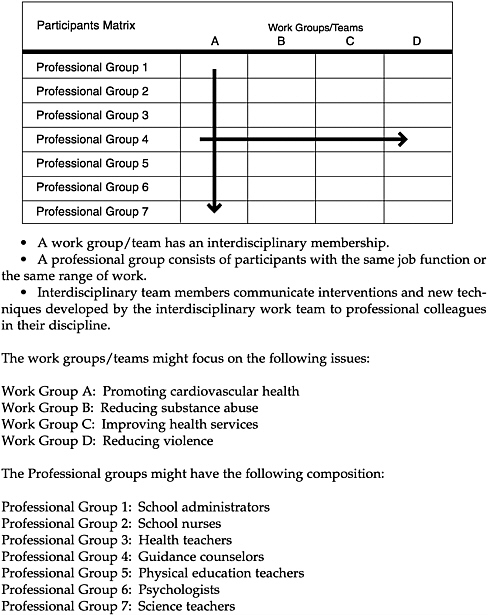
vidual assigned to coordinate the program have been proposed as an effective arrangement. Ideally, the school-based program coordinator or member of the health council would serve as a representative to the district coordinating council. In large schools, in addition to the overarching school health council, the work may be divided among subcommittees or work teams, with each responsible for a particular aspect of the program (Gurevitsch, 1991). Ideally, two types of teams might work simultaneously: (1) professional or disciplinary groups focusing on one particular program component, such as health education or food and nutrition services, and (2) cross-disciplinary groups that cut across all program components and major health and educational issues facing students, such as reducing substance abuse or promoting cardiovascular fitness. Cross-disciplinary teams allow for enhanced communication and dissemination of ideas as team members share information and receive advice from other members of their professional team (see Figure 5-1).
It should be emphasized that the school-based infrastructure can be built on existing personnel and programs. A school nurse or a health education teacher might serve as the program coordinator and be given appropriate compensation or "released time" from his or her normal duties. Existing faculty and staff, including those from all disciplines and levels, should serve on school teams.
Extending the Infrastructure through Interdisciplinary and School–Community Collaboration
In the current era of limited resources for both health care and education, it is essential that school health professionals purposefully collaborate with each other and with members of the mainstream health and social services systems in the community. School programs and services that are disconnected from the student's family, primary care provider, social support system, and the larger community merely add a fragmented layer of care that may be either contradictory or redundant.
Existing resources can be maximized by considering schools as an essential, integral part of the overall community health and service system. Although school health programs are often called "comprehensive," it should be emphasized that programs and services actually delivered at the school site may not provide complete coverage by themselves. Instead, on-site school programs and services should work with and complement the efforts of families, primary sources of health care, and other health and social service resources in the community to provide a continuous, complete, and seamless system to promote and protect students' health. In fact, the suggestion has been ventured that the term "coordi-
nated school health program" might be more appropriate than "comprehensive school health program" to emphasize this notion.
Often, a variety of professionals must work together within the school to determine appropriate interventions for students with academic or behavioral problems or those who require special education or have special needs. Students receiving special attention at school may also be undergoing assessment and treatment in health and social services systems outside the school; they may be seen and/or treated by psychologists, psychometrists, social workers, counselors, nurse practitioners, physicians, physical therapists, occupational therapists, adaptive physical education specialists, speech pathologists, case managers, and so on. School and community professionals may or may not have similar professional credentials and licensure; assessments may be varied or duplicated; and interventions may occur in both settings or neither setting.
Professional communication across disciplines and settings is therefore critical for the benefit of these students. Ideally, assessment results for common clients are shared, needs are determined jointly, and intervention plans are made with active involvement of the student and his or her family, along with appropriate staff from the school and the individuals or agency staff providing health and social services in the community. This level of integration would result in a truly "seamless" delivery system for children and their families, reduce fragmentation or duplication of care, and maximize existing resources.
Two major barriers have been identified regarding interagency collaboration: the confidentiality of medical records and the varied qualifications of staff among agencies doing the same tasks for shared clients. However, as pointed out in Chapter 4, confidentiality is a barrier only if the clients or the parents or guardians of clients who are minors refuse to consent to the sharing of medical information. The issue of staff qualifications among agencies can be addressed with protocols to ensure standardization of care and administrative support from the agencies involved. For example, assessments done by nurse practitioners, registered nurses, and certified assistive personnel (such as psychometrists and physician assistants) may not be as consistently accepted as those done by physicians. Interagency protocols and agreements can address those inconsistencies so that clients do not have repetitious assessments and duplicated medical, laboratory, or psychological tests from a variety of agencies.
Personnel Training Needs
Appropriately prepared professionals and paraprofessionals—teachers, administrators, counselors, psychologists, social workers, school
nurses, foodservice personnel, and other team members from the school and community—will be crucial for the implementation of effective CSHPs, and collaboration among these professionals will be essential to produce a strong CSHP infrastructure within a district or school. However, some observers suggest that many professionals do not understand disciplines beyond their own and that discipline-based views and terminology inhibit the fullest exchange of ideas. Thus, there is a critical need to take an interdisciplinary approach to preservice and inservice training, not just for personnel assigned directly to school health but for educators in all fields and for administrators as well. Interdisciplinary interaction should be an integral part of preservice preparation at the university level, and preservice programs should be aligned with the concepts embodied by CSHPs. University faculty providing preservice preparation in school health and related fields should create models of collaboration with colleagues in other relevant departments, and students should be exposed to interdisciplinary experiences in field placements and internships (Gingiss, 1995; Lawson and Hooper-Briar, 1994). Consideration should also be given to creating a new category of personnel—comprehensive school health coordinators—who can work with both the school and the community and who have the management skills to oversee complex partnership programs.
School administrators, both at the district level and in individual schools, can be pivotal in developing and supporting the CSHP infrastructure. Thus, the preparation of administrators should include providing them with an understanding of all facets of a CSHP—what programs are about and what they can do; the mobilization of support among staff and community members; sources of financing; organization of the school day, facilities, and existing resources to support the program; and the responsibilities that departments and individuals must assume.
Overcoming Controversy
The ultimate authority for all local school policies and programs belongs to the local board of education, which operates within the federal, state, and local legislative framework. Whether appointed or elected directly, these boards are political bodies. As in other arenas, with politics come controversies. Indeed, many of the most visible and controversial issues that school boards encounter—sexuality and family life education, mental health counseling, reproductive health counseling and services—are associated with school health programs (Marks and Marzke, 1993; Rienzo and Button, 1993).
Thus, supporters of comprehensive school health programs must become activists at school board meetings and in the media—although they
must take special care not to ride roughshod over general community and parental concerns. Where criticism is ill-informed or unwarranted, supporters must operate with a clear understanding of the health status, behaviors, and needs of children and young people in the community. Supporters can also be armed with facts such as the results of the national Gallup and Harris surveys, discussed in Chapter 3, which show overwhelming support for school health education from parents and students. They can cite studies of parents' perceptions of school-based health centers, such as the one carried out in the vicinity of Portland, Oregon, which found that parents overwhelmingly favored the provision of all general health, counseling, parent education, and reproductive health services in the school (Glick et al., 1995). 6
Healthy Caring, the process evaluation of the Robert Wood Johnson School-Based Adolescent Health Care Program, found that controversy surrounded the start-up of school-based health centers at almost all program sites (Marks and Marzke, 1993). Objections were reported to have come from limited but vocal segments of the community, often from individuals or representatives of organizations who themselves did not have children attending the schools. One effective strategy for deflecting controversy was to involve the parents of school students in program planning and advocacy. Another successful approach was to establish an advisory committee for the school-based health center that included respected leaders in the medical and health professions, educators, parents, and other community leaders.
Supporters of school health programs must respect the concern that some—perhaps many—parents have about the possible loss of control over what is taught in the health education classroom or over services that their children might receive in school. Proposed health education curricula and materials should be reviewed and accepted by a majority of parents and community leaders, including religious leaders, and they should be available to all parents for examination. Healthy Caring reported that planners of school-based health centers eased parents' concerns by allowing parents to choose services they wished to exclude for their children. The committee emphasizes the importance of compromising on small issues for the sake of advancing the larger program. For example,
Healthy Caring noted that several sites dropped plans for making contraceptives available to students at the school site when it became apparent that this single issue could seriously impede, if not completely derail, attempts to establish a school-based health center.
Overcoming Other Barriers
Inertia and resistance to change are often obstacles that local communities must be prepared to confront in establishing a CSHP infrastructure. Time will also be an issue—especially finding time for teachers and other professionals on school teams to meet and plan. Resource constraints will likely exist. Turf battles may arise over who has authority. Unconvinced or uncommitted administrators may not understand the importance of programs or may refuse to assume leadership for promoting collaboration. Professional training differences could lead to misunderstandings and communication gaps. Some staff may feel overly burdened or threatened as traditional roles give way to new responsibilities.
Several recent articles provide advice on overcoming barriers to collaboration, but they also concede that progress may often be difficult (Allensworth, 1994; Lawson and Hooper-Briar, 1994; Melaville and Blank, 1991; Melaville et al., 1993; Russell, 1994). Districts and schools should expect occasional problems, but they should maintain the leadership and commitment to persevere. The committee believes that communities faced with seemingly insurmountable barriers would benefit from technical assistance provided by a school health extension service and from communication with other communities that have overcome similar problems.
Mobilizing Community Support
Economics may provide the ultimate argument in persuading unconvinced community members of the importance of a CSHP. Today's world of work requires employees to think critically and make decisions, to solve problems individually or as part of a team, to analyze and interpret new information, to develop convincing arguments, and to apply knowledge and skills. Moreover, employers value "healthy" employees—those who practice good nutrition and keep fit, avoid risky behavior, do not smoke or abuse alcohol or drugs, are well adjusted socially and emotionally, and have less health-related absenteeism. The school's mission is to ensure that its graduates have the skills and qualities that are needed to succeed in the world of work, and a comprehensive school health program can play a central role in meeting this goal. Therefore, an important task of the community coordinating council is to help the community come to see the school health program as a critical and primary compo-
nent in achieving the mission of preparing students for the future—not to see the program as a separate, unconnected, or secondary "add-on."
Peer, family, and community influences are as integral to the adoption of health-promoting behaviors as is the acquisition of knowledge. The discussion of health education in Chapters 3 and 6 points out that perceived norms are a critical factor that influences behavior. No matter how high the quality of the school program, its effects will likely be diminished if the community environment does not support and reinforce the program. A strong community coordinating council can work to ensure that all health messages received in the school are reinforced in the community. The council can also marshal forces to develop desirable health-related policies, to provide opportunities to practice health-promoting behaviors, and to foster role modeling by community members. For example, when schools educate students about the laws and hazards regarding the use of illegal substances such as tobacco and alcohol, and prohibit the use of these substances in school, the community should also establish policies and expectations that will help establish a perceived community norm that "alcohol and tobacco are not acceptable substances to use, they are not available to students, and other alternatives are available for students to explore their emerging independence." Students must also see that adults in the community practice responsible behavior with regard to the use of alcohol and tobacco. Another example of community reinforcement of school health messages is that when health classes are discussing access to health care and emphasizing the importance of periodic health assessment, the message will be strengthened if students see that these needed services are accessible to all students.
Principles for Collaboration
A number of articles on collaboration have appeared in the literature in recent years. A review of this literature found that some elements were consistently mentioned as essential for successful collaboration and integration of education and health-related services (Thomas et al., 1993). These elements include
-
family-centered service delivery that responds to the diversity of youth and families,
-
coordinated and comprehensive services,
-
local community and empowerment focus,
-
evaluation of processes and cost,
-
joint data collection,
-
strategies to ensure that youth and families have easy access to
-
services and that they actually receive the services they need (e.g., collocation, one-stop shopping, case management), and
-
restructuring of funding streams to achieve integrated budgets.
A set of principles for integrating local education, health, and human services for children, youth, and families was affirmed by the more than 50 national organizations that met at the consensus conference in January 1994 (American Academy of Pediatrics, 1994). The conference report, Principles to Link By, outlines eight principles for building stronger structures for coordination in the development of the CSHP infrastructure:
-
Coordinating structures should be collaborative.
-
Coordinating structures should be community-based and reflect the diversity and uniqueness of the community.
-
Coordinating structures should be empowered to guide systems change and assure collaboration.
-
Coordinating structures should have flexibility in defining geographic boundaries and institutional relationships.
-
Coordinating structures should establish and maintain a results-based accountability system.
-
Coordinating structures should be encouraged without prescribing a specific structure or authority.
-
Federal and state levels should model collaboration that supports community efforts.
-
Federal and state policies should provide incentives that encourage collaboration among public, private, and community agencies.
SUMMARY OF FINDINGS AND CONCLUSIONS
Many parts of the infrastructure—the basic framework of policies, resources, organizational structures, and communication channels—needed to support CSHPs already exist or are emerging. However, these parts are often fragmented and uncoordinated, and resources are typically transient or limited to specific categorical activities. Leadership and coordination at all levels—national, state, local—will be crucial for programs to become established and grow.
RECOMMENDATIONS
The committee believes that a strong interconnected infrastructure will be essential if CSHPs are to become established and flourish. What happens school by school is ultimately the important outcome. The national infrastructure establishes certain policies and programs that serve as a foundation for the state infrastructure; in turn, the state infrastructure develops and coordinates policies and programs that further add to the
foundation for the infrastructure at the district and local school levels. Below is a summary of the committee's recommendations for the infrastructure at each level.
National Level
At the national level, the federal Interagency Committee on School Health (ICSH) was established in 1994 to improve coordination among federal agencies, identify national needs and strategies, and serve as a national focal point for school health. The National Coordinating Committee on School Health (NCCSH), which works closely with the ICSH, brings together federal departments with approximately 40 national nongovernmental organizations to provide national leadership in school health.
The committee recommends that the mission of the federal Interagency Committee on School Health be revitalized so that the ICSH fulfills its potential to provide national leadership and to carry out critical new national initiatives in school health. In addition, the committee recommends that the National Coordinating Committee on School Health serve as an official advisory body to the ICSH and that individual NCCSH organizations mobilize their memberships to promote the development of a CSHP infrastructure at the state and local levels. The committee also recommends that the membership of the NCCSH be expanded to include representatives from managed care organizations, indemnity insurers, and others who will be key to resolving financial issues of CSHPs.
The ICSH and the NCCSH are poised to provide national leadership, and expanding the missions of these organizations may help them to fulfill the leadership role. Specifically, the ICSH and the NCCSH should develop a national action plan for school health and, in so doing, promote the adoption of the national standards in health education, physical education, school nutrition, school nursing, and school-based health care.
To provide leadership in research, the ICSH and NCCSH could establish a grants program for basic research and outcome evaluation in school health programming; ensure that national data about student health behaviors and health status as well as school health programs and practices are collected, monitored, and tracked; encourage the inclusion of health topics in national and state assessment programs, develop national and state ''school health report cards," and establish a national clearinghouse,
accessible through the Internet, that analyzes and disseminates in useful form, research findings and effective practices in school health for state and local practitioners.
Other leadership roles could include providing funding and technical assistance to help states establish a state-level coordinating council on school health; assisting states in establishing a school health extension service by uniting regional educational service units, agricultural extension services, and area health education coordinators; providing mechanisms for communication between the local and national level to share information, such as an Internet discussion group, annual conferences, and newsletters; identifying and publicizing information about federal funding streams and various strategies for financing school health programs at the state and local levels; promoting the flexible use of federal funds for school health programming; and coordinating relevant federal programs so that states and local communities are not faced with an array of related programs with different or conflicting requirements regarding eligibility, application and reporting processes, personnel, funding, and so forth.
To finance these initiatives without an increase in overall spending, each ICSH agency could receive from a common pool of each of the participating agencies an appropriate fraction of its budget for school health programming.
State Level
At the state level, the infrastructure can be anchored by a structure similar to the ICSH-NCCSH arrangement at the national level.
The committee recommends that an official state interagency coordinating council for school health be established in each state to integrate health education, physical education, health services, physical and social environment policies and practices, mental health, and other related efforts for children and families. Further, an advisory committee of representatives from relevant public and private sector agencies, including representatives from managed care organizations and indemnity insurers, should be added.
This state coordinating council should develop a state plan for school health and institute appropriate policies and legislation; serve as a link for communication about funding and local concerns between the federal and local or regional levels; increase cross-agency integration of programs, funding streams, and research; coordinate federal funding streams by
developing mechanisms to allow categorical funds to be used for CSHPs; find new sources of funding for school health, such as lottery revenues or taxes on items such as tobacco, alcoholic beverages, health club memberships, or Medicaid and private insurers; coordinate state programs and funding streams; provide technical assistance to establish district school health coordinating councils and demonstration models, training, curriculum development, program evaluation, and so forth (especially targeting districts that have the greatest number of students at risk); and sponsor research and evaluation studies on multicomponent-multistrategy programs. Establishing a regional school health extension service, modeled after the Agricultural Extension Service and educational service agencies offers a particularly promising approach for providing technical assistance.
Community or District Level7
To anchor the infrastructure at the community or district level, the committee recommends the following:
A formal organization with broad representation—a coordinating council for school health—should be established in every school district.
Among its duties, the district coordinating council should appoint a district school health coordinator to oversee the program; involve the community in conducting a needs and resource assessment; develop plans and policies for delivery and ongoing assessment of quality programs (with special attention to students at greater risk); provide information to individual schools about standards, practice, and technological developments; coordinate programs and resources; increase cross-agency integration of funding streams and research; assist each individual school in designating a school health coordinator and a school health committee; coordinate school health and social service programs with other community programs and resources, including the private health care sector; ensure that all students have a medical home—a stable, accessible source of primary care; collaborate with nearby districts, regional, or state providers of technical assistance, information, and inservice programs; support the employment, involvement, and continuing professional development of appropriately prepared professional school health staff; and
|
7 |
A "community" may consist of a single school district or be divided into two or more districts. See Figure 5-2 for a distinction between community and district responsibilities. |
provide a monitoring and tracking program for feedback to the community, and to the state coordinating council. Communities must be prepared to confront barriers in building their CSHP infrastructures, including time and resource constraints, turf battles, indifference, or controversy over sensitive aspects of programs. An effective method for mobilizing support has been to enlist parents, students, and other community leaders as program advocates. Compromise on small issues may be essential for the sake of advancing the larger program.
School Level
The committee recommends that at the school level, individual schools should establish a school health committee and appoint a school health coordinator to oversee the school health program.
Under this leadership, schools should address the major health issues facing students and/or the continuous improvement of the various components of the CSHP; develop policies and plans for periodic reports of all aspects of the CSHP (current activities, student outcomes, and plans for improvement); appoint representatives to the district school health coordinating council; coordinate activities and resources with the district coordinating council for assessment of students' needs and behaviors; coordinate funding, time, space, personnel, and other resources to implement comprehensive school health education and provide needed health services for students at the school or at school-linked sites; coordinate case management of services for students at risk; support the employment, involvement, and continuing professional development of appropriately prepared professional school health staff; and seek the active involvement of students and families in designing and implementing programs.
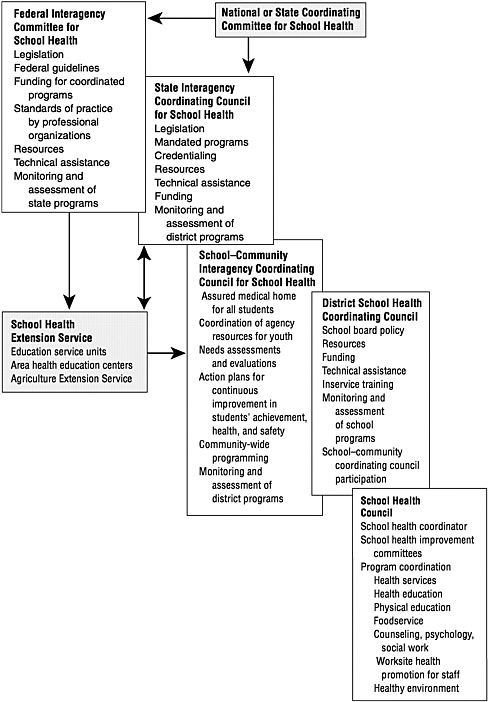
The comprehensive school health infrastructure—the basic interconnected framework on which programs can be built—is summarized in Figure 5-2.
In order to implement quality comprehensive school health programs, the training and utilization of competent, properly prepared personnel should be expanded.
In general, the committee believes that an interdisciplinary approach is needed in the preservice and inservice preparation of CSHP professionals to enable them to communicate and collaborate with each other. In addition, the committee believes that educators in all disciplines—particularly administrators—need preparation in order to understand the phi-
losophy and potential of CSHPs. Important personnel needs include the following:
-
employment of more certified health education specialists at the middle and secondary school levels,
-
enhanced preparation of elementary teachers to deliver quality health instruction and deal with student health problems,
-
increased utilization of certified physical education specialists to provide instruction at the elementary level,
-
enhanced preparation of school administrators in order that they more thoroughly understand school health programs and fully utilize school health personnel,
-
employment of more certified school nurses, nurse practitioners, and other midlevel providers,
-
retraining and shifting existing service providers (especially nurse practitioners and other midlevel providers) from one setting to another in order to respond to changing health delivery demands,
-
designation of a school health coordinator at each school site, with appropriate released time or compensation,
-
employment of professionally prepared foodservice or nutrition directors and managers,
-
increased emphasis on interdisciplinary health-related experiences in the preservice preparation of all educators and school personnel,
-
additional and ongoing training of school health professionals, especially in the ability to translate and adapt research findings to field practice,
-
increased health-related knowledge of individuals in disciplines outside health education so that they are better able to see the relationships between their own disciplines and health promotion,
-
increased emphasis on school health in pediatric and family practice training for physicians, including the roles of physicians in primary and specialty care, as well as roles for physicians from academic health centers and hospitals, in these programs,
-
possible creation of a new category of personnel—comprehensive school health coordinators—who can work with both the school and the community and who have the management skills to operate complex partnership programs.
The call for proper professional preparation is not intended to be self-serving or to promote narrow professional interests; instead, the committee believes that CSHPs and the health of our children are important enough to merit a requirement for well-prepared, qualified professionals. Ideally, all personnel involved in school health programs should have the
appropriate academic credentials and certification before initial employment, and this should be the goal for the future with all new hires. The committee recognizes, however, that there are currently many personnel serving in school health programs without the necessary paper credentials who have received their training on the job. It would not be practical to attempt to replace these individuals, because many are performing well; furthermore, there would be a shortage of credentialed personnel to fill these positions. However, it is important that all school health personnel—whether initially credentialed or trained on the job—be evaluated regularly by knowledgeable supervisors, participate in ongoing inservice training, and maintain active connections with the professional organizations in their respective fields.
REFERENCES
Academy for Educational Development. 1995. Comprehensive School Health Program Infrastructure Development: Process Evaluation Manual (Draft III). Washington, D.C.: Academy for Educational Development.
Allensworth, D.D. 1987. Building community support for quality school health programs. Health Education (Oct./Nov.):7.
Allensworth, D.D. 1994. Building Effective Coalitions to Prevent the Spread of HIV/AIDS. Kent, Ohio: American School Health Association.
American Academy of Pediatrics. 1994. Principles to Link By: Integrating Education Health, and Human Services for Children, Youth, and Families . Report of the Consensus Conference. Washington, D.C.
American Cancer Society. 1993. National action plan for comprehensive school health education. Journal of School Health 63(1):46–66.
Collins, J.L., Small, M.L., Kann, L., Pateman, B.C., Gold, R.S., and Kolbe, L.J. 1995. School health education. Journal of School Health 65(8):302–311.
Dorman, S.M., and Foulk, D.F. 1987. Characteristics of school health education advisory councils. Journal of School Health 57(8):337–339.
Education Development Center and the Centers for Disease Control and Prevention. 1994. Educating for Health: A Guide to Implementing a Comprehensive Approach to School Health Education. Newton, Mass.: Education Development Center.
Gingiss, P.L. 1995. Education and Training for Interprofessional Collaboration. Presentation to the Institute of Medicine Committee on Comprehensive School Health Programs in Grades K–12, Washington, D.C., June 28.
Glick, B., Doyle, L., Ni, H., Gao, D., and Pham, C. 1995. School-Based Health Center Program Evaluation: Perceptions, Knowledge, and Attitudes of Parents/Guardians of Eleventh Graders. A limited dataset presented to the Multnomah County (Oregon) Commissioners, March 21.
Gurevitsch, G. 1991. The Nordberg Project: A model for the development of a health-promoting school in Denmark. In Youth Health Promotion: From Theory to Practice in School and Community, D. Nutbeam, B. Haglund, P. Farley, and P. Tillgren, eds. London: Forbes Publication.
Hackenburg, H. 1959. School health by citizen's council. Journal of School Health 29(9):330–332.
Joint Committee on National Health Education Standards. 1995. National Health Education Standards: Achieving Health Literacy. Atlanta: American Cancer Society.
Kane, W.M. 1994. Planning for a comprehensive school health program. In The Comprehensive School Health Challenge, P. Cortese and K. Middleton, eds. Santa Cruz, Calif.: Education, Training, and Research, Associates.
Killip, D.C., Lovick, S.R., Goldman, L., and Allensworth, D.D. 1987. Integrated school and community programs. Journal of School Health 57(10):437–444.
Lavin, A.T., Shapiro, G.R., and Weill, K.S. eds. 1992. Creating an Agenda for School-Based Health Promotion: A Review of Selected Reports . Boston: Harvard School of Public Health.
Lawson, H.S., and Hooper-Briar, K. 1994. Expanding Partnerships: Involving Colleges and Universities in Interprofessional Collaboration and Service Integration. Oxford, Ohio: Danforth Foundation and the Institute for Educational Renewal at Miami University.
Marks, E.L., and Marzke, C.H. 1993. Healthy Caring: A Process Evaluation of the Robert Wood Johnson Foundation's School-Based Adolescent Health Care Program. Princeton, N.J.: Mathtech.
Marx, S.H. 1968. How a health council developed a narcotics education program. Journal of School Health 38(4):243–246.
Melaville, A.I., and Blank, M.J. 1991. What it Takes: Structuring Interagency Partnerships to Connect Children and Families with Comprehensive Services. Washington, D.C.: Education and Human Services Consortium.
Melaville, A.I., Blank, M.J., and Asayesh, G. 1993. Together We Can: A Guide for Crafting A Profamily System of Education and Human Services . Washington, D.C.: Superintendent of Documents.
National Research Council. 1995. Colleges of Agriculture at the Land Grant Universities. Washington, D.C.: National Academy Press.
Ohio State Board of Education. 1980. Guidelines for Improving School Health Education K–12. Columbus, Ohio: State Board of Education.
Pate, R.R., Small, M.L., Ross., J.G., Young, J.C., Flint, K.H., and Warren, C.W. 1995. School physical education. Journal of School Health 65(8):312–318.
Pateman, B.C., McKinney, P., Kann, L., Small, M.L., Warren, C.W., and Collins, J.L. 1995. School food service. Journal of School Health 65(8):327–332.
Penfield, A.R., and Shannon, T.A. 1991. School Health: Helping Children Learn. Alexandria, Va.: National School Boards Association.
Rienzo, B.A., and Button, J.W. 1993. The politics of school-based clinics: A community-level analysis. Journal of School Health 63(6):266–272.
Russell, W.R. 1994. Preparing Collaborative Leaders: A Facilitator's Guide. Washington, D.C.: Institute for Educational Leadership.
Small, M.L., Majer, L.S., Allensworth, D.D., Farquhar, B.K., Kann, L., and Pateman, B.C. 1995. School health services. Journal of School Health 65(8):319–326.
Spurling, D. 1948. A school health council in action. Journal of School Health 18(2):50–54.
Sullivan, C.J. 1995. School Health Programs: A Time for Action. Washington, D.C.: National School Health Education Coalition.
Thomas, C.F., English, J.L., and Bickel, A.S. 1993. Moving Toward Integrated Services: A Literature Review for Prevention Specialists . Portland, Ore.: Northwest Regional Educational Laboratory.
U.S. Department of Education. 1995. School-Linked Comprehensive Services for Children and Families: What We Know and What We Need to Know. Washington, D.C.: SAI 9503025, U.S. Department of Education.
U.S. Department of Education and U.S. Department of Health and Human Services. 1994. Joint Statement on School Health by the Secretaries of Education and Health and Human Services .
U.S. Department of Education, U.S. Department of Health and Human Services, and U.S. Department of Agriculture. 1994. Interagency Committee on School Health Charter. Washington, D.C.: U.S. Department of Health and Human Services, Public Health Service.
Valente, C.W., and Humb, K.J. 1981. Organization and function of a school health council. Journal of School Health 51(7):446–468.
Wang, M.C., Haertel, G.D., and Walberg, H.J. 1995. Effective features of collaborative school-linked services for children in elementary schools: What do we know from research and practice? Paper commissioned for the Invitational Conference of the U.S. Department of Education and the American Educational Research Association: School-Linked Comprehensive Services for Children and Families, Leesburg, Va., September 28 to October 2, 1994.
Zimmerli, W.H. 1981. Organizing for school health education at the local level. Health Education Quarterly 8:39–42.
RECOMMENDED READING
Allensworth, D.D. 1994. The Comprehensive School Health Program: Essential Elements. Paper commissioned by the World Health Organization.
American Academy of Pediatrics. 1994. Task force on integrated school health services: Integrated school health services. Pediatrics 4(3):400–402.
Children's Defense Fund. 1989. Vision for America's Future: An Agenda for the 90's. Washington D.C.: Children's Defense Fund.
Davies, D. 1981. Citizen participation in decision making in the school. In Communities and Their Schools, D. Davies, ed. New York: McGraw Hill.
Davies, D., Burch, P., and Palanki, A. 1993. Fitting Policy to Family Needs: Delivering Comprehensive Services Through Collaboration and Family Empowerment. Boston: Center on Families, Communities, Schools and Children's Learning.
Dryfoos, J. 1991. Adolescents at Risk: Prevalence and Prevention. New York: Oxford University Press.
Gingiss, P.L. 1992. Enhancing program implementation and maintenance through a multiphase approach to peer-based staff development. Journal of School Health 62(5):161–166.
Gingiss, P.L. 1993. Peer coaching: Building collegial support for using innovative health programs. Journal of School Health. 63(2):79–85.
Green, W., and Krueter, M.W. 1991. Health Promotion Planning: An Educational and Environmental Approach. Toronto: Mayfield Publishing.
Jehl, J., and Kirst, M. 1992. Spinning a family support web. The School Administrator (September):8–15.
Jivanjee, P., Moore, K., Friesen, B.J., and Schultze, K.H. 1995. Education for Interprofessional Collaboration: A Status Report. Portland, Ore.: Regional Research Institute for Human Services, Portland State University.
Liontos, L.B. 1991. Why is collaboration mandatory? Eric Digest: Collaboration Between Schools and Social Services. Eugene, Oreg.
Palanki, A., Burch, P., and Davies, D. 1992. Mapping the Policy Landscape: What Federal and State Governments Are Doing to Promote Family-School-Community Partnerships. Boston: Center on Families, Communities, Schools and Children's Learning.
Resnicow, K. 1995. Conducting a Comprehensive School Health Program. Unpublished paper.
Saxl, E.R., Miles, M.B., and Lieberman, A. 1990. Assisting Change in Education: Trainer's Manual. Alexandria, Va.: Association for Supervision and Curriculum Development.
Sujansky, J.G. 1991. The Power of Partnerships. San Diego: Pfeiffer.
Thompson, R. 1988. Primary School Drug Education Evaluation: A School Team Approach. Canberra, Australia: CPO/Communications.


