
2
Societal Context
Why is it that thousands of people are still being infected every day with the HIV virus even though national AIDS control programs worldwide have conducted extensive information and education campaigns to teach people how to avoid infection? As suggested in Chapter 1, a decade of HIV/AIDS-prevention work in sub-Saharan Africa and elsewhere has demonstrated that while information and education about how to prevent transmission of HIV are necessary for inducing behavior change, such an approach by itself has been unable to induce sufficiently widespread behavioral change to alter significantly the course of the epidemic. Planners and policy makers must be cognizant of the societal context, and attempt to modify it in ways that are conducive to and supportive of change.
From this perspective emerges a distinction between proximal interventions that attempt to interrupt HIV transmission directly and contextual or indirect interventions that attempt to change the environment in which the HIV/AIDS epidemic and many other communicable and noncommunicable diseases are deeply rooted (Mann et al., 1992). Empirical evidence accumulated during more than a decade of prevention work indicates that both proximal and contextual interventions are necessary to reduce the spread of HIV, as well as to mitigate its impact (Mann et al., 1992). It is difficult to overemphasize the importance of contextual intervention as a weapon against HIV; policy makers simply must begin to consider reform of laws and policies outside the health sector as legitimate AIDS-reduction strategies. For example, discussing the merits of alternative HIV-prevention strategies for women, Heise and Elias (1995:939) conclude:
Subsidizing the uniform and school fees of adolescent girls in Africa might actually do more to reduce HIV transmission—by eliminating the need for
Sugar Daddies—than the most sophisticated ''peer education" campaign. It would also reduce unwanted pregnancy, raise the age of marriage and decrease infant mortality, not to mention promoting gender equality. One benefit of women-centered AIDS strategies is that they have positive backward links to many other development objectives.
Thus effective interventions must target not only individual perceptions and behavior, but also the larger context within which those perceptions and behaviors are shaped. In Africa, that context includes laws and policies, social and family structure, sexual debut and the construction of sexual careers, medical and program factors, and economic factors. Structural and individual factors combined produce behavior change. This chapter focuses on those contextual issues we feel may be most directly addressed through intervention.
A wide variety of social, political, and economic factors affect the societal context within which the AIDS epidemic must be viewed; similarly, these factors provide the context for the rest of this report. Among the more salient features of the societal context that affect the size and shape of the HIV/AIDS epidemic in sub-Saharan Africa are the age and gender composition of the population; the construction of sex roles and expectations within society; inequities in gender roles and power; sexual access to young girls and the acceptance of widespread differentials in the ages of sexual partners; rapid urbanization under conditions of high unemployment; considerable transactional sex fostered by limited earning opportunities for women; and lack of access to health care, particularly treatment for STDs. These factors are often exacerbated by social upheavals related to economic distress, political conflicts, and wars. Of course, sub-Saharan Africa is quite heterogeneous with regard to some, if not all, of these factors, so that there is enormous variation in the situation from country to country; particularly noteworthy are the differences between West Africa and East and Southern Africa.
SOCIAL STRUCTURE AND FAMILY ORGANIZATION
Sub-Saharan Africa is home to around one-tenth of the world's population. Its approximately 1,700 identified ethnic groups constitute over 30 percent of the world's cultures. Each group may have its own form of social organization and its own norms governing reproductive life, family formation, inheritance, and so on. Childbirth and marriage may be synonymous in some groups, or one may be expected to precede the other (in either order). Marriage may be a salient event, an extended process, or simply a convenient social label. Expectations and rules for marriage vary enormously. It may be permanent or fleeting; it may occur once in a lifetime, repeatedly over several years, or concurrently with other marriages. It may carry with it the expectation of fidelity or imply a duty of multiple partnership. Several types of unions may coexist. Some ethnographic accounts describe as many as 14 differently named transactions under the umbrella of marriage in a single society, although colonial administrations apparently
attempted to narrow the field, confining amorphous unions within strictly defined legal and religious bounds (Guyer, 1994).
Clearly, the norms within a given society affect common behaviors that put people at risk of HIV infection as well as the messages that are most likely to alter those behaviors effectively. But it is vital to recognize that these norms are changing. In almost every society, sexual relations, reproduction, and marriage are governed by dynamic rules that will change in response to changes both in economic and demographic conditions and in the nature and course of the HIV/AIDS epidemic. In this age of increasing communication, researchers may well find that such changes are taking disparate cultures in a similar direction.
Studies on sexual behavior in sub-Saharan Africa share certain broad assumptions about the historical and social background of the study populations. Following is a brief description of the most common assumptions. Not all these reported findings are well substantiated, and many are probably too broad. However, they provide a review of current knowledge, demonstrate the diversity found, and reveal some of the complex structural issues that affect the epidemic.
It is widely believed that colonial urbanization fundamentally changed the terms of family life and gender relations in sub-Saharan Africa. The levers of this change were colonial administration and proselytizing, male migration to the cities, the creation of jobs—such as cash cropping—dominated by men, and the consequent economic marginalization of women. As taxation monetized the economy, women were forced to earn money where they could. In the indigenous cities of West Africa, they frequently did so through trading; as a result, West African women often have their own income and control their own budget without interference from their husbands. In colonial towns concentrated in East and Southern Africa, single women in town were often automatically associated with the exchange of sex for money or other support (Larson, 1989; Standing and Kisekka, 1989). Enforced migration and the search for support in a dislocated situation set the tone for multipartner relationships (Preston-Whyte, 1994).
Polygyny was common in nearly all sub-Saharan African societies and remains so, but to varying degrees (see Figure 2-1). Formal polygyny is more common in rural than in urban areas, probably because polygyny is well suited to agriculture. Nevertheless, various forms of multiple partnerships are also common in many urban areas, such as the taking of mistresses or "outside wives" (Larson, 1989; Standing and Kisekka, 1989; Hogsborg and Aaby, 1992; Carballo and Kenya, 1994; Rutenberg et al., 1994). Polygyny allows older men with resources to monopolize young women, leaving young men to search for sex outside stable unions (Caldwell et al., 1993). Junior wives may have limited access to family resources and need to supplement them by seeking outside support (Orubuloye et al., 1991). Some researchers have argued that the existence of polygyny may encourage a man to initiate a search for new wives during culturally prescribed periods of sexual abstinence following a birth to an existing wife (Larson, 1989; Orubuloye et al., 1993).
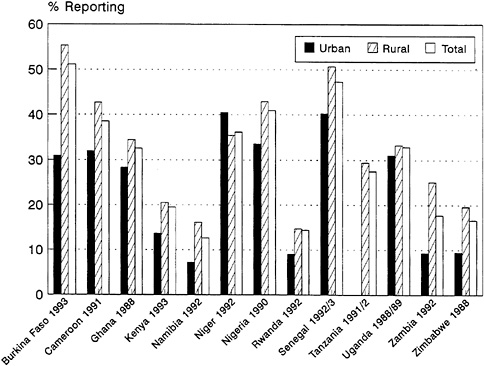
FIGURE 2-1 Percentage of Women in Polygynous Unions. SOURCES: Burkino Faso: Konaté et al. (1994); Cameroon: Balépa et al. (1992); Ghana: Ghana Statistical Service (1989); Kenya: National Council for Population and Development (1994); Namibia: Katjiuanjo et al. (1993); Niger: Kourguéni et al. (1993); Nigeria: Federal Office of Statistics [Nigeria] (1992); Rwanda: Barrè et al. (1994); Senegal: Ndiaye et al. (1994); Tanzania: Ngallaba et al. (1993); Uganda: Kaijuka et al. (1989); Zambia: Gaisie et al. (1993); Zimbabwe: Central Statistical Office [Zimbabwe] (1989).
In all sub-Saharan African societies, sexual contact forms part of an exceedingly complex network of relationships that may involve formal or informal marriage; permanent support of a woman or her children; regular or occasional gifts; or straight payment for sex, either on a repeated basis or as a single event. The same relationship may be viewed differently by different people, and the motivations of the various actors in the relationship will frequently differ as well. Both patrilineal and matrilineal kinship systems are common, and each may have different implications for sexual behavior.
Women in West Africa have traditionally enjoyed more autonomy than women in East and Southern Africa, participating in the labor force in a wide range of income-generating activities such as trading. Furthermore, it is claimed that women in West Africa who separate from their husbands can easily return to their families and usually retain their children, even in patrilineal societies
(Caldwell and Caldwell, 1993). By contrast, rural women's labor force participation in East Africa has largely been confined to subsistence farming and beer-making. In urban areas in East Africa, women are engaged mainly in the preparation and sale of food products or the production of alcoholic beverages, the latter being closely linked to the commercial sex industry (Caldwell and Caldwell, 1993). Finally, divorced or separated women in East Africa are less likely to retain their children or to be able to return to their families of origin. Therefore they are more likely, the Caldwells argue, to be forced to turn to prostitution (Caldwell and Caldwell, 1993).
SEXUAL BEHAVIOR AND HIV/AIDS
Knowledge of social and sexual networks, and of their determinants, is important in projecting the future course of the epidemic and in developing preventive strategies. Studies have begun to address how sexual and social networks channel and potentially amplify HIV transmission in sub-Saharan Africa (Dyson, 1992; Caldwell et al., 1993; Orubuloye et al., 1994; Morris et al., 1995); in addition to migration and transportation systems, such networking encompasses the role of local markets (Edmondson et al., 1993; Orubuloye et al., 1993) and local "mating networks" (Orubuloye et al., 1991; Caldwell et al., 1992; Obbo, 1993). Asymmetric age matching, whereby young women have sexual contact with older men, results in a young cohort of women being exposed to older male partners with higher HIV prevalence (Edmondson et al., 1993; Ssengonzi et al., 1995); this pattern facilitates the spread of infection from generation to generation. Perhaps even more significant, the social context of marriage and childbearing is changing dramatically (Bledsoe and Cohen, 1993). Until recent decades, females in most African societies married at puberty, and there were strong religious sanctions against sex before circumcision or nubility or pubertal ceremonies. Now, according to some evidence, age at menarche may be declining, and formal education and other forms of training are delaying marriage. The result is an ever-rising number of postpubertal single women as a feature of society (see, for example, Antoine and Nanitelamio, 1991).
The composition of sexual networks may have strong implications for the speed or direction of viral transmission. Patterns observed in some African settings of mixing between people in high-risk core groups and others in the general population (as opposed to simple assortative mixing with strong within-group partner preference, such as pairings confined to well-defined groups) can result in substantial spread of sexually transmitted infections, including HIV, among the general population (see Anderson and May, 1992). There is also a growing realization that outside partnerships concurrent with a recognized union, including those that are stable and long term (a not uncommon phenomenon in many sub-Saharan African settings), may be frequent sources of HIV transmission—potentially
as much as or more than sequential, short-term partnerships (Hudson, 1993; Morris et al., 1995).
At the same time, however, networks also serve as bases for social support and the development of new behavioral norms. When a person is well integrated into a stable social network, that network becomes a potential resource for behavioral intervention (Morris et al., 1995). Support for behavioral change, such as acceptance of condoms, can enable individuals to negotiate these matters more effectively when confronted with a resistant partner. By the same token, the absence of social networks can make behavioral change more difficult to achieve. For example, young women working in bars may have little social support for developing and negotiating safer sexual practices because they are often migrants from elsewhere and not from the local community.
Several factors lend a special character to conjugal bonds in many sub-Saharan societies: the relatively greater importance placed on lineage and intergenerational links than on marital ties; traditional separation of spousal economic activities and responsibilities; and polygyny (a common feature of married life in many sub-Saharan African populations, although its prevalence varies considerably according to region and ethnic group), which can result in substantial age differences between husbands and later wives (Caldwell et al., 1989; Goldman and Pebley, 1989; Pebley and Mbugua, 1989; Orubuloye et al., 1990). Some men choose to seek extramarital partners as a result of long periods of postpartum abstinence, particularly in West Africa (Orubuloye et al., 1991). Moreover, in certain African societies, premarital sex is an accepted practice, particularly for men. Indeed, a recent study among the Yoruba in Nigeria found that members of either sex who did not engage in such relations could be accused of being timid, sick, or afraid of disease (Orubuloye et al., 1990). 1 Although more women are attending secondary school and fewer are marrying before age 20, the proportion of young women giving birth has remained relatively constant. Because more young mothers are unmarried, premarital births as a percentage of all births to women under age 20 have risen, particularly in Botswana and Kenya, but also to a lesser degree in Uganda and Zimbabwe (Bledsoe and Cohen, 1993).
Across sub-Saharan Africa, a substantial demand for transactional sex outside marriage is met by various types of commercial sex workers. In many cities, particularly those in East and Southern Africa, a core group of prostitutes have multiple clients a week, or in some cases a day. By contrast, in other cities such a pattern is rarer, and commercial sex workers tend to have long-term, albeit sporadic, relationships with a few men over an extended period of time (Caldwell et al., 1989; Karanja, 1987). Consequently, many men surveyed in Ekiti, Nigeria,
"were reluctant to identify some of their sexual contacts as commercial, because they had known the women involved over a period of time and felt that their relationship involved more than a monetary transaction" (Orubuloye et al., 1992:344). The need for discretion in such relationships reduces condom use because use would imply that at least one of the partners has multiple outside relationships.
In the latter pattern, i.e., multiple long-term relationships, labels such as "prostitution" and "commercial sex worker"2 are not readily applicable. Women play various roles in society; and many women who take part in what might be considered commercial sex do not view themselves, and often are not viewed by their communities, as prostitutes or commercial sex workers. Hence identifying such women for targeted interventions may be very difficult, if not impossible. In the Yoruba study, approximately one-fifth of women having premarital sex said they did so primarily for material returns (gifts in rural areas and money in town) (Orubuloye et al., 1990). Multiple partnerships, the need for discretion, and unacknowledged commercial sex all militate against the effectiveness of contact tracing or of interventions aimed primarily at "core groups'' such as identifiable commercial sex workers. The economic situation of many African women results in a context where "transactions relating to sexual activity have been looked upon … as equally normal as those relating to work" (Caldwell et al., 1989:203).
High fertility continues to be an important survival strategy in many contexts for families in Africa, particularly for women. This imperative has at least two implications. First, females in premarital relationships tend to be under pressure to prove their fertility. The desire to have children to ensure the survival of the clan and the family in the face of AIDS reduces the probability of using condoms (Preston-Whyte, 1994). Second, to avoid jeopardizing their marital relationship, women may enter or remain in sexual unions that have the potential to place them at risk of HIV infection as a result of the extramarital activities of their husbands.
Use of modern family planning is still fairly limited in Africa. Statistics gathered from family planning programs and contraceptive surveys show low, albeit rapidly growing, acceptance and use of modern contraceptive methods. Use of modern contraceptives among women of childbearing age is below 10 percent in all but five sub-Saharan African countries; condom use is below 1 percent nationally in all sub-Saharan African countries except Botswana, Cameroon, Ghana, Malawi, and Zambia (United Nations Economic Commission for Africa, 1995). Condoms tend to be used only with an outside partner, rather than with one's spouse, and there is a tendency among both men and women to
regard condoms as having a stigmatizing association with promiscuity (McGinn et al., 1989; Wawer et al., 1990; Schoepf, 1992). Moreover, husbands and wives generally report little discussion of sexual matters, including family planning, with their spouses. Chapter 4 provides more detailed information on patterns of sexual behavior and HIV/AIDS in the African context.
MOBILITY
Rural-Urban Migration
One hypothesis for the emergence of the HIV/AIDS epidemic in sub-Saharan Africa is that the migration of individuals from areas of low endemicity to new, uninfected areas was instrumental in the eventual dissemination of HIV into larger, more congregated populations (Quinn, 1994). This hypothesis is supported by several findings.
First, following independence in the 1960s, many African countries experienced dramatic demographic changes, including migration from remote regions to more populous areas. For example, the number of African cities with more than 500,000 inhabitants increased rapidly from 3 in 1960 to 28 by 1980 (United Nations, 1991). By the year 2000, the projected proportion of people living in urban centers is expected to exceed one-third of the national populations in all regions except East Africa (Oucho and Gould, 1993). Demographically, migrants have tended to be young adult males. Early in the process, there was little economic or social encouragement for women to migrate; over time, however, growing numbers of women have come to the cities to work in trade and processing or in the entertainment/commercial sex work sector (Okoth-Ogendo, 1991). Ghana and Cô d'Ivoire offer paradigms of such female migration (Denis et al., 1987; Neequaye et al., 1988). Because of the large number of migrants to urban centers, unemployment and social disruption became common, and as a result, many individuals, mostly women, turned to commercial sex work as a means of survival. During the period of rapid urbanization, health officials noted marked increases in sexually transmitted diseases, more recently including HIV-1 infection, within the growing cities (Quinn, 1994). In addition, the economic recession may have aggravated the transmission of HIV by increasing the population at risk through increased migration, disruption of rural families, and poverty (Quinn, 1994).
Cities in East and Southern Africa have attracted a much higher proportion of male than female migrants, so that sex ratios in the cities are quite unbalanced. This pattern is also partly a legacy from the colonial period, when men were recruited for work in the mines or for blue-and white-collar jobs in urban areas, but were often prohibited from bringing their wives or families to town with them (Oucho and Gould, 1993). Sex ratios in many mining areas and cities in East and Southern Africa often exceed 110 (and sometimes 120) men to every 100 women.
Only in Abidjan, C^ote d'Ivoire, is such an imbalanced sex ratio observed in West Africa. This surplus of men in urban areas has created a large demand for transactional sex that is met by prostitution (Caldwell et al., 1989, 1992; Caldwell and Caldwell, 1993).
Truck drivers, the military, and female commercial sex workers are all well recognized as high-risk populations for HIV infection, and are all highly mobile (Smallman-Raynor and Cliff, 1991; Orubuloye et al., 1993). Women involved in commercial sex work frequently move from one locality to another because of economic pressures. For example, in South Africa, the migrant labor system created a market for commercial sex in mining towns and established geographic networks of sexual relationships within and between urban and rural communities (Jochleson et al., 1991). Industrialization and the rapid growth of the mining industry led to an epidemic of STDs among migrant workers (Hunt, 1989). HIV prevalence in South Africa has been recorded as ranging from less than 1 percent among local residents to as high as 18 percent among migrants from Malawi (Quinn, 1994). Women who provide migrant mine workers with sexual services also come from socially and economically marginalized groups in rural and urban areas, many of which also have high rates of HIV infection and STDs, further enabling the spread of both (Pepin et al., 1989; Wasserheit, 1992). These data illustrate one end of the spectrum of behavior, where multiple partners and frequent partner changes are common. Thus, male labor migrants relocating to work without their spouses and commercial sex workers represent "core" populations involved in high-risk activity that act as a major engines of HIV transmission (Anderson, 1991).
Diffusion via Major Roads
Several studies have suggested that the geographic distribution of HIV and AIDS also reflects a diffusion process in which major roads act as principal corridors for the spread of the virus between urban areas and other proximal communities (Wood, 1988; Carswell et al., 1989). Such diffusion is related to contact of local populations with truck drivers, particularly between the drivers and local women, many of whom work in roadside bars or lodges but are not formally considered to be commercial sex workers. In one study of truck drivers and their assistants, one-third were found to be HIV-infected (Bwayo et al., 1991a, 1991b). Epidemiologic evidence demonstrated a wide travel history among this population involving six different countries served by the port of Mombasa, including Kenya, Tanzania, Uganda, Zaire, Burundi, and Rwanda. High seroprevalence was also documented among the female commercial sex workers and bar/hotel workers that lived along the same major highways (Serwadda et al., 1992). In a rural region of Uganda, lower community levels of HIV infection were noted to correlate with greater distance from main and secondary roads and with lower population mobility (Wawer et al., 1991; Serwadda
et al., 1992). It is thus probable that the availability of adequate transportation routes to and through rural areas and the level of rural/urban migration both contribute to the speed of HIV infection. Thus, countries with well-developed transportation infrastructures and high levels of rural/urban migration may experience the rapid spread of HIV infection.
Civil Unrest and Wars
It is highly probable that the profound civil unrest and wars that many sub-Saharan African countries have experienced in the last two decades have contributed to the spread of the HIV virus. As discussed above, the military comprises predominantly single young males with high geographic mobility—factors that encourage casual sexual relationships, often with commercial sex workers. In times of war or unrest, the military are particularly aggressive and mobile, further facilitating the spread of the virus. Furthermore, in times of unrest, rape is a not uncommon tactic to intimidate a local populace and thereby force them into submission. It has been hypothesized that social and civil dislocation due to conflict has contributed to the HIV epidemic in southern Uganda and northern Tanzania (Omara-Otunnu, 1987) and to increased rates of sexually transmitted diseases in Mozambique (Gersony, 1988). In many cases, countries have undergone long periods of low-intensity warfare that have been accompanied by large-scale migrations of the local population. Between 1960 and 1980, more than 75 military coups occurred in 30 sub-Saharan Africa countries (Quinn, 1994). Civil unrest also contributes to declining infrastructure, reducing or eliminating services and slowing the extension of programs. Wars and civil unrest disrupt local authority, creating environments of lawlessness, and disrupt or destroy local economies, pushing people into cities and sex work.
MEDICAL AND PROGRAM FACTORS
Access to and use of health services (including STD treatment), HIV serological counseling, and condoms have a major bearing on HIV prevention; limitations in the availability of diagnosis and treatment for STDs may have contributed to the rapid spread of the epidemic. Many Africans do not recognize that they have an STD, and great numbers do not recognize that their partners are infected. Even when an STD is recognized, many Africans have little access to curative health services, which means that genital ulcer disease and other STDs that facilitate the spread of AIDS can remain untreated for long periods (Caldwell, 1995). Services in many health facilities in sub-Saharan Africa are woefully inadequate. Drugs are often in short supply. In some hospitals, there are far more patients than beds, and patients are forced to sleep on the floor. There is also great pressure on the families of patients to pay for care in spite of their limited means.
Problems for STD control have included ignorance of correct health-seeking behavior, a lack of inexpensive diagnostic tests for gonorrhea and chlamydia, the need for long therapeutic regimens that result in poor rates of compliance, limited treatment alternatives for pregnant women, and the need for broad-spectrum agents to treat polymicrobial STDs or multiple STDs occurring simultaneously (Stamm, 1987). A number of these problems will be alleviated once single-dose regimens of newly developed broad-spectrum antibiotics become both available and economically accessible in developing countries (Andriole, 1988; Philips et al., 1988; Steingrimsson et al., 1990; Handsfield, 1991; Handsfield et al., 1991; Plourde et al., 1991; Martin et al., 1992).
In rural Africa, poor transport and communications networks complicate STD control measures. Contact tracing is logistically difficult and potentially highly stigmatizing because household visits represent the principal means of contact. Intensive follow-up to ensure drug compliance is virtually impossible; because medications are expensive and often scarce, drugs are frequently hoarded, shared with relatives, or sold (Ministry of Health [Uganda], 1988). Such factors all contribute to the emergence of drug resistance (Pepin et al., 1989; Piot and Tezzo, 1990).
Underreporting of genital symptomatology and infection is common, further contributing to inadequate STD control. Reasons for underreporting include asymptomatic or low-grade infections, particularly in women; reluctance to discuss potentially stigmatizing information; limited acceptability of genital examination; and a belief that such conditions are normal. Whereas the majority of men with gonorrhea will experience at least limited symptomatology, 50 to 80 percent of women are asymptomatic (Rothenberg and Potterat, 1990; Jones and Wasserheit, 1991).
ECONOMIC FACTORS
The AIDS crisis struck sub-Saharan Africa in the middle of its greatest economic crisis since independence. Since the 1970s, many sub-Saharan African countries have experienced declining productivity in agriculture and industry, worsening balance-of-payments positions, rising unemployment, and declining real wages. Many African countries have been forced to initiate structural adjustment programs in an effort to restore macroeconomic balance in their economies and reverse their economic declines. As government budgets have been reduced, health ministries have not been spared. Many have been forced to accept a smaller share of government expenditures (Ogbu and Gallagher, 1992).
What are the long-term implications of these economic reversals for the fight against HIV and AIDS? It is still too early to know, but certainly many individuals will be adversely affected either directly or indirectly by the crisis, and economic hardship can lead quickly to the adoption of survival mechanisms that are detrimental to health. Furthermore, the gap between the few who are affluent and
the many who are left behind creates an environment conducive to exploitation and the rapid spread of the virus. For example, economic problems and structural adjustment may hinder women's access to job opportunities in urban formal-sector labor markets. With no other opportunities, women are forced to resort to commercial sex or to rely on multiple partnerships to support themselves and their children. In Zaire, for example, the economic crisis has led to an increase in the number of young rural women migrating to the towns and cities and to the proliferation of various forms of multiple-partner relationships for economic reasons (Schoepf, 1988).
In a recent review, Lurie et al. (1995) argue that the International Monetary Fund (IMF) and the World Bank's structural adjustment programs may have heightened people's risk of HIV infection by (1) reducing the sustainability of a rural subsistence economy, (2) developing a transportation infrastructure, (3) increasing migration and urbanization, and (4) reducing spending on health and social services. Although not the sole reason for the spread of HIV, such programs "may have only exacerbated pre-existing circumstances or simply failed to reverse adverse trends" (Lurie et al., 1995:539). While one negative consequence of economic development is that it facilitates the spread of communicable disease by bringing people into closer and more frequent contact (Feachem et al., 1995), Lurie et al. (1995) argue that there is a need to develop alternative development models that strive to have a less harmful effect than current policies on the spread of HIV.


