

NATIONAL ACADEMY PRESS
2101 Constitution Avenue, N.W. Washington, DC 20418
NOTICE: The project that is the subject of this report was approved by the Governing Board of the National Research Council, whose members are drawn from the councils of the National Academy of Sciences, the National Academy of Engineering, and the Institute of Medicine. The members of the committee responsible for the report were chosen for their special competencies and with regard for appropriate balance. Part I of this report has been reviewed by a group other than the authors according to procedures approved by a Report Review Committee consisting of members of the National Academy of Sciences, the National Academy of Engineering, and the Institute of Medicine.
The Institute of Medicine was established in 1970 by the National Academy of Sciences to enlist distinguished members of the appropriate professions in the examination of policy matters pertaining to the health of the public. In this, the Institute acts under both the Academy's 1863 congressional charter responsibility to be an adviser to the federal government and its own initiative in identifying issues of medical care, research, and education. Dr. Kenneth R. Shine is president of the Institute of Medicine.
This report was produced under grants DAMD17-92-J-2003 and DAMD17-94-J-4046 between the National Academy of Sciences and the U.S. Army Medical Research and Materiel Command. The views, opinions, and/or findings contained in chapters in Parts II through V that are authored by U.S. Army personnel are those of the authors and should not be construed as official Department of the Army positions, policies, or decisions, unless so designated by other official documentation. Human subjects who participated in studies described in those chapters gave their free and informed voluntary consent. Investigators adhered to U.S. Army regulation 70-25 and United States Army Medical Research and Development Command regulation 70-25 on use of volunteers in research. Citations of commercial organizations and trade names in this report do not constitute an official Department of the Army endorsement or approval of the products or services of these organizations. The chapters are approved for public release; distribution is unlimited.
Library of Congress Catalog Card Number 96-67970
International Standard Book Number 0-309-05484-2
Additional copies of this report are available from:
National Academy Press
2101 Constitution Avenue, N.W. Box 285 Washington, DC 20055 Call 800-624-6242 or 202-334-3313 (in Washington Metropolitan Area).
Copyright 1996 by the National Academy of Sciences. All rights reserved.
Printed in the United States of America.
The serpent has been a symbol of long life, healing, and knowledge among almost all cultures and religions since the beginning of recorded history. The image adopted as a logotype by the Institute of Medicine is based on a relief carving from ancient Greece, now held by the Staatlichemuseen in Berlin.
COMMITTEE ON MILITARY NUTRITION RESEARCH
ROBERT O. NESHEIM (Chair),
Salinas, California
WILLIAM R. BEISEL,
Department of Molecular Microbiology and Immunology, School of Hygiene and Public Health, The Johns Hopkins University, Baltimore, Maryland
GAIL E. BUTTERFIELD,
Nutrition Research, Palo Alto Veterans Affairs Health Care System, and Program in Human Biology, Stanford University, Palo Alto, California
JOHN D. FERNSTROM,
Department of Psychiatry, Pharmacology, and Neuroscience, University of Pittsburgh School of Medicine, Pennsylvania
G. RICHARD JANSEN,
Department of Food Science and Human Nutrition, Colorado State University, Fort Collins, Colorado
ROBIN B. KANAREK,
Department of Psychology, Tufts University, Boston, Massachusetts
ORVILLE A. LEVANDER,
Nutrient Requirements and Functions Laboratory, U.S. Department of Agriculture, Beltsville, Maryland
GILBERT A. LEVEILLE,
Nabisco Foods Group, East Hanover, New Jersey
JOHN E. VANDERVEEN,
Office of Plant and Dairy Foods and Beverages, Food and Drug Administration, Washington, D.C.
DOUGLAS W. WILMORE,
Department of Surgery, Brigham and Women's Hospital, Boston, Massachusetts
ALLISON A. YATES,
College of Health and Human Sciences, University of Southern Mississippi, Hattiesburg (through June 30, 1994)
Food and Nutrition Board Liaison
JOHANNA T. DWYER,
Frances Stern Nutrition Center, New England Medical Center Hospital and Tufts University School of Medicine, Boston, Massachusetts
Committee on Military Nutrition Research U.S. Army Grant Officer Representative
HARRIS R. LIEBERMAN,
U.S. Army Research Institute of Environmental Medicine, Natick, Massachusetts
JAMES A. VOGEL,
U.S. Army Research Institute of Environmental Medicine, Natick, Massachusetts (through September 1, 1995)
COL ELDON W. ASKEW,
U.S. Army Research Institute of Environmental Medicine, Natick, Massachusetts (through February 21, 1994)
FOOD AND NUTRITION BOARD
CUTBERTO GARZA (Chair),
Division of Nutritional Sciences, Cornell University, Ithaca, New York
JOHN W. ERDMAN, JR. (Vice Chair),
Division of Nutritional Sciences, College of Agriculture, University of Illinois at Urbana-Champaign
PERRY L. ADKISSON,
Department of Entomology, Texas A&M University, College Station
LINDSAY H. ALLEN,
Department of Nutrition, University of California, Davis
DENNIS M. BIER,
Children's Nutrition Research Center, Baylor College of Medicine, Houston, Texas
FERGUS M. CLYDESDALE,
Department of Food Science, University of Massachusetts, Amherst
MICHAEL P. DOYLE,
Center for Food Safety and Quality Enhancement, Department of Food Science and Technology, The University of Georgia, Griffin
JOHANNA T. DWYER,
Frances Stern Nutrition Center, New England Medical Center and Tufts University School of Medicine, Boston, Massachusetts
SCOTT M. GRUNDY,
Center for Human Nutrition, University of Texas Southwestern Medical Center at Dallas
K. MICHAEL HAMBIDGE,
Center for Human Nutrition, University of Colorado Health Sciences Center, Denver
JANET C. KING,
University of California, Berkeley and U.S. Department of Agriculture Western Human Nutrition Research Center, Presidio of San Francisco
SANFORD A. MILLER,
Graduate School of Biomedical Sciences, University of Texas, Health Science Center, San Antonio
ALFRED SOMMER,
School of Hygiene and Public Health, The Johns Hopkins University, Baltimore, Maryland
VERNON R. YOUNG,
Laboratory of Human Nutrition, School of Science, Massachusetts Institute of Technology, Cambridge
STEVE L. TAYLOR (Ex-Officio Member),
Department of Food Science and Technology and Food Processing Center, University of Nebraska, Lincoln
Staff
ALLISON A. YATES, Director
BERNADETTE M. MARRIOTT, Associate Director (through November 22, 1995), Interim Director (December 23, 1993 through June 30, 1994)
GAIL SPEARS, Administrative Assistant
MARCIA S. LEWIS, Assistant (through June 30, 1994)
| This page in the original is blank. |
Preface
This publication, Nutritional Needs in Cold and in High-Altitude Environments, is the most recent in a series of reports based on workshops sponsored by the Committee on Military Nutrition Research (CMNR) of the Food and Nutrition Board (FNB), Institute of Medicine, National Academy of Sciences (NAS). Other workshops or mini-symposia have included such topics as body composition and physical performance, nutrition and physical performance, cognitive testing methodology, fluid replacement and heat stress, nutritional needs in hot environments, food components to enhance performance, and strategies to overcome underconsumption. These workshops form a part of the response that the CMNR provides to the Assistant Surgeon General of the Army regarding issues brought to the committee through the Military Nutrition Division of the U.S. Army Research Institute of Environmental Medicine (USARIEM) at Natick, Massachusetts.
FOCUS OF THE REPORT
The conduct of military missions may require operations in hostile climatic environments. The success of such operations will be influenced by how well humans can perform in these extreme conditions. This report is concerned with
nutrition and related factors that may influence the ability of personnel to operate in cold or high-altitude terrestrial environments. While there are differences in the stresses imposed by cold as compared to high-altitude environments, there are enough similarities to make them suitable to address at the same workshop and in the same resulting publication.
During the 1950s and 1960s, a series of symposia on Environmental Physiology in Cold and High Altitude Environments was sponsored or cosponsored by the U.S. Armed Services. These resulted in several publications (see Askew, Chapter 3 in this volume) during the period 1952–1967. While studies on working in environmental extremes continued after this time, they were largely through in-house research at various Armed Services laboratories. More recently, the scientists of USARIEM have been interested in updating information available on the impact of extreme environments and now of cold and high-altitude environments on the nutritional requirements of military personnel.
This publication follows previous CMNR studies requested through the Military Nutrition Division of USARIEM on Fluid Replacement and Heat Stress and Nutritional Needs in Hot Environments. The present report thus completes this series by summarizing the current state of knowledge about the influence of cold and high altitudes on nutrient requirements. Also identified are current programs for feeding troops in these two environments and recommendations for areas of future study.
HISTORY OF THE COMMITTEE
The Committee on Military Nutrition Research (CMNR) was established in October 1982 following a request by the Assistant Surgeon General of the Army that the Food and Nutrition Board of the National Academy of Sciences set up a committee to advise the U.S. Department of Defense on the need for and conduct of nutrition research and related issues. The committee's tasks are to identify nutritional factors that may critically influence the physical and mental performance of military personnel under all environmental extremes, to identify deficiencies in the existing data base, to recommend research that would remedy these deficiencies and approaches for studying the relationship of diet to physical and mental performance, and to review and advise on standards for military feeding systems. Within this context, the CMNR was asked to focus on nutrient requirements for performance during combat missions rather than requirements for military personnel in garrison. (The latter were judged as not significantly different from those of the civilian population.) Although the membership of the committee has changed periodically, the disciplines represented have consistently included human nutrition, nutritional biochemistry, performance physiology, food science, and psychology. For issues that require broader expertise than exists within the committee, the
CMNR has convened workshops or utilized special consultants. These workshops provide additional state-of-the-art scientific information and informed opinion for the consideration of the committee.
COMMITTEE TASK AND PROCEDURES
In early summer 1993, personnel from the USARIEM requested that the CMNR examine the current state of knowledge concerning the influence of cold and high-altitude terrestrial environments on nutrient requirements of military personnel. The task was to evaluate the latest research on energy requirements and potential changes in the requirements for other nutrients necessary to maintain military physical and mental performance in these harsh environments.
The committee was aware that the majority of the scientific work on these topics had been conducted through military research. Committee members decided that the best way to review the state of knowledge in this diverse area was through a small workshop at which knowledgeable researchers could review published research and provide an update on current knowledge. Such a workshop would enable the CMNR to review the adequacy of the current nutrient specifications for military operational rations and to identify gaps in the knowledge base that might be filled by future research.
A subgroup of the committee met in August 1993, determined the key topics for review, identified speakers with expertise in these topics, and planned the workshop for January 1994. Invited speakers were asked to prepare review papers on their assigned topics for presentation and subsequent publication and to identify gaps in the data base. The CMNR also believed that it would be beneficial to obtain the viewpoints of military commanders and training staff who worked with soldiers in cold and high-altitude environments. The planning group identified several speakers who were involved in mountain warfare training. These speakers presented informal commentary at the workshop on troop training and feeding. In addition, LTC Nancy King and CW4 Thomas Lange provided information on rations and the logistics of feeding soldiers in the cold and at high altitudes.
At the two-day workshop, the speakers gave formal presentations, which were followed by questions and a brief discussion period. The proceedings were tape-recorded and professionally transcribed. At the end of the presentations, a general discussion of the overall topic was held. On the day after the workshop, the CMNR met in executive session to review the issues, draw some tentative conclusions, and assign the preparation of draft reviews and summaries of specific topics to individual committee members. Committee members subsequently met in a series of working sessions and worked separately and together using the authored papers and additional reference material to draft the summary and recommendations. The final report was
reviewed and approved by the entire group. These early working sessions included Richard Atkinson and Joël Grinker, who have since rotated off the committee.
The summary and recommendations of the Committee on Military Nutrition Research constitute Part I of this volume, and the papers presented at the workshop make up Parts II, III, IV, and V. As is part of the NAS process, Part I has been reviewed anonymously by an outside group with expertise in the topic area and experience in military issues. The authored papers in Parts II, III, IV, and V have undergone limited editorial change, have not been reviewed by the outside group, and represent the views of the individual authors. Selected questions directed toward the speakers and their responses are provided at the end of each part to give an indication of the discussion after each set of presentations. This is followed by a summary of an unpublished manuscript presented by K. K. Srivastava, "Environmental Stress Management at High Altitudes by Adaptogens," in Appendix A, brief biographical sketches of committee members and chapter authors in Appendix B, and a list of abbreviations used in this report in Appendix C. The invited speakers were also requested to submit a brief list of selected background papers prior to the workshop. These recommended readings, as well as relevant citations obtained through a computerized literature search and the citations from each chapter, are included in the Selected Bibliography (Appendix D).
ACKNOWLEDGMENTS
It is my pleasure as chairman of the CMNR to acknowledge the contributions of the FNB staff, particularly the excellent technical and organizational skills of Bernadette Marriott, the associate director for the FNB and the study director for the CMNR. Her assistance in organizing the workshop and in bringing the proceedings to the point of publication is greatly appreciated. I wish to acknowledge as well the fine contributions by the workshop speakers and their commitment to participating and preparing detailed review papers on relatively short notice. The CMNR appreciates the assistance of COL Eldon W. Askew and others from the USARIEM for their assistance in identifying issues of concern to the military and obtaining the involvement of the military personnel who participated in the workshop. COL Askew provided outstanding leadership to the Military Nutrition Research Program at USARIEM and clearly identified the issues to be reviewed by the CMNR. James Vogel, former director of the Occupational Health and Performance Directorate at USARIEM, retired in September 1995. Jim played an instrumental scientific role at USARIEM in areas that were related to a number of the CMNR reports. His expertise and leadership will be missed. The comments by FNB director Allison Yates provided helpful insight in the development of this final document. I want to thank Sydne Carlson who has recently joined the FNB
staff and significantly contributed to editorial efforts on this report. The editorial efforts of Judy Grumstrup-Scott are gratefully acknowledged. The assistance of Susan Knasiak, CMNR research assistant, and Donna Allen, CMNR project assistant, in editing, proofreading, and word processing this report is greatly appreciated.
Finally, I am grateful to the members of the committee who participated significantly in the discussions at the workshop and in the preparation of the summaries of the proceedings. In particular, I wish to express my thanks to Richard Atkinson and Joël Grinker, who have completed their terms on the CMNR. Their participation in various committee activities, workshops, and reports has been very valuable in the conduct of CMNR activities. I wish also to express my appreciation to Allison Yates, whose term on the CMNR ended as she was appointed director of the FNB. We are pleased to have her continued input on our activities and her continued interest in our work. Committee members William Beisel and Gail Butterfield have been instrumental in organizing, reviewing, and writing major sections of this report. The full committee is grateful for their time and interest. I and the other members of the committee are very appreciative of liaison member Johanna Dwyer. She has been much more than a liaison to the FNB as she has actively participated in our meetings and workshops and assisted in preparing this workshop report.
The commitment of the members of this committee, past and present, who serve without compensation in participating and contributing to the successful outcomes of our activities is commendable. Any success this CMNR has had in fulfilling the committee's mission is due to their interest and diligence, and they are a real inspiration to me.
ROBERT O. NESHEIM, CHAIRMAN
COMMITTEE ON MILITARY NUTRITIONAL RESEARCH
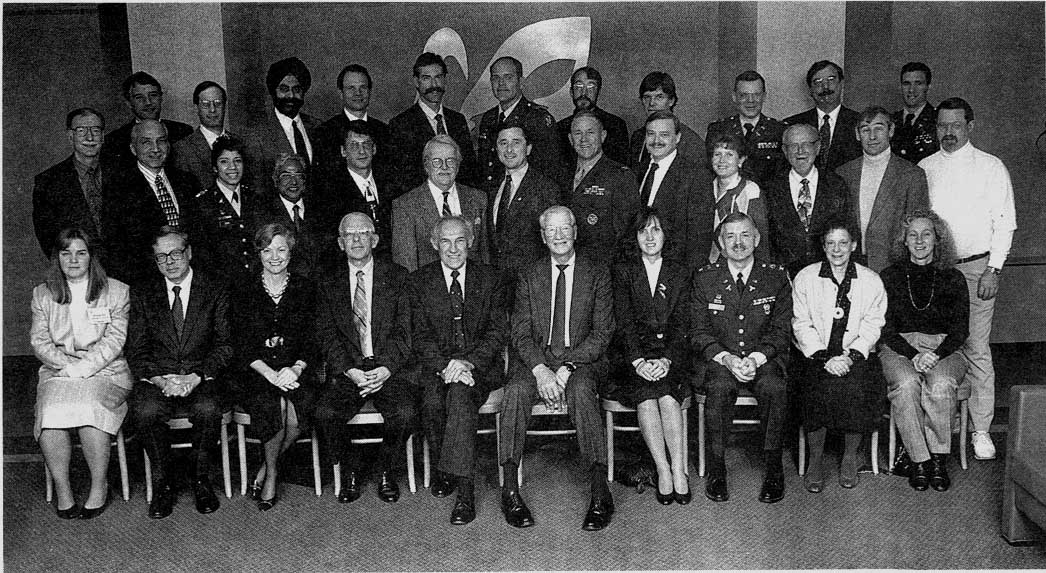
Participants at the Workshop on Nutritional Needs in Cold and High-Altitude Environments, January 31–February 1, 1994, Washington, D.C. Back Row (Left to Right): Peter J. H. Jones, Harris R. Lieberman, Inder S. Anand, Reed W. Hoyt, André Vallerand, Thomas J. Lange, John L. Beard, Robert B. Schoene, Robert Gifford, Andrew J. Young, and Beau Freund. Middle Row: Irwin Taub; Robert S. Pozos; Nancy King; K. K. Srivastava; Ira Jacobs; Jacques A. LeBlanc; William D. Strauss; Russell W. Schumacher, Jr.; Robert D. Reynolds; Irene M. Simon-Schnass; Robert E. Feeney; Allen Cymerman; and Murray P. Hamlet. Seated: Barbara Shukitt-Hale, Orville A. Levander, Allison A. Yates, G. Richard Jansen, William R. Beisel, Robert O. Nesheim, Bernadette M. Marriott, Eldon W. Askew, Joël A. Grinker, and Gail E. Butterfield. Not Pictured: Richard L. Atkinson, A. J. Dinmore, Johanna T. Dwyer, John D. Fernstrom, Gilbert A. Leveille, and John E. Vanderveen.
|
Oxidative Stress at High Altitudes and Effects of Vitamin E |
||||
|
Effects of Altitude on Cognitive Performance and Mood States |
||||
|
Food Components and Other Treatments That May Enhance Mental Performance at High Altitudes and in the Cold |
||||
|
|
||||
|
|
||||
|
Environmental Stress Management at High Altitudes by Adaptogens, summary of unpublished manuscript |
||||
| This page in the original is blank. |


