
| This page in the original is blank. |
Appendix A Public Law 102-484—Oct. 23, 1992 (Extract)
Subtitle G—Chemical Demilitarization Program
SEC. 171. CHANGE IN CHEMICAL WEAPONS STOCKPILE ELIMINATION DEADLINE
Section 1412(b)(5) of the Department of Defense Authorization Act, 1986 (50 U.S.C. 1521 (b)(5)), is amended by striking out "July 31, 1999" and inserting in lieu thereof "December 31, 2004."
SEC. 172. CHEMICAL DEMILITARIZATION CITIZENS ADVISORY COMMISSIONS
|
(a) |
ESTABLISHMENT.— |
|
(1) |
The Secretary of the Army shall establish a citizens' commission for each State in which there is a low-volume site (as defined in section 180). Each such commission shall be known as the "Chemical Demilitarization Citizens' Advisory Commission" for that State. |
|
(2) |
The Secretary shall also establish a Chemical De militarization Citizens' Advisory Commission for any State in which there is located a chemical weapons storage site other than a low-volume site, if the establishment of such a commission for such State is requested by the Governor of that State. |
|
(b) |
FUNCTIONS.—The Secretary of the Army shall provide for a representative from the Office of the Assistant Secretary of the Army (Installations, Logistics, and Environment) to meet with each commission under this section to receive citizen and State concerns regarding the ongoing program of the Army for the disposal of the lethal chemical agents and munitions in the stockpile referred to in section 1412(a)(1) of the Department of Defense Authorization Act, 1986 (50 U.S.C. 1521 (a)(1)) at each of the sites with respect to which a commission is established pursuant to subsection (a). |
|
(c) |
MEMBERSHIP.— |
|
(1) |
Each commission established for a State pursuant to subsection (a) shall be composed of nine members appointed by the Governor of the State. Seven of such members shall be citizens from the local affected areas in the State; the other two shall be representatives of State government who have direct responsibilities related to the chemical demilitarization program. |
|
(2) |
For purposes of paragraph (1), affected areas are those areas located within a 50-mile radius of a chemical weapons storage site. |
|
(d) |
CONFLICTS OF INTEREST.—For a period of five years after the termination of any commission, no corporation, partnership, or other organization in which a member of that commission, a spouse of a member of that commission, or a natural or adopted child of a member of that commission has an ownership interest may be awarded— |
|
(1) |
a contract related to the disposal of lethal chemical agents or munitions in the stockpile referred to in section 1412(a)(1) of the Department of Defense Authorization Act, 1986 (50 U.S.C. 1521(a)(1)); or |
|
(2) |
a subcontract under such a contract. |
|
(e) |
CHAIRMAN.—The members of each commission shall designate the chairman of the commission from among the members of the commission. |
|
(f) |
MEETINGS.—Each commission shall meet with a representative from the Office of the Assistant Secretary of the Army (Installations, Logistics, and Environment) upon joint agreement between the chairman of the commission and that representative. The two parties shall meet not less often than twice a year and may meet more often at their discretion. |
|
(g) |
PAY AND EXPENSES.—Members of each commission shall receive no pay or compensation for their involvement in their activities of the commission. |
|
(h) |
TERMINATION OF COMMISSIONS.—Each commission shall be terminated after the stockpile located in that commission's State has been destroyed. |
Appendix B Chemical Stockpile Disposal Program
The Call for Disposal
The United States has maintained a stockpile of highly toxic chemical agents and munitions for more than half a century. Three unitary1 agents are stored and exist largely as liquids: nerve agent VX, a high-boiling point liquid that will adhere to surfaces for days or weeks; nerve agent GB (sarin), a liquid that evaporates quickly and has a volatility similar to water; and mustard, a blister agent that evaporates slowly. These agents are stored in a variety of munitions and containers.
Lethal chemical agents are extremely hazardous, which is why they have been used in weapons. The manufacture of such agents and munitions and their subsequent stockpiling were undertaken in the belief that they were valuable as deterrents to similar materials being used against U.S. forces. That deterrence is no longer considered necessary. Consequently, the United States can no longer justify the continuing risk and expense of storage.
In an attempt to avoid the worldwide risk posed by chemical warfare, the United States is entering into agreement with many other nations to rid the world of all such materials. There is ample incentive for disposing of U.S. chemical agents and munitions as promptly as safe procedures permit.
In 1985, Congress passed Public Law 99-145 initiating the Chemical Stockpile Disposal Program (CSDP) to eliminate the unitary chemical stockpile, starting with an "expedited" effort to dispose of M55 rockets, a particularly hazardous munition. The program was expanded to treat the entire stockpile and led to the development of the current baseline incineration system. In 1992, after setting several intermediate goals and dates, Congress enacted Public Law 102-484 directing the Army to dispose of the entire unitary chemical warfare agent and munitions stockpile by December 31, 2004.
Disposal Program Background and Role of the National Research Council
The Army's search for the best disposal system for bulk agents and munitions has continued for some time, with input from several committees of the National Research Council. Prior to 1969, disposal was mainly by land burial, open pit burning, and deep ocean dumping.2 An NRC review committee (NAS, 1969) concluded that:
It should be assumed that all agents and munitions will require eventual disposal and that dumping at sea should be avoided. Therefore, a systematic study of optimal methods of disposal on appropriate military installations, involving no hazards to the general population and no pollution of the environment, should be undertaken.
The use of the terms "no hazard" and "no pollution" is unfortunate. The stockpile is a hazard, and both storage and disposal entail some risk. The only way to eliminate the hazard and associated storage risk is to eliminate the materials themselves.
The Army commissioned studies of different disposal technologies and tested several in the 1970s, including incineration and chemical neutralization (Moynihan et al., 1983). In 1982, the Army selected component disassembly and incineration with
associated pollution abatement systems, now known as the baseline system, as the preferred disposal system.
The NRC Committee on Demilitarizing Chemical Munitions and Agents was formed in August 1983 to review the status of the stockpile and technologies for disposal. That committee reviewed a range of technologies and, in its final report in 1984, endorsed incineration as an adequate technology for the safe disposal of chemical agents and munitions (NRC, 1984). The committee also concluded that the stockpile was well maintained and posed no imminent danger but added, "It is not possible to give assurance at this time that an increased rate of deterioration may not occur within the relatively near future."
In 1987, at the request of the Undersecretary of the Army, the Committee on Review and Evaluation of the Army Chemical Stockpile Disposal Program (referred to as the Stockpile Committee) was established under the aegis of the National Research Council Board on Army Science and Technology to provide the Army with technical advice and counsel on specific aspects of the disposal program. Under this charter, the Army has requested and received 14 reports from the Stockpile Committee.
Construction of the Johnston Atoll Chemical Agent Disposal System (JACADS), the first facility to bring together and integrate the elements of the baseline system, was begun in 1984. JACADS began operations using agents in July 1990 with Operational Verification Testing (OVT) that concluded in March 1993. The MITRE Corporation was engaged to monitor four test series (MITRE, 1991, 1992, 1993a, 1993b) and to provide a summary report upon conclusion of OVT (MITRE, 1993c). The Stockpile Committee issued a preliminary review and commentary on MITRE's reports in July 1993, Evaluation of the Johnston Atoll Chemical Agent Disposal System Operational Verification Testing: Part I (NRC, 1993b), including comments and broad recommendations on the implications of JACADS performance for disposal facilities in the continental United States. The committee then issued a more detailed review containing expanded recommendations for improvement of the baseline system, Evaluation of the Johnston Atoll Chemical Agent Disposal System Operational Verification Testing: Part II (NRC, 1994a).
In 1989, construction of the first disposal facility in the continental United States, the Tooele Chemical Agent Disposal Facility (TOCDF), was begun at the Tooele Army Depot in Utah. The design of the TOCDF represents a second generation baseline system, incorporating improvements based on experience with the JACADS facility, advances in technology, and recommendations made by the Stockpile Committee. Pre-operational testing, or "systemization," of the TOCDF started in August 1993.
During the systemization period, additional modifications were made to systems and procedures at the TOCDF in response to recommendations by the Stockpile Committee in the two OVT reports mentioned above and in Review of Monitoring Activities Within the Army Chemical Stockpile Disposal Program (NRC, 1994b) and Recommendations for the Disposal of Chemical Agents and Munitions (NRC, 1994c).
In addition, the Stockpile Committee issued a letter report concerning the chemical stockpile disposal risk management process (NRC, 1993a). In that report, the committee recommended that a site-specific risk assessment be performed at each continental U.S. site prior to the start of agent operations. Each risk assessment is expected to include all site operations, including continuing risks from storage as well as risks from accidental agent releases and from chronic exposures during plant operations. The Army has retained Science Applications International Corporation (SAIC) to perform the site-specific risk assessments.
Description of the Stockpile
Agents
The two principal types of agent in the U.S. stockpile are nerve agents (GB and VX)3 and blister or mustard agents (H, HD, HT). Each is found in a variety of containers and munitions.
Nerve agents are organophosphonate compounds that contain phosphorus double-bonded to an oxygen atom and single-bonded to a carbon atom. Nerve agents are highly toxic and lethal in both liquid and vapor forms. In pure form, the nerve agents are practically colorless and odorless. GB evaporates at about the same rate as water and is relatively nonpersistent in the environment. VX evaporates much more slowly and can persist for a long time under average weather conditions.
Bis (2-chloroethyl) sulfide is the principal active ingredient in blister agents, or mustard.4 Mustard has a garlic-like odor. It presents both vapor and contact hazards. Because it is practically insoluble in water, mustard is very persistent in the environment and can contaminate soils and surfaces for a long time.
Containers and Munitions
The stockpile of unitary chemical agents can be found in containers (various bombs stored without explosives, aerial spray tanks, and ton containers) and munitions (land mines, M55 rockets, bombs, artillery projectiles, and mortar projectiles) (see figures B-1, B-2, and B-3). Some munitions are stored with no explosives or propellant, whereas others contain some combination of fuse, booster, burster, and propellant (table B-1). These components are referred to collectively as ''energetics." They include a variety of chemical compounds that must be eliminated as part of the chemical stockpile disposal operation.
The fuse, a small, highly sensitive explosive element, initiates an explosive chain by detonating a booster. The booster is an intermediate charge sensitive enough to be detonated by the fuse and energetic enough to detonate the much larger burster. The burster, the end of the chain, bursts the munition with sufficient energy to disperse the agent. The M55 rocket also contains an integral solid rocket propellant that can be removed only by cutting open the rocket.5

Figure B-1
M55 rocket and M23 land mine.
Source: USATHAMA, 1982, 1983; NRC, 1993c, 1994a,c.
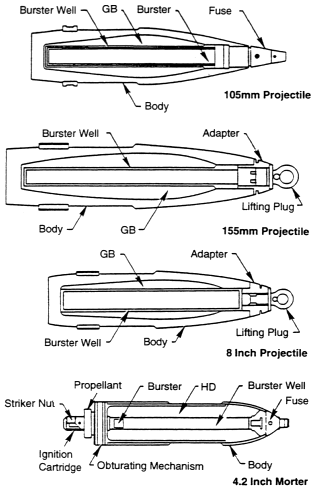
Figure B-2
105-mm, 155-mm, 8-inch, and 4.2-inch projectiles.
Source: USATHAMA, 1982; NRC, 1993c, 1994a,c.
Geographical Distribution
The unitary chemical stockpile is located at eight continental U.S. storage sites (see figure B-4) and at Johnston Atoll in the Pacific Ocean about 700 miles southwest of Hawaii. The nature of the stockpile at each continental U.S. site, by type of container or munition and by type of agent, is indicated in table B-2.
The amount of agent, energetics, and metals stored at each site varies. (table B-3). Within the continental United States, the largest quantity of chemical agent and munitions is at Tooele Army Depot, Utah, with 42.3 percent of the stockpile. All three types of agent and all types of munitions are stored there.
The Baseline Incineration System
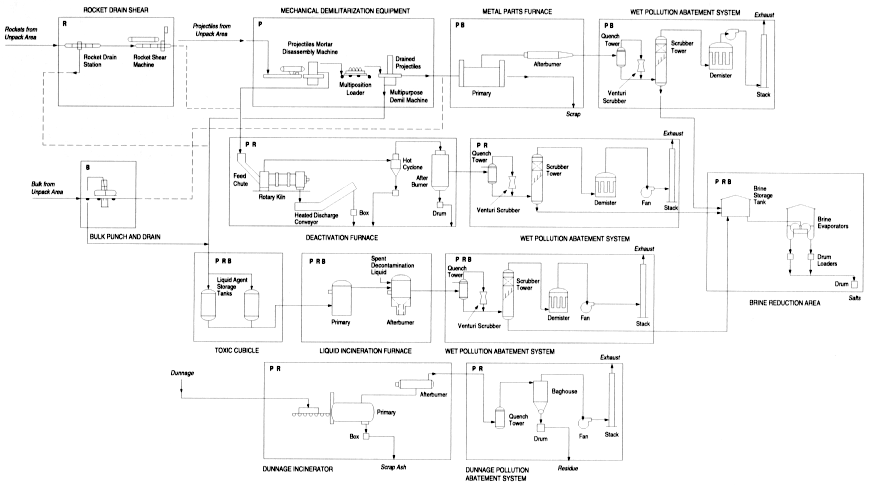
In this section the baseline system is briefly described. The first-generation system, JACADS, is now operating on Johnston Island, having successfully completed Operational Verification Testing (OVT) in March 1993. Figure B-5 shows the major components of the baseline system.
Storage, Transportation, and Unloading of Munitions and Containers
Munitions are stored in vented igloos, and the igloo area is monitored for agent. Most bulk containers are stored in the open or in monitored warehouses. Prior to
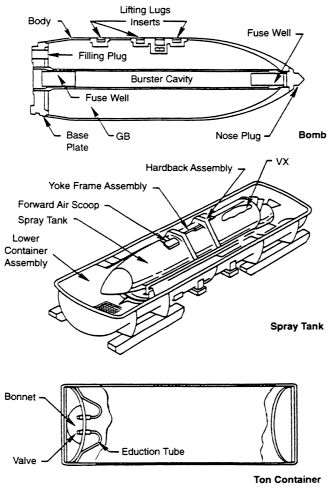
Figure B-3
Bomb, spray tank, and ton container.
Source: USATHAMA, 1982; NRC, 1993c, 1994a,c.
Table B-1 Composition of Munitions in the U.S. Chemical Stockpile
|
Munition Type |
Agent |
Fuse |
Burster |
Propellant |
Dunnage |
|
M55 115-mm rocketsa |
GB, VX |
Yes |
Yes |
Yes |
Yes |
|
M23 land mines |
VX |
Yesb |
Yes |
No |
Yes |
|
4.2-in. mortars |
Mustard |
Yes |
Yes |
Yes |
Yes |
|
105-mm cartridges |
GB, mustard |
Yes |
Yes |
Yes |
Yes |
|
105-mm projectiles |
GB, mustard |
Yesc |
Yesc |
No |
Yes |
|
155-mm projectiles |
GB, VX, mustard |
No |
Yesc |
No |
Yes |
|
8-in. projectiles |
GB, VX |
No |
Yesc |
No |
Yes |
|
Bombs (500-750 lb) |
GB |
No |
No |
No |
Yes |
|
Weteye bombs |
GB |
No |
No |
No |
No |
|
Spray tanks |
VX |
No |
No |
No |
No |
|
Ton containers |
No |
No |
No |
No |
|
|
a M55 rockets are processed in individual fiberglass shipping containers. b Fuses and land mines are stored together but not assembled. c Some projectiles have not been put into explosive configuration. d GA (Tabun), or ethyl-N,N-dimethylphosphoramidocyanidate, is a nerve agent. e Lewisite, or Dichloro(2-chlorovinyl) arsine, is a volatile arsenic-based blister agent. Source: U.S. Army, 1988. |
|||||
transporting munitions and containers, the area is checked for signs of leakage. If agent contamination is found, special procedures are followed to isolate and contain leaking munitions and to decontaminate the area. The munitions or ton containers are then loaded into robust, vapor-tight transport containers designed to withstand impacts and exposure to fire. (A transport container for spray tanks is yet to be designed.) The transport container is moved from the storage area to the unpacking area within the disposal building, where munitions and agent containers are unpacked manually. Packing materials (dunnage) are transported to the dunnage furnace.
Disassembly and Draining
Munitions are moved into an explosive containment room that is maintained below atmospheric pressure to prevent leakage of agent outside the enclosure and is designed to withstand overpressures that might result from the explosion of munitions during processing.
Ventilation air from this room is passed sequentially through six charcoal filter beds, with agent monitors after the first, second, and fourth beds. Agent traces were rarely found after the first bed and were never detected beyond the second bed throughout the OVT at JACADS. After OVT and years of operation, some trace agent leakage through maintenance door gaskets on the carbon filtration system was detected at JACADS. Testing of improved gasket materials is under way at JACADS, and the new materials will be installed at the TOCDF prior to the start of agent operations.
Bulk storage containers are taken to a bulk drain station where they are mechanically punched and drained within an enclosure; the air of the enclosure also passes through the charcoal bed filter banks.
Agent is removed from munitions and containers by automated machinery by one of two processes. Where possible, agent storage compartment walls in M55 rockets, land mines, bombs, spray tanks, and ton containers are simply punched and drained of agent. Heavy-walled steel artillery projectiles must be disassembled. Disassembly begins with the removal of explosive elements in the case
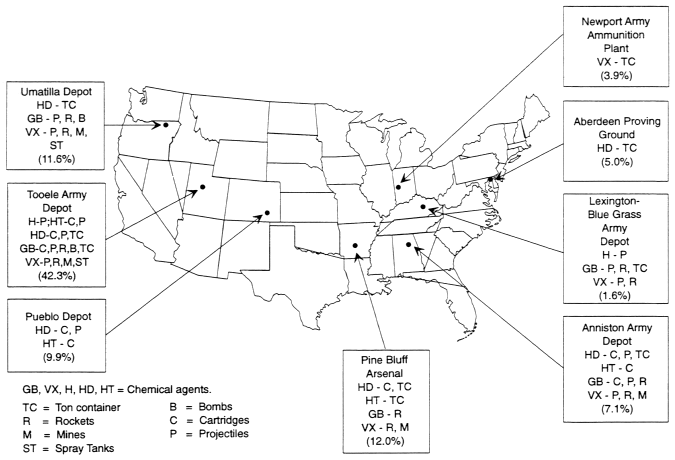
Figure B-4
Types of agent and munitions and percentage of total agent stockpile (by weight of agent) at each storage aite.
Source: OTA, 1992; NRC, 1994a,c.
of armed projectiles. In all cases, mechanical extraction of a press-fit burster well gains access to the agent. Agent drainage (and subsequent destruction) can be complicated because of gelling or solidification of the material, which then does not drain from the munition or ton container. Gelling occurs mostly in aging mustard.
These operations result in three separate streams of material that are fed to specially designed destruction systems: an agent stream that is stored in a feed tank prior to injection into the liquid incinerator; a mixed stream of energetics, small metal components, and residual agent that is fed to the rotary kiln deactivation furnace system; and large metal parts (e.g., ton containers, spray tanks, artillery projectiles), with residual agent but no energetics, that are fed to the metal parts furnace. The separation of these three streams is an important safety feature of the baseline system, enabling the designer to tailor each disposal system for specific material streams to ensure safe, controllable operations. As a result, most agent is treated in liquid form; energetics and metal parts where only residual agent is present are treated separately.
Agent Destruction
Because of the risk of earthquakes, the volume of agent stored for processing at the TOCDF has been greatly reduced (by a factor of about 5 compared to JACADS). The drained agent at the TOCDF will be stored in a 500-gallon tank inside a room designed to contain toxic substances. This tank represents the largest volume of agent in a single container on-site. A larger emergency dump tank is also provided at Tooele but is not intended to be used for normal operations.
The liquid incinerator consists of two sequential combustion chambers and a pollution abatement system
Table B-2 Chemical Munitions Stored in the Continental United States
|
Chemical Munitions (Agent) |
APG |
ANAD |
LBAD |
NAAP |
PBA |
PUDA |
TEADa |
UMDA |
|
Mustard agent (H, HD, or HT) |
|
|
|
|
|
|
|
|
|
105-mm projectile (HD) |
|
X |
|
|
X |
|
|
|
|
155-mm projectile (H, HD) |
|
X |
X |
|
X |
X |
|
|
|
4.2-in. mortar (HD, HT) |
|
X |
|
|
X |
|
X |
|
|
Ton container (HD) |
X |
X |
|
|
X |
Xb |
X |
X |
|
Ton container (HT) |
|
|
|
|
X |
|
|
|
|
Agent GB |
|
|
|
|
|
|
|
|
|
105-mm projectile |
|
X |
|
|
|
X |
|
|
|
155-mm projectile |
|
X |
|
|
|
|
X |
X |
|
8-in. projectile |
|
X |
X |
|
|
|
X |
X |
|
M55 rocket |
|
X |
X |
|
X |
|
X |
X |
|
500-lb bomb |
|
|
|
|
|
|
|
X |
|
750-lb bomb |
|
|
|
|
|
|
X |
X |
|
Weteye bomb |
|
|
|
|
|
|
X |
|
|
Ton container |
|
Xb |
Xb |
|
Xb |
|
X |
X |
|
Agent VX |
|
|
|
|
|
|
|
|
|
155-mm. projectile |
|
X |
X |
|
|
|
X |
X |
|
8-in. projectile |
|
|
|
|
|
|
X |
X |
|
M55 rocket |
|
X |
X |
|
X |
|
X |
X |
|
M23 land mine |
|
X |
|
|
X |
|
X |
X |
|
Spray tank |
|
|
|
|
|
|
X |
X |
|
Ton container |
|
|
|
X |
|
|
|
|
|
a Small quantities of Lewisite and tabun (GA) are stored in ton containers at TEAD. b Small quantities of agent drained as part of the Drill and Transfer System assessment for the M55 rockets. Note: APG, Aberdeen Proving Ground, Md.; ANAD, Anniston Army Depot, Ala.; BAD, Blue Grass Army Depot, Ky.; NAAP, Newport Annex Army Depot, Ind.; PBA, Pine Bluff Arsenal, Ark.; PUDA, Pueblo Depot Activity, Colo.; TEAD, Tooele Army Depot, Utah; and UMDA, Umatilla Depot Activity, Ore. Source: Information supplied by the Program Manager for Chemical Demilitarization at a meeting of the Committee on Alternative Chemical Demilitarization Technologies, March 9–10, 1992, National Academy of Sciences. |
||||||||
(discussed below). The first, or "primary," combustion chamber is preheated to an operating temperature of 2,7001.16F with fuel before agent is injected. The primary fuel is natural gas; liquified propane gas is stored in an on-site tank to provide a backup fuel supply. As agent flow increases, the fuel flow is decreased to maintain the desired temperature for effective agent destruction. Agent flow to the burner is stopped if the temperature drops below 2,5501.16°F. Gases from the first chamber are sent to a secondary chamber, also preheated with fuel, for a final burn stage at 2,0001.16°F. The afterburner gases are then treated in the pollution abatement system.
Some slag produced during nerve agent destruction will form on the lower-temperature walls of the secondary chamber. Spent decontamination fluid is also injected into the secondary chamber to ensure destruction of any residual agent in the solution as well as the evaporation and discharge of the water vapor. This fluid also contains salts that are deposited in the bottom of the secondary chamber. The liquid incinerator at JACADS had to be shut down periodically for manual removal of glasslike solidified salts from both agent and decontamination fluid disposal. A slag removal system has been developed to discharge molten salts during operations at the TOCDF.
Destruction of Energetics
Energetics (fuses, boosters, bursters, and solid rocket propellant) are burned in a counterflow rotary kiln (deactivation furnace system). Energetics are all contained
Table B-3 Approximate Amounts of Metals, Energetics, and Agent Contained in the Unitary Chemical Stockpile (tons), by Site
|
Site |
Ferrous Metal |
Aluminum |
Explosive |
Propellant |
Estimated Agenta |
|
Tooele |
22,000 |
570 |
350 |
175 |
10,500 |
|
Anniston |
13,700 |
1,020 |
451 |
757 |
1,800 |
|
Umatilla |
7,930 |
1,380 |
338 |
1,030 |
2,900 |
|
Pine Bluff |
2,644 |
1,431 |
180 |
1,060 |
3,000 |
|
Lexington |
1,631 |
904 |
115 |
670 |
400 |
|
Pueblo |
10,910 |
0 |
124 |
0 |
2,500 |
|
Newport |
2,455 |
0 |
0 |
0 |
1,000 |
|
Aberdeen |
NAb |
0 |
0 |
0 |
1,300 |
|
JACADS |
NA |
NA |
NA |
NA |
1,700 |
|
TOTAL |
61,270 |
5,305 |
1,558 |
3,692 |
24,800 |
|
a Estimated values, calculated by the Alternatives Committee, based on percentages of the total stockpile at each site, multiplied by 25,000 tons. b NA—not available. Source: Information supplied by the Program Manager for Chemical Demilitarization at a meeting of the Committee on Alternative Chemical Demilitarization Technologies, March 9–10, 1992, National Academy of Sciences. |
|||||
in thin-walled metallic housings that must be punched or cut into pieces prior to burning; confined energetics would detonate in the kiln rather than burn. M55 rockets, after being drained of agent, are sliced into eight pieces to expose energetic material surface area so the material will burn without detonating. Draining and slicing are both done while the rocket is in its fiberglass launch tube. Bursters from artillery projectiles are also sliced, but after removal from the projectile. Explosive elements in land mines are punched in place to expose the explosive and are not removed from the munition. The pieces, most of which may be wetted with agent, are fed slowly into the downstream end of the kiln (downstream in the sense of gas flow) to avoid explosive concentrations within the kiln. Solid pieces move upstream (against the gas flow) as the energetics are burned and then moved onto an electrically heated discharge conveyor, where the temperature is maintained at 1,000°F for 15 minutes. This results in a ''5X" decontaminated material, which is the Army's classification for material that is suitable for release to the public.
The resultant mixture of light steel components, melted aluminum, and glass fibers is of no commercial value. Gases discharged from the rotary kiln pass through an afterburner where they are subjected to a temperature of 2,200°F for 2 seconds. This is a higher temperature and longer time than was used for oxidation at JACADS (2,000°F for 1 second) and should ensure that the TOCDF furnace fully complies with requirements for the complete destruction of polychlorinated biphenyls (PCBs), small quantities of which are present in some fiberglass launch tubes. The afterburner gases are then treated in the pollution abatement system.
Metal Parts Decontamination
Metal parts that have been drained of agent (ton containers, bombs, spray tanks, artillery projectiles, and burster wells, which were pulled to access the agent) are heated to 1,000°F and maintained at that temperature for 15 minutes in a fuel-fired metal parts furnace to produce metal suitable for release as scrap (defined by the Army as 5X). Residual or undrained (including gelled) agent that has not been removed is vaporized and burned within the furnace. This process takes additional time and can limit the system's throughput. At JACADS,
special procedures were approved by the Environmental Protection Agency and implemented to increase the quantity (over the design limit of 5 percent residual per ton container) of agent processing in the metal parts furnace. This procedure ensured compliance with the specifications in the Resource Conservation and Recovery Act (RCRA) permit (U.S. Code of Federal Regulations, 1976). After testing,, this modification has been shown to be acceptable, with proper monitoring and control, but the RCRA permit should be clarified so that waivers will not be required for operation at the TOCDF. Gases discharged from the metal parts furnace are passed through an afterburner, maintained at 2,000°F, before being treated in the pollution abatement system.
Pollution Abatement Systems
The liquid incinerator, deactivation furnace system, and metal parts furnace employ identical, dedicated pollution abatement systems. Gases leaving the secondary chamber of the liquid incinerator or the metal parts furnace afterburner flow to separate dedicated pollution abatement systems for removal of gaseous pollutants and particles to meet emission standards. Hot gases leaving the deactivation furnace system kiln flow to a refractory-lined cyclone separator, where large particles (glass fibers from rocket launch tubes) are removed; next, the gases enter the afterburner; finally, they flow to a similar pollution abatement system.
Each pollution abatement system consists of a quench tower, a venturi scrubber, a packed bed scrubber, a candle mist-eliminator vessel, brine or quench recycle pumps, and an induced draft (ID) blower. Figure B-6 is a schematic drawing of a pollution abatement system.
The exhaust gas stream enters the quench tower near the bottom, where it is cooled by contact with a countercurrent spray of brine pumped from the packed bed scrubber sump. Acidic or acid-forming gases (e.g., hydrogen chloride, hydrogen fluoride, nitrogen oxides (NOx), carbon dioxide, and sulfur dioxide, depending on the chemical agent incinerated)
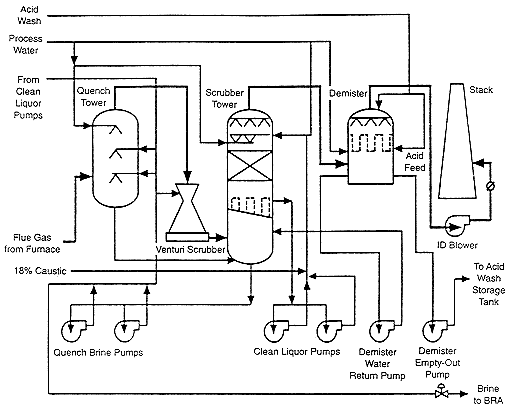
Figure B-6
Schematic drawing of a pollution abatement system.
Source: MITRE, 1993a; NRC, 1994a,c.
in the exhaust gas react with the caustic brine to form salts, which remain in solution in the brine. The cooled gas stream exits from the top of the quench tower and enters a variable throat venturi where it is scrubbed to remove particulates. The venturi has a variable throat to maintain a constant pressure drop independent of the flow of exhaust gases. The brine streams from the quench and venturi scrubber are then returned to the scrubber tower sump. Process water is added to the packed bed scrubber sump to make up for water evaporated in the quench tower. An 18 percent caustic (sodium hydroxide) solution is added, as necessary, to the sump to maintain the brine pH above 8 or 9.
The exhaust gas stream from the venturi scrubber enters the scrubber tower below the clear liquor reservoir tray, moves upward through the packed bed section, and exits at the top of the tower, after passing through a mist-eliminator pad. In the packed bed section, the gas stream comes in contact with a brine solution flowing countercurrently through the bed. Acidic gases in the exhaust gas stream are further scrubbed with caustic brine. The brine solution from the packed bed falls back to the reservoir tray and is recycled back to the top of the packed bed section. Excess brine overflows into the tower sump. Brine density is controlled by pumping a brine stream into the brine reduction area (BRA) storage tanks and replacing it with processing water.
The scrubbed gases enter a candle mist-eliminator vessel. Mist-eliminator candles (i.e., candle-shaped fabric filters) remove very fine mist and submicron particulate matter that were not removed in the venturi scrubber. The cooled and cleaned exhaust gases are pulled through an induced draft blower located upstream of the stack shared by the three pollution abatement systems.
In the tests at JACADS, particulate emissions from the liquid incinerator, the deactivation furnace system, and the metal parts furnace were consistently low (the dunnage furnace was not tested). The mean particulate concentration for all trial burns for each incinerator was less than 5 mg/m3 at 7 percent oxygen, with a maximum value of 10.9 mg/m3. Permits require less than 180 mg/m3. The tests show that metal emissions are extremely low, frequently below detectable limits.
Auxiliary Systems
The dunnage furnace and its pollution abatement system consist of a feed handling system, a primary chamber, an afterburner, a quench tower, a bag house separator, an induced draft blower, and a separate exhaust stack. This system is designed to burn both non-contaminated and contaminated dunnage from the
Table B-4 Air and Exposure Standards
|
|
Permissible Hazard Levels in Air (mg/m3) |
Lethal Human Doses |
||||
|
Agent |
Workersa |
Stack Emissionsb |
General Populationc |
Skin, LD50 (mg/kg) |
Intravenous, LD50 (mg/kg) |
Inhalation, LCt50 (mg-min/m3) |
|
GA |
0.0001 |
0.0003 |
0.000003 |
14–21 |
0.014 |
135–400 |
|
GB |
0.0001 |
0.0003 |
0.000003 |
24 |
0.014 |
70–100 |
|
VX |
0.00001 |
0.0003 |
0.000003 |
0.04 |
0.008 |
20–50 |
|
H/HD/HT |
0.003 |
0.03 |
0.0001 |
100 |
|
10,000 |
|
Note: The Army standards shown in the first three columns set the minimum level of performance required for gas release by any alternative process and are applicable to all four process streams. LCt50 and LD50 represent dosage and dose, respectively, that result in 50 percent lethality. LCt50 represents a concentration (mg/m3) times the exposure time (min). a For 8-hour exposure. b Maximum concentration in exhaust stack. c For 72-hour exposure. Source: U.S. Army, 1974, 1975, 1988; NRC, 1993c. |
||||||
munitions processing operations, as well as charcoal and high-efficiency particulate air (HEPA) filter media from the air filters. Exhaust gases from the afterburner flow into the dunnage pollution abatement system quench tower. A water quench is used to cool the exhaust gases, and a bag house is used to remove particles. This pollution abatement system does not include acid gas scrubbing. The exhaust gases are maintained above the saturation temperature to prevent moisture from condensing in downstream equipment. Gases exhaust to the atmosphere through a separate stack via the dunnage furnace induced draft blower.
Initially, problems demonstrating acceptable performance of this unit at JACADS prevented incineration of most of the dunnage there. The alternative at JACADS has been to dispose of materials as hazardous waste. If the dunnage incinerator at Tooele is not proven satisfactory, an alternative dunnage waste disposal strategy must be developed and proven prior to agent operations there. The Army has decided not to burn demilitarization protective ensemble (DPE) suits (containing polyvinyl chloride) from Tooele operations in the dunnage furnace to avoid public concerns about the potential of chlorinated dioxins and furans in the exhaust.
In the brine reduction area, discarded process brines are collected, stored, and evaporated, and salts from the pollution abatement systems for the three furnaces are dried. Operation of the brine reduction system produces salt that contains 10 percent or less water by weight. The brine reduction system consists of four subsystems: (1) steam generation (boilers); (2) brine evaporation; (3) brine drying; and (4) pollution abatement. Entrained particles from the brines are collected in a bag house before exhaust is discharged to the atmosphere. The brine reduction area pollution abatement system consists of a heated, dual-module bag house dust collection system. A fan pulls the exhaust gas through the bag house modules prior to discharge to the atmosphere through a stack. Brine reduction area exhaust is heated in a fuel-fired superheater so that the exhaust remains above the dew point as it passes through the filters in the bag house modules. The bag house modules are equipped with a pulse air jet system that cleans the bags continuously. As solids accumulate in drums under the bag house, they are packaged and stored for shipping to land disposal sites as hazardous waste.
Satisfactory operation of the brine reduction area was not demonstrated during the OVT. Modifications to this system are described in chapter 2.
Agent Monitoring Systems
The agent monitoring systems to be installed at Tooele are the same as the systems at JACADS. There are two types of analyzers: (1) the Automatic Continuous Air Monitoring System (ACAMS), which is capable of detecting agent at concentrations well below the levels that present an immediate threat to plant personnel or the surrounding population, with a response time of three to eight minutes; and (2) the Depot Area Air Monitoring System (DAAMS) for collecting longer, time-averaged samples for more selective subsequent analysis in the laboratory. The ACAMS monitors in personnel areas and in the stack are set to trigger an alarm at 20 percent of permissible agent levels (table B-4), at which point agent operations are shut down. The DAAMS samples are analyzed for the much lower permissible general population levels. ACAMS and DAAMS monitoring points are distributed throughout the facility at appropriate locations.
In the event of agent release, the ACAMS monitors provide alarms and initiate corrective actions. For example, if agent is detected in a furnace effluent, agent feed to that furnace is stopped automatically. The DAAMS system serves the dual purpose of providing samples to confirm or refute ACAMS alarms (which are sometimes false) and of documenting concentrations of agent at much lower levels of detection sensitivity. Both systems use the principle of drawing gas through a gas chromatograph equipped with a flame photometric detector. Every detection of agent is interpreted by computer analysis.
The monitoring systems must be readjusted for each agent type. ACAMS monitors generate frequent false alarms because they cannot adequately differentiate agent from other commonly encountered organic contaminants (e.g., fuel contaminants, diesel exhaust, anti-freeze). For example, during 151 days of testing in the fourth set of operational verification tests, there were 55 alarms suggesting that allowable stack concentrations had been exceeded. All 55 were determined to be false positives. The retrieval and laboratory analysis of the DAAMS collection tubes to verify conditions typically require at least 30 minutes. Frequent false alarms pose several problems. They may make operators complacent and reluctant to stop operations, particularly when faced with production goals. At continental U.S. sites, false alarms could erode public confidence in the safety of the facility.
Appendix C Recommendations of the Committee on Review and Evaluation of the Army Chemical Stockpile Disposal Program (Stockpile Committee)
Appendix C consists of four tables presenting extract listings of recommendations from 1993 and 1994 reports (NRC, 1993b; 1994a,b; 1993a; 1994c. respectively) prepared by the Committee on Review and Evaluation of the Army Chemical Stockpile Disposal Program (Stockpile Committee). The fourth table (table C-4) includes findings as well as recommendations. An alpha-numeric code reference has been added to each finding and recommendation to assist the reader. These code references are applied to each use in the text.
Table C-1 Recommendations from Evaluation of the Johnston Atoll Chemical Agent Disposal System Operational Verification Testing: Part I (OVT1) and Part II (OVT2)
|
Alpha-numeric Code |
Recommendation |
|
OVT1-1 |
The Army should initiate systemization of the Tooele Chemical Disposal Facility at Tooele Army Depot, Utah. |
|
OVT1-2 |
The Army should use systemization of the Tooele Chemical Disposal Facility to implement improvements relating to safety, environmental performance, and plant efficiency. These improvements should be made at Tooele prior to initiating the destruction of agent and munitions. |
|
OVT2-1 |
Give safety considerations priority over production goals. |
|
OVT2-2 |
Proceed with Tooele systemization, and during systemization, conduct needed testing and improvement activities, including the following: |
|
OVT2-2A |
Develop and demonstrate an improved agent monitoring and identification system. |
|
OVT2-2B |
Complete the brine reduction area (to include its pollution abatement system) performance tests, or develop a satisfactory brine disposal alternative. |
|
OVT2-2C |
Demonstrate the dunnage furnace performance with various levels of chlorinated waste; if needed, either modify the pollution abatement system design (e.g., add acid gas scrubbing) or limit feed materials to those that can be handled by the existing design; alternatively, satisfactory land disposal options must be identified. |
|
OVT2-2D |
Review the probable levels of NOx production from VX destruction and the allowable emission levels at the other continental U.S. sites requiring VX destruction; if appropriate, develop needed NOx abatement systems. |
|
OVT2-2E |
Develop and demonstrate the proposed hot-slag removal system for the liquid incinerator system. |
|
Alpha-numeric Code |
Recommendation |
|
OVT2-2F |
Eliminate furnace feed errors by improved monitoring and control of the deactivation furnace and metal parts furnace feed systems and by improved methods for tracking the various types of munitions. |
|
OVT2-2G |
Address all problems associated with residual gelled mustard, in particular, the use of suited personnel to perform functions that were intended to be automated. |
|
OVT2-3 |
Establish and maintain close working relationships with permitting agencies, and support these efforts with careful analysis of operating parameters to ensure that permits provide for safe destruction of agent, adherence to regulatory requirements, and effective plant operations. |
|
OVT2-4 |
Establish programs, procedures, and management oversight to ensure continuing compliance with all environmental regulations. |
|
OVT2-5 |
Develop systems to improve overall management of safety. |
|
OVT2-6 |
Complete the risk assessment for the Tooele Chemical Agent Disposal Facility during the systemization period. |
|
Source: NRC, 1993b; NRC, 1994a. |
|
Table C-2 Recommendations from Review of Monitoring Activities Within the Army Chemical Stockpile Disposal Program (MON)
|
Alpha-numeric Code |
Recommendation |
|
|
General recommendations |
|
MON-1 |
The Army should initiate a substantial program to upgrade the monitoring systems for continental U.S. sites. |
|
MON-2 |
The Army should obtain expert help at both the systems design and the equipment selection levels, perhaps by engaging a contractor with extensive experience in monitoring of trace species and in advanced instrument development. |
|
MON-3 |
The Army should undertake whatever instrument development is necessary to ensure that improved instrumentation is available to the chemical disposal program in suitably rugged and operational forms. |
|
MON-4 |
The Army should test and use new monitoring instrumentation at JACADS before such instrumentation is employed at Tooele. |
|
MON-5 |
The Army should plan to continually improve the monitoring system in areas where performance is presently limited by unavailability of suitable instrumentation. |
|
|
Recommendations for agent/nonagent monitoring |
|
MON-6 |
Add the capability for positive identification of chemical agent species (chemical speciation) to the agent detection system and analytical laboratories at all of the disposal facilities in order to reduce the occurrence of false positives. |
|
MON-7 |
Institute continuous monitoring for all agents present at each facility, including those in storage areas. |
|
MON-8 |
Reduce the time required for confirmation of false positives. |
|
MON-9 |
Evaluate the procedures for periodic testing of field sensors to ensure that false negatives are not possible if a significant release should occur. |
|
MON-10 |
Implement monitoring designed to provide more rapid response to high-level agent release. |
|
MON-11 |
Evaluate the benefits of more frequent analysis of facility stack gases for nonagent trace contaminants. |
|
|
Recommendations for laboratory operations |
|
MON-12 |
Increase the automation of sample handling and laboratory operations to ensure better quality control and efficiency. |
|
MON-13 |
Give laboratory personnel a variety of tasks that ensure optimal attention and performance. |
|
MON-14 |
Give blind challenges to the laboratory. |
|
MON-15 |
Perform a detailed error analysis of the laboratory system and procedures. |
|
Source: NRC, 1994b. |
|
Table C-3 Recommendations from the letter report to the Assistant Secretary of the Army to recommend specific actions to further enhance the CSDP risk management process (RISK)
|
Alpha-numeric Code |
Recommendation |
|
RISK-1 |
A site-specific, full-scope, scenario-based risk assessment should be performed for each continental U.S. facility, starting with the Tooele facility. |
|
RISK-2 |
Each site-specific risk assessment should include the case of continued storage without disposal as one scenario. |
|
RISK-3 |
The risk assessments should be quantitative and include the following features:
|
|
RISK-4 |
Modern, up-to-date methodologies should be employed, such as those found in the risk assessments reported in NUREG-1150. |
|
RISK-5 |
The risk assessments should be conducted by organizations with recognized expertise in the field, but not otherwise involved in the CSDP. In a similar vein, independent peer reviews are an absolute requirement. |
|
RISK-6 |
Local representatives of neighboring communities must be involved early. Their concerns about the CSDP may be substantial, and will warrant consideration throughout the analysis process. |
|
RISK-7 |
Emphasis must be placed on human reliability factors, particularly in light of the human factors issues raised by the Stockpile Committee in reviewing the first phase of Operational Verification Testing at JACADS. |
|
RISK-8 |
To avoid overstatement of the results it is important that the confidence levels of the risk parameters be fully displayed. It is this process of quantifying the uncertainty in the risk that will establish the reliability of the conclusions. Experience has indicated that the results of a risk assessment provide valuable information on the importance of different contributors to risk, not only in terms of hardware failures but also in terms of human errors and deficiencies in procedures and software. Thus the risk assessment can lead to process changes that reduce overall risk. |
|
Source: NRC, 1993a. |
|
Table C-4 Recommendations (REC) and Findings (FIND) from Recommendations for the Disposal of Chemical Agents and Munitions
|
Alpha-numeric Code |
Finding and Recommendation |
|
|
Expeditious Progress |
|
FIND/REC-1 |
The storage risk will persist until disposal of all stockpile materials is complete. Both storage risk and disposal risk will increase with time as the stockpile deteriorates further. Existing analyses indicate that the annual storage risk to the public at each site is the same as or greater than the annual risk due to disposal. Thus, total risk to the public will be reduced by prompt disposal of the stockpile. |
|
REC-1 |
The Chemical Stockpile Disposal Program should proceed expeditiously and with technology that will minimize total risk to the public at each site. |
|
|
Risk Analyses |
|
FIND/REC-2 |
Existing risk analyses did not evaluate the latent health hazards associated with storage, handling, and disposal activities. These latent risks represent one of the major concerns voiced by the public. |
|
REC-2 |
The committee expects the latent risks from storage, handling, and disposal activities to be low. However, new risk analyses should be conducted that explicitly account for latent health risks from storage, handling, and disposal. |
|
FIND/REC-3 |
The finding that total risk will be reduced by prompt disposal, although apparently reasonable, is based upon earlier analyses that do not reflect current risk assessment methods and knowledge about the storage, handling, and disposal activities. |
|
REC-3 |
Updated analyses of the relative risk of storage, handling, and disposal activities should be completed as soon as possible. |
|
FIND/REC-4 |
The Stockpile Committee is confident that site-specific risk analyses will confirm the wisdom of proceeding promptly. Further, the schedule of the disposal program should not be delayed pending completion of the updated analyses, because they can be conducted concurrently with other activities within the overall construction and operations schedule. Both storage risk and processing risk differ from site to site. Storage risks differ greatly depending on storage configuration, types and mix of munitions, and the potential for external events, as well as nearby community conditions. |
|
REC-4A |
New risk analyses should be site specific, using the latest available information and methods of analysis. At this time, since there is insufficient knowledge of potential alternative technologies, a first-cut series of analyses should compare the relative risks of continued storage and disposal by the baseline system. Analyses should identify the major contributors to total risk including storage. The analyses will confirm or refute the present belief that maximum safety dictates prompt disposal. |
|
REC-4B |
As new, site-specific risk analyses become available, the Army should reconsider the schedule of construction and operation of disposal facilities and, if indicated, reorder the remaining sequence so as to minimize any subsequent cumulative total risk. The Army should also consider reconfiguring each high-risk stockpile to a safer condition prior to disposal if this will significantly decrease cumulative total risk. |
|
Alpha-numeric Code |
Finding and Recommendation |
|
FIND/REC-5 |
The committee does not foresee that any alternative agent destruction technology will substantially reduce the total agent processing risk. Site-specific risk analyses will identify the potential to improve safety over the baseline system and thus serve as a check on this belief. |
|
REC-5 |
As research progresses on potential alternative technologies and as their potential for improved safety becomes apparent, site-specific risk analyses should be reexamined, with the potential alternative substituted in the baseline system, to estimate overall system performance. In view of the limited potential for overall safety improvement, however, the disposal program should not be delayed pending completion of such research. |
|
|
Public Concerns |
|
FIND/REC-6 |
The members of the public in communities near the chemical stockpile sites have voiced diverse views and opinions regarding the stockpile disposal program, and their desire to have greater access and input into decisions concerning that program. The committee's public forum, as well as correspondence and telephone calls to the committee, indicate that the Army is not as well informed of public sentiment as desirable. The public wants a larger role in the selection of disposal technology, the monitoring of operations that ensure its own safety, and determining the fate of the facility after completion of disposal efforts. |
|
REC-6 |
The Army should develop a program of increased scope aimed at improving communication with the public at the storage sites. In addition, the Army should proactively seek out greater community involvement in decisions regarding the technology selection process, oversight of operations, and plans for decommissioning facilities. Finally, the Army should work closely with the Chemical Demilitarization Citizens Advisory Commissions, which have been (or will be) established in affected states. There must be a firmer and more visible commitment to engaging the public and addressing its concerns in the program. |
|
|
Current System |
|
FIND/REC-7 |
Chemical agents and munitions materials have been successfully divided into four distinct process streams having widely differing properties. Separation of these materials for processing in distinct, well-engineered systems provides a safer and more reliable operation than would processing of a mixed stream in a single process. |
|
REC-7 |
All disposal systems should be designed to separately process agent, energetics and associated small metal components, large metal parts, and dunnage streams. |
|
FIND/REC-8 |
The committee found no acceptable alternative to mechanical methods to gain access to agent in munitions and to separate agent, energetics, and associated small metal components, and large metal parts. |
|
REC-8 |
The Army should continue with mechanical methods to gain access to agent and to separate material streams. Alternative mechanical systems should be pursued if simpler, more durable concepts, which also permit separation of the streams, are discovered. |
|
FIND/REC-9 |
Gelled agent, particularly mustard, is difficult to separate from its container and will hamper any agent destruction or neutralization process or any attempt to decontaminate containers. |
|
REC-9 |
Research to develop means to extract, handle, and process gelled agents should be accelerated, to sustain the advantages of handling separate streams and to facilitate the use of alternative technologies. |
|
Alpha-numeric Code |
Finding and Recommendation |
|
FIND/REC-10 |
The committee found no readily applicable alternative to incineration of energetic components. Energetics are solid materials, cast in place in metal containers. In this form they are not compatible with alternative oxidation technologies that require liquid or finely divided feed materials. Extraction of energetics and reduction to suitable slurry form would be difficult and hazardous. |
|
REC-10 |
Dispose of energetic materials by incineration. |
|
FIND/REC-11 |
The committee found no alternative to high-temperature treatment for reliable decontamination of metal parts to a level suitable for release to the public. |
|
REC-11 |
Use of the baseline metal parts furnace or other high-temperature treatment is recommended. |
|
FIND/REC-12 |
The Johnston Atoll Chemical Agent Disposal System (JACADS) Operational Verification Testing (OVT) provided additional assurance that the baseline system is capable of the safe disposal of the Army's chemical stockpile. However, the committee found that OVT identified opportunities for improvements in operations, management practices, and training with regard to safety, environmental performance, and plant efficiency. The committee has recommended that systemization be used to implement these improvements prior to the initiation of the destruction of agent and munitions at Tooele. |
|
REC-12 |
The Chemical Stockpile Disposal Program should continue on schedule with implementation of the baseline system, unless and until alternatives are developed and proven to offer safer, less costly, or more rapidly implementable technologies (without sacrifice in any of these areas). Baseline system improvements should be implemented as identified and successfully demonstrated. |
|
FIND/REC-13 |
The Stockpile Committee finds the baseline system to be adequate for disposal of the stockpile. Addition of activated carbon filter beds to treat all exhaust gases would add further protection against agent and trace organic emissions, even in the unlikely event of a substantial system upset. If the beds are designed with sufficient capacity to adsorb the largest amount of agent that might be released during processing, addition of these beds could provide further protection against inadvertent release of agent. |
|
REC-13 |
The application of activated charcoal filter beds to the discharge from baseline system incinerators should be evaluated in detail, including estimations of the magnitude and consequences of upsets, and site-specific estimates of benefits and risks. If warranted, in terms of site-specific advantages, such equipment should be installed. |
|
|
Alternatives |
|
FIND/REC-14 |
After examination of all the technologies brought to the attention of the Stockpile Committee by the Alternatives Committee and others, the Stockpile Committee has determined that four neutralization-based systems offer the most promise for agent destruction. Neutralization has been demonstrated to be effective for GB but is not yet proven for mustard and VX. Utilizing lower temperatures and pressures and ordinary chemical processing equipment, neutralization is simpler than incineration, and it may be lower in cost for some sites. Recent laboratory studies have reported encouraging results for the neutralization of neat VX and mustard (see Appendix E [of source document]), though questions remain for neutralizing impure and gelled materials. Reaction products from neutralization processes will require further treatment prior to disposal. Potentially applicable processes for further treatment of these reaction products are incineration, wet air oxidation, supercritical water oxidation, and biological treatment. All of these combinations will require further research and demonstration to ensure that the combination of these processes treats agent to levels consistent with treaty and environmental requirements. In view of the increasing total risk associated with disposal program delays, and recognizing that public opposition might delay the program for a number of reasons, including opposition to incineration, it is imperative that alternative technologies be developed promptly. |
|
Alpha-numeric Code |
Finding and Recommendation |
|
REC-14A |
Neutralization research should be substantially accelerated and expanded to include field-grade and gelled material as appropriate and the neutralization of drained containers. |
|
REC-14B |
Neutralization research should be accompanied by preliminary analyses of integrated systems capable of reducing agents all the way to materials acceptable for transport or disposal. |
|
REC-14C |
These analyses and research should be conducted in parallel to lead to the selection of a single system for further development. |
|
FIND/REC-15 |
There has been continued development of various research programs involving potential alternatives since the National Research Council report Alternative Technologies for the Destruction of Chemical Agents and Munitions was issued. |
|
REC-15 |
The Army should continue to monitor research developments in pertinent areas. |
|
FIND/REC-16 |
Neutralization of agent and decontamination of containers, followed by transport of both to another facility for final treatment, offer an attractive alternative to the baseline liquid incinerator, especially for sites with no stored energetics. Receiving sites might be another chemical agent disposal site or commercial hazardous waste incineration facilities (if possible). This option could be viable at Newport Army Ammunition Plant and at Aberdeen Proving Ground, provided complications with gelled mustards do not arise. |
|
REC-16 |
Neutralization followed by transport for final treatment should be examined as an alternative, at the Aberdeen and Newport sites. This examination should include location of acceptable receiver sites and transport routes, and a comparison of costs and schedules relative to on-site baseline treatment. If favorable results are indicated, the examination should be expanded as an option to eliminate the liquid incinerator at other sites. At those locations, on-site incineration of energetics and associated metal parts is still recommended. |
|
FIND/REC-17 |
The current chemical stockpile disposal schedule may provide time for site-specific substitution or integration of proven alternative agent disposal processes at selected sites if research and development efforts are accelerated and results are favorable. |
|
REC-17 |
Proven alternative technologies, if available without increasing risk, should be considered for application on the basis of site-specific assessments. |
|
FIND/REC-18 |
Future developments for the baseline system as well as for a number of alternative technologies will require a flexible, agent-qualified experimental facility. |
|
REC-18 |
The facility and staff at the Chemical Agent Munitions Disposal System (CAMDS) facility should be maintained at an effective operating level for the foreseeable future. However, agent stocks should not be deliberately retained at Tooele in order to feed an alternative technology demonstration. |
|
FIND/REC-19 |
Application of all known alternative agent disposal systems will require research and development, and demonstrated safe operation (operational verification testing) with chemical agents. |
|
REC-19 |
Application of an alternative technology at any site should be preceded by demonstration of safe, pilot operation (operational verification testing) at the Chemical Agent Munitions Disposal System facility. These operations should not be carried out on a trial basis at storage sites. |
|
Alpha-numeric Code |
Finding and Recommendation |
|
|
Stockpile Safety |
|
FIND/REC-20 |
A recent MITRE Corporation evaluation of stockpile condition with respect to propellant stabilization in M55 rockets suggests that the stockpile is safe until 2007 or later, whereas a similar Army report suggests 2002. The MITRE report notes that stockpile surveillance may be reduced in the belief that the stockpile will be disposed of by 2004. The committee is concerned that there is considerable uncertainty in all of the attempts to estimate safe storage life of the M55 rocket propellant. Degradation is not well understood. If surveillance is reduced, it would leave the stockpile subject to dangerous uncertainty. Further, other signs of degradation—gelled mustard, foaming mustard artillery shells, leaking and corroded ton containers—suggest that stockpile degradation can adversely affect disposal processes. Finally, realistic estimates of the duration of the disposal effort will extend well beyond 2004, particularly if alternative technologies are to be used. |
|
REC-20 |
Further research into the nature and sequence of propellant stabilizer degradation should be undertaken promptly. The present condition of the stockpile should be evaluated with sufficient new field sampling of propellant grains, including grains from representative leakers that have been overpacked. Stockpile surveillance should be increased rather than decreased, particularly for M55 rockets. |
|
|
Staffing Needs |
|
FIND/REC-21 |
The Army faces significant challenges in executing the Chemical Stockpile Disposal Program. As more sites begin development, important engineering and technical issues will be faced. These will cover a large spectrum over the life of this program, and will include, for example, development and maturation of alternative technologies, as well as development of a method for extracting and disposing of gelled mustard. These challenges will create more demand for planning, management, and supervision than the office of the Program Manager for Chemical Demilitarization will be capable of providing without augmentation. A shortage of skilled staff could have safety implications for the program, as well as its more obvious implications for program slowdown with attendant increased risk. |
|
REC-21 |
The Army should establish a program to incrementally hire (or assign military) personnel to ensure that staff growth is consistent with the workload and with technical and operational challenges. These additional personnel must be assigned and trained before the project office gets deeply involved in addressing each challenge. |
|
Source: NRC, 1994c. |
|
Appendix D Public Meeting Tooele County Courthouse, Tooele, Utah
On March 29, 1995, the National Research Council Committee on Review and Evaluation of the Army Chemical Stockpile Disposal Program (Stockpile Committee) held a public meeting at the Tooele County Courthouse in Tooele, Utah for the purpose of receiving briefings from and holding discussions with the Utah Chemical Demilitarization Citizens Advisory Commission (CAC) the state Division of Comprehensive Emergency Management, and the state Division of Solid and Hazardous Waste. The committee desired to learn about the perspectives of these organizations with regard to the Army's Chemical Stockpile Disposal Program. The agenda for this meeting is reproduced as part of this appendix.
Letters of invitation were sent to all three organizations. The letter to the Citizens Advisory Commission is reproduced to show the content of the letter and the list of individuals and other government agencies to which all letters were copied.
The Stockpile Committee also dispatched invitations to almost 100 other state and local officials and private individuals. These letters extended an invitation to appear personally before the committee, as well as to provide written materials. The list of individuals was drawn up with the assistance of state and local officials, as well as with the help of private citizens and organizations. There was a diligent attempt by the National Research Council staff to include all interested individuals and groups on the list. An example of these letters of invitation is also reproduced in this appendix (see Public Invitation Letter), as well as a list of all agencies and persons to whom the letters were sent (see Distribution List).
Agenda
|
WEDNESDAY, MARCH 29,1995 |
||
|
Tooele County Courthouse, 47 South Main Street, Tooele, Utah |
||
|
CITIZENS MEETING: |
COMMUNITY INVOLVEMENT SUBGROUP |
|
|
COMMITTEE: |
Dr. Ann Fisher, Lead Dr. Dennis Bley Dr. Elisabeth Drake Mr. Gene Dyer |
Dr. Richard Magee Dr. Walter May Dr. Alvin Mushkatel Mr. Peter Niemiec |
|
NRC STAFF: |
Mr. Bruce Braun, Director, BAST Mr. Archie L. Wood, Executive Director, CETS Mr. Donald Siebenaler, Study Director Ms. Margo Francesco, Administrative Supervisor |
|
|
PMCD/USACDRA POC: |
Ms. Suzanne Fournier, Public Affairs Specialist Ms. Donna Shandle, Director, CSEPP Mr. Tim Thomas, Project Manager, TOCDF |
|
|
10:00 a.m.–5:00 p.m. |
Tooele County Courthouse |
|
|
10:00–11:00 a.m. |
CHEMICAL DEMILITARIZATION CITIZENS ADVISORY COMMISSION |
|
|
MG John L. Matthews Chairman, (USA Retired) |
Introductions |
|
|
Dr. Suzanne Winters State Science Advisor |
Tooele Advisory Commission, a history |
|
|
MG John L. Matthews Chairman, (USA Retired) |
Program Issues |
|
|
|
|
|
|
All |
Discussions with Commission Members |
|
|
11:00–11:45 a.m. |
UTAH DIVISION OF COMPREHENSIVE EMERGENCY MANAGEMENT (CEM) |
|
|
Mr. Don Cobb, Chief CEM Natural and Technological Hazards Bureau |
CEM Introductions and Welcoming Remarks |
|
|
|
Utah Chemical Stockpile Emergency Preparedness Program (CSEPP) Mission |
|
|
|
Utah ''T.E.E.M. C.S.E.P.P.'' Concept |
|
|
|
|
|
|
|
Utah CSEPP Functional Area Update |
|
|
|
|
|
|
|
Utah CSEPP Readiness: Critical First-Responder Issues |
|
|
|
|
|
|
|
Utah CSEPP Jurisdictional Comments |
|
|
|
|
|
|
|
Questions and Answers |
|
|
11:45 a.m.–12:30 p.m. |
UTAH DEPARTMENT OF ENVIRONMENTAL QUALITY |
|
|
Mr. Dennis R. Downs Executive Director |
|
|
|
1:30–2:00 p.m. |
VISIT TOOELE COUNTY EMERGENCY OPERATIONS CENTER |
|
|
2:00–5:00 p.m. |
CITIZENS MEETING |
|
Letters of Invitation
Citizens Advisory Commission Invitation Letter
March 7, 1995
MG John L.Matthews, USA Retired
Chairman
Chemical Demilitarization Citizens Advisory Commission
Governor's Office of Planning and Budget, Room 116 State Capitol Building Salt Lake City, Utah 84114
Dear General Matthews:
For more than seven years, the National Research Council's Committee on Review and Evaluation of the Army Chemical Stockpile Disposal Program (Stockpile Committee) has been providing technical analysis and guidance to the U.S. Army regarding its program of research, development, construction, and operations relating to the task of eliminating the nation's stockpile of lethal unitary chemical agents and munitions. As Chairman of the Stockpile Committee, I am writing to inform you of an information gathering meeting on community concerns regarding the Army's Chemical Stockpile Disposal Program. This meeting will be hosted by members of the Stockpile Committee at Tooele, Utah, on March 29, 1995. The committee's first such community meeting was held on January 4, 1995, at Aberdeen and Kent Counties in Maryland. It was quite useful and informative.
The Committee will be seeking information about various facets of the Army's Chemical Stockpile Disposal Program (CSDP), including such aspects as:
- the concerns of the community as they relate to the implementation of the CSDP;
- the opportunities and mechanisms for community involvement in the CSDP;
- the nature of community involvement in and the status of the Chemical Stockpile Emergency Preparedness Program (CSEPP); and
- other issues of concern to affected parties.
The Utah Citizens Advisory Commission's perspective regarding the CSDP is important to the Stockpile Committee. During its upcoming visit to Utah, the committee would appreciate the commission providing a briefing on this perspective relating to the aspects listed above, and on the commission's responsibilities regarding the CSDP. The committee has set aside time in the meeting agenda from 10:00–11:00 a.m. on March 29 at the Tooele City Hall, 47 South Main Street, for the commission's presentation and any ensuing discussion. Please extend an invitation to all members of the commission to attend. Should you accept this invitation, you may coordinate your presentation with Mr. Donald L. Siebenaler of the National Research Council staff in Washington, D.C., at (202) 334-2577.
Thank you for your interest and efforts on this most important local and national issue.
Sincerely yours,
Richard S. Magee, Chairman
Committee on Review and Evaluation of the Army Chemical Stockpile Disposal Program
Public Invitation Letter
March 7,1995
Mr. John Doe
123 Main Street Anywhere, USA 00000
Dear Mr. Doe:
For more than seven years, the National Research Council's Committee on Review and Evaluation of the Army Chemical Stockpile Disposal Program (Stockpile Committee) has been providing technical advice and counsel to the U.S. Army regarding its program of research, development, construction, and operations relating to its task to eliminate the nation's stockpile of lethal unitary chemical agents and munitions. As the Chairman of the Stockpile Committee, I am writing to inform you of an information gathering meeting planned by members of the Stockpile Committee at Tooele, Utah, on March 29, 1995. The committee's first such meeting was held on January 4, 1995, at Aberdeen and Kent County communities in Maryland. It was quite useful and informative.
The Committee is seeking information about various facets of the Army's Chemical Stockpile Disposal Program (CSDP), including such aspects as:
- the concerns of the community as they relate to the implementation of the CSDP;
- the opportunities and mechanisms for community involvement in the CSDP;
- the nature of community involvement in and the status of the Chemical Stockpile Emergency Preparedness Program (CSEPP); and
- other issues of concern to affected parties.
Your perspectives and suggestions regarding the CSDP are important to the Stockpile Committee. Specifically, the committee requests written comments on any of the aspects listed above no later than April 24, 1995. Please send them to Mr. Donald L. Siebenaler of the National Research Council staff at the following address:
Board on Army Science and Technology
Room HA 258
National Research Council
2101 Constitution Avenue, N.W.
Washington, D.C. 20418
Additionally, during the committee's March 29 meeting at the Tooele City Hall, 47 South Main Street, several committee members will have limited time to hear summary comments from interested parties on the CSDP between the hours of 2–5 p.m. Should you or your representative wish to address the committee, we have allocated approximately five minutes for each presentation. Enclosed is a response form where you may indicate your choice of time for meeting with the committee members. This form should be returned no later than March 22,1995. You or your representative will then be contacted and provided an approximate time to address the committee.
For more information, please contact Mr. Siebenaler (202) 334-2577 or Ms. Margo Francesco (202) 334-1902 at the National Research Council. Thank you for your interest and efforts on this most important local and national issue.
Sincerely yours,
Richard S. Magee, Chairman
Committee on Review and Evaluation of Army Chemical Stockpile Disposal Program
Distribution List
COMMITTEE ON REVIEW AND EVALUATION OF THE
ARMY CHEMICAL STOCKPILE DISPOSAL PROGRAM
CITIZENS MEETING
WEDNESDAY, MARCH 29,1995
Tooele. City Hall, 47 South Main Street, Tooele, Utah
Briefings Requested from:
Mr. Dennis Downs
Executive Director
Utah Department of Environmental
Quality
Division of Solid and
Hazardous Waste
Salt Lake City, Utah
Ms. Lorayne Frank
Public Safety Department
Comprehensive Emergency
Management Division
Salt Lake City, Utah
MG John L. Matthews, USA Retired
Chairman
Chemical Demilitarization Citizens
Advisory Commission
State Capitol Building
Salt Lake City, Utah
STATE OF UTAH MAILING LIST
Governor Michael O. Leavitt
State Capitol
Salt Lake City, Utah
Honorable Eli H. Anderson
State Representative
Tremonton, Utah
Honorable Robert F. Bennett
U.S. Senate
Washington, DC
Honorable James Gowans
State Representative
Tooele, Utah
Honorable James V. Hansen
U.S. House of Representatives
Washington, DC
Honorable Orrin G. Hatch
U.S. Senate
Washington, DC
Honorable William Orton
U.S. House of Representatives
Washington, DC
Honorable Enid Waldholtz
U.S. House of Representatives
Washington, DC
Mr. Doug Ahlstrom
County Attorney
Tooele, Utah
Ms. Anne Allred
Erda, Utah
Mr. Scott Anderson
Branch Manager
Division of Solid and
Hazardous Waste
Salt Lake City, Utah
Ms. Linda Armington
Director
Tooele County Public Health
Tooele, Utah
Dr. William Banner
Division of Pediatric Critical Care
Salt Lake City, Utah
Mr. Malcolm Beck
Provo, Utah
Ms. Relky Bell
Tooele, Utah
Mr. Rex Benmon
Tooele, Utah
SGT David Bennett
CSEPP Coordinator
Utah County Division of
Emergency Management
Provo, Utah
Dr. S. John Bennett
Thiokol Corporation
Brigham City, Utah
Mr. Glade Berry
Lehi, Utah
Mr. E. James Bradley
Salt Lake County Commission
Salt Lake City, Utah
Colonel Jesse Brokenburr
Commander
Tooele Army Depot
Tooele, Utah
Honorable Cosetta Castagno
Mayor of the Town of Vernon
Vernon, Utah
Mr. David Clark
Stansbury Park, Utah
Mr. Edward Coale
Systems Manager for
Tooele Test Operations
Tooele, Utah
Mr. Don Cobb
Bureau Chief
State Office Building
Salt Lake City, Utah
Ms. Janet Cook
Grantsville, Utah
Mr. Leo Coonradt
CSEPP Program Coordinator
State Office Building
Salt Lake City, Utah
Mr. Dave Daniels
Salt Lake City, Utah
Councilwoman Coleen DeLaMare
Tooele City Council
Tooele, Utah
Honorable George Diehl
Mayor
Tooele, Utah
Mr. Ron Elton
Tooele County Attorney
Tooele, Utah
Mr. Steven Erickson
Utah Issues
Salt Lake City, Utah
Councilman David Faddis
Tooele City Council Chairman
Tooele, Utah
Mr. D. Fifield
SARA Title III Program Manager
State Office Building
Salt Lake City, Utah
Mr. Mike Ford
Science and Technology Corporation
Tooele, Utah
Mr. Bipin Gandhi
Ammo Equipment Directorate
Tooele Army Depot
Tooele, Utah
Mr. Gary Griffith
Tooele County Commissioner
Tooele, Utah
Mr. Randy Hall
Tooele, Utah
Ms. Mary Hammong
Grantsville, Utah
Mr. Gary Herbert
Provo, Utah
Commissioner Rancy Horluchi
Salt Lake County Commission
Salt Lake City, Utah
Sidney Hullinger
McFarland Hullinger Co.
Tooele, Utah
Chairman Teryl Hunsaker
Tooele County Commissioner
Tooele, Utah
Mr. Wendell Jensen
Cedar Fort, Utah
Mr. Richard Johnson
Provo, Utah
Mr. Troy Johnson
Grantsville, Utah
Mr. Leo Kelland
T&E Coordinator
State of Utah, Division of CEM
State Office Building
Salt Lake City, Utah
Ms. Corrine Kenney
Utah CEM
State Office Building
Salt Lake City, Utah
Ms. Cindy King
Sierra Club Representative
on the L.E.P.C.
Salt Lake City, Utah
Dr. Richard Koehn
Vice President of Research
University of Utah
Salt Lake City, Utah
Mr. Allen Leung
Salt Lake City, Utah
Dr. Eugene Loh
Department of Physics
University of Utah
Salt Lake City, Utah
Dr. James MacMahon
Dean
College of Science
Utah State University
Logan, Utah
Honorable George Mantes
Tooele, Utah
Mr. Brad Maulding
Division of Solid and Hazardous Waste
Salt Lake City, Utah
Commissioner Lois McArthur
Tooele County Commissioner
Tooele, Utah
Captain Ray McKaye
Utah Highway Patrol
Salt Lake City, Utah
Ms. Norma Miner
Tooele, Utah
Honorable Brenda Morgan
Mayor of the City of Wendover
Wendover, Utah
Honorable Howard L. Murray
Mayor of the City of Grantsville
Grantsville, Utah
Honorable Ray Nelson
Mayor of the City of Stockton
Stockton, Utah
BG David Nydam
Salt Lake City, Utah
Councilwoman Karen Oldroyd
Tooele City Council
Tooele, Utah
Mr. David Ostler
Salt Lake City, Utah
Commissioner Brent Overson
Salt Lake County Commission
Salt Lake City, Utah
Mayor Grant "Bud" Pendleton
Tooele, Utah
Chief Jess Peterson
Tooele Police Department
Tooele, Utah
Councilman Don Peterson
Tooele City Council
Tooele, Utah
Mr. Elwood Powell
Salt Lake City, Utah
Sheriff Donald Proctor
Tooele County Sheriff's Office
Tooele, Utah
Mr. John Ready
Salt Lake City, Utah
Mr. Mark Roberson
Salt Lake City, Utah
Honorable Odell Russell
Mayor of Rush Valley City
Rush Valley, Utah
Ms. Marianne Rutishauser
Tooele County CSEPP Manager
Tooele, Utah
Mr. Doug Sagem
Tooele, Utah
Ms. Kari Sagers
Director
Tooele County Emergency
Management
Tooele, Utah
Mr. Jim Salmon
Division of Solid and Hazardous Waste
Salt Lake City, Utah
Sheriff Frank Scharmann
Tooele, Utah
Ms. Rachel Shilton
Division of Solid and Hazardous Waste
Salt Lake City, Utah
Honorable Walter G. Shubert
Mayor of the City of Ophir
Tooele, Utah
Dr. Paul Skyles
Superintendent of Schools
Tooele School District
Tooele, Utah
Mr. Robert Smith
Resident Engineer
U.S. Army Corps of Engineers
Tooele, Utah
Mr. Ed St. Clair
Tooele County Commissioner
Tooele County Courthouse
47 South Main Street
Tooele, Utah
Mr. Dennis S. Stanley
L.E.P.C. Chairman
Salt Lake County Fire/
Emergency Services
Salt Lake City, Utah
Mr. Gary Swan
Tooele, Utah
Mr. Robert Swensen
Salt Lake County
Emergency Services
Salt Lake City, Utah
Ms. Vicki Varela
Office of the Governor
State Capitol
Salt Lake City, Utah
Mr. Jim Wangsgard
Division of Solid and
Hazardous Waste
Salt Lake City, Utah
Mr. Everett Ward
Tooele County Clean
Air Coalition
Grantsville, Utah
Ms. Beverly White
Tooele, Utah
Councilman Roy Whitehouse
Tooele City Council
Tooele, Utah
Dr. William G. Wilson
Vice President
Hercules, Inc.
Magna, Utah
Dr. Suzanne Winters
State Science Advisor
Office of Planning and Budget
State Capitol
Salt Lake City, Utah
Mr. David Yarborough
Stockton, Utah
Ms. Dorothy D.S. Yu
EG&G Defense Materials, Inc.
Tooele, Utah
Ms. Elizabeth Zimmerman
Utah County Emergency Management
State Office Building
Salt Lake City, Utah
E Biographical Sketches
Dr. Richard S. Magee, chair is a professor in the Department of Mechanical Engineering and the Department of Chemical Engineering, Chemistry, and Environmental Science and is executive director of the Center for Environmental Engineering and Science at New Jersey Institute of Technology (NJIT). He also directs U.S. Environmental Protection Agency's Northeast Hazardous Substance Research Center as well as the Hazardous Substance Management Research Center, which is jointly sponsored by the National Science Foundation and the New Jersey Commission on Science and Technology, both headquartered at NJIT. He is a fellow of the American Society of Mechanical Engineers (ASME) and a diplomate of the American Academy of Environmental Engineers. Dr. Magee's research expertise is in combustion, with major interest in the incineration of municipal and industrial wastes. He has served as vice chairman of the ASME Research Committee on Industrial and Municipal Wastes and as a member of the United Nations Special Commission (under Security Council Resolution 687) Advisory Panel on Destruction of Iraq's Chemical Weapons Capabilities. He presently serves as a member of the North Atlantic Treaty Organization Science Committee's Priority Area Panel on disarmament technologies.
Dr. Elisabeth M. Drake, vice chair, a member of the National Academy of Engineering, is the associate director of the Massachusetts Institute of Technology Energy Laboratory. A chemical engineer with interest and experience in technology associated with the transport, processing, storage, and disposal of hazardous materials, as well as with chemical engineering process design and control systems, she has a special interest in the interactions between technology and the environment. Dr. Drake has served extensively as both a consultant to government and industry and as a professor of chemical engineering. She has been very active with the American Institute of Chemical Engineers, in particular with their Center for Chemical Process Safety. She belongs to a number of environmental organizations, including the Audubon Society, the Sierra Club, and Greenpeace.
Dr. Dennis C. Bley is president of Buttonwood Consulting, Inc., and a principal of The Wreath Wood Group, a joint venture supporting multidisciplinary research in human reliability. He has more than 25 years of experience in nuclear and electrical engineering, reliability and availability analysis, plant and human modeling for risk assessment, diagnostic system development, and technical management. He began his career in 1968 as an officer in the Navy's nuclear reactor engineering program, after graduating from the Massachusetts Institute of Technology. He is a registered professional engineer in the State of California. Dr. Bley has served on a number of technical review panels for Nuclear Regulatory Commission and Department of Energy programs and is a frequent lecturer in short courses for universities, industries, and government agencies. Active in many professional organizations, he holds office in the Institute of Electrical and Electronic Engineers, the Society for Risk Assessment, the Orange County Engineering Council, and the International Association for Probabilistic Safety Assessment and Management. He has published extensively on subjects related to risk assessment. Dr. Bley's current research interests include bringing risk analysis to diverse technological systems, modeling uncertainties in risk analysis and risk management, technical risk communication, and human reliability analysis.
Dr. Colin G. Drury is currently a professor of industrial engineering at the State University of New York at Buffalo and executive director at the Center for Industrial Effectiveness. He has served in a number of professional capacities including committees of the National Institute of Occupational Safety and Health and the National Institutes of Health. His expertise is in human factors and ergonomics, and he has written numerous publications on human factors.
Mr. Gene H. Dyer was graduated with a bachelor of science degree in chemistry, mathematics, and physics from the University of Nebraska. Over a 12-year period he worked for General Electric as a process engineer, the U.S. Navy as a research and development project engineer, and the U.S. Atomic Energy Commission as a project engineer. He then began a more than 20-year career with the Bechtel Corporation in 1963. First a consultant on advanced nuclear power plants and later a program supervisor for nuclear facilities, he then served as manager of the Process and Environmental Department from 1969 to 1983. This department provided engineering services related to research and development projects, including technology probes, environmental assessment, air pollution control, water pollution control, process development, nuclear fuel process development, and regional planning. He culminated his career at Bechtel by serving as a senior staff consultant for several years, with responsibility for identifying and evaluating new technologies and managing their further development and testing for practical applications. He is a member of the American Institute of Chemical Engineers and is a registered professional engineer. He recently served as a member of the National Research Council (NRC) Committee on Alternative Chemical Demilitarization Technologies.
Major General Vincent E. Falter spent more than 34 years in the Army, about half of that time dealing with nuclear weapons. He was Director of Nuclear and Chemical Warfare on the Army Staff and was the single point of contact for all chemical operations for the Department of Defense. He was then responsible for all chemical weapons and their destruction. He initiated funding for the Johnston Atoll Chemical Agent Disposal System and testified on behalf of the system before Congress. He retired from the Army approximately five years ago. Since then, he has been a national security research analyst and consultant for numerous corporations. He has participated in a number of activities, including (a) Joint Strategic Targeting Planning Staff at the Strategic Air Command; (b) Scientific Advisory Committee for Nuclear Weapons Effects; and (c) Department of Defense negotiator for two of the rules for chemical disarmament talks.
Dr. Ann Fisher, senior research associate, Department of Agricultural Economics and Rural Sociology, The Pennsylvania State University, has extensive academic experience. She also spent 10 years at the Environmental Protection Agency, where she analyzed the benefits of reducing environmental risks and then managed the Risk Communication Program. She initiated the Risk Communication Specialty Group within the Society for Risk Analysis. Her research examines how people form perceptions of risk and how those perceptions (and related behavior) change when new information is provided.
Dr. J. Robert Gibson is the assistant director of the Haskell Laboratory, E.I. du Pont de Nemours & Company, and an adjunct associate professor of marine studies at the University of Delaware. After receiving his Ph.D. in physiology from Mississippi State University, Dr. Gibson specialized in toxicology for more than 20 years. Certified by the American Board of Toxicology, he has written numerous publications.
Dr. Charles E. Kolb is president and chief executive officer of Aerodyne Research, Inc. At Aerodyne since 1971, his principal research interests have included atmospheric chemistry, combustion chemistry, chemical lasers, gas/surface methods for advanced materials preparation, and the chemical physics of rocket and aircraft exhaust plumes. He has served on several National Aeronautics and Space Administration panels dealing with ozone in the atmosphere, as well as on two NRC committees dealing with atmospheric chemistry.
Dr. David S. Kosson was graduated with a bachelor of science degree in chemical engineering, a master's degree in chemical and biochemical engineering, and a doctorate in chemical and biochemical engineering from Rutgers—The State University of New Jersey. He joined the faculty at Rutgers in 1986 and was made an associate professor with tenure in 1990. He teaches graduate and undergraduate chemical engineering courses. In addition, he is the projects manager for the Department of Chemical and Biochemical Engineering, where considerable work is under way in developing microbial, chemical, and physical treatment methods for hazardous waste. He is responsible for project planning and coordination, from basic research through full-scale design and implementation. Dr. Kosson is a participant in several Environmental Protection Agency advisory panels involved in waste research and is the director of the Physical Treatment Division of the Hazardous Substances Management Research Center in New Jersey. He is a prolific writer in the fields of chemical engineering and waste management and treatment. He is a mem-
ber of the American Institute of Chemical Engineers. He recently served as a member of the NRC Committee on Alternative Chemical Demilitarization Technologies.
Dr. Walter G. May was graduated with a bachelor of science degree in chemical engineering and master of science degree in chemistry from the University of Saskatchewan and with a doctor of science degree in chemical engineering from the Massachusetts Institute of Technology. He joined the faculty of the University of Saskatchewan as a professor of chemical engineering "in 1943. In 1948, he began a distinguished career with Exxon Research and Engineering Company, where he was a senior science advisor from 1976 to 1983. He was professor of chemical engineering at the University of Illinois from 1983 until his retirement in 1991. There he conducted courses in process design, thermodynamics, chemical re-actor design, separation processes, and industrial chemistry and stoichiometry. Dr. May has published extensively, served on the editorial boards of Chemical Engineering Reviews and Chemical Engineering Progress, and has obtained numerous patents in his field. He is a member of the National Academy of Engineering and a fellow of the American Institute of Chemical Engineers, and he has received special awards from the American Institute of Chemical Engineers and the American Society of Mechanical Engineers. He has a particular interest in separations research work. He is a registered professional engineer in the state of Illinois. He recently served as a member of the NRC Committee on Alternative Chemical Demilitarization Technologies.
Dr. Alvin H. Mushkatel, professor of public affairs, School of Public Affairs, and director, Office of Hazards Studies, Arizona State University, is an expert in emergency response and communications. His research interests include emergency management, natural and technological hazards policy, and environmental policy. He has been a member of the NRC Committee on Earthquake Engineering. His most recent research focuses on the intergovernmental policy conflicts involving high-level nuclear waste disposal and the role of citizens in this policy area.
Mr. Peter J. Niemiec, a partner in the law firm of Greenberg, Glusker, Fields, Claman & Machtinger, in Los Angeles, is an expert in environmental law and regulations. His work in the private sector has focused on the regulation of, and liability arising out of, hazardous materials, including extensive work on Superfund issues. Mr. Niemiec has also represented federal and state environmental agencies, where he was involved in the development of national enforcement policies, and permitting and enforcement issues for major industrial facilities and landfill disposal sites. Mr. Niemiec currently serves as a vice chair of the American Bar Association Special Committee on Toxic and Environmental Torts. He also served as an adjunct professor at the Indiana School of Law (Indianapolis), where he taught environmental law. He has published several articles on the availability of private remedies for environmental cleanup.
Dr. George W. Parshall is a member of the National Academy of Sciences; has been with the Central Research Department of E.I. du Pont de Nemours & Company for nearly 40 years, including 13 years as director-chemical science; and is an expert in conducting and supervising chemical research, particularly in the area of catalysis and inorganic chemistry. He is a past member of the NRC Board on Chemical Science and Technology and has played an active role in National Research Council and National Science Foundation activities.
Dr. James R. Wild was graduated with a bachelor of arts degree from the University of California, Davis, and with a doctorate in cell biology from the University of California, Riverside. Following service as a research microbiologist-biochemist at the U.S. Navy Medical Research Institute, he joined the faculty at Texas A&M University in 1975 as an assistant professor of genetics. He was associate professor of biochemistry and genetics from 1980 to 1984 and was appointed professor of biochemistry and genetics in 1984. In addition to being an extremely active teacher, he has served the university in various administrative positions: currently as chairman of the Faculty of Genetics, professor and head of the Department of Biochemistry and Biophysics from 1986 to 1990, and executive associate dean/associate dean for academic programs of the College of Agriculture and Life Sciences from 1988 to 1992. Dr. Wild has conducted and directed extensive genetic and biochemical research and has published more than 70 scientific articles and participated in countless seminars and invited presentations. He has been a member of the Faculty of Toxicology and has held an NIEHS Graduate Student/Postdoctoral Training Grant in Toxicology since 1992. He recently served as a member of the NRC Committee on Alternative Chemical Demilitarization Technologies.
Dr. Jya-Syin Wu, principal and senior engineer of Advanced System Concepts Associates (ASCA), holds a Ph.D. in nuclear science and engineering from the University of California, Los Angeles. Early in her career she was an associate scientist at the Institute of Nuclear Energy Research in Taiwan, where she held considerable responsibilities in the development of probabilistic risk assessments for nuclear power plants throughout that country. With ASCA since 1991, she has broad experience with probabilistic risk assessments; system reliability analyses; development and application of models for software safety, reliability, and quality assurance; and development and application of expert systems, automated reasoning, and advanced software techniques for automated process management of complex engineering systems.


