
5
Ensuring Small Water Supply System Sustainability
Since passage of the Safe Drinking Water Act (SDWA), debates among regulators, policymakers, the water supply industry, and other interest groups about how water systems should balance health and safety requirements against the need to contain costs have generated an incremental, issue-by-issue approach to managing water systems (Cromwell, 1994a). A more comprehensive approach is needed. Rather than focusing solely on how to comply with the latest regulations, water systems and regulators need to assess the sustainability of these systems—that is, their long-term ability to provide adequate water service while adapting to new regulations and customer demands.
This chapter discusses processes for evaluating the sustainability of small water systems. It also examines options for improving management of water systems that face challenges in maintaining sustainability.
What is Sustainable?
A sustainable water system is one that can meet performance requirements over the long-term. Such systems have the following characteristics (Wade Miller Associates, 1991; Okun, 1995):
- a commitment to meet service expectations;
- access to water supplies of sufficient quality and quantity to satisfy future demand;
- a distribution and treatment system that meets customer expectations and regulatory requirements; and
- the technical, institutional, and financial capacity to satisfy public health and safety requirements on a long-term basis.
Like any good business, a sustainable water system can also adapt to future changes in regulatory requirements and customer demand.
Sustainability depends not only on a system's capacity and capabilities, or on its financial prospects, but also on the larger socioeconomic and resource environment that both supports and draws on the system, the regulatory requirements the system must meet, and the technical and financial assistance available to it. A thorough evaluation of all these factors (including the system's own resources) is necessary to identify the main deficiencies jeopardizing sustainability. Water systems need to periodically evaluate their present and future plans, processes, skills, and services and seek to identify options and solutions that will promote sustainability. The ability to effectively implement such potential solutions, and to identify and implement them in the future, is an oft-overlooked but critical component of a system's sustainability. Achieving sustainability is not a one-time task; it requires a continuous effort.
System Capacity and Capabilities
Small systems today face severe challenges, including rapidly increasing regulation, declining water quality and quantity, legal liability for failing to meet the SDWA or other purveyor responsibilities, financial distress, and customer resistance. A system's ability to deal with these challenges depends to a great degree on its managerial, technical, and financial capabilities. Many systems possess adequate staff, expertise, and other resources to meet these challenges, or they can develop the necessary resources. Systems that lack these assets or the ability to develop them, or that simply face community, socioeconomic, or environmental issues beyond their control, usually need to be restructured—that is, absorbed into, combined with, or served by other utilities.
Socioeconomic and Environmental Factors
Communities require water of sufficient quality and quantity to meet their needs, reliably delivered at affordable rates. A small water system's ability to meet these basic expectations often depends on factors beyond the system's control.
The most obvious such factor is a lack of sufficient community income to maintain the water system's infrastructure and operations. As discussed in Chapter 2, many small rural systems suffer from this problem.
Another factor is the stability of the community's population. If a system's population is continually decreasing, as in many rural communities, or rapidly increasing, as in many periurban areas, the system often lacks the expertise or
resources to deal with the way these changes affect revenues, infrastructure, and staffing responsibilities. Small rural communities in particular frequently lack adequate personnel or capital to manage a public water supply without some form of assistance or restructuring.
Another growing problem is the availability of water resources. This issue now stretches beyond technical or logistical concerns and into social, political, and environmental concerns; what was once the province of engineers and well drillers is now an arena for municipal officials, various coalitions, and differing interest groups. It recent conflicts over the allocation of waters in the Pacific Northwest, in which concerns over maintaining stream flows sufficient to support fish populations are making allocation decisions difficult, and the reallocation of water from the City of San Antonio, Texas, in which concerns over withdrawals from a major aquifer containing endangered species complicated allocation decisions, are any indication, such supply issues will pose a growing challenge to the sustainability of many water systems. The "total water management" concept promoted by the American Water Works Association, which emphasizes the need to account for all uses and sources in water management decisions, simply formalizes the growing recognition that water is a limited resource subject to competing uses. Policymakers need to develop innovative water resource allocation solutions to promote sustainable water service—and small systems must share the responsibility of balancing competing water resource allocation needs.
Community or other political resistance to change is another challenge frequently facing systems trying to address supply or treatment problems. A small system seeking to solve a supply problem by tapping a new source, for instance, may meet resistance either within the community or from interest groups outside of the community because of fears of environmental or other impacts of developing or using the new source.
Similarly, in cases where the solution to a system's problems lies in relinquishing control to another water authority or entity, the decision to restructure may meet resistance from community members, developers, or local officials. In some cases, one community criterion for a successful solution may be that the system function within existing political or community oversight structures.
Regulatory Options for Promoting Sustainability
Regulators can employ a wide range of options for regulating small water systems; these options will be best used if all states develop strategies that seek not only to ensure regulatory compliance but also to encourage system sustainability. Options for ensuring sustainability range on a continuum from policies of nonproliferation, which discourage the creation of new small systems, to policies of assistance and support, which bolster existing systems. These approaches are frequently mixed to some degree. For example, a state could
|
BOX 5-1 Several states have taken steps to mandate or encourage regional or statewide water system planning efforts. Maryland, through the Maryland Department of Environment (MDE), requires that counties develop comprehensive water supply plans that specify service areas' projected needs for new service over the next 10 years and how any proposed new water systems will be financed. These regulations also call on county authorities to develop specific planning regulations and requirements. The water supply plans must be submitted to MDE for approval and must be updated every 2 years. MDE has the authority to require connection to public water systems or require designs that will facilitate future interconnection to public water systems. In the Washington and Connecticut programs, final approval authority for regional water supply planning rests with the state. Both states use this combined planning process to assign local officials the responsibility of guaranteeing the service responsibilities of new small systems. In Washington, the establishment of a strong state planning effort required continued efforts directed at the legislature over a period of years. In Connecticut, a severe drought provided the impetus to implement such an effort. Recognizing that a financial incentive may be required to get agreement at the local level, Washington State provides grant monies in a "matching" format to promote comprehensive assessment or planning efforts. Washington has also developed a financial viability test that new systems must pass before being allowed to be formed. Pennsylvania has adopted an incentive-based approach. Three demonstration programs have been implemented. One offers regionalization feasibility planning grants to any group of two or more municipalities in rural areas. Another provides demonstration grant funding to study the feasibility of establishing countywide authorities. The third provides demonstration grants to counties interested in launching comprehensive water supply planning initiatives. This voluntary approach to initiating comprehensive assessments and planning will probably leave some parts of the state uninvolved in this kind of planning effort, but it will encourage planning in many others (Cromwell, 1994b). |
establish regulatory criteria that identify and discourage unsustainable small systems but that lend assistance to those that show they are or can be sustainable.
A few states have begun to use performance assessments to evaluate water system sustainability. These assessment efforts have focused primarily on regional and local planning policies. For example, Connecticut, Maryland, and Washington have created comprehensive regional and system planning programs through legislation and administrative rules. These are described briefly in Box 5-1. Box 5-2 outlines in more detail the key components of the Washington State regional planning process, which includes both large and small systems.
Such regional or statewide planning efforts provide an effective, economical way to identify problems that should be addressed on a regional basis. They also
|
BOX 5-2
|
||||||||||||||||||||||||||||||||||||||||||||||||||||||||||||||||||||||||||||||||||||||||||||||||||||||||||||||||||||||||||||||||||||||||||||||||||||||||||||||||||||||||||||||||||||||||||||||||||||||||||||||||||||||||||||||||||||
provide opportunities to assess and coordinate alternatives that promote sustainability at both the regional and individual system levels. Regional planning processes, for instance, can identify systems that have difficulty conducting an assessment effort and thus may be prone to failure. This early identification of troubled systems is important to prevent "throwing good money after bad" by trying to maintain a system doomed to failure. Experience demonstrates that once individual systems begin to spend money to keep service afloat, the system administrators or owners often give increasing resistance to relinquishing control of the system, even when doing so is the most cost-effective alternative (Cromwell, 1994).
This situation is aggravated by the phased implementation of many SDWA regulations. A larger system that might lead a restructuring effort through direct connection or development of a satellite strategy, for instance, may face compliance requirements several years before neighboring small systems will, creating a situation in which the smaller systems have no motivation to cooperate or join with the larger system's effort. Also, depending on its source of supply, a water system may have to comply with certain rules years before a neighboring system with a different supply source does, leaving the second system disinclined to cooperate with the first in any collaborative efforts. Thus, while these varying compliance deadlines may allow sustainable small systems time to make necessary changes, they can also leave serious problems in unsustainable systems hidden if those systems go unevaluated. A coordinated regional planning process will help reveal such problems early so that the troubled systems can either be fixed or merged with other systems.
Public Health Performance Appraisals
Whatever a state sees as its regulatory role, its central motivation should be to protect public health and ensure reliable water service at a reasonable cost. This requires evaluating the performance of small water systems in a structured and objective manner. Mandatory, comprehensive public health performance appraisals can serve a critical role in this evaluation. Performance appraisals can
- assist regulators in evaluating SDWA compliance and the sustainability of systems;
- allow a system to comprehensively review its strengths, deficiencies, and needed improvements;
- present a rationale for specific internal management improvements or restructuring options;
- ensure that consumer expectations of being provided reliable, sustainable; and high-quality water service are met.
Perhaps most important, a requirement for periodic performance appraisals enables
state regulatory agencies to be proactive in ensuring safe water and promoting sustainability, rather than using piecemeal reactive measures. The U.S. Environmental Protection Agency (EPA) should award state revolving fund (SRF) monies for drinking water systems only to states with structured programs for conducting public health performance appraisals of water systems regulated by the SDWA. This will ensure that SRF monies are not used to prop up unsustainable small systems and that the funds are used as cost effectively as possible.
The basis for the public health performance appraisals could be an evaluation form developed by state regulators and sent to all community water systems. For very small systems, the evaluation form need not be more than two pages long. Initially, the performance appraisals could be phased in over a 5-year period to allow a manageable work load for state regulators. When a water utility's performance appraisal reveals inadequacies in the system, states will need to provide assistance in developing options (such as management changes and restructuring) to correct the inadequacies, so that water service to the community can be maintained.
Figure 5-1 shows suggested key components of a model state performance appraisal program. To enforce the performance appraisal requirement, states can impose regulatory sanctions such as the denial of a proposed system expansion or the rejection of state funding applications for systems that fail to comply. States can also condition the receipt of an operating permit on successful completion of a performance appraisal, as shown in Figure 5-1. This creates strong incentives for compliance through its effect on the banking and mortgage industry, since many lenders will approve residential or commercial purchase, refinance, or construction loans only if the applicants are hooked up to permitted water systems. In Washington State, for instance, any public water system that must meet federal requirements, as well as any satellite system management agency, must obtain an annual operating permit from the state Department of Health for each system owned; to get a permit, the system must conduct a performance assessment. There is an operating permit fee based upon system size and type. The operating permit must be renewed annually or with a change in ownership. Numerous criteria regarding system integrity, reliability, SDWA compliance, management, financial viability, and planning are used to evaluate systems and place them into one of three permit categories: substantial compliance, conditional compliance, or substantial noncompliance. The Department of Health may impose conditions on a permit or modify, revoke, or alter it at any time as changes occur in the system. (Of course, where permits are revoked for existing systems, the state will need to ensure that the affected community continues to receive water service.)
Several other states have used performance appraisals or similar programs to support policies of nonproliferation. These states include Massachusetts, where the Department of Environmental Protection may deny system approval unless the system demonstrates that it has the technical, managerial, and financial resources
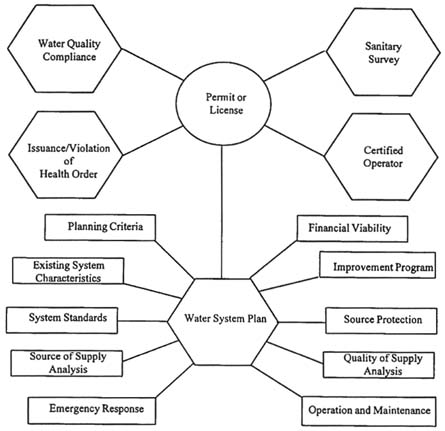
FIGURE 5-1 Model state public health performance appraisal program, in which a performance appraisal and development of a water system plan are required in order to obtain an operating permit or license.
to operate and maintain the system; Montana, where the Department of Health and Environmental Sciences may review the financial viability of new or expanding water systems; and Idaho, where the Idaho Public Utility Commission may deny certifications for proposed new investor-owned utilities if there is no need for the service or if another company is willing and able to provide similar or better service.
Elements of a Public Health Performance Appraisal
The public health performance appraisal process (or licensing or permit criteria process) should require documentation and evaluation of several key
indicators of system performance and sustainability. These indicators include the following:
- Record of issuance of health orders: Any issuance of a health order or other water-quality-related health violation calls into question a system's ability to reliably deliver safe drinking water. Requiring automatic moratoria on new customers for systems issued health orders will help compel correction of unacceptable conditions.
- Record of water quality compliance: Complying with monitoring and maximum contaminant level (MCL) water quality standards is the most fundamental responsibility of any water utility and should be required for licensing or permitting. Monitoring requirements should include specifications for accurate recordkeeping.
- Certification of operators: A system's size, treatment process, supply and distribution characteristics, and other operational parameters will dictate the number of staff and their appropriate training or certification level; permitting standards should require such appropriate training or certification, as well as continuing education.
- Record of sanitary surveys: Regular sanitary surveys, or on-site visits, have long been an effective means for regulatory agencies to inspect and aid the operation of small water systems. These visits allow regulators to verify facilities and their condition, evaluate source protection measures and operator abilities, and recommend improvements. They should be part of any assessment or certification program.
- Existence of a water system plan: Prior to receiving a permit, the water system should have a plan specifying how it will meet current and future performance criteria.
While the importance of health violation records, water quality compliance, operator certification, and sanitary surveys have long been considered by regulators evaluating small water systems, the importance of a comprehensive, forward-looking water system plan is only now becoming recognized among planners and system owners and operators. For that reason, it is worth examining what these plans involve and the role they play in performance appraisals.
Small Water System Plans
Every water utility should create a comprehensive plan that specifies how the utility will affordably meet present and future demands while complying with SDWA and other regulations. More than any other aspect of the performance appraisal, the creation of a water plan compels the utility to examine itself closely and develop a road map for the future.
A utility's plan should be written somewhat like a business plan. The plan
should include information on future trends in the service area, population and growth, land use policies, water demands, and other factors on both a short-term and long-term basis spanning 5 to 20 years. In addition, like any good business, water systems should make customer satisfaction a priority in the planning process and should involve customers in developing their plans. The level of detail included in the plan will vary with the size and complexity of the water system. Example outlines for plans for small, relatively simple systems and larger, more complex systems are included in Boxes 5-3 and 5-2, respectively.
Regardless of the format used for the water system plan, the plan should include the following elements:
- Evaluation of existing system characteristics: A water system plan should include a description and inventory of system facilities and their general condition, as well as an analysis of their capability to supply sufficient water quality and quantity to meet existing and projected demands. The analysis should include an evaluation of raw and treated water quality for each source and the distribution system and of the condition, capacity, and reliability of the source of supply, storage facilities, and system piping. Finally, this evaluation should discuss possible remedies for any existing and anticipated deficiencies in these areas.
- Statement of system standards: The plan should list all federal, state, or other standards the system must meet. These may include water quality parameters, average and maximum daily demands, peak hour demand, storage requirements, fire flow rate and duration, minimum system pressure, minimum pipe sizes, telemetry and back-up power requirements, valve and hydrant spacing, and other policies that affect performance and design. In addition, the utility should establish standard construction specifications for system expansion.
- Analysis of source of supply: The plan should evaluate opportunities to optimize the use of existing water sources and evaluate both possible new sources and other innovative methods to meet water needs. This analysis should consider the pros and cons of developing and implementing a conservation program; confirming or changing water rights; pursuing interties with neighboring utilities for either emergency or sustained usage; and artificially recharging available surface water into an aquifer and subsequently withdrawing it.
- Plans for source protection: The water plan should include a program to protect or improve source waters through the development of a wellhead protection and/or watershed control program.
- Statement of operation and maintenance program: In many small water systems, operations procedures are known only to the system operator. Carefully documenting what is involved in operating and maintaining the system will allow a smooth transfer of this knowledge so that the utility can continue to provide good service if the operator leaves the utility's employment or for some reason cannot run the system. The operation and maintenance program should describe
|
BOX 5-3
|
|||||||||||||||||||||||||||||||||||||||||||||||||||||||||||||||||||||||||||||||||||||||||||||||||||||||||||||||||||||||||||||||||||||||
- the primary day-to-day operational activities and state by whom and how they are performed. Suggested elements include job descriptions for management and operating personnel, along with a description of the decision-making ''chain of command"; descriptions of system components and how they function and are controlled; preventive maintenance activities and their scheduled frequencies; equipment and chemical inventories and suppliers' names, contacts, addresses, and phone numbers; safety procedures; cross-control connection activities; and a listing of the appropriate recordkeeping procedures and reporting requirements.
- Emergency response program: The plan should clearly specify appropriate remedial action and notification procedures, call-up lists, and back-up procedures
- for times that normal operational conditions are disrupted. This response plan should include a realistic vulnerability analysis that identifies the major facilities at risk under a variety of emergency situations and operational responses to their failure in different scenarios.
- Analysis of quality of supply: SDWA requirements have become increasingly complex for both source and distribution monitoring and compliance. A plan for monitoring and reporting all water quality testing parameters will help system operators and managers meet SDWA standards. This element of the plan might address monitoring locations for each parameter; sampling schedules; sampling waivers and conditional requirements; lists of certified testing laboratories; any special monitoring requirements; and procedures to follow in the event of an MCL or sampling violation.
- Statement of improvement program: This vital element of the plan specifies the capital and operational improvements needed to rectify problems the plan has identified. The improvements should be prioritized and scheduled and their costs estimated. Prioritization of these improvements will be influenced by the health risks, project costs, funding options, related improvements, and other policy considerations relevant to each option. This improvement program will be vital to creating a detailed budget of capital and operational expenses and to devising a suitable financing strategy for implementation.
- Financial viability evaluation: Finally, every water plan should include a financial viability evaluation that assesses the system's ability to remain financially solvent while complying with all relevant regulations. This is one of the most critical parts of the plan and as such warrants detailed description.
Financial Viability Evaluations
A financial viability evaluation seeks to measure a system's "ability to obtain sufficient funds to develop, construct, operate, maintain and manage a public water system on a continuing basis in full compliance with federal, state, and local requirements." (WADOH, 1994). The evaluation identifies the total cost of providing water service, including needed improvements, and establishes fees adequate to cover these costs. In general, the financial impact of improvements is usually much greater on small systems than on those with a larger customer base. However, various experiences in Pennsylvania, Washington, and elsewhere have shown that it is often possible for small systems to budget and pay for necessary improvements.
The financial viability evaluation takes into account how the system will be affected by such factors as more restrictive funding sources for private versus public utilities; the density of the system's customer base compared to the area served; the system's prospects for consolidating financial resources; and any past practices that have created high costs. A utility may not be able to control all of
these factors, but it can recognize or anticipate them and plan to minimize their impacts.
One useful model for such evaluations is the evaluation process developed by Washington State for small systems. The evaluation seeks to determine whether the utility is in compliance with the operating and monitoring requirements imposed by the SDWA in the short-term and to determine whether the system is sustainable, from a financial resource perspective, over the long-term. The evaluation includes four key "tests" that assess whether a water system can operate successfully day-to-day, respond to emergency situations, plan for needed improvements and expected growth, and develop and maintain a reliable base of financial support.
These tests include the following:
- Test 1: Is there a workable operating budget? The operating budget test reviews whether a system is generating sufficient revenue to meet its estimated expenses. If the system lacks sufficient revenue to meet expenses, it should either raise its water rates or reduce nonessential expenses.
- Tests 2: Is there an adequate operating cash reserve? This test evaluates the system's ability to withstand cash-flow fluctuations. There is often a significant length of time between when a system provides a service and when a customer may pay for that service; a study of the system's historic cash flow can accurately quantify the time period between delivery and payment for service. Since a 45-day difference is the industry norm, most systems attempt to keep at least 45 days' worth, or one-eighth, of their annual operating and maintenance and general and administrative expenses in an operating cash reserve to prevent potential cash-flow problems. The operating cash reserve is essentially the "checkbook balance" a system should maintain to meet cash-flow needs and pay for unforeseen operating emergencies. If a system does not presently have an existing operating cash reserve equal to or greater than one-eighth its annual operating budget, it needs to develop one with (1) a one-time charge, (2) a transfer of funds from an existing reserve, or (3) funds accumulated over a reasonable period of time through the budget process.
- Test 3: Is there an emergency reserve fund? This evaluates the system's ability to cover the costs of the failure or loss of its most vulnerable system component (generally a production well, a source of supply, the largest pumping equipment, or key transmission lines). Such a reserve can be funded initially with a one-time charge, a transfer of funds from existing reserves, funds accumulated over a reasonable period of time through the budget process, or an alternative financing arrangement.
- Test 4: Will water rates be affordable based on local criteria? In this fourth and final test, the system measures the rate impact that any expected increased operating and facility expenses will have on its users and provides an indication of a residential connection's ability to pay the existing and projected rates.
To conduct this test, a system can determine the current and projected average annual residential water bill and compare it to the local average annual median household income, or MHHI, which is a value computed by the U.S. Census Bureau. If the expected rates exceed a certain percentage of the MHHI for the county, the system's costs are too high. The appropriate percentage of the MHHI used as a ceiling for water rates varies by location depending on factors such as the availability of water resources and citizens' willingness to pay for water. Washington State regulators use 1.5 percent of MHHI as a rule of thumb for determining whether water rates are reasonable, but, especially in arid climates, citizens may be willing to pay more. In Washington State, when water rates exceed 1.5 percent of the MHHI, the utility must attempt to identify a more cost-effective means of providing service.
It is presumed that a water can control the outcome of the first three tests (i.e., the water system either does or does not perform the required actions). The fourth test, however, is only to be used as a tool in determining whether the rates are affordable. It may not be in the power of the water system to ensure that its water rates are less than 1.5 percent of the MHHI.
In Washington State, failing these tests can result not only in denial of water system permits and the associated denial of building permits by local governments, or of home mortgages by lending institutions, but also in the promotion of active restructuring efforts.
Other Nonproliferation Tools
Public health performance appraisals are just one tool that states can use to curb the proliferation of small water systems. The various tests used in performance appraisals can be used separately, and in a variety of ways, in nonproliferation policies. Such policies often require interagency coordination to provide effective regulation and assistance, since water system approval and oversight seldom fall under the purview of a single entity. In Connecticut, for instance, the drinking water agency and the public utility commission jointly issue operating permits and share the tasks of reviewing site, source, construction, and financial requirements. In that state, local authorities that grant local permits in the absence of a state operating permit may ultimately be held responsible for providing water service if the system in question fails. Maryland, with a relatively strong tradition of local planning, requires that permit approval requirements be specified in local subdivision and land development regulations.
A number of states condition water system approval on special requirements designed to ensure sound management and financial practices. The Maryland Department of the Environment can require escrow accounts, sinking funds for replacement (a type of reserve fund), and performance bonds. The department may waive these financial requirements in cases where the water system has a
binding public works agreement with the county government; such agreements stipulate the terms under which ownership will be transferred to the local government entity.
The Ohio utility commission requires unobligated paid-in capital equal to 40 percent of the construction cost of new facilities, as well as commitments from financial institutions for the remaining 60 percent. Nevada grants approval to privately owned small water systems where no alternative system is available, but system operators must post a 5-year performance bond with the local governing body, which has the ultimate responsibility for water service if the system fails. In California, the Public Utilities Commission may require a proposed new investor-owned utility to post a bond of up to $50,000 if gross operating revenues are projected to be less than $200,000. Further, in a survey of state drinking water officials for the American Water Works Association (McCall, 1986), 15 states indicated that their permit review processes require small systems to review and evaluate regionalization, consolidation, contract service, or other alternatives.
For a number of reasons, it is difficult to say at this point how well various nonproliferation efforts are working. However, the number of drinking water systems in this country has grown dramatically, suggesting that proliferation of nonsustainable systems is likely to be a continuing problem, increasing the need for mandatory public health performance appraisals.
Utility Options for Improving Sustainability
Once a performance appraisal or other method has evaluated how well a water system measures up to public health and safety standards, the utility must work to achieve compliance with regulatory requirements and service expectations either on its own or, if it cannot manage the necessary changes, by restructuring, which involves either entering into mergers or other cooperative arrangements with other (usually larger) systems or transferring management and/or ownership to another entity.
Internal Improvements
While they struggle to meet daily operational and regulatory requirements, small water systems must find ways to make the capital improvements or service enhancements necessary to ensure long-term sustainability. Maintaining this long-term focus in the face of pressing immediate needs is one of the greatest challenges small water systems face.
As is often the case, money lies at the heart of this challenge. Small systems in particular are hampered by limited access to capital markets (a problem both because the relatively small amounts small systems seek to borrow—generally well under $1 million—do not attract institutional investors and because these
TABLE 5-1 Federal Funding Programs for Small Public Water Systems
|
Contact |
Telephone |
|
Appalachian Regional Commission (ARC) |
(202) 673-7874 |
|
Department of Housing and Urban Development (HUD) |
(202) 708-2690 |
|
Community Development Block Grants, Economic Development Administration (EDA) |
(202) 482-5113 |
|
Indian Health Service (IHS) |
(301) 443-1083 |
|
Rural Utility Services (RUS) (formerly Farmer's Home Administration) |
(202) 720-9589 |
|
SOURCE: Reprinted, with permission, from Campbell (1993). ©1993 by the Journal of the American Water Works Association. |
|
systems often have no borrowing track record); by an insufficient rate and/or tax base, either because the number of customers is small or because the population served has a low per-capita income; by inappropriate rate and fee structures; and by limited managerial resources, which are often, in turn, caused by the system's limited financial resources. This situation is complicated by the difficulty of identifying all available funding resources and by heavy competition for those funds. These challenges require system managers to be creative and persistent in developing a financing strategy.
However, a determined, innovative small system can often find financing alternatives and assistance for infrastructure, operations and maintenance, or other funding needs. Some of the most common financing alternatives are described below. Table 5-1 lists federal funding sources for small water system infrastructure and improvement; Table 5-2 lists state funding sources.
Funds for Capital Improvements
Typical funding alternatives for making improvements include state and federal grant and loan programs, conventional commercial loans (both short- and long-term), and long-term debt-financing mechanisms such as municipal, general obligation, rate revenue, or assessment bonds. Other options include capital facility charges (or "hook-up fees"), paid by new users as they connect to a system, and developer extension policies, in which a developer either pays an "impact fee" to the utility to finance or directly bears the cost of the infrastructure expansion.
One new funding option is the SRF, which is essentially a self-perpetuating loan fund replenished by previous borrowers. In July 1996, Congress established a federally backed SRF program specifically for improving drinking water systems.
Funds for Operation and Maintenance
For operation and maintenance costs, utilities generally turn first to monthly user charges and/or commodity rates (AWWA, 1991, 1992). At minimum, these charges should cover the cost of operating the system at peak capacity; the commodity costs associated with the total consumption of water over a given period of time, the "customer costs," or costs associated with having customers enter or leave the system, and the cost of supplying water for fire protection. These charges are also sometimes used to retire debt service related to capital improvements.
Some utilities also fund operating and maintenance costs with transfers or subsidies from other government departments. However, in the interest of self-sufficiency and stability, utilities should not depend on interdepartmental or interfund subsidies except for the purpose of making health-related improvements.
Finally, more utilities are trying to reduce funding needs by pursuing public-private partnerships. The main types of such partnerships are defined in Table 5-3. One frequent form of public-private partnership is the outsourcing of discrete services, such as consulting, meter reading, facility construction, or even system operation and maintenance. Any of these can help a utility stabilize rate costs or improve service.
Restructuring
Restructuring strategies, unlike internal changes to the water system, often require small systems to relinquish some degree of control. Restructuring frequently involves a change in ownership for the utility and almost always involves assistance from an outside restructuring agent. The role played by the restructuring agent depends on individual system needs and plans for improvement. There are numerous examples of these arrangements in place throughout the country.
The relationship a restructuring agent assumes with a troubled utility can take one of four forms: (1) direct ownership, (2) receivership or regulatory takeover, (3) contract service, or (4) support assistance. A brief explanation of each type of relationship and some relevant policy and procedural issues typically evaluated by the restructuring agent before assuming an assistance role are outlined below.
Direct Ownership
Direct ownership transfers responsibility for ownership and operation from the utility in distress to a restructuring agent. This most commonly involves the consolidation of two or more utilities through a merger, acquisition, or regulatory takeover. Water supply may be provided through a new intertie connection to a
TABLE 5-2 State Financing Mechanisms for Small Water Supply Systems
|
State |
Program |
Type |
Contact |
|
Alaska |
Department of Community and Regulatory Affairs, Rural Development Division |
Grants and loans |
(907) 465-4890 |
|
|
Department of Revenue, Alaska, Municipal Bond Bank Authority |
Loans |
(907) 274-7366 |
|
|
Community Enterprise Development Corporation of Alaska (with Farmer's Home Administration) |
Loans |
(907) 465-5000 |
|
Alabama |
Alabama Underground Storage Tank Program |
Loans |
(205) 271-7720 |
|
|
State revolving fund—proceeds of bond sales used for loans |
Loans |
(205) 271-7720 |
|
Arkansas |
Community Resource Group—Community Loan Fund |
Loans |
(501) 756-2900 |
|
|
Water Resources Development General Obligations Bond Program |
Bonds and lease-purchase |
(501) 682-1611 |
|
|
Water Development Fund Program |
Loans, grants, joint ventures, deferred loans |
(501) 682-1611 |
|
|
Water, Sewer, and Solid Waste Revolving Fund |
State revolving fund |
(501) 682-1611 |
|
|
Water Resources Cost-Share Revolving Fund |
Cooperative agreement |
(501) 682-1611 |
|
|
Community Loan Fund |
Loans |
(501) 797-3783 |
|
California |
Department of Health Services, Division of Drinking Water and Environmental Management |
Loans |
(916) 323-6111 |
|
Connecticut |
Connecticut Works Fund Loan Guarantee Program |
Guaranteed loans |
(203) 258-7822 |
|
|
Connecticut Development Authority-Business Assistance Fund |
Loans |
(203) 258-7822 |
|
Florida |
Florida State Bond Fund |
Bonds |
(904) 487-1855 |
|
Georgia |
Georgia Environmental Facilities Authority |
Loans |
(404) 656-0938 |
|
Iowa |
Iowa Department of Natural Resources, Environmental Protection Division |
Loans |
(515) 242-4837 |
|
Idaho |
Loans-commercial irrigation |
Loans |
(208) 334-1369 |
|
Illinois |
Illinois Rural Bond Bank |
Bonds |
(217) 524-2663 |
|
Indiana |
Community Promotion Fund |
Grants and bonds |
(317) 233-8911 |
|
Kentucky |
Drinking Water Loan Fund (local government, fund B2) |
Loans |
(502) 564-2382 |
|
|
Infrastructure Revolving Loan Fund (fund B) |
Loans and grants |
(502) 564-2090 |
|
|
Kentucky Infrastructure Authority-Bonding Bank |
Bonds |
(502) 564-2090 |
|
Louisiana |
Louisiana Drinking Water Program (connect fee) |
Loans |
(504) 568-5101 |
|
Maryland |
Water Supply Financial Assistance Program |
Bond money |
(301) 631-3706 |
|
Missouri |
Missouri Department of Natural Resources |
Grants |
(314) 751-1599 |
|
Montana |
Renewable Resource Development Program |
Grants and loans |
(406) 444-6699 |
|
|
Water Development Program-Department of Natural Resources and Conservation |
Grants |
(406) 444-6699 |
|
|
Treasure State Endowment Program-New State Infrastructure Financial Program |
Grants and loans |
(406) 444-6699 |
|
|
State Water Plan Advisory Council-Water Development Program |
Grants |
(406) 444-6668 |
|
|
State Special Revenue Account for Water Storage |
Special fund |
(406) 444-6699 |
|
|
Department of Natural Resources and Conservation—Resource Development Bureau |
Grants and loans |
406 444-6668 |
|
New Hampshire |
New Hampshire Community Local Fund |
Loans |
(613) 224-6669 |
|
State |
Program |
Type |
Contact |
|
New Jersey |
Water Supply Rehabilitation Loan Program-10-year/20-year hardship |
Loans |
(609) 292-5550 |
|
|
Water Supply Interconnection Loan Program (shared peak demand) |
Loans |
(609) 292-5550 |
|
|
Water Supply Replacement Program (types A and B, shared peak demand) |
Loans |
(609) 292-5550 |
|
New Mexico |
Laboratory fee program |
Grants |
(505) 827-0152 |
|
North Carolina |
State Revolving Loan and Grant Program-Division of Environmental Health and Natural Resources-Clean Water Program |
Grants and loans |
(919) 733-6900 |
|
Ohio |
Emergency Village Capital Improvement Special Account |
Advance loans |
(614) 644-2829 |
|
|
Ohio Water Development Authority |
Cooperative agreements and bonds |
(614) 644-5822 |
|
|
Ohio Water Development Authority 2% Hardship Loan Program |
Loans |
(614)466-5822 |
|
|
Ohio Water and Sewer Rotary Commission |
Loans |
(614) 466-2285 |
|
|
Community programs |
Loans |
(614) 469-5400 |
|
Oklahoma |
Water Emergency Grant Program |
Grants |
(405) 231-2621 |
|
|
Community Loan Fund |
Loans |
(405) 231-2621 |
|
|
Indian Health Service |
Grants |
(405) 945-6800 |
|
Oregon |
Water Development Loan Fund-Oregon Water Resources Department |
Loans |
(503) 731-4010 |
|
|
Oregon Bond Bank |
Grants and loans |
(503) 731-4010 |
|
|
Safe Drinking Water Funding Program |
Loans |
(503) 731-4010 |
|
|
Special Public Works Fund-Oregon Health Development |
Loans and grants |
(503) 731-4010 |
|
|
Small-scale energy loans |
Loans |
(503) 731-4010 |
|
|
First Interstate Bank of Oregon Foundation |
Grants |
(503) 225-2167 |
|
Pennsylvania |
Penvest-Water Facilities Loan Funds |
Loans |
(717) 787-8137 |
|
|
Pennvest-Site Development Capital Budget Projects |
Grants and loans |
(717) 787-9035) |
|
Rhode Island |
Development Loan Program |
Loans |
(401) 277-2217 |
|
|
Water Facilities Assistance Grant Program |
Grants |
(401) 277-2217 |
|
South Dakota |
Governor's Office of Economic Development-Community Projects |
Grants |
(605) 773-4216 |
|
|
Governor's Office of Economic Development-Special Projects |
Grants and revolving loans |
(605) 773-5651 |
|
Tennessee |
Tennessee Department of Economic and Community Development |
Grants |
(615) 741-6201 |
|
|
Tennessee Division of Construction Grants and Loans |
Grants and loans |
(615) 741-0638 |
|
|
Tennesse Association of Utility Districts |
Loans |
(615) 896-9022 |
|
|
Tennessee Division of Water Supply Reviews, Water Supply Construction Grants |
Grants |
(615) 741-6636 |
|
Texas |
Community Loan Fund |
Loans |
(512) 458-7542 |
|
Utah |
Utah Drinking Water Board Loan Program |
Loans |
(801) 538-6159 |
|
|
Utah Permanent Community Impact Fund |
Loans and grants |
(801) 538-8729 |
|
|
Department of Natural Resources-Cities Water Loan Fund |
Loans |
(801) 538-7294 |
|
|
Department of Natural Resources-Revolving Construction |
Loans |
(801) 538-7294 |
|
|
Department of Natural Resources-Conservation and Development Fund |
Long-term loans |
(801) 538-7294 |
|
Virginia |
Virginia Environmental Endowment-The Virginia Program |
Grants |
(801) 644-5000 |
|
State |
Program |
Type |
Contact |
|
|
Virginia Environmental Endowment-Water Quality Grants |
Grants |
(804) 644-5000 |
|
|
Industrial Revenue Bond Housing and Community Development |
Bonds |
(804) 371-7061 |
|
|
Virginia Housing Partnership Fund's Indoor Plumbing Program |
Grants and loans |
(804) 371-7100 |
|
|
Drinking Water Bonds |
Bonds |
(804) 644-3100 |
|
|
Rural systems |
Grants and loans |
(703) 345-1184 |
|
|
Drinking Water Revolving Loan Fund |
Loans |
(804) 765-5555 |
|
Washington |
Washington State Public Works Trust Fund (PWTF)-Department of Community Development |
Loans |
(206) 493-2893 |
|
|
Washington State PWTF emergency loans |
Loans |
(206) 493-2893 |
|
|
Washington State PWTF general construction matching loans |
Loans |
(206) 493-2893 |
|
|
Washington State PWTF capital improvement planning |
Loans |
(206) 493-2893 |
|
|
Department of Trade and Economic Development (Community Economic Revitalization Board) |
Grants and loans |
(206) 464-6282 |
|
|
Department of Ecology, Centennial Clean Water Fund |
Grants and loans |
(206) 459-6096 |
|
|
Department of Ecology, Interim Ref 30 |
Grants |
(206) 459-6096 |
|
|
Washington Bureau of Reclamation Distribution System Loan Act |
Loans |
(206) 334-1639 |
|
|
Conservation Commission Water Quality Research Grant Program |
Grants |
(206) 459-6141 |
|
|
Department of Ecology, State Revolving Fund |
State revolving fund |
(206) 459-6061 |
|
|
Washington Local Development Matching Fund-Department of Community Development |
Loans |
(206) 586-0662 |
|
|
Northwest Area Foundation |
Grants |
(612) 224-9635 |
|
Wyoming |
State Farm Loan Board |
Loans |
(307) 777-7781 |
|
SOURCE: Adapted, with permission, from Campbell (1993). © 1993 by the Journal of the American Water Works Association. |
|||
different system or, if water supply is acceptable, through the operation of the troubled system as a satellite operation by the other utility.
Policy and procedural issues that must be addressed in direct ownership takeovers include system size, infrastructure improvement needs, capital improvement needs, purchasing costs, rate structures, and, finally, the system's monetary value, if any. Each of these bears some elaboration.
- System size: Some utilities accommodate requests for assistance from systems of any size. Others, however, because of differences in regulatory, rate base, and financial capabilities between large and small systems, might have preferences for systems above or below a certain size.
- Infrastructure condition: Some utilities will not accept systems that do not meet their design and construction standards or some other level of minimum qualifications. For systems not constructed in accordance with minimum standards, an engineering evaluation may be necessary to evaluate system upgrade requirements. The costs for this engineering evaluation may be paid or shared by either party.
- Capital improvement, purchasing costs, and rate structures: Financing of local improvements and purchasing costs, if any, must either be spread throughout all of the new utility customers or assigned specifically to the residents of the restructured system. This may affect whether identical rates are used for all customers, or whether the restructured customers will pay a capital surcharge in their rates.
- System value: Utilities vary widely in how they participate financially in the takeover of small systems. Utilities frequently will not assist if a small system in trouble is seeking a purchase amount. More often than not, the small system is glad to merely transfer the responsibility to the utility at no cost. If money is to change hands, however, a financial feasibility analysis is usually conducted to determine the assessed value of the system or to use as a basis for negotiating the purchase. Any of several methods may be used to establish a system price. Comparable sales, where such may be found, may become the basis for the system value. Another method is to use the net book value, in which the original installed cost is reduced by accumulated depreciation and contributed capital. Replacement value methods estimate the value as if the system were built at current construction costs (but do not account for the cost of needed improvements—a factor that can lead this method to overvalue a system). The depreciated replacement value method calculates a value by depreciating the replacement costs of infrastructure from the date of their installation to present. Again, if the system is inadequate and does not meet prescribed standards, then the value of the system, even using this method, will be overstated unless an adjustment is made for the system's functional depreciation. In a capitalized income calculation, the annual net income and a rate of return are used to calculate a lump sum
TABLE 5-3 Types of Public-Private Partnerships
|
Type |
Definition |
Responsibilities |
|
Contract services |
Private partner contracted to provide specific municipal service |
Financing: public |
|
|
|
Design: public-private |
|
|
|
Construction: public-private |
|
|
|
Ownership: public |
|
|
|
O&Ma: private |
|
Turnkey |
Private partner designs, constructs, and operates an environmental facility owned by public sector |
Financing: public |
|
|
|
Design: private |
|
|
|
Construction: private |
|
|
|
Ownership: public |
|
|
|
O&M: private |
|
Developer financing |
Private party (usually developer) finances construction or expansion of environmental facility in return for right to build houses, stores, or industrial facilities |
Financing: private |
|
|
|
Design: either |
|
|
|
Construction: either |
|
|
|
Ownership: either |
|
|
|
O&M: either |
|
Privatization |
Private party owns, builds, and operates a facility and partially or totally finances the operation |
Financing: private |
|
|
|
Design: private |
|
|
|
Construction: private |
|
|
|
Ownership: private |
|
|
|
O&M: private |
|
Merchant facilities |
Private company makes a business decision to provide an environmental service in anticipation of profit |
Financing: private |
|
|
|
Design: private |
|
|
|
Construction: private |
|
|
|
Ownership: private |
|
|
|
O&M: private |
|
a Operation and maintenance. |
||
- payment equivalent to the present value of the income stream generated by the utility. Finally, a negotiated sale may use any combination of the above methods and adjustments as a basis for negotiating a price agreeable to both buyer and seller.
Receivership or Regulatory Takeover
Some states have the authority to take over or transfer management of failing water systems that put public health and safety at risk (see Box 5-4). These transfers sometimes include a transfer of ownership as well. For example, Washington State may place a failing water system under the responsibility of a county
|
BOX 5-4 Although ordered by the Connecticut Department of Health Services (DOHS) to make a variety of improvements, the owners of Greenacres Water Supply determined that they could not afford the $191,000 required to upgrade their 115-connection system. Instead, they notified DOHS that they wanted to quit the water business altogether. DOHS asked the state Department of Utility Control (DPUC) to hold a hearing on the matter. During the hearing, two water systems expressed interest in purchasing Greenacres Water Supply and operating it as a satellite system. Later, Greenacres' owners agreed to sell the system to the Tyler Lake Water Company for $10,000, but the DPUC consumer counsel opposed the price as excessive. After examining Greenacres' financial records and considering the improvements that the DOHS proposed, DPUC determined (1) that $617 was a more reasonable price and (2) that the Bridgeport Hydraulic Company (BHC) was a ''more suitable entity" to own and operate Greenacres. (BHC already operated the North Canaan water system, and its water mains ran within 4,000 ft of Greenacres Water Supply.) Ownership of Greenacres was transferred in 1988. The drinking water system that BHC purchased had three wells, one spring, a 6,300-gal and a 2,500-gal atmospheric water tank, and a 5,000-gal pressure tank. The distribution system consisted of 11,583 ft of 1- to 2-in. galvanized, plastic, and copper pipe. None of the 107 residential, 1 commercial, or 7 industrial customers was metered. There was no fire protection. The state ordered BHC to spread the cost of system improvements across its base of 96,000 customers to reduce the financial burden on Greenacres' customers. DOHS and DPUC also ruled that Greenacres' customers would be billed at their old rate until all the residences were metered. BHC could then bill them at the same rate it charged other customers in the area. BHC was given a schedule for improving the Greenacres system. It also was required to submit certain financial information to the DPUC and to notify Greenacres' customers of the acquisition. This ownership transfer was facilitated by Connecticut's takeover statute, which empowers the state to promote system acquisitions as a way of correcting the problems of nonviable systems. |
government, which must develop a plan to correct system deficiencies and mitigate health problems. Another form of takeover exists through the right of eminent domain or condemnation power of local governments. This authority has been exercised in cases where a purveyor consistently provided unsafe or unreliable water service.
Contract Service
The proper operation of any utility requires qualified professionals. A contract service program enables a restructuring agent (such as another utility or a private contractor) to provide professional support to existing or new systems at
|
BOX 5-5 The Beckham County Rural Water District No. 2 board of directors in western Oklahoma was having a difficult time keeping up with the technical demands of system operations. The system's single employee lacked sufficient skills to operate the system, and when he quit in 1993, the board decided to seek outside help. The board contracted with Water Systems Management (WSM), the for-profit subsidiary of the Oklahoma Rural Water Association, to fully manage and operate the district's 212-connection system. WSM looks after the system's 100-plus miles of water mains, its three wells, and its chlorination, storage, and pumping infrastructure. WSM also takes responsibility for meter reading, billing, accounting, and operation and maintenance. The water district provides material and equipment free of charge for WSM's use in operating the system. This arrangement has proved to be cost-effective for Beckham County; contracting with WSM is less expensive than hiring a system operator. |
a cost-effective level without the small system having to find, hire, or supervise its own personnel (see Box 5-5). The service contract establishes the frequency, duration, cost, and specific responsibilities being hired out. Such responsibilities may include routine system operation and maintenance, periodic performance monitoring, required water quality monitoring, wholesale purchasing, equipment maintenance, scheduled repair activities, on-call emergency assistance, utility billing services, or other tasks. Some of the major contract considerations in providing this type of service are as follows:
- System improvements: If improvements are needed to enhance reliability, safety, or water quality, then the restructuring agent must determine whether they are to be completed or scheduled for completion before providing service. The restructuring agent may also agree to accomplish the improvements as a part of the contract.
- Access: The contracted services may be limited to facilities located on property owned by the system or located where guaranteed rights-of-way, easements, or unrestricted access exist for servicing, maintenance, and repair work.
- Expansion: If the system's service area is expected to expand, the restructuring agent may want the option to either approve the expansion or discontinue its contract services.
- System contract: The system should designate an accessible, responsible individual as the official contact.
- Term of service: The contract should specify the length of service being provided. Provisions for extensions may or may not be included.
- Legal authority: The contract should specify which system representatives
- are authorized to contract services, commit to expenses, and be held accountable. Some restructuring agents require a hold harmless clause, especially regarding water quality conditions.
Support Assistance
Support assistance may be provided by a restructuring agent to a troubled water system on either a one-time or a continuous basis. The assistance may include operator training, information system support, purchasing of equipment and supplies, development of computerized mapping or infrastructure databases, financial management or grant procurement assistance, or technical and engineering expertise. The major policy challenge is usually determining charges that will compensate the restructuring agent fairly without crippling the system seeking assistance.
Support assistance may take any of several forms. A joint operating agreement, for instance, can benefit two or more utilities that have complementary facilities, skills, or other assets; ideally, the strengths of each system will help correct the deficiencies of the others. This contractual relationship may include the sale or sharing of a portion, such as supply or storage, of a major facility. Detailed cost-sharing and responsibility assignments should be specified in the agreement.
Mutual aid agreements are likely to be between utilities of similar size and circumstances; any fees involved are usually low. An example might be two or more systems that join in making volume purchases to get volume discounts on supplies or water. Other examples are the sharing of equipment to handle special circumstances and the joint purchase of technical support programs for operator training.
Restructuring Agents
Any number of organizations or private or public utilities may serve as restructuring agents. Most fall into one of four categories: (1) nonmunicipal nonprofit organizations, (2) regional water authorities, (3) urban governments, and (4) investor-owned utilities.
Nonmunicipal/Nonprofit Organizations
This group is typified by the country's numerous rural water associations and rural electric cooperatives. Since the 1930s, these organizations have been empowered to provide utility services to rural entities. In most cases, these organizations are governed by a board of directors elected from the association's
|
BOX 5-6 The tribally owned Tohono O'Odham Utility Authority (TOUA) in southern Arizona manages all utility services for a reservation approximately the size of Connecticut but having a population of less than 10,000, as compared to Connecticut's population of 3 million (Rural Electric Research Project, 1994). The TOUA provides electric, water, wastewater, and telephone services to all residents of the Tohono O'Odham Nation. In total, the TOUA oversees 51 water systems serving 52 villages. Central administration of all the utilities provides considerable economies in overhead and staffing costs and allows customers to do "one stop shopping" for their utility needs. The billing department provides one bill per customer covering all utilities. The TOUA staff read water and electric meters at the same time, share expensive equipment (such as backhoes and trenchers) and maintain it in a central facility), and have a mapping system that covers all utilities. |
or cooperative's membership, which usually includes only the utility's customers or shareholders.
The National Rural Electrification Cooperative Association (NRECA) and Electric Power Research Institute have recently advocated the movement of cooperative power utilities into the water works industry. This is a logical extension of services, particularly in rural and nonmetropolitan areas, where many of the staffing requirements, metering services, equipment demands, and service policies for power and water customers are similar (see Box 5-6).
In 1994, NRECA and the National Rural Utilities Cooperative Finance Corporation organized a joint task force to study the need and roles of rural electric systems in rural water and wastewater business. The task force's final report, Community Involvement Opportunities in Water-Wastewater Services, outlines different activities a rural electric system might be able to assume and an overview of the various issues involved in working with rural water and wastewater systems.
Regional Water Authorities
Regional water authorities may be composed of a consortium of several water purveyors or a single municipal or county government with territorial responsibilities. A classic example of this exists where a large municipal utility provides wholesale and retail service to customers throughout a metropolitan and rural area. Another example is the authority provided to public utility districts in Washington State; these districts have countywide authority and taxing capability to provide a range of utility services, including water, for county customers. These authorities generally focus on addressing comprehensive regional issues
and aiding small water systems throughout the area. This often involves satellite management, because of the remoteness of many locations and the difficulty of providing direct interties.
Urban Governments
Larger individual municipal government utilities with urban levels of service also provide small system assistance. As growth and expansion widen the municipal boundaries and service territories of large cities or metropolitan governments, these entities are technically, managerially, and financially poised to take over responsibility for small systems. As government agencies, they can often obtain grant and loan funds for small privately owned water systems that would otherwise be ineligible. Frequently, however, customer concerns regarding other government policies, rate impacts, and city-county disputes over annexation of unincorporated areas affect the acceptance of these services.
Investor-Owned Utilities
Investor-owned utilities are economically motivated to provide assistance to small systems in cases that are profitable. As a group, these utilities develop and practice a "business plan" approach to utility service. In most cases, state public utility commissions regulate investor-owned utilities, so their level of service, pricing structure, and accounting and recordkeeping practices are closely scrutinized and regulated. Nonetheless, the economies of scale and the entrepreneurial expertise of investor-owned utilities make them effective candidates for small system assistance.
Barriers to Restructuring
Various factors can frustrate attempts to restructure small water systems:
- Physical condition of system: The most deteriorated systems are the most difficult to upgrade and finance. Who bears responsibility for evaluating and paying for system improvements is a key policy issue.
- Location: Remote locations make satellite service or direct interties more expensive and difficult and complicate routine operation and maintenance, as well as emergency support.
- Density: Operating and capital costs are more easily absorbed by systems with high densities rather than those with sparse populations spread over a large service territory.
- Data: Any serious lack of system, operational, or financial data makes it
- difficult for a restructuring agency to accurately assess what will be involved in assisting a system.
- Regulation: Inflexible interpretation or implementation of regulations discourages restructuring agents from providing assistance. For instance, an expectation that a utility immediately comply with water quality standards with a subpar system might discourage them from purchasing it.
- Politics: Local political issues, including voter resistance to water system ownership changes and budget conflicts, may discourage some potential restructuring agents from active involvement in restructuring if such issues lead the restructuring agent to fear political resistance to its efforts.
- Finances: The lack of government funds to promote feasibility or regionalization studies often delays restructuring. In addition, the luck of funding assistance to correct or mitigate existing problems places the entire burden of implementing costly improvements on the restructuring agent that takes over the failing system. The inability of investor-owner utilities to access government financial assistance may further minimize their involvement.
- Liability: Liability risks, either real or perceived, assumed by restructuring agents that take over failing systems discourage restructuring activity. This is particularly true in cases where a system is in noncompliance with water quality standards and the restructuring agent cannot reach agreement with regulators about a reasonable compliance schedule.
- Control: The loss of decisionmaking powers, control, or ownership often leads systems in trouble (or the communities the systems serve) to reject efforts to restructure.
- Growth impacts: Given the perception that better-managed or upgraded water utilities can encourage growth, concerns about such growth may create opposition to restructuring.
- Water resource allocation: Currently, interpretation of water rights law, particularly in the western states, makes it cumbersome or impossible to change either the place of use or purpose of use in transfers of water rights. Appropriate state legislation can correct this situation by allowing such rights to be transferred to restructuring agents that have the ability to provide a supply of water through direct interties.
To reduce or eliminate these barriers and stimulate the use of more restructuring activities, several changes need to be made. The following suggested list covers a range of procedural and financial incentives for restructuring; these incentives can be created at the federal, state, or local levels.
- As mentioned previously, the federal government should provide SRF monies only to states with public health performance appraisal programs for water systems. The SRF monies should be used in part to provide funds to organizations and utilities that can participate in restructuring, both for regional
- and system-specific feasibility studies and for water system improvements. SRF funds should also be available to states to provide technical and administrative support to local jurisdictions involved with restructuring and satellite management.
- Federal and state agencies should provide low-interest loans and grants to public and private entities that can assist with restructuring unsustainable water systems.
- Such loans and grants should not be used to prop up unsustainable systems.
- Both federal and state governments should provide tax incentives to investor-owned utilities to assist with restructuring unsustainable water systems.
- Congress should remove the "no credit elsewhere" test (a requirement that a system have exhausted conventional lending options) from the Rural Utility Service (RUS) grant and loan program; at the same time, water systems should be eligible for RUS grants and loans only if they have completed a public health performance appraisal. In cases where more expensive financing is available from a private lender, RUS grants and loans are currently provided only when the resulting rates to water users would not be comparable to those in nearby areas.
- Congress should modify section 312 of the Rural Electrification Act to enable electric utility borrowers to invest more than 15 percent of their total utility plan in nonelectric activities. This would allow electric utilities to participate more freely in water system projects.
- The federal tax code should be changed to ensure that RUS water grants or loans are not considered nonmember income for purposes of federal income taxes, lest their contribution bring total nonmember revenues above 15 percent of total revenues, which triggers tax consequences on the utility.
- State public utility commissions should allow adjustments to the rate base of utilities to reflect the cost of acquiring a failing system.
- State public utility commissions should allow restructuring agents to depreciate systems for which they have assumed responsibility.
- Federal and state governments should provide temporary waivers to restructuring agents for liabilities associated with SDWA violations in cases where the restructuring agent acquired a failing water company. These waivers should be tied to reasonable compliance schedules and activities.
Implementing Changes to Promote Sustainability
The ability to successfully implement changes is critical to maintaining sustainability for small systems with limited resources. Leadership is vital to this effort. Communications skills in particular can prove critical to focusing public debate constructively. As Bennett (1993) notes in Managing the Human Side of Change, "During any change process, something new begins only after something
else ends. It is the loss associated with this ending that people seek to avoid. In other words, people don't fear change—they fear loss." Good communication skills can help a debate focus less on what is being lost than what is being gained.
The appropriate strategy and tactics to minimize this fear of loss and develop a viable solution depend on the missions and characteristics of the restructuring agent and the small system being assisted. Bryson and Delbecq (1979) listed six steps to identifying and effectively implementing strategies. These include (1) initial agreement concerning the purpose of the action, (2) needs assessment, (3) search for possible solutions, (4) proposal development, (5) proposal review and adoption, and (6) implementation.
Bryson and Delbecq found that in politically difficult situations, the importance of giving good attention to the initial agreement (step 1) and of the proposal review and adoption phases (step 5)—two of the more political phases—increased. They found the initial agreement to be most important phase in politically difficult situations and the least important in politically easy situations.
Increased technical difficulty, in the absence of increased political difficulty, tends to increase the relative importance of the needs assessment and search for possible solutions phases—two of the more technical phases. Interestingly, the identification of more difficult solutions (step 3) tended to increase the relative importance of the initial agreement and the proposal review and adoption phase. In other words, increased solution difficulty has something of the same effect as increased political difficulty and requires more attention to the political steps. Demonstration projects may be critical, either in solving technical questions or in generating political support for the proposed solution.
Finally, Bryson and Delbecq found that in most cases, a final solution is not so much "planned" as it is negotiated and haggled out—preferably in a structured, goal-oriented fashion through an exercise of leadership and appropriate problem-solving processes. In such debates, local involvement is essential to ensure that if supporting agencies providing assistance end their involvement, the local community will have the capacity to sustain the system or seek an alternative solution (Okun and Lauria, 1991).
Conclusions
Water supply systems of all sizes face increasing challenges as they attempt to meet customer expectations, health requirements, and safety considerations within affordable rate structures. The problem is particularly pressing for smaller systems, which generally do not have the resources needed to implement necessary changes.
- The solutions to the problems of small water supply systems should focus on ensuring sustainable water supply service. A sustainable water supply system is one that has a commitment to meet service expectations; has the technical, managerial, and financial capacity to meet public health and safety performance requirements on a long-term basis; and has access to an adequate source of water.
- Meeting the escalating public health regulations and customer demands for water service requires that small systems use a business planning approach to assess their options. The local community should be involved as much as possible to ensure community endorsement.
- In some cases, the problems of small systems will best be solved through restructuring, that is, by relinquishing control of some or all aspects of the water system to another organization, known as a restructuring agent. Options for restructuring include direct transfer ownership to the restructuring agent, receivership or regulatory takeover, contracting services for some system components while leaving system ownership unchanged, and provision of technical support on a regular basis.
- A variety of barriers can discourage efforts to restructure small water systems. Barriers include disputes over who should pay for system improvements, lack of data for assessing what will be involved in assisting a system, requirements that restructuring agents be held liable for violations of drinking water standards by the small system, political resistance to ownership changes lack of funds to promote feasibility studies, and water resource allocation policies. Greater efforts are needed to overcome these barriers.
Recommendations
- States should establish requiring all water systems to conduct public health performance appraisals. Only systems that have passed a performance appraisal should be issued an operating permit. Those that do not receive permits should be obliged to restructure.
- The federal government should provide state revolving fund monies and rural utility service grants and loans for drinking water systems only to states with official public health performance appraisal programs. This will ensure that federal funds are not used to prop up unsustainable water systems. States should be able to use SRF monies to help develop their performance appraisal programs.
- Federal, state, and local governments should develop incentives to encourage the restructuring of unsustainable water systems. Incentives include providing SRF monies and tax breaks to restructuring agents that take over failing water systems, allowing adjustments to the rate base to reflect the costs of acquiring a failing system, allowing restructuring agents to depreciate systems for which they have assumed responsibility, and providing temporary
- waivers to SDWA requirements in cases where a restructuring agent has acquired a failing water company. Waivers to SDWA requirements should be tied to reasonable compliance schedules.
References
AWWA (American Water Works Association). 1991. Water Rates, Manual No. 1, Fourth Edition. Denver: AWWA.
AWWA. 1992. Alternative Rates 1992, Manual No. 34. Denver: AWWA.
Bennett, M. W. 1993. Managing the human side of change. In Proceedings of the American Water Works Association/Water Environment Federation Joint Management Conference. Denver:American Water Works Association.
Bryson, J. M., and A. L. Delbecq. 1979. A contingent approach to strategy and tactics in project planning. Journal of the American Psychological Association (April): 167–179.
Campbell, S., B. Lykins, Jr., and J. A. Goodrich. 1993. Financing Assistance Available for Small Public Water Systems. Denver: American Water Works Association.
Cromwell, J. E., III. 1994a. Strategic planning for SDWA compliance in small systems. Journal of the American Water Works Association (May):42–51.
Cromwell, J. E., III. 1994b. Generic elements of a state viability program. Presented at the AWWA National Conference, New York, June 19, 1994.
EPA (Environmental Protection Agency). 1990. Improving The Viability of Existing Small Drinking Water Systems. EPA 570/9-90-004. Washington, D.C.: EPA.
McCall, R. G. 1986. Institutional Alternatives for Small Water Systems. Denver: American Water Works Association.
Okun, D. A., and D. T. Lauria. 1991. Capacity Building for Water Resources Management. New York: United Nations Development Programme.
Okun, D.A. 1995. Addressing the problems of small water systems. In International Water Supply Association Congress, Burban, Republic of South Africa. London: International Water Supply Association.
Rural Electric Research Project. 1994. Rural Water/Wastewater Study, Volume 2: Case Studies and Management Issues. Washington, D.C.; National Rural Electric Cooperative Association.
Wade Miller Associates. 1991. State Initiatives to Address Non-viable Small Water Systems in Pennsylvania. Arlington, Va.: Wade Miller Associates.
WADOH (Washington Department of Health). 1994. Small Water Utilities Financial Viability Manual. Seattle: WADOH.


