
2
Ballast Water and Ships
Ships have always required ballast to operate successfully and safely. For millennia, ships carried solid ballast in the form of rocks, sand, roof tiles, and many other heavy materials. From the 1880s onward, ships increasingly used water for ballast, thereby avoiding time-consuming loading of solid materials and dangerous vessel instabilities resulting from the shifting of solid ballast during a voyage. Today, vessels carry ballast that may be fresh, brackish, or salt water (see Box 2-1).
About 80 percent of the world's trade volume is transported by ship (Peters, 1993). Thus, global shipping is the underpinning of the majority of world trade. Unfortunately, in many instances half of a given voyage must be undertaken in ballast to compensate for the absence of cargo. The etymology of the word "ballast," meaning "useless load" in Middle Dutch, reflects the fact that since time immemorial ship owners have endeavored to avoid using ballast.
This chapter, which provides information on the role of ballast in ship operations, is a necessary prerequisite to the committee's assessment of proposed strategies for managing ballast water and controlling the introduction of nonindigenous aquatic species without compromising ship safety. A brief summary of ship types and ballast systems is followed by an overview of safety issues relating to ballast operations and typical ballast conditions at sea and in port. Mechanisms for the introduction of nonindigenous species into ballast tanks are addressed in Chapter 1.
DIVERSITY OF SHIPS AND BALLAST SYSTEMS
Ballast water is carried by many types of vessels and is held in a variety of tanks or holds. The relative complexity of ballast operations depends on the size,
|
BOX 2-1 Ballast Defined Ballast is any solid or liquid placed in a ship to increase the draft, to change the trim, to regulate the stability, or to maintain stress loads within acceptable limits. For the purposes of this study, the term ballast includes the sediment that accumulates in ballast tanks, which may be discharged with ballast water. |
configuration, and requirements of the ship and on the complexity of its pumping and piping systems. Ballast capacity can range from several cubic meters in sailing boats and fishing boats to hundreds of thousands of cubic meters in large cargo carriers. Large tankers can carry in excess of 200,000 m3 of ballast. Ballasting rates can be as high as 15,000 to 20,000 m3/h (see Table 2-1).
Piping is sized so that flow velocities do not exceed about 2.6 to 3m/s, with ballast pump capacities ranging up to 5,000 m3/h. There is no international standard unit of measurement for ballast; quantities of ballast are variously recorded in metric tons, long tons, cubic meters, U.S. gallons, Imperial gallons, and barrels. In this report cubic meters is used as the unit of measurement; conversion factors are given in the glossary.
Typical vessel types and their ballast needs can be broadly classified as shown in Table 2-1. There is a wide range of ballast tank locations and configurations, as illustrated schematically in Figure 2-1. The capacity, location, and flexibility of use of ballast tanks is a focal point in ship design. Consideration of required drafts and trim, hull loading limitations, and required vertical center of gravity establishes the necessary ballast volume and location. Because of different cargo distributions or fuel and water quantities on board, sister ships can have different ballast needs, even though the locations and sizes of the ballast tanks are identical.
Ideally, ship owners prefer to complete all voyages with cargo. However, many trades and voyages require passage without cargo or in a light-cargo condition. For example, a crude oil tanker or iron ore carrier typically transports a single cargo load between two ports, then returns to its point of origin or another port without cargo. In this empty condition the vessel requires ballast to operate safely—a condition referred to as being "in ballast."1 In contrast, a container ship may be fully loaded between two ports but may then proceed with only a partial load between the next two ports. This vessel, therefore, sails with some cargo and some ballast, that is, "with ballast." Since fuel costs usually increase with
TABLE 2-1 Typical Vessel Types, Ballast Needs, and Pumping Rates
|
Ballast Needsa |
Vessel Types |
Typical Pumping Rates (m3/h) |
|
Ballast replaces cargo |
Dry bulk carriers |
5,000–10,000 |
|
Ballast required in large quantities, primarily for return voyage. |
Ore carriers |
10,000 |
|
|
Tankers |
5,000–20,000 |
|
|
Liquefied-gas carriers |
5,000–10,000 |
|
|
Oil bulk ore carriers |
10,000–15,000 |
|
Ballast for vessel control |
Container ships |
1,000–2,000 |
|
Ballast required in almost all loading conditions to control stability, trim, and heel. |
Ferries |
200–500 |
|
|
General cargo vessels |
1,000–2,000 |
|
|
Passenger vessels |
200–500 |
|
|
Roll-on, roll-off vessels |
1,000–2,000 |
|
|
Fishing vessels |
50 |
|
|
Fish factory vessels |
500 |
|
|
Military vessels |
50–100 |
|
Ballast for loading and unloading operations |
Float-on, float-off vessels |
10,000–15,000 |
|
Ballast taken on locally in large volumes and discharged in same location. |
Heavy lift vessels |
5,000 |
|
|
Military amphibious assault vessels |
5,000 |
|
|
Barge-carrying cargo vessels |
1,000–2,000 |
|
a The three categories of ballast needs are not mutually exclusive. For example, a vessel in which ballast replaces cargo may also require ballast to control stability. |
||
displacement, ship owners tend to use as little ballast as is necessary for the ship's safe, efficient passage when operating either with ballast or in ballast.
SAFETY
Ballast water is taken on board vessels to achieve the required safe operating conditions during a specific voyage or portion of a voyage. Proper ballasting (in terms of the amount of water taken aboard and its distribution) fulfills the following functions:
-
reduces stresses on the hull of the ship
-
provides for transverse stability
-
aids propulsion by controlling the submergence of the propeller
-
aids maneuverability by submerging the rudder and reducing the amount of exposed hull surface (freeboard or windage)
-
compensates for weight lost from fuel and water consumption
Ballast condition, including when and how much water is loaded, is determined by ships' officers, based on the specific vessel's operating needs and the
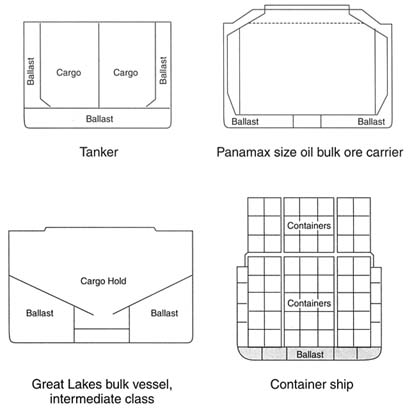
FIGURE 2-1 Typical ballast tank arrangements.
national and international requirements for proper maintenance of the trim and stability of the vessel at sea. The master of the ship is responsible for ensuring that all ballasting operations are executed in a safe manner, commensurate with prevailing conditions (see Box 2-2).
BALLAST CONDITIONS AT SEA
The major purposes of ballasting a vessel for a voyage are to increase its manageability (and safety), particularly under heavy weather conditions; control its draft and trim for maximum efficiency; and control its stability to ensure safe passage. Related factors that determine ballast conditions at sea are summarized below.
Heavy Weather Considerations
Ships must be deep enough in the water to ensure safe passage, particularly in heavy weather. If the bow of the ship is not deep enough, the ship's forefoot
|
BOX 2-2 Safety Is Paramount The numerous ballasting requirements applicable to ship safety result in very complex and time-consuming operations for crew members. Ballast operations are performed in a dynamic environment, either at sea or in port, and safety is paramount. The ultimate responsibility for the safety of the ship and its crew always rests with the master of the ship. |
(the area under the bow) will emerge periodically from the water surface. This leads to slamming—or heavy impact—of the hull when the bow hits the water with a high velocity on re-entry. Excessive slamming can lead to hull structural damage or even to hull failure and ship loss in extreme conditions. In heavy weather conditions, the ship's master usually chooses to decrease speed, which reduces the rate of occurrence and severity of slamming. Deeper drafts forward will generally reduce the tendency for the ship to slam. Typically, ships ballast to a light-ballast draft in normal weather, then ballast to a deep-ballast draft in heavy weather.
Efficient propeller operation usually requires the propeller to be immersed, even in calm water conditions. Thus, if the stern is not deep enough, ballast may be needed to trim the vessel. Further, if the stern draft is not sufficient in rougher sea conditions, the ship's propeller will race (i.e., increase its revolutions per minute) when it emerges from the water and will slow down when it re-enters the water. This causes engine control problems and increased loading on the propeller shafting and machinery. Increasing stern drafts reduces the tendency for the propeller to emerge and, thus, reduces racing. Designs typically seek to achieve a stern draft in heavy ballast of about 80 percent of the load draft.
Accordingly, safe ship operation in heavy weather requires the addition of ballast to designated cargo holds, ballast holds, or tanks to achieve a heavy-ballast load condition (storm ballast).
Sailing with Full Tanks
Ballast tanks used for controlling trim or heel, some fuel oil tanks, and tanks containing fresh water for domestic use, may be partially full at sea, depending on the stability and strength requirements of the ship. It is usually necessary to sail with as many as possible of the tanks on board either completely full or entirely empty. When a tank is not completely full (i.e., "slack"), and the ship heels, the free surface effect of the liquid moves the center of gravity of the liquid in the tank, thus reducing the transverse stability of the ship (see Appendix C). In
addition, fluid in a slack tank sloshes around during ship motion, which may lead to excessive loads on the tank/hold bulkheads, frames, or underdeck structure. In severe weather conditions, this could lead to structural failure. Thus, during ballast change at sea, the ballast in a single tank or pair of tanks should be completely changed before proceeding to the next tank or tanks.
Controlling Trim during Voyages
As fuel is consumed during a voyage, the draft and trim of the ship will change. During a long voyage, thousands of tons of fuel may be used. Thus, to keep the hull immersed correctly for maximum efficiency, it is often necessary to take on additional ballast as the voyage progresses. Some ship designs place the fuel tanks so that the ship naturally trims by the stern as fuel oil is consumed, but ballasting may still be required. Ballast capacity and location during a given voyage are established by examining the estimate of fuel to be consumed, weather conditions expected, and the required draft and trim for the arrival port(s).
Transverse Stability Considerations
The transverse stability of a ship is defined as its ability to sail upright and to resist capsizing. To attain proper transverse stability requires careful control of the righting moment of the ship (see Appendix C). Ideally the ship should be loaded and/or ballasted in such a way as to give it an easy rolling period that is neither too fast nor too slow. A vessel that rolls too fast has excess stability (a stiff ship) and has a marked tendency to return to its original upright position quickly. This creates an extremely uncomfortable motion that can exert high loads on the ship's structure and cargo lashings and high sloshing loads in slack tanks. A vessel that rolls too slowly has insufficient stability (a tender ship) and may capsize under heavy weather conditions. When ballast is moved, it creates a condition of slack ballast tanks. The associated free surface effect can lead to a weight shift when the vessel heels that adversely affects the transverse stability of the ship. A more detailed discussion of stability issues is provided in Appendix C.
BALLAST CONDITIONS IN PORT
Ballast operations are carried out in port to maintain ship stability, as discussed above. Ballast operations in port also maintain both the clearance under cargo loading or cargo discharge facilities and the under-keel clearance so the vessel remains safely afloat; maintain the hull bending moments and shear forces within safe limits to avoid the catastrophic damage that can result from incorrect loading; and maintain the ship upright by trimming or heeling the ship. In addition, ballast operations in port establish the efficient ballast condition for the pending voyage.
Ballasting during Cargo Loading and Discharge Operations
Bulk oil carriers (tankers), dry bulk carriers, and most other ships deballast during cargo loading operations and take on ballast during cargo discharge operations (see Table 2-1). A group of ships operate as float-on, float-off platforms where the ship is ballasted down to allow cargo to be floated on board and deballasted to lift the cargo for the voyage. The process is reversed for unloading. The ballast needed is set by the required cargo-deck submergence. Some vessels, such as heavy lift vessels, use ballast to control ship heel during loading operations.
Controlling Drafts and Trim for Port Entry
In the course of normal operations many vessels must alter draft and trim to facilitate entry to ports, berths, or both, at loading and unloading facilities. Both water draft and air draft may be of concern during port entry. Ballast may need to be discharged to reduce water drafts when entering some ports or approaching specific terminals, and it may need to be added to reduce air draft when clearing bridges or when approaching under loading heads at some bulk cargo terminals. These operational parameters can place restrictions on the time and location of ballasting and deballasting.
Safe Longitudinal Loading Considerations
The shear forces and bending moment on the hull of a ship are established by the distribution along the ship's hull of the difference between the light ship weight, together with the cargo, fuel, ballast and other deadweight items; and the supporting buoyancy force. In a seaway, buoyancy support forces are subject to change as waves move along the hull and as the hull moves relative to the sea surface. The structural design of a ship's hull is developed for specific conditions of loading defined in the design process. The ship operator must ensure that the in-service conditions to which the ship is subjected are consistent with the structural design of the ship. The specific location and amount of ballast on board in various conditions can be essential to the ship's safety, ensuring that the bending moment and the shear forces acting on the hull remain within these design parameters. Loading manuals and onboard loading computers are used by ship's officers to monitor the effects of various cargo, fuel, and ballast loading configurations on the draft, trim, and non-wave-induced bending moment conditions experienced by the hull. There are specific conditions when ballast is needed to avoid exceeding these hull loading limits. There are also times when it is not possible to add or remove ballast in particular tanks without exceeding these hull loading limits—in extreme cases excessive loads could cause hull failure and possibly the sinking of the ship.
Controlling Trim and Heel During Cargo Handling
Some vessels, particularly containerships, need to control trim and heel carefully during cargo loading and discharging so that the cargo operations can proceed both safely and efficiently. Some vessels have computerized heel control systems that move ballast between heeling tanks to maintain the vessel within a set tolerance of vertical. Roll-on, roll-off vessels have restrictive draft limits for the use of their ramps. Both the cargo weight distribution at the various intermediate stages of loading and wind heel effects on a light vessel can heel the vessel to the extent that containers will not move in their cell guides.
Ballast Condition for Voyages
When ballasting a ship for a voyage, the crew, under the direction of the master, defines the amount of water required taking into account the loaded condition, route, predicted weather conditions, and the need to complete the voyage in a safe and efficient manner. In the future there may be some possibility of modifying ballast systems in new ship designs for facilitate cleaning and improve the safety of changing ballast at sea, but the complete elimination of ballast is not currently practicable (see Appendix D).
BALLASTING
Ballast water is taken on board using sea chests with ballast pumps or by gravity feed. Sea chests can be located under the ship, on the turn of the bilge, or on the ship's side and are usually replicated on both sides of the vessel (see Figure 2-2). The ballast system usually works in reverse during deballasting, with the water passing through an overboard discharge valve located on the side of the ship's hull. Ballast water loading and discharging operations are usually controlled from a central ballast monitoring/control station and ballast water can be gravitated in or out of a particular tank or hold, pumped in or out, or a combination of these methods can be used. Ballast pumps remove most of the ballast water. In some cases, separate stripping pumps further reduce the amount of water remaining in the tanks. Trimming of the ship by the stern may also be used to aid ballast removal. Despite these efforts, some ballast water and sediment will always remain on board.
The ballast intake is covered with a grate or a strainer plate with small holes, and inboard of the sea chest there is usually a suction strainer. The primary purpose of grates and strainers is to protect the pumping system from foreign objects being drawn in. In some poorly maintained vessels, the integrity of grates and strainers can be compromised, allowing larger organisms to enter the ballast system. The additional use of portable screens to prevent intake of unwanted
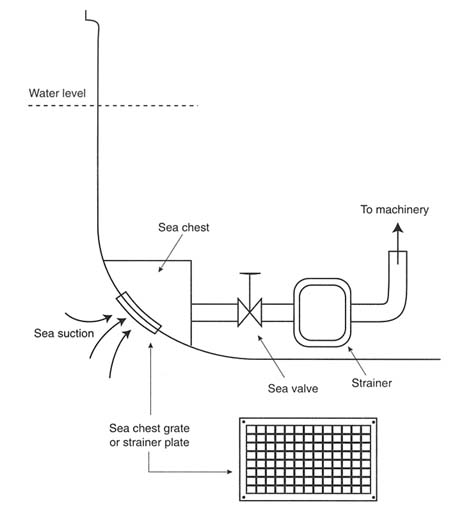
FIGURE 2-2 Typical ballast system.
organisms is unlikely to be practicable for existing vessels but could be an attractive option if incorporated in new ship designs.
As was noted earlier, some unpumpable ballast water always remains on board.2 This unpumpable water may form a virtually permanent layer on the bottom of a dedicated ballast tank, with the concomitant capability of supporting
a living benthic community on the tank bottom. A similar situation may exist on vessels that nominally are not carrying ballast. Inbound vessels that have released their ballast water prior to or during cargo loading, and outbound vessels with full cargo loads, may have relatively little ballast water remaining such that the mariner would report a ballasting condition of ''no ballast on board."
Sediment frequently accumulates on the bottom and on many horizontal surfaces in ballast tanks. Sediment may include the settled mud (silt and clay) of harbor, port, and estuarine waters, detrital and other flocculent material ubiquitous in shelf waters (but present to some extent in almost all waters), scale (rusted metal shedding off tank walls), and cargo residue. Of 343 cargo vessels sampled from 18 Australian ports, at least 65 percent "were carrying significant amounts of sediment on the bottom of their ballast tanks" (Hallegraeff and Bolch, 1992). Sediment is typically removed every three to five years when the vessel is undergoing special survey or refit work in a dry dock. Sediment is removed more frequently if the buildup warrants the expense.
In ballasted cargo holds, sediment typically is removed by hosing down at the end of each ballast leg before the next cargo is loaded; thus, a portion of the sediment is almost always directly released into the arrival port. The amount of sediment buildup is a function of ship design and operating practice.
REFERENCES
Hallegraeff, G.M., and C.J. Bolch. 1992. Transport of diatom and dinoflagellate resting spores in ships' ballast water: Implications for plankton biogeography and aquaculture. Journal of Plankton Research 14:1067–1084.
Peters, H. 1993. The Maritime Transport Crisis. Washington, D.C.: The World Bank.
Weathers, K., and E. Reeves. 1996. The defense of the Great Lakes against the invasion of nonindigenous species in ballast water. Marine Technology 33(2):92–100.


