
3
The Technical and Human Context of Telemedicine
Telemedicine, like most other advanced information and communications technologies, depends on complex technical and human infrastructures that operate both within discrete institutions and across organizational and geographic boundaries. The individual components of these structures (e.g., tasks, roles, tools, procedures, and standards) are often quite complicated, and taken together their workings and effects may be exceedingly difficult to analyze and reconfigure.
In many respects, these complexities and difficulties are generic and are experienced by managers, technical personnel, workers, and consumers in business, education, government, and other arenas. Nonetheless, they must still be dealt with site by site and application by application as clinical uses of telemedicine are planned, implemented, evaluated, and redesigned. This chapter considers elements of the technical and human infrastructures that support clinical applications of telemedicine and that are often identified as the source of application failures or disappointments.
The Technical Infrastructure
Advances in the communications and information technologies that support telemedicine are so frequent, numerous, and complex
that a thorough discussion of those that might be integral to a telemedicine evaluation would be both lengthy and partly out of date before it was even published. A recent "buyer's guide" issue of a telemedicine journal included nearly 50 pages of small-type tables listing product and service suppliers, products, and product specifications for video conferencing room systems, desktop video products, teleradiology products, and medical peripherals such as electronic stethoscopes, dental cameras, and video oto/ophthalmoscopes (Telemedicine Today, 1996). The service listing included telecommunications service providers, those offering telemedicine related services, and organizations providing other resources including telemedicine research and evaluation (see Table 3.1).
Overall, however, the health care sector has been described as relatively slow in adopting advanced communications and information systems. For example, a 1995 survey of 10 business sectors found health care respondents showing the lowest level of agreement that information networking was critical (35 percent compared to 48 percent for government and 71 percent for banking) and the lowest level of electronic information transfer (7 percent compared to 19 percent for government and 25 percent for business services) (NRC, 1996, p. 35). An earlier analysis of the growing use of telecommunications technologies likewise suggested that the health care sector has lagged somewhat behind other sectors of the economy in finding opportunities to substitute less expensive telecommunications for more costly capital, labor, and materials (Cronin et al., 1994).
Health care organizations are often only a small part of the market for various information and telecommunication technologies. Although technologies such as computed tomography and laser surgery were explicitly tailored to health care uses, other equipment and tools may not be designed with clinical uses and settings in mind—at least, initially. For example, expensive digital cameras produce the high resolution images needed for teledermatology, but some features, which were designed with newspaper and magazine photographers in mind, may be of marginal clinical value (Van Riper, 1996).
Furthermore, manufacturers may abandon technologies useful for some telemedicine applications because the total market is too limited to justify continued support of the product or because corporate realignments have shifted business priorities. For example, committee members heard military personnel express concern about the
TABLE 3.1 Types of Telemedicine Service Providers, Related Services, and Other Resources
|
Category |
Type |
|
Telecommunication service providers |
Regional Bell operating companies; Local exchange companies; Independent operation companies; Interexchange companies; Competitive access providers; Other |
|
Telemedicine-related services |
System design and integration; Technical support/systems maintenance; Value added network monitoring/management; Telecommunications and telemedicine consulting; Software systems design/provision; Internet access services; Other |
|
Other telemedicine resources |
Continuing medical education service providers; Telemedicine research and evaluation organizations; Medical information resources; Telemedicine conferences/training; Other |
|
SOURCE: Adapted from Telemedicine Today: Telemedicine Buyer's Guide and Directory, Winter 1996 special issue. |
|
possible discontinuation of Picasso, a basic, relatively inexpensive still-image phone system because it has not found a large enough market (Telemedicine Business Newsletter, 1995). From the radiology community, the committee heard some concern that picture archiving and communication systems (PACS) designed for digital image management on a large scale, are vulnerable to similar decisions by vendors concerned about returns on very expensive but slow-to-pay-off investments (Siegel, 1996; Ridely, 1996).
One other issue in the wider availability of telemedicine systems involves uncertainty about the regulation of medical software by the
Food and Drug Administration (Bashshur et al., 1994; OTA, 1995). Chapter 4 briefly reviews FDA policies on medical software and other medical devices used in telemedicine.
Table 3.2, which is taken from one of the last reports completed by the now defunct U.S. Office of Technology Assessment, lists key information technologies for health care (OTA, 1995). The list includes a highly varied mix of relatively discrete technologies (e.g., magnetic stripe cards) and more general concepts (e.g., clinical information systems). Although most have a potential, if not existing, place in one or another kind of telemedicine application, uses in banking, retail, entertainment, and other business areas may dominate technical, pricing, and related decisions for many of the discrete technologies such as hand-held computers. For telemedicine and for health care generally, computer-based patient records, clinical information systems, and clinical decision support systems—all of which involve management judgments as much as technical factors—are critical items on the list.
Variation in User Needs and Circumstances
Rural emergency departments, primary care clinics, public health facilities, correctional institutions, home care programs, and managed care plans may each need somewhat different technologies or combinations of technologies to fit their particular objectives and circumstances. As suggested by the examples in Chapter 2, real-time interactive audio and video connections may be essential in some situations, whereas telephone consultation may be quite satisfactory for others. In many cases, the relative effectiveness and costliness of different options remain to be systematically evaluated.
User needs or problems may also differ between the central service or consulting site and the site seeking the service or consultation. For example, a consulting radiologist or dermatologist may need a very sophisticated and expensive display unit that is capable of showing extremely fine gradations in images. For an attending physician, however, lower resolution may be sufficient to support discussions of an image with a consultant or with a patient. A central consulting site will need significant radiographic storage capacity whereas the remote site may need very little.
At both central and satellite practices, clinical and other staff must be trained (and trained anew as staff come and go and technologies
change), space must be identified and adapted to handle new equipment, and backup arrangements must be made in case of system failures. Given the smaller patient base and limited resources of many satellite sites, these demands can impose significant burdens. For busy practitioners, the time for training can be hard to find. These problems suggest the paradox that the satellite locations most in need of the access benefits that telemedicine may provide may also find it particularly difficult to participate in telemedicine without major financial and other support.
Because different telemedicine applications may involve quite different combinations of technologies and because each telemedicine program reflects different organizational objectives and circumstances, the particular configurations of equipment and space will vary from place to place. Figure 3.1 depicts some of the components of a telemedicine consulting installation at National Naval Medical Center in Bethesda, Maryland. The equipment, which is employed in different kinds of consultations between the center and Naval Medical Clinic in Annapolis, Maryland, includes clinical and administrative work stations, communications and storage devices, and a variety of peripherals such as video cameras.
Variety and Complexity of Technologies
The variety and complexity of advanced technologies makes formidable demands on those responsible for planning, deploying, sustaining, and evaluating information and telecommunications systems and programs (see, e.g., IOM, 1991; OTA, 1995; NRC, 1996). These challenges arise from
- the rapid pace of technological change affecting the hardware and software options;
- the multiplicity of hardware and software options and pricing schemes;
- the scarcity of standards to assure that different hardware and software options will work together well;
- the requirements for specially adapted space, extensive user training and reinforcement, and sophisticated support staff;
- the diversity of needs and circumstances among users within an organization; and
- the need to develop a variety of communications links with
TABLE 3.2 Key Information Technologies for Health Care
|
Category |
Technology |
|
Human-computer interaction |
Hand-held computers; Handwriting/speech recognition; Personal digital assistants; Personal identifiers/fingerprint recognition; Automated data collection; Structured data entry |
|
Storage, processing, compression |
Computer-based patient records; Magnetic stripe cards; Smart cards; Picture archiving and communications systems; Medical imaging (radiology, pathology, other); Optical storage; Image compression; Digital signal processors; Object-oriented software design |
|
Connectivity |
Clinical information systems; Cabled, optical, wireless networks; Internet and electronic mail; World Wide Web; Integrational Services Digital Network |
- "outside" organizations and individuals that differ in the capacities and configurations of their systems.
Evaluators, for example, may find the specific features of an application becoming outdated (or updated) or subject to significantly different pricing or marketing practices while they are still under investigation. Key aspects of the technical infrastructure of telemedicine that affect its feasibility, utility, and cost are briefly described immediately below. The discussion minimizes the use of more technical terminology, but the report's glossary provides definitions of some basic terms. The committee notes that the language of the National Information Infrastructure (NII) is subject to some dispute and flux. Terms that are commonplace in telemedicine discussions—such as "architecture," "multimedia," "interoperability,"
|
Category |
Technology |
|
|
Frame relay; Asynchronous Transfer Mode; Client-server computing; Messaging and coding standards; Proprietary and consensus standards; Medical Information Bus Security; Passwords; Fault tolerant computers; Redundant disk (RAID) systems; Authenticators; Encryption; Firewalls |
|
Data distillation |
Decision support systems; Pattern recognition; Artificial neural networks; Knowledge-based systems; Relational databases; Nomenclature/controlled vocabularies; Knowledge discovery; Natural language processing; Encoders and groupers |
|
SOURCE: Adapted from OTA, 1995. |
|
and "network"—may be used and defined differently in different sectors of the NII (NRC, 1996).
Information Carrying Capacity
The capabilities of telemedicine are constrained by the information carrying capacity—the bandwidth—of the communications media on which they depend (e.g., copper telephone wires, coaxial cable). Bandwidth is expressed in hertz (Hz) units (the number of repetitions per second of a complete electromagnetic wave) or in bits per second (bps) units (a unit of information expressed in binary digits). Higher bandwidth tends to be more costly to install and maintain. Figure 3.2 illustrates the bandwidth requirements of different
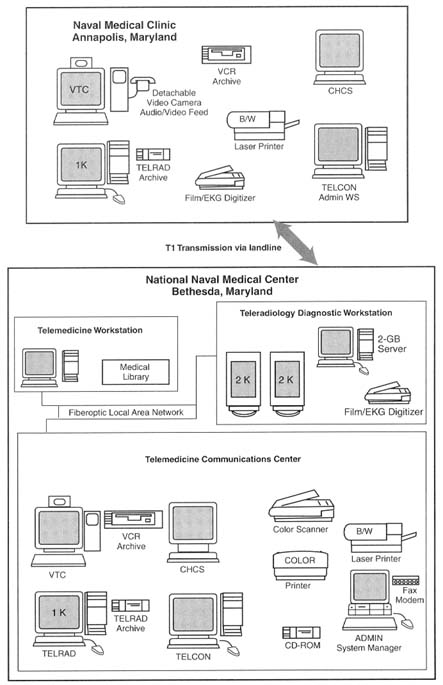
FIGURE 3.1 Schematic representation of the telemedicine center at the National Naval Medical Center, Bethesda, Maryland and the satellite Naval Medical Clinic in Annapolis. ADMIN = administrative workstation; CHCS = Composite Health Care System (Department of Defense Hospital Information System); TEL CON = clinical video teleconferencing workstation; TELCON Admin WS = teleconferencing administrative workstation; TEL RAD = teleradiology workstation; TELRAD Archive = Picture Archiving and Communications Systems (PACS); T1 line = communications line capable of transmitting 1.544 Mbps of electronic information; VTC = video teleconferencing workstation; 2GB Server = two gigabyte server; 1K = standard resolution 1024 × 768 monitor; 2K = high resolution (for diagnostic imaging) 2048 × 1756 monitor. Sources: The NNMC-NMCL Annapolis Telemedicine Prototype Status Report prepared by Richard S. Bakalar for the Telemedicine Working Group, September 28, 1995; personal communication, R.S. Bakalar, July 2, 1996.
telemedicine applications and the capacity provided by different transmission media.
The costs and information carrying capacity of different telecommunications technologies are important because they affect the availability, quality, and affordability of information needed by clinicians to diagnose and manage health problems. Among the key dimensions of information relevant to physicians are
- sound fidelity;
- image resolution (spatial and contrast);
- range (completeness) of motion depicted; and
- transmission speed (or the amount of information that can be transmitted in a defined period).
In many respects, choosing among telemedicine technologies is an exercise in trade-offs involving the amount, quality, immediacy, and cost of different kinds of information. For example, satisfactory voice communication requires less bandwidth than satisfactory video communication, so decisionmakers must consider whether the cost of video technologies is worth the benefit in particular situations. Similarly, full-motion video useful for assessing gait or other physical signs is more demanding of bandwidth than common video conferencing technologies, which often show movement as somewhat jerky rather than smooth.
In nonurgent situations in which the patient remains in touch
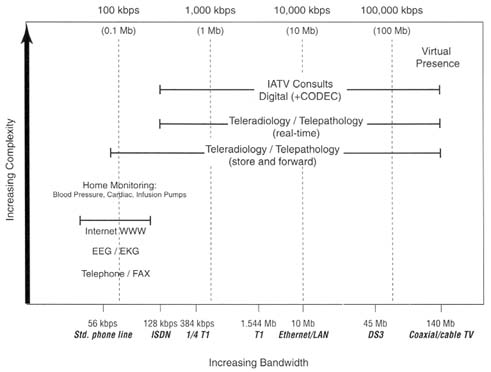
FIGURE 3.2 Relationship between the complexity of telemedicine applications and bandwidth (information carrying capacity) requirements (see glossary for explanation of terms and abbreviations).
Source: Adapted from Allen and Perednia, 1996. Used with permission from Telemedicine Today.
with the primary care clinician, many consultations can be handled with good store-and-forward systems that allow still or video images to be sent to a remote data storage device from which they can be retrieved later and rerun. For example, a clinician or technician can transmit an image in the morning, but a distant consultant or technician can wait until that afternoon or evening to retrieve it. If such an arrangement suffices, then a system providing real-time images—and involving higher bandwidth and higher costs—need not be put in place. If, however, the patient is transient or otherwise unable to stay or return for the results of a consultation, then a real-time system may be appropriate. Real-time capacity is also appropriate for services dependent on extensive communication with the patient, most notably, telepsychiatry.
Once again, the demand for information carrying capacity depends on user needs and resources. Increases in capacity can be achieved by improving transmission media and by restructuring data. Both are briefly described below.
Information Transmission Media
Several different transmission media, with different capacities and costs, are available for telemedicine applications. Many telemedicine transmissions rely on telephone lines because they are so widely distributed and relatively inexpensive. Ordinary copper phone lines, however, have relatively low bandwidth (see Figure 3.2). Because they transmit large amounts of data relatively slowly, they are best suited for conventional telephone or for store-and-forward uses.
Enhanced copper phone lines can carry substantially more information per unit of time than ordinary lines for home phones, and fiber optic cable can provide even greater capacity. Use of these higher capacity technologies is expanding but is still constrained by the requirements for laying new lines, rewiring structures (e.g., hospitals, physician offices, homes), and installing other specialized equipment.
Coaxial cables, which already provide cable television to millions of households, also carry much more information than copper wires. Most cable systems are, however, structured for one-way rather than two-way communication and for home rather than business use. Although this is now a significant limitation on the use of
existing cable networks to support certain kinds of home health services, changing technologies, costs, and regulations could alter the situation in a market that is highly competitive and volatile (Andrews, 1996).
Satellite and microwave systems offer additional options for transmitting very large amounts of data very quickly, but their high capital costs have made them unattractive for many telemedicine applications. They may, however, be the only transmission medium available for distant sites (e.g., ships, combat units) that cannot readily be reached by hard-wired systems. Also, if costs can be spread across other uses (e.g., for statewide educational networks as in the Oregon telepsychiatry program described in Chapter 2), then costs become more reasonable. At least one rural telemedicine program in Billings, Montana, rents time on its system to local businesses (Allen and Perednia, 1996; Dena Puskin, personal communication, May 10, 1996).
Because the prospective market for higher bandwidth is so lucrative, telephone, cable, computer, and other companies are competing on a number of fronts to achieve legal, technical, and other advantages. These fronts include the U.S. Congress, which recently passed major telecommunications legislation. Weekly if not daily articles in the financial press show that the federal telecommunications legislation passed in 1996 (see Chapter 4) is stimulating widespread reevaluation of strategies and alliances in the telecommunications industry. The implications for short-term and long-term advances in bandwidth options—and their stability—are likely to be significant.
Information Restructuring and Digital Technologies
Limitations on the carrying capacity of different transmission media can be overcome, in part, by restructuring or manipulating information before it is sent. In particular, the key to accurate and fast transmission of large amounts of information over long distances has been the development of techniques for converting continuous analog information or signals (e.g., sound waves, radiographs) into discrete digital signals coded in binary (e.g., on/off or 0/1) digits known as bits. The translation of data into digital form is also the foundation of other technological advances, most significantly, the computers that support the complex information processing requirements of modern communications technologies.
Some technologies further increase communications capacity by compressing data to reduce bandwidth requirements. This may or may not involve the loss of some information (and such loss may or may not be clinically important).
Digital data may also be packaged or manipulated in other ways. For example, packet switching technologies break digital data into small, standardized packets, several of which can be processed at once. This permits the fast transfer of large amounts of data.
The integrated service digital network (ISDN) is a protocol for standardized high-speed digital transmission of integrated audio, video, and data signals. It can be used with standard copper wires, but it requires installation of special digital input and output devices. The major benefit of ISDN is that it helps deal with the "last mile" problem of bringing high bandwidth into homes and offices without the high expense of rewiring them to connect with the rest of a telephone system that is mostly digital. In certain locales ISDN is available to residential as well as business customers, but marketing, pricing, service, fluctuating opinions about its value, and other problems have hindered its introduction (NRC, 1996).
The choice of specific techniques for coding, compressing, packaging, transmitting, and then decoding and displaying information may vary depending on several factors. These include the nature of the original signal (e.g., voice or video), the transmission distance, and the needs of users (e.g., for low versus high speed transmission or for moderately rather than highly accurate data). With the cost of some infrastructure options so high (e.g., laying cable to areas not currently served), financial considerations weigh heavily.
Making the Pieces Work Together
In any large health care organization, multiple information and communication systems initiatives may be under way simultaneously (IOM, 1991; Morrissey, 1996). The trend toward consolidation in health care delivery—including mergers of hospitals or health care systems and insurers, and purchase of physician practices and home care programs by hospitals—further complicates the information management picture as different information and telecommunications systems have to be understood and meshed. What two observers call the "hype associated with medical computing and telecommunications technologies" is, on the one hand, alluring to
decisionmakers and, on the other hand, frustrating to those trying to distinguish real capacities from marketing hyperbole (Allen and Perednia, 1996, p. 9).
As described further in Chapter 7, the costs of a telemedicine application include up-front installation costs and continuing operating costs involving hardware, software, transmission, and support personnel. Misjudgments in the design and implementation of information and telecommunications systems are common and expensive, leaving organizations with perplexing decisions about whether (and for how long) the costs of replacing an unsatisfactory system exceed the costs of struggling to work with that system (NRC, 1996).
For managers at central telemedicine sites, some of the most frustrating aspects of telemedicine technologies involve how well the components operate together, work in different settings without extensive adaptation, and accommodate change (Bashshur et al., 1994; OTA, 1995). Phrased as questions, the issues are
- Is the hardware or software usable "off the shelf" or does it require custom design, fabrication, or programming?
- Does the hardware or software require considerable user sophistication or willingness to learn new procedures?
- Do the hardware or software components from different manufacturers (or even the same manufacturer) function together without difficulty?
- Do the hardware and software work together in modules that can be easily replaced when a component fails?
- When one component is replaced by a newer technology, will the new unit work with the remaining older components?
The problems implicit in these questions have led system users and major vendors to support modular components and open architecture, both of which make systems more flexible, adaptable, and easily maintained. Across the whole range of business and personal uses of information and telecommunications technologies, the persistent demand is also for more user-friendly systems. Among the critical ingredients for such systems are standards to link myriad different pieces of equipment and the software that makes them work.
Standards for Hardware and Software
The questions listed above highlight the issue of standards for designing hardware and software so that (a) different components of a telemedicine or other information and communication system work together (both within and across institutions) and (b) users can select compatible components from different vendors. Such standards cover a wide territory. For example, as characterized in one recent National Research Council (NRC) report,
Standards describe low-level electrical and mechanical interfaces (e.g., the video plugs on the back of a television …). They define how external modules plug into a PC. They define the protocols, or agreements for interaction between computers connected to a common network. They define how functions are partitioned up among different parts of a system, as in the relationship between the television and the decoder now being defined by the FCC. They define the representation of information, in circumstances as diverse as the format of a television signal broadcast over the air and a Web page delivered over the Internet. [NRC, 1996, p. 151]
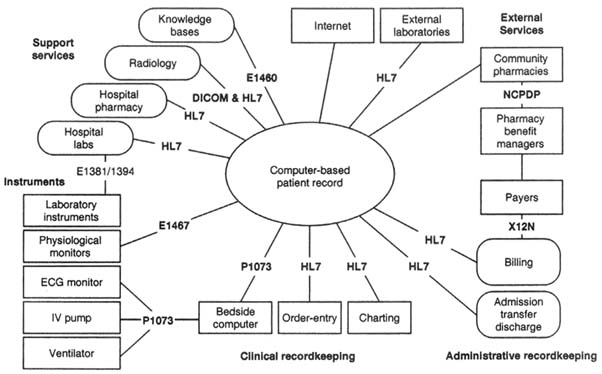
More than 400 private, mostly industry- or profession-specific organizations that develop standards are at work on information technology and telecommunications standards (NRC, 1996). In health care, a number of voluntary standard-setting groups and accrediting organizations for such groups have worked to develop standards in different areas including medicine, nursing, dentistry, and pharmacy. Figure 3.3 displays the array of messaging standards applicable to hospitals (OTA, 1995). Several organizations including the American Society for Testing and Materials (ASTM) and the American National Standards Institute, accredit standard-setting groups and also seek to coordinate the development of common approaches for messaging standards.
One major ongoing effort, Health Level Seven (HL7), which dates to 1987, develops standards for exchanging clinical, administrative, and financial information among hospitals, government agencies, laboratories, and other parties.1 The HL7 standard covers the interchange of computer data about patient admissions, discharges,
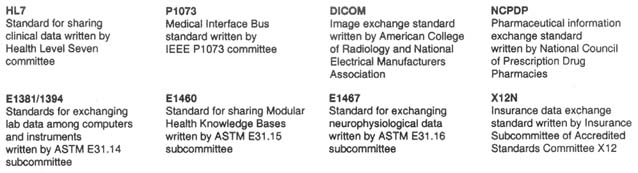
transfers, laboratory orders and reports, charges, and other activities. Most vendors of computer systems support this standard, which is also widely used internationally.
Radiology has been particularly active in standards development, dating back to the early 1980s. The American College of Radiology (ACR) and the National Electrical Manufacturers Association (NEMA) have cooperated to produce initial standards for exchanging digital radiological images and then to revise them in the face of changing technologies and user needs (ACR, 1994; OTA, 1995). The original standards emphasized connections between digital imaging equipment (e.g., a CT scanner) and display units and involved both hardware and software specifications. More recent work has focused on improving network communications capabilities and reducing hardware requirements. The major product as been the Digital Imaging and Communication in Medicine (DICOM) standard, which is now in its third version. A new working group has been considering whether and how to broaden the scope of DICOM by including other disciplines (e.g., cardiology, pathology) and other kinds of health information (ACR/NEMA, 1995).
Managing the Old and the New
A major issue for managers remains the rapid obsolescence—or at least succession—of hardware and software. Progress in information technologies often seems to comes in 18-to-36-month cycles that bring significant increases in processing speeds, storage capacity, or other technical dimensions. The advances that make systems faster, better, cheaper, more flexible, or convenient can be simultaneously satisfying and aggravating.
For example, as organizations move toward an integrated electronic patient record, they may not find it affordable or practical to replace all their older information systems for pharmacy, radiology, pathology, and other services. Thus, they often must develop innovative methods for connecting old, so-called "legacy" systems to new systems until it becomes possible to replace the old ones. In an increasingly competitive, cost-dominated environment, decisions about how much (and how) to invest in information technologies are both difficult and critical.
If the old systems have been abandoned by their manufacturers
or software developers, finding replacement parts or qualified technicians, or even identifying software codes that need to be changed, may be difficult and expensive. The crises facing the nation's huge but obsolete air traffic control system dramatize this problem (Frey, 1996). Equally dramatic is the "millennium" or "year 2000" problem facing many banks and other major institutions that still rely in mundane but critical ways upon old, often undocumented software that cannot easily be changed to handle dates past the year 1999 (Duvall, 1996; IBM, 1996).
Human Factors And The Acceptance Of Telemedicine2
The human infrastructure of telemedicine—like the technical infrastructure—is varied and complex. It generally will include an intraorganizational and an interorganizational mix of clinicians (e.g., physicians and nurses), clinical support personnel (e.g., radiology technologists), physicists, engineering and computer specialists, administrative support personnel (e.g., appointment schedulers), and managers at consulting, satellite, or other sites. In addition, those directly involved in telemedicine will ordinarily be linked to other personnel involved in financial administration, information systems management, research, and a myriad of patient care activities.
Getting these human components—both individuals and organizations—to work well together and with complex and changing technologies is a never-ending challenge. By illuminating when and why these components are not performing as intended, evaluators can help program managers decide whether to continue, discontinue, or redesign operations and can also suggest to vendors and designers how their technologies might be better designed to accommodate human characteristics.
A major frustration with modern technologies is that while they promise to make life easier for people, they may simultaneously make it more difficult. Human factors engineer Donald Norman emphasized this in his book The Design of Everyday Things:
We are surrounded by large numbers of manufactured items, most intended to make our lives easier and more pleasant. In the office we have
computers, copying machines, telephone systems, voice mail, and fax machines. … All these wonderful devices are supposed to help us save time and produce faster, superior results. But wait a minute—if these new devices are so wonderful, why do we need special dedicated staff members to make them work—"power users" or "key operators"? Why do we need manuals or special instructions to use the typical business telephone? Why do so many features go unused? And why do these devices add to the stresses of life rather than reduce them? [Norman, 1990, p. vii]
The task of answering these questions (and seeing that they are asked) falls particularly within the domain of human factors engineering. This discipline seeks to design equipment, systems, and jobs by applying knowledge about how people interact with machines and how preferences and abilities affect these interactions (see, e.g., Salvendy, 1987; Rouse, 1991; Dumas and Redish, 1994; Gosbee, 1995). The issues raised and the strategies proposed by human factors engineers can inform designers and evaluators of telemedicine projects.
Growing Recognition of Human Factors
A recent overview of telemedicine technologies by two experienced telemedicine researchers argued that "most failures of telemedicine programs are associated with the human aspects of implementing telemedicine" (Allen and Perednia, 1996, p. 22). Similarly, in its site visits, meetings, and other activities, the committee heard repeatedly about the human factors that appear to underlie the rejection or limited acceptance of telecommunications and information technologies by otherwise interested clinicians and administrators.
Policymakers, too, have begun to appreciate that many of the programs which they have funded have used telemedicine far less than originally anticipated. For example, the federal Office of Rural Health Policy (ORHP), the Health Information and Applications Working Group of the Information Infrastructure Task Force Committee on Applications, the National Library of Medicine, and other agencies have sponsored a number of workshops and conferences on the opportunities and barriers facing telemedicine (see, for example, ORHP, 1993a; Bashshur et al., 1994, 1995; CPSC, 1995; Scott and Neuberger, 1996). Participants in these conferences have concluded, first, that much more research is needed to determine how patients
and health professionals respond to telemedicine and, second, that the starting point for telemedicine should be the identification of needs and preferences of consumers and providers from a user(e.g., patient, practitioner, community) rather than a technology-driven perspective. They also identified factors that may slow acceptance and adoption of telemedicine, including lack of documented benefit for clinicians; difficulty of incorporating telemedicine into existing practice; problems related to equipment; concerns about professional image; inadequate assessment of needs and preferences; lack of societal readiness; and health care restructuring (Scott and Neuberger, 1996).
To incorporate an examination of human factors, evaluators may in some cases be able to use program logs, debriefing interviews, or questionnaires to detect how these factors may have shaped the effects of telemedicine application. In other cases, they may infer the existence of certain problems based on their own experience, for example, their own frustrations with the technical limitations of hardware and software used in a particular application.
Although the research literature documenting the conditions for successful telemedicine programs is sparse, the conclusions above reflect a common view that telemedicine's successful transition from the demonstration phase into one of wide-spread use depends on better approaches to the human factors in telemedicine. The discussion below, which draws on the sources cited above, considers two broad categories of such factors: practical and socioeconomic. Users and potential users may also be discouraged by real or perceived policy barriers to telemedicine. Chapter 4 examines a number of such policies, including those that exclude payment for most consultations that are not provided on a face-to-face basis.
Practical Human Factors
Problems Related to Equipment
Telemedicine and information technologies are frequently "user unfriendly." Vendor sales, support, and other practices may also be frustrating and constraining. Among the problems reported to the committee were
- problems with the convenience, reliability, quality and integrity of equipment;
- lack of time to learn the correct use of complicated hardware or software that requires extensive training and continued reference to lengthy and highly technical user manuals;
- equipment purchase decisions based on grant and other financing requirements rather than appropriateness;
- lack of flexibility with proprietary systems;
- vendor restrictions on equipment leasing, which dictate large capital investment and maintenance costs for purchased equipment;
- constantly changing sales representatives and vendor product lines; and
- lack of market influence by small purchasers over vendors.
These problems are compounded when vendor marketing practices heighten clinicians' expectations about equipment performance and ease of use and then cannot deliver on their promises. Further, most product specifications and proposed technology solutions reflect the perspective of the technology vendor rather than the user of the product. More attention to applications-driven design, human factors engineering principles, and business process re-engineering might help to alleviate many of the problems identified here.
Difficulty of Incorporating Telemedicine into Existing Practice
When awkward, early stage telemedicine technologies and procedures are grafted piecemeal onto existing routines, the result can be important time management problems for clinicians and their patients. For example, interactive applications may require that primary care and consulting practitioners in different locations abide by the same schedule in order to use "real time" telemedicine systems. When managers in one telemedicine program charted the steps to schedule a telemedicine consult, they found it took at least 5 calls to do so and could take up to 25 calls (Armstrong, 1995). In contrast, much consultative medicine is practiced "asynchronously" with attending and consulting clinicians leaving messages for each other throughout the course of the day or over a period of days. Patients rather than data are often responsible for moving from place to place in the standard consultative medicine scenario. Computer-based scheduling programs can reduce though not eliminate scheduling
|
Box 3.1 In several respects, the current status of many telemedicine systems mirrors that of early telephone systems (Sanders, 1995). Earlier in this century, apartment buildings with 20 to 30 individual apartments typically had only one wall telephone on the ground floor for the entire apartment complex. When the phone rang, the hope was that a tenant in a nearby apartment would answer it and call to the phone the person being sought. This was inconvenient for all involved. Networking was inefficient and switching systems were slow; a person first had to reach an operator who in turn made a manual connection to another line. In addition, the sound quality was poor, maintenance was a problem, costs were high, and lines and equipment were scarce. Not surprisingly, telephone use was infrequent. The telephone only became indispensable when the communication infrastructure allowed for multiple, private lines in an apartment complex, so that each family had its own private line and could directly dial the party wanted. |
problems, but the adoption of common or compatible systems across different organizations is not necessarily a simple step.
Another problem is the physical location of the telemedicine units, which are not always located where the services are being provided (e.g., a physician's office). In some cases, such an arrangement may seem reasonable, akin to having physicians go to the emergency room to see patients in urgent and emergency situations or having radiologists use special viewing rooms. More often, such an arrangement is artificial and inconvenient. Even if the equipment is only five or ten minutes away on another floor or in a nearby building, this can serve as a powerful deterrent to frequent use. Box 3.1 suggests parallels between the current status of tele-medicine systems and early telephone systems.
The widespread availability of practical and affordable desktop work stations should make it easier to employ telemedicine and a variety of other applications, such as patient record, clinical information, and decision support systems. Whether telemedicine or other applications are cost-effective for any specific user and situation still, however, would need to be assessed.
E-mail, voice mail, and fax machines—tools that are often overlooked as telemedicine technologies—may be better suited to some routine clinical communications, although improved store-and-forward technologies for data transmission should also permit for easier off-line consideration of information in response to medical requests.
In the future, clinicians could have available in one multimedia work station the capabilities, if needed, for visual (e.g., still images, full-motion video) and audio communication, graphics, medical literature searches, diagnostic peripherals, electronic mail, fax, and telephone. This technological base appears to be developing, pushed in considerable part by other service-oriented industries (e.g., entertainment, shopping, banking). The cost-effectiveness of telemedicine work stations, however, needs to be assessed, not assumed, for any given setting and set of uses.
A further issue involves the timely availability of relevant patient information. Clinicians involved in telemedicine consultations and other services often lack the whole picture, including patient history as well as current status and condition. Many health care institutions and most clinicians have not yet adopted computer-based patient records systems, but even those who have done so may find it difficult to integrate them with telemedicine applications. Barriers include the lack of common definitions and clinical vocabulary, inadequate standards for sharing and protecting the confidentiality of electronic data, and inconvenient documentation and data retrieval procedures. (In late 1996, the IOM plans to republish its 1991 report on the computer-based patient record with new commentaries describing developments since the original report was issued.)
Inadequate Assessment of Needs and Preferences
Given the discussion above, it is not surprising that a common criticism of advanced technologies is that developers and promoters too often fail to ask what practical needs or problems the technology might address. Even if such questions are asked, however, one dilemma in needs assessment is that "end users [in many instances] do not quite know what they want" and cannot readily imagine the uses of complex technologies with which they are often unfamiliar (NRC, 1996, p. 32). Thus, statements of provider or community needs may read like wish lists rather than realistic assessments and statements of priorities.
Needs assessments have several components. One involves the health status, problems, and other characteristics of the relevant population. A second relates to the characteristics, capacities, and objectives of individual practitioners and health care organizations. A third involves more broadly the characteristics and capacities of
the health care system, including insurance coverage. User preferences may also be considered. For example, if color is preferred to black and white video, user aesthetic preferences may be relevant to decisionmakers considering video options. Even if a strategy may fail without such accommodation, financial considerations will undoubtedly affect the extent to which decisionmakers are willing to accommodate user preferences.
One pressing challenge is to develop methods and tools for assessing potential users' needs and for matching characteristics of particular telemedicine technologies to these needs. One study that attempted to determine clinicians' information needs employed a multidisciplinary evaluation team that (1) directly observed a randomized sample of clinicians for an eight-week period, (2) developed a process flowchart to identify process deficiencies and information requirements, (3) conducted semi-structured interviews, and (4) surveyed a larger group of clinicians to assess their experience with computers and their perceptions about the value of information system options (Tang et al., 1995). The results indicated not just a need for simple patient information but a need for information that was integrated, analyzed, and available when clinical decisions are actually being made.
Cultural and Socioeconomic Factors
Professional Culture and Image
Health care professionals take many of their cues from their colleagues. Thus, acceptance of a new technology by peers as well as opinion leaders may determine a clinician's receptivity to new practices. Most physicians have, however, developed referral patterns to specialists and subspecialists whom they know personally and see periodically on a face-to-face basis in professional or social settings. Telemedicine may disrupt this "culture" and perhaps damage local colleagues economically, as noted below.
In addition, appearances are important in the healing arts, and clinicians may be as concerned and self-conscious as anyone else about their appearance on camera. Because confidence is thought to be reassuring to patients and may, in and of itself, affect patient outcomes, clinicians may be concerned about the possibility that electronic media could weaken the patient's trust.
Nationally, because few programs have demonstrated sustained clinical and business benefits from telemedicine, role models are scarce. Evidence from other areas suggests that respected opinion leaders are important instruments of change because they serve as role models and trustworthy sources of information (or endorsement) for peer-oriented clinicians (Wolinksy, 1988; Soumerai and Avorn, 1990; IOM, 1992a). For those considering the introduction of a telemedicine program, the involvement of a range of specialists from a project's outset can help pave the way to acceptance by a broader community of colleagues.
Lack of Documented Benefit
The scarcity of rigorous evaluations of clinical telemedicine—the stimulus for this report—may also discourage clinicians and other decisionmakers. Little information is available to document how telemedicine can help health care organizations or clinicians improve health outcomes, promote better quality of care, manage costs, attract patients, reduce administrative hassles, or otherwise be of benefit. In addition, practitioners may be concerned that the early adoption of a new and relatively untested technology might be poorly regarded by the people they rely on for support and collaboration. A cautious approach to untested treatment modalities is generally expected of clinicians, and tolerance for "mistakes" in medicine is low. In time, recognized standards for telemedicine practice and direction from accrediting bodies may reduce this concern.
Absent an accessible body of knowledge to draw upon, clinicians and institutions must find their own paths anew. Journals, conferences, seminars, and Internet-based sources are beginning to fill the information vacuum, but the committee concluded from its sampling of these sources that more is sometimes promised than delivered by way of clear, accurate, and usable guidance. Moreover, in an era when health care institutions see each other as rivals not only within but also across communities, the climate for sharing information and experience is not always favorable.
Societal readiness is also an issue. Although some evidence suggests considerable patient acceptance of telemedicine in some settings (e.g., rural areas), it is not clear that patients are generally ready to accept that these new technologies will benefit them. The broader use of telemedicine may require, in addition to evidence
relevant to clinicians and managers, efforts to inform and educate patients and consumers.
Lack of Payment for Telemedicine Services
Added to the uncertainties about the benefits of telemedicine is the important fact that most telemedicine consultations are not covered by Medicare or other third party payers (see Chapter 2 and Chapter 4 for additional discussion). Most of those interviewed by the committee believed this to be a major deterrent to telemedicine use, regardless of whether or not they were advocates of telemedicine or favored a change in payment policies.
Health Care Restructuring
Changes in the American health care system are altering the relationships between clinicians, patients, health care institutions, managed care plans, and public and private purchasers of health care. Strategic alliances, joint venture arrangements, and takeovers are changing historic relationships and centers of control over clinical practice. Practitioners and administrators are acutely concerned about protecting their patient base in the face of cost-driven reductions in the use of many services and changes in referral patterns. Advanced telecommunications technologies stand to alter further the relationships between health care organizations and professionals and between the practitioners and their patients. Will there be gatekeepers for telemedicine applications, and if so, who will play that role—clinicians, health plan managers, government officials, or perhaps the technicians who operate and maintain the equipment? For health care professionals accustomed to assigned roles and responsibilities, questions about who performs new and existing tasks in a networked environment may prompt considerable concern.
What may start as a simple way to improve access through telemedicine may end up as a permanent shift in the locus of patient care—locally, regionally, and even nationally. In the short term, this prospect may lead some to seek policy barriers (for example, licensure restrictions) or other limits on telemedicine practice. In the longer term, however, if telemedicine is viewed by managed care plans and integrated health systems as bringing cost and competitive advantages, they will use their leverage with government officials
and employer purchasers of health benefits to implement telemedicine as they have done with other measures (e.g., discounted fees, utilization review) that are unpopular with clinicians.
Conclusion
Those responsible for creating, sustaining, and evaluating information and telecommunications systems and programs face a bewildering and constantly changing array of hardware and software options, many of which are not tailored to health care uses. Assessing the utility of advanced information and telecommunications technologies is difficult, particularly given the need to consider options in combination, not just individually. Although many groups are working to develop hardware and software standards, it remains frustrating and difficult to put together systems in which the components operate predictably and smoothly together, work in different settings without extensive adaptation, and accommodate replacement components.
Getting the components of the human infrastructure of telemedicine to function efficiently and predictably is also a major challenge. The limited adoption of telemedicine is due in part to a variety of what are commonly called "human factors," including a poor fit with the environment, needs, and preferences of clinicians, patients, and other decisionmakers (both individuals and organizations). Clinicians and other decisionmakers may be skeptical of telemedicine's clinical effectiveness as well as its practicality in everyday use. Thus, the scarcity of telemedicine evaluations and evidence of benefits is itself an element in the human factors equation. In addition, those advocating, adopting, or evaluating telemedicine must recognize the uncertainties and even fears that clinicians and organizations may have about how telemedicine will affect them in a period characterized by increased competition, structural realignments, and surpluses of some categories of health professionals.
This chapter has considered some elements of the technical and human infrastructures of telemedicine that evaluators may need to investigate if they are to provide assessments that help decisionmakers determine why a program succeeded or failed and whether and how it might be redesigned to work better. The next chapter considers some policy issues that evaluators may need to consider as they affect the adoption and implementation of telemedicine programs.


