
3
Overview of the Siting Process
This chapter provides a general description and analysis of the site selection process formulated by the Siting Commission to meet its responsibilities under the 1986 State Act, described in Chapter 2. New York State submitted a draft of its site selection plan to the U.S. Department of Energy to meet the January 1, 1988, milestone for the development of a siting plan set by the 1985 Amendments Act (see Table 2.1). The Siting Commission followed this plan until the process was halted by the governor in 1990.
The siting process involved several discrete screening steps. This chapter describes how each of the screening steps fit into the overall process and provides an analysis of those characteristics common to many of the individual steps. Subsequent chapters provide a more detailed analysis of several of the discrete steps.
Siting Plan
The framework for the siting process is presented in the November 1988 Siting Commission's Plan for Selecting Sites for Disposal of Low-Level Radioactive Wastes (referred to throughout this report as the "Siting Plan"). The Siting Plan describes the goal of the siting process as follows (Siting Plan, p. 2-4):
The process will identify sites that are expected to be potentially suitable for low-level radioactive waste disposal. It may not, however, identify every possible site within the state. Moreover, the process is intended to identify sites that can satisfy the site suitability criteria of 6 NYCRR Part 382 and to demonstrate that no obviously superior alternatives can be identified.
The Siting Plan acknowledges that other factors besides technical suitability are necessary for certification (p. 2-4):
The Siting Commission recognizes that the selected site must be suitable for certification from the standpoints of technical suitability, public acceptance, and policy considerations. The decision-making process must balance the geologic, hydrologic, and environmental considerations with social, economic, and policy needs.
The Siting Commission makes it clear in the siting plan, however, that technical suitability is the primary focus of the screening process (Siting Plan, p. 2-1):
The Siting Commission's objective is the selection of sites that are technically suitable for protecting public health and safety and the environment. Once technically suitable sites are identified, the Siting Commission will then be able to take into consideration other factors in selecting candidate sites.
The Siting Plan established a two-phase approach to selecting a low-level radioactive waste (LLRW) disposal site (Figure 3.1). Phase 1 was designed to identify a small number of potentially certifiable sites 1 based on a screening process that employed existing data or limited reconnaissance studies. Phase 2 called for detailed, on-site studies to identify a single "preferred site" for certification. This phase was never reached due to termination of the siting process by the governor of New York.
|
1 |
The terms certifiable and licensable are used interchangeably throughout this report, although they have slightly different meanings. Sites that meet the New York State Department of Environmental Conservation (DEC) regulations for disposal of radioactive waste are referred to in this report as certifiable sites—although actual certification would be granted only after a review of an application by the DEC. Sites that meet the DEC regulations are also referred to as licensable sites—although, as noted in Chapter 2, the responsibility for issuing licenses resides with the New York State Department of Labor. |
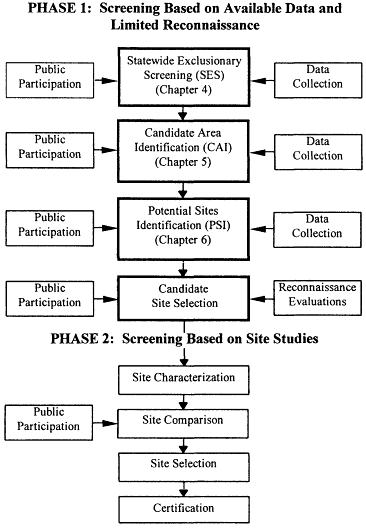
The first phase of the screening process was subdivided into four parts:
- Statewide Exclusionary Screening (SES), in which the Siting Commission screened the entire state using a set of exclusionary criteria to eliminate from consideration as an LLRW facility those areas prohibited from such use by law or regulation. This step is discussed in more detail in Chapter 4 of this report.
- Candidate Area Identification (CAI), in which the nonexcluded areas were screened using a set of exclusionary and preference criteria to select about 10 "candidate areas" for more detailed study. This step is discussed in more detail in Chapter 5 of this report.
- Potential Sites Identification (PSI), in which the candidate areas were screened using another set of exclusionary and preference criteria, to identify 4 to 8 "potential sites" for even more detailed study. This step is discussed in Chapter 6 of this report.
- Candidate Site Selection, in which the Siting Commission was to use limited on-site studies to eliminate from consideration those potential sites having conditions that would preclude site certification and to select up to 4 "candidate sites" for detailed site characterizations. These detailed characterizations were to occur during phase 2 of the screening process.2
The Siting Plan noted that the DEC had the responsibility for developing the regulations and siting criteria governing the selection of a permanent disposal facility.3 The Siting Plan indicated that the Siting Commission would carry out site selection in compliance with DEC's
|
2 |
As noted previously, the siting process was halted by the governor of New York during the first phase of the screening process, after five potential sites had been identified. |
|
3 |
The regulations are laid out in Title 6, Part 382, New York Code of Rules and Regulations (NYCRR), the final version of which was issued in March 1993. A draft of these regulations and criteria was published 11 months prior to final version of the Siting Plan, in December 1987 (see Table 2.1). According to a January 21, 1994, memo to the committee from Mr. William Gilday, environmental analyst of the DEC Bureau of Radiation, these 1993 regulations "for the most part, were effective in March of 1988. These were substantially what the Siting Commission had to work with during the initial site selection activities." |
regulations and associated criteria and that the Siting Commission "intend[ed] to communicate early and regularly with DEC to obtain guidance for ensuring that site selection activities comply with 6 NYCRR Part 382" (Siting Plan, p. 1-5).
As noted in Chapter 2, the commission had considerable discretion in selecting the methodology and the process to identify a certifiable site. Indeed, the Siting Commission noted that it needed guidance in interpreting some of the regulations. Notably, however, the DEC did not perceive that it should play an active role in guiding the site selection process. In response to this committee's questions regarding its role in the early stages of the commission's site selection plan (Appendix F), the DEC responded as follows:
Because DEC would eventually review the Siting Plan and its implementation under that regulatory review, it was not appropriate for DEC to take a more active role in the SC's [Siting Commission's] implementation of the plan.
Screening Criteria
The DEC regulations in 6 NYCRR Part 382 identified a set of 13 factors that were important for siting an LLRW facility. The factors are shown in the first column of Table 3.1. The Siting Commission designated two sets of screening criteria to address these siting factors. The first set of criteria, exclusionary criteria, contained the mandatory elements (e.g., "the site must not be located . . .") of the regulations. Areas that failed to meet these criteria were disqualified from further consideration. The second set of criteria, preference criteria, included the discretionary elements (e.g., "sites are preferred that . . .") of the DEC regulations. The Siting Commission used these preference criteria to rank areas in terms of their favorability for an LLRW facility. As shown in Table 3.1, the Siting Commission designated a total of 17 exclusionary criteria and 43 preference criteria. A complete list of these criteria is given in Appendix I of this report.
TABLE 3.1
Preference and Exclusionary Criteria
|
Siting Factors |
Number of Exclusionary Criteria |
Number of Preference Criteria |
Total Weight of Preference Criteriaa |
|
Geology |
1 |
4 |
135 |
|
Natural resources |
1 |
3 |
60 |
|
Ground water hydrology |
1 |
3 |
135 |
|
Surface water hydrology |
3 |
5 |
150 |
|
Meteorology and climatology |
0 |
3 |
55 |
|
Air quality |
1 |
1 |
30 |
|
Ecology |
1 |
1 |
55 |
|
Incompatible nearby activities |
0 |
2 |
40 |
|
Demographic patterns |
1 |
3 |
115 |
|
Land use |
6 |
5 |
70 |
|
Cultural resources and aesthetics |
2 |
3 |
45 |
|
Transportation |
0 |
7 |
75 |
|
Socioeconomics/ community services |
0 |
3 |
35 |
|
Total |
17 |
43 |
1,000 |
|
a Weights are discussed later in this chapter. |
|||
The use of the two different categories of screening criteria was initiated by the Siting Commission and was not required by the DEC regulations. In response to a question on this subject from the committee (Appendix F), the Siting Commission noted that this approach had been suggested by the senior staff of its primary contractor for the site selection process, Roy F. Weston, Inc.
Except for statutory exclusions, the decisions regarding classification of criteria as exclusionary or preference were made at the discretion of the Siting Commission. In an appendix the Siting Plan summarizes the statutory or regulatory basis for each of the criteria. Because the exclusionary and preference criteria played a central role in the site selection process, much of this report focuses on the design and application thereof.
Disposal Methodology
Although not required by the 1986 State Act, the Siting Plan indicated that the selection of a disposal method would occur concurrently with the selection of candidate sites. The Siting Plan stated (Siting Plan, p. 2-29):
. . . up to three disposal methods and up to four candidate sites will be developed and evaluated for compatibility. Combinations that are incompatible will be eliminated from further consideration. The remaining site/disposal method combinations will be retained for further evaluation.
The Siting Plan indicated that there would be interaction between the selection of a site and the selection of a disposal method throughout the siting process.
In the Siting Plan the Siting Commission considered two different disposal technologies: (1) aboveground or belowground disposal and (2) mine disposal. The first method would involve the construction of engineered containment structures at, or slightly below, ground level. The second method would use existing or purpose-built
TABLE 3.2
Disposal Method-Specific Exclusionary and Preference Criteria (criterion numbers are shown in parentheses)
|
Type of Criterion |
Aboveground/Belowground Disposal |
Mine Disposal |
|
Exclusionary |
Wetlands exclusion (17) |
Existing mine exclusion (4) Surface water bodies (15)a |
|
Preference |
Unconsolidated stratigraphic units (14) Distance from wetlands (18) Drainage (19) Erosion (20) Annual precipitation (23) Severe weather frequency (25) |
Existing mines and mineral/energy resource potential (9) |
|
a The Excluded Areas Report (New York State Siting Commission, 1993) states that this criterion was applied only to aboveground or belowground disposal methods during CAI and PSI. The Siting Plan, Candidate Area Identification Report (CAIR), and Report on Potential Sites Identification (ROPSI), however, indicate that this criterion was applied to all disposal methods. |
||
underground excavations for waste storage—either in vertical shafts or horizontal ''drifts.'' Most of the siting criteria were applied to both of these methods. A few criteria, however, were method specific (Table 3.2; see Appendix I for criteria descriptions).
Application of Screening Criteria
The first part of the screening process, Statewide Exclusionary Screening (SES), involved the application of selected exclusionary criteria to all lands in the state (see Chapter 4). Areas that failed any of the criteria used in the screening were eliminated from further consideration. The second and third parts of the screening process, CAI
and PSI, involved further screening using exclusionary criteria and the quantitative scoring and ranking of nonexcluded lands using different sets of preference criteria.
The scoring system involved the application of numerical scaling and weighting factors to each criterion. Scaling factors are integer values that express numerically how well a particular area satisfies a particular criterion. With some exceptions (which are discussed later in the report), each preference criterion used in scoring was assigned a set of scaling factors in the range from 1 to 5, where 1 was least favorable and 5 was most favorable. The degree to which the preference criterion was met at a given area determined its scaling value. For example, criterion 7 preferred "areas that are distant from active or nearby abandoned mines" (see Table 1.2). If a location was more than 1 mile from any mine, a scaling factor of 5 was assigned. If the closest mine was between 1/2 mile and 1 mile, a scaling factor of 3 was assigned, whereas a scaling factor of 1 was assigned if the closest mine was less than or equal to 1/2 mile away.
Weighting factors are integer values that provide a relative ranking of the numerical importance among the preference criteria in terms of site suitability—for example, the importance of distance to schools versus distance to highways. Weighting factors were developed through a process known as values elicitation. The Siting Commission developed the weighting factors from information obtained at a workshop attended by a small number of representatives of government, industry, and interest groups and from a similar internal Siting Commission exercise.
Weighting factors for the various preference criteria ranged from 5 to 55 (see Table 1.2), and the weighting factors for all 43 preference criteria summed to 1,000 (Table 3.1). Most of the screening steps utilized only a subset of these criteria. In these cases, the weights of the criteria were renormalized so that they summed to 1,000.4
The Siting Plan indicates that the Siting Commission was aware of the subjective nature and importance of weighting factors. The plan states (p. 2-9):
|
4 |
Except as noted in Chapter 6 for the Geographic Information System (GIS) Screening step, where a different renormalization method was used. |
In order to make comparative technical evaluations of candidate areas and sites, it will be necessary for the Commission to make value judgments about the relative importance of each siting criterion. This recognizes that some criteria are more important determinants of the overall suitability of a site than others. Quantitative expression[s] of these value judgments are called weighting factors.
In the CAI and PSI steps of the screening process, the Siting Commission used the following process to "score" each area under consideration quantitatively to assess its suitability for an LLRW disposal facility:
- A scaling factor of 1 to 5 was assigned to each preference criterion for each area. The assignment was based on the degree to which the area satisfied the criterion based on examination of available data.
- The scaling factor and renormalized weight for each criterion were multiplied to obtain a "score" for that criterion.
- The scores for all of the criteria used in the screening step were added together to obtain a total score for the area. The total scores were a measure of the relative favorability of each area, with the most "favorable" areas having the highest scores. The maximum possible score for any area was 5,000.
As discussed in Chapters 5 and 6, different combinations of criteria were used in the CAI and PSI screening steps. In response to questions from the committee (Appendix F), the Siting Commission stated that the initial schedule for applying the criteria was developed by senior staff at Roy F. Weston, Inc. "based on previous experience on siting projects and the nature of anticipated data sources. . . ." As described in Chapters 5 and 6, the Siting Commission applied additional unplanned screening procedures during both of these stages.
Quality Assurance Program
The U.S. Nuclear Regulatory Commission (USNRC) and the DEC required a quality assurance program as part of site characterization and licensing efforts. The USNRC regulations regarding license applications for a low-level waste disposal site require
a description of the quality control program for the determination of natural disposal site characteristics and for quality control during the design, construction, operation, and closure of the land disposal facility and the receipt, handling, and emplacement of waste. Audits and managerial controls must be included. (10 CFR 61.12(j))
Similarly, DEC regulations require the following:
The Commission must submit its proposed plans for site characterization studies and a description of the proposed quality control program for such studies to the department for the department's review. . . (6 NYCRR 382.6 (b)(3))
In addition, the report NUREG-1293, Quality Assurance Guidance for Love-Level Radioactive Waste Disposal Facility, (USNRC, 1989) clarifies the intent of the quality assurance requirements and provides guidance for planning the site selection and characterization process. (A full list of the supporting publications for the Siting Commission's quality assurance plan is presented in Appendix J.) From a regulatory perspective, the goal of the Siting Commission's quality assurance program was to ensure documented evidence of quality in the site selection process that would provide a basis for denying or issuing a license. A quality assurance program would stipulate procedures for a disciplined system involving planning, training, data collection, analysis, validation, and review to preserve all important information. Since New York is an agreement state, the DEC was to provide the guidance on the development and implementation of a quality assurance program.
Public Participation
As noted in Chapter 2, the 1986 State Act required the Siting Commission to keep the public informed of its activities and encourage public participation in siting and disposal method selection. In the Siting Plan the Siting Commission committed itself to meaningful public participation in all phases of its work. The following objectives were identified:
- Provide a base of public information on the LLRW disposal facility site and method selection process.
- Create convenient, meaningful opportunities for members of the public across the state to participate in those processes.
- Consider the range of public ideas and values in making the decisions that would lead to a disposal facility site and method.
The Siting Commission also committed to meet these objectives (Siting Plan, p. 1-8) by
. . . involving the public at many points throughout the site selection. This began with the development of the site selection plan and will continue through each of the decision points leading to the selection of the preferred site.
Planned public participation programs included (1) a workshop at which representatives of state and local government, industry, and interest groups reviewed and commented on weighting factors for criteria used in site and method selection; (2) development and dissemination of public information materials, including a quarterly newsletter and fact sheets on relevant subjects; (3) a series of public meetings; and (4) solicitation of public review and comments on major documents.
The Siting Commission's stated intention for CAI screening was to recognize a range of value judgments on the relative importance of the site selection factors. Once technically suitable sites were established, the Siting Commission was to take into consideration other economic, social,
and policy factors in selecting those sites upon which it would focus its efforts.
As required by the 1986 State Act, an Advisory Committee review was also to be sought. The Siting Plan describes the site selection plan workshop in which both the Advisory Committee and its invited guests had participated in August 1988. It also describes a series of meetings held in October 1988 to introduce the public to the siting process. Meetings were planned to receive input on CAI in mid-January 1989. In the spring of 1989 the meetings were to focus on identification of potentially suitable sites, and meetings planned for the summer of 1989 were to be held in candidate site communities to obtain public input on information needed to make a recommendation for certification. Input was to be sought from local citizens on the selection process, local data pertinent to the evaluations, and public values and preferences.
Throughout the process, staff were to be available to answer questions, provide presentations, and work with interest groups to provide information on the process. Local information offices were to be opened in the candidate site communities to provide a channel of communication with the Siting Commission. These offices would provide public information on radioactive waste disposal, Siting Commission plans, and the site selection process. In response to questions from this committee (Appendix F), the Siting Commission stated that approximately $5 million was expended on public participation activities between 1988 and 1993.
Analysis and Discussion
Two observations are worth noting at this early point in the review of the New York siting effort. The first relates to the goals of the siting effort. As noted previously in this chapter, the stated goals for the siting process were (1) to identify potentially certifiable sites and (2) to demonstrate that no "obviously superior alternatives" could be identified readily. The second goal was interpreted by some parties in the siting process—and many members of this committee—as favoring the selection of a "best" site in some objective sense. The requirements for a site that has no obvious superior alternatives, however, are difficult to
define because many factors are involved in the suitability assessment, and no one site can be expected to be superior in all respects. In any event, the Siting Commission was required only to identify certifiable sites—although, as shown in later chapters of this report, the expectations of some affected communities with regard to a "best" site created problems for the Siting Commission as siting progressed.
Second, through the implementation of the exclusionary and preference criteria, the Siting Commission divided the site selection process into an exclusionary phase, during which the commission was removing land from consideration, and a selection phase, during which the commission actively sought to identify certifiable sites from ever-smaller areas of the state. The differences between these two activities had important implications for the commission's work. The exclusionary steps, which were largely in the beginning of the process (particularly SES and the early stages of CAI; see Chapters 4 and 5), were not controversial because of their very nature. Because they excluded large regions of the state, the results of exclusionary screening were welcomed by citizens in excluded areas. By comparison, the process of selecting candidate areas and potential sites has the potential to be more visible because it focused public scrutiny on relatively small areas, and the result—being selected—was cause for concern among affected communities. In fact, as noted in Chapters 5 and 6, public interest did not become significant until the later inclusionary phases of the screening process.
By choosing a two-stage process the Siting Commission automatically, if inadvertently, heightened public scrutiny during the later stages of the screening process—where, as discussed in Chapters 5 and 6, the data were frequently mismatched to the scale of screening and the screening methodology became increasingly subjective. As later chapters show, the Siting Commission's progress slowed significantly as its focus changed from exclusion to selection. It is not clear that the commission appropriately recognized this shift of emphasis. Moreover, as far as the committee could judge, the commission failed to understand the implications of the change in emphasis from exclusion of land to selection of sites.


