
3
Entry into Science
Ph.D. Production and Individual Characteristics
The reason for opening science to women is not that they will do it differently and better but that good scientists are hard to find and it seems perversely absurd to place social impediments before half the human race when that half could, person for person, do the job as well as the half granted access.
—Stephan Jay Gould, New York Times Book Review, 19841
But a scientist without a Ph.D. (or a medical degree) is like a lay brother in a Cistercian monastery. Generally he has to labor in the fields while others sing in the choir.
—Spencer Klaw, The New Brahmins, 19682
INTRODUCTION
The Ph.D. is the sine qua non of a scientific career. Without this certification, active participation in science and engineering beyond the level of a technician is an increasingly rare exception. Accordingly, it is appropriate that we begin our study of the careers of women and men in science and engineering (S&E) by examining the number and proportion of women who receive advanced degrees in S&E fields. While more women than men continue to be lost through attrition during the training to become a scientist or engineer, from 1973 to 1995 there was substantial growth in the representation of women in all broad fields of science and engineering. Still, women continue to be significantly underrepresented in the fields of mathematics, engineering, and the physical sciences.
We next consider gender differences in the characteristics of scientists and engineers at the time they receive their doctorate. Understanding
differences in backgrounds is necessary, but not sufficient, for understanding differences in career outcomes that are the focus of later chapters. We begin by examining the educational background of a scientist’s parents. We then turn to characteristics of a scientist’s own education, including the type of baccalaureate institution attended, the prestige of the doctoral program, time from the baccalaureate to the Ph.D., and the types of financial support received during graduate study. While there has been a reduction in gender differences in background characteristics, some differences remain that may lead to disadvantages for women in their postdoctoral careers. We end the chapter by examining differences between male and female scientists and engineers in marriage and having children. Later chapters show that the effects of marriage and family on career outcomes are very different for men and women.
While our focus is on quantifying gender differences in individual backgrounds, it is important to keep in mind that gender differences in entry into science and engineering can arise both from differences in the socioeconomic backgrounds of individuals and from differences in access to education. Differences in background can also interact with opportunities in complex ways. For example, a young woman who believes that her chances for a rewarding future in science are not as good as a male classmate’s might choose, on that basis alone, to enter a different profession. Similarly, a woman who believes (whether that belief is correct or not) that she must meet higher standards for admission than a man might decide not to enter the competition on such an uneven basis. If women make different decisions about their education than do men, as they often do, the reasons could have less to do with interest and ability than with the perception of unfairness.
While differences in personal background characteristics are easy to document with the types of survey data that we have, the evidence on past discrimination against women is often circumstantial. Nonetheless, until the advent of Title IX of the 1972 Higher Education Amendments, discrimination against women was widely practiced throughout higher education, especially in research universities. The practice of requiring higher grades and test scores for the admission of women was ubiquitous in universities and professional schools, resulting in the exclusion of thousands of women whose abilities matched those of admitted men. Low quotas for the admission of women to certain undergraduate curricula, especially schools and colleges of science, were common. For example, at Cornell University, despite its founding as a coeducational institution, housing for women (but not for men) was limited, resulting in a system of assigning only small numbers of “female beds” to those departments deemed unsuitable for women (Conable 1977:110–117). Following passage
of the GI Bill in 1944, most universities reduced female enrollments deliberately in order to accommodate veterans. At the University of Michigan, for example, women’s admissions were suddenly reduced by almost one-third (McGuigan 1970:112).3 The consequence was that women were forced into the newly developing state colleges, formerly normal schools, where opportunities for undergraduate preparation in sciences and engineering were often inadequate or nonexistent. The effect of such practices was exacerbated by discriminatory financial aid practices, at least until passage of the Equal Credit Act of 1974. In sum, all of these factors, while difficult to quantify on a national scale, combined to make it far more difficult for women to study sciences as undergraduates and to pursue professional careers in these fields. While a complete review of the historical evidence on the treatment of women in the pursuit of the doctorate is beyond the scope of our report, Solomon (1985) and Rossiter (1982, 1995) are excellent histories of women in higher education.
THE PIPELINE TO THE PH.D.
The educational process leading to the Ph.D. has been described as a pipeline, where a large flow of children enter the pipe with many “leaks” as students flow towards the Ph.D. (Berryman 1983; U.S. Congress 1988:11–12). While only a small proportion of either men or women make it to the end of the educational pipeline, substantially more women than men are lost through attrition. In her presidential address to the American Association for the Advancement of Science, Sheila Widnall (1988) described the pipeline as shown in Figure 3–1: out of a cohort of 2,000 girls and 2,000 boys in the ninth grade, 280 boys and 220 girls complete work in high school that prepares them for science in college; of those 500 students, 140 men and 44 women concentrate in science in college, with only 46 men and 20 women receiving a bachelor’s degree in science; of these 66 students, just five men and one woman earn a doctorate in science or engineering. The greater loss of women than men on the way to a Ph.D. results in women comprising a smaller proportion of those with advanced S&E degrees. For a discussion of factors affecting the differential achievement of boys and girls prior to entrance into college, see Catsambis (1994) and Kahle and Matyas (1987).
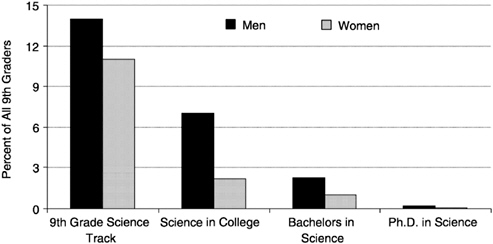
FIGURE 3–1 Summary of the pipeline to the Ph.D. SOURCE: Widnall (1988).
BACCALAUREATE DEGREES
If the college woman is a mistake, Nature will eliminate her.
—David Starr Jordon, President of Stanford University, 19064
Is it time for affirmative action for men?
—Ben Gose, The Chronicle of Higher Education, 19975
A bachelor’s degree, and usually one in science or engineering, is the normal prerequisite for pursuing a Ph.D. in S&E. Consequently, the dramatic changes in the enrollment of women for undergraduate degrees set the stage for women increasing their representation among Ph.D. scientists. In 1847, Lucy Stone was the first woman to receive a baccalaureate degree in the United States (Solomon 1985:43). Since then, as shown in Figure 3–2, there have been dramatic changes in the presence of women among those enrolled in colleges and universities. From 11,000 women in 1870, to 601,000 in 1940, to nearly 7 million in 1995, the number of women enrolled in baccalaureate programs has increased every year (shown by the dashed line), with explosive growth beginning in 1960. However, the representation of women as a proportion of all students has shown periods of increasing success and reversals along the way. The largest decline in
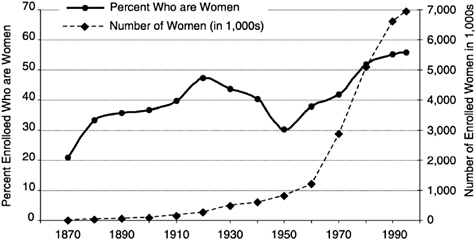
FIGURE 3–2 Percent of those enrolled in college who are women. SOURCES: Solomon 1985:63; NSB 1998:A-53.
representation occurred after World War II as a result of the huge increase in the number of men whose education was funded by the GI Bill. The history of the struggle of women to become full participants in higher education is documented in Barbara Miller Solomon’s (1985) fascinating book, In the Company of Educated Women.
Beginning in 1950, the proportion of women has grown steadily. By the early 1980s, women were a majority of those enrolled in undergraduate education, with their share approaching 60 percent in 1995. The greater representation of women occurred as the number of women increased and the number of men stayed nearly constant. From 1975 to 1995, the total number of baccalaureate degrees awarded increased by 26 percent, from 931,663 in 1975 to 1,174,436 in 1995.6 Degrees to women increased by 52 percent, while degrees awarded to men increased by only 4 percent. During this same period, baccalaureate degrees in S&E grew by only 21 percent, from 313,555 to 378,148. The entire growth in the number of S&E degrees was the result of an increase of 71 percent in the number of women, while the number of men decreased by 4 percent. The net result of these changes is that men became less likely to choose a degree in science and engineering, down from 41 percent of all degrees to men in 1975 to 38 percent in 1995. In comparison, the percent of women in S&E fields rose
from 24 percent to 27 percent. This increase by women in the pursuit of baccalaureate degrees in S&E is also seen in data on transition rates from high school. Barber (1995) notes that in 1970 only 5 percent of women graduating from high school went on to earn a bachelor’s degree in S&E compared to 14 percent of the male high school graduates. By 1989, the difference narrowed with 9 percent of the women compared to an unchanged 14 percent of the men obtaining S&E degrees.
DOCTORAL DEGREES IN SCIENCE AND ENGINEERING
The growth in the number of women with baccalaureate degrees in science and engineering was essential for the growth in doctorates earned by women during this period. But the completion of the baccalaureate does not necessarily lead to an advanced degree. The evidence suggests that a greater proportion of women than men end their education with a bachelor’s degree (Hornig 1987:108). Accordingly, women represent an even smaller proportion of those with Ph.D.s and even fewer of those with Ph.D.s in science and engineering fields. The study Climbing the Ladder (CEEWISE 1983:1.12) estimated that in 1970 women with bachelor’s degrees in the physical sciences were 61 percent less likely than men to obtain a Ph.D.; 49 percent less likely in the biological sciences; and 40 percent less likely in psychology. By 1980, there was substantial movement towards parity, with rates 25 percent lower in the physical sciences, 6 percent in the biological sciences, and 3 percent in psychology.7 In S&E fields, Barber (1995) calculated that the number of women who earned doctorates each year represented from 5 percent to 7 percent of the women earning baccalaureate degrees in S&E eight years earlier. While the propensity for men to pursue Ph.D.s is much higher than for women, especially in certain fields of S&E, the likelihood for men with bachelor’s degrees to pursue a Ph.D. dropped drastically in the 1970s and early 1980s (Barber 1995; Lomperis 1990; CEEWISE 1983). For example, Barber (1995) estimates that from 1970 to 1990 the percent of men with S&E undergraduate degrees who obtained Ph.D.s in S&E 8 years later dropped from 15 percent to 8 percent. The net result of these changes is that women have steadily increased their proportion among new Ph.D.s in science and engineering.
In her history of the education of women, Solomon (1985:134) reports that the first doctoral degree in America was to a man at Yale in 1862. Fifteen years later, the first woman received a doctorate from Boston
University, while most universities continued to exclude women from graduate programs. By the end of the 19th century, 9 percent of all Ph.D.s had been awarded to women, with 228 women and 2,372 men receiving degrees. While women continue to lag behind men in attaining the doctorate, Figure 3–3 shows that since 1960 there has been a steady increase in the percentage of degrees received by women in the natural and social sciences. From the 1920s until the Depression of the 1930s, degrees to women fluctuated between 10 percent and 15 percent in the physical sciences, and between 15 percent and 20 percent in the social sciences. The drop during the Depression was followed by a rapid increase in degrees to women during World War II, reversed by a sharp decline as GIs returned to school. The difficult position of women in graduate programs after the war is reflected in Keller’s (1991:230) account of a committee formed at M.I.T. during this period to decide whether the school should continue to admit female students. Remarkably, the percentage of degrees awarded to women did not match the levels of the 1920s again until the mid-1970s.
The dramatic growth in the number of new Ph.D.s in science and engineering from 1963 to 1970, shown by the dashed line in Figure 3–4, was fueled by huge increases in federal support to graduate programs that followed the launch of Sputnik in 1957. During this period, degrees to women, shown by the thick black line, grew a modest 0.3 percentage points each year. The growth for women was limited by competition with veterans from the Korean Conflict returning to school using the GI Bill,
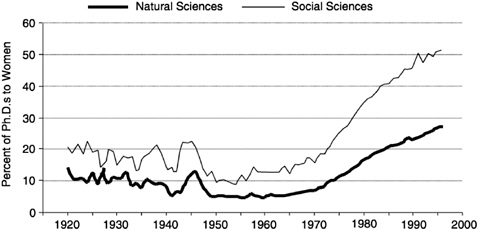
FIGURGE 3–3 Percent of doctoral degrees awarded to women in the natural and social sciences from 1920 to 1996. SOURCES: Harmon, Doctorate Records File (1963).
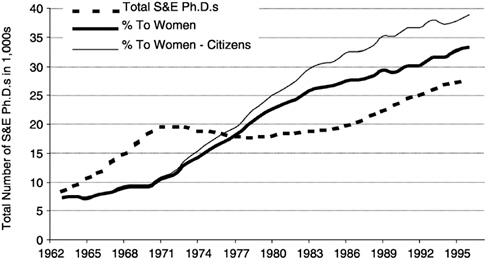
FIGURE 3–4 Total number of S&E doctoral degrees and percent of S&E doctoral degrees awarded to women and percent of S&E doctoral degrees awarded to women among those who are citizens or permanent U.S. residents. SOURCE: Doctorate Records File.
social pressure for early marriage and childbearing, and discrimination against women in admissions and financial aid (CEEWISE 1983:1.13, 2.1). The early 1970s ended the long expansion in higher education, as Ph.D. production declined for 6 years in response to federal cutbacks and a poor academic labor market (McPherson 1985; Wilson 1979:49–53, 78–79). But, while the number of men obtaining S&E doctorates declined annually from 1972 until 1988, the number of S&E doctorates granted to women increased every year since 1963. From 1971 to 1983, the percent of S&E Ph.D.s awarded to women increased on average 1.3 points per year. During this period, the capacities of universities were high while the enrollment of men was decreasing, making schools more receptive to accepting women.
Antidiscrimination laws such as Title IX and the feminist movement also contributed to increases in women pursuing the doctorate (Chamberlain 1988:16). This period of rapid growth for women was followed by slower growth of 0.6 points a year from 1984 to 1996. By 1996, women had attained one third of all doctorates, half of the doctorates in the social sciences, and nearly one quarter of the doctorates in the natural sciences. By 1996, there were over 15 times more degrees received by women than in 1963, and 3.6 times more than in 1973.
Women are more highly represented among those who are U.S. citizens and who have permanent resident status. This can be seen by com-
paring the thin black line indicating the percent of women among citizens and permanent residents to the thick line representing all Ph.D.s regardless of citizenship. The difference emerged in the early 1970s and grew steadily until the present day. By 1996, women made up 33 percent of all S&E Ph.D.s, but 39 percent of the degrees awarded to U.S. citizens and permanent residents.
Field Differences in Ph.D. Production
Each of our five broad fields showed substantial growth in the representation of women, but there are important differences. While the percent of degrees to women is clearly important as an indication of the representation of women, the number is also critical, especially in smaller fields such as engineering and mathematics. A given field (or university or department) may need at least a minimum number of women before these women attain a critical mass whereby they are no longer viewed as an oddity. Having a critical mass can minimize socialization difficulties otherwise encountered in a male-dominated environment (LeBold 1987:86 and the literature cited therein). For example, Dresselhaus (1986) found that women in physics classes were very quiet until the percentage of women in the class grew to 10 percent or 15 percent, at which time their participation equaled that of men. The importance of number is also related to the idea of tokenism, in which a small number of a minority group is seen as representing the entire group (Kanter 1977). Thus, female scientists may be viewed by their colleagues primarily as women, rather than as scientists or engineers (Yentsch and Sindermann 1992:213). Once a critical mass is obtained, the presence of women has the potential to affect the social conditions of science, including personal interactions, policy-making, and tenure decisions (Sonnert 1995:11).
Information on the number and percent of women by field and year is summarized in Figures 3–5 and 3–6. The years 1973, 1979, 1989, and 1995 correspond to the years of the Survey of Doctorate Recipients (NSF 1973– 1995) (hereafter, SDR) that are used throughout our report. Figure 3–5 shows the percent of Ph.D.s awarded to women in a given year; Figure 3–6 shows the number of new Ph.D.s who are women in the corresponding fields and years. In assessing these graphs, keep in mind that the years of our survey are not evenly spaced. All else being equal, we would expect larger changes from 1979 to 1989 than from 1973 to 1979 or from 1989 to 1995. With this caveat in mind, there are several important differences across fields.
Engineering. Engineering is the most male dominated of all professions (McIlwee and Robinson 1992:2) and the number and percentage of women with Ph.D.s is smallest in engineering. The number of women
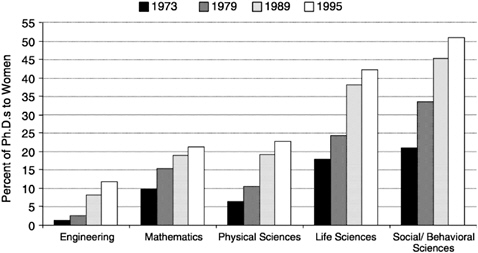
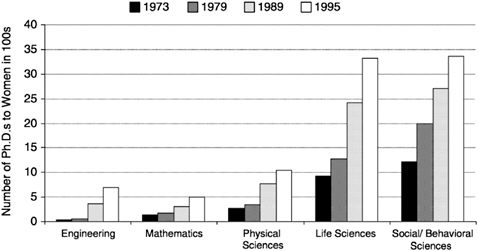
grew from a dismal 46 in 1973 to 696 in 1995. Although this represents an increase of over 1,500 percent, in 1995 women still made up less than 12 percent of the Ph.D. recipients. In terms of the percentage of women, the situation in engineering in 1995 was roughly equivalent to the situation in the social/behavioral sciences in 1963, the life sciences in 1966, mathematics in 1976, and the physical sciences in 1980. LeBold (1987) suggested that in engineering a critical mass of women might be particularly important in obtaining the social support necessary to meet the demands of a strict engineering curriculum.
Mathematical Sciences. Mathematics had the slowest growth in the participation of women. While 9 percent of the degrees were given to women in 1973, this increased to only 20 percent by 1995. Given the small total number of degrees awarded in mathematics, this translates into less than 500 degrees to women in 1995.
Physical Sciences. Since 1973, the physical sciences saw a tripling in the number of Ph.D.s given to women, with 1,048 doctoral degrees to women in 1995. However, women still make up less than 25 percent of the total degrees in this field.
Life Sciences. In 1973, 17 percent of the degrees in the life sciences were awarded to women. By 1995, this representation doubled to over 40 percent. In that year, over 3,300 degrees were awarded to women.
Social and Behavioral Sciences. The representation of women is greatest in the social/behavioral sciences. In 1973, women already represented 20 percent of the degrees, and by 1995 the proportion of women was just over 50 percent of the 6,613 degrees granted.
SUMMARY OF DEGREES IN SCIENCE AND ENGINEERING
Figure 3–7 shows the proportion of women among those with high school, baccalaureate, and doctoral degrees since 1960. While half of the high school diplomas have been awarded to women, in 1960 women were substantially less likely to extend their education with a baccalaureate or doctoral degree, especially in S&E fields. Since 1960 there have been steady gains by women in the receipt of all types of advanced degrees, with increasing improvements beginning in 1970, reflecting new civil rights legislation. By 1985, women received half of the bachelor’s degrees among all fields and by 1990 they represented 40 percent of undergraduate degrees in S&E. There was similar progress in doctoral degrees, although by 1990 women were still less than 30 percent of the Ph.D.s in science and engineering fields. Overall, even with the significant gains that have been made, women continue to lag behind men, especially in science and engineering fields where the percent of degrees awarded to women remains substantially below 50 percent.
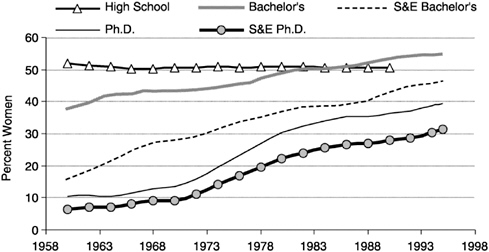
FIGURE 3–7 Percent of degree recipients who are women by year. SOURCES: High school data and years before 1966 (Barber 1995); other data (NSF 2000a).
BACKGROUND CHARACTERISTICS OF SCIENTISTS AND ENGINEERS
In this section, we compare the background characteristics of men and women who receive doctoral degrees in science and engineering. In later chapters, gender differences in background are considered as explanations for differences in career outcomes. We begin by examining the educational characteristics of the parents, as well as the baccalaureate origins of the doctorates themselves. We then consider characteristics of graduate education, including the prestige of Ph.D. department, time from the baccalaureate to the Ph.D., and types of financial support received during graduate education.8
Parents’ Education
There is both anecdotal and systematic evidence that the educational backgrounds of parents affect the educational outcomes of their children
and that these influences are greatest for young women. Malcom (1983) found that the most effective pre-college programs for increasing the participation of women in science involved parental input and that the effects of parents were strongest for young women. Solomon (1985:67) concludes that “[t]he influence of mothers extended beyond convincing obdurate fathers to relent,” noting that mothers also provide the encouragement and support for a woman to obtain higher education. Sonnert (1995:68) concludes that mothers might be important in imparting to their daughters the value of a scientific career, or at least in not dissuading their daughters from such ambitions. These conclusions are consistent with our data on the education of the mothers and fathers of Ph.D. scientists.
Figures 3–8 and 3–9 show differences between male and female doctorates in the percent of their mothers and fathers with baccalaureate degrees, along with baseline data on the percent of the civilian U.S. population with baccalaureate degrees. While the parents of both male and female Ph.D.s have much higher levels of education than the average man or woman in the United States, there are interesting gender differences. Until recent years, women who received doctorates in S&E were substantially more likely than men to have fathers with college degrees, with 47 percent of the fathers of female doctorates graduating from college compared to 29 percent of the fathers of male doctorates.9 This is seen by comparing the dashed line for women to the thick black line for men in Figure 3–8. As the percentage of fathers with degrees has steadily increased, reflecting trends for higher education in society in general (shown by the thin line with +’s), there is a convergence between male and female doctorates in the percent of fathers graduating from college. By 1994, 59 percent of the women and 57 percent of the men had fathers with baccalaureate degrees.
Figure 3–9 shows that female Ph.D.s are also more likely than men to have mothers who graduated from college, with several key differences from the results for fathers. First, a significantly smaller proportion of the mothers of S&E doctorates, whether men or women, attend college compared to their fathers attending college. This reflects the overall higher education of men than women in society as a whole, as shown by comparing the thin lines with +’s for fathers in Figure 3–8 with the line for mothers in Figure 3–9. Second, differences between women and men in the percent of mothers with college degrees were smaller in 1962 (28 percent versus 16 percent) than the difference in the percentage of fathers (47
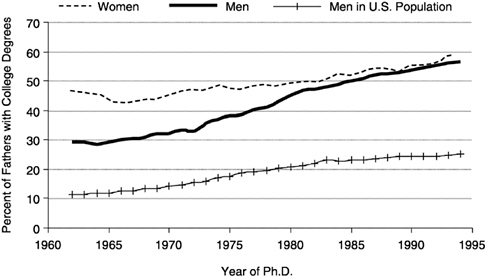
FIGURE 3–8 Percent of the fathers of Ph.D. recipients who have college degrees, by sex of Ph.D. scientist and year of survey. SOURCES: U.S. Census (1999); Doctorate Records File.
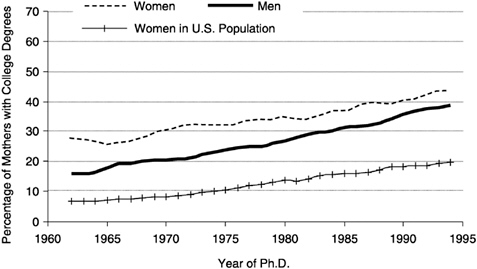
FIGURE 3–9 Percent of the mothers of Ph.D. recipients who have college degrees, by sex of Ph.D. scientist and year of survey. SOURCES: U.S. Census (1999); Doctorate Records File.
percent versus 29 percent). But there is less convergence over time for the education of mothers than for fathers. By 1995, 44 percent of the female doctorates had mothers with bachelor’s degrees compared to 39 percent of the men, leaving a difference of 5 percentage points.
There are several notable field differences in the percent of fathers and mothers who have college degrees, as shown in Figures 3–10 and 3–11. The parents of engineers are the most highly educated, followed by parents in mathematics and the physical sciences, with lower educational levels of parents for Ph.D.s in the life sciences and the social/behavioral sciences. The more rural backgrounds of those attaining degrees in the life sciences may account for the lower education levels of parents of Ph.D.s in the life sciences (Harmon 1978:41–43).
Overall, the education levels of the families of female doctorates are consistently higher than those of male doctorates. This might reflect the greater importance of parental encouragement for women during a time when female doctorates were rare and societal support for women entering science and engineering was much weaker. The continued difference between men and women in the education levels of their mothers may also reflect the importance to young women of having a same-sex role model and encouragement from another woman. This is especially true in the male dominated field of engineering, with approximately 20 percent
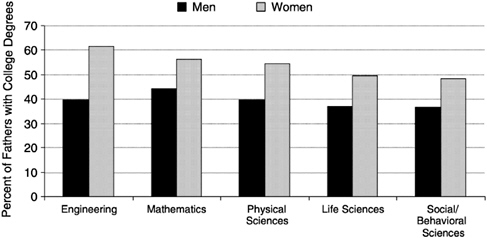
FIGURE 3–10 Percent of fathers with college degrees, by field and sex. All Ph.D.s years were combined.
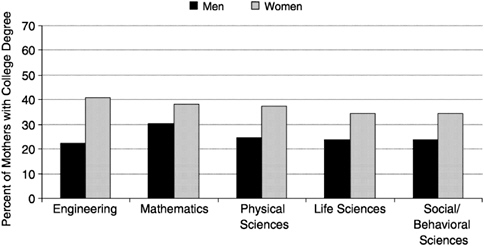
FIGURE 3–11 Percent of mothers with college degrees, by field and sex. NOTE: All Ph.D.s years were combined.
more of the parents of female engineers having college degrees. This is consistent with the results of McIlwee and Robinson (1992:29–30) who found that female engineers were more likely to come from professional families than male engineers.
Baccalaureate Origins of Scientists and Engineers
Traditionally, men and women attend different types of institutions for their undergraduate degrees. Women are more likely to attend baccalaureate-only institutions, such as liberal arts or women’s colleges, while men are more likely to attend institutions that also grant a doctoral degree. However, Figures 3–12 and 3–13 show that changes in baccalaureate origins since the 1930s have lead to a convergence in the educational backgrounds of male and female doctorates. The most notable change is the steady decline in degrees from baccalaureate-only institutions (shown by the light region at the top of each figure), especially for women. Twenty percent fewer women graduated from baccalaureate-only institutions in the 1990s compared to women in the 1930s, with the largest increases in Master’s (9 points), Doctoral (7 points), and Research II (6 points). There has been almost no change, however, in the proportion of degrees to women from Research I institutions. For men, however, the changes in baccalaureate origins have been much smaller, with decreases in degrees from baccalaureate-only institutions of about 10 points, with no other type of institution gaining more than a few points. In general, a large
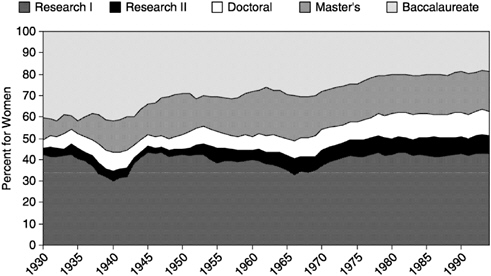
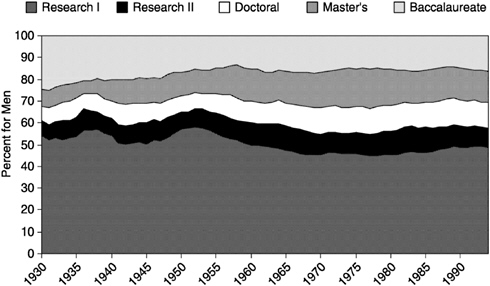
modality of those with Ph.D.s in S&E receive undergraduate degrees from Research I institutions. This is followed by the much smaller categories of Master’s, Baccalaureate, Doctoral, and Research II institutions.
The net effect of these changes has been a convergence in the undergraduate origins of men and women. With the exception of a small reversal among those with Ph.D.s from 1965 to 1970, women have become increasingly similar to men in their attendance of undergraduate institutions that also awarded doctoral degrees. By the 1990s, the difference was reduced to 8 percentage points, compared to a difference of 20 points for those with degrees in the 1950s. Still, women are more likely to attend baccalaureate-only or master’s-only institutions for their bachelor’s degree. The larger proportion of women attending baccalaureate-only colleges tends to put them at a disadvantage in preparation for S&E careers. Except for a few highly selective colleges, most liberal arts colleges lack the sophisticated facilities for modern science study, as well as faculty oriented to or actively engaged in research. Thus, gender differences in baccalaureate origins could give men an advantage by providing them with earlier exposure to graduate level research and a better understanding of what graduate school will be like.
Convergence in baccalaureate origins has occurred in each of the five broad fields. However, there are some differences. First, both male and female doctorates in engineering are far more likely to come from research universities and far less likely to come from baccalaureate-only institutions. For those with degrees in the 1990s, 74 percent of the men and 68 percent of the women had degrees from research universities, with 4 percent of the men and 7 percent of the women with degrees from baccalaureate-only institutions. This almost certainly reflects the lack of predoctoral engineering programs in non-Ph.D. granting institutions. Second, to a lesser degree, both male and female doctorates in mathematics and the life sciences are more likely to come from research universities and less likely to come from baccalaureate-only institutions. By the 1990s in mathematics, 56 percent of the men and 52 percent of the women came from research universities, with 14 percent of men and 17 percent of women coming from baccalaureate institutions. In the life sciences 59 percent of the men and 51 percent of the women came from research universities, with 16 percent of men and 17 percent of women coming from baccalaureate institutions.
Quality of the Ph.D. Department
A scientist’s experience in graduate school is essential for learning the craft of science. During graduate school a student develops her or his conception of scientific roles, establishes a style of work, and learns the
standards of performance in the field. And, significantly, it is during graduate school that a scientist finds a mentor who helps the student map out a research program, and enter the job market (Zuckerman 1970, 1977; Long and McGinnis 1985). It is not surprising that a substantial body of work (see Long and Fox 1995 for a review of this literature) has found that the quality of a scientist’s graduate program has important consequences for the later career, affecting job placement, work activity, and scientific productivity.
Figure 3–14 shows the distribution of the prestige of doctoral origins of scientists and engineers in the 1995 SDR (see Chapter 2 for details on this measure of the quality of the Ph.D. program). Results from other years of the SDR provide similar patterns. The modality of doctorates in all fields except mathematics receive their degrees from strong departments; in mathematics, distinguished programs produce the largest number of doctorates. In engineering, the physical sciences, and life sciences, where expensive laboratories are necessary, there is a smaller proportion of degrees from the least prestigious programs. In the social/behavioral sciences, and to a lesser extent in mathematics, a greater proportion of degrees are produced by lower tier programs.
While the distribution of the prestige of doctoral origins is stable over time, there are some differences between men and women by field. Table 3– 1 shows gender differences in the average prestige by field according to the decade in which the Ph.D. was received.10 The biggest differences are
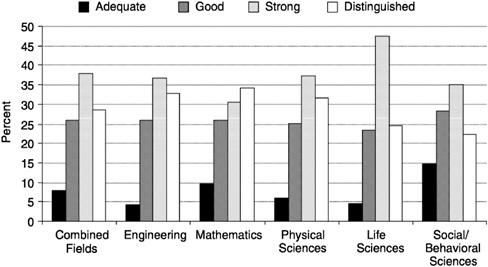
FIGURE 3–14 Distribution of Ph.D.s among programs of differing quality, by field. SOURCE: SDR 1995.
TABLE 3–1 Mean Prestige of Ph.D. Program, by Sex, Field, and Decade of Ph.D.
seen in mathematics, where there has been a steady decline in the average quality of the Ph.D. origin of more recent doctorates. This is especially true for women, resulting in an increase in gender differences in the prestige of the Ph.D. In other fields, differences are smaller with no consistent pattern of change.
Time Between the Baccalaureate and Doctorate
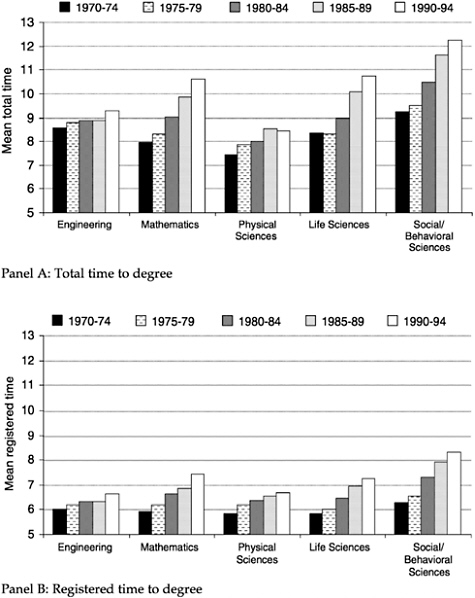
In examining the time it takes a scientist to complete the doctorate, it is important to distinguish between total time that has elapsed between the undergraduate degree and the doctorate (referred to as total time to degree) and time during which the student was registered in graduate studies (referred to as registered time to degree). Panel A of Figure 3–15 shows that from 1970 to the present there has been a steady increase in the mean time between the undergraduate degree and the receipt of the doctorate. This is consistent with the results of Tuckman et al. (1990:7) who noted that this increase reversed the trend toward shorter time to degree that occurred during the 1960s. As shown in Table 3–2, the increase in total time to degree varied across fields, with the smallest increases occurring in engineering and the physical sciences, 8 and 13 percent, respectively, and increases of around 30 percent in all other fields.
Registered time to degree excludes time between the baccalaureate and the doctorate in which the student was not registered as a student. The excluded time would include, for example, time in a job immediately after the baccalaureate and interruptions in schooling to raise a family. Panel B of Figure 3–15 shows that registered time is around 1.7 years shorter in the physical sciences, 3.4 years shorter in the social/behavioral sciences, and around 2.5 years shorter in other fields. But, as shown in Table 3–2, increases in registered time to degree were similar to those for total time to degree.
In mathematics, the life sciences, and the social/behavioral sciences women had substantially longer total times between the baccalaureate and the doctorate than men, as shown in Panel A of Figure 3–16. Until 1990 in engineering, the total time was about .5 years longer for men, with only trivial gender differences in the physical sciences. The longer total time to degree for men in engineering might reflect the greater likelihood of baccalaureate engineers beginning work immediately after the baccalaureate and then returning to graduate study after a period of employment. Gender differences in registered time are substantially smaller, as shown in Panel B. That is to say that once they are enrolled, men and women are quite similar in the amount of time taken to complete their graduate education.
With the exception of engineering, women are more likely to have interruptions of a year or more before completion of their doctorate. In engineering men were 10 points more likely to have interruptions for those with degrees from 1970 to 1974, with smaller differences since then. In other fields, women are overall more likely to have interruptions, especially in the life sciences, but there are clear trends (Table 3–3). For the latest cohort, those with degrees in the 1990s, women are about 5 points
more likely to have interruptions. These results are consistent with Sonnert (1995:80) who found that women were more likely than men to interrupt their education or to attend school part-time. Recent estimates by Henderson et al. (1996:12, 29) found that gender differences in registered time in a doctoral program were smaller than gender differences in elapsed time from the baccalaureate to Ph.D. While we do not have information to evaluate the causes of interruptions, it is possible that women postpone their education while raising a family or change institutions when follow- ing an older spouse to a job. A second possibility is that interruptions are due to gender differences in support for graduate education, as suggested by Bowen and Rudenstine (1992:12, 192) and Tuckman et al. (1990:51–54). This topic is now considered.
Financial Support during Graduate School
The type of support received in graduate school is likely to affect a student’s ability to complete the Ph.D. in a timely fashion and may affect the quality of the research that a graduate student can complete. In the sciences, research assistantships are often considered the ideal form of support, since they allow a student to work with his or her mentor. In the process, the student receives additional training and often is able to pursue research that contributes to the completion of the dissertation (Chamber- lain 1988:212). Consistent with this suggestion, Bowen and Rudenstine (1992:179–182, 189) found that students supported with research assis- tantships were most likely to complete their dissertation. Teaching assis- tantships, while perhaps superior to student loans, take time away from research and limit contact with the mentor. Since the late 1960s, the SED asked new Ph.D.s to list all sources of funding that were used during graduate education. Their answers reflect the massive change in the fund- ing of graduate education that has occurred since the 1960s and show important gender and field differences. When interpreting these results, keep in mind that a respondent can list multiple sources of support.
TABLE 3–2 Percent Increase in Total Time Between Baccalaureate and Doctorate and Registered Time to Degree Between 1970 and 1994, by Field
|
|
Engineering |
Mathematics |
Physical |
Life Sciences |
Social/ Behavioral Sciences |
|
Total Time |
10.5 |
25.1 |
14.0 |
24.0 |
32.6 |
|
Registered Time |
8.1 |
33.2 |
13.7 |
28.6 |
32.3 |
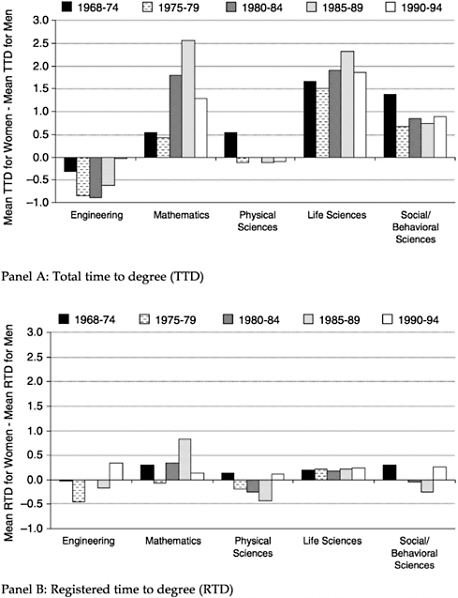
TABLE 3–3 Difference in the Percent of Women and Percent of Men with Interruptions of More Than One Year Between the Baccalaureate and the Doctorate
Figure 3–17 shows the steady increases in the percent of Ph.D.s who use loans to fund their graduate education and the substantial field differences in both the relative frequency and rate of increase in the use of loans. Loans are least likely in mathematics and engineering, and substantially more likely in the social and behavioral sciences, where in the 1990s over 40 percent relied at least partially on loans to support their graduate education. Figure 3–18 shows that in engineering women have been increasingly more likely to use loans, while in other fields men are more likely to report using loans, with decreasing gender differences over time. By the 1990s all gender differences were less than 2 percentage points except in engineering.
During the 1980s, research assistantships (RAs) financed by grants and contracts were the most rapidly growing form of graduate student support (NSB 1993, 1996). This is reflected in Figure 3–19, which shows the increase in funding through research assistantships in all fields. The largest proportions of students with RAs are in the physical sciences and engineering, followed by the life sciences, mathematics, and finally the social/behavioral sciences. Among all sources of funding, the largest gender differences are in the receipt of research positions, as shown in Figure 3–20. In mathematics, men are 4 points more likely to be supported as RAs from 1968–1974, a difference that increased to 10 points for 1990–1994. In the life sciences, the differences are also large, decreasing slightly from 9 points in 1968–1974 to 7 points in 1990–1994. Men are slightly more likely to have research funding in the physical sciences and the social/behavioral sciences, although this advantage for men has nearly disappeared by 1994. Even though the activities of RAs are limited by the research agenda
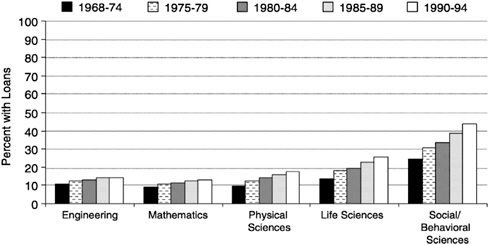
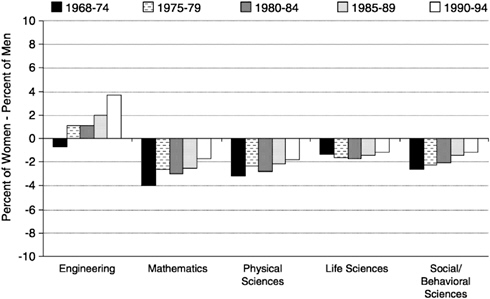
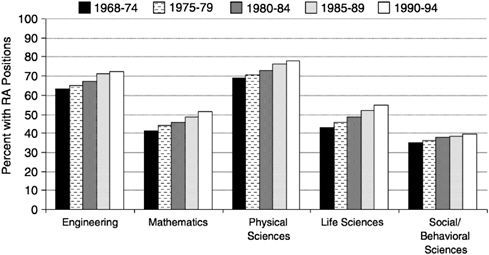
FIGURE 3–19 Percent of doctorates who received funding through research positions, by field and year of Ph.D.
of the principal investigator, research positions are likely to provide holders with opportunities to develop their own research programs. Accordingly, the disproportionate number of men with RA positions may represent a significant disadvantage to women. Finally, it is interesting to note that the physical sciences, with very small gender differences, is the broad field with the most support from the federal government.
Figure 3–21 shows that while there has been relatively little change over time in the percent of students supported by teaching assistantships (TAs), there are large differences across fields. TAs are most common in mathematics, likely resulting from institutional needs to staff a large number of required courses in undergraduate mathematics, followed closely by the physical sciences. They are somewhat less frequent in the social and behavioral sciences, although there has been a steady increase from 1968 to 1994. Women are between 6 and 8 points more likely than men to have teaching positions in engineering. They are also more likely to have TAs in mathematics and the physical sciences. Women are less likely to have teaching positions in the life and social/behavioral sciences, the two fields where research assistantships are least likely. This suggests that women may be given a lower priority for departmental support through teaching assistantships.
There are noticeable differences in sources of funding with clear signs that these differences are decreasing. Except for engineering, women are
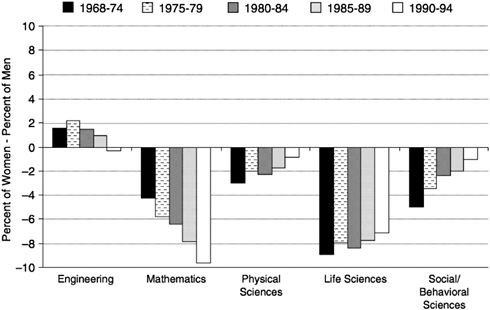
FIGURE 3–20 Differences between percent of women and percent of men who received funding through research positions, by field and year of Ph.D. NOTE: Positive values indicate more women use this type of funding.
more likely to use loans and are less likely to be funded with an RA position. Indeed, gender differences in obtaining RA positions are increasing in the mathematical sciences. Women are more likely to have TA positions in engineering, mathematics, and the physical sciences, with increasing differences in engineering but convergence in the other fields (Figure 3–22). In the life sciences and social/behavioral sciences men are more likely to have teaching positions. While our analyses are too limited to clearly determine the degree to which differences in sources of graduate support either favor or disadvantage women, this is clearly a topic that merits further study.
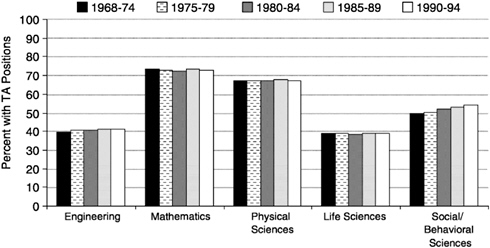
FIGURE 3–21 Percent of doctorates who received funding through teaching assistantship, by field and year of Ph.D.
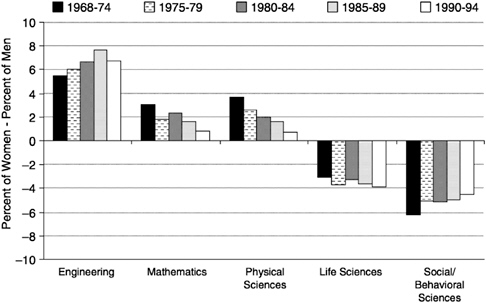
FIGURE 3–22 Differences between percent of women and percent of men who received funding through teaching assistantships, by field and year of Ph.D. NOTE: Positive values indicate more women are supported by this type of funding.
MARRIAGE AND FAMILY
“…as much as women may want to be good scientists or engineers, we must remember that they want first and foremost to be womanly companions of men and to be mothers.”
—Bruno Bettelheim, Women and the Scientific Professions, 1965.11
Male scientists and engineers are more likely to be married than female scientists and engineers, but this difference has declined significantly in the last 60 years. Figure 3–23 plots the percent of male and female Ph.D.s who are married against the years in which a scientist received his or her Ph.D.12 Prior to WWII, nearly 95 percent of the men were married, compared to figures increasing from 30 percent to 45 percent for women. After WWII, marriage rates dropped to 90 percent for men, with continuing decreases until 1994. For women, there were steady increases in the percent married until around 1984, when rates began to mirror the gradual decline shown for men. By 1994, the difference between men and women was reduced to 7 percentage points. To understand the declines in the percent married for the most recent Ph.D.s, it is important to keep in mind
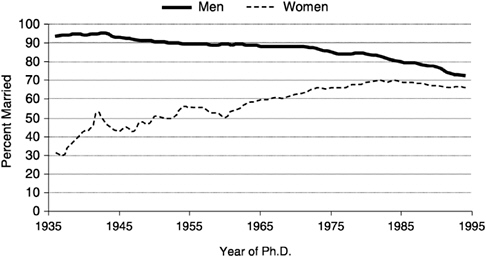
FIGURE 3–23 Percent of men and women who are married, by year of Ph.D.
that Figure 3–23 reflects both general trends for more female and fewer male scientists to marry and also the timing of marriage. For example, marital status for individuals with recent Ph.D.s was obtained from the 1995 SDR and accordingly these scientists were younger; for the 1955 cohort, for example, data were collected in 1973, 1979, 1989, and 1995 when these scientists would have been older. Accordingly, the decline in the percent married since 1985 almost certainly reflects the younger biological age of these individuals at the time of the survey.
Given the demands of a scientific career, and the likelihood that women will undertake more of the responsibilities of raising children, it is not surprising that male scientists are more likely to have children. Figure 3–24 shows the percent of married scientists with children age six or younger living at home in 1995, by gender and years since the Ph.D. Immediately after the doctorate, 15 percent more of the married men have young children than married women. With time, gender differences narrow as fewer individuals have young children. Figure 3–25 shows that between 1979 and 1995 married women have become more likely to have children. The largest changes occurred between career years 5 and 17, which could reflect societal trends for having children later in life. As a result of these changes, differences in the percentage of men and the
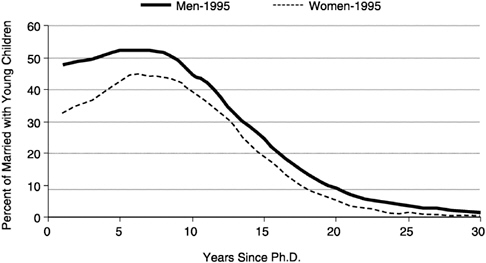
FIGURE 3–24 Percent of married scientists, both men and women, with children six or younger living at home in 1995, by sex and years since the Ph.D.
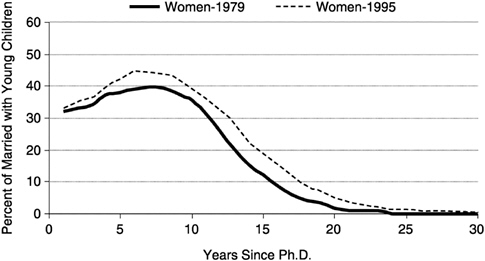
FIGURE 3–25 Percent of married women with young children at home, by years since the Ph.D. and year of survey.
percentage of women with young children have decreased substantially since 1979.
Overall, women and men have become increasingly similar in their patterns of marriage and having children. These changes are likely to reflect improvements in child care that help women balance the demands of a demanding career with raising a family. They may also indicate an increasing willingness by men to share the responsibilities of raising children and greater flexibility by employers in accommodating the demands of parenting. Still, the next chapter shows that marriage and family have quite different effects on the careers of men and women in science and engineering.
CONCLUSIONS
From 1970 to 1995, there were significant advances in the entry of women into science and engineering. Combining our five fields, there were 350 percent more women among new Ph.D.s in 1995 than in 1973. In the social and behavioral sciences, women were just over half of the Ph.D.s in 1995 and in the life sciences they reached over 40 percent. The concentration of women’s doctoral degrees in psychology and in some of the social and biological sciences suggests that these fields could become female dominated in the future (NSB 1993). The progress toward gender
equity in the receipt of science and engineering doctorates seems to have resulted from general social trends in women’s advancement in higher education, the enforcement of anti-discrimination laws, falling interest in science and engineering among men, and a more rapid increase for women in degrees in scientific compared to non-scientific fields. Still, as the proportion of doctoral degrees to women in the social/behavioral and life sciences approaches parity, women remain but a small fraction of doctorates in engineering and mathematics.
While the increases are encouraging for attaining the equal representation of women and men in science and engineering, the advances represent neither unconditional success in overcoming gender inequalities nor provide assurance of continuing progress. The trend of greater participation of women in science and engineering may have peaked and the possibility remains of more restricted opportunities for women in years to come. For instance, new data from the American Association of University Women Education Foundation (1992:52) indicate that “the numbers and percents of girls interested in careers in math and science [are] increasing minimally, if at all.” Although girls and boys are increasingly taking the same number of science and math credits in high school, many more girls drop out of the pipeline for scientific careers because of a lack of interest and encouragement in scientific fields that are heavily dominated by males.
The greater number of women lost through attrition on the way to the Ph.D. does not reflect a lack of academic ability or potential. For example, a study by Adelman (1991) found that women out-performed men on many dimensions that should positively affect success in science and engineering: high school performance, receipt of awards, rate of completing college, academic performance in college, and positive attitudes toward education. A report of the American Association of University Women Educational Foundation assessed more than 1,300 studies and concluded that (1992): “…girls are not receiving the same quality, or even quantity, of education as their brothers. By stereotyping women’s roles, popular culture plays a role in short-changing girls by limiting their horizons and expectations. Unintentionally, schools sometimes follow suit, depriving girls of classroom attention, ignoring the value of cooperative learning, and presenting texts and lessons in which female role models are conspicuously absent.”
A great deal of work has been done to understand the different experiences of men and women on the way to the Ph.D. (see Rayman and Brett 1993 for a review of this literature) and to develop initiatives to increase the participation of women (Matyas and Dix 1992). In 1980, Congress passed a law authorizing $30 million to the National Science Foundation (NSF) to be used to increase women’s involvement in science at all educa-
tional levels and in the workforce. As a result, NSF instituted a number of initiatives, many of which continue to be administered through its Programs for Women and Girls within NSF’s Directorate for Human Resources. The lack of funding stability, however, has hampered these programs and some grants have been eliminated. Fox (1998) reviews recent initiatives to support the participation and performance of women in graduate education.
When we examine background characteristics of men and women, we find that while differences persist, they have shrunk considerably. Still, women are less likely to obtain undergraduate degrees from Ph.D. granting institutions, take longer from the time of the baccalaureate to complete the degree, and are less likely to be supported by research positions during graduate education. While these differences are declining, each is likely to have negative effects on career outcomes for women. Finally, men are more likely to be married and to have children. While these differences are much smaller in 1995 than they were in 1973, later chapters will show that women who are married and have small children are less likely to have a full-time career in science and engineering.


