
HENRY EYRING
February 20, 1901-December 26, 1981
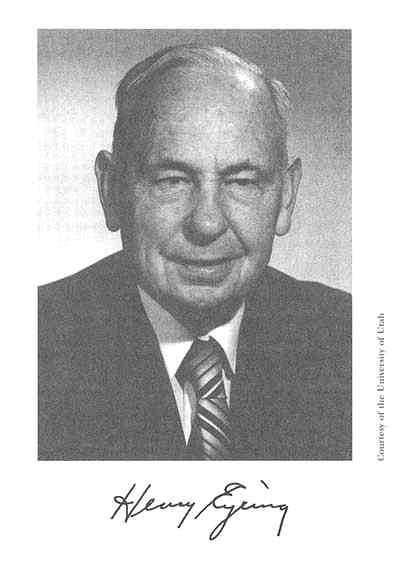
BY WALTER KAUZMANN
HENRY EYRING WAS FORTUNATE in entering the arena of chemical physics at the time that quantum mechanics began impinging on the fundamental problems of chemistry. He was also fortunate in possessing to an unusual degree a fertile imagination, unbounded curiosity, a warm and outgoing personality, a high degree of intellectual talent, the ability to work hard, and a determination to succeed. The result was that, beginning in the early years of the 1930s, he exerted an important influence on the large numbers of students and colleagues lucky enough to come into contact with him. This influence continued to spread throughout the chemical community for the rest of his life.
He broke new ground in a wide sweep of scientific activities, involving matters that ranged from fundamental principles of chemistry to problems of a highly practical and applied nature. Some of his ideas contain elements that remain controversial and a considerable number of contemporary scientists continue to work on them.
Eyring was born in 1901 in the prosperous Mormon community of Colonia Juarez, Mexico (about 100 miles south of Columbus, New Mexico). He was a third generation Mormon, his grandparents on both sides having participated in
the early migration (1850-60), first to Salt Lake City and then to outlying communities. The move to Mexico by his grandparents took place in the late 1880s following the admission of Utah to the United States and the consequent persecution of those Mormons who refused to accommodate to the new state of affairs. Henry was born and raised as a Mormon and he remained a devoted follower of that faith throughout his life.
Henry's father was a successful cattle rancher and Henry was riding ''as soon as my legs were long enough to straddle a horse." But the beginning of the Mexican revolution in 1910 destabilized the political situation to such an extent that 4,800 of the colonists migrated to El Paso, Texas, in mid-July 1912. They left behind them essentially all that they owned, expecting that conditions would return to normal. This did not happen; they spent a year of penury in El Paso. After another year struggling to make ends meet in small towns in Arizona Henry's father purchased a small farm near Pima. Hard work by all members of the family was required to clear the land, but in a few years they began to get back on their feet again.
Henry had finished the fifth grade by the time he left Mexico. A year of schooling was missed in El Paso, but he was able to skip several grades and graduate from eighth grade at Pima in 1914. He then attended Gila Academy, a church school near Pima, graduating in 1919. He did especially well in mathematics and science and was encouraged by one of his teachers to go into engineering at the University of Arizona. Winning a state fellowship there, he decided to study mining engineering. By assisting in classes and waiting on tables he was able to earn enough, not only to support himself, but also to send some money home "to help with payments on the farm."
During the summer after his junior year he gained expe-
rience in the mining profession working underground in a mine. Repeated exposure to danger, observation of a number of bad accidents, some of them fatal, and the realization that as a supervisor in a mine he would be sending others into dangerous situations (quite aside from the dangers to himself) caused Henry to change his field of specialization from mining to metallurgy. So, after graduating in 1923 with a B.S. in mining engineering he continued his studies at the University of Arizona and obtained a master's degree in metallurgy in the spring of 1924. A summer's exposure to the sulfurous fumes of a smelter, however, caused another decision to change careers; Henry returned to the University of Arizona as a chemistry instructor for the academic year 1924-25. Here his promise as a chemist was recognized by several faculty members and he was encouraged to go on for a Ph.D. He was accepted as a graduate student at Berkeley, where he received his Ph.D. in 1927. His thesis work was under the direction of Professor George F. Gibson and involved a study of the ionization of various gases by alpha particles from polonium, as well as the stopping powers of these gases.
He continued this work on the interaction of gases with alpha particles during the 1927-28 academic year as an instructor in the chemistry department at the University of Wisconsin. In his second year at Wisconsin he received a postdoctoral appointment in the laboratory of Farrington Daniels, where he studied the decomposition of N2O5 in various solvents. It was here that he began working in chemical kinetics, a field that was to remain so central to his interests and reputation for the rest of his life.
His work with Daniels resulted in the award of a National Research Council fellowship at the Kaiser Wilhelm Institute in Berlin from the summer of 1929 until the summer of 1930. His chief collaboration there was with Michael Polanyi.
This was shortly after Heitler and London had explained the covalent bond by writing a reasonably successful wave equation for the hydrogen molecule and Fritz London was close at hand, not to mention Eugene Wigner and others who were fully aware of the possibilities lying in wait for the quantum mechanical attack on basic chemical problems. The notion of describing a chemical reaction in terms of a potential energy surface had been formulated and Eyring and Polanyi decided to try to perform a quantum mechanical calculation of the surface for the reaction H + H2 → H2 + H. This turned out to be a formidable problem, but by introducing clever and intuitive approximations a surface was produced. The following is excerpted from Annual Review of Physical Chemistry 28 (1977):1-13:
This way we got an exciting, if only approximate, potential surface and with it gained entrance into a whole new world of chemistry, experiencing all of the enthusiasm such a vista inspired. We perceived immediately the role of zero point energy in reaction kinetics and our method . . . made it possible to extend our calculations to all kinds of reactions.
In the fall of 1930 Eyring returned to Berkeley on a one-year appointment as instructor in the chemistry department. He applied his method of calculating potential energy surfaces to the reactions of hydrogen with the halogens and was able to explain why hydrogen and iodine reacted by a bimolecular collision of H2 molecules with I2 molecules, whereas the reaction of hydrogen with bromine and chlorine involved an atomic mechanism. He also made the remarkable prediction that hydrogen and fluorine would be unreactive at room temperature, which was in conflict with the currently accepted observations. This work was reported at the Indianapolis meeting of the American Chemical Society. In the audience was Professor Hugh Taylor of the Princeton University chemistry department. Taylor was im-
mediately impressed by the enormous potential of Eyring's efforts. He was also aware of recent work that showed that the observed explosive reaction of hydrogen and fluorine with hydrogen was caused by surface catalysis, and that if the mixture was prepared in the absence of surfaces no reaction occurred at room temperature, just as Eyring had expected. Taylor invited Eyring to come to Princeton to give some lectures, and thus began his fifteen-year connection with Princeton University.
During the academic year 1931-32 Eyring held an appointment in the Princeton chemistry department with the title of research associate with rank of instructor, and from 1932 to 1936 his title was research associate with the rank of assistant professor. It was only in October 1936 that he was given a regular faculty appointment, but as associate professor with promotion to full professor following in April 1938. His research activities during this period were intense and it was at this time that his reputation became established.
Calculation of the potential energy surfaces was continued. The concept was applied, for instance, to problems in surface catalysis. The constant thinking in terms of these surfaces led in due course to what is probably Eyring's most important scientific contribution: the development of the notion of the activated complex as an entity controlling the rates of chemical reactions with a definite mean lifetime and capable of treatment in rigorous thermodynamic and statistical mechanical terms. As is well known the paper presenting this idea was first rejected when submitted to the Journal of Chemical Physics, but the editor was persuaded to change his mind and the paper appeared in 1935. It should be mentioned, however, that the validity of the basic assumptions of this theory frequently have been questioned and discussion on this continues to this day. Nevertheless,
it is generally conceded that the theory provides a highly useful framework for the interpretation of chemical reaction rates.
Eyring became involved in a great many other activities that were taking place in the Frick Laboratory at the time. Hugh Taylor was engaged in the successful effort of preparing pure heavy water, and many papers appeared on its properties, many with Eyring as a co-author. He also became very actively interested in constructing models that would explain the existence and properties of the liquid state. The activated complex was applied to dynamic properties such as viscosity and diffusion. The preparation of heavy water in Frick was accomplished through electrolysis, and the concept of the activated complex was applied to electrolytic processes and to the phenomenon of overvoltage. The role of the zero point energy in the separation of isotopes was recognized. With Professor E. U. Condon of the physics department a new theory of the origin of optical rotatory power was developed. Seventy-five papers bearing Eyring's name and based on his work at Princeton appeared between 1932 and 1940.
Eyring's active mind was constantly coming up with interesting ideas, some of which did not work out. One of these is sufficiently amusing to deserve mention. Eyring came upon the fact that the onset of turbulence in laminar flow occurs when the Reynolds number reaches a value of 2000. It occurred to him that turbulence might be somehow a consequence of the uncertainty principle. He pointed out that in only one substance (hydrogen gas) is the ratio of the total mass of the electrons to that of the nuclei different from that in matter in general (nuclei other than hydrogen have roughly equal numbers of protons and neutrons, so that the ratio of the total mass of the electrons to that of the nuclei is half that in hydrogen, and this differ-
ence holds for deuterium as well as for hydrogen). Might it not be possible that turbulence in hydrogen sets in at half the normal Reynolds number for the onset of turbulence in deuterium? An appropriate apparatus was set up and measurements were made. Unfortunately no difference was observed. (These measurements were performed by Professor William Roseveare.) In my opinion shots in the dark such as this are the mark of a certain kind of genius that sometimes lead to very important scientific advances.
The war years brought Eyring into contact with still other areas of research. A major classified project dealt with the theory of detonation. The work of Professor Frank Johnson in the Princeton biology department on the effects of temperature, pressure, and narcosis on luminescent bacteria led to an extensive collaboration. In 1944 the Textile Research Institute was relocated in Princeton, and Eyring became heavily involved in its research program. A large number of papers on the mechanical properties of textiles came from this. Eyring was also involved in a heavy schedule of extracurricular teaching in several of the defense-related industries of North Jersey. The Princeton years from 1941 to 1947 resulted in fifty more papers bearing Eyring's name. Eyring was elected to the National Academy of Sciences in 1945.
In 1946 Eyring was approached by the University of Utah to explore his interest in becoming the dean of its graduate school, with the aim of building a major research activity at the university. The attraction of Salt Lake City was strong. While at Wisconsin Eyring had married Mildred Bennion, also a devout Mormon. The marriage had produced three sons, Edward Marcus, born in Oakland in 1931, Henry Bennion born in Princeton in 1933, and Harden Romney born in Princeton in 1936. Mildred especially was concerned about the problems of raising her sons in New Jersey, so far
from the center of the Mormon faith. Professor Taylor was unable to convince either Eyring or his wife that it was in Eyring's best interests to remain in Princeton. And so began the final thirty-five years of Eyring's career, in which highly successful activities as an administrator were added to a continuing productive scientific output.
In Eyring's Utah years approximately 485 papers appeared bearing his name. The range of topics covered is astonishing. Areas that concerned him at Princeton continued to maintain his interest, but many other areas attracted his attention, involving pure, basic science, and highly applied matters. Eyring also did a great deal of consulting and traveled widely, giving many talks. He was a master at communicating his ideas, and a great many honors came to him.
In view of current controversies over the teaching of creationism and Darwinism, Eyring's intellectual interactions with the Mormon church, and particularly his opinions on the relationship of science to the scriptures, deserve special mention. It was his position that the interpretation of the scriptures was up to the individual members of the church, and it was not appropriate for the leadership to declare what positions on scientific matters were "correct" or "incorrect." The Mormon church had assumed a relatively liberal view of the relationship of science to the church, but in 1953 Joseph Fielding Smith, president of the Council of Twelve Apostles, began to express his opinion that the scriptures must be interpreted as literally true on scientific matters. In a number of meetings and writings Eyring tactfully yet forcefully engaged President Smith in the matter. His point is summarized in the following:
The church is committed to the truth whatever its source and each man is asked to seek it out honestly and prayerfully. It is, of course, another matter to teach as a doctrine of the church something which is manifestly
contradictory and to urge it in and out of season. The author has never felt the least constraints in investigating any matter strictly on its merits.
The consequence of this interchange seems to have been that Eyring's position received official support. (The fascinating story of this incident is told in some detail in the thesis of Steven H. Heath, which is referred to in the references section of this memoir).
One aspect of Eyring's personality that was particularly appealing was his thoughtfulness toward all who came in contact with him, regardless of their station in life. He has written of "how important it is to care about people even when they are small and may not seem very important." I myself observed numerous occasions in which he practiced this principle. He once remarked on the importance of being good to people whom you pass "on the way up," because you will want them to be good to you when they pass you on their way up and you are on the way down.
Eyring had a serious encounter with cancer in 1969, which was thought to have been successfully treated. Unfortunately the cancer returned and in his last years his health declined, though he continued to work hard and productively and maintained a cheerful outlook, undoubtedly strengthened by the faith that had sustained him throughout his life. He died in Salt Lake City two months after a large meeting was held in Berlin to celebrate the fiftieth anniversary of his famous paper with Polanyi, "Über einfache Gasreaktionen."
REFERENCES
Many of Eyring's students, friends, and collaborators have written about him. He had a colorful personality and some delightful stories will be found among the following references.
The most complete account of Eyring's career, family history, and religious views will be found in Henry Eyring Mormon Scientist by S. H. Heath (masters thesis, Department of History, University of Utah, June 1980). See also S. H. Heath, "The making of a physical chemist: the education and early researches of Henry Eyring," J. Chem. Educ. 62(1985):93-98.
Reminiscences written by Eyring: "Men, mines and molecules," Annu. Rev. Phys. Chem. 28(1977):1-13. "Reminiscences on my stay in Berlin (1929-1930) and on the events leading to the paper, Über einfache Gasreaktionen'," Ber. Bunsenges. Phys. Chem. 86(1982):348-49.
D. Henderson, "My friend, Henry Eyring," J. Phys. Chem. 87(1983) :2638-40.
K. J. Laidler, "Henry Eyring," Dictionary of Scientific Biography, ed. C. C. Gillispie, vol. 17, suppl. 2, pp. 279-84. New York: Charles Scribner (1990).
J. O. Hirschfelder, "A forecast for theoretical chemistry, "J. Chem. Educ. 43(1985):93-98; "My fifty years of theoretical chemistry: I. Chemical kinetics," Ber. Bunsenges. Phys. Chem. 86(1982):349-52.
D. W. Urry, "Henry Eyring (1901-1981): a 20th century physical chemist and his models," Math. Model. 3(1982):503-22; "Henry Eyring (1901-1981): a 20th century architect of cathedrals of science," Intl. J. Quantum Chem., Quantum Biol. Symp. 9(1982):1-3.
W. Kauzmann, "Reminiscences from a life in protein physical chemistry," Protein Science 2(1993):671-91.
A detailed history of the ideas behind Eyring's theories of kinetics is given by K. J. Laidler and M. C. King, "The development of transition-state theory, "J. Phys. Chem. 87(1983):2657-64. The status of the theory as of 1983 is discussed by D. G. Truhlar, W. L. Hase, and J. T. Hynes, "Current status of transition state theory," J. Phys. Chem. 87(1983):2664-82. For a more recent discussion see D. Chandler, Faraday Discuss. Chem. Soc. 85(1988):341-64.


