
Environmental Goals and Science Policy: A Review of Selected Countries
KONRAD von MOLTKE
Institute on International Environmental Governance, Dartmouth College, and World Wildlife Fund
Contents
Science and technology play an unusual role in environmental policy. Science makes the environment speak. Many environmental threats would be unknown without scientific research, or known too late to permit appropriate policy action. In other words, environmental policy rests on a foundation of scientific research without which it would not even exist.
This creates a unique and uneasy relationship between scientists and policy-makers. The ethics and process of scientific research are not geared to the needs of policy-making. Science seeks to prove or disprove hypotheses as a strategy for reaching enduring answers. Policy is limited in time and location: decisions must be made at a given time for a specific jurisdiction, so policy-makers are seeking the best possible answers to issues they have chosen not because they may be susceptible to being answered but because there is a constituency that requires an answer. Thus for policy-makers any answer is better than no answer.
Because environmental policy needs science to identify its objects but science is not normally organized to provide information that can be used in policy-making, most countries have developed specialized procedures for science assessment. This generally involves a process rooted in science and the values of scientific investigation but is not itself a scientific undertaking. It involves a review of available evidence and provides an assessment of what is known about a specific issue at a given point in time. Scientific assessments are not readily transferable from one jurisdiction to another because they already incorporate certain aspects of the policy environment for which the assessment is being undertaken.
Even while science and technology are at the heart of environmental policy, they are also widely perceived as being at the origin of the environmental crisis. Without many scientific developments of the past century, and their adaptation by technology to practical uses, even 10 billion humans would be incapable of threatening the natural fabric of the planet. The extraordinary magnification of the human presence through technologies, ranging from fossil fuel combustion to organic chemistry, from medical and biological interventions to electronics, is a precondition of threats to the environment that are qualitatively different from the historical impact of humans on the planet. The population explosion itself is fundamentally a product of simple technologies relating to sanitation and nutrition, which have expanded average human life expectancy beyond anything dreamed of but a century ago.
Finally, no solutions short of human catastrophe are conceivable without further resort to science and technology. The modern human condition has created a dependence on technology which implies that only technology holds the prospect of saving us from technology, a paradox often barely perceived and never resolved.
Each of these reasons would link science and technology closely with environmental policy. All three taken together cause them to be in an almost ''symbiotic" relationship. The stakes are extraordinary high, ranging from the universal to the prospects of individual material benefit:
-
Science policy must ensure research is undertaken that is essential to identify environmental threats in a timely fashion so as to avoid the kind of crisis caused by "unknown" natural events.
-
Science policy must ensure that science itself respects limits that are defined by the environmental impacts of unknown applications of scientific discoveries.
-
Science policy must contribute to developing technologies that redirect human efforts from environmentally damaging to environmentally benign activities.
-
Science policy can give direction to future social and economic development, providing extraordinary comparative advantages to the individuals, corporations, and societies that take the "right" decisions earlier than others and thereby define the parameters of future development and reap the social and economic benefits associated with this paradigm shift that may follow.
While all countries face the need to articulate science and technology goals for environmental research and policy, each will tend to go about this process in characteristic ways.
Environmental policy is confronted by essentially the same agenda in all countries. In the temperate zone, the environment will be more forgiving than in extreme climates, but everywhere the basic need is to protect air, water, soil, fauna, and flora from the impacts of human interventions. Everywhere the extraction of natural resources, their transport and transformation, their use, and the wastes attendant upon these processes are the stuff of environmental policy. Despite these basic similarities, due to the universality of nature, environmental policies differ widely from one country to the next because they reflect specific environmental conditions, because differing social and economic priorities exist, and because they can only be expressed through the existing political and administrative culture of each country.
COMPARING ENVIRONMENTAL POLICY1
The Framework for Environmental Policy
Environmental policy represents a relatively recent development. In most Western industrialized countries, systematic attention was first given environmental management in the late sixties and early seventies. The problems were everywhere the same: economic growth had reached a stage where the consequences of emissions could be felt over large areas, affecting significant segments of the population. Public pressure increased to limit the risks associated with the practice of using the ambient environment for waste disposal. The responses were also everywhere quite similar: the adoption of laws regulating emissions to air and water, the establishment of procedures for environmental management, and legislation concerning the control of hazardous wastes and toxic substances. Table 1 shows the early pattern of regulation in selected countries. It is most remarkable for the overall symmetry of responses.
Table 1 Major National Environmental Laws in Some OECD Countries
|
|
Type of Law |
|||||
|
|
General |
Water |
Wastes |
Air |
Impact Statement |
Other |
|
Canada |
|
1970 |
|
|
1973 |
1975a |
|
United States |
1970 |
1972 |
1965 |
1963 |
1969 |
1976b |
|
|
|
1977 |
1970 |
1970 |
|
|
|
|
|
|
1976 |
1977 |
|
|
|
|
|
|
1984 |
|
|
|
|
Japan |
1967 |
1958 |
1970 |
1962 |
|
1973c |
|
|
1970 |
1970 |
|
1968 |
|
1973c |
|
Australia |
1974 |
|
|
|
1974 |
|
|
New Zealand |
|
1967 |
|
1972 |
1972 |
|
|
|
|
1974 |
|
|
1977 |
|
|
Austria |
|
1959 |
|
|
|
1973 |
|
Belgium |
|
1971 |
1974 |
1964 |
|
|
|
Denmark |
1973 |
1978 |
1978 |
|
|
1978d |
|
|
|
1980 |
|
|
|
1979b |
|
|
|
1982 |
|
|
|
|
|
Finland |
|
1961 |
1978 |
1982 |
|
1923d |
|
|
|
1979 |
|
|
|
1965e |
|
France |
1976 |
1964 |
1975 |
1974 |
1976 |
1977b |
|
Germany |
|
1957 |
1972 |
1974 |
1975 |
1976d |
|
|
|
1976 |
|
|
|
|
|
Greece |
1976 |
1977 |
|
1983 |
|
1977l |
|
|
1980 |
1978 |
|
|
|
1985g |
|
Iceland |
|
|
|
|
|
|
|
Ireland |
1976 |
1977 |
|
1977 |
1976 |
|
|
Italy |
|
1976 |
|
1966 |
|
|
|
Luxembourg |
1982 |
1961 |
1980 |
1976 |
|
1976j |
|
Netherlands |
1952 |
1969 |
1976 |
1970 |
|
1963h |
|
|
1979 |
1975 |
1977 |
|
|
1979 |
|
|
|
|
|
|
|
1983i |
|
Norway |
1981 |
|
|
|
|
1977b |
|
Portugal |
1976 |
1977 |
|
1980 |
|
1976d |
|
|
|
|
|
|
|
1983b |
|
|
1983 |
|
|
|
|
1983k |
|
Spain |
|
|
1975 |
1972 |
|
|
|
Sweden |
1969 |
1969 |
1975 |
1969 |
1969l |
1964d |
|
|
1981 |
1981 |
|
1981 |
1981 |
1973b |
|
|
|
1983 |
|
|
|
|
|
Switzerland |
1983 |
1971 |
|
|
|
1966d |
|
|
|
|
|
|
|
1969b |
|
|
|
|
|
|
|
1979k |
|
Turkey |
1983 |
1960 |
|
|
|
1983d |
|
|
|
1971 |
|
|
|
|
|
United Kingdom |
1974 |
1961 |
1974 |
1956 |
|
1974j |
|
|
|
1974 |
|
1968 |
|
1975c |
|
|
|
|
|
1974 |
|
1981d |
Given the similarity of the problems and the symmetry of responses, it might be expected that environmental management is essentially the same in industrialized countries. In fact, it is difficult to compare environmental policies between countries because newly emerging environmental policies did not develop in a void. A number of important factors have created a framework that contributes to the specificity of responses.
Existing Related Legislation
In most countries, legislation concerning water supply and quality dates to the 19th century.2 Initiated at widely differing times, ranging from the earliest such legislation in the Netherlands where water management represents an existential need, to the United Kingdom in the 19th century, to the United States, which—blessed with abundant resources—felt compelled to address this issue at a relatively late date. Similarly the regulation of industrial nuisances, essentially the impact of industries on their neighborhoods, follows the pattern of industrialization itself. The United Kingdom, having been the first to industrialize, first confronted industrial pollution. Germany followed at some distance, and many countries did not address this issue until the early 20th century. Countries also began to address issues of workplace safety and health. In the United States these issues were not tackled until a relatively late date.
Despite these differences, early linkages already existed between countries regarding these newly emerging policy areas, particularly through trade. Indeed, the United States first moved on pesticide safety in response to a trade ban for reasons of environment and public health: a British embargo imposed in 1925 on apples from the United States. Forced to comply with British requirements concerning arsenical residues on apples or lose an important export market, the United
States adopted the British standard for exported apples. It could hardly provide its own citizens with less protection than it afforded British consumers and proceeded to impose the standards on its own production, despite vigorous opposition from apple growers.3
Land use planning represents an important forerunner of environmental policy. Most European countries have known land use controls for decades, growing out of a limited concept of property in societies subject to monarchical rule. In the United States, federal land use planning does not exist and state programs are restricted by traditional reluctance to limit individual property rights and the Constitutional doctrine of "taking," which requires compensation for the diminution of rights through certain public actions.
The great surge of environmental legislation in the United States in the late sixties and early seventies is often seen as the beginning of modern environmental policy and is usually interpreted as a signal act of US leadership. Seen in a comparative perspective, the major acts—the Clean Water Act, the National Environmental Policy Act, the Toxic Substances Control Act, the Resource Conservation and Recovery Act, and the Clean Air Act Amendments of 1977—contain important legislative innovations. They have been used as benchmarks worldwide. At the same time, these acts filled a legislative void which had been allowed to continue longer than in most other developed countries and represent belated recognition of necessities that had been addressed elsewhere over longer periods of time. The United States had a strong tradition of conversation, a relatively short tradition of industrial safety regulation, and almost no tradition of land use planning. In the western United States, extraordinarily large areas of federally owned lands permitted the federal authorities to act directly in a manner that was impossible elsewhere. The resultant environmental legislation reflected these pre-existing circumstances. In particular the environmental assessment requirement of NEPA is comprehensible only in the context of a country that had neglected land use planning and consequently did not dispose of the basic data and decision-making structures that had existed elsewhere for decades. In this respect, the United States of 1965 resembled the countries of the developing world more than those of Western Europe or Japan.
Political and Administrative Culture
The policy areas that were ultimately to form a core of environmental management—water supply, neighborhood protection, worker safety, and public health, as well as land use planning—developed independently of each other. Each responded to a particular need, and while linkages may have been recognized, it did not seem essential to the success of each endeavor to undertake them jointly. As a consequence, each of these policy areas was typically housed in separate administrative units, often with incommensurate hierarchical structures. For example water quality aimed at integrating river basins, worker safety was
linked to economic policy-making, and land use planning needed a strong local base.
In addition to their independent development, these institutions tended to reflect political and administrative traditions of the respective country. Bureaucracies in different countries, while exhibiting well-known structural similarities, also reflect characteristic differences determined by history, the constitutional framework, and the educational system. As a result, essentially similar administrative procedures as basic as the issuance of identity papers or the description of factual information are undertaken in a distinctive manner in different countries. Permits with equivalent effect will tend to be structured differently, rendering comparison difficult.4
One of the major innovations inherent in the concept of "environmental policy" is the recognition of linkages that exist between seemingly disparate policy areas and of the fact that their joint management is a condition of success in each of them. This requires close coordination between the existing areas and new issues such as air pollution, toxic substances control, waste management, or global phenomena such as climate change.
In most countries, environmental agencies were formed in several stages, and certain aspects of environmental policy are frequently still managed outside the environmental agency. In the United States, for example, marine pollution is in the Commerce Department, nature protection in the Department of the Interior, and there are no land use planning functions at the federal and few at state level; in Germany, marine pollution is in the Ministry of Transport and new chemicals must be notified to a unit attached to the Ministry of Labor, while land use planning is the responsibility of a third ministry; in the Netherlands, water quality is handled by the environmental authorities but all other aspects of water management by the Ministry of Transport. In Japan, the Ministry for Industry and Trade (MITI) plays a central role in most aspects of environmental policy that concern industrial production. There exists no universally recognized definition of the responsibilities that need to be assigned to a ministry to qualify it as "environmental." Frequently, the name preceded the reality of administrative authority as it is easier to identify the issues that need attention than to reorganize the structure of government.
Environmental Conditions
The natural environment varies from region to region. To the extent that environmental policies are designed to achieve certain environmental outcomes, they may be expected to be different from one region to the next. In economic terms, these differences appear as elements of comparative advantage. In other words, a company producing in Ireland with emissions primarily to the open ocean should face less stringent environmental controls than a company producing in the Ruhr region whose emissions affect densely populated regions, sensitive
ecosystems, and rivers utilized by others. In practice it is not possible to finetune policies to reflect all variations in each environmental medium. Moreover, few emissions have no environmental impact whatsoever and many can have long-range or long-term impacts that are difficult to identify. Moreover, governments must maintain consistent policies for all affected persons to avoid arbitrary decisions and ensure predictability.
Different policies may sometimes even be needed to achieve identical environmental outcomes. An example is the preservation of lobster stocks in the United States and Canada through size limitations.5 In this case, a smaller size limitation in Canada achieved better conservation than larger US limits because lobsters mature faster (i.e., at smaller size) in Canadian waters, which are warmer on account of the Gulf Stream. Other examples concern the control of photochemical smog in Southern California, which experiences long periods of sunshine and limited atmospheric exchange. Western Europe has less sunshine, lies at more northerly latitudes and has greater wind movement, and consequently experiences different smog events.
In some instances the impact of environmental conditions can be observed in the phasing of environmental measures or in differences in priority-setting. The United Kingdom (like Japan but unlike the rest of Europe) is an island with short, swift-flowing rivers. Modest levels of water treatment can achieve dramatic improvements in water quality, as demonstrated by the Thames. In continental Europe, even vigorous water treatment can still result in limited water quality, as demonstrated by the Rhine.6 Even though the lack of water treatment in the United Kingdom is essentially transferring pollution to the oceans, it has taken twenty years to demonstrate the impact of such policies and to induce a shift in priorities to more closely resemble those of the countries most affected by deterioration of the North Sea.
Certain chemical substances react differently under different ambient conditions. For example, pesticides will typically volatilize more rapidly under hot climatic conditions, requiring larger applications to achieve comparable levels of receptor exposure.
These differences in environmental conditions are frequently overlaid by long distance effects of emissions, which are hard to detect and have tended to be identified only when they reach crisis proportions, as in the case of acid rain in Europe or the transport of toxic substances into the Great Lakes region of North America, or when their presence is very unusual, as with particulates from the United Kingdom found in remote Swedish lakes in the late 1960s or industrial chemicals in the tissue of Arctic and Antarctic animals.
Past Emissions
Environmental policy does not originate in a pristine environment. In many countries, accumulated environmental impacts, some of which are reversible only
over very long periods, severely limit the options available to policy-makers. The countries of Central and Eastern Europe are a dramatic demonstration of the manner in which environmental liabilities can destroy the capital base of enterprises that appear to be going concerns.
It is often said that current generations must not appropriate the possibilities of future generations to utilize environmental resources. In practice, the current generation already faces a situation where past practices have elimited numerous options that might otherwise have been available. This may require appropriate investments to remediate environmental problems and sometimes can produce rapid results. It may also foreclose any possibility of using certain substances. For example, it is well known that the characteristic London smog that persisted throughout the first half of this century was attributable in large measure to the practice of burning coal in open fireplaces to heat private residences. The smog events were successfully curtailed by banning this practice. Less well known is the fact that the burning of coal also involved emissions of trace amounts of lead. Since lead is not very mobile once emitted into the environment, these lead emissions have accumulated in the soil and are to be found in dust. As a consequence, the London environment is intolerant to additional emissions of lead—for example, from gasoline—and the United Kingdom presses for a more rigorous elimination of lead from other products than is advocated by most other EC countries. Even while the United Kingdom began to confront the health hazards posed by this lead reservoir, Germany assessed the health risks of lead in the environment and concluded that they were not sufficient to push for the elimination of lead additives in gasoline; however, the desire to limit sulfur and nitrogen oxide emissions from automobiles to reduce acidification (and to permit forests to recover from the accumulated acidifying deposits) caused the German government to advocate the introduction of unleaded gasoline almost simultaneously with the British, but for other reasons. The United States failed to adopt the White Lead Convention when it was agreed to by the International Labor Office in 1921. As a result, paints laced with lead continued to be used in US dwellings for fifty more years, creating a huge reservoir of lead, which will be released into the urban environment over centuries and create conditions similarly intolerant of additional lead burdens, albeit for different reasons again.
Economic Conditions and Social Preferences
There has been a vigorous debate in Western countries concerning the association of strong environmental policies and elevated levels of economic activity, particularly as measured by gross domestic product. Some observers view environmental quality as a luxury good for which demand rises as disposable income rises.7 Many of these observations are based on empirical data derived from the past twenty years of environmental policy showing that levels of sulfur dioxide emissions started to fall as GDP grew beyond a "threshold" of approximately
$5,000 per capita. The assumption is that increasing economic activity will have the effect of increasing demand for environmental quality and consequently lead more or less directly to environmental improvement.
These arguments are flawed for two principal reasons. The empirical data are derived from a period when environmental policies are known to have been inadequate. Consequently their interpretation is liable to be misleading since they reflect a period during which significant environmental costs continued to be deferred. Moreover, they reflect a period when environmental management and economic policies were inadequately integrated, thus increasing the cost of environmental measures.
On the other hand there exists a level of economic development at which no resources beyond those required to meet basic human needs are available—essentially a subsistence economy. At this level, the trade-off between environment and economic activities is akin to the farmer faced with the need to consume the next year's seed stock to assure immediate survival.
At all levels of economic activity, however, social preferences for environmental quality may differ. Most developed societies have come to tolerate certain levels of environmental risk and actual pollution. Social choices concerning these risks are liable to differ depending on a wide range of factors. Countries (and even jurisdictions within countries) must remain free to determine these preferences through their own processes of social choice, insofar as these decisions do not have impacts on others.
Differing Pressures on the Environment
The intensity of human pressures on the environment varies widely. Some regions, centers of population and economic activity for the most part, are the focus of intense pressures. Those who live and work there benefit from the advantages of their location and suffer its disadvantages. Other regions, rural areas not used for agriculture for the most part, are characterized by an absence of human pressures on the environment, again resulting in specific advantages and disadvantages. It is difficult to determine how these differences are to be taken into account when comparing environmental management.
One approach is to focus on the areas of greatest intensity of use, which generally are also considered the motors of economic activity in the country or region, and to compare policies and practices for these areas. In most countries, special rules apply to areas like Southern California or the US East Coast, the Tokyo region, or the Ruhr area, reflecting the special circumstances of these regions. This generally requires analysis that goes well beyond the national level and takes into account the role and the discretionary flexibility of local authorities and regional government.
Another approach is to focus on national rules, on the assumption that they represent an average or at least a minimum standard that must be universally
respected. The result is a clearer comparison but less specificity for practical applications.
Criteria for Comparing Environmental Management
Until recently, environmental management represented a marginal activity of public policy. In many countries, environmental agencies did not have the status of a ministry or remained subunits of some ministry which handled matters that were considered more important—typically health or housing. From an economic perspective, environmental affairs were viewed as a minor issue, of concern mainly as a possible impediment to the priorities of economic growth in terms of GDP. The steady increase in the importance of environmental management as a government priority tended to occur as a result of unremitting public pressure, a forceful expression of changing societal priorities.
Until the late eighties, differences in environmental management between countries were a curiosity rather than a serious problem. It was perhaps useful to understand how other countries conducted their environmental affairs, since these may certainly have some indirect impact on the conduct of policy elsewhere, but it was not essential. In recent years, environmental issues have multiplied and their interrelationships have become more evident. Our understanding of the fragility of many ecosystems has increased. Environmental protection measures have become more extensive both because human activities have continued to increase in volume and because their environmental impacts have been better understood. How other countries manage "their" environment has become a matter of growing concern. Failure to control chlorofluorocarbons in New Zealand will deplete the stratospheric ozone layer over Frankfurt. Continuing deforestation will contribute to global warming, threatening Dacca and Rotterdam alike with inundation. Extensive use of DDT in Mexico will contaminate fish in the Great Lakes (through air transport), and the ocean dumping of sewage sludge threatens a food chain that ultimately reaches Europe, Japan, and North America alike. Moreover, economic actors constantly fear that their competitors elsewhere are advantaged by less rigorous regulatory requirements, and superficial analyses lend themselves to false conclusions.
In addressing the emerging environmental challenge, most countries sought to supplement an existing policy structure for water management, public health, worker safety, and land use planning. Consequently, the first phase of environmental management can be described as a patchwork approach to a common problem, again complicating comparisons between countries.
Environmental policy in the nineties is different from policies pursued in the previous decades. These differences frequently reflect perceived inadequacies of earlier policies. The new approach has several important characteristics that distinguish it both from the early and disjointed efforts to contain industrial pollution and the first stage of more systematic environmental management. Environmental
policy is integrated in the double sense that it is sensitive to the ecological linkages that exist in the natural environment and reflects the complex linkages that exist between environmental management and other areas of public policy.8 It is procedurally complex, using environmental assessment, freedom of information, and public participation to establish priorities and to ensure implementation of measures that have been decided. It seeks an equitable distribution of costs associated with environmental management by ensuring as far as possible the internalization of related environmental costs in all economic activities. Indeed, this process of internalization has increasingly been recognized as creating desirable economic incentives to find the most cost-effective means of environmental management; this in turn leads to the development of new tools of environmental policy such as pollution charges, resource taxes, or tradable permits.
There are now two principal reasons to investigate the hypothesis that the outcomes of environmental management are broadly comparable in developed countries, even though the process by which these results are achieved may differ significantly:
-
The increasingly significant international dimension of environmental management implies that countries will need to know what other countries are doing to protect the environment, beginning with their neighbors, if they are to achieve their own policy goals.
-
As environmental management becomes more complex, more comprehensive and more effective, significant differences in levels of environmental control or degrees of internalization of environmental costs can cause noticeable economic distortions that impact the relative competitive position of the countries concerned both positively and negatively.
The literature comparing environmental management is sparse and largely limited to Western Europe and North America. It remains unclear just what must be compared to adequately assess environmental management in different countries. At least five dimensions need to be kept in mind.
Comparing Legislation
Comparative studies are a well-established field of legal scholarship. Consequently several authors initially thought that a comparison of legal requirements in developed countries would provide important insight into the state of environmental policy in those countries. The results have generally been unsatisfactory, mainly for two reasons. Environmental regulations are but part of an extended process, which begins well before the adoption of legislation and continues long beyond it. The legislative stage is certainly a key way station since it codifies agreements reached up to that point and defines the framework within which the process is to continue. Focusing on existing law often fails to capture this dynamic. While this is a problem with most comparative legal studies, it is particularly
acute in an area that has been changing rapidly, like environmental regulation. Furthermore, environmental policy is an indirect activity: it seeks to influence human behavior with the ultimate goal of changing environmental conditions. Because the environment responds to laws of nature and not to laws made by people, it has proven difficult to achieve satisfactory results through legal analysis alone.
A two-tiered implementation gap exists: laws are not adequately enforced, and even adequately enforced laws do not change environmental conditions sufficiently. As a result, environmental policy has proceeded in cycles as it has become increasingly clear that certain measures or standards do not achieve the desired result. This has inevitably increased the complexity of the policy structure. It is now manifest that single measures of environmental performance do not exist: measurement is necessary along the entire pathway of pollutants to ensure that the ultimate goal—environmental quality—is actually achieved, and policy must follow actual environmental conditions. An OECD study of the early eighties put it succinctly: ''… in practice, there is no single control procedure which can provide a safe barrier to the spread of pollutants, and thus safe environmental protection."9
Legislation is needed until satisfactory environmental conditions are attained, and that can frequently require many iterations of the legislative process. Exclusive focus on legislation does not capture the actual nature of environmental management. It can, however, provide useful insights concerning possible regulatory tools to employ.
Comparing "Standards"
In the search for more readily comparable aspects of environmental management, attention has turned to "standards." Generally expressed in technical terms, standards appear to offer a comparable basis for evaluating environmental policies in different countries. However, two difficulties exist in comparing standard: variations in the definition of standards and in their application in practice.
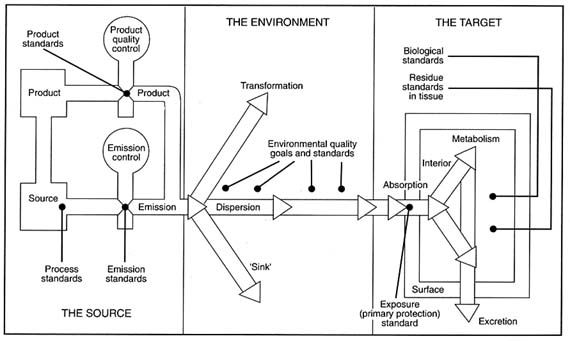
Several distinct types of standards exist.10 It is common to distinguish among product standards, process standards, and environmental quality standards, but in practice further variations exist, including emission standards, exposure standards, and biological standards. Figure 1 provides a schematic overview of the possible points on the pollutant pathway at which standards or objectives may be set.
Attempts to "harmonize" standards internationally have proven difficult. The experience of the European Community (which has undertaken more extensive international harmonization of environmental standards than any other organization) is instructive. It indicates how apparently simple issues such as determining blood lead levels in humans, harmonizing water quality management or defining product standards for automobiles can lead to major complications.11
The EC has experienced what can only be described as competitive standard-setting,
as countries use the regulatory process to secure their position in the EC process and to protect the interests of domestic industries. For example, attempts to harmonize ambient air quality standards for sulfur dioxide were rendered difficult by German insistence on retaining its measuring system which was manufactured by a German company but was incompatible with the systems used by most other EC countries. The French government exercises close control over the regulatory process and has therefore been able to put in place domestic regulations rapidly when this appeared desirable to impel EC negotiations in particular direction. The pattern of French regulation with respect to environmental assessment, toxic substances control, waste oil collection and the management of packaging waste is suggestive in this regard.
The United States has also long promoted US environmental standards for adoption by other countries, with the purpose of improving environmental management and the incidental outcome of creating a market for US monitoring technologies. In practice, environmental standards can have a significant impact on the direction of scientific research and technological innovation, as public authorities first fund research to support the regulatory process and those affected by regulation subsequently move to implement requirements and to limit their economic impact through the introduction of new technologies.
What emerges from the EC experience is the difficulty of comparing, and consequently of harmonizing, environmental standards internationally. In some instances, the availability of a standard of comparison can be helpful. For example, the European debate on automobile emissions repeatedly used US emission standards as a benchmark for the evaluation of proposals. In other instances, US standards have been proposed as a guideline for international action without success. For example the ban on the use of chlorofluorocarbons in aerosols enacted in the United States in 1977 was pressed upon other countries as a reasonable first step.12 Because such a ban would have had quite different impacts in different countries (some of which used fewer aerosols than the United States or had an industry structure based on smaller enterprises where changing technologies exacted higher penalties), it ultimately proved impossible to establish international action based on the US approach and negotiations only progressed when the United States embraced the EC approach of controlling production and use (which the EC had originally applied in a wholly unconvincing manner13). This illustrates the difference between national and international action. National standards can reflect the needs and criteria of a given country. International standards must be formulated in such a manner as to accommodate different control approaches while rendering their differences transparent and moving towards greater comparability in terms of outcomes. In the EC, this has made the directive the instrument of choice. Article 189 of the EC Treaties stipulates that "a directive shall be binding, as to the results to be achieved upon each Member State to which it is addressed, but shall leave to the national authority the choice of form and methods."14
EC Directives cover the entire range of environmental policy. They frequently provide a viable international standard of comparison since they are designed with this in mind. From this perspective it is hardly surprising that the EC approach underlies the Montreal Protocol, because it already reflects the needs of international action.
Comparing Procedures
In addition to standards, it is possible to compare procedures, that is, the rules and regulations governing the regulatory process. This assumes that the process has an impact on the outcomes that are achieved. It further assumes that the nature of the procedure to be followed influences the economic impact of the measures that are adopted as a result. It reflects the fact that environmental management has developed a substantial body of specialized procedural regulations.
The impacts of environmental degradation are difficult to predict. Traditional concepts to determine interested parties, based on property or membership in certain groups, do not apply without qualification. Geographic proximity can define affectedness, as can belonging to certain groups (for example, pregnant women or indigenous peoples whose diet includes a large proportion of fish from a single ecosystem). However, in other instances, users of certain products (automobiles) can be affected, or all those within a certain distance of major highways along which large numbers of automobiles may pass. Environmental phenomena such as stratospheric ozone depletion can affect every person capable of leaving the house. In many countries, environmental management has increasingly embraced the principle that everybody has an interest in environmental decisions, requiring procedures to allow anybody who feels affected, or potentially affected, to participate in decision-making as environmental regulations are elaborated. Some European countries and Japan continue to use traditional criteria (frequently relating to property ownership or neighborhood) to limit participation rights.
The need for public participation has engendered a number of aspects of environmental policy that are the proximate cause of its procedural complexity. Participation is not possible without an adequate information base that is publicly available. This informs the structure of many environmental assessment requirements and explains the central importance of freedom of information regulations to environmental management. Each of these can result in additional economic burdens on enterprises, which must comply with extensive procedural regulations prior to obtaining environmental permits and after these have been awarded.
Increasingly, the need for public participation across national boundaries is becoming apparent. Since environmental problems transcend national boundaries, there are no logical reasons why the participation rights of citizens must end at the border. However, this poses serious problems in relation to traditional legal systems. The European Community struggled with this problem in negotiating a directive on environmental assessment. After considering various forms of direct
TABLE 2 Comparison of Ambient Air Quality Standards
|
Country |
SO2 (ppm) |
CO (ppm) |
Suspended particulates (mg/m3) |
NO2 (ppm) |
Photochemical oxidants (ppm) |
|
Japan |
DMV 0.04 HV 0.1 |
DMV 10 8 HM 20 |
DMV 0.10 HV 0.20 |
DMV 0.04–0.06 or less |
HV 0.06 |
|
USA |
Primary EQS AMV 0.03 DMV 0.14 |
AHV 9 1 HM 35 |
AMV 0.05 DMV 0.05 |
AMV 0.05 |
HV 0.12 (for Ozone) |
|
|
Secondary EQS 3 HM 0.5 |
the same as above |
the same as above |
the same as above |
the same as above |
|
Germany |
AMV 0.05 30 MM 0.15 |
AMV 9 30 MM 6 |
AMV 0.15 30 MM 0.30 |
AMV 0.04 30 MM 0.11 |
|
|
Canada |
Max. Desirable Level |
||||
|
|
AMV 0.01 DMV 0.06 HV 0.17 |
8 HM 5 1 HM 13 |
AMV 0.06 |
AMV 0.03 |
DMV 0.02 HV 0.05 |
|
|
Max. Acceptable Level |
||||
|
|
AMV 0.02 DMV 0.11 HV 0.34 |
8 HM 13 1 HM 31 |
AMV 0.07 DMV 0.12 |
AMV 0.05 DMV 0.11 HV 0.21 |
AMV 0.02 DMV 0.03 HV 0.08 |
|
|
Max. Tolerable Level |
||||
|
|
DMV 0.31 |
8 HM 18 |
DMV 0.40 |
DMV 0.16 HV 0.53 |
HV 0.15 |
|
SOURCE: Japan Environment Agency (the JEA converted values where units of measurement differed from those used in Japan). Numbers are not strictly comparable because each country may use different instruments, analytical procedures, and requirements of the location of measurements. Terms: AMV: annual mean value; DMV: daily mean value; 8 HM: 8-hour mean; 3 HM: 3-hour mean; HV: hourly values; 30 MM: 30-minute mean. Definitions used in each country: Japan: the Environmental Quality Standards (EQS) are standards that should be maintained in order to protect human health. USA: Primary EQS are standards necessary to protect human health. Secondary EQS are standards considered necessary to protect public welfare from known hazards. Germany: The establishment of and operation of certain facilities must be subject to governmental approval. For approved facilities, neighboring residents cannot suspend operation of the facility for reasons of emission (hazards such as air pollution, noise, vibration, light, radiation, etc., affecting humans, plants, and animals), but they may claim for damages. Canada: These are long-term targets and serve as a basis for long-term development of pollution prevention policies in non-polluted areas. |
|||||
TABLE 3 Comparison of Water Quality Standards (for Health Purposes) [units: mg/l]
|
Country |
Cadmium |
Cyanide |
Lead |
Chromium (hexavalent) |
Arsenic |
Total Mercury |
|
Japan |
0.01 |
ND |
0.1 |
0.05 |
0.05 |
0.0005 |
|
USA (in Ohio, for the Ohio R) |
0.01 |
0.025 |
0.05 (dissolved Pb) |
0.05 |
0.05 |
0.0002 |
|
Canada (Ontario) |
0.0002 |
0.05 |
0.05–025 |
0.1 (total Cr) |
0.10 |
0.0002 |
|
Holland |
0.0025 |
NA |
0.05 |
NA |
0.05 |
0.005 |
|
China (draft) |
0.01 |
0.05 |
0.1 |
0.05 |
0.04 |
0.001 (Inorg. Hg) |
|
SOURCE: Japan Environment Agency. Numbers are not strictly comparable because each country may use different instruments, analytical procedures, and requirements of the location of measurements. Terms: ND: not detectable; NA: not available (either no standard, not published, or not convertible). |
||||||
international public participation, the EC recognized that differences in procedural rights in bordering countries were sometimes irreconcilable. Consequently the directive contains only an obligation to provide the public authorities of a neighboring country with the information commonly provided the citizens of the country in which a project is located. Consultation of the affected public in the neighboring country is the responsibility of the authorities in that country, which are also charged with providing a response to the agency that is managing the assessment process. No general direct citizen participation proved possible. In several instances, projects close to the border have created tension between countries and caused demonstrations by citizens from one country who felt curtailed in their rights to be consulted.
Subsequent implementation of environmental regulations frequently involves broad participation as well, either because people find themselves affected by some practice with environmental impacts and make their concern known, or because potentially affected persons undertake informal monitoring activities that can help to set priorities for more formal enforcement efforts. Indeed, no country has implemented effective rules for environmental management without the direct participation of its citizens.
The bedrock of this procedural structure is a permitting system by which public authorities determine who may emit what amounts of which substances
into which media at what times. The importance of such a system is identified by a number of European Community Directives which require member countries to bring these into existence and stipulate certain conditions for their operation (see Table 4). Given the number of possible variables, most permitting systems are highly complex. They have frequently grown over many years, with layer after layer of permits superimposed on each other.
Attempts are currently under way in several countries to develop more integrated systems of permitting that allow authorities to consider all environmental variables at the same time.15
Permitting systems reflect many variables, including the administrative culture of countries. Federal systems typically require more complex permitting structures, particularly when levels of government are not integrated (as in the United States), so that regulatory requirements and permits become primary means of communicating priorities between levels of government. Countries with a strong civil service tradition can rely on continuity in public administration to a greater extent than countries like the United States or the Netherlands where civil service is but a career station for many individuals. A strong civil service tradition generally results in more stable (some would say more rigid) administration. In countries with a strong civil service, comparable stability is frequently to be found in the staffing of private sector enterprises so that long-term relationships between administrators and enterprises can develop. Such relationships have both positive and negative results. All parties can afford to take a medium- to long-term perspective, relying on the continuity of the relationship to ensure that goals that have been postponed are also met. The need to deal again and again with the same people make commitments more readily enforceable since the alternative is to encounter difficulties at subsequent stages. On the other hand, lack of stability in relationships can lead to more aggressive pursuit of particular goals since delay is tantamount to failure. This fosters more confrontational relationships.
All of these factors in the permitting system will tend to impact the form and substance of environmental regulation. It is impossible in practice to determine the exact nature of these impacts since they can be both positive and negative.
Comparing Costs
The cost of environmental protection measures is an obvious measure of economic impact and appears to lend itself readily to comparison. Two problems arise, however. Comparing costs tends to obscure the related benefits, not only through environmental improvement but also through gains in efficiency. For example, the Canadian authorities moved in the mid eighties to significantly reduce acidifying emissions. This included major emission reductions at a nickel smelter in Sudbury, Ontario, the largest single source of sulfur dioxide emissions on the North American continent. The new requirements caused the operator of the smelter to rethink its smelting operations and undertake a far-reaching redesign
TABLE 4 European Community Directives with General Procedural Requirements
|
Directive |
Title |
Procedure |
|
75/440/EEC |
Drinking water |
Plan of action |
|
76/464/EEC |
Dangerous substances in water |
Authorization procedure |
|
78/176/EEC |
Titanium dioxide |
Authorization procedure |
|
78/659/EEC |
Water for freshwater fish |
Pollution reduction programmes |
|
79/923/EEC |
Shellfish waters |
Pollution reduction programmes |
|
91/676/EEC |
Nitrates from agricultural sources |
Action programme for vulnerable zones |
|
77/795/EEC |
Exchange of information—water |
Monitoring; information exchange |
|
75/442/EEC |
Waste |
Waste management plans; permits; record-keeping |
|
78/319/EEC |
Hazardous wastes |
Permits; inspections and records; plans |
|
84/631/EEC |
Transfrontier shipment of toxic waste |
Notification; record-keeping |
|
76/403/EEC |
Disposal of PCBs |
Authorization |
|
75/439/EEC |
Waste oils |
Permits; information campaigns; situation reports |
|
85/339/EEC |
Containers for liquids |
Reduction programmes |
|
86/278/EEC |
Sewage sludge |
Bans, authorizations |
|
85/203/EEC |
Air quality standards for NO2 |
Consultation in border regions |
|
84/360/EEC |
Emissions from industrial plants |
Authorization |
|
88/609/EEC |
Large combustion plants |
Licensing; national programmes |
|
594/91 |
Substances that deplete the ozone layer |
Reports |
|
82/459/EEC |
Exchange of information—air |
Monitoring; exchange of information |
|
92/72/EEC |
Air pollution by ozone |
Monitoring |
|
79/831/EEC |
Sixth amendment |
Testing; notification; inventory |
|
82/501/EEC |
Major accident hazards |
Safety report; on-site emergency plan; off-site emergency plan; public information |
|
2455/92 |
Export of chemicals |
Notification (prior informed consent) |
|
90/219/EEC |
Genetically modified micro-organisms |
Risk assessment |
|
90/220/EEC |
Genetically modified organisms—release |
Notification |
|
91/414/EEC |
Authorization and marketing pesticides |
Authorization |
|
79/409/EEC |
Birds and their habitats |
Control of hunting; restriction on sale |
|
3626/82 |
Trade in endangered species |
Permitting; certification |
|
3245/91 |
Fur from leghold traps |
Certification |
|
92/43/EEC |
Habitats and species conservation |
Establishment of a coherent European ecological network |
|
85/337/EEC |
Environmental impact assessment |
Environmental assessment; public information |
|
85/338/EEC |
Information on the state of environment |
Work programme; information gathering |
|
90/313/EEC |
Freedom of information |
Access to information |
leading to both emission reductions and an increase in operational efficiency, which offset most of the costs. Since then, the design has been licensed to other companies, leading to environmental improvements elsewhere and increased profits for the originator of the design.
Environmental costs borne by others, for example as a result of emissions, are not paid by the polluter and consequently not properly accounted for in the price. Elimination of these costs consequently appears as an additional expense in relation to prior practice. In reality, environmental externalities are also indicators of internal inefficiencies since they reflect patterns of waste production. Consequently changes in internal efficiency can frequently contribute to the reduction of externalities without engendering additional costs. This basic fact of environmental management, which has not been analyzed systematically, explains why low- or no-cost solutions to environmental problems can frequently be found.
How are investments that improve internal efficiency while eliminating externalities to be accounted for? They were initiated by environmental considerations but their impact extends well beyond the domain of emission reduction. They may be economical by any standard, although alternate investments with a higher return may have been available. Depending on the interpretation of these questions, estimates of aggregate expenditures for environmental purposes can vary dramatically.
The Organization for Economic Cooperation and Development (OECD) has maintained a system of statistics comparing environmental protection expenditures in member countries (see Table 5). These figure are largely self-declared by the countries concerned. While there is no reason to assume that they are incorrect from each country's point of view, they will tend to reflect the variables outlined above, as well as significant differences in practices relating to the identification and recording of relevant data. Countries with more widely dispersed responsibility for environmental management and without a central statistical office that assesses these data independently of the self-reporting are liable to produce lower figures than countries with more concentrated authority and a continuing statistical exercise. OECD admonishes users of its data to "exercise great caution in interpreting" the table, which provides trends in pollution control expenditures by industry, and to "interpret carefully" the table, which identifies public research and development expenditures for environmental protection. 16 Despite these warnings, the data have been repeated frequently in the literature.
In a recent report on pollution control and abatement expenditures, the OECD explains: "It is difficult to assess the extent to which data are truly comparable over time or across countries. In some instances changes in definitions used, or the means of collecting data, lead to discontinuities in the time series for individual countries. These changes in the data collection procedures, or changes in the definitions used, pose more of a problem for some countries than others since, for practical purposes, the effect of such changes may, or may not, be substantial. Apart from typical 'end-of-pipe' installations, it is often very difficult to estimate
TABLE 5 Total (Private and Public) Pollution Control Expenditure as Percentage of GDP
|
Country |
1972 |
1974 |
1976 |
1978 |
1980 |
1982 |
1984 |
1986 |
|
United States |
1.22 |
1.44 |
1.57 |
1.57 |
1.62 |
1.47 |
1.44 |
1.47 |
|
Incl. households |
1.50 |
1.76 |
1.92 |
1.92 |
1.99 |
1.85 |
1.85 |
1.88 |
|
Austria |
… |
… |
1.09 |
1.10 |
… |
… |
… |
… |
|
Finland |
… |
… |
… |
… |
1.31 |
1.24 |
1.10 |
1.16 |
|
France |
… |
… |
… |
… |
… |
0.86 |
0.84 |
0.89 |
|
Incl. households |
… |
… |
… |
… |
… |
… |
… |
1.15 |
|
Germany |
… |
… |
1.26 |
1.33 |
1.45 |
1.45 |
1.37 |
… |
|
Netherlands |
… |
… |
… |
… |
1.11 |
1.18 |
… |
… |
|
United Kingdoma |
… |
… |
1.66 |
… |
1.57 |
… |
… |
… |
|
SOURCE: OECD 1990, Table 2, p. 40. a 1977 and 1981 figures. |
||||||||
the part of expenditure that is really a result of environmental control. It is equally difficult, if not impossible, to measure increased expenditure caused by product control, as for example, when a pesticide or other chemical is banned and disappears from the market…. it should be noted that some data are survey-based, others are budgeted figures and others are estimates. Furthermore, some countries have provided data on a calendar year basis whilst others have provided information on a fiscal year basis. In a few cases data have been provided for combined calendar and fiscal years. Most of the data are provided on a current price basis, but a few figures are given on a constant price basis. Finally, the composition of the expenditure categories varies widely between countries, especially for the different environmental media."17 This warning effectively implies that the OECD data should be used for broad comparisons only rather than as a precise indicator of costs.
Environmental Quality
The ultimate goal of environmental policy is environmental quality. It can be argued that policies should achieve comparable environmental quality, given comparable environmental conditions to begin with. In effect this approach compares ambient quality standards or other measures of environmental quality. It must face the fact that countries with lower standards, lesser procedures, and smaller costs may achieve better environmental quality than countries with high standards, rigorous procedures, and high costs. For example, the Rhine valley in Northern Germany holds an extraordinary concentration of population and activity. It is also an area through which two of the main transportation arteries of Europe pass. Consequently its environment is heavily burdened. At the same time, the Rhine Valley represents an area of high attraction for economic activity
because it has relatively inexpensive energy resources (in particular lignite-based electricity), superb infrastructure, proximity to one of the most important markets in the world, and a profusion of vital services. It is not unreasonable to expect those who benefit from such locational advantages to accept higher burdens for environmental protection so as to maintain basic levels of environmental quality. Some states in North America show similar characteristics, providing one explanation why states considered to have high levels of environmental control have continued to attract significant investment. This is particularly true of an area such as Southern California where environmental characteristics (weather, proximity to the ocean, and accessibility of relatively untouched natural areas) represent critical elements of the quality of life and their preservation an important source of welfare. Regions reputed to be highly polluted do not normally attract the kind of economic activity that characterizes the most successful economies.18 Thus comparison of outcomes represents a reasonable criterion, even if it is in practice difficult to apply.
In Europe, this approach has led to the development of the concept of ''critical loads," defined by the 1988 Protocol to the 1979 Convention on Long Range Transboundary Air Pollution as "a quantitative estimate of the exposure to one or more pollutants below which significant harmful effects on specified sensitive elements of the environment do not occur according to present knowledge." Critical loads are currently being defined in several countries and at an international level for a range of common pollutants in a number of ecosystems. They allow a much more precise determination of environmental quality than the ambient standards previously applied since they explicitly take ecosystem stability as their point of reference and recognize that some ecosystems are significantly more fragile than others. The message from the study of critical loads has been unambiguous. Even countries with vigorous environmental policy and apparently quite unaffected ecosystems are experiencing cumulative ecosystem changes that will ultimately lead to broader environmental change. In other words, it remains necessary to reduce current environmental loadings by a sizable percentage, ranging from 60–90 percent for most common pollutants, if sensitive ecosystems are to be protected. The Netherlands has developed an explicit policy which recognizes that even the most vigorous environmental protection will make it impossible to protect certain ecosystems because these are affected by emissions originating in several countries and the Dutch government is unable to project the reduced levels of emissions for those countries that protection of the most sensitive ecosystems would require. Thus Dutch policy recognizes that these ecosystems will degrade progressively over the coming decades and that there is nothing the Dutch government can do to arrest this process.19 This may be a reflection of the intensive research, assessment, and consultation that characterizes Dutch environmental policy.20
The Netherlands has taken the concept of critical loads one step further, developing a range of environmental policy performance indicators that apply to a
number of themes such as climate change, acidification, or eutrophication, and to target groups such as agriculture, traffic and transport, refineries, or consumers.21
Implications for Science and Technology Policy
The above discussion suggests that international comparisons of environmental policy have become increasingly important just as they are becoming more difficult to undertake. Since environmental policy itself has become highly complex, comparisons of environmental policy will necessarily also need to be complex. These difficulties in comparing environmental policy have permitted public officials (and affected business interests) everywhere to claim that their policies are the most advanced, the most stringent, and the most effective. This litany is repeated by spokespersons from most OECD countries, and by picking the times and the areas where a country has been active it is even possible to provide proof for these mutually exclusive statements. For example, for decades, the United States lagged behind all other industrialized countries in its land use planning, worker protection and industrial safety measures. When it finally turned to remedying this situation in the late sixties, it adopted a series of remarkable environmental laws that appeared highly progressive, as long as the peculiar circumstances of prior US neglect were forgotten.
The role of science and technology is a constant among the diverse criteria for comparison of environmental policy. Significant environmental degradation is always linked to the introduction of "Western" technologies, which help to magnify the impact of humans on the environment. These technologies are everywhere the same, ranging from simple rules of conduct for sanitation and nutrition, which lead to a population explosion, to cutting edge electronic and biological technologies. Consequently appropriate control and the creation of necessary incentives to science and technology are a consistent need for the development of environmental policies. In general, only countries with a strong scientific community can participate actively in the definition, development, and implementation of policies concerned with the environment and sustainability because only these countries have the means to participate actively in the required processes.
It is generally assumed that countries undertaking particularly vigorous forms of environmental protection will be at a disadvantage relative to countries with lesser levels of protection. In practice the opposite may prove to be the case, but only if scientific research and technological innovation move in a direction that is consonant with environmental policy goals.
The assessment of environmental quality requires a long-term effort to establish appropriate monitoring facilities and to study and evaluate the results. This creates an important field of scientific research and technological development as the "interface" between society and the environment becomes better defined. It is unique in its consistent requirement for broad interdisciplinary cooperation, including not only various disciplines in a common area of activity—for example,
the natural sciences or the humanities—but also interdisciplinary collaboration between the natural and the social sciences.
THE ROLE OF SCIENCE AND TECHNOLOGY POLICIES IN SELECTED COUNTRIES
Science is international in its self-image and generally international in practice. Scientific results should be capable of validation anywhere. This goal has proven illusive for the social sciences, which remain, for better or for worse, embedded in their own social and political environments. But even the natural sciences show surprising national variations, reflecting broader values that become part of the training of scientists and influence the kinds of questions they are liable to pose and the strategies they will pursue to find answers. It cannot be fortuitous that modern organic chemistry has its roots in Germany, that modern physics represents the outcome of an international dialogue within a small group of Europeans, that modern biology is rooted in the United States, or that France has played a special role in certain fields of human health research. Science policy is even more clearly a product of national circumstances, the result of subtle differences in the research community of each country and their cause. Countries have organized their research endeavors in strikingly different ways and have created different structures to determine the levels of funding available for science and technology and how it is to be spent. Comparing these structures is interesting. Why is it important? A number of reasons underpin the effort to compare science and technology goals for environmental policy and research.
-
Environmental policy is international by its very nature. What one country does or does not do to protect its environment can affect the environment of other countries.
-
Most environmental policy areas by now require some form of international coordination of measures. To develop equitable approaches it is important to be able to compare national measures.
-
Countries must draw on all available scientific information when they undertake science assessments. Knowledge of research strategies and parallel assessments is important in avoiding mistakes and misunderstanding.
-
Most countries do not have the resources to undertake research in all areas of environmental concern; some countries cannot undertake any such research. These countries must rely on information available elsewhere to base their policies.
-
The existence of an active research community directly impacts the ability of a country to address an issue and in some cases limits the ability to even recognize its importance. Lack of independent domestic research on stratospheric ozone depletion was one of the reasons why European countries were particularly slow in responding to the emerging threats and resisting the self-serving information being circulated by affected industrial interests.
A comparison of science and technology goals for environmental research and policy is an uncertain venture. It requires an understanding of the strengths and weaknesses of environmental policy in a particular country, the structure of its research community, the manner in which science policy decisions are traditionally made, and the manner in which the specific linkage of science and policy has been resolved with respect to the environment. This paper will outline some of the processes and some of the implications of these interlocking issues for Canada, selected European countries, the European Community, and Japan.
Canada
Environmental Policy
Canadian environmental policy is characterized by the complex division of labor between federal government and provinces. The latter control practical environmental policy to a greater degree than the federal units of any other OECD country. This division of responsibilities has rendered the participation of Canada in international environmental agreements particularly difficult. On the one hand, Canadian federal authorities have shown great enthusiasm and support for international environmental activities—not least because their constitutional authority for foreign affairs is broader than in most other areas of policy. On the other hand, the provinces, which control most of the policies that need to be adopted to meet international obligations, have not generally been willing to have their hand forced by international agreements negotiated by the federal authorities.
Canada is a very large, extremely sparsely populated country. Consequently it has tended to confront the environmental impacts of human activity and modern technology at a relatively late date because visible degradation of the environment remains rare. For example, Canada adopted controls on acidifying emissions well after most other OECD countries because it argued that its own emissions were largely dissipated over very large areas and were not the direct cause of some of the phenomena that were being attributed to acidification. Only the need to match its pressure on the United States with comparable deeds of its own moved the Canadian provinces to adopt more stringent measures. Canada's size has also been a major factor in causing the country to have a greenhouse gas emissions profile that is highly disadvantageous—and relatively difficult to change. Long distances—and a cold climate—imply high transport and domestic energy requirements, which can be reduced only through major innovations and extensive investments in public and private infrastructure.
Canada is a country whose economy continues to depend in large measure on the production of commodities—primary economic goods extracted from the environment. Commodity markets provide less room for the recovery of environmental costs than most other markets and have been subject to long-term downward price pressures. At the same time, much commodity production is again
relatively energy intensive, certainly when measured in terms of energy input per unit of GDP.
For all of the above reasons, Canada has engaged in a more active debate on issues pertaining to sustainability than many other OECD countries. In the area of general economic policy, the relationship between federal government and provinces is more balanced and an economy that depends on commodity production is more likely to benefit from more sustainable economic systems. The Canadian debate is characterized by heavy reliance on consultative procedures. The country pioneered the use of Roundtables to bring together government, industry, and environmental interests in the search for consensual approaches to the broader issues of environmental policy.
The Research Community
The Canadian research community is spread widely across the country, with extremely long distances creating major burdens for the exchange of information. Canada embraced the information highway with more enthusiasm than most other countries outside the United States. The distribution of research centers has implications beyond geographic spread as funding decisions at the national level are inevitably influenced by considerations relating to geographic distribution (particularly insofar as French speaking Quebec is concerned), which overlays more traditional scientific considerations.
Because of its dependence on commodity production, and forest products in particular, and because of its location as the largest Arctic country after Russia, Canada has developed particular strengths with regard to forestry research and research on extreme climates.
Science Policy
Canada has recently created a new Department of Industry, which encompasses several previously dispersed science and technology functions, in particular of the precursor Department of Industry, Science and Technology.
The Natural Sciences and Engineering Research Council, the Medical Research Council, and the Social Sciences and Humanities Research Council support university research and training. Their combined budgets totaled C$806 million ($520 million). Government R&D spending represents about 2.6 percent of the federal budget, the lowest figure for any of the G7 countries. However, provincial budgets include significant additional resources for science and technology. The Council of Science and Technology Ministers involves cabinet level representatives from the federal and provincial governments and is designed to provide a forum for addressing policy issues of common interest.
A significant proportion of the government's research funds is channeled to
the Networks of Centers of Excellence programme, which was initiated in 1988 with a budget commitment of C$240 million ($156 million) for five years and recently renewed with additional funds. The NCE are required to include leading researchers from across Canada and to involve an active collaboration between researchers and the potential users of new technologies, industry for the most part or government agencies.
Environmental Considerations
Environmental research has not traditionally been the focus of a special institution. Consequently environmental activities have had to be funded through the traditional avenues of research support.
Environment Canada is a ministry with limited executive functions. Consequently funding of environmental research to support Environment Canada's mission represents one of its most important activities.
The Government's Green Plan, announced in 1990, is a national strategy to take a step towards sustainable development in Canada. Twenty-five of the Plan's initiatives have a significant science and technology content, amounting to C86.6 million ($56 million) in 1992–1993. Among these are Global Warming Science Program (C$4.8 million), Technology for Environmental Solutions (C$2 million), and Eco-Research (C$3.3 million). The latter program encourages cross-disciplinary research and training on environmental issues.
The Networks of Centers of Excellence included two environmental topics in its 1994 call for proposals but only one was funded, a project on sustainable forest management. No network was funded to address the linked issues of trade, competitiveness, and sustainability, which had also been identified as a priority in the call for proposals.
The peculiar distribution of authority between the federal government and the provinces makes the provision of funding by the federal government (essentially subsidies) an important instrument to leverage desired outcomes, either from provincial governments or from industry. These subsidies frequently support specific research and development efforts designed to permit the more rapid or more efficient adjustment of policies or enterprises to the demands of federal government environmental priorities. An example of this process was the promise of subsidies to a major mining and smelting operation in Sudbury, Ontario to facilitate reductions in what was at the time the largest single source of sulfur dioxide emissions in North America. The result of this effort was the development of new smelting technology, which not only reduced emissions dramatically but proved to be economically superior to other available technologies and can therefore successfully be commercialized and sold to other companies. In this case, the promise of subsidies alone proved an effective tool, since the profitability of the new technology obviated most elements of subsidy.
France
Environmental Policy
French environmental policy has been dominated by the national administration, which has more extensive authority and control than its counterpart in most developed countries. France has frequently been able to legislate new measures rapidly, well in advance of other countries, largely because the French administration is capable of ensuring passage of most laws it deems important. The counterpoint to this forward looking action is the almost total inaction when confronted with issues the administration is not convinced are of major importance. For example, France was one of the last countries with significant levels of production of ozone depleting substances to remove representatives of the affected industry from its delegations and to act decisively to control the production of the most important ozone depleters. Only massive citizen protests were able to slow down a process designed to regulate the Loire, the last major free-flowing river in France. Because higher echelons of the environmental administration are frequently recruited from the École des Ponts et Chaussées, essentially a national training institutions for civil engineers, there is a tendency to believe that engineering solutions are available for most environmental issues.
France has maintained an unwavering commitment to the development and extensive utilization of nuclear power generation. While this commitment is presumably linked to a similar commitment to the development of its own nuclear arsenal, the result has been an unparalleled investment in nuclear power, occasionally even over the protests of local populations. France is one of the few countries to operate a nuclear fuel reprocessing facility.
The Research Community
France has one of the highest proportions of researchers in the work force, with 5.2 per 1,000.
Like much else in France, the research community is centered on Paris. Despite continuing attempts to promote decentralization, most leading scientific institutions—and all important decision-making positions—are in Paris. This high degree of centralization has enabled the creation of a number of strong research institutions at the national level.
French public administration is characterized by the existence of a limited number of highly selective "grandes écoles," institutions to train an administrative elite. The grandes écoles are not, however, major centers of research, which is typically conducted in specialized institutions that are sometimes attached to universities. Graduates of the grandes écoles will tend to "colonize" certain government functions. For example, a preponderance of engineers from the School for Bridges and Roads is to be found in the Environment Ministry. In consequence the perspective of a given school can predominate in the government's approach to issues such as the environment.
A significant portion of French industry is under the influence of public authorities, and leadership of many of the major industrial enterprises is in the hands of persons from the grandes écoles who will frequently also have served in administrative positions at some time. The result is particularly close cooperation between government and industry.
Establishing closer linkages between research and universities is one of the priorities of current policy: 990 of the 1,370 research units receiving support from the National Research Council are formally associated with universities. However, research and teaching functions remain relatively separate, and the universities as such play a limited role in the determination of research priorities.
Science Policy
France devotes a larger proportion of its national budget than most countries to research (5.99 percent). However, this figure is somewhat distorted by the absence of any significant sources of public research funding at other levels of government. Over the past decade, research and development expenditures have risen steadily as a percentage of GDP, from 2.01 percent in 1981 to 2.36 percent in 1992. These increases stabilized in 1990.22
Following parliamentary elections in March 1993, responsibility for science and technology policy were assigned to a new Ministry for Higher Education and Research. Until that date, research and higher education functions had generally been separate. The National Research Council provides cross-cutting coordination of research policy and is the avenue for providing government funds to centers of research excellence.
In comparison to other countries, at 50 percent, government funds represent a particularly large proportion of total research and development funds. This implies that government resources also play an important role in funding pre-competitive industrial research.
Environmental Considerations
The French structure of policy-making and research is not particularly well suited to topics that are interdisciplinary and require the cooperation of large numbers of research institutions. In many instances, French researchers have used opportunities for international cooperation as a structure to complement the fairly distinctive French structure. The absence of independent policy research institutions—due to the absence of funding for this kind of work from sources outside government—leads to a comparative paucity of independent scientific research to prepare policy. Much research is either purely academic in orientation or directly related to technological applications. Again this represents a hurdle for addressing environmental issues.
The lower status of environmental research is reflected in the priorities articulated
for the 1995 civil research and development budget, which lists three first tier priorities (medical and biological research, civil aviation, and scientific employment and training through research) and five second tier priorities, among them the environment.
The exceptionally powerful position occupied by the Presidency and the French Administration render parliament a relatively weak institution. While major policy decisions are submitted to parliament and are subject to debate in the Assembly and Senate, it is unusual for this process to result in significant changes.
Germany
Environmental Policy
German environmental policy can be divided into a pre-Waldsterben and a post-Waldsterben phase (Waldsterben being the German term for forest dieback, which was widely observed in the early eighties and attributed to acidification, even though the link has never been conclusively established). In the pre-Waldsterben phase, German policy was largely technocratic and skeptical of claims to extensive and pervasive environmental degradation. It placed significant faith in traditional approaches to industrial safety, land use planning, and the permitting process. Emblematic of this approach was the powerful rearguard action fought by German negotiators against adoption of the Convention on Long Range Transboundary Air Pollution and the undermining of work in the OECD on transboundary pollution. Water management was strictly oriented to state of technology considerations, and technology forcing policies were considered undesirable. With a powerful chemical industry, German authorities were unable to legislate domestic toxic substances control legislation without a strong mandate from the European Community, which largely overrode resistance from domestic interests. In procedural terms, German policy rejected legal standing for environmental groups and restricted the citizens' rights to participation to the property rights. Foreigners who were not German property owners had no rights to participate, even in administrative proceedings.
Since 1982, these policies have largely been modified with initial pressure coming from citizen activist groups and, surprisingly, from core conservative constituencies such as foresters concerned about Waldsterben. The experience of Chernobyl reinforced the transition to environmental policies based on the precautionary principle, a concept that lay dormant in German environmental law until the eighties when it was used to justify the dramatic shift in government policies without having to disavow previous measures. The German government has not shied away from technology forcing legislation, for example, in the areas of waste reduction and packaging.
German environmental policy is characterized by the unique distribution of
functions between the federal government and the Länder. Federal environmental legislation is implemented by the Länder. There exists no federal environmental agency with implementing authority. Under these circumstances, federal legislation and regulation are typically highly detailed and the federal government must take recourse to indirect means of achieving its policy objectives, not least of which are research funding and the extensive use of subsidies to promote environmental management.
The Research Community
As with many other aspects of German life, the research community is characterized by the experience of political division and unification in the postwar era and the strong role of the Länder in funding higher education and research.
German universities have traditionally been institutions devoted to research, with teaching a dependent function of the research effort. In the nineteenth century, based on models developed in Göttingen and the Humboldt University in Berlin, Germany pioneered the development of research-based higher education, resulting in dramatic scientific discovery, including many of the fundamental developments that underpin the chemical industry. German universities are funded and managed by the Länder. A federal role in higher education evolved in the sixties as the expanding needs of higher education outstripped the availability of funds at the level of the Länder. The need to attract federal funds forced the Länder to cede some authority to the federal authorities, particularly in the area of research.
The chance occurrence that the Berlin Academy of Sciences, the leading institution of its kind until World War II, was located in the part of Germany that came under Soviet control, forced the development of new science policy institutions independent of the academies and their traditional functions in postwar Western Germany. These institutions have generally been transferred to the new Eastern Länder.
Similarly the headquarters of the former "Kaiser Wilhelm Institutes" lay in Eastern Germany, leading to the creation of a new network of research institutes named for Max Planck. In the German tradition these institutes are built around individuals rather than around themes, at least in their initial definition of tasks. As a result, they have tended to be strong in mature fields of research and relatively slow to take up emerging topics such as the environment. In general it can be said that German universities have adapted with great difficulty to the demands of the type of interdisciplinary research required for environmental policy.
Science Policy
In 1992, Germany spent 2.53 percent of its GDP on science and technological development activities. Of this amount, 22.1 percent was provided by the
federal government (representing 4.31 percent of federal budget outlays), 16.1 percent by the Länder, and 59.5 percent by industry. The latter figure decreased from 70.1 percent in 1987 and 65.6 percent in 1990 but is still high in comparison to other EC Member States.23
The distribution of responsibilities between the Länder, which are mainly responsible for R&D in the universities, and the federal government, which is mainly responsible for non-university R&D, is characteristic for Germany.
Current research priorities are to reconstitute and complete the research system in the new Länder (former German Democratic Republic); to assure a high level of basic research (20 percent of total R&D expenditure); to promote strategic technologies in the precompetitive field (in particular, information technologies, miniaturization of electronic and mechanical systems, biotechnology, research on advanced materials, research for transport, energy, and concentration on interdisciplinary research; to improve the innovation capabilities of small and medium enterprises; to continue preventive research (in particular, ecology, health and social problems, space, and polar research); to strengthen international cooperation in research and technology development; to continue public long-term programs (fusion and space research).
Environmental Considerations
The federal Ministry of the Environment is responsible for a Federal Environment Agency, which undertakes information and research management tasks for environmental policy development. All other environmental research is funded through the federal Ministry for the Future.
Germany has a highly developed structure of advice and consultation that permits the participation of a wide range of interest groups in the formulation of public policy. Two institutions are particularly relevant in the environmental field. The Council of Experts on the Environment is a group of academic experts who provide research-based advice to the federal government on topics of importance to environmental policy. Over the years, the Council has produced numerous reports that can be viewed as way stations in the process of structuring public debate on major environmental issues. In recent years, the Bundestag has established several Study Commissions to address environmental issues, utilizing a peculiar instrument of the German parliamentary system that has proven particularly suited to environmental ends. Study Commissions are composed of an equal number of members of parliament and outside experts (nominated by a political process) and have no decision-making authority. Over the past two parliamentary sessions, one Study Commission has addressed ''Preventive Measures to Protect the Earth's Atmosphere."24 Its recommendations played an important role in the development of German policy on stratospheric ozone depletion and climate change. During the late parliamentary session, a further Study Commission considered
the issue of material flows without coming to specific recommendations. Both Commissions are being continued in the current session.
United Kingdom
Environmental Policy
British environmental policy has long been a matter of controversy in Europe, with one commentator going so far as to call Britain the "Dirty Man of Europe." This diatribe was recently returned by the British environment minister who accused Denmark of hypocrisy in the Brent Spar incident, claiming the Scandinavian country was in fact "the dirty man of Europe." Certainly Britain has taken an approach to environmental management more closely informed by (British) scientific research and less inclined to take a precautionary approach when confronted with inevitable scientific uncertainty.
The United Kingdom invented pollution along with the industrial revolution. It was confronted in the 19th century with the practical problems of managing untrammeled economic growth based on technological innovation. Its early measures to limit damage to neighbors of industrial facilities through HM Alkali Inspectorate and its work on water pollution, the provision of safe drinking water, and the development of wastewater treatment technologies were pioneer achievements of environmental management. At the same time, Britain's location on an island with short, swift-flowing rivers and few occurrences of poor air circulation created powerful incentives to distribute and dilute emissions with a view to avoiding harmful impacts on the immediate environment. Relatively modest efforts brought dramatic improvements in environmental quality, and for several decades, Britain was a staunch defender of environmental quality standards as the measure of success in environmental management.
It was not until the eighties that Britain came to accept its contribution to long-range pollution, including acidification in Scandinavia and pollution of the North Sea from land-based sources.
Britain has a strong tradition of conservation and humane concern for animal welfare, which has marked some of its policies in the area of agriculture and the environment.
Hardly any country has a stronger record of fulfilling international commitments once entered into. This has tended to make the British government particularly cautious when negotiating international commitments. Frequently it has taken direct participation of British researchers in international environmental research to convince the government of the need for action. In the early stages of the dispute about stratospheric ozone depletion, the lack of active participation of British atmospheric researchers contributed to the deeply skeptical appraisal of the available evidence by the British authorities. Even discovery of the Antarctic ozone "hole" by a British team did not fundamentally alter these perceptions.
Similarly it took a joint project of the British Royal Academy and the Norwegian and Swedish Royal Societies to create the scientific record needed to induce government action on acid rain. A comparable role was played by the Water Research Center (at the time still a government research establishment, since then privatized) with respect to North Sea pollution. British scientists have long played a prominent role in global change research.
Increasingly British environmental researchers are part of international cooperative research efforts, frequently funded by the European Community and involving partners from other European countries. These cooperative research programs tend to focus on large, complex interdisciplinary research tasks, typically like those required for environmental management. 25
The Research Community
The number of scientists and engineers engaged in research and development in the United Kingdom is 4.5 per 1,000 of the labor force, high in comparison with most European countries.26 A major portion of the research community is affiliated with higher education, which expanded substantially in the sixties and seventies. In addition, numerous government departments maintain their own research laboratories, in particular the Department of Trade and Industry; the Ministry of Defense; and the Ministry of Agriculture, Forestry and Fisheries. The Research Councils also directly support a number of laboratories. The Department of the Environment does not have major dedicated laboratories, although the recently privatized Water Research Center was in large measure concerned only with environmental research even though it transcended the sphere of responsibility of the Department of the Environment.
The British government has engaged in systematic scrutiny of all research establishments that depend on government funding with a view to rationalizing the structure or privatization.
Science Policy
In 1992, Britain spent 2.12 percent of its GDP on science and technological development activities. Of this amount, 35.4 percent was provided by the government (representing 3.01 percent of budget outlays) and 49.7 percent by industry. In 1993, defense research accounted for 45 percent of government research and technology development expenditures. Government R&D has fallen progressively in real terms from 6.8 billion ECU in 1992–1993 to 6.02 billion ECU in 1995–1996 (at 1993 prices and exchange rates).
Higher education institute funding is channeled primarily through the six Research Councils. A new Research Council structure went into effect in 1994 with stronger links to the central government, with a Director General based in the Office of Science and Technology. Government Department laboratories, such
as those of the transport, agriculture and forestry, and defense departments, are being reviewed with a view to possible privatization. Support to industry, particularly to small and medium sized industry, through the Department of Trade and Industry now concentrates on technology transfer, consultancies, standards, awareness, and best practice and has moved away from the generation of technology, an area that now falls largely within industry responsibility.
Following publication of a White Paper, a Technology Foresight Programme was launched to identify priority market/technology sectors of most relevance to industrial users and to assist the formulation of government science and technology policy. Fifteen broad areas have been identified for further analysis: agriculture, natural resources and environment, chemicals, communications, construction, defense and aerospace, energy, financial services, food and drink, health and life sciences, information technologies and electronics, leisure and education, materials, manufacturing production and business processes, retail and distribution, and transport.
Responsibility within the government for research funding has shifted twice over the past three years In 1992, science policy and funding was moved from the Department of Education to the Chancellor of the Duchy of Lancaster (the Office of the Prime Minister), and an Office of Science and Technology (OST) was created. This was widely viewed as enhancing the role of science and improving the prospects for funding. In the most recent change within government, the OST was removed from the cabinet office and transferred to the Department of Trade and Industry, a large and powerful ministry with interests of its own in relation to science policy.27
Environmental Considerations
One of the six British research councils is devoted to Environmental Science. This Environmental Science Research Council (ESRC) funds primarily research in institutions of higher education and supports a number of research centers. In addition, the Department of Environment has a research budget at its disposal to support research that is relevant to policy. That this structure can produce undesirable results is illustrated by a decision by the relevant body to cut funding for the Antarctic group led by Farmer in the years immediately following its crucial discovery of the "ozone hole" above Antarctica. This funding was ultimately replaced by US government sources.
There is no established procedure to ensure public participation in the formulation of government science policy as it pertains to the environment. A standing Royal Commission on Environmental Pollution provides one avenue to develop priorities for future policy development in relation to research funding. This Commission has traditionally been chaired by a prominent scientist although its membership is more widely representative of groups with an interest in environmental policy.
Parliament has not traditionally played an active role in the formulation of general policy guidance and the implementation of legislation, its principal role being legislative in the strict sense of the term. In the early eighties, the introduction of the select committee system created closer links between these committees and the government agencies they were to monitor. Select committees are not, however, a strong vehicle for public involvement.
A peculiarity of the British system is the existence of the House of Lords, composed of hereditary peers who are members by birthright and life peers who are members upon elevation by the Monarch based on a list provided by the Prime Minister. Life peerages are frequently awarded to prominent scientists so that some committees of the House of Lords have significant levels of expertise among their members. This is particularly true of the committees that deal with science policy and environmental affairs.
In general, British environmental policy is particularly sensitive to advice from British scientists. In several instances, the government has maintained environmental policy positions in the face of international pressure—for example, on acidification, pollution of the North Sea, or ozone depletion. However, once scientific advice changed, the government has generally been quite willing to shift its position.
European Community
Environmental Policy
The year 1972 was one in which international organizations needed to make their initial determination concerning the significance of the environmental agenda and their need to respond to it. Through the Stockholm Conference, the United Nations system concluded that the environment was marginal to its major priorities and could be entrusted to a newly created United Nations Environment Programme, which was given vast responsibility, few resources, and no authority. 28 UNEP was not integrated into the UN development system, which was emerging simultaneously, centered on the United Nations Development Programme.29 The GATT established a Working Group on the environment, which was not convened for the following twenty years. The European Community launched its environmental activities with a political mandate from the newly constituted meeting of heads of state and government (which was later formalized as the European Council) but with no particular legal authority in the Treaties.
The fate of each of these three initiatives reflects the different character of the institutions involved. UNEP developed far beyond reasonable expectations in response to a pressing agenda of international environmental issues but failed to have a significant impact on the UN system. GATT was not confronted with the full range of environmental issues until the early nineties when these suddenly threatened to upset the delicate balance of an institution long accustomed to effective
action based on an uncertain institutional mandate.30 The environmental activities of the EC expanded so strongly that they were given a clear legal mandate in the Single European Act, which has been further elaborated in the Maastricht Treaty.31
EC environmental policy is implemented by means of more than 300 legal instrument (primarily Directives) adopted over the past twenty years.32 Its development is marked by a series of five consecutive multi-annual Action Programmes. Beginning with the first Action Programme, which sought to give more specific form to a legally questionable political mandate, these documents have provided direction to EC environmental policy. Each of the Programmes has set out an ambitious agenda, and while the implementation of the details has been quite poor, the general thrust of action has indeed followed the directions indicated. Thus the recently adopted Fifth Action Programme, entitled "Towards Sustainability," can be taken as a strong indication of the direction of EC environmental policy even though its details are likely to prove difficult to implement.33
By now, EC environmental policy covers virtually every aspect of environmental management, ranging from water (12 major directives) to impact assessment and information (8 major instruments) and from waste (8 major directives), air (15 major directives), and harmful substances (16 major instruments) to wildlife and countryside protection (8 instruments) and climate change (5 instruments). Environmental policy of individual member states can no longer be adequately understood without incorporating the EC dimension of these policies.
Originally driven by sometimes hesitant recognition that the process of economic integration could not proceed without an accompanying programme of environmental management, EC environmental policy has developed a dynamic of its own—abetted by the existence of unambiguous authority in the EC Treaties following the changes introduced in 1986 by the Single European Act, including a new Title on the environment (Art. 130r–130t) and some other changes concerning the environment, in particular concerning harmonization.
It is not easy to identify the motors of EC environmental policy. In an initial phase, they were primarily economic, reflecting the view that the elimination of economic barriers between the Member States (six until 1972, nine until 1973, ten until 1981, and twelve since 1986) required measures to harmonize environmental policy. This view was reinforced by the need to draw on a narrow legal base until 1986, primarily Art. 100 (concerning the "approximation of such provisions laid down by law, regulation or administrative action in Member States as directly affect the establishment or functioning of the common market") and Art. 235 (a vague mandate, which permitted the EC to take unspecified measures necessary to achieve the goals set out in Art. 2). For the purpose of Art. 235, the 1957 mandate to achieve "harmonious" development was interpreted to imply attention to environmental issues beyond the simple harmonization of standards.
Formulation of a Title in the Treaties does not ensure action by the Community. The EC mandate for energy policy has been unambiguous from 1957 on,
with special treaties for coal and nuclear power. Nevertheless no effective EC energy policy has emerged. Indeed it has taken the pressure of an environmental issue—climate change—to move energy policy forward. Similarly transport policy, theoretically a matter of eminent concern for a Community in which barriers are falling, did not develop effectively until the completion of the single market, despite a corresponding title in the Treaties since 1957. Thus it has been more than the simple logic of linking economic integration and the environment, or the expressed desire of governments, but the internal dynamic of environmental management itself that has impelled the EC to develop strong and frequently effective environmental policies. The provisions of the Single European Act concerning the environment were effective because they simply legitimized what was occurring anyhow. The need to develop environmental policies at EC level has been driven by the joint concerns of economic and political integration and the equally powerful pressure to find environmental measures at all levels at which they were needed, ranging from the local to the transnational. In the latter category, the EC represents a forum of convenience, the only international organization capable of undertaking systematic policy development.
The environmental provisions of the Maastricht Treaty build on the Single European Act although they are not only a development of its approach. While they reflect serious consideration of the need to reflect environmental concerns and the need to achieve greater sustainability, they also reflect some haste in drafting and relatively limited public discussion prior to their formal adoption. For example, while there is explicit though tortuous reference to sustainability in the aims of the EC,34 this issue is not picked up in the operative articles concerning the environment.35 This reinforces the impression that the reference to "sustainable growth" in the aims was largely declaratory and not meant to entail specific actions to operationalize it.
The Research Community
It is not possible to identify a specifically "EC" research community, apart from the approximately 7,000 persons employed by the European scientific facilities and organizations.36 The EC draws on the researchers of its member states. These have widely differing levels of research intensity, ranging from a low of 1.2 researchers per 1,000 persons in the labor force (Portugal) to a high of 6 per 1,000 (Germany). Belgium, Denmark, France, Luxembourg, Ireland, and the United Kingdom also have research intensity ratios above 4 per 1,000.37 Greece and Spain are below 3 per 1,000 and the Netherlands is 3.8.
Science Policy
Articles 130i and 130h were introduced by the Single European Act into the Treaty establishing the European Community as part of new Title VI concerning
Research and Technological Development. They provide for two complementary instruments for research and technological development at the Community level: a Framework Programme setting out the Community's research and technological development activities and the coordination of national and European research and technological development policies. 38 While activities under the Framework Programme are well established, the coordination function has remained dead letter. In a recent communication, the Commission proposes to "achieve better coordination by intensifying cooperation at the various stages of drafting and implementing RTD policy."39
The European Community's resources represent approximately 4 percent of the research and technological development resources available in its member states. Consequently it can have an impact on science policy only if it focuses attention on priority issues. The area in which its Framework Programme has had the most important impact concerns large projects requiring international and interdisciplinary cooperation. In these areas, the most appropriate partners are not always in a single country and the Community can provide the resources to ensure that cooperation occurs. At the same time, it can provide access to already established research networks for researchers in the countries with low research intensity. Indeed, cooperative research and technological development endeavors have become the hallmark of the EC research program (see Table 6). In addition to the various European scientific facilities and organizations, this program is conducted primarily through EUREKA (a program of collaborative R&D involving firms, universities, and research institutes, which seeks to increase European productivity and competitiveness through closer cooperation between firms and research institutes in advanced technologies, developing products, processes, and services with a world market potential) and the European Cooperation in the Field of Scientific and Technical Research (COST), a program that is to provide a framework for R&D cooperation. COST actions consist of precompetitive or basic research or activities of public utility.
Environmental Considerations
Environmental policy requires large-scale projects involving international and interdisciplinary cooperation. In this respect, it is ideally suited to the EC approach to research policy. While environmental research represents a priority of most European research programs, it does not emerge as a major area of activity in terms of total budget allocation.
While environmental issues crop up in many of the EC research and technological development programs, the principal activities are subsumed within the Environment and Climate 1994–1998 Work programme 40 (see Table 6). The total budget allocation for this work program is 482 million ECU for four years. Additional areas of work are included in the Marine Sciences and Technologies (MAST) program and the Joint Research Center's program.41
TABLE 6 Scientific Content and Means of Implementation, EC Environment and Climate Work programme, 1994–1998
|
Theme 1 Research into the Natural Environment, Environmental Quality, and Global Change |
|||
|
Area 1.1 |
Climate change and impact on natural resources |
||
|
|
|
1.1.1 Basic processes in the climate system |
|
|
|
|
1.1.2 The climate system in the past |
|
|
|
|
1.1.3 Climate variability, simulations of climate, and predictions of climate change |
|
|
|
|
1.1.4 Impact of climate changes and other environmental factors on natural resources |
|
|
|
|
|
1.1.4.1 European water resources |
|
|
|
|
1.1.4.2 Agriculture, forestry, and the natural environment |
|
|
|
|
1.1.4.3 Land resources and the threat of desertification and soil erosion in Europe |
|
Area 1.2 |
Atmospheric physics and chemistry, interactions with the biosphere, and mechanisms of environmental change impacts |
||
|
|
|
1.2.1 Atmospheric physics and chemistry |
|
|
|
|
|
1.2.1.1 Stratospheric chemistry and depletion of the ozone layer |
|
|
|
|
1.2.1.2 Tropospheric physics and chemistry |
|
|
|
1.2.2 Biospheric processes |
|
|
|
|
|
1.2.2.1 The functioning of ecosystems |
|
|
|
|
1.2.2.2 Alterations of processes as a result of UV-B radiation |
|
|
|
|
1.2.2.3 Biodiversity and environmental change |
|
|
Theme 2 Environmental Technologies |
||
|
Area 2.1 |
Instruments, techniques, and methods for monitoring the environment |
||
|
Area 2.2 |
Technologies for assessing risks to, and protecting and rehabilitating, the environment |
||
|
|
|
2.2.1 Methods of estimating and managing risks to the environment and to humans |
|
|
|
|
|
2.2.1.1 Risks to human health |
|
|
|
|
2.2.1.2 Risks to the environment |
|
|
|
|
2.2.1.3 Industrial safety |
|
|
|
2.2.2 Analysis of the life cycle of industrial and synthetic products |
|
|
|
|
2.2.3 Technologies to protect and rehabilitate the environment |
|
|
|
|
2.2.4 Technologies to protect and rehabilitate European cultural heritage |
|
|
Area 2.3 |
Technologies to forecast, prevent, and reduce natural risks |
||
|
|
|
2.3.1 Hydrological and hydrogeological risks |
|
|
|
|
2.3.2 Seismic risk |
|
|
|
|
2.3.3 Volcanic risk |
|
|
|
|
2.3.4 Forest fires |
|
|
|
Theme 3 Space Techniques Applied to Environmental Monitoring and Research |
||
|
Area 3.1 |
Methodological research and pilot projects |
||
|
|
|
3.1.1 Methodological research |
|
|
|
|
3.1.2 Pilot projects |
|
|
Area 3.2 |
Research and development work for potential future operational activities |
||
|
Area 3.3 |
Center for Earth Observation |
||
|
|
Theme 4 Human Dimensions of Environmental Change |
||
|
Area 4.1 |
Socio-economic causes and effects of environmental change |
||
|
Area 4.2 |
Economic and social responses to environmental problems—towards Sustainable Development |
||
|
Area 4.3 |
Integration of scientific knowledge and of economic and societal considerations into the formulation of environmental policies |
||
|
Area 4.4 |
Sustainable development and technological change |
||
The EC legislative process is largely controlled by high-level bureaucrats from the Member States. Because many decisions are taken with minimal public accountability, the EC legislative process is particularly prone to capture by interest groups. The European Parliament has a mainly advisory role, which can involve co-decision under certain complex circumstances.42 These general observations also extend to the determination of environmental policy priorities and their linkage to science and technology policy.
Japan
Environmental Policy
Environmental policy in Japan reflects a characteristic interaction between private interests and public authorities at various levels. Binding codification of environmental norms generally only occurs after a lengthy period during which less formal (but still constraining) negotiations between public authorities and affected enterprises continue. Consequently in Japan, environmental law and published standards are only an incomplete reflection of environmental policy at any given moment in time.43
Major local government agencies such as the prefectures and metropolitan authorities have considerable autonomy.44 The prefectures (and under certain circumstances the metropolitan authorities) are responsible for compliance with national regulations. In practice, however, they have the authority to apply their own standards, and this leads to a "three tier environmental control strategy."45 The first level is a "recommendation" (also frequently known as administrative guidance). The Tokyo Metropolitan Authority currently expects industrial boilers to achieve 50 percent of the NOx emissions permitted by national law. These recommendations are adjusted to the state of technology on a continuous basis. After several years of experience with a particular recommendation, the local authority will transform the recommendation into a local ordinance that is legally binding and enforced against all facilities. The third tier is a contractual agreement between the local authority and companies, under which the latter agree to achieve certain levels of environmental performance that may deviate substantially from the national norm. As a result, Japanese environmental policy is subject to a ratcheting process, much of which is not visible in the public domain.
At the national level, environmental authority is divided between many agencies, with the Ministry of International Trade and Industry (MITI) and the Environment Agency sharing responsibilities but MITI wielding far more power on account of its close ties to industry and its organizations. A recent observer summed up the process as follows: "In summary, environmental rule-making at the national level displays an interlocking set of processes in operation: the Environment Agency's technical hearing system, which ensures that all relevant information is considered prior to legislation and then formally repeats the process
to determine the best time scale for implementation; a similar but less formal dialogue between MITI (and sometimes others) and industry, which allows MITI to determine the optimal time scales for implementation, where it has that responsibility; finally, the local authorities, again maintaining a detailed, open dialogue with industry and providing a direct route for the public's concerns to be fed back to firms as an obligation to continuously reduce their impacts on the environment.'' 46 This policy-making structure permits extraordinary levels of consultation and the integration of research, policy, and industrial development.
The Basic Law for Environmental Pollution of 1967 was replaced in November 1993 by a revised version. This places the concept of sustainability at the heart of Japanese environmental policy and for the first time incorporates significant elements of international and global responsibility. It also codifies the previous procedure by introducing an obligation to undertake voluntary pollution reduction beyond the requirements of the law: "Corporations are responsible for making voluntary efforts to conserve the environment such as reduction of the environmental loads in the course of their business activities."47 The Environment Agency is required to draw up a Basic Environmental Plan (of course in consultation with other agencies, industry, and local authorities) that sets out measures to achieve the goals of the Basic Law.
In recent years, Japan has devoted increasing attention to the international dimension of environmental policy. Nevertheless, the strong influence of Japanese industry on the formulation of environmental policy and the absence of any significant commodity production in Japan itself lead to a strong emphasis on manufacturing industry and management of the waste cycle (emissions and other waste disposal) and a comparative disregard for environmental management issues associated with commodity production, the extraction cycle in which natural resources are turned into economic goods.
The Research Community
In comparison with other countries, research in higher education in Japan is weak, while research in government and industry scientific institutions is strong.
Science Policy
In early 1992, the Council for Science and Technology, an advisory body to the Prime Minister and the principal national deliberative body for science and technology policy in Japan, recommended a basic national science and technology policy. On this basis, the Japanese government established the "Basic Policy for Science and Technology" in April 1992. The fundamental goals of this policy are coexistence of humans in harmony with the Earth, expansion of the stock of knowledge, and construction of a society where people can live with peace of mind.
The government science budget has expanded by 5.3 to 6.2 percent in each of the years 1990–1993.48 Total expenditures in FY 1993 ¥ were 2,266 billion, or 2.7 percent of general budget expenditure. Proportionately, this places Japan at the lower end of the spectrum of major OECD countries although comparisons are complicated by the existence of countries (such as Germany, Italy, or the United States) with significant levels of expenditure at the level of federal sub-units. The largest proportions of these funds are disbursed by the Ministry of Education, Culture and Science (almost 50 percent), the Science and Technology Agency (more than 25 percent), and MITI (13 percent). Funds are disbursed to a number of semi-independent institutions with program responsibilities.
Environmental Considerations
In recent years, environmental considerations have loomed large on the Japanese research and technology agenda. While the research budget of the Environment Agency remains modest (about 6 percent of the total government research budget in 1993), its growth rates have been above average in most of the past years. Because "coexistence of humans in harmony with the Earth" is the first of three priorities of the new Basic Policy for Science and Technology, environmental research is by now spread throughout the government's research budget.
There are no formal avenues for public participation at the national level in the determination of science policy priorities. Local authorities participate in this process and are considered to be representative of the interests of the general public. The Diet has a marginal role in this process as well. The driving interests are representatives of the research community and of government agencies and private institutions with ties to industry. The increased emphasis on environmental science and technology in all Japanese government programs reflects an assessment by these groups, in particular by industry, that taking account of environmental considerations will be a major factor of future production technologies and even constitutes an area of important competitive advantage.49
A recent review of Japanese environmental policy did not discuss science and technology policy issues.50 This suggests that the Environment Agency plays a relatively marginal role in the determination of science and technology priorities, even when these are directly relevant to environmental policy. This task is largely undertaken by groups with close links to industry.
CONCLUSIONS
In each of the countries considered, a balance exists between similarities that derive from commonalities in the issues confronted by policy-makers and differences based on specific characteristics of the respective environmental policy, research communities, and science policy. Nevertheless a number of issues emerge.
Interdisciplinarity
Environmental science is a quintessentially interdisciplinary field of endeavor. This is universally recognized. Indeed, in several countries the promotion of more interdisciplinary research is seen as a goal of science policy, apart from the special needs of environmental policy. Nevertheless most countries struggle to realize these goals.
The difficulties in supporting interdisciplinary research are by now well known. The range of topics covered is typically wide so that peer groups are correspondingly small, with all the problems that entails. Academic organization, and the related rewards structure, are still prominently disciplinary in orientation. Training is still typically based on disciplinary specialization. Young researchers devote some of their most productive years to meeting the requirements of advancement rather than pursuing interdisciplinary topics. More senior researchers are then established in their disciplines and many see little advantage in taking the risks entailed in launching interdisciplinary work.
These problems all exist in relation to interdisciplinary work within broad fields of research such as the natural sciences or the social sciences. They become even more pronounced when dealing with issues that may require interdisciplinary approaches across natural and social science boundaries, as policy-related environmental research typically does.
No country has found a clear answer to these problems. However, increasing emphasis on cooperative research patterns may represent the most promising approach for science policy.
Network Formation
Many countries, particularly smaller ones or those with widely dispersed research communities, have been seeking to foster the development of wider networks of cooperation. In many instances, these are internationally oriented in that their membership is recruited internationally and the standards of excellence are based on international criteria. These networks respond to the difficulty in addressing complex environmental issues, because of both the dimensions of the needed research and the interdisciplinary nature of the work.
Networks have the added advantage that they can draw on the particular strengths of several institutions. No research institution, no matter how large and accomplished, is capable of covering all aspects of environmental research. Indeed no single research institution will have the capability to undertake high quality research on all aspects of a single environmental issue. On the one hand the issues are typically complex and require a range of skills not generally to be found in a single institution. On the other hand, even when these skills are all represented in a research institution, the standing of individual researchers within their peer group can vary widely. While some may be internationally recognized, others may have a lesser reputation.
Government Laboratories
Most countries have laboratories that were created at a time when scientific research was expected to expand in a predictable fashion. Many of these research establishments were government funded and designed to support a putative transition to nuclear energy or were engaged in military research. The collapse of the nuclear energy industry, combined with the end of the Cold War, has created a crisis for these institutions, many of which are very large and some of which have scientists with permanent contracts.
The maintenance of these laboratories represents a challenge for many governments, and the emergence of environmental issues represents a unique opportunity to redirect at least some of the research effort of these establishments. Experience in several countries indicates, however, that it is not easy to redirect the work of these laboratories. Many researchers are disinclined to change the focus of their professional activities, and many who may be inclined to do so bring a prospective defined by their past work, which can be inappropriate to the new agenda they are being asked to address.
The presence of these large scale facilities puts significant pressure on the available research funds, pressure that is felt acutely in periods of stagnating or declining funds or in periods when new issues—in this instance, environmental needs—require attention.
Policy Support or Technology Development
The research requirements of policy support and technology development are notably different. Essentially the former focuses on issues identification and specification while the latter seeks to develop responses to known issues. In some instances, research on issue identification can lead to the development of applicable new technologies but this is likely to be the exception rather than the rule.
The audiences for policy oriented and technology developing research are quite distinct. Increasingly, countries appear to be moving away from publicly financed technology development and increasing support for policy oriented environmental research. This reflects an assessment that the needs for policy oriented research remain pressing while the use of scarce public resources for technology development is less efficient than the use of private resources.
Industrial Research and Development
For many years, public authorities have felt a need to promote the development of environmental technologies. Industry long questioned the existence of cost-effective solutions to many publicly mandated programs, and research was needed to prove out basic technologies and to support their initial application in practice. Countries appear to be reducing their involvement in industrial research and development (apart from the continuing provision of tax breaks, which are
non-selective in character). This presumably reflects an assumption not only that industry is a better location for this kind of research but also that industry is now willing to invest in the development of environmentally sound technologies, either because this is the most cost-effective way to meet public mandates or because this is viewed as a promising market in its own rights.
SOME PERSONAL OBSERVATIONS
This paper began by pointing out that science is the bedrock of environmental policy. There is no greater threat to the environment than our continuing ignorance about the consequences of human interventions. We know next to nothing about the species with which we cohabit on the planet. We remain remarkably ignorant about the effects of new chemical substances that we introduce into the environment, including their long-term effects on humans. While conclusive proof of climate change remains elusive, it is hard to avoid the overwhelming impression that climate change is under way and we know little about the likely effects of the experiment we are undertaking with the climate system.
The success stories in the short history of environmental management—the control of organic emissions to water, reduction in emissions of acidifying compounds to the atmosphere, protection of the stratospheric ozone layer—all are based on a mixture of systematic research and happenstance. In particular the story of the ozone layer contains several fortuitous elements without which we would be emitting ozone depleting substances without limit: that the initial ozone depletion hypothesis was formulated by a scientist who pursued it beyond the limits of scientific etiquette, and that the British Antarctic Expedition chose to undertake (theoretically meaningless) ozone measurements that happened to uncover the "hole"—and that they had the courage to publish their results. It is not unreasonable to wonder whether there are phenomena that are not being pursued with comparable determination.
No country has yet confronted the systemic challenge implicit in the environmental imperative. What is most disturbing is that everywhere the incentives for research are environmentally insensitive. Interdisciplinary research remains the exception rather than the rule. In industry the development of environmentally benign technologies is evaluated by economic criteria that force innovation in one direction and render environmental benefits an added value rather than the principal outcome.
It needs to be recognized that industrial societies "underproduce" environmental quality and "underproduce" environmental innovation. When faced with such problems, society has previously developed creative approaches to changing the incentive structure, for example, by introducing protection of intellectual property as an inducement to innovation in general. What is needed is a structure that gives an environmental direction to the processes of scientific investigation, technological
development, and economic change, which are currently driven by rewards structures that are environmentally insensitive.


