
Page 132
APPENDIX G.1
Special Challenges in Extending Deterrence in the New Era
A PROVOCATIVE PREMISE
This paper proceeds from the following premise:
• A principal strategic issue for the developed world is how to deter invasion or coercion of weak and medium-strong states when the security of the threatened states is important but is not a "vital" national interest of the powers that might be protectors.
Deterring attacks on the United States, Western Europe, South Korea, Kuwait, and Saudi Arabia will continue to be a key national security objective. Much more controversial, however, is the notion of attempting to deter threats to Poland, Ukraine, the Baltic states, Taiwan, or a unified Korea. The potential aggressors would be Russia and China, although we hope that both countries will instead travel down more enlightened paths in the decades ahead.
On the one hand, it is obvious that the United States would prefer to deter aggression against any of these states (as well as future Bosnias). On the other hand, none of them is a clearly vital national interest. As a result, it is difficult to formulate and implement any strategy. Indeed, many people believe that entertaining the notion of a deterrent strategy smacks of strategic overextension and becoming a world policeman. This paper, however, accepts the premise as a sober expression of fact.
TOWARD A STRATEGY FOR DETERRING THREATS TO NON-VITAL INTERESTS
Factors Contributing to Deterrence
Suppose that the United States wanted a deterrent strategy for dealing with threats to important but non-vital interests. What might it look like? Standard defense planning involving vital regional interests tends to focus on military capabilities that could with some confidence defeat aggression if it occurred (deterrence by denial). In more difficult cases involving non-vital interests, however, we will need to reduce our standards and rely on a wide range of influence factors, some of them distinctly squishy and political. Figure G. 1.1 summarizes these factors in a "success tree" for deterrence: the factors below contribute to the successful result at the top (deterrence).
Page 133
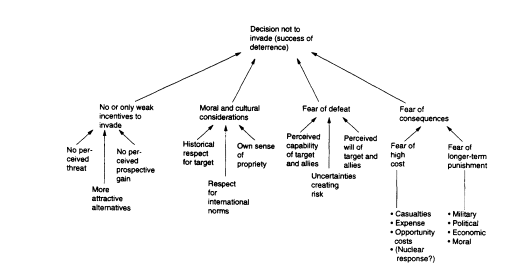
Figure G.1.1 Factors contributing to deterrence.
Although the tree happens to have emerged from using decision modeling methods to think about crises, conflicts, and deterrence, none of the factors in the tree is truly remarkable. The tree could have been assembled by merely combining ideas from a dozen texts and articles in international relations. However, viewing deterrence as influencing human beings operating in politically rich contexts has the effect of increasing the weight one puts on several of the factors, which are often mentioned in lip service and then discarded. Moving from left to right, we see that deterrence is served if the would-be aggressor has no compelling incentives to invade and if there are moral and cultural considerations that argue against invasion. These factors may remind us that Canadians do not lose sleep worrying about invasion by the United States; nor do the Low countries in Europe currently worry about historical enemies repeating their deeds. Moving rightward again in Figure G. 1.1, deterrence is served if there is fear of military defeat in an invasion attempt and if there is fear of other consequences even if "success" is likely. At the next level of detail there are some important distinctions, but what matters most to this discussion is recognizing that we must be serious about all of the factors, not merely list them and then move on to the more straightforward of military issues. Why? Because both history and analysis indicate that depending on extended deterrence by denial (being able to defeat invasion) to protect non-vital interests is probably a losing proposition. In some cases, deterrence by denial is not even militarily feasible. In other cases, it is politically very questionable because it requires prompt and decisive multilateral actions under ambiguous circumstances.
Page 134
Possible Suggestions for Weak and Medium-Strength States
One way to view the situation is to imagine ourselves giving advice to a generic weak or medium-strength state concerned about a strong and potentially troublesome neighbor. Motivated primarily by issues highlighted in Figure G. 1. 1, Table G. 1.1 summarizes possible suggestions. A few of the items merit elaboration.
Minimizing incentives for invasion (item 1) includes avoiding excuses such as mistreatment of ethnic minorities for whom the neighboring strong country sees a sense of responsibility (either real or contrived during an internal political crisis). Nurturing moral attitudes and cultural ties (item 2) includes the notion of identifying and weeding out "dangerous ideas" such as hatred-perpetuating stereotypes or distortions of history found in some countries' educational materials (e.g., Arab materials referencing Israel, Japanese materials misrepresenting as benign the brutal Japanese imperialism in Korea, materials claiming that recent events in Bosnia were "inevitable," or, less relevant here, American materials ignoring the mistreatment of Native Americans).
Maintaining a competent defense (item 3) is, of course, highly important if feasible, which it is not, for example, for Latvia. This, however, involves not just having an army, but also avoiding operational vulnerabilities that would make a quick and successful attack feasible. Today, a defender should worry about everything from special operations forces to information warfare. Operational arms control (item 4) has considerable potential because relatively straightforward measures can greatly reduce opportunities for surprise attack. It may also be that there will be increased interest in total force structures, including support, that lack credible offensive capability for theater-level campaigns, although this is a complex subject and it is futile to try to label weapons as offensive or defensive. In addition to all of these, weak or medium-strong states are well advised to seek protectors and, as necessary, to make their commitment credible and permit and even encourage prepositioning or forward deployment of forces. Countries should be discouraged from believing that the United States or any other protector can keep its forces "over the horizon" and quickly deploy them when needed. The last item in Table G. 1.1 deals with something listed ambivalently in Figure G. 1.1—nuclear weapons. By and large, dependence on nuclear weapons for deterrence is a dangerous game for weak countries. Such weapons assure that the countries are targeted, and the weapons might invite what would be alleged to be preemption or preventive war and are not obviously good deterrents anyway, except when nations appear willing to commit suicide rather than be occupied. Israel appears to be the exception here because it lacks strategic depth and is surrounded by large countries with a depth of religious and ethnic enmity that goes beyond normal rationality.
Page 135
|
|||||||||||||||||||||||||||||||||||||||||||||||||||||||||
Possible Suggestions for U.S. Security Planning
What is the complement of Table G. 1.1 for countries like the United States that would like to "extend" deterrence in politically and economically feasible ways? Table G. 1.2 suggests some principles. Many of them are by no means trivial. Even item 1 involves the controversial issue of NATO expansion but
Page 136
|
||||||||||||||||||||||||||||||||||||||||||||||||||||||||||||
Page 137
would perhaps go farther to envisage arrangements involving the Baltic states, Ukraine, and Taiwan among others. Item 2 recognizes that a major cause of failure for immediate deterrence in the past has been the failure to recognize and express interests clearly—clearly enough to be understood by adversaries who do not reason in the same "pragmatic" and status-quo-oriented way that we and our allies do and who respect power and firmness, not cosmetic compromise signals (e.g., a small-scale naval exercise without serious warfighting capability) that suggest lack of resolve and commitment.
The admonition to prepare for prompt intervention may sound obvious, but it involves more than building military capabilities. Democracies such as the United States have great difficulty reacting decisively under ambiguous circumstances. To mitigate these problems, the National Security Council might regularly conduct strategic crisis games that would serve both to prepare and to educate. Given strategic warning of a crisis, such games could be called as a matter of operational political-military doctrine—as a matter of responsibility. If game participants included appropriate members of Congress and appropriate allies, then working through the strategic dilemmas might go far to encourage unified prompt and decisive action early enough for immediate deterrence to work. Without such a doctrine of preparation, it seems likely that the United States will often be ineffective early in a crisis, when deterrence could work. This conclusion is the result of studies of past crises and the use of decision modeling to better understand the dilemmas felt by political leaders. The theory of immediate deterrence is much easier than its practice.
Another feature of preparing for prompt intervention includes dealing in advance with the weapons of mass destruction (WMD) problem. The United States needs a firm and frightening declaratory policy, backed up by operational capabilities, to deter use of WMD. In addition, the United States needs significant and even substantial active and passive capabilities for missile defense. Although this is already a national priority, it is also very difficult to achieve technically. A major factor in any real-world capability is likely to be early deployment, early commitment (in part for deterrence and in part to assure our own resolve), and early counterforce attacks on adversary systems, perhaps surprise preemptive attacks. Envisaging this is sobering given traditional American attitudes and behaviors. Without an ability to deter and, if necessary, defeat WMD, the United States is likely to be self-deterred with respect to protecting less than vital interests, especially if not already forward deployed and committed.
Continuing in item 3 of Table G.1.2, any realistic assessment of prompt intervention capability quickly demonstrates that the United States should be prepared to assure that the earliest-arriving capabilities are those tailored to supplement the defenses of the target state. This might include capability for DDay Air Force and Navy attacks on ground forces, air forces, and naval forces (including small boats used for special operations units). It might also include a capability for establishing information dominance, which implies not only
Page 138
superb reconnaissance and surveillance, but also the requisite communications with allies.
Arms control appears prominently in this list, as it does in Table G. 1.1. The basic principle is that deterrence can be greatly enhanced by making surprise attacks difficult, because aggressors typically want a quick, easy, and low-risk victory. In practice, surprise attacks have seldom been a surprise; instead, they have been the consequence of exploiting ambiguous circumstances. Arms control can reduce opportunities for such strategies by, for example, prohibiting the massing of potentially aggressive forces near a border. Actions in violation of the agreement would not be particularly ambiguous; they would indicate hostile intentions and would be more likely to trigger appropriate responses.
Unfortunately, arms control measures can also be counterproductive, especially measures proposed to avoid allegedly provocative actions in a crisis that would preclude increasing readiness to fend off attacks. Proponents of arms control in the form of confidence-building measures too often assume a requirement for symmetry that makes no sense militarily or in terms of security-related equity. For example, it would be ridiculous to require that a small state not be able to ready its modest forces along its borders merely because its mammoth neighbor state was enjoined from concentrating massive forces along the same border. There is a significant late-1980s literature on the theory of sound operational arms control.
One of the most important realities in thinking about immediate deterrence is that the current U.N. mechanisms for crisis action are altogether unsuitable and incompetent for supporting serious efforts at immediate deterrence. Alternative mechanisms must be found, because neither the United States nor its partners are likely to engage in unilateral actions, however virtuous. International legitimacy is essential.
Item 6 in Table G. 1.2 is unusual: it is a concept of assured strategic punishment of aggressors. "Punishment strategies" have been unfairly and incompetently maligned over the years by academic studies. Except for nuclear deterrence, which is deemed unique, it is often claimed that history proves that punishment strategies do not work. Claims to that effect fail to understand the underlying decision dynamics and overinterpret modest historical data (e.g., on the alleged failure of U.S. bombing of North Vietnam). What Table G. 1.2 refers to is something quite different and quite consistent with fundamentals of influencing decisions. A major deterrent of action is the certainty of prompt and unpleasant punishment. Today, a potential aggressor has many ways to rationalize (whether or not wisely) that punishment might not happen at all, would probably be short-lived if enacted, and would probably be spottily applied. By contrast, suppose that in each region of interest there were a regional security framework in which participants agreed—in advance—to respond to any armed aggression by immediately curtailing diplomatic relations, severing trade, and imposing an embargo. The potential aggressor would no longer be able to count on political dithering by the various states. Further, the leader of the aggressive state would no longer find it easy to persuade other
Page 139
|
||||||||||||||||||||||||||||||||||||||||||||||||||||||
Page 140
leaders that a proposed military action might be cost-free. Suppose further that the United States and other relevant nations were known to have capabilities and well-exercised operations plans for strategically significant military punishment of rogue states—e.g., destruction of the adversary's naval forces or attacks on economic targets expected to cause few civilian casualties. Surely, such options would further enhance worries about ''consequences." To be sure, military punishment options would be controversial against nations with the capability for nuclear strikes on the United States (or even regional states), but the existence of such punishment options would improve deterrence and the options might actually be executable, especially given overwhelming nuclear superiority and perhaps some level of ballistic missile defense. In any case it would seem unwise to preemptively discard such options out of a belief that they could never be credible.
POTENTIAL ACTIONS
What implications might this discussion have for follow-on actions? It would seem that there are many implications, but Table G. 1.3 summarizes some of the most important. It ends with possible actions for the Navy, without providing analogs for the other services, because the Navy sponsored the National Research Council study for which this paper was developed.


