
Page 141
APPENDIX G.2
Decision Modeling as an Aid to Strategic Planning and Crisis
Action
ABSTRACT
Most studies of deterrence and crisis action approach issues in the vernacular and structures of political science. This paper summarizes an alternative approach based on behavioral decision models. Decision modeling has distinct advantages for structuring issues, appreciating psychological factors, avoiding mirror imaging and the tyranny of the best estimate, and discriminating among situations when developing strategy. The decision models are not the familiar abstract constructs of utility theory, but rather natural-language models expressed in diagrams and tables that can be discussed in group settings and used to guide or generalize from political-military crisis games. Although the methodology requires background use of logic and mathematics and should be guided by serious analysts, it largely involves concepts and reasoning understandable by individuals with backgrounds as diverse as law, international relations, physical science, psychology, or military planning. The methods have been applied experimentally to nuclear crisis stability, understanding and predicting the behavior of Saddam Hussein, understanding historical crises early in the century, the decisions of states contemplating development of nuclear weapons, and strategies for dealing with North Korea.
INTRODUCTION
There are many ways to approach the issue of deterrence. The one discussed here (see references for details and citations to the literature) focuses on understanding the reasoning of the potential aggressor (who may not think of himself as an aggressor). This approach is concerned with human perceptions, arguments, and logic-all of them affected by psychological considerations. It seeks to describe such reasoning analytically by building models of reasoning that can be used not only to improve insights retrospectively but also to guide strategy prospectively.
In attempting to describe reasoning analytically, one could structure the problem in any of several ways. The approach described here assumes limited rationality and universal classes of reasoning patterns. Assuming "limited rationality" means that the relevant leaders (1) attempt to relate means to ends (i.e., their decisions and actions have purpose); (2) consider a range of options; and (3) evaluate those options in terms of likely outcome, most favorable outcome, and worst-case outcome. Thus, the leaders attempt to be rational and
Page 142
even take uncertainty into account. However, their decisions may be flawed because of incomplete or incorrect information, the mental frames through which information is viewed, anxieties, extreme dissatisfaction with the status quo, erroneous mental models of the other protagonists, and other factors. Perceptions may even shift wildly during a fast-moving crisis. Further, leaders have very different attitudes about risk taking.
It is controversial in some circles to assume rationality, but most of the national leaders who have sometimes been described as irrational (e.g., Adolph Hitler, Joseph Stalin, the Ayatollah Khomeni, and Saddam Hussein) were quite rational in the sense defined above. Some of them suffered from severe psychological problems and exhibited bizarre and abhorrent behavior, but their most strategically significant decisions can be understood in terms of their objectives and perceptions. It is also important to recognize that all of us are subject to making a wide variety of perceptual and reasoning errors, but we do not consider ourselves irrational. "Limited rationality" allows for a wide variety of such cognitive "errors," which go by names such as framing, anchoring, attributional inference, "group think," and so on.
The second assumption is that it is useful to structure the theory around universally observable types of reasoning rather than culture-specific concepts such as the so-called Arab, Oriental, Latin, or Western minds. To be sure, cultural factors can have profound effects that must be reflected in any application of theory, but the current approach has such factors entering along the way in context-dependent ways rather than as part of basic structure. The relevant behaviors of historical leaders can be found in all cultures, albeit with different frequencies. For example, the Arab world has produced Anwar Sadat and Saddam Hussein, and the Western world has produced George Bush and Adolph Hitler.
MODELING OPPONENTS AND THEIR ASSESSMENT OF OPTIONS
Assessment of Options
Let us next consider how many aggressors may, in effect, have reasoned about their options in the past and how many others may do so in the future. To repeat, they are attempting to make rational decisions. They are considering options and are also examining likely and possible consequences of those options, as suggested in Table G.2. 1. The format here is that for each option the reasoner estimates the likely outcome, most favorable outcome, and worst-case outcome. He then makes an overall assessment of the option based on these estimates. Each outcome is characterized by a value in the set {Very Bad, Bad, Marginal, Good, Very Good}. Although real-world reasoning is seldom so tidy or linear, the assumption here is that it ends up addressing the issues indicated.
Page 143
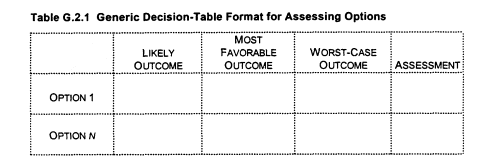
This basic structure is generic, but estimates of the various outcomes depend sensitively on perceptions and values. To understand how a potential opponent might reach individual judgments about, for example, the worst-case outcome (would it be Very Bad, Bad, Marginal, Good, or Very Good?), we need:
• Alternative mental images of the opponent,
• An understanding of what factors are most likely to affect the opponent's reasoning,
• A way to go systematically from the image and factors to estimates of the opponents' various judgments, and
• A way to combine judgments in reaching overall assessments of options.
Alternative Images of the Opponent
Developing alternative images is an antidote to some of the problems associated with the tyranny of best-estimate thinking, which is so often wrong. To develop alternative images of the opponent's reasoning, one can use a combination of essay writing, attribute lists, influence diagrams, and cognitive maps. In one image, for example, the opponent may be pragmatic and incrementalist; in another, he may be exceedingly ambitious and frustrated; in yet a third, he may feel cornered, surrounded by enemies, and desperate.
Figure G.2.1 shows contrasting "cognitive maps" (closely related to what others call "influence diagrams") used in a study of Saddam Hussein. They represent very different images of Saddam's perceptions about the economic situation in mid-1990. The convention in such diagrams is that when an arrow connects two items, an increase or improvement in the first leads to an increase or improvement in the second, unless there is a negative sign, in which case an increase or improvement in the first leads to a decrease or worsening in the second. Negative signs are usually used to indicate a troublesome influence.
Page 144
For example, at the bottom of Figure G.2.1a, we see that an increase in U.S. trade sanctions would worsen Iraq's economic status.
Figure G.2.1a represents the cause-effect relationships emphasized in the intelligence community's "best-estimate" understanding of Saddam prior to the invasion. Figure G.2. lb represents an alternative image that could readily have been formulated at the time, except for the pressures to focus on a single best estimate. It includes additional factors such as Saddam's perception that his problems were the direct result of Iraq's being squeezed deliberately by his enemies (the United States, Kuwait, and Saudi Arabia among them). It also highlights the connection between his economic travails and his grandiose ambitions. Note that although nearly all the experts would have agreed on all the factors in either diagram being "significant," the dominant mental image (Figure G.2. 1a) was one in which some of the factors were not given much emotional weight. The purpose of the diagrams is merely to highlight differences of perspective, in this case differences in perspective about how Saddam might be viewing the world. We used a number of such diagram pairs in depicting our two images or models of Saddam Hussein. Although the work started after the invasion and we therefore had no trouble constructing a model to explain it, the models were both insightful and predictive for Saddam's subsequent behavior through February 1991 (i.e., his failure to pull out of Kuwait in the kind of compromise American strategists feared).
Table G.2.2 illustrates a different method for clarifying distinctions between images of the opponent, one based on an attribute list. Again using the example from our study of Saddam Hussein, Model 1 is painted as being essentially pragmatic and relatively risk averse. Model 2 is more ambition driven and risk accepting.
Identifying the Factors Affecting Judgments and Decisions
Suppose we have used methods such as the cognitive maps, attribute lists, and other devices to develop strong alternative mental images of the opponent. The next step is identifying the factors (i.e., variables) most likely to contribute to the opponent's judgments, notably judgments about the likely, best-case, and worst-case outcomes of various options. It is not very useful to attempt this in abstract terms, because so much of what seems to matter is exquisitely context dependent. It is more useful to brainstorm the problem with an interdisciplinary mix of regional experts and strategists, to identify key factors in concrete "natural" language (e.g., Saddam Hussein's assessment of President Bush's resolve), and to develop hierarchies of such factors (or variables). This approach reflects the observation that people make their most reasoned judgments on the basis of only a few "high-level" variables, but these variables, in turn, sometimes reflect many subordinate judgments about "lower-level variables."
Page 145
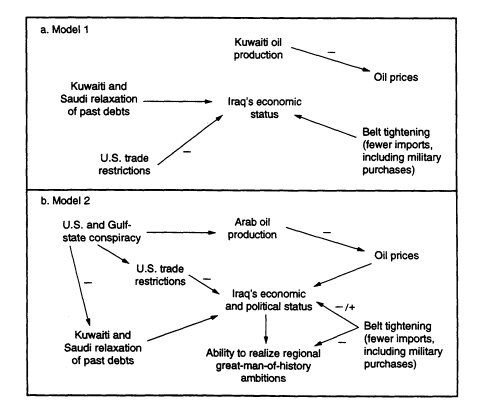
Figure G.2.1 Saddam's image of the 1990 economic situation: two models.
To illustrate this, consider how Saddam Hussein may, in mid-1990, have assessed his worst-case outcome (i.e., his "risks") for an option in which he invades Kuwait. Was the worst-case outcome (risks) very bad, bad, marginal, good, or very good? In the summer of 1990 as Saddam Hussein contemplated this matter, it is likely that he considered the risks would result from two principal possibilities: the possibility that the United States would defend Kuwait directly and immediately, and the possibility that even though the United States didn't defend Kuwait itself, it would deploy forces into Saudi Arabia and change the balance of power in the region We do not know that Saddam thought about the problem this way, but it is likely that these possibilities were on his mind explicitly or implicitly. To assess risks, then, he would be concerned about the likelihood of each of these possibilities and the consequences. The consequences of an immediate war with the United States would obviously be very bad, but the likelihood of that (i.e., the likelihood of the United States defending Kuwait) probably did not appear large. The United States was more likely to deploy into Saudi Arabia, although the Saudis probably would not permit it, but even if such a deployment and related
Page 146
|
|||||||||||||||||||||||||||||||||||||||||||||||||||||||||
sanctions occurred, the likely consequences would be tolerable: the Saudis would tire of the U.S. presence, other regional states would deplore it, and economic sanctions would probably not last longer than 6 months or so.
Figure G.2.2 characterizes hierarchically Saddam's likely risk assessment when he contemplated the particular option of conquering Kuwait. For example, the figure suggests that Saddam would have seen larger risks if there had been strong and credible political warning of U.S. intervention, warning evidenced by strong and credible diplomatic messages along with other indications of resolve by President Bush and Congress. Saddam would also have seen higher risks if there were reason to believe that the United States considered Kuwait to be a vital national interest. Indicators of that might have been a defense agreement, the presence in Kuwait of U.S. forces, or "objective" considerations such as the expectation that Iraq would cut off Kuwaiti oil to the West. Diagrams such as that in Figure G.2.2 can be worked out in group discussions and then embellished with subsequent analysis.
Page 147
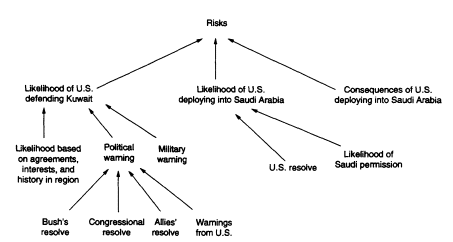
Figure G.2.2 Possible map of Saddam's assessment of risk before invading.
Estimating the Opponent's Judgments and Decisions
Given alternative images of the opponent and an understanding of likely options and major variables or factors, it is possible to estimate how the opponent might reason in a wide variety of circumstances—not merely today's circumstances, but those that might exist tomorrow or next year. For each image of the opponent, we can develop what can be called judgment tables and decision tables. Judgment tables represent how the opponent might look at each of several factors and reach an overall judgment about, say, the most likely or worst-case outcome of a given option. A decision table is similar but relates specifically to evaluating the options in a common format.
Table G.2.3 illustrates a judgment table for model 2 of Saddam Hussein evaluating risks of a conquer-Kuwait option in mid- 1990 consistent with the factors identified in Figure G.2.2. It covers a wide variety of possible world situations. Lines indicated in bold letters show the situations that Saddam probably believed best characterized reality in mid-1990, with the result that he probably considered risks to be marginal (or less) rather than bad or very bad.
Table G.2.4 shows a decision table for model 2 of Saddam Hussein evaluating strategic options in late July 1990. The net assessment for the conquer-Kuwait option is very good. (By contrast, model l's assessment was very bad.)
Where do the judgments and decisions (i.e., the values in the last columns of Tables G.2.3 and G.2.4) come from? They are subjective estimates made by the author and colleagues, who studied the alternative images and tried to "get inside the minds" of the adversaries. However, there is logic connecting the elements of the image (e.g., the cognitive maps and attribute lists) with the individual judgments. Indeed, some of this can be treated mathematically to
Page 148
improve rigor. (It is also possible to build artificial intelligence models to formalize the logic, but the price of doing so is very high.)
The following formula is one way to express the combining logic mathematically when estimating the "net assessment" of an option:
N = R{aL+bM+cW}/{a+b+c}
Here N is the net assessment of an option; L, M, and W represent, respectively, the likely outcome, most-favorable outcome, and worst-case outcome; R is a rounding operator; and a, b, and c are weighting factors. If reasoning itself is qualitative, then the formula can be used by first mapping the qualitative values into numbers (e.g., very bad? -2, bad? -1, . . .), computing the net assessment numerically, and then remapping the result back into qualitative values. This approach creates a preference order for the options. By choosing different values of a, b, and c, one can represent the reasoning of leaders that are more and less risk acceptant, or less and more tolerant of the status quo. This is quite important in practice.
It is useful to postulate several types of reasoning that differ primarily in attitudes toward risk and that assume a higher willingness to take risks when the current and projected situations are deemed to be very bad and a reduced willingness to take risks when the current situation and prospects are deemed to be reasonably good. This reflects the well-established (and intuitively familiar) psychological phenomenon described in "prospect theory," developed largely through the work of Daniel Kahneman and Amos Tversky. Psychologically, the reasoning styles might better be characterized as having a predisposition to "go for it" or "take no chance," depending on perceptions about the goodness of the current situation and current trends. Another key point the author has highlighted is the role of thresholds: below some level of perceived probability, risk is treated as zero, despite the consequences of the risk. That is, not only do we often underestimate risks, but we also often go farther and ignore those we have judged low. The reverse also happens: we sometimes rule out options because we see them as involving a level of risk beyond some threshold of acceptability.
The point here is that we cannot only construct formal models to reflect best-estimate notions about how the opponent is and may in the future be reasoning; we can also construct alternative models to reflect fundamental uncertainties about the nature of that reasoning. The principal question, of course, is whether we have to consider an infinite number of such alternative models. The answer appears to be no. Indeed, having two or at most three models appears to go a very long way, especially since one can also do sensitivity analysis within a given model. This is crucial, because it means that the technique, which is surely good for getting groups to confront uncertainty and be more humble about any "best estimate," should also be workable in practice. Formal intelligence estimates and high-level meetings should be able
Page149
|
||||||||||||||||||||||||||||||||||||||||||||||||||||||||||||||||||||||||||||||||||||||||||||||||||||||||||||||
|
||||||||||||||||||||||||||||||||||||
Page 150
to cope with two, or conceivably three, very different perspectives on how the opponent may be thinking.
FACTORS TENDING TO INCREASE RISK TAKING
Since risk-taking propensity is such an important issue in determining the probability of aggression, it is worthwhile to review major factors tending to increase a willingness to assume risk (Figure G.2.3). Starting at the top and moving clockwise, we see first the previously mentioned role of the current situation. The next factor is the degree to which the decision maker can make decisions unilaterally, without broad discussion that might mitigate perceptions and introduce new considerations. The next factor is ambition. This is often underestimated in thinking about adversaries in crisis and conflict. Status quo powers fairly comfortable with their own circumstances are especially likely to underestimate others' ambitions. So it is that Saddam Hussein was erroneously assumed to be ''pragmatic" and to be merely looking for a way to improve Iraq's economic situation "somewhat," when in fact he had grandiose goals. Similarly, the United States applied incrementalist compellence logic to Ho Chi Minh, when he was an idealist revolutionary. Other factors include opportunities for reaching important goals, the abstractness of risk factors (the more abstract the risk factor, the more it may be underestimated by someone who is yearning for action), pain, and the degree to which the protagonist believes he is in control of events and therefore able to "make his own luck." All of these factors should be familiar from everyday life, supplemented by a knowledge of history. It should perhaps be obvious that in applying the theory described above, one considers the presence or absence of the factors in Figure G.2.3 when estimating how a given type of decision maker might judge the worst-case outcome of a given option. One also uses these factors in judging which reasoning models to employ (e.g., in choosing parameter values a, b, and c, and rounding rules of equation 1, to correspond to more or less risk aversion).
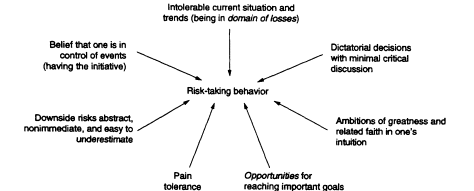
Figure G.2.3 Factors contributing to risk-taking behavior.
Page 151
A GENERIC SITUATION ENCOURAGING AGGRESSION
Let us now consider a sketch of how the theory applies to real-world problems of defense planning and foreign policy. To do so, consider first a decision table describing a remarkably generic situation to be avoided, one in which aggression is possible and deterrence is difficult. Table G.2.5 is the decision table that we do not want potential aggressors to be implicitly using.
The salient features of this somewhat generic dangerous situation are
• The perception that the current situation is very bad (implicit in the conclusion that a continuation of peaceful policies would have a very bad likely outcome);
• The perception that continuing current or other peaceful policies will not improve the situation;
• The perception that mere coercion may have a payoff, but not much, and might make things worse (e.g., by strengthening the coalition of hostile interests and by causing the potential target of aggression to increase its defenses); and
• The perception that military action is likely to pay off, may pay off handsomely, and involves risks that are not outrageous and perhaps only marginal.
• Importantly, national leaders have their own standards in evaluating current situations and the outcomes of various options. These often differ substantially from the standards that leaders of other nations might expect. As suggested above, it is easy to underestimate ambitions (and emotions) of adversaries by
|
||||||||||||||||||||||||||||||||||||
Page 152
assuming that they will behave "pragmatically" or "reasonably," by which is meant being satisfied with only marginal improvements in their situation.
It is also a profound mistake to believe that adversaries necessarily reason in a way that decision theorists would describe as attempting to maximize expected utility. Exceedingly ambitious, goal-driven people often seek to maximize the likelihood of success, which is quite different psychologically from maximizing expected utility. That is, utility theory is a poor way to represent such reasoning even though one can look at behavior and infer effective utility functions.
CONCLUSIONS
The methods described here could be profitably used routinely in a wide variety of national security planning contexts such as studies of plausible contingencies, peacetime crisis gaming, high-level gaming in the presence of strategic warning, and the development of better intelligence assessments. They are particularly good for getting beyond the "tyranny of the best estimate" that has so badly affected prior decision making. They are also very good for structuring discussion and allowing strategists to discriminate among situations that might appear analogous if one were to operate solely on the basis of intuition gained from real-world experience and a few human crisis games. That is, the methods described here can draw heavily on experiential methods such as gaming, but they are substantially more analytic and integrative. A word of caution, however. These methods are no better than those who apply them. Ideally, applications should be guided by strongly analytic people drawing, in an interdisciplinary setting, on the perspectives and expertise of strategists, regional experts, military officers, and others.
BIBLIOGRAPHY
Davis, Paul K., ed., "Improving Deterrence in the Post-Cold War Era: Some Theory and Implications for Defense Planning," New Challenges for Defense Planning: Rethinking How Much Is Enough, Rand, Santa Monica, Calif., 1994.
Davis, Paul K., and John Arquilla, Deterring or Coercing Opponents in Crisis: Lessons from the War with Saddam Hussein, Rand, Santa Monica, Calif., 1991.
Thinking About Opponent Behavior in Crisis and Conflict: A Generic Model for Analysis and Group Discussion, Rand, Santa Monica, Calif., 1991.
For an application to proliferation issues see:
Arquilla, John, and Paul K. Davis, Modeling Decisionmaking of Potential Proliferators as Part of Developing Counterproliferation Strategies, MR-467, Rand, Santa Monica, Calif., 1994.


