
5
The Estimation of Earthquake-Generated Ground Motion
Chapter 5 of the Senior Seismic Hazard Analysis Committee's (SSHAC) report, entitled “Methodology for Estimating Ground Motions on Rock,” addresses the basic building block of a well-executed probabilistic seismic hazard analysis (PSHA) that has the surest observational and theoretical foundation. The past two decades have brought significant theoretical advances in ground motion models, as well as significant new data sets with which to test the new models. Fundamental to the stability of state-of-the-art high-frequency (f = 1 Hz) ground motion estimates is the essential constancy of earthquake stress drops. This allows the substantial experience developed from California and elsewhere to be transferred to the eastern United States (EUS) with little modification.
There are, to be sure, real variations in earthquake stress drops, and recent data for the EUS point to some anomalous magnitude-dependent high-frequency excitation (Atkinson, 1993). The EUS data set on the excitation and propagation of earthquake ground motion for the purposes of PSHA is still very sparse. Model predictions of EUS earthquake ground motion, whether empirical or theoretical, can vary significantly across the magnitude, distance, and frequency range of interest.
SCIENTIFIC VALIDITY AND CLARITY OF PRESENTATION
SSHAC's Chapter 5, together with the supporting Appendixes A and B (Ground Motion Workshops I and II), is an impressive synthesis of current knowledge about estimating high-frequency ground motions and their uncertainties in the EUS. The reader experienced in SHA will note
that site-response issues, including nonlinear effects, are not addressed, on the grounds that they can only be incorporated on a site-specific basis.
Chapter 5 is itself a well-written primer on the essentials of ground motion estimation, valid for any region in which earthquakes occur. It begins with basic ground motion measures; provides the fundamentals of magnitude, distance, and site response; and describes the essentials of empirical and theoretical predictions of earthquake ground motion. It explicitly warns against the use of fixed spectral shapes anchored by peak ground acceleration (PGA) alone, and then progresses to a discussion of uncertainty in ground motion predictions. A fourfold decomposition of uncertainty for the Hanks and McGuire (1981) pointsource, stochastic model, the simplest physical model used in these predictive exercises, is demonstrated in this discussion. Readers should study this decomposition carefully (Table 5-1, Section 5.5.1). It is difficult, and, if this example is not well understood, similar attempts at uncertainty decomposition for more sophisticated and parametrically complicated models will be frustrating.
Section 5.7, “Specific Expert-Elicitation Guidance for Obtaining Ground Motion Values,” is based on the results of Workshops I and II, reported in detail in Appendixes A and B. Figure 5-5, reproduced as Figure 2.1 in this report, is intended to guide readers through the process. Regrettably, it is not well keyed to the description in the text.
CONTRIBUTIONS TO THE DEVELOPMENT OF PSHA: SUMMARY OF THE GROUND MOTION WORKSHOP RESULTS
The comprehensive treatment of ground motion estimation in Appendixes A and B is an important contribution to the SSHAC effort. Workshop I provided for the presentation of four basic ground motion estimation models: (1) intensity-based models presented by M. D. Trifunac, (2) empirical models presented by K. W. Campbell, (3) stochastic or random-vibration models presented by G. M. Atkinson, and (4) the empirical source-function method presented by C. Saikia. These proponents of the models were asked to evaluate the models in the company of 10 additional experts, the “invited participants” listed in Table A-1 of the SSHAC report. The principal result of Workshop I was rejection of intensity-based models for estimating ground motion in the EUS (SSHAC Table A-2). Additional information was collected on the
applicability or validity of all models as a function of frequency, magnitude, and distance (SSHAC Tables A-3 and A-4). These polls of the assembled experts also show a distinct preference for the stochastic models.
Workshop II proceeded to actual ground motion numbers and their uncertainties on the basis of the “selected models” resulting from Workshop I. The threefold elicitation exercise that constituted Workshop II, described below, provided for pre-, co-, and postworkshop estimates. Prior to the workshop, the four proponents were asked to provide estimates of peak acceleration and spectral accelerations based on the ground motion models they actually use, along with the corresponding estimates of epistemic and aleatory uncertainties. The distances, frequencies, and magnitudes for which estimates were requested are listed in an unnumbered table in “Instructions for Proponents,” Appendix B. In keeping with the Workshop I preference for stochastic models, two of the four Workshop II proponents supported stochastic models (Atkinson and Silva), although there are significant differences between their models.
In advance of Workshop II these ground motion estimates were sent to three additional experts. These experts were asked to provide their own estimates of ground motion and uncertainties for the same distances, frequencies, and magnitudes, on the basis of what the proponents had provided, as well as any other information they considered relevant. Significantly, the four proponents were also asked to perform as experts; as such, their ground motion estimates were generally not the same as those they provided as proponents. These pre-Workshop II ground motion estimates and uncertainties are labeled as Expert 1 results, examples of which are shown in SSHAC Figure B-3, reproduced here as Figure 5.1a.
The second stage of the elicitation process occurred at the workshop, attended by all proponents and experts, the integration team, and several observers (SSHAC Table B-1). The principle of “active listening ” was put to work, the idea being that all proponents and experts were to understand what every other proponent and expert was doing, whether or not he/she agreed with it. The panel concludes that this worked very well, revealing significantly different interpretations of key terms and procedures. It is noteworthy that Workshop II deliberations also revealed considerable misunderstandings about the differences between epistemic and aleatory uncertainties.
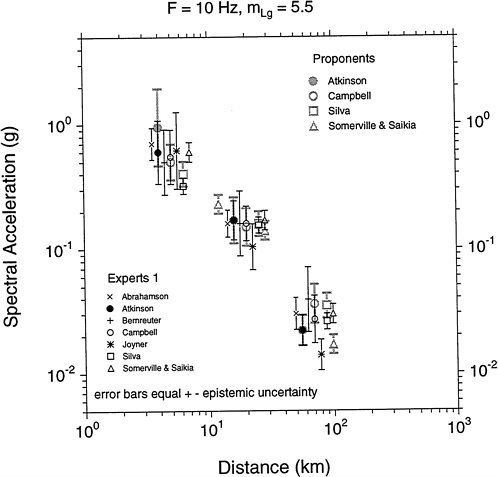
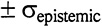 epistemic range.
Next, experts (at this stage all proponents were now experts) were asked to reconsider overnight their estimates of ground motion and uncertainties. This led to the Expert 2 results, which are compared to the Expert 1 results. An example (SSHAC Figure B-7) is reproduced here as Figure 5.1b. The differences are modest to zero at f = 10 Hz and somewhat greater at f = 1 Hz.
Two activities followed the workshop. First, all experts were invited to change their estimates one more time. Only a few did, and no one offered significant changes. An example of the integrated Expert 3 (postworkshop) results is shown here in Figure 5.1c (SSHAC Figure B-21). The second postworkshop activity was the manipulation of the Expert 3 results by the Integration Team. The results of the seven experts were weighted equally (SSHAC Table B-8, shown here as Table 5.1), and the results of the four proponents were weighted unequally (SSHAC Table B-9). The former are the preferred results, but the differences in median values and epistemic and aleatory uncertainties are slight.
IMPLICATIONS FOR FUTURE GROUND MOTION ESTIMATION
The many successes and few limitations of the Workshop II elicitation/integration process are summarized in Section B.5, “Concluding Observations and Discussion,” of the SSHAC report. The panel is impressed with the success of this process in two principal ways, one of which SSHAC recognized and the other it did not.
SSHAC recognized explicitly that “the Proponents and Experts exhibited a striking amount of agreement. . . .” Once freed from the thicket of unintentional disagreements, mutual misunderstandings, and individual egos, the group of specialists who participated found that what it knows about ground motion estimation is impressively consistent. The panel doubts that this degree of consistency and agreement could have been achieved without this highly interactive elicitation/integration process.
There may be some who will believe that this agreement is illusory, that in some unspecified way it was cajoled or coerced. The panel finds no evidence of this. Doubters should note the workshop finding that “the estimated values of aleatory uncertainty for 10 Hz and
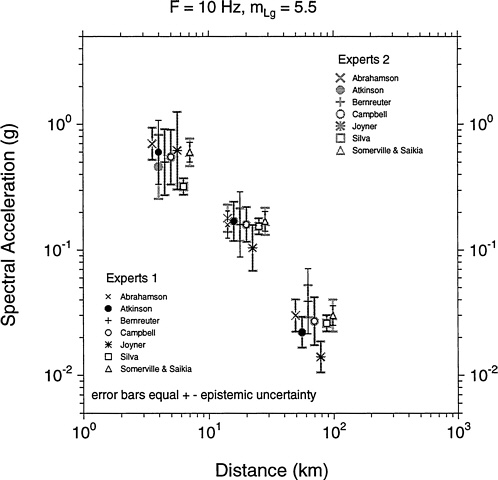
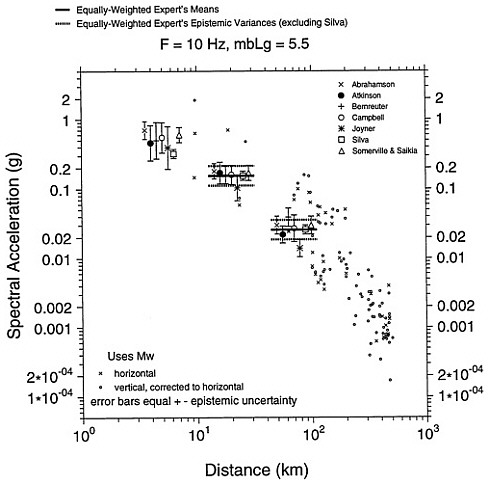
TABLE 5.1 Results of Integrating Experts' Estimates with Equal Weights (Table B-8, Appendix B, SSHAC Report)
|
f (Hz) |
mbLg |
R (km) |
Median Amplitude (g) |
Epistemic Std. Dev. |
Aleatory Std. Dev. |
|
1 |
5.5 |
20 |
1.09E−02 |
0.48 |
0.80 |
|
5.5 |
70 |
2.27E−03 |
0.46 |
0.80 |
|
|
5.5 |
200 |
9.36E−04 |
0.37 |
0.80 |
|
|
7.0 |
20 |
1.67E−01 |
0.66 |
0.78 |
|
|
7.0 |
70 |
4.50E−02 |
0.71 |
0.78 |
|
|
7.0 |
200 |
1.82E−02 |
0.73 |
0.79 |
|
|
2.5 |
5.5 |
20 |
4.17E−02 |
0.34 |
0.77 |
|
7.0 |
20 |
3.67E−01 |
0.53 |
0.73 |
|
|
10 |
5.5 |
20 |
1.55E−01 |
0.32 |
0.73 |
|
5.5 |
70 |
2.58E−02 |
0.32 |
0.75 |
|
|
7.0 |
20 |
8.45E−01 |
0.52 |
0.70 |
|
|
7.0 |
70 |
1.88E−01 |
0.53 |
0.72 |
|
|
25 |
5.5 |
20 |
2.13E−01 |
0.34 |
0.73 |
|
7.0 |
20 |
1.07E+00 |
0.51 |
0.70 |
|
|
PGA |
5.5 |
70 |
1.28E−02 |
0.41 |
0.75 |
|
7.0 |
70 |
9.36E−02 |
0.51 |
0.70 |
PGA are, however, significantly higher than [the] values obtained using western North America strong-motion data, especially for large magnitudes.”
SSHAC did not comment on the extent to which the workshop ground motion estimates and uncertainties can actually be used in future PSHA studies, at any level. The panel recognizes that there is a certain incompleteness about Table 5.1. Considerable interpolation and some extrapolation of the results in that table will be required to cover the many distances, frequencies, and magnitudes that must be considered in even the lowest-level PSHA. Unfortunately, the elicited results for R = 5 km, where R is the distance between the seismic source and the affected area, are not presented by SSHAC, presumably because of problems with the interpretations of “closest distance.”
Even if the SSHAC ground motion results are not suitable for further use in their present form, the panel wonders how many times this information will be reelicited in the future. The panel believes that community consensus on PSHA-type ground motion issues, at any level of PSHA, may well be close at hand, at least within the limits of the ground motion models and data sets available in 1994. The broad agreement resulting from the two SSHAC ground motion workshops led to this opinion of the panel. With further consideration of some additional distances, frequencies, and magnitudes, together with appropriate interpolation schemes, ground motion matters of concern to PSHA could well be resolved at least for the next few years.


