
1—
Introduction and Background
THE GROUND WATER VALUATION DILEMMA IN BRIEF
Typically, water in the United States has not been traded in markets. Because of this, there are no market-generated prices or meaningful estimates of the value that markets would assign to water, if in fact water were a traded good. This undetermined value for water is most apparent in the case of ground water. Whatever might have been the historic circumstances, there is no basis today for our practice of judging the value of ground water to be negligible. All scarce resources, commodities, and services have value. Ground water is often a scarce resource, whether judged by the direct use people make of it (for example, as drinking water) or by its less obvious ecological functions, such as wetlands maintenance and its contribution to stream flow; or the prevention of land subsidence.
The longer we ignore or distort ground water's value, the more overused, degraded, and misallocated the resource becomes. Without price signals or other indicators of value to help guide policy, we tend to devote too little attention and funding for resource management and protection of ground water.
Goods or services that are generally not ''owned" in the same sense as other property are often not traded in well-functioning markets. Without such markets, determining the value of these goods and services becomes more complicated, and analytical efforts must be made to estimate values. In the case of ground water, that estimate must account for both the cost of pumping and delivery and
the inherent value of the resource, reflecting its multiple services, the "goods" it provides and the "costs or hardships" it protects against. In many states and localities, however, the charge to the user is confined to out-of-pocket costs such as energy for pumping and amortization of investments in well construction and costs of treatment and distribution systems. These are necessary components of the value of ground water. But undervaluation of the resource is inevitable, principally because there is no widely accepted means of recording users' or society's valuation of those broader use and nonuse attributes.
Improved ground water valuation techniques and estimates could assist water resource management and policy-making in many important ways. For example, an improved ability to weigh alternative water sources or protection strategies should lead to better allocation of scarce Superfund dollars. There is general agreement that water resource decision-making has focused mainly on an evaluation of alternative projects primarily by the costs of these projects. However, improved techniques would facilitate the decision-making for cleanup and protection based on a better standard, one that compares values and benefits of different ground water sites.
The valuation principles described in this report can be a critical input to but are distinct from cost-benefit analysis. That is because the estimation of costs (for example, the infrastructural investment requirements of a municipal water system) is of secondary concern here. To be sure, certain nonmarket values at risk on the cost side, such as subsidence, increased salinity from excessive ground water mining, wetland degradation, and destruction of riparian habitat are relevant. The principal emphasis here is on methods that value the benefits of ground water.
Ground water valuation concepts and challenges discussed in the following chapters cut across numerous valuation dilemmas in the natural resources-environmental arena. An example of such similarity and overlap is the problem of assigning values to surface water. Of course, surface water and its management provide some unique services (e.g., navigation, power, and flood control) not applicable to ground water, but many services are common to both surface and ground water (household use, irrigation, and joint ecological benefits, such as wetlands maintenance). Moreover, ground and surface water are hydrologically linked, so that the contamination of one body can migrate to the other. There is no way to divide up benefits neatly and analyze value simply.
CONTEXT FOR GROUND WATER VALUATION
Trends in Ground Water Use and Protection
Tables 1.1 and 1.2 and Figure 1.1 provide quantitative highlights of trends in U.S. water use. The growth of withdrawals of ground or surface water from 1950 to 1990, occurred largely during the first 25 years of that time span, substantially
TABLE 1.1 Withdrawals of Water, by Type and Category of Use, 1990
|
|
|
Percent of |
|
|
|
Million gals. per day |
Total U.S. |
Ground or Surface |
|
U.S. Total |
408,000 |
100.0 |
|
|
Ground water, total |
80,620 |
19.8 |
100.0 |
|
Public supply |
15,100 |
3.7 |
18.7 |
|
Domestic |
3,260 |
0.8 |
4.0 |
|
Commercial |
908 |
0.2 |
1.1 |
|
Irrigation |
51,000 |
12.5 |
63.3 |
|
Livestock |
2,690 |
0.7 |
3.3 |
|
Industrial |
3,960 |
1.0 |
4.9 |
|
Mining |
3,230 |
0.8 |
4.0 |
|
Thermoelectric |
525 |
0.1 |
0.7 |
|
Surface water, total |
327,000 |
80.1 |
100.0 |
|
Public supply |
23,500 |
5.8 |
7.2 |
|
Domestic |
132 |
0.0 |
0.0 |
|
Commercial |
1,480 |
0.4 |
0.5 |
|
Irrigation |
85,500 |
21.0 |
26.1 |
|
Livestock |
1,800 |
0.4 |
0.6 |
|
Industrial |
18,600 |
4.6 |
5.7 |
|
Mining |
1,718 |
0.4 |
0.5 |
|
Thermoelectric |
194,500 |
47.7 |
59.5 |
|
SOURCE: Compiled from Solley et al., 1993. Because of rounding, individual items may not add precisely to totals. |
|||
exceeding U.S. population growth in that period. Since 1975 water use has remained essentially flat. The U. S. Geological Survey (USGS) singles out three factors to account for that level trend. First, higher energy prices and declines in farm commodity prices in the 1980s reduced the demand for irrigation water and spurred the introduction of more efficient pumping technologies. In addition, pollution control regulations encouraged recycling and reduced discharge of pollutants, thereby decreasing water requirements in the industrial sector. And more generally, the public became increasingly concerned about conservation (Solley et al., 1993). No doubt the slowdown in development of new hydroelectric capacity in the United States contributed as well. However, the USGS does not identify water pricing as a factor in the deceleration of water use, though higher energy prices would have constituted an indirect disincentive to consumption.
Ground water is the predominant source of water supply for rural areas in the United States, primarily for agriculture and domestic use. In 1985 ground water provided drinking water for more than half the U.S. population and 97% of the rural population (Moody, 1990). As Table 1.1 indicates, agriculture (irrigation
TABLE 1.2 Trends of Estimated Water Use in the U.S., 1950-90
|
|
|
|
|
|
|
|
|
|
|
Average annual % rate of change |
|
|
|
1950 |
1955 |
1960 |
1965 |
1970 |
1975 |
1980 |
1985 |
1990 |
1950-75 |
1975-90 |
|
Population (mill.) |
150.7 |
164.0 |
179.3 |
193.8 |
205.9 |
216.4 |
229.6 |
242.4 |
252.3 |
1.5 |
1.0 |
|
Withdrawals (bill. gals. per day) |
180 |
240 |
270 |
310 |
370 |
420 |
440 |
399 |
408 |
3.4 |
-0.2 |
|
Ground |
34 |
48 |
50 |
60 |
69 |
83 |
84 |
74 |
81 |
3.6 |
-0.2 |
|
Surface |
150 |
198 |
221 |
253 |
303 |
329 |
361 |
325 |
327 |
3.2 |
-0.0 |
|
SOURCE: Compiled from Solley et al. (1993). Because total withdrawals were rounded off, the ground and surface numbers do not add precisely to totals. |
|||||||||||
and livestock) uses approximately two-thirds of the total ground water withdrawn in the United States, with public supply (including domestic withdrawals) accounting for nearly a quarter of the total.
In the late 1970s and early 1980s, the U.S. Environmental Protection Agency (EPA) began to direct attention toward ground water pollution studies, emphasizing the identification and evaluation of pollution sources and source categories and subsurface transport and fate processes for both inorganic and synthetic organic chemicals. Also in the early 1980s, the inception of the Superfund program brought attention to the need to clean up contaminated soil and ground water and led to major remediation programs by EPA and the Departments of Defense and Energy. In 1984 EPA adopted a ground water protection strategy that focused on land use planning, engineering control measures, and management practices that could be used to prevent ground water contamination and thus protect ground water quality.
The Safe Water Drinking Act of 1986 included a wellhead protection program to further encourage such pollution prevention efforts by state and local governments. EPA has continued to promulgate policies and related guidance to stress the importance of protecting renewable ground water resources from contamination and thus minimize the need for remediation efforts (U.S. EPA, 1991).
Ground Water Valuation Terminology
The inherently interdisciplinary nature of the ground water valuation problem becomes obvious in the confusion about terminology used to describe it. There is no commonly used ground water valuation terminology and no one set that is obviously superior. Two different sets of valuation terminology are displayed in Table 1.3. The first is based upon the physical state of the ground water from which value is derived. The primary distinction is between extractive values, which occur as a result of the extraction of ground water and subsequent consumptive use, and in situ values, which occur as a consequence of leaving the water in the aquifer. Extractive values include municipal, agricultural, and industrial uses of water, uses that nearly always include a sizable component of consumptive use. In situ values are derived from the services provided by leaving water in the aquifer and typically do not involve consumptive transformation of the water. In situ values include ecological values, buffer values, values associated with the avoidance of subsidence, recreational values, existence values, and bequest values.
The second set of terminology comes from the economic literature or the valuation of ground water resources which classifies ground water values in terms of use values and nonuse values. This distinction acknowledges that use values are associated with both consumptive and nonconsumptive uses of water, including ecological uses, buffering, subsidence avoidance, and recreation. By contrast, nonuse values, including existence and bequest value, may occur when
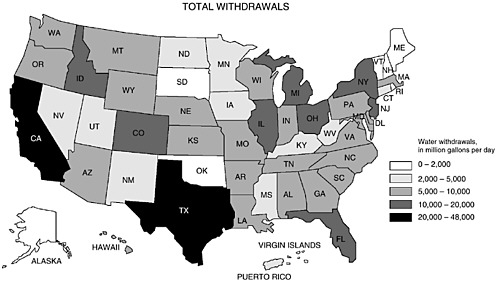
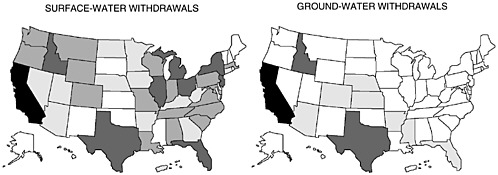
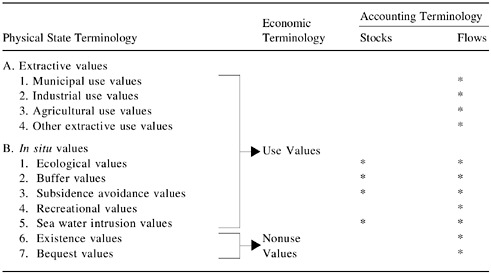
TABLE 1.3 Taxonomy of Ground Water Valuation Terminology
the ground water is not devoted to any use. The relationship between these two different sets of taxonomies is also depicted in Table 1.3. The terminology used in the remainder of this report follows these two taxonomies and the relationship between stocks and flows of ground water. It is important to recognize that it is sometimes difficult to draw a distinct line between use and nonuse values. For example, in southern California ground water in the aquifer has a value in protecting against sea water intrusion. Sea water intrusion can affect both the use values of ground water, by increasing the cost of drinking water supplies, and the nonuse values, through contamination of the aquifer even if it was never to be used as source of water for human consumption.
Unless care is taken in definition and use, both sets of terminology may mask or confuse the important distinction between values which are associated with a flow or stream of goods and services and values which are associated with stocks or assets which create those streams. Flows or streams of value, such as use values which come from extraction, recur over time and contrast with stock values which are the value of an asset (or liability) which yields flows of value over time. Flow values and stock values are linked because a stream of values (costs or benefits) can be converted into an asset value by calculating the present discounted value of the flow. Failure to distinguish between the value of flows and the value of a stock or asset may result in double counting or other errors. The last two columns of Table 1.3 indicate whether the various categories of physical state or economic values are commonly treated as flows or stocks or as both. In instances where values are commonly expressed as either stocks or flows, it is important to specify whether the value is a flow value or a stock (asset value).
Services Provided by Ground Water
Tables 1.4 and 1.5 encapsulate some of the major services ground water provides that give rise to economic value. (Detailed discussion of the approaches used to determine quantitative estimates of value is in Chapter 4.) Although many people already appreciate or may have intuitively accepted the nature of these services and the importance of assigning value to them, they have not engaged in widespread action to more effectively conserve, protect, and allocate these resources. Part of the problem no doubt arises from the technically demanding nature of the problem, for example, the complex behavior and properties of aquifers. In particular it is challenging to evaluate from an economic perspective the ecological services rendered by ground water since such services are not traded in markets and are viewed in a highly subjective way.
Table 1.6 (also in Chapter 4 as Table 4.5) presents an overview of the alternative valuation methods for addressing selected ground water functions/services. These economic valuation methods and existing applications are discussed in more detail in Chapter 4.
Ground water problems are receiving more attention for a number of reasons. Increased withdrawals are causing problems such as subsidence, salt water intrusion, and destruction of wildlife habitat. Public water supply systems dependent on ground water can be found in every state (Solley et al., 1993). Also, the importance of ground water as a buffer, or emergency supply, is beginning to be more widely recognized. This value was illustrated in California during the drought in the early 1990s, when demands for surface water far outstripped the available supplies. Agricultural and municipal ground water use increased dramatically, causing concerns about whether ground water protection regulations were adequate.
The importance of ground water has also changed in the context of conjunctive use. Recharge of surface water in Florida and use of effluent to replenish ground water is now common in southern California. In this context the ground water aquifer becomes an actively managed storage facility, with ground water supplies replenished by flood flows, imported surface water, and treated effluent. Water is cycled through the aquifer materials on a relatively short term basis and provides a buffer against shortages of surface water.
The environmental values associated with ground water are also becoming more widely recognized. Just as the ecosystem concept is gaining more recognition in habitat management to protect animal species, the role of ground water in the support of surface water supplies, wetlands, and riparian habitat is more clearly understood.
Management/Regulatory Decisions Related to Valuation
Most decisions regarding ground water development, use, or protection are
TABLE 1.4 Potential Service Flows and Effects of Those Services for Ground Water Stored in an Aquifer
|
Service Provided |
Effect on Value |
|
Potable water for residential use |
Change in Availability of Potable Water; Change in Human Health or Health Risks |
|
Landscape and turf irrigation |
Change in Cost of Maintaining Public or Private Property |
|
Agricultural crop irrigation |
Change in Value of Crops or Production Costs; Change in Human Health or Health Risks |
|
Livestock watering |
Change in Value of Livestock Products or Production Costs; Change in Human Health or Health Risks |
|
Food product processing |
Change in Value of Food Products or Production Costs; Change in Human Health or Health Risks |
|
Other manufacturing processes |
Change in Value of Manufactured Goods or Production Costs |
|
Heated water for geothermal power plants |
Change in Cost of Electricity Generation |
|
Cooling water for other power plants |
Change in Cost of Electricity Generation |
|
Prevention of land subsidence |
Change in Cost of Maintaining Public or Private Property |
|
Erosion and flood control through absorption of surface water runoff |
Change in Cost of Maintaining Public or Private Property |
|
Medium for wastes and other by-products of human economic activity |
Change in Human Health or Health Risks Attributable to Change in Ground Water Quality; Change in Animal Health or Health Risks Attributable to Change in Ground Water Quality; Change in Economic Output Attributable to Use of Ground Water Resources as "Sink" for Wastes |
|
Improved water quality through support of living organisms |
Change in Human Health or Health Risks Attributable to Change in Ground Water Quality; Change in Animal Health or Health Risks Attributable to Change in Ground Water Quality; Change in Economic Output or Production Costs Attributable to Use of Ground Water Resources as "Sink" for Wastes |
|
Nonuse services (e.g., existence or bequest motivations) |
Change in Personal Utility |
|
SOURCE: Modified from Boyle and Bergstrom, 1994. |
|
TABLE 1.5 Potential Service Flows and Effects of Those Services for Surface Water and Wetland Surfaces Attributable to Ground Water Reserves
|
Service Provided |
Effect on Value |
|
Surface water supplies for drinking water |
Change in Availability of Potable Water; Change in Human Health or Health Risks |
|
Surface water supplies for landscape and turf irrigation |
Change in Cost of Maintaining Public or Private Property |
|
Surface water supplies for agricultural crop irrigation |
Change in Value of Crops or Production Costs; Change in Human Health or Health Risks |
|
Surface water supplies for watering livestock |
Change in Value of Livestock Products or Production Costs; Change in Human Health or Health Risks |
|
Surface water supplies of food product processing |
Change in Value of Food Products or Production Costs; Change in Human Health or Health Risks |
|
Surface water supplies for manufacturing processes |
Change in Value of Manufactured Goods or Production Costs |
|
Surface water supplies for power plants |
Change in Cost of Electricity Generation |
|
Erosion flood and storm protection |
Change in Cost of Maintaining Public or Private Property; Changes in Human Health or Health Risks through Personal Injury Protection |
|
Transport and treatment of wastes and other by-products of human economic activity through surface water supplies |
Change in Human Health or Health Risks Attributable to Change in Surface Water Quality; Change in Animal Health or Health Risks Attributable to Change in Surface Water Quality; Change in Economic Output or Production Costs Attributable to Use of Surface Water Resources for Disposing of Wastes |
|
Recreational swimming, boating, fishing, hunting, trapping, and plant gathering |
Change in Quality or Quantity of Recreational Activities; Change in Human Health or Health Risks |
|
Commercial fishing, hunting, trapping, and plant gathering supported by ground water discharges |
Change in Value of Commercial Harvest or Costs; Change in Human Health or Health Risks |
|
On-site observation or study of fish, wildlife, and plants purposes supported by ground water discharges for leisure, educational, or scientific purposes |
Change in Quantity or Quality of On-Site Observation or Study Activities |
|
Service Provided |
Effect on Value |
|
Indirect, off-site fish, wildlife, and plant uses (e.g., viewing wildlife photos) |
Change in Quality or Quantity of Indirect Off-Site Activities |
|
Improved water quality resulting from living organisms related to ground water discharges |
Change in Human Health or Health Risks Attributable to Change in Air Quality; Change in Animal Health or Health Risks Attributable to Change in Air Quality; Change in Value of Economic Output or Production Costs Attributable to Change in Air Quality |
|
Regulation of climate through support of plants |
Change in Human Health or Health Risks Attributable to Change in Climate; Change in Animal Health or Health Risks Attributable to Change in Climate; Change in Value of Economic Output or Production Costs Attributable to Change in Climate |
|
Provision of nonuse services (e.g., existence services) associated with surface water bodies or wetlands environments or ecosystems supported by ground water discharges |
Change in Personal Utility or Satisfaction |
|
SOURCE: Modified from Boyle and Bergstrom, 1994. |
|
made with inadequate attention to the value of ground water as a source of consumptive use and for the in situ services it provides. For example, although many states require permits to drill a new high-capacity well, they tend to grant such permits on a routine basis, neglecting the broad range of values at stake. Management decisions have traditionally been made by comparing the direct financial costs of various alternatives, without taking into account the impacts on the full set of values of ground water. This tendency to consider only financial costs limits the usefulness of the underlying calculations for cost-benefit analysis. As a result, ground water (which should be a renewable resource) tends to be rationally managed only where problems of depletion or pollution are apparent or have become critical. In most areas of the country, the ground water management policy may be aptly characterized as out of sight, out of mind.
Superfund: Prevention vs. Remediation
In some cases ground water quality degradation may be irreversible. In such situations it becomes especially important that the resource is properly valued. If
TABLE 1.6 A General Matriz of Ground Water Functions/Services and Applicable Valuation Methods
|
Ground Water Function/Service Flow |
Applicable Valuation Method |
|
|
A. |
Extractive values |
Cost of illness |
|
|
1. Municipal use (drinking water) |
|
|
|
a) Human health - morbidity |
Averting behavior; Contingent valuation; Contingent ranking/behavior |
|
|
b) Human health - mortality |
Averting behavior; Contingent valuation; Contingent ranking/behavior |
|
|
2. Agricultural water use |
Derived demand/production cost |
|
|
3. Industrial water use |
Derived demand/production cost |
|
B. |
In situ values |
|
|
|
1. Ecological values |
Production cost techniques; Contingent valuation; Contingent ranking/behavior |
|
|
2. Buffer value |
Dynamic optimization; Contingent valuation; Contingent ranking/behavior |
|
|
3. Subsidence avoidance |
Production cost; Hedonic pricing model; Contingent valuation; Contingent ranking/behavior |
|
|
4. Recreation |
Travel cost method; Contingent valuation; Contingent ranking/behavior |
|
|
5. Existence value |
Contingent valuation; Contingent ranking/behavior |
|
|
6. Bequest value |
Contingent valuation; Contingent ranking/behavior |
|
SOURCE: Adapted from Freeman, 1993. (Reprinted with permission from Resources for the Future, 1993. Copyright 1993 by Resources for the Future.) |
||
ground water of suitable quality becomes increasingly scarce owing to pollution and if substitute sources are unavailable, then the resource's value may rise abruptly. Conversely, a contaminated aquifer that poses little threat to its ambient surroundings and possesses few prized attributes not available from substitutes would rate no such premium.
At both the federal and state levels, there have been prodigious efforts in recent years to remediate the subsurface environment for purposes of ground water quality protection and restoration. Current estimates of the total costs of
remediation, through Superfund and analogous programs in the Departments of Energy and Defense as well as state and local efforts, amount to hundreds of billions of dollars. Consideration of this enormous expense has led the regulated community and some decision-makers to question the benefit-cost balance of mandated subsurface remediation programs.
The Committee on Ground Water Cleanup Alternatives of the National Research Council (NRC) has recently reviewed the technical means to restore ground water quality (NRC, 1994). The committee found that there is no panacea for treating ground water contaminated by hazardous wastes. Especially in cases with heterogeneous hydrogeologic conditions and complex chemical behavior, it may prove infeasible to restore ground water to its ''pristine" state. In such instances it may be necessary to revert to strategies that aim to contain, or isolate, the contamination to the extent possible, thus alleviating the endangerment of surrounding ground water supplies. However, even the less ambitious objective of containment implies the obligation indefinitely to monitor the quality of the adjacent threatened ground water, as well as to remove the maximum feasible mass of contaminants in order to minimize the consequences of possible failure of the containment measures. For now, the debate continues as to whether a comprehensively implemented containment strategy will prove less expensive in the long term than the current policy of complete cleanup.
Valuation, including consideration of alternative uses of an affected site, and the costs of alternative sources of water, would not only be a useful tool to guide decisions on whether to pursue containment or remediation but is also worthwhile for clarifying various trade-offs to contamination prevention action. Increasing awareness of the need to prevent contamination of ground water supplies, on top of mounting costs of remediation, point to the importance of coordinated and comprehensive land and water use decision-making. Only within such a broad framework will it be possible to inject ground water valuation into strategies for containment, remediation, or alternatives for safeguarding the welfare of the community.
Management Issues
Water managers make decisions within a particular sociopolitical and technical context. They are constrained by technical considerations such as capacity of various conveyance facilities, recharge capability of an aquifer, physical availability of surface water supplies, and environmental or resource impacts of supply development. They are also limited by the institutional environment in which they operate, including federal, state, and local regulations and court-decreed rights and uses of ground water, and legislated or adjudicated mandates are not always in accord with economically optimal outcomes. Financial constraints can greatly aggravate the political landscape; the impact that a particular course of
action has on local water rates and taxes is frequently the controlling factor in a water management decision.
The public has become progressively more involved in water-related decision-making in the past few decades. Because of the pervasive importance of water availability in virtually all types of activity (in households, commercial development, industry, and agriculture) water issues are commonly linked with concerns about economic growth. Water management decisions are often infused with local or regional politics and burdened with a heavy overlay of social values. As a result, the degree of autonomy of local and regional water providers varies greatly among and within states.
History of Economic Valuation of Natural Resources
The principles for valuing natural assets such as energy and mineral deposits, forests, and aquifers were set forth more than 60 years ago. This research established a relationship between the value of the asset and the present value of the services it provides. Some of the earliest attempts to value nonmarketed goods and services focused on environmental and natural resource assets. One of the first such efforts involved the development of value measures for water resources used in irrigated agriculture in the western United States. Linear programming models and other techniques were used to estimate the value of both surface and ground water by examining how the profitability of farm enterprises changed as water became more or less available. These techniques worked well in assigning economic value to water use in agriculture since water is an input to the production processes of firms whose products are sold in reasonably well functioning markets. These early methods, which highlighted the valuation of nonmarketed inputs, were not well adapted for measuring the value of nonmarketed outputs that are consumed directly.
Principles for measuring the consumptive value of water for household use were set forth a century ago. The idea of using a demand curve to measure the value of a good as the area under the demand curve (consumer surplus) was articulated in the late 19th century, and applied methods for doing so have been developed ever since. Hewitt and Hanemann (1995) provide a sophisticated example of an application to urban water.
Two techniques were developed specifically for the estimation of nonmarketed outputs: the travel cost method (TCM) and the contingent valuation method (CVM). The first, created to value visits to national parks, is an example of an indirect methodology to infer values of nonmarketed goods and services by examining ancillary evidence such as expenditures on travel. Refinements in the TCM and the development of other indirect techniques have enhanced the ability of economists to value a wide range of natural resource and environmental services, including improvements in air and water quality. These indirect tech-
niques, however, are sometimes based on questionable assumptions and often require the resolution of difficult and complex problems in statistical estimation.
Using an earlier suggestion by Ciriacy-Wantrup; Davis in 1963 undertook the first application of stated-preference approaches to valuing a natural asset (Ciriacy-Wantrup, 1952; Davis, 1963). These CVM techniques rely on carefully structured interviews with consumers and potential consumers to elicit measures of economic value (see Appendix B). Such direct techniques have proved useful in measuring the value of a wide range of goods and services not traded in a market. In particular CVM techniques have been used to estimate nonuse values. Nevertheless, direct valuation techniques, like their indirect counterparts, are subject to both conceptual and practical difficulties.
Although nonmarket valuation techniques have been helpful in valuing individual environmental commodities, policy and regulatory attention has increasingly focused on the management of ecosystems. The need to value complex hydrologic or ecological functions and the associated range of service flows raises a number of issues in nonmarket valuation. Part of the difficulty in valuing ecosystem services is that ecologists cannot define and measure unambiguously the performance of ecosystems and boundaries of successional trajectories. Other problems arise from the inability of economists to measure the consequences of complex phenomena over the long run. Further problems grow out of differences in disciplinary perspectives, which complicate the interdisciplinary task of integrating the physical relationships required for bioeconomic assessments.
THE ROLE OF THE NRC
The Environmental Protection Agency requested that the NRC appoint a committee to study approaches to assessing the future economic value of ground water and the economic impact of the contamination or depletion of these resources. In 1994 the NRC appointed a committee to conduct this study under the auspices of the NRC's Water Science and Technology Board. The committee was charged to:
-
review and critique various approaches for estimating the future value of uncontaminated ground water in both practice and theory (addressed in Chapters 2, 3, and 4);
-
identify areas in which existing approaches require further development and promising new approaches might be developed (addressed in Chapters 3 and 4);
-
delineate the circumstances under which various approaches would be preferred in deciding long-term resource use and management (addressed in Chapters 4 and 6);
-
outline legislative and policy considerations in connection with the use and implementation of recommended approaches and related research needs (addressed in Chapter 5); and
-
illustrate, through real or hypothetical case examples, how recommended procedures would be applied in practice for representative applications (addressed in Chapter 6).
The committee's report is organized into six chapters. Chapter 2 addresses ground water hydrology, ecology, and economic concepts relevant to valuation studies. Chapter 3 highlights the relationship between time, institutional, and hydrologic constraints and ground water services; it goes on to explain extractive and in situ services. Also included is a conceptual framework for calculating economic value based on services, modified from Boyle and Bergstrom (1994). The central concept of total economic value and the role of time/discounting and uncertainty round out Chapter 3.
A critique of valuation methods, for example, the contingent valuation method, the travel cost method, and the hedonic pricing method, as applied in ground water-related studies is the focus of Chapter 4. Advantages and limitations of such methods are described along with their application in delineating use and nonuse values for ground water resources. The available evidence from existing ground water valuation studies is compared with the possible range of extractive and in situ values identified in earlier chapters. Chapter 5 explores how various institutional issues such as ground water law and allocation methods can both affect and be improved by valuation study results. The last chapter contains brief synopses of seven case studies in which ground water valuation has been or could be used to enhance problem analysis and the decision-making process.
This report blends both resource depletion (ground water mining) issues with quality deterioration issues as they relate to valuation. Further, there are relationships between depletion and quality which need to be recognized. Finally, the reader should be aware that these issues and relationships are, of necessity, intertwined throughout the report.
References
Boyle, K. J., and J. C. Bergstrom. 1994. A Framework for Measuring the Economic Benefits of Ground Water. Department of Agricultural and Resource Economics Staff Paper. Orono: University of Maine.
Ciriacy-Wantrup, S. V. 1952. Resource Conservation. Berkeley: University of California.
Davis, R. 1963. The Value of Outdoor Recreation: An Economic Study of the Maui Woods. Ph.D. dissertation, Harvard University.
Hewitt, J. A., and W. M. Hanemann. 1995. A discrete/continuous choice approach to residential water demand under block-rate pricing. Land Economics 71(2):173-192.
Freeman, A. M., III. 1993. The Measurement of Environmental and Resource Values: Theory and Methods. Washington, D.C.: Resources for the Future Press.
Moody, D. W. 1990. Ground water contamination in the United States. Journal of Soil and Water Conservation 45(2):170-179.
National Research Council. 1994. Alternatives for Ground Water Cleanup. Washington, D.C.: National Academy Press.
Solley, W. B., R. R. Pierce, and H. A. Perlman, 1993. Estimated Use of Water in the United States in 1990. U.S. Geological Survey Circular 1081. Washington, D.C.: U.S. GPO.
U.S. Environmental Protection Agency. 1991. Preliminary Risk Assessment for Bacteria in Municipal Sewage Sludge Applied to Land. EPA/600/6-91/006. Cincinnati: U.S. Environmental Protection Agency.


