
2—
Ground Water Resources: Hydrology, Ecology, and Economics
The use value of ground water depends fundamentally on the costs of producing or obtaining the water and its value in the uses to which it is ultimately put. The costs of producing ground water typically include the costs of extraction and delivery as well as the opportunity cost of using the water right away rather than leaving it in storage for later use. The value in alternative uses can be expressed by the willingness of users to pay for the water. Willingness to pay depends in turn upon a number of factors, including the quality of the water. The quality of ground water should be thought of in terms of its acceptability for certain uses. Thus the quality of a given source of ground water may not be acceptable for potable uses but may be sufficient for a wide variety of nonpotable uses. Because extraction and delivery costs are related to the quantity of ground water, the real question is, What is the availability of ground water that possesses some desired quality? Ground water quality and the costs of extraction depend on the geologic and hydrologic characteristics of a given aquifer as well as the economic circumstances that characterize the particular uses to which ground water is devoted. Both the current and future values of ground water, then, are determined jointly by the interaction of geologic/hydrologic factors and economic factors.
HYDROLOGICAL CONCEPTS
Ground water is usually found in subsurface formations known as aquifers, which may be a significant hydrological component of watersheds and basins. Basins and watersheds are similar in that all of the collected water within them drains through a single exit point. Basins differ from watersheds only in the
perception of their size, with basins being much larger than watersheds and typically composed of many watersheds. In the United States, "basin" is often used to mean a large riverine drainage system. Within a watershed or basin, water moves both on and below the surface. Aquifers are generally bounded by subsurface divides similar to surface features that separate watersheds. Often the boundaries of basins are not as obvious as those of watersheds, and aquifers may underlie and be common to several surface watersheds. Geologic strata that are tilted counter to the topography can conduct water in the opposite direction from topographic surface slopes. Large, confined aquifers may underlie smaller, unconfined zones that conform more closely to the surface topography. Because aquifers may be connected, the availability and quality of the ground water within them may be regional issues, defined by both surface and subsurface topography. The three-dimensional nature of aquifers is not generally well understood and is rarely considered in modeling for management applications. The condition and characteristics of a given aquifer are determined by the hydrologic cycle and by anthropogenic modifications in the hydrologic cycle.
The Hydrologic Cycle
The hydrologic cycle can be usefully depicted on both global and basinwide scales. In the global hydrologic cycle, water can be transferred from one location to another and transformed among the solid, liquid, and gaseous phases, but the total amount of water remains the same. From a basinwide perspective, the fact that water can be transferred from one basin to another means that specific basins can experience gains and losses in the total amount of water. This is an important concept in that the quantity of water in a basin can be depleted, whereas the total amount of water remains the same as it cycles among the various basins. The hydrologic cycle is depicted from a basin perspective in Figure 2.1. Precipitation is the pathway by which water enters the basin. Evaporation and transpiration, along with stream flows, are the principal pathways by which it leaves. Runoff, which is overland flow, can be augmented by interflow, which operates below the surface but above the water table, and by base flow, which refers to the discharge to streams from the saturated portion of the system. Infiltration of water into the subsurface is the ultimate source of both interflow and recharge to the ground water. Ground water recharge, defined as the portion of infiltration water that reaches the ground water, represents the replenishment of ground water supply.
Ground Water Balance: Recharge and Depletion
The quantity of water stored in an aquifer can be characterized over time by accounting for inflows and outflows according to the following expression:
Change in storage = recharge - depletion
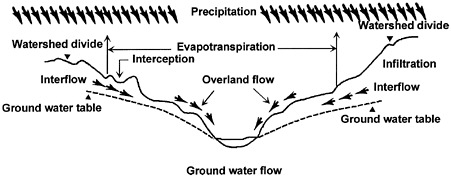
FIGURE 2.1 The hydrologic cycle as applied to basins.
Recharge occurs whenever precipitation or surface water infiltrates downward through the soil to the water table. Recharge can also result from subsurface lateral flows that reach the aquifer. Recharge may occur naturally, and natural recharge can be augmented by artificial recharges (as outlined in a recent study, National Research Council, 1994a). Surface water is usually viewed as a renewable resource, since it derives from rainfall and snowmelt, which recur periodically. Natural ground water supplies may be either renewable or nonrenewable, depending upon whether recharge occurs at rates similar to those of withdrawal.
The rate of recharge may be influenced to a large extent by whether the aquifer is confined or unconfined. Aquifers may have upper and lower boundaries, termed "confining layers." These boundaries normally comprise layers of unconsolidated material or rock that have a much lower permeability than the materially lying immediately above or below. Confined aquifers have a confining layer both above and below, while an unconfined aquifer has no confining layer on top. Since unconfined aquifers tend to be found uppermost in a ground water system, they are frequently called surficial aquifers. Unconfined aquifers are the first to receive water infiltrating from the surface. This means that the depth to water or the water table frequently fluctuates in such aquifers. It also means that such aquifers tend to contain higher concentrations of dissolved materials of anthropogenic origin than do lowerlying, confined aquifers. Indeed, water contained in many shallow, unconfined aquifers is often not used for drinking because of contamination.
Confined aquifers are protected to some degree by the presence of a confining, low-permeability zone between the surface (and the source of recharge water) and the ground water itself. While an unconfined aquifer is characterized by a water table or the depth to ground water, a confined aquifer is characterized by a piezometric, or potentiometric, surface, which results because the height of the upper surface of the aquifer is constrained by the confining layer. The potentiometric surface represents the height of rise of the water due to hydrostatic pressure when the constraint of the confining layer is removed, as illustrated in Figure 2.2.
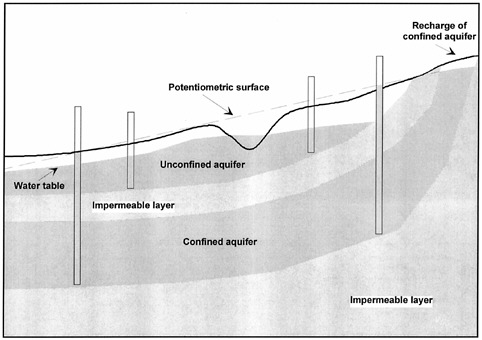
FIGURE 2.2 Unconfined aquifer and its water table; confined aquifer and its potentiometric surface.
Water found in deep aquifers may have been stored over millions of years and is sometimes referred to as "fossil water." The natural rates of recharge to these deep aquifers, when recharge occurs at all, are quite low (Lloyd and Farag, 1978). Fetter (1994) notes that for practical purposes such aquifers are not recharged and any extractions are irreversible. The extraction and use of water from such aquifers is analogous to the mining of resources such as minerals that do not recur periodically on anything less than geologic time scales. Aquifers in arid regions are frequently characterized by very small rates of recharge that range from a few hundredths of a millimeter per year to perhaps 200 mm/yr (Heath, 1983). Aquifers characterized by either the total absence of recharge or by very low rates of recharge cannot be relied upon as a sustainable source of water supply. The Ogallala aquifer underlying parts of Texas, Oklahoma, and New Mexico is a good example of such an aquifer. The relatively high rates of extraction and use of water from the Ogallala aquifer for agricultural purposes over the past four decades has resulted in progressive increases in pumping depths. In many places the depth to ground water is so great that it is no longer economical to pump. In these areas irrigated agriculture that historically relied on waters from the Ogallala must be converted to dry land farming or other land uses.
Ground water depletions occur when water is discharged from aquifers naturally via seeps and springs, from direct uptake by plants where the water table is in the root zone, and from extractions through wells. The manner in which a ground water basin responds to pumping depends upon whether the aquifer is confined or unconfined. For a confined aquifer, a cone of depression, which originates at the point that water is actually extracted by pumps, will move rapidly through the aquifer. Thus remote parts of the aquifer will be affected and some of the natural discharge will be captured. For unconfined systems, the cone spreads too slowly to affect distant points of natural discharge so that most of the water removed comes from storage. The ease of pumping is related to the capacity of the aquifer to conduct water, its hydraulic conductivity. Aquifers with low conductivities will pass water only very slowly so that wells must be deep to produce adequate supply. The increased depth requires increases in pumping lifts, which translate directly to increased pumping (extraction) costs.
In aquifers that are undisturbed by human activity, recharge tends to be balanced by natural ground water discharge or extractions. This means that water tables in unconfined aquifers and the potentiometric surfaces in confined aquifers remain stable. When this steady state is disturbed by ground water pumping or diversion of customary sources of recharge, water tables and potentiometric surfaces respond accordingly. Thus, for example, in unconfined aquifers the water table rises when the rate of recharge exceeds the rate of extraction and discharge. Conversely, if extractions exceed recharge, water tables will fall, as will surface discharges such as base flow in streams (Figure 2.3). As a general rule, however, rising or falling water tables cannot be sustained indefinitely, and the aquifer will always tend toward a steady-state condition where the rates of extraction and discharge are equal to the rate of recharge. For this reason, the sustainable or safe yield of any aquifer is equal to the long-run average rate of recharge.
Conjunctive Use of Surface and Ground Water
Conjunctive use of surface and ground water may be defined as any integrated plan that capitalizes on the combination of surface and ground water resources to achieve a greater beneficial use than if the interaction were ignored (Morel-Seytoux, 1985). Interactions of this kind occur naturally in alluvial valleys and flood plains, but under present circumstances prudent watershed management often necessitates engineered approaches to enhance the natural processes. Such management of overall water resources often takes the form of storing surface water underground in times of surplus by recharging natural ground water aquifers, thus saving the enormous cost of above-ground storage reservoirs and aqueducts.
Moreover, long-term storage in and passage through a ground water aquifer generally improve water quality by filtering out pathogenic microbes and many, although by no means all, other contaminants (NRC, 1994b). Ground water
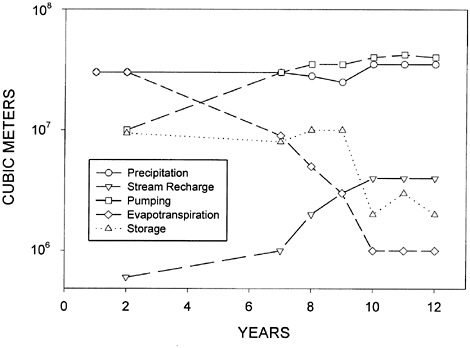
FIGURE 2.3 The effect of pumping on service flows provided by a hypothetical aquifer. With regard to this inventory, the following points are worth noting: (1) Prior to pumping the aquifer, natural recharge equaled natural discharge, and the ground water basin was in a steady state. (2) With the addition of pumping and in the course of withdrawals from storage, net recharge to the aquifer from stream flow increased and reached some maximum value (i.e., part of the stream flow was captured by pumping the aquifer), whereas discharge by evapotranspiration decreased and approached some minimum value (i.e., the amount of plant-viable water was reduced). (3) During the course of the withdrawals, the basin was in a transient state where water was continually being withdrawn from storage. Although not shown, this results in a continual decline in water levels. A new steady state could be achieved by reducing pumping to about 3.8' 107 m3 yr-1, but the steady state would include the reduced stream flow and evapotranspiration. Data for this figure were taken from Domenico and Schwartz, 1990. (Reprinted with permission from John Wiley & Sons, Inc., 1990. Copyright 1990 by John Wiley & Sons, Inc.)
supplies generally are far superior to surface water sources (American Water Works Association, 1990). Indeed, where available, ground water basins afford benefits of storage, conveyance, and treatment that often render the ground water resource preferable to surface water alternatives from the standpoint of health protection, technical simplicity, economy, and public acceptance.
THE ECONOMICS OF GROUND WATER USE
There is a significant and varied literature on the economics of ground water use (see, for example, Burt, 1970; Cummings, 1970; Burness and Martin, 1988; and Provencher and Burt, 1993). Several common principles emerge from this literature, perhaps the most important of which is that ground water is used most efficiently when it is extracted at rates that maximize net benefits (total benefits net of total costs) over time. Costs include the cost of extracting and delivering the ground water and the opportunity, or user, cost. The benefits are determined by the uses to which the water is put.
The costs of extraction are primarily a function of pumping technology (or pump efficiency), the depth from which the ground water must be pumped, and the costs of energy. These costs increase with pumping depth and the cost of energy and decrease as pump efficiency is improved. The cost of extraction also includes the value of the opportunity foregone by extracting and using the water immediately rather than at some time in the future. The user cost is a measure of the economic consequences of pumping now and thereby lowering the water table and increasing costs of extraction for all future periods. The extraction rate in the current period will be efficient only if the potentially higher costs of pumping in the future periods are appropriately estimated. Much economic literature on ground water resources emphasizes that when ground water is pumped in an individually competitive fashion, pumpers have strong incentives to ignore the user cost. In these circumstances pumpers tend to treat ground water as an open access resource, with the result that rates of extraction exceed the economically efficient rate.
The tendency to consider ground water an open access resource when it is exploited competitively underscores the importance of well-defined, clearly enforceable rights to extract ground water. These rights may be assigned to individuals or the citizens of a political entity. They may also be permanent or time limited and subject to change. In instances where rights are not effectively defined and enforceable, the availability of ground water is determined by and subject to the law of capture: whoever taps the ground water first gets to use it. Pumpers have an incentive to extract as much water as possible, subject to the constraints imposed by pumping costs. Incentives to conserve voluntarily are absent, since water not pumped is available to competing users and will not necessarily be conserved for future periods. Thus, competitive pumpers often ignore user costs both because they believe that self-discipline will not effectively conserve supplies for the future and because they believe that the impact of their own pumping on the water table will be small. When the user cost is ignored, the costs of ground water extractions are undervalued and water is extracted too quickly. This contrasts with situations in which ground water is extracted by a single pumper. The single pumper accounts for the user cost simply because he or she will have to bear all of the additional costs of pumping
from a lowered water table in the future. In competitive situations regulatory measures can be used to ensure that pumpers account for the user cost. Two common measures are the imposition of a pump tax equivalent to the user cost or the imposition of pumping quotas to ensure that the aquifer is not exploited too quickly (Nether, 1990). Such measures can be imposed by ground water management agencies, and where taxes are employed, the revenues could be used to defray the costs of managing the ground water basin, should that be the most efficient use of the funds.
Defining and enforcing ground water extraction rights and ensuring that rates of extraction are efficient are equally important in decisions to invest in the protection of ground water quality, as well as in programs to remediate or enhance ground water quality. If ground water is subject to the law of capture, then the benefits of protection, remediation, and enhancement investments will similarly be subject to the law of capture. This results in less than optimal investment in the preservation and enhancement of ground water quality, since those investing in such measures cannot be sure they will capture all of the benefits. This fact underscores the necessity of establishing clear and enforceable systems of extraction rights and appropriate regulatory measures before investing in the protection and enhancement of ground water quality.
In the long run, rates of ground water extraction cannot exceed rates of recharge. That is, over time, rates of extraction and recharge will be brought into steady-state equilibrium. When overdrafting occurs persistently, water tables are lowered and pumping costs increase. Finally a point is reached where the costs of extracting ground water exceed the benefits that can be obtained from its use; then pumpers stop extracting and the decline in the ground water table is arrested. Because ground water is extracted and used only when it is profitable to do so, overdraft will be self-terminating and rates of extraction will ultimately be exactly equivalent to the rates of recharge.
It is important to recognize, nevertheless, that ground water overdraft may be economically efficient in some instances. When the benefits of use are quite high in relation to the costs of extraction (including the user cost), overdraft may be efficient for some period of time. In periods of drought, for example, when surface water supplies may be absent or scarcer than normal, overdraft may be efficient. However, even in situations where overdraft is efficient, it will ultimately be self-terminating. Moreover, in assessing the economic desirability of overdraft, we must account for certain adverse impacts, such as land subsidence, salt water intrusion, and deleterious effects on surface water and aquatic habitats
The geological substrate of aquifers differs from location to location, with materials ranging from coarse sediments to fractured rock. Substrates that consist of fine grained sediments such as clays tend to compact when water is removed, resulting in elimination of the pore spaces that previously contained water. Thus removing water reduces the aquifer's water-holding capacity. In addition the land surface may sink when compaction occurs in such aquifers.
This may cause severe disruption of utilities such as sewer and water lines and damage to structures and roads. Subsidence can also cause flooding, particularly in coastal areas. Between 1906 and 1987, land in the Houston/Baytown region of Texas subsided by between 1 and 10 feet, resulting in pronounced flooding of valuable land adjacent to Galveston Bay. When policy-makers recognized the value of remaining ground water in preventing subsidence and concomitant flooding, they formulated a plan to conserve ground water in situ by developing sufficient surface supplies to accommodate 80 percent of the projected demand for Houston by the year 2010 (Schoek, 1995). The most dramatic example of subsidence is found in the San Joaquin Valley of California, where land surfaces have fallen up to 40 feet in some areas.
A unique problem associated with subsidence caused by prolonged overdrafting has been the development of sinkholes in some areas of Florida where natural flow patterns in limestone aquifers have been perturbed. Land subsidence generally occurs when aquifer pressure levels are significantly lowered in basins where the substrate is primarily fine-grained material such as clays and silts, which are more compressible than more rigid coarse grains such as sand or limestone and sandstone formations. Subsidence caused by the consolidation of fine-grained material cannot be reversed by artificially injecting additional water into the formation. Subsidence is reversible only in aquifers usually dominated by sands, gravels, or sandstone, which can accept the additional fluids.
Saline ground water is found in aquifers throughout the United States. Ground water depletion may cause intrusion of poorer-quality water into high-quality water supplies. In some coastal regions, particularly in California and Florida, there are serious sea water intrusion problems caused by the attenuation of fresh ground water flows toward the ocean. The in situ value of ground water in these cases derives from providing a barrier to salt water intrusion. Overdrafting can depressurize confined aquifers, leading to the intrusion of salt water into portions of the aquifer that formerly contained high-quality water (see Figure 2.4). Salt water intrusion problems are not limited to coastal areas. Problems with saline ground water have been documented in 41 states (Atkinson et al., 1986). A number of methods are available to combat salt water intrusions, including artificial recharge, reductions in extractions, establishment of a pumping trough along the coast, formation of pressure ridges through artificial water injection, and installation of subsurface barriers.
Discharges from unconfined aquifers are the source of about 30 percent of the nation's stream flow (Frederick, 1995). This source of surface water is especially important in sustaining stream flow during dry periods, the so-called base flow. Ground water levels have a direct impact on lake levels and on the amount of freshwater flowing through estuaries to the oceans. Reductions in surface water flows can have adverse impacts on the aesthetic values, recreational potential, and use of surface waterways for transportation.
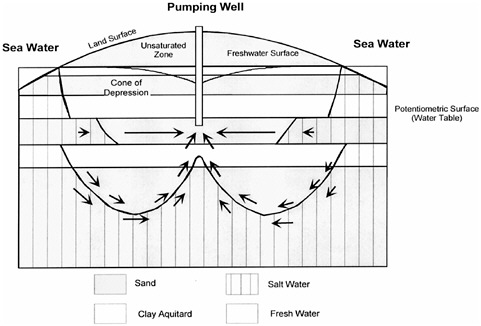
FIGURE 2.4 Salt water intrusion into a confined aquifer.
Surface water flows originating from ground water also support riparian vegetation and play a major role in maintaining wetlands (NRC, 1995). Such support constitutes a vital ecological service. Ground water depletions are known to have eliminated surface water flows altogether in some areas. Many of the flowing streams in Arizona have disappeared because of the overpumping of ground water. High water tables may also support riparian species in areas where surface flows are ephemeral. The ecological services of ground water are particularly dramatic in cases where ground water supports habitat for endangered species. (An example of how ground water drawdown can affect stream flow appears in Figure 2.3.)
The availability of ground water is thus determined by the interaction of geological, hydrologic, and economic factors. The quantities of water available now and in the future depend upon the interaction of recharge and extraction. The cost of obtaining ground water is determined by pumping depths, energy costs, and the cost assigned to the opportunity foregone as a consequence of extracting ground water now rather than later. The value of ground water depends upon both the cost of obtaining it and the willingness of users to pay, and willingness to pay depends crucially on the quality of the water.
GROUND WATER QUALITY
Contamination
Because ground water exists in an environment that includes a mineral matrix and perhaps some organic matter (even living organisms), the quality of the water is controlled by the physical, chemical, and biological processes that interact in the aquifer. Ground water exists in a variety of geological settings, ranging from tiny cracks in otherwise solid rock to the (relatively) large voids between grains of coarse sand or gravel. Geological formations that constitute aquifers differ widely in the rocks and minerals they contain. Some contaminants occur naturally, whereas others are derived from human activities: landfills, agriculture wastes, industrial spillage, and many others (see Table 2.1).
In many areas the greatest threat to the potability of ground water is from contamination by microorganisms such as bacteria and by disease-causing virus particles. The presence of potentially pathogenic microbes (expanding the definition of microbes to include viruses) represents the most serious drinking water contamination problem. The organisms of concern in potential ground water contamination are those that are shed in fecal material, including bacteria, viruses, and protozoan parasites. These organisms are spread via the fecal-oral route. Ingestion of organisms can occur through consumption of contaminated food or water or by direct contact. Organic contaminants are wide ranging and include chlorinated hydrocarbons (e.g., trichloroethylene, carbon tetrachloride), fuel hydrocarbons (e.g., benzene, toluene, xylene), oxygenated compounds (e.g., phthalates and phenols), polynuclear aromatic hydrocarbons (PAHs, e.g., arochlor). Many times the contaminants are mixtures, e.g., gasoline, diesel fuel, and creosote. In some cases, contaminant plumes may cover many square miles of aquifer material (NRC, 1994b).
One of the major differences between surface water and ground water is the time frame for contamination. Contamination in ground water develops slowly, based on migration and flow rates. In addition, once contaminated, ground water takes far more time to assimilate and recover than does surface water. Surface water is generally contaminated rather quickly and has the ability to purge the contaminant in a short period of time. Both natural and artificial cleanup of ground water are lengthy processes because of slower flow rates, slower dilution, and reduced capacity for reoxygenation.
Remediation: An Economic Outlook
Policy-makers cannot select an appropriate treatment technology until they define the final use or disposal location of the water. As they evaluate possible treatment, then, they must consider the water-quality objectives for the receiving waters. They should identify feasible disposal options. Although most areas
TABLE 2.1 Sources of Ground Water Contamination
|
Category I |
Category II |
Category III |
|
Sources designed to discharge substances |
Sources designed to store, treat, and/or dispose of substances; discharged through unplanned release |
Sources designed to retain substances during transport or transmission |
|
Subsurface percolation (e.g., septic tanks and cesspools); Injection wells; Land application |
Landfills; Open dumps; Surface impoundments; Waste tailings; Waste piles; Materials stockpiles; Aboveground storage tanks; Underground storage tanks; Radioactive disposal sites |
Pipelines; Material transport and transfer |
|
Category IV |
Category V |
Category VI |
|
Sources discharging as consequence of other planned activities |
Sources providing conduit or inducing discharge through altered flow patterns |
Naturally occurring sources whose discharge is created and/or exacerbated by human activity |
|
Irrigation practice; Pesticide application; Fertilizer applications; Animal feeding operations; De-icing salt applications; Urban runoff; Percolation of atmospheric pollutants; Mining and mine drainage |
Production wells; Other wells (nonwaste); Construction excavation |
Ground water-surface water interactions; Natural leaching; Salt water intrusion, brackish water |
|
SOURCE: Office of Technology Assessment, 1984. |
||
favor beneficial use of treated ground water, in certain instances disposal would be cost-effective. Disposal options include placement in evaporation ponds (probably limited to the southwestern United States), deep-well injection, and ocean discharge (limited to coastal areas).
As indicated, appropriate treatment depends on both the types of contaminants and the intended beneficial uses of the renovated ground water. Treatment technologies commonly in use today and their effectiveness for removing specific contaminants and their associated costs appear in Table 2.2. The costs
TABLE 2.2 Effectiveness and Typical Costs of Treatment for Water Containing Various Classes of Contaminants
–
–
–
–
–
–
–
–
–
–
–
–
–
–
|
|
Inorganic Compounds |
Organic Compounds |
||||
|
Treatment Process |
TDS |
NO3-, SO42 |
Volatile (TCE, PCE) |
Novolatile (DBCP) |
Cost Range ($/acre-foot) |
Facility Capacity Range (MGD) |
|
GAC |
+ |
150-110 |
2-12 |
|||
|
Air stripping |
+ |
130-50 |
0.5-7 |
|||
|
Ion exchange |
+ |
130-60 |
1-15 |
|||
|
Reverse osmosis |
+ |
+ |
400-250 |
1-6 |
||
|
In situ bioremediation |
+ |
Varies |
Varies |
|||
|
SOURCE: Orange County Water District, 1996. |
||||||
shown are only for the indicated treatment process, that is, the costs do not include costs of extraction wells and collection systems or conveyance and disposal costs. Note that the cost for each treatment process depends upon the size of the facility. Thus the unit treatment cost will decrease as the size of the facility increases. Bioremediation is not included in Table 2.2 because the costs are controlled by the site at which the technology is being employed.
Aquifer Remediation
A recently published National Research Council study dealt with the cleanup of contaminated aquifers and ground water (NRC, 1994b). That study was motivated by the need to assess critically the feasibility of restoring ground water quality at hazardous waste contamination sites, considering the limitations of present technology as well as foreseeable advances in methodology. The need for such an assessment stemmed in turn from disappointment in the slow rate of progress in hazardous waste site remediation and its burgeoning cost.
The NRC committee found that the general frustration with the slow progress and rising costs in hazardous waste site (sometimes referred to as Superfund site) remediation is indeed justified. Only a very few sites have, in fact, been renovated successfully, while efforts at many others have been hampered by inept planning, unrealistic objectives, ponderous decision-making processes, and conflicts among the various stakeholders. Nonetheless, at the bottom of the problem are intrinsic technical difficulties that would be hard to counter even with near-perfect planning procedures in an ideal institutional setting. Where complete restoration remains elusive, it may be prudent simply to contain the contamination after removing the portion of the contaminant mass that is amenable to cleanup.
In the face of these newly perceived difficulties, the task of restoring ground water quality seems considerably more daunting than when the Resource Conservation and Recovery Act (RCRA) and Comprehensive Environmental Response, Compensation, and Liability Act (CERCLA) programs were instituted. Estimates of total costs of cleanup in the range of hundreds of billions of dollars raise the question of whether all contaminated ground water can and should be remediated to the strictest criteria: that is, pristine conditions or health-based standards. This in turn raises the question of the long-term economic and resource impacts of permitting ground water resources to deteriorate in quality. Furthermore, it is necessary to take into consideration the observed tendency of subsurface contamination to become more intractable the longer it is left in place, so that long-term contamination may be virtually irreversible.
Hydrologic Uncertainty
Hydrologic uncertainty results from the heterogeneity of natural systems and from data inadequate to characterize and model the systems accurately. Uncer-
tainty arises regarding both the quantity and quality of ground water systems. Uncertainties related to ground water flow include insufficient or erroneous data from imprecise measurements and observations, sampling errors, or statistical errors; inappropriate model assumptions; and inadequate characterization of subsurface hydrology. Uncertainty regarding quality arises from lack of information on both the fate of the contaminants in the subsurface, and their health effects.
Additional uncertainties concern the role of ground water in providing ecological services. Ground water supports microbial habitats in the subsurface and surface flows that sustain riparian habitats. Connections between ground and surface waters are better defined in theory than in application.
Mathematical models of ground water systems have been under development for decades, but data are rarely if ever adequate to allow accurate prediction of subsurface dynamics in three dimensions. Model uncertainty stems from shortcomings in current theory or failure of models to incorporate the elements of current theory, scarcity of field data for model calibration, inadequacies of computer capacity for modeling complex systems, and failure to incorporate operational constraints into models (Anderson and Burt, 1985).
RECOMMENDATIONS
This review of hydrological concepts, ground water quality, the influence of societal activities on ground water quantity and quality, and ground water treatment scenarios suggests the following conclusions regarding implications for ground water valuation.
-
Decision-makers should proceed very cautiously with any actions that might lead to an irreversible situation regarding ground water use and management. Ground water depletion, for instance, may often be irreversible. Some aquifers (e.g., the southern edge of the Ogallala) do not recharge in useful time scales, and thus any extractions constitute a form of mining. In other cases the length of time needed for natural recharge of deep aquifers where ground water removal rates are high leads to a continual reduction in stock that will not be replenished in short time frames. Moreover, overdrafting can sometimes lead to a collapse of the formation permanently reducing the aquifer's storage capacity.
-
Decision-makers should also be cautious regarding contamination of ground water. Restoration of contaminated aquifers, even when feasible, is resource intensive and time consuming. Restoration methods are uncertain and unlikely to improve significantly in the near future. As a result, it is almost always less expensive to prevent ground water contamination than to clean up the water.
-
Ground water often makes significant contributions to valuable ecological services. For example, in the Southwest, many flowing streams have
-
been eliminated by overpumping. Because the ground water processes that affect ecosystems and base stream flow are not well understood, combined hydrologic/ecologic research should be pursued to clarify these connections and better define the extent to which changes in ground water quality or quantity contribute to changes in ecologic values.
-
Ground water management entities should consider appropriate policies such as pump taxes or quotas to ensure that cost of using the water now rather than later is accurately accounted for by competing pumpers.
-
Because ground water resources are finite, decision-makers should take a long-term view in all decisions regarding valuation and use of the resources.
REFERENCES
American Water Works Association. 1990. Water Quality and Treatment. Blacklick, Ohio: McGraw-Hill.
Anderson, M. G., and T. P. Burt. 1985. Hydrologic Forecasting. New York: John Wiley and Sons.
Atkinson, S. F., G. D. Miller, D. S. Curry, and S. D. Lee. 1986. Salt Water Intrusion: Status and Potential in the Contiguous United States. Chelsea, Mich.: Lewis Publishers.
Burness, H. S., and W. E. Martin. 1988. Management of a tributary aquifer. Water Resources Research 5(24):1339-1344.
Burt, O. R. 1970. Groundwater storage control under institutional restrictions. Water Resources Research 6(6):1540-1548.
Cummings, R. G. 1970. Some extensions of the economic theory of exhaustible resources. Western Journal of Economics 7(3):201-210.
Domenico, P. A., and F. W. Schwartz. 1990. Physical and Chemical Hydrogeology. New York: John Wiley and Sons.
Fetter, C. W. 1994. Applied Hydrogeology. New York: Macmillan College Publishing.
Frederick, K. D. 1995. America's water supply: Status and prospects for the future. Consequences 1(1):14-23.
Heath, R. C. 1983. Basic ground-water hydrology. Water-Supply Paper 2220. U. S. Geological Survey.
Lloyd, J. W., and M. H. Farag. 1978. Fossil ground water gradients in and regional sedimentary basins. Ground Water 16:388-398.
Morel-Seytoux, H. J. 1985. Conjunctive use of surface and ground water. Pp. 35-67 In Artificial Recharge of Ground Water. T. Asano, ed. Chapter 3. Boston: Butterworths Publishers.
National Research Council. 1994a. Ground Water Recharge Using Waters of Impaired Quality. Washington D.C.: National Academy Press.
National Research Council. 1994b. Alternatives for Ground Water Cleanup. Washington, D.C.: National Academy Press.
National Research Council. 1995. Wetlands: Characteristics and Boundaries. Washington, D.C.: National Academy Press.
Nether, P. A. 1990. Natural Resource Economics: Conservation and Exploitation. New York: Cambridge University Press.
Office of Technology Assessment. 1984. Protecting the Nation's Groundwater from Contamination, OTA-O-233. Washington, D.C.: U.S. Congress.
Provencher, B., and O. R. Burt. 1993. The externalities associated with common property exploitation of groundwater. Journal of Environmental Economics and Management 24(2):139-158.
Schoek, J. M., ed. 1995. City cuts use of depleted ground water. The Ground Water Newsletter 24(12):6.


