
| This page in the original is blank. |
Cellular Materials: Structure, Properties, and Applications
Lorna J. Gibson
Department of Materials Science and Engineering
Massachusetts Institute of Technology
Cambridge, Massachusetts
Cellular materials—in the form of either honeycombs, with two-dimensional prismatic cells, or foams, with three-dimensional polyhedral cells—are widespread (Figure 1). Processes now exist for making these cellular materials from almost any solid material, including polymers, metals, ceramics, and glasses. Their cellular structure gives rise to stress-strain curves with a characteristic shape: initial linear elasticity, caused by cell wall bending, is followed by a period of roughly constant stress, resulting from cell collapse, and then a final sharp increase in stress at the point at which opposing cell walls touch and the material densifies (Figure 2). Also, the properties of a foam for a particular application can be controlled by the engineer by suitable selection of the solid material from which the foam is to be made, the volume fraction of the solid, and whether or not the cells are open or closed.
The low density of cellular materials is widely exploited in the production of buoyancy devices and of lightweight cores of structural sandwich panels. The combination of low compressive strength and high strain capacity makes cellular materials ideal for absorbing the kinetic energy of impacts—they can absorb large impact energies while generating only low stresses on a packaged object. For this reason, they are the materials of choice for impact protection in everything from crash helmets to packaging for electronic devices. Also, the high volume fraction of low thermal conductivity gas within the cells of a closed-cell foam makes them valuable for widespread use as thermal insulation, and open-cell foams can be used as filters and membranes.
Our research has focused on modeling the mechanisms of deformation and failure in cellular solids to give expressions for their mechanical properties, such as stiffness and strength. We have used these models to improve
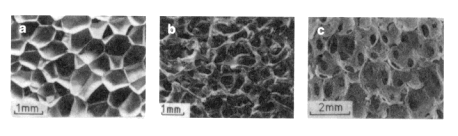
Figure 1
Scanning electron micrographs of engineering cellular materials: (a) polyethylene, (b) copper, and (c) mullite. Source: Gibson and Ashby, 1988.
techniques for selecting the optimum foam for the core of a structural sandwich panel as well as for energy absorption devices (Gibson and Ashby, 1988).
To improve our understanding of the mechanical behavior of a variety of widespread natural cellular materials, including wood, cork, and trabecular bone (Figure 3), we have used the models developed for engineering honeycombs and foams. For instance, wood is much stiffer and stronger when loaded along the grain than across it; we have found this anisotropy arises, in part, from the composite nature of the cell wall in wood and, in part, from its cellular structure: loading along the grain axially compresses the cell walls
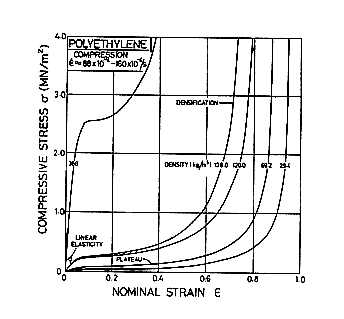
Figure 2
Compressive stress-strain curves for flexible polyethylene.
Source: Gibson and Ashby, 1988.
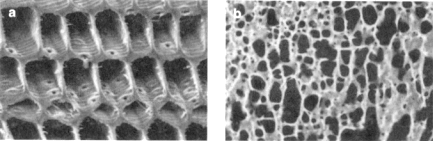
Figure 3
Scanning electron micrographs of (a) Norway spruce and (b) human vertebral trabecular bone. Source: Gibson and Ashby, 1988.
while loading across the grain bends them. Currently, we are studying progressive damage, by creep or fatigue, in trabecular bone, which is the porous bone occurring at the ends of the long bones and making up the bulk of the vertebrae. Patients with osteoporosis are at increased risk of hip, wrist, and vertebral fractures, all of which largely involve trabecular bone. About 10 percent of hip fractures and 50 percent of vertebral fractures are thought to be the result of the activities of daily living rather than a sudden impact such as a fall, and understanding how this progressive damage occurs in osteoporotic bone is essential for evaluation of fracture risk.
Here, we briefly describe models for the mechanical behavior of cellular materials, compare the models with data, and note some of the remaining questions to be answered. Two applications of cellular materials, in sandwich panels and in energy absorption devices, then are discussed. Finally, we describe new directions for research on cellular materials.
Modeling Mechanical Behavior
The mechanical properties of cellular solids can be described by using structural mechanics to analyze their mechanisms of deformation and failure. The stress-strain curve is characterized by three regimes (Figure 2): (1) Initial linear elastic behavior is caused by bending of the cell walls. (2) At sufficiently large stresses, the cells begin to collapse, either by elastic buckling, plastic yielding, or brittle fracture of the cell walls; cell collapse begins at a weak layer and then propagates through the rest of the material, giving an almost constant stress plateau. (3) Finally, at large strains, all of the cells have collapsed; further strain then loads the cell walls against each other, leading to a rapid increase in stress at densification. The simplest cellular material in which to analyze this is a two-dimensional honeycomb with repeating hexagonal cells (Figure 4a). Its properties can be described by ana-

Figure 4
(a) Hexagonal unit cell of two-dimensional honeycomb. (b) Cubic cell used for dimensional analysis of a foam. Source: Gibson and Ashby, 1988
lyzing the response of a unit hexagonal cell. The elastic moduli, the compressive strength, and the brittle fracture toughness depend on the properties of the solid from which the honeycomb is made, the volume fraction of the solid (raised to some power), and the geometry of the cells. For instance, the Young's modulus, E*, of the honeycomb with the unit cell shown in Figure 4a is
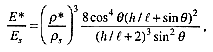
where Es is the Young's modulus of the solid from which the honeycomb is made, ρ*/ρs is the density of the honeycomb divided by that of the solid from which it is made (i.e., the relative density of the honeycomb), and h/l and θ (shown in Figure 4a) describe the cell geometry.
The more complex geometry of three-dimensional foam materials makes analysis more difficult. We have used dimensional arguments to give the relationship between foam properties and those of the cell wall material and the relative density; they do not give the dependence of foam properties on cell geometry (Figure 4b). Comparisons of typical results of the dimensional analysis with data are given in Figure 5.
More recently, numerical techniques have been used to give more detailed analyses. For instance, the unit cell analysis of a two-dimensional honeycomb does not allow the effect of irregularities in the cell geometry or defects in the structure (such as missing cell walls) to be modeled. Finite element analysis of a honeycomb with a random cell structure shows that the random cell structure has little effect on the elastic moduli but reduces the strength of the honeycomb by about 25 percent compared with that of an
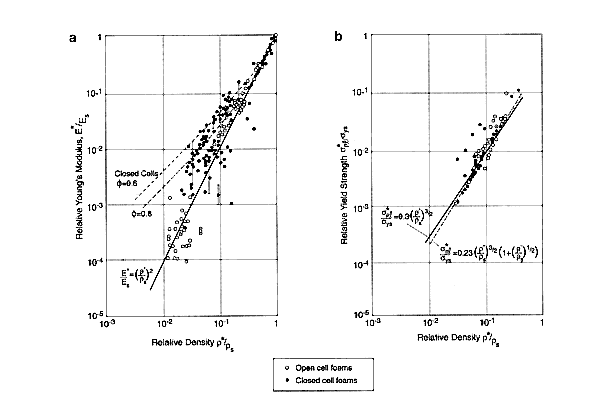
Figure 5
(a) The Young's modulus of a foam, E*, relative to that of the solid from which it is made, Es, plotted against the density of the foam, ρ*, relative to that of the solid, ρs. (b) The plastic collapse stress of a foam, σ*, relative to the yield strength of the solid from which it is made, σys, plotted against the density of the foam, ρ*, relative to that of the solid, ρs. Source: Gibson and Ashby, 1988.
equivalent regular honeycomb. Removal of cell walls has a dramatic effect on strength: removal of 10 percent of the cell walls results in a reduction of 70 percent in compressive strength (Silva and Gibson, in press; Silva et al., 1996). Finite element analysis of three-dimensional foams allows the effect of cell geometry to be determined as well as allows irregularities in the cell geometry or defects in the structure to be examined (Warren and Kraynik, in press).
Although there has been considerable progress in understanding the uniaxial behavior of cellular materials, further research is required to study multiaxial postyield behavior, fatigue, creep, and fracture.
Applications
Structural members with two stiff, strong faces or skins separated by a lightweight core are known as sandwich panels. Separation of the skins by the core increases the moment of inertia of the panel with little increase in weight, thus producing an efficient structure for resisting bending and buckling loads. Because of this, sandwich panels often are used in applications where weight-saving is critical: in aircraft, in portable structures, and in sports equipment.
Consider the design of a downhill ski for instance. There is a particular value of bending stiffness for which the ski is designed; a ski that is too flexible or too rigid obviously is undesirable. The length and width of the ski are given. And let us assume that the designer has chosen the materials for the skin and foam core of the ski. The designer then wishes to find the values of the face and core thicknesses and the density of the foam core that minimize the weight of the ski for the required stiffness. The weight of the ski is the objective function; this depends on the densities of the face and foam core material as well as the length, width, and face and the core thicknesses of the ski. The required bending stiffness is the constraint; it depends on both the flexural rigidity of the faces as well as the shear rigidity of the foam core, which can be written in terms of the core density using the models described above. The bending stiffness constraint equation is then solved in terms of the core density, and this is substituted into the weight equation. Setting the partial derivatives of the weight equation with respect to the face and core thicknesses equal to zero then gives the minimum weight design for the ski. This same procedure can be applied to other, more complex loading geometries.
Foams are also widely used as packaging and protective padding. The goal here is to select a foam that will absorb the energy of the impact while keeping the peak force on the object to be protected below the limit that will cause damage or injury. The capacity of foams to undergo large deformations at almost constant load makes them especially good at this. The impact
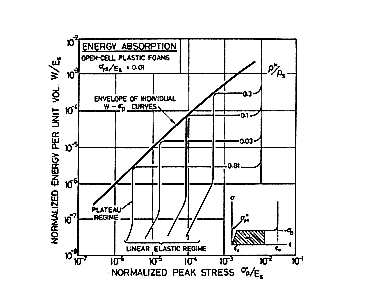
Figure 6
Energy absorbed up to a given peak stress plotted against the peak stress. Both axes are normalized by the Young's modulus of the solid from which the foam is made, Es.
Source: Gibson and Ashby, 1988.
performance of foams can be summarized in energy absorption diagrams (Figure 6), which can be made either from experimental stress-strain curves or from the results of the models described above. The diagrams allow the designer to select the thickness and density of a foam required for a given packaging application.
New Directions
Recently, several new processes for producing cellular metals have been developed, offering several advantages over conventional cores in structural sandwich panels. Current honeycomb-core sandwich panels have three limitations: (1) they require adhesive bonding, (2) they are subject to penetration by moisture, leading to damage difficult to detect, and (3) they cannot be formed into complex shapes. The foamed metal processes allow the production of panels with integral skins, eliminating the need for adhesive bonding and reducing the risk of delamination. The use of closed-cell metal foams reduces moisture penetration and any resulting damage. The belief now is that current processes can be modified to produce more-complex shaped components. Current foam core panels usually use either expanded polystyrene or rigid polyurethane foam cores; their structural application is limited by the low creep and fire resistance of the polymer foam cores. Metal foam core panels, however, have improved performance in both creep and fire resis-
tance. Together with a number of collaborators, we plan to evaluate the potential of metal foam use in lightweight structural components.
Novel biocompatible cellular materials are being developed in the new field of tissue engineering, which aims at growing new, healthy tissue within the body to replace defective tissue. The general principle is to provide a porous scaffold onto which cells will grow. One of the first examples of such a porous scaffold was an open-celled, foam-like collagen material used to regenerate skin cells on burn victims (Yannas, 1995). Over time, as the skin cells grow, the collagen scaffold resorbs into the body, leaving only the healthy new tissue behind. In a further development, the scaffold can be designed to carry bioactive drugs, such as epidermal growth factor, which act to increase tissue growth. Porous scaffolds for peripheral nerves, cartilage, bone and bone marrow currently are being studied by a number of researchers (Ellis and Yannas, 1996; Paige et al., 1996).
Acknowledgments
This paper briefly summarizes work done over a number of years. I would like to acknowledge the contributions of my graduate students and my collaborators. In particular, I thank Professor Michael F. Ashby of Cambridge University's Engineering Department for his contribution to my work on cellular materials. Financial support has been provided by the National Science Foundation, the National Institutes of Health, the U.S. Army, the Office of Naval Research, and the Department of Energy.
References
Ellis, D. L., and I. V. Yannas. 1996. Recent advances in tissue synthesis in vivo by use of collagen-glycosaminoglycan copolymers. Biomaterials 17:291-299.
Gibson, L. J., and M. F. Ashby. 1988. Cellular Solids: Structure and Properties. Oxford, England: Pergamon.
Paige, K. T., L. G. Cima, M. J. Yaramchuk, B. L. Schloo, J. P. Vacanti, and C. A. Vacanti. 1996. De novo cartilage generation using calcium alginate chondrocyte constructs. Plastic and Reconstructive Surgery 97:168-178.
Silva, M. J., and L. J. Gibson. In press. The effects of non-periodic microstructure and defects on the compressive strength of two-dimensional cellular solids. International Journal of Mechanical Sciences.
Silva, M. J., L. J. Gibson, and W. C. Hayes. 1996. The effects of non-periodic microstructure on the elastic properties of two-dimensional cellular solids. International Journal of Mechanical Sciences 37:1161-1177.
Warren, W. E., and A. M. Kraynik. In press. Linear elastic behavior of a low-density Kelvin foam with open cells. ASME Journal of Applied Mechanics .
Yannas, I. V. 1995. Tissue regeneration templates based on collagen-glycosaminoglycan copolymers. Advances in Polymer Science 122:220-244.


