


Below is the uncorrected machine-read text of this chapter, intended to provide our own search engines and external engines with highly rich, chapter-representative searchable text of each book. Because it is UNCORRECTED material, please consider the following text as a useful but insufficient proxy for the authoritative book pages.
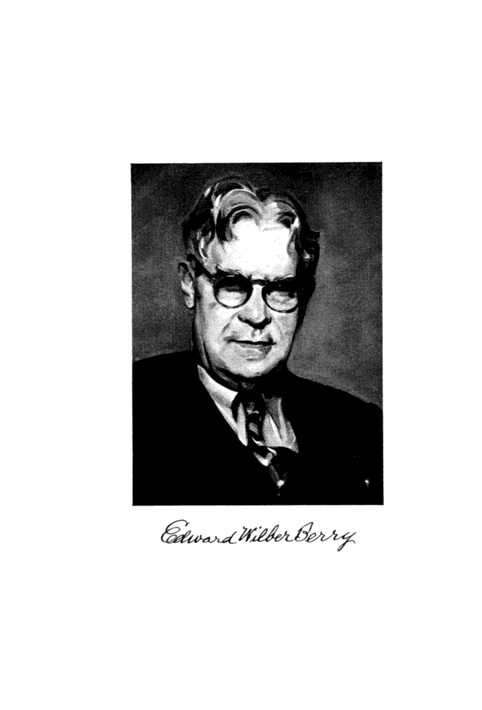
EDWARD WILBER BERRY February 10, 1875-September 20, 1945 BY ERNST CLOOS EDWARD WILBER BERRY died twenty-nine years ago, and several of his colleagues undertook the writing of his memorial. John B. Reeside, ir., was assigned it, but he died in 1958. Ralph W. Chaney then accepted the task, but died before he completed it. In 1971 I accepted the assignment because I knew Berry well at Hopkins for fourteen years, admired him greatly, and am close to source material. Lloyd W. Stephenson wrote an excellent account for the Geological Society of America (1946), which I used extensively. Berry was an extraordinary man who owed his success to inherited abilities and hard work. He is an outstanding example of what an energetic and intelligent man with motivation can achieve if given an opportunity. He graduated from high school, never went to a college or university, became an out- standing geologist and paleontologist, and was elected to the National Academy of Sciences in 1922 at the age of forty-seven, which is early for a geologist. His list of publications includes more than 500 entries and almost 8000 printed pages. He be- came Professor of Paleontology at Johns Hopkins, then dean of the College of Arts and Sciences and provost of the university. He died at age seventy when he was President of the Geological Society of America. 57
58 BIOGRAPHICAL MEMOIRS BEGINNINGS Edward Wilber Berry was born at Newark, New Jersey, on February 10, 1875. His parents were Abijah Conger Berry and Anna Wilber Berry. Of his father and mother he said, "I don't believe there ever lived a kindlier man. My mother was the much more dominating of the two, with an infinite capacity for sacrifice and love." The family included a younger sister, Win- netta, and a still younger brother, Clinton. Berry graduated from high school in 1890 and would have liked to go to college, but family finances did not permit it. While he was still in high school his interest in botany led him into the field in the region around Raritan Bay in New Jersey, where he collected and identified fossil plants from Cretaceous clays along the south shore. With a friend, he studied the flora of bogs and swamps, and the boys read U.S. Geological Survey reports and books on botany. He must have studied intensely and thoroughly because even before coming to Baltimore, in 1905, he published about thirty paleobotanical papers display- ing considerable knowledge of the subject and skill in illustrat- ~ng. After high school Berry worked as office boy for the cotton goods commission house of Denny Poor and Company, and in a few years he became traveling salesman in the southern states. In 1897 he accepted a position as business manager for the Passaic Daily News and between 1897 and 1905 became, in turn, managing editor, president, and treasurer. During this time he by no means neglected his primary interests, but intensified his studies in geology, biology, and paleontology. He began writing for publication and worked part-time for the New Jersey Geo- logical Survey (190~1906) and the Geological Survey of North Carolina (1905-1907~. In 1901 he received the Walker Prize of the Boston Society of Natural History. In 1898 Berry married Mary Willard of Passaic. They had
EDWARD WILBER BERRY 59 two sons, Edward Willard, born in 1900, and Charles Thomp- son, born in Baltimore in 1906. HOPKINS CAREER At a field conference of geologists of Maryland, New Jersey, and the U.S. Geological Survey, William Bullock Clark, head of the Maryland Geological Survey and also chairman of the geol- ogy department at Johns Hopkins, was so impressed by Berry's knowledge and personality that he persuaded him to come to Baltimore. Clark's recommendation of April 3, 1906, to Presi- dent Remsen describes the beginning at Hopkins as follows: "I recommend the appointment of E. W. Berry as assistant in Paleontology at $500.- a year, the understanding being that he will have charge of our rapidly growing collections in geology, paleontology, and mineralogy and will also aid in the labora- tory in paleontology. I know of nothing that will more strengthen the work in geology than the appointment of a capable man like Mr. Berry to take charge of the work outlined. Our collections have gotten beyond our control and have reached that point where they are frequently unavailable for instruction. We have tens of thousands of specimens and with no one who has the time to give to the care of this material. Mr. Berry has special aptitude for such work and is furthermore an experienced paleontologist and for a number of years past has written extensively on paleontological subjects, particularly in the field of paleobotany where he is recognized as an authority on certain portions of the subject. At my urgent request he has been in residence with us here for a year and I am anxious to hold him here if possible. He is a mature man who does not contemplate going forward to the attainment of the Doctor's degree but is a thorough scholar and a most admirable man for us to retain." A second letter, by the Hopkins botanist, Pro- fessor Duncan S. Johnson, endorsed this recommendation, and the appointment was made.
60 BIOGRAPHICAL MEMOIRS This was Berry's opportunity, and he accepted the challenge. In the president's report for 1906 the following item appeared: "Mr. Berry has been engaged in a study of the Potomac floras of New Jersey, Maryland, and North Carolina for the surveys of those states, and is already engaged in the preparation of several interesting articles on the same." He was then not yet listed as faculty and carried no courses, but in 1908 Clark recommended that Berry be made an instructor and the salary doubled. Dur- ing these first years he listened to geology classes unobtrusively in the back of the room, quietly absorbing information. From 1907 he worked as a staff member of the Maryland Geological Survey. In 1910 Mr. Berry was promoted to associate (now called "assistant professor"), and his name appeared in the university catalog as "Mr. Berry, Paleobotany" and jointly with Clark under Paleontology and General Geology. In April 1913 the chairman recommended promotion to associate professor: "Mr. Berry is carrying on investigations of much moment in his special field of paleobotany, several monographs and more than a score of other significant papers having been issued by him during the past three years. Mr. Berry has rapidly come to the front as the leading paleobotanist in this country and his work has elicited much favorable comment on the part of the leading paleobotanists in Europe." In 1916 Professor Clark urged that Mr. Berry be advanced to Professor of Paleontology because "the influence which he exerts over our students is very pronounced, probably greater than that of any other member of our staff." From then on, he was listed simply as "E. W. Berry, Professor of Paleontology," in contrast to all other mem- bers of the faculty, who listed degrees, dates, titles, and, at times, several lines of data. His entry remained unchanged until he became dean. The contrast was striking and very typical of the man, who was no friend of pomp, glitter, and prima dontlas. After the death of W. B. Clark, Berry became the dominating Personality in the department. He taught a variety of courses
EDWARD WILBER BERRY 61 reaching a large number of students who were profoundly affected, and nobody in the department remained untouched. PROFESSOR AND STUDENTS Berry was an inspiring teacher, and he "turned on" many students who owe him a great deal. He was intolerant of laziness or mediocrity, and his appraisal of his fellowman was prevail- ingly by instinct and common sense and rarely inaccurate. He made mistakes, but since he was very kind and warmhearted he was sympathetic to those who tried hard but did not quite suc- ceed. One of his students who was not in his field and was afraid of his oral examination writes, "But what I remember most about him was his exceeding kindness to all graduate students. His action during that oral was that of a gentleman." Another student writes, "When I was at Hopkins he gave courses in paleobotany, invertebrate paleontology, and on classic European localities. He lectured, for example, on the Paris basin as though he had been all over it, but he was never in France." Berry gave a whole generation of geology students a feeling for creative research, inspired by his own example. He was never hurried or harassed and was always accessible in his room, seated at his big rolltop desk, on which was placed a board that was used for all his writing. The walls around him were lined with bookshelves and books. If the function of a graduate professor is not to teach facts and theories but to inculcate a critical attitude toward one's own ideas, as well as those of others, Berry did extremely well. His Saturday morning seminars were famous and are well remembered by all who ever attended. They lasted four hours and typically began with a critical review of some famous text- book. Deflation of the near great was legendary, and though he was caustic he really intended to amuse and shock his audiences. Following the review was a report by one of the students on
62 BIOGRAPHICAL MEMOIRS a self-selected topic. The last portion of the seminar was a topical discussion on, for instance, cross-bedding, mudcracks, sorting, or anything else having to do with stratified rocks. Berry tried to keep arguments going. He rarely lectured, but made the students dig things out by themselves. He would demolish an illogical report, but mostly he encouraged the students to criticize each other. He had a remarkable gift for creating interest. Some of the sessions became a bit sterile at times but never for long. He would try to stir things up, but never took the floor for more than a few minutes. He was an excellent blackboard artist. He illustrated all his lectures and could make his fossils quickly come to life by a few deft strokes with the chalk. Once a month the Berrys invited the students and faculty into their home after dinner. Everybody gathered in the living room or, in later years, in the library, where he would read from a classic work in geology or an outside speaker would tell of his works and travels. Ensuing discussions were at times quite heated because Berry held strong opinions, and if he disagreed he said emphatically what he thought about an idea or the person who proposed it. Nobody was spared, no matter how high a position or scientific reputation he held. He taught his students to examine ideas carefully and never to be afraid to challenge them. Many of his students still appreciate the direction their whole lives were given by E. W. Berry. SCIENTIFIC PRODUCTION Berry's scientific output was amazing. There are numerous short notes but also many longer articles and very substantial monographs. The number of entries exceeds 500, most of which are illustrated. The bibliography of Stephenson (1946) lists 1028 figures and 585 plates, but some articles are listed as "illustrated," and numbers are therefore only approximate. Even if many illustrations are photographs, almost all plates also
EDWARD WILBER BERRY 63 include drawings. The preparation of the illustrations alone must have consumed very much time, and the total for writing and illustrating is large. If one has seen the lack of assistance of those days, one wonders how this was accomplished. When I arrived at Hopkins, in 1931, the Maryland Geological Survey had one secretary-typist, the Department of Geology none. A general assistant mailed publications for the survey and took photographs with an old box camera for publications of the survey. Otherwise the faculty did their own work in their offices. There were no research laboratories for faculty or stu- dents. There also was no "Illustration Division"; neither were there National Science Foundation grants or research assistants. Berry's first publications were mostly notes and brief, illus- trated descriptions of fossil plants or localities. They reveal a growing familiarity with the subject as well as with techniques of handling the material, identification, description, terminol- ogy, ant! publication. This was during the time when he was working at the Passaic Daily News, where he must also have been successful, judging from his advances within that organization. In the annual report of the New Jersey Geological Survey for 1904, published in 1906, there are two of Berry's articles. One is "A Brief Sketch of Fossil Plants"; the other is "The Flora of the Cliffwood Clays." Both are most revealing and much above the average for a state survey report. The sketch on fossil plants is of interest to anyone interested in natural science. It is a broad review outlining the relevance of paleobotany from the botanical or biological and from the geological points of view. Berry discusses evolution, definition of a species, and rela- tion of fossil to recent plants and reaches far back into history and the first recognition of fossil plants. The sketch is also a summary on geologic time, evolution, and plant classification and is well illustrated. Considering the background and the author's job this reveals a considerable amount of reading and understanding, not only as a fossil collector but as a scientist
64 BIOGRAPHICAL MEMOIRS and geologist. He wrote the report in 1904 at age thirty-four in his "spare time," which cannot have been plentiful. The second report contains extensive lists of paleobotanical data and species, many of which were named by Berry himself, showing that he must have collected extensively in the field and prepared his material at home. One may divide Berry's publications into four broad cate- gories. First is a vast number of short, mostly illustrated notes, a page or so long, with descriptions, observations, corrections of nomenclature, and general paleontological inventory. Second are many papers in which the cataloged data are placed in broad geological, historical, and biological context. These articles are good reading, as are the New Jersey report mentioned above, an address to the Philosophical Society on "Tertiary Floras of the Atlantic Gulf Coast," and several articles in the Scientific Monthly, such as "Rilly, A Fossil Lake" or "The Mayence Basin, A Chapter of Geologic History." Here Berry's vivid and interest- ing style is delightful and brings dull subjects to life in an ex- traordinary way. The "Jurassic Lagoons of Solnhofen" deals with paleontology, general philosophy, history, and geology and should be read by all students who feel that paleontology is a dull subject. There are many similar examples, such as "Far Away and Long Ago," where Patagonia becomes an interesting area and geologic history an important factor in today's dis- cussion of tectonics. Other articles deal with tectonics, con- tinental drift, or the origin of the Andes. The article "Shall We Return to Cataclysmal Geology" is a gem and good reading for all scientists. The third category of Berry's publications includes the large monographs of the U.S. Geological Survey and the Maryland Survey and his contributions to the geology and paleobotany of South America. The latter are the fruit of his travels to South America on several expeditions. The com- prehensive works are Berry's major contributions, and his keen
EDWARD WILBER BERRY 65 appreciation of the meaning of fossil plants led him to see forests and prairies, coastal swamps and steaming jungles, where most geologists saw merely fossil leaves. Finally, there are many short publications in newspapers, such as an article on the con- tributions of Charles Lyell, editorials, discussions of educational policies at Hopkins, and others. As can be exepected with such a volume of publications, not all are of equal quality or weight, and some of Berry's work has been severely criticized. It has been said that he was too quick in submitting manuscripts for publication. He was aware of that himself and once told a student who referred to the en- cyclopedia as authority, "That stuff is no good; I wrote it my- self." On the other hand, when we were discussing publications needed by younger faculty for advancement, he said, "If a man has something he must say, it will come out, because he is alive. All we want are signs of life." In spite of the administrative diversion, Berry's production continued, if at a declining rate. The crest, however, is between 1920 and 1-930, when he was forty-five to ~fty-five. After that the writing focused on larger papers with broader application and scope. One of the most interesting and readable papers, "The Origin of Land Plants," was published in 1945. DEAN AND PROVOST In 1929 Berry was appointed Dean of the College of Arts and Sciences as successor to Professor Ames, who became presi- dent. Though Dr. Ames did not appoint a provost, Professor Berry served as his right-hand man and adviser, essentially as provost. The appointment was noted by many, inside and outside of the university, and Berry said in 1929, "Most people may feel that Hopkins took a radical step, making a dean out of an un- educated man. But the truth of the matter is that education
66 need not stop with the end of schooling. After all, it is not what we learn at an institution that is of value to us as much as the attitude we develop toward all learning." The dean did not organize an administrative apparatus, but dealt with students' needs and problems and with those of the institution in a very direct and uncomplicated way. He was accessible, and nobody remained in the dark about the dean's views, because he expressed them openly and very forcefully. Berry made many important contributions to university policy and scholarly efforts, largely enforcing fundamental Hopkins philosophy, which was not then and is not now uni- versal in the country. Two important areas stand out: the educational purpose of the university and college, and the role of athletics at Hopkins. Berry thought there should be three distinct kinds of col- leges: one where rich men's sons spend a pleasant four years in contact with culture; a second one for drifters who need strict supervision and persuasion to find out what they want; and a third one for the rare minority of bright young men who have selected a goal and are willing to work toward it. He felt four years of college are not necessary, because after two years a stu- dent is ready for either serious graduate work or for business. For the mature student there should be as few rules as possible and no credit or marking system. A student should be allowed to select his own course and pursue it unhindered. This system had been introduced as the "Goodnow plan," making it possible for a student to bypass the A.B. degree and to enter a department for graduate work after two years or after making up fundamentals. Berry very forcefully favored and applied this philosophy, which is still working, at Hopkins today and has recently been reinforced. A second concern of the dean was the abolition of inter- collegiate and commercialized football. He felt that the uni- versity should provide ample facilities for all kinds of sports, BIOGRAPHICAL MEMOIRS
EDWARD WILBER BERRY 67 indoor and outdoor, with competition among all sorts of intra- mural groups. All students who are not physically unfit should . . . ~ ~ . . participate in some torm ot activity. The deanship did not slow Berry's teaching or departmental activities, but it took some of his time and reduced his scientific output. When Dr. Bowman became president he appointed him provost and P. S. Macauley secretary. This reduced the time Berry could devote to writing, research, and his students, which was regretted by all. Dr. Bowman leaned heavily on his provost and delegated much of the internal administration to him. President Bowman described the relationship as follows: "In 1935 when I asked him to associate himself with me as Provost I did so because preliminary discussions of University problems with faculty members showed that he had unusually good judgment and a wide range of interest and experience. He was instinctively inquisitive about men and wanted to know what made them click. He tried to get at the roots of a man. He disliked fine words and undocumented praise. In judging his associates he was apt to be severe. I think his best friends would also say that he was somewhat rough in the expression of his opinions. But when it came to action that affected an individual person he habitually went into reverse and became critical of his own judgment, often proposing a milder course than he himself had advocated at the beginning. He was never a man to spend time on mere amiable discourse about policies or appointments. He kept his eye on the action that would have to be taken and was ready with mature judgment when the time for action came." As Berry approached retirement, friends of his had a portrait painted, and at its presentation to the university President Bowman summarized the esteem in which the dean and provost was held: "If I were adequately to express the appreciation of the University for the gift of Dean Berry's portrait, I would be
68 BIOGRAPHICAL MEMOIRS obliged to employ terms as wide and diverse as the procedures and interests of students and colleagues who have know their unique Dean for so many years. This would require me at one stage to sing my words, at another to consult an appropriate committee, and at still another to express myself in the symbols of science and the compositions of art. It is with deep gratitude that I receive and accept on behalf of the Trustees this portrait of our College Dean, our distinguished paleontologist, and our efficient Provost who is known to and deeply respected and be- loved by so many generations of Hopkins men." In 1942 Berry retired as dean and provost and in 1943 as professor. On September 20, 1945, Edward Wilber Berry passed away. IN ASSEMBLING data for this memorial I received help from many sources. The following former students supplied very important information: Christina L. Balk, A. Lincoln Dryden, lames Gilluly, I. Edward Hoffmeister, Shailer S. Philbrick, Vernon E. Scheid, Hobart E. Stocking, Edward H. Watson, and Wendell P. Woodring. The manuscript has been checked by some of these and several Hopkins colleagues. I also received assistance from the Department of Geology at Campbell College, Buies Creek, North Carolina, where the Berry papers are on deposit, and from the archives and library here at Johns Hopkins. The memorial by Lloyd William Stephenson, published in Geo- logical Society of America Proceedings for 1945, was of great help.
EDWARD WILBER BERRY HONORS, DISTINCTIONS, MEMBERSHIPS New York Academy of Sciences, 1899-1938 American Association for the Advancement of Science, 1900 Torrey Botanical Club (Secretary, 1904; Honorary Life Member, 1937-1945; Editorial Board, 1939-1945) Geological Society of America (Fellow, 1909; Vice President, 1924; Depositories and Exchange Committee, 1924-1933; President, 1945) Paleontological Society (President, 1924) American Philosophical Society, 1919 (Council, 1933-1936) American Academy of Arts and Sciences, 1921 National Academy of Sciences, 1922 (Marsh Fund Committee, 1933- 1937) Executive Committee, National Research Council, 1929-1932 (Chair- man, Committee on Paleobotany; Member, Committee on Quan- titative Data of Geological Processes and Committee on Pale- oecology) Board of Control and Editor for Paleobotany and Evolutionary History, Botanical A bstracts, 1918-1926 Assistant State Geologist of Maryland, 1917-1942 Senior Geologist, U.S. Geological Survey, 1910-1942 American Society of Naturalists Societe Geologique de France Paleontologische Gesellschaft Academia National de Ciencias en Cordoba (Argentina) Sociadad Geologica del Peru Washington Academy of Sciences International Committee Paleobotanische Zeitschrift Editor Paleobotany, B io logical A bstracts, 1926-1943 Associate Editor, American Journal of Science, 1921-1938 Pan American Geologist, 1922-1939 Member, Research Committee of 100, A.A.A.S. Member, Committee on Grants, A.A.A.S., 1934 Member, International Commission Paleobotanical Nomenclature, 1930-1945 Walker Prize, Boston Society of Natural History, 1901 Phi Beta Kappa, Alpha Chapter President, 1933-1934 Sigma Xi, Gamma Alpha, Omicron Delta Kappa, Phi Delta Epsilon, Scabbard and Blade 69
70 BIOGRAPHICAL OILS bleda1 Insure ~ los Col~bor~dores de 1~ InstrucciGn Publica, Rag publka de Venezuela 1933 Scan, honorary, Lehigh Univershy, 1930 Vice President, Section Paleobot~ny, Fifth Institute of Potanica1 C>~p~s~ Can bra 1930 glory Clark Iborapson hleda1 for Paleontology (1942\ 1945
EDWARD WILBER BERRY BIBLIOGRAPHY KEY TO ABBREVIA TIONS Am. I. Sci. - American Journal of Science Am. Museum Novitates American Museum Novitates Am. Naturalist American Naturalist Asa Gray Bull. - Asa Gray Bulletin Boll Petrol. - Bol~tin de Petrdleos Bot. Gaz. Botanical Gazette Bull., Can. Geol. Surv. Bulletin, Canada Geological Survey Bull. Geol. Soc. Am. Bulletin of the Geological Society of America Bull. Torrey Bot. Club _ Bulletin of the Torrey Botanical Club Can. Dep. Mines Geol. Surv. Mem. Canada Department of Mines, Geo- logical Survey Memoir Fla. Geol. Surv. Florida Geological Survey Geol. Mag. Geological Magazine Johns Hopkins Univ. Alumni Mag. - Johns Hopkins University Alumni Magazine Johns Hopkins Univ. Circ. Johns Hopkins University Circular Johns Hopkins Univ. Stud. Geol. Johns Hopkins University Studies in Geology I. Geol._ Journal of Geology T. Paleontol. Journal of Paleontology I. Wash. Acad. Sci. - Journal of the Washington Academy of Science Natur. Hist. - Natural History N.~. Geol. Surv. Ann. Rept. New Jersey Geological Survey Annual Report Pan-Am. Geol. - Pan-American Geologist Proc. Am. Phil. Soc. Proceedings of the American Philosophical Society Proc. Nat. Acad. Sci. - Proceedings of the National Academy of Sciences Proc. Roy. Soc. Can. Proceedings of the Royal Society of Canada Proc. U.S. Nat. Museum Proceedings United States National Museum Sci. MonthlyScientific Monthly Smithsonian Inst. Ann. Rept. Smithsonian Institution Annual Report Trans. Roy. Soc. Can. - Transactions of the Royal Society of Canada U.S. Geol. Surv. Prof. PaperUnited States Geological Survey Professional Paper 1896 A reverted leaf form. Asa Gray Bull., 4:67. 71 1897 What is the earliest spring flower? Asa Gray Bull., 5:40. The Pine Barren plants of New jersey. Asa Gray Bull., 5:20-22, 71-75. Depauperate Cruciferae. Asa Gray Bull., 5:89-90.
72 BIOGRAPHICAL MEMOIRS 1900 Abnormal forms of dogwood. Plant World, 3: 56-57. 1901 The origin of stipules in Liriodendron. Bull. Torrey Bot. Club, 28:493-98. Notes on Liriodendron leaves. Torreya, 1:105-7. A new common name. Torreya, 1: 147. 1902 Liriodendron Celakovskii Velenovsky. 478-80. Bull. Torrey Bot. Club, 29: Additional notes on Liriod end ron leaves. Torreya, 2: 33-70. Notes on the phylogeny of Liriodendron. Bot. Gaz., 34:44-63. Notes on Sassafras. Bot. Gaz., 34:426-50. Notes on the local flora. Torreya, 2:103-5. 1903 The American species referred to Thinafeldia. Club, 30:438-45. Bull. Torrey Bot. New or hitherto unknown ephemerid nymphs of the eastern U.S. Am. Naturalist, 37: 25-31. New species of plants from the Matawan formation. Am. Nat- uralist, 37: 677-84. The flora of the Matawan formation (Crosswicks clays). Bulletin of the New York Botanical Garden, 3:45-103. Aralia in American paleobotany. Bot. Gaz., 36:421-28. Insect visitors of Scrophularia leporella. Torreya, 3:8-9. Notes on the Matawan formation and its flora. Torreya, 3: 64- 65. (A) A triple Samara in Acer rubrum. Torreya, 3:73-74. Liriod end ron notes. Torreya, 3: 129-32. A question for morphologists. Torreya, 3: 170-71. 1904 Additions to the flora of the Matawan formation. Bull. Torrey Bot. Club, 31: 67-82. The Cretaceous exposure near Cliffwood, N.~. American Geologist, 34:253-60.
EDWARD WILBER BERRY 73 Primary venation in Cinnamomum. Torreya, 4:10-11. Some monotypic genera of the eastern U.S. and their ancestors. Torreya, 4:74; also in Science, 19:825. A notable paleobotanical discovery. Science, 20:56-57. Teratology of seedling bean. Torreya, 4:92. Two-bracted dogwood. TorreYa, 4:104. Otto Kuntze on sequoia. , , Torreya, 4: 153-54. Recent contributions to our knowledge of Paleozoic seed-plants. Torreya, 4: 185-88. 1905 Additions to the fossil flora from Cliffwood, N. i. Bull. Torrey Bot. Club, 32:43-48. Fossil grasses and sedges. Am. Naturalist, 39:345-48. A palm from the mid-Cretaceous. Torreya, 5:30-33. Three cotyledons in fuglans. Torreya, 5:87. An old swamp-bottom. Torreya, 5:179-82. The ancestors of the big trees. Popular Science Monthly, 67:465- 74. A Ficus confused with Proteoides. Bull. Torrey Bot. Club, 32: 327-30. 1906 Isolation and evolution. Science, 23:34. A note on mid-Cretaceous geography. Science, 23:509-10. Fossil plants along the Chesapeake and Delaware Canal. Journal of the New York Botanical Garden, 7:5-7. A brief sketch of fossil plants. N.~. Geol. Surv. Ann. Rept., for 1905, pp. 97-133. The flora of the Cliffwood clays. 1905, pp. 135-72. N.J. Geol. Surv. Ann. Rept., for Living and fossil species of Comptonia. Am. Naturalist, 40:485- 524. Contributions to Mesozoic flora of the Atlantic Coastal Plain. I. Bull. Torrey Bot. Club, 33: 163-82. Pleistocene plants from Virginia. Torreya, 6:88~90. Leaf-rafts and fossil leaves. Torreya, 6: 246-48. With W. K. Gregory. Prorosmarus alleni, a new genus and species of walrus from the upper Miocene of Yorktown, Virginia. Am. J.Sci.,21:444-50.
74 BIOGRAPHICAL MEMOIRS 1907 Recent discussions of the origin of gymnosperms. Science, 25: 470-72. Coastal-Plain amber. Torreya, 7 :4-6. Scott on the present position of Paleozoic botany. 64. Torreya, 7:62- A Tilia from the New Jersey Pleistocene. Torreya, 7:80-81. Contributions to the Mesozoic flora of the Atlantic Coastal Plain. II. Bull. Torrey Bot. Club, 34: 185-205. Contributions to the Pleistocene flora of North Carolina. l. Geol., 15:338-49. Pleistocene plants from Alabama. Am. Naturalist, 41:689-700. Cretaceous floras in North and South Carolina. Johns Hopkins Univ. Circ., 7:79-82. New species of plants from the Magothy formation. Univ. Circ., 7:82-89. Johns Hopkins The stomata in Protophyllocladus subintegrifolius (Lesquereux) Berry. Johns Hopkins Univ. Circ., 7:89-91. 1908 Progressus Rei Botanicae. (Review) Science, 27:393-94. Plant Remains of the Scottish Peat Mosses. (Review) Torreya, 8: 200-01. A mid-Cretaceous species of Torreya. Am. I. Sci., 25:382-86. Some Araucarian remains from the Atlantic Coastal Plain. Bull. Torrey Bot. Club, 35: 249-60. A new Cretaceous Banhinia. Torreya, 8:218-19. A Miocene cypress swamp. Torreya, 8:233-35. 1909 A Miocene flora from the Virginia Coastal Plain. J. Geol., 17: 19-30. Contributions to the Mesozoic flora of the Atlantic Coastal Plain. III. Bull. Torrey Bot. Club, 36: 245-64. uglandaceae from the Pleistocene of Maryland. Torreya, 9:96- 99. Additions to the Pleistocene flora of North Carolina. Torreya, 9: 71-73. Pleistocene swamp deposits in Virginia. Am. Naturalist, 43:432-36.
EDWARD WILBER BERRY 75 The geologic relations of the Cretaceous floras of Virginia and North Carolina. Science, 29:629. (A) 1910 Contributions to the Mesozoic flora of the Atlantic Coastal Plain. IV. Bull. Torrey Bot. Club, 37:19-29. Contributions to the Mesozoic flora of the Atlantic Coastal Plain. V. Bull. Torrey Bot. Club, 37:181-200. Contributions to the Mesozoic flora of the Atlantic Coastal Plain. VI. Bull. Torrey Bot. Club, 37:503-11. A new species of Dewalquea from the American Cretaceous. Tor- reya, 10:34-38. Additions to the Pleistocene flora of New Jersey. 67. Torreya, 10:261- A revision of the fossil plants of the genus Nageiopsis of Fontaine. Proc. U.S. Nat. Museum, 38:185-96. A revision of the fossil plants of the genera Acrostichopteris, Taeni- opteris, Nilsonia and Sapindopsis from the Potomac group. Proc. U.S. Nat. Museum, 38:625-44. A new Cretaceous Banhinia from Alabama. Am. i. Sci., 29:256-58. Additions to the Pleistocene flora of Alabama. Am. l. Sci., 29: 387-98. A Cretaceous Lycopodium. Am. l. Sci., 30:275-76. Evidence of the flora regarding the age of the Raritan formation. J. Geol., 18:252-58. An Eocene flora in Georgia and the indicated physical conditions. Bot. Gaz., 50:202-8. The epidermal characters of Frenelopsis ramosissima. Bot. Gaz., 50:305-9. The geologic relations of the Cretaceous floras of Virginia and North Carolina. Bull. Geol. Soc. Am., 20:655-59. 1911 The flora of the Raritan formation. Geological Survey, 3:233. Bulletin of the New Jersey The lower Cretaceous floras of the world. In: Lower Cretaceous' Maryland Geological Survey, pp. 99-151. Baltimore, Johns Hopkins Press.
76 BIOGRAPHICAL MEMOIRS Correlations of the Potomac formations. In: Lower Cretaceous, Maryland Geological Survey, pp. 153-72. Baltimore, Johns Hopkins Press. Systematic paleontology, lower Cretaceous. In: Lower Cretaceous, Maryland Geological Survey, pp. 214-597. Hopkins Press. With W. B. Clark and A. B. Bibbins. Baltimore, Johns The lower Cretaceous de- posits of Maryland. In: Lower Cretaceous, Maryland Geological Survey, pp. 23-98. Baltimore, Johns Hopkins Press. A lower Cretaceous species of Schizaeaceae from eastern North America. Annals of Botany, 25:193-98. A study of the Tertiary floras of the Atlantic and Gulf Coastal Plain. Proc. Am. Phil. Soc., 50:301-15. A revision of several genera of gymnospermous plants from the Potomac group of Maryland and Virginia. Proc. U.S. Nat. Museum, 40: 289-318. A revision of the fossil ferns from the Potomac group which have been referred to the genera Cladophlebis and Thyreopteris. Proc. U.S. Nat. Museum, 41:307-32. The age of the type exposures of the Lafayette formation. J. Geol., 19:249-56. An Engelhardtia from the American Eocene. Am. l. Sci., 31:491- 96. Contributions to the Mesozoic flora of the Atlantic Coastal Plain. VII. Bull. Torrey Bot. Club, 38:399-424. Notes on the ancestry of the bald cypress. Plant World, 14:39-45. Latin diagnoses of fossil plants. Plant World, 14:118-19. Paleobotany. American Yearbook, 1910, pp. 619-21. New York, Daniel Appleton & Co. A method of making leaf prints. Torreya, 11:62-64. 1912 American Triassic Neocalamites. Bot. Gaz., 53: 174-80. Pleistocene plants from the Blue Ridge in Virginia. Am. J. Sci., 34:218-23. Contributions to the Mesozoic flora of the Atlantic Coastal Plain. VIII. Bull. Torrey Bot. Club, 39: 387-406. Some ancestors of the persimmon. Plant World, 15:15-21. Notes on the present status of paleobotany. Plant World, 15:169- 75.
EDWARD WILBER BERRY 77 Notes on the geological history of the walnuts and hickories. Plant World, 15: 225~0. Notes on the genus Widdringtonites. Bull. Torrey Bot. Club, 39: 341~8. The age of the plant-bearing shales of the Richmond coal field. Am. i. Sci., 34:224-25. Geology of the Virginia Coastal Plain; Lower Cretaceous. Virginia, Division of Geology, Bulletin, 4:61-86. 1913 A fossil flower from the Eocene. 63. Proc. U.S. Nat. Museum, 45:261- The age of Pithecanthropus erectus. Science, 37:418-20. Contributions to the Mesozoic flora of the Atlantic Coastal Plain. IX. Bull. Torrey Bot. Club, 40:567-74. Some paleontological results of the Swedish South Polar Expedition under Nordenskiold. Science, 38: 656-61. 1914 Notes on the geologic history of Platanus. Plant World, 17:1-8. A Nipa palm in the North American Eocene. Am. i. Sci., 37:57-60. Fossil plants in the Panama Canal Zone. Science, 39:357. The Upper Cretaceous and Eocene floras of South Carolina and Georgia. U.S. Geol. Surv. Prof. Paper, No. 84, 200 pp. Fruits of a date palm in the Tertiary deposits of eastern Texas. Am. I. Sci., 37:403-6. Contributions to the Mesozoic flora of the Atlantic Coastal Plain. X. Bull. Torrey Bot. Club, 41:295-300. Two new Tertiary species of Trapa. Torreya, 14:105-8. The affinities and distribution of the lower Eocene floras of south- eastern North America. Proc. Am. Phil. Soc., 53:129-250. Additions to the Pleistocene flora of the southern states. Torreya, 14: 159-62. Notes on the geologic history of the walnuts and hickories. Smith- sonian Inst. Ann. Rept., 1913, pp. 319-31. 1915 The Mississippi River bluffs at Columbus and Hickman, Kentucky, and their fossil flora. Proc. U.S. Nat. Museum, 48:293-303. An Eocene ancestor of the Zapod illa. Am. J. Sci., 39: 208-13.
78 BIOGRAPHICAL MEMOIRS A species of Copaifera from the Texas Eocene. Torreya, 15:41-44. Scientific results of the Terra Nova Expedition. Science, 41:830- 31. The origin and distribution of the family Myrtaceae. Bot. Gaz., 59:484-90. Paleobotanic evidence of the age of the Morrison formation. Bull. Geol. Soc. Am., 26: 335~2. Pleistocene plants from Indian Head, Maryland. Torreya, 15: 205-8. The Pliocene flora of Holland. Science, 42:613-15. Erosion intervals in the Eocene of the Mississippi embayment. U.S. Geol. Surv. Prof. Paper, No. 95F, pp. 73-82. Paleobotany. In: New International Encyclopedia, Vol. 17, pp. 730-36. New York, Dodd, Mead & Co. The age of the Cretaceous flora of southern New York and New England. I. Geol., 23: 608-18. 1916 A petrified palm from the Cretaceous of New jersey. Am. l. Sci., 41: 193-97. The geologic history of gymnosperms. Plant World, 19:27-41. Charles Rene Zeiller. Science, 43:201-2. Notes on the ancestry of the beech. Plant World, 19:68-77. The Upper Cretaceous floras of the world. Proc. Nat. Acad. Sci., 2: 186-87. (A) Remarkable fossil fungi. Mycologia, 8:73-79. With W. B. Clark and i. A. Gardner. The age of the middle At- lantic Coast Upper Cretaceous deposits. Proc. Nat. Acad. Sci., 2: 181-86. The Upper Cretaceous floras of the world. In: Upper Cretaceous, Maryland Geological Survey, pp. 183-314. Baltimore, Johns Hopkins Press. With W. B. Clark and J. A. Gardner. Correlation of the Upper Cretaceous formations. In: Upper Cretaceous, Maryland Geo- logical Survey, pp. 315-41. Baltimore, Johns Hopkins Press. Systematic Paleontology, Upper Cretaceous. Vertebrata. In: Upper Cretaceous, Maryland Geological Survey, pp. 347-61. Baltimore, Johns Hopkins Press. Systematic Paleontology, Upper Cretaceous. Thallophyta; Pteri- dophyta; Cycadophyta; Coniferophyta; and Angiospermophyta.
EDWARD WILBER BERRY 79 In: Upper Cretaceous, Maryland Geological Survey, pp. 757- 906. Baltimore, Johns Hopkins Press. The physical conditions and age indicated by the flora of the Alum Bluff formation. U.S. Geol. Surv. Prof. Paper, No. 98E, pp. 41-59. The physical conditions indicated by the flora of the Calvert forma- tion. U.S. Geol. Surv. Prof. Paper, No. 98F, pp. 61-73. A Zamia from the lower Eocene. Torreya, 16: 177-79. Contributions to the Mesozoic flora of the Atlantic Coastal Plain. XI. Bull. Torrey Bot. Club, 43:283-304. A fossil nutmeg from the Tertiary of Texas. Am. J. Sci., 42:241-45. The environment of the ape man. Sci. Monthly, 3: 161-69. The lower Eocene floras of southwestern North America. U.S. Geol. Surv. Prof. Paper, No. 91, 481 pp. The flora of the Citronelle formation. U.S. Geol. Surv. Prof. Paper, No. 98L, pp. 193-208. The Catahoula sandstone. U.S. Geol. Surv. Prof. Paper, No. 98M, pp. 227-51. 1917 The Mississippi Gulf three million years ago. 274-83. Sci. Monthly, 4: Notes on the history of the willows and poplars. Plant World, 20: 16-28. A middle Eocene member of the "Sea Drift." 300. Am. J. Sci., 43:298- Contributions to the Mesozoic flora of the Atlantic Coastal Plain. XII. Bull. Torrey Bot. Club, 44: 167-90. The age of the Bolivian Andes. Proc. Nat. Acad. Sci., 3:283-85. The delta character of the Tuscaloosa formation. Johns Hopkins Univ. Circ., 3: 18-24. The classification of vascular plants. 33. Proc. Nat. Acad. Sci., 3:330- A sail fish from the Virginia Miocene. Am. J. Sci., 43:461-64. Geologic history indicated by the fossiliferous deposits of the Wilcox group (Eocene) at Meridian, Mississippi. U.S. Geol. Surv. Prof. Paper, No. 108E, pp. 61-72; also in J. Wash. Acad. Sci., 7:601. A middle Eocene Goniopteris. Bull. Terrey Bot. Club, 44:331-35. Rilly, a fossil lake. Sci. Monthly, 5:175-83. Pleistocene plants from the marine clays of Maine. Torreya, 17: 160-63.
80 BIOGRAPHICAL MEMOIRS William Bullock Clark. Science, 46: 104-6; also in Am. J. Sci., 44: 247~8; Geol. Mag., 4:43. Fossil plants from Bolivia and their bearing upon the age of uplift of the eastern Andes. Proc. U.S. Nat. Museum, 54:103-64. J. Geol., 25:661-66. A note on the "age and area" hypothesis. Science, 46:539~0. The fossil plants from Vero, Florida. Fla. Geol. Surv. 9th Ann. Rept., pp. 19-33. The fossil plants from Vero, Florida Plants associated with human remains at Vero, Florida. Bull. Geol. Soc. Am., 28: 197-98. (A) 1918 Cyrille Grand'Eury. Science, 47: 62-63. With W. B. Clark and E. B. Mathews. The surface and under- ground water resources of Maryland. Maryland Geological Survey, 1 0 (Part 2~: 1 69-542. A restoration of Neocalamites. Am. i. Sci., 45:445-48. Notes on the fern genus Clathropteris. Bull. Torrey Bot. Club, 45:279-85. The Jurassic lagoons of Solnhofen. Sci. Monthly, 7:361-78. Fossil plants from the late Tertiary of Oklahoma. Proc. U.S. Nat. Museum, 54:627-36. Fossil higher plants from the Canal Zone. Museum Bulletin, No. 103, pp. 15-44. United States National Paleogeographic significance of the Cenozoic floras of equatorial America and adjacent regions. Bull. Geol. Soc. Am., 29:631-36. The age of certain plant-bearing beds and associated marine forma- tions in South America. Bull. Geol. Soc. Am., 29:637-48. The history of the linden and ash. Plant World, 21:163-75. Geological history of the locust and its allies. Plant World, 21: 284-98. 1919 A Cretaceous Hymenaea from Alabama. Am. .T- Sci., 47:65-68. Eucalyptus never present in North America. Science, 49:91-92. Pleistocene plants from Tennessee and Mississippi. Torreya, 19: 8-10. The age of the Brandon lignite and flora. Am. l. Sci., 47:211-16. Miocene fossil plants from northern Peru. Proc. U.S. Nat. Museum, 55:279-94.
EDWARD WILBER BERRY 81 The Upper Cretaceous floras of the eastern Gulf region. U.S. Geol. Surv. Prof. Paper, No. 112, 177 pp. Paleobotany. In: Encyclopedia Americana, Vol. 21, pp. 140-70. New York, Encyclopedia Americana Corp. The Upper Cretaceous Mississippi Gulf. Sci. Monthly, 9:131-44. An Eocene flora from Trans-Pecos Texas. U.S. Geol. Surv. Prof. Paper, No. 125A. Present tendencies in paleontology. Am. l. Sci., 43:1-12. A new Matonidium from Colorado, with remarks on the distribution of the Mal;oniaceae. Bull. Torrey Bot. Club, 46: 285-94. 1920 The George Huntington Williams Memorial Expedition. Johns Hopkins Univ. Alumni Mag., 8:142-54. The evolution of flowering plants and warm blooded animals. Am. J.Sci.,49:207-11. The ancestors of the sequoias. Monthly, 2:207-8 (1921~. Natur. Hist., 20:152-55; also in Sci. The late Lower Cretaceous at Federal Hill, Maryland. Am. l. Sci., 50:48-52. The geological history of the sweet gum and witch hazel. Plant World, 22:345-54. Fossil plants from the late Cretaceous of Tennessee. Proc. Nat. Acad. Sci., 6:333-34. Concerning diastrophism. Science, 52: 315-18. A fossil sea bean from Venezuela. Am. l. Sci., 50:310-33. Paleobotany: a sketch of the origin and evolution of floras. Smith- sonian Inst. Ann. Rept., 1918, pp. 289-407. (contributions to the Mesozoic flora of the Atlantic Coastal Plain. XIII. Bull. Torrey Bot. Club, 47: 397~06. The age of the Dakota flora. Am. J. Sci., 50:387-90. A new specific name. Torreya, 20:101. The teaching of paleobotany. Bull. Geol. Soc. Am., 31:389-92. Paleontology and pragmatism. Science, 52: 529-31. 1921 Contributions to the Mesozoic flora of the Atlantic Coastal Plain. XIV. Tennessee. Bull. Torrey Bot. Club, 48:55-72. Paleontology: its contributions to knowledge. Scientia, 29:263-74. A Potamogeton from the Upper Cretaceous. Am. J. Sci., 1 :420-23.
82 BIOGRAPHICAL MEMOIRS A palm nut from the Miocene of the Canal Zone. Proc. U.S. Nat Museum, 59:21-22. Tertiary fossil plants from the Dominican Republic. Proc. U.S. Nat. Museum, 59:117-27. Tertiary fossil plants from Costa Rica. 59: 169-84. A Pseud ocycas from British Columbia. Proc. U.S. Nat. Museum. Am. J. Sci., 2:183-86. With G. F. Loughlin and {. A. Cushman. Limestones and marls of North Carolina. North Carolina Geological and Economic Survey, Bulletin, No. 28, 203 pp. Tertiary fossil plants from Venezuela. Proc. U.S. Nat. Museum, 59:553-79. Across the Andes to the Yungas. Natur. Hist., 21:494-506. Tertiary formations of western South America. Proceedings of the First Pan-Pacific Scientific Conference, pp. 845-65. Hono- lulu, Bernice P. Bishop Museum, Special Publication No. 7. 1922 Environmental interpretation of fossil plants. 9-17. Recency of origin of the Andes. Pan-Am. Geol. 37:15-24. Northernmost extension of marine Eocene beds in the Mississippi embayment. Pan-Am. Geol., 37: 75-76. Carboniferous plants from Peru. Am. J. Sci., 3: 189-94. Additional occurrences of Pleistocene plants. Torreya, 22:10-11. A new genus of fossil fruit. Am. l. Sci., 3:251-53. The flora of the Woodbine sand at Arthurs Bluff, Texas. U.S. Geol. Surv. Prof. Paper, No. 129G, pp. 153-81. The flora of the Cheyenne sandstone. No. 1291, pp. 199-225. With J. T. Singewald, Jr. Pan-Am. Geol., 36: U.S. Geol. Surv. Prof. Paper, The geology of the Corocoro Copper District of Bolivia. Johns Hopkins Univ. Stud. Geol., No. 1, 117 pp. An American Spirulirostra. Am. l. Sci., 3:327-34. Scope of Cretacic sedimentation in Andean geosyncline. Pan-Am. Geol., 37: 241-42. Hipturites from South America. Pan-Am. Geol., 37:272-74. With J. T. Singewald, Jr. The geology and paleontology of the Huancavelica Mercury District. Johns Hopkins Univ. Stud. Geol., No. 2, 100 pp.
EDWARD WILBER BERRY 83 Marine Upper Cretaceous and a new Echinocorys from the Alta- planicie of Bolovia. i. Geol., 30:227-31. The geologic evidence of evolution. Sci. Monthly, 15:97-118. With J. T. Singewald, Jr. Origin of Bolivian copper deposits. Pan-Am. Geol., 37:367-78. A possible explanation of upper Eocene climates. Soc.,61:1-14. Proc. Am. Phil. baccoglottis, recent and fossil. Am. i. Sci., 4: 127-30. Additions to the flora of the Wilcox group. U.S. Geol. Surv. Prof. Paper, No. 131 A, pp. 1-21. Carboniferous plants from Peru, Bolivia and Chile. Univ. Stud. Geol., 4:9~4. The Mesozoic flora of Peru. 45-65. The flora of the Conception-Arauco coal measures of Chile. Johns Hopkins Univ. Stud. Geol., 4:73-144. Pliocene fossil plants from eastern Bolivia. Stud. Geol., 4: 145-204. Late Tertiary plants from Jancocata, Bolivia. Stud. Geol., 4:205-20. Johns Hopkins Johns Hopkins Univ. Stud. Geol., 4: Johns Hopkins Univ. Johns Hopkins Univ. Outline of South American geology. Pan-Am. Geol., 38:187-222. Sagenopteris, a Mesozoic representative of the Hydropteraceae. Bot. Gaz., 74:329-31. Evolution in relation to the queen bee and the horse. North Amer- ican Veterinarian, 3: 682-83. Tertiary fossil plants from the Republic of Haiti. Proc. U.S. Nat. Museum, 62: 1-10. Permian glacial and continental deposits in Argentina. Pan-Am. Geol., 38:420-22. With W. A. Johnson. Pleistocene interglacial deposits in the Van- couver region, British Columbia. Trans. Roy. Soc. Can., 16: 133-39. 1923 The Mayence Basin, a chapter of geologic history. Sci. Monthly, 16:113-29. Bolivia's least known mountain range. Natur. Hist., 23:72-85; also in Bulletin of the Pan American Union, 56:437~8. Tertiary plants from the Andes of Cajamarca, Peru. Am. i. Sci., 5:239-46.
84 BIOGRAPHICAL MEMOIRS Miocene plants from southern Mexico. 62: 1-27. The Pennsylvanian of north central Texas. Science, 57:690-92. Pathological conditions among fossil plants. Chapter III in: Paleo- pathology, by R. L. Moodie, pp. 99-108. Urbana, Ill., Uni- versity of Illinois Press. Extension of the Miocene Zorritos formation in Peru and Ecuador. Pan-Am. Geol., 40:15-18. Tree Ancestors; A Glimpse into the Past. Baltimore, Md., Wil- liams & Wilkins Company. 270 pp. A new Hercoglossa from the Eocene of Peru. Am. i. Sci., 6:427-31. The age of the supposed Lower Cretaceous of Alabama. l. Wash. Acad. Sci., 13:433-35. The treasure house of Spain. Natur. Hist., 23:578-88. Proc. U.S. Nat. Museum, 1924 Organic remains other than diatoms from the excavation. l. Wash. Acad. Sci., 14: 12-25. A fossil flower from the Miocene of Trinidad. Am. T. Sci., 7:103-8. A curcubitaceous fruit from the Tertiary of Texas. Torreya, 24: 5-7; a correction, ibid, 37:108. Mesozoic Gleichenia from Argentina. Pan-Am. Geol., 41:17-21. Fossil fruits from the eastern Andes of Colombia. Bull. Torrey Bot. Club, 51:61-67. Paleobotany at the N.Y. State Museum. Science, 59:336-37. An early Eocene florule from central Texas. U.S. Geol. Surv. Prof. Paper, No. 132E, pp. 87-92. The Ellsworth Expedition of the Johns Hopkins University to Peru. Manufacturers Record, 85: 87-88. Mesozoic plants from Patagonia. Am. J. Sci., 7:473-82. With A. Hollick. A late Tertiary flora from Bahia, Brazil. Johns Hopkins Univ. Stud. Geol., No. 5, 136 pp. A fossil Celtis from Colombia. Torreya, 24:44-46. Ophioglossum hastatiforme Cockerell, not an Ophioglossum. Tor- reya, 24:49-50. Germanic pseudo-science. Science, 60: 176. Devonian paleontology of Bolivia. Science, 60:191-92. An Oligocene cashew nut from South America. Am. l. Sci., 8: 123-26.
EDWARD WILBER BERRY 85 The Mississippi Gulf in the middle and upper Eocene. Sci. Monthly, 19:30-42. Fossil plants and Unios in the red beds of Wyoming. l. Geol., 32: 488-97. The middle and upper Eocene floras of southeastern North America. U.S. Geol. Surv. Prof. Paper, No. 92, 206 pp. The food value of an Equisetum from the Lance formation of A1- berta. Canadian Field Naturalist, 38:131-32. New Tertic species of Anacardium and Vantanea from Colombia. Pan-Am. Geol., 42: 259-62. Age and area as viewed by the paleontologist. of Botany, 11: 547-57. American Journal A Sparganium from the middle Eocene of Wyoming. Bot. Gaz., 78:342~8. American Tertiary terrestrial plants and their interdigitation with marine deposits. Bull. Geol. Soc. Am., 35:767-84. 1925 A Pleistocene flora from the Island of Trinidad. Proc. U.S. Nat. Museum, 66:1-9. A species of Musa, in the Tertiary of South America. Proc. Nat. Acad. Sci., 11 :298-99. The environment of the early vertebrates. 62. Am. Naturalist, 59: 354- On correlation. (Presidential Address, Paleontological Society) Bull. Geol. Soc. Am., 36:263-78. Fossil plants from the Tertiary of Patagonia and their significance. Proc. Nat. Acad. Sci., 11:404-5. Miocene Araceae related to Caladium from Trinidad. Pan-Am. Geol., 44:38-42. The flora of the Ripley formation. No.136,94 pp. The Quimsa Cruz region of Bolivia. Geol., 6:9-28. The Tertiary flora of the Island of Trinidad, B.W.I. Johns Hop- kins Univ. Stud. Geol., 6:71-162. Tertiary plants from eastern Peru. Geol., 6:163-82. A Miocene flora from Patagonia. Johns Hopkins Univ. Stud. Geol., 6: 183-252. U.S. Geol. Surv. Prof. Paper, Johns Hopkins Univ. Stud. Johns Hopkins Univ. Stud.
86 BIOGRAPHICAL MEMOIRS The age and affinities of the Tertiary flora of western Canada. Proc. Nat. Acad. Sci., 11:671-73. A banana in the Tertiary of Colombia. Am. l. Sci., 10:530-37. Flora and ecology of so-called Bridger beds of Wind River Basin, Wyoming. Pan-Am. Geol., 44: 357-68. A new Salvinia from the Eocene. Torreya, 25:116-18. The age of uplift of the Andes. Hrvatsko prirodostovno drustvo u Zagrebu Glasnik, 37: 3-29. 1926 Pleistocene plants from North Carolina. Paper, 140: 97-119. U.S. Geol. Surv. Prof. Terminalia in the lower Eocene of southeastern North America. Bull. Torrey Bot. Club, 53:59-65. Pre-Columbian petrified wood industry. Pan-Am. Geol., 45:273-76. Antaeus, or the future of geology. Science, 63:475-76. The fossil seeds from the Titanotherium beds of Nebraska, their identity and significance. Am. Museum Novitates, No. 221, 8 pp. The term psychozoic. Science, 64:16. Cocos and Phymatocaryon in the Pliocene of New Zealand. Am. I. Sci., 12:181-84. Tertiary floras from British Columbia. Bull. Geol. Surv. Can., 42:91-116. A fossil palm fruit from the middle Eocene of northwestern Peru. Proc. U.S. Nat. Museum, 70:1-4. The romance of collecting fossil plants. Natur. Hist., 26:475-85. Fossil leaves from Beaver County, Oklahoma. Oklahoma Geo- logical Survey Bulletin, 38:34-35. On fossil plants from Paskapoo formation of Alberta. Proc. Roy. Soc. Can., 20: 189-200. The age of certain Mesozoic geological formations in western Can- ada. Proc. Roy. Soc. Can., 20:201-6. 1927 Frank Hall Knowlton, 1860-1926. Science, 65:7-8; also in Am. l. Sci., 13:281-82. The term Oligocene and some climatic considerations. Am. J. Sci., 13:252-56. The age of uplift of the Andes. Kramberger Festschrift, pp. 1-27.
EDWARD WILBER BERRY 87 The Baltic amber deposits. Sci. Monthly, 24:268-78. Petrified fruits and seeds from the Oligocene of Peru. Pan-Am. Geol., 47: 121-32. New plant records from the Pleistocene. Torreya, 27:21-27. Eocene botany of our Gulf States. Pan-Am. Geol., 47:269-78. Cycads in the Shinarump conglomerate of southern Utah. l. Wash. Acad. Sci., 17:303-7. A new type of caddie case from the lower Eocene of Tennessee. Proc. U.S. Nat. Museum, 71:1-4. Devonian floras. Am. J. Sci., 14:109-20. Links with Asia before the mountains brought aridity to the west- ern United States. Sci. Monthly, 25:321-28. 1928 The flora of the Esmaralda formation in western Nevada. Proc. U.S. Nat. Museum, 72:1-15. Weichselia in the lower Cretaceous of Texas. l. Wash. Acad. Sci., 18: 1-5. An ammonoid from the Carboniferous of Peru. 151-53. Am. J. Sci., 15: A caddie case of leaf pieces from the Miocene of Washington. I. Wash. Acad. Sci., 18: 60-61. Stones of Celtis from the western United States. Novitates, No. 298, pp. 1-5. A petrified walnut from the Miocene of Nevada. Sci., 18:158-60. Am. Museum J. Wash. Acad. Cephalopod adaptationsthe record and its interpretation. terry Review of Biology, 3: 92-1 08. Comments on the Wegener hypothesis. In: The Theory of Con- tinental Drift, symposium of American Association of Petroleum Geologists, Tulsa, Oklahoma, pp. 194-96. Fossil outlets of the genus Lithospermum. Museum, 73:1-3. Proc. U.S. Nat. The story told by fossil plants. In: Creation by Evolution, ed. by F. B. Mason, pp. 156-73. New York, The Macmillan Company. How old are the Everlasting Hills? Scientific American, 139:31-33. Concerning terrestrial floras in the pre-Cambrian. Am. I. Sci., 15: 431. A Miocene Paliurus from the State of Washington. Am. i. Sci., 16:39-44.
88 BIOGRAPHICAL MEMOIRS A palm fruit from the Miocene of western Panama. J. Wash. Acad. Sci., 18 :455-57. Tertiary fossil plants from the Argentine Republic. Proc. U.S. Nat. Museum, 73:1-27. Contributions to the Mesozoic floras of the Atlantic Coastal Plain. XV. Bull. Torrey Bot. Club, 55:441-48. An Alethopteris from the Carboniferous of Peru. l. Wash. Acad. Sci., 18: 586-88. The tectonic history of western South America. Proceedings of the 3d Pan-Pacific Science Congress, Vol. 1, pp. 431-39. Tokyo, National Research Council of Japan. 1929 Shall we return to cataclysmal geology? Am. J. Sci., 17:1-12. An Anacardium from the Eocene of Texas. .T- Wash. Acad. Sci., 19:37-39. Seeds of a new species of Vitaceae from the Wilcox Eocene of Texas. ~.Wash.Acad.Sci.,19:39-41. The genus Amygdalus in North America. l. Wash. Acad. Sci., 19: 41-43. A walnut in the Pleistocene at Frederick, Oklahoma. l. Wash. Acad. Sci., 19: 84-86. A fossil Meliosma from the Miocene of California. Sci., 19:99-100. Revision of the flora of the Latah formation. Paper, 154: 225-65. An Eocene tropical forest in the Peruvian desert. Sci., 15: 345-46. J. Wash. Acad. U.S. Geol. Surv. Prof. Proc. Nat. Acad. Paleontology. New York, McGraw-Hill Book Co., Inc. 392 pp. With L. W. Stephenson. Marine shells in association with land plants in the Upper Cretaceous of Guatemala. J. Paleontol., 3: 157-63. Tertiary fossil plants from Colombia, South America. Proc. U.S. Nat. Museum, 75:1-12. A palm nut of Attalea from the upper Eocene of Florida. l. Wash. Acad. Sci., 19:252-55. Fossil plants and mountain uplift in the Pacific states. Proc. Nat. Acad. Sci., 15 :477-80. Eocene plants from Restin formation of Peru. 51 :241-44. Pan-Am. Geol.,
89 The fossil flora of the Lola Basin in southern Ecuador. Johns Hopkins Univ. Stud. Geol., 10:79-136. Early Tertiary fruits and seeds from Bolen, Peru. Johns Hopkins Univ. Stud. Geol., 10: 137-80. Fossil fruits in the Ancon sandstone of Ecuador. l. Paleontol., 3:298-301. The Kootenay and lower Blairmore floras (of Alberta). Bull. Geol. Surv. Can., 58: 28-53. The upper Blairmore flora (of Alberta). Bull. Geol. Surv. Can., 58:55-65. The Allison flora (of Alberta). Bull. Geol. Surv. Can., 58:66-72. Gord onia from the Miocene of Idaho and Washington. Am. l. Sci., 18:429-32. The age of the St. Eugene silt in the Kootenay Valley, British Columbia. Trans. Roy. Soc. Can., pp. 47-48. The flora of the Frontier formation. U.S. Geol. Surv. Prof. Paper, No. 158H, pp. 129-35. Climatic significance of Arctic fossil floras. Bull. Geol. Soc. Am., 40:236 (A); also in Pan-Am. Geol., 51:228-29. Development of knowledge concerning the physical features of Baltimore County. In: Baltimore County, Maryland Geological Survey, pp. 21-57. Baltimore, Johns Hopkins Press. The Coastal Plain Deposits. In: Baltimore County, Maryland Geo- logical Survey, pp. 200-17. Baltimore, Johns Hopkins Press. EDWARD WILBER BERRY 1930 A flora of Green River age in the Wind River Basin of Wyoming. U.S. Geol. Surv. Prof. Paper, No. 165B, pp. 55-81. The past climate of the north polar region. Smithsonian Miscel- laneous Collections, 82:1-29. Fossil plants from the Cypress Hills of Alberta and Saskatchewan. National Museum Canada Bulletin, 63:15-28. Revision of the lower Eocene Wilcox flora of the southeastern States. U.S. Geol. Surv. Prof. Paper, No. 156, 196 pp. Centenary of a geologist (Charles Lyell). Baltimore Evening Sun, July 8, editorial page. Johns Hopkins to-day. Review of Reviews, 52:92-93. With F. H. Knowlton. The flora of the Denver and associated formations of Colorado. U.S. Geol. Surv. Prof. Paper, No. 155, 142 pp.
go BIOGRAPHICAL MEMOIRS The origin and evolution of plants. l. Wash. Acad. Sci., 20:344. (A) The ancestry of our trees. Sci. Monthly, 31:260-63. A new Pterophyllum from the Shinarump conglomerate in Utah. i. Wash. Acad. Sci., 20:458-63. Geology of southern Alberta and southwestern Saskatchewan. In: Can. Dep. Mines, Geol. Surv. Mem. No. 163, pp. 63-64; also in Summary Report, 1929B: 57-58. A new Miocene Cercis from Idaho and Washington. Bull. Torrey Bot. Club, 57: 239-44. 1931 Plan for reorganization of graduate work at Johns Hopkins Univer- sity. Association of American Universities, 32d Annual Con- ference, pp. 53-56. An insect-cut leaf from the lower Eocene. Am.~.Sci.21:301-3. A Bothrodendron from Bolivia. l. Wash. Acad. Sci., 21:295-98. A palm nut of Attalea from the upper Eocene of Florida. Fla. Geol. Surv., 21/22 Ann. Rept., pp. 120-25. The ancestry of our trees. In: Science Today, ed. by W. Davis, pp. 157-63. New York, Harcourt, Brace & Company, Inc. Centenary of a voyage. Baltimore Evening Sun, Dec. 29, editorial page. A Miocene flora from Grand Coulee, Washington. U.S. Geol. Surv. Prof. Paper, No. 170C, pp. 31~2. 1932 A sterculiaceous fruit from the lower Eocene (?) of Colorado. l. Wash. Acad. Sci., 22:119-21. A new oak (Quercus perplexa) from the Miocene of the western United States. l. Wash. Acad. Sci., 22:171-73. A new Drepanolepis from Alaska. l. Wash. Acad. Sci., 22:217-20. The Miocene flora of Idaho. Proc. Nat. Acad. Sci., 18:289-92. A new Celtis from the western Miocene. Torreya, 32:40~2. Sketch of the geology of Bolivia. Pan-Am. Geol., 57:241-62. Eocene plants from Wyoming. Am. Museum Novitates, No. 527, 13 pp. Fossil plants from Chubut territory collected by the Scarritt Pata- gonian Expedition. Am. Museum Novitates, No. 536, 10 pp.
EDWARD WILBER BERRY 91 A new palm from the upper Eocene of Ecuador. J. Wash. Acad. Sci., 22:327-29. The story of fossil plants. servatory House No. 2. 209-37. Fossil stipules of Platanus. Guide to the transparencies in Con- Brooklyn Botanic Garden Record, 21: J. Wash. Acad. Sci., 22:413-16. 1933 Carboniferous plants interbedded in the marine section of Bolivia. Am. J. Sci., 25:49-54. New occurrences of Pleistocene plants in the District of Columbia. J. Wash. Acad. Sci., 23:1-25. A Protolepidodendron from the Devonian of Virginia. Bull. Torrey Bot. Club, 60:73-75. A new Lygod ium from the late Tertiary of Ecuador. J. Wash. Acad. Sci., 23: 208-10. A Jacaranda from the Pliocene of Brazil. Torreya, 33:38-40. Fossil plants from Morrison, Colorado. J. Wash. Acad. Sci., 23: 308-12. The College at the Johns Hopkins University. Johns Hopkins Univ. Alumni Mag., 21:316-29. Trees, ancestry of. In: Collier's Encyclopedia, Vol. 10, p. 94. New York, P. F. Collier & Son, Inc. Paleobotany. In: Colliers Encyclopedia, Vol. 10. on. 485-90. New York, P. F. Collier & Sons, Inc. A dictator and his country. Baltimore Evening Sun, Oct. 18, edi- torial page. A Knowltonella from the Black Hills Cretaceous. Sci., 23: 503-~. The cuticle of an Eocene Combretum. 505-8. 1934 J. Wash. Acad. J. Wash. Acad. Sci., 23: The lower Eocene floras of southern England. Science, 79:274-75. A pine from the Potomac Eocene. J. Wash. Acad. Sci., 24:182-83. Pliocene in the Cuenca Basin of Ecuador. J. Wash. Acad. Sci., 24: 184-86. Pleistocene plants from Cuba. Bull. Torrey Bot. Club, 61:237-40. A walnut from the Chesapeake Miocene. J. Wash. Acad. Sci., 24: 227-29.
92 BIOGRAPHICAL MEMOIRS Miocene Patagonia. Proc. Nat. Acad. Sci., 20:280-82. Extension of range of Attalea olssoni. J. Wash. Acad. Sci., 24:447- 48. Three additions to the Pleistocene flora of Tennessee. l. Wash. Acad. Sci., 24:482-83. A lower Lance florule from Harding County, South Dakota. U.S. Geol. Surv. Prof. Paper, No. 185F, pp. 127-33. Miocene plants from Idaho. U.S. Geol. Surv. Prof. Paper, No. 185E, 97-125. Former land connection between Asia and North America as indi cased by the distribution of fossil trees. Proceedings of the 5th Pacific Science Congress, pp. 3093-3106. Toronto, Ontario, University of Toronto Press. 1935 A fossil Cochlospermum from northern Patagonia. Bull. Torrey Bot. Club, 62:65-67. A Tertiary Ginkgo from Patagonia. With A. C. Hawkins. Flora of the Pensauken formation in New Jersey. Bull. Geol. Soc. Am., 46:245-52. Fossil plants from the Malacatos Valley in southern Ecuador. J. Torreya, 35: 11-13. Wash. Acad. Sci., 25:126-28. A criticism of E. M. Reid's "Notes on some fossil fruits . . . from Colombia. . . ." David White. Geol. Mag., 72: 143. Am.~.Sci.,29:390-91. The Monimiaceae and a new Laurelia. Bot. Gaz., 96:751-54. Tertiary plants from Brazil. Proc. Am. Phil. Soc., 75:565-90. A preliminary contribution to the floras of the Whitemud and Ravenscrag formations. Can. Dep. Mines Geol. Surv. Mem. No. 182, 105 pp. 1936 Miocene plants from Colombia, South America. Bull. Torrey Bot. Club, 63:53-66. A fig from the Eocene of Virginia. l. Wash. Acad. Sci., 26:108-11. Geology of Callixylon. Bulletin of the American Association of Petroleum Geologists, 20:628-30. Tertiary plants from Venezuela. Proc. U.S. Nat. Museum, 83:335- 60. Pine and cherry from the Calvert Miocene. Torreya, 36:12~27.
EDWARD WILBER BERRY 1937 93 Tertiary floras of eastern North America. Botanical Review, 3: 31-46. Upper Cretaceous plants from Patagonia. Science, 86:221-22. Reid on Celtis. Science, 86:349. Succession of fossil floras in Patagonia. Proc. Nat. Acad. Sci., 23: 537~2. A correction. Torreya, 37: 108. On the presence of the fern Weichselia in Colombia, South America. i. Wash. Acad. Sci., 27:458-61. An Upper Cretaceous flora from Patagonia. Stud. Geol., 12:11-32. A Palecene flora from Patagonia. 12:33-50. A flora from the forest clay of Trinidad, B.W.I. Univ. Stud. Geol., 12:51-68. A late Tertiary flora from Trinidad, B.W.I. Stud. Geol., 12:69-79. Johns Hopkins Univ. Johns Hopkins Univ. Stud. Geol., Johns Hopkins Johns Hopkins Univ. Late Tertiary plants from the territory of Acre, Brazil. Johns Hopkins Univ. Stud. Geol., 12:81-90. Eocene plants from Rio Turbio in the territory of Santa Cruz, Patagonia. Johns Hopkins Univ. Stud. Geol., 12:91-98. The Parinas sandstone of northwestern Peru. Johns Hopkins Univ. Stud. Geol., 12:99-106. Lower Cretaceous plants beneath the floodplain of the Orinoco. Johns Hopkins Univ. Stud. Geol., 12: 107-10. Gyrocarpus and other fossil plants from Cumarebo field in Vene- zuela. i. Wash. Acad. Sci., 27:501-6. Plantas Miocenicas de Colombia. Boll Petrol., Nos. 97-102, pp. 221~1. Frutas fosiles de los Andes orientates de Colombia. Boll Petrol., Nos. 97-102, pp. 243-52. Un banana del terciario de Colombia. Boll Petrol., Nos. 97-102, pp. 253-63. 1938 Additional Miocene plants from Grand Coulee, Washington. Bull. Torrey Bot. Club, 65: 89-98. Pleistocene fossils from Westmoreland County, Virginia. T. Wash. Acad. Sci., 28: 58-61.
94 BIOGRAPHICAL MEMOIRS A representative of the Olacaceae in the Eocene of southeastern North America. Torreya, 38: 5-7. Tertiary flora from the Rio Pichileufu, Argentina. Geological Society of America, Special Paper No. 12, 149 pp. 1939 Far away and long ago. Sci. Monthly, 48:51-60. Do faunas and floras evolve at different rates? 25th Indian Congress, Part IV, pp. 175-77. The fossil flora of Potosi, Bolivia. Geol., 13: 9-68. Proceedings of the Johns Hopkins Univ. Stud. The fossil plants from Huallance, Peru. Johns Hopkins Univ. Stud. Geol., 13:73-93. A Miocene flora from the gorge of the Yumuri River. Matanzas, Cuba. Johns Hopkins Univ. Stud. Geol., 13: 95-135. Fossil plants from the state of Anzoategui, Venezuela. Johns Hop- kins Univ. Stud. Geol., 13: 137-55. Eocene plants from a well core in Venezuela. Stud.Geol.,13:157-68. Johns Hopkins Univ. Fossil plants from the Cretaceous of Minnesota. {. Wash. Acad. Sci., 29:331-36. A Meliosma in the Wilcox Eocene. l. Wash. Acad. Sci., 29:377-79. Geology and paleontology of Lake Tacarigua, Venezuela. Proc. Am. Phil. Soc., 81:547-68. 1940 Additions to the Pensauken flora. J. Wash. Acad. Sci., 30:132. A Cusparia from the Pliocene of trans-Andean Bolivia. l. Wash. Acad. Sci., 30:464-67. 1941 Notes on the Pleistocene of Maryland. I. Wash. Acad. Sci., 3 1: 28-32. Pinus and Quercus in the Chesapeake Miocene. l. Wash. Acad. Sci., 31:506-8. Sabre-tooth visits Hopkins. 29:41-42. Johns Hopkins Univ. Alumni Mag., The age of Jurassic dinosaurs. Science, 93:374. Additions to the Wilcox flora from Kentucky and Texas. U.S. Geol. Surv. Prof. Paper, No. 193E, pp. 83-99.
EDWARD WILBER BERRY 95 Liriodendron in the Miocene of America and eastern Asia. Torreya, 41 :82-84. Paleobotany. In: Geology 1888-1938, both Anniversary Volume, pp. 159-76. New York, Geol. So,.c. Am. 1942 Mesozoic and Cenozoic plants of South America, Central America and the Antilles. Proceedings of the 8th American Scientific Congress, Vol. 4: Geological Sciences, pp. 365-73. Washington, Department of State. 1943 The age of flowering plants. Sci. Monthly, 57:363-69. The giant Sequoia. Science, 98:586. 1944 Harry Fielding Reid. Science, 100:67-68. David White. In: Dictionary of American Biography, 21(Suppl. 1 ~ :701-3. New York, Charles Scribner's Sons. 1945 The age of the Punjab salt series. Science, 101 :87. Harry Fielding Reid. i. Wash. Acad. Sci., 35:31-32; also in Amer- ican Philosophical Society Yearbook, pp. 383-85; and Proceed- ings Volume of the Geological Society of America, pp. 293-98. The lower Eocene flora of southeastern North America. l. Wash. Acad. Sci., 35: 87-89. The beginnings and history of land plants. Johns Hopkins Univ. Stud. Geol., 14:9-91. Fossil floras from southern Ecuador. Geol., 14:93-150. The Weichselia stage in the Andean geosyncline. Univ. Stud. Geol., 14:151-70. Late Tertiary fossil plants from eastern Colombia. Univ. Stud. Geol., 14:171-86. The genus Linguifolium of Arber. Geol., 14:187-91. ohns Hopkins Univ. Stud. Johns Hopkins Johns Hopkins Johns Hopkins Univ. Stud.
