


Below is the uncorrected machine-read text of this chapter, intended to provide our own search engines and external engines with highly rich, chapter-representative searchable text of each book. Because it is UNCORRECTED material, please consider the following text as a useful but insufficient proxy for the authoritative book pages.
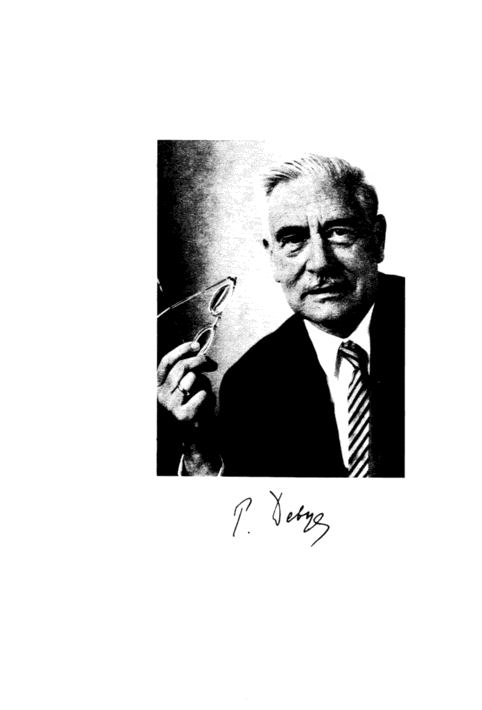
PETER JOSEPH WILHELM DEBYE March 24, 1884-November 2, 1966 BY J. W. WILLIAMS VITAE PETER JOSEPH WILHELM DEBYE was born on March 24, 1884, at Maastricht, the Netherlands. His education began in the elementary and secondary schools there; it continued at the Technische Hochschule in Aachen. His first degree, achieved in 1905, was in electrical engineering. During the Aachen period Debye came under the influence of two exceptionally able physicists, Professors Max Wien and Arnold Sommerfeld, and with their encouragement and guidance remained there for a short additional period with an appointment as Assistant in Technical Mechanics. When Sommerfeld was called to Munich in 1906 as Professor of Theoretical Physics he invited Debye to accompany him as his assistant. Debye there com- pleted his doctoral program in July 1908 and was promoted to privatdozent in 1910. By this time it was abundantly evident that he was well on the way to an illustrious career in physics. In 1911 Debye received an appointment at the University of Zurich as Professor of Theoretical Physics. He returned to the Netherlands in 1912 to accept a position as Professor of Theoretical Physics at the University of Utrecht. The next invitation, two years later, was from Gottingen to take charge of the theoretical section of the Physics Institute. Within a 23
24 BIOGRAPHICAL MEMOIRS short time he became director of the institute, and he lectured on experimental physics until after the end of World War I. Debye returned to Zurich in 1920, this time to become Professor of Physics and director of the Physics Laboratory at the Eidgenossische Technische Hochschule. An equivalent position at the University of Leipzig opened in 1927, and he was invited to fill it. From 1934 to 1940 he served as director of the Max Planck Institute of the Kaiser Wilhelm Institute for Physics at Berlin-Dahlem and Professor of Physics at the University of Berlin. The Berlin post turned out to be his last in Europe. Im- mediately following its termination (for political reasons) he became Professor of Chemistry and, later, also chairman of the Department of Chemistry at Cornell University at Ithaca, New York. The promotion to emeritus status came in 1950. It was during the Ithaca period that Debye became an American . · . cltlzen. The quality of his scientific work gained him many honors and distinctions. A number of them have been listed to form an endpaper for this Memoir. Election to the National Academy of Sciences (U.S.) came first as a Foreign Associate (1931) and then as a Member (1947~. A different type of recognition came in 1939. A shoulder- length bust, a gift of the natives of his birthplace, Maastricht, was there unveiled in his honor to adorn the town hall. It has been noted by others that this distinction probably pleased Debye above all others. Professor Debye married Mathilda Alberer in 1913. There were two children, a son, Peter Paul Rupprecht (b. 1916), and a daughter, Mathilda-Maria (b. 1921~. He died on Novem- ber 2, 1966. THE SCIENTIST In the Nobel Prize citation to Debye ( 1936) one reads, "for his contributions to our knowledge of molecular structure
PETER JOSEPH WILHELM DEBYE 25 through his investigations on dipole moments and on the dif- fraction of x-rays and electrons in gases." The structure of atoms and molecules was indeed a subject of major and continu- ing interest with Debye; it extended over the years from studies of the arrangements of the electrons in the simplest of the atoms to measurements of the average end-to-end distance in macromolecules of the "random-coil" type. One might have elected to consider in a single section those contributions that are related to the structure of matter, but here the attempt will be made to conform more closely to the outline Debye himself selected for his Collected Papers (1954), a volume that was pre- sented to him by his students and friends and by the publisher on the occasion of his seventieth birthday, in 1954. In this way there is retained to some degree a chronological order, another plan that might have been adopted. The articles presented in this compendium, fifty-one titles, constitute somewhat less than one quarter of the total number of his contributed papers. In even this portion one finds an impressive record of high-level achievement. The main subject areas are four in number: "X-Ray Scattering," "Dipole Moments," "Electrolytes," and "Light Scattering." A fifth unit is made up of "Miscellaneous Contributions." In the develop- ment and description of the researches, the reports are invari- ably replete with that same skill for which the author came to be known as a speaker and lecturer, namely, consummate proficiency in the description of a difficult and intricate subject in a lucid and well-organized fashion. A study of these and the other Debye contributions is indeed a rewarding experience. X-RAY SCATTERING The story has often been told of how, after learning about the progress of a study of the passage of light through crystals by Ewald and Sommerfeld at Munich in 1910-1912, Von Laue became interested in the passage of very short waves through such materials. He reasoned that if the wavelength of the
26 BIOGRAPHICAL MEMOIRS radiation were of the same order as the distance between the structural units a diffraction effect should be obtained. For the experimental test he suggested that x rays be used; the result strongly supported the correctness of his anticipation of a dif- fraction of the x rays by the crystals. As a result of this experi- ment a whole new subject, x-ray analysis, had been created. Though the analysis came to be recognized as being simple in principle, there were certain complications in detailed ap- plication. Debye, well informed about the research activities at Munich, was quick to perceive that refinements of several kinds were necessary if the analyses were to have quantitative character. His treatments of two of them, the temperature effect (1914) and the atomic scattering factor effect (1915), are representative of great pioneering achievement. In the first of these efforts Debye made calculations of the influence of the thermal vibrations of solids on the x-ray diffrac- tion pattern. His earlier experience with the famous theoretical evaluation of the heat capacities of crystalline solids (1912) served him well in this endeavor. Using the same general idea, that the thermally induced atomic displacements in the crystal may be described as being elastic waves that are propagated through the material, he developed a mathematical expression to describe the temperature dependence of the x-ray structure amplitude factor. Introduced was the quantity now known as the Debye, or Debye-Waller, temperature factor. (Waller, later on, had made some adjustments.) Incidentally, this factor is essential to an understanding of the Mossbauer effect. A consideration of the atomic scattering factor, Debye's second of the two refinements discussed in x-ray analysis, is of vital importance in structure determination. For the analysis, observed intensities of the spectra are compared with those calculated for assumed electronic arrangements of the struc- tural elements. The calculations require a knowledge of the atomic scattering factor, a quantity that describes the result of interference effects within the scattering atoms.
PETER JOSEPH WILHELM DEBYE 27 For atoms of different sizes and kinds the scattering power for the x rays varies. Further, the waves scattered from the different parts of the electron cloud that surrounds a nucleus will be diffracted with phase differences in the direction of observation. The total amplitude is thus a function of the scattering angle and the distribution of the electron density about the atom. The. atomic scattering factor, the quantity calculated, is defined as the ratio of the actual amplitude to that which would be produced by a single Thomson electron under the same experimental conditions. Debye was able to take these several factors into quantita- tive account (1915~. He demonstrated that as the angle of scattering increases, these phase differences become larger, so that the effective number of scattering units becomes smaller. The scattering factor, I, is now a quantity smaller than the total number of electrons in the atom. The factor depends on the wavelength, A, of the incident rays in such a way that it is a function of sin b/x, with ~ being the Bragg angle of diffraction. For example, it was possible for Debye to construct the curve for the distribution of diffracted x-ray intensity to be expected from Bohr atoms with their electrons arranged in circular orbits about their nuclei. It was at this time, 1915, that Debye first recorded his con- clusions that in matter of any state one never finds a completely random arrangement of atoms and molecules, and that perfect crystallinity is not required' for the diffraction of x rays. It was pointed out in this renowned article (1915) that even in gases the atoms are not completely random in their order. This obser- vation was the beginning of a whole sequence of experimental researches by Debye concerned with the scattering of x rays by gases, liquids, and amorphous solids. In such systems the curve of diffraction intensity versus angle of diffraction should show broad maxima and minima. However, Debye's first experimental test, conducted with Scherrer (1916), produced an unanticipated result. The test substance was finely powdered lithium fluoride,
~8 BIOGRAPHICAL MEMOIRS but the x-ray diffraction pattern that was observed consisted of the sharp spots characteristic of diffraction by a crystal lattice. The formation of the sharp rings was properly explained as being due to the intersection on the photographic plate of a succession of conical beams from randomly oriented crystals. It was in this way that a new and useful method of x-ray analysis, the "powder method," was discovered. Debye persisted in his researches in x-ray optics. In an article published somewhat later (1925), his thoughts were refined, extended, and summarized. He reaffirmed that it should be possible to observe diffraction effects that are in- terpretable in terms of the structure of the atoms and the molecules, irrespective of their physical state. More definitively, the thought was still to the effect that certain arrangements of any given atom with respect to its neighbors are more probable than others; thus it should be possible to obtain information about them by an x-ray analysis, regardless of the state of matter. For liquids on exposure to x rays a small number of broad and diffuse halos are produced in scattering. Two factors determine the outline of these halos; Debye early called them "inner" and "outer" interferences, with those of the first kind being between waves scattered by atoms belonging to the same molecule, while those of the second kind derive from intermolecular interfer- ences. It is now known that this distinction cannot generally be made. For the molecular structure determination it was reasoned that the "outer" interferences should vanish if the system were "diluted," as in a gas. In this way, the mathematical analysis and interpretation should be greately simplified. The intensity factor, 1, scattered by the gas should be an average effect, one described by a well-known Debye formula n n I_ k ~ ~ f?fj 1 1 x~j
PETER JOSEPH WILHELM DEBYE 29 in which the magnitude xtj is proportional to the distance lid from atom i to atom j and ft and fj are their atomic scattering factors. The sums include the cases where i j. For the angle of scattering, 2b, of rays of wavelength A (of the primary radia- tion), sine x~j - 41 _. The formula is written for a molecule that consists of n atoms. The scattering curve is thus a composite of as many in- dividual curves as there are atomic distances in the molecule. Each such distance produces an intensity that increases and decreases as the angle of scattering is increased; the importance of the several interatomic distances is measured by the product of the scattering factors. The results of the first experiments with gases, those from Debye's laboratory, were reported from Leipzig (1929~. The reasoning had been correct; interference rings were produced by the scattering of x rays even from the simplest of molecules. For instance, from the photometered records of the rings, the chlorine-chlorine interatomic distances in carbon tetrachloride could be established with precision. Since the model for this molecule is taken to be a tetrahedron, this single distance suffices to define the complete structure. A more definitive and expanded account of similar researches, extended to certain other molecules, appeared within another year (1930~. It was at this time that Mark and Wierl ~ presented a pre- liminary description of their investigations showing that the Debye formula descriptive of the scattering of x rays by a gas, a brief outline of which appears above, could also be applied to describe the scattering of electron rays by gases. Physically, there is one difference. The electron interferences provide in- formation about the positions of the atomic nuclei themselves, while the x-ray interferences reveal the locations of the centers ~ H. Mark and R. Wierl, "Electron Diffraction, by a Single Molecule," Natur- wissenschaften 18 (1930): 205.
30 BIOGRAPHICAL MEMOIRS of gravity of the electron clouds about them. What is really ascertained in either case is the position of the atom centers, the desired quantity. For reasons that need not be here described, electron dif- fraction became at once the preferred experiment. Though it is true that the actual number of molecules to which these methods may be applied remains small, still with modern computational devices and vastly improved equipment, electron diffraction has become a method of great utility and high pre- cision for the evaluation of molecular structure. Concurrently with the study of gaseous structure Debye, with Menke (1930), conducted experimental researches to determine the inner structure of liquids by x-ray analysis. The scattering pattern now represents the superposition of the two interference phenomena, an intramolecular part and an inter- molecular part. It was argued that if these two parts could be separated, it would become possible to draw conclusions about the structure of the liquid. Mercury, a monatomic liquid, was selected as being a suitable test substance. With this choice the separation of inner and outer effects becomes possible. The separation of the contributions to the scattering pattern was achieved, and, by using an analysis of the type that had been presented already, by Zernicke and Grins, it was possible to com- pute a distribution function to describe the probability of finding the molecules in the liquid at particular separations. This probability distribution curve for mercury demonstrated that even in the liquid there is found to be a quasi-crystalline state. The term "clustering" has been applied to short-range oraer situations of this general type; one finds it used in several other Debye discussions, in particular in his description of the underlying principles of electrolytic solution behaviors and in his treatments of the critical state. . .. .. ~ . . ~ F. Zernike and J. A. Prins, "The Bending of X-Rays in Liquids as an Effect of Molecular Arrangement'', 7~^~~` `^'~ Dl~.A:L A' 'l^~\ ADA ~t;zl~c~-rl~zJr fur rnysz~ g1 (lying/) 184.
PETER JOSEPH WILHELM DEBYE 31 In these ways it was proven that there is no absolutely sharp distinction between the amorphous and crystalline states. The general subject was again given definitive overall and more modern consideration in a critical review published rather recently (1960~. The volume in which this article appears pro- vides a good idea of the enormous amount of work that has been done in structural studies of various types of amorphous materials, an area in which Debye was the pioneer. DIPOLE MOMENTS It is as a consequence of their asymmetrical (electrical) structure that most molecules possess a permanent dipole mo- ment; the magnitude of this characteristic entity is a quantita- tive measure of the polarity of the molecule. The practical unit of dipole moment is 1 x 10-~8 e.s.u., now universally known as the debye, with symbol (D). Sixty years after the appearance of the original Debye con- tributions on the subject (1912; 1913), the measurement and interpretation of molecular dinole moments continues un- abated. Of the two articles, one was addressed to the problem of the behavior of a dielectric in a static electric field and the other to the case in which the electric field varies sinusoidally with time. The full significance of their teachings was not immediately recognized in chemical circles. The reports had appeared in journals for subjects in physics, and they were mathematical in character. This situation changed with the appearance of two more lengthy discourses by Debye: the re- nowned article in the Marx Handb?'ch der Radiologie (1925) and the record of a course of lectures presented at the Uni- versity of Wisconsin in early 1927 and published later in book form (1929) with the title "Polar Molecules." In these publica- tions the subject matter was superbly summarized, organized, and enriched, and it came quickly to the attention of the physicists, who in turn communicated their interest to friends
32 BIOGRAPHICAL MEMOIRS in chemistry. In the United States Professors K. T. Compton and R. C. Tolman were of great influence in this way. To provide an indication of continuing interest we may note that beginning in 1955 at least three monographs that summarize advances in the subject have made their appearance: C. P. Smyth, "Dielectric Behavior and Structure," United States; N. E. Hill, W. E. Vaughan, A. H. Price, and M. Davies, "Dielectric Properties and Molecular Behavior," Great Britain; and V. I. Minkin, O. A. Osipov, and Yu. A. Zhdanov, "Dipole Moments in Organic Chemistry," the Soviet Union. An earlier Methuen pocket-size monograph, Dipole Moments, by R. J. W. LeFevre is now in its third edition; we consider this source of information to be an excellent introduction to the subject. Debye, in his treatment of the electrical case, made use of the Langevin statistical theory of (orientation for the permanent magnetic moments of paramagnetic molecules. In doing so, he took cognizance of the fact that matter is built up of electrically charged units. Prior to 1912 it had been recognized that many molecules, ammonia and water for example, showed abnormally high electrical susceptibilities, ones for which there was no explanation. By analogy with the magnetic problem Debye reasoned that such asymmetric molecules must possess finite and permanent electrical moments and that their total electrical polarizations result from two contributions, a displacement of electrons and atoms in the molecule and an orientation in the electrical field of the molecule as a whole. For the actual appli- cation in any given case it was necessary to devise means for the quantitative evaluations of each of these polarizations. The result, another well-known Debye equation that can be applied to polar gases at low pressures or (less exactly) to dilute solu- tions of polar substances in a nonpolar solvent, provides the means to compute the dipole moment, a. It is, in molar form, P 3 N (<a + ,U2/3kT). The quantity P. which Debye called the molar polarization, is .
PETER JOSEPH WILHELM DEBYE 33 evaluated experimentally by means of the Clausius-Mossotti formula, which involves dielectric constant and density data. As the formula is written, the term a measures the sum effect of electronic and atomic polarizations of a molecule as the field is applied; it is a constant that is independent of temperature. The quantity ~u2/3kT represents the orientation polarization, again per molecule. The equation demonstrates that a plot of P versus 1/T .(`T absolute temperature) should be linear. From the slope of the line the dipole moment of the molecule is calculable. At the time of its inception the dipole moment was the principal source of information about molecular structure. Now such data for small molecules of the rigid type have become of lesser significance because of the incidence of the x-ray and electron diffraction techniques (of Debye) and of modern spectroscopic methods. There are molecules for which the P versus 1/T plot is nonlinear, with downward concavity. This result indicates that the molecular dipole moment is not independent of tem- perature; it can be explained by an intramolecular rotation of polar groups. Such effects are observed all the way from rela- tively small molecules to "random-coil" polymers in which, for example, -C-C- linkages occur. The particular finite value of the dipole moment observed at any temperature for molecules with internal rotations about such linkages then becomes the root-mean square value averaged over all the rotational posi- tions. For the molecule 1, 2-dichloroethane, for example, a rota- tion of the two -CH2C1 groups about the -C-C-bond could be established. In this instance the rotations are of the "hindered" rather than "free" type. The molecular configuration possesses a center of symmetry when the two C1 atoms are at their greatest distance apart, the bans form, and the dipole moment in this arrangement is zero. In any other configuration, the dipole moment is finite and increases with increasing angle of internal
34 BIOGRAPHICAL MEMOIRS rotation; it reaches a maximum value in the cis form, with an azimuthal angle of 180°. A third rotational state, the gauche form, has an azimuthal angle of ~+120°. These three rota- tional states serve to represent and characterize the staggered forms of the molecule. In this way it becomes possible to compute a fractional occupation of each state and its relative potential energy.T With F. Bueche, Debye (1951) applied this relatively simple idea of internal rotations to an organic high-polymer system. It will be indicated later that one may gain information about the average size of coiled polymer molecules in solution from light scattering measurements. However, the average coil di- ameter found by this experiment is usually much larger than would be calculated for a "random-coil" molecule of the same molecular weight and with unhindered rotaion about the bonds that link the monomeric structural units. The difference was ascribed to a restriction of the rotations about these bonds, and a model was devised by~which its effect could be quantitatively taken into account. It may be mentioned that there have been established by dipole moment studies cases where free and unhindered rota- tions are encountered. An interesting example in polymer chemistry is that of the omega-hydroxydecanoic acid esters." The result, the interpretation of which is actually a triumph of the Debye dipole theory, provided early and ample justification for the universal use by polymer chemists of the "random-coil" model for their macromolecules. The concept of the orientation of dipolar molecules in an p. 7. # S. Mizushima, Structure of Molecules (New York: Academic Press, Inc., 1954), ~ Cf. for example, G. L. Braun, W. H. Stockmayer, and R. A. Orwoll, "Dipole Moments of 1,2-Disubstituted Ethanes and Their Homologs. An Experiment for Physical Chemistry," Journal of Chemical Education 47 (1970): 287. :: W. B. Bridgman and I. W. Williams, "Polar Group Orientation in Linear Polymeric Molecules. The ~~,-Hydroxydecanoic Acids," Journal of the American Chemical Society 59 (1937): 1579; J. Wyman, Jr., "A Dielectric-Constant Study of co-Hydroxydecanoic Acid Polymers," Journal of the American Chemical Society 60 (1938): 328.
PETER JOSEPH WILHELM DEBYE 35 electric field, this time an alternating one, was applied by Debye (1913) in the explanation of the behavior of the two dielectric constants, real and imaginary, that are to be observed. (Permittivity and loss factor are better terms when frequency dependence is involved.) The basic principle is that when the field is applied, or released, a finite time will be required for the molecules to come to their equilibrium orientation because there is a viscous resistance to these rotatory motions. The range of frequency over which the real dielectric constant is variable extends from the static field to one that oscillates so rapidly as not to provide for any rotational motion of the polar molecule at all; the theory thus describes a typical molec- ular relaxation process. The accompanying constant, called the time of relaxation, is made available from measurements of the frequency variation of either the real dielectric constant or the energy absorption for the system; in solutions this time constant may be related to molecular size and shape. The arguments and equations presented in connection with the frequency dependence problem have perhaps been of great- est interest in electrical engineering. One difficulty with the Debye theory has been that, written in terms of molecular di- mensions and the internal friction of the medium, it leads to equations of quite the same mathematical form as an alternative explanation of Wagner ~ that is founded upon inhomogeneity of substance without reference to any molecular mechanism. There is nothing vague about the Debye model, and one can readily appreciate its appeal to those who work to elucidate the molecular behavior of electrically insulating materials. The model's main fault may be that it is too definitive in character. E LIE CTROL`YTE S As physical chemistry was taught in the early 1920's one of its major subdivisions was a description of the electrochemical ~ Cf. in H. Schering, Isolierstoje in der Elektrotechnik (Berlin: Springer, 1924), p. 1.
36 BIOGRAPHICAL MEMOIRS behavior of electrolyte solutions. But in this particular area one encountered many perplexing situations; overall its con- slderation was not a satisfying experience for either teacher or student. Clearly, a new idea was needed, and while Debye may not have provided it he did achieve great success in transforming, a new postulate into an effective and practical working tool. In particular, there was a fundamental problem in that the simple laws of Arrhenius and van's Hoff, so successful in applica- tion for the study of the equilibrium and transport properties of weak electrolytes (organic acids and bases), failed utterly when applied to account for these same kinds of data for solu- tions of the strong electrolytes (salts, certain inorganic acids and bases). In the latter situations the starting point, a mass action law equilibrium, was clearly inconsistent with the results of extensive sets of experiments. The answer was found in the assumption that the strong electrolytes are completely dissoci- ated when dissolved in water. This representation had been considered by others, notably by Bjerrum and Sutherland and, using it, Milner ~ had actually computed the osmotic coefficient (a quantity that is simply related to the activity coefficient) for the electrolytes. - analysis is, in principle, a solution of the thermodynamic prob- lem, but there remained substantial mathematical difficulties such that the result had to be expressed in graphical and im- practical ways. Certainly, it may be said that the Milner For the treatment of the equilibrium properties, another mathematical route was selected by Debye and Huckel (1923~. The results were presented in quantitative expressions that could be adapted simply and directly to freezin~,-point depres- sion and related data for dilute stron~,-electrolyte aqueous sys- tems. In the classical theory the ions had been treated as independently active units. In the new analysis it was the ~ S. R. Milner, "Virial of a Mixture of Ions," The Philosophical Magazine 23 (1912): 551; "The Effect of Interionic Forces on the Osmotic Pressure of Electrolytes," The Philosophical Magazine 25 (1913): 742.
PETER JOSEPH WILHELM DEBYE 37 electrostatic forces exerted between the ions that proved to be the basic causes of the observed nonideality of solution be- haviorhence the term "interionic attraction theory." Actually, for sufficiently dilute electrolyte solutions, it became possible for Debye and Nickel to calculate in advance of any experiment what wo~lr1 he the oh.served osmotic oressure (or freezing . point lowering, etc.) for salts of different valence types at a given ionic strength (a function of the electrolyte concentration) in an aqueous solution. The restriction to dilute solution behaviors made easier an otherwise very involved mathematical problem. Still with reference to the first of the Debye-Huckel papers and the freezing point depression problem, we amplify these remarks. The argument is based on the application of well- known laws of electrostatics and together with the Maxwell- Boltzmann statistics. The ions were considered to be spheres of the same diameter, with their charges spread out in spherical symmetry. The solvent was a medium of uniform dielectric constant, a quantity unchanged by the addition of the solute Ions. The ions in solution might be expected to be in random thermal motion. However, because of the charges they carry, .m there will be, as a time average, more ions of opposite sign than those of the same sign in a neighboring small element of volume about any individual ion upon which attention is focused. As a result there is a structure in the system, one which is neither completely regular nor completely random in char- acter. Each ion is thus subject to an average net electrostatic attraction by all of the other ions, and a clustering results. The magnitude of this attraction is a function of the product of the charges of the ions and the mean distance between them (con- centration of the solution). The potential energy of any arbi- trary central ion in the solution is lower as compared to what the energy would have been if the ion had possessed zero charge. The magnitudes of ionic attractions and repulsions were de- scribed by Coulomb's law, a fact that leads eventually to the
38 BIOGRAPHICAL MEMOIRS square root of concentration behaviors for both equilibrium and transport behaviors observed by experiment in dilute solu- tions of strong electrolytes. In the theory it was the most probable distribution of an ionic atmosphere about a central ion that was first determined. Then, the average electrical potential of a given ion due to the presence of all the other ions was calculated. The calcula- tion involved the combination of the Poisson differential equation, in which potential is related to the average electrical charge density, with the Boltzmann distribution theorem. It was the approximations here introduced to effect a simplifica- tion of the mathematical problem that have become the cause of much later comment. Certainly, they restrict the application of the theory largely to dilute aqueous solutions. With a knowledge of this potential, the excess free energy due to the electrostatic interactions was computed. It is related to the several measures of solution nonideality, for instance, the osmotic coefficient from freezing-point depression data, and even more simply, the activity coefficient. In the common usage of today it is the activity coefficient which is sought. Debye (1924) was prompt in his appreciation of its advantage in use over the osmotic coefficient; he recog- n~zea anal nits earlier presentation with Huckel (1923) could be greatly simplified if written in terms of the activity coefficient. It is the equivalent of this second derivation of the limiting thermodynamic law that is almost universally reproduced in the modern physical chemistry texts. The title of this article is, in translation, "Osmotic Equation of State and Activity of Di- lute Strong Electrolytes." In the introduction to this report one finds the German equivalent of the sentences, "Besides, I , . . . . . have in the meantime come across some laws on the activity of strong electrolytes which G. N. Lewis discovered in a purely experimental way. I am glad to have this opportunity to em- phasize the special importance of these fine investigations, the
PETER JOSEPH WILHELM DEBYE 39 more so since the laws of Lewis can be explained very easily by the proposed theory. The appreciably more difficult transport problem of elec- trical conductance was the subject of the second of the basic Debye-Huckel theoretical treatments (1923~. On the basis of the Arrhenius theory, the variation of the equivalent electrical conductance with electrolyte concentration was explained by the change in the relative number of the ions, the carriers of the . . current, as a function of concentrationa law of mass action effect. While this explanation remains correct to a good approx- imation for weak electrolytes, it could not account for the square root of concentration decrease in equivalent conductance with increasing concentration that had already been found experi- mentally by Kohlrausch and others for the strong electrolytes. Here, per equivalent of electrolyte, the number of carriers of electricity remains substantially constant (in dilute solution); it is the ion mobilities that decrease with increasing electrolyte concentration, again an effect of the interionic attractions. The discussion was now focused on two properties of the ionic at- mosphere, a relaxation time effect and an electrophoretic effect. Although this time absolute values could not be computed, Debye and Huckel were able to demonstrate that for the limit- ing law the two progressive decreases in ion Nobilities with increasing salt concentration are each proportional to the square root of the equivalent concentration. In their first treatment of the transport problem Debye and Huckel did not fully take into account the effect of the Brownian movement of the ions during the time of their displacement in the electrical field. The required modification was provided by Onsager, and the combined result is called today the Debye-Huckel-Onsager theory. With the appearance of these papers there began a whole new era in the treatment of systems containing electrolytes. Debye himself continued to recognize new areas in the subject
40 BIOGRAPHICAL MEMOIRS and to treat them with his customary aplomb. Immediately following the publication of the fundamental disclosures he indicated (1923) at length that his simple limiting law for the activity coefficient of a strong electrolyte can be directly applied in the explanation of the change in solubility of a difficultly soluble salt caused by the addition to the solution of a salt with- out a common ion. The quantity log s/sO versus square root of the ionic strength is linear, and log s/sO is a direct measure of -log By+, for the difficultly soluble salt. The quantities s and so are the solubilities of the saturating salt in the presence and absence, respectively, of the added electrolyte, and y+ is its mean activity coefficient. In two papers on the "salting-out effect," Debye ( 1925; 1927) showed that the separation of organic solutes from satu- rated aqueous systems on salt addition is largely a consequence of the inhomogeneous electrical field produced by the localized charges carried by the ions. Again, these accounts do not take into consideration the fact of the presence of other forces, especially in that one is no longer dealing with dilute solutions. In further connection with the transport problem Debye and Falkenhagen (1928) reasoned that because of the finite time of relaxation of the ionic atmosphere there must be a frequency dependence of the electrical conductivity for a strong electrolyte in solution. Further it was indicated that the Wien observation of a deviation from Ohm's law when high field strengths are applied in the measurement could be interrelated with the fre- quency dependence problem. Although the experiments are difficult to perform, the detailed prediction of the dependence of conductance on the frequency of the applied field was later verified by direct experiment, an establishment of the sufficiency of the Debye model to explain not only the conductance be- havior, but also to provide treatments of other transport prob- lems, such as diffusion and viscosity, again for dilute strong electrolyte solutions. The Debye papers descriptive of his interionic attraction
PETER JOSEPH WILHELM DEBYE 41 theory have influenced profoundly the course of research in several related areas. We mention but two of them: 1. The velocity of ionic reactions is modified as salt is added to the system. These effects are not generally due to any direct action of the salt; they are due rather to the electrostatic forces between the ions as they influence the velocity constants for the reaction. The bearing of modern electrolyte theory on the re- action kinetics has been treated in an authoritative fashion by Bell. ~ 2. There has been much confusion in the literature of the protein physical chemist as data for typical equilibrium and transport experiments have been interpreted. The system used is traditionally that of water, protein, and salt, a three-com- ponent system, one which requires detailed mathematical in- terpretation. By the simple expedient of the addition of excess salt, called "supporting electrolyte," and attention to certain experimental details, the influence of the charge on the macro- ion is largely suppressed, and the problem is reduced in com- plexity to that encountered in the analysis of a two-component, neutral molecule system. Casassa and Eisenber~ t have discussed this problem as it relates to osmotic pressure, light scattering, and sedimentation equilibrium in such systems. LIGHT SCATTERING The final period of Debye~s life began in 1940 when he arrived at Cornell University. Debye note applied his talents to macromolecular and colloid chemistry and began at once to provide new ideas and ways for their study. Now, the central theme was again the interaction of radiation and matter. He recognized that just as the wavelength of x rays is comparable to the size of atoms in the crystal, so is the corresponding length of light rays of the same order as the dimensions of the polymer molecules and colloidal particles. As the result one finds in the R. P. Bell, Acid-Base Catalysis (Oxford: Clarendon Press, 1941) . ~ E. F. Casassa and H. Eisenberg, "Thermodynamic Analysis of Multi- Component Solutions," A dvances in Protein Chemistry 19 (1964): 287.
42 BIOGRAPHICAL MEMOIRS literature theoretical analyses by which light-scattering experi- ments may be interpreted in terms of macromolecular size, radius of gyration, and even of the end-to-end distance of the macromolecular unit when it has the random-coil configuration. There are also significant extensions of our knowledge of the structure of colloidal particles and porous solids. Of the two kinds of mathematical analysis for light scattering from solutions, the vibrating dipole theory of Hertz ~ and the density fluctuation theory of van Smoluchowski ~ and of Ein- stein,1: the latter is the more generally applicable. A basic quantity is the turbidity, T. described by an ex- ponential law of common form: 1 10e-7r. This statement has as a source the vibrating dipole theory. In it I and ID are the scattered and incident light intensities, re- spective~y, and r is the distance between the scattering center and the point of observation. The turbidity is thus the extinc- tion coefficient in cow. In experimental quantities it can be written as: 32~3 v ~ 1 dn~ _ . 3 A4 no dc_ It will be noted that this formula contains the familiar Raylei~h scattering factor (A4~-~. With v, the number of macromolecules per cubic centimeter, which is equal tc} cN/M, the molecular weight (M) is introduced and ~ HMc. The concentration (c) is the weight of solute per cubic centimeter of solution, H is the familiar light-scattering constant in (A4~-~, and ~n/dc is the refractive index increment. Fluctuation theory may be used with advantage in the calcu- lation of the excess scattering by a dissolved substance. From an ~ H. Hertz, "Die Krafte electrischen schwingungen, behandelt nach der Max- wellschen theorie," Annalen der Physik 36 (1888): 1. Smoluchowski, Annalen der Physik 25 (1908): 205. : A. Einstein, "Theory of the Opalescence of Homogeneous and of Mixed Liquids in the Neighborhood of the Critical Region," Annalen der Physik 33(1910): 1275.
PETER JOSEPH WILHELM DEBYE 43 Einstein relation between osmotic pressure and light scattering Debye obtained the general expression to describe the light- scattering behavior as a function of solute concentration (c) for a binary nonideal solution of neutral macromolecules whose size is small in comparison with the wavelength of the mono- chromatic light. It is: He + 2Bc T M ' in which B is the osmotic pressure second virial coefficient. With intramolecular interference of the light, such as is found in larger and flexible molecules, the situation becomes much more complicated because a particle-scattering factor now must be introduced into the essential working equations. Debye's classical and original work on the atomic scattering factor in x-ray analysis pointed the way for him to relate the angular dissymmetry of the light scattering now involved to particle shape. The particle-scattering factor contains a size parameter, angle of scattering, and wavelength dependence. The application of the Einstein and Rayleigh equations for light scattering to the determination of the molecular size of macromolecules in solution did not originate with Debye. There were the earlier Putzeys and Brosteaux ~ and the Gehman and Field! contributions; proper and generous references tO these papers were made in the Debye reports. But, as is typical, Debye did make the procedure a practical one, so much so that immediately following the appearance of his disclosures there began an explosive development of organic high-polymer chem- istrythe subject matter of which had now been taken out of the realm of the descriptive and into exact science. Further, the light-scattering techniques were applied to other types of systems, such as silicates and soap micelles. In an inter- esting series of papersj published during the period 1948-1951, ~ P. Putzeys and J. Brosteaux, "The Scattering of Light in Protein Solutions," Transactions of the Faraday Society 31(1935): 1314. ~ S. D. Gehman and J. E. Field, "Colloidal Structure of Rubber in Solution," Industrial and Engineering Chemistry 29 (1937): 793.
44 BIOGRAPHICAL MEMOIRS Debye, with several collaborators, used the techniques to learn about micelle formation in solutions of paraffin-chain salts. Both the size and the shape of the micelles were considered. An ob- jective was to determine the number of primary units of which they are composed and whether all the micelles are alike in size; another was to describe the mechanism of micelle formation. Of the two theoretical accounts of the Debye theory of micelle formation appearing in the literature (1949), the New York Academy of Sciences article is the more definitive. It should be mentioned, however, that both Reich ~ and Ooshika believe Debye to be seriously in error in his treatment of the problem. Both critics agree that the stable micellar size must be the one that results in a minimum of free energy for the system as a whole rather than for the individual micelle, as Debye had postulated. (Although an interval of two years be- tween the appearance in the literature of the two criticisms is evident, the original manuscripts reached their respective edi- torial offices in August 1953, actually within one week of each other. The presumption is that they were conceived and pub- lished independently.) In the final period of his scientific life, Debye became greatly interested ire the phenomenon of critical opalescence and lec- tured widely and enthusiastically on the subject. Under certain circumstances small molecules may form aggregates of a size com- parable to the wavelength of light, again a typical clustering phenomenon. A study of the scattering of light from such systems provides information about the distance of nearest ap- proach of the molecules, which is taken to be a measure of the range of molecular interaction. But here, and apparently ~vith- out full realization, the work of Debye had been largely, but ii I. Reich, "Factors Responsible for the Stability of Detergent Micelles," Journal of Physical Chemistry 60 (1956): 257. ~ Y. Ooshika, "Theory of Critical Micelle Concentration of Colloidal Electrolyte Solutions," Journal of Colloidal Science 9 (1954): 254.
PETER JOSEPH WILHELM DEBYE 45 not completely, anticipated by Ornstein and Zernike it; their distribution function to ascertain this distance was the one used by Debye. Their study was concerned with density fluctuations in the critical region; the basic article bears the title "Accidental Deviations of Density and Opalescence at the Critical Point of a Single Substance." There exists in the literature a series of papers over a period of some eight years in which these authors continued the development and description of various phases of the problems related to the clustering tendency of molecules in the critical state and the resultant opalescence. MISCELLANEOUS Of the papers assigned to the miscellaneous category by Debye for his Collected Works, lack of space requires that but two of the items receive mention. Both are of such consequence that accounts of them appear in most of the better modern texts of physical chemistry. The earlier one has to do with the theory of the heat capacity of solids (1912~. According to an old empirical rule of Dulong and Petit, the heat capacity per gram-atom of an element in the solid state is 6.2 calories. In the attempt to account for this value theoreticians had believed it to result from an equipartition of energy, but as more accurate data for the temperature depend- ence of the heat capacity were made available it became evident that this could not be the complete explanation, especially at the lower temperatures. The experimental fact is that the heavy and soft elements possess this value for the heat capacity per gram-atom at room temperature, but for the light and hard elements much higher temperatures are required for its attain- ment. At the low temperatures all the solid elements show heat capacities lower than 6.2 calories per gram-atom. ~ L. S. Ornstein and F. Zernicke, "Accidental Deviation of Density and Opalescence at the Critical Point of a Single Substance," Proceedings of the Royal Academy of Sciences of Amsterdam 17 (1914): 793.
46 BIOGRAPHICAL MEMOIRS The model used by Debye was to treat the solid as a con- tinuum filled with elastic waves rather than as a system of oscil- lators. In spite of very involved mathematical operations he succeeded in deriving a formula that gives an excellent repre- anon of the heat capacity at constant volume, car, as a tunc- tion of temperature. It contains his famous T3 law for the quantity cv at very low temperatures, while still accounting for the fact that car does not increase indefinitely as the temperature . . . IS 1ncreasecl. The later miscellaneous Debye paper, "Some Remarks on Magnetization at Low Temperatures" (1926), is another thor- oughly imaginative and impressive item. (The same procedure was described independently by the American physical chemist Giauque, and concurrently in time.) Herein is presented in detail the principle of adiabatic demagnetization as a method for the production of very low temperatures. In it, a paramagnetic ~ . ~ ~ . , , salt is inserted between the poles of a powerful magnet contained in a bath of liquid helium. As the field is turned on, the mag- netic dipoles are oriented, with the production of heat; in turn, this heat is absorbed in the bath. Following the strong mag- netization, the salt is insulated from its surroundings. On de- crease of the field strength the orientation of the dipoles moves toward randomization, increasing the potential energy at the expense of the kinetic energy of the molecules. Accordingly, the temperature of the salt is decreased. The difficult experiment came gradually into fruitful application, beginning with Giauque in 1933. Debye did not write many monographs and review articles. In addition to the definitive article on dipole theory in the Marx Handbuch der Radiologie (1925; 1934), his "Polar Mole- cules" of 1929 has served as a great stimulus to chemists. Interest in this volume has continued, with paperback reprints having been maple available in 1945 and again in 1960. The Chu and the Prock-McConkey books, records of two series of lectures by
PETER JOSEPH WILHELM DEBYE 47 Debye (Cornell and Harvard), provide valuable information about molecular interactions and the forces responsible for them. The overall record, of which but a small part has been herein depicted, must demonstrate that in his lifetime Professor Debye made many brilliant contributions of great value to physics, to chemistry, and to certain of their borderline disciplines. In these writings he has left a precious legacy for physical scientists. In every sense and by universal acclaim he was indeed one of the leading scientists of our century. THE MAN As an individual Professor Debye was held in universal af- fection and esteem by those who knew him. One description, taken from a Harvard University citation, is particularly apt "a large-hearted physicist who gladly lends to the chemist a helping hand." He was the kind of person Maurice Hindus had in mind when he wrote, "A student needs to come under the influence of only one exciting professor to feel the effects of it all his life, even to have the course of his life changed." He was readily approachable, a very friendly person to whom one could go for advice in research and come away fully rewarded. No one was beneath his personal encouragement; he was patient and understanding with all. The many honors and distinctions that came with the passing of the years did not in any way change him. He was modest and realistic about them. He never forgot his old friends and asso- ciates, nor did his interest in science diminish with increased time or frame. To the end his generosity, friendliness, and con- cern for others were commensurate with his mental prowess. Whether as classroom teacher or as special lecturer he was renowned for his facility of expression. This apparent ease of exposition must have required concerted effort at organization. Nowhere were his abilities to explain scientific principles better
48 BIOGRAPHICAL MEMOIRS demonstrated than in his lectures for the large introductory physics courses presented during the Zurich and Leipzig periods. The concomitant lecture table displays were correspondingly pertinent and skillful; here again it was obvious that much thought and time had gone into their preparation. In his years in the United States Debye became an inveterate traveler. He gave lectures and seminars outside of Ithaca almost weekly. At meetings his appearances invariably meant large . . ~ ~ . . . ~ _ ~ A ~ . A AIL _ ~ ~ ~ 4 _ audiences, for from his discussions at them the new and unex- pected was the rule. He possessed the ability to explain scientific ideas and principles to a wide variety of audiences, and wherever he went he was received as a desirable and agreeable lecturer. It has been noted elsewhere ~ that Debye was "an affection- ate husband, father, and grandfather." His hobbies were few. such as gardening, fishing, and collecting cacti. There were periods when his lengthy activities in his rose garden might have brought concern to an observer, but more often than not they were followed by extraordinary bursts of scientific activity; a new idea had been elaborated during the out-of-doors time. As a result of my own relationships with him I must note that Professor Debye did indeed have true kindness of heart, along with his rare vigor of intellect. THE AUTHOR is indebted to colleagues both here at the University of Wisconsin and at the California Institute of Technology for their advice and help. Drs. E. W. Hughes, W. E. Vaughan, P. Bender, and l. D. Ferry have read portions of the manuscript. have Riven wise counsel, and have made useful suggestions. Subject to certain revisions and modifications, the bibliography which is here included has been taken from the Debye Memoir written by Professor Mansel Davies for the 1970 volume, Bio- graphical Memoirs of the Fellows of the Royal Society (London). Too, he has read the manuscript and raised certain questions in connection with it. For the permission of Dr. Davies to make use of both bibliography and suggestions, I am deeply grateful. ~ F. A. Long, "Peter Debye An Appreciation," Science 155 (1967): 979. 1 ' <I
PETER JOSEPH WILHELM DEBYE 49 A substantial portion of this memoir was written in the hos- pitable Millikan Library of the California Institute of Technology at Pasadena. HONORS AND DISTINCTIONS ACADEMIES National Academy of Sciences, Washington, D.C. New York Academy of Sciences, New York American Academy of Arts and Sciences, Boston American Philosophical Society, Philadelphia Franklin Institute, Philadelphia Royal Dutch Academy, Amsterdam, Holland Royal Society, London, England Roval Institution of Great Britain, London, England Royal Danish Academy, Copenhagen, Denmark Academies of Berlin, Gottingen, Munich, Germany Academies of Brussels and Liege, Belgium Royal Irish Academy, Dublin, Ireland Papal Academy, Rome, Italy Indian Academy, Bungalore, India National Institute of Science, India Real Sociedad Espanola de Fisica y Quimica, Madrid, Spain MEDALS Rumford Medal (Royal Society, London), 1930 Lorentz Medal (Royal Dutch Academy, Amsterdam), 1935 Nobel Prize in Chemistry, 1936 Franklin Medal (Franklin Institute), 1937 Willard Gibbs Medal (American Chemical Society, Chicago), 1949 Max Planck Medal (German Physical Society), 1950 Nichols Medal (American Chemical Society, New York), 1961 HONORARY DEGREES Brussels and Liege (Belgium) Oxford (England) Prague (Czechoslovakia) Sofia (Bulgaria) Aachen and Mainz (West Germany)
50 BIOGRAPHICAL MEMOIRS Zurich, E. T. H. (Switzerland) Harvard, St. Lawrence, Colgate, Notre Dame, Holy Cross, Brooklyn Polytechnic, Boston College, Providence College, and Clarkson Institute of Technology (United States) LECTURESHIPS Paris (France) Liege (Belgium) Oxford and Cambridge (England) Harvard, Michigan, Columbia, California, Southern California, Massachusetts Institute of Technology, California Institute of Technology, and Wisconsin (United States)
PETER JOSEPH WILHELM DEBYE 51 BIBLIOGRAPHY KEY TO ABBRE VIA TIONS Angew. Chem. Angewandte Chemie Ann. Phys. _ Annalen der Physik Ber. Verh. Saech. Akad. Leipz. math.-naturwiss. K1.Berichte uber die Verhandlungen der Saechsischen Akademie zu Leipzig, mathematisch- naturwissenschaftlich Klasse Bull. sci. Acad. Roy. Belg. Bulletin des sciences, Academie Royale de Belgique C. R. Soc. Suisse Phys. Comptes rendus de la Socidtd Suisse de Physique Ergeb. tech. Rontgenk. _ Ergebnisse der technischen Ront~enk,~n~le J. Appl. Phys.Journal of Applied Physics |. Chem. Phys. journal of Chemical Physics |. Colloid Sci.[ournal of Colloid Science i. Phys. Chem. [ournal of Physical Chemistry }. Phys. Colloid Chem. journal of Physical and Colloid Chemistry |. Polym. Sci. - [ournal of Polymer Science Nachr. Akad. Wiss. Goett. math.-phys. K1. IIa Nachrichten der Akademie der Wissenschaften in Goettingen, mathematisch-physikalische Klasse, IIa Natuur-en Geneeskd. Congr. Natuur-en Geneeskundige Congress Phys. Eindhoven Physica, Eindhoven Phys. Rev. Physical Review Phys. Z. Physikalische Zeitschrift Rev. univ. mines (Li~ge) Revue universelle des mines (Lidge) Sitzungsber. Bayer. Akad. Wiss. math.-naturwiss. K1. - Sitzungsberichte der Bayerischen Akademie der Wissenschaften, mathematisch-naturwissen- schaftliche Klasse Trans. Am. Electrochem. Soc. - Transactions of the American Electro- chemical Society Trans. Faraday Soc. _ Transactions of the Faraday Society Verh. Dtsch. Phys. Ges. VerhandI0ngen der Deutschen Gesellschaft fur Physik Verh. Schweiz. Naturforsch. Ges. Freib. Verhandlungen der Schweizer- ischen Naturforschenden Gesellschaft, Freiburg Z. Elektrochem. Zeitschrift fur Elektrochemie und angewandte physika- lische Chemie Z. Phys. Zeitschrift fur Physik Z. phys. Chem. Zeitschrift fur physikalische Chemie Z. tech. Phys. Zeitschrift fur technische Physik ~ _ _ _ 1907 Wirbelstrome in Staben von techteckigem Querschnitt. Zeitschrift fur Mathematik und Physik, 54:418. 1908 Eine Bemerkung zu der Arbeit von F. A. Schulze. Einige neue
52 BIOGRAPHICAL MEMOIRS Methoden zur Bestimmung der Schwingungszahlen hochster horbarer und unhorbarer Tone usw. Ann. Phys., 25:819. Das elektromagnetische Feld um ein Zylinder und die Theorie des Regenbogens. Phys. Z., 9:775; also in Verh. Dtsch. Phys. Ges., 10~20~:741. 1909 Naherungsformeln fur die Zylinder funktionen fur grosse Werte des Arguments und unbeschrankt veranderliche Werte des Index. Mathematische Annalen, 67:535. Der Lichtdruck auf Kugeln von beliebigen Material. Ann. Phys., 30:57. Das Verhalten von Lichtwellen in der Nahe eines Brennpunktes oder einer Brennlinie. Am. Phys., 30:755. 1910 Stationare und quasistationare Felder. In: Encyklopadie der Mathematischen Wissenschaften, vol. 5, Physik, Teil 2, p. 395. Leipzig, B. G. Teubner. Zur theorie der Elektronen in Metallen. Ann. Phys., 33:441. Semikonvergente Entwickelungen fur die Zylinder-funktionen und ihre Ausdehnung ins Komplexe. Sitzungsber. Bayer. Akad. Wiss. math.-naturwiss. K1., no. 5, p. 1. With D. Hondros. Elektromagnetische Wellen an dielektrischen Drahten. Ann. Phys., 32:465. Die Berechnung der Molekuldimensionen aus Radiometerbeobach- tungen. Phys. Z., 11:115. Der Wahrscheinlichkeitsbegriff in der Theorie der Strahlung. Ann. Phys., 33:1427. 1911 Die Frage nach der atomistischen Struktur der Energie. Viertel- jahtsschrift der Naturforschenden Gesellschaft in Zurich, 56: 156. · Uber Abweichungen vom Curie-Langevin'schen Gesetz und ihren Zusammenh ang mit der Quantenhypothese. Verh. Schweiz. Naturforsch. Ges. Freib., 94:220; also in C. R. Soc. Suisse Phys., ler aout, 1911. 1912 Zur Theorie der spezifischen Warmen. Ann. Phys., 39:789.
PETER JOSEPH WILHELM DEBYE 53 Einige Resultate einer kinetischen Theorie der Isolatoren. Phys. Z., 13:97. 1913 Zur Theorie der anomalen Dispersion im Gebiete der langwelligen elektrischen Strahlung. Verh. Dtsch. Phys. Ges., 15:777. With W. Dehlinger. Die kinetische Theorie der Materie in ihrer modernen Entwicklung (Ausgang aus der Utrechter Ancrittsreder von Prof. P. Debye). Archiv Elektrotechnik, 2:167. Zustandsgleichung und Quantenhypothese. Nachr. Akad. Wiss. Goett. math.-phys. K1. IIa, 1913:140; also in Phys. Z., 14:317. ., Uber den Einfluss der Warmebewegung auf der Interferenzer- scheinungen bei Rontgenstrahlen. Verh. Dtsch. Phys. Ges., 15: 678. .. Uber die Intensitatsverteilung in den mit Rontgenstrahlen erzeugten Interferenzbildern. Verh. Dtsch. Phys. Ges., 15:738. Spektrale Zerlegung des Rontgenstrahlen mittels Reflexion und Warmebewegung. Verh. Dtsch. Phys. Ges., 15:857. With A. Sommerfeld. Theorie des lichtelektrischen Effektes vom Standpunkt des Wirkungsquantums. Ann. Phys., 41:873. 1914 With l. Kern. Uber die B,ehandlung gekoppelter Systeme nach der Methode der Eigenschwingungen. Phys. Z., 15:490. Zustandsgleichung und Quantenhypothese mit einem Anhang uber \Varmeleitung. In: Vortrage uber die kinetische Theorie der Materie und der Elektrizitat. Math. Forlesgn, vol. VI. Leipzig, B. G. Teubner. Interferenz von Rontgenstrahlen Phys., 43:49. 1915 und Warmebewegung. Ann. Die Konstitution des Wasserstoff Molekuls. Sitzungsber. Bayer. Akad. Wiss. math.-naturwiss. K1., 1915:1. Zerstreuung von Rontgenstrahlen. Ann. Phys., 46: 809; also in Nachr. Akad. Wiss. Goett. math.-phys. K1. IIa., 1915:70. 1916 With P. Scherrer. Interferenzen an regellos orientierten Teilchen
54 BIOGRAPHICAL MEMOIRS im Rontgenlicht. I. Phys. Z., 17: 277; also in Nachr. Akad. Wiss. Goett. math.-phys. K1. IIa., 1916: 1. WitI, P. Scherrer. Interferenzen an regellos orientierten Teilchen i~ Rontgenlicht. II. Nachr. Akad. Wiss. Goett. math.-phys. K1. IIa, 1916:16. Die Feinstruktur wasserstoffahnlicher Spektren. Phys. Z., 17:512; also in Nachr. Akad. Wiss. Goett. math.-phys. K1. IIa, 1916:161. Quantenhypothese und Zeeman-Effekt. Phys. Z., 17:507; also in Nachr. Akad. Wiss. Goett. math.-phys. K1. IIa, 1916: 142. 1917 Konzentrationselement und Brownsche Bewegung. Phys. Z., 18: 144. Der erste Elektronenring der Atome. Phys. Z., 18:276; also in Nachr. Akad. Wiss. Goett. math.-phys. K1. IIa, 1917:236. With P. Scherrer. Uber die Konstitution von Graphit und amorpher Kohle. Nachr. Akad. Wiss. Goett. math.-phys. K1. IIa, 1917:180. With P. Scherrer. Interferenzen an regellos orientierten Teilchen im Rontgenlicht. III. Die Kohlenstoffmodifikationen. Phys. Z., 18:291. Optische Absorptionsgrenzen. Phys. Z., 18:428. Die Atomanordnung von Wolfram. Phys. Z., 18:483. 1918 With P. Scherrer. Atombau. Phys. Z., 19:474; also in Nachr. Akad. Wiss. Goett. math.-phys. K1. IIa, 1918: 101. 1919 Das molekulare elektrische Feld in Gasen. 1920 Phys. Z., 20: 160. Die neuen Forschungen uber den Bau der Molekule und Atome. Verhandlungen der Gesellschaft deutscher Naturforscher und Arzte, 86: 239. Die van der Waalsschen Kohasionskrafte. Phys. Z., 21:178; also in Nachr. Akad. Wiss. Goett. math.-phys. K1. IIa, 1920:55. 1921 Adsorptie van elekenische molekulen. Phys. Eindhoven, 1:362.
PETER JOSEPH WILHELM DEBYE 55 Molekularkrafte und ihre Elektrische Deutung. Phys. Z., 22:302. Moleculaire krachten van electrischen Oorsprong. Handelingen v. het. XVIII Vdld. Natuur-en Geneeskd. Congr., Utrecht. 1922 Laue-interferenzen und Atombau. 1923 Naturu~issenschaften, 10:384. Zerstreuung von Rontgenstrahlen und Quantentheorie. Phys. Z., 24:161. With E. Huckel. Zur Theorie der Elektrolyte. I. Gefrier- punktserniedrigung und verwandte Erscheinungen. 24:185. With E. Huckel. Zur Theorie der Elektrolyte. II. Das Grenzgesetz fur die elektrische Leitfahigkeit. lr ~ ~ d ~ ~U ~ ~ _ _ ~ ~ 1 _ Phys. Z., 24:305. nerlscne 1 neorle cter ~esetze aes osmotischen Drucks bei starker Elektrolyten. Phys. Z., 24: 334; also in Recueil des travaux chimiques des Pays Bas et de la Belgique, 42:597. De moderne ontwikkeling van de elektrolyt-theorie. Handelingen v. het. XVIII Vdld. Natuur-en Geneeskd. Congr., Maastricht. Over Ionen en Hun Activiteit. Chemisch Weekblad, 20:562. 1924 With E. Huckel. Bemerkungen zu einem Satze uber die Kataphore- tische Wanderungsgeschwindigkeit suspendierter Teilchen. Phys. Z., 25:49. Osmotische Zustandsgleichung und Aktivitat verdunnter starker Elektrolyte. Phys. Z., 25:97. 1925 Molekulare Krafte und ihre Deutung. Ges. Freib., 106: 128. Note on the scattering of x-rays. Physics, 4:133. Verh. Schweiz. Naturforsch. Journal of Mathematics and Theorie der elektrischen und magnetischen Molekulareigenschaften. In: Handbuch der Radiologie. Die Theorien der Radiologie, ed. by E. Marx, vol. VI, p. 597. Leipzig, Academische Ver- lagsgesellschaft. With L. Pauling. Inter-ionic attraction theory of ionised solutes. IV. The influence of variation of dielectric constant on the limit-
56 BIOGRAPHICAL MEMOIRS ing law for small concentrations. ~ournal of the American Chemical Society, 47:2129. With [. McAulay. Das elektrische Feld der Ionen und die Neutral- salzwirkung. Phys. Z., 20: 22. With A. Huber. Een proef over de installing van paramagnetische molukulen. Phys. Eindhoven, 5:377. 1926 Die Grundgesetze der elektrischen und magnetischen Erregung vom Standpunkte der Quantentheorie. Phys. Z., 27:67. Molekulare Krafte und ihre Deutung. Umschau, 30:905; also in Verh. Schweiz. Naturforsch. Ges. Freib., 106: 128. Einige Bemerkungen zur Magnetisierung bei tiefer Temperatur. Ann. Phys., 81:1154. Bemerkung zu einigen neuen Versuchen uber einen magneto- elektrischen Richteffekt. Z. Phys., 36:300. With W. Hardmeier. Anomale Zerstreung von a-strahlen. Phys. Z., 27:196. With W. Hardmeier. Dispersion anomale des rayons alpha. C. R. Soc. Suisse Phys., 8: 131. 1927 Wellenmechanik und Korrespondenzprinzip. Phys. Z., 28: 170. With C. Manneback. The symmetrical top in wave mechanics. Nature, Lond., 119:83. Report on conductivity of strong electrolytes in dilute solutions. Trans. Faraday Soc., 23:234. Das elektrische Ionenfeld und das Aussalzen. Z. phys. Chem., 130: 56. Uber die Zerstreuung von Rontgenstrahlen an amorphen Korpern. Phys. Z., 28:135. Dielectric constants of electrolyte solutions. chem. Soc., 51:449. 1928 Trans. Am. Electro- Die elektrischen Momente der Molekeln und die zwischenmole- kularen Krafte. Z. Elektrochem., 34:450. Editor of Sommerfeld Festschrift. Die Zeitlichen Vorgange in Elektrolytlosungen. In: Probleme der Modernen Physik, p. 52. Leipzig, S. Hirzel.
PETER JOSEPH WILHELM DEBYE 57 Uber elektrische Momente. Atti del Congresso Internazionale dei Bologna, N. Zanichelli. Fisici, Como, 1927. With H. Falkenhagen. Dispersion von Leitfahigkeit und Dielek- trizitatskonstante bei starker Elektrolyten. Phys. Z., 29: 121; also in Z. Elektrochem.? 34:562. With H. Falkenhagen. Dispersion der Leitfahigkeit und der Dielektrizitatskonstante starker Elektrolyte. Phys. Z., 29:401. 1929 With L. Bewilogua and F. Ehrhardt. Zerstreuung von Rontgen- strahlen an einzelnen Molekeln. Phys. Z., 30:84. Interferometrische Messungen am Molekul. Phys. Z., 30:524; also in Berichte Z~iricher Vortrage, Juli 1-4. Polar Molecules. Wisconsin lectures. New York, Chemical Catalog Co. With L. Bewilogua and F. Erhardt. Interferometriscl~e Messungen am Molekul. Ber. Verh. Saech. Akad. Leipz. math.-naturwiss. K1., 81:29. 1930 Rontgeninterferenzen an isomeren Molekulen. Rontgenzerstreuung an Flussigheiten und Gasen. Rontgeninterferenzen und Atomgrosse. Phys. Z., 31:419. With H. Menke. Bestimmung der inneren Struktur von Flussig- keiten mit Rontgenstrahlen. Phys. Z., 31:797. Interferometrische Bestimmung der Struktur von Einzelmolekulen. Z. Elektrochem., 36:612. Interference measurements with single ~nolecules. Proceedings of the Physical Society of London, 42:340. Phys.Z.,31:142. Phys. Z., 31:348. 1931 A note on comparison of electrolytic resistance at low and radio frequencies. Indian [ournal of Physics, 6:261. ~rith H. Menke. Untersuchung der molekularen Ordnung in Flussigkeiten mit Rontgenstrahlung. Ergeb. tech. Rontgenk., 2:1. 1932 The dispersion of conductivity in different solvents, pp. 32-33; In- terferometric measurement of atomic distances in molecules, pp.
58 BIOGRAPHICAL MEMOIRS 20~209; Anomalous dispersion in solids, p. 207. In: Chemistry at the Centenary (1931~. British Association for the Advancement of Science. Cambridge, Heffer & Sons, Ltd. Polar molecules. Congres International d'Electricite, Paris. Sect. 1. Rapport No. 1. De polaritare molecularum. Pontificia Academia della Scienze, Nuovi Lyncei, Nuncius Radiophonicus, no. 14, p. 3. With F. W. Sears. On the scattering of light by supersonic waves. Proceedings of the National Academy of Sciences, 18:409. Schallwellen als optische Gitter. Ber. Verh. Saechs. Akad. Leipz. math.-naturwiss. K1., 84:125. Zerstreuung von Licht durch Schallwellen. 1933 Phys. Z., 33:849. Die elektrische Leitfahigkeit von Elektrolytlosungen in starker Feldern und bei hohen Frequenzen. Z. Elektrochem., 39:478. With H. Sack. Demonstration des Hochfrequenzeffektes bei Elek- trolyten. Z. Elektrochem., 39:512. 15th Faraday lecture. Relations between stereochemistry and physics. Journal of the Chemical Society, London, 1933:1366. A method for the determination of the mass of electrolytic ions. [. Chem. Phys., 1: 13. Streuung von Rontgen- und Kathodenstrahlen. Ergeb. tech. Rontgenk., 3: 11. 1934 Rontgen und sein Entdeckung. Abhandlungen des Berliner Deut- schen Museums, 6:83. Die Physik der Atomkerne. Vortrag des Bund der Freunde der Technischen Hochschule Munchen. With H. Sack. Theorie der elektrischen Molekuleigenschaften. In: Handbuch der Radiologie. Die Theorien der Radiologie, ed. by E. Marx, vol. VI, pt. 2, p. 69. Leipzig, Akademische Verlagsgesellschaft. Einfluss des n~olekularen Feldes auf den Verlauf adiabatischer Entmagnetisierungsprozesse bei tiefsten Temperaturen. Ber. Verh. Saech. Akad. Leipz. math.-naturwiss. K1., 86:105. Energy absorption in dielectrics with polar molecules. Trans. Fara- day Soc., 30:679. Hochfrequenzverluste und Molekulstruktur. Phys. Z., 35:101.
PETER JOSEPH WILHELM DEBYE 59 Die magnetische Methode zur Erzeugung tiefster Temperaturen. Phys. Z., 35:923; also in Z. tech. Phys., 15:499. With H. Sack and F. Coulon. Experiences sur la diffraction de la lumiere par des ultrasons. Sciences, Paris, 198:922. Comptes rendus de l'Academie des 1935 Kernphysik. Angew. Chem., 48:381. Les propriet~s dielectriques du point de vue moleculaire. Rev. univ. mines (Liege), 11:176. Analyse des essaies de sedimentation. Rev. univ. mines (Liege), 1 1: 266. La rotation des molecules dans les liquides. Bull. sci. Acad. Roy. Belg., 21:166. Relations entre la constitution chimique et les proprietes dielec- triques. Bulletin de la Societe Chimique de Belgique, 44:167. Der Rotationszustand von Molekulen in Flussigkeiten. Phys. Z., 36:100; also in Bull. sci. Acad. Roy. Belg., 21:166. Dielektrische Sattigung und Behinderung der freien Rotation in Flussigkeiten. Phys. Z., 36:193. 1936 Dielectric properties of pure liquids. Chen~ical Reviews, 19:171. Der Weg zum absoluten Nullpunkt. Umschau, 40:41. Die tiefsten heute erreichten Temperaturen. Forschungen und Fortschrifte, 12:22; idem, English version. The lowest tempera- tures yet established. Research Progress, 2:89. Bemerkung zu dem Artikel von E. Gehrcke: "Wie die Energiever- teilung der schwarzen Strahlung in Wirklichkeit gefunden wurde." Phys. Z., 37:440. 1937 Das Kaiser-~7ilhelm-Institut fur Physik. 257. [ohann Diderik van der Waals. kunde, 4:257. With W. Ramm. Grundlagen der Strahlungsphysik. In: Die Welt der Strahlen, ed. by H. Woltereck. Leipzig, Verlag Quelle & Meyer. With H. Sack. Constantes dielectriques, moments electriques. Tables annuelles des constantes, Nr. 2. Paris, Hermann et Cie. Naturwissenschaften, 25: Nederlands tijdschrift voor natuur-
60 BIOGRAPHICAL MEMOIRS ~truct;ure in electrolytic solutions. journal of the Franklin Insti- tute, 224: 135. With W. Ramm. Hochfrequenzverluste und Struktur von Flussigkeiten. Ann. Phys., 28:28. quasikrystalline Die Untersuchung der freien Elektronen in Metallen mit Hilfe von Rontgenstrahlen. Phys. Z., 38: 161. \lethoden zur Bestimmung der elektrischen und geometrischen Struktur von Molekulen. Nobelvortrage. Angew. Chem., 50:3. English version. Nobel Lectures Chemistry 1922-1941. New York, N.Y., Elsevier Publ. Co. (1966~. 1938 A contribution. In: Physiq ue Generale. Wege der modernen Forschung in der Physik. wes, 58: 1. With M. H. Pirenne. Paris, Hermann et Cie. Stahl Eisenhuetten- ·. Uber die Fourieranalyse von interferome- trischen Messungen an freien Molekulen. Ann. Phys., 33:617. Die Geburt des M~irkungsquantums. Z. tech. Phys., 19: 121. Abkuhlung durch adiabatische Entmagnetisierung. Ann. Phys., 32:85. With W. Ramm. Dispersion und Absorption polarer Substanzen. Nuovo Cimento, 15:226. Die paramagnetische Relaxation. Phys. Z., 39:616. 1939 Die quasikrystalline Struktur von Flussigkeiten. Z. Elektrochem., 45:174. Uber den tiefsten heute erreichbaren Temperaturen. Schriften der Deutschen Akademie fur Luftforschung, No. 3, p. 8. Das Sektorverfahren l~ei der Aufnahme von Elektroneninterferenzen. Phys. Z., 40:507. Untersuchung eines neuen Vorschlags zur Fourier-Analyse von Elektronenaufnahmen. Phys. Z., 40:573. Zur Theorie des Clusiusschen Trennungsverfahrens. Ann. Phys., 36:284. 1941 The influence of intramolecular atomic motion on electron diffrac- tion diagrams. J. Chem. Phys., 9: 55.
PETER JOSEPH WILHELM DEBYE 61 1942 Reaction rates in ionic solutions. 82:265. 1944 Trans. Am. Electrochem. Soc., Magnetic approach to the absolute zero of temperature. American Scientist, 32:229. Light scattering in solutions. J. Appl. Phys., 15:338. 1945 Angular dissymmetry of scattering and shape of particles. Tech- nical Report no. 637. Washington, D.C., Rubber Reserve Com- pany. 1946 The intrinsic viscosity of polymer solutions. l. Chem. Phys., 14:636. With R. H. Ewart, C. P. Roe, and I. R. McCartney. The determina- tion of polymeric molecular weights by light scattering in solvent-precipitant systems. l. Chem. Phys., 14:687. 1947 The structure of polymers in solution. ress, 8~1 /~: 1. Record of Chemical Prog- Molecular weight determination by light scattering. I. Phys. Col- loid Chem., 51: 18. 1948 The structure of polymers in solutions. Les Grosses molecules en solution. Homage national a Paul Langevin et Jean Perrin, p. 39. College de France, Paris. Light scattering in soap solutions. I. Colloid Sci., 3:407. With A. M. Bueche. Thermal diffusion of polymer solutions. In: High Polymer Physics, ed. by H. A. Robinson, p. 497. Brooklyn, Chemical Publishing Co., Inc. With A. M. Bueche. Intrinsic viscosity, diffusion and sedimentation rate of polymers in solution. J. Chem. Phys., 16:573.
62 BIOGRAPHICAL MEMOIRS 1949 Light scattering in soap solutions. emy of Sciences, 51:575. Annals of the New York Acad- Light scattering in soap solutions. l. Phys. Colloid Chem., 53:1. With R. V. Nauman. The scattering of light by sodium silicate solutions. I. Chem. Phys., 17: 664. With A. M. Bueche. Scattering by an inhomogeneous solid. I. Appl. Phys., 20:518. With A. M. Bueche. Light scattering by inhomogeneous solids. India Rubber World, 119:613. With W. M. Cashin. Determination of molecular weights and sizes by absorption. Phys. Rev., 75: 1307. 1950 With A. M. Bueche. Scattering by inhomogeneous materials. Col- loid Chemistry, 7:33. With A. M. Bueche. Light scattering by concentrated polymer solutions. J. Chem. Phys., 18:1423. Estructura de altos polimeros estudiada por metodos opticos. Anales de la Real Sociedad Espanola de Fisica y Quimica (Madrid) Ser. B. 46:343. 1951 With R. V. Nauman. Light scattering investigations of carefully filtered sodium silicate solution. l. Phys. Colloid Chem., 55:1. With F. Creche. Dielectric constant of polystyrene solutions. I. Phys. Colloid Chem., 55:235. With E. W. Anacker. Micelle shape from dissymmetry measure- ments. I. Phys. Colloid Chem., 55:644. With C. W. Tait, R. i. Vetter, and i. M. Swanson. Physical char- acterization of cellulose xanthate in solution. I. Polym. Sci., 7:261. With W. M. Cashin. Effect of small refractive-index differences be- tween solution and solvent on light scattering. I. Chem. Phys., 19:510. With F. Bueche. Electric moments of polar polymers in relation to their structure. l. Chem. Phys., 19:589. With F. Bueche and Id. M. Cashin. Expressions for turbidities. J. Chem. Phys., 19:803.
PETER JOSEPH WILHELM DEBYE 63 With F. Bueche. A study of crystallite sizes in polymers by a light scattering method. Phys. Rev., 81:303. 1952 With J. O. Edwards. Long-lifetime phosphorescence and the dif- fusion process. I. Chem. Phys., 20:236. With F. Bueche. Distribution of segments in a coiling polymer molecule. l. Chem. Phys., 20: 1337. With F. Bueche and W. M. Cashin. The measurement of self- diffusion in solid polymers. l. Chem. Phys., 20:1956. With I. O. Edwards. A note on the phosphorescence of proteins. Science, 116:143. 1954 Equilibrium and sedimentation of uncharged particles in inhomo- geneous electric fields. In: Ion Transport Across Membranes, p. 273. New York, Academic Press, Inc. With P. P. Debye, B. A. Eckstein, W. A. Barber, and G. I. Arquette. Experiments on polymer solutions in inhomogeneous electrical fields. If- Chem. Phys., 22:152. With P. P. Debye and B. H. Eckstein. Dielectric high frequency method for molecular weight determinations. Phys. Rev., 94: 1412. With W. A. Barber, P. P. Debye, and B. H. Eckstein. A field-in- duced-diffraction method for molecular-weight determinations. Phys. Rev., 94:1412. The Collected Papers of Peter I. W. Debye. New York, Interscience Publishers Inc. 1955 With N. T. Notley. The extension of polystyrene chains; de- pendence on molecular weight and solvent. J. Polym. Sci., 17: 99. Structure of gel-catalysts by low angle x-ray scattering. American Chemical Society Directory of Petroleum Chemistry, General Papers, No. 33, p. 35. 1957 With H. R. Anderson, Jr., and H. Brumberger. Scattering by an inhomogeneous solid. II. The correlation function and its ap- plication. I. Appl. Phys., 28:679.
64 BIOGRAPHICAL MEMOIRS With N. T. Notley. Dimensions of linear polystyrene molecules in solution: molecular weight dependence for low molecular weights. J. Polym. Sci., 24:275. With H. Brumberger. Low-angle scattering of x-rays by glasses. J. Phys. Chem., 61:1623. 1958 With P. Dorefuss and N. T. Notley. penylstyrene. J. Polym. Sci., 28:611. With W. Prins. Polymerization of isopro- Micellar dispersion of oe-monoglycerides in benzene and chlorobenzene. l. Colloid Sci., 13:86. 1959 Rontgenstreuung in Korpern mit regelloser Struktur. Z. Phys., 156: 256. With R. L. Cleland. Flow of liquid hydrocarbons in porous Vycor. J. Appl. Phys., 30:843. Angular dissymmetry of the critical opalescence in liquid mixtures. [. Chem. Phys., 31:680. With L. K. H. van Beek. Effect of adsorbed water on the optical transmission properties of isotropic powders. J. Chem. Phys., 31:1595. With I. Daen. Stability considerations on non-viscous jets exhibit- ing surface or body tension. Physics Fluids, 2:416. Strukturbestimmung von Korpern mit regelloser Struktur mit Hilfe van Streustrahlung. In: Physikertagung Berlin 1959. Mos- bach, Baden, Physik Verlag. 1960 Scattering of radiation by non-crystalline media. In: Nonc~ystal- line Solids, ed. by V. D. Frechette, p. 1. New York, John Wiley & Sons. Paul Scherrer und die Strenung von Rontgenstrahlen. Basel-Stutt- gart, Birkhauser Verlag, GmbH. Die Winkelverteilung der kritischen Opalezenz und die Messung molekularer Wechselwirkung. Makromolekulare Chemie, 35A: 1.
PETER JOSEPH WILHELM DEBYE 65 With A. Prock and G. McConkey. Inhomogeneous field method for the study of large polarizable particles. I. Chem. Phys., 32:234. With H. Coll and D. Woermann. Critical opalescence of poly- styrene solutions. l. Chem. Phys., 32:939. With H. Coll and D. Woermann. Critical opalescence of polystyrene in cyclohexane. i. Chem. Phys., 33: 1746. Arnold Sommerfeld und die Uberlichtgeschwindigkeit. Physika- lische Blatter, 16: 568. With H. Coll. Non-ionic detergents in non-aqueous solvents. PB 146,513. Washington, D.C., U.S. Department of Commerce, Office of Technical Services. With H. Coll. Non-ionic detergents in non-aqueous solvents. II. Critical opalescence of binary liquid mixtures: the system poly- styrene-cyclohexane. PB 149,895. Washington, D.C., U.S. De- partment of Commerce, Office of Technical Services. 1961 With R. N1. Nauman. The slow change in turbidity of sodium sili- cate solutions. l. Phys. Chem., 65:5. With R. V. Nauman. The refractive indices of sodium silicate solu- tions. l. Phys. Chem., 65:8. With R. V. Nauman. A light scattering study of the aggregation of acidified sodium silicate solutions. l. Phys. Chem., 65:10. With B. Chu. Critical opalescence of polystyrene in cyclohexane: transmission measurements. AD 264,359. Washington, D.C., U.S. Department of Commerce, Office of Technical Services. With B. Chu. Critical opalescence of polystyrene in cyclohexane: range of molecular forces and radius of gyration. AD 264,360. Washington, D.C., U.S. Department of Commerce, Office of Technical Services. 1962 Molecular forces. In: International Symposium on Electrolytes, ed. by B. Pesce, p. 1. Proceedings of a conference, Trieste, 1959. Oxford, Pergamon Press, Inc. Interatomic and intermolecular forces in adhesion and cohesion. In: Symposium on Adhesion and Cohesion, ed. by Philip Weiss, p. 1. Proceedings of a conference, Warren, Michigan, 1961. New York and Amsterdam, Elsevier Pub. Co.
66 BIOGRAPHICAL MEMOIRS With D. Woermann and B. Chu. Critical opalescence of poly- styrene in cyclohexane: transmission measurements. I. Chem. Phys., 36:851. Critical opalescence and the range of molecular interaction. Ponti- ficiae Academiae Scientiarum, Scripta Varia, 22:53. With B. Chu and D. Woermann. Critical opalescence of poly- styrene in cyclohexane: range of molecular forces and radius of gyration. l. Chem. Phys., 36:1803. With B. Chu and H. Kaufmann. Critical opalescence of binary liquid mixtures: methanolcyclohexane and aniline-cyclohex- ane. i. Chem. Phys., 36: 3378. With B. Chu. Spectrophotometry and light scattering on supported platinum. J. Phys. Chem., 66:1021. With H. Coll. The association of cx-monoglycerides in non-aqueous solvents. [. Colloid Sci., 17: 220. With H. Kaufmann, K. Kleboth, and B. Chu. Angular dissymmetry of critical mixtures: anilinecyclohexane: aniline-l-hexene. Transactions of the Kansas Academy of Sciences, 66:260. With B. Chu. Critical opalescence of polystyrene in ethylcyclo- hexane. AD 266,258. Washington, D.C., U.S. Department of Commerce, Once of Technical Services. Topics in Chemical Physics, ed. by A. Prock and G. McConkey. Harvard lectures. New York, Elsevier Pub. Co. 1963 Structure determination by radiation scattering. Chemical Engi- neering News, 41:92. With B. Chu and D. Woermann. Viscosity of critical mixtures. J. Polym. Sci. Ser. A, 1:249. With D. Woermann and B. Chu. Critical opalescence of poly- styrene in ethylcyclohexane. J. Polym. Sci. Ser. A, 1 :255. With B. Chu and H. Kaufmann. Molecular configuration of poly- styrene in benzene. J. Polym. Sci. Ser. A, 1:2387. Light scattering and molecular forces in electromagnetic scattering. In: Interdisciplinary Conference on Electromagnetic Scattering, ed. by Milton Kerker. Oxford, Pergamon Press, Inc. 1964 The early days of lattice dynamics. In: Lattice Dynamics, ed. by
PETER JOSEPH WILHELM DEBYE 67 R. F. Wallis. Proceedings of Copenhagen conference, August 1963. London, Pergamon Press, Inc. Flussigkeiten, Gase, Makromolekule: kritische Streuung und die Reichweite der Molekularkrafte. Zeitschrift fur Kristallo- graphie, Kristallgeometrie, Kristallphysik, Kristallchemie, 120: 113. Light scattering as a tool. Official Digest of the Federation Society of Paint Technology, 36:518. With D. Caulfield and I. Bashaw. Critical opalescence of binary mixtures: perfluorotributylamine-isopentane. I. Chem. Phys., 41:3051. NVith K. Kleboth. An electrical field effect on the critical opales- cence. AD 604,494. Washington, D.C., U.S. Department of Commerce, Office of Technical Services. 1965 Hans Falkenhagen zum 70 Geburtstag am 13 mai 1965. Z. Phys. Chem., 1965: 228, 289. Spectral width of the critical opalescence due to concentration fluctuations. Physical Review Letters, 14:783. Title K. Kleboth. Electrical field effect on the critical opalescence. J. Chem. Phys., 42:3155. Static homogeneous electrical field effect on critical opalescence. Ithaca, N.Y., Cornell University Report No. TR-9. NASA N65- 1 1285. Surface determination by x-ray scattering. In: Coloqulo sobre Quimica Fisica de Procesos en Superficies Solidas, pp. 1-11. Madrid, Consejo Superior de Investigaciones Cientificas. 1966 Light-scattering as a tool. Pure and Applied Chemistry, 12:23. With J. Bashaw, B. Chu, and D. M. Tancredi. Critical opalescence of the polystyrenecyclohexane system: small-angle x-ray scat- tering. I. Chem. Phys., 44:4302. With C. C. Gravatt. The behavior of non-ionic detergents in non- polar solvents. AD-642604, N67-16150. Washington, D.C., U.S. Department of Commerce, Office of Technical Services. With C. C. Gravatt and M. Ieda. Electric field effect on the critical opalescence. II. Relaxation times of concentration fluctuations.
68 BIOGRAPHICAL MEMOIRS Report AD-642606, N67-16129. Washington, D.C., U.S. Depart- ment of Commerce, Office of Technical Services. With C. C. Gravatt. Behavior of non-ionic detergents in non-polar solvents. AD-642604. Washington, D.C., U.S. Department of Commerce, Office of Technical Services. 1967 With C. C. Gravatt and M. Ieda. Electric field effect on the critical opalescence. II. Relaxation times of concentration fluctuations. J. Chem. Phys., 46:2352. With C. C. Gravatt. Measurement of relaxation times of concen- tration fluctuations by the electric field effect on critical opales- cence. AD-657208, N67-38297. Washington, D.C., U.S. De- partment of Commerce, Office of Technical Services. Molecular Forces. Baker Lectures, Cornell. (Book: B. Chu) New York, Elsevier Pub. Co. 1968 With R. T. Jacobsen. Direct visual observation of concentration fluctuations in a critical mixture. I. Chem. Phys., 48:203.
