
This paper was presented at a colloquium entitled “Science, Technology, and the Economy,” organized by Ariel Pakes and Kenneth L.Sokoloff, held October 20–22, 1995, at the National Academy of Sciences in Irvine, CA.
Star scientists and institutional transformation: Patterns of invention and innovation in the formation of the biotechnology industry
(geographic agglomeration/human capital/scientific breakthroughs/scientific collaborations/technology transfer)
LYNNE G.ZUCKERaAND MICHAEL R.DARBYb
aDepartment of Sociology and Organizational Research Program, Institute for Social Science Research, University of California, Box 951484, Los Angeles, CA 90095–1484; andbJohn M.Olin Center for Policy, John E. Anderson School Graduate School of Management, University of California, Box 951481, Los Angeles, CA 90095–1481
ABSTRACT The most productive (“star”) bioscientists had intellectual human capital of extraordinary scientific and pecuniary value for some 10–15 years after Cohen and Boyer’s 1973 founding discovery for biotechnology [Cohen, S., Chang, A., Boyer, H. & Helling, R. (1973) Proc. Natl. Acad. Sci. USA 70, 3240–3244]. This extraordinary value was due to the union of still scarce knowledge of the new research techniques and genius and vision to apply them in novel, valuable ways. As in other sciences, star bioscientists were very protective of their techniques, ideas, and discoveries in the early years of the revolution, tending to collaborate more within their own institution, which slowed diffusion to other scientists. Close, bench-level working ties between stars and firm scientists were needed to accomplish commercialization of the breakthroughs. Where and when star scientists were actively producing publications is a key predictor of where and when commercial firms began to use biotechnology. The extent of collaboration by a firm’s scientists with stars is a powerful predictor of its success: for an average firm, 5 articles coauthored by an academic star and the firm’s scientists result in about 5 more products in development, 3.5 more products on the market, and 860 more employees. Articles by stars collaborating with or employed by firms have significantly higher rates of citation than other articles by the same or other stars. The U.S. scientific and economic infrastructure has been particularly effective in fostering and commercializing the bioscientific revolution. These results let us see the process by which scientific breakthroughs become economic growth and consider implications for policy.
“Technology transfer is the movement of ideas in people.”
—Donald Kennedy, Stanford University, March 18, 1994
Scientific breakthroughs are created by, embodied in, and applied commercially by particular individuals responding to incentives and working in specific organizations and locations; it is misleading to think of scientific breakthroughs as disembodied information which, once discovered, is transmitted by a contagion-like process in which the identities of the people involved are largely irrelevant. In the case of biotechnology, as new firms were formed and existing firms transformed to utilize the new technology derived from the underlying scientific breakthroughs, the very best scientists were centrally important in affecting both the pace of diffusion of the science and the timing, location, and success of its commercial applications.
We, in work done separately and in collaboration with coauthors (1–6), are investigating the role of these “star” bioscientists (those with more than 40 genetic sequence discoveries or 20 or more articles reporting genetic sequence discoveries by 1990) and their “collaborators” (all coauthors on any of these articles who are not stars themselves) in biotechnology.c The star scientists are extraordinarily productive, accounting for only 0.8% of all the scientists listed in GenBank through 1990 but 17.3% of the published articles— i.e., their productivity was almost 22 times the average GenBank scientist.
Our prior research has concentrated on particular aspects of the process of scientific discovery and diffusion and of technology transfer. We draw here two broad conclusions from this body of work: (i) to understand the diffusion and commercialization of the bioscience breakthroughs, it is essential to focus on the scientific elite, the stars, and the forces shaping their behavior, and (ii) the breakthroughs as embodied in the star scientists initially located primarily at universities created a demand for boundary spanning between universities and firms via star scientists moving to firms or collaborating at the bench-science level with scientists at firms. We demonstrate empirically that these ties across university-firm boundaries facilitated both the development of the science and its commercialization, with the result that new industries were formed and existing industries transformed during 1976–1995.
We report below the following major findings from our research. Citations to star scientists increase for those who are more involved in commercialization by patenting and/or collaborating or affiliating with new or preexisting firms (collectively, new biotechnology enterprises or NBEs). As the expected value of research increases, star scientists are more likely to collaborate with scientists from their own organiza-
The publication costs of this article were defrayed in part by page charge payment. This article must therefore be hereby marked “advertisement” in accordance with 18 U.S.C. §1734 solely to indicate this fact.
tion, and this within-organization collaboration decreases the diffusion of discoveries to other scientists. Incumbent firms are slow to develop ties with the discovering university stars, leading some stars to found new biotechnology firms to commercialize their discoveries. Star bioscientists centrally determined when and where NBEs began to use biotechnology commercially and which NBEs were most successful. Stars that span the university-NBE boundary both contribute significantly to the performance of the NBE and also gain significantly in citations to their own scientific work done in collaboration with NBE scientists. Nations differentially gain or lose stars during the basic science- and industry-building period, indicating the competitive success of different national infrastructures supporting development of both the basic science and its commercial applications.
Ideas in People
There are great differences in the probability that any particular individual scientist will produce an innovation that offers significant benefits, sufficient possibly to outweigh the costs of implementing it. We know that a wide range of action differs between great scientists—including our stars—and ordinary scientists, from mentoring fewer and brighter students to much higher levels of personal productivity as measured by number of articles published, number of citations to those articles, and number of patents (5, 7, 8).
As shown in Table 1, among the 207 stars who have ever published in the United States, we observe higher average annual citation rates to genetic-sequence-reporting articles, a scientific productivity measure, for stars with greater commercial involvement: most involved are those ever listing a NBE as one’s affiliation (“affiliated stars”), next are those ever coauthoring with one or more scientists then listing a local NBE as their affiliation (“local linked stars”), and then those listing only such coauthorship with NBE scientists outside their local area (“other linked stars” who are less likely to be working directly in the lab with the NBE scientists).d We distinguish local from other on the basis of the 183 functional economic areas making up the United States (called BEA areas). In addition, being listed as discoverer on a genetic sequence patent implies greater commercial involvement. For the U.S. as a whole, stars affiliated with firms and with patented discoveries are cited over 9 times as frequently as their pure academic peers with no patents or commercial ties. The differences in total citations reflects both differences in the quantity of articles and their quality as measured by citation rate, where quality accounts for most of the variation in total citations across these groups of scientists.
Why Intellectual Human Capital? In most economic treatments, the information in a discovery is a public good freely available to those who incur the costs of seeking it out, and thus scientific discoveries have only fleeting value unless formal intellectual-property-rights mechanisms effectively prevent use of the information by unlicensed parties—i.e., absent patents, trade secrets, or actual secrecy—the value of a discovery erodes quickly as the information diffuses.
We have a different view. Scientific discoveries vary in the degree to which others can be excluded from making use of them. Inherent in the discovery itself is the degree of “natural excludability”: if the techniques for replication involve much tacit knowledge and complexity and are not widely known prior to the discovery—as with the 1973 Cohen-Boyer discovery (9) —then any scientist wishing to build on the new knowledge must first acquire hands-on experience. High-value
Table 1. U.S. stars’ average annual citations by commercial ties and patenting
|
|
Stars by gene-sequence patents |
||
|
Type of star |
None |
Some patents |
All stars |
|
NBE affiliated* |
153.2 |
549.2 |
323.0 |
|
Local linked† |
130.3 |
289.7 |
159.3 |
|
Other linked‡ |
100.1 |
176.8 |
109.4 |
|
Never tied to NBE§ |
59.9 |
230.0 |
72.2 |
|
All stars |
77.3 |
310.9 |
104.4 |
|
The values are the total number of citations in the Science Citation Index for the 3 years 1982, 1987, and 1992 for all genetic-sequence discovery articles (up to April 1990) in GenBank (release 65.0, Sept. 1990) authored or coauthored by each of the stars in the cell divided by 3 (years) times the number of stars in the cell. *All stars ever affiliated with a U.S. NBE. †Any other star ever coauthoring with scientists from NBE in same BEA area (functional economic area as defined by the U.S. Bureau of Economic Analysis). ‡Any other star ever coauthoring with scientists from NBE outside the BEA area. §All remaining stars who ever published in the United States. |
|||
discoveries with such a high degree of natural excludability, so that the knowledge must be viewed as embodied in particular scientists’ “intellectual human capital,” will yield supranormal labor income for scientists who embody the knowledge until the discovery has sufficiently diffused to eliminate the quasi-rents in excess of the normal returns on the cost of acquiring the knowledge as a routine part of a scientist’s human capital.e
Thus, we argue that the geographic distribution of a new science-based industry can importantly derive from the geographic distribution of the intellectual human capital embodying the breakthrough discovery upon which it is based. This occurs when the discovery—especially an “invention of a method of discovery” (10) —is sufficiently costly to transfer due to its complexity or tacitness (11–15) so that the information can effectively be used only by employing those scientists in whom it is embodied.
Scientific Collaborations. Except for initial discoverers, the techniques of recombinant DNA were generally learned by working in laboratories where they were used, and thus diffusion proceeded slowly, with only about a quarter of the 207 U.S. stars and less than an eighth of the 4004 U.S. collaborators in our sample ever publishing any genetic-sequence discoveries by the end of 1979. In a variety of other disciplines, scientists use institutional structure and organizational boundaries to generate sufficient trust among participants in a collaboration to permit sharing of ideas, models, data, and material of substantial scientific and/or commercial value with the expectation that any use by others will be fairly acknowledged and compensated to the contributing scientists (16).
Zucker et al (1) relate the collaboration network structure in biotechnology to the value of the information in the underlying research project: the more valuable the information, the more likely the collaboration is confined to a single organization. As expected, diffusion slows as the share of within-organization collaborations increases, so organizational boundaries do operate to protect valuable information effectively. In work underway, we get similar results in Japan: the value of information being produced increases the probability that collaborators come from the same organization.
Table 2. Articles by affiliated or linked stars
|
NBEs |
Article counts of stars |
||||
|
Type by period |
No. |
Affiliated* |
Local linked† |
Other linked‡ |
Foreign linked§ |
|
1976–1980 |
|||||
|
NBFs |
1 |
9 |
0 |
0 |
0 |
|
Major Pharm. NBSs |
0 |
0 |
0 |
0 |
0 |
|
Other NBSs |
0 |
0 |
0 |
0 |
0 |
|
Total, all NBEs |
1 |
9 |
0 |
0 |
0 |
|
1981–1985 |
|||||
|
NBFs |
13 |
97 |
20 |
12 |
10 |
|
Major Pharm. NBSs |
4 |
0 |
2 |
7 |
1 |
|
Other NBSs |
0 |
0 |
0 |
0 |
0 |
|
Total, all NBEs |
17 |
97 |
22 |
19 |
11 |
|
1986–1990 |
|||||
|
NBFs |
19 |
68 |
16 |
30 |
6 |
|
Major Pharm. NBSs |
8 |
8 |
3 |
9 |
4 |
|
Other NBSs |
3 |
0 |
2 |
2 |
0 |
|
Total, all NBEs |
30 |
76 |
21 |
41 |
10 |
|
1976–1990 |
|||||
|
NBFs |
22 |
174 |
36 |
42 |
16 |
|
Major Pharm. NBSs |
9 |
8 |
5 |
16 |
5 |
|
Other NBSs |
3 |
0 |
2 |
2 |
0 |
|
Total, all NBEs |
34 |
182 |
43 |
60 |
21 |
|
Pharm., pharmaceutical. *Count of articles published by each star affiliated with a U.S. NBE of indicated type during the period. †Count of articles published by each U.S. star linked to a NBE in the same BEA by type and period. ‡Count of articles published by each U.S. star linked to a NBE in a different BEA by type and period. §Count of articles published by each foreign star linked to a U.S. NBE by type and period. |
|||||
Boundary Spanning Between Universities and NBEs. This work on collaboration structure indicates the importance of organizational boundaries in serving as “information envelopes” that can effectively limit diffusion of new discoveries, thereby protecting them. It follows that when information transfer between organizations is desired, boundary spanning mechanisms are vital, creating a demand for social structure that produces ties between scientists across these boundaries. In biotechnology, early major discoveries were made by star scientists in universities but commercialized in NBEs, so the university-firm boundary was the crucial one. It is “people transfer,” not technology transfer, that is measured as star scientists who become affiliated with or linked to NBEs. Working together on scientific problems seems to provide the best “information highway” between discovering scientists and other researchers.
New institutions and organizations, or major changes in existing ones, that facilitate the information flow of basic science to industry are positive assets, but also require considerable redirection of human time and energy, and therefore incur real costs (1, 17); some also require redirection of substantial amounts of financial capital. Therefore, for social construction to occur, the degree to which these structures facilitate bioscience and its commercialization must outweigh the costs.
If the endowed supply of institutions and organizations have not already formed strong ties between universities or research institutes and potential NBEs, or at least make these ties very easy to create, then demand for change in existing structures and/or formation of new institutions and organizations to facilitate these ties is expected.f How much structure is changed, and how much is created, will depend on the relative costs and benefits of transformation/formation.
In the United States the costs relative to the benefits of transforming existing firms appear to be higher than those incurred in forming new firms: Over 1976–1990, 74% of the enterprises beginning to apply biotechnology were ad-hoc creations, so-called new biotechnology firms (NBFs), compared with 26% representing some transformation of the technical identity of existing firms (new biotechnology subunits or NBSs). As Table 2 shows, ties of star scientists to NBSs have emerged slowly in response to the demands for strong ties between universities or research institutes and firms, accounting for under 7% of the articles produced by affiliated or linked stars through 1985 and only increase to about 13% in the 1986–1990 time period.g The resistance of preexisting firms to transformation is understated even by these disproportionately low rates, since the NBSs have generally many more employees than NBFs and since the majority of incumbent firms in the pharmaceutical and other effected industries had not yet begun to use biotechnology by 1990 and so are not included in our NBS count.
At the same time, many of the NBFs were literally “born” with strong ties to academic star scientists, who were often among their founders. Through 1990, generally much smaller and less well-capitalized NBFs produced more research articles with affiliated or linked stars than the NBSs.
Commercialization of Bioscience
NBE Entry. The implications of our line of argument are far reaching. An indicator of the demand for forming or trans-
|
f |
Not every social system, however, is flexible enough to rise to that demand. In work underway, we examine these processes comparatively across countries to explore both the demand and the aspects of the existing social structure that make realizing that demand difficult. In some countries, the social structure is just too costly to change, and great entrepreneurial opportunities are lost given the excellence of the bioscience. |
|
g |
These low shares of total ties to NBEs are, if anything, overestimates since we have expanded our definition of linked in Table 2 to include “foreign linked stars” whose only ties to NBEs are to firms outside their own country. NBSs have a higher share of links to these stars whose degree of connection to the firm is likely to be lower on average than local or other linked stars located in the same country as the NBE. |
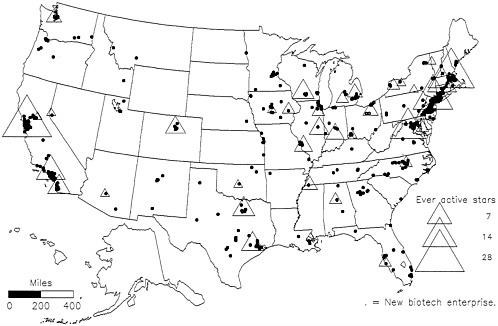
FIG. 1. Ever-active stars and new biotechnology enterprises as of 1990.
forming NBEs to facilitate commercialization is the number of star scientists in a local area. Absent such demand measures, the local and national economic infrastructure provide a good basis for prediction, but when stars (and other demand-related indicators) are taken into account, most effects of the economic infrastructure disappear (4).
Our empirical analysis of NBE entry is based on panel data covering the years 1976–1989 for each of the 183 BEA areas. Key measures of local demand for birth of NBEs are the numbers of stars and collaborators active in a given BEA in a given year. We define a scientist as active where and when our star-article data base shows him or her to have listed affiliation in the BEA on three or more articles published in that or the 2 prior years. This is a substantial screen, with only 135 of the 207 U.S.-publishing stars ever active in the U.S. while only 12.5% (500 of 4004) U.S.-publishing collaborators are ever active in the United States.
To graphically summarize our main results, we plot both ever-active star scientists and NBEs on a map of the United States cumulatively through 1990 (Fig. 1). We can see that the location of stars remained relatively concentrated geographically even when considering all those born in the whole period, and that NBEs tended to cluster in the areas with stars. The geographic concentration and correlation of both stars and NBEs is even greater for those entering by 1980.
With this very simple analysis, we can see the strong relationship between the location of ever-active stars and NBEs. These relationships received more rigorous test in multivariate panel Poisson regressions for the 183 BEAs over the years 1976–1989 as reported in ref. 4: Even after adding other measures of intellectual capital, such as the presence of top-quality universities and the number of bioscientists supported by federal grants, and economic variables such as average wages, stars continued to have a strong, separate, significant effect in determining when and where NBEs were born. The number of collaborators in a BEA did not have a significant effect until after 1985, when the formative years of the industry were mostly over, and labor availability became more important than the availability of stars.
In these same regressions we also found evidence of significant positive effects from the other intellectual human capital variables, which serve as proxy measures for the number of other significant scientists working in areas used by NBEs which do not result in much if any reported genetic-sequence discoveries. Adding variables describing the local and national economic conditions improved the explanatory power of the intellectual capital variables relatively little (as judged by the logarithm of the likelihood function).
In summary, prior work has found that intellectual human capital and particularly where and when star scientists are publishing is a key determinant of the pattern over time and space of the commercial adoption of biotechnology.
NBE Success and Ties to Star Scientists. The practical importance for successful commercialization of an intellectual human capital bridge between universities and firms is confirmed in a cross-section of 76 California NBEs (5). Local linked (and sometimes affiliated) stars have significant positive effects on three important measures of NBE success:h products in development, products on the market, and employment growth. That is, the NBEs most likely to form the nucleus of a new industry are those that have the strongest collaborative links with star scientists. We will see below that these NBE-star ties also dramatically improve the scientists’ productivity. This remarkable synergy, along with the intrinsic and financial
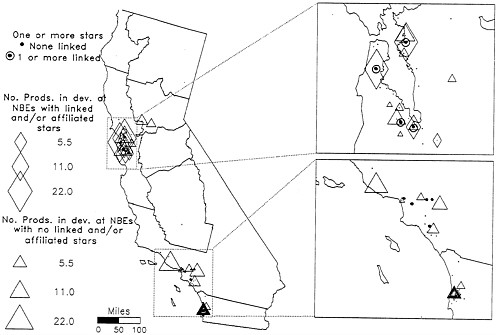
FIG. 2. California stars and the number of products in development at new biotechnology enterprises in 1990.
incentives it implies, aligns incentives across basic science and its commercialization in a manner not previously identified.
Consider first the number of products in development, coded from Bioscan 1989. A graphical summary of the main effects uncovered in a rigorous regression analysis are summarized by the map in Fig. 2 which shows both the location of star scientists and the location of enterprises that are using biotechnology methods. Note that we limited this initial work to California, because of the intensive data collection required. California saw early entry into both the science and industry of biotechnology, possesses a number of distinct locales where bioscience or both the science and industry have developed, and is generally broadly representative of the U.S. biotechnology industry.i Large dots in circles indicate NBE-affiliated or NBE-linked stars, while large dots alone indicate stars located in that area but not affiliated or linked with a local firm. We indicate the location of firms by either scaled triangles, representing NBEs with no linked or affiliated stars, or by scaled diamonds, representing NBEs with linked and/or affiliated stars. The size of the triangle or diamond indicates the number of products in development; small dots represent NBEs with no products in development. While there is a small diamond and there are a few large triangles, it is clear that generally NBEs with linked and/or affiliated stars are much more likely to have many products in development.
Over all three measures of NBE success analyzed (5), there is a strong positive coefficient estimated on the number of articles written by firm scientists collaborating with local linked stars. For an average NBE, two articles coauthored by an academic star and a NBE’s scientists result in about 1 more product in development, 1 more product on the market, and 344 more employees; for five articles these numbers are 5, 3.5, and 860, respectively.j We note two qualifications to these strong findings: (i) it is not the articles themselves but the underlying collaborations whose extent is indicated by the number of articles which matters; and (ii) correlation cannot prove causation, but we do have some evidence that the main direction of causation runs from star scientists to the success of firms and not the reversed.k
|
i |
In our full 110 NBE California sample, there are 87 NBFs and 22 NBSs (with one joint venture unclassified), a ratio that is only slightly higher than the national average. Missing data for 34 firms reduced the number of observations available for the regressions to 76. |
|
j |
In Poisson regressions, the expected number of products in development and products on the market are both exponentially increasing in the number of such linked articles; in linear regressions there are about 172 more employees per linked article. We expected the linking relationship to be especially important because of its potential for increasing information flow about important scientific discoveries made in the university into the NBE. Being part of an external “network for evaluation,” these academic stars are likely to be able to provide more objective advice concerning scientific direction including which products should “die” before testing and marketing and which merit further investment by the firm, even given their often significant financial interest in the firm (18). Even so, we found the magnitude of the effects surprising. |
|
k |
We believe, primarily on the basis of fieldwork, that very often tied stars were deeply involved in the formation of the NBEs to which they were tied. Moreover, we are beginning to examine some quantitative evidence which confirms our belief on the direction of causation. For star scientists whose publications began by the year of birth of the tied firm’s birth, there is only an average lag of 3.02 years between the birth of the firm and the scientist’s first tied publication, which is far shorter than the time required for any successful recombinant DNA product to be approved for marketing (on the order of a decade). We would interpret most of the average lag in terms of time to set up a new lab, apply for patents on any discoveries, and then get into print, with some allowance needed for trailing agreements with prior or simultaneous employers. For star scientists who start publishing after the firm was born, the average lag between their first publication and their first tied publication is only 2.14 years. This is too short a career for the scientists to be hired for any possible halo effect. Indeed we think many of these scientists became stars only because of the very substantial productivity effects of working with NBEs. In summary, the evidence on timing is that these relationships typically start too early for either the firm to have any substantial track record or before the stars do. |
Table 3. National stars: Commercial ties and migration
|
Countries |
Share of stars* |
Fraction tied† |
Migration rate |
|
|
Gross‡ |
Net§ |
|||
|
United States |
50.2 |
33.3 |
22.2 |
2.9 |
|
Japan |
12.6 |
21.1 |
40.4 |
9.6 |
|
United Kingdom |
7.5 |
9.7 |
58.1 |
–32.3 |
|
France |
6.1 |
0.0 |
20.0 |
4.0 |
|
Germany |
5.8 |
0.0 |
50.0 |
8.3 |
|
Switzerland |
3.6 |
20.0 |
93.3 |
–40.0 |
|
Australia |
3.4 |
7.1 |
35.7 |
7.1 |
|
Canada |
2.4 |
0.0 |
50.0 |
–30.0 |
|
Belgium |
1.7 |
14.2 |
42.9 |
14.3 |
|
Netherlands |
1.2 |
20.0 |
80.0 |
0.0 |
|
Total for top 10 |
94.7 |
14.9 |
35.4 |
–0.8 |
|
*Percent of total stars ever publishing in any country; some double-counting of multiple-country stars; rest of world: Denmark, Finland, Israel, Italy, Sweden, and the U.S.S.R. †Percent of stars ever publishing who were affiliated or linked to a NBE in the country. ‡Rate=100×[(immigration+emigration of stars)/stars ever publishing in country]. §Rate=100×[(immigration—emigration of stars)/stars ever publishing in country]. |
||||
Star Scientist Success and Ties to NBEs. We have seen how ties to stars predict more products in development and on the market, as well as more employment growth. Just as ties predict NBE success, they also predict higher level of scientific success as measured by citations. Recall the strong covariation between total citations and the degree to which stars are involved in commercialization and patenting in Table 1. It can be explained in three, possibly complementary ways. (i) The stars who are more commercially involved really are better scientists than those who are not involved either because they are more likely to see and pursue commercial applications of their scientific discoveries or are the ones most sought out by NBEs for collaboration or venture capitalists to work on commercial applications (quality-based selection), (ii) For this elite group there is really no significant variation across stars in the expected citations to an article, but NBEs and venture capitalists make enormous offers to the ones lucky enough to have already made one or more highly cited discoveries (luck-based selection). (iii) NBEs provide more financial and other resources to scientists who are actively working for or in collaboration with the firm making it possible for them to make more progress (resource/productivity).
Because we have the star scientists’ full publishing histories for articles reporting genetic-sequence discoveries (up to April 1990), we can competitively test these three explanations of the higher citation rates observed for stars who are more involved in commercialization by looking at the total citations received by each of these articles for 1982, 1987, and 1992 (mean = 14.52 for the world and 16.64 for the United States). Generally, we find consistent support for the third hypothesis listed above: NBEs actually increase the quality of the stars’ scientific work so that their publications written at or in collaboration with a NBE would be more highly cited than those written either before or afterwards. The presence of one or more affiliated stars about doubles the expected citations received by an article. The same hypothesis is supported for (local-, other-, and foreign-NBE) linked stars in the full sample, but the relevant coefficient, though positive, is not significant in the U.S.-only sample. In addition, highly-cited academic scientists are selected by NBEs for collaborations in the full sample, but this does not hold up in the U.S. sample. Otherwise tests of higher citation rates before or after working with NBEs consistently rejected the selection hypotheses. Overall, the resource/productivity hypothesis is maintained: Star scientists obtain more resources from NBEs and do work that is more highly cited while working for or with a NBE.
International Competitiveness and Movement of Stars. Our syllogism argues that star scientists embodying the breakthrough technology are the “gold deposits” around which new firms are created or existing firms transformed for an economically significant period of time, that firms which work with stars are likely to be more successful than other firms, and that—although access to stars is less essential when the new techniques have diffused widely—once the technology has been commercialized in specific locales, internal dynamics of agglomeration (19–22) tend to keep it there. The conclusion is that star scientists play a key role in regional and national economic growth for advanced economies, at least for those science-based technologies where knowledge is tacit and requires hands-on experience.
Given the widespread concern about growth and “international competitiveness,” we present in Table 3 comparative data for the top 10 countries in biotechnology on the distribution, commercial involvement, and migration of star scientists. Based on country-by-country counts of stars who have ever published there, the United States has just over half of the world’s stars. Our nearest competitor, Japan, has only one fourth as many. Collectively, the North American Free Trade Area has 55.7%, the European Community and Switzerland 27.4%, and Japan and Australia 16.9% of the stars operating in the top 10 countries.
Looking at the fraction of stars who are ever affiliated with or linked to a NBE in their country, we see that the United States, particularly, as well as Japan, Switzerland, Netherlands, and Belgium, all appear to have substantial star involvement in commercialization, with more limited involvement in the United Kingdom and Australia. Surprisingly, at least up to 1990 when our data base currently ends, we find no evidence of these kinds of “working” commercial involvement by stars in France, Germany, or Canada.l Both the large number of the best biotech scientists working in the United States and their substantial involvement in its commercialization appear to interact in explaining the U.S. lead in commercial biotechnology. These preliminary findings lend some support to the hypothesis that boundary-spanning scientific movement and/or collaboration is an essential factor both in the demand for forming or transforming NBEs and in determining their differential success. In work underway, we are modeling
empirically the underlying mechanisms which explain each of these proximate determinants.
Migration is a particularly persuasive indicator of the overall environment—scientific and commercial—faced by these elite bioscientists. Moving across national boundaries involves substantial costs so that differences in infrastructure must be correspondingly large. The United States, with a strong comparative advantage in the higher education industry as well as many of the key discoveries, is the primary producer of star scientists in the world. Despite the significant outflow of outstanding young scientists who first publish in the United States before returning home, America has managed to attract enough established stars to achieve a small net in-migration.m The major losers of key talent have been Switzerland, the United Kingdom, and Canada. Field work has indicated that Swiss cantons have enacted local restrictions inhospitable to biotechnology and that the United Kingdom has systematically reduced university support (23) and deterred other entrepreneurial activity by subsidy to favored NBEs. The Canadian losses presumably reflect the ease of mobility to the particularly attractive U.S. market.
Conclusions
Generalizability. We have seen for biotechnology that a large number of new firms have been created and preexisting businesses transformed to commercialize revolutionary breakthroughs in basic science.n Economic and wage growth in the major research economies are dependent upon continuing advances in technology, with the economies’ comparative advantages particularly associated with the ability of highly skilled labor forces to implement new breakthrough technologies in a pattern of continuous renewal (19, 24–27). Based on extended discussions with those familiar with other technologies and some fragmentary evidence in the literature, it seems likely that many of our central findings do generalize to other cases of major scientific breakthroughs which lead to important commercial applications.
First note that technological opportunity and appropriability—the principal factors that drive technical progress for industries (28, 29) —are also the two necessary elements that created extraordinary value for our stars’ intellectual human capital during the first decade of biotechnology’s commercialization. While relatively few mature industries are driven by technological opportunity in the form of basic scientific breakthroughs, the emergence phase of important industries frequently is so driven.
For example, there are broadly similar patterns of interfirm relationships for large and small enterprises within and across national boundaries for semiconductors and biotechnology, although there is some corroborating evidence that embodiment of technology in individual scientists is even more important for semiconductors than for biotechnology. Levin (30) notes that [as with recombinant DNA products] integrated circuits were initially nearly impossible to patent. More generally, Balkin and Gomez-Mejia (31) report on the distinctive emphasis on incentive pay and equity participation for technical employees in (largely nonbiotech) high-tech firms, especially for the “few key individuals in research and development…viewed as essential to the company….” Success in high-technology, especially in formative years, we believe comes down to motivated services of a small number of extraordinary scientists with vision and mastery of the breakthrough technology.
Growing Stars and Enterprises. We have seen for biotechnology—and possibly other science-driven breakthrough technologies—that the very best scientists play a key role in the formation of new and transformation of existing industries, profiting scientifically as well as financially. We see across countries that there is very substantial variation in the fraction of star scientists involved in commercialization, bringing discoveries initially from the universities to the firms via moving or working with NBE scientists. Clearly, there are very substantial implications for economic growth and development involved in whether a nation’s scientific infrastructure leads to the emergence of numerous stars and is conducive to their involvement in the commercialization of their discoveries.o
Commercialization is more a traffic rotary than a two-way street: More commercialization yields greater short-run growth, but this may be offset in the future if the development of basic science is adversely affected. Commercial involvement of the very best scientists provides them greatly increased resources and is associated with increased scientific productivity as measured by citations. However, it may lead them to pursue more commercially valuable questions, passing up questions of greater importance to the development of science. On the other hand, the applied questions of technology have often driven science to examine long-neglected puzzles which lead to important advances and indeed important new subdisciplines such as thermodynamics and solid-state physics.
We are confident that the commercial imperative will continue to a play an important role in both private and public decision making. We believe that it is essential, therefore, that we develop a better understanding of what policies, laws, and institutions account for the wide variety of international experience with the science and commercial application of biotechnology, and their implications, for better or worse, for future scientific advancement.
Both field and quantitative work have taught us technology transfer is about people, but not just “ideas in people.” The “people transfer” that appears to drive commercialization is importantly altered by the by the incentives available and by the entrepreneurial spirit that seeks “work arounds” in the face of impediments. A star scientist who can sponsor a rugby team at Kyoto University seems capable of achieving anything, but we also see that different rules, laws, resources, and customs have led to wide national differences in success in biotechnology. We need deeper empirical understanding of these institutional determinants of personal and national achievement in a variety of sciences and technologies to retain what is valuable and replace what is not. The most important lessons are to be drawn not for analysis of past breakthroughs which have formed or transformed industries, but for those yet to come in sciences we can only guess.
This article builds on an ongoing project in which Marilynn B. Brewer (at the University of California, Los Angeles, and currently at Ohio State University) also long played a leading role. Jeff Armstrong was responsible for the analysis of firm success and Maximo Torero for the analysis of mobility of top scientists. We acknowledge very useful comments from our discussant Josh Lerner and other participants in the 1995 National Academy of Sciences Colloquium on Science,
|
m |
The low gross (in plus out) migration rate reflects the large size of the U.S. market, so that there is much interregional but intranational migration with regional effects implicit in the analysis of birth of U.S. NBEs above. |
|
n |
See, in particular, ref. 6 for a detailed case study of the transformation of the technical identity of one of the largest U.S. pharmaceutical firms to the point that firm scientists and executives believe that it is indistinguishable in drug-discovery from the best large dedicated new biotech firms. A similar pattern of transformation appears to have been followed by nearly half of the large pharmaceutical firms. The remainder appear to be either gradually dropping out of drug discovery or merging with large dedicated new biotech firms to acquire the technical capacity required to compete. |
|
o |
The economic infrastructure, including the flexibility of incumbent industries and the availability of start-up capital, is also likely to be significant in comparisons of international differences in commercialization of scientific breakthroughs. |
Technology, and the Economy. We are indebted to a remarkably talented team of postdoctoral fellows Zhong Deng, Julia Liebeskind, and Yusheng Peng and research assistants Paul J.Alapat, Jeff Armstrong, Cherie Barba, Lynda J.Kim, Kerry Knight, Edmundo Murrugara, Amalya Oliver, Alan Paul, Jane Ren, Erika Rick, Benedikt Stefansson, Akio Tagawa, Maximo Torero, Alan Wang, and Mavis Wu. This paper is a part of the National Bureau of Economic Research’s research program in Productivity. This research has been supported by grants from the Alfred P.Sloan Foundation through the National Bureau of Economic Research Research Program on Industrial Technology and Productivity, the National Science Foundation (SES 9012925), the University of California Systemwide Biotechnology Research and Education Program, and the University of California’s Pacific Rim Research Program.
1. Zucker, L.G., Darby, M.R., Brewer, M.B. & Peng Y. (1996) in Trust in Organizations, eds. Kramer, R.M. & Tyler, T. (Sage, Newbury Park, CA), pp. 90–113.
2. Liebeskind, J.P., Oliver, A.L., Zucker, L.G. & Brewer, M.B. (1996) Organ. Sci. 7, 428–443.
3. Tolbert, P.S. & Zucker, L.G. (1996) in Handbook of Organization Studies, eds. Clegg, S.R., Hardy, C. & Nord, W.R. (Sage, London), pp. 175–190.
4. Zucker, L.G., Darby, M.R. & Brewer, M.B. (1994) Working Paper (National Bureau of Economic Research, Cambridge, MA), No. 4653.
5. Zucker, L.G., Darby, M.R. & Armstrong, J. (1994) Working Paper (National Bureau of Economic Research, Cambridge, MA), No. 4946.
6. Zucker, L.G. & Darby, M.R. (1995) Working Paper (National Bureau of Economic Research, Cambridge, MA), No. 5243.
7. Zuckerman, H. (1967) Am. Social. Rev. 32, 391–403.
8. Zuckerman, H. (1977) Scientific Elite: Nobel Laureates in the United States (Free Press, New York).
9. Cohen, S., Chang, A., Boyer, H. & Helling, R. (1973) Proc. Natl. Acad. Sci. USA 70, 3240–3244.
10. Griliches, Z. (1957) Econometrica 25, 501–522.
11. Nelson, R.R. (1959) J. Potit. Econ. 67, 297–306.
12. Arrow, K.J. (1962) in The Rate and Direction of Inventive Activity: Economic and Social Factors, N.B.E.R. Special Conference Series, ed. Nelson, R.R. (Princeton Univ. Press, Princeton), Vol. 13, pp. 609–625.
13. Arrow, K.J. (1974) The Limits of Organization (Norton, New York).
14. Nelson, R.R. & Winter, S.G. (1982) An Evolutionary Theory of Economic Change (Harvard Univ. Press, Cambridge, MA).
15. Rosenberg, N. (1982) Inside the Black Box: Technology and Economics (Cambridge Univ. Press, Cambridge, U.K.).
16. Zucker, L.G. & Darby, M.R. (1995) in AIP Study of Multi-Institutional Collaborations Phase II: Space Science and Geophysics, Report No. 2: Documenting Collaborations in Space Science and Geophysics, eds. Warnow-Blewett, J., Capitos, A.J., Genuth, J. & Weart, S.R. (American Institute of Physics, College Park, MD), pp. 149–178.
17. Zucker, L.G. & Kreft, I.G.G. (1994) in Evolutionary Dynamics of Organizations, eds. Baum, J.A.C. & Singh, J.V. (Oxford Univ. Press, Oxford), pp. 194–313.
18. Zucker, L.G. (1991) Res. Sociol. Organ. 8, 157–189.
19. Grossman, G.M. & Helpman, E. (1991) Innovation and Growth in the Global Economy (MIT Press, Cambridge, MA).
20. Marshall, A. (1920) Principles of Economics (Macmillan, London), 8th Ed.
21. Audretsch, D.B. & Feldman, M.P. (1993) The Location of Economic Activity: New Theories and Evidence, Centre for Economic Policy Research Conference Proceedings (Consorcio de la Zona Franca di Vigo, Vigo, Spain), pp. 235–279.
22. Head, K., Ries, J. & Swenson, D. (1994) Working Paper (National Bureau of Economic Research, Cambridge, MA), No. 4767.
23. Henkel, M. & Kagan, M. (1993) in The Research Foundations of Graduate Education: Germany, Britain, France, United States, and Japan, ed. Clark, B.R. (Univ. of California Press, Berkeley), pp. 71–114.
24. Romer, P.M. (1986) J. Polit. Econ. 94, 1002–1037.
25. Romer, P.M. (1990) J. Polit. Econ. 98, Suppl., S71-S102.
26. Grossman, G.M. & Helpman, E. (1994) J. Econ. Perspect. 8, 23–44.
27. Jones, C.I. (1995) J. Polit. Econ. 103, 759–784.
28. Nelson, R.R. & Wolff, E.N. (1992) Reports (New York Univ., New York), No. 92–27.
29. Klevorick, A.K., Levin, R.C., Nelson, R.R. & Winter, S.G. (1995) Res. Policy 24, 185–205.
30. Levin, R.C. (1982) in Government and Technological Progress: A Cross-Industry Analysis, ed. Nelson, R.R. (Pergamon, New York), pp. 9–100.
31. Balkin, D.B. & Gomez-Mejia, L.R. (1985) Pers. Admin., 111– 123.


