


Below is the uncorrected machine-read text of this chapter, intended to provide our own search engines and external engines with highly rich, chapter-representative searchable text of each book. Because it is UNCORRECTED material, please consider the following text as a useful but insufficient proxy for the authoritative book pages.
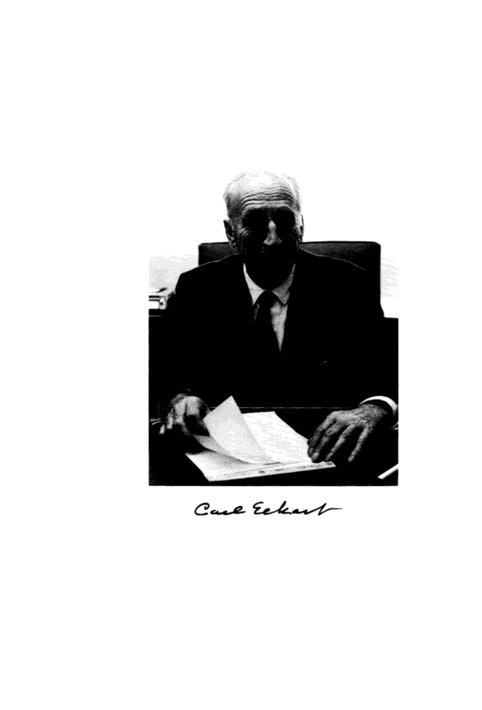
CARL HENRY ECKART May 4, 1902-October 23,1973 BY WALTER H. MUNK AND RUDOLPH W. PREISENDORFER ~ . CARL ECKART was a major participant in the development of quantum mechanics and atomic physics. At the age of forty, with the advent of World War II, he turned his attention to underwater acoustics and related problems in geophysical hydro- dynamics; this was to remain Eckart's primary interest for the rest of his life. His contributions to physics and oceanography are about equally divided. For ten years he directed the Uni- versity of California Division of War Research and its successor, the Marine Physical Laboratory. For two years he was Director of the Scripps Institution of Oceanography. A shy man, he dis- charged these responsibilities with precision, elegance, and gentle care. Carl Eckart, an only child and the son of conservative people of German heritage, was born in St. Louis, Missouri. During his high school years in St. Louis, Eckart's interests were in science and mathematics. These interests, along with an innate ability in fine draftsmanship, left little time for social pursuits. Upon graduation he was awarded a full scholarship to Washington University, in St. Louis, where he received B.S. and M.S. degrees with a major in engineering. Eckart's intention was to turn his interest to mathematics, but this changed to physics, evidently under the influence of Arthur Holly Compton, a physics faculty member (later Chancellor). Compton influenced Eckart to con- 195
196 BIOGRAPHICAL MEMOIRS tinue graduate work at Princeton University, where he went on an Edison Lamp Works Research Fellowship and received a Ph.D. in 1925. It was during this period that Eckart produced his first recorded research paper (with G. E. M. Jauncey) sug- gesting an extension of Compton's classic photon-scattering ex- periment to X rays in crystal lattices. Other papers in this period followed (jointly with Arthur's older brother Karl): a study of low-voltage arcs, particularly the oscillatory phenomena arising in the diffusion of electrons against low-voltage fields. He con- tinued this work as National Research Council Fellow at the California Institute of Technology from 1925 to 1927. During the winter of 1925, Max Born came to Pasadena and gave a lecture on quantum mechanics. This lecture aroused Eckart's interest in a possible general operator formalism for quantum mechanics. Working through the winter of 1925-1926, Eckart developed the formalism and completely familiarized himself with what is now known as the Schrodinger energy operator. In January 1926, when Schrodinger's first paper (of the famous set of four) on wave mechanics appeared in the Annalen der Physik, Eckart immediately recognized its revolu- tionary content. There was, in particular, the puzzling presence of another formulation alternative to Schrodinger's wave me- chanics: the matrix mechanics of Heisenberg, which used not the partial differential equation for matter waves, but rather infinite-ordered matrices. Despite their outwardly different struc- ture, the theories yielded identical predictions of atomic spectra and identical relations between atomic constants. Evidently, they were equivalent ways of viewing the same physical phe- nomena, and Eckart felt that there should be a general mathe- matical framework that would encompass both formalisms as alternative representations. Working in relative isolation in California, far from the exciting German scientific centers, Eckart soon found the connecting link between the Hilbert space of eigenfunctions of Schrodinger's equation and the
CARL HENRY ECKART 197 matrices of the Jordan-Born matrix algebra (which lay at the base of Heisenberg's mechanics). Eckart's solution was submitted to the Proceedings of the National Academy of Sciences on May 31, 1926. But the credit generally went to Schrodinger, whose note to the Annalen der Physik containing essentially the same solution was dated March 18. Later that year, in June 1926, Eckart completed his general study of the operator calculus (see the "note in proof" appended to his paper in Physical Review). This near miss was a source of disappointment for Carl; on the few occasions when a friend could approach him on the subject, he would comment on his isolation in 1926 from the main- stream of quantum physical activity. But this was soon to change. In 1927, Eckart received a Guggenheim Fellowship to study with Arnold SommerfelcT in Munich. Here he worked on the quantum mechanical behavior of simple oscillators using Schrodinger's equation, developing further the operator calculus that would allow rapid and almost mechanical manipulations of the newly discovered matrix me- chanics and gaining new insights into the correspondence prin- ciple. Applications were made to the electron theory of metallic conduction using Fermi statistics, with particular attention to the Volta effect. The German fellowship coincided with the culmination of the twer~ty-year search by European physicists for the key in- sights that would consolidate the long series of experimental and theoretical advances in the "old" quantum mechanics begun in 1905 by Planck. The search came to an end in the period 1925-1928 with the advent of Heisenberg's matrix mechanics and Schrodinger's wave mechanics. As we saw, Eckart was an integral part of these exciting developments. During his Ger- ~ For further discussion of this period of time, see M. Jammer, The Concep- tual Development of Quantum Mechanics (New York: McGraw-Hill Book Co., 1966), p. 275. (We have used the above-cited communication dates as they appear in the original papers.)
198 BIOGRAPHICAL MEMOIRS man fellowship, Eckart became ever more deeply absorbed in "the mathematics of the period, which was miraculously made available and compiled for quantum physicists in almost fully developed forms by the applied and pure mathematics schools at Gottin~en headed by Felix Klein and David Hilbert. It was this mathematics that would guide Carl Eckart's approaches to all his subsequent theoretical investigations. On his return to the United States in 1928, Eckart was ap- pointed to an Assistant Professorship in the Physics Department at the University of Chicago. Although once again removed from the physics centers of Munich and Gottingen, Eckart con- tinued his quantum mechanical studies over the subsequent fourteen-year period. Particularly noteworthy is the paper (with H. Honl) on the foundations of wave mechanics, an exposition of the role of group theory in the quantum dynamics of mon- atomic systems, and the comparisons of the nuclear theories of Heisenberg and Wigner. It was in this period that Eckart built on his formulations of the so-called Wigner-Eckart theorem, a link between the symmetry transformation groups of space (applied to the Schrodinger equations) and the laws of conserva- tion of energy, momentum, and angular momentum.! It is of practical use in atomic spectroscopy. These researches went hand in hand with teaching activities and with a translation (together with F. C. Hoyt) of Heisenberg's tract on the Physical Principles of Quantum Theory. In all, the decade of the 1930s saw twenty important papers by Eckart in quantum physics. Eckart's paper on the electrodynamics of material media (in 1938) suggests a transition in his interests. By that time he had begun to lose interest in the submicroscopic world of matter ~ H. Weyl, "David Hilbert and His Mathematical Work," Bulletin of the American Mathematical Society 50(1944):612 (the section on integral equations). ~ The basic idea occurs in E. P. Wigner, "Some Consequences for Term Struc- ture from Schrodinger's Theory," Zeitschrift fur Physik 43(1927):624. The idea was elaborated in Eckart's 1930 group theory paper. Our description covers only the simpler cases. For a fuller description, see P. Roman, Advanced Quantum Theory (Reading, Mass.: Addison-Wesley Publishing Co., Inc., 1965>, p. 583.
C AR L H E N R Y E C K ART 199 waves. Perhaps he felt that the trend of quantum mechanical research into atomic systems was toward less-rigorous and only partial analyses of solutions of the associated Schrodinger equa- tions. Physicists, facing the complicated multiple interactions of electors systems in the heavier atoms, were adopting simpli- fied models (such as the shell and liquid drop model) that could only partially describe the physical facts. On the other hand, such venerable subjects as electrodynamics and thermodynamics, worked over as they were by several generations of physicists, still contained obscurities and curious gaps between the pure and applied levels. For example, the thermodynamic basis of heat transport and the mechanism of mixing of fluids needed attention. The title of the 1938 paper is somewhat misleading, for it implies a reworking of the Minkowski or Lorentz formulations of fiche subject. In fact, Eckart achieved a unified theory of Maxwellian and quantum electromagnetics, leading to a gauge- invariant formulation of electrodynamics (previously attempted notably by Mie and Weyl, but without success). He was not successful in extending the formulation to contain as special cases Schrodinger's, Heisenberg's, and Dirac's equations of elec- trodynamics, but his approach did yield equations closely re- sembling these famous equations and also portions of gas theory for irrotational motion. This latter feature may seem somewhat incongruous, but it falls out quite naturally from a general approach that postulates a set of moving particles of matter characterized by "states" that can be electric, magnetic, or of other forms. (The resultant variational formulation of the kinetic theory of such particles- is subject to the constraint of Ampere's law.) By shutting off the electric states, a portion of gas theory is recovered. This paper is one of Eckart's major contributions towards a physical synthesis. The 1938 paper prepared the way for "The Thermodynam- ics of Irreversible Processes," parts I, II, and III of which were published in 1940. The first paper showed how the entropy
200 BIOGRAPHICAL MEMOIRS increase in a simple viscous fluid can be calculated and the KelvinFourier hypothesis of heat conduction can be rigorously deduced from the laws of thermodynamics. Thus, this ostensibly empirical law was placed into the fold of classical thermodynam- ics. In the second paper, in a similar vein, Ohm's law and Fick's law of diffusion were shown to be special cases of more general thermodynamic laws. This paper also discussed the general theory of entropy increase in fluid mixtures. (Eckart's subse- quent work in hydrodynamics of the oceans and the atmosphere had its beginnings in this work.) In a third paper, the concepts of relativity and of fluid dynamics were related. The influence of these three papers in the field of irreversible processes was immediate and long-lasting, as a study of the subsequent work by Tolman and Prigogine shows. Twice more, Eckart would reach for a thermodynamic formulation of physical laws, start- ing from the particle level. Paper IV (1948) deals with elasticity and Inelasticity; paper V, with shock waves and phase bound- aries (written in 1965 but never submitted for publication). In December 1941, the United States entered World War II. It was already clear to responsible scientists in mid-1941 that preparations for the national defense must be made realistically and without further delay. Axis submarines were taking their toll of shipping. University scientists were being approached by the U.S. Navy concerning the problems of optical and acoustical detection of enemy submarines. V. O. Knudsen, director of the embryonic University of California Division of War Research, and his close associate L. P. Delsasso asked Eckart for advice and help. He spent a week in June of that year in San Diego review- ing reports by the British Naval Laboratories and the Naval Research Laboratory in the United States. Impressed with the need for understanding the fundamentals underlying submarine detection, he took leave of absence from the University of Chicago (still an Associate Professor), a momentous decision not only in his own life, but also in the lives of many others. When
CARL HENRY ECKART 201 Eckart began his thirty-one-year stay in California, during those hectic days of preparation for the national defense, he was forty years old. He had at his beck all of classical mathematics and physics of that time. Now, before him, there were new problems to solve and new concepts to clarify. Eckart found himself in the unaccustomed role of working with technicians and engineers on a day-to-day basis. He was greatly stimulated by this contact, and many of his later contri buttons had their roots in this period. In a series of classified reports (some of which are now available), we can trace his grow- ing interest in the problems of sound attenuation in the sea, in the effect of randomly moving sea surfaces on the reflection of sound waves and electromagnetic waves, and in the analysis of time series of acoustical signals. Following the war, Eckart col- lected his work and the work of others into Principles and A ppli- cations of Underwater Sound, first issued in 1946, declassified in 1954, and reprinted in 1968. Principles serves as standard reference even today. By 1946 many of Eckart's wartime col- leagues had returned home, but Eckart decided to remain in California. He terminated his appointment at the University of Chicago and became Professor at the University of California and the first Director of its Marine Physical Laboratory (MPL), established by Eckart, Roper Revelle and Admiral Rawson Bennett to continue geophysical research of common interest to the academic and navy communities. MPL became an integral part of the Scripps Institution of Oceanography in 1948, and Eckart served as Director until 1952. Under the present leader- ship of Fred Spiess, MPL continues its vital function. One of the major puzzles unsolved in the war research was the anomalously high attenuation of sound in seawater. Eckart encouraged experimentalists to work on this problem, particu- larly Leonard Liebermann, whom Eckart had brought from Woods Hole Oceanographic Institution to join the staff of MPL. As a result of the work by Liebermann and the late
202 BIOGRAPHICAL MEMOIRS Robert Leonard at UCLA, the attenuation could be ascribed to molecular resonances of certain trace constituents. Eckart's wartime acoustical studies had called attention to the fact that the usual linear formulation was incomplete and that additional effects could be predicted if nonlinear terms were included in the equations. He showed that irradiation of a fluid by sound led to streaming and that the streaming could be used to mea- sure the "second viscosity" of fluids, as distinct from the classical notion of dilational viscosity. This theoretical work was directly responsible for a series of experiments by Liebermann. During this period there was time to consolidate some pre- war studies into two major review papers. Eckart's exposition of the one-dimensional Schrodinger equation for the Reviews of Modern. Physics was enriched by his wartime experiences with sound and light waves and internal waves in the sea. Eckart's close attention to the logical development of ideas with regard to fundamentals is perhaps brought out in its most explicit form in his Encyclopacdia Britannica article on the ether in physics. Eckart clearly put an immense amount of work into this, and it should remain a classic. It is unfortunate that with the passing of the 1948 edition this article will no longer be generally available. The article traces the evolution of ether from its initial concept as a passive backdrop of space-time events for matter to that of an active participant In these events. In its passive role, Eckart likened the ether to a movie screen that is unaffected by the events cast on it by the movie projector. The Einstein equations changed the passive role of space-time to an active one by equating the Einstein curvature tensor of space-time to the energy momentum tensor of matter. In this way, seemingly empty space between atoms, planets, and stars responded to their presence by accommodating its curvature; and the matter in turn evolved and moved in response to space's curvature. Eckart concluded his 1948 article on a tentative note, anticipating future changes in the ether concept when quantum . ~ . . . .
C AR L H E N R Y E C K A R T 203 effects would direct attention to the structure of the ether (space-time) in "the small." Such concepts were in fact devel- oped in the following decade, mainly by the Princeton research group headed by Eckart's friend and colleague John Archibald Wheeler. In 1957, Wheeler and one of his students, Charles Misner, showed that Einstein's field equations could be so inter- preted that matter itself (their example used electromagnetic fields) was a property of empty space. In conversations with Eckart about these advances, he expressed a neutral attitude, preferring to defer judgment until more empirical evidence was available. In 1948, Harald Sverdrup, Director of the Scripps Institu- tion, decided that he would return to his native Norway and that Roger Revelle (a Scripps Ph.D. then on duty with the Office of Naval Research in Washington, D.C.) should succeed him. There was some determined opposition, which was resolved by Eckart's appointment to the Scripps directorship, with Revelle as Associate Director. After two years, Eckart resigned, and Revelle succeeded him. Concerning this period, Revelle has written (personal communication): "After I assumed the job, I rapidly gained a reputation as a poor administrator. But in some ways, compared to Carl, I was an administrative genius. The difficulty was that he took the job too seriously. The rigor in definition and precision of thought, and the inability to leave any loose strings untied, which were his great strengths as a scientist, were just what was not needed as an administrator. I remember he spent a good deal of time trying to tidy the Scripps Institution up; it was quite a messy place in those days and this was a completely frustrating job for him. ~ C. W. Misner and J. A. Wheeler, "Classical Physics as Geometry. Gravita- tion, Electromagnetism, Unquantized Change, and Mass as Properties of Curved Empty Space," Annals of Physics 2(1957):525. C. W. Misner, "Feynman Quantiza- tion of General Relativity," Reviews of Modern.Physics 29(1957):497.
204 BIOGRAPHICAL MEMOIRS "In other ways, however, he was a great leader. He had good taste in people, in choosing staff, and even more, he had the ability to see what was good about them, what was original about them, and to help them fulfill their promise." Following the two-year directorship, Eckart returned with vigor to research and teaching. Several generations of students were to benefit from his outstanding teaching abilities. Many of Eckart's studies are in the form of lecture notes and Scripps reports that have never been published. This is particularly the case for his work on stochastic processes and geophysical time series. These studies originated in wartime and were conducted in parallel with, but quite independently of, a large effort at the Massachusetts Institute of Technology's radiation laboratory. The MIT work was published promptly after the war, but Eckart's contributions have not been generally recognized. Eckart's blackboard work was a reflection of the working of his mind: he would start in the upper left-hand part of the left- most board and then work slowly, with his elegant handwriting, down the board, and then onto the next, developing as he went a set of ideas woven through with a logical thread. Eckart's "rough" notes, written in ink as they occurred, usually without corrections, are so well-worded, annotated, and spaced that they could not be improved. (They lose some of their clarity when subsequently set in print.) In the solitude of his study, there would be held lightly in the fingers of his left hand the ever- present smoldering cigarette; its fumes randomly swirling about his head as he strove, oblivious to the thickening haze, toward the end of some syllogistic trail. Eckart depended on his colleagues for ideas and stimulation; yet he was impatient and driven to distraction by the lack of rigor with which some of his scientific associates presented their problems. Turbulence, described with an appropriate wave of the hands, was the all-encompassin~ sink of oceanographic igno- rance. This drove Eckart to his 1948 paper on stirring and mix-
CAR L H E N R Y E C K ART 205 ing, emphasizing the fundamental orthogonality between these two processes, which many had thought to be equivalent. This is one of the basic papers in the modern theory of turbulence. At about the same time Walter Munk gave a seminar on the wandering of the Earth's poles, based on the concept of a "Max- well body" that exhibits the property of a viscous fluid under low-frequency disturbances and that of a solid at high fre- quencies. Eckart questioned Munk strenuously concerning this use of the "Maxwell solid," and when Munk gave as his defense that the model had been used by everyone, including Lord Kelvin himself, Eckart said that this was no excuse whatsoever. Eckart went home and overnight wrote a set of notes, drawing on his prior studies of irreversible processes and his recent re- view paper on ether (a Maxwell solid according to Stokes's theory); these notes grew into the fourth paper in the therm dynamics series. He emphasized the fundamental difference be- tween the concepts of strain and of deformation in elastic and anelastic materials. In making this distinction, as in the previous work on stirring and mixing, Eckart followed his usual working procedure: to start by carefully defining some fundamental hitherto not well-formulated concepts and to develop their im- plications through rigorous mathematical reasoning. During this period Eckart lectured to Scripps students on the analogy between the ray theory of (ocean) waves and the trajec- tories of particles, providing a convenient formalism for the propagation of ocean waves over irregular bottoms. This led to one of the earliest applications of computer technology to geo- physical problems. The difl5culty inherent in the theory of scattering of ocean waves by irregular bathymetry is great: the traditional methods of transform techniques, separation of vari- ables, and simple boundary value problems are no! longer avail- able. Accordingly, recourse to- numerical methods must even- tually be made. Henry Stommel, of Woods Hole, and Walter Munk were invited to Princeton to discuss with John van
206 BIOGRAPHICAL MEMOIRS Neumann problems in oceanography that could be suitably attacked with the newly developed computers. Before going on to this visit, Munk had asked Eckart's advice, who had suggested the problem of wave scattering by an irregular seafloor. Van Neumann's response was, "Well, anything that Carl Eckart thinks worth doing is worth doing." In subsequent years, the study of ocean tides, ocean circulation, and near-shore wave processes would become major numerical research problems. In 1953, Eckart took a year's sabbatical at the Institute of Advanced Study in Princeton. In rapid succession he produced a remarkable quartet of papers on wave propagation in sto- chastic media. "The Theory of Noise in Continuous Media" presented an original view of the propagation of the covariance field as governed by a wave equation. "Relation Between Time Averages and Ensemble Averages in the Statistical Dynamics of Continuous Media" expanded the idea of using the equations of the dynamics of a continuum to aid in studying the connec- tions between time and ensemble averages. "Generation of Wind Waves on a Water Surface" developed the theory of ocean wave generation by random wind gusts. (This work predates the important contribution by O. M. Phillips.) The fourth paper, "Scattering of Sound from the Sea Surface," has been widely applied; here Eckart inferred the two-dimensional spatial spectrum of the sea surface from the scattering function of rela- tively long sound waves. Analogies were developed among sound scattering from the sea surface, light (Rayleigh) scattering in the atmosphere, and scattering of light by molecular (crystal) media. The work also made connections with the ray theory of scattered light from the sea surface. The principal finding was that short acoustic waves were less effective than long waves in describing the spatial wave spectra of the sea (counter to the well-known crystal molecular case). The mathematical methods are extend- able to the scattering by the sea of electromagnetic (particularly over-the-horizon radar) waves. This paper represents a contribu-
C A R L H E N R Y E C K A RT 207 tion to geophysics of an important type of inverse problem: wherein the local structure of a medium (the atmosphere, the sea, or earth) is inferred from its response to appropriately di- rected remote field probes. Shortly before leaving on this productive sabbatical, Eckart was seen by Ellen Revelle walking along the street in deep con- centration. Her cheery hellos were ignored. Some time later he apologized for having been so grumpy and distracted: "The trouble was that I was pregnantpregnant with ideas." By the mid-1950s Eckart's experience with linearized per- turbation theory applied to geophysical hydrodynamics began to take definitive form. He reexamined the classical methods of linearizing the Navier-Stokes and thermodynamics equations and developed (with Horace Ferris) a set of unibed hydro- dynamic/thermodynamic equations of motion of oceans and atmospheres. This formed the basis of his monograph, Hydro- dynamics of Oceans and Atmospheres, which stands as a bridge between the early formulations of the Physikalische Hydro- dynamik and the perturbation expansions of later investigators. Only the simplest plane-parallel and spherical-parallel geo- metries are considered, but with a fully stratified atmosphere and ocean on a rotating Earth. The manifold types of oscillatory motion of the air and sea are unraveled, from the grand, slow, free oscillations of the global atmosphere and oceans to the rapid oscillations of sound in these same media. Out of the many pos- sible mathematical formulations of this subject, Eckart charac- teristically chose that which was most elegant mathematically and, to him, physically meaningful. In particular, he departed from the usual way of representing the sea motion by its surface elevation function and instead used a normalized entropy func- tion. Consequently, his equations take on great simplicity in which the self-adjointness of the hydrodynamic system is mani- fest. But this elegance had been gained at the expense of ready visualization (and some of the audience).
208 BIOGRAPHICAL MEMOIRS In the late 1950s and early 1960s, Eckart became concerned with the equation of state of seawater. His primary objective was a critical examination of the p-v-T data on seawater, and the construction of a simple but adequate empirical formula for the equation of state. Such a formula is useful, for example, in deter- mining accurately the eigenmodes of internal waves in the sea, a subject that then occupied Eckart. In this period he wrote a closely connected pair of papers on the stability of unidirec- tional laminar flow of a stratified compressible fluid. The key to these studies was the transformation of the hydrodynamic equations to general coordinates so as to exhibit the general form of a pseudopotential energy function. This was applied to the stability problem concerned with the extension to compres- sible flow of Howard's circle theorem for incompressible lam- inar flow. The result has applications to atmospheric jet streams. He also attempted to deduce the equations of the macroscopic theory of matter from those of the N-particle problem without using the concept of probability. A difficulty arose: The method could not yield the derivation of entropy. In this failure, Eckart nevertheless deepened our perspective of the inherently proba- bilistic nature of entropy. In the 1960s Eckart participated in the development of the new campus of the University of California that had grown from the Scripps Institution. In 1963-1965 he served as Chairman of the Academic Senate of the University of California, San Diego, and in 1965-1969 as Vice Chancellor. He was responsible for Academic Planning of the fledgling campus, and his projections have turned out to be remarkably accurate. Yet he did not derive much satisfaction from these responsibilities, and returned to his research during every possible moment. Paper N1 in the series on irreversible thermodynamics falls into this period. The manuscript (unpublished) is an important contribution to the thermodynamic characterization of evaporation and condensa- tion. Following the Rankine-Hugoniot boundary condition
CARL HENRY ECKART 209 developed earlier for shock waves, Eckart specifically considered phase changes and added to the classical boundary conditions the generation of entropy across the phase discontinuity bound- ary. This led to a theory of evaporation and condensation, pre- dicting that energy is added or removed via radiation rather than convection. In evaporation, a thermal boundary layer is formed in the liquid, and a high-pressure gradient opposes the flow in a thin layer in the vapor. In condensation, the thermal layer occurs in the vapor, the pressure gradient in the liquid. The mathematical and physical similarities between shock waves and phase boundaries in chemically homogeneous sub- stances are thus established. This study, as his earlier ones, was marked by Eckart's abid- ~ng preoccupation with the powerful methods of classical mathe- matical physics. The mathematical themes were those of the Sturm-Liouville differential systems, of integral operators, of classical groups of motions in Euclidean spaces, of useful analyt- ical transformations, of variational principles; in short, of all the notions arising in prerelativistic, prequantum physics. Revelle remarked to van Neumann that he never really understood Eckart's mathematics, and that they were difficult to follow. Von Neumann replied that Eckart's mathematics were quite simple and easy to follow, and that Eckart had great ability as a mathematician; but that he was first, last, and always a physicist. The single-minded and intense devotion to his work took their toll, first of Carl Eckart's private life, and later of his health. He was a lonely man, who had little supportive home life in his first marriage. This finally ended in divorce after some eighteen years of his constant, but unsuccessful, attempts to help his wife through severe psychological problems. Carl Eckart, always shy, remained somewhat aloof from the social activities of La Jolla, then a maturing seaside village. After the death of Eckart's great and good friend John van Neumann, Klara van Neumann turned to Carl Eckart for solace and companionship.
210 BIOGRAPHICAL MEMOIRS Their marriage led to a brief period of happiness and active participation in the sprawling life of the postwar Scripps Insti- tution and beginnings of a general university campus, until Klara's tragic drowning in 1963. During the two remaining years of his life after retirement in 1971, Eckart's thoughts turned to a task which he had been considering for years: the summing up in book form of his beliefs concerning the role of mathematical science in further- ing human society. This task became urgent as his eyesight began to fail. With the help of friends, notebooks and reference materials were supplied as needed. The evolving manuscript was called, "Our Modern Idol: Mathematical Science." Eckart found that the promise of mathematical science in furthering man's social progress was hollow. This realization, though un- pleasant for him at the time, was in the end salutary. For he realized that great scientists such as Ernst Abbe and Bertrand Russell could use their clear insights into social problems with- out recourse to mathematical analysis. These men were for Eckart fine examples of concerned scientists who could use their knowledge to educate fellow humans so that the latter could in turn further the social progress of mankind. In Essay 9, Part IV, of the manuscript, Eckart writes: "When men of proven mathematical creativity become seri- ously concerned with the problems of people and society, they abandon the mathematical methods of which they are masters. Their actions show that they do not consider that problems of society are amenable to mathematical theories and calculations. No matter how pessimistic they may be about the future, or how ungratefully their efforts to improve it are received, they do not become fatalistic. Their hope for improving, the future of Man rests not on inexorable mathematical calculations but on the ability of people to make decisions, to make plans, and to implement them." Another principal concern of Eckart in this, his final study,
CARL HE N RY E CKART 211 was the often fallacious use of language by the ancient western philosophers in cataloging their perceptions and conceptions of the real world, and the malevolent persistence of their con- fusions down to the present. In particular, these errors arose in the improper separation of the kind of thinking that scientists do about the real world from that kind of thinking all of us do about the thinking of humans. These two kinds of thinking are designated by A. N. Whitehead as homogeneous and hetero- geneous thinking, respectively. Eckart made three applications of this classification: to the long-standing problems of the faulty development of knowledge and its faulty communication from one generation to another; to the needless mental confusion of ethical and scientific matters; and last and most painful for him, to the seeming impotence of mathematical reasoning to show society the way clear of its political, economic, and social prob- lems. These applications were developed by Eckart in a series of several dozen essays over a span of 2,000 handwritten pages, showing his concern for social progress and the responsibility of scientists to assure the proper use of their discoveries. Death overtook Eckart before this work was finished. Plans are being made by friends to prepare the incomplete manuscript for publication as a book. When Eckart first accepted the challenge of the oceans and the Earth as a test of his mathematical and physical insight, he had available the most powerful tools of his generation. He felt that if only he could spend ten concentrated years on the prob- lems of oceanography and geophysics, he would "solve" them on some level of satisfaction. As he made progress, the complexity and difficulty of the problems grew at approximately the same rate as the evolving solutions, perhaps at a slightly greater rate. After having worked in this oceanographic setting during his ~ A. N. Whitehead, The Concept of Nature (Cambridge: Cambridge University Press, 1964), chap. 1.
212 BIOGRAPHICAL MEMOIRS mature lifetime, Eckart probably overreacted and was left with the impression that the problems of the oceans (like the social problems) are unsolvable. Nevertheless, in the thirty or so years between the time when he thought he could solve the problems and the times when he thought that they were unsolvable, he provided inspiration to a generation of oceanographers. Eckart was elected to the National Academy of Sciences in 1953 and received the Academy's Alexander Agassiz Medal in 1966.
CARL HENRY ECKART BIBLIOGRAPHY KEY TO ABBREVIA TIONS 213 Am. I- Sci. = American journal of Science C. U. W. of C. E. = Collected Unpublished Works of Carl Eckart~ I. Acoust. Soc. Am. = The journal of the Acoustical Society of America I. Mar. Res. = Journal of Marine Research Phys. Fluids = The Physics of Fluids Phys. Rev. = Physical Review Proc. Natl. Acad. Sci. USA = Proceedings of the National Academy of Sci- ences of the United States of America Rev. Mod. Phys. = Reviews of Modern Physics Scripps Inst. Oceanogr., Ref. No. = Scripps Institution of Oceanography, Reference Number Univ. Calif. Div. War Res. Rep. = University of California Division of War Research Report Z. Phys. = Zeitschrift fur Physik 19~23 With G. E. M. jounced. Is there a change of wave-length on reflec- tion clef X-rays from crystals? Nature, 112:325-26. 1924 With K. T. Compton. Oscillations in the low-voltage helium arc. Science, 59:166-68. With K. T. Compton. Explanation of abnormal low-voltage arcs. Nature,114:51. With K. T. Compton. The abnormal low-voltage arc. Phys. Rev., 24:97-112. The wave theory of the Compton effect. Phys. Rev., 24:591. 1925 With K. T. Compton. The diffusion of electrons against an electric field in the non-oscillatory abnormal low-voltage arc. Phys. Rev., 26: 139-46. The life of metastable helium and mercury. Science, 61:517-18. The conservation of momentum and the width of critical potentials determined by the method of energy loss. Science, 62:265. Post-arc conductivity and metastable helium. Phys. Rev., 26:454-64. # Available at the Library of the Scripps Institution of Oceanography, Uni- versity of California at San Diego.
214 BIOGRAPHICAL MEMOIRS 1926 The solution of the problem of the simple oscillator by a combina- tion of the Schrodinger and the Lanczos theories. Proc. Natl. Acad. Sci. USA, 12:473-76. Operator calculus and the solution of the equations of quantum dynamics. Phys. Rev., 28:711-26. The hydrogen spectrum in the new quantum theory. Phys. Rev., 28:927-35. Note on the correspondence principle in the new quantum theory. Proc. Natl. Acad. Sci. USA, 12:684-87. 1928 Ober die Elektronentheorie der Metalle auf Grund der Fermischen Statistic, insbensondere uber den Volta-Effekt. Z. Phys., 47:38-42. Die korrespondenzmaszige Beziehung zwischen den Matrizen und den Fourier-koeffizienten des Wasserstoff-Problems. Z. Phys., 48: 295-301. 1929 The continuous X-ray spectrum. Phys. Rev., 34: 167-75. 1930 With H. Honl. Grundzuge und Ergebnisse der Wellenmechanik. Physikalische Zeitschrift, 31: 89` 119, 145-65. Boundary conditions in wave mechanics. Phys. Rev., 35: 1298. (L) The penetration of a potential barrier by electrons. Phys. Rev., 35: 1303-9. The application of group theory to the quantum dynamics of mon- atomic systems. Rev. Mod. Phys., 2:305-80. Wave mechanics of deflected electrons. Phys. Rev., 36: 1514-15. With D. S. Hughes. The effect of the motion of the nucleus on the spectra of Li I and Li II. Phys. Rev., 36:694-98. The calculation of energy values. Phys. Rev., 36: 149-50. Theory and calculation of screening constants. Phys. Rev., 36:878- 92. With F. C. Hoyt. Translation of Physical Principles of the Quantum Theory, by W. Heisenberg. Chicago: Univ. of Chicago Press. xii ~ 186 pp.
CARL HENRY ECKART 1933 215 A general derivation of the formula for the diffraction by a perfect grating. Phys. Rev., 44: 12-14. A comparison of the nuclear theories of Heisenberg and Wigner, I. Phys. Rev., 44: 109-11. 1934 The influence of the ionization chamber on the form of the cosmic- ray depth-ionization curve. Phys. Rev., 45:451-53. The analysis of the cosmic-ray absorption curve. Phys. Rev., 45:851- 59. The kinetic energy of polyatomic molecules. Phys. Rev., 46:383-87. 1935 Some studies concerning rotating axes and polyatomic molecules. Phys. Rev., 47:552-58. 1936 With Gale Young. The approximation of one matrix by another of lower rank. Psychometrika, 1 :211-18. With B. L. Griping. A positive energy wave packet solution of the Dirac equation. Phys. Rev., 50:1145-47. 1937 The correction of continuous spectra for the finite resolution of the spectrometer. Phys. Rev., 51:735-38. With A. Weinberg. The rotation and vibration of linear triatomic molecules. journal of Chemical Physics, 5:517-22. 1938 With F. R. Shonka. Accidental coincidences in counter circuits. Phys. Rev., 53: 752-56. The electrodynamics of material media. Phys. Rev., 54:920-23. 19!39 With Gale Young. A principal axis transformation for non-hermitian matrices. Bulletin of the American Mathematical Society, 45: 118-21.
216 BIOGRAPHICAL MEMOIRS 1940 The thermodynamics of irreversible processes. I. The simple fluid. Phys. Rev., 58:267-69. The thermodynamics of irreversible processes. II. Fluid mixtures. Phys. Rev., 58:269-75. The thermodynamics of irreversible processes. III. Relativistic theory of simple fluid. Phys. Rev., 58:919-24 (erratum, 58:924~. 1944 The attenuation of sound in the sea. Univ. Calif. Div. War Res. Rep. U236. C. U. W. of C. E. 1945 Additive analysis with disproportionate weighting. Univ. Calif. Div. War Res. Rep. M379. C. U. W. of C. E. 19~46 The sea surface and its effect on the reflection of sound and light. Univ. Calif. Div. War Res. Rep. M407. C. U. W. of C. E. An introduction to the theory of time-series. Univ. Calif. Div. War Res. Rep. M408. C. U. W. of C. E. Principles and applications of underwater sound. Originally issued as a Summary Technical Report of Division 6, NDRC Volume 7, Washington, D.C., 1946. Declassified and distributed Sept. 7, 1954. Reprinted and redistributed by Department of the Navy Headquarters Naval Material Command, Washington, D.C., lg68. 1948 Ether (in physics). In: Encyclopaedia Britannica, 8:751. Chicago: Encyclopaedia Britannica, Inc. Vortices and streams caused by sound waves. Phys. Rev., 73:68-76. The theory of the anelastic fluid. Rear. Mod. Phys., 20:232-35. The thermodynamics of irreversible processes. IV. The theory of elasticity and Inelasticity. Phys. Rev., 73:373-82. The approximate solution of one-dimensional wave equations. Rev. Mod. Phys., 20: 399~17.
CARL HENRY ECKART 217 An analysis of the stirring and mixing processes in incompressible fluids. T. Mar. Res., 7:265-75. Principles of hydrodynamics. Lecture notes. C. U. W. of C. E. 1949 General solutions of the hydrodynamic equations. Lecture notes. C. U. W. of C. E. 1950 Ray-particle analogy. J. Mar. Res., 9: 139-41. 1951 With J. D. Isaacs and E. A. Williams. Total reflection of surface waves by deep water. Transactions of the American Geophysical Union, 32:37-39. Surface waves on water of variable depth. (Lecture notes, fall semes- ter, 1950 - 1951) Scripps Inst. Oceanogr. Wave Report No. 100, Ref. No. 51-12. The theory of noise suppression by linear filters. Scripps Inst. Oceanogr., Ref. No. 51-44. The measurement and detection of steady A.C. and D.C. signals in noise. Scripps Inst. Oceanogr., Ref. No. 51-39. 1952 Propagation of gravity waves from deep to shallow water. In: Grav- ity Waves. National Bureau of Standards Circular 521. Wash- ington, D.C.: U.S. Govt. Print. Off. 1953 The theory of noise in continuous media. J. Acoust. Soc. Am., 25: 1 95-99. Scattering of sound from the sea surface. J. Acoust. Soc. Am., 25: 566-70. Relation between time averages and ensemble averages in the sta- tistical dynamics of continuous media. Phys. Rev., 91:784. Generation of wind waves on a water surface. Journal of Applied Physics, 24: 1485-94.
218 BIOGRAPHICAL MEMOIRS 19154 Principles and applications of underwater sound. See 1946 listing. lg55 Statistical hydrodynamics. J. Mar. Res., 14: 29'5-301. 1956 With H. G. Ferris. Equations of motion of the ocean and atmo- sphere. Rev. Mod. Phys., 28:48. The theory of wakes. C. U. W. of C. E. 1958 Properties of water. Part II. The equation of state of water and sea water at low temperatures and pressures. Am. l. Sci., 256:225- 40. (Part of a series, not all by Eckart. See Am. J. Sci., 256:744~. Disturbances in an idealized atmosphere on a flat planet without rotation. journal of Geophysical Research, 63:599-604. Surface wake of a submerged sphere. Phys. Fluids, 1:457-61. The steady flow of a heavy inviscid fluid of constant density. (Notes based on lectures, fall semester, 1957-58) Scripps Institution of Oceanography, University of California. C. U. W. of C. E. lg60 Hydrodynamics of Oceans and A tmospheres. Oxford: Pergamon Press, Ltd. xi + 290 pp. Variation principles of hydrodynamics. Phys. Fluids, 3:421-27. 19~61 Internal waves in the ocean. Phys. Fluids, 4:791-99. 1962 The equations of motion of sea-water. In: The Sea; Ideas and Ob- servations on Progress in the Study of the Seas. I. Physical Ocean- ography, ed. by M. N. Hill, pp. 31-41. New York: Interscience. Wave, water, shallow. In: Encyclopaedic Dictionary of Physics, Vol. 7, ed. by l. Thewlis et al., pp. 740-42. Oxford: Pergamon Press, Ltd.
CARL HENRY ECKART 1963 219 Some transformations of the hydrodynamic equations. Phys. Fluids, 6: 1037~1. Extension of Howard's circle theorem to adiabatic jets. Phys. Fluids, 6: 1042~7. lg65 The N-particle problem and the macroscopic theory of matter. C. U. W. of C. E. Thermodynamics of irreversible processes. V. Shock waves and phase boundaries. C. U. W. of C. E. 1968 The general circulation of the oceans. (Lecture notes, Oceanography 222, winter quarter) Scripps Institution of Oceanography. C. U. W. of C. E. Principles and applications of underwater sound. See 1946 listing.
