


Below is the uncorrected machine-read text of this chapter, intended to provide our own search engines and external engines with highly rich, chapter-representative searchable text of each book. Because it is UNCORRECTED material, please consider the following text as a useful but insufficient proxy for the authoritative book pages.
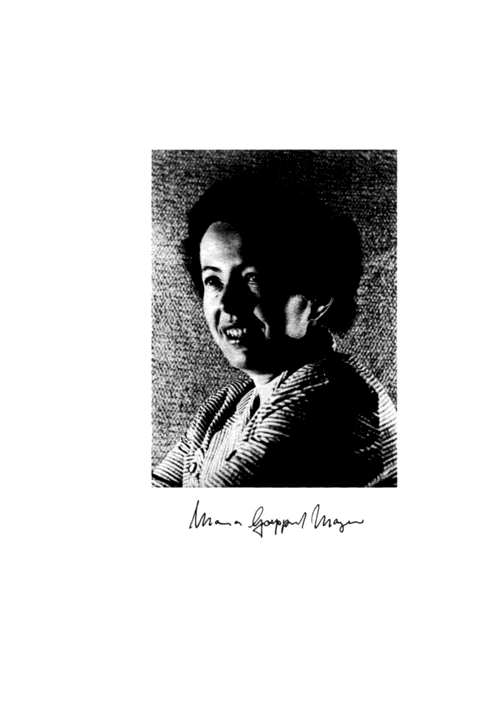
MARIA GOEPPERT MAYER June 2S, 1906-February 20,1972 BY ROBERT G. SACHS WHEN IN 1963 she received the Nobel Prize in Physics, Maria Goeppert Mayer was the second woman in history to win that prize- the first being Marie Curie, who had received it sixty years earlierand she was the third woman in history to receive the Nobel Prize in a science category. This accomplish- ment had its beginnings in her early exposure to an intense atmosphere of science, both at home and in the surrounding university community, a community providing her with the opportunity to follow her inclinations and to develop her re- markable talents under the guidance of the great teachers and scholars of mathematics and physics. Throughout her full and gracious life, her science continued to be the theme about which her activities were centered, and it culminated in her major contribution to the understanding of the structure of the atomic nucleus, the spin-orbit coupling shell model of nuclei. Maria Goeppert was born on June 28, 1906, in Kattowiz, Upper Silesia (then in Germany), the only child of Friedrich Goeppert and his wife, Maria nee Wolff. In 1910 the family moved to Gottingen, where Friedrich Goeppert became Pro- fessor of Pediatrics. Maria spent most of her life there until marriage. On January 19, 1930, she married Joseph E. Mayer, a chemist (elected to the National Academy of Sciences in 1946), 311
312 BIOGRAPHICAL MEMOIRS and they had two children: Maria Ann, now Maria Mayer Wentzel, and Peter Conrad. Maria Goeppert Mayer became a citizen of the United States in 1933. She died on February 20, 1972. Both her father's academic status and his location (Gottin- gen) had a profound influence on her life and career. She was especially proud of being the seventh straight generation of university professors on her father's side. Her father's personal influence on her was great. She is quoted as having said that her father was more interesting than her mother, "He was after all a scientist." ~ She was said to have been told by her father that she should not grow up to be a woman, meaning a housewife, and therefore decided, "I wasn't going to be just a woman." ~ The move to Gottingen came to dominate the whole struc- ture of her education, as might be expected. Georgia Augusta University, better known simply as "Gottingen," was at the height of its prestige, especially in the fields of mathematics and physics during the period when she was growing up. She was surrounded by the great names of mathematics and physics. David Hilbert was an immediate neighbor and friend of the family. Max Born came to Gottingen in 1921 and James Franck followed soon after; both were close friends of the Goeppert family. Richarc! Courant, Hermann Weyl, Gustav Herglotz, and Edmund Landau were professors of mathematics. The presence of these giants of mathematics and physics naturally attracted the most promising young scholars to the institution. Through the years, Maria Goeppert came to meet and know Arthur Holly Compton, Max Delbrueck, Paul A. M. Dirac, Enrico Fermi, Werner Heisenberg, John van Neumann, J. Robert Oppenheimer, Wolfgang Pauli, Linus Pauling, Leo Szilard, Edward Teller, and Victor Weisskopf. It was the oppor- ~ Joan Dash, A fife of One's Own (New York: Harper and Row, 1973), p. 231. t Ibid.
MARIA GOEPPERT MAYER 313 tunity to work with James Franck that led to Joseph Mayer's coming to Gottingen and gave him the chance to meet and marry her. Maria Goeppert was attracted to mathematics very early and planned to prepare for the University, but there was no public institution in Gottingen serving to prepare girls for this pur- pose. Therefore, in 1921 she left the public elementary school to enter the Frauenstudium, a small private school run by suf- ragettes to prepare those few girls who wanted to seek admission to the University for the required examination. The school closed its doors before the full three-year program was com- pleted, but she decided to take the University entrance exami- nation promptly in spite of her truncated formal preparation. She passed the examination and was admitted to the University in the spring of 1924 as a student of mathematics. Except for one term spent at Cambridge University, England, her entire career as a university student was completed at Gottingen. In 1924 she was invited by Max Born to join his physics seminar, with the result that her interests started to shift from mathematics to physics. It was just at this time that the great developments in quantum mechanics were taking place, with Gottingen as one of the principal centers; in fact, Gottingen might have been described as a "cauldron of quantum mechan- ics" at that time; and in that environment Maria Goeppert was molded as a physicist. As a student of Max Born, a theoretical physicist with a strong foundation in mathematics, she was well trained in the mathematical concepts required to understand quantum me- chanics. This and her mathematics education gave her early style of research a strong mathematical flavor. Yet the influence of James Franck's nonmathematical approach to physics certainly became apparent later. In fact, a reading of her thesis reveals that Franck already had an influence at that stage of her work. She completed her thesis and received her doctorate in 1930.
314 BIOGRAPHICAL MEMOIRS The thesis was devoted to the theoretical treatment of double photon processes. It was described many years later by Eugene Wigner as a "masterpiece of clarity and concreteness." Although at the time it was written the possibility of comparing its theo- retical results with those of an experiment seemed remote, if not impossible, double photon phenomena became a matter of considerable experimental interest many years later, both in nuclear physics and in astrophysics. Now, as the result of the development of lasers and nonlinear optics, these phenomena are of even greater experimental interest. After receiving her degree, she married and moved to Balti- more, Maryland, where her husband, Joseph Mayer, took up an appointment in the Chemistry Department of Johns Hopkins University. Opportunities for her to obtain a normal profes- sional appointment at that time, which was at the height of the Depression, were extremely limited. Nepotism rules were particularly stringent then and prevented her from being con- sidered for a regular appointment at Hopkins; nevertheless, members of the Physics Department were able to arrange for a very modest assistantship, which gave her access to the Univer- sity facilities, provided her with a place to work in the Physics Building, and encouraged her to participate in the scientific activities of the University. In the later years of this appoint- ment, she also had the opportunity to present some lecture courses for graduate students. At the time, the attitude in the Physics Department toward theoretical physics gave it little weight as compared to experi- mental research; however, the department included one out- standing theorist, Karl Herzfeld, who carried the burden of teaching all of the theoretical graduate courses. Herzfeld was an expert in classical theory, especially kinetic theory and ther- modynamics, and he had a particular interest in what has come to be known as chemical physics. This was also Joseph Mayer's primary field of interest, and under his and Herzfeld's guid- ance and influence Maria Mayer became actively involved in
MARIA GOEPPERT MAYER 315 this field, thereby deepening and broadening her knowledge of physics. However, she did not limit herself to this one field but took advantage of the various talents existing in the Johns Hopkins department, even going so far as to spend a brief period working with R. W. Wood, the dean of the.Johns Hopkins experimen- talists. Another member of the department with whom she had a substantial common interest was Gerhard Dieke. The Mathe- matics Department, which was quite active at that time, included Francis Murnaghan and Aurel Wintner, with whom she devel- oped particularly close connections. However, the two members of the Johns Hopkins faculty who had the greatest influence were her husband and Herzfeld. Not only did she write a num- ber of papers with Herzfeld in her early years there, but also they became close, lifelong friends. The rapid development of quantum mechanics was having a profound effect in the field of chemical physics in which she had become involved, and the resulting richness and breadth of theoretical chemical physics was so great as to appear to have no bounds. She was in a particularly good position to take advantage of this situation, since no one at Johns Hopkins had a background in quantum mechanics comparable to hers. In particular, she became involved in pioneering work on the structure of organic compounds with a student of Herzfeld's, Alfred Sklar; and in that work she applied her special mathe- matical background, using the methods of group theory and . . . matrix mechanics. During the early years in Baltimore, she spent the summers of 1931, 1932, and 1933 back in Gottingen, where she worked with her former teacher, Max Born. In the first of those sum- mers she completed with him their article in the Handbuch der Physik, "Dynamische Gittertheorie der Kristalle." In 1935 she published her important paper on double beta-decay, repre- senting a direct application of techniques she had used for her thesis, but in an entirely different context.
316 BIOGRAPHICAL MEMOIRS Later, James Franck joined the faculty at Johns Hopkins and renewed his close personal relationship with the Mayers. Also in that later period, Edward Teller became a member of the faculty of George Washington University, in nearby Wash- ington, D.C., and she looked to him for guidance in the devel- oping frontiers of theoretical physics. At about the same time, she became deeply involved in a collaboration with Joseph Mayer in writing the book Statistical Mechanics, published in 1940. When as her first bona fide student I turned to her for guid- ance in choosing a research problem, nuclear physics was on the rise; and she told me that that was the only field worth con- sideration by a beginning theorist. She took me to Teller to ask his advice about possible research problems. Our resulting joint work was her first publication in the field of nuclear physics. My thesis problem on nuclear magnetic moments was also se- lected with Teller's help, and she gave her guidance throughout that work, suggesting application to this problem in nuclear physics of techniques of quantum mechanics in which she was so proficient. These two forays into the field were her only activities in the physics of nuclear structure until after World WarII. Her approach to quantum mechanics, having been so greatly influenced by Born, gave preference to matrix mechanics over Schroedinger wave mechanics. She was very quick with matrix manipulations and the use of symmetry arguments to obtain answers to a specific problem, and this ability stood her in good stead in her later work on nuclear shell structure, which led to her Nobel Prize. She appeared to think of physical theories, in general, and quantum mechanics, in particular, as tools for solving physics problems and was not much concerned with the philosophical aspects or the structure of the theory. When she had the opportunity to teach graduate courses, her lectures were well organized, very technical, and highly con-
MARIA GOEPPERT MAYER 317 densed. She spent little time on background matters or physical interpretation. Her facility with the methods of theoretical physics was overwhelming to most of the graduate students, in whom she inspired a considerable amount of awe. At the same time, the students took a rather romantic view of this young scientific couple, known as " Joe and Maria," and felt that it was a great loss when they left Johns Hopkins to go to Columbia University in 1939. At Columbia University, where Joseph Mayer had been appointed to an associate professorship in chemistry, Maria Mayer's position at first was even more tenuous than at Johns Hopkins. The chairman of the Physics Department, George Pegram, arranged for an office for her, but she had no appoint- ment. This was the beginning of a close relationship between the Mayers and the Harold Ureys, a relationship which was to con- tinue throughout her life, as they always seemed to turn up in the same places in later years. Willard Libby became a good friend, and it was at Columbia that she first began to come under the influence of Enrico Fermi, although she had already met him in her first summer in the United States (1930) at the University of Michigan Special Summer Session in Physics. The Mayers also saw much of I. I. Rabi and Jerrold Zacharias during their years at Columbia. She quickly put to work her talent for problem solving when Fermi suggested that she attempt to predict the valence-shell structure of the yet-to-be-discovered transuranium elements. By making use of the very simple Fermi-Thomas model of the electronic structure of the atom, she came to the conclusion that these elements would form a new chemical rare-earth series. In spite of the oversimplifications of the particular model, this subsequently turned out to be a remarkably accurate prediction of their qualitative chemical behavior. In December 1941, she was offered her first real position: a
318 BIOGRAPHICAL MEMOIRS half-time job teaching science at Sarah Lawrence College, and she organized and presented a unified science course, which was developed as she went along during that first presentation. She continued, on an occasional basis, to teach part time at Sarah Lawrence throughout the war. She was offered a second job opportunity in the spring of 1942 by Harold Urey, who was building up a research group devoted to separating U 235 from natural uranium as part of the work toward the atomic bomb. This ultimately became known as Columbia University's Substitute Alloy Materials (SAM) Project. She accepted this second half-time job, which gave her an opportunity to use her knowledge of chemical physics. Her work included research on the thermodynamic properties of uranium hexafluoride and on the theory of sepa- rating isotopes by photochemical reactions, a process that, how- ever, did not develop into a practical possibility at that time. (The much later invention of the laser has reopened that possi- bility.) Edward Teller arranged for her to participate in a program at Columbia referred to as the Opacity Project, which concerned the properties of matter and radiation at extremely high tem- peratures and had a bearing on the development of the thermo- nuclear weapon. Later, in the spring of 1945, she was invited to spend some months at Los Alamos, where she had the oppor- tunity to work closely with Teller, whom she considered to be one of the world's most stimulating collaborators. In February of 1946, the Mayers moved to Chicago where Joe had been appointed Professor in both the Chemistry De- partment and the newly formed Institute for Nuclear Studies of The University of Chicago. At the time, the University's nepotism rules did not permit the hiring of both husband and wife in faculty positions, but Maria became a voluntary Associ- ate Professor of Physics in the Institute, a position which gave
MARIA GOEPPERT MAYER 319 her the opportunity to participate fully in activities at the University. Teller hail also accepted an appointment at The University of Chicago, and he moved the Opacity Project there, giving Maria Mayer the opportunity to continue with this work. It was accommodated in the postwar residuum of the Metallurgi- cal Laboratory of the University where, in its heyday during the war, the initial work on the nuclear chain reaction had been carried out. She was hired as a consultant to the Metallurgical Laboratory so that she could continue her participation in this project, and several students from Columbia who hack become graduate students at Chicago worked under her guidance. The Metallurgical Laboratory went out of existence to make way for establishing Argonne National Laboratory on July 1, 1946, under the aegis of the newly formed Atomic Energy Com- mission. She was offered and was pleased to accept a regular appointment as Senior Physicist (half time) in the Theoretical Physics Division of the newly formed laboratory. The main interest at Argonne was nuclear physics, a field in which she had had little experience, and so she gladly accepted the oppor- tunity to learn what she could about the subject. She continued to hold this part-time appointment throughout her years in Chicago, while maintaining her voluntary appointment at the University. The Argonne appointment was the source of finan- cial support for her work during this very productive period of her life, a period in which she made her major contribution to the field of nuclear physics, the nuclear shell model, which earned her the Nobel Prize. Since the mission of Argonne National Laboratory at the time was, in addition to research in basic science, the develop- ment of peaceful uses of nuclear power, she also became in- volved in applied work there. She was the first person to under- take the solution by electronic computer of the criticality prob-
320 BIOGRAPHICAL MEMOIRS lem for a liquid metal breeder reactor. She programmed this calculation (using the Monte Carlo method) for ENIAC, the first electronic computer, which was located at the Ballistic Research Laboratory, Aberdeen Proving Ground. A summary of this work was published in 1951 (U.S. Department of Commerce, Applied Mathematics, Series 12: 19-20~. While carrying on her work at Argonne, she continued her voluntary role at The University of Chicago by lecturing to classes, serving on committees, directing thesis students, and participating in the activities at the Institute for Nuclear Studies (now known as the Enrico Fermi Institute). The University had pulled together in this Institute a stellar assembly of physicists and chemists, including Fermi, Urey, and Libby, as well as Teller and the Mayers. Gregor Wentzel joined the faculties of the Physics Department and Institute later, and the families quickly became very close, one outcome being the joining of the families by marriage of Maria Ann to the Wentzels' son. Subrahmanyan Chandrasekhar, who had beers on the faculty of the Astronomy Department for many years, also joined the Institute. A stream of young and very bright physical scientists poured into the Institute, and the atmosphere was stimulating to the extreme. To add to this exciting atmosphere, which in some ways must have been reminiscent of Gottingen in the early days, her former teacher and friend, James Franck, was already a member of the University's Chemistry Department. The activities in the Institute reflected the interests of the leading lights, interests that were very broad indeed, ranging from nuclear physics and chemistry to astrophysics and from cosmology to geophysics. The interdisciplinary character of the Institute was well suited to the breadth of her own activities over the past, so that her Chicago years were the culmination of her variety of scientific experience. In keeping with this, she turned her attention at first to completing and publishing some earlier work in chemical physics, including work with Jacob
MARIA GOEPPERT MAYER 321 Bigeleisen on isotopic exchange reactions. Bigeleisen had col- laborated with her in other work at Columbia University and at this time was a fellow of the Institute. At the same time, she began to give attention to nuclear physics. Among the many subjects being discussed at the Institute was the question of the origin of the chemical elements. Teller was particularly interested in this subject and induced Maria Mayer to work with him on a cosmological model of the origin of the elements. In pursuit of data required to test any such model, she became involved in analyzing the abundance of the elements and noticed that there were certain regularities associ- ating the highly abundant elements with specific numbers of neutrons or protons in their nuclei. She soon learned that Walter M. Elsasser had made similar observations in 1933, but she had much more information available to her and found not only that the evidence was stronger but also that there were addi- tional examples of the effect. These specific numbers ultimately came to be referred to as "magic numbers," a term apparently invented by Eugene Wigner. When she looked into information other than the abun- dance of the elements, such as their binding energies, spins, and magnetic moments, she found more and more evidence that these magic numbers were in some way very special and came to the conclusion that they were of great significance for the understanding of nuclear structure. They suggested the notion of stable "shells" in nuclei similar to the stable electron shells associated with atomic structure, but the prevailing wisdom of the time was that a shell structure in nuclei was most unlikely because of the short range of nuclear forces as compared to the long-range coulomb forces holding electrons in atoms. There was the further difficulty that the magic numbers did not fit simple-minded ideas associated with the quantum mechanics of shell structure. Maria Mayer persisted in checking further evidence for shell
322 BIOGRAPHICAL MEMOIRS structure, such as nuclear beta-decay properties and quadrupole moments, and in trying to find an explanation in terms of the quantum mechanics of the nuclear particles. In this she was greatly encouraged by Fermi and had many discussions with him. She was also strongly supported by her husband, who acted as a continual sounding board for her thoughts on the subject and provided the kind of guidance that could be expected from a chemist who, in many ways, was better equipped to deal with phenomena of this kind than a physicist. The systematics of regularities in behavior with which she was faced had great similarity to the systematics in chemical behavior that had led to the classical development of valence theory in chemistry, and whose fundamental explanation had been found in the Pauli Exclusion Principle. It was Fermi who asked her the key question, "Is there any indication of spin-orbit coupling?" whereupon she immediately realized that that was the answer she was looking for, and thus was born the spin-orbit coupling shell model of nuclei. Her ability to immediately recognize spin-orbit coupling as the source of the correct numerology was a direct consequence of her mathematical understanding of quantum mechanics and especially of her great facility with the numerics of the represen- tations of the rotation group. This ability to instantly identify the key numerical relationships was most impressive, and even Fermi was surprised at how quickly she realized that his aues- tion was the key to the problems - 1 While she was preparing the spin-orbit coupling model for ~ Joseph Mayer gives the following description of this episode: "Fermi and Maria were talking in her office when Enrico was called out of the office to answer the telephone on a long distance call. At the door he turned and asked his question about spin-orbit coupling. He returned less than ten minutes later and Maria started to 'snow' him with the detailed explanation. You may remem- ber that Maria, when excited, had a rapid fire oral delivery, whereas Enrico always wanted a slow detailed and methodical explanation. Enrico smiled and left: 'Tomorrow, when you are less excited, you can explain it to me.'"
MARIA GOEPPERT MAYER 323 publication she learned of a paper by other physicists presenting a different attempt at an explanation and, as a courtesy, she asked the Editor of the Physical Review to hold her brief Letter to the Editor in order that it appear in the same issue as that paper. As a result of this delay, her work appeared one issue following publication of an almost identical interpretation of the magic numbers by Otto Haxel, J. Hans D. Jensen, and Hans E. Suess. Jensen, working completely independently in Hei(lel- berg, had almost simultaneously realized the importance of spin-orbit coupling for explaining the shell structure, and the result had been this joint paper. Maria Mayer and Jensen were not acquainted with one an- other at the time, and they did not meet until her visit to Germany in 1950. In 1951 on a second visit, she and Jensen had the opportunity to start a collaboration on further interpreta- tion of the spin-orbit coupling shell model, and this was the beginning of a close friendship as well as a very productive scientific effort. It culminated in the publication of their book, Elementary Theory of Nuclear Shell Structure (1955~. They shared the Nobel Prize in 1963 for their contributions to this subject. After Fermi's death in 1954, other members of the Institute for Nuclear Studies who had provided so much stimulation for her left Chicago. Teller had gone earlier in 1952, Libby left in 1954, and Urey in 1958. In 1960 she accepted a regular appoint- ment as Professor of Physics at the University of California at San Diego when both she and her husband had the opportunity to go there. Her appointment as a full professor in her own right at a major university was very gratifying to her, and she looked forward to the stimulation of this newest interdisciplinary group of scientists that was being drawn together there. However, shortly after arriving in San Diego, she had a stroke, and her years there were marked by continuing problems with her health.
324 BIOGRAPHICAL MEMOIRS Nevertheless, she continued to teach and to participate actively in the development and exposition of the shell model. Her last publication, a review of the shell model written in collaboration with Jensen, appeared in 1966; and she continued to give as much attention to physics as she could until her death in early 1972. In addition to being elected to the National Academy of Sciences in 1956 and receiving the Nobel Prize in 1963, Maria Goeppert Mayer's honors included being elected a Correspond- ing Member of the Akademieder Wissenschaften in Heidelberg and receiving honorary degrees of Doctor of Science from Rus- sell Sage College, Mount Holyoke College, and Smith College.
MARIA GOEPPERT MAYER BIB LI O GRAP HY 1929 325 Ober die Wahrscheinlichkeit des Zusamenwirkens zweier Licht- quantan in einem Elementarakt. Naturwissenschaften, 17:932. 1931 Ober Elementarakte mit zwei Quantensprungen. Annalen der Physik, 9~2):273-94. With K. F. Herzfeld. Energieubertragung an adsorbierte Molekule. Zeitschrift fur Physikalische Chemie (Bodenstein-Festband), 669- 78. With M. Born. Dynamische Gittertheorie der Kristalle. Handbuch der Physik, Band 24 (part 2~: 623-794. 1933 With ioseph E. Mayer and Stephen Brunauer. The entropy of polyatomic molecules and the symmetry number. Journal of the American Chemical Society, b5:37-53. With ioseph E. Mayer. The polarizability of ions from spectra. Phys. Rev., 43: 605-11. 1934 With K. F. Herzfeld. On the states of aggregation. J. Chem. Phys., 2:38-45. \\lith K. F. Herzfeld. On the theory of fusion. Phys. Rev., 46:995. With K. F. Herzfeld. Behavior of hydrogen dissolved in palladium. Zeitschrift fur Physikalische Chemie, B 26:203-8. 1935 Double beta-disintegration. Phys. Rev., 48:512-16. 1936 With K. F. Herzfeld. On the theory of dispersion. Phys. Rev., 49:332-39. \Vith Albert May. Some lattice sums involved in the calculation of elastic constants. Phys. Rev., 50:99.
326 BIOGRAPHICAL MEMOIRS 1938 With R. G. Sacks. Calculations on a new neutron-proton interaction potential. Phys. Rev., 53:991-93. With A. L. Sklar. Calculations of the lower excited levels of benzene. J. Chem. Phys., 6:643-52. 1940 With Joseph E. Mayer. Statistical Mechanics. N.Y.: Wiley. With Brother Gabriel Kane. Lattice summations for hexagonal close-packed crystals. I. Chem. Phys., 8:642. 1941 Rare earth and transuranic elements. Phys. Rev., 60: 184-87. 1942 With K. l. McCallum. Calcuations of the absorption spectrum of Wurster's salts. Rev. Mod. Phys., 14:248-58. 1947 With Jacob Bigeleisen. Calculation of equilibrium constants for isotopic exchange reactions. J. Chem. Phys., 15:261-67. 1948 With Jacob Bigeleisen, Peter C. Stevenson, and John Turkevich. Vibrational spectrum and thermodynamic properties of uranium hexafluoride gas. J. Chem. Phys., 16:442-45. With R. G. Oracles. On the binding energy of the triton. Phys. Rev., 73:185. On closed shells in nuclei. Phys. Rev., 74:235-39. 1949 On closed shells in nuclei, II. Phys. Rev., 75: 1969-70. With Edward Teller. On the origin of the elements. Phys. Rev., 76: 1226-31. 1950 Nuclear configurations in the spin-orbit coupling model. I. Empiri- cal evidence. Phys. Rev., 78:16-21.
MARIA GOEPPERT MAYER 327 Nuclear configurations in the spin-orbit coupling model. II. Theore- tical considerations. Phys. Rev., 78:22-23. 1951 The structure of the nucleus. Scientific American, March. With S. A. Moszkowski and L. W. Nordheim. Nuclear shell struc- ture and beta decay. Rev. Mod. Phys., 23:315-21. Report on a Monte Carlo calculation performed on the ENTAC. U.S. Department of Commerce, Applied Mathematics, Ser. 12:19-20. 1952 With i. H. D. Jensen. Electromagnetic effects due to spin-orbit coupling. Phys. Rev., 85: 1059. Radioactivity and nuclear theory. Annual Reviews of Physical Chemistry, 3: 19-38. 1954 Review of shell structure. In: Proceedings of the International Con- ference of Theoretical Physics, Tokyo, pp. 345-55. Science Coun- cil of Japan. 1 955 Classification of beta transitions. In: Beta and Gamma Ray Spec- troscopy, chap. 16.1. Amsterdam: North Holland Publishing. With I. H. D. Jensen. Elementary Theory of Nuclear Shell Struc- ture. N.Y.: John Wiley & Sons. 269 pp. 1957 With V. L. Telegdi. Twin neutrino theory. A modified ~ component theory. Phys. Rev., 107: 1445-47. 1958 Statistical theory of asymmetric fission, Part VII. In: Proceedings of the International Symposium on Transport Processes in Statis- tical Mechanics, Brussels, pp. 187-91. N.Y.: Interscience Pub- lishers. 1960 With R. D. Lawson. Harmonic oscillator wave function in nuclear spectroscopy. Phys. Rev., 117:174-84.
328 BIOGRAPHICAL MEMOIRS 1964 The shell model. Science, 145:999-1006. The shell model. In: Les Prix Nobel en 1963. Stockholm: The Nobel Foundation. Das Schalenmodell des Atomkerns. Angewandte Chemie, iahrgang, 76~7~:729-37. 1965 With l. H. D. Jensen. The shell model. I. Shell closure and jj cou- pling. In: Alpha-, Beta- and Gamma-Ray Spectroscopy, ed. Kai Siegbahn, p. b57. Amsterdam: North Holland Publishing.
