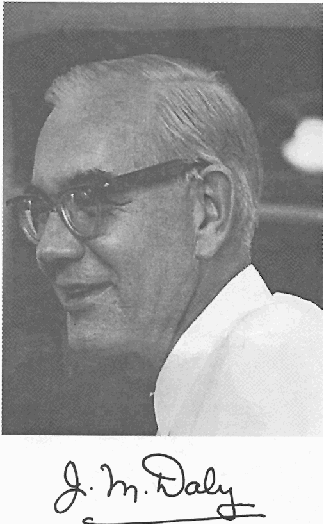
ALLAN V. COX
December 17, 1926-January 27, 1987
BY KONRAD B. KRAUSKOPF
IN THE EARLY MORNING of January 27, 1987, Allan Cox died in a bicycle accident, colliding with a large redwood tree after a steep descent on a stretch of mountain road. By this mishap geophysics lost a major contributor to the theory of plate tectonics, Stanford University lost an able and innovative dean of earth sciences, and the Stanford community lost a stimulating and compassionate teacher and counselor. More than a thousand people crowded into the Stanford chapel for the memorial service following his untimely death.
Allan was the son of a house painter, born in Santa Ana, California, in 1926. He was an avid reader and student of many fields from an early age. His chemistry teacher in a Santa Ana high school, because of other commitments, found it necessary to teach a semester's course in only six weeks. The students were really pushed, having to study chemistry three or four hours a day, five days a week-an experience that Allan found very stimulating. “Just plunging into something with enthusiasm and working hard at it was a big experience for me," he recalled later. He decided then that he wanted to be a chemist, and chose chemistry as a probable major when he entered the University of California at Berkeley. After a single quarter, however, he left school for
a three-year spell in the merchant marine, a job that gave him ample time for pursuing his love of eclectic reading.
Chemistry remained his chosen field when he returned to Berkeley, but a summer job in Alaska with Clyde Wahrhaftig convinced him that geology was more to his liking. Continued work in chemistry proved so dull that his grades suffered, and as a result he lost his draft deferment. Two years in the Army made a return to school seem especially attractive, again at Berkeley but this time with a major in geology. More trips to Alaska with Wahrhaftig elicited an interest in glaciers, both ice glaciers and rock glaciers, and particularly in the mechanics of glacier movement. He had fond memories of those expeditions, not only for their scientific content but also for long conversations on the works of Proust and the music of Bach.
In graduate work at Berkeley Allan came under the influence of John Verhoogen and chose geophysics rather than glaciology for his specialty. Verhoogen at the time was much interested in rock magnetism, and this was the subject that became the focus of Allan's doctoral research. Verhoogen also was one of the very few at Berkeley who thought there might be some validity in the idea of continental drift.
This was an hypothesis proposed in 1912 by a German meteorologist, Alfred Lothar Wegener, suggesting that the continents are not fixed in their present positions on the Earth's surface, but over geologic time have drifted widely, joining together, breaking up, and assuming new shapes. Continental drift plays a major role, of course, in the current doctrine of plate tectonics, but in the 1950s it was generally regarded by geologists, in the northern hemisphere at least, as a wild notion with little evidence to back it up. Verhoogen's solitary support of the hypothesis made a deep impression on Allan, and he came to regard continental drift as a real possibility. In his Arthur Day Lecture many
years later, Allan gave a vivid description of the atmosphere at Berkeley during his graduate years:
As graduate students at the University of California in the mid-fifties, we sniffed something in the air that we were NOT hearing about in our lectures and seminars, with the exception of those of John Verhoogen. So we graduate students formed a Geology Club. The only two by-laws that I remember are (1) that we met only in places that served beer, and (2) that faculty members were not invited. .. At the end of the first year we voted on the question of whether continental drift was likely. For safety we used a secret ballot. Continental drift won, though not by a landslide. Voting as we did on a scientific issue was probably done mainly to annoy the Berkeley faculty. Luckily they had the good judgment not to acknowledge that our club existed.
Continental drift remained a strong interest for Allan, but in his graduate research he concentrated on rock magnetism.
Rocks formed near the surface are influenced by the Earth's magnetic field. As a lava flow cools and solidifies, for example, any magnetic minerals it contains become magnetized parallel with the field, and the resulting rock is then itself a weak magnet. The orientation of a rock's magnetism is thus a record of the Earth's field at the time of the rock's formation, and by measuring the magnetism of older rocks it is possible to tell whether the Earth's field has had a different direction in the past. Surprisingly, the field direction has indeed changed. The most remarkable change is an apparent complete reversal of direction at some times in the Earth's history: if the magnetism of specimens from a variety of old lava flows is measured, some show directions parallel to the present Earth's field, others a direction just reversed. Evidently the Earth's field has changed direction many times in the geologic past, the present north magnetic pole becoming the south pole and vice versa. It was this strange behavior of the Earth's field that attracted
Allan's interest, and remained a principal subject of his research for many years.
After obtaining his doctor's degree (1959) Allan joined the U.S. Geological Survey at its western headquarters in Menlo Park. There he worked with another Survey geophysicist, Richard Doell, whom he had met as a fellow graduate student at Berkeley. From these two men in the early 1960s came many important papers on rock magnetism. A major question concerned the timing of the apparent reversals in the Earth's field: did the field stay in one direction for periods of, say, thousands of years, or millions of years? Was there a regular alternation of normal and reverse fields in the past, or was the alternation erratic? Many other questions continued to intrigue Cox and Doell, but the timing of reversals remained their major concern.
To get an answer required that the rock specimens they were using be accurately dated, and this posed a real difficulty. Many of their rocks were not very old geologically, say from a few hundred thousand to several million years, a range for which accurate methods of dating were at that time not available. Very fortunately work had begun on adapting the potassium-argon method of rock dating to this time range, and even more fortunately one of the principal workers in this enterprise was a Berkeley graduate student looking for a job, Brent Dalrymple. The Cox-Doell pair arranged for the Survey to hire Dalrymple, and it was this triumvirate that succeeded in working out details of the magnetic-reversal time scale. Much of the effort was accomplished in a small tar-paper shack set up adjacent to the main Survey building—a location that seemed at the time to reflect a low estimate of the importance of rock magnetism on the part of their Survey superiors. It turned out, however, to be a particularly favorable place for their work, because of the absence of other laboratory paraphernalia
that would have interfered with the measurement of very weak magnetic fields.
The work was far from easy. Samples had to be collected worldwide and their magnetic direction and age carefully determined. Some samples were not suitable for measurement because their magnetic properties had been altered since they were formed, by the action of heat or lightning or changes in their chemistry produced by solutions. A few rock specimens had evidently acquired reverse magnetization not from the Earth's field but simply because of peculiarities in their chemical composition ("self-reversal"). Such deviants caused trouble in establishing the pattern to which the great majority of samples conformed.
Despite these difficulties, the job was carried through triumphantly. Reversals had indeed occurred worldwide many times, but on a very irregular schedule. Sometimes reversed polarity had lasted only a few hundred thousand years, sometimes several million. Teams elsewhere in the world contributed similar data, and for a time there was feverish competition among the different laboratories. General agreement about the times of polarity change made it clear that a time scale or calendar could be set up showing just when the changes had occurred, and the dates could be correlated with other geologic events like volcanic eruptions and changes in fossil assemblages.
This was all impressive enough, but the most spectacular application of the reversal calendar came from another source. Rock magnetism could be measured not only on specimens in the laboratory but on rocks at the bottom of the sea, by using magnetometers carried on ships. At about the time the Cox-Doell-Dalrymple calendar was being fashioned, others were exploring magnetic properties of rocks on and near the mid-ocean ridges. In general, rocks at the high point of a ridge showed normal magnetic orientation,
but on either side were belts parallel to the ridge showing the reverse direction. Then beyond these were belts of normal direction, then more reverse directions, and so on. On a map the ridge would be at the center of a pattern of stripes, the stripes representing a symmetrical alternation of normal and reverse magnetization. And the width of the stripes showed rough proportionality to the length of the times indicated by the Cox-Doell-Dalrymple calendar. This correlation between widths of stripes and times shown by magnetic reversals became apparent to Allan at a meeting where the two records were placed side by side. He describes his reaction: "I felt cold chills. This was the most exciting moment of my scientific career."
There was ample cause for excitement. A then-current hypothesis about the mid-ocean ridges pictured them as places where lava comes up from the Earth's interior and flows to either side forming the ocean crust as it cools, and where the solidified crust is moving apart. If lava has been flowing from a ridge at intervals for a long time, and if the solidified lava of the crust is moving away from the ridge on either side, the lava would be of increasing age with increasing distance from the ridge. It should thus represent material that over time has been magnetized alternately in the normal and reverse direction. Allan's observation that the sea-bottom magnetic orientations do indeed show this alternation, with a timing parallel to that shown by the Cox-Doell-Dalrymple calendar, is strong support for the hypothesis. So the ocean crust is demonstrated to be moving, and parts of the crust on the two sides of a ridge represent huge "plates" of crustal material that are drifting apart. Here, then, is solid evidence that great areas of the Earth's crust are in motion, one of the principal kinds of evidence that paved the way to the concept of plate tectonics. Thus, Allan Cox early in his professional career played a major
role at the beginning of a scientific revolution that within the next few years would profoundly transform the earth sciences.
In 1967 Allan moved from the Geological Survey to the geophysics department at Stanford, where he continued work on paleomagnetism and attracted the interest of many students to this field. The magnetic field preserved in rocks can provide much information about Earth history besides the simple reversal of field direction at various times in the past, and some of these other aspects proved a fertile area for Allan and his students to explore.
The magnetism of a rock records many details of the Earth's field at the time of the rock's formation: its intensity, its direction with respect to north (since the axis of the Earth's dipole field remains fairly close to the rotational axis), and its inclination to the horizontal (since lines of force of the Earth's field range from horizontal at the magnetic equator to vertical near the poles). Measurements of the direction of a rock's field and its inclination thus make it possible to determine the latitude and longitude of the place on the Earth's surface where the rock was at the time it acquired its magnetism. If the place so indicated is different from the rock's present position, this means that the crustal plate containing the rock must have moved since the rock's formation. Such measurements on rocks of different ages provide a means of tracing the movements of continents and islands and ocean basins over geologic time, and the record of these movements shows great changes in the Earth's geography during its long history.
As an example, one problem of crustal movements that particularly interested Allan and some of his students was to find an explanation for the curious pattern in the geology of the rocks that make up the west coast of North America. Here large elongated areas of rock of very different kinds
and structures and ages ("terranes") exist side by side, as if they had come from a distance and had been successively jammed against the continent. From the magnetic directions indicated by rocks in the different terranes, it could be deduced that they had indeed moved to their present positions at different times and after long travels across the Pacific Ocean basin from various places in latitudes far to the south. Using computer graphics Allan and his students could make animated diagrams to illustrate these movements. "Earth science is highly visual, in fact almost artistic," Allan said in describing this activity. Working out details of the origin and travel of terrane components was a fascinating but difficult undertaking, an undertaking even yet not completed in all details. The magnetic properties of rocks have thus provided not only a key to the initial concept of plate tectonics, but a wealth of data on the large-scale movement of crustal plates in the Earth's past.
In 1979 Allan became dean of the School of Earth Sciences, a demanding position in which he displayed a talent for administration that had not previously been known or appreciated by his colleagues. Despite his new duties he kept up his research program and his close contact with students, at one time supervising the research of thirty student advisees, in addition to his work as teacher and administrator.
In the university environment Allan's interest broadened to other parts of earth science and to the general problems of liberal education. He gave generously of his time to student groups, helping to devise a lighting system for a student theatre and living for one period of time in a student residence. He became widely known for his teaching, in both graduate and undergraduate classes. A special interest was the designing of research projects for undergraduate students.
Praises for his work as administrator were loud in the tributes accorded Allan by university colleagues in the memorial service that followed his death. "He was the very ideal of the teacher-scholar: the faculty resident and National Academy of Science Member, the theater-lighter and the pioneer of magnetic reversal, the living proof that we were right to insist that such capabilities and interests can come together in one person" (from the university president). "Allan greeted each problem of academic leadership with the excitement that a child brings to the exploration of a new game. Problems as diverse as the challenge of faculty development, or of dealing with prejudices that faculty and staff bring to the problems of health and safety in laboratories, or of bringing the fruits of scholarly investigation within the reach of undergraduates, or of dealing with the complex implications of divestment in South Africa ... each of these problems, and many more, challenged Allan's imagination—and he poured some part of himself into the ultimate solution of each" (from the university provost). Many other samples could be cited of the heartfelt tributes that came his way in the memorial service.
His scientific work brought Allan many honors: election to the National Academy of Sciences, the American Philosophical Society, and the American Academy of Arts and Sciences, the presidency of the American Geophysical Union, the Day Medal of the Geological Society of America, the Fleming Medal of the American Geophysical Union, and the Vetlesen Medal of Columbia University. He is the author of more than one hundred scientific papers and of two books on plate tectonics. The first of these books (1973), Plate Tectonics and Geomagnetic Reversals, is a reprinting of the more important early papers on plate tectonics, together with an extensive major introduction and then shorter introductions to different parts of the subject which provide
notes on the different authors and the background of their work. The second book (1986), Plate Tectonics: How It Works, written with Robert Brian Hart, is intended for undergraduates or other readers with some scientific background, and explains in simple terms, with a multitude of diagrams, the basics of plate-tectonic theory and the techniques of using magnetic data to reconstruct past motions of continental and oceanic plates.
Allan's influence was felt far beyond the confines of the School of Earth Sciences. To university faculty and staff and to students both in and outside the school he was widely known for his understanding and friendliness combined with exacting standards. Notable particularly was his quiet ability to elicit the best possible performance from all with whom he came in contact. A lifelong bachelor, he lived by himself in a small house in the wooded hills above the Stanford campus, where he delighted in entertaining friends and students. Perhaps from this kind of life came his often expressed concern for preservation of open space and his talent for giving wise counsel to politicians and environmental groups on problems of timber harvesting in the nearby hills. In 1970, with the help of students and other faculty members, he published a small book, Logging in Urban Counties, in which he analyzed at length the effect that unrestricted logging can have on soil, streams, and watersheds, with a resulting increase in the danger of fires and landslides. The book led to his appearance at many hearings on problems of open space and land management, and ultimately to the stiffening of logging regulations.
Allan had an extraordinary combination of scientific acumen, humility, concern for his fellows, and love of the natural world that makes his death at an early age seem especially tragic.
To some of Allan's friends the occurrence of January 27, 1987, seemed unbelievable. He was a safety-conscious bicyclist of long experience, incapable of simply running off a road and smashing head-on into a redwood tree. Another possible explanation came a few days later. The collision may not have been an accident, but a carefully arranged suicide prompted by a police investigation of allegations that he had had improper relations with a teenage boy. The sad event becomes then a tragedy of true Shakespearean dimensions, for here is a character admired and loved by all about him, successful in everything he tries, who in the end may have been betrayed by a fatal weakness.
SELECTED BIBLIOGRAPHY
1960
With R. R. Doell. Review of paleomagnetism. Geol. Soc. Am. Bull. 71:645-768.
1961
With R. R. Doell. Paleomagnetic evidence relevant to a change in the earth's radius. Nature 190:36-37. Anomalous remanent magnetization of basalt. U.S. Geol. Suru. Bull. 1083E:131-60.
1962
With R. R. Doell. Magnetic properties of basalt in hole EM 7, Mohole Project. J. Geophys. Res. 67:3997-4004.
1963
With R. R. Doell. The accuracy of the paleomagnetic method as evaluated from historic Hawaiian lava flows . J. Geophys. Res. 68:1997-2009. With R. R. Doell and G. B. Dalrymple. Geomagnetic polarity epochs and Pleistocene geochronometry. Nature 198:1049-51.
1964
With R. R. Doell. Long period variations of the geomagnetic field. Seismol. Soc. Am. Bull. 54B:2243-70. With R. R. Doell and G. B. Dalrymple. Reversals of the earth's magnetic field. Science 144:1537-43.
1965
With G. B. Dalrymple and R. R. Doell. Potassium-argon age and paleomagnetism of the Bishop tuff, California. Geol. Soc. Am. Bull. 76:665-73. With R. R. Doell and G. B. Dalrymple. Quaternary paleomagnetic stratigraphy. In The Quaternary of the United States, eds. H. E. Wright, Jr. and D. G. Frey, pp. 817-30. Princeton, N.J.: Princeton University Press.
1966
With R. R. Doell and G. B. Dalrymple. Geomagnetic polarity epochs: Sierra Nevada data. J. Geophys. Res. 71:531-41. With D. M. Hopkins and G. B. Dalrymple. Geomagnetic polarity epochs-Pribilof Islands, Alaska. Geol. Soc. Am. Bull. 77:883-910.
1967
With G. B. Dalrymple. Statistical analysis of geomagnetic reversal data and the precision of potassium-argon dating. J. Geophys. Res. 72:2603-14. With G. B. Dalrymple, R. R. Doell, and C. S. Grommé. Pliocene geomagnetic polarity epochs. Earth Planet. Sci. Lett. 2:163-73. Geomagnetic polarity epochs-Nunivak Island, Alaska. Earth Planet. Sci. Lett. 3:173-77. With G. B. Dalrymple and R. R. Doell. Reversals of the earth's magnetic field. Sci. Am. 216:44-54.
1968
Lengths of geomagnetic polarity intervals. J. Geophys. Res. 73:3247-60 With R. R. Doell and G. B. Dalrymple. Radiometric time scale for geomagnetic reversals. Geol. Soc. Lond. Q. J.
1969
Geomagnetic reversals. Science 163:237-45.
1970
Reconciliation of statistical models for reversals. J. Geophys. Res. 75:7501-503.
1973
Plate Tectonics and Geomagnetic Reversals. San Francisco: W. H. Freeman.
1974
With R. F. Butler. The effect of neutron irradiation on remnant magnetization in multi-domain iron and kamacite. J. Geomagn. Geoelectr. 26:55-71.
1976
With J. Hillhouse. Brunhes-Matuyama polarity transition. Earth Planet. Sci. Lett. 29:51-64. With J. D. Phillips. Spectral analysis of geomagnetic reversal time scales. Geophys. J. R. Astron. Soc. 45:19-33.
1978
With R. G. Gordon and C. Harter. Absolute motion of an individual plate estimated from its ridge and trench boundaries. Nature 274:752-55.
1979
With R. G. Gordon and M. O. McWilliams. Pre-Tertiary velocities of the continents: A lower bound from paleomagnetic data. J. Geophys. Res. 84:5480-86.
1980
With R. G. Gordon. Paleomagnetic test of the early Tertiary plate circuit between the Pacific Basin plates and the Indian plate. J. Geophys. Res. 85:6534-46.
1982
With J. Achacha and S. O'Hare. Paleomagnetism of the Kennett limestone and the rotation of the eastern Klamath Mountains. Earth Planet. Sci. Lett. 61:365-80.
1984
With R. G. Gordon. Paleolatitudes determined from paleomagnetic data from vertical cores. Rev. Geophys. Space Phy. 22:47-72.
1985
With D. C. Engebretsen and R. G. Gordon. Relative motion between oceanic and continental plates in the Pacific Basin. Geol. Soc. Am. Special paper no. 206.
1986
With R. B. Hart. Plate Tectonics: How It Works. Palo Alto, Calif.: Blackwell Scientific Publications.