
11 Intergenerational Relations and the Elderly
Ronald D. Lee
Introduction
Recent essays on the role of the elderly in nature (Carey and Gruenfelder, Austad, in this volume) describe a variety of animal behaviors across the life cycle. This note is prompted by the thought that these animal behaviors have interesting links and counterparts in human behaviors. In it I will consider some of these links, particularly those that have an intergenerational aspect. Specifically, I will discuss (1) various estimates of the prevalence of postreproductive and elderly women in human stationary populations, (2) the role of elders as repositories of knowledge that may benefit their kin or larger group, (3) transfer flows of resources from members of one age group to members of another, and (4) transfers of assets to children at the death of their parent or inter vivos.
Prevalence Of The Elderly In Human Populations—Actual, Historical, And Projected
According to Austad (in this volume), physiologically postreproductive individuals are generally very rare in nature, although for some particular species such as toothed whales they are quite prevalent. Austad indicates that 24 percent of female short-finned pilot whales survive past the physiological reproductive age, at which point their remaining life expectancy is 14 years. In some killer whale populations, about 30 percent of females are postreproductive, and postreproductive life expectancy is over 25 years.
It is interesting to compare these figures to human populations. Austad (in this volume) takes the view that the evidence on human survival in preagricultural populations is dichotomous, with paleodemographic data indicating that ''humans until recently did not live into their postreproductive years except very rarely." while other data indicate much higher proportions of postreproductive females in the populations. He suggests that the disagreement in these estimates may be unresolvable.
A brief survey of the evidence may be useful. To begin with, we must operationalize "post reproductive." In developed countries, the mean age at menopause ranges from 47 to 50 years, but menopause comes some years after the effective cessation of the ability to bear children. In noncontracepting agricultural populations, the mean age at last birth is usually in the range of 39 to 41 years (Bongaarts, 1983:124-127). The mean age at last birth for the forest dwelling Aché hunters and gatherers is slightly higher (42.1 years; Hill and Hurtado, 1996:254) and for the !Kung is substantially lower (35.4 years; Howell, 1979:130). Nonetheless, many females in noncontracepting populations continue to bear children after age 40, so it is preferable to use age 45 for present purposes. By this age, about 70 percent of couples are sterile (Bongaarts, 1983:126), although often the sterility of the couple is due to sterility of the male rather than the female.
Evidence for survival in high-mortality populations comes from a variety of sources that include skeletal data, contemporary preagricultural populations who retain traditional life styles, high-mortality agricultural populations, and extrapolation from agricultural populations using statistical methods to generate model life-table systems.
There are many estimates of mortality based on skeletal (paleodemographic) data. These estimates have well-known weaknesses that arise from differences by age in the probability that a dead person will be represented by bones in the collection, difficulty in ascribing an age at death to the bones, distortions due to nonstationarity of the age distribution of the population giving rise to the specimens, etc. There is a very wide range in estimated life expectancies from skeletal data (Hassan, 1981), with some analysts reporting very low life expectancies, far lower than those estimated for contemporary preagricultural groups, whereas others estimate mortality at levels consistent with those for contemporary groups. Table 11-1 gives one estimate based on a combination of the model life-table methods developed by Weiss (1973) for preagricultural populations (here assuming that 60 percent of births survive to age 15), with an estimate of life expectancy at age 15 of 21.2 years presented as an average for a large body of paleodemographic data reviewed by Hassan (1981:118). The implied life expectancy at birth is 23 years.
The next column is based on a model life table with a life expectancy at birth of only 20 years and with an age pattern of mortality based on extrapolation from high-mortality agricultural populations analyzed by Coale and Demeny
TABLE 11-1 Postreproductive Females in Stationary Populations
|
|
Paleo Averagea |
High Mortalityb |
High Mortalityc |
Achéd |
!Kunge |
Modern Industrialf |
U.S. in in 2065g |
|
Life expectancy at birth (years) |
23 |
20 |
20 |
37 |
30 |
79 |
90 |
|
Prop surviving to age 45 (%) |
0.17 |
0.21 |
0.18 |
0.46 |
0.35 |
0.96 |
0.997 |
|
Life expectancy at age 45 (years) |
14 |
17 |
16 |
22 |
20 |
36 |
45 |
|
Pop 45+ as Prop of total female pop (%) |
0.10 |
0.18 |
0.15 |
0.28 |
0.23 |
0.44 |
0.50 |
|
Prop surviving to age 65 (%) |
0.05 |
0.08 |
0.06 |
0.28 |
0.17 |
0.85 |
0.965 |
|
Life expectancy at age 65 (years) |
7 |
8 |
8 |
10 |
9 |
19 |
27 |
|
Pop 65+ as Prop of total female pop (%) |
0.01 |
0.03 |
0.02 |
0.08 |
0.05 |
0.20 |
0.28 |
|
aThis is interpolated from Weiss (1973) model life tables with survival to age 15 assumed to be 0.6. and with life expectancy at 15 set equal to the average given by Hassan (1981) for the Paleolithic studies he reviews, which was 21.2 years. bBased on Coale and Demeny (1983), model west female life tables and stable populations with growth rate 0. cBased on Preston et al. (1993) model life table for females. dCalculated from data in Hill and Hurtado (1996:196-198). These data are explicitly for the forest dwelling period, not the later reservation period when mortality was lower. eBased on Howell (1979), which I interpret to mean that it is appropriate to use Coale-Demeny model west life table with life expectancy at birth of 30 years to characterize !Kung mortality in the past; recent !Kung mortality has been much lower. fBased on the U.S. female life table for 1990, according to data of the Social Security Administration (1992:34-35). gBased on Carter and Lee (1992), who forecast mortality using statistical time-series analysis and some modeling assumptions; they forecast somewhat larger gains in life expectancy than do either the Social Security Administration or the U.S. Census Bureau. Note: Pop = population; Prop = proportion. SOURCES: Weiss (1973), Hassan (1981), Coale and Demeny (1983), Hill and Hurtado (1996), Howell (1979), U.S. Social Security Administration (1992), Carter and Lee (1992). |
|||||||
(1983).1 Even in this case, 18 percent of the stationary female population would be postreproductive. In both these life tables, which describe extremely high mortality, there are still substantial numbers of postreproductive women, and the life expectancy of women surviving to age 45 is still an additional 14 to 17 years. There are very few elderly women, however.
The Hassan-Weiss life table has a radically different shape than those in the Coale-Demeny model life-table system: child mortality is lower, and adult mortality is higher. In the Coale-Demeny system, the lowest life expectancy at age 15 for females is about 31 years, and that corresponds to about 41 percent of births surviving to age 15, for an overall life expectancy at birth of 20 years. However, the Coale-Demeny model life tables for life expectancies of 20 to 30 years are mainly extrapolations from life tables with life expectancies of 33 years or higher, and the method of extrapolation has been criticized as exaggerating the mortality of children and understating the mortality of adults (Bhat, 1987; Preston et al., 1993). Preston et al. (1993) have developed a new set of model life tables for high-mortality populations, which are better based empirically and which avoid the methodological problems of the Coale-Demeny tables at low life expectancies. These model life tables have a shape between that of the Hassan-Weiss and Coale-Demeny life tables, as shown in the third column of Table 11-1. At a life expectancy at birth of 20 years, 44 percent survive to age 15, with a remaining life expectancy of 27 years.
It is true that there are some analysts of some skeletal collections who conclude that mortality was higher than these three life tables suggest and that the proportion of female births surviving to age 45 was lower (e.g., Lovejoy et al., 1977; Weiss, 1973). Others, analyzing similar collections, conclude that life expectancy was substantially higher than these life tables suggest (see the many life tables described in Hassan, 1981). Hassan (1981:121) sums up his survey with the view that "It is premature, pending further evaluation of the age distribution of prehistoric skeletal populations, to affirm that prehistoric mortality was greater than that for ethnographic hunter-gatherers." Which leaves open the possibility that it may have been greater.
The leading demographic studies of contemporary hunter-gatherer populations are for the Aché and the !Kung. Howell (1979:116) concluded that the !Kung had a life expectancy at birth of about 30 years in the past, although in recent years it appears to have been much higher. She also found that the !Kung
data were fit reasonably well by Coale-Demeny (1983) model life tables. Table 11-1 shows the implied information for the !Kung, indicating that around 23 percent of the female population would have been postreproductive in a stationary population. Table 11-1 also presents data for the forest dwelling Aché (Hill and Hurtado, 1996), indicating that in a stationary female population, 28 percent would be postreproductive. 2
Further evidence is summarized by Wilmoth (1995), who surveys a large number of estimated life tables for high-mortality populations and for each tabulates estimated life expectancy at birth and at age 50 (these are the only data he provides). Life expectancy at 50 is 2.5 to 3 years less than at age 45 in high-mortality populations (see Coale and Demeny, 1983), so we can adjust accordingly. Wilmoth reports values for 56 different life tables of which 26 have life expectancy at birth of less than 30 years. It is striking that of these 56, in only four tables was life expectancy at 50 at or below 10 years (plus one life table that gives a range of 9.5 to 12.5 years). The four exceptions are all for immigrants from the United States to Liberia. If the first year of experience in Liberia is included, life expectancies at birth were only 1.7 and 2.2 years (for males and females, respectively), but even in this case, life expectancy at age 50 was 7.9 and 6.6 years. These data for the first year of exposure to the West African disease environment can be dismissed as irrelevant in the present context. For those who survived the first year in Liberia, the corresponding figures are life expectancies at birth of 25.8 and 23.9 years, and at 50 of 9.6 and 8.3 years. Included in Wilmoth's table is a summary estimate for Stone Age populations, taken from Acsadi and Nemeskeri's (1970) history of the human life span; they estimate life expectancy at birth to be 21 years and at 50 to be 12 years.
Because women are still vigorous at age 45 and for many years after, it is also useful to consider the size of the elderly population, taking 65 as a convenient benchmark. Table 11-1 shows that although life expectancy for those reaching age 65 was probably 7-10 years, the population share of the elderly was probably in the range of only 1-8 percent.
In my view this evidence is quite persuasive: 15-45 percent of females in preagricultural societies would have survived to age 45, at which point their remaining life expectancy would have been more than 10 years and probably in the range of 12-25 years. Something like 10-30 percent of the stationary female population would have been postreproductive. If this view is right, then the prevalence of postreproductive human females in preagricultural populations would be similar to, or greater than, that for pilot whales.
It is also interesting to consider comparable figures for modern low-mortality populations, for which a female life expectancy at birth of 80 is not unusual. For the United States, we see in Table 11-1 that life expectancy at 45 is 36 years, and at 65 it is still 19 years. Forty-four percent of the female stationary population is postreproductive, and 20 percent is at or over age 65. Looking to the future, Table 11-1 also shows data projected to the year 2065, at which point the life expectancy at birth is 90 years, 50 percent of the stationary female population would be postreproductive, and 28 percent would be at or above age 65.
We can conclude that in our preagricultural past, postreproductive females probably made up a substantial proportion of the population. This leads us naturally to the question: what did these abundant older members of the population do? Were they a benefit or a burden for the younger members of the population? We turn now to consider a subset of the issues raised by this question.
The Elderly As Repositories Of Knowledge
"Knowledge, wisdom, and experience are social assets which normally accumulate with age and outlast physical stamina.... Those endowed with the art of writing and surrounded by printed documents can scarcely appreciate the inestimable value of an aged person possessing more knowledge than any other source within reach" (Simmons, 1945:131). Statements of this sort are frequently encountered and are certainly plausible. However, quantitative evidence is rarely available to support them. Fairbanks and McGuire (1986) have reported a striking inverse association of the mortality rates for young captive female vervets (small gray African monkey) with the presence of a grandmother.
It would be a simple matter to search for such associations in many preindustrial human populations using widely available survey data, but I am unaware of any such studies. However, an interesting study reported in Rosenzweig (1994) provides quantitative evidence on a related point. He notes that in India families farm the same plot of land for generations and there are important variations in the microclimatic and microagronomic conditions from plot to plot. Under these conditions, farmers accumulate much valuable information about their specific plots of land through experience over their lives, and the elderly have the most experience, sometimes of infrequent events such as serious droughts. Rosenzweig considers the extent to which farm profits decline under locally adverse weather conditions in two large samples of Indian farms for which longitudinal data are available. The findings are shown in Figure 11-1. Farm profits fell most when the eldest person present in the family was less than 40 years old; they fell less when the oldest was less than 60; and they fell only about half this much when the eldest was 60 or over. Having an eldest over age 60 appeared to reduce the losses to about half the level attainable through the presence of a local agricultural extension station or of electricity. A related
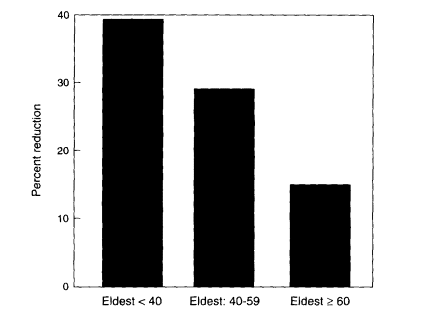
Figure 11-1
Percentage fall in profits due to bad weather, by age of eldest member.
NOTES: These are households in which there is no extension aid. SOURCE: Based on Rosenzweig (1994).
analysis with a different data set for Indian farms showed similarly important effects of the years of experience of the most experienced worker on the farm, which appeared to raise average productivity and reduce the influence of adverse conditions on output (Rosenzweig, 1994:78).
It is important to realize that there are serious dangers in inferring causality from associations of this sort, whether for humans or for animals. If there were a genetic component to survival, then that component alone could account for a positive association of the survival of infants and grandparents, even if grandmothers had no effect on survival of their grandchildren. The same is true for any other source of variation in mortality that is specific to a particular family. For example, variations across families in the healthiness of the site they occupy could induce such a positive association. A spurious association might arise in other ways, as well. Causality might run from prosperity to coresidence of the grandparents, rather than the reverse, at least in human populations. Grandparents with a number of adult children might choose the most prosperous to live with, and grandparents might be sent away when food is inadequate to support them. Caution is necessary in interpreting data of this sort, intriguing as such data may be.
Transfer Flows To And From The Elderly
"In summary, then, individuals everywhere seem to have become progressively dependent upon others for their food with the onset of old age" (Simmons, 1945:34-35).
An evolutionary perspective suggests that postreproductive and elderly humans would increase the reproduction or survival of their own children, as Kaplan (1994) argues. For toothed whales, discussed by Carey and Gruenfelder (in this volume) and Austad (in this volume), postreproductive females continue to lactate and thus transfer food to their young descendants. This view contrasts starkly with one of the best-known theories of fertility for traditional human societies (Caldwell, 1976). Caldwell's theory is based on the premise that in traditional societies, children transfer resources to their parents and are in other ways instrumentally useful to them:
The key issue here, and, I will argue, the fundamental issue in demographic transition, is the direction and magnitude of intergenerational wealth flows or the net balance of the two flows—one from parents to children and the other from children to parents—over the period from when people become parents until they die. . . . In all primitive societies and nearly all traditional societies the net flow is from child to parent (1976:140).
Caldwell argues that a net upward transfer of resources provides the motivation for the high fertility typically observed in traditional societies until recently. Cross-cultural survey evidence confirms that in agricultural societies, parents do value children for their instrumental contributions—help around the house, in the fields, and support in old age. If Caldwell's argument is correct, then the behavior of elderly humans in preindustrial societies would present a strong contrast to the behavior of postreproductive elderly animals in nature, who typically transfer resources downward to their own adult offspring and to their grandchildren (as described by Carey and Gruenfelder, and by Austad, in this volume). If elderly humans in traditional societies are a drain on the resources of their adult children. receiving resources that might otherwise have been used for reproduction and child rearing, then it is hard to see how such behavior maximizes fitness, unless the elderly make sufficiently great contributions as stores of knowledge to warrant such support.
To shed light on these issues, I will review evidence on intergenerational transfers in human populations. There are two questions to address. (1) Is the general direction of transfers (intergenerational wealth flows, in Caldwell's terminology) upward from younger to older members of the population (as Caldwell asserts) or downward from older to younger members of the population? (2) Is there a stage in the life cycle when transfers flow upward from younger to older members of the population, particularly to elderly people, even if the net flow is downward over the whole life cycle? We will not be looking for individual cases of one kind of flow or another, because surely at one time or another, for one or
another pair of individuals, one could find any kind and direction of flow. What does interest us is the broad pattern of flows, on average, in a population. The section concludes by discussing how selection could lead to upward transfers from children to parents while the parents are still in their reproductive phase.
While it would be instructive to have microlevel data showing who gave what to whom when, such comprehensive data are seldom, if ever, available, and partial data are of little use. The data more often available are aggregate average-age profiles of consumption and production by age. When capital markets and storable commodities are rare, mistrusted, or nonexistent, then differences between consumption and production are made up by transfers.
Formal modeling and analysis of populations in which there are interage transfer flows suggest some simple but useful measures (Willis, 1988; Lee, 1994a). (1) Simple inspection of the aggregate age profiles of consumption and production can be useful. (2) The population-weighted average ages of consumption, Ac and production, Ay, are very informative. If Ac > Ay, then, on average, consumption in the population occurs later than production, and resources, on average, flow upward from younger to older. A simple arrow diagram, with a head at the average age of consumption and tail at the average age of production, is an effective way to display this information. The arrow then points in the direction of the transfers, and the arrow length indicates the degree to which these transfers flow either upward or downward. The position of the arrow shows the average ages. (3) In a stationary population, the product of the difference in average ages, Ac - Ay , and the average amount of consumption or production per capita in the population as a whole gives the total amount, W, that the average member of the population can expect to receive in net transfers, over the remainder of life.
If W is positive, the average person is expecting to receive more in future transfers than this person will give in transfers; transfers are upward from younger to older on net. If W is negative, transfers are downward. The diagram can be modified to incorporate the measure of W by thickening the arrow in proportion to per capita consumption. The arrow area then indicates the net future transfer to be received, W. (For a formal development of these ideas, see Lee, 1994a.) The thick arrows are most useful for comparing different kinds of transfer flows within the same population, such as child support, bequests, or a public sector pension system.
This diagrammatic approach provides a way to assess the overall direction of inter-age transfer flows in a population, thereby answering the first question about net direction of transfer flows in a population. For the second question—whether there is some life cycle stage when transfers flow upward from younger to older—either we can simply inspect the aggregate age profiles of consumption and production or we can explicitly evaluate flows between adult parents and their children, and between the elderly and their adult children, in a strictly intergenerational manner.
We can now look at some estimates of the overall direction of transfer flows for preindustrial societies. I have examined data on the following populations:
- Kaplan (1994) presents consumption and production data for three different groups of Amazon Basin hunter-gatherer-horticulturalists, including the Aché, and generously made these available to me for further analysis. The age profiles themselves show that people continue to be net producers throughout their adult lives, including in old age. The elderly clearly continue to transfer food to their children and grandchildren. The Aché practice gerontocide, particularly of females, once the elderly are no longer able to produce.
- Dodds et al. (1996) provide estimates for five other Amazon Basin hunter-gatherer-horticulturalist societies, based on time-use data combined with assumed age profiles of consumption and hourly productivity. In these data, the net direction of transfers is still clearly downward, but there is apparently a stage in which the elderly produce less than they consume. For Figure 11-2, I have pooled these data for all five societies.
- Stecklov (1995) presents data for rural Cote D'Ivoire and analyzes them using the framework outlined above. Here also the net direction of transfers is strongly downward from older to younger, but at the same time the elderly consume more than they produce, by virtue of transfers from younger members of the population.
- Mueller (1976) develops age profiles of consumption and production from a variety of broad-based estimates representative of Third World agricultural populations. These data clearly indicate a net downward flow of transfers in the population, but again the elders receive transfers that enable them to consume more than they produce.
Figure 11-2 presents arrows for these societies. They all point distinctly downward, indicating that the direction of transfer flows is, on net, from older to younger. This contradicts the statement from Caldwell quoted above, if his statement is taken to refer strictly to transfers of foods and other easily measured physical items. The horizontal position and length of these arrows reflect the average ages of making and receiving transfers, and the figures indicate the difference in these average ages.
The answer to the second question, more specifically about the elderly, is that in some societies average transfers are always downward, even in old age (Kaplan, 1994), whereas in other societies, perhaps the majority, the older population consumes more than it produces. In this connection, however, note that the elderly provide many useful functions besides directly producing food. As Rosenzweig's (1994) study indicated, and as suggested by the quote from Simmons (1945), the knowledge and experience of the elderly can contribute substantially to food production, even when their physical contribution is limited. Furthermore, they may contribute in other intangible ways through leadership, maintaining order, etc. Finally, they may contribute childrearing services that
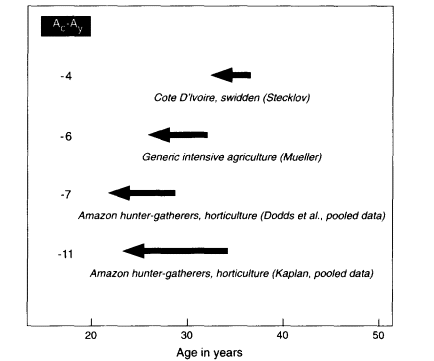
Figure 11-2
The direction of transfers in various preindustrial populations. NOTE: The tail of each arrow is located at the average age of producing in the population, and the head is located at the average age of consuming in the population. The length of the arrow is the number of years of age traversed by the average transfer. The thickness and vertical position of each arrow have no significance. Ac-Ay: difference between two average ages. SOURCE: Based on Lee (in press), Stecklov (1995), Mueller (1976), Dodds et al. (1996), and Kaplan (1994).
permit younger members of the population to be more productive, or they make tools for younger hunters (Hill and Hurtado, 1996:235-236).
For these reasons, some degree of upward-flowing physical transfers from adult children to elderly parents could be consistent with the demands of reproductive fitness. The same might also be true for other animals. If postreproductive female toothed whales provide fitness-enhancing childrearing services, including feeding and baby-sitting, then why should not their reproductive-age children or grandchildren render them some assistance through transfers of food, for example by sharing a kill? One could ask the same question about elephants, for whom elderly matriarchs appear to provide valuable services. Have such questions been addressed in field work?
Upward transfers of resources certainly do sometimes occur in nature, as in
social insects, notably ants and bees. The queen, who is by far the oldest member of the population, produces no food and is herself fed and tended by younger members who are sterile. Following the analytic framework outlined above, there would doubtless be a strong downward transfer from worker bees to offspring and another upward transfer to the queen. The net direction of flows is not apparent a priori. In any event, in these cases there is no puzzle about the relation of the upward transfers to reproductive fitness.
Upward transfer flows might also occur when generations share a domicile that includes a store of food, as happens when bannertail kangaroo rats permit one of their children to remain in the mound (as described by Austad, in this volume). Whether there is, in fact, any transfer, either upward or downward, through access to a common store of food, is not clear. A quote from Simmons (1945) is relevant: ''. . . the aged among primitive peoples had greater opportunity for securing provisions from a common store in societies where group sharing of food was an established practice irrespective of age considerations than in societies where this was not the case."
As noted, the elderly may perform many services that enhance the reproductive fitness of their children and therefore of themselves but which escape an accounting of visible physical transfers. But it is also true, at least for humans, that the children may perform many valuable services for their parents that escape the measure of transfers. These services may involve low cost to the children, yet the services may be of high value to the older parents. Services of this kind include physical security for the household and its property arising from numbers of household members, care during occasional bouts of sickness or disability (risk spreading), political power in the community arising from kin networks, and so on. Some of these services may also be rendered to parents by children in nature. Such services make it very difficult to assess a broader version of Caldwell's theory, and clearly at times it is this broader version that Caldwell has in mind.3
So far I have discussed only preindustrial transfer flows. In the preindustrial societies for which I have presented data, the public sector was small, and its tax and transfer role was minimal. Financial institutions such as savings banks or stock markets were also of little relevance for the average person in the rural areas. Interage transfers took place almost entirely through the family, mainly in the form of childrearing or, in agricultural societies, through support for coresident elders. In the modern industrial state the situation is very different. Financial institutions are widespread, widely trusted, and widely used. I will not discuss their role here, however. Instead I will focus on three subjects: overall direction
of the transfer flow, transfers within the family, and transfers through the public sector.
Figure 11-3 shows arrow diagrams for transfers within the family in the United States, grouped into four kinds: (1) bequests to children at death of the parent: (2) interhousehold transfer flows between no-longer coresident parents and children; (3) parental costs of higher education; and (4) parental costs of child rearing, net of children's earnings as teenagers.
For each kind, the arrow is positioned as described earlier, and the thickness of the arrow represents the average size of the flow per person in the population (for details of estimation, see Lee, 1994b). All four kinds of familial transfers are downward. The area of each arrow indicates the expected value of net future receipts of transfers over the life cycle of the individual or the household. The average household expects a receipt of -$44,000 in bequests (data not shown); that is, the average household has received $44,000 in bequests already and anticipates leaving a similar amount to its heirs in the future. Bequests flow downward across age. Other interhousehold gifts and transfers are poorly measured in the data used for these calculations, but better data confirm the net direction of such flows. The average child receives about $81,000 in childrearing expenditures (not counting parental time costs) and can expect to allocate a corresponding amount to each of its own children in the future, with the help of a spouse. There was an additional expenditure of about $6,000 per child for costs of higher education, which the child can also be expected to "repay" in the future. The figure shows massive downward transfer flows from parents to children within the family.
This pattern of downward familial transfers at all ages is consistent with Kaplan's (1994) measurements for the Aché and with the facts concerning postreproductive toothed whales reported in Carey and Gruenfelder and in Austad (in this volume). However, the pattern is not consistent with the other agricultural and preagricultural societies for which data were earlier described; these commonly showed that the elderly received transfers from younger members of the population, enabling them to consume more than they produced. However, the net flows up to surviving elders are overwhelmed in value by the value of net flows downward from parents to children earlier in the life cycle, so the net direction of transfers flows overall is definitely downward, as shown earlier in Figure 11-2.
There is an obvious reason why the elderly in the United States continue to make net transfers to their adult children, in contrast to most preindustrial societies so far examined (except for those studied by Kaplan, 1994). The United States, like other industrial nations, has a well-developed system of transfers to the elderly through the public sector. These public transfers substitute for transfers to the elderly from their own children. Indeed, many elderly apparently believe that these public sector transfers go too far and offset the flows by private transfers in the opposite direction. Figure 11-4 shows arrows for public sector net
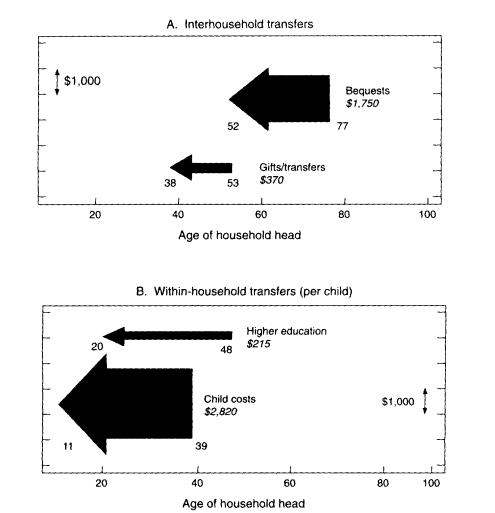
Figure 11-3
Familial transfers in the United States (data for the 1980s).
NOTES: The four arrows represent bequests to children at death of parent; interhousehold transfer flows between no-longer coresident parents and children; parental costs of higher education; and parental costs of child rearing, net of children's earnings as teenagers. The top panel shows flows of transfers between households; the bottom panel shows flows of transfers within households. The tail of each arrow is located at the average age of making each kind of transfer in the population, and the head of the arrow is located at the average age of receiving each kind of transfer in the population. The thickness of each arrow represents the per capita (or per household) flow of each kind of transfer, indicated by the number below each label. The area of each arrow equals the average net transfer of each kind expected to be received by the average person or household over the remaining lifetime and is negative if the arrow points to the left. SOURCE: Based on Lee (1994b).
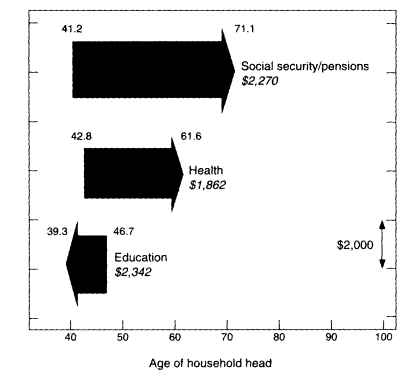
Figure 11-4
Public sector transfers to and from households in the United States (data for the 1980s). NOTE: Sec the note to Figure 11-3. The tail of the transfer is located at the average age of paying taxes in support of each kind of transfer, and the head at the average age of receiving each kind of transfer—in each case based on the age of the household reference person. Data combine federal, state, and local transfers.
SOURCE: Based on Lee (1994b).
transfers for education, pensions, and medical care for the local, state, and federal levels combined. The areas of these arrows tell us the value of the expected net future transfer received per household, which is $69,000 for Social Security pensions: $35,000 for health care; -$17,000 for education (this negative sign means that the average household will pay more taxes in the future for education than it will receive in educational services, because educational services are received early in the life cycle of the average household and paid for through taxes later—the opposite to pensions and Medicare, for example). Clearly, on net, there are massive upward transfers through the public sector, even though educational transfers are, of course, downward. Indeed, when the upward transfers through the public sector are combined with the downward transfers through the family shown in Figure 11-3, the net direction of transfer flows is still up-
ward, from younger to older. I think that this pattern would hold for other industrial countries as well. Data on interhousehold transfers support this speculation (see Lee, in press), although detailed analysis at the individual level has not yet been done except for the United States.
Caldwell (1976) argued that fertility is low in industrial societies because wealth flows have been reversed in these societies, with children now imposing substantial net costs on their parents rather than being the source of upward transfer flows. In fact, we have just seen that in the United States, net transfer flows are upward, not downward. However, we have also seen that it is the public sector transfers that are responsible for the upward direction, and the taxes in support of these transfers must be paid regardless of the number of children one has. For this reason, the net upward flows in the United States do not contradict Caldwell's ideas, and the downward flows we estimate within the family are consistent with his ideas.
The net upward direction of transfers in the United States and perhaps in other industrial societies is partly due to the changed demography (see Table 11-1). The proportion of elderly people in industrial societies is much higher than in traditional societies, due to lower mortality and lower fertility; moreover, their share in the population is destined to rise substantially in the coming decades. This transfer is also due to the relatively high consumption level (including health care) that the public sector transfers such as Social Security, Medicare, and Medicaid allow, together with home ownership, private savings, and private pensions.
I conclude this section by suggesting how evolution might lead in some cases to upward transfer flows from children to parents at some stage of the life cycle. Godfray (1995) reviews evolutionary theories of offspring-parent conflict, arising because the optimal parental investment in a child may be larger from the point of view of the child than the parent, so that generational interests diverge. A superficially related issue arises in analyses for humans of optimal parental investment in children's education, but with a more harmonious outcome than in the theories described by Godfray.
For humans, familial intergenerational transfers can be used to achieve the optimal investment in education from the child's perspective, even if this investment exceeds the optimal parental transfer to the child (Becker, 1988: Willis, 1994). The optimal investment in a child's education is such as to equate the rate of return from an incremental investment to the market rate of interest.4 The child is unable to finance the education him/herself through credit markets, but
the optimal investment can nonetheless be achieved if the parents loan the child the incremental amount for education, in excess of the parental outright transfer. The child repays the parents later, in the form of old age support or perhaps assistance with the educational costs of younger siblings.
More generally, the parental investment t which maximizes the reproductive fitness of a given child is larger than the parental investment T which maximizes the reproductive fitness of the parent. In this circumstance, the reproductive fitness of both parent and child might be increased if the parent transferred outright the amount T to the child and then additionally "loaned" an amount of food or care to the child in excess of T, say L = T- t, with this amount L to be repaid by the child to the parent at a later life-cycle stage. The later repayment could take the form of assistance with a younger generation of the parent's children, as when adolescents help care for infants during a life-cycle stage in which they can generate a surplus to be transferred but are not yet capable of their own reproductive effort. Alternatively, the children could give food to their parent to replenish depleted reserves. Either way, parents could achieve more surviving offspring and greater reproductive fitness.
If a mutation should yield a gene that affected behavior so that children partially repaid parental investments in this way, the parents could then produce more surviving offspring by investing more in each or by having a greater number. Thus this gene would raise the reproductive fitness of those who had it, because it would be transmitted to their own children, who would behave similarly toward them. Furthermore, a gene for reneging would convey lower reproductive fitness in this example, because it also would be transmitted to offspring, and reproductive fitness would return to the original baseline level, which is by hypothesis lower than that with the repayment gene.
In this way, evolution could lead to life-cycle patterns of intergenerational transfers in which some parental investment in children is subsequently "repaid" by the child at a later life-cycle stage—that is, patterns in which transfers in both directions occur between parents and children, at different ages.
This theory has somewhat different implications than the inclusive fitness theory, according to which animals act to increase the reproductive fitness of those who share their genes. The repayment theory could explain such behavior independent of shared genes—for example, the behavior might be predicted to be as strong in relation to half siblings as to full siblings (if the exchange occurs with only one of the parents, rather than with both). At the same time, under the repayment theory and in contrast to the inclusive fitness theory, one would not expect any helpful behavior toward more distant relatives with whom a parent is not shared.
The Transfer Of Assets: Bequests
Austad (in this volume) discusses the transfer of assets from parents to their children. This transfer of a stock is usefully distinguished from transfer flows,
such as routine feeding of children by their parents. The notions of assets and property rights for animals, and their transmissibility to offspring, at first seem odd and implausible to a social scientist. However, concrete examples make clear that these notions are indeed appropriate. Property rights do not seem to follow from a legal code or public sanctions, but rather from some aspect of the motivation of contestants, such that the defender of territory seldom loses a confrontation. Assets include territories, stores of food (seeds), and homes of various kinds such as burrows and mounds. Sharing the asset with a child during the parent's lifetime means that the child will inherit it on the death of the parent. Inter vivos bequeathal also occurs when the parent simply relinquishes the asset. Approximate ultimogeneture appears to be common, because parents are more likely to share their asset with a child when they are old and their life expectancy is short. According to Austad (in this volume), systematic study of the transfer of assets in relation to the aging of the parents is rare, and not much is yet known.
Transmission of assets among humans, and particularly bequest behavior, has been the subject of a great deal of study and literary effort. In parts of Europe, children could not marry until they inherited the family farm, creating a link between marriage, fertility, and mortality. Sometimes only one of the children was permitted to marry and reproduce, while the others might remain on the farm as unmarried servants or leave to become soldiers, emigrants, clerics, or servants elsewhere. In other parts of Europe, older parents might transfer ownership of the farm to a child, while continuing to live on the farm in an outbuilding; the child would then be obligated to feed and care for the parents until their death. Many other arrangements were also possible, including transmission of the rights to use land without outright ownership. The transmission of assets from parents to children was surrounded by elaborate strategic behavior on the part of both children and parents. Indeed, the ownership of property is one of the major ways in which elderly parents have induced their children to transfer flows of resources upward to them, as in the example given above in which inter vivos transfer of the farm to a child carried a contractual obligation on the part of the child to provide food for the elderly parents.
Because it appears from Austad (in this volume) that children who receive transfers of assets are at a real advantage in terms of reproductive fitness, it would be interesting to investigate whether the transmission of assets is also subject to strategic behavior on the part of either parents or, perhaps more likely, siblings. If it matters a lot who inherits the family mound, then there should be observable competition for the right to do so.
Austad (in this volume) suggests that "As a gross generality, males are more likely to be bequeathed valuable resources such as nests, dens, or territories in birds, whereas females are more likely to inherit such resources in mammals . . . ." It is interesting that Simmons (1945:49) also suggests a generalization, based on a statistical analysis of the practices of different societies: " . . . aged women, in contrast with men, have tended to acquire property rights more readily in simple
societies characterized by collection, hunting and fishing, and also within the matrilineal type of family organization; while aged men have gained their greatest advantage in the control of property among farmers, and especially herders, as well as within the patriarchal system of family organization and amid social traits characteristic of more advanced cultures."
Conclusion
I will briefly summarize the main points that have emerged in the preceding discussion, including questions that might be addressed through animal studies:
- It is very likely that even in Stone Age populations, the life expectancy of females at age 45 was more than 10 years, and probably in the range of 12—25 years and that a substantial proportion of the female population, perhaps 10-30 percent, was postreproductive. The proportion of elderly at or above age 65 may have been very low, however.
- The average flow of net transfers within the family appears to be downward in all human societies so far examined, subject to the caveat that many studies measure mainly flows of food.
- There is often an upward net flow within the family from adult children to elderly parents, although this is always swamped by the magnitude of transfers downward through child rearing.
- There are many ways in which both human and animal elders can raise the reproductive fitness of their children, and therefore of themselves, beside the transfer of physical resources such as food. Such ways include leadership, storing knowledge, maintaining order, and so on.
- Widely available data would support the analysis of the effect on infant and child mortality of the presence of a grandparent in human agricultural households, if direction of causality can be established.
- Although upward transfer flows may be altruistic in humans, it is also possible that because the elderly can increase the reproductive fitness of their adult children, their children could enhance their own reproductive fitness by transferring resources to their parents. By a similar argument, one might expect sometimes to observe such transfers taking place, not only among humans but also among animals.
- It may be that upward transfers do occur sometimes in nature, and the possibility may be worth attention. Possible cases that come to mind include social insects (which are a very special case); stored food in shared dwellings, to which the elderly have access; kills which the elderly are permitted to eat; and general food sharing.
- Both humans and animals in nature sometimes bequeath valuable assets to their children. Among humans, control of these assets by the elderly, combined with declared plans to transfer the asset to a child at death, is often used to manipulate the favored child into supporting the elder through upward transfers.
Does such strategic use of valuable assets ever occur among animals? For example, do elders share in the stores accumulated by the coresident-favored offspring among bannertail kangaroo rats? And do animal children compete in some way for the right to inherit?
I have argued that postreproductive females and older males were quite prevalent in preagricultural human populations and that they probably raised the reproductive fitness of their children through leadership, knowledge, and food transfers. It is unknown, however, whether the longevity of humans can, in fact. be explained by the usefulness of older humans. The contribution of postreproductive humans to the reproductive fitness of their descendants is a necessary, but not sufficient, condition for the viability of an evolutionary explanation.
Austad (in this volume) concludes with the suggestion that if there is more field work linking transmission of assets to senescence in animals, then "a generalized theory of the ecology of resource transfer across generations may emerge." The study of the evolution of longevity together with a general study of intergenerational transfers does, indeed, appear to be a promising and fascinating area for further work.
Acknowledgment
I am grateful to Timothy Miller, Shripad Tuljapurkar, Kenneth Wachter, and two anonymous referees for comments during preparation of this chapter. Research for this paper was funded by a grant from National Institute on Aging (AG1 1761).
References
Acsadi. G., and J. Nemeskeri 1970 History of Human Life Span and Mortality. Budapest: Akademiai Kiado.
Becker, G.S. 1988 Family economics and macro behavior. American Economic Review 78(1 March):1-13.
Bhat, M.P. 1987 Mortality in India: Levels, Trends, and Patterns. Ph.D. dissertation, University of Pennsylvania.
Bongaarts, J. 1983 The proximate determinants of natural marital fertility. Pp. 61-102 in R. Bulatao and R. Lee, eds., Determinants of Fertility in Developing Countries Supply and Demand for Children, Vol. 1. New York: Academic Press.
Caldwell. J.C. 1976 Toward a Restatement of Demographic Transition Theory, Population and Development Review. Pp. 113-180 reprinted in (1982) J. Caldwell Theory of Fertility Decline. New York: Academic Press.
Carter. L., and R. Lee 1992 Modeling and forecasting U.S. mortality: Differentials in life expectancy by sex. In D. Ahlburg and K. Land, eds., Population Forecasting, a special issue of International Journal of Forecasting 14(3):393-412.
Coale, A., and P. Demeny 1983 Regional Model Life Tables and Stable Populations. New York: Academic Press.
Dodds, D.. D. Friou, and C. Mason 1996 Does wealth flow upward in lowland tropical America? A test of Caldwell's hypothesis. A paper presented at the 1996 annual meeting of the Population Association of America, New Orleans.
Ermisch, J. 1989 Intergenerational transfers in industrialized countries: Effects of age distribution and economic institutions. Journal of Population Economics 1:269-284.
Fairbanks, L.A., and M.T. McGuire 1986 Age, reproductive value, and dominance-related behavior in vervet monkey females: Cross-generational influences on social relationships and reproduction. Animal Behavior 34:1710-1721.
Godfray, H.C.J. 1995 Evolutionary theory of parent-offspring conflict. Nature 376(July 13):133-138.
Hassan, F.A. 1981 Demographic Archeology, New York: Academic Press.
Hill, K., and A.M. Hurtado 1996 Aché Life History. New York: Aldine de Gruyter.
Howell, N. 1979 Demography of the Dobe !Kung. New York: Academic Press.
Johnson. A. 1975 Time Allocation in a Machiguenga Community. Ethnology 14:301-310.
Kaplan, H. 1994 Evolutionary and wealth flows theories of fertility: Empirical tests and new models. Population and Development Review 20(4):753-791.
Lee, R.D. 1994a The Formal Demography of Population Aging, Transfers, and the Economic Life Cycle, Pp. 8-49 in L. Martin and S. Preston, eds., The Demography of Aging. Committee on Population, National Research Council. Washington, DC: National Academy Press.
1994b Population age structure, intergenerational transfers, and wealth: A new approach, with Applications to the U.S. In P. Gertler, ed., on The Family and Intergenerational Relations, a special issue of Journal of Human Resources 29(4):1027-1063.
In press A Cross-Cultural Perspective on Intergenerational Transfers and the Economic Life Cycle. Presented at IUSSP seminar, East West Center Population Program, Honolulu, September 12-14, 1995. Forthcoming conference volume A. Mason, ed.
Lovejoy, C.O., R.S. Meindl, T.R. Pryzbeck, T.S. Barton, K.G. Heiple, and D. Kotting 1977 Paleodemography of the Libben site, Ottawa County, Ohio. Science 198:291-293.
Mueller, E. 1976 The economic value of children in peasant agriculture. Pp. 98-153 in R. Ridker, ed., Population and Development: The Search for Interventions. Baltimore, MD: Johns Hopkins Press.
Preston, S.H., A. McDaniel. and C. Grushka 1993 New model life tables for high-mortality populations. Historical Methods 26(4): 149-159. Rosenzweig, M.
1994 Human capital development, the family, and economic development. Pp. 63-90 in S. Asefa and W.C. Huang, eds., Human Capital and Economic Development. Kalamazoo. MI: Upjohn Institute.
Simmons, L. 1945 The Role of the Aged in Primitive Society. New Haven, CT: Yale University Press.
Stecklov, G. 1995 Intergenerational Resource Flows in Cote d'Ivoire: An Empirical Analysis, Presented at the annual meeting of the Population Association of America. San Francisco, May 1995.
U.S. Social Security Administration 1992 Life Tables for the United States Social Security Area. 1990-2080. Washington, DC: U.S. Department of Health and Human Services.
Weiss, K.M. 1973 Demographic models for anthropology. Society for American Archaeology Memoirs 27:11-86.
Willis, R. 1988 Life cycles, institutions and population growth: A theory of the equilibrium interest rate in an overlapping-generations model. Pp. 106-138 in R. Lee, W. B. Arthur and G. Rodgers eds., Economics of Changing Age Distributions in Developed Countries. New York: Oxford University Press.
1994 Economic analysis of fertility: Micro-foundations and aggregate implications. Pp. 139172 in K.L. Kiessling and H. Landberg, eds., Population and Economic Development and the Environment. New York: Oxford University Press.
Wilmoth, J.R. 1995 The earliest centenarians: A statistical analysis. in Bernard Jeune and J.W. Vaupel, eds., Exceptional Longevity. Odense, Denmark: Odense University Press.


