
3
Achieving a Focused Research Agenda
Chapter 2 identified two types of environmental research, referred to as core research and problem-driven research, that are necessary to develop sound solutions to environmental problems and presented the case for the development and maintenance of core research capabilities. As discussed in Chapter 2, these categories are not mutually exclusive, but they do constitute a useful framework for describing the components of a comprehensive environmental research program. While a strong program to develop core capabilities is essential for anticipating some problems and better preparing the nation to solve whatever problems arise, problem-driven research (the focus of this chapter) that directly assists the agency in carrying out its regulatory mission will continue to be a necessary component of EPA's research program. Pressing problems with real and immediate economic, ecological, and health consequences must be addressed (see, for example, Box 3-1).
Recognizing that funding is not sufficient to examine every identified problem while also maintaining core research, it is important to avoid spreading research efforts so thin that no useful results can be obtained. Thus, EPA must prioritize within the long list of issues perceived as important, pursuing only the most critical in order to receive the biggest return on its research investment. Chapter 2 discussed a general approach for selecting the most important core research topics. This chapter discusses ways to identify and then select among problem-driven research areas.
ANTICIPATING EMERGING ENVIRONMENTAL PROBLEMS
Many advisory groups have proposed that efforts be made to identify emerging environmental issues and thus get a head start on avoiding or mitigating them (e.g., EPA/SAB, 1988, 1995). However, based on consideration of other reports
|
BOX 3-1 Nutrient Contamination of Coastal Waters: Attacking a Difficult Problem Maintaining the chemical and biological integrity of coastal waters in the face of an influx of nutrients and other pollutants generated by continuing demographic, economic, and technological growth in the watersheds of coastal areas has become a major challenge. Past efforts to protect coastal waters by addressing thermal pollution, soil loss and sediment control, toxic substances, and dredging have deflected attention from what is probably the most significant threat to many coastal waters—excessive nutrient loading. Nutrient inputs to aquatic ecosystems lead to deficiencies of dissolved oxygen. Degraded water quality, in turn, has significant negative impacts on biological resources, such as fish and shellfish. Rapid population growth, coastline development, increases in agricultural fertilization and the density of farm animals, and atmospheric inputs continue to increase the severity of the problem. To mitigate nutrient contamination of coastal waters, problem-driven research is needed to answer questions such as the following:
Consistent monitoring and accurate modeling are also needed to understand natural cycles, ascertain anthropogenic sources of variability, indicate the efficacy of pollution control programs, delineate research needs, and identify potential problems as they begin to develop. Monitoring and modeling must be coordinated and interactive. A key task will be to characterize and quantify the nonpoint sources of contaminants. |

FIGURE 3-1 Identification and mitigation of environmental problems is a continual process. The items listed as examples are simply illustrations of the type of environmental problems in each category. They are neither the only, nor necessarily the most important, problems.
and extensive discussion of the issues identified in Table 2-1, this committee concluded that there is a continuum of identified and emerging issues. The very fact that an issue has been recognized indicates that, in some circles at least, it has ''emerged." The discovery and amelioration of environmental problems has been an ongoing process for hundreds of years. As illustrated in Figure 3-1, there is a continuum between well-defined, widely known problems and those that are less well understood and less well-known to a broad public. And beyond those, there are the speculative, potential future problems. Many observers have predicted that environmental problems of the future are likely to occur as a consequence of large-scale economic, demographic, and technological change. World population continues to increase, and the magnitude and patterns of human activities continue to evolve. In some regions, environmental problems are driven by rapid economic growth, increases in consumption, and technological change. This has been the pattern in the United States over the last 50 years. An ever-increasing percentage of the world's population lives in large urban areas. By the year 2000, there are likely to be more than 20 cities with populations exceeding 10 million, and most of these will be in developing countries (United Nations, 1992). Among the predictable consequences of this rapid growth are (1) the acceleration of geochemical cycles leading to effects such as climate change and the excessive fertilization of lacustrine, riverine, estuarine, and coastal ecosystems, (2) inefficient utilization of land resources leading to increased erosion, the destruction of productive land, and the physical impairment of ecosystems, (3) the introduction and accumulation of xenobiotic substances, and (4) re-emergence of infectious diseases once thought to be under control. Figure 3-2 illustrates some of the impacts of human population growth on global environmental change.
People transform the landscape and exploit natural resources, and yet our understanding of the nature of global ecosystems is just beginning to come into focus. Human society is dependent on the "goods and services" provided by
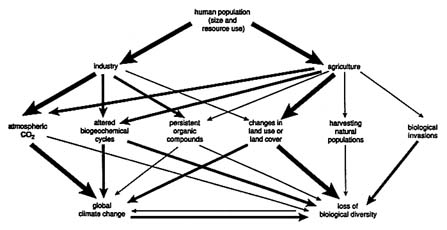
FIGURE 3-2 The growth of industry and agriculture in the past 200 years has promoted at least six identifiable components (middle row) of global environmental change. To varying degrees these components alter the earth's climate and reduce the planet's biological diversity. A general notion of the magnitude of these effects (arrow thickness) can be estimated, but the interrelationships and the synergistic effects of all six components have yet to be fully appreciated. SOURCE: Vitousek et al., 1996, as adapted from Vitousek, 1994.
ecosystems, including clean air, clean water, productive soils, and generation of food and fiber. A growing recognition of this dependence alters the way we conceptualize environmental problems. Reducing the harmful environmental impact of human activities on ecosystems, which in turn provide humans with essential goods and services, is of direct benefit to society.
In Beyond the Horizon (EPA/SAB, 1995), EPA's Science Advisory Board (SAB) suggested that EPA devote a substantial fraction of its resources to anticipating environmental problems that could emerge over the next 5 to 30 years and crafting preventive strategies. The SAB recommended that EPA incorporate "futures research and analysis" into its programs and activities and establish an "early warning system" to identify potential future environmental risks. The SAB suggested that EPA stimulate "coordinated national efforts to anticipate and respond to environmental change" and identified five areas worthy of focused attention: (1) sustainability of terrestrial ecosystems, (2) non-cancer human health effects, (3) total air pollutant loadings, (4) non-traditional environmental stressors, and (5) the health of the oceans.
Such "futures" analyses and evaluations must necessarily be based on educated assumptions about the nature of the relationship between the present and
the future. The number and complexity of interactions in the global system cannot, at present, be modeled with precision, much less yield reliable predictions. It is increasingly recognized that the interactions between the planet, its non-human inhabitants, and its mobile, large, and still expanding human population constitute a dynamic system of rapidly increasing complexity. However, the sciences of chaos and complexity that may eventually prove helpful in understanding these interactions are still in their infancy and are as yet of limited predictive value. Two facts have emerged: (1) complex systems (such as the biogeosphere) exist at the interface between order and chaos and (2) linear cause-and-effect thinking yields highly unreliable extrapolations into the future. These observations reinforce the value of maintaining a broad core research program whose results will be applicable to a wide range of possible future environmental problems.
IDENTIFYING ENVIRONMENTAL PROBLEMS IN NEED OF FOCUSED ATTENTION
Even without anticipating the future problems, many existing environmental problems such as those listed in Table 2-1 and those described in Boxes 3-2 and 3-3, could benefit from scientific attention. These problems gain recognition in many ways: observation of direct effects on the public or environment, public demand, Congressional mandates, international negotiations, or identification as an actual or potential problem by organizations ranging from Worldwatch to EPA's SAB. EPA's program and regional offices also play an important role by identifying areas where technical assistance is needed for them to make sound regulatory, policy, or enforcement decisions. Finally, discoveries made in connection with core research programs often lead to the identification of previously unrecognized problems.
At present, EPA does not conduct any ongoing, systematic inventory of current and emerging problems. However, a thorough identification of issues is a necessary first step in selecting the right issues for attention. For this reason, some sort of continuous mechanism for soliciting current and emerging environmental issues from a wide range of sources, including an analysis of the implications of the latest research findings, is critical to EPA's research endeavor. It is not within this committee's charge to make recommendations concerning EPA's internal organization, but it is important for the agency to ensure that this function gets carried out.
The list of environmental issues identified by various individuals and organizations as important is very long, and continues to grow. Attention to all of these seemingly pressing issues of the day can quickly overwhelm a limited environmental research budget. Commitment, discipline, and a clear understanding of the value of maintaining both core and problem-driven research will be required for EPA to achieve an appropriately balanced, focused research program.
|
BOX 3-2 Effectiveness of Control Strategies for Tropospheric Ozone For more than 25 years, the products of photochemical smog—ozone (O3), nitrogen dioxide (NO2), peroxyacetyl nitrate (PAN) and peroxides, acid-bearing substances, and other trace gas species—have been the subject of environmental concern because of their effects on human health, vegetation, and, potentially, climate change. Ozone control programs initiated in the early 1970s in the United States to meet the National Ambient Air Quality Standard (NAAQS) (Clean Air Act, 42 USC Section 7401 7671q) have fallen far short of expectations, leaving more than 70 U.S. cities that fail to meet ozone standards and raising serious questions as to what might be the most cost-effective control program to pursue. Many factors have contributed to the lack of progress in meeting the NAAQS for ozone. Greater urbanization and increased economic activity are obvious factors. Photochemical air quality simulation models are currently used as the principal approach for assessing emission control strategies to meet the ozone standard. However, the scientific soundness of these models and the quality of the required input data have been questioned. Additionally, although many sources of uncertainty in models and data have been identified, significant sources of error still remain. To implement more effective pollution control strategies, further research and tools are required (NRC, 1991). Additional knowledge of atmospheric chemistry and the underlying quantitative relationship between ozone formation and anthropogenic emissions would be helpful. Also useful would be advances in understanding of the role of meteorology in the distribution and deposition of these atmospheric substances. Specific questions that need to be answered include the following: (1) How does ozone accumulation on local and regional scales depend on scale and location of the source and on meteorology? (2) What are the precursor relationships and contributions of anthropogenic emissions to local versus transported ozone production? (3) What are the precursor relationships and contributions of biogenic emissions to local versus transported ozone production? (5) What are the relationships between the control strategies designed to manage tropospheric ozone and those designed to manage other pollutant regimes of interest? (6) What is the role of new energy/transportation technologies in reducing ozone precursor emissions? (7) Can government stimulate the adoption of less polluting technologies? Research tools that must be improved to make further progress in the mitigation of ozone air quality include instrumentation technology for the |
|
measurement of atmospheric concentrations and fluxes of ozone and its precursors; mathematical modeling and diagnostic analysis techniques for integration of the chemical and physical processes affecting the formation, distribution, and disposition of ozone in the environment; and laboratory studies for the determination of reaction rate coefficients and mechanistic pathways for ozone and its precursor species (NRC, 1991). Also important will be the deployment and operation of long-term monitoring networks designed specifically to (1) perform source attribution analyses on emissions of anthropogenic and biogenic volatile organic compounds and oxides of nitrogen, (2) track ozone and ozone precursor trends, and (3) characterize ozone exposures and NAAQS attainment. The development of data management, analysis, and distribution systems in support of the ozone attainment demonstration process will also be necessary. |
CRITERIA FOR PRIORITIZING AMONG IDENTIFIED ISSUES
The notion of setting priorities when resources are limited is not a new one. It has been addressed by many others over time (e.g., EPA/SAB, 1988, 1990; NRC, 1994b, 1995a). This committee concludes that the concept of risk-based prioritization continues to be the strongest, most defensible approach for making such choices in the environmental arena. Two recent documents in particular (EPA/SAB, 1995; EPA, 1996) lay out useful criteria and processes for selecting among many environmental issues that appear to demand attention.
Beyond the Horizon, the 1995 report from the SAB, identified six issue-selection criteria (see Box 3-4). Five of these—timing, novelty, scope, severity, and probability—are particularly relevant to setting a focused environmental research agenda. The sixth, "visibility to the public," is less clearcut. Although it can influence perceptions of EPA's responsiveness to public concerns (Slovic, 1993), this factor has not historically corresponded well with the actual level of risk posed by a particular problem. The Beyond the Horizon criteria constitute a good, if rough, triage mechanism for narrowing the list to high-priority issues. However, a more detailed and quantitative approach also is needed. This is risk assessment. The 1996 strategic plan for EPA's Office of Research and Development (EPA, 1996) does a good job of laying out the principles of risk assessment as a mechanism for choosing among potential research issues. The risk assessment process is summarized in Figure 3-3.
Risk assessment methodologies are also in need of refinement. Large uncertainties can be introduced into risk assessment calculations due to inadequate data
|
BOX 3-3 Drinking Water Disinfection Providing the public with safe potable water has been a responsibility of engineers, scientists, city managers, and public servants for centuries. This task has become increasingly difficult and complex as a result of demographic patterns, economic and technological growth, increased scientific understanding, and rising public expectations. One problem associated with this increasingly complicated task centers on disinfection byproducts (DBPs). All surface water supplies and many ground water supplies contain organic matter. They can also contain pathogenic organisms (viruses, bacteria, and protozoa). The importance of controlling these pathogens was brought home by recent outbreaks of infection in Milwaukee and Las Vegas, caused by Cryptosporidium, a particularly virulent protozoan (Singer, 1993). Disinfection is required to provide biologically safe potable water; however, free chlorine, the classic disinfectant of choice in the United States, reacts with organic matter in the water to produce trihalomethanes and other chlorinated and brominated organic substances, known as DBPs. Several of these DBPs have been classified as probable human carcinogens. Other disinfectants, such as ozone and chlorine dioxide, can also produce potentially harmful DBPs. In general, the more vigorous the disinfection of a water supply with free chlorine or other chemical disinfectants, the fewer the pathogens but the greater the production of DBPs. The challenge in potable water treatment and supply is to balance chemical risks with microbial risks, while also considering treatment and other costs. At present, this means regulating DBPs in drinking water while at the same time protecting the public from pathogens such as Cryptosporidium. Targeted problem-driven research is needed to clarify the chemical processes of the disinfectants, disinfectant combinations, and DBPs and to better understand their interactions with water and organic material. Core research in the areas of risk analysis methodology and comparative risk assessment, core tools such as analytical methods and capabilities, and better monitoring approaches will also provide important information. Together, problem-driven and core research would greatly improve our ability to address the following significant questions: (1) How can we more accurately detect and quantitatively measure DBPs in treated water supplies? (2) How can detection and quantitative measurement of pathogens in raw and treated water supplies be improved? (3) How can we develop improved risk analysis methodologies for carcinogens? (4) How can we develop comparative risk assessments for different issues, such as comparison of chemical risks from carcinogens with biological risks from human pathogens? (5) How can we develop improved and cost-effective treatment technologies for both large and small water supply systems? |
|
BOX 3-4 Criteria for Selecting Among Identified Environmental Issues1 Timing: How soon is this problem likely to emerge, how important is early recognition, and how rapidly can the problem be reversed? Novelty: To what extent is this a new problem that has not been addressed adequately? Scope: How extensive—in terms of geography or population affected, for example—is this problem? Severity: How intensive are the likely health, ecological, economic, and other impacts of this problem, and are they reversible? Visibility: How much public concern is this problem likely to arouse? Probability: What is the likelihood of this problem emerging, and necessitating a response, in the future? |
inputs. In addition there are uncertainties in risk assessments due to a fundamental lack of understanding of the biology involved. Each underlying assumption in risk assessment contains some inherent uncertainty, but the cumulative level of uncertainty is often not quantified or adequately communicated in risk estimates. Developing reproducible, quantitative measures to characterize the uncertainty has not been possible. A research agenda based on risk assessment must compare the magnitudes of various risks, but there are currently no well-developed consensus methods for such comparative risk assessment. Application of a credible method for comparative risk would allow EPA to focus its research efforts on those problems whose solution is likely to bring the greatest benefit to human and/or environmental health. Achieving a better understanding of risk and developing better methods for performing risk assessments were identified as core research needs in Chapter 2.
Just a few of the unanswered questions surrounding the performance and communication of comparative risk assessments are:
-
Can (and should) voluntary risks be compared with involuntary risks and, if so, under what circumstances?
-
How can comparative risk assessments be communicated effectively without creating the perception that some risks are being downplayed?
-
Is it necessary and sufficient to have a common currency of risk, such as probability of death or expected dollar cost?7
-
How should risks of differing or large uncertainties be compared?
Despite these shortcomings, risk assessment currently is the most satisfactory approach for setting research priorities in the environmental arena. It is particularly valuable in identifying areas of uncertainty that need to be resolved in order to achieve more accurate assessments.
In the absence of reliable risk assessment, enormous sums of money that might be better spent elsewhere may be allocated to dealing with perceived risks. While it is essential to ensure public health and environmental integrity, limited resources reinforce the need to assess risks as accurately as possible (see Box 3-5). Estimates have indicated that the cost of environmental regulations in the
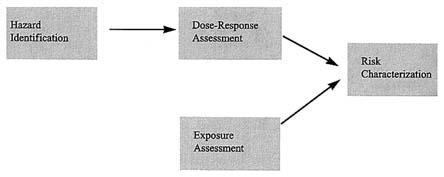
FIGURE 3.3 The risk assessment process. The process consists of four steps:
1. During hazard identification, scientists describe the adverse effects (e.g., short-term illness, cancer, reproductive effects) that might occur due to exposure to the environmental stressor of concern.
2. During dose-response assessment, scientists estimate the toxicity or potency of a stressor. The dose-response assessment attempts to quantify the relationship between the amount of exposure to a stressor and the extent of injury or disease.
3. During exposure assessment, scientists describe the nature and size of the populations(s) or ecosystem(s) potentially exposed to a stressor and the probable magnitude and duration of exposure. Exposure assessment includes a description of the pathways by which the stressor might travel through the environment; the changes that a stressor undergoes en route; the environmental concentrations of the stressor relative to time, distance, and direction from its source; potential routes of exposure (oral, dermal, or inhalation); and the distribution of sensitive subgroups, such as pregnant women and children.
4. During risk characterization, scientists use the data collected in the three previous steps to estimate the effects of human or ecological exposure to the stressor of concern. They estimate the likelihood that a population will experience any of the adverse effects associated with the stressor under known or expected conditions of exposure. This estimate can be qualitative (e.g., high or low probability) or quantitative (e.g., one in a million probability of occurrence) and is highly dependent on the accuracy of the first three steps.
SOURCE: EPA, 1996, as adapted from Risk Assessment in the Federal Government: Managing the Process (NRC, 1983), and Science and Judgment in Risk Assessment (NRC, 1994b).
|
BOX 3-5 Environmental Endocrine Modulators: Reducing Uncertainties A variety of naturally occurring and synthetic chemicals have been identified as having hormonal effects on many species of animals. Many of these chemicals, referred to as endocrine modulators, are released into the environment by human activity. Because humans depend on ecological systems for goods and services, and because federal laws prohibit damage to ecological systems, it is essential to determine to what degree such chemicals threaten ecological systems. The potential for harm to ecosystems, wildlife, and humans must be judged correctly to avoid wasteful and unnecessary expenditures of time, money, and human resources. To assess the risk of endocrine modulators in the environment, problem-driven research is needed to resolve significant uncertainties concerning the distribution of such chemicals in the environment; sources of chemicals and their fate and transport in natural systems; concentrations at which different chemicals affect wildlife species; and the extent, nature, and time scale of ecological effects or potential effects. Understanding the chemical, physical, natural or anthropogenic changes that affect ecological systems would be easier if a long-term monitoring network were in place. Extensively studied, relatively pristine sites are also helpful, as they can be used to provide a frame of reference for comparing systems affected by toxicants. EPA's plan to identify 30 to 40 sites for long-term study and monitoring will ultimately help clarify concerns about endocrine modulators as well as other potentially toxic substances. |
United States will total between $171 and $185 billion by the year 2000 (Carlin et al., 1992). Compliance with air pollution control regulations will cost an estimated $94 billion per year by the year 2000 (Carlin et al., 1992). Russell et al. (1991) estimated that cleaning up all the major hazardous-waste sites would cost between $500 billion and $1 trillion over the next 30 years. The sums are enormous, and a convincing analysis must be provided to demonstrate that these expenditures are justified as the most cost-effective way to reduce risks to human health and to the environment.
DEVELOPING AND MAINTAINING RISK ASSESSMENT CAPABILITIES AT EPA
As described both in the ORD strategic plan (EPA, 1996) and in the discussion above, consistent, thorough, well-grounded risk assessments are fundamental
to EPA's research strategy. Thus, it is important to have strong, internal capabilities in this area. It will not be helpful to the agency in the long run to rely exclusively on outsiders for issue selection and prioritization. As was made clear in assembling Table 2-1, each attempt by an outside group to identify high priority research issues yields different results due to the nature of each group's composition, the evolution of issues, and variations in methods used. Although independent oversight and advice is valuable for any organization, no external advisory group can substitute for the value of having an experienced, in-house, issue selection team to complement the issue-identification function described above.
RETAINING FLEXIBILITY
The discussion of core research in Chapter 2 emphasized the importance of "staying the course"—the fundamental processes in need of elucidation, the research tools required, and the kinds of data needed do not change much from year to year. For problem-driven research the opposite is true. It is essential to re-evaluate and re-prioritize among such research projects at regular intervals to ensure that limited resources are being directed at the most important, high-risk issues. In fact, one of the functions of problem-driven research is to reduce the uncertainties associated with particular identified problems—uncertainties that may have led to inaccurate initial risk assessments and thus inappropriate responses. Periodically, some environmental issues can be moved off the priority list to make room for problems that pose higher risks or for potentially risky problems with large uncertainties that remain to be resolved. The problem-driven portion of a research program must be designed with enough flexibility and with appropriate adaptive feedback capabilities to cope with periodic changes in direction when necessary.


