
3
The Face of the U.S. Population in 2050
How will the population of the United States change on the way to the middle of the 21st century? How will immigration—current and future—contribute to that change? This chapter seeks to answer the second question, which in turn will help answer the first. It focuses on the characteristics of immigrants and their descendants and explores how they will change the demography of the United States over the next six decades.
Immigration is not the only force at work shaping the size and the structure of the United States in the coming years. It will interact with other demographic forces, already in place, that also play a large role in what the country will look like by the middle of the next century.
First, in the two decades following World War II, the baby-boom greatly increased the annual rate of U.S. population growth and provided birth cohorts from 1946 to about 1963 that were much larger than those of either the decade before or after. The baby-boom and the subsequent baby-bust will have major ramifications over the next half century: the population will age as the baby-boom generations become older; when they eventually retire, the number of retirees will be much larger than this country has ever seen.
Second, the future level of mortality among the elderly will have fundamental implications for their numbers. These changes, in turn, will affect their demand for private and public pensions and for health services. Because the small baby-bust generations will be the workers at that time, a relatively few income-producing residents will be providing for the older generations.
Finally, volatility in the volume and composition of immigration affects the U.S. population across many dimensions: its size and rate of growth, its age and sex composition, and its racial and ethnic makeup. In the future, a major source
of variation in population change may lie in the volume and characteristics of immigration.
Population change inevitably has broad social and economic implications. Changes in the age composition of the population affect school enrollments and policies. The number and educational levels of the population in the early and middle adult years are critical for the future labor force and its productivity. And the numbers of elderly and how healthy they are become major determinants of pension needs and the health care system. Population change may also produce ripples across many other critical aspects of American life, in the needs for housing, the crime rate, savings, and voting.
Immigration has consequences for all these aspects of population change. In its relatively large flows and wide variety, immigration as the United States experiences it adds both to the numbers of people in the nation and to their diversity. Immigration works its longer-term effects through other dimensions as well.
First, not every group of immigrants into the United States bears children at the same rate. Immigrant groups with persistently high fertility rates will grow over time, absolutely and in relation to other immigrant groups. Second, not every group of immigrants has the same life span—that is, their mortality rates differ; these, too, may change over time and thus shift in their relation to one another.
If immigrants have a higher fertility rate than does the resident population, the nation will grow younger on average. And if immigrants have a higher mortality rate—that is, if they die at an earlier age—that trend will be reinforced. Again, the differences among groups of immigrants also matter, and so do the shifts within-groups and between groups as the generations unfold.1
Previewing the U.S. population in 2050, then, calls for making assumptions about the numbers of people entering and leaving the country, about the numbers from various racial and ethnic groups within the totals, and about the fertility and mortality rates of individual groups. Moreover, it calls for assumptions about exogamy and ethnic affiliation— the degree to which groups intermarry and the way the descendants of intergroup marriages identify themselves.
This chapter offers a view of how future immigration will alter the U.S. population.2 To paint that portrait, a framework is used to ensure consistency for
alternative assumptions about the future course of immigration and emigration and their associated demographic implications. This work has several purposes:
- To evaluate the assumptions concerning demographic developments in the years 1995 to 2050;
- To present alternative results so the sensitivity of assumptions can be assessed;
- To explore the national implications for population change from specific variations in immigration; and
- To use the population results to describe the implications for economic and social policies.
On the basis of our population projection model, this chapter examines the effects of immigration on the future course of the U.S. population. We first examine why immigration is important for population change. Next, a model for population projection is briefly described, and the alternative assumptions used here to illustrate future population change are set out. Against this background, the heart of the chapter is a discussion of the main effects of immigration on the U.S. population over the next six decades.
Background To Population Change
The number and age structure of the population are determined by fertility, mortality, and migration. The last factor has attracted considerably less attention in formal models than the first two, which have been extensively examined by means of stable population models and their various extensions.
At the simplest level, that of total population numbers, only net migration appears in the demographic balancing equation: population change = births deaths + net migration. Thus, net migration series are typically used to examine the effects of immigration on population structure. For most of its history, the United States has attracted large numbers of immigrants. In recent years, the estimated net inflow has been around 800,000 people, including illegal and legal immigrants and refugees. This figure reflects immigrant flows into the country and emigrant departures of both immigrants and native-born residents. Although the net figure is important from the demographic accounting perspective, gross inflows and outflows are necessary for many purposes of policy and analysis. To cite one example: immigrants who are not U.S. citizens are ineligible to vote, but emigrants who are U.S. citizens are eligible to vote by absentee ballot.
Role of the United States in the World Population
The world population has been growing at a historically unprecedented rate
TABLE 3.1 World Population by Region: Actual Population, 1950-1990; Projected Population, 2010-2050
|
|
1950 |
1970 |
1990 |
2010 |
2030 |
2050 |
|
World total (in millions) |
2,520 |
3,697 |
5,285 |
7,032 |
8,671 |
9,833 |
|
Percentage of world population |
||||||
|
World |
100 |
100 |
100 |
100 |
100 |
100 |
|
Africa |
9 |
10 |
12 |
15 |
19 |
22 |
|
Asia |
55 |
58 |
60 |
60 |
60 |
58 |
|
Europe |
21 |
17 |
14 |
10 |
8 |
7 |
|
Latin America and the Caribbean |
7 |
8 |
8 |
9 |
9 |
9 |
|
North America |
7 |
6 |
5 |
5 |
4 |
4 |
|
United States |
6 |
5 |
4 |
4 |
4 |
4 |
|
Other Countriesa |
1 |
1 |
1 |
1 |
0 |
0 |
|
Oceania |
1 |
1 |
1 |
1 |
0 |
0 |
|
a Other North American countries, by United Nations definitions, include Bermuda, Canada, Greenland, and St. Pierre and Miquelon. Source: United Nations (1995:Tables A.1 and A.2); population projections by the panel for the United States, 2010-2050. |
||||||
for the past century and numbered an estimated 5.8 billion in 1996. In 1990, the U.S. population accounted for 4 percent of the world's population (see Table 3.1). Since 1950, the U.S. population has been declining as a proportion of the world's population, decreasing from 6 percent in 1950. If we rely on the world population projections prepared by the United Nations (1995), anticipating results for the United States that are discussed later, the population of the world and the United States will grow through the year 2050.
Because we project that the United States will experience moderate population growth for the next six decades, its proportion of the world's population will remain constant at 4 percent. Some other regions, such as Europe, will account for a diminishing proportion of the world's population over the next six decades, and regions such as Africa are likely to increase their relative proportion.
Although not everyone outside the United States wishes to or realistically will seek to emigrate to the United States, these results also provide evidence that the number of potential U.S. immigrants will increase in the future.
Population Projections
The population projections reported in this chapter take the 1995 U.S. population and calculate future growth by making assumptions about the level of births, deaths, and net immigration. The initial 1995 population is characterized by age, sex, race/ethnicity, and immigrant generation—whether the person is of the first generation (foreign-born) or is its descendant.
We examine four racial or ethnic groups of primary affiliation: Asian and Pacific Islander (taken together and referred to as Asian in this chapter), black, Hispanic, and white.3 In federal government statistics, Hispanic status is defined for purposes of establishing a Hispanic population, which may be reported in any of the four races. In practice, the Hispanic population mainly reports itself as either white or "other" race (the latter includes individuals who do not check a specific, listed race but write in such responses as "Mexican"). The official current classification is based on an arbitrary separation of race and ethnicity, defining Asians, blacks, and whites as "races'' and not ethnic groups. We refer to the four groups broadly as ethnic groups in this chapter.
The main implication of the official classification system is that population projections for the Hispanic population overlap with the overall projections for the main race groups in official government projections. For the projections presented here, we calculate a base population in which the white, black, and Asian groups do not include any Hispanic component.4 This avoids a double-counting of Hispanic persons.
We rely on a population projection model that makes assumptions about several parameters: immigration and emigration; mortality, fertility, and exogamy; and ethnic attribution. In the next sections, we set out the model we used to make our projections and the demographic assumptions that underlie them. For a technical, detailed description of the model and additional information about the assumptions used in the projection model, see Appendixes 3.A and 3.B, respectively.
A Projection Model
This report uses a new demographic model for population projections. Similar to standard cohort-component models, this model forecasts an initial population under certain assumptions about fertility, mortality, and international migration.5 Our interest in projecting the future population, however, places special emphasis on the size of the foreign-born population and the ethnicity of its descendants. In an important innovation, therefore, the model arrays the population by generation: a foreign-born first generation (the immigrants), a second generation (sons and daughters of immigrants), a third generation (grandsons and granddaughters of immigrants), and fourth and later generations. Because the model requires fertility, mortality, and migration by generation, it takes a somewhat different form from that of conventional demographic models.
Standard cohort-component projection models do not distinguish immigrant generations. Such a model has several limitations for our projections. First, it does not incorporate the changes in fertility and mortality that occur within a generational framework (Werner, 1986). Second, its specification of emigration is inadequate, usually assuming a fixed number of emigrants or a number based on a certain percentage of the total number of residents (Miltenyi, 1981). Finally, it provides no information on such important aspects of ethnic groups as the number who are foreign-born and native-born (Tabah, 1984). In particular, it has questionable assumptions about rates of intermarriage and ethnic attribution.
The new model presented in this chapter overcomes some of these limitations. By distinguishing the population by immigrant generation, it improves the description of population dynamics influenced by immigration.
With the model used here, we make no attempt at a pinpoint prediction of future population. Rather, the implications of a credible set of assumptions about basic demographic processes are examined on the basis of state-of-the-art research. Projections for the immediate future—say, 15 to 25 years, for which current research provides credible parameters—have much higher analytical credibility. Beyond that, population projections must be seen as much more uncertain.
The simulations of the model reported here are designed to generate the racial/ethnic distribution of the U.S. population implied in assumed interactions of the basic demographic process. Except for arithmetic errors, the projections presented here must, in a special sense, be accurate because they derive logically
from the assumptions of the demographic model. Hence, it becomes all the more necessary to explicate the new generational model and to buttress the assumptions we have made.
We stress that the projections for ethnic groups are not necessarily accurate predictions for the future course of the population.6 Supported as they are by the latest evidence, our assumptions about fertility and mortality are reasonable, yet leading researchers vigorously debate the dynamics of these demographic processes. Furthermore, immigration and emigration may follow a variety of plausible courses in the coming decades. Recent history suggests, for example, that one or more new countries may be the source of a major surge of immigration, whose size, composition, and origin are uncertain.
An Immigrant-Generation Approach
Standard cohort-component population projections move a population through time by estimating its survival under the conditions of mortality (its survival from one period to the next), fertility (the births to the population and their survival during the projection period), and migration (the survival of immigrants during the projection period and the survival of the population until emigration). Such projections take into account the age and sex distribution of the population, but they do not treat immigrants and their descendants explicitly.
The population projections presented here are distinguished by their explicit treatment of the generations of the immigrant population. They address the four generations of each racial or ethnic group defined above. Characterized from this perspective, the population includes a foreign-born component (the first generation) and a native-born population (the second and later generations).
A generational perspective has several advantages for examining the future population of immigrant groups and their influence on the nation. First, the generations themselves may be useful numbers. Those in the first generation speak the language and hold many of the cultural values of their countries of origin. Their children typically grow up speaking their parents' native language at home and adhering to many of their parents' cultural values, even while speaking English and absorbing U.S. culture. To know the generational distribution of a racial or ethnic group, therefore, is to know a lot about its acquisition of the English language and of U.S. values.
Second, generational characteristics refine the modeling of immigrants, who usually enter the United States as first-generation, foreign-born individuals, and
of emigrants, whose rate of leaving the United States varies greatly with the number of foreign-born members of a racial or ethnic group. The model also permits varying the assumptions about fertility and mortality rates by generation. Conventional population projection models generally make the unreasonable assumption, for example, that childbearing patterns are the same for all generations—that, in other words, immigrants acquire the fertility levels of the resident population upon arrival in the United States. Demographic research, however, suggests that fertility differences exist for immigrants but that they diminish with later generations.
A Generational Perspective
To sum up, our modified cohort-component approach adds a generational perspective to the characterization of the initial population by age, sex, and ethnicity used by standard population projections. The base population is moved forward in five-year intervals, with successive application of the demographic dynamics: births are added to the population. Deaths are subtracted. And net migration is added, depending on the combination of immigration and emigration. Thus, the model requires assumptions about the fertility, mortality, and migration flows for the age-sex groups in each generation.
For our approach, assumptions made about the generational dynamics are also important, inasmuch as they affect the results and interpretation of the projection.
Most users of population projections need to be able to regard them as plausible. "Plausible," in this context, means that the conditions for demographic dynamics could be regarded as likely for the future course of fertility, mortality, and international migration. Thus, a critical aspect of population projections is scrutiny of the assumptions made about the demographic dynamics.
Our approach assumes a relatively general model for each of the demographic processes on a generational basis (the formal model is presented in Appendix 3.A). For mortality, each age and sex group in each generation experiences its own schedule of death rates. Deaths in a generation reduce its numbers. For fertility, births to a generation add to the next generation.7 Births to foreign-born immigrants (the first generation) are members of the second generation and will thus, given the time intervals used in the model, add to the 0-4 age group in the second generation in the next interval of the projection. In our approach, the latest generation is the fourth and their descendants. Births to the third generation and to the fourth or later generations will, by definition, become members of the last generation group.
International migration also calls for assumptions about the generational composition of migrants. Immigrants to a population are almost exclusively foreign-born.8 Emigrants from the United States are predominantly members of the first generation: people who have emigrated to the United States and then decided to return to their country of birth. A relatively small number of native-born residents, second or later generation, also emigrate from the United States.
Base Population
The base populations were defined for July 1, 1995, and rely on information from April 1, 1990, the date for the 1990 U.S. Census of Population, and post-census estimates made by the U.S. Bureau of the Census (1996a). The age-sex distributions for the four immigrant generations in each ethnic group were taken from fitted projections of the U.S. population for the years 1880 to 1990. To obtain their numbers by generation, the projections were scaled, by ethnic group, to the 1970 census (for the first, second, and third and later generations) and the 1980 and 1990 censuses (for the native- and foreign-born). Finally, the population figures were scaled to the post-census age-sex distributions for the total population, by ethnic group, estimated by the U.S. Bureau of the Census (1996a).
For this chapter, we include estimates for the 1995 population by single and multiple-ancestry. We consider two types of births in these projections: single-ancestry births are those to parents who have the same racial or ethnic identification; multiple-ancestry births are births to parents whose racial or ethnic identifications differ. Single ancestry, in the context of this chapter, means that a person reports a racial or ethnic ancestry that is the same as his or her primary racial or ethnic identification.
To obtain estimates of single and multiple-ancestry, we used the 1990 census to divide persons in each of the four main racial/ethnic groups into two groups: (1) single-ancestry persons, who reported that both ancestries were the same as their racial/Hispanic-origin identification and (2) multiple-ancestry persons, who reported one or more ancestries that differed from their racial/Hispanic-origin group identification.
Overall, the proportion of multiple-ancestry for the four main racial/ethnic groups varies a lot. About 7 percent of the U.S. population reported multiple-ancestry in the 1990 census. Of those who reported their primary ethnic affiliation as white, about 6 percent reported one or more ancestries that were not white. Of those reporting themselves as black, about 7 percent reported one or more
ancestries that were not black. The comparable figures were 8 percent for Asians and 9 percent for Hispanics.
Fertility Assumptions
Fertility is the starting point of any demographic projection model. Higher fertility rates will make the future population larger, and subgroups with higher than average fertility will grow relative to others.
Since 1971, the Census Bureau has published fertility estimates in a special supplement to the Current Population Survey (CPS) in June of each year. The survey asks women several fertility questions, including how many children they have ever borne and whether they have had a child within the past year. Starting in 1994, the CPS has also asked about the nativity of the respondent and the parents of the respondent. Using the CPS nativity data, we tabulated the population for the foreign-born (first generation), sons and daughters of the foreign-born (second generation), and native-born of native-born parents (third and later generations).9
There is apparently some underreporting of births in the CPS, when compared with vital statistics for registered number of births. Births are registered for a calendar year, whereas CPS data on reported births are from July of the preceding year to June of the survey year. We tabulated the number of births from vital statistics and the CPS by race/ethnicity, along with the adjustment factors to scale CPS data to the known level of births by race of mother.10
Age-specific fertility rates for the four major racial/ethnic groups were estimated using recent fertility data from the June 1994 CPS and the tabulations for 1994 of the National Center for Health Statistics (NCHS). Separate estimates were made for the first, second, and third and later immigrant generations (fertility levels for the third and fourth and later generations were assumed to be the same). Overall, the following total fertility rates were assumed for the starting period of 1995 to 2000:1.81 for the white population, 2.33 for Asians, 2.34 for blacks, and 2.63 for Hispanics. As the generational composition shifts, the pro-
TABLE 3.2 Fertility Estimates for U.S. National Population Projections by Race/Ethnicity and Immigrant Generation, 1995-2050
|
|
Immigrant Generation |
|||
|
Race/Ethnicity |
Overall |
First |
Second |
Third+ |
|
Total |
1.98 |
|
|
|
|
White |
1.81 |
1.82 |
1.82 |
1.81 |
|
Asian |
2.33 |
2.54 |
2.17 |
1.80 |
|
Black |
2.34 |
2.76 |
2.53 |
2.31 |
|
Hispanic |
2.63 |
3.23 |
2.63 |
2.04 |
|
Source: Panel estimates based on June 1994 Current Population Survey data and 1994 National Center for Health Statistics birth registration data. |
||||
jection shows declining overall total fertility levels for the heavily immigrant-oriented groups, such as Asians and Hispanics.
We used the June 1994 CPS to make fertility estimates for the major racial/ethnic groups for the first, second, and third-plus generations, using the adjustment factor described above (see Table 3.2).
In a number of important ways, our fertility assumptions are not very different from those used by the Census Bureau in their demographic modeling. The overall estimate of the fertility rate of the population, 1.98, is only slightly lower than the 2.02 assumption made for the 1995 Census Bureau's baseline population projection. The new estimate for the white population of 1.81 is also similar to the previous assumption of 1.83. There is little difference in the fertility levels by immigrant generation for the non-Hispanic white population.
The fertility estimate for the black population from the June 1994 CPS is slightly lower than the Census Bureau's projections. Reductions appear as the generations progress, with a decline to 2.3 children per woman by the third and later generations.
The 2.33 fertility estimate for the Asian population is considerably higher than the assumption of 1.92 used in the 1995 Census Bureau projections. We assume different fertility levels for each immigrant generation, with higher fertility for first-generation immigrants and a decline to 1.80 for the third and fourth generations. Fertility rates for Asians three or more generations out are similar to those for the white population.
Fertility estimates in the June 1994 CPS for the Hispanic population appear to be lower than those assumed in the Census Bureau's projections. 11 Moreover,
there is a large decrease in fertility with the progression of the generations. The estimate for the third and later Hispanic generations is 2.04, higher than that for the white and Asian groups but substantially lower than the current observation for the overall Hispanic population (2.63).
To evaluate the relationship of variations in fertility to the course of future population change, we make alternative assumptions about the levels of lower and higher fertility levels. In general, we assume lower and higher levels of fertility that are similar to the low and high fertility assumptions used in the Census Bureau's projections. The low and high fertility assumptions used in this report differ from the Census Bureau's, however, in two ways. First, as noted above, we assume different total fertility levels for some racial and ethnic groups. Second, because we make assumptions about fertility for immigrant generations, overall fertility levels will change as the generational composition shifts in the future. For lower fertility in 1995, we assume overall total fertility rates of 1.55 for the white population, 1.98 for the black population, 2.04 for the Asian population, and 2.18 for the Hispanic population. For higher fertility in 1995, we assume overall total fertility rates of 2.08 for the white population, 2.70 for the black population, 2.62 for the Asian population, and 3.08 for the Hispanic population. Although we hold total fertility rates constant within immigrant generations, we emphasize that overall total fertility rates may change over the projection period, as each race and Hispanic group shifts its immigrant generation composition.
Mortality Assumptions
We assume that mortality follows the trends specified in the medium series of the national population projections for 1995 to 2050 made by the Census Bureau. On that basis, overall life expectancy at birth increases from 75.9 years in 1995 to 82.0 years in 2050 (see Figure 3.1). We make separate assumptions about mortality for males and females and for each of the four main ethnic groups; and we assume that mortality is the same for immigrant generations within each of the ethnic groups.12
|
|
Using estimates for 1995 of the generational composition of the 1995 native-born Hispanic population, we estimate total fertility rates of 2.63 for the second generation and 2.04 for the third and later generations. Such fertility variation suggests that there is a substantial decline in fertility levels with increasing generational residence in the United States. Over time, as a greater proportion of Hispanics are native-born and as a greater proportion are third and later generations, overall Hispanic fertility levels are assumed to diminish in our projections. |
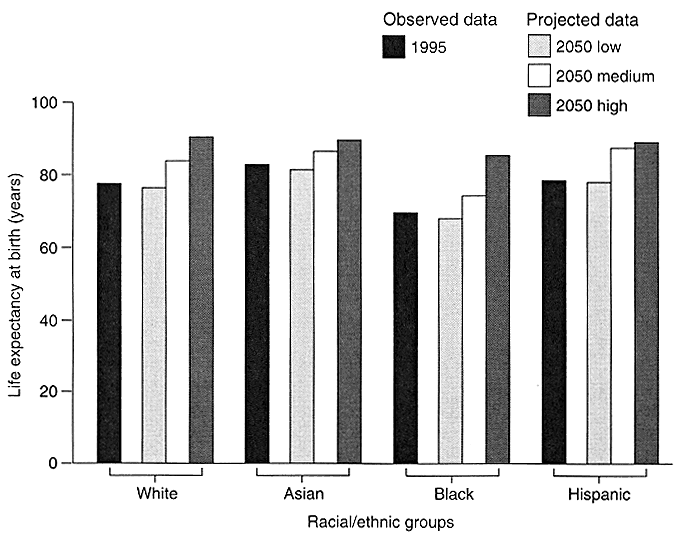
Figure 3.1
Mortality assumptions for national population projections.
Assumptions about lower and higher levels for future mortality help us assess the sensitivity of future population change to mortality variations. We use the same lower and higher mortality assumptions as are used for the Census Bureau's 1995 national population projections. For the low, medium, and high mortality assumptions, we assume the same levels of mortality, by sex and for each race and Hispanic group, for 1995. For 2050, we assume the mortality levels shown in Appendix 3.B: Table 3.B1.
Assumptions About Immigration
We make five different immigration assumptions about net immigration—termed zero, low, medium, high, and very high—in order: 0, 410,000, 820,000, 1,230,000, and 1,640,000. The medium assumption of 820,000 is close to the average for the period 1990-95 and includes the assumption of about 225,000 net annual illegal immigrants. The zero assumption implies both zero immigrants and zero emigrants, providing a context for discussing the overall net impact of immigration on population change. The low assumption of 410,000 assumes a decline to immigration levels that are close to net immigration during the 1980s. The high assumption represents possible expanded legal immigration through
modifications of immigration law. The very high assumption suggests greatly expanded immigration.13
For the actual population projections, we make separate assumptions about immigration and emigration. For the five net immigration assumptions, we assume immigration levels of 0, 700,000, 1,040,000, 1,360,000, and 1,720,000 in conjunction with emigration levels of 0, 290,000, 220,000, 130,000, and 80,000. We assume a racial/ethnic distribution, with an age-sex composition, that is the same as that made in the Census Bureau's 1996 projections. Because of the need to make assumptions by immigrant generation, however, we assume that all immigrants enter into the first generation (in other words, no immigrants into the United States are native-born persons) and emigrants are selected as follows: 95 percent are from the first generation, 5 percent are from the second generation, and none are from the third or later generations.14
The age, sex, and ethnic compositions for the medium assumption were derived from recent data of the Immigration and Naturalization Service and from estimates of the characteristics of illegal immigrants. For the medium assumption, we assume net illegal immigration of 225,000; for the low assumption, 115,000; for the high assumption, 320,000; and for the very high assumption, 404,000. We vary the age, sex, and ethnic composition of immigrants for the different immigration assumptions, based on the legal and illegal components of net immigration.
Exogamy Assumptions
Exogamy is defined as marital and nonmarital unions between people of different racial/ethnic backgrounds. Why is exogamy important when projecting future populations? Suppose that the population consists only of Italians and Norwegians. Suppose further that each couple has two children. If Italians marry only Italians, then the future size of the Italian population will be a function only of the demography of Italians. All progeny of Italian parents would presumably report themselves as of Italian ancestry. But the two children of an Italian and Norwegian couple may report themselves as Norwegian, so that the Italian ancestry is not represented in the second generation; or they may report themselves as
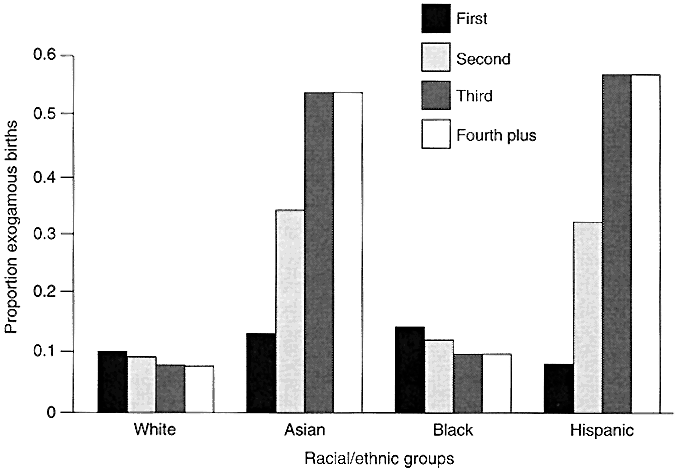
Figure 3.2
Exogamy assumptions for national population projections.
Italian, so that Norwegian ancestry is not represented; or each may claim one of the ancestries. Each may also report herself as of multipleancestry. These real-life possibilities suggest the importance of assumptions about exogamy.
Conventional population projections assume that persons of different major racial/ethnic groups do not have children together and that all children will be of the same racial/ethnic identity as their parents. We address changes in the racial/ ethnic identification in two ways in this chapter. First, we take into account the possibility that children may be born to exogamous unions—to parents of different racial/ethnic identification. Second, we take into account that children of multiple-ancestries may report ancestries different from the ones their mothers report. How they report matters for population analysis and also complicates it.
Using 1990 census data, we estimate intermarriage rates by nativity (that is, for the foreign-born and the native-born) and by racial/ethnic ancestry (see Appendix 3.B: Table 3.B2). If those who themselves are the offspring of an intermarriage are more likely to enter into an interracial or Hispanic/non-Hispanic marriage, intermarriage estimates using data for all persons would be an overestimate for single race/ethnicity persons.
Figure 3.2 presents exogamy rates for racial/ethnic groups based on the data described above.15 Nativity influences intermarriage in racial/ethnic groups. In
1990, foreign-born and native-born whites had similar intermarriage rates. The rates for Asians and Hispanics, however, were higher for the native-born than for the foreign-born. For blacks, intermarriage rates are lower for the native-born.
Whether one is of single or multiple-ancestry also matters. Intermarriage rates are higher for persons of all racial/ethnic groups who themselves report multiple-ancestries, including a racial/ethnic identification that is different from the primary one. There is considerable variation, however, in intermarriage rates for persons of multiple-ancestry compared with those of single ancestry.16
To calculate estimates of exogamy by generation, we note that earlier work with 1970 census and survey data, mostly analyzing Hispanics, revealed a roughly linear increase in intermarriage rates for the first, second, and third generations (Gurak and Fitzpatrick, 1982). If we take the native-born population as an estimate for the second-plus generations and locate the estimate appropriate for the generational composition of racial/ethnic groups in 1990, then the native-born estimates for the white and black populations reflect primarily the third and later generations. We use the native-born information as an estimate for the third and fourth generations and estimate the second generation by averaging estimates for the first and third generations.
The native-born estimate for the Asian population is for a population centered on about the 2.6th generation. We assume that the fourth-plus generation is the same as the third. For the Hispanic population, we center the native-born population at 2.5.
Data on exogamy are available from several sources for the U.S. population. Although some data on intermarriage are available, data on intergroup nonmarital unions are not. We can approach exogamy using what is known about intermarriage, recognizing that information on currently married-couples differs from data on births to parents of different racial/ethnic origins. For these population projections, we rely on data from the 1990 census on intermarriage rates for the foreign- and the native-born. For the native-born, we assume that the generational pattern for the second and third-plus generations, for each racial/ethnic group, was simi
|
|
rately for the foreign-born and the native-born. For example, the intermarriage rate for foreign-born whites is 2.4 for single ancestry and 2.7 for all ancestries. We assume that the ratio of the two, 0.89, offers an estimate for adjusting the exogamy rate of 1 1.7. Thus, we derive the estimate of 0.89 x 1 1.7, or 10.4 percent exogamy for the foreign-born white population. |
lar to that reported in the 1970 census. Finally, we use NCHS data for births in 1994 on the race/ethnicity of mothers and fathers, for the native- and the foreign-born. Our overall results are that 92 percent of births to a white mother have a white father; 90 percent of births to a black mother have a black father; the ratio is 66 percent for Asian mothers, and for Hispanic mothers it is 68 percent. We use separate estimates for immigrant generations, so the initial overall exogamy rates change over time, increasing particularly for the Asian and Hispanic groups, since they have a greater proportion of persons in the later immigrant generations (Appendix 3.B: Table 3.B3 presents the final exogamy estimates for the population projections).
Assumptions about Racial and Ethnic Attribution
Assumptions about racial and ethnic attribution are crucial for population projections. Think of a child born to two parents, one of whom is Asian and the other is not. Now consider two possibilities: one, the child never identifies as Asian; the other, the child always identifies as Asian. In the first case, no children born to an Asian/non-Asian couple will identify as Asian; the only persons in the next generation who will do so will be single-ancestry Asians (those with an Asian mother and father). In the second case, all multiple-Asian ancestry persons will report themselves as Asians. The Asian population will grow more slowly in the first case, because exogamous births will not be counted in it. In the second case, the Asian population will grow more quickly, because births to either Asian men or Asian women, regardless of the ethnicity of their partners, will add to the size of the next generation's Asian population.17
Conventional population projections make a simple assumption that children will eventually report their ethnicity to be the same as their mothers. In our projections, we make a number of alternative assumptions. Here we refer to conventional population projections as the baseline assumption for the attribution of racial/ethnic identification for multiple-ancestry persons. If no multiple-ancestry children identify with a specific racial/ethnic group, we call this the extremely low attribution assumption. If all multiple-ancestry children identify with
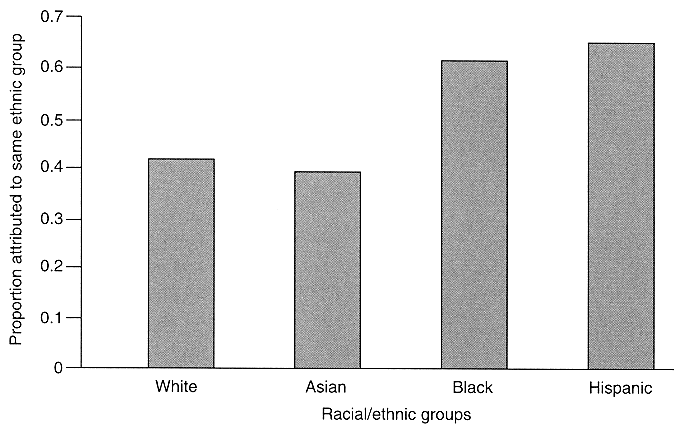
Figure 3.3
Racial/ethnic attribution assumptions for population projections.
a particular racial/ethnic group, we call this the extremely high attribution assumption.
Neither of these assumptions is plausible. To provide more realistic bounds, we examined data on actual racial and ethnic attribution. This information underlies a medium assumption about racial/ethnic attribution rates for multiple-ancestry persons. We assume identification rates that are 20 percentage points lower and 20 percentage points higher, respectively (see Figure 3.3).
In summary, we rely on six different assumptions about the combined effects of exogamy and racial/ethnic identification to illustrate future change in the racial and ethnic composition of the U.S. population. Two extreme and unrealistic assumptions capture the possibility that either none of the multiple-ancestry persons or all of them will choose to identify a particular ethnic background as their primary affiliation. Current attribution rates form a medium assumption, in contrast with a continuation of the conventional baseline assumptions for population projections. And we vary the current attribution rates to illustrate realistic changes in low and high attribution rates (see Appendix 3.B: Table 3.B).
National Population Growth
The United States is currently the third most populous nation in the world, after China and India. How large will the United States become in future decades? Will its rate of growth, which has slackened in recent decades, revive? And how much difference will immigration make?
Immigration can play a critical role in determining the future size of the U.S. population. Within the population balancing equation, population growth could rise substantially if fertility or net immigration rises or if mortality declines. The rate of fertility, which has been below the replacement level for almost 20 years, shows little evidence of reviving sufficiently to alter the course of population growth. Our mortality assumptions incorporate mortality declines over the projection period, which will lead to higher levels of natural increase and population growth. Population growth will be even higher if there is an even greater improvement in life expectancy.18
That leaves immigration as the most likely factor acting to spur population growth in the coming decades. Apart from the additions its net numbers make to the population, immigration, because it alters the age and racial/ethnic composition of the population, influences the rates of fertility and mortality that are the basic components of population change.
Demographic change has three main effects: on population size, on population composition, and on population growth. We draw attention to changes in the national population size and growth in later sections of this chapter.19 Age composition is one of the most important compositional effects, because immigration alters relative numbers of the school-age population, young adults, and the elderly.
Table 3.3 lists our projections of the future size of the American population under five alternative immigration assumptions. It is important to remember that this country's population will continue to grow well into the next century, even if net immigration was immediately eliminated forever. Under the assumption of zero immigration, the population of the United States will grow slowly, reaching a peak of 311 million in about 2035.20 Thereafter, it will very slowly decline, because, as the baby-boom cohorts age, deaths will outweigh births.
Table 3.3 also demonstrates that population growth will be significantly higher under any of our scenarios of positive levels of immigration. According to
|
18 |
The sensitivity of the overall population results to alternative fertility or mortality assumptions are described in Appendix 3.B. |
|
19 |
We do not present projections for states or other subnational population groups. The Census Bureau makes population projections for states; however, their projections do not separately display different immigration assumptions. Most states also prepare population projections, although they do not appear to examine separately the effect of different U.S. immigration assumptions. |
|
20 |
The projections reported here differ from but are close to those prepared by the U.S. Bureau of the Census (1996a). The Census Bureau's median series projection begins with the same 1995 base population of 263 million. The Census Bureau's projected population for 2050 is 394 million, 7 million or 2 percent greater than this projection. Because we make similar immigration, emigration, and mortality assumptions, the reason for the difference is that our projections assume overall lower fertility levels. We make separate fertility assumptions by immigrant generation, including the notion that fertility decreases with greater generational residence in the United States. The Census Bureau's projections do not distinguish fertility levels by the native- and the foreign-born. |
TABLE 3.3 Population of the United States, 1995-2050
|
|
Immigration Assumption |
||||
|
|
Zero |
Low |
Medium |
High |
Very High |
|
Assumed net immigrants per year (thousands) |
0 |
410 |
820 |
1,230 |
1,640 |
|
Population (millions) |
|||||
|
1995 |
263 |
263 |
263 |
263 |
263 |
|
2000 |
272 |
275 |
277 |
279 |
281 |
|
2010 |
287 |
295 |
302 |
310 |
318 |
|
2020 |
298 |
313 |
327 |
341 |
354 |
|
2030 |
308 |
330 |
351 |
373 |
393 |
|
2040 |
310 |
341 |
370 |
400 |
429 |
|
2050 |
307 |
349 |
387 |
426 |
463 |
our medium immigration assumption (under which current levels persist indefinitely into the future), the size of the population will be 327 million in the year 2020 (an increment of 29 million compared with the zero immigration scenario). Although the rate at which population is growing will decline, the absolute size of the American nation will continue to expand until, by the year 2050, the population will be 387 million.21 Allowing immigration to continue at its current levels for the next 55 years will produce a population that is 80 million people larger than it would have been if all net immigration ceased instantly. These additional people are the direct effect of the 45 million more immigrants over this period. Then come the dual indirect effects of the descendants of these immigrants (compounded by higher fertility rates among immigrants) and of their lower overall mortality rate due to the relative youth of immigrants.
Immigration, then, will obviously play the dominant role in our future population growth. Of the 124 million additional people living in 2050 under the medium immigration assumption, 80 million will be the direct or indirect consequence of immigration.
Table 3.3 also displays what population growth would be under realistic ranges of alterations in immigration policy. For example, if, on one hand, net
immigration were halved, to 410,000 per year, growth would be slower, but the population would still rise to 349 million by the middle of the next century. If, on the other hand, net immigration were to increase by half, to 1,230,000 a year, the population would rise to 426 million by 2050. In either policy scenario, the population will be different from that under the medium immigration assumption—and by more than the simple addition or subtraction of immigrants, since the descendants of these immigrants will also be part of the future nation.
Although, in light of the current debate, very high immigration is not a realistic policy option, Table 3.3 also illustrates population growth under that scenario. The outcome is a steady increase to 463 million in 2050.22
Components of Change
What underlies the effects the various immigration scenarios have on population? Although the five immigration scenarios in the population projections assume a constant annual number of net immigrants, the annual net immigration rate23 will change as the population grows. That rate is one of the two elements in the rate of population growth; the other is the rate of natural increase—that is, the crude birth rate minus the crude death rate. Table 3.4 lists crude birth and death rates as well as the rate of natural increase under our five alternative immigration scenarios. We first examine the contribution of net immigration to annual population growth.
Besides simply adding people to the population, immigration has other repercussions for population change. By shifting the age-sex composition of the population, immigrants alter the likelihood of all residents of dying or having children. Immigrants may have a different age distribution from other residents, or they may have different childbearing rates, and thus they may affect the number of deaths and births.
In the absence of net immigration, the crude birth rate would decrease between 1995 and 2050, the crude death rate would increase, and the rate of natural increase would decline to zero (see Table 3.4). These results would occur because the population would slowly become older, with a smaller proportion in the childbearing ages (15 to 44) and a greater proportion in the higher mortality ages (65 and over).
TABLE 3.4 Components of Population Growth, Selected Years, 1995-2000 to 2045-2050
|
|
Immigration Assumption |
||||
|
|
Zero |
Low |
Medium |
High |
Very High |
|
Crude birth rate (per 1,000) |
|||||
|
1995-2000 |
14.4 |
14.5 |
14.6 |
14.7 |
14.8 |
|
2005-2010 |
13.3 |
13.7 |
14.0 |
14.3 |
14.5 |
|
2015-2020 |
13.1 |
13.6 |
14.0 |
14.3 |
14.6 |
|
2025-2030 |
12.6 |
13.2 |
13.8 |
14.1 |
14.5 |
|
2035-2040 |
12.5 |
13.3 |
13.9 |
14.3 |
14.6 |
|
2045-2050 |
12.6 |
13.5 |
14.0 |
14.4 |
14.8 |
|
Crude death rate (per 1,000) |
|||||
|
1995-2000 |
8.9 |
8.9 |
8.8 |
8.8 |
8.7 |
|
2005-2010 |
8.9 |
8.6 |
8.5 |
8.4 |
8.2 |
|
2015-2020 |
9.3 |
9.0 |
8.7 |
8.5 |
8.3 |
|
2025-2030 |
11.2 |
10.7 |
10.2 |
9.8 |
9.4 |
|
2035-2040 |
12.8 |
12.0 |
11.3 |
10.7 |
10.3 |
|
2045-2050 |
12.6 |
11.7 |
10.9 |
10.4 |
10.0 |
|
Rate of natural increase (per 1,000) |
|||||
|
1995-2000 |
5.5 |
5.7 |
5.8 |
5.9 |
6.0 |
|
2005-2010 |
4.5 |
5.1 |
5.5 |
6.0 |
6.4 |
|
2015-2020 |
3.8 |
4.6 |
5.2 |
5.8 |
6.3 |
|
2025-2030 |
1.4 |
2.6 |
3.5 |
4.3 |
5.0 |
|
2035-2040 |
-0.4 |
1.4 |
2.6 |
3.5 |
4.3 |
|
2045-2050 |
0.0 |
1.9 |
3.1 |
4.1 |
4.9 |
|
Net immigration rate (per 1,000) |
|||||
|
1995-2000 |
0.0 |
1.6 |
3.1 |
4.8 |
6.3 |
|
2005-2010 |
0.0 |
1.4 |
2.9 |
4.2 |
5.6 |
|
2015-2020 |
0.0 |
1.3 |
2.7 |
3.8 |
4.9 |
|
2025-2030 |
0.0 |
1.3 |
2.5 |
3.5 |
4.5 |
|
2035-2040 |
0.0 |
1.3 |
2.3 |
3.3 |
4.0 |
|
2045-2050 |
0.0 |
1.2 |
2.2 |
3.1 |
3.8 |
Under the medium immigration assumption, the crude birth rate would decline slightly between 1995 and 2050. The proportion of the population in the childbearing years would rise modestly, and there would be a continued influx of immigrants, some of whom have higher fertility than do the native-born. The population would have a greater proportion of older persons, however, and the crude death rate would increase from 8.8 per 1,000 in 1995-2000 to 10.9 per
1,000 in 2045-50. Overall, the rate of natural increase would decrease almost in half, from 5.8 to 3.1 per 1,000.24
Implications of the Size of the Population
Under any of our positive net immigration scenarios, the size of the U.S. population will be higher in the future than it would be if net immigration were zero at this moment. The increase in the total size of the population in most of these positive immigration worlds would not be trivial. As we have just seen, simply holding immigration to current levels would mean a net addition of 80 million Americans by the year 2050. Should we care about whether the 2050 population is the 387 million implied by current immigration levels as opposed to the 307 million implied by the absence of net immigration?
Although we do not answer that question categorically in this volume, we spell out some important elements of the answer. Our reticence rests in part on our conviction that knowledge about many of the crucial parameters on which an informed answer should rest is still lacking.
The future size of the population is important for labor market, fiscal, social, and environmental reasons. Chapter 5 spells out our analysis of the labor market effects. As we explain there, the critical issue is the extent to which a larger population size for the United States may be associated with some economies or diseconomies of scale. For example, if the U.S. economy is characterized by economies of scale, then a 10 percent increase in population will mean more than a 10 percent increase in national output. For some specialized products, businesses with access to the large U.S. market may have a substantial advantage, compared with doing business in a country with a smaller market. Similarly, in large part, the net fiscal impact we estimate in Chapters 6 and 7 will simply be scaled up or down by the size of the immigration flow, as long as the composition of immigration remains constant.
It is less clear what the comparative advantages and limitations are for social and environmental matters. Some have argued that there may be some important congestion effects from a larger population. These congestion effects may reveal themselves in more crowded highways, schools, and parks. From an environmental perspective, a large and growing population places greater demands on the environment, other conditions being equal. Probably more important, however, from a demographic perspective, is the extent to which the population resides in environmentally sensitive areas and the per capita environmental effects of the population.
However, it should be noted that immigration involves primarily a redistribution of the world's population, not an absolute increase. Indeed, since the fertility of immigrants tends to decline after they come to the United States, total world population will be slightly lower. The potential for negative environmental effects (congestion and the like) must then be primarily local. From a world perspective, (negative) environmental effects in the United States may be counterbalanced by possible (positive) effects in the sending countries that are losing population. Total consumption by immigrants will typically be higher in the United States than in the places they left (which, after all, is one reason they immigrated). But efforts to abate environmental effects at any given level of consumption may also be higher in the United States. A weighting of the factors should enter into an evaluation of the environmental effects of immigration.
Age and Sex Composition
Even with zero net migration, a population's age and sex composition will shift if the characteristics of the immigrants and emigrants differ. The general effect of migration on the population structure over the past decades can be illustrated by comparing the actual age and sex compositions in 1995 with what they would have been in the absence of migration since 1950 (see Table 3.5).25 It can be seen that the effect of net migration has been noteworthy over this period in terms of both the population and sex composition.
In the absence of migration since 1950, the U.S. population would have numbered about 225 million in 1995, about 14 percent fewer than the actual 263 million. However, the impact of migration on sex composition would have been trivial: the actual population distribution has slightly more males and slightly fewer females than the hypothetical population with no migration.
Immigration would, however, have influenced the age composition for both males and females. In general, migration would have made the population younger, adding to the proportion of the population aged 10 to 39 years and reducing the proportion who are aged 50 to 79.
Sex Composition
As our illustration just suggested, the impact of alternative immigration
TABLE 3.5 Age-Sex Structure of the U.S. Population in 1995 in the Absence of Migration Since 1950
|
|
Hypothetical Population Under Assumption of No Migration |
|||||||||
|
|
Number (thousands) |
Percentage of Total |
Observed Population Number (thousands) |
Percentage of Total |
Ratio of Observed to Hypothetical Population |
|||||
|
Age Group |
Males |
Females |
Males |
Females |
Males |
Females |
Males |
Females |
Males |
Females |
|
0-9 |
17,065 |
16,583 |
7.6 |
7.4 |
19,862 |
18,941 |
7.6 |
7.2 |
99.6 |
97.7 |
|
10-19 |
15,436 |
15,092 |
6.9 |
6.7 |
18,952 |
18,038 |
7.2 |
6.9 |
104.9 |
102.4 |
|
20-29 |
15,506 |
15,276 |
6.9 |
6.8 |
18,593 |
18,263 |
7.1 |
6.9 |
102.5 |
102.2 |
|
30-39 |
18,487 |
18,442 |
8.2 |
8.2 |
21,995 |
22,166 |
8.4 |
8.4 |
101.8 |
102.8 |
|
40-49 |
16,010 |
16,423 |
7.1 |
7.3 |
18,560 |
19,129 |
7.1 |
7.3 |
99.2 |
99.6 |
|
50-59 |
10,482 |
11,147 |
4.7 |
5.0 |
11,994 |
12,782 |
4.5 |
4.9 |
97.4 |
98.0 |
|
60-69 |
8,532 |
10,146 |
3.8 |
4.5 |
9,227 |
10,745 |
3.5 |
4.1 |
92.4 |
91.5 |
|
70-79 |
5,860 |
8,015 |
2.6 |
3.6 |
6,555 |
8,965 |
2.5 |
3.4 |
95.4 |
95.2 |
|
80+ |
2,061 |
4,306 |
.9 |
1.9 |
2,622 |
5,478 |
1.0 |
2.1 |
109.7 |
108.3 |
|
Total |
109,439 |
115,330 |
48.7 |
51.3 |
128,311 |
134,509 |
48.8 |
51.2 |
100.3 |
99.7 |
|
Both Sexes |
224,769 |
100.0 |
262,820 |
100.0 |
100.0 |
|||||
|
Sources: The hypothetical 1995 population, under the assumption of no migration since 1950. is derived by surviving the 1950 population, by age and sex, using period life tables and adding annual births using period fertility rates, and surviving births, by age and sex until 1995. The observed 1995 population is taken from estimates of the U.S. Bureau of the Census (1996a:Table 2). |
||||||||||
TABLE 3.6 Ratio of Males to Females, 1995-2050
|
|
Net Immigration Assumption |
||||
|
Year |
Zero |
Low |
Medium |
High |
Very High |
|
1995 |
.954 |
.954 |
.954 |
.954 |
.954 |
|
2000 |
.959 |
.958 |
.958 |
.958 |
.957 |
|
2010 |
.965 |
.963 |
.962 |
.961 |
.961 |
|
2020 |
.964 |
.962 |
.962 |
.961 |
.960 |
|
2030 |
.963 |
.960 |
.959 |
.959 |
.958 |
|
2040 |
.963 |
.961 |
.960 |
.960 |
.960 |
|
2050 |
.966 |
.964 |
.964 |
.963 |
.963 |
scenarios on the future balance between men and women is negligible (see Table 3.6). The sex ratio was favorable to females in 1995 and is expected to remain so throughout the projection period. In 1995, there was 0.954 male per female; put another way, the population was 51.1 percent female. By 2050, the ratio is expected to change slightly, to 50.9 percent female. The range of variation in the sex ratios across our alternative immigration assumptions varies only between 0.963 and 0.966.26
Throughout the next century, males will outnumber females before middle age because more boys than girls are born. After age 50, the relatively higher mortality of men decreases their ratio to women and eventually results in a markedly higher number of women at the older ages. None of these age patterns in the sex ratio will be altered, no matter which immigration assumption prevails.
Age Structure
In contrast to the situation for sex composition, immigration will significantly affect the age structure of the future population. As Chapter 2 demonstrates, immigrants are concentrated in the age groups from 20 to 40 and are relatively scarce in the over-60 group. In the zero-migration assumption, the population will be much older than it would be if current immigration persists. Thus, the aging of the population, which is already obvious, would become even more pronounced if immigration stopped altogether.
Perhaps the single most common index of population aging is the median age of the population—the age that divides the younger half of the population from
the older half. Although the median age, viewed over time, is a useful summary indicator of population aging, it does not capture many important compositional changes so crucial for public policy decisions. Population aging usually involves a decreasing proportion of young people and, correspondingly, an increasing proportion of the older ones. For many issues, it is helpful to separate younger and older groups and present estimates of their population size and change. But, first, we discuss the relationship of immigration and median age.
Median Age
Population aging is not a new phenomenon in the United States. In the 1800s, the median age of the U.S. population was under 20, a reflection of high fertility levels that produced a population with a large number of children. The median age has been steadily rising for more than a century, reaching the historically unprecedented level of over 34 in 1995.
As the results below indicate, the median age of the population will continue to rise, changing as much in the next 55 years as in the previous 55 years. This rise is a consequence of continued low levels of fertility and the aging of the numerically large baby-boom cohorts. Over the next half-century, the impact of the baby-boom cohorts of the 1950s will be clear. Under all the net immigration assumptions, the future population will continue to age (Figure 3.4). Under the medium assumption, the median age will rise to 38.5 years in 2030 and then level off at about 38 years. Under the low net immigration assumption, the population
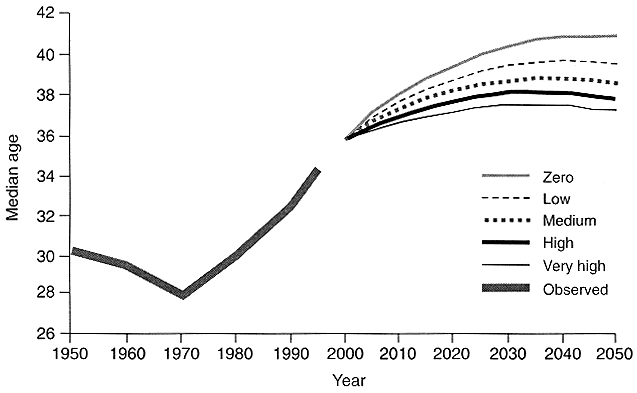
Figure 3.4
Median age of the U.S. population: Observed population, 1950-1995; projected population under five immigration assumptions, 1995-2050.
will reach a median age of 39.3 years in 2035 and then stabilize at about 39 years. The more numerous the immigrants, the more youthful the population over the projection period. With high net immigration, the median age of the population will reach 37.9 years in 2035 and then decrease to 37.4 years in 2050.27
School-Age Population
Public policies for education are perhaps the ones most obviously influenced by demography. Immigration makes a difference for the size of the school-age population, virtually all of whom do attend school—directly as young children enter as immigrants and indirectly because many immigrants are in their childbearing years. What will the next decades hold for the school-age population?
The projections for the school-age population are subject to considerable uncertainty because they depend on projections of future fertility as well as on those for the immigration of younger persons. Since the 1980s, the school-age population (aged 5 to 19 years) has been increasing steadily, to number 56.2 million in 1995. Under the medium immigration assumption, it will expand throughout the projection period, reaching 77.3 million in 2050. With low net immigration, the school-age population would expand more slowly—to 67.9 million in 2050—whereas under the high net immigration assumption, there will be 86.6 million in 2050.28
If school enrollment rates, by age group and nativity, are unchanged from 1995, we can make estimates for future school enrollments.29 The number of school-age children will expand rapidly. Under current immigration policy, the K-8 enrollment will increase to 53.7 million in 2050, compared with 36.8 million in 1995 (an increase of about 17 million). The school-age population in 2050 will be 6.4 million lower if immigration flows are cut in half and 3.9 million greater if they are increased by 50 percent.30
Similarly, high school enrollments for grades 9 to 12 were 14.0 million in 1995. These enrollments would increase to 20.3 million under medium net immigration—with a range of about 2.5 million more or less under low and high immigration assumptions.31
In light of the geographic concentration of immigrants, it is important to remember that not all school districts will be affected equally by immigration. In fact, most school districts in this country will feel no consequences, no matter what happens with immigration.32 Other districts, especially those in the urban areas of the large immigration states, will be keenly sensitive to any changes in immigration policy.
Young Adults
Young adults, aged 15 to 24 years, are a crucial component of the population, given their unique economic role and place in the economy. These young adults are part of a special transition group who move on to postsecondary education, enter the labor force, and experience the highest rate of unemployment. They also are the ones who consider forming a household, getting married, and starting a family. They acquire the right to vote and are a critical recruitment pool for the Armed Forces. After peaking in the early 1980s, the numbers in this group have begun to increase again in the 1990s. Young adults numbered 35.9 million in 1995. Under the medium immigration assumption, that number will expand to over 42 million by 2020, and to almost 51 million by 2050.
With low net immigration, the young adult population will increase more slowly, from 35.9 million in 1995 to 44.7 million in 2050. Therefore, cutting immigration flows in half, a sharp departure from historical immigration policy, results in a young adult population that is 25 percent smaller 53 years from now then it would have been with continued current immigration levels. Under the high net immigration assumption, growth will be at a faster pace, with the young adult population reaching 56.6 million in 2050.33 The next chapter discusses the implications of such a change on the labor market outcomes of native-born workers.
The implications of these changes for college enrollments can be derived
from our model.34 College enrollments of 14.2 million in 1995 will increase to 19.4 million in 2050 under the medium net immigration scenario, assuming that college enrollment rates are unchanged from 1995 for the foreign-born and native-born in this age group. College enrollments will increase to 17.1 million under low net immigration and 21.8 million under high net immigration.35 Therefore, enrollments for U.S. colleges will grow about one-third by the middle of the next century. These enrollments will be incremented or decremented by more than 2 million students by the plausible range of immigration assumptions.
Working Age
The impacts of demographic trends on growth in the labor force, which comprises those aged 20 to 64, have received less public attention. The compositional changes associated with the sharp decline in fertility rates since the early 1960s appear to have been masked by the higher rates of immigration since the end of that decade, and by the noticeable increase in the participation of women in the labor force. However, policymakers continue to be puzzled by the high rates of unemployment among youths and by the continued higher unemployment of some minority groups. How many people will be in the labor force years in coming decades? And what role will immigration, with its impact on the age and sex composition of the population, play in that number?
Under all assumptions, the working-age population, at 171.5 million in 1995, will continue to grow throughout the projection period. By 2000, under the medium immigration assumption, this group will climb to 183.6 million, and by 2050, to 240.2 million, a 40 percent expansion from 1995.
Under the assumption of low net immigration, the working age population will increase gradually, to 215.7 million in 2050, or 26 percent greater than 1995. Under the high net immigration assumption, the increase will be to 265.2 million in 2050, or 55 percent above the 1995 level.36
Elderly
The number of elderly in the population has importance for private and public pension programs, for health care, and for a host of services related to aging and retirement. As the population ages, the maintenance of the real level of public services to the elderly can impose an ever-increasing tax burden on future generations. The nation will face two unattractive alternatives: either the elderly will receive less public services and suffer a decline in their standard of living, or future generations must draw down their resources to maintain that standard of living.
Unlike that in the population at younger ages, future change in the population aged 65 years and older is known with a fair degree of certainty because persons reaching this age in the projection period have either already been born in the United States or will be survivors among future immigrants. This population will grow rapidly in the coming years, both in numbers and as a proportion of the total population. It stood at 33.6 million in 1995, and could double—from 73.0 to 80.6 million, depending on the net immigration assumptions. Under the medium assumption, the elderly population will rise to 39.1 million in 2010, then will increase steadily as the baby-boom cohort begins to reach age 65 in large numbers. It will grow to 53.0 million in 2020 and, by 2050, to 76.8 million.37 Although the impact of immigration on the size of the elderly population is not trivial, it certainly plays only a supporting role. No immigration policy, no matter how restrictive, can reverse the underlying trend. The big news, therefore, over the next half-century is the guaranteed substantial growth in the number of people past age 65—the size of that population is likely to double.
The ''oldest-old" (those over 85) represent an important age group because they have the highest rates of hospitalization and nursing home use, factors that are forces driving health care costs. Variations in immigration, however, do not account for substantial differences in the size of the population aged 85 years and older. Under the medium net immigration assumption, the oldest-old age group will increase from 3.6 million in 1995 to 17.7 million in 2050 (a fourfold increase). Assuming the low and high net immigration levels provides a range for this age group of 17.4 to 18.1 million.38 Although the oldest-old population will expand greatly during the next half-century, immigration will have little effect on its size. People who will be over age 85 in 2050 are at least 32 years old
today. Because most new immigrants who arrive in the next decades will be younger than that age, immigration flows will not fundamentally alter the size of this age group. Rather, the size of the oldest-old population will depend mainly on future trends in mortality.
Dependency Ratio
One useful concept in population analysis, the ratio of the number of people in their "dependent" years to those who are in their working years, is especially relevant to the study of immigration. Variations in age dependency reflect in an overall way the contribution of variations in age composition to economic dependency. Dependency ratios based on age, it should be emphasized, do not equate with economic dependency. We report three dependency ratios here: (1) a youth dependency ratio, for the number of persons 19 years of age or under per 100 persons in the working years, aged 20 to 64 years; (2) an elderly dependency ratio, relating persons aged 65 years and over to those in the working years; and (3) an overall dependency ratio relating these two groups together to those in the working years.
Youth Dependency
As can be seen in Figure 3.5, the youth dependency ratio reached a peak in the 1960s as the large number of those born in the baby boom were of school-age.
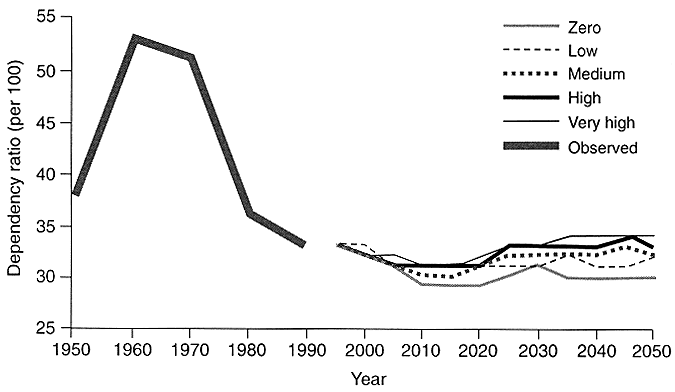
Figure 3.5
Youth dependency ratio: Observed population, 1950-1995; projected population under five immigration assumptions, 1995-2050. Note: dependency ratio defined as number of dependents 0-19 years of age per 100 persons aged 20-64 years.
The ratio has declined in recent decades to 33 youths per 100 persons in the working ages. As the figure shows, variations in immigration have relatively little effect on the youth dependency ratio because they tend to change the numbers of persons in both the youth and the working-age years.39 Under the medium net immigration assumption, the youth dependency ratio will decline slightly to 32 per 100 in 2050. Under the low or high net immigration assumptions, the youth dependency ratio will range from 32 to 33.40
Elderly Dependency
As the population has aged, the elderly dependency ratio has been rising for the past three decades. Regardless of the level of immigration assumed, this ratio will increase substantially (Figure 3.6). From 20 elderly persons per 100 in the working years, the ratio will rise to over 29 per 100 by about 2050. Although immigration will not offset these notable increases in the elderly dependency ratio, it will influence the eventual level. Under the low net immigration assumption, the elderly dependency ratio will increase to 30 in 2050. Under the high immigration assumption, the elderly dependency ratio will increase to 27 in 2030.41
Overall Dependency
These two dependency ratios—for youth and the elderly—can be combined into a single dependency ratio. However, it is important to remember that such a combination can be misleading. For example, current estimates indicate that the governmental budgetary costs of adding another older person is about four times higher than that of adding another child.
In 1995, there were 53 people in age groups that typically do not work for every 100 persons of working age in the United States (see Figure 3.7). Changes in the dependency ratios will be similar for all immigration scenarios until about 2025. Under the medium assumption, this ratio is projected to decline for the next 15 years, to a low of 48 in 2010, then increase, reaching 61 in 2050. The
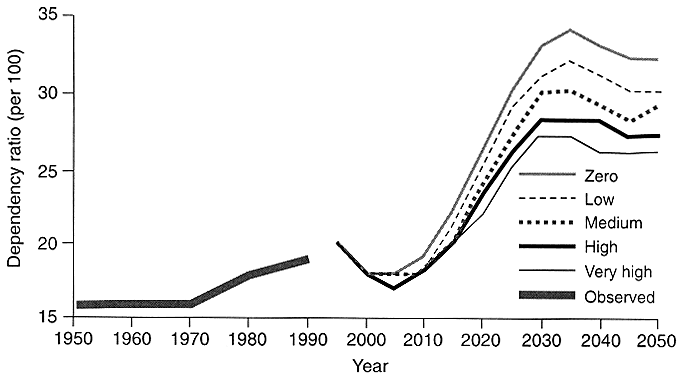
Figure 3.6
Elderly dependency ratio: Observed population, 1950-1995; projected population under five immigration assumptions, 1995-2050. Note: dependency ratio defined as number of dependents 64 years of age and older per 100 persons aged 20-64 years.
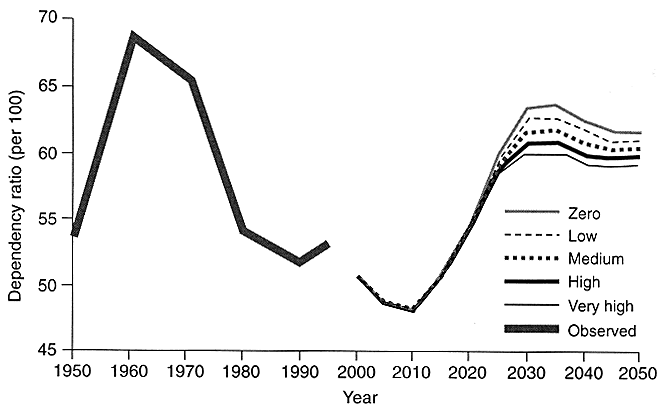
Figure 3.7
Overall dependency ratio for observed population, 1950-1995; projected population under five immigration assumptions, 1995-2050. Note: dependency ratio defined as number of dependents per 100 persons aged 20-64 years.
increases after 2010 are due primarily to the increase in the number of the elderly, as the baby-boom cohorts begin to reach age 65. At the same time, growth in the working-age population will slow, as smaller cohorts born after the fertility decline of the 1960s come to dominate the labor force.
Under the low net immigration assumption, the dependency ratio will decline to 48 in 2010, increase to a peak of 63 in 2035, and then again decrease, to 62 in 2050. Under the high net immigration assumption, the overall dependency ratio will decline to 48 in 2010 and then increase to a plateau of 61 in 2030.42
We anticipate the evidence presented in Chapter 7 by observing that relative fiscal costs vary by age group. The relative fiscal costs for youths, including education and other programs directed at the population less than 20 years of age, are approximately $1 for every $4 of programs directed at the elderly, including Social Security, health care, and other programs for the population aged 65 years and older. Chapter 7 discusses these fiscal implications of population trends in more detail.
Summary of Effect of Immigration on Age Structure
The age structure of the U.S. population will change over the next 50 years, regardless of immigration. Figure 3.8 displays the absolute change in population at five-year age intervals for our medium, low, and high rates of immigration. Under our medium immigration assumption, between 1995 and 2050, there will be an increase in each five-year age group. Two age groups are particularly noteworthy. First, the group aged 25 to 55 years (the working-age population) will not expand as much as other age groups. Second, there will a rapidly expanding number of elderly persons.
Immigration policy will have a declining influence on the population as the age group considered increases. In the extreme, different immigration assumptions have little influence on the rapid growth of the population aged 80 years and over. The elderly population of 2050 has, to a great extent, already been born and are currently younger working residents. Although a smaller number of immigrants would reduce the elderly population in 2050, lower immigration would not substantially alter the unprecedented increase in the size of the elderly and the oldest-old age groups.
Immigrants and Their Children
The levels of future immigration are obvious key determinants of changes in
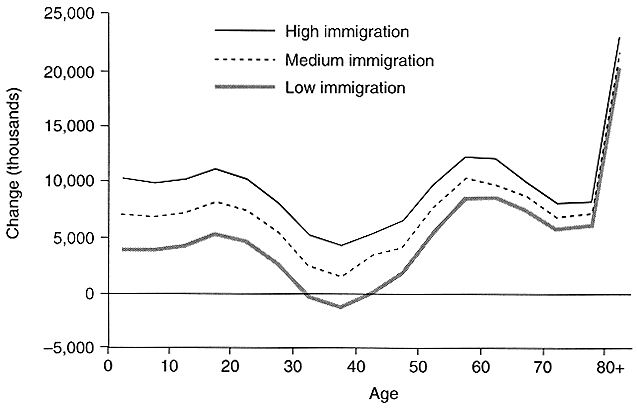
Figure 3.8
Population changes in the U.S. population, 1995 to 2050, by fiveyear age group, by alternative levels of net immigration.
the size and composition of the foreign-born population. Those changes will, in turn, affect the growth of the second immigrant generation. There is, however, a time lag in the effect of immigration on changes in the second generation, because it takes some 30 or 40 years for changes in immigration to result in substantial shifts in the number of their children.
The foreign-born population has been increasing since 1970 and numbered 25.2 million in 1995. Under the medium net immigration assumptions, the foreign-born population will grow throughout the projection period, nearly doubling and reaching 46.7 million in 2050 (see Figure 3.9). Under the low assumption, the foreign-born population will peak at slightly less than 30 million and then begin to decline, although in 2050 it will be above current levels. Only under the zero assumption will the foreign-born population decline over the next 55 years, as its members gradually age and, given the mortality rates of advancing age, die. Under the very high immigration assumption, the foreign-born population will expand rapidly, growing at an annual rate of 2.2 percent and reaching 85 million in 2050.
With below-replacement fertility and medium net immigration, the U.S. population will experience only slight changes in its immigrant generational distribution (see Figure 3.10). All immigrant generations will increase, and so will the proportion of the population in the first, second, and third generations. The number of people in the fourth-plus generations will rise from 176.6 million in
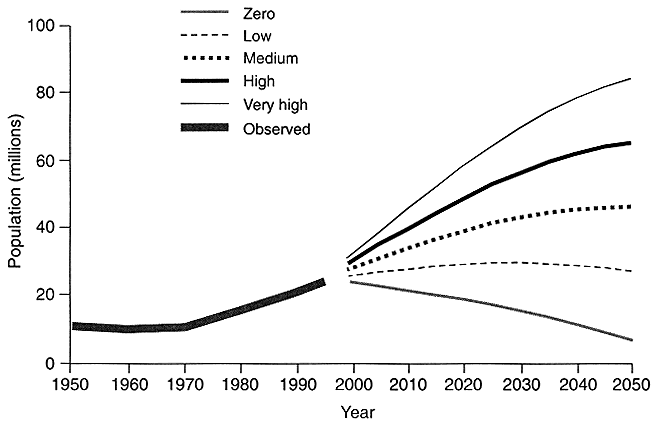
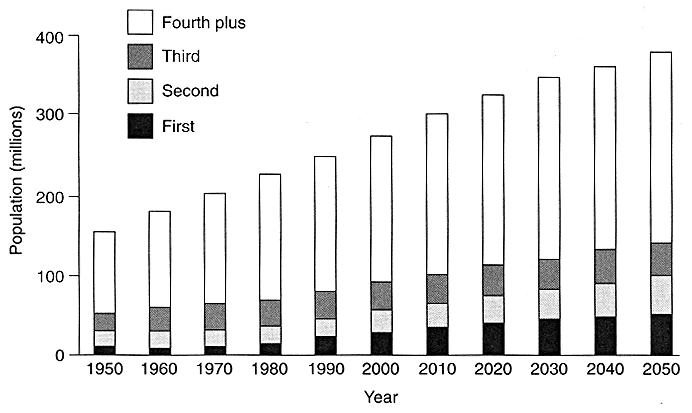
1995 to 240.0 million in 2050, although they will account for a slightly smaller proportion of the total population.43
Racial and Ethnic Composition
As described earlier in this chapter, projecting the future population by racial and ethnic groups in the conventional way involves making assumptions about fertility, mortality, and immigration for each group—independent of the other groups—and projecting the group as if it were a closed population. As Hirschman (1996:22) argues, this approach, however logical the exercise may seem, suffers from two limitations, one methodological and the other interpretive. First, the critical assumption of ethnic groups as ascriptively defined populations with fixed boundaries may be a very tenuous one, historically and for the future. Second, racial and ethnic population projections are being used, often without careful thought or reflection, as firm demographic evidence to show that American society and culture is being threatened by continued immigration.
The growing rate of intermarriage among whites, blacks, Hispanics, and Asians (although most intermarriages are of whites with other groups) ensures that the future of the United States will not be a set of distinct cultures and languages, let alone a unique ethnic identification. If there are many intermarriages, then more people will have multiethnic parental ties and more children will have multipleancestry, possibly weakening traditional ethnic boundaries in the United States.44
With these important caveats in mind, even if net immigration is zero, the future racial/ethnic composition of the population will not remain static. Differences in fertility and mortality among groups in the present population will see to that. Because there are a large number of younger people in the U.S. population, the population will continue to grow in the future, even without further immigration. This population "momentum" is inherent to the age structure of each of the racial and Hispanic groups, although there will be future growth in the absence of
immigration. The age structure of the white population, for example, has less momentum for future growth, whereas the Asian and Hispanic populations will continue to grow, even if they receive no further immigrants.
But net immigration is unlikely to be zero, and it will significantly affect population growth in two ways. First, the level of immigration matters. Each immigrant directly adds one new person to a racial/ethnic group. Second, beyond simply their numbers, the procreativity of immigrants—that is, their ages and fertility rates—matters, for succeeding generations. A young immigrant in a group with generally high fertility rates will add the most descendants, whereas an elderly immigrant will add few. Beyond this, exogamy and the self-identification of multiple-ancestry persons influence the racial/ethnic composition of the population. Hence, the future growth of racial/ethnic groups will be a complex product of several interacting factors.
Given our assumptions—that the current level and composition of immigration, of exogamy, and of kinds of racial/ethnic identification will continue, the racial/ethnic composition of the population will experience a pronounced shift in the next decades. In 1990, according to the 1990 census, 75 percent of the population was white. The remaining one-quarter was divided thus: 12 percent black, 9 percent Hispanic, 3 percent Asian, and about 1 percent American Indian. If we assume medium net immigration levels, constant exogamy conditions, and the medium level of racial/ethnic attribution for multiple-ancestry persons, the white population will increase from 194 million in 1995 to a peak of 211 million in 2025 and then start to fall (see Figure 3.11 and Table 3.7). By 2050, the white population will have become relatively less numerous and drop from 75 percent of the total population to only 50 percent.45
The black population, meanwhile, will increase substantially, from 32 to 54 million. Its share, however, will change only a little, from 12 to 14 percent of the population. The black population will grow primarily because of higher fertility rates and very high attribution rates (children with one black parent are more likely to report themselves as black). Immigration will play a secondary role for population change for the black population. The range of the projected black populations for 2050 varies only from 52 to 56 million for the low to high net immigration assumptions.
In contrast, both the Asian and Hispanic population will grow rapidly under current immigration policy. The Asian population will expand at annual rates
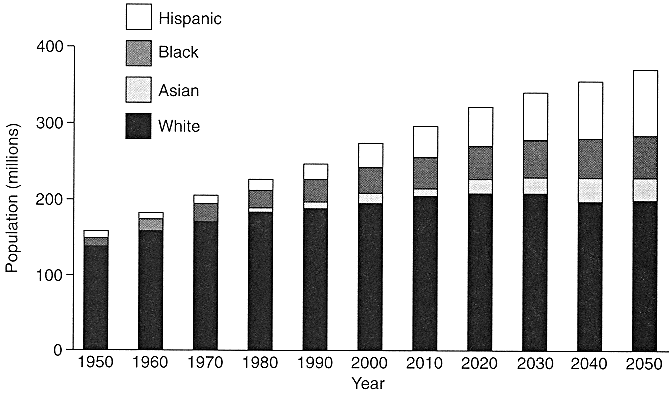
Figure 3.11
U.S. population by racial/ethnic group: Observed population, 1950-1995; projected population under medium immigration assumption, 1995-2050.
exceeding 1 percent for the next half-century. The size of the Asian population will increase from 9 million in 1995 to 34 million in 2050 (growing from 3 to 8 percent of the total population). The growth of the Asian population is principally fueled by immigration. Although fertility levels for the foreign-born Asian population is slightly above average, the sizable future growth stems from the large number of immigrants added to the Asian population. Based on the low to high immigration assumptions, the Asian population in 2050 may range from 26 to 42 million.
Fueled by heavy immigration and by high attribution rates—more than 50 percent of multiple-ancestry persons report themselves as Hispanic—the Hispanic population will grow substantially over the projection period. It will rise from 27 million in 1995, or about 1 in 11 of the total population, to 95 million in 2050, or about 1 in 4. The growth of the Hispanic population is driven by multiple factors: immigration, higher fertility rates, and high attribution rates. Although immigration is the principal factor, the Hispanic population will grow significantly in the future even if immigration were to cease. Because of their higher fertility, especially of the foreign-born, the Hispanic population will almost double by 2050, even in the absence of immigration. Under the low to high net immigration assumptions, the size of the Hispanic population will increase to 77 to 113 million in 2050.
One caution in interpreting these results arises from our assumptions about current conditions of exogamy and ethnicity persisting into the future. In fact, intermarriage has been changing during recent decades, especially for Asians and
TABLE 3.7 U.S. Population, by Ethnic Groups and Level of Net Immigration: Observed Population, 1950-1995; Projected Population, 2000-2050 (millions)
|
|
Level of Net Immigration |
||||
|
Population |
Zero |
Low |
Medium |
High |
Very High |
|
White |
|||||
|
1950 |
|
|
134.4 |
|
|
|
1960 |
|
|
155.0 |
|
|
|
1970 |
|
|
170.4 |
|
|
|
1980 |
|
|
180.4 |
|
|
|
1990 |
|
|
187.1 |
|
|
|
1995 |
|
|
193.6 |
|
|
|
2000 |
197.4 |
197.6 |
198.4 |
199.1 |
199.9 |
|
2010 |
201.7 |
202.4 |
204.8 |
207.1 |
209.8 |
|
2020 |
203.6 |
204.8 |
209.1 |
213.1 |
217.9 |
|
2030 |
202.8 |
204.6 |
211.0 |
216.9 |
223.9 |
|
2040 |
196.6 |
199.1 |
207.6 |
215.4 |
224.7 |
|
2050 |
187.6 |
190.7 |
201.4 |
211.2 |
222.9 |
|
Black |
|||||
|
1950 |
|
|
15.7 |
|
|
|
1960 |
|
|
19.1 |
|
|
|
1970 |
|
|
23.0 |
|
|
|
1980 |
|
|
23.0 |
|
|
|
1990 |
|
|
30.0 |
|
|
|
1995 |
|
|
31.6 |
|
|
|
2000 |
33.5 |
33.7 |
33.8 |
33.9 |
34.1 |
|
2010 |
37.0 |
37.6 |
38.0 |
38.5 |
38.9 |
|
2020 |
39.9 |
41.1 |
41.9 |
42.9 |
43.4 |
|
2030 |
43.6 |
45.3 |
46.5 |
47.8 |
48.9 |
|
2040 |
46.1 |
48.5 |
50.1 |
51.8 |
53.4 |
|
2050 |
48.4 |
51.6 |
53.7 |
55.9 |
57.9 |
Hispanics. In addition, current rates of racial/ethnic attribution may change as the population becomes increasingly diverse. This sensitivity can be illustrated by varying assumptions about racial/ethnic reporting, holding constant the immigration assumption at current levels.
Table 3.8 presents results with alternative ethnic attribution assumptions. We start with some unrealistic extremes. Very low attribution assumes that no multiple-ancestry persons identify with the ethnic group and very high attribution assumes that all multiple-ancestry persons identify with the ethnic group. A more realistic range can be obtained by using what we label as low and high attribution rates. Low and high attribution levels reflect ranges around the medium attribution rates that are based on 1990 census data: low is 20 percentage points less than the reported 1990 levels, and high is 20 percentage points greater. In between, half attribution assumes that 50 percent of multiple-ancestry persons iden-
|
|
Level of Net Immigration |
||||
|
Population |
Zero |
Low |
Medium |
High |
Very High |
|
Asian |
|||||
|
1950 |
|
|
.7 |
|
|
|
1960 |
|
|
1.1 |
|
|
|
1970 |
|
|
1.8 |
|
|
|
1980 |
|
|
3.7 |
|
|
|
1990 |
|
|
7.3 |
|
|
|
1995 |
|
|
8.8 |
|
|
|
2000 |
9.6 |
10.3 |
10.8 |
11.4 |
11.9 |
|
2010 |
11.0 |
13.4 |
15.1 |
16.9 |
18.6 |
|
2020 |
11.3 |
16.5 |
19.6 |
22.9 |
25.9 |
|
2030 |
13.5 |
19.9 |
24.4 |
29.3 |
33.7 |
|
2040 |
14.3 |
22.9 |
29.1 |
35.6 |
41.7 |
|
2050 |
14.9 |
25.9 |
33.7 |
42.1 |
49.7 |
|
Hispanic |
|||||
|
1950 |
|
|
4.0 |
|
|
|
1960 |
|
|
6.3 |
|
|
|
1970 |
|
|
9.6 |
|
|
|
1980 |
|
|
14.6 |
|
|
|
1990 |
|
|
22.4 |
|
|
|
1995 |
|
|
26.9 |
|
|
|
2000 |
29.8 |
30.9 |
31.7 |
32.5 |
33.3 |
|
2010 |
35.2 |
39.3 |
42.2 |
45.2 |
47.9 |
|
2020 |
40.3 |
48.1 |
53.7 |
59.5 |
64.6 |
|
2030 |
45.2 |
57.6 |
66.5 |
75.6 |
83.8 |
|
2040 |
49.4 |
67.4 |
80.2 |
93.4 |
105.3 |
|
2050 |
52.8 |
77.2 |
94.7 |
112.7 |
128.8 |
tify with the ethnic group. This midpoint comes close to a biological view in which 50 percent of children identify with the parent's ethnicity.
The Asian population has moderate rates of exogamy and of self-identification—less than 50 percent (see Appendix 3B: Tables 3.B3 and 3.B4). As a greater proportion of the Asian population is accounted for by the second, third, and fourth-plus generations, the projection reflects the increasing level of exogamy. Overall, the size of the Asian population in 2050 for the spectrum of assumptions, from low to high attribution, is within a range of 31 to 37 million.
Although the Hispanic population is expected to expand rapidly, its growth will be magnified by moderate levels of exogamy and attribution rates above 50 percent (see Appendix 3.B: Tables 3.B3 and 3.B4), resulting in growth rates greater than baseline assumptions. Unless the extremely low attribution conditions prevail, under the more reasonable low to high attribution assumptions, the
TABLE 3.8 U.S. Population, by Ethnic Groups and Level of Ethnic Attribution: Observed Population, 1950-1995; Projected Population, 2000-2050 (millions)
|
Population |
Very Low |
Low |
Half |
Medium |
High |
Very High |
|
White |
||||||
|
1950 |
|
|
134.4 |
|
|
|
|
1970 |
|
|
170.4 |
|
|
|
|
1990 |
|
|
187.1 |
|
|
|
|
1995 |
|
|
193.6 |
|
|
|
|
2020 |
191.0 |
207.0 |
210.0 |
209.1 |
211.3 |
215.3 |
|
2050 |
175.5 |
195.2 |
203.9 |
201.4 |
207.8 |
220.3 |
|
Black |
||||||
|
1950 |
|
|
15.7 |
|
|
|
|
1970 |
|
|
23.0 |
|
|
|
|
1990 |
|
|
30.0 |
|
|
|
|
1995 |
|
|
31.6 |
|
|
|
|
2020 |
37.5 |
41.6 |
41.9 |
41.9 |
43.0 |
43.7 |
|
2050 |
43.2 |
51.1 |
52.3 |
53.7 |
56.4 |
59.2 |
|
Asian |
||||||
|
1950 |
|
|
.7 |
|
|
|
|
1970 |
|
|
1.8 |
|
|
|
|
1990 |
|
|
7.3 |
|
|
|
|
1995 |
|
|
8.8 |
|
|
|
|
2020 |
17.3 |
19.1 |
19.8 |
19.6 |
20.2 |
21.4 |
|
2050 |
27.9 |
31.3 |
35.2 |
33.7 |
36.5 |
42.9 |
|
Hispanic |
||||||
|
1950 |
|
|
4.0 |
|
|
|
|
1970 |
|
|
9.6 |
|
|
|
|
1990 |
|
|
22.4 |
|
|
|
|
1995 |
|
|
26.9 |
|
|
|
|
2020 |
43.7 |
51.5 |
52.2 |
53.7 |
56.0 |
57.9 |
|
2050 |
64.5 |
85.0 |
87.8 |
94.7 |
105.5 |
115.2 |
|
Note: Assumed level of ethnic attribution for multiple-ancestry persons is: Very low = 0 percent; Low = .2 less than medium assumption; Half = 50 percent; Medium = attribution rates estimated from 1990 census data, see Table 3.B4; High = .2 greater than medium assumption; Very high = 100 percent. |
||||||
Hispanic population is likely to increase in number from 85 to 106 million in 2050.46
These projections imply substantial growth in multiple-ancestry persons, re-
gardless of the reported primary ethnic identification. Table 3.9 shows changes in the single and multiple-ancestry categories for ethnic groups. Overall, in 1995, about 7 percent of the population reports one or more different races or Hispanic origins than their primary race or Hispanic identification. The percentage of the population reporting multiple-ancestries will increase from 7 percent in 1995 to 21 percent in 2050, assuming that intermarriage continues at current levels. There is substantial variation in the proportion of multiple-ancestry persons for ethnic groups. Trends for the white population are similar to the overall population, but the increase in the proportion of multiple-ancestry persons is somewhat lower for the black population. But the relative gain in multiple-ancestry persons is especially high for the Asian and Hispanic populations, reaching 36 and 45 percent, respectively, in 2050. The major implication of these trends is to raise questions about the primary racial and Hispanic identification of the large number of persons of multiple-ancestries.
Projections of the type presented here must be placed in a historical context. Early in the twentieth century, public interest focused on fertility differences between the ''new" immigrants from Southern and Eastern Europe and the older "American" stock. Indeed, Theodore Roosevelt warned in his inaugural address about immigration bringing on the "suicide of the race."
Had there been population projections by European ethnic groups during the period of peak European immigration (1880-1920) that tried to forecast what the U.S. population would look like by 1950 or 2000, those predictions would certainly have been wrong if they assumed that groups would not intermarry at all and that all future descendants would report the same ethnic identity as their mother (or father). Such projections would have seriously overestimated the proportions of some European groups and underestimated others. Hout and Goldstein (1991) remind us that the number of self-reported Irish Americans in the 1980 census could not possibly have come about purely as a result of immigration and the fertility of Irish immigrants: the number is simply too large. Rather, most of the growth in Irish Americans must have resulted from intermarriage and the choice of many children of intermarriage to claim Irish ancestry.
Projections made at the turn of the century would have been in error for two reasons. First, they would have had to deal with all the vagaries of population projections about fertility, mortality, and immigration. Common to all projections is that the world changes, that basic demographic parameters will vary in the future in ways that cannot be fully anticipated, and thus that assumptions
|
|
exogamy rates and high attribution rates for multiple-ancestry persons. The medium attribution assumption suggests that the growth of the black population will be slightly greater than conventional baseline projection results. The results in 2050 under the low to high assumptions are clustered within a narrow range, from 51 to 56 million. |
made about them may err. Second and more important, such projections would have missed the subsequent changes in the social meaning and functioning of the ethnic groups themselves. These changes are discussed in detail in Chapter 8.
As these findings make clear, the ethnic affiliation of Americans in the future is subject to some uncertainty. Today, many people have parents and grandparents who are of the same ethnic origin, using the broad racial and Hispanic groups current today. But a substantial and growing number have links to two or more ethnic ancestries, allowing wide latitude in how they may choose to identify themselves.
To display this blurring of single and multiple ethnic linkages, Table 3.9 displays estimates for single and multiple-ancestry of the current and future U.S. population. Of the 8.8 million persons in 1995 whose primary ethnic identification was Asian, the vast majority (8.1 million) had only Asian ancestry. In addition, there were another 1.5 million persons who reported some Asian ancestry—of whom only 0.7 million self-reported that they were Asian. The net result is that in 1995 there were an additional 800,000 persons who had some Asian an-
TABLE 3.9 Population by Ethnic Groups by Single and Multiple-Ancestry, 1995, 2020, and 2050 (millions)
|
|
Population by Ancestry |
|||
|
|
Single Ancestry |
Multiple-Ancestry |
Total: All Ancestries |
Percentage Multiple of Total |
|
White |
||||
|
1995 |
181.7 |
15.5 |
197.2 |
7.9 |
|
2020 |
192.0 |
24.3 |
216.3 |
11.2 |
|
2050 |
167.9 |
44.8 |
212.7 |
21.2 |
|
Black |
||||
|
1995 |
29.4 |
2.7 |
32.1 |
8.4 |
|
2020 |
39.6 |
4.3 |
43.9 |
9.8 |
|
2050 |
49.0 |
8.0 |
57.0 |
14.0 |
|
Asian |
||||
|
1995 |
8.1 |
1.5 |
9.6 |
15.6 |
|
2020 |
17.4 |
4.1 |
21.5 |
19.1 |
|
2050 |
26.7 |
15.0 |
41.7 |
36.0 |
|
Hispanic |
||||
|
1995 |
24.4 |
4.9 |
29.3 |
16.7 |
|
2020 |
43.9 |
14.2 |
58.1 |
24.4 |
|
2050 |
61.7 |
50.7 |
112.4 |
45.1 |
|
Totala |
||||
|
1995 |
245.0 |
17.8 |
262.8 |
6.8 |
|
2020 |
294.5 |
32.7 |
327.2 |
10.0 |
|
2050 |
306.7 |
80.6 |
387.3 |
20.8 |
|
a The total population includes American Indians, Eskimos, and Aleuts. |
||||
TABLE 3.10 U.S. Population by Race and Hispanic Origin: Observed Population, 1950-1995; Projected Population, 2000-2050 (percentage of total population)
|
|
1950 |
1970 |
1990 |
1995 |
2010 |
2030 |
2050 |
|
Totala |
100 |
100 |
100 |
100 |
100 |
100 |
100 |
|
White |
87 |
83 |
76 |
74 |
67 |
59 |
51 |
|
Black |
10 |
11 |
12 |
12 |
13 |
13 |
14 |
|
Asian |
I |
1 |
3 |
3 |
5 |
7 |
8 |
|
Hispanic |
3 |
5 |
9 |
10 |
14 |
20 |
26 |
|
a The total U.S. population includes American Indians, Eskimos, and Aleuts. |
|||||||
cestry but who identified themselves as non-Asian. Overall, 16 percent of all persons with Asian ancestry had multiple-ancestry.
Now, let us go to the future and see what our model presents about the multiple-ancestry of Asians. If all persons of some Asian ancestry identified themselves as Asian, the reported population could be as high as 42 million in 2050. Instead, if only single-ancestry persons reported themselves as Asian in 2050, the population could be as low as 27 million. The projected Asian population of 34 million in 2050 is between these extremes because only a fraction of the multiple-ancestry Asian population will identify themselves as Asians. The salient secular trend is the increased blurring of the lines of ethnic boundaries. By the middle of the next century, more than one-third of all of those with some Asian ancestry will have multiple-ancestries, compared with only 8 percent today.
There is even greater latitude for variation in the future Hispanic population. In 1995, there were an estimated 4.9 million persons with multiple Hispanic ancestry (17 percent of all persons with some Hispanic ancestry). By 2050, through high fertility and continued intermarriage, the multiple-ancestry Hispanic population will expand to 51 million persons, or 45 percent of all persons with some Hispanic ancestry. If only single-ancestry persons reported themselves as Hispanic in 2050, the Hispanic population will be 62 million (17 percent of total U.S. population). If, instead, on the high side, all persons with any Hispanic ancestry reported themselves as Hispanic, the population could be as high as 112 million (29 percent of the total U.S. population).47
This blurring of ethnic boundaries illustrates some of the ambiguity inherent in any ethnic projection. With this caveat in mind, Table 3.10 shows the projected fraction of the future U.S. population by ethnic group. Today, three-quar-
ters of the population identify themselves as non-Hispanic whites. By the middle of the next century, the fraction will decline to about one-half (51 percent). The two groups that will expand in relative terms are Hispanics and Asians. We project that the Asian population, which today comprises 3 percent of the population, will rise to 8 percent in 2050. Similarly, the relative size of the Hispanic population will more than double over this period from 1 in 10 to about 1 in 4.
Conclusions
This chapter paints a demographic portrait of Americans over the next half-century, taking the contribution of immigration into account. Our projections are based on a set of ethnic and generational specific rates of fertility, mortality, exogamy, and ethnic affiliation. This future population is simulated under five immigration scenarios, wherein the baseline scenario represents continuation of current policies of about 800,000 net immigrants per year. In addition, our simulations use four other immigration assumptions: net immigration of zero, 410,000 per year, 1.23 million, and 1.64 million per year. We consider net immigration levels of 410,000 (about one-half current levels) and 1.23 million (about 50 percent greater than current levels) to be realistic bounds for likely variation around current policies.
We project a 2050 population of 387 million, 124 million more than the 1995 total of 263 million. If current immigration flows continue, there will be about 45 million immigrants arriving in the United States between 1995 and 2050. These immigrants, plus their descendants, will add 80 million people to the population. Continued current levels of immigration will add substantial numbers to the future U.S. population, through the combined effects of adding new people and maintaining higher average fertility levels. If immigration is one-half current levels, the U.S. population will increase to 349 million; if immigration is one-half greater than current levels, the population will expand to 426 million in 2050.
Immigration will have a negligible effect on the balance of men and women in the future population, but it will significantly alter the age structure of the population. No matter what happens to immigration flows, the U.S. population will become older, as the large number of people in the baby-boom years reach retirement. Immigration has its largest impact on the youngest age groups in the population, with diminishing impacts on older age groups. Immigration will increase primary school, secondary school, and college enrollments, compared both with current numbers and with a future scenario of lower immigration. Immigration will increase the size of the labor force. The elderly population will increase substantially in the future, although immigration will play a supporting role in its expansion.
Even if immigration ceases immediately, the racial and ethnic composition of the U.S. population will change. Differences in fertility and mortality levels
and variations in the age structure of current ethnic groups imply that some would grow more quickly and some more slowly. The growth momentum for the white population, for instance, is less than that of the Asian and Hispanic populations—even in the absence of immigration.
Immigration is unlikely to be zero, however. If current immigration policy continues, the Asian and Hispanic populations will experience much more rapid growth, increasing relative to the total population. In 1995, 74 percent of the population was white, 12 percent black, 10 percent Hispanic, and 3 percent Asian. By 2050, the relative size of the white population will decline to 51 percent, the black population will increase only slightly to 14 percent, and the Asian and Hispanic populations will reach much higher levels, 8 and 26 percent, respectively. The Asian and Hispanic populations will increase under any immigration scenario. By 2050, the absolute and relative sizes of their populations will more than double.
The current extent of intermarriage and the ethnic self-identification of children of multiple-ancestry are critical parameters of our projections. Assuming that current levels of intermarriage continue, there will be a large increase in the number of persons of multiple-ancestry, especially for Asians and Hispanics. The multiple-ancestry population will increase from 18 million in 1995 to 81 million in 2050 (a growth from 7 to 16 percent of the total population). Such a population will add complexity and ambiguity to the ethnic definitions used. The proportion of the U.S. population with multiple-ancestry will continue to increase under any immigrant scenario. By the middle of the next century, the social meaning of ethnic and racial lines will become increasingly blurred.
References
Gurak, D.J., and J.P. Fitzpatrick 1982 Intermarriage among Hispanic ethnic groups in New York City. American Journal of Sociology 87:921-934.
Hirschman, C. 1996 Race and Ethnic Population Projections: A Critical Evaluation of Their Content and Meaning. Revision of a paper presented at the 13th SUNY, Albany Conference "American Diversity: A Demographic Challenge for the Twenty-First Century," April 15-16, 1994.
Hout, M., and J. Goldstein 1991 How 4.5 million Irish immigrants became 40 million Irish Americans: Demographic and subjective aspects of the ethnic composition of white Americans. American Sociological Review J9:64-82.
Long, J. 1991 The relative effects of fertility, mortality, and immigration on projected age structure. Pp. 503-522 in Wolfgang Lutz (editor), Future Demographic Trends in Europe and North America. New York: Academic Press.
Miltenyi, K. 1981 Population Projections: Problems and Solutions. Report of the Workshop on Population Projections, Budapest, Hungary, March 1980. Department of Technical Co-operation for Development, United Nations, New York.
Passel, J.S., and B. Edmonston 1994 Immigration and race: Recent trends in immigration to the United States. In B. Edmonston and J.S. Passel (editors), Immigration and Ethnicity: Immigration and the Adjustment of America's Newest Immigrants. Washington, D.C.: The Urban Institute.
Romaniuc, A. 1990 Population projection as prediction, simulation, and prospective analysis. Population Bulletin of the United Nations 29:16-31.
Shapiro, G.M., G. Diffendal, and D. Cantor 1993 Survey undercoverage: Major causes and new estimates of magnitude. Pp. 638-663 in Proceedings of the 1993 Bureau of the Census Annual Research Conference. Washington, D.C.: U.S. Department of Commerce.
Tabah, L. 1984 Population Projections: Methodology of the United Nations. Papers of the United Nations Ad Hoc Expert Group on Demographic Projections, United Nations Headquarters, 16-19 November 1981. Population Studies Number 83. Department of International Economic and Social Affairs, United Nations, New York.
United Nations 1995 World Population Projections. New York: United Nations.
U.S. Bureau of the Census 1989 Projections of the population of the United States, by age, sex, and race: 1988 to 2080. Prepared by Gregory Spencer. Current Population Reports, Series P-25, No. 1018. Washington, D.C.: U.S. Department of Commerce.
1996a Population projections of the United States by age, sex, race, and Hispanic origin: 1995 to 2050. Current Population Reports, P25-1130. Washington, D.C.: U.S. Department of Commerce.
1996b Statistical Abstracts of the United States, 1996. Washington, D.C.: U.S. Department of Commerce.
Werner, B. 1986 Family building intentions of different generations of women: Results from the General Household Survey, 1979-83. Population Trends 44 (Summer): 17-23.
Appendix 3.A
Population Projection Model
The panel's population projection model forecasts a population by age, sex, and four generation groups for a period of five-years, using survival rates by five-year age groups for each sex and generation, five-year age-specific fertility rates for each generation, and the number of migrants by age, sex, and generation during the five-year period. The projection handles four generations: the foreign-born (the first generation), the sons and daughters of the foreign-born (the second generation), the grandsons and granddaughters of the foreign-born (the third generation), and all higher-numbered generations lumped together. A FORTRAN program, designed for use on microcomputers, implements the basic immigration generation model. The program displays results for each generation as well as the total native-born (the second and higher generations) and the total population. Although a special procedure handles each five-year projection, the main population projection program can make projections for a period of 5 to 100 years.
The model requires the following data: (1) initial female population in five-year age groups, by generation, (2) initial male population in five-year age groups, by generation, (3) five-year survival rates for females during each five-year period, by generation, (4) five-year survival rates for males during each five-year period, by generation, (5) annual age-specific fertility rates (for five-year age groups) for the beginning and end of each five-year period, by generation, (6) female immigrants and emigrants by five-year age groups during each five-year period, by generation, (7) male immigrants and emigrants by five-year age groups during each five-year period, by generation, and (8) sex ratio at birth. In addition, several parameters control various options of the computer program and permit alternative input data (such as using Coale-Demeny model life tables instead of age-specific survival rates).
Consider a population defined with the following characteristics:

population size for age x at time t,

rates for population age x surviving to age x+5 during the period from t to t+5, and

age-specific fertility rates for women age x at time t. Survival rates are derived from the life table person-years lived values in the standard fashion, with
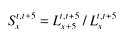
We assume five-year age groups here, so the population age x represents the age group x to x+4.
Model With No International Migration. For a population projection with no international migration, the closed population is affected only by fertility and mortality processes. The survival of the population at the beginning of a five-year projection period is:

(1)
and
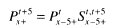
(2)
for the last, open-ended age interval, where x+ is the population age x to the end of life, and each equation is separate for males and females.
We calculate the total births during the five-year interval as:
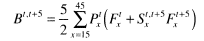
(3)
where P is for the female population only. Then the population aged 0 to 4 years at t+5 is:
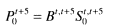
(4)
and would use the sex ratio at birth to calculate the number of male and female births. P and S are also separate by sex, and

indicates the survival from birth to age 0-4 for the appropriate sex during the period t to t+5.
Model With International Migration. The basic population projection model can be modified to include the effects of international migration. Define

as in-migrants age x during the period t to t+5 and

as out-migrants age x during the period t to t+5, each separate by sex. Then the net migrants age x during the period t to t+5 is

The impact of international migration on the population alive at the beginning of a five-year projection period is:

(5)
and

(6)
for the open-ended age category.
Equation 3 for total births is affected by migration and reflects births to the resident population plus births to the net immigrants during the period:

(7)
where births to net immigrants is:
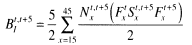
(8)
¬
The population aged 0 to 4 years is also altered by international migration:

(9)
where P, S, and N are separate by sex and the sex ratio at birth is needed to calculate the number of male and female births.
Model With Population by Generations. The population described above is distinguished by an age and time index (and is assumed to be separate by sex). Consider now a population indexed by k generations, where k=1, 2, 3, and 4: k=l indicates the first generation, k=2 indicates the second, k=3 represents the third, and k=4 indicates the fourth and later generations. For the survival of the population alive at the beginning of the projection period equation 5 becomes:

(10)
and equation 6 becomes:

(11)
for the open-ended age category, where

represents the survival values for the kth generation and

indicates the number of net migrants for the kth generation. In general, the number of immigrants by generation

is non-zero for the first generation (k = 1) and zero for the second and later generations (k = 2,3,4). Immigrants are generally not native-born persons. On the other hand, this model makes apparent that emigrants by generation

may have non-zero values for all generations. Hence, observed values of net migrants by generation

are usually positive for the first generation (representing net immigration of the foreign-born) and typically negative for the second and later generations (indicating some emigration and negligible immigration of the native-born).
In a female-dominant model,48 a mother in the kth generation would produce an offspring in the k+1 generation. The population aged 0 to 4 for the first generation would derive solely from immigration (it is logically impossible for a mother to give birth to a foreign-born child in the United States):
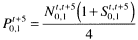
(12)
separate for each sex. The population aged 0 to 4 years for the second and third generations results from births to mothers in the first and second generations, respectively, plus the effect of net migration:

(13)
for k=2,3 and for each sex separately, where the sex ratio at birth is needed to calculate the number of male and female births and where:

(14)
We would ordinarily assume that births to net immigrants during the period

would be non-zero only for the second generation. The population aged 0 to 4 years in the fourth and later generations results from births to third-generation mothers plus fourth- and later-generation mothers along with the effects of net migration:

(15)
for each sex separately, where total births during the period are obtained using equation 14.
However, the female-dominant model does not correspond to the classifications used in U.S. censuses or surveys for most recent immigrant ancestor. A kth-generation female might marry a male of a different immigrant generation, and their offspring would not necessarily be the k+1 generation. If a third-generation woman produces an offspring in union with a first-generation man, the child would report ancestry relative to the father (the most recent immigrant generation of the parents) and indicate second-generation ancestry. Because some females marry males with a lower-order immigrant generation than themselves, the observed generational composition of births (and the resulting population aged to 4 years) is always a lower order than implied by a female-dominant model.
To make the model correspond to data collection methods, consider a matrix

which indicates the proportion of births in the mth (m= 1,2,3,4) generation born to women in the kth generation, subject to the condition

for k= 1,2,3, and 4. In the female-dominant model

and all other cells in the G matrix are zero. A model incorporating the G matrix, where mothers of the kth generation produce births in the mth generation is:

(16)
for m = 1,2,3,4 and separate by sex. The empirical challenge, in this case, is to estimate the intergenerational birth matrix

The population projection model requires information about the probability that a kth generation mother gives birth to a mth generation child. The fertility assumptions for the model determine the overall chances of having a child; the intergenerational birth matrix therefore affects the generational distribution of births, and not the fertility process itself.
Data are lacking on childbearing by parental generation, for both parents, for racial/ethnic groups in the United States. We used data from the 1989 Current Population Survey (CPS) to make estimates of this matrix, examining births to parents for the first, second, and third-plus generation for the Asian, black, Hispanic, and white non-Hispanic populations. We then adopted an iterative procedure to develop estimates that fit both the CPS data and the known overall number of births (U.S. Bureau of the Census, 1989). This procedure produces approximate estimates for the intergenerational birth matrix. We estimate, for example, that births to third-generation Hispanic mothers are distributed roughly as 30 percent in the second generation, 20 percent in the third generation, and 50 percent in the fourth-plus generation.
Our current analysis of intergenerational births is preliminary. However, analysis of the 1989 CPS data suggests that the intergenerational birth matrix is affected by the generational distribution of males and females. In a population with a high proportion of immigrants, the chances are greater that a native-born person will marry a foreign-born person and produce a child with a more recent immigrant generation. Populations with few immigrants, in contrast, would have an intergenerational birth matrix that more closely resembles the female dominant perspective.
For the population projections presented here, we assume that each racial/ ethnic group has an intergenerational birth matrix in 1990 that is estimated from 1989 CPS data, for the particular racial/ethnic group. Over time, we assume that the matrix changes, depending on the generational distribution of males and females in the population at the beginning of the projection period.
Appendix 3.B
Population Projection Assumptions
This appendix presents detailed tables for the population projection assumptions. The tables that follow provide the assumptions used in the projections for fertility, mortality, immigration and emigration, exogamy, and ethnic attribution for multiple-ancestry persons. These appendix tables do not show assumptions made for American Indians, Eskimos, and Aleuts; the text and the tables do not present results for these population groups because they are relatively small and not affected by variations in immigration. Tables, graphs, and information for the U.S. total population, however, includes estimates for American Indians, Eskimos, and Aleuts.
TABLE 3.B1 Mortality Assumptions for Life Expectancy at Birth for U.S. National Population Projections by Race and Hispanic Origin, 1995 and 2050
|
|
1995 |
2050 |
|||||
|
Race/Ethnicity |
Low |
Medium |
High |
Low |
Medium |
High |
|
|
White |
|||||||
|
Male |
73.6 |
73.6 |
73.6 |
72.6 |
81.9 |
87.5 |
|
|
Female |
80.0 |
80.0 |
80.0 |
79.8 |
85.3 |
92.9 |
|
|
Asian |
|||||||
|
Male |
79.6 |
79.6 |
79.6 |
78.6 |
83.9 |
87.5 |
|
|
Female |
80.2 |
80.2 |
80.2 |
79.8 |
85.0 |
89.3 |
|
|
Black |
|||||||
|
Male |
64.5 |
64.5 |
64.5 |
62.2 |
69.5 |
80.8 |
|
|
Female |
74.3 |
74.3 |
74.3 |
73.4 |
78.8 |
89.8 |
|
|
Hispanic |
|||||||
|
Male |
74.9 |
74.9 |
74.9 |
73.1 |
84.4 |
85.5 |
|
|
Female |
82.2 |
82.2 |
82.2 |
81.7 |
89.6 |
91.4 |
|
|
Source: Mortality assumptions made in national population projections of the U.S. Bureau of the Census (1996a). |
|||||||
TABLE 3.B2 Intermarriage Rates by Race/Ethnicity and Nativity, 1980, and by Race/Ethnicity, Nativity, and Racial/Ethnic Ancestry, 1990, Aged 20 to 29 Years
TABLE 3.B3 Exogamy Estimates for Ethnic Groups by Immigrant Generation
|
|
Immigrant Generation |
|||
|
Race/Ethnicity |
First |
Second |
Third |
Fourth+ |
|
White |
.10 |
.09 |
.08 |
.08 |
|
Asian |
.13 |
.34 |
.54 |
.54 |
|
Black |
.14 |
.12 |
.10 |
.10 |
|
Hispanic |
.08 |
.32 |
.57 |
.57 |
|
Source: Panel estimates using 1990 census microdata and 1994 birth data from the National Center for Health Statistics. |
||||
TABLE 3.B4 Racial and Ethnic Attribution Rates for Multiple-Ancestry Persons for Racial and Ethnic Groups
|
|
Level of Ethnic Attribution |
|||||
|
Race/Ethnicity |
Very Low |
Low |
Half |
Medium |
High |
Very High |
|
White |
.00 |
.22 |
.50 |
.42 |
.62 |
1.00 |
|
Asian |
.00 |
.19 |
.50 |
.39 |
.59 |
1.00 |
|
Black |
.00 |
.41 |
.50 |
.61 |
.81 |
1.00 |
|
Hispanic |
.00 |
.44 |
.50 |
.64 |
.84 |
1.00 |
|
Source: Panel estimates from 1990 census microdata. |
||||||
Appendix 3.C
Sensitivity of Population Projection Results
Different assumptions for each component of population change lead to shifts in population size. Using alternative assumptions for immigration, fertility, and mortality—each projected under low and high assumptions—we obtain changes in the projected population size. These variations can be compared with the medium-level projections, assuming medium levels for immigration, fertility, and mortality. Table 3.C1 shows results for these projections.
In the intermediate 10 to 15 year period, different assumptions about immigration and fertility could increase or decrease the population size by 2 to 3 percent (see Table 3.C2). In the long run, by 2050, different mortality assumptions will result in population size differences of 6 to 7 percent. In contrast, the cumulative effects of immigration and fertility are greater. Different immigration assumptions, ranging from low to high, will result in population size differences of 10 percent. Different fertility assumptions will account for differences of 12 to 14 percent. These results are consistent with other studies (Long, 1991) concluding that variability in fertility and immigration outpaces the contribution to long-term population size from mortality, in the U.S. context.
TABLE 3.C1 U.S. Population Size Under Alternative Immigration, Fertility, and Mortality Assumptions, 1995-2050
|
|
|
Immigration |
Fertility |
Mortality |
|||
|
Year |
Medium |
Low |
High |
Low |
High |
High |
Low |
|
1995 |
263 |
263 |
263 |
263 |
263 |
263 |
263 |
|
2000 |
277 |
275 |
279 |
271 |
274 |
277 |
277 |
|
2010 |
302 |
295 |
310 |
296 |
308 |
299 |
305 |
|
2020 |
327 |
313 |
341 |
314 |
340 |
320 |
334 |
|
2030 |
351 |
330 |
373 |
330 |
372 |
337 |
362 |
|
2040 |
370 |
341 |
400 |
337 |
407 |
352 |
385 |
|
2050 |
387 |
349 |
426 |
341 |
441 |
360 |
410 |
TABLE 3.C2 U.S. Population Size Relative to Medium-Level Assumptions Under Alternative Immigration, Fertility, and Mortality Assumptions, 1995-2050
|
|
|
Immigration |
Fertility |
Mortality |
|||
|
Year |
Medium |
Low |
High |
Low |
High |
High |
Low |
|
1995 |
100 |
100 |
100 |
100 |
100 |
100 |
100 |
|
2000 |
100 |
99 |
101 |
99 |
100 |
100 |
100 |
|
2010 |
100 |
97 |
103 |
98 |
102 |
99 |
101 |
|
2020 |
100 |
96 |
104 |
96 |
104 |
98 |
102 |
|
2030 |
100 |
94 |
106 |
94 |
106 |
96 |
103 |
|
2040 |
100 |
92 |
108 |
91 |
110 |
95 |
104 |
|
2050 |
100 |
90 |
110 |
88 |
114 |
93 |
106 |


