
5
Immigration's Effects on Jobs and Wages: Empirical Evidence
Building on our first-principles treatment of the economic effects of immigration, this chapter focuses on the empirical evidence concerning immigrants' role in U.S. labor markets. We first address the changing economic status of the immigrants themselves: What is the size of the economic gain to immigrants? What is happening to the labor market skills of recent immigrants compared with those of native-born workers? Are immigrants able to assimilate economically into the U.S. labor market? Most of the literature has examined these issues for male immigrants; to gauge the labor market success of immigrant women, we make comparisons between female immigrants and female natives similar to those we make for men.
The section that follows directly addresses the issue of the impact that immigrants have on native workers' earnings and employment. We start our treatment of this central issue with a theoretical discussion that places some constraints on how large or small these impacts on native workers can be. This theoretical treatment is complemented by a summary of the empirical evidence on the size of the wage and employment effects on native workers.
The bulk of research has looked for the effects of immigration on labor market outcomes. However, immigration may also alter product markets, raising or lowering the prices of alternative goods and services by different amounts. Since Americans do not consume all goods in the same proportions, some may gain more than others as these prices change. The final section of this chapter presents new evidence on the impact of immigration on the prices of goods. By doing so,
it attempts to identify the American households that benefit the most and those that gain the least from these changing prices.1
The Economic Gain to Immigrants
In the previous chapter, we argued that immigrants expect that they themselves will gain from immigration, or they would not come. But how large are these economic benefits to immigrants? Although the question is straightforward, it is amazing how little direct evidence exists on the magnitude of their actual economic benefits. Some thorny conceptual issues beset comparison of standards of living across countries, but the primary reason for the lack of knowledge is that survey data contain little information about immigrants' lives before they came to America. As a not atypical example, the decennial census questionnaire asks no direct questions about how immigrants fared in labor markets at home.
Given this paucity of direct evidence, the best we can do is make some simple contrasts between what immigrants earn here compared with average wages in the major sending countries.2 There are two salient facts in describing wages in the United States relative to those of potential sending countries. First, wages in the United States are high relative to those in the less economically developed sending countries, such as the Philippines, Mexico, and the other Central and South American countries. Second, dispersion in wages in the United States is high relative to that in most of the developed sending countries, including those in Western Europe and Canada.
The implication is that immigration to the United States should be attractive to most workers from less economically developed countries and that skilled workers from many developed countries may want to emigrate into the United States.3 These implications appear to be broadly consistent with migration patterns—for example, unskilled labor from Mexico and skilled labor from Western Europe.
As a rough gauge on relative standards of living, Table 5.1 lists gross domestic product per capita for the principal source countries. This table illustrates the
TABLE 5.1 Per Capita Gross Domestic Product Measures, for Selected Countries, 1992
|
Region and Country |
GDP Per Capita Relative to U.S. |
GDP Per Capita |
|
Europe |
||
|
Austria |
73.2 |
16,989 |
|
Czechoslovakia |
23.2 |
5,066 |
|
France |
78.5 |
18,232 |
|
Germany |
87.0 |
20,197 |
|
Greece |
39.0 |
8,203 |
|
Hungary |
24.9 |
5,780 |
|
Italy |
72.0 |
16,724 |
|
Poland |
21.1 |
4,907 |
|
Portugal |
41.3 |
9,005 |
|
U.S.S.R. |
41.9 |
8,780 |
|
United Kingdom |
70.2 |
16,302 |
|
Yugoslavia |
25.0 |
5,467 |
|
Asia |
||
|
Cambodia |
NA |
NA |
|
China |
7.9 |
1,838 |
|
India |
7.0 |
1,633 |
|
Iran |
17.9 |
4,161 |
|
Japan |
85.8 |
19,920 |
|
Korea |
42.1 |
9,358 |
|
Laos |
7.7 |
1,710 |
|
Lebanon |
NA |
NA |
|
Philippines |
9.4 |
2,172 |
|
Taiwan |
45.1 |
9,850 |
|
Vietnam |
NA |
NA |
|
North and South America |
||
|
Argentina |
25.3 |
5,532 |
|
Canada |
90.3 |
20,970 |
|
Colombia |
18.3 |
4,254 |
|
Cuba |
NA |
NA |
|
Dominican Republic |
12.6 |
2,918 |
|
Ecuador |
14.7 |
3,420 |
|
Guatemala |
12.4 |
2,888 |
|
Haiti |
4.6 |
957 |
|
Jamaica |
13.4 |
2,978 |
|
Mexico |
33.9 |
7,867 |
|
Nicaragua |
6.6 |
1,441 |
|
Panama |
17.7 |
4,102 |
|
Peru |
11.3 |
2,602 |
tremendous variation in incomes among the sending countries as well as the large gap between some of these countries and the United States. For example, gross domestic product (GDP) per capita in the United States is roughly 7 times as large as that in Ecuador and 15 times as large as that in Nicaragua. The disparity is three to one with the largest source country, Mexico.
With the exception of Japan, income disparities are also quite large with many of the Asian sending countries—a ratio of 11 to 1 with the Philippines and 14 to 1 with India and China. The disparities with Western Europe are considerably smaller, and with many of the Eastern European nations they run as much as 5 to 1. Collectively, the data in Table 5.1 suggest that many immigrants experience large economic benefits from migrating to the United States.
Immigrant wages in the United States typically far exceed those in their home countries. How do they compare with the wages of native-born workers? And what factors account for any immigrant wage deficit that may exist? Tables 5.2 and 5.3 answer the first question. For example, the hourly wages of foreign-born men in 1990 were 7 percent lower than those of native-born male workers, and annual earnings were 15 percent lower (Table 5.2). These gaps vary greatly across the sending countries, ranging from wages that are only one-half of native wages among recent Mexican male immigrants to wage premiums among European and Canadian male immigrants.
Recent arrivals earned considerably less than natives throughout the last three decades. The wage gap between recent immigrants and natives widened substantially in more recent years: in 1970 the gap for men was about 10 percent of native wages; in 1990 it was 22 percent. Gaps in men's annual earnings were larger than those in hourly wages but showed a similar trend, widening from about 19 percent in 1970 to about 35 percent in 1990.
TABLE 5.2 Average Hourly Wages and Earnings of Foreign-Born and Native Men in 1970, 1980, and 1990, Civilian Employed, Ages 25-64, 1995 Dollars
|
|
1970 |
1980 |
1990 |
|||
|
Nativity and Time of Arrival |
Hourly |
Annual |
Hourly |
Annual |
Hourly |
Annual |
|
Native-born |
$19.00 |
$37,212 |
$19.83 |
$37,591 |
$19.41 |
$37,551 |
|
All foreign-born |
19.29 |
36,043 |
18.93 |
34,164 |
18.06 |
31,935 |
|
Recent arrivals |
17.08 |
30,156 |
16.18 |
27,107 |
15.17 |
24,318 |
|
Europe and Canada |
19.20 |
35,779 |
20.04 |
36,648 |
21.52 |
41,957 |
|
Asia |
18.09 |
29,863 |
17.54 |
29,548 |
16.97 |
28,026 |
|
Africa and Oceania |
19.03 |
27,439 |
18.06 |
29,387 |
19.95 |
25,446 |
|
Other Americaa |
15.00 |
26,259 |
14.68 |
23,035 |
13.04 |
19,594 |
|
Mexico |
11.74 |
20,165 |
12.11 |
18,911 |
9.71 |
14,251 |
|
Earlier arrivals |
20.40 |
38,981 |
20.71 |
38,750 |
20.06 |
37,228 |
|
Europe and Canada |
21.69 |
41,942 |
22.45 |
43,299 |
24.07 |
47,270 |
|
Asia |
20.00 |
37,980 |
24.00 |
46,883 |
24.67 |
46,385 |
|
Africa and Oceania |
17.77 |
33,477 |
24.25 |
46,833 |
19.05 |
36,746 |
|
Other Americaa |
17.87 |
32,506 |
18.19 |
33,011 |
18.78 |
33,564 |
|
Mexico |
13.57 |
24,498 |
15.97 |
26,153 |
13.17 |
21,846 |
|
Notes: Recent arrivals are defined as foreign-born men who arrived in the 10 years preceding the census year, and earlier arrivals include all other foreign-born men in the sample. Hourly wages are computed by dividing annual earnings from wages and self-employment income by weeks worked and average hours per week. The sample is men aged 25-64 years who worked at some point in the preceding year, were not self-employed, did not reside in group quarters, and were not in the armed forces at the time of the census. a ''Other America" includes Central America, the Caribbean, and South America. |
||||||
The widening gap between recent immigrants and natives is accounted for at least in part by the shift in immigrants' home countries: immigrants in 1990 included large numbers from Latin America and Asia, whereas in 1970 a larger share came from Europe. Recent male immigrants from Europe did well relative to natives throughout this period, moving from a slight deficit in earnings relative to natives in 1970 to substantially higher earnings in 1990. In contrast, recent male immigrants from the countries that are now the dominant sources (in Asia and Latin America) earned much less than natives. For instance, wages and annual earnings of recent male immigrants from Mexico were less than half those of native-born workers, and they were also substantially below those of recent male immigrants from other regions.4
TABLE 5.3 Average Hourly Wages and Earnings of Foreign-Born and Native Women in 1970, 1980, and 1990, Civilian Employed, Ages 25-64, 1995 Dollars
|
|
1970 |
1980 |
1990 |
|||
|
Nativity and Time of Arrival |
Hourly |
Annual |
Hourly |
Annual |
Hourly |
Annual |
|
Native-born |
$12.70 |
$14,899 |
$12.63 |
$16,805 |
$13.42 |
$20,196 |
|
All foreign-born |
13.02 |
15,338 |
12.63 |
16,604 |
13.23 |
19,154 |
|
Recent arrivals |
11.82 |
13,894 |
11.71 |
14,606 |
11.64 |
15,157 |
|
Europe and Canada |
12.46 |
14,254 |
11.98 |
14,953 |
14.76 |
18,841 |
|
Asia |
13.71 |
15,196 |
12.61 |
16,743 |
12.84 |
17,669 |
|
Africa and Oceania |
9.99 |
12,870 |
13.81 |
15,807 |
12.81 |
16,863 |
|
Other Americaa |
10.81 |
14,086 |
11.10 |
13,255 |
10.22 |
13,178 |
|
Mexico |
10.11 |
8,823 |
9.47 |
10,067 |
8.08 |
8,738 |
|
Earlier arrivals |
13.62 |
16,082 |
13.11 |
17,663 |
14.06 |
21,242 |
|
Europe and Canada |
13.75 |
16,378 |
13.06 |
17,561 |
14.40 |
21,963 |
|
Asia |
13.70 |
16,285 |
15.23 |
21,975 |
16.53 |
26,175 |
|
Africa and Oceania |
14.72 |
16,261 |
13.81 |
19,570 |
14.54 |
21,832 |
|
Other Americaa |
13.42 |
16,533 |
13.07 |
18,064 |
13.97 |
21,195 |
|
Mexico |
10.97 |
11,770 |
11.11 |
12,448 |
9.89 |
12,803 |
|
Notes: Recent arrivals are defined as foreign-born women who arrived in the 10 years preceding the census year, and earlier arrivals include all other foreign-born women. Hourly wages are computed by dividing annual earnings from wages and by weeks worked and average hours per week. The sample is women aged 25-64 years who worked at some point in the preceding year, were not self-employed, did not reside in group quarters, and were not in the armed forces at the time of the census. a "Other America" includes Central America, the Caribbean, and South America. |
||||||
Similar patterns appear in comparing the hourly wages and annual earnings of native and foreign-born women (Table 5.3). Recent arrivals have lower wages and earnings than native women; this gap has widened over time, whereas earlier arrivals fare well relative to natives throughout the period. The same diversity in economic outcomes exists across sending countries. However, the wage gap between recent arrivals and others is generally smaller for women than for men, as is the variation in wages across region of origin.
One gender difference of note involves the changing standard (native-born wages) to which immigrants' wages are being compared over time. For men, the wages of natives were quite flat over the past few decades and, consequently, the growing gap implies an absolute decline in the real wages and earnings of recent immigrants. In contrast, the real wages of native-born women have been rising, so that the widening of the gap among women is consistent with flat or rising wages of immigrants.5
Mean wage disparities between immigrants and the native-born hide considerable diversity. One way of measuring this diversity across the full distribution of wages is to first rank natives by their wages into 10 equal deciles. If natives and the foreign-born had precisely the same wage distribution, 10 percent of the foreign-born would also be placed in each of those deciles. These distributions are presented in Table 5.4 for the six largest immigration states, for California taken alone, and for Los Angeles.
This table demonstrates that immigrants are disproportionately at the bottom of the wage distribution. This concentration is particularly strong in places where immigrants make up a substantial share of the population. For example, in the six states receiving the largest number of immigrants between 1980 and 1990 (California, Florida, Illinois, New York, New Jersey, and Texas), 17.7 percent of immigrants fall in the bottom decile of the native wage distribution. For the state with the highest concentration of immigrants, California, this proportion is 22.7 percent, and for a high-immigration city, Los Angeles, it rises to 29.5 percent.6
The overrepresentation of immigrants in the bottom rung of the wage ladder is even more dramatic for the most recent arrivals. For those immigrants who arrived within five-years of the 1990 census year, 27.5 percent have wages in the lowest wage decile in the top six immigrant states, compared with only 13.7 percent of those who came before 1980. The concentration is even more pronounced in California and Los Angeles. For example, 44.5 percent of all recent immigrants living in Los Angeles in 1990 have wages below that of a native-born worker at the lowest decile. In large immigrant cities like this, immigrants earn wages that place them disproportionately in the lowest economic stratum.
What explains these wage disparities between the native-born and immigrants, especially those from sending countries, such as Mexico, whose wage deficits are huge? The disparities could be due to differences in the skills that immigrants and the native-born bring to the labor market, or to overt or covert discrimination against immigrants. Such discrimination would not be difficult to exercise, because the foreign-born may be easy to identify. Skill differences could emerge for a number of reasons, including the schooling gap (in both quantity and quality) between immigrants and natives and the quality of their respective labor market experiences. The latter may be particularly relevant for older immigrants, whose experience in their home countries may not be as highly valued in the U.S. labor market.
For the most part, the available studies attribute much of the wage gap between many immigrant groups (particularly those from poorer countries) and na-
|
|
the gap was only 4 percent larger for earnings than for wages, whereas for women, the change in the gap was 12 percent larger for earnings. This reflects the rapid increase in employment rates experienced by native women. |
TABLE 5.4 Distribution of 1990 Hourly Wages of the Foreign-Born Angeles (percentage) by Native Wage Decile, for Immigration States, California, and Los
tives to underlying skill differentials. In particular, a great deal of evidence suggests that much of the wage differential between Hispanics and non-Hispanics is due to differences in observed socioeconomic characteristics, particularly education and English language proficiency. For example, Reimers (1983) found that differences in observed socioeconomic characteristics accounted for 27 of a 34 percentage point wage difference between white non-Hispanic men and men of Mexican ancestry. Her results indicated that, for men of Cuban ancestry, adjusting for observable differences more than accounted for the entire wage differential, whereas for "other Hispanic" men, observable characteristics accounted for roughly half of a 23 percent wage differential. McManus et al. (1983) found that there was no statistically significant difference in wages between non-Hispanic white men and Hispanic men who were proficient in English, once adjustments were made for other differences in socioeconomic characteristics. Similarly, Smith (1997) found that, after controlling for differences in education, geographic location, language, and time since immigration, there was little remaining wage difference between Hispanics and native-born whites. The evidence, therefore, is not consistent with the hypothesis that widespread labor market discrimination results in substantially reduced wages for immigrant Hispanic and Asian groups.
Our conclusion about the relatively minor role that discrimination plays in aggregate labor market outcomes of immigrants should not be misunderstood. In particular, it is not meant to deny that immigrants in their daily lives encounter many instances of verbal and nonverbal abuse. Such abuse occurs with far too great frequency, and it stings. The import of our conclusion is that discriminatory actions of this kind do not lead to a significant wage penalty in the labor market.
To sum up, most immigrants who come to the United States enjoy substantial economic benefits, in that wages are considerably higher here than in their home countries. There is a great deal of diversity among immigrants in their incomes in the United States. For both male and female immigrants, the lowest wages are received by recent immigrants and by immigrants from Mexico, Central America, and South America. The size of the wage gap between recent immigrants and natives has widened substantially in recent years. Finally, there appears to be little evidence of substantial wage discrimination against immigrants.
Trends in Immigrant Skills
We have argued in this volume that the skill composition of immigrants helps determine the distributional impact of immigration on the employment opportunities of native-born workers. In Chapters 6 and 7, we argue that it also helps determine expenditures in social insurance programs. Trends in the skills of immigrants relative to those of the native-born are important because they help us answer another critical question: How successful are immigrants in assimilating
economically into the U.S. labor market? This issue is dealt with in the section on economic assimilation below.
Are there intrinsic differences in relative productivity across immigrant cohorts? If so, why? Such cohort effects can arise from changes in immigration policy; one consequence of the major changes in policy embodied in the Immigration and Nationality Act Amendments of 1965, for example, may have been to deemphasize the role of skills in allocating entry visas. Later immigrants may thus have been less skilled relative to the native-born than those who came earlier.
Cohort effects may also stem from changes in economic or political conditions in the source countries and in the United States. Even if the United States had not adopted the 1965 amendments, the improvements in economic conditions in Western Europe would have reduced the number of immigrants from these historical source countries. If skill levels vary across countries or if skills from different countries are not equally transferable to the United States, then the changing mix in national origins of the immigrant flow generates cohort effects. 7
To determine whether such cohort effects indeed exist, it is instructive to summarize the key trends in some measures of skills over the past three decades.8 Table 5.5 reports both the distribution of educational attainment as well as the percentage wage differential between immigrant and native workers over this period; it presents data on men and women separately.
While comparing the skills and wages of immigrants with those of the native-born, it is important not to lose of sight of trends in the absolute skill levels of newly arriving immigrants. Table 5.5 shows, for example, that the education levels of new immigrant cohorts (men or women) have been rising over time. If education is a proxy for skill, the labor market skills that immigrants bring with them thus have been improving over time—but so have the skills of native-born Americans. The question, then, is whether the secular rate of improvement in immigrant skills has kept up with that of the native-born.
Education may be the central credential an immigrant carries when he or she arrives in the United States. Many immigrants come with impressive schooling. In fact, a larger proportion of recent new immigrants have at least a bachelor's
TABLE 5.5 Socioeconomic Characteristics of Immigrants and Natives in the United States, 1970-1990
|
Group/Variable |
1970 |
1980 |
1990 |
|
MEN |
|||
|
Natives |
|||
|
Mean educational attainment (in years) |
11.4 |
12.7 |
13.2 |
|
% less than high school diploma |
40.2 |
22.7 |
14.4 |
|
% college graduate |
15.0 |
22.9 |
26.3 |
|
All immigrants |
|||
|
Mean educational attainment (in years) |
10.7 |
11.6 |
11.6 |
|
% less than high school diploma |
48.9 |
37.7 |
37.1 |
|
% college graduate |
18.2 |
25.0 |
26.2 |
|
Percent wage differential between immigrants and natives |
-0.7 |
-9.5 |
-16.0 |
|
Recent immigrants (less than 5 years in U.S.) |
|||
|
Mean educational attainment (in years) |
11.1 |
11.7 |
11.8 |
|
% less than high school diploma |
46.0 |
37.5 |
36.2 |
|
% college graduate |
27.7 |
29.6 |
30.5 |
|
Percent wage differential between immigrants and natives |
-17.0 |
-27.4 |
-32.4 |
|
WOMEN |
|||
|
Natives |
|||
|
Mean educational attainment (in years) |
11.1 |
12.1 |
12.8 |
|
% less than high school diploma |
40.7 |
26.0 |
16.7 |
|
% college graduate |
9.0 |
14.3 |
20.4 |
|
All immigrants |
|||
|
Mean educational attainment (in years) |
9.9 |
10.9 |
11.2 |
|
% less than high school diploma |
52.1 |
39.4 |
37.4 |
|
% college graduate |
7.9 |
14.6 |
19.3 |
|
Percent wage differential between immigrants and natives |
1.8 |
-2.5 |
-5.3 |
|
Recent immigrants (less than 5 years in U.S.) |
|||
|
Mean educational attainment (in years) |
9.8 |
10.6 |
11.2 |
|
% less than high school diploma |
52.8 |
42.2 |
37.4 |
|
% college graduate |
13.0 |
19.3 |
24.1 |
|
Percent wage differential between immigrants and natives |
-11.5 |
-15.0 |
-22.0 |
|
Source: Tabulations from 1970, 1980, and 1990 Public Use Samples of U.S. Census of Population. Educational attainment for men and relative wages for both men and women are calculated in the sample of those aged 25-64 years who did not reside in group quarters, who were not self-employed, and who were employed in the civilian sector. Educational attainment for women is based on the sample of women aged 25-64 years who did not reside in group quarters. |
|||
degree than is true of the U.S. population as a whole; 10 percent have advanced degrees, compared with 7 percent of the U.S. population. 9 At the same time, most recent immigrants have much lower levels of schooling than do other residents of the United States. More than 1 in 4 have only an eighth-grade education
or less, compared with only 1 in 10 in the U.S. population. One in eight new immigrants has only four-years of schooling or less.
In 1970, almost half (48.9 percent) of male immigrants enumerated by the census were high school dropouts, and only 18.2 percent were college graduates. On average, immigrant men had 10.7 years of schooling. In contrast, a somewhat smaller fraction of native-born men were either high school dropouts (40.2 percent) or college graduates (15.0 percent). The typical native male worker had 11.4 years of schooling in 1970. The 1970 distribution of educational attainment in the male immigrant population compared favorably with that of native male workers: the typical immigrant was slightly more likely to be a high school dropout, but also more likely to be a college graduate. Given their similar skill levels in 1970, it is not surprising that the wage rate of the typical male immigrant was only 0.7 percent lower than the wage rate of the typical male native worker.10
This situation changed dramatically by 1990. By that year, 37.1 percent of male immigrants were high school dropouts, as compared with only 14.4 percent among native men. Male immigrants were now more than twice as likely as the native-born not to have completed a high school education. Similarly, about 26 percent of both male immigrants and male natives were college graduates. On average, the typical male immigrant had 11.6 years of schooling compared with 13.2 years for natives, an education gap of 1.6 years. Partly as a result of the widening education gap between immigrants and natives, the typical male immigrant earned 16.0 percent less than male natives in 1990.
Part of this decline in the relative economic status of immigrants can be attributed to cohort effects. The best way of tracking the changing character of new immigrants over time is to examine only the attributes of recent immigrant arrivals. Table 5.5 accomplishes this by isolating the latest immigrant wave enumerated in each of the censuses—namely, those who have been in the United States less than five-years. In the 1970 census, the most recent immigrant wave refers to those who arrived between 1965 and 1969; in the 1980 census, it refers to the 1975-79 arrivals; and in the 1990 census, it refers to the 1985-89 arrivals.
As the table shows, the educational distribution of the most recent male arrivals enumerated in 1970 was more skewed toward the higher skill levels than that of native men. About two-fifths of both male natives and recent male immigrants were high school dropouts, but 27.7 percent of male immigrants were college graduates, almost double the college graduation rate of the native workers.
By 1990, however, the relative educational attainment of the most recent male immigrants had declined substantially. In particular, they were now about twice as likely as the native-born to be high school dropouts, and they had roughly
the same rate of college graduates. Partly as a result of the widening gap in educational attainment, the relative wage of the most recent male arrivals dropped from -17.0 percent in 1970 to -32.4 percent in 1990.
The patterns of schooling for immigrant and native women are similar in many ways to those for men. Relative to the education of native women, education levels among immigrant women have also fallen over time. Although the fraction of immigrant women who have less than a high school education shrank, the decline was not nearly so large as that for native women. Among immigrant women, that fraction fell from 52.1 percent in 1970 to 37.4 percent in 1990, and for native women it dropped from 40.7 to 16.7 percent over that same period. Immigrant women remain far more likely than native women to have very low levels of education.
At the same time, the proportion of immigrant women who have a college degree has improved, and, on this dimension, immigrant women have essentially kept pace with native women. Twenty-seven years ago, immigrant women were slightly less likely to be college graduates than were native women, a difference that has remained relatively constant since.
As was the case for men, secular trends are more apparent if we examine data only for recent immigrants. The decline in the relative position of immigrant women appears actually to have accelerated during the 1980s. Relative to their respective populations, the fraction of high school dropouts among recent immigrant women was about 16 percentage points higher than that among native-born women in 1980. By 1990, that difference had expanded to 21 percentage points.
In addition to these gaps in years of schooling, many immigrants experience a competitive disadvantage because the quality of their limited schooling was also poor. Because of the poverty of the countries from which they came, their schools were often characterized by limited instructional resources.
In light of this growing gap in immigrant-native differences in schooling, it is not surprising that relative wages follow a similar path. Among recent immigrants, for example, the wages of female immigrants trailed those of native-born women by 11.5 percent in 1970; this wage deficit had grown to 22.0 percent by 1990.
In sum, there is considerable evidence that the skills (as measured by schooling) of new waves of immigrant men and women have improved over the last few decades. At the same time, they have been declining relative to those of native-born Americans. This decline appears across a number of measures, including education levels and wages.
Differentials across National Origins and the Decline in Immigrant Skills
Why have the labor market skills of immigrants declined relative to the native-born? One possible reason is the changing mix of countries of origin. To
explore this possibility, Tables 5.6 and 5.7 illustrate the huge differences in educational attainment and earnings across national origin groups in 1990, for men and women, respectively.
The variation in schooling levels across these sending countries is enormous for both men and women. Mean years of schooling among men range from 8 years for immigrants from Mexico or Portugal, to about 15 years for immigrants from such diverse countries as Austria, India, Japan, and the United Kingdom. Similarly, male immigrants from El Salvador or Mexico earn 36 to 37 percent less than natives, while male immigrants from Australia or South Africa earn 34 to 44 percent more than natives.
The patterns for women are similar: countries with high levels of education and relative wages for immigrant men also have high levels of education and relative wages for immigrant women. However, the dispersion in both measures tends to be somewhat smaller among immigrant women. Male and female immigrants from Taiwan, for example, have the highest average level of education among immigrants—16.4 years for men and 14.9 for women. However, at the other end of the distribution, Mexican immigrants have among the lowest average levels of education among both men and women immigrants, but the levels for women—8.3 years—are not as low as those for men—7.7 years.11
In view of these sizable earnings differentials across national origin groups, the changes in the source countries may explain part of the decline in immigrants' relative earnings. To see whether it does, immigrant flows are separated into five regions: Europe or Canada, Mexico, other Latin America, Asia, and other countries. Table 5.8 gives the fraction of the immigrant flow that originates in each of these regions, as well as the relative wage of immigrants from each region in the 1990 census (that is, the percentage differential in wages between each group of immigrants and natives). The average relative wage of immigrants in 1990 can be defined by:

(1)
where pi gives the fraction of the immigrant flow that originates in region i as of 1990, and wi gives the relative wage of immigrants originating in that region.
Consider the following counterfactual exercise: What would be the average wage of immigrants in 1990 if the national origin composition of the immigrant flow had not changed between 1970 and 1990? Table 5.8 also reports the na-
TABLE 5.6 Educational Attainment and Wages of Immigrant Men in 1990, by National Origin Group
|
|
Educational Attainment (years) |
Percentage Wage Differential Between Immigrants and Natives |
||
|
|
All Immigrants |
Pre-1980 Arrivals |
All Immigrants |
Pre-1980 Arrivals |
|
Country of Birth |
||||
|
Europe |
||||
|
Austria |
14.5 |
14.3 |
37.5 |
38.2 |
|
Czechoslovakia |
14.5 |
14.6 |
27.1 |
37.6 |
|
France |
14.8 |
14.0 |
28.1 |
27.7 |
|
Germany |
13.9 |
13.7 |
22.8 |
22.1 |
|
Greece |
11.8 |
11.6 |
2.5 |
5.4 |
|
Hungary |
13.6 |
13.4 |
26.5 |
29.6 |
|
Italy |
11.0 |
10.8 |
17.8 |
18.3 |
|
Poland |
12.7 |
12.3 |
3.3 |
20.5 |
|
Portugal |
8.3 |
8.4 |
-1.8 |
-0.1 |
|
U.S.S.R. |
14.2 |
14.1 |
29.9 |
26.6 |
|
United Kingdom |
14.6 |
14.3 |
37.3 |
37.1 |
|
Yugoslavia |
11.7 |
11.4 |
15.2 |
21.1 |
|
Asia |
||||
|
Cambodia |
10.2 |
11.5 |
-28.5 |
-16.6 |
|
China |
12.8 |
13.2 |
-18.3 |
0.4 |
|
India |
15.9 |
16.6 |
17.6 |
51.6 |
|
Iran |
15.5 |
15.9 |
9.9 |
19.1 |
|
Japan |
15.1 |
14.7 |
54.2 |
23.2 |
|
Korea |
14.2 |
14.8 |
-7.5 |
12.0 |
|
Laos |
10.0 |
10.5 |
-29.5 |
-24.6 |
|
Lebanon |
14.2 |
14.0 |
-1.3 |
9.7 |
|
Philippines |
14.1 |
14.1 |
-5.1 |
8.5 |
|
Taiwan |
16.4 |
17.2 |
19.5 |
48.5 |
|
Vietnam |
12.3 |
13.3 |
-16.4 |
-2.2 |
|
North and South America |
||||
|
Argentina |
13.3 |
13.1 |
6.4 |
16.4 |
|
Canada |
13.8 |
13.6 |
25.7 |
25.4 |
|
Colombia |
12.0 |
12.3 |
-15.6 |
-3.5 |
|
Cuba |
11.7 |
12.3 |
-13.7 |
-5.0 |
|
Dominican Republic |
10.2 |
10.5 |
-20.8 |
-15.6 |
|
Ecuador |
11.5 |
11.9 |
-17.7 |
-7.2 |
|
El Salvador |
8.6 |
9.6 |
-35.8 |
-25.2 |
|
Guatemala |
9.2 |
10.3 |
-34.6 |
-21.6 |
|
Haiti |
11.3 |
12.3 |
-25.2 |
-7.8 |
|
Jamaica |
12.0 |
12.4 |
-6.7 |
0.4 |
|
Mexico |
7.7 |
7.6 |
-37.2 |
-30.8 |
|
Nicaragua |
11.6 |
12.2 |
-31.3 |
-10.8 |
|
Panama |
13.4 |
13.5 |
6.0 |
14.9 |
|
Peru |
12.9 |
13.1 |
-18.4 |
3.7 |
|
|
Educational Attainment (years) |
Percentage Wage Differential Between Immigrants and Natives |
||
|
Country of Birth |
All Immigrants |
Pre-1980 Arrivals |
All Immigrants |
Pre-1980 Arrivals |
|
Africa |
||||
|
Egypt |
15.5 |
15.6 |
15.3 |
41.1 |
|
Ethiopia |
13.7 |
15.4 |
-14.0 |
7.7 |
|
Nigeria |
15.8 |
16.5 |
-17.1 |
-4.4 |
|
South Africa |
15.8 |
15.8 |
44.4 |
55.2 |
|
Australia |
15.2 |
15.0 |
34.5 |
26.1 |
|
Source: Tabulations from the 1990 Public Use Sample of the U.S. Census of Population. The statistics are calculated in the subsample of men aged 25-64 years who work in the civilian sector, who are not self-employed, and who do not reside in group quarters. The educational attainment of native men in 1990 is 13.2 years. |
||||
tional origin composition of the immigrant flow in 1970, which we denote by qi for region i. The predicted 1990 wage of immigrants had there been no change in national origin between 1970 and 1990 is given by:

(2)
and these numbers are given in the last rows of Table 5.8.12
The average wage of male immigrants in 1990, therefore, would have been 0.2 percent lower than that of natives had there been no change in national origin; the actual wage was 17.2 percent smaller. Since the wage of immigrants in 1970 was 1 percent lower, the relative standing of immigrants would not have changed had the national-origin mix not changed.
The picture is similar for immigrant women. The majority who worked in 1970 were from Europe or Canada, source countries with high levels of education and wages. By 1990, those countries accounted for only about one-quarter of the immigrant women in the labor force, and Asia, Latin America, and the Caribbean had greatly increased their shares. Of the decline of about 7 percent in relative
TABLE 5.7 Educational Attainment and Wages of Immigrant Women in 1990, by National Origin Group
|
|
Educational Attainment (years) |
Percentage Wage Differential Between Immigrants and Natives |
||
|
Country of Birth |
All Immigrants |
Pre-1980 Arrivals |
All Immigrants |
Pre-1980 Arrivals |
|
Europe |
||||
|
Austria |
13.5 |
13.5 |
17.4 |
17.1 |
|
Czechoslovakia |
13.6 |
13.4 |
12.0 |
16.0 |
|
France |
14.0 |
13.6 |
13.7 |
11.9 |
|
Germany |
13.0 |
12.9 |
-0.3 |
-0.5 |
|
Greece |
11.3 |
11.1 |
-1.1 |
-0.3 |
|
Hungary |
13.3 |
13.2 |
17.7 |
20.9 |
|
Italy |
10.5 |
10.3 |
2.6 |
1.5 |
|
Poland |
12.3 |
12.0 |
-1.4 |
5.3 |
|
Portugal |
8.3 |
8.4 |
-8.5 |
-6.1 |
|
U.S.S.R. |
14.1 |
14.0 |
28.6 |
23.8 |
|
United Kingdom |
13.3 |
13.2 |
7.9 |
7.5 |
|
Yugoslavia |
11.1 |
10.9 |
6.0 |
7.3 |
|
Asia |
||||
|
Cambodia |
8.8 |
10.0 |
-17.0 |
-12.0 |
|
China |
11.7 |
12.1 |
-10.7 |
2.1 |
|
India |
14.9 |
15.1 |
20.1 |
37.5 |
|
Iran |
14.7 |
15.0 |
16.7 |
27.3 |
|
Japan |
13.0 |
12.7 |
3.7 |
-0.6 |
|
Korea |
12.6 |
12.8 |
2.2 |
10.0 |
|
Laos |
8.2 |
8.4 |
-19.6 |
-16.2 |
|
Lebanon |
13.2 |
12.8 |
17.6 |
13.3 |
|
Philippines |
14.2 |
14.2 |
17.4 |
28.8 |
|
Taiwan |
14.9 |
14.9 |
25.2 |
31.6 |
|
Vietnam |
11.5 |
12.1 |
-1.8 |
1.0 |
|
North and South America |
||||
|
Argentina |
13.2 |
13.2 |
11.3 |
17.7 |
|
Canada |
13.5 |
13.4 |
16.3 |
14.9 |
|
Colombia |
11.8 |
11.9 |
-7.0 |
-0.0 |
|
Cuba |
12.1 |
12.4 |
-4.1 |
1.8 |
|
Dominican Republic |
10.0 |
10.4 |
-11.1 |
-2.4 |
|
Ecuador |
11.7 |
11.8 |
-7.2 |
-4.8 |
|
El Salvador |
8.6 |
9.4 |
-24.8 |
-16.4 |
|
Guatemala |
9.0 |
9.9 |
-28.0 |
-15.9 |
|
Haiti |
11.1 |
12.3 |
-6.0 |
11.8 |
|
Jamaica |
12.5 |
12.8 |
14.5 |
23.8 |
|
Mexico |
8.3 |
8.5 |
-25.3 |
-22.4 |
|
Nicaragua |
11.2 |
11.7 |
-20.8 |
-3.7 |
|
Panama |
13.0 |
13.1 |
13.8 |
18.0 |
|
Peru |
12.7 |
12.7 |
-1.8 |
8.6 |
|
|
Educational Attainment (years) |
Percentage Wage Differential Between Immigrants and Natives |
||
|
Country of Birth |
All Immigrants |
Pre-1980 Arrivals |
All Immigrants |
Pre-1980 Arrivals |
|
Africa |
||||
|
Egypt |
14.9 |
14.9 |
29.4 |
38.1 |
|
Ethiopia |
13.4 |
14.3 |
4.7 |
12.2 |
|
Nigeria |
15.0 |
15.3 |
11.9 |
29.1 |
|
South Africa |
14.5 |
14.2 |
13.8 |
15.1 |
|
Australia |
14.1 |
14.1 |
29.1 |
27.1 |
|
Source: Tabulations from the 1990 Public Use Sample of the U.S. Census of Population. The statistics are calculated in the subsample of women aged 25-64 years who work in the civilian sector, who are not self-employed, and who do not reside in group quarters. The educational attainment of native women in 1990 was 13.2 years. |
||||
wages of immigrant women over that period, the shift across regions in country of origin accounted for three-quarters.
This simple exercise points to a striking result: the relative decline in the economic status of both male and female immigrants can be attributed essentially to a single factor—the changing national-origin mix of the immigrant flow. If that mix had not changed in the past few decades, we would not have seen much change in the relative wage of immigrants.13
Who are the Immigrants?
One limitation of using conventional surveys to track changes in the status of immigrants over time is that the foreign-born population included in these surveys is not made up exclusively of legal immigrants. Though they are not permitted to live or work in this country, as many as 50 percent of illegal immigrants participate in surveys such as the census, according to current demographic estimates. Moreover, many nonimmigrants—for example, students and temporary workers—are included because they are residents of the United States at the time of the survey.
TABLE 5.8 Link Between Changes in National Origin Composition and Relative Skills of Immigrants
|
|
Percentage of Immigrant Men Originating in Region |
|
Percentage of Working Immigrant Women Originating in Region |
|
||
|
Region of Birth |
1970 |
1990 |
Relative Wage of Immigrant Men in 1990 |
1970 |
1990 |
Relative Wage of Immigrant Women in 1990 |
|
Asia |
10.8 |
25.3 |
-.045 |
9.1 |
27.9 |
.045 |
|
Europe and Canada |
60.8 |
20.5 |
.166 |
63.1 |
25.4 |
.053 |
|
Mexico |
10.0 |
24.9 |
-.512 |
5.9 |
14.8 |
-.370 |
|
Other America |
13.8 |
22.2 |
-.254 |
16.5 |
25.9 |
-.103 |
|
Other |
4.6 |
7.1 |
-.179 |
5.3 |
6.1 |
-.021 |
|
All regions |
|
|
-.172 |
|
|
-.055 |
|
All regions, adjusted |
|
|
.002 |
|
|
-.002 |
|
Source: Tabulations from the 1970 and 1990 Public Use Samples of the U.S. Census of Population. The statistics are calculated in the subsamples of men and women aged 25-64 years who work in the civilian sector, who are not self-employed, and who do not reside in group quarters. The relative wage of immigrants in 1990 refers to the log point differential between the immigrant group and native men. |
||||||
Because the census and household surveys do not distinguish among legal immigrants, illegal immigrants, and nonimmigrants, the three groups are commingled in the tables in this chapter. In consequence, the trends the tables reveal obviously do not represent legal immigrants alone, desirable as that would be. Even though legal immigrants account for most of the foreign-born surveyed, we have no way of knowing whether, for example, the decline in the skills of the foreign-born was due entirely to illegal immigrants—because their education was declining over time or because they accounted for an increasing fraction of the foreign-born in the survey.
Nor do the available data shed light on the influence on these trends exerted by the mix of immigrants that is determined by the preference categories under which they were admitted. So we do not know whether changes in immigration policy in favor of, say, the better educated or the more highly skilled would alter these trends.
We can gain some insight on these issues from data the Immigration and Naturalization Service (INS) collects in giving ''green cards" to those newly becoming permanent residents. Among other things, the demographic data include age, sex, and marital status, and the economic data include the occupation reported by the immigrant.14 These data are collected on a monthly basis, so that they are ideal for tracking trends across new immigrant cohorts.
Although income is not reported in the INS data, occupation, a key correlate of income, is a measure of an immigrant's economic status. It would be difficult to gauge the overall trend in economic status by directly examining changes in the fraction of immigrants in each of the 25 INS occupational categories. Instead, we use a summary measure created by taking average earnings of U.S. men in each occupation and then assigning such a value to each immigrant based on the occupation they reported—a value we will term "occupational earnings."15 Table 5.9 presents these numbers for six broad occupation categories, along with the distribution of new permanent residents across these categories for three entry cohorts—1977, 1982, and 1994.16
Average occupational earnings appear below the figures giving the occupa-
TABLE 5.9 Occupation, Immigrants Aged 21-65 Years at Admission to Permanent Residence: Fiscal Year 1977, 1982, and 1994 Cohorts
tional distribution. For each year, these are based on the same set of occupational earnings from the 1980 census, so changes in the average value over time occur only through shifts in the distribution of immigrants across occupations. Thus, a decrease in the fraction of new immigrants in the relatively highly paid managerial and professional specialty occupations will lead to a fall in average occupational earnings.
Among male immigrants, average occupational earnings fell 7.6 percent between 1977 and 1994. Using the same methodology, incomes of native-born men rose 1.5 percent. Therefore, the same general trend of declining relative quality of immigrant cohorts is found using legal immigrants only. Similarly, among immigrant women, occupational income declined 0.6 percent between 1977 and 1994, and that of native women rose 4.1 percent. These trends are broadly consistent with the earlier evidence on trends among recent immigrants in conventional household surveys. The occupational earnings of immigrant men declined 9.1 percent relative to those of natives, and immigrant women experienced about a 5 percent relative decrease.
This analysis can be taken a step further by examining how average occupational earnings vary depending on the visa class of admission to permanent residence (see Table 5.10). New immigrants admitted under employment-preference visas have substantially greater earnings than those in other categories. Male employment principals had the highest occupational earnings, followed by their wives, women admitted as employment principals, and the spouses of those women. At the other end of the spectrum, refugees or asylees and their spouses have the lowest occupational earnings, and the various family-preference immigrants fall between these extremes.
The other columns in the table list changes in average occupational earnings relative to their 1977 level, first for 1982 and then for 1994. For both men and women, the most substantial changes are declines in earnings among employment principals and their spouses. These decreases occurred between 1977 and 1982, with some recovery (particularly among women) by 1994. A closer look at the change in occupational distributions reveals that the change in occupational earnings was driven largely by a dramatic fall in the number of physicians being admitted. This decline was driven by changes in U.S. immigration policy that made it much more difficult for physicians to enter as employment principals. The other substantial decline in occupational earnings was among male refugees and asylees, suggesting that the composition of refugees was shifting toward those whose occupational prospects were not so good.
Occupational earnings also differ substantially across country of origin, a pattern illustrated in Table 5.11. Immigrants from Mexico have the lowest average incomes, and those from Vietnam and the Dominican Republic have only modestly higher averages. In contrast, immigrants from India have the highest average incomes. There were very large declines in the occupational earnings of immigrants from some areas over this period—namely Vietnam, India, and Af-
TABLE 5.10 Occupational Earnings Among Immigrants Aged 21-65 Years at Admission to Permanent Residence, by Visa Class and Fiscal Year of Admission, Fiscal Year 1977, 1982, and 1994 Cohorts
TABLE 5.11 Cohort Percent Change in Occupational Earnings Among Immigrants Aged 21-65 Years at Admission, Relative to the Fiscal Year 1977 Cohort, by Region and Selected Countries of Birth
|
|
Men |
Women |
||
|
Region/Country of Birth |
1977 Levels |
FY 1994 |
1977 Levels |
FY 1994 |
|
North/Central America |
$17,970 |
-5.0 |
$16,851 |
0.0 |
|
Canada |
24,925 |
-5.4 |
20,274 |
4.1 |
|
Cuba |
18,211 |
-6.6 |
16,890 |
3.5 |
|
Dominican Republic |
17,465 |
-1.2 |
17,976 |
17.7 |
|
Haiti |
18,744 |
-0.6 |
17,281 |
11.2 |
|
Mexico |
16,494 |
-1.3 |
15,841 |
-2.8 |
|
South America |
19,487 |
-3.2 |
17,859 |
5.8 |
|
Africa |
22,904 |
-23.1 |
20,504 |
-8.9 |
|
Asia |
22,061 |
-11.7 |
20,264 |
-6.1 |
|
China, mainland |
20,901 |
-5.5 |
19,490 |
-2.3 |
|
Hong Kong |
22,946 |
3.2 |
20,529 |
12.0 |
|
India |
27,384 |
-21.5 |
27,206 |
-18.2 |
|
Japan |
21,428 |
11.7 |
19,316 |
1.9 |
|
Korea |
21,273 |
-1.9 |
19,571 |
-5.8 |
|
Philippines |
21,962 |
-8.5 |
20,212 |
-2.9 |
|
Taiwan |
25,619 |
0.5 |
22,235 |
1.9 |
|
Vietnam |
17,122 |
-27.6 |
16,829 |
-15.5 |
|
Europe |
20,388 |
2.0 |
19,203 |
0.2 |
|
Ireland |
20,246 |
8.6 |
19,061 |
0.1 |
|
Italy |
19,098 |
10.2 |
18,746 |
21.0 |
|
Poland |
18,848 |
0.2 |
18,677 |
4.8 |
|
Oceania |
21,700 |
0.6 |
18,942 |
-2.0 |
|
All immigrants |
21,267 |
-5.1 |
18,888 |
-0.5 |
rica, the last two being the earlier source of many physicians, whose entry was restricted during this period. The fall in occupational earnings among the Vietnamese reflects the changing composition of Vietnamese refugees.
To sum up, the decline in the relative skills of the foreign-born over the last few decades is not due exclusively to illegal immigrants or nonimmigrants. The data suggest that the relative skills of legal immigrants have also been falling over this period. In part, this decline reflects more severe limitations on entry placed on certain highly skilled immigrants (physicians) and the changing country of origin of refugees and other legal immigrants.
Economic Assimilation
To what extent do immigrants make up some of their initial wage deficits as they continue their lives and careers in the United States? Some of the economic
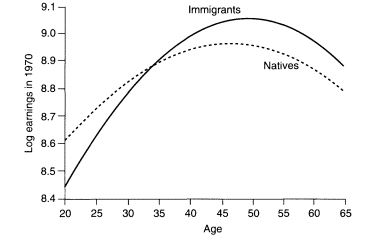
Figure 5.1
Cross-sectional age-earnings profiles of immigrants and natives in the United States, 1970.
consequences of the gap between wages of the native-born and of immigrants when they first arrive in this country could be ameliorated if the gap narrowed over time, as immigrants accumulate job experience in the U.S. labor market-in a process of economic assimilation. To learn whether immigrants indeed assimilate economically, we must follow individual immigrants or groups of immigrants over their careers and compare their outcomes with those of comparable native-born workers as their careers progress. Early research (Chiswick, 1978; Carliner, 1980) on this issue instead simply compared the earnings of immigrants and native workers of different ages at a point in time using a single cross-sectional data set.
The essential nature of the cross-sectional evidence is summarized in Figure 5.1, which illustrates the predicted age-earnings profiles of immigrants and natives implied by the 1970 census. At the time of arrival, immigrants earn about 17 percent less than natives. Because immigrants experience faster wage growth, their earnings appear to overtake native earnings within 15 years of arrival. After 30 years in the United States, the typical immigrant earns about 11 percent more than a comparable native worker.
These cross-sectional data lend support to a very optimistic view of rapid economic progress (or assimilation) of immigrants within their own generation. In this view, at the time of arrival, immigrants earn less than natives because they lack many of the skills that the U.S. labor market rewards (such as English proficiency). As these skills are acquired, the human capital of immigrants grows
relative to that of natives, and immigrants experience faster wage growth than natives.17
The basic problem with the optimistic interpretation of the cross-sectional data is that it draws inferences about how earnings of different cohorts of immigrant workers evolve over time from a single snapshot of the immigrant population (Borjas, 1985). But we already know that newly arrived immigrants are inherently different from those who migrated 20 years ago. If so, the situation of an immigrant worker who is 40 years old in 1990 cannot be used to predict the economic situation 20 years hence of an immigrant worker who is 20 years old in 1990. Because the relative labor market quality of newly arriving immigrant cohorts has been declining, a cross-sectional comparison of immigrants by age will tend to paint far too optimistic a rate at which immigrants will be able to assimilate.
Table 5.12 follows wage growth of specific cohorts of male immigrants and male natives across U.S. censuses.18 To illustrate the way to read these tables, consider those immigrants who arrived when they were between 25 and 34 years old in the late 1960s. These immigrants are first compared with natives in the same age groups in 1970. Then 10 years later, the wages of this same immigrant cohort are compared with those of natives who are now 10 years older (35 to 44 in 1980), and 20 years later to natives aged 45 to 54 years in 1990. A similar comparison for women is presented in Table 5.13. These data are stratified by schooling levels in the appendix to this chapter.
Let us start with male immigrants who arrived between 1965 and 1969 and who were relatively young at the time of arrival (that is, aged 25 to 34 years at the time of the 1970 census). These immigrants earned 11.2 percent less than native men in 1970, but only 3.1 percent less by 1990. Over a 20 year period, therefore, the wage of this immigrant cohort relative to that of native men increased by 8 percentage points. Once schooling levels are controlled, wage convergence is almost total for this immigrant cohort (see Appendix A: Table 5.A1).
A similar pattern of wage growth is experienced by other male immigrant cohorts who arrived at younger ages. For instance, examine the immigrant cohort that entered the United States between 1975 and 1979 and who were around age 30 at the time of arrival. These immigrants earned 21.8 percent less than natives
TABLE 5.12 Observed Relative Wage Growth of Specific Cohorts of Immigrant Men (Percentage Wage Differential Between Immigrants and Natives, by Age Group and Year of Arrival)
in 1980 and 16.3 percent less than natives in 1990. Comparably aged male immigrants who arrived between 1965 and 1969 had a similar experience: they earned 11.2 percent less than natives in 1970 and 6.6 percent less in 1980.
Men who enter the country at older ages tend to face more adverse economic opportunities, both initially and throughout their working lives. Men who arrived in the late 1970s and who were roughly aged 25 to 34 years at the time of arrival
TABLE 5.13 Observed Relative Wage Growth of Specific Cohorts of Immigrant Women (Percentage Wage Differential Between Immigrants and Natives, by Age Group and Year of Arrival)
earned 21.8 percent less than natives at the time of entry; men aged 45 to 54 years who entered the country at the same time earned 29.8 percent less than natives at the time of entry. This gap narrows little, if at all, over their lifetime. These much larger wage disparities among older immigrants, even after we control for
time since entry into the United States, suggests that their prior work experience is not valued highly in the U.S. labor market.
Although some patterns appear, especially when we stratify by schooling levels and age, no systematic pattern appears between the size of the initial immigrant wage deficit relative to native-born workers and the rate at which the two converge. The historical pattern suggests that the wage gap between young male immigrants and male natives may narrow by about 10 percentage points during the first two decades after immigration. This rate of convergence may have been sufficient to allow earlier male cohorts to catch up economically with natives. Because of the sizable cohort effects, however, more recent male cohorts are starting out at a much greater disadvantage. Although they may close their wage gap at the same pace that earlier cohorts did, the greater distance they have to travel implies that it will be very difficult, if not impossible, for them to fully close it. 19
Following a given cohort of immigrant women over time, one finds that the gap in wages between immigrants and natives narrows somewhat. The gap for those entering between 1970 and 1974 narrows by about 3 percentage points for each of the age groups (see Table 5.13). The 1975-1979 cohort starts out with larger wage gaps in 1980, but has larger gains—about 8 percentage points for the 25 to 34 and 45 to 54 age groups, but less than 3 percentage points for the 35 to 44 age group. Like immigrant men, immigrant women make small gains relative to natives over time, but because the wage gap for women is narrower to begin with, immigrant women come closer to catching up to natives than do immigrant men.
During the past few decades, the labor market underwent a number of other structural changes that may have affected the economic prospects of newly arriving immigrants. The most important change was the sharp widening in wage inequality in the labor market over the last two decades; these historic changes did not affect all skill groups equally (Murphy and Welch, 1992). In particular, the wage gap between highly educated and less educated workers widened considerably, as did that between workers with many years of experience and new labor market entrants and that among workers within narrowly defined occupation and industry cells. The simplest summary is that, across many dimensions, those with less skill saw their wages fall significantly relative to those with more skill.
These changes in the wage structure are unlikely to have affected the earnings of immigrant and native workers by the same percentage, since immigrants are relatively less skilled. Because the wages of unskilled labor (including the
native-born) fell over the last two decades, the relative wage of immigrants would have fallen over time even if immigrant skills had remained constant.20
It is very unlikely, however, that this changing wage structure can fully account for the downward trend in relative wages across successive immigrant cohorts, or for the slow pace of wage convergence between immigrants and natives. The same general trends appear in educational attainment, a measure of skill that is invariant to changes in the wage structure. Such data clearly show that the relative decline in skills cannot be attributed solely to the changing wage structure of the United States.
The average rates of wage convergence reported for all immigrants hide a great deal of variation across national-origin groups. To show this diversity, Table 5.14 presents a similar tracking of the wage experience of male immigrants separately for Mexican and non-Mexican immigrants.21 Male Mexican immigrants, who also happen to have some of the lowest initial wage levels, experienced essentially no career wage convergence what so ever—in fact, they may have experienced a decline in their relative wage over time (see also Smith, 1997). In contrast, immigrants (from Europe, China, Korea, and Japan) experienced a great deal of wage convergence over the 1970-1990 period. Within their own work careers, Mexican immigrants have a much more difficult time closing their sizable wage gaps with natives.
The decline in wages of initial entry cohorts appears to characterize non-Mexican as well as Mexican immigrants. Controlling for age and time since immigration, the wage gap for new immigrants has widened substantially over time. For example, Mexican male immigrants 25 to 34 who arrived between 1965 and 1969 had an initial wage gap of 39.8 percent; this gap had broadened to 51.1 percent among men of the same ages who came 10 years later.
In sum, the typical immigrant experienced a modest amount of economic assimilation during his or her time in the United States, but this average hides a great deal of dispersion across national-origin groups. In particular, Mexican immigrants, who have very high initial wage gaps with native-born workers, experience no wage convergence with natives during their time in the United States. In contrast, immigrant groups from Europe and Asia experienced significant wage convergence with native workers.
|
20 |
Essentially, this argument claims that period effects influence the wage of immigrants and natives by the same relative amount. Period effects refer to those changes in economic conditions that are associated with calendar time. For example, we may be experiencing a boom in some years and an economic recession in others. |
|
21 |
The data for women are included in Appendix A: Table 5.A3. The patterns are quite similar to those obtained for men. |
TABLE 5.14 Observed Wage Growth of Specific Cohorts of Immigrant Men from Mexico and from Countries Other Than Mexico
|
|
Year |
||
|
Cohort/Age Group |
1970 |
1980 |
1990 |
|
Immigrants from Mexico |
|||
|
1960-64 arrivals |
|||
|
15-24 in 1970 |
— |
-11.2 |
-20.0 |
|
25-34 in 1970 |
-24.0 |
-26.9 |
-35.9 |
|
35-44 in 1970 |
-37.6 |
-35.7 |
-35.9 |
|
45-54 in 1970 |
-41.9 |
-41.0 |
— |
|
1965-69 arrivals |
|||
|
15-24 in 1970 |
|
-18.9 |
-29.2 |
|
25-34 in 1970 |
-39.8 |
-31.9 |
-39.5 |
|
35-44 in 1970 |
-52.2 |
-38.2 |
-44.7 |
|
45-54 in 1970 |
-49.0 |
-36.7 |
— |
|
1970-74 arrivals |
|||
|
25-34 in 1980 |
— |
-27.0 |
-35.9 |
|
35-44 in 1980 |
— |
-38.7 |
-47.2 |
|
45-54 in 1980 |
— |
-45.8 |
-47.8 |
|
1975-79 arrivals |
|||
|
15-24 in 1980 |
— |
-40.0 |
-43.2 |
|
25-34 in 1980 |
— |
-51.1 |
-52.7 |
|
35-44 in 1980 |
— |
-53.6 |
-54.5 |
|
1980-84 arrivals |
|||
|
25-34 in 1990 |
— |
— |
-37.4 |
|
35-44 in 1990 |
— |
— |
-51.1 |
|
45-54 in 1990 |
— |
— |
-57.3 |
|
1985-90 arrivals |
|||
|
25-34 in 1990 |
— |
— |
-44.7 |
|
35-44 in 1990 |
— |
— |
-55.1 |
|
45-54 in 1990 |
— |
— |
-62.1 |
|
Immigrants from Countries Other Than Mexico |
|||
|
1960-64 arrivals |
|||
|
15-24 in 1970 |
— |
5.7 |
12.0 |
|
25-34 in 1970 |
9.1 |
7.1 |
10.0 |
|
35-44 in 1970 |
-0.5 |
-0.1 |
9.7 |
|
45-54 in 1970 |
-11.8 |
-5.7 |
— |
|
1965-69 arrivals |
|||
|
15-24 in 1970 |
|
2.1 |
4.6 |
|
25-34 in 1970 |
-7.5 |
0.2 |
6.5 |
|
35-44 in 1970 |
-14.0 |
-12.9 |
-4.1 |
|
45-54 in 1970 |
-20.7 |
-19.6 |
— |
|
1970-74 arrivals |
|||
|
25-34 in 1980 |
— |
-3.5 |
5.6 |
|
35-44 in 1980 |
— |
-11.3 |
-5.2 |
|
45-54 in 1980 |
— |
-22.3 |
-14.0 |
Emigration
A significant fraction of immigrants residing in the United States eventually return to their country of origin. The Census Bureau makes population projections by assuming that 30 percent of immigrant flows return to their countries of origin (or migrate elsewhere). The changing composition of immigrant cohorts across censuses suggests that the wage convergence derived by tracking this group over time might be biased if the typical return migrant differs from the typical immigrant who chooses to remain in the United States. If return migrants are disproportionately workers who have lower than average wages, intercensus tracking of immigrant cohorts may indicate an improvement in relative wages, even if none has taken place. Alternatively, the rate of wage convergence would be underestimated if return migrants are the more successful members of the original immigrant cohort.
The United States does not collect information on the number or skill composition of return migrants, so the available data do not permit a systematic study of the potential biases introduced by return migration. Nevertheless, there is a simple way of ascertaining the relative importance of this bias. Let  be the average (log) wage of a cohort of immigrants at the time of entry (period 0) relative to the wage of natives, and let w1s be the average relative (log) wage of
the sample of survivors in period 1 (that is, the average wage of those immigrants who chose to remain in the United States relative to the wage of natives in period 1). A fraction r of the immigrants will leave the United States between periods 0 and 1; assume that there is no sample attrition in the native population. We can then write the observed rate of wage convergence over this period for this particular cohort of immigrants as:

(3)
where w0S is the average relative entry wage of immigrants who remained in the United States; and w0R is the average relative entry wage of the immigrants who returned home. We can rewrite equation 3 as:

(4)
Equation 4 shows the relationship between the observed rate of wage growth and the true rate of wage growth (w1S - w0S) experienced by the sample of survivors.
Note that the observed rate of wage growth is a biased measure of the true rate as long as the sample of survivors differs from the sample of return migrants (that is, as long as w0S ≠ w0R).
No direct empirical evidence tells us about how much the entry wage of immigrants who remain in the United States differs from the entry wage of immigrants who do not. Equation 4 suggests, however, that the observed rate of wage convergence estimated by tracking cohorts across censuses cannot be far off the mark for reasonable parameter values. Suppose subsequent emigration rates are about 30 percent and out-migrants are the successes (they have higher wages than those who remain in the United States).22 If immigrants who leave earn about 30 percent more than those who stay, equation 4 then indicates that the true rate of wage convergence is about 9 percentage points higher than the observed rate of wage convergence. The data in Table 5.12 suggest, however, that even if we add 9 percentage points to the wage growth experienced by the surviving immigrants, the wage of recent immigrants will remain far below that of native workers.
Trends in Employment
Although most research focuses on wages of immigrants and natives, there are other salient labor market outcomes. One of the most important involves the likelihood of working. Trends in employment propensities for males are documented in Table 5.15, which lists employment rates for male immigrants relative to those of native-born men; Table 5.16 presents parallel evidence for women.
|
22 |
If the out-migrants are persons with relatively low wages, then the estimated rate of wage convergence reported in Table 5.12 overestimates the actual rate. |
TABLE 5.15 Observed Growth in Relative Employment Rates of Specific Cohorts of Immigrant Men (Difference Between Immigrant Men and Native Men in Percentage of the Population That Is Employed, by Age Group and Year of Arrival)
Since these tables have exactly the same format as those that tracked cohort-specific trends in wages, they can be used to examine both changes in employment across immigrant cohorts as well as career trajectories in relative employment rates of immigrants.23
TABLE 5.16 Observed Growth in Relative Employment Rates of Specific Cohorts of Immigrant Women (Difference Between Immigrant and Native Women in Percentage of the Population That Is Employed, by Age Group and Year of Arrival)
Each number in these tables expresses the difference between the percentage of immigrants and natives of the same ages who are employed. For example, men who arrived between 1965 and 1969 and were aged 25 to 34 years in 1970 had an employment rate in 1970 that was 5.4 percentage points lower than that of natives aged 25 to 34. Ten-years later, they were 1 percentage point more likely to be employed than were natives of the same ages (now 35 to 44). By the time they were ages 45 to 54 in 1990, this group of immigrants had a 2.4 percentage point higher employment rate than did their native counterparts.
For both men and women, there are two salient trends in these employment rates. First, the employment rates of newly entering immigrant cohorts have been declining relative to those of natives. Second, most of that initial employment deficit seems to disappear the longer the immigrants remain in this country.
Finding employment apparently has been much more difficult for new entrants in recent years. For example, in 1970, men aged 25 to 34 years who had been in the country less than five-years had an employment rate 5.4 percentage points lower than that of natives. By 1980, the employment deficit had deepened to 11.4 percentage points, and it was 9.6 percentage points for that age group in the newest entry cohort in 1990.
Even more dramatic cohort trends in relative employment appear for women. In their first five-years in the United States, women aged 25 to 34 years had exactly the same employment rate as native-born women in 1970; but, by 1980, a deficit of 13.7 percentage points had opened, and by 1990 it had widened to 22.3 percentage points. The reason was not that immigrant women weren't employed at the same rate; in fact, their employment rate remained essentially the same. It was, rather, the striking expansion in the other part of the comparison, the employment among native-born women: in 1970, barely half of these women worked; by 1990, two-thirds of them did.
Although successive cohorts of new immigrants have ever wider employment deficits against their native counterparts, the gaps consistently narrow the longer immigrants remain in the United States.
For men, the end result has generally been employment rates equal to or above those of natives.24 The situation for immigrant women is more complicated. The data in Table 5.16 do indicate that their initial employment gap is substantially reduced as their stay lengthens. However, there is not yet enough time in the United States to know whether these large employment gaps for recent immigrant women will ultimately close altogether. For immigrants arriving in the 1970s and 1980s who began with a large deficit, the initial rise has not yet generally brought their employment rates up to those of natives.
What factors explain these large differences in employment rates between immigrant and native women? Shifts in the national origins of new female immigrants can account for approximately one-third of the relative decline in employment between the cohorts who entered before 1970 and those entering in the
1980s, according to Funkhouser and Trejo (1996). These authors also find that the change in distribution of education and the decline in English proficiency among more recent immigrants play a supporting role.25
Moreover, the low rates of employment among newly entering female immigrant cohorts may simply be a consequence of current immigration policies. The entry years to which we refer in these tables do not mark the date these women became legal immigrants but rather the date they entered the United States. Many arrived as spouses with visas that explicitly prohibited or severely limited their working in the United States. Once these restrictions were removed, employment rates of immigrant women converged toward those of native-born women. 26
For both men and women, the employment rates of new immigrant cohorts have been declining relative to those of native workers. Immigrants catch up relatively quickly, however, so that after some years they exhibit employment rates quite similar to those of natives.
Occupations and Jobs
Our first principles discussion in the previous chapter suggested that immigrants and native-born workers may hold quite different jobs. To see how far this is true, we pay special attention to the concentration of immigrants in certain occupations. We know that immigrants, relative to natives, are overrepresented at both ends of the educational spectrum. And it may be that this concentration is reflected in the jobs they hold: immigrants may be disproportionately included in both some very low-skilled and some very highly skilled occupations.27
Tables 5.17 and 5.18 examine two groups of occupations with above-average representation of immigrants: those that require a great deal of formal skill and those that require relatively little skill. For the occupations listed, the first and third columns provide the fraction of all labor that is foreign-born at the
|
25 |
Potentially, differences in family structure may also be important in affecting comparisons of immigrant and native women. Chapter 2 presented evidence that immigrant women were more likely to be married and have more children than native women of comparable ages. However, Funkhouser and Trejo document that the difference between natives and immigrants in rates of childbearing and marriage are not large enough to be a primary determinant of the differences in their rates of employment. |
|
26 |
One of the important missing pieces of information is what employment rates of immigrant women were in their home countries. Such data are required to know the direct impact of immigration on the likelihood of working for immigrant women. |
|
27 |
Twelve percent of all hours worked by natives were accounted for by those who had neither graduated from high school nor received an equivalent degree: the comparable figure for immigrants was 32.0 percent. This share was even larger for recent immigrants—34.5 percent. Immigrants are also overrepresented at the high end of the educational distribution, but not nearly so extremely as at the low end. Among native workers, 3.5 percent of hours in 1990 were worked by those having a professional degree or a Ph.D., compared with 5.5 percent among immigrants. |
national level and for the six largest immigration states, respectively. 28 The second and fourth columns list the proportions of recent immigrants in all foreign-born labor in the occupation. In both tables, separate listings are provided for men and women.
How were the particular occupations listed selected? In Table 5.17, which lists the top 20 high-education occupations, the ranking is in terms of the proportion who are foreign-born. Occupations are designated as ''high education" if the percentage of native-born employees with professional degrees or Ph.D.s is above the national average for native-born workers.29 These occupations mainly involve college teaching, science, and the health field. The predominance of college professors is particularly striking in the list of occupations for men. That immigrants predominate among foreign language teachers is not surprising, but they also account for a very large fraction of many other disciplines. For example, more than one out of every four physics professors is an immigrant, as is about one out of every five doctors.30
The relative fraction of all immigrant workers who are new immigrants offers some hint about whether any of these occupations serve as entry-level jobs for new immigrants. Many new male immigrants are dental assistants, and a popular field for new female immigrants is teaching economics. The fraction of new immigrants in a field also may tell us something about the job prospects in that occupation. For example, male immigrants display about the same overall fraction in both the math and sociology teaching, but the proportion of the foreign-born who are new immigrants is four times as large.
Table 5.18 provides a parallel list of the 20 low-education occupations with the greatest immigrant representation. A low-education occupation is defined as one in which the percentage of native-born employees with less than a high school
TABLE 5.17 Top 20 High-Education Occupations, Ranked by Immigrant Share of Hours Worked
|
|
National Share of Hours Worked |
Share of Hours Worked in 6 Immigration Statesa |
|||
|
Occupation |
All Immigrants |
Recent/ All |
All Immigrants |
Recent/ All |
|
|
Men |
|||||
|
1. |
Foreign language teachers |
38.5 |
33.2 |
37.1 |
42.8 |
|
2. |
Physics teachers |
30.8 |
38.6 |
39.0 |
32.1 |
|
3. |
Health record technologists and technicians |
29.6 |
39.2 |
46.9 |
40.3 |
|
4. |
Medical scientists |
29.0 |
69.6 |
40.7 |
65.8 |
|
5. |
Dental assistants |
25.4 |
71.6 |
38.3 |
73.0 |
|
6. |
Political science teachers |
24.9 |
43.7 |
43.2 |
55.5 |
|
7. |
Social science teachers, n.e.c. |
21.8 |
32.8 |
47.5 |
74.7 |
|
8. |
Medical science teachers |
21.2 |
20.9 |
24.6 |
17.1 |
|
9. |
Physicians |
19.0 |
22.3 |
25.2 |
23.0 |
|
10. |
Engineering teachers |
18.0 |
42.8 |
24.4 |
41.4 |
|
11. |
Computer science teachers |
16.8 |
44.1 |
20.9 |
11.9 |
|
12. |
Economics teachers |
16.5 |
31.9 |
27.1 |
34.1 |
|
13. |
Physicists and astronomers |
16.0 |
45.1 |
20.2 |
50.1 |
|
14. |
Earth, environmental and marine science teachers |
16.0 |
49.6 |
33.6 |
62.0 |
|
15. |
Postsecondary teachers, subject not specified |
15.9 |
43.6 |
19.6 |
42.5 |
|
16. |
Chemists, except biochemists |
15.8 |
38.6 |
21.6 |
37.5 |
|
17. |
Health specialties teachers |
14.8 |
31.2 |
13.3 |
26.6 |
|
18. |
Chemistry teachers |
14.4 |
26.6 |
19.0 |
16.9 |
|
19. |
Sociology teachers |
14.2 |
14.5 |
21.7 |
0.0 |
|
20. |
Mathematical science teachers |
13.8 |
59.2 |
14.4 |
55.2 |
|
Women |
|||||
|
1. |
Foreign language teachers |
39.8 |
39.7 |
50.0 |
33.7 |
|
2. |
Political science teachers |
31.9 |
43.3 |
53.0 |
100.0 |
|
3. |
Physicians |
23.4 |
27.2 |
31.8 |
27.2 |
|
4. |
Dentists |
23.4 |
29.1 |
35.8 |
30.8 |
|
5. |
Chemists, except biochemists |
21.0 |
37.2 |
32.2 |
38.5 |
|
6. |
Artists, performers, and related occupations |
20.5 |
31.0 |
25.1 |
31.2 |
|
7. |
History teachers |
17.8 |
20.0 |
2.0 |
100.0 |
|
8. |
Social science teachers, n.e.c. |
17.0 |
64.9 |
38.3 |
100.0 |
|
9. |
Architects |
16.2 |
37.5 |
25.4 |
40.4 |
|
10. |
Medical scientists |
16.1 |
47.3 |
20.8 |
47.8 |
|
11. |
Actuaries |
15.2 |
19.6 |
18.2 |
18.1 |
|
12. |
Biological and life scientists |
15.1 |
41.0 |
21.6 |
42.9 |
|
13. |
Physicists and astronomers |
14.7 |
47.7 |
18.1 |
25.4 |
|
|
|
National Share of Hours Worked |
Share of Hours Worked in 6 Immigration Statesa |
||
|
Occupation |
All Immigrants |
Recent/ All |
All Immigrants |
Recent/ All |
|
|
14. |
Science technicians, n.e.c. |
14.4 |
48.3 |
26.9 |
46.9 |
|
15. |
Chemical engineers |
14.3 |
24.9 |
17.3 |
19.9 |
|
16. |
Economics teachers |
13.5 |
56.1 |
9.8 |
100.0 |
|
17. |
Social work teachers |
13.4 |
0.0 |
22.3 |
0.0 |
|
18. |
Pharmacists |
12.3 |
21.8 |
24.5 |
21.9 |
|
19. |
Computer science teachers |
12.2 |
16.5 |
23.2 |
21.3 |
|
20. |
Statisticians |
11.5 |
33.1 |
16.5 |
33.1 |
|
a High immigration states are California, Florida, Illinois, New Jersey, New York, and Texas. Note: High education occupations are defined as those in which at least 3.46 percent of all hours worked by native workers are accounted for by those with a professional degree or a Ph.D., and less than 12.19 percent of native hours are accounted for by those with less than a high school diploma or equivalent (3.46 percent and 12.19 percent represent the overall fraction of hours accounted for by workers in the respective education groups). For the country as a whole, immigrants accounted for 9.3 percent of all hours worked by men, and 8.7 percent of all hours worked by women, with recent immigrants accounting for 3.5 percent among men and 2.8 percent among women. In high education occupations in which immigrants are overrepresented, immigrants account for 15.2 percent of male employment, and 11.2 percent of female employment. Of all hours worked by immigrants, 5.7 percent are accounted for by such occupations among men, and 7.4 percent among women. The analogous numbers for natives are 3.3 percent for men and 5.7 percent for women. Occupations for which there were fewer than 10 observations in the Census Public Use Microsample (PUMS) sample are excluded. Source: Tabulations from the 1970, 1980, and 1990 Public Use Samples of the U.S. Census of Population. The statistics are calculated in the subsample of men and women aged 25-64 years who did not reside in group quarters. |
|||||
diploma is below the percentage among all native-born workers.31 These occupations separate into those that appear to be relatively menial and those that are skilled crafts that require little formal schooling. This last category includes, for example, tailors, dressmakers, cooks, and jewelers; the former includes farm laborers, parking lot attendants, and private household cleaners and servants.
The concentration of immigrants is much more dramatic for the low-education occupations than for the high-education occupations, reflecting the greater
TABLE 5.18 Top 20 Low-Education Occupations, Ranked by Immigrant Share of Hours Worked
|
|
National Share of Hours Worked |
Share of Hours Worked in 6 Immigration Statesa |
|||
|
Occupation |
All Immigrants |
Recent/ All |
All Immigrants |
Recent/ All |
|
|
Men |
|||||
|
1. |
Tailors |
58.8 |
29.5 |
75.1 |
31.7 |
|
2. |
Waiters'/waitresses' assistants |
55.2 |
68.3 |
70.0 |
68.7 |
|
3. |
Cooks, private household |
52.8 |
58.9 |
78.0 |
54.9 |
|
4. |
Dressmakers |
49.5 |
58.9 |
74.1 |
54.6 |
|
5. |
Housekeepers and butlers |
47.6 |
66.1 |
46.8 |
48.8 |
|
6. |
Graders and sorters, agricultural products |
43.6 |
44.1 |
66.5 |
42.0 |
|
7. |
Nursery workers |
41.9 |
56.1 |
61.0 |
54.4 |
|
8. |
Waiters and waitresses |
40.5 |
50.7 |
53.7 |
49.8 |
|
9. |
Cooks |
39.0 |
51.6 |
54.9 |
51.0 |
|
10. |
Miscellaneous food preparation occupations |
38.1 |
65.5 |
59.9 |
65.8 |
|
11. |
Textile sewing machine operators |
37.5 |
56.2 |
77.1 |
59.0 |
|
12. |
Precious stones and metals workers (jewelers) |
35.3 |
41.3 |
53.4 |
43.1 |
|
13. |
Parking lot attendants |
35.0 |
61.4 |
48.9 |
61.4 |
|
14. |
Shoe repairers |
34.4 |
41.2 |
56.9 |
41.4 |
|
15. |
Taxicab drivers and chauffeurs |
32.2 |
51.1 |
44.7 |
50.9 |
|
16. |
Kitchen workers, food preparation |
31.9 |
52.1 |
46.0 |
52.3 |
|
17. |
Private household cleaners and servants |
31.9 |
55.4 |
46.5 |
53.3 |
|
18. |
Solderers and brazers |
31.5 |
50.1 |
60.3 |
49.8 |
|
19. |
Food counter, fountain and related occupations |
30.2 |
49.7 |
44.7 |
51.3 |
|
20. |
Bakers |
29.5 |
46.5 |
46.9 |
50.0 |
|
Women |
|||||
|
1. |
Production samplers and weighers |
47.1 |
21.1 |
75.6 |
22.4 |
|
2. |
Housekeepers and butlers |
45.8 |
63.2 |
62.4 |
62.8 |
|
3. |
Tailors |
45.7 |
32.5 |
70.2 |
34.8 |
|
4. |
Miscellaneous precision apparel and fabric workers |
43.5 |
31.1 |
60.2 |
35.8 |
|
5. |
Graders and sorters, agricultural products |
43.4 |
39.8 |
62.3 |
37.9 |
|
6. |
Private household cleaners and servants |
37.5 |
57.3 |
58.6 |
58.0 |
|
7. |
Dressmakers |
37.2 |
35.4 |
60.2 |
38.8 |
|
8. |
Patternmakers, layout workers, and cutters |
34.0 |
29.4 |
4.1 |
100.0 |
|
|
National Share of Hours Worked |
Share of Hours Worked in 6 Immigration Statesa |
|||
|
Occupation |
All Immigrants |
Recent/ All |
All Immigrants |
Recent/ All |
|
|
9. |
Cooks, private household |
31.6 |
46.0 |
51.9 |
45.0 |
|
10. |
Numerical control machine operators |
29.1 |
33.3 |
65.4 |
51.0 |
|
11. |
Textile sewing machine operators |
27.3 |
41.1 |
72.9 |
43.2 |
|
12. |
Farmworkers |
25.8 |
42.3 |
53.3 |
40.9 |
|
13. |
Child care workers, private household |
24.8 |
68.1 |
44.3 |
69.1 |
|
14. |
Electrical and electronic equipment assemblers |
23.4 |
34.1 |
42.3 |
36.6 |
|
15. |
Graders and sorters, except agricultural |
23.1 |
35.6 |
49.4 |
35.1 |
|
16. |
Inspectors, agricultural products |
23.1 |
53.0 |
32.6 |
54.7 |
|
17. |
Maids and housemen |
23.0 |
45.0 |
42.2 |
45.3 |
|
18. |
Parking lot attendants |
23.0 |
42.4 |
43.1 |
45.8 |
|
19. |
Precious stones and metals workers (jewelers) |
22.8 |
45.6 |
40.0 |
43.2 |
|
20. |
Elevator operators |
22.7 |
51.7 |
35.7 |
36.0 |
|
a High immigration states are California, Florida, Illinois, New Jersey, New York, and Texas. Note: Low education occupations are defined as those in which at least 12.19 percent of all hours worked by native workers are accounted for by those with less than a high school diploma or equivalent (12.19 percent represents the overall fraction of hours accounted for by workers with less than a high school diploma). For the country as a whole, immigrants accounted for 9.3 percent of all hours worked by men, and 8.7 percent of all hours worked by women, with recent immigrants accounting for 3.5 percent among men and 2.8 percent among women. In low education occupations in which immigrants are overrepresented, immigrants account for 16.3 percent of male employment, and 15.1 percent of female employment. Of all hours worked by immigrants, 38.0 percent were accounted for by such occupations among men, and 45.0 among women. The analogous numbers for natives were 20.1 for men and 24.2 for women. Occupations for which there were fewer than 10 observations in the Census Public Use Microsample (PUMS) sample are excluded. Source: Tabulations from the 1970, 1980, and 1990 Public Use Samples of the U.S. Census of Population. The statistics are calculated in the subsample of men and women aged 25-64 years who did not reside in group quarters. |
|||||
overrepresentation at the low end of the education distribution. For example, the majority of tailors are immigrants, and so are close to half of all housekeepers and butlers.32
The degree to which immigrants dominate some of these fields is remarkable. In the large immigrant states, three out of every four tailors, cooks, and textile workers are immigrants. A majority of taxicab drivers and service workers in homes are immigrants. These jobs are consistent with our first principles expectations. Some industries, such as textiles, that are dominated by immigrants are substitutes for trade in the same products and would not exist domestically without immigrants. Other jobs employing many immigrants are in the nontraded goods sector (restaurant and private household work). These services would not exist on the same scale without immigrants, and the main economic impact may well be in the form of lower prices.
The second and fourth columns in Table 5.18 give the percentage of all immigrant hours that are worked by recent immigrants—an indicator of entry-level jobs for new immigrants. For example, in the country as a whole, immigrants work about 53 percent of all the hours any man works as a cook in a private household. Of all the hours that all immigrant men work as cooks, new immigrants account for about 59 percent. That means that the new immigrants account for 31 percent (0.528 times 0.589) of all the hours any man—native- or foreign-born, new or established immigrant—spends cooking for private families. A common entry point for low-skilled male immigrants is waiting on tables, often in ethnic restaurants owned by older immigrants with the same ethnic background. New low-skilled female immigrants clean houses and often care for the children who live in them. Within these low-education occupations, the share of recent male immigrants as a fraction of all male immigrants exceeds 60 percent for such jobs as waiters' or waitresses' assistants, miscellaneous food preparation, and parking lot attendants. New female immigrants account for over 60 percent of the hours worked as housekeepers and child care workers in private homes by all foreign-born labor.
Each of these tables contains data based on employment in the six states with the largest inflows of immigrants between 1980 and 1990—California, Florida, Illinois, New Jersey, New York, and Texas. Not surprisingly, given the much greater share of immigrants in the labor market in these states (17.6 percent for men and 16.1 percent for women), immigrant shares in these occupations are generally higher there. But not by a uniform degree: the difference between the shares for the nation and for the high-immigration states is much larger for the low-education occupations. Averaging across the occupations in the two lists, the average difference between the national share and the six-state share is about 6 percent for the high-education occupations, and about 18 percent for the low-education occupations.
These figures suggest that, to some extent, immigrants with high skills and high education see the market for their services as national in scope. They are not as geographically concentrated as low-skilled immigrants are, and they are as likely as not to work with and for native-born Americans. In contrast, low-wage immigrants work largely in the big immigrant states. Their labor market bound-
TABLE 5.19 Top 20 Medium-Education Occupations, Ranked by Native Share of Hours Worked
|
|
National Share of Hours Worked |
Share of Hours Worked in 6 Immigration Statesa |
|||
|
Occupation |
All Immigrants |
Recent/ All |
All Immigrants |
Recent/ All |
|
|
Men |
|||||
|
1. |
Tool and die maker apprentices |
0.0 |
— |
0.0 |
— |
|
2. |
Supervisors, firefighting and fire prevention occupations |
0.9 |
0.0 |
1.8 |
0.0 |
|
3. |
Classified ad clerks |
1.0 |
100.0 |
2.0 |
100.0 |
|
4. |
Forestry and conservation scientists |
1.3 |
5.0 |
1.7 |
0.0 |
|
5. |
Firefighting occupations |
1.3 |
20.1 |
2.1 |
20.0 |
|
6. |
Administrators, protective services |
1.5 |
16.6 |
3.3 |
18.7 |
|
7. |
Sheriffs, bailiffs, and other law enforcement officers |
1.7 |
16.1 |
2.9 |
16.4 |
|
8. |
Postmasters and mail superintendents |
1.9 |
24.8 |
3.1 |
26.3 |
|
9. |
Supervisors, police and detectives |
1.9 |
16.7 |
2.9 |
16.0 |
|
10. |
Fire inspection and fire prevention occupations |
2.0 |
15.1 |
3.1 |
20.7 |
|
11. |
Telephone line installers and repairers |
2.2 |
18.6 |
4.5 |
20.9 |
|
12. |
Power plant operators |
2.3 |
19.8 |
5.3 |
20.4 |
|
13. |
Police and detectives, public service |
2.3 |
12.8 |
3.9 |
13.0 |
|
14. |
Locomotive operating occupations |
2.5 |
16.3 |
5.3 |
13.2 |
|
15. |
Correctional institution officers |
2.6 |
23.6 |
4.3 |
26.4 |
|
16. |
Teachers, secondary school |
3.2 |
22.7 |
4.9 |
28.4 |
|
17. |
Commissioned officers and warrant officers |
3.4 |
23.0 |
4.4 |
22.4 |
|
18. |
Broadcast equipment operators |
3.4 |
27.7 |
6.1 |
33.5 |
|
19. |
Teachers, elementary school |
3.5 |
26.9 |
6.4 |
28.6 |
|
20. |
Air traffic controllers |
3.6 |
23.9 |
6.4 |
23.4 |
|
Women |
|||||
|
1. |
Mining engineers |
0.0 |
— |
0.0 |
— |
|
2. |
Helpers, extractive occupations |
0.0 |
— |
0.0 |
— |
|
3. |
Supervisors, firefighting and fire prevention occupations |
0.0 |
— |
0.0 |
— |
|
4. |
Captains and other officers, fishing vessels |
0.0 |
— |
0.0 |
— |
|
5. |
Patternmakers and model makers, wood |
0.0 |
— |
0.0 |
— |
|
6. |
Supervisors, forestry and logging workers |
0.0 |
— |
0.0 |
— |
|
|
National Share of Hours Worked |
Share of Hours Worked in 6 Immigration Statesa |
|||
|
Occupation |
All Immigrants |
Recent/ All |
All Immigrants |
Recent/ All |
|
|
7. |
Postmasters and mail superintendents |
1.3 |
5.9 |
4.2 |
3.8 |
|
8. |
Supervisors, material moving equipment operators |
1.6 |
0.0 |
3.8 |
0.0 |
|
9. |
Power plant operators |
1.9 |
0.0 |
5.6 |
0.0 |
|
10. |
Correctional institution officers |
2.0 |
11.4 |
3.3 |
10.6 |
|
11. |
Sheriffs, bailiffs, and other law enforcement officers |
2.1 |
12.2 |
2.9 |
20.6 |
|
12. |
Speech therapists |
2.1 |
27.7 |
3.5 |
21.0 |
|
13. |
Supervisors, police and detectives |
2.3 |
9.5 |
3.8 |
12.0 |
|
14. |
Meter readers |
2.4 |
9.0 |
5.3 |
13.2 |
|
15. |
Air traffic controllers |
2.4 |
25.4 |
4.1 |
33.0 |
|
16. |
Dispatchers |
2.4 |
14.0 |
4.4 |
15.3 |
|
17. |
Railroad conductors and yard masters |
2.5 |
0.0 |
4.9 |
0.0 |
|
18. |
Commissioned officers and warrant officers |
2.5 |
36.0 |
4.6 |
45.9 |
|
19. |
Mail carriers, postal service |
2.7 |
29.0 |
5.1 |
27.8 |
|
20. |
Firefighting occupations |
2.8 |
0.0 |
4.9 |
0.0 |
|
a High immigration states are California, Florida, Illinois, New Jersey, New York, and Texas. Note: Medium-education occupations are defined as those in which less than 12.19 percent of all hours worked by native workers were accounted for by those with less than a high school diploma or equivalent, and less than 3.46 percent of all hours worked by native workers were accounted for by those with a graduate or professional degree (12.19 percent and 3.46 percent represent the overall fraction of hours accounted for by workers in those education groups). For the country as a whole, immigrants accounted for 9.3 percent of all hours worked by men, and 8.7 percent of all hours worked by women, with recent immigrants accounting for 3.5 percent among men and 2.8 percent among women. In medium-education occupations in which immigrants were underrepresented, immigrants accounted for 6.6 percent of male employment and 5.7 percent of female employment. Of all hours worked by immigrants, 25.4 percent were accounted for by such occupations among men, and 32.5 among women. The analogous numbers for natives were 37.2 for men and 51.3 for women. Occupations for which there were fewer than 10 observations in the Census Public Use Microsample (PUMS) sample are excluded. Source: Tabulations from the 1970, 1980, and 1990 Public Use Samples of the U.S. Census of Population. The statistics are calculated in the subsample of men and women aged 25-64 years who did not reside in group quarters. |
|||||
aries appear to be much more local in scope, and many of them work with and for other immigrants.
If immigrants are highly concentrated in certain jobs, they are almost invisible in others. Table 5.19 lists the 20 medium-education occupations in which immigrants have the lowest representation. Medium-education occupations are those in which the native-born with either low or high education levels are underrepresented compared with their overall representation among all native-born workers. For men, these are primarily public-sector occupations, such as firefighters and law enforcement officers. The list for women also includes public-sector occupations, but a number of others appear to be occupations that are traditionally male, such as mining engineers, helpers in extractive occupations, and captains of fishing vessels.
All in all, the data suggest that the jobs of immigrant and native workers are different. One can find jobs that are dominated by immigrants at both the high and the low end of the educational distribution: teachers and scientists at the high end, service workers and what are sometimes referred as crafts people at the low end. Immigrants are less prominent in jobs that require intermediate levels of education.
Some of the heterogeneity in the skills of recent immigrants is an artifact of the preference categories in which they were admitted. Employment-preference immigrants are heavily concentrated in two highly skilled kinds of occupation: executive, administrative, and managerial posts and professional specialties. A sizable proportion of refugees and of those admitted to reunite with their families are concentrated in the low-skilled occupations; they are employed as service workers and as operators, fabricators, and laborers.33
To sum up: mirroring the situation in education, although foreign-born men are somewhat more likely to be in the high-education, high-paying jobs, they are far more commonly found to be working in the low-education, low-paying jobs. Compared with natives, immigrant men are found in some occupations requiring high levels of education, such as college teachers of foreign-languages and medical scientists, as well as in some occupations requiring little schooling, such as tailors, waiters' and waitresses' assistants, and housekeepers and butlers. The picture for immigrant women is similar to that for immigrant men. They are disproportionately employed in some high-education occupations, such as foreign language teachers and physicians, but they also make up a large share of employment in many more
occupations that require little schooling: tailors, graders and sorters of agricultural products, and private household service workers.
Impact of Immigrants on Native Earnings and Employment
To this point, we have talked mostly about the economic impacts of immigration on immigrants themselves. But do immigrants alter the earnings and employment opportunities of natives? If so, how much? Are all native groups equally affected by the entry of immigrants into the labor market?
In this section, we summarize the empirical evidence about the impacts that immigrants have on the wage structure of natives. Again, this summary is guided by the first principles discussion in the previous chapter. Although immigration yields a positive net economic gain to the native-born, there may be some winners and losers among native-born workers. In general, we should expect that the wages of native-born workers who are complements (the more skilled) should rise, and the wages of those who are substitutes (the less skilled) for immigrants should fall.
What determines the magnitude of these potential effects? Recall the example presented in Chapter 4 in which we drew the demand curve for domestic unskilled labor (Figure 4.1). An increase in the number of immigrants lowered the wage of substitute labor by W0 - W01 while the wages of skilled labor rose. One critical parameter that will determine how much wages may change is the steepness of this demand curve for labor. If this curve is very steep, wages of unskilled domestic labor will fall a lot. If it is very flat, wages will hardly change at all. The technical term used to describe this steepness is the elasticity of the demand for labor. Demand curves will be very elastic (flat in Figure 4.1) when there are good substitutes for this type of labor, and relatively inelastic (steep in Figure 4.1) when good substitutes are unavailable.
What does the literature on labor demand suggest that we would expect to find empirically? According to Hamermesh's extensive review (1993), the best point estimate is an elasticity of demand for labor of about 0.3. That is, the empirical evidence suggests that a 10 percent increase in the size of the labor force will reduce the wage of competing workers by about 3 percent of that change. During the 1980s, immigration increased the supply of all workers by about 4 percent. Therefore, immigration may reduce the wage of competing native workers by only about 1.2 percent.34
The weight of the empirical evidence suggests that the impact of immigration on the wages of competing native-born workers is small—possibly reducing them by only 1 or 2 percent. Why does this effect seem so small? One reason is that it is easy to exaggerate the importance of immigration. Although immigration touches some hot button issues, the American economy is extremely large and complex, running at $7.6 trillion a year. This economy is the end result of ten of thousands of factors, many of which are far more critical than the country's immigration policy. Such factors include the rate at which the country saves and invests and the human capital of its own workers. It is simply not plausible that immigration, even across a decade, by increasing the supply of workers by 4 percent could seriously impact such an economy. However, although it is easy to exaggerate the aggregate effects of immigration, they should not be minimized. As measured by changes in wages, the economic benefits of immigration run as much as $10 billion a year. In addition, the economic benefits of immigration that operate only through lower prices, without displacing or disadvantaging competitive domestic labor, add to the positive effects of immigration.
Another reason why the potential effects seem small is that the aggregate increase in the supply of labor caused by immigration is itself small. And although the effect on the aggregate wage may be small, the effects in other dimensions may be larger. The two dimensions that have preoccupied the literature are subgroups of workers and local labor markets. The increase in the supply of workers may be larger for some types of workers—for example, less educated and black workers—because their skill distribution more closely resembles that of immigrants. Similarly, because immigrants are concentrated in relatively few geographic labor markets, native-born workers who live in those local areas may feel heavier impacts.
|
|
percentage change in the wage for a given percentage change in the number of workers, holding marginal costs constant) is given by -(1 - s)/σ,. The elasticity of factor price can then be written in terms of the output-constant elasticity of demand, and is thus given by (1 - s)2/e. It is well known that s is approximately 0.7, and Hamermesh concludes that e is approximately -0.3 (pp. 76-105). The elasticity of factor price that holds marginal cost constant, therefore, is about -0.3 (a 10 percent change in labor supply reduces the wage by 3 percent). However, this calculation assumes that the marginal cost of production is fixed. If immigration reduces marginal costs (because it reduces wages), it would lead to a reduction in the price of the output, which would in turn induce an additional reduction in the wages of native workers. No estimates are available about how much larger this impact is likely to be. Estimates of the elasticity of demand for labor vary somewhat depending on the level of skill considered. However, given the range of estimates it is difficult to be precise about how the elasticity for one type of labor differs from that of another. The basic point is that, in the relevant range of these elasticities, the impact of immigration on native wages will be small. |
Local Labor Markets and the Empirical Evidence
The basic impetus for an analysis of the economic impact of immigrants in local labor markets flows from the fact that immigrants are highly concentrated in relatively few geographic areas. The increase in supply from additional immigration may be small at the national level, but it may be much larger in some communities with lots of immigrants. Los Angeles is a good example, since one-third of its current population is foreign-born.
The basic framework used by most local labor market studies that attempt to determine the impact of immigrants on native employment opportunities is easy to describe. For the most part, these studies compare the economic performance of natives who live in cities where few immigrants live with the economic performance of natives who live in cities where many immigrants live. If immigration truly has an adverse impact on the earnings of some native workers, we would expect to find that some natives in immigrant cities would have lower earnings or lower employment propensities (or both) than comparable natives who live in labor markets that immigrants have not yet penetrated. Of course, these comparisons require controlling for other factors that could create variation in economic performance across labor markets.35
Practically all empirical studies in the literature, beginning with the initial work of Grossman (1982), use this type of spatial comparison to measure the impact of immigration on native employment opportunities. The typical study correlates a measure of the native wage in the locality on the relative numbers of immigrants in that locality (or correlates the change in the wage in the locality over a specified time period on the change in the number of immigrants in the locality).
A number of recent studies have surveyed this extensive literature (Borjas, 1994; Friedberg and Hunt, 1995; Greenwood and McDowell, 1993). Panel A of Table 5.20 reports the Borjas summary of the representative results in this literature. The spatial correlations generally indicate that the average native wage is slightly lower in labor markets where immigrants tend to reside. The point estimates of the elasticity of the native wage with respect to the number of immigrants cluster around zero.36 Even the most negative effect found in these stud-
TABLE 5.20 Elasticity of Native Wages and Native Employment with Respect to the Number of Immigrants in a Locality
|
Study |
|||
|
Panel A: Native Wages |
Impact of Immigrants on: |
Dependent Variable |
Elasticity Estimate |
|
Altonji and Card (1991:220) |
Less skilled natives |
Weekly wages |
+.01 |
|
Bean, Lowell, and Taylor (1988:44) |
Native Mexican men |
Annual earnings |
-.005 to +.05 |
|
|
Black men |
Annual earnings |
-.003 to +.06 |
|
Borjas (1990:87) |
White native men |
Annual earnings |
-.01 |
|
|
Black native men |
Annual earnings |
+.02 |
|
Grossman (1982:600) |
All natives |
Factor share of native workers |
-.02 |
|
LaLonde and Topel (1991:186) |
Young black natives |
Annual earnings |
-.06 |
|
|
Young Hispanic natives |
Annual earnings |
-.01 |
|
Panel B: Native Employment |
|||
|
Altonji and Card (1991:220) |
Less skilled natives |
Employment-population ratio |
-.038 |
|
|
|
Weeks worked |
-.062 |
|
Borjas (1990:92) |
White native men |
Labor force participation rate |
-.01 |
|
|
Black native men |
Labor force participation rate |
+.04 |
|
Muller and Espenshade (1985:100) |
Black natives |
Unemployment rate |
-.01 |
|
Simon, Moore, and Sullivan (1993) |
Natives |
Unemployment rate |
+.001 |
|
Winegarden and Khor (1991:109) |
Young white natives |
Unemployment rate |
.01 |
|
|
Young black natives |
Unemployment rate |
-.003 |
|
Source: Borjas (1994). |
|||
ies, LaLonde and Topel's (1992) estimate for young black natives, implies that a 10 percent increase in the number of immigrants would decrease the wages of young black natives by only 0.6 percent.
Most of the studies focus on the relationship between native earnings and the immigrant share in the local labor market, but some also estimate the correlation between immigration and native labor force participation rates, hours worked, and unemployment rates. Panel B of Table 5.20, taken from Borjas's survey article, illustrates the findings of such studies. The available cross-city evidence also suggests that immigration has a weak effect on the employment of natives. Altonji and Card's (1991) study, for example, finds an elasticity that would imply that a 10 percent increase in the number of immigrants in a local labor market would reduce weeks worked by less skilled natives by 0.6 percent.
Studies of specific labor markets confirm these findings even when the market receives very large numbers of immigrants. On April 20, 1980, Fidel Castro declared that Cuban nationals wishing to move to the United States could leave freely from the port of Mariel. By September 1980, about 125,000 Cubans, mostly unskilled workers, had chosen to undertake the journey. Almost overnight, Miami's labor force had unexpectedly grown by 7 percent. Card's (1990) analysis of the data indicates that the time-series trend in wages and employment opportunities for Miami's workers, including its black population, was barely nudged by the Mariel flow. The trend between 1980 and 1985 was similar to that in other cities, such as Los Angeles, Houston, and Atlanta, which did not experience the Mariel flow.
The evidence also indicates that the numerically weak relationship between native wages and immigration is observed across all types of native workers, white and black, skilled and unskilled, male and female. The one group that appears to suffer significant negative effects from new immigrants are earlier waves of immigrants, according to many studies. For instance, Grossman (1982) reports that a 10 percent increase in the number of immigrants reduces the immigrant wage by 2 percent, and Altonji and Card (1991) conclude that a 10 percent increase in the number of immigrants reduces the immigrant wage by at least 4 percent.
Many of the studies make a particular effort to measure the impact of immigration on the wages and employment of specific subgroups of the native population, particularly black Americans. Because immigrants are relatively unskilled, some suspect that black workers may be particularly hard-hit by immigration. However, a look at Table 5.20 reveals that the estimated effects on both employment and wages are small even when estimated separately for blacks. None of the available evidence on spatial correlations suggests that in the aggregate the economic opportunities of black Americans are substantially reduced by immigration.
One reason for this perhaps surprising result is that black Americans and immigrants live in quite different areas of the country. For each black American
TABLE 5.21 Distribution of Native-born Black Americans Aged 25-64 Years, by the Percentage Immigrant in the Area in Which They Live
between the ages of 25 and 64, we computed the fraction of his or her area's population who were immigrants.37 The black population was then ranked by that fraction. As Table 5.21 shows, 30 percent of blacks live in areas where immigrants account for 2 percent or less of the population. Although 10 percent of the population are immigrants, they are only 4.2 percent of the population where the median black adult resides. Some black adults live in places with heavy concentrations of immigrants, but as such they are very few.
As these numbers suggest, black Americans and immigrants reside in different states: 63 percent of blacks live in states other than the six top immigration states. In those 44 states, only 4 percent of the population are immigrants.
Some black workers have lost their jobs to immigrants, especially when they live in a place with a large concentration of immigrants. But the vast majority do not live in such places, and their economic opportunities are determined by other things.
The absence of any large wage effect on certain subgroups of workers also
appears at first blush to be inconsistent with some case studies of a particular industry in a particular city (such as the apparel or restaurant industry in New York or Los Angeles). These studies typically trace the employment patterns in an industry as it is penetrated by immigrants. Often, they find substantial ''displacement"—in the sense that native workers leave the industry as the immigrants enter it. For example, Waldinger (1996) studied the garment and hotel industries in New York City over the period 1940-90. He found that immigrants' share of employment in these sectors grew as the share of natives, particularly black natives, fell. Mines and Martin (1984) found that new Mexican immigrants working for farm labor contractors expanded their share of employment in the citrus industry in California's Ventura County during the 1970s. As this happened, the employment of established unionized workers (who were largely earlier Mexican immigrants) decreased.
However, such studies are not inconsistent with our overall conclusion that immigrants have no large negative impact on wages. One reason is that such studies systematically examine situations in which displacement might have been thought to be large. But more fundamentally, these case studies are asking a question different from ours: employment displacement may well be very large without any noticeable wage adjustment if the displaced workers find employment often in other industries or in other areas of the country. Although such case studies generally have little information on what happens to individuals who have left the industry in question, the evidence that the wages and employment of natives are not substantially lower in areas with large numbers of immigrants suggests that, if substantial displacement occurs, displaced workers must either find other jobs with similar pay or move to other areas.
Moreover, the empirical literature may have a systematic bias in that it consistently searches for negative wage effects, typically on less skilled or economically disadvantaged groups, while rarely exploring the possibility that the wages of other workers may improve. In fact, they do, for the more skilled, and although the improvement is small, it may be spread over a larger fraction of the workforce.
Do Spatial Correlations Measure the Labor Market Impact of Immigration?
A number of problems arise in using spatial correlations between the wage (or employment) of natives and the presence of immigrants to measure whether immigration adversely affects native workers. In particular, the comparison of economic conditions in different metropolitan areas, as well as the pre- and postimmigration comparison in a particular metropolitan area, presumes that the labor markets are closed (once immigration takes place) and that the immigration flow into an area is exogenous.
Both of these assumptions can be questioned. Local labor markets in the
United States are certainly not completely closed economies. Labor, capital, and goods flow across localities and in doing so tend to equalize the price of labor (the wage rate). As long as native workers and firms respond to the entry of immigrants by moving to areas offering better opportunities, there may be no reason to expect much of a correlation between the wage of natives and the presence of immigrants.
To give an concrete example, suppose that immigration into San Diego lowers the earnings of natives there substantially. San Diegans are not likely to stand idly by and watch their economic opportunities vanish. Some, especially those who compete with immigrants, will move to other cities, and people who were considering moving to San Diego will now move somewhere else instead. As native workers respond to immigration by voting with their feet, the adverse impact of immigration on this Southern Californian labor market is diffused to other communities. 38
In terms of Figure 4.1, there is a reduction in the supply of competing domestic workers in the local area that may partially or even fully offset the increase in the supply of immigrants. If this is a full adjustment, all competing native workers are worse off from immigration by the same amount, not simply those residing in cities where immigrants cluster. If so, the comparison of native economic opportunities across local labor markets will not capture the macro effect of immigration. 39 However, if we accept this reasoning and then move to the national level, we must also accept that the increases in total supply due to immigration are much lower if they are calculated at the national level.
The second reason why the local labor market effect may be small concerns the elasticity of demand for labor in a local area. If demand elasticities are large, we know that wage effects will be small. Elasticities of demand must be considerably larger in local areas than nationally since workers in other areas should be very good substitutes for labor in any one place.
Concern about these spatial correlations has motivated a second strand of research, which has been called the factor-proportions approach. These studies take a national perspective, focusing on the impact of immigration on native labor market opportunities in the aggregate economy, rather than in a particular local-
ity. They view immigrants as the source of an increase in the national supply of workers with the relevant skill. Because immigration tends to expand the supply of some skill groups more than others, it changes the factor proportions in the economy—for example, the ratio of unskilled to skilled workers. An extensive literature in economics analyzes how wage ratios change when the proportions of different labor inputs change. The factor-proportions approach then uses the estimated elasticities of substitution to simulate how labor market opportunities for particular skill groups must have changed when immigration shifted the relative number of less skilled workers.
The factor-proportions approach also has its limitations. First, it does not truly estimate the actual impact of immigration on the labor market. Rather, it simulates the impact. In other words, given the existing estimates of the elasticity of substitution among different types of workers—estimates that were derived outside the immigration context—these studies calculate what a change in the relative number of skilled to unskilled workers implies for the wage ratio between the two groups. In addition, by its very nature, the factor-proportions approach must be based on an underlying model of the economy. In a sense, the approach does not let the data speak freely. As a result, if the economic model used in the simulations does not accord with the real-world labor markets, the validity of the conclusions comes into question.
Borjas et al. (1992, 1997) used the factor-proportions approach to provide evidence of the macro impact of immigration using time-series data drawn from the Current Population Surveys and the decennial census. The 1980s and early 1990s witnessed a substantial increase in the wage gap between workers who do not have a high school diploma and workers with more education. As we have seen, the decade also witnessed the entry of large numbers of less skilled immigrants. In their comprehensive study, Borjas et al. (1997) show that the increase in the supply of workers due to immigration was concentrated among high school dropouts. Post-1979 immigration increased the relative supply of dropouts by roughly 15 percent. Over that same period, the relative wages of high school dropouts fell by roughly 11 percent. If wages went down by 3 percent for every 10 percent increase in supply, then the immigration-induced increase in the relative number of high school dropouts lowered wages by 4.8 percent. Alternatively, 44 percent of the decline in the relative wage of high school dropouts between 1980 and 1994 can be attributed to the large influx of less skilled immigrants who entered the United States during that period (see Borjas et al., 1996).
The Borjas et al. study shows very modest effects of immigration on relative wages of all other groups. For example, since 1979, wages of college graduates relative to high school graduates increased by 19 percent. Immigration had only a very modest impact on the relative supplies of these college graduates relative to high school graduates over this period. Immigration alone would have predicted less than a I percent rise in relative wages of college graduates, thereby explaining very little of the rapid rise in the wages of college graduates.
Over the last two decades, immigration has played some role in explaining the declining wages of high school dropouts but little part in the expanding wage inequality for any other group of domestic workers. The negative wage effects of immigration led to about a 5 percent wage reduction among high school dropouts. This wage reduction is concentrated on a declining group of American workers. By 1995, high school dropouts represented less than 10 percent of the American workforce.
Immigration and Native Migration
A central linkage between the impact of immigration on local labor markets and the national economy concerns how the internal migration flows of native workers respond to immigration. The economic impacts of immigration on local labor markets will generally be smaller the larger the net internal outflow of native workers induced by inflows of immigrants into an area.40
Our evidence on whether internal migration patterns are affected by immigration is contained in Table 5.22. This table shows the 1950-90 trends for the working-age populations of California, a composite group of five other immigrant-receiving states (Florida, Illinois, New Jersey, New York, and Texas), and the rest of the United States. Before 1970—that is, before the decade when the immigrant population began to increase rapidly—the share of natives who lived in California was rising rapidly—from 6.9 to 9.6 percent between 1950 and 1970. At the same time, the table reveals that the share of natives who live in California has remained roughly stable at that level since then. By 1990, only 10 percent of the native population lived in California, a state that experienced remarkable population growth in the 1970s and 1980s.
Most of this population growth can be attributed to immigration. Even though the share of natives who lived in California rose only slightly between 1970 and 1990, the share of the U.S. population residing in California rose from 10.2 percent to 12.4 percent during that period. In other words, the 1970-90
TABLE 5.22 Percentage of the U.S. Population Living in Particular States
expansion experienced by California can be attributed almost exclusively to immigration.
This basic empirical fact has an important implication in the present context. If the native population in California had grown in the 1970s and 1980s at the same rate that it grew in the 1950s and 1960s, 12.3 percent of natives would have lived in California in 1990.41 One interpretation of the evidence suggests that the increasing immigration to California displaced much of the native migration that would have occurred between 1970 and 1990. In other words, the increased immigration to California encouraged natives to stop moving there, and this process effectively dispersed the labor market effects of immigration from California to the national economy.
This migration process may play an important role in the estimation of the immigrant effect on native earnings, according to related evidence. If native workers or native capital responds to immigration by moving to other labor markets, the impact of immigration on labor market opportunities will be relatively small when spatial correlations are calculated at the city level (it is easy to move from one city to another), but it will be larger at the state or regional level (it is more costly to move across states or regions). Although there is a great deal of dispersion in the estimated effects, a recent study by Borjas et al. (1996) suggests that the impact of immigration on the wages of natives depends on the level of geography. In particular, the impact of immigration on the native wage is smallest when the comparison is across metropolitan areas, becomes more negative when the comparison is across states, and is largest when the comparison is across census regions.
The evidence leads us to conclude that immigration has only a small adverse impact on the wage and employment opportunities of competing native-born groups. This effect appears not to be concentrated in the local areas where immigrants live; much of it is probably dispersed across the United States as competing native workers migrate out of the areas to which immigrants move. The migration of native labor and native capital across cities (to take advantage of whatever differential economic opportunities initially arise from immigration), as well as the beneficial effect that immigrant groups have on other native groups, suggests the unlikelihood of detecting any sizable negative effect on native workers.
Price Effects of Immigration
The earlier examination of the occupational distribution of immigrants indicated that the jobs they hold differ from those natives hold, suggesting that in the
absence of immigration jobs performed by immigrants would either have to be filled by natives or would not be performed at all. Thus the presence of immigrants in U.S. labor markets causes a reallocation of labor across different sectors of the U.S. economy, and in so doing changes the mix of goods the country produces, as well as the prices of those goods. As consumers, natives benefit from immigration by consuming goods and services whose relative prices fall in response to this reallocation.
In this section, the question is: Who benefits most from the labor services provided by immigrants? Since we cannot measure prices without immigration, our focus is on the extent to which consumers rely on commodities that are produced by immigrant labor. If, for example, some groups of consumers rely more heavily than others on goods produced primarily with immigrant labor, then it follows that they would benefit more than others from the changes in relative prices due to immigration. Examining how much different consumers rely on goods produced with immigrant labor can provide only a first-order approximation to the price effects of immigration. Such an exercise cannot, for example, inform us of the effects of changes in the wages of those natives who are either complements or substitutes for immigrant labor.
We focus on the relationship between the amount consumers spend on particular goods and services and the cost share of immigrant labor in their production. This type of analysis involves tracing consumption back to the place of production. It is made more complicated by the fact that behind most goods that consumers buy is a lengthy production process. When a typical consumption good reaches the household, it has traveled through several different industries, starting perhaps with natural resources or agriculture, going on through manufacturing, transportation, wholesale trade, and then ending in retail trade, where it is purchased by the consumer. To correctly infer the amount of immigrant labor involved in producing a dollar's worth of consumer spending requires detailed knowledge about the production process along every step of the way.
That knowledge is embodied in economy-wide input-output tables provided by the Bureau of Economic Analysis. These tables are used to determine how much of a commodity gets produced domestically, which industries produce it, and how much labor these industries use in production. The immigrant portion of labor costs is then inferred from immigrants' share of earnings paid to workers in these industries, derived from the 1990 census. For each commodity listed in the input-output tables, the cost share of immigrant labor is calculated by summing up the immigrant cost share in each of the steps in the production process. Commodities are then aggregated into 48 broad expenditure categories. These categories include food (distinguishing between that consumed inside the home and that consumed outside the home), household services, financial and legal services, household goods (appliances, furniture), utilities, housing (rent, maintenance), apparel, education, transportation, and recreation. Appendix 5.B provides the
TABLE 5.23 Share of Consumption Expenditures Attributable to Immigrant Labor
details about the calculation of the immigrant labor shares and the aggregation into broad expenditure categories.
The categories that have relatively high immigrant labor-cost shares include household services (18.2 percent), services to dwellings (13.5 percent), and laundry, cleaning, and garment services (10.9 percent). Identification of these categories is not surprising given the evidence presented earlier on the occupations and industries in which immigrants are disproportionately employed. Categories with relatively low immigrant labor-cost shares include electricity (1.3 percent) and all other utilities, tobacco products (1.3 percent), and gasoline (1.5 percent).
Who consumes the commodities in these categories is then determined from expenditures on these categories, as reported in the 1994 Consumer Expenditure Survey (CES). By examining the relationship between consumers' expenditures and their other characteristics, we can explore the question of who is most likely to benefit from the price effects of immigration.
As Table 5.23 illustrates, the share of expenditures that can be attributed to immigrant labor in this way is remarkably constant over most of the household income distribution, though it rises at the high end of the distribution. On average, immigrant labor accounts for about 4.9 percent of household consumption expenditures, very similar to the 4.8 percent share among consumers in the bottom 10 percent of the income distribution. Consumer shares are very close to this level through the ninth income decile. Only for consumers with incomes above that level does the immigrant share of expenditures appear to be markedly higher.
TABLE 5.24 Share of Expenditures Attributable to Immigrant Labor by Education and Household Composition
|
|
|
Immigrant Labor Share |
|
|
|
Total Quarterly Expenditures (1994 $) |
All Immigrants |
Recent Immigrants |
|
By Education |
|||
|
Less than high school |
$3,946 |
0.046 |
0.019 |
|
High school diploma |
5,613 |
0.048 |
0.020 |
|
Some college |
6,062 |
0.051 |
0.021 |
|
College degree |
8,522 |
0.052 |
0.022 |
|
By Household Composition |
|||
|
Single males |
4,013 |
0.051 |
0.021 |
|
Single females |
3,516 |
0.050 |
0.021 |
|
Single male parents |
7,532 |
0.049 |
0.020 |
|
Single female parents |
4,359 |
0.050 |
0.020 |
|
Husband and wife, no children, both work |
5,951 |
0.051 |
0.021 |
|
Husband and wife, no children |
7,827 |
0.048 |
0.019 |
|
Husband, wife, and children < 6, both work |
6,920 |
0.051 |
0.021 |
|
Husband, wife, and children < 6 |
9,113 |
0.049 |
0.020 |
|
Husband, wife, and children > 5, both work |
7,737 |
0.050 |
0.020 |
|
Husband, wife, and children > 5 |
7,532 |
0.048 |
0.020 |
|
Others |
6,216 |
0.048 |
0.019 |
The share attributable to the labor of recent immigrants parallels that pattern, with consumers spending close to 2.0 percent on goods and services attributable to immigrant labor in all but the highest 10 percent of the income distribution.
An examination of expenditure shares by the education level of the head of household confirms this finding. About 5.2 percent of spending is attributable to immigrant labor among those with a college education, compared with a slightly lower 4.6 percent among those who did not graduate from high school (see Table 5.24). That is not surprising given that those with more education have on average higher levels of income.
Single (childless) males and couples in which both spouses work have the highest fraction of expenditures attributable to immigrant labor—5.1 percent (see
TABLE 5.25 Effects of Income, Age, Education, Race, and Family Composition on the Share of Household Expenditures Attributable to Immigrant Labor
the lower portion of Table 5.24). This is so because these households spend a greater proportion of their income on services, in particular household services and food consumption away from home, both expenditure categories with relatively high immigrant labor shares.
As a final summary, Table 5.25 presents estimates that simultaneously examine the effects of various consumer characteristics—such as household income, education level and race of the head of household, and household composition—on the share of household expenditures attributable to immigrant labor. The estimates come from a linear regression model and so give differences in expenditure shares associated with particular characteristics, holding constant each of the other characteristics of the household. So, for example, the coefficient for college degree indicates that the share of expenditures attributable to immigrant labor among those with a college degree is on average 0.035 percentage point larger than the reference group (high school graduates) after adjustment for associated differences in average income levels, race, age, and household composition.
Controlling for all these variables together does not substantively alter any of the conclusions that one would derive from the simple averages presented earlier.
All of the coefficients are quite small, indicating that consumption of immigrant-intensive commodities is spread rather evenly across different groups of consumers stratified by these attributes. The positive coefficients for those with relatively high incomes, those with high levels of education, and those who would be expected to have less time to spend inside the household indicate that they consume fractionally higher proportions of commodities produced using relatively high proportions of immigrant labor.
Because the price benefits of immigration appear to be largely independent of the household attributes listed in the models, one should not conclude that all households benefit the same amount from immigration. Even within the attributes on which we stratify, some households gain a great deal from immigrants. For example, some households in West Los Angeles hire immigrant labor to care for their children, to chauffeur them to and from school, to tend their gardens and clean their houses, and to cook their meals. They also indirectly buy immigrant labor when they go out to expensive restaurants, have their cars washed, and have their clothes tailored. These households derive considerable economic benefits from immigration, but that subtlety is not captured in the models.
In sum, the benefits of immigration from lower prices are spread quite uniformly across most types of domestic consumers. Benefits from lower prices are higher for households with very high levels of wealth and education.
Conclusions
Our examination of empirical evidence on how immigration affects labor markets leads to the following general conclusions.
Immigration most directly affects the welfare of the immigrants themselves. Wages are higher in the United States than in less economically developed countries, and dispersion in wages is high relative to most of the developed sending countries. Because of these differences, immigration to the United States should be attractive to most workers from less economically developed countries and to more-skilled workers from many developed countries.
Once in the United States, immigrants on average earn less than native workers. This gap between foreign-born and native workers has widened recently, and recent arrivals and immigrants from Latin America have the lowest wages. The growth in this gap has come about despite improvement in the education levels of new immigrants over the last several decades. Although immigrant education levels have risen, they have not kept pace with the rising schooling of the native-born, and so the skills of immigrants have declined relative to those of the native-born.
This relative decline in wages and skills can be attributed essentially to a single factor—the change in the national origins of the immigrants. Recent immigrants have come increasingly from poorer countries, where average education
levels are far below those in the United States. Part of this growing wage gap may stem from the influx of illegal immigrants, but there is also evidence of a growing gap among legal immigrants. With time spent in the United States, the wage gap narrows for some—significantly for immigrants from Europe and Asia, and at least modestly for some others—but not at all for those from Mexico.
Employment rates of recent immigrants have also fallen relative to those of natives. However, immigrants catch up to natives relatively quickly on this dimension, so that their employment rates are quite similar to those of natives after some years in the United States.
A higher proportion of immigrants than of the native-born work in many jobs that call for high levels of education—they are college teachers, medical scientists, economists. But they are even more disproportionately represented in many of the lowest-paying jobs: waiters and waitresses, agricultural graders and sorters, private household workers. Immigrants also account for a disproportionate number of workers in many occupations that require little education but much skill, such as tailors and jewelers.
Potentially, immigration could have large effects on certain parts of the labor market—workers in geographic areas that receive large numbers of immigrants or those with low levels of education. However, the evidence on local labor markets shows only a weak relationship between native wages and the number of immigrants. This evidence also indicates that the numerically weak relationship between native wages and immigration is observed across all types of native workers, skilled and unskilled, male and female, and black and white. Ironically, the one group that appears to suffer substantially from new waves of immigrants are immigrants from earlier waves.
However, the weak observed relationship between native wages and immigration may be due to problems with this approach. If native workers and firms respond to the entry of immigrants by moving to areas offering better opportunities, the wages of all competing native workers fall, not just the wages of natives working in the cities where immigrants cluster. But in this case, because immigration generates only small changes in aggregate labor supply, wage changes will be relatively small.
Looking in particular at workers with low levels of education, over the 1980s immigration was partly responsible for increasing the supply of high school dropouts by 15 percent relative to the supply of workers with at least a high school diploma. Based on an alternative approach using previous estimates of wage responses to changes in supply, the supply increase due to immigration could account for about 44 percent of the total decline in the relative wage of high school dropouts that was observed between 1980 and 1994.
The evidence points to the conclusion that there is only a small adverse impact of immigration on the wage and employment opportunities of competing native groups. This effect does not appear to be concentrated in the local areas where immigrants live, but instead is dispersed across the United States. This
dispersal comes about in part because competing native workers migrate out of the areas to which immigrants move.
References
Altonji, J.G., and D. Card 1991 The effects of immigration on the labor market outcomes of less skilled natives . Pp. 201-234 in J. Abowd and R. Freeman (editors), Immigration, Trade, and the Labor Market. Chicago: University of Chicago Press.
Bean, F.D., B.L. Lowell, and L.J. Taylor 1988 Undocumented Mexican immigrants and the earnings of other workers in the United States. Demography 25(1):35-52.
Borjas, G.J. 1985 Assimilation, changes in cohort quality, and the earnings of immigrants. Journal of Labor Economics 3(4):463-489.
1990 Friends or Strangers: The Impact of Immigrants on the U.S. Economy. New York: Basic Books.
1992 National origin and the skills of immigrants in the postwar period. Pp. 17-47 in G. Borjas and R. Freeman (editors), Immigration and the Work Force. Chicago: University of Chicago Press.
1994 The economics of immigration. Journal of Economic Literature 32(4): 1667-1717.
1995 The economic benefits from immigration. Journal of Economic Perspectives 9:3-22.
Borjas, G.J., R. Freeman, and L.F. Katz 1992 On the labor market effects of immigration and trade. Pp. 213-244 in G. Borjas and R. Freeman (editors), Immigration and the Work Force. Chicago: University of Chicago Press.
1996 Searching for the effect of immigration on the labor market. American Economic Review 86(2):246-51.
1997 How much have immigration and trade affected the U.S. job market? Brookings Papers, forthcoming.
Card, D. 1990 The impact of the Mariel boatlift on the Miami labor market. Industrial Labor Relations Review 43(2):245-257.
1996 Immigrant Inflows, Native Outflows, and the Local Labor Market Impacts of Higher Immigration. Unpublished manuscript, Department of Economics, Princeton University.
Carliner, G. 1980 Wages, earnings and hours of first, second and third generation American males. Economic Inquiry 18(1):87-102.
Chiswick, B.R. 1978 The effect of Americanization on the earnings of foreign-born men. Journal of Political Economy 86(5):897-921.
DeFreitas, G. 1988 Hispanic immigration and labor market segmentation. Industrial Relations 27(2): 195-214.
Duleep, H.O., and M.C. Regets 1992 The Elusive Concept of Immigrant Quality. Washington, D.C.: The Urban Institute.
Filer, R.K. 1992 The effect of immigrant arrivals on migratory patterns of native workers. Pp. 245-269 in G. Borjas and R. Freeman (editors), Immigration and the Work Force. Chicago: University of Chicago Press.
Frey, W.H., and K. Liaw 1996 The Impact of Recent Immigration on Population Redistribution within the United States. Paper prepared for the panel. Research Report 96-376. Population Studies Center, University of Michigan.
Frey, W.H., K.L. Liaw, Y. Xie, and M.J. Carlson 1996 Interstate migration of the U.S. poverty population: Immigration ''pushes" and welfare magnet "pulls." Population and Environment 17(6):491-537.
Friedberg, R.M., and J. Hunt 1995 The impact of immigrants on host country wages, employment, and growth. Journal of Economic Perspectives 9:23-44.
Funkhouser, E., and S.J. Trejo 1996 Female Immigrants in the United States. Paper prepared for panel. Department of Economics, University of California, Santa Barbara, September.
Greenwood, M.J., G.L. Hunt, and U. Kohli 1997 The factor-market consequences of unskilled immigration to the United States. Labor Economics 4:1-28.
Greenwood, M.J., and G.L. Hunt 1995 Economic effects of immigrants on native and foreign-born workers: Complementarity, substitutability, and other channels of influence. Southern Economic Journal 61(4): 1076-1097.
Greenwood, M.J., and J.M. McDowell 1993 The Labor Market Consequences of U.S. Immigration. U.S. Department of Labor, Bureau of International Labor Affairs, Division of Immigration Policy and Research.
Grossman, J.B. 1982 The substitutability of natives and immigrants in production. Review of Economics and Statistics 64(4):596-603.
Hamermesh, D.S. 1993 Labor Demand. Princeton, NJ: Princeton University Press.
LaLonde, R.J., and R.H. Topel 1991 Labor market adjustments to increased immigration. Pp. 167-199 in J. Abowd and R. Freeman (editors) Immigration, Trade, and the Labor Market. Chicago: University of Chicago Press.
1992 The assimilation of immigrants in the U.S. labor market. Pp. 67-92 in G. Borjas and R. Freeman (editors), Immigration and the Work Force. Chicago: University of Chicago Press.
McManus, W., W. Gould, and F. Welch 1983 Earnings of Hispanic men: The role of English language proficiency. Journal of Labor Economics 1(2):101-130.
Mines, R., and P.L. Martin 1984 Immigrant workers and the California citrus industry. Industrial Relations 23(1):139-149.
Muller, T., and T.J. Espenshade 1985 The Fourth Wave: California's Newest Immigrants. Washington, D.C.: The Urban Institute.
Murphy, K.M., and F.R. Welch 1992 The structure of wages. Quarterly Journal of Economics 57(1):285-326.
Reimers, C.W. 1983 Labor market discrimination against Hispanic and black men. Review of Economics and Statistics 65(4):570-579.
Simon, J.L., S. Moore, and R. Sullivan 1993 The effect of immigration on aggregate native unemployment: An across-city estimation. Journal of Labor Research 14(3):299-316.
Smith, J.P. 1997 Hispanics and the American Dream. Forthcoming.
Waldinger, R. 1996 Still the Promised City? Cambridge, MA: Harvard University Press.
White, M.J., and L. Hunter 1993 The Migratory Response of Native-Born Workers to the Presence of Immigrants in the Labor Market . Unpublished manuscript, Brown University.
White, M.J., and Z. Liang 1993 The Effect of Immigration on the Internal Migration of the Native-Born Population, 1981-1990. Unpublished manuscript, Brown University.
Winegarden, C.R., and L.B. Khor 1991 Undocumented immigration and unemployment of U.S. youth and minority workers: Econometric evidence. Review of Economic Statistics 73(1):105-112.
TABLE 5.A1 Observed Wage Growth of Specific Cohorts of Immigrant Men, by Education Level (Percentage Wage Differential Between Immigrants and Natives, by Age Group and Year of Arrival)
|
|
Year |
||
|
Cohort/Age Group |
1970 |
1980 |
1990 |
|
0-8 years of school |
|||
|
1960-1964 arrivals |
|||
|
15-24 in 1970 |
— |
7.7 |
8.9 |
|
25-34 in 1970 |
12.7 |
7.2 |
8.1 |
|
35-44 in 1970 |
-1.0 |
-0.1 |
5.2 |
|
45-54 in 1970 |
-4.3 |
-6.7 |
— |
|
1965-1969 arrivals |
|||
|
15-24 in 1970 |
— |
6.6 |
12.6 |
|
25-34 in 1970 |
-2.4 |
0.1 |
5.4 |
|
35-44 in 1970 |
-15.7 |
-8.5 |
2.8 |
|
45-54 in 1970 |
-15.5 |
-9.5 |
— |
|
1970-1974 arrivals |
|||
|
25-34 in 1980 |
— |
-3.3 |
4.3 |
|
35-44 in 1980 |
— |
-7.9 |
-10.8 |
|
45-54 in 1980 |
— |
-15.6 |
-8.9 |
|
1975-1979 arrivals |
|||
|
25-34 in 1980 |
— |
-18.0 |
-7.3 |
|
35-44 in 1980 |
— |
-24.9 |
-17.4 |
|
45-54 in 1980 |
— |
-29.8 |
-22.3 |
|
1980-1984 arrivals |
|||
|
25-34 in 1990 |
— |
— |
-9.3 |
|
35-44 in 1990 |
— |
— |
-16.8 |
|
45-54 in 1990 |
— |
— |
-24.5 |
|
1985-1989 arrivals |
|||
|
25-34 in 1990 |
— |
— |
-17.7 |
|
35-44 in 1990 |
— |
— |
-25.4 |
|
45-54 in 1990 |
— |
— |
-34.4 |
|
9-11 years of school |
|||
|
1960-1964 arrivals |
|||
|
15-24 in 1970 |
— |
12.1 |
20.7 |
|
25-34 in 1970 |
15.8 |
7.5 |
8.3 |
|
35-44 in 1970 |
-1.3 |
0.5 |
7.8 |
|
45-54 in 1970 |
-18.7 |
-8.9 |
— |
|
|
Year |
||
|
Cohort/Age Group |
1970 |
1980 |
1990 |
|
1965-1969 arrivals |
|||
|
15-24 in 1970 |
— |
2.2 |
12.1 |
|
25-34 in 1970 |
4.1 |
2.3 |
1.2 |
|
35-44 in 1970 |
-16.0 |
-8.4 |
-1.9 |
|
45-54 in 1970 |
-17.5 |
-14.5 |
— |
|
1970-1974 arrivals |
|||
|
25-34 in 1980 |
— |
-7.8 |
4.7 |
|
35-44 in 1980 |
— |
-12.4 |
-5.0 |
|
45-54 in 1980 |
— |
-25.3 |
-6.5 |
|
1975-1979 arrivals |
|||
|
25-34 in 1980 |
— |
-20.4 |
-7.0 |
|
35-44 in 1980 |
— |
-21.4 |
-19.1 |
|
45-54 in 1980 |
— |
-27.0 |
-18.5 |
|
1980-1984 arrivals |
|||
|
25-34 in 1990 |
— |
— |
-9.5 |
|
35-44 in 1990 |
— |
— |
-17.4 |
|
45-54 in 1990 |
— |
— |
-23.8 |
|
1985-1989 arrivals |
|||
|
25-34 in 1990 |
— |
— |
-20.7 |
|
35-44 in 1990 |
— |
— |
-24.7 |
|
45-54 in 1990 |
— |
— |
-29.1 |
|
High school graduates |
|||
|
1960-1964 arrivals |
|||
|
15-24 in 1970 |
— |
-1.5 |
6.3 |
|
25-34 in 1970 |
4.0 |
0.0 |
-1.1 |
|
35-44 in 1970 |
-0.8 |
-8.3 |
4.1 |
|
45-54 in 1970 |
-17.2 |
-13.7 |
— |
|
1965-1969 arrivals |
|||
|
15-24 in 1970 |
— |
-3.1 |
3.0 |
|
25-34 in 1970 |
-15.5 |
-10.2 |
-3.4 |
|
35-44 in 1970 |
-16.8 |
-17.7 |
-2.6 |
|
45-54 in 1970 |
-24.3 |
-23.9 |
— |
|
1970-1974 arrivals |
|||
|
25-34 in 1980 |
— |
-10.5 |
-1.0 |
|
35-44 in 1980 |
— |
-21.0 |
-15.9 |
|
45-54 in 1980 |
— |
-25.4 |
-14.5 |
|
|
Year |
||
|
Cohort/Age Group |
1970 |
1980 |
1990 |
|
1975-1979 arrivals |
|||
|
25-34 in 1980 |
— |
-22.1 |
-10.0 |
|
35-44 in 1980 |
— |
-25.5 |
-18.5 |
|
45-54 in 1980 |
— |
-31.7 |
-21.0 |
|
1980-1984 arrivals |
|||
|
25-34 in 1990 |
— |
— |
-13.3 |
|
35-44 in 1990 |
— |
— |
-22.2 |
|
45-54 in 1990 |
— |
— |
-30.5 |
|
1985-1989 arrivals |
|||
|
25-34 in 1990 |
— |
— |
-21.5 |
|
35-44 in 1990 |
— |
— |
-28.3 |
|
45-54 in 1990 |
— |
— |
-34.7 |
|
Some College |
|||
|
1960-1964 arrivals |
|||
|
15-24 in 1970 |
— |
3.1 |
5.8 |
|
25-34 in 1970 |
2.0 |
0.8 |
1.8 |
|
35-44 in 1970 |
-2.1 |
-8.0 |
0.1 |
|
45-54 in 1970 |
-14.7 |
-13.1 |
— |
|
1965-1969 arrivals |
|||
|
15-24 in 1970 |
— |
0.1 |
-1.9 |
|
25-34 in 1970 |
-15.7 |
-9.4 |
-5.6 |
|
35-44 in 1970 |
-3.4 |
-11.5 |
-7.3 |
|
45-54 in 1970 |
-12.7 |
-20.9 |
— |
|
1970-1974 arrivals |
|||
|
25-34 in 1980 |
— |
-6.8 |
-3.5 |
|
35-44 in 1980 |
— |
-18.2 |
-11.7 |
|
45-54 in 1980 |
— |
-18.7 |
-16.9 |
|
1975-1979 arrivals |
|||
|
25-34 in 1980 |
— |
-18.4 |
-9.0 |
|
35-44 in 1980 |
— |
-22.3 |
-20.0 |
|
45-54 in 1980 |
— |
-30.5 |
-16.2 |
|
1980-1984 arrivals |
|||
|
25-34 in 1990 |
— |
— |
-13.8 |
|
35-44 in 1990 |
— |
— |
-21.3 |
|
45-54 in 1990 |
— |
— |
-30.9 |
TABLE 5.A2 Observed Wage Growth of Specific Cohorts of Immigrant Women, by Education Level (Percentage Wage Differential Between Immigrants and Natives, by Age Group and Year of Arrival)
|
|
Year |
||
|
Cohort/Age Group |
1970 |
1980 |
1990 |
|
0-8 years of school |
|||
|
1960-1964 arrivals |
|||
|
15-24 in 1970 |
— |
2.6 |
16.0 |
|
25-34 in 1970 |
17.2 |
14.4 |
14.6 |
|
35-44 in 1970 |
21.4 |
5.7 |
14.4 |
|
45-54 in 1970 |
13.7 |
7.9 |
— |
|
1965-1969 arrivals |
|||
|
15-24 in 1970 |
— |
8.5 |
11.3 |
|
25-34 in 1970 |
2.2 |
9.5 |
14.9 |
|
35-44 in 1970 |
2.9 |
3.6 |
7.0 |
|
45-54 in 1970 |
2.0 |
-0.0 |
— |
|
1970-1974 arrivals |
|||
|
25-34 in 1980 |
— |
2.5 |
9.2 |
|
35-44 in 1980 |
— |
2.2 |
7.7 |
|
45-54 in 1980 |
— |
0.7 |
4.4 |
|
1975-1979 arrivals |
|||
|
25-34 in 1980 |
— |
-6.6 |
0.8 |
|
35-44 in 1980 |
— |
-4.8 |
-2.3 |
|
45-54 in 1980 |
— |
-8.6 |
2.8 |
|
1980-1984 arrivals |
|||
|
25-34 in 1990 |
— |
— |
-3.0 |
|
35-44 in 1990 |
— |
— |
-5.7 |
|
45-54 in 1990 |
— |
— |
-5.5 |
|
1985-1989 arrivals |
|||
|
25-34 in 1990 |
— |
— |
-12.2 |
|
35-44 in 1990 |
— |
— |
-13.1 |
|
45-54 in 1990 |
— |
— |
-9.8 |
|
9-11 years of school |
|||
|
1960-1964 arrivals |
|||
|
15-24 in 1970 |
— |
11.8 |
11.6 |
|
25-34 in 1970 |
13.2 |
6.3 |
18.2 |
|
35-44 in 1970 |
12.0 |
8.0 |
9.2 |
|
45-54 in 1970 |
10.0 |
3.5 |
— |
|
|
Year |
||
|
Cohort/Age Group |
1970 |
1980 |
1990 |
|
1965-1969 arrivals |
|||
|
15-24 in 1970 |
— |
8.6 |
17.1 |
|
25-34 in 1970 |
10.1 |
12.2 |
10.8 |
|
35-44 in 1970 |
-5.8 |
9.3 |
10.3 |
|
45-54 in 1970 |
-4.8 |
-1.4 |
— |
|
1970-1974 arrivals |
|||
|
25-34 in 1980 |
— |
6.1 |
10.2 |
|
35-44 in 1980 |
— |
2.6 |
0.6 |
|
45-54 in 1980 |
— |
-1.3 |
-2.1 |
|
1975-1979 arrivals |
|||
|
25-34 in 1980 |
— |
-3.9 |
4.7 |
|
35-44 in 1980 |
— |
-11.0 |
1.4 |
|
45-54 in 1980 |
— |
-8.7 |
-0.4 |
|
1980-1984 arrivals |
|||
|
25-34 in 1990 |
— |
— |
1.5 |
|
35-44 in 1990 |
— |
— |
-0.8 |
|
45-54 in 1990 |
— |
— |
-8.2 |
|
1985-1989 arrivals |
|||
|
25-34 in 1990 |
— |
— |
-7.0 |
|
35-44 in 1990 |
— |
— |
-10.9 |
|
45-54 in 1990 |
— |
— |
-15.0 |
|
High school graduates |
|||
|
1960-1964 arrivals |
|||
|
15-24 in 1970 |
— |
8.4 |
14.9 |
|
25-34 in 1970 |
8.1 |
0.9 |
3.5 |
|
35-44 in 1970 |
-2.0 |
-1.4 |
2.2 |
|
45-54 in 1970 |
-8.5 |
-7.9 |
— |
|
1965-1969 arrivals |
|||
|
15-24 in 1970 |
— |
5.1 |
11.7 |
|
25-34 in 1970 |
-0.7 |
3.4 |
2.3 |
|
35-44 in 1970 |
-5.9 |
-1.3 |
1.9 |
|
45-54 in 1970 |
-22.7 |
-8.3 |
— |
|
1970-1974 arrivals |
|||
|
25-34 in 1980 |
— |
-2.4 |
5.2 |
|
35-44 in 1980 |
— |
-2.6 |
4.2 |
|
45-54 in 1980 |
— |
-8.1 |
-1.0 |
|
|
Year |
||
|
Cohort/Age Group |
1970 |
1980 |
1990 |
|
1975-1979 arrivals |
|||
|
25-34 in 1980 |
— |
-9.3 |
3.4 |
|
35-44 in 1980 |
— |
-3.6 |
-2.2 |
|
45-54 in 1980 |
— |
-13.7 |
-7.0 |
|
1980-1984 arrivals |
|||
|
25-34 in 1990 |
— |
— |
-4.0 |
|
35-44 in 1990 |
— |
— |
-3.7 |
|
45-54 in 1990 |
— |
— |
-9.8 |
|
1985-1989 arrivals |
|||
|
25-34 in 1990 |
— |
— |
-8.8 |
|
35-44 in 1990 |
— |
— |
-15.7 |
|
45-54 in 1990 |
— |
— |
-22.8 |
|
Some college |
|||
|
1960-1964 arrivals |
|||
|
15-24 in 1970 |
— |
5.7 |
12.7 |
|
25-34 in 1970 |
11.1 |
4.9 |
9.2 |
|
35-44 in 1970 |
-1.1 |
1.2 |
4.1 |
|
45-54 in 1970 |
8.0 |
1.2 |
— |
|
1965-1969 arrivals |
|||
|
15-24 in 1970 |
— |
8.5 |
8.6 |
|
25-34 in 1970 |
-8.2 |
8.6 |
8.4 |
|
35-44 in 1970 |
-9.8 |
1.5 |
6.9 |
|
45-54 in 1970 |
-15.0 |
-4.0 |
— |
|
1970-1974 arrivals |
|||
|
25-34 in 1980 |
— |
1.3 |
6.2 |
|
35-44 in 1980 |
— |
-2.4 |
5.0 |
|
45-54 in 1980 |
— |
-5.7 |
3.8 |
|
1975-1979 arrivals |
|||
|
25-34 in 1980 |
— |
-7.0 |
3.6 |
|
35-44 in 1980 |
— |
-8.2 |
-1.3 |
|
45-54 in 1980 |
— |
-18.5 |
1.7 |
|
1980-1984 arrivals |
|||
|
25-34 in 1990 |
— |
— |
-2.3 |
|
35-44 in 1990 |
— |
— |
-7.5 |
|
45-54 in 1990 |
— |
— |
-15.5 |
TABLE 5.A3 Observed Wage Growth of Specific Cohorts of Immigrant Women from Mexico and from Countries Other Than Mexico
|
|
Year |
||
|
Cohort/Age Group |
1970 |
1980 |
1990 |
|
Immigrants from Mexico |
|||
|
1960-64 arrivals |
— |
|
|
|
15-24 in 1970 |
— |
-9.0 |
-16.6 |
|
25-34 in 1970 |
-25.2 |
-20.0 |
-26.2 |
|
35-44 in 1970 |
-12.9 |
-21.6 |
-25.8 |
|
45-54 in 1970 |
-21.6 |
-21.2 |
— |
|
1965-69 arrivals |
|||
|
15-24 in 1970 |
— |
-17.7 |
-25.6 |
|
25-34 in 1970 |
-31.0 |
-21.0 |
-29.4 |
|
35-44 in 1970 |
-36.1 |
-23.6 |
-28.3 |
|
45-54 in 1970 |
-33.5 |
-28.1 |
— |
|
1970-74 arrivals |
|||
|
25-34 in 1980 |
— |
-26.0 |
-31.7 |
|
35-44 in 1980 |
— |
-26.6 |
-34.3 |
|
45-54 in 1980 |
— |
-30.8 |
-35.5 |
|
1975-79 arrivals |
|||
|
15-24 in 1980 |
— |
-33.3 |
-37.1 |
|
25-34 in 1980 |
— |
-32.4 |
-40.9 |
|
35-44 in 1980 |
— |
-34.9 |
-37.7 |
|
1980-84 arrivals |
|||
|
25-34 in 1990 |
— |
— |
-36.6 |
|
35-44 in 1990 |
— |
— |
-42.3 |
|
45-54 in 1990 |
— |
— |
-44.2 |
|
1985-90 arrivals |
|||
|
25-34 in 1990 |
— |
— |
-40.9 |
|
35-44 in 1990 |
— |
— |
-42.8 |
|
45-54 in 1990 |
— |
— |
-46.9 |
|
Immigrants from Countries Other Than Mexico |
|||
|
1960-64 arrivals |
|||
|
15-24 in 1970 |
— |
7.3 |
16.0 |
|
25-34 in 1970 |
5.2 |
4.5 |
7.4 |
|
35-44 in 1970 |
0.7 |
0.2 |
5.1 |
|
45-54 in 1970 |
-4.0 |
-3.1 |
— |
Appendix 5.B
Calculation of Shares of Expenditures Attributable to Immigrant Labor
This appendix outlines the procedures implemented to calculate labor and immigrant labor shares for all commodities available in the 1987 benchmark input-output tables of the Bureau of Economic Analysis (BEA), explaining how these shares are transformed into labor shares by broad expenditure categories.
The Calculation of Commodity Labor Shares
To be able to relate industries of employment to consumer products, the 1987 benchmark input-output (I-O) accounts are used. The BEA constructs these tables from census data once every five-years (the 1992 tables are not available until 1997). The I-0 tables accounts use two classification systems, one for industries and another for commodities, both using the same I-O numbers. This distinction between commodities and industries is necessary since industries may produce more than one commodity, and commodities in turn may be produced by more than one industry. For example, the commodity 14.0600, fluid milk, gets produced by industries 14.0600 (80.4 percent), 1.0100 (dairy farm products, 13.2 percent), and several other industries with relatively small shares. In turn, industry 14.0600 produces other commodities as well, such as creamery butter, cheese, and so on. The 6 digit I-O accounts thus summarize information for 519 commodities and industries.
The I-O tables are used to determine how much of a commodity gets produced domestically, by which industries it gets produced, and how much labor these industries use. Although not all commodities are consumed by households, they are still used as intermediate inputs in production of other commodities. To relate a dollar of consumption expenditure to the share of immigrant labor, several steps are undertaken. Industries produce commodities using inputs such as labor and capital in combination with intermediate inputs, which may have been produced by other industries. The ''make" table from the I-O accounts shows the dollar value in producer prices of each commodity produced by each industry. From this table, industry shares in producing commodities are determined as follows,
j = S i (1)
where j and i are vectors of ones representing commodities and industries, respectively. The S matrix is of dimension j by i, its elements representing industry commodity shares, with its rows adding up to one.
The "use" table shows the dollar value, in producer prices, of each commodity used by each industry. It also contains information on an industry's value added. From the use table, a technology matrix is constructed as follows,

(2)
where the elements of T represent the commodity shares in a dollar of industry production and V being the industry's value added. The compensation of employees part of the value added, l, is used to determine an industry's labor share. Let o represent other value added, and we can rewrite equation 2 as,

(2a)
Substituting 2a in equation 1 we get,

(3)

(3a)
The term Wl represents the dollar share of labor in the producer price of a commodity.
To obtain the commodity labor share in terms of purchaser, we need to add the labor that is involved in transportation, wholesale trade, and retail trade. Since part of the domestic supply of commodities is imported, the domestic labor share of a dollar's worth of consumption expenditure is given by the commodity labor share in terms of purchaser prices times the domestic share of commodity production.
Let lj denote the share of labor in a dollar's worth of consumption expenditure. The commodity labor shares are then calculated as,

(4)
where m is the margin (transportation and trade) part of the purchaser price and lm the share of labor involved in the trade and transportation margin. Shares attributable to labor are calculated in this way for every commodity.
Industries from the I-O tables are matched up with 1990 census industries to obtain immigrant industry labor shares. Immigrants are simply defined as foreign-born, not to American citizens, between the ages of 18 and 64 years, not living in group quarters. The immigrant labor share is defined as the share of total wages that flows to immigrants within every industry.
Expenditure Categories
In order to relate the commodity labor shares to consumption expenditure data, commodities are mapped into 48 separate categories. A labor share is then calculated for every expenditure category. Commodities are weighted by the amount of personal consumption expenditures (PCE) to determine labor shares by expenditure category. Expenditures on housing are largely allocated to the construction industry. The definition of expenditure categories depends on how easy it is to map an expenditure category to a commodity in the I-O tables. On one hand, for example, expenditures on laundry, cleaning, and garment services can be directly linked to one I-O commodity. On the other hand, expenditures on food inside the home are linked to 50 commodities, most of which fall under "food and kindred products." Expenditure categories range from food (inside the home, outside the home), household services, financial and legal services, household goods (appliances, furniture), utilities, housing (rent, maintenance), apparel, education, transportation (cars, public), and recreation (equipment, fees).


