
6
Do Immigrants Impose a Net Fiscal Burden? Annual Estimates
Introduction
Are immigrants an asset or a liability in the provision and financing of public services in the United States? Judging by the 1996 welfare reform legislation restricting the access of legal and illegal immigrants to a variety of federally funded transfer programs, citizen approval in 1994 of Proposition 187 in California denying funding for public services to illegal immigrants, and recent suits by Arizona, California, Florida, New York, New Jersey, and Texas to recover additional funding from the federal government for immigrant services, many people believe the effect of immigrants is both negative and large. This chapter outlines how the fiscal impacts of immigrants on U.S. citizens in a single fiscal year should be measured and provides estimates of that annual impact for residents of California, New Jersey, and the nation as a whole. Chapter 7 extends this analysis to provide estimates of the long-run or dynamic fiscal effects of new immigrant families. 1
Estimates of the annual and dynamic fiscal consequences of immigration are important for three reasons. First, from the perspective of those wishing to redesign immigration policy, estimates of the annual and lifetime fiscal impacts of new immigrants can be combined with estimates of their effects on the current
and future earnings of domestic workers (discussed in Chapter 5) to determine whether they will be net economic contributors to society.
Second, because our system of public finance is a federal system and new immigrants tend to concentrate in particular regions of the country, they may create taxpayer inequities. Regions that receive a high concentration of new immigrants may bear relatively higher fiscal burdens in the short run if new immigrants contribute less in revenues—inclusive of federal and, for local governments, state aid—than they receive in additional public services. If so, residents in these regions shoulder a disproportionate share of the nation's annual fiscal burden of immigration. Apart from these tax inequities for native residents, a disproportionate allocation of immigration's fiscal burdens may also induce an inefficient allocation of labor. Facing relatively high tax burdens because of concentrated immigration, workers may leave productive employment in the fiscally disadvantaged region for less productive jobs elsewhere.
Third, although estimates of the annual fiscal impacts are important for understanding the economic consequences of immigration for the current year, estimates of how an immigrant family consumes public services and pays taxes over time are also important in order to know the full consequences of admitting additional immigrants into the United States. Almost no family stays just one-year. On one hand, new immigrants, even those receiving a net fiscal transfer from residents in the annual accounting (those with children in school, for example), may ultimately be net contributors to the public-sector over their lifetimes, as they pass into years of productive labor force participation. In the dynamic fiscal accounting, native residents will then be net fiscal beneficiaries. On the other hand, new immigrants who help solve our "annual" funding problem for Social Security and Medicare by increasing the population of payroll taxpayers (young adults, for example), are likely to become recipients of those programs later in life. In that case, an annual fiscal gain for native residents may eventually become a long-run fiscal burden. Furthermore, the long-run burdens or contributions of new immigrants can be reallocated among native residents through the choice of tax and debt policies. Today's burdens can be shifted onto future native residents (and immigrants) through increased government borrowing. Only a dynamic fiscal accounting can reveal these redistributions of fiscal burdens or benefits across generations and the true long-run consequences on native residents of new immigration. Finally, only dynamic fiscal accounting allows us to calculate the effects of new immigrants on the long-run economic sustainability of current fiscal policies.
Both annual and dynamic estimates of the fiscal effects of immigration will require decisions along five dimensions. The first four decisions must be made for both annual and dynamic accounting, the fifth for dynamic accounting only.
First, what is the appropriate demographic unit of analysis? The choice will depend on whether the study seeks to provide static or dynamic estimates of fiscal burdens. Since the household is the primary unit through which public services
are consumed and taxes paid, it is the most appropriate unit as a general rule and is recommended for static analysis. Dynamic fiscal accounting using households becomes exceedingly difficult, however, as (often arbitrary) forecasts of family dissolution and formation become necessary. Dynamic studies are best completed by estimating fiscal impacts for individuals. If household estimates are required, hypothetical households can then be constructed directly from the individual fiscal profiles.
Second, what is the legal status of new immigrants? Legal status determines what services immigrants can receive and what taxes they will be required to pay.
Third, given immigrants' household composition and legal access to public services, what will be the effects of additional immigrants on the costs of providing those services? Care must be taken to specify the appropriate technology of public services. Some services are "public" goods—national defense is the easiest example—and do not require additional service spending to accommodate new residents; other services are more like private goods—for example, income transfers—and new residents must receive the same spending as current residents if service levels for all are to be held constant. In addition, new immigrants may utilize public services at different rates than current residents.2
Fourth, what will be the contribution of new immigrants to public revenues? For certain taxes—income and payroll—immigrant contributions seem clear. Less clear are the property tax contributions of immigrants who own or rent their residences, the corporate tax contributions of immigrants who buy corporate shares, and sales and excise taxes paid by immigrants who remit an unknown portion of their income to their country of origin.
Fifth—and unique to dynamic fiscal accounting—what are the future paths of income and population growth for new immigrants and for current residents, and what are the future paths of government spending and tax rates? In addition, dynamic fiscal accounting requires specification of a social rate of discount, so that future tax revenues and spending needs can be compared in terms of current dollars. The fact that different scholars give different answers to these five questions goes a long way to explaining the wide range of estimates now available for the fiscal impacts of new immigration (see MaCurdy et al., 1996).
The next section outlines the appropriate methodology for measuring the annual fiscal impact of immigrants on native households.3 Afterward comes a section that applies this methodology to estimate the annual fiscal impact of immigrants in two states with a heavy concentration of immigrants: New Jersey
|
2 |
Immigrants may impose a variety of external costs and benefits on society, some of which are not described here. Immigration may be associated with more diverse restaurants in an area, a benefit to some residents that is not directly measured in the fiscal analysis. Some of these social consequences of immigration are discussed in Chapter 8. |
|
3 |
Attention is limited in this chapter to the fiscal effects of immigration. The effects of immigration on labor market aspects of economic welfare of native residents are addressed in Chapters 4 and 5. |
and California. In addition, estimates of the annual fiscal impact of immigrants on the federal budget are provided. The chapter's final section summarizes the results.
We emphasize here, and again in the conclusion, that any estimates of the annual fiscal impact of new immigrants, our own included, must be used with care. Annual estimates provide only a one-year snapshot of the how immigrant-headed households contribute revenues and withdraw resources from the public treasury. Such numbers do not tell us what the final fiscal impacts of a change in national immigration policy will be. To estimate the full fiscal impact of new immigrants, we need to know how those immigrants and their descendants will use services and pay taxes over their lifetimes while in the United States. Those estimates can come only from a dynamic fiscal analysis, the task of Chapter 7. The static analysis presented here provides the building blocks for the dynamic analysis, however, much as snapshots provide the images necessary for a moving picture.
Estimating the Annual Fiscal Impact of New Immigrants
The annual fiscal impact of immigrants on the economic well-being of native residents can be estimated in two steps.4 Step one approximates the effect of the added tax burden imposed on native residents to fund the current level of services received by natives and now extended to immigrants. The reader should note that this analysis is carried out under the assumption that there are no behavioral changes in response to changes in the number of immigrants—it is what is known as a "partial-equilibrium" exercise. Step two shows how this added tax burden can be estimated from published data on government spending, taxes, family incomes, and family program participation.
Fiscal Accounting: Step One
Before the admission of immigrants, native residents enjoy consumption of government-provided public services (denoted by gN) and after-tax income (denoted as yN) that together determine their economic well-being. Higher levels of public services and more after-tax income improve the well-being of current residents, and reductions in services and after-tax income reduce it. Immigrants may affect the level of services provided to native residents, the level of their taxes and thus their after-tax incomes, or both. The final fiscal effects of immigrants on a typical native resident's economic welfare can be approximated by
the following monetary measure of the net annual fiscal impact of immigration on native residents (denoted as NAFIN):

(1)
where ΔgN is the change in public services received by the native household because new immigrants now share these services, µN is the economic value (measured in dollars) the native resident places on these public services, and ΔTN is the change in taxes paid by the native resident because of new immigration. If NAFIN is positive, then the fiscal effects of immigration make the typical native resident better off economically. If NAFIN is negative, then the fiscal effects of immigration make the native resident worse off economically.5




Most studies of the fiscal impact of new immigrants make one important assumption, at least implicitly, before using NAFIN as a measure of the change in current residents' well-being. The studies typically assume that all governments respond to the flow of new immigrants by holding fixed the level of government services provided to current residents—in other words, they assume government policies are adjusted so that ΔgN ≡ 0. If immigrants share government facilities and resources with native residents, then new facilities may be needed to provide services to the immigrants and to protect the level of services now provided to native residents. If so, government spending must increase and government taxes must rise. If native residents help pay for this increase in spending, then their taxes must rise. Using this approach implicitly values all changes in government services at their input costs. All fiscal impacts are now felt through changes in native residents' tax payments. With this additional assumption that all changes are made through taxes, the monetary measure for the overall fiscal effects of new immigration on current residents reduces to:

(2)
where it must be understood that government spending and residents' taxes are adjusted to protect the level of services now provided to current residents (i.e., ΔgN = 0).6
If ΔTN > 0 and native taxes rise, then NAFIN < 0 and native residents are worse off for fiscal reasons following immigration. Conversely, if ΔTN < 0 and native residents receive a net fiscal transfer from the new immigrants, then their taxes fall, NAFIN > 0, and native residents are better off for fiscal reasons following immigration.
|
|
which can be rewritten more simply as:  where ΔV is the monetary value to a native resident of the change in utility caused by new immigration, ΔIN is the change in pretax incomes, and NAFIN is the net annual fiscal impact of new immigrants defined as the effect of new immigrants on public services received by native residents (µNΔgN) minus the effect of new immigrants on native resident taxes (ΔTN). Chapters 4 and 5 have provided estimates of ΔIN. This chapter provides estimates of NAFIN. |
Fiscal Accounting: Step Two
The annual fiscal impact of new immigrants on the tax payments of current native residents—ΔTN—can be estimated from the government budget constraint that equates government spending to government revenues. Government revenues come from taxes on current native residents measured as the average tax per native resident times the number of current native residents (= TN ∙ N); from taxes on current immigrant residents measured as the average tax per immigrant times the number of current immigrants (= TM∙ M); and from nonresident revenues such as government borrowing, intergovernmental transfers, proceeds from previously accumulated government wealth, and business taxes not already allocated to resident households equal to AN per native resident times the number of residents (= AN ∙ N). Similarly, government spending is allocated to provide services to native residents at a cost of EN per resident times the number of residents (= EN ∙ N); to previous immigrants at a cost of EM per immigrant times the number of immigrants (= EM∙ M); and to businesses and nonresidents, including holders of current government debt raised to finance past deficits at a cost of XN per native resident times the number of native residents (= XNN). The government's cash-flow balance requires revenues in any year to equal spending in that year:

(3)
or alternatively,

(4)
Any changes in the budget must also show a cash-flow balance. If we assume that the number of native residents does not change following immigration and that government spending allocated to native residents remains fixed at current levels, so that service flows to those residents remain constant too, then changes in the public budget following an inflow of ΔM new immigrants becomes:7



(5)
The effect on native residents' taxes of all budget changes that follow from immigration can therefore be specified as:8

(6)
This change in native taxes measures the stock of dollars needed to protect the current flow of public services provided to native households following immigration minus any new revenues generated by the new immigrants themselves. This difference, ΔTN, is what the average native household must pay to protect government services after immigration and - ΔTN is the net annual fiscal impact (NAFIN ) of this tax change. If ΔTN > 0 and NAFIN < 0, then new immigrants impose a net fiscal burden on native residents. If ΔTN < 0 and NAFI N > 0, then new immigrants offer a net fiscal benefit to native residents. Finally, if ΔTN = 0, then the new immigrants are ''fiscally neutral" for native residents.9
This budget accounting clarifies the three possible avenues through which new immigrants can change a native resident's tax burden. First, if new immigrants receive the same level of services and pay the same level of taxes as previous immigrants, and spending exceeds (or is less than) taxes, then there is new tax burden (or relief) equal to the net fiscal balance of each immigrant (= TM



- EM) times the number of new immigrants (ΔM). This aggregate fiscal balance is then shared among all native residents (N).
Second, if the new immigrants are poorer or less well educated than previous immigrants, then their utilization of public services—particularly, redistributive services and perhaps public education—may well be greater than utilization by previous immigrants. Furthermore, their tax contributions are likely to be lower. If so, then ΔEM (the expenditures on immigrants) > 0 and ΔTM (the taxes immigrants pay) < 0, and there will be a need for an upward fiscal adjustment to the initial fiscal balance estimate of (TM - EM). Of course, if new immigrants are richer and better educated than previous immigrants, then average spending on immigrants may fall (ΔEM < 0) and average immigrant taxes may rise (ΔTM > 0), reducing the average tax burden or increasing the average level of tax relief for native residents.
Current spending per immigrant may also decline with new immigration, even if the same level of immigrant services is provided, if there are significant economies of scale in the provision of public services to immigrants. For example, if a public service is a pure public good, such that the same level of services can continue to be supplied without an increase in spending even in face of new immigration, then average spending per immigrant following new immigration should be reduced (ΔEM < 0) to reflect this savings. This savings is assigned to the current native resident as a reduction in the tax burden imposed on them by new immigration. These adjustments to the average fiscal impact of immigration caused by admitting new immigrants (ΔTM - ΔE M) are then multiplied by all previous immigrants (M), and this total adjustment is then shared by native residents (N).
Finally, new immigrants may mean changes in nonresident revenues (ΔAN), or nonresident spending obligations per native resident (ΔX N), or both. The most likely direct source of new nonresident monies (ΔAN > 0) for state and local governments is additional federal aid to states and additional federal and state aid to localities when new immigrants qualify for federally supported public programs. Welfare programs at the state level and education at the local level are the most important examples. New immigrants may also have a positive effect on business tax revenues (ΔAN > 0) at all levels of government if workers' wages are lowered and returns to capital or to land increase and those higher business profits are then taxed. Offsetting these potential gains is the fact that new immigrants will share the proceeds from the stock of existing national public wealth.10 Finally, nonresident spending at the state or local level may change (ΔXN) if new immigrants affect the ability of government to provide services to the business sector, requiring compensating increases in government spending so as to hold
business services fixed (ΔXN > 0). To the extent that the increase in nonresident revenues is larger than any increase in nonresident spending, the additional tax burden of new immigration on the average native resident will decline.
Fiscal Accounting: Implementation
Steps one and two detail how to measure, in principle, the annual fiscal impact of new immigrants on current residents. Turning theory into practice requires data that first measure the number of current native residents (N), previous immigrants (M), and new immigrants (ΔM); average spending for (EM) and revenues from (TM) previous immigrants; the adjustments to average immigrant expenditures (ΔEM) and revenues (ΔTM) needed to reflect attributes of the new immigrant population; and changes in nonresident expenditures (ΔXN) and revenues (ΔAN) because of new immigration. There are guiding principles for estimating each of these needed quantities.
Measuring Population and Population Changes
Since most government programs will be decided for households, it is appropriate to measure N, M, and ΔM as the number of households in a given governmental jurisdiction.11 The decennial census defines a household as family members living in the same home.12 Furthermore, households should be distinguished by their legal status to receive government services and to pay taxes.13
|
11 |
The calculation of spending and revenue includes all persons residing in the state on the date of the study. By definition, the static analysis is based on period estimates. All persons residing in the state, including native-born and foreign-born persons who moved into the state from another state, are included in the analysis. The static fiscal analysis takes into account interstate migrants, and the estimates are influenced by the number and characteristics of these migrants as well as of residents who were born in the state. |
|
12 |
The fiscal implications of this census definition should be appreciated when estimating the fiscal impact of previous immigrant households on native residents. For example, a previous immigrant couple with four U.S.-born children may, in the year in which fiscal effects are measured, have only two of those children living at home. The other two older children may now be in the workforce. The two older children will be counted in the census definition as native (not foreign-born) residents. In estimating the fiscal costs of previous immigration policies, it would be an error to count taxes and spending for the two immigrant parents and the two children at home and not count the taxes and spending of the two older children now in the workforce. It is most likely that these older children are contributing more in taxes than they are withdrawing in spending (particularly if their own children are not yet born). These positive contributions should be balanced against the net fiscal impacts of the parents and the two children still at home. Only a dynamic fiscal analysis can correctly account for these life-cycle changes; see Chapter 7. |
|
13 |
Available census and survey data do not distinguish the legal status of foreign-born respondents. The participation of illegal immigrants in the census and surveys, however, affects the reported public welfare use because they are ineligible for such programs. |
Measuring Spending and Spending Changes
Spending per immigrant on government services (EM) equals the sum of all spending needed to provide the current level of public services or government assistance to previous immigrant households now provided divided by the previous immigrant population. Spending must include the wages and benefits of public employees, the costs of materials and supplies, the payment of land rents, and the depreciation of public capital.14 If the provided service is a transfer payment, then the costs of that service should equal the transfer paid plus administrative costs required to verify and service the recipient household.
The average level of spending per immigrant can change with new immigrants for one or more of four reasons: (1) New immigrant households are provided with lower (ΔEM < 0) or higher (ΔEM > 0) levels of services than previous immigrant households;15 (2) new immigrant households permit the use of a more (ΔEM < 0) or less (ΔEM > 0) productive technology for producing services;16 (3) new immigrant households use the public facilities less (ΔEM < 0) or more (ΔEM > 0) intensely than previous immigrant households;17 or (4) new immigrant households may permit economies of scale through the sharing of public facilities with previous immigrants allowing a reduction (ΔEM < 0) in overall spending per immigrant.
Most studies of the fiscal costs of immigration assume that new immigrants are provided with services similar to those for previous immigrants, benefit from an equally productive service technology, and consume those services at the same rate as previous immigrants. These assumptions are reasonable provided care is taken to estimate the average spending on new immigrants from spending on previous immigrants with comparable incomes and family demographics.
Even with matching demographic cohorts, however, there may remain economies of scale in public service provisions. If so, then ΔEM must be estimated, allowing for potential savings because services can be shared. Average spending declines by:

(7)
where α measures the average degree of "privateness" in the provision of services to the immigrant population. The average degree of privateness (α) equals I when all services are fully congestible, private goods. As an example, take a crowded swimming pool or a crowded highway: a 10 percent increase in the number of swimmers or cars will typically require a matching 10 percent increase in the size of the pool or the highway if services per user are to remain constant. In this case, government facilities must be increased in direct proportion to the increase in the number of immigrants consuming the public service. Alternatively, when government services are best described by a privateness parameter (α) equal to 0, then those services are not congested and are called "pure public" goods. Pure public goods—an almost empty swimming pool or highway—can absorb an increase in the number of users without a corresponding reduction in the benefits currently enjoyed by service recipients. If government activities are pure public goods, then additional immigrants will not reduce the service benefits enjoyed by current native or immigrant residents.
If all government services are pure private goods (α = 1), then there is no adjustment needed to the original estimate of the fiscal costs of taking a new immigrant into the public economy. Here ΔEM = 0, and estimating the costs of a new immigrant using average spending on previous immigrant households (EM) is appropriate. Adding a new immigrant means that the same amount must be spent as is currently spent if service levels for old and new immigrants are to be protected. However, if government services are pure public goods (α = 0), then an adjustment is required. Here ΔEM = - EM ·(ΔM/M). The final fiscal costs needed to protect the provision of public services following new immigration is estimated as:

(8)
When public services are pure public goods, adding new immigrant households does not require an increase in government spending; the government can provide the same level of benefits to old and new users without an increase in public facilities.
Of course, government services are neither all pure public goods nor all private goods. Typically, the public budget involves a mixture of public and private services.18 In this general case, the final effect of new immigrants on native resident taxes felt through an increase in government spending will be:

(9)
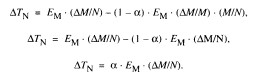
where ¬ is the average degree of privateness in the public budget. 19 In the end, the total expenditure burden of new immigrants on native residents equals the average degree of privateness in the service bundle provided to immigrants times the average level of spending needed to provide that bundle times the number of new immigrants. This total burden is then shared among all current native residents, requiring each native resident to pay ΔTN.
Measuring Revenues and Revenue Changes
Current taxes paid per immigrant household equal the sum of all taxes paid by previous immigrant households divided by the previous immigrant population. Not all immigrants pay taxes, however. If ρ is the proportion of immigrants who pay taxes, and if the taxes are levied at an average immigrant household's tax rate τ on the average immigrant household's tax base of β per immigrant taxpayer, then summing over each tax (denoted by t) collected by government defines the total taxes paid per average immigrant household as:

(10)
Most important, since the burden of taxes can be "shifted," it is the economic burden of the tax, not its initial legal burden, that must be measured.
|
|
Brueckner (1981) and McMillan (1989) find that fire protection services show significant publicness (¬ 0); Duncombe and Yinger (1993) find fire protection services to be nearly a private good with respect to changes in population (¬ 1). Craig (1987) presents evidence that police protection is a public good over most neighborhood sizes but in large neighborhoods services can be congested (¬ 1). Inman (1978) finds that major access highways are pure public goods, except at peak rush hour when congestion is observed. On balance, the evidence is mixed as to the effect of population on the costs of service provision. The prudent assumption—one that biases upward the estimates of the effects of new immigration on public service costs—is to assume that all public services are private goods (¬ = 1). The one reasonable exception to this rule is national defense, for which it seems plausible to assume that the service will remain a pure public good (¬ = 0) for most anticipated levels of new immigration. |

Estimating the economic burden of a tax after-tax shifting requires assumptions as to how the legal burden of the tax is allocated economically. Do those who bear the legal burden change their economic behavior and "shift" the tax onto those less able to adjust? For example, it is reasonable to assume that workers bear the full burden of an income tax on their incomes from labor since most workers need their jobs (see Pechman, 1985; MaCurdy, 1992). But who bears the burden of an employer tax on worker incomes, like the employer portion of the Social Security payroll tax? Again, and largely because workers need their jobs, current estimates suggest that workers are likely to bear most of the tax's burden through a reduction in worker wages, even though the tax is legally assessed against the employer (see Pechman, 1985). Similarly, in a competitive economy, sales and excise taxes that are legally paid by retail businesses are likely to be passed on to consumers in higher prices for goods; thus, the consumer of the taxed good bears the burden of sales and excise taxes (see Pechman, 1985). The burden of government fees and licenses paid by consumers for the use of government services will likewise be borne by the consumer.
More difficult to assign are the final economic burdens of property taxation and business income taxes. Property taxes are probably best divided between owners of the taxed property and consumers of the services that the property provides. Thus, local property taxes on rental properties will be borne by renters and by landlords; most estimates suggest local renters bear the largest share of the tax's burden (see Grieson, 1974; Aaron, 1975). Local property taxes on owner-occupied housing will be fully borne by the family living in the house as they both "rent" and "own" the property. Property taxes on businesses will be borne by the investors in the business, by the firm's workers if wages can be reduced, or by the firm's customers if prices can be increased; best estimates suggest that business capital bears the burden of that tax (see Mieszkowski, 1972; Aaron, 1975). Similarly, business income taxes may be borne by business capital, by workers, or by customers; again, best estimates suggest that business capital bears the burden of business income taxes (see Shoven and Whalley, 1972; Pechman, 1985).20
In summary, current economic evidence argues that immigrants should be assigned the burden of sales and excise taxes and public-sector user fees when they consume the taxed goods and services, should be assigned the burden of labor and all of payroll taxes as they earn labor income, should be assigned all of
local property taxes as homeowners and almost all if they are renters, and should be assigned business income and property taxes if they own businesses or invest in business equity.
Even if correctly allocated, however, estimates of the average tax payments of new immigrants may not be accurately measured by the revenue contributions of previous immigrant households if new immigrants have different incomes, consumption behavior, or investments than previous immigrants. Three adjustments seem of potential importance. First, do new immigrants participate in the formal, taxable economy at the same rate (ρ) as previous immigrants do? If not, then estimates of immigrant tax contributions must be adjusted downward from the average level for previous immigrants if new immigrant participation is less than that of previous immigrants and adjusted upward if new immigrant participation is greater than that of previous immigrants. Second, do new immigrants have the same tax base (β) measured by taxable incomes, consumption, and investments as previous immigrants? If not, then again, average revenue estimates from previous immigrant households must be adjusted following new immigration, downward if tax bases are smaller and upward if tax bases are larger.21 Third, if the tax system is progressive, so that tax rates rise as incomes rise, then if new immigrant households have higher (or lower) incomes than previous immigrants, then the average tax rate must be adjusted upward (or downward).22
The needed adjustment to the initial revenue estimates from new immigration provided by TM can be approximated by:

(11)
where Drt measures the change in the share of all immigrants who pay tax t, Dbt measures the change in the average immigrant tax base for tax t, and Dtt measures the change in the average tax rate of immigrants paying taxes. If new immigrant households are richer than previous immigrants, then the share of immigrants paying taxes is likely to rise (Drt > 0), as is the average tax base (Dbt > 0) and, for progressive taxation, the average tax rate (Dtt > 0). Thus, the average level of tax revenues collected from immigrants must be adjusted upward to reflect the lower contributions of new immigrants: ΔTM > 0. However, if new immigrants are poorer than previous immigrants, then the average rates of tax participation, the average tax base, and the average immigrant tax rate will fall, and the level of
|
21 |
The evidence in Chapter 5 that recent immigrants have lower incomes than those who have been in the country for many years points to a downward adjustment, under the assumption that new immigrants are likely to have characteristics much like those who have recently arrived. |
|
22 |
Conversely, if the tax system is regressive and tax rates fall as income rises, then if new immigrants have higher (or lower) incomes than current immigrants the average tax rate must be adjusted downward (or upward). |
revenues collected from immigrant households is likely to be lower than that now collected from previous immigrants (ΔTM < 0).
Measuring Nonresident Revenues and Spending
Governments receive revenues from nonresident sources—borrowing, intergovernmental transfers, accumulated public wealth, and nonresident taxes. These revenues (AN) help current residents to pay for service expenditures not covered by resident taxes. Offsetting the gains from nonresident taxes, however, is government spending for nonresident and, most important, business services and debt repayments for past deficit financing (XN). Increases in nontax revenues (ΔANi > 0) because of new immigration will reduce the added tax burden of immigration on native residents, and reductions in these revenues (ΔANi < 0) following immigration will add to native residents' burden. The most obvious and important source of additional nontax revenues for state and local governments is increased intergovernmental aid to cover the cost of services to new immigrant households. Matching aid tied to the level of current spending by the state or local government or grants paid per capita will rise with new immigration (ΔAN > 0); lump-sum grants and project grants independent of population or spending increases do not contribute to nontax revenues (ΔAN = 0). There may be a possible additional tax benefit from new immigration if it makes labor cheaper and thereby increases the taxed returns to capital or fixed factors of production such as land (ΔAN > 0). Offsetting these possible gains in nontax revenues for natives, however, is the dilution of native residents' share of the proceeds from national public wealth (ΔAN < 0).23
Finally, but likely to be less important, are changes in government spending for nonresident business services caused by immigration. The most likely case of new immigrants affecting the provision of business services is one in which residents and businesses share the same public facility, for example, a sewer system. In this case, however, if residents receive a direct benefit from that public facility, then the additional expenditures needed to protect the residential, and now business, service flows are already measured through EM (spending to
provide government services to immigrants) and ΔEM. Only in the very unlikely case that residents congest a public facility used by business but get no direct benefits themselves will new immigrants force an increase in XN spending that is not already included elsewhere in the annual fiscal accounting. The final component of XN spending is payments for past deficit financing. For this, however, new immigrants have no effect on the costs of repaying these historical obligations. For these reasons it seems reasonable to assume that ΔXN is zero following new immigration.24
Estimates of the Annual Fiscal Impact of Immigrant-Headed Households
Two recent studies, one of New Jersey by Garvey and Espenshade (1996) and one of California by Clune (1997) prepared for this panel, offer the most careful analyses to date of the annual fiscal incidence of immigrant-headed households on the budgets of local and state governments. In addition, the Clune study estimates the annual incidence effects on the federal budget of immigrant-headed households in California. The first two parts of this section summarize the local and state government results for New Jersey and California, respectively. The third part reports the estimates of the fiscal effects of California immigrants on the federal budget. Together the two studies allow estimates of the average fiscal balance (T - E) for immigrant-headed households (TM - EM ) and native households (TN - EN), the key first step to estimating the net annual fiscal impact (NAFIN) of new immigrants on native residents. Using these data from the Garvey and Espenshade and Clune studies, the fourth part estimates NAFIN for the current population of immigrant-headed households on native residents. The final part extends the analysis to estimate the net annual fiscal impact on native residents of new immigration.
Table 6.1 summarizes the basic demographic and economic facts about immigrant-headed households in New Jersey and California and compares them with each state's native household population. Households are defined as all
family members living in the same home. Both legal and illegal immigrant households are included in both the Garvey-Espenshade (1996) and Clune (1996) studies; separate fiscal accounting for the two groups is not possible.
Net Fiscal Burdens in New Jersey: State and Local Budgets
New Jersey ranks fourth among the states in immigration measured by the number of the state's household population whose heads are foreign-born.
Almost half of New Jersey's immigrant population is from Europe or Canada; families from Latin America account for about a third; and families from Asia about a fifth of the state's immigrant population. Compared with native households, immigrant households have more children, earn slightly lower incomes, and use welfare services a bit more often. But there are large variations within the immigrant population. In particular, Asian and Latin American immigrant families have larger families, the Latin American immigrant families have significantly lower incomes, and they use welfare services nearly twice as often as native and other immigrant households.
Garvey and Espenshade (1996) provide the fiscal analysis required to measure the average fiscal balance for immigrant-headed households (TM - EM) and native households (TN - EN) for the state of New Jersey. Estimates of the utilization of local and state government services and taxes and fees paid by native and immigrant-headed households are provided for fiscal year 1989-90. The authors develop their estimates of spending received and revenues paid from individual household data, using the Census Bureau's Public Use Microdata Sample (PUMS) of 145,000 New Jersey households for 1990.25 Previous studies have typically used state-wide averages for local and state spending and assigned the same spending levels to both native and immigrant households. 26 This standard approach allows for differences in program utilization between natives and immigrants (for example, in number of children and welfare eligibility), but it misses potentially important differences in the level of services received once a family qualifies. The Garvey and Espenshade study measures these important differences too.
Each household in the study is assigned to one of five groups by the nativity status of the head of household: native-born households, foreign-born of European/Canadian origin, foreign-born of Asian origin, foreign-born of Caribbean/
TABLE 6.1 Profile of New Jersey and California Native and ImmigrantHeaded Households
Latin American origin, and foreign-born of African or Oceanic origin (''other"). For each household in each nativity group, estimates are made of the taxes and fees paid to and of services received from local or state governments. For those services that are jointly provided by local and state governments—education is the most important example—each level of government is assigned its own share of total service provision.
Services provided by local governments and included in the Garvey and Espenshade study are general government administration, courts (excluding corrections), police and fire protection services, public works, welfare and public health, recreation and conservation, libraries, vocational education, community colleges, and—most important—K-12 education. The costs of each service are defined to include labor costs (including employee benefits, taxes, and pension contributions), expenditures for materials and supply, and capital costs estimated by the interest payments on local debts. Local governments include county governments as well as municipalities and school districts. Services provided by state government and included in the study are general government administration, public safety and criminal justice, health, community development, transportation, environmental management, employment training, education administration and state aid for K-12 education, higher education, the state share of
|
Characteristic |
Native |
Foreign Born |
Europe/ Canada |
Asia |
Latin America |
Other |
|
Households (share of all households) |
8.385m (.746) |
2.851m (.254) |
.345m (.031) |
.699m (.062) |
1.592m (.142) |
.215m (.019) |
|
Household size |
2.48 |
3.72 |
2.18 |
3.54 |
4.18 |
3.41 |
|
Age of head |
49.10 |
43.70 |
56.00 |
45.20 |
40.00 |
45.80 |
|
Children < 18 |
.64 |
1.37 |
.42 |
1.15 |
1.70 |
1.22 |
|
Adults > 65 |
.34 |
.23 |
.45 |
.26 |
.15 |
.34 |
|
Income/household |
$50,518 |
$37,878 |
$45,857 |
$48,096 |
$30,012 |
$51,166 |
|
% receiving AFDC |
4.80 |
9.80 |
3.00 |
8.80 |
12.50 |
4.70 |
|
Source: New Jersey data are from Garvey and Espenshade (1996: Tables I and 2). California data are from Clune (1996: Tables 3a and 4a). |
||||||
spending on Medicaid, Aid to Families with Dependent Children (AFDC), and Supplemental Security Income (SSI), general state welfare assistance, pharmaceutical assistance for the elderly and disabled, municipal aid to local governments, and property tax reimbursements.27 All these local and state government services are treated as private goods by Garvey and Espenshade, each requiring a
proportional increase in spending to protect the level of services provided to native residents.28
Taxes and fees collected by local governments and assigned to households include property taxes and utility taxes. Consistent with current economic analysis, households who are renters are assumed by Garvey and Espenshade to bear the full burden of property taxes on their rental dwelling. Taxes and fees collected by state government and assigned to households include personal income tax, sales and use taxes, automobile and fuel taxes, alcohol and cigarette taxes, estate taxes, personal property taxes, and the realty transfer tax. State taxes on corporations and on banks and financial institutions and local property taxes on business are assumed to be borne by business capital; they are not assigned to New Jersey's household sector (see note 29).
Using the Garvey and Espenshade analysis, Table 6.2 summarizes local and state government revenues paid (T) and expenditures received (E) for all households in New Jersey, reported for an average ("all") household and for native and immigrant-headed households separately. The original Garvey and Espenshade estimates are for fiscal year 1989-90; Table 6.2 adjusts their estimates by the national consumer price index-urban (CPI-U) price index to reflect the value of services provided and taxes paid as of December 1996. The average New Jersey household, native and immigrants combined (denoted "all" in Table 6.2), receives $3,141 in locally funded services for which it pays $3,141 in local taxes and fees, and $2,715 in state funded services for which it pays $2,715 in states taxes and fees. The household fiscal budgets at both the state and local levels are in balance (expenditures = revenues). This overall fiscal balance for all households is required because (1) the overall state and local budgets must be in balance and (2) by assumption, all business taxes are assigned to provide business services.29

The fiscal balance for native households (TN - EN) and immigrant-headed households (TM - EM) measured separately need not equal zero, however; there can be fiscal redistributions within the household sector from one group to the other. Table 6.2 shows that in New Jersey in fiscal year 1989-90 there was a net fiscal redistribution from native households to immigrant households at both the local and state levels of government. At the local level, the average native household in New Jersey paid an additional $144 per native household to offset the negative fiscal balance of $922 per immigrant-headed household imposed by current New Jersey immigrants.30 Table 6.2 reveals that the negative fiscal balance for immigrant households originates from the differentially high spending for immigrant families, particularly on K-12 education services. New Jersey immigrant families have more children than native families do on average (see Table 6.1), and in addition, Asian families in New Jersey tend to live in high-expenditure school districts. Immigrant households also receive more "other services," including local welfare services; this gap is particularly large for Latin American immigrant families. Interestingly, the fiscal gap between native and immigrant households is closed slightly by the fact that immigrant families in New Jersey—particularly those from Europe/Canada and Asia—pay more in local taxes than do native households.
At the state government level, immigrant-headed households in New Jersey are also in negative fiscal balance, by $562 per immigrant-headed household. To cover this shortfall, native resident taxpayers contribute a positive fiscal balance of $88 per native household.31 The main sources of immigrants' negative balances at the state level are higher spending for K-12 education aid (because
|
|
behalf of the federal government. Thus the federal government does not appear in AN and XN. Businesses and, to a lesser extent, nonresident tourists are included in AN and XN, however. Expenditures for business and nonresident tourist services (XN) cannot be estimated directly. Revenues from business and tourists (AN) can be estimated, however. Assuming businesses and tourists are mobile and will not locate in any state that exploits them fiscally, the analysis assumes AN= XN. Given this assumption, then [TN - EN] ·∙ N + [TM - EM] ∙ M ≡ 0—that is, the full household sector is in fiscal balance. In Table 6.2, balance is achieved by subtracting directly measured business taxes from the Garvey and Espenshade estimates of uniformly allocated state services. The remaining deficit for the household sector is then an estimate of the unmeasured business or tourist taxes in excess of business services. This final residual is also allocated to the business sector and netted uniformly from all households' state services. |
TABLE 6.2 Local and State Expenditures, Revenues, and Average Fiscal Balance by Households: New Jersey (1996 dollars per New Jersey household)
|
|
All |
Native |
Foreign- Born |
Europe/ Canada |
Asia |
Latin America |
Other |
|
Expendituresa |
|||||||
|
Local |
|||||||
|
K-12 education |
$2,273 |
$2,162 |
$2,985 |
$2,730 |
$4,002 |
$2,625 |
$2,792 |
|
All other |
868 |
807 |
1,251 |
1,075 |
1,080 |
1,606 |
1,471 |
|
Total |
3,141 |
2,969 |
4,236 |
3,805 |
5,082 |
4,231 |
4,263 |
|
State |
|||||||
|
K-12 education |
1,625 |
1,585 |
1,878 |
1,583 |
1,985 |
2,178 |
1,912 |
|
Transfers to households |
502 |
496 |
530 |
338 |
499 |
928 |
563 |
|
All other |
588 |
566 |
738 |
623 |
813 |
833 |
763 |
|
Total |
2,715 |
2,647 |
3,146 |
2,544 |
3,297 |
3,939 |
3,238 |
|
Revenuesb |
|||||||
|
Local |
|||||||
|
Property tax |
2,949 |
2,921 |
3,126 |
3,485 |
3,417 |
2,544 |
2,967 |
|
All other |
192 |
192 |
188 |
196 |
190 |
182 |
180 |
|
Total |
3,141 |
3,113 |
3,314 |
3,681 |
3,607 |
2,726 |
3,147 |
|
State |
|||||||
|
Income tax |
1,515 |
1,526 |
1,446 |
1,581 |
1,852 |
1,062 |
1,302 |
|
Sales tax |
582 |
586 |
562 |
591 |
646 |
483 |
528 |
|
All other |
618 |
623 |
576 |
622 |
624 |
503 |
522 |
|
Total |
2,715 |
2,735 |
2,584 |
2,794 |
3,122 |
2,048 |
2,352 |
|
Average fiscal balancec |
|||||||
|
Local |
≡ 0 |
144 |
-922 |
-124 |
-1,475 |
-1,505 |
-1,116 |
|
State |
≡ 0 |
88 |
-562 |
250 |
-175 |
-1,891 |
-886 |
|
Total |
≡ 0 |
232 |
-1,484 |
126 |
-1,650 |
-3,396 |
-2,002 |
|
Note: Other = Africa or Oceania. a Local government expenditures by community, school district, and county governments include the local share of outlays for K-12 education and an estimate of the household sector's share of "other" local expenditures for such services as public safety, public works, general health, recreation, and the local share of general assistance; see text. State government expenditures include the state share of outlays for K-12 education (school aid), the state's share of transfers to households (AFDC, general assistance, Medicaid, SSI, and miscellaneous state transfer programs), and an estimate of the household sector's share of "other" state expenditures, the most significant of which are expenditures for higher education and municipal assistance, including property tax relief; see text. b Local government revenues collected by community, school district, and county governments include property taxation and a tax on utilities ("all other"). State government revenues include revenues paid by households under the state income and sales taxes and through various excise taxes ("all other"). c Average fiscal balance equals total revenues minus total expenditures. If the average fiscal balance > 0, then the average household in this category makes a net contribution to the state or local treasury. If the average fiscal balance < 0, then the average household in this category receives a net |
|||||||
immigrants have more children), for transfers to households (because immigrants are poorer), and for other state expenditures (because immigrant families are larger), and lower taxes collected from immigrant families (because immigrant families are on average poorer). On average, these spending and revenue differences between native and immigrant-headed families are relatively small, however. Two immigrant groups—families from Latin America and "other" (Africa and Oceania)—account for almost all of the immigrant group's negative fiscal balance. Asians and families from Europe/Canada (actually net contributors) impose no significant fiscal burden on native residents at the state level.
Combining the state and local public-sectors, native households in New Jersey bear a total net fiscal burden of $232 per native household from the fact that the average immigrant-headed household receives $1,484 per immigrant household more in state and local services than it contributes in state and local taxes (see Table 6.2). There is wide variation across immigrant households as to the total state and local burdens they impose. Immigrants from Latin America are the biggest group contributor to the burden on native households. In contrast, families originating from Europe/Canada actually help native New Jersey households cover the estimated local and state fiscal shortfalls imposed by the other immigrant families.
Net Fiscal Burdens in California: State and Local Budgets
California has the most immigrant-headed households of any U.S. state, both absolutely and as a share of the state's population. In contrast to New Jersey, where immigrant families come predominately from Europe and Canada, more than half of California's immigrant families come from Latin America, and an additional 25 percent come from Asia. As in New Jersey, California immigrant families are poorer on average than California's native residents, have larger families, and use welfare services more often. But, as in New Jersey, immigrant households vary widely in these important attributes. Families coming from Latin America have the lowest incomes and the most children and are the most likely to be on public welfare; in California, these families are the biggest immigrant group.
|
transfer from the state or local treasury. Since the overall state budget must be in balance and (by assumption) state and local business revenues are fully allocated to pay for state and local business services, the overall household sector (column "all") must have an average fiscal balance = 0; see text. Source: Calculations based on Garvey and Epenshade (1996: Tables 1, 3, and 5). Garvey and Epenshade's expenditure and revenue estimates for FY 1990 are adjusted upward to reflect December 1996 prices as measured by the CPI-U index. |
Clune (1997) provides the fiscal analysis necessary to estimate the average fiscal balance for immigrant-headed households and native households for the state of California. The primary data source for Clune's analysis is the Current Population Survey for March 1995, providing detailed fiscal information for 4,590 California households. This survey is supplemented by data from state and local government budgets for fiscal year 1994-95. Like the Garvey and Espenshade study of New Jersey, the Clune study of California identifies program use by individual households. Households are assigned to native or immigrant groups by the country of origin of the household's head: U.S. native, or European/Canadian, Asian, Latin American, or other immigrant (of African or Oceanic origin). For each household in each nativity group, Clune estimates taxes paid and services received at both the state and local levels of government.
Public services provided at the state level to California households include Medi-Cal health care coverage and AFDC and SSI income transfers, state aid for K-12 education, state support for higher education, state police, corrections, and justice, public works, government administration, transportation, environment and recreation, and state assistance to local governments. Services provided by local governments include local spending on K-12 education, community colleges, police and fire protection, transportation, libraries, public health, public works, general low-income assistance, and general government administration. Like Garvey and Espenshade, Clune assumes each of these services is a private good, requiring a proportional increase in spending to protect services for native residents.32
Taxes and fees collected by (or in the case of the sales tax, for) local governments include property tax, sales tax, and miscellaneous fees and charges. As in the New Jersey study, renters are assumed to bear the full burden of local property taxation. Taxes and fees collected for the state government and borne by the household sector include personal income tax, sales tax, a state disability insur-
ance tax, fuel taxes, liquor, tobacco, and excise taxes, motor vehicle fees, and estate taxes. As in the New Jersey study, state taxes on corporations and out-of-state tourists are assumed to be borne by businesses and nonresidents and are therefore not included as part of tax burden on California's households.33
Based on Clune's estimates of the fiscal incidence of government spending and taxes, Table 6.3 summarizes revenues paid to, and services received from, local and state governments by California households. As with Table 6.2 for New Jersey, the analysis reports expenditures, revenues, and average fiscal balance of an average ("all") California household (T - E), for an average native household (TN - EN), and for an average immigrant-headed household (TM - EM), overall and by country of origin. Clune's expenditure and revenue estimates are for fiscal year 1995; the results in Table 6.3 have been adjusted upward by the national CPI-U index so as to reflect December 1996 dollars.
The estimates for California reported in Table 6.3, like those for New Jersey, reflect the assumption that the household sector as whole is in fiscal balance. Thus, the average fiscal burden computed for "all" households equals zero at the local and state levels. Within the household sector, however, we see that in California—as in New Jersey—there is a fiscal redistribution from native residents to immigrant households at both levels of government. When providing local services, the average native household contributes a fiscal surplus of $283 per household to fund a fiscal deficit of $831 per immigrant-headed household (see Table 6.3).34 When providing state services, the average native household contributes a fiscal surplus of $895 per household to cover an average negative fiscal balance of $2,632 per immigrant household (see Table 6.3).35 Comparing services received and revenues paid across native and immigrant households
reveals that immigrant-headed households are larger consumers of K-12 education (due to relatively larger family size) and receive more state transfers to households (due to relatively lower incomes). Native and immigrant households pay nearly the same in local taxes, but the richer native households pay more in state income and sales taxes. Within immigrant groups, families from Europe/ Canada are actually net fiscal contributors, even more so than natives, and households from Asia, Latin America, and "other" (Africa and Oceania) receive net fiscal transfers from California's state and local treasuries.
Combining the state and local public-sectors, native households pay an additional $1,178 per household in revenues above services received to support a net fiscal transfer to the average immigrant-headed household of $3,463 household (see Table 6.3). As in New Jersey, the immigrant group making the biggest contribution to this net fiscal burden on native households in California is families from Latin America.
Net Fiscal Burdens in California: The Federal Budget
Clune (1997) also provides estimates of revenues paid, expenditures received, and the fiscal balance for the federal budget for households living in California for fiscal year 1994-95; all dollars have been inflated to reflect December 1996 prices. Table 6.4 summarizes these estimates for an average California household ("all") and then provides separate estimates for native households, all immigrant households, and immigrant households by country of origin.
Clune estimates the average California household paid $14,896 in federal taxes and received $13,549 in federal service spending. The difference-$1,347 per household—is the surplus contributed by the typical California household to the "primary" federal budget.36 Native households contribute more than immigrant-headed households; virtually all the difference is due to the larger tax payments made by the (on average) richer native residents. Native and immigrant families receive about the same aggregate level of benefits from the federal treasury, with native families (which are, on average, older) receiving relatively more in Social Security and Medicare benefits and immigrant families (which are, on average, poorer) receiving relatively more in income assistance transfers
|
36 |
Excluded from the accounting in Table 6.4 are federal government interest payments. Californians' share of federal interest payments equalled $1,995 per household in fiscal year 1995 (measured in 1996 dollars). Like all Americans, Californians ran a federal deficit on the full—primary plus interest payment—budget. The Californians' share of this deficit averaged -$648 per household (= $1,347 - $1,995). This total is smaller than the national average deficit of -$1,672 per household in fiscal year 1995 because Californians are richer (and thus pay more taxes) and younger (and thus use fewer services) than the typical American household, thereby "benefiting" less from federal borrowing. |
TABLE 6.3 Local and State Expenditures, Revenues, and Average Fiscal Balance by Households: California (1996 dollars per California household)
|
|
All |
Native |
ForeignBorn |
Europe/ Canada |
Asia |
Latin America |
Other |
|
Expendituresa |
|||||||
|
Local |
|||||||
|
K-12 education |
$974 |
$768 |
$1,581 |
$435 |
$1,453 |
$1,888 |
$1,561 |
|
All other |
4,549 |
4,522 |
4,627 |
4,587 |
4,732 |
4,587 |
4,624 |
|
Total |
5,523 |
5,290 |
6,208 |
5,022 |
6,185 |
6,475 |
6,203 |
|
State |
|||||||
|
K-12 education |
1,537 |
1,212 |
2,496 |
687 |
2,294 |
2,981 |
2,465 |
|
Transfers to households |
817 |
594 |
1,474 |
698 |
1,758 |
1,581 |
903 |
|
All other |
780 |
704 |
1,003 |
686 |
1,140 |
882 |
1,086 |
|
Total |
3,134 |
2,510 |
4,973 |
2,071 |
5,192 |
5,444 |
4,454 |
|
Revenuesb |
|||||||
|
Local |
|||||||
|
Property tax |
1,059 |
1,092 |
965 |
1,117 |
1,239 |
776 |
1,233 |
|
All other |
4,464 |
4,481 |
4,412 |
4,453 |
4,467 |
4,370 |
4,484 |
|
Total |
5,523 |
5,573 |
5,377 |
5,570 |
5,706 |
5,146 |
5,717 |
|
State |
|||||||
|
Income tax |
1,738 |
1,964 |
1,070 |
1,549 |
1,635 |
620 |
1,806 |
|
Sales tax |
688 |
727 |
570 |
662 |
696 |
473 |
736 |
|
All other |
708 |
714 |
701 |
620 |
749 |
703 |
657 |
|
Total |
3,134 |
3,405 |
2,341 |
2,831 |
3,080 |
1,796 |
3,199 |
|
Average fiscal balancec |
|||||||
|
Local |
≡ 0 |
283 |
-831 |
548 |
-479 |
-1,329 |
-486 |
|
State |
≡ 0 |
895 |
-2,632 |
760 |
-2,112 |
-3,648 |
-1,255 |
|
Total |
≡ 0 |
1,178 |
-3,463 |
1,308 |
-2,591 |
-4,977 |
-1,741 |
|
Note: Other = Africa or Oceania. a Local government expenditures by community, school district, and county governments include the local share of outlays for K-12 education and an estimate of the household sector's share of "other" local expenditures for such services as public safety, public works, general health, recreation, and the local share of general assistance; see text. State government expenditures include the state share of outlays for K-12 education (school aid), the state's share of transfers to households (AFDC, general assistance, Medicaid, SSI, and miscellaneous state transfer programs), and an estimate of the household sector's share of "other" state expenditures, the most significant of which are expenditures for higher education and municipal assistance, including property tax relief; see text. b Local government revenues collected by community, school district, special district, and county governments include property taxation and a tax on utilities ("all other"). State government revenues include revenues paid by households under the state income and sales taxes and through various excise taxes ("all other"). c Average fiscal balance equals total revenues minus total expenditures. If the average fiscal balance > 0, then the average household in this category makes a net contribution to the state or local |
|||||||
to households.37 National defense and other federal government services (state aid, subsidies to business, flood control, and so on) are distributed equally across native and immigrant families.
Among immigrant-headed households, we again observe significant variation in each cohort's net fiscal contribution. ''Other" immigrants contribute to the federal treasury at about the same rate as native households, whereas Asian immigrants also make a significant positive contribution. Immigrant households from Europe/Canada and Latin America both receive a net fiscal transfer from the federal primary budget. Immigrant households from Europe/Canada are older and receive significant Social Security and Medicare benefits; Latin American immigrant households have lower incomes and more children and therefore qualify for more federal income assistance. Comparing the estimates here with the national fiscal year 1994 estimates presented in the dynamic analysis presented in Chapter 7 reveals a downward (toward negative) bias in the estimated federal burden in the California sample. The cause of the bias is the lower incomes of immigrants in California. Thus, the numbers here are not representative of the average immigrant household nationwide—the focus of Table 6.5.
The Total Net Fiscal Burden of Current Immigrants
The estimates of local and state fiscal balances from Tables 6.2 and 6.3 can be combined with the estimates of the federal government fiscal balances adjusted for defense spending in Table 6.4 to yield estimates of the net annual fiscal impact (NAFIN) of all current immigrant-headed households in New Jersey and California on the native residents of those states (see Table 6.5, panel A). Tables 6.2 and 6.3 provide direct estimates of the average fiscal balance (TMEM), the most important component of - ΔTN and NAFIN. For state and local budgets, we
|
37 |
Programs included in "transfers to households" in Table 6.4 include the federal share of AFDC, Medi-Cal, and SSI, and direct federal transfers to residents through federal, military, and railroad retirement and disability payments, unemployment compensation, workers' compensation, veterans' benefits, Pell grants, housing benefits, food stamps, school lunches, energy assistance, and the earned income tax credit. |
|
treasury. If the average fiscal balance < 0, then the average household in this category receives a net transfer from the state or local treasury. Since the overall state budget must be in balance and (by assumption) state and local business revenues are fully allocated to pay for state and local business services, the overall household sector (column "all") must have an average fiscal balance = 0; see text. Source: Calculations based on Clune (1996: Tables 1, 2, 3a, 5a, 6a, and 7a). Clune's expenditure and revenue estimates for FY 1995 are adjusted upward to reflect December 1996 prices as measured by the CPI-U index. |
TABLE 6.4 Federal Expenditures, Revenues, and Average Fiscal Balance by Households: California (1996 dollars per California household)
|
|
All |
Native |
Foreign- Born |
Europe/ Canada |
Asia |
Latin America |
Other |
|
Expendituresa |
|||||||
|
Social Security |
$3,064 |
$3,517 |
$1,728 |
$4,852 |
$1,308 |
$1,221 |
$1,834 |
|
Medicare |
1,707 |
1,883 |
1,186 |
2,341 |
1,448 |
747 |
1,725 |
|
Transfers to households |
3,461 |
2,977 |
4,727 |
3,059 |
4,672 |
5,265 |
3,593 |
|
Defense |
2,809 |
2,809 |
2,809 |
2,809 |
2,809 |
2,809 |
2,809 |
|
All other |
2,508 |
2,439 |
2,876 |
2,344 |
3,117 |
2,894 |
2,833 |
|
Total |
13,549 |
13,625 |
13,326 |
15,405 |
13,354 |
12,936 |
12,794 |
|
Revenuesb |
|||||||
|
Income tax |
6,733 |
7,621 |
4,123 |
6,153 |
6,198 |
2,357 |
7,207 |
|
Social Security |
5,100 |
5,352 |
4,358 |
4,374 |
5,551 |
3,686 |
5,434 |
|
All other |
3,063 |
3,374 |
2,163 |
2,392 |
2,468 |
1,855 |
2,398 |
|
Total |
14,896 |
16,347 |
10,644 |
12,919 |
14,217 |
7,898 |
15,039 |
|
Average fiscal balancec |
|||||||
|
Federal |
1,347 |
2,722 |
-2,682 |
-2,486 |
863 |
-5,038 |
2,245 |
|
Note: Other = Africa or Oceania. a Federal expenditures include Social Security and Medicare, direct federal transfers to households, the federal share of AFDC, Medicaid, and SSI transfers, defense, and other expenditures (e.g., transfers to state and local governments). Excluded are federal interest payments on past federal deficits; see text. b Federal revenues include all revenue collected from the household sector: personal income taxation, revenues from Social Security taxes (including employer share), unemployment insurance tax, corporate taxation allocated to the household sector, and various excise taxes. c Average fiscal balance equals total revenues minus total expenditures. If the average fiscal balance > 0, then the average household in this category makes a net contribution to the federal treasury. If the average fiscal balance < 0, then the average household in this category receives a net contribution from the federal treasury. Source: Calculations based on Clune (1996: Tables 2, 5a, and 6a). Clune's expenditure and revenue estimates for FY 1995 are adjusted upward to reflect December 1996 prices as measured by the CPIU index. All federal expenditures and revenues are based on Clune's estimates for households living in California. |
|||||||
TABLE 6.5 Net Annual Fiscal Impact (NAFI) Imposed by Current Immigrant-Headed Households on Native Residents in New Jersey and California
|
A. NAFI Imposed by Current Immigrant-Headed Households on Native Households in New Jersey and California |
|||||||||||
|
|
Local NAFI |
State NAFI |
Federal NAFI |
Total NAFI |
|||||||
|
New Jersey |
-$144/native |
-$88/native |
$3/native |
-$229/native |
|||||||
|
California |
-$283/native |
-$895/native |
$4/native |
-$1,174/native |
|||||||
|
B. NAFI Imposed by Current Immigrant-Headed Households on All U.S. Native Households |
|||||||||||
|
|
Europe/Canada |
Asia |
Latin America |
Other |
All Immigrant-Headed Households |
||||||
|
State Budget |
NAFI |
Nat'l Share |
NAFI |
Nat'l Share |
NAFI |
Nat'l Share |
NAFI |
Nat'l Share |
NAFI |
Immigrant Households |
Aggregate NAFI |
|
New Jersey |
$449 |
.26 |
$2,022 |
.25 |
-$5,625 |
.43 |
$3,052 |
.06 |
-$1,613 |
9.156 million |
-$14.77 billion |
|
California |
$1,631 |
.26 |
$1,081 |
.25 |
-$7,206 |
.43 |
$3,313 |
.06 |
-$2,206 |
9.156 million |
-$20.16 billion |
|
C. NAFI Imposed by Current Immigrant-Headed Households on Average Native Household |
|||||||||||
|
|
Aggregate NAFI |
Native U.S. Households |
Native Household |
||||||||
|
New Jersey Budget |
-$14.77 billion |
$89.019 million |
-$166/native |
||||||||
|
California Budget |
-$20.16 billion |
$89.019 million |
-$226/native |
||||||||
|
|
|||||||||||
assume that ΔTM = 0 (new immigrants and previous immigrants pay identical taxes), that ΔEM = 0 (all services are private goods), and that immigration does not alter the balance between nonresident taxes and nonresident services (AN - XN = 0).38 Thus for state and local budgets:

(12)
For the federal government budget, - ΔTN and NAFIN require an estimate of the average fiscal balance (TM - EM) at the federal level (see Table 6.4). The federal budget, however, contains an important pure public good—national defense—that need not be increased with additional immigration. Thus there is the need for a ΔEM adjustment (see the section on fiscal accounting: implementation). Here ΔEM = -$2,809 per household.39 Again we assume ΔTM = 0 (new and previous immigrants pay identical taxes) and that ΔAN = 0 and ΔXN = 0.40 For the federal government budget therefore:

(13)
where ΔEM = -$2,809 per household.
From Table 6.2, an average immigrant household in New Jersey is seen to have a negative average fiscal balance (TM - EM) of -$922 at the local government level and -$562 at the state government level. In Table 6.5, all current immigrants are treated as "new" immigrants; thus ΔM = M. The average fiscal balances (TM - EM) are therefore multiplied by the ratio of the current immigrant to the native households (= M/N= .392m/2.503m = .157; see Table 6.1) to give estimates of NAFIN for New Jersey native residents; Table 6.5, panel A, reports the results. For local governments in New Jersey, NAFIN equals -$144 per native household, and for state governments NAFIN equals -$88 per native household.
|
38 |
Estimates of EM and TM are "own government" expenditures and revenues only. Thus state expenditures and revenues exclude federal aid and local expenditures and revenues exclude federal and state aid. In this specification, there is therefore no need to adjust state and local revenues for changes in federal and state aid following immigration; ΔAN = 0. We do need to include such aid in estimates of EM for federal and state governments, however, as Tables 6.2 to 6.4 in fact do. |
|
39 |
See the section on fiscal accounting: implementation. In this section the adjustment in spending to allow for less than fully private goods is given as:  Since national defense is a pure public good (α = 0), ΔM = M in this analysis, and EM for defense = $2,809 from Table 6.4, we have ΔEM = -$2,809. |
|
40 |
Since there is no aid to the federal government, all business taxes are allocated to the household sector and are thus part of TM, and the aggregate stock of government wealth is unaffected by new immigrants (see note 24 above), ΔAN = 0. New immigrants are assumed to not affect the flow of federal services unique to businesses nor the inherited aggregate stock of government debt (see note 24 above), ΔXN = 0. |
Immigrant households in New Jersey impose a total fiscal burden on native residents of -$232 per household through the state and local sectors, about four-tenths of 1 percent of a typical native family's income (.0037 = $232/$61,966; see Table 6.1).
From Table 6.3, an average immigrant household in California is shown to have a negative average fiscal balance (TM - EM) of -$831 per household at the local level and -$2,632 per household at the state level. Again, treating all current immigrant-headed households as new immigrants (ΔM = M) requires multiplying these estimates of (TM - EM) by the ratio of current immigrants to native households (=M/N = 2.851m/8.385m = .34) to estimate the NAFIN of California immigrants on native residents. For California's local sector, NAFIN equals -$283 per native household, and for California's state sector NAFI N equals -$895 per native household) (see Table 6.5, panel A). The total fiscal burden imposed on California native residents through the state and local public-sectors because of immigrant-headed households is -$1,178 per household, or about 2.3 percent of a typical native household's annual income (.023 = $1,178/$50,518; see Table 6.1).
Immigrant households do make a positive contribution to the fiscal position of native households through the federal budget, however. Table 6.4 allows us to estimate the NAFIN from the federal budget for residents of New Jersey and California because of the presence of current immigrants in their states. First, the average federal fiscal balance of (TM - EM) -$2,682 per immigrant household reported in Table 6.4 is adjusted for the fact that national defense is a pure public good; defense spending of $2,809 per immigrant household should not be included in new expenditures and is therefore added to the negative fiscal balance ($127 = -$2,682 + $2,809). Second, the resulting $127 per immigrant household is multiplied by the number of immigrant households in California (= M = 2.851m) and then divided by the national native household population (= N = 89.018m), since all native households in the country share the federal contributions and costs of California immigrants. The resulting estimate of NAFI N from the federal budget for all California immigrant households on California native households is $4 per native household (= $127 x (2.851m/89.018m); see Table 6.5, panel A).
The estimates in Table 6.4 for how California immigrants contribute to the national treasury can be used to approximate the contributions of New Jersey immigrants, assuming that they contribute in the same way as their country-of-origin counterparts in California. If so, then the net fiscal contribution of a New Jersey immigrant family, adjusted for defense spending, equals $520 per immigrant household. 41 Again, this contribution should be aggregated over all New
|
41 |
This estimate follows from applying the New Jersey distribution of immigrant households by country of origin (Table 6.1) to the estimated average fiscal balance adjusted for defense spending for each immigrant cohort in Table 6.4: $520 per immigrant household = (.063/.135) x (-$2,486 + $2,809) per European-Canadian household) + (.027/.135) x ($863 + $2,809) per Asian household) + |
Jersey immigrant families and then shared by all U.S. native households. In the end, a New Jersey native household benefits from a positive NAFIN of about $3 (see Table 6.5, panel A).42
Combining the local, state, and federal estimates of the net fiscal burdens imposed by immigrant households on native residents in New Jersey and California shows that the average native household bears an overall fiscal burden of $229 in New Jersey and $1,174 in California. The fiscal burden borne by Californians is larger primarily because of the larger burdens imposed at the local and particularly the state levels. Causing these differences are the larger ratio of immigrant to native households in California,43 California's large share of immigrants in the economically poorer Latin American cohort,44 and the relatively more generous welfare programs available to California residents.45
The analysis in Tables 6.2, 6.3, and 6.4 also allows estimates of the aggregate net fiscal impact on all U.S. native households of the current national immigrant population (Table 6.5, panel B). Two estimates are presented here, using the local and state budgets of New Jersey and California to estimate the net annual fiscal impact of immigrants through the state and local sectors. Because California has relatively more generous welfare programs, the national estimate using
|
|
(.038/.135) x (-$5,038 + $2,809) per Latin American household) + (.007/.135) x ($2,245 + $2,809) per "other" immigrant household). |
|
42 |
This share of the net fiscal contribution of New Jersey immigrant households is estimated as (net fiscal contribution/New Jersey immigrant household) ¥ (number of immigrant households in New Jersey) ÷ (number of U.S. native households) = ($520) ¥ (.439 m) ÷ (89.018 m) = $2.56/U.S. native household, including California native families. To be consistent with the California estimates, the 1994/95 New Jersey immigrant household population of 438,738 was used. |
|
43 |
From Table 6.1, the ratio of immigrant to native households in California is .34 (= 2.851m/ 8.385m). In New Jersey the ratio of immigrant to native households is .16 (= .392m/2.503m). |
|
44 |
In both California and New Jersey, immigrants from Latin America impose the largest net fiscal burdens on native households. Among the immigrants in California, more than half (= .56 = 1.592m/ 2.851m; Table 6.1) come from Latin America; in New Jersey the share of all immigrants from Latin America is about one-quarter (= .28 = . 111m/.392m; Table 6.1). |
|
45 |
Comparing "transfers to households" in Tables 6.2 and 6.3 reveals that California immigrant households in each country-of-origin cohort receive from two to four times the transfers per household in New Jersey. More generally, the aggregate sizes of the per-household local-plus-state-sector transfers in California and New Jersey are $8,657 per household (= $5,523 per household + $3,134 per household; Table 6.3) and $5,856 per household (= $3,141 per household + $2,715 per household; Table 6.2), respectively. The state and local public sector is 48 percent larger in California than in New Jersey ($8,657/$5,856 = 1.48). Comparing the net fiscal contribution/transfer to immigrants by country of origin for California and New Jersey shows the transfer to Latin Americans in California is a 47 percent larger net fiscal benefit than that to their counterparts in New Jersey (-$4,977/ -$3,396 = 1.47) and the transfer to Asians in California is 57 percent larger than to Asians in New Jersey (-$2,591/-$1,650 = 1.57). "Other" immigrant households in the two states receive about equal net fiscal transfers, but they are only a small percentage of all immigrant households. The California fiscal disadvantage from the deficit immigrant groups is offset somewhat by the larger net contribution from the Europe/Canada immigrants, presumably because of more progressive state taxation in California. |
the California budget can be viewed as an upper-bound estimate of the national net annual fiscal impact. Table 6.5, panel B, reports the total (local plus state plus federal) net annual fiscal impact (NAFIN) imposed by each immigrant cohort for both the New Jersey and California specifications of the state and local budgets.46 In fact, except for immigrant households from Latin America, today's current immigrants are net fiscal contributors to the overall fiscal position of native U.S. households, primarily because of their large positive net contributions to the federal treasury to help pay for defense spending. The Latin American immigrant cohort is large, however, and their negative net annual fiscal impact more than offsets the aggregate fiscal contributions paid to natives by Canadians, Europeans, Asians, and other immigrants.
Weighting each cohort's contribution by its share in the national immigrant population provides an estimate of the net annual fiscal impact imposed by a national average immigrant receiving either the New Jersey or the California state and local budgets. The national average immigrant imposes a net annual fiscal impact of -$1,613 per immigrant household when receiving the New Jersey budget and a net fiscal burden of -$2,206 per immigrant household when receiving the California budget. The aggregate NAFIN on native residents for all U.S. immigrants is estimated by multiplying these per-immigrant burdens by the number of immigrant households in the nation as whole. In 1994-95, there were 9,156,000 immigrant-headed households in the United States.47 The aggregate net annual fiscal impact imposed on native households by all immigrant-headed households in the United States is therefore estimated to range from -$14.77 billion (New Jersey budgets) to perhaps as high as -$20.16 billion (California budgets) (see Table 6.5, panel B).
Sharing this aggregate burden over all 89,019,000 native households in the United States in 1994-95 would imply a net annual fiscal impact per native household ranging from -$166 (New Jersey budgets) to perhaps as high as -$226 (California budgets). This is an annual fiscal burden imposed on a typical native U.S. household by the current stock of immigrant-headed households now in the United States. The burden ranges from about four-tenths of 1 percent to half of 1 percent of the average household income of $45,000 in 1996.48
|
46 |
For example, the total average fiscal balance for immigrants from Europe/Canada living in New Jersey is the sum of Table 6.2's estimates of that cohort's local and state net fiscal transfer plus the Table 6.4 estimate of that cohort's federal average fiscal balance adjusted for removing defense spending: -$124 + $250 + [-$2,486 + $2,809] = $449. The total average fiscal balance for immigrants from Europe/Canada living in California is the sum of Table 6.3's estimates of that cohort's local and state net fiscal transfer plus the Table 6.4 estimate of that cohort's federal net fiscal transfers: $548 + $760 + [-$2,486 + $2,809] = $1,631. All other cells in Table 6.5, panel B, are calculated in a similar way. |
|
47 |
Estimates calculated from the 1994-95 Current Population Survey. |
|
48 |
Average household income is estimated as the average for the most recent year available (= $41,428 in 1993) adjusted for inflation. |
It is important to stress what the NAFIN estimates here represent. They are estimates of the annual fiscal burdens imposed on native households by current immigrant-headed households in the early 1990s. They are not estimates of the annual costs we could expect in all future years from admitting new immigrant families, and they are not estimates of the annual fiscal costs today of past immigration policies. To estimate the future fiscal costs, or benefits, of immigration, one must allow for today's fiscally costly young immigrants to leave school, take jobs, and contribute taxes; this requires a dynamic fiscal accounting. To estimate the annual cost today of past immigration policies also requires a dynamic analysis, one that looks back in time. Children born to immigrants in the United States who are now living on their own and earning incomes must be included in this historical evaluation. These contributing, second-generation children are here because of past immigration policies; they are not, however, included in the average fiscal balance for immigrant-headed households calculated here, because these children no longer live at home. Again, only a dynamic analysis can accurately account for the contributions of these individuals. Chapter 7 outlines one approach to dynamic fiscal accounting for immigration.
The Net Annual Fiscal Impact of New Immigrants
Although it is perhaps interesting to know the annual fiscal burden of current immigrant-headed households on U.S. native households, more relevant for contemporary policy debates over immigration policy are estimates of the net fiscal burdens of new immigrants on native U.S. households.
Tables 6.6 and 6.7 offer estimates of the net annual fiscal impact of new immigrants on native families living in New Jersey (Table 6.6 ) and California (Table 6.7), under the assumption that new immigrant families are just like the current stock of immigrants now residing in the state. The estimates reported in Tables 6.6 and 6.7 answer this question: What would be the fiscal burden on native residents if the number of immigrant-headed households now in the state were to exactly double?
The net fiscal impact imposed by a doubling of the number of immigrant-headed households is simply equal to the net annual fiscal impact from current immigrant-headed households, now shared by all households in the state or nation (see note 6). Thus, the net fiscal impact of doubling "all immigrants" will be slightly smaller than the burden of previous immigrants because the tax base over which to share the costs of the new immigrants will be larger. Whereas, as we've said, the current stock of immigrant households imposes a NAFIN on native households of about -$229 per household in New Jersey and -$1,174 per household in California, doubling "all immigrants" will impose a net annual fiscal impact on native New Jersey households of $199 per household (Table 6.6) or
TABLE 6.6 Net Annual Fiscal Impact (NAFI) Imposed by Additional Immigrant-Headed Households on Native Residents: New Jersey (1996 dollars per current New Jersey household)
|
Immigrant Group |
Local NAFI |
State NAFI |
Federal NAFI |
Total NAFI |
|
All immigrants |
-$125 |
-$76 |
$2 |
-$199 |
|
Contribution by age of household head |
||||
|
< 65 |
-$150 |
-$74 |
$12 |
-$212 |
|
65+ |
$25 |
-$2 |
-$10 |
$13 |
|
Contribution by region of origin |
||||
|
Europe/Canada |
-$9 |
$18 |
$1 |
$10 |
|
Asia |
-$42 |
-$6 |
$3 |
-$45 |
|
Latin America |
-$65 |
-$81 |
-$3 |
-$149 |
|
Other |
-$9 |
-$7 |
$1 |
-$15 |
|
Note: Estimates of the NAFI imposed by New Jersey immigrants through the federal budget are based on Clune's estimates of the average federal fiscal balance by a typical immigrant household living in California in each age group and from each region of origin; see Table 6.4. The per immigrant household estimates were then weighted by the New Jersey immigrant population shares to obtain the federal NAFI estimates reported above. Other = Africa and Oceania. Source: Calculations based on Tables 6.2 and 6.4, adjusted for the share of native households in the New Jersey population (= .865) for local and state NAFIs and in the national population (= .0045) for the federal NAFI. |
||||
about three-tenths of 1 percent of the state's average household income (.03 = $199/$66,371) and will impose a NAFIN on native California households of -$876 per household (Table 6.7), or about 1.8 percent of the state's average household income (.018 = $876/$48,347).
Tables 6.6 and 6.7 also decompose the net annual fiscal impacts from doubling "all immigrants" into the contributions made by doubling each of various subgroups of immigrant-headed households. For example, doubling all immigrant households doubles the number whose heads are under age 65 and the number whose heads are over age 65. What contributions do these two age groups make to the "all immigrants" totals? In both New Jersey and California, older immigrant households make a positive fiscal contribution at the local government level, paying more in taxes than they use in services (Tables 6.6 and 6.7). These positive contributions partially offset the negative net annual fiscal impact imposed by immigrant-headed households whose heads are younger than 65. At the state level, both age groups contribute to the negative NAFIN imposed on
TABLE 6.7 Net Annual Fiscal Impact (NAFI) Imposed by Additional Immigrant-Headed Households on Native Residents: California (1996 dollars per current California household)
|
Immigrant Group |
Local NAFI |
State NAFI |
Federal NAFI |
Total NAFI |
|
All immigrants |
-$211 |
-$669 |
$4 |
-$876 |
|
Contribution by age of household head |
||||
|
8 65 |
-$221 |
-$635 |
$77 |
-$779 |
|
65+ |
$10 |
-$34 |
-$73 |
-$97 |
|
Contribution by region of origin |
||||
|
Europe/Canada |
$17 |
$24 |
$2 |
$43 |
|
Asia |
-$30 |
-$141 |
$26 |
-$145 |
|
Latin America |
-$189 |
-$528 |
-$36 |
-$753 |
|
Other |
-$9 |
-$24 |
$12 |
-$21 |
|
Note: Other = Africa and Oceania. Source: Calculations based on Tables 6.3 and 6.4, adjusted for the share of native households in the California population (= .746) for local and state NAFIs and in the national population (= .029) for the federal NAFI. |
||||
natives by immigrant households. Younger households, however, are responsible for 98 percent (.98 = -$74/-$76; Table 6.6) of the "all immigrant" total in New Jersey (.98 = -$74/-$76; Table 6.6), and for 95 percent of the total in California (.95 = -$635/-$669; Table 6.7). The reason, of course, is the larger number of younger immigrants. The relative contributions of the two age groups to the federal net annual fiscal impact shows that the younger immigrant groups make a net contribution in both New Jersey and California; older immigrants impose a fiscal burden on the federal budget.
Tables 6.6 and 6.7 also report the results of a decomposition by country of origin of the net annual fiscal impact from doubling immigrant-headed households. New immigrants matching the economic and demographic attributes of current immigrants from Europe/Canada will be overall net fiscal contributors (NAFIN > 0). New immigrants matching the attributes of current immigrants from Asia, Latin America, and "other" regions will impose a net fiscal burden on natives (NAFIN < 0). The single biggest group contribution to new net fiscal burdens—75 percent in New Jersey (.75 = -$149/-$199; Table 6.6) and 86 percent in California (.86 = -$753/-$876; Table 6.7)—will be by new immigrants matching the economic and demographic attributes and numbers of current Latin American immigrants.
Finally, the net annual fiscal impact imposed on an average native household nationally from a doubling of the current immigrant population can be estimated. If all states use the New Jersey state and local budget, then the aggregate NAFIN from a doubling of today's immigrant-headed households will be -$14.77 billion (see Table 6.5, panel B). If all states used the California state and local budget, then the aggregate NAFIN from doubling today's immigrant household population will be -$20.16 billion. These new fiscal burdens will be shared by all 98.175 million current native and immigrant households, implying an additional net fiscal cost per household ranging from $150 per household (New Jersey budgets) to $205 per household (California budgets), or a burden of between three-tenths and four-tenths of 1 percent of current national household income .
.
These estimates of the net annual fiscal impact of doubling the current immigrant-headed household population can be adjusted to reflect the fiscal burdens on native residents of more modest population changes. For example, what will be the net annual fiscal impact on natives of a 5 percent increase in the current immigrant household population—an increase of about 460,000 new households? Such an increase represents an approximate continuation of current immigration policies. Such an increase will raise next year's net fiscal burden of immigrant-headed households by about $10 per household in New Jersey (-$9.95 = .05∙ -$199 per household; see Table 6.6) and by about $45 per household in California (-$43.80 = .05 ∙ -$876 per household; see Table 6.7). Nationally, a 5 percent increase in today's immigrant population will lead to an increase in next year's net fiscal burden for all U.S. native households of from $7.50 per household (-$7.50 = .05 ∙ -$150 per household for New Jersey budgets) to $10 per household (-$10.25 = .05 ∙ -$205 per household for California budgets).
Conclusions
On the basis of this analysis of the annual net fiscal burden of immigrant households on native families, the panel reaches six conclusions:
- The state and local net annual fiscal impact of current immigrant-headed households on native residents measured as the difference between the costs of state and local services received and state and local taxes paid for New Jersey residents (for fiscal year 1989-90 adjusted to 1996 dollars) is estimated at $232 per native household. Similarly constructed estimates for the net annual fiscal impact of current immigrant-headed households on native residents for California residents (for fiscal year 1994-95 adjusted to 1996 dollars) is estimated at $1,178 per native household.
- There are three central causes for the negative fiscal impact of immigrants on native residents at the state and local levels: (1) immigrant-headed households have more children than native households on average and therefore consume
- more educational services, (2) immigrant-headed households are poorer than native households on average and therefore receive more state and locally funded income transfers, and (3) immigrant-headed households have lower incomes than native households on average and thus pay lower state and local taxes.
- There are, however, important variations within the immigrant population in the size of the net annual fiscal impact imposed on native residents. Current immigrants over the age of 65 are net fiscal contributors to native residents in New Jersey, but they are a small net fiscal burden on native residents in California. However, almost all of the fiscal burdens imposed on native households by immigrants come from immigrant households whose head is younger than 65. Among the younger immigrant households, the net burden imposed on natives is by far the greatest for those immigrants from Latin American countries. In fact, immigrant households of European or Canadian origin make a net fiscal contribution to the native households of New Jersey and California through the state and local budgets in those states.
- On average, immigrant-headed households in California made a net fiscal contribution to the federal budget in fiscal year 1994-95, receiving less in services and transfers than they paid in taxes. The positive fiscal impact of immigrant households at the federal level arises because they are assumed to impose no additional burden on the federal budget for national defense, specified here as a ''pure" public good. The one exception to this pattern is the immigrant-headed households from Latin America; those households were a fiscal burden even at the federal level.
- New Jersey and California are both states with high immigration, and as a consequence, the net annual fiscal impact of immigrant-headed households on native residents in those states—particularly from the services provided through state and local governments—are high as well. If these net fiscal burdens from immigrant households were shared not just within the states but nationally, then the burden per native resident would fall significantly. Estimates of the net fiscal burden imposed on all 89,019,000 U.S. native households by all 9,156,000 U.S. immigrant-headed households through all levels of government range from $166 per native household to $226 per native household. The lower estimate gives all U.S. immigrant households the New Jersey state and local budget; the higher estimate gives all U.S. immigrant households the California state and local budget.
- A decision to admit 460,000 new immigrant-headed households—assuming those households match the economic and demographic attributes of immigrant-headed households now in the United States—would add about $10 per household to next year's net fiscal burdens for New Jersey residents and about $45 per household to next year's net fiscal burden for California residents. Nationally, admitting an additional 460,000 immigrant-headed households would lead to an increase in next year's net fiscal burden on all U.S. native households
- of about $7.50 per household (New Jersey budgets) to $10 per household (California budgets).
The estimates of the net annual fiscal impact provided in Tables 6.2 to 6.7 provide a useful snapshot of the current fiscal consequences of today's immigrant-headed households on native residents in the United States. But also like a snapshot, these annual estimates cannot be used to criticize the past nor to predict the future. A simplistic use of the net annual fiscal impacts estimated here will be misleading for at least two reasons. First, both the native and current immigrant populations and the populations of newly admitted immigrants grow over time. The annual fiscal impact estimates provided here must be adjusted for these changing demographics if we are to accurately judge the fiscal burdens or benefits today of prior policies, or to predict the future burdens or benefits of today's choices. Second, annual estimates take people as they are today, but in the future native residents, current immigrants, and newly admitted immigrants will be people who differ both demographically and economically; their fiscal contributions or fiscal burdens will be different too. Children who consume services and pay no taxes today become contributing taxpayers tomorrow. Today's contributing adults will retire in the future and become net beneficiaries of government programs. Estimates of the current net annual fiscal impact of today's immigrant-headed households are not likely to give us very accurate information about the fiscal impact of today's immigrants 20 or more years from now.
The analysis here of the annual fiscal impact of today's immigrant households provides a starting point for understanding the future fiscal consequences of immigration. Predictions as to the long-term fiscal consequences of current or new immigration policies, however, must be based on a truly dynamic analysis of the fiscal incidence of immigration. Such a study must project the demographic and economic futures of current residents and new immigrants and the future paths of government spending, taxes, and debt policies. Only then will we have an honest representation of the long-run consequences of national immigration policies. Such estimates are provided in Chapter 7.
References
Aaron, H. 1975 Who Pays the Property Tax: A New View. Washington, D.C.: The Brookings Institution.
Angrist, J., and V. Lavy 1997 Using Maimonides' Rule to Estimate the Effect of Class Size on Scholastic Achievement. National Bureau of Economic Research Working Paper No. 5888.
Borjas, G., and S. Trejo 1991 Immigrant participation in the welfare system. Industrial and Labor Relations Review 44(Jan.): 195-211.
Borjas, G., and L. Hilton 1996 Immigration and the welfare state: Immigrant participation in means-tested entitlement programs. The Quarterly Journal of Economics 111 (May):575-604.
Boskin, M.J., M.S. Robinson, T. O'Reilly, and P. Kumar 1985 New estimates of the value of federal mineral rights and land. American Economic Review 75(5):923-936.
Brueckner, J. 1981 Congested public goods: The case of fire protection. Journal of Public Economics February:45-58.
Clark, R.L. 1994 The Costs of Providing Public Assistance and Education to Immigrants. Washington, D.C.: The Urban Institute.
Clune, M. 1997 The Fiscal Impacts of Immigrants: A California Case Study. Paper prepared for panel. Department of Demography, University of California, Berkeley, January.
Courant, P.N. 1977 A general equilibrium model of heterogeneous local property taxes. Journal of Public Economics 8(3):313-327.
Craig, S. 1987 The impact of congestion on local public good production. Journal of Public Economics 32(Apr.):331-353.
Duncombe, W., and J. Yinger 1993 An analysis of returns to scale in public production, with an application to fire protection. Journal of Public Economics 52(Aug.):49-72.
Garvey, D., and T. Espenshade 1996 Fiscal Impacts of New Jersey's Immigrant and Native Households on State and Local Governments: A New Approach and New Estimates. Office of Population Research, Princeton University, September.
Grieson, R. 1974 The economics of property taxes and land values: The elasticity of supply of structures. Journal of Urban Economics (Oct.):367-381.
Hanushek, E. 1986 The economics of schooling: Production and efficiency in public schools. Journal of Economic Literature 24(September), 1986:1141-1177.
Inman, R. 1978 A generalized congestion function for highway travel. Journal of Urban Economics 5(Jan):21-34.
MaCurdy, T. 1992 Work disincentive effects of taxes: A reexamination of some evidence. American Economic Review 82(May):243-249.
MaCurdy, T., T. Nechyba, and J. Bhattacharya 1996 An economic framework for assessing the fiscal impacts of immigration. Department of Economics, Stanford University, September.
McMillan, M. 1989 On measuring congestion of local public goods. Journal of Urban Economics 26(Jan): 131-137.
Mieszkowski, P. 1972 The property tax: An excise or profits tax? Journal of Public Economics 1(April):73-97.
Pechman, J. 1985 Who Paid the Taxes, 1966-85. Washington, D.C.: The Brookings Institution.
Rothman, E., and T. Espenshade 1992 Fiscal impacts of immigration to the United States. Population Index 58(Fall):381-415.
Shoven, J., and J. Whalley 1972 A general equilibrium calculation of the effects of differential taxation of income from capital in the U.S. Journal of Public Economics 1(Apr.):281-321.
Vernez, G., and K. McCarthy 1995 The Fiscal Costs of Immigration: Analytical and Policy Issues. DRU-958-1-IF. Center for Research on Immigration Policy, RAND.
1996 The Costs of Immigration to Taxpayers: Analytic and Policy Issues. Center for Research on Immigration Policy, RAND.


