
7
The Future Fiscal Impacts of Current Immigrants
Introduction
Chapter 6 is a snapshot of the effects immigrants have on the U.S. fiscal situation, on an existing group of new immigrants at one point in time. It assigns to native-born residents alive at that time the tax burdens and expenditure benefits occasioned at all levels of government by members of different immigrant cohorts at that time. That picture is instructive, but it cannot be used to predict the long-term consequences of current or new immigration policies. This chapter sets out a forward-looking projection of the long-run implications immigration has for the fiscal balance. It fills in the picture drawn by the static calculations.
For our purposes, those static calculations in Chapter 6 have important limitations. These are particularly relevant when we consider the impact of immigrant flows that change in size and character over time, and when we wish to determine how such changes in the immigrant pool will affect fiscal balance.
The limitations in the static calculations stem from four factors. First, because a static calculation takes one group of existing immigrants, it combines members of different immigrant generations in that group who differ from one another. It therefore gives an inaccurate picture of the impact of any particular generation of immigrants. If, for example, elderly immigrants generally have had a higher level of income than younger, more recent immigrants, then the ratio of their Social Security benefits (which are based on their past incomes) to the payroll taxes of the new immigrants (based on their own, lower incomes) will overstate the ratio based on the benefits and taxes of either group separately.
Second, even if immigrants are all the same, tax and expenditure rules may
change in the future. Today's Social Security benefits may be more generous than benefits in the future, so we cannot use current benefits to infer the burden that today's immigrants will ultimately impose on the system when they age.
Third, the outcome of the static calculation depends both on the relation of taxes to expenditures at each age over the life cycle and on the relative numbers of immigrants of each age in the population. Because patterns of expenditures and taxes differ over a lifetime, no single snapshot can accurately depict the impact of any individual cohort of immigrants if the population's age structure changes over time. For example, education spending relates primarily to the school-age population, and income tax payments relate to the working-age population. Consequently, increasing cohort size will overstate the cost of educational expenditures relative to the revenue from income taxes when these children enter the labor market. However, because any single cohort receives its education benefits earlier than it pays income taxes, the failure to discount income taxes overstates revenues relative to education spending. In general, unless the rate of growth of populations plus productivity equals the appropriate government discount rate, these effects will not cancel one another.
Fourth, because the government's budget need not be balanced over any particular time period, a deficit (or surplus) will develop equal to the difference between revenues and expenditures. There is no obvious way to assign the incidence of a deficit in a static calculation; if expenditures exceed revenues, this is not an "error" to be corrected. Yet we know that running a budget deficit today alters the fiscal policy choices tomorrow.
Many static calculations suffer from an additional, serious problem if they are based on the analysis of households with immigrant heads. In this case, they miss the effect of the adult native-born children of immigrants who do not live in households headed by immigrants, as we mentioned in Chapter 6. Because these younger people are likely to be making substantial contributions to the fiscal balance, their omission biases the results toward negative outcomes. This difficulty is not intrinsic to the approach, however.
These problems highlight the inherent limitations of static calculations, but they also point to a solution. Using the static as a starting point, we can project revenues and expenditures into the future, taking account of differences in individuals, policies, cohort sizes, and budget deficits to arrive at a more meaningful calculation that assigns revenues and expenditures to groups of immigrants at each date. This approach will yield the net impact of each group, based on the present value of these annual flows.
Dynamic Incidence
The methodology of dynamic calculations of incidence is, to a large extent, simply the methodology of static calculations. Initially, we must go through the same exercise of estimating the marginal tax payments and benefits by age of
different groups, determining the extent to which the addition of an individual would change expenditures or revenues, holding fixed the fiscal position of those already in the population. Once this is done for the current period, though, we must take several additional steps and make many more assumptions to complete the calculation. These additional steps include projecting future taxes and expenditures, discounting these future flows, and defining the nature of an immigrant "experiment."
Projecting Future Taxes and Expenditures
Because the dynamic calculation is forward-looking, it requires estimating the trajectory of taxes and expenditures far into the future. These estimates affect the calculation in potentially important ways, since we are calculating the present value of the difference between taxes and expenditures at each age that immigrants pass through. If the government runs a large deficit in future years, then expenditures will exceed taxes for everyone on average, including immigrants. If taxes are raised in the future to balance the budget, or if expenditures are reduced, the negative impact of immigrants will decline, or the impact will become more positive.
The rules governing taxes and expenditures change every year, and it is impossible to predict precisely how they will evolve over the relevant future. Over the long run, however, any government faces an overall constraint on its ability to use deficit finance, which narrows the range of possible outcomes. In particular, it cannot let its debt grow without limit relative to the economy, as measured by gross domestic product (GDP), without losing credibility in its ability to repay and may eventually face default. To reflect this, it is necessary to assume that the ratio of debt to GDP stabilizes at some point. From this assumption comes the overall changes in taxes net of expenditures necessary in each year, relative to current policy.
To see why it is necessary to make some assumptions about a future fiscal adjustment, consider for a moment what would happen if we simply let taxes and expenditures follow a pattern that adheres to current rules. We initially projected taxes and expenditures each year, assuming a particular rate of economic growth, a particular pattern of immigration, and maintenance of current fiscal rules (except those already slated to change, like Social Security provisions). The results of that projection for the pattern of national debt is displayed in Figure 7.1. This figure depicts the time path of the national debt that will emerge given the present U.S. fiscal picture. Current tax and expenditure policies will cause the debt to explode over time (Auerbach, 1994; Congressional Budget Office, 1996). We can consider a variety of changes in taxes and expenditures that will bring the path of national debt into line with the particular assumption about how it will be stabilized, and measure the incidence for each scenario. For example, we might assume that the debt/GDP ratio is stabilized immediately at its current value; that
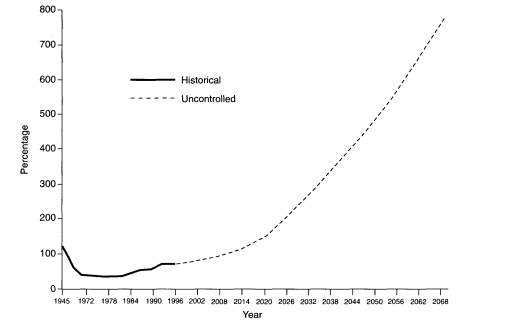
Figure 7.1
Gross federal debt as percentage of gross domestic product. (Historical data taken from 1996 Statistical Abstract, Table 512.) Uncontrolled: no fiscal controls on deficit. Adjusted: adjusted to historical data series using 1990 as the base year.
current policy remains in place for 10 years, after which the ratio is stabilized; or that current policy remains in place until the debt/GDP ratio hits 1.0. For each of these scenarios, we can consider the impact of adjustment in income taxes, in transfer payments, in defense spending, or in any combination of these and other components of the budget.
This approach to the government's long-run budget constraint clarifies the appropriate treatment of government debt and deficits under a dynamic incidence calculation. The burden of the debt itself is not assigned directly. Rather, individuals and their descendants are assigned the higher future taxes or lower future benefits that a higher current deficit may necessitate.
In each instance, we perform these calculations as a "partial-equilibrium" exercise. That is, we estimate budget changes needed under the assumption that people do not change their behavior in response to the new conditions. This assumption is unrealistic, but it is necessary given the complexity of the calculation. In any event, this limitation is one carried over from the static-incidence approach, and it is not likely to alter the qualitative nature of the conclusions.
One general equilibrium issue, however, needs to be discussed—how the net increase in the incomes of natives discussed in Chapters 4 and 5 would affect the
fiscal calculations. In general, one can think of the total effect of immigration on native after-tax income (in a particular year) as the sum of the net increase in income from labor market effects plus the net fiscal impact in that year. Thinking of the labor and fiscal effects as completely independent seems problematic at first glance, because the increase in income from the labor market effects would presumably lead to additional tax payments, which one would think ought to be considered in doing the fiscal calculation. However, in adding these two pieces together, it is important to realize that it would be double counting to first count a gain in income in the labor market effects and then also count the part of that increase that goes to additional tax payments in calculating fiscal effects.
How should one factor in the increase in incomes of natives in doing the fiscal calculation? The answer depends on what is assumed about the path of future taxes and expenditures. Consider the case in which taxes and benefits adjust to stabilize the debt/GDP ratio at some point. For simplicity, think of benefits as fixed, so debt targets are met through adjustments in taxes. The total amount of tax revenues needed to meet the debt target in a given year is essentially unaffected by the increase in the incomes of natives, although the tax rate needed to generate that level of revenues will fall. Taking into account the income gain to natives may thus lead to a slight shift in the incidence of the tax that would be unfavorable to natives. With a reduced tax rate for everyone and higher income for natives, natives would pay a slightly higher portion of total tax revenues, but this effect would have to be small. Aside from this shift in incidence, it would be correct to simply ignore the additional tax revenues coming from the gain in native income in the fiscal calculations, because it is rebated to natives through lower tax rates.
Discounting Future Dollar Flows
To discount the future flows for each immigrant or immigrant group, we must also settle on an appropriate discount rate. Here, there are a variety of options. The straightforward approach is to use a government borrowing rate, which will provide, in expected value, the present value of future net flows. However, given the uncertainty of the future and the riskiness of future taxes and benefits, it may be more appropriate to discount these flows with a discount rate that reflects their risk characteristics. For example, future income taxes might be discounted with a market discount rate that reflects the riskiness of future income (see Auerbach et al., 1991, for further discussion). Because the "right" discount rate depends on the question being asked, calculations based on a range of discount rates may be appropriate, and that is the approach we follow.
Defining the New Immigration "Experiment"
A dynamic-incidence calculation is intended to enable us to determine the
fiscal impact of an additional immigrant of a particular type at a particular date. But we must be more precise regarding this "experiment." An immigrant's arrival has fiscal consequences not only from the immigrant directly, but also from her offspring and their descendants, even though they themselves will be native-born. Thus, we must include in the calculation changes in taxes and expenditures associated not only with the immigrant, but also with her descendants. This process relies on the assumptions made about the characteristics of future immigrants and the speed of assimilation. To calculate the future tax and expenditure flows for immigrants, we must estimate the characteristics of new immigrants, as well as the extent to which the differences between immigrants and natives (in, for example, the birth rate, earnings conditional on education, the fraction of those who are eligible for a benefit that actually apply for it) disappear over time through assimilation. It may also depend on assumptions about the extent to which immigrants marry outside their own ethnic groups, to the extent that this is deemed to influence the rate of assimilation.
Indeed, the dynamic-incidence approach should also allow us to compare the impact of a new immigrant of a particular type at a particular date to that of a comparable native birth. This comparison is useful in separating the fiscal impact of immigration into the impact of population growth generally and the impact of growth through immigration.
Kinds of Impacts
The lifetime fiscal effects of an immigrant and his descendants can be divided into two categories: first, the fiscal benefits or costs of adding one more person to the population regardless of immigrant status and, second, the fiscal benefits and costs associated with the special characteristics of immigrants, such as age at arrival, time since arrival, English language ability, and education. We will briefly discuss these two categories of impacts.
Fiscal Impacts Relatively Independent of Immigrant Characteristics
Any increment to the population, holding all else equal, will have fiscal effects. These arise in part because a larger population helps to bear the cost of so-called public goods—those that provide services to all in the population at a cost that does not rise with the size of the population. National defense, expenditures on veterans, and research on health and science all are public goods.1 The cost per capita of providing a given level of services declines as population rises because more taxpayers share the unchanging total costs. Also, a larger popula-
|
1 |
For a discussion of empirical estimates of the "publicness" of various kinds of government expenditures, see Chapter 6. |
tion helps to bear the burden of the preexisting public debt through tax payments to cover interest or repayment charges.2
Much like anyone else in the population, immigrants use services that are costly to provide, or that others can use less freely—so-called congestion costs. Examples include services from roads, sewers, police and fire departments, libraries, airports, and foreign embassies. These services may have a public good aspect, but because they are highly congestible, we treat them as if immigrants raise both the demand for them and the cost of meeting that demand, in proportion to their numbers. Such items have both a capital cost and a current cost, and we account for these separately.
Additional members of the population, whether immigrant or not, crowd the existing social infrastructure, including roads, libraries, airports, sewage and water supply systems, and public buildings. We include in our analysis a cost of investment for each incremental immigrant to replicate the existing social capital stock. We have done this in two ways. First, when we include the present value of a per capita share of government expenditures on congestible goods and services, we implicitly include this capital cost because capital outlays are an item in such expenditures. Second, we use a direct estimate of the per capita value of net public capital (U.S. Department of Commerce, 1994), and use an annual flow of services plus depreciation of this capital, while omitting the capital outlays from expenditures on congestibles.3 These two methods yield nearly identical results.
Sensitivity of Fiscal Impacts to Immigrant Characteristics
Apart from their simple numbers, the specific characteristics of immigrants influence their fiscal impacts. Immigrants arrive with human resources different from those of the rest of the population. In recent years, for instance, there has been concern that immigrants are disproportionately poor and uneducated. Such immigrants may both pay less in taxes and receive more in benefits than natives do. An immigrant's age at arrival is also important. Natives begin life in the United States when they are born, but an immigrant can arrive at any age; the modal age is around 25. If she arrives after school age, although she may have less education than natives, the public costs of her education have been borne by the sending country. Although she may give birth to children in the United States
who will then incur educational costs, these costs will be paid in part by the immigrant parents, who will typically be working and paying taxes.
A child born here or a young immigrant child, however, will not generate incremental tax payments until he or she begins to work, since the parents would have been paying taxes in any case. At the other end of the age spectrum, elderly immigrants, arriving late in their working years or during retirement, will be particularly expensive, since they can qualify for certain kinds of benefits such as Medicaid and Supplemental Security Income, even if they do not qualify for Social Security and Medicare. Consequently, the age distribution of arriving immigrants distinguishes them from native increments to the population, all of whom ''arrive" at age 0.
The different fertility, mortality, and emigration rates of immigrants also have effects. On one hand, on average, immigrants have higher fertility and lower mortality rates than natives do, which affect the benefits they receive and the fiscal impact of their descendants. On the other hand, a substantial proportion of immigrants (about 30 percent) return to their country of origin, presumably taking at least their younger children with them, thus substantially mitigating the effect of their higher fertility.4
The need for bilingual education for many immigrants makes their public education more costly than that of natives. Cultural factors may influence the extent to which immigrants make use of the benefits for which they qualify. For example, strong family values may reduce the use of nursing homes by elderly immigrants. Finally, immigrants and their descendants are concentrated in certain areas of the country, and these areas may have different taxes and benefits from the rest of the country. For example, the states in which immigrants concentrate on average have higher levels of per pupil expenditures in public schools, and also higher state and local taxes.
To put these various fiscal impacts into perspective, it is useful to consider how important the programs involved are in current federal expenditures. In 1995, for example, expenditures on what we have categorized as public goods accounted for 23.7 percent of total federal outlays. Age-related expenditures made up an additional 55.4 percent of federal outlays, with debt payments accounting for 13.9 percent, and spending on congestible goods or social infrastructure making up the last 7.0 percent. Immigrants affect each of these categories differently in our calculations. New immigrants reduce the burden to natives of public goods and interest on the public debt; on average they are younger than
|
4 |
As noted in Chapter 3, there is little evidence on the characteristics of return migrants. However, there seems good reason to think that they leave few children behind them. Most return migrants leave the United States within the first decade or so of their arrival. Emigration thus cuts short the period during which they could have children in the United States. This also means that children born in the United States are likely to be young when their parents emigrated, making it unlikely that they would leave them behind. |
natives when they arrive, so immigrants initially participate less in age-related entitlements.
The annual or cross-sectional estimates of fiscal impacts were done for state and local governments as well as at the federal level. However, it does not make sense to do the longitudinal estimates for individual states or localities, because there is so much mobility from locality to locality and from state to state. Each year, 17 percent of the U.S. population changes residence, 6 percent changes county, and 3 percent changes state. For this reason, it does not make sense to do calculations that are based on the assumption that people remain in the same state over their lifetimes, and that their descendants do the same. When we do these calculations at the national level, we can simply group together all the state and local expenditures. One drawback, however, is that we can easily lose sight of the fact that immigrants and their state and local fiscal impacts are very heavily concentrated in a few states, rather than evenly spread across the nation.
Recall from the introduction that we do not take into account indirect fiscal effects of immigrants arising from any consequences of immigration for the earnings or employment of the existing labor force. This means that we will not consider the possibility that immigrants impose fiscal costs indirectly, by causing native workers to become unemployed or to drop into poverty due to reduced wages. The earlier chapters on the labor market effects of immigration suggested that any such negative effects on native workers are likely to be quite small, and the effects could even be positive. However, the possibility remains that immigration into a particular state may cause some out-migration of workers to other states, resulting in fiscal effects for high-immigration states that we have not taken into account. For the nation as a whole, such effects should average out to zero.
A Word on the Demographic Unit of Account
Many studies of the fiscal impact of immigrants use the immigrant-headed household as the unit of account. Here we use the individual as the unit of account. We do so because it is necessary for longitudinal calculations. If we were to use households, we would have to deal with changing household structure over time through marriage, divorce, widowhood, the departure of growing children, the arrival of additional family members from abroad, death of elderly members, and so on. We would also have to deal with nonimmigrant household members. Using the individual is much simpler in all these respects. Note that our calculations can subsequently be used as the basis of constituting families or households of immigrants when needed for interpreting the results, or for comparing them to results of studies that use the household framework.5
Some Data Issues
Most of our analysis is based on the Current Population Surveys (CPS) of March 1994 and 1995. The relative merits of several data sets for this purpose—the Current Population Survey, the Survey of Income and Program Participation, the Public Use Micro Sample—are discussed in Appendix 7.C. The number of respondents in the combined CPS sample is roughly 300,000, of which about 29,000 are foreign-born. The 1994 and 1995 March CPS were simply pooled, treating each as a separate sample. Because of the way respondents are rotated from one panel to the next, approximately one-half of the data represent reinterviews of the "same" household a year later.
In principle, these surveys cover illegal immigrants as well as legal immigrants and nonimmigrants (foreign students and foreign business travelers). To the extent that these are included in the CPS, they distort the information about immigrants, particularly those who don't stay very long. The problem may not be trivial, since the number of nonimmigrants in the United States at any time is comparable to the annual inflow of immigrants. At shorter durations in the United States, our calculations could most accurately be said to apply to the foreign-born, rather than to immigrants per se. In practice, we do not know the coverage of illegal immigrants, but we suspect that it is incomplete. In our analysis we cannot distinguish between legal and illegal immigrants. Presumably, illegal immigrants both pay less in taxes and receive less in benefits than other immigrants do.6
The Heterogeneity of Immigrants and Intra- and Intergenerational Mobility
The fiscal impacts of immigrants vary greatly depending on a number of their characteristics. The benefits received by immigrants in the United States
|
|
average taxes and receive average benefits for people of the ages in the family, and these amounts may be out of line with their exact circumstances. However, since both age and education level of self or parent could be taken into account, this does not seem to be a serious problem for constituting families. For example, low-education families would be more likely to receive Aid to Families with Dependent Children, and this would be reflected in the average numbers. |
and the taxes they pay depend strongly on their earnings. Migrants to the United States do not all have the same human resources, which heavily influence earnings. Our analysis captures some of this heterogeneity by distinguishing three categories of educational attainment of immigrants and others: less than high school, exactly high school, and more than high school. For our longitudinal analysis, we need to project educational attainment for the children and grandchildren of immigrants, according to the immigrant's education at arrival. For this purpose we analyzed data from the General Social Survey in a merged sample, calculating intergenerational transition matrices for these three educational categories.
Our analysis distinguishes three lengths of an immigrant's time since arrival: less than 5 years, 5 to 9 years, and 10 years and more. For every age, for every program, and for taxes, we estimate three age schedules from the CPS data, one for each duration. That is, we fully incorporate all the ways in which age and duration of residence here interact for these three duration categories and five-year age groups. The durations were chosen to correspond to potential qualification for entitlement programs, such as Aid to Families with Dependent Children (AFDC) and Old-age, Survivors, Disability, and Health Insurance (OASDHI).7
We also analyze the taxes paid by immigrants according to their education, age, and time since arrival. Because immigrants arriving in different periods have had different characteristics, the time of arrival variable may overstate the degree of earnings progress that can be expected of current immigrants. Those who have been in the United States for more than 10 years in 1994-95 may be different from more recent arrivals in ways not fully captured by their education and age.
For this reason we have done the analysis in two ways: first, assuming that the taxes paid by immigrants do follow the progress indicated by the trajectory estimated according to "time since arrival" and, second, assuming that the earnings follow this trajectory only for the first 10 years, and that thereafter the ratio of earnings between immigrants and native-born workers is fixed.8 There are
similar concerns about assuming that current immigrants will eventually use government benefits in the same way as immigrants who have been in the United States for more than 10 years in 1994-95, controlling for age and education. However, the case of benefits is quite different from that of taxes.
The Age Profiles of Taxes and Benefits
We begin by discussing the estimated age profiles of taxes and benefits for 1993-94, which are important building blocks for the later longitudinal calculations. We have used the merged 1994 and 1995 CPS, and occasionally other data sources, to estimate age profiles for 25 different state, local, and federal programs, most of which are disaggregated by educational level, immigrant generation, and, for immigrants, time since arrival. 9 It should be borne in mind that the benefits and taxes estimated from these data will reflect the fact that the U.S. economy ended a recession in the first quarter of 1991. Real gross domestic product growth averaged 2.5 percent in 1992-93; unemployment began to fall in the third quarter of 1992 and averaged 0.6 points lower in 1993 than in 1992. Incarceration costs were estimated using the Public Use Micro Sample (PUMS).10 The estimated age profiles were adjusted to match national program totals (using the National Income and Product Accounts, NIPA), when weighted by the distribution of the population by age and immigrant status and summed.
Many of these age profiles for specific programs are interesting in their own right, showing striking differences across generations. We present 5 age schedules representing aggregates of 12 of the 25 individual programs: OASDHI (Social Security benefits including Medicare), Medicaid (including costs for chronic care), SSI, public assistance (AFDC, general assistance, food stamps, and earned income tax credit), and public education (including elementary school, secondary school, and colleges and universities, and bilingual education). Disaggregation by time in the United States (not shown) adds further interesting detail. For example, an immigrant aged 70 years who has been in the United States for 30 years is most likely to be receiving benefits from Social Security and Medicare but is less likely to receive SSI and Medicaid. An immigrant aged 70 years who has been in the United States for only 10 years will probably not qualify for Social Security or Medicare, and so will be more likely draw benefits from SSI and Medicaid.
In addition to these benefits, all of which can be allocated by the age of the recipient, there are other benefits that immigrants receive that are not allocable by age. These are discussed later.
Age Profiles for Illustrative Individual Program Benefits
Figure 7.2 shows the Social Security and Medicare benefits (OASDHI) by age and immigrant generation. Note that here and throughout, third generation refers to the entire population other than immigrants and the children of immigrants. We see that the age schedules are very similar, but that immigrants receive $1,000 to $2,000 less per year in benefits than do second or third generations. This difference presumably reflects lower average earnings throughout their lives, shorter earnings histories in the United States, and, for some immigrants arriving late in life, a failure to qualify at all for benefits.11
Figure 7.3 shows that immigrants tend to receive higher Medicaid benefits up to age 80 or so, and lower benefits thereafter. But these differences are surprisingly small, on the order of a couple of hundred dollars. The age profile reflects separate treatment of Medicaid for the noninstitutionalized population, for which information is available from the CPS, and the institutionalized population, for which we made estimates using PUMS.12 Our analysis indicates that
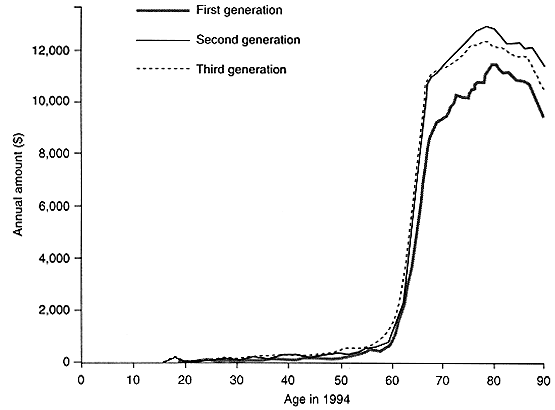
Figure 7.2
Estimated age profiles of benefits received from Social Security and Medicare by immigrant generation. Note: Data are from the March Current Population Survey, 1994 and 1995. Data have been smoothed on a moving window of 1,000 observations using a local regression smoother.
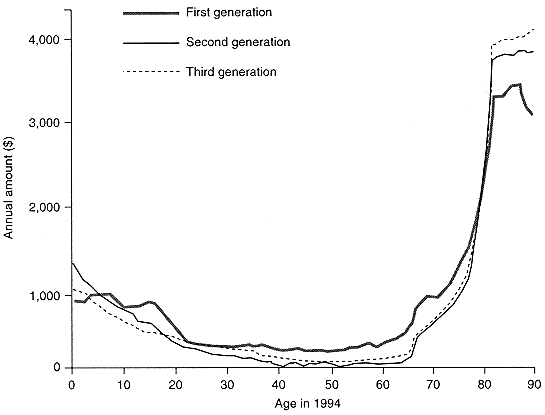
Figure 7.3
Estimated age profiles of benefits received from Medicaid by immigrant generation. Note: Data are from the March Current Population Survey, 1994 and 1995. Data have been smoothed on a moving window of 1,000 observations using a local regression smoother.
elderly immigrants are about 40 percent less likely to be in nursing homes than are second- or third-generation elders.
As the age profiles in Figure 7.4 reveal, elderly immigrants rely very heavily on Supplementary Security Income (SSI) compared with the native-born, presumably because many elderly immigrants cannot qualify for Social Security and Medicare.
Figure 7.5 shows expenditures on public education, combining elementary and secondary education with higher education, and reflecting specific educational costs for immigrants, such as bilingual education.13 For elementary and secondary education, the cost of education is somewhat higher for immigrants and the second generation than for others because states with high proportions of immigrants also have high educational costs per pupil, and state-specific data were used to assign costs by state of residence. For age 15 and above, the CPS furnishes enrollment information, which is also reflected in the profiles; at younger ages, the same enrollment rates are assigned to all children.
Figure 7.6 shows expenditures on public assistance (AFDC and general assistance), food stamps, and the refunded portion of the earned income tax credit. Up to age 30 or so, immigrants receive benefits similar to those for the general population, although higher than those for the second generation. After 30, however, they receive substantially more assistance, on the order of $200 more per person until nearly age 60.
We can now combine all the benefit profiles (see Figure 7.7). It is striking that the benefit levels appear quite similar across all three groups. First- and second-generation immigrants are somewhat more costly during childhood because of the higher educational expenditures in the states in which they live and the costs of bilingual education, but first-generation immigrants who are of college age or who are old are substantially less expensive. The average immigrant does not receive more costly benefits at a given age than natives do; if anything, the opposite is the case. Note, however, that immigrant households are on average larger than native households, so that they may well receive substantially greater benefits than native households, as in the case study of California.
One important lesson to draw from this brief discussion of the age profiles
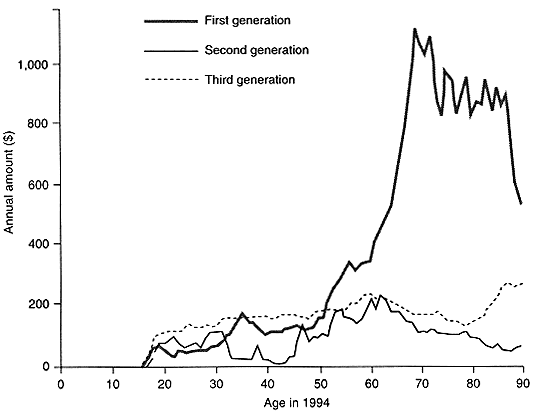
Figure 7.4
Estimated age profiles of benefits received from Supplemental Security Income by immigrant generation. Note: Data are from the March Current Population Survey, 1994 and 1995. Data have been smoothed on a moving window of 1,000 observations using a local regression smoother.
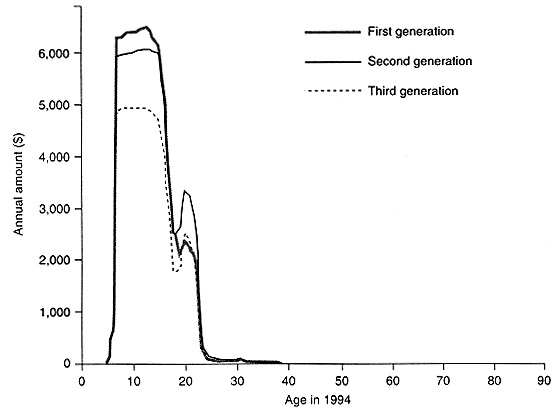
FIGURE 7.5 Estimated age profiles of benefits received from public education by immigrant generation. Note: Data are from the March Current Population Survey, 1994 and 1995. Data have been smoothed on a moving window of 1,000 observations using a local regression smoother.
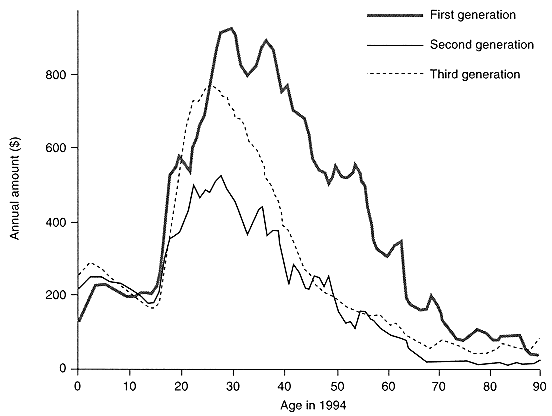
Figure 7.6
Estimated age profiles of benefits received from Aid to Families with Dependent Children, general assistance, food stamps, and earned income tax credits by immigrant generation. Note: Data are from the March Current Population Survey, 1994 and 1995. Data have been smoothed on a moving window of 1,000 observations using a local regression smoother.
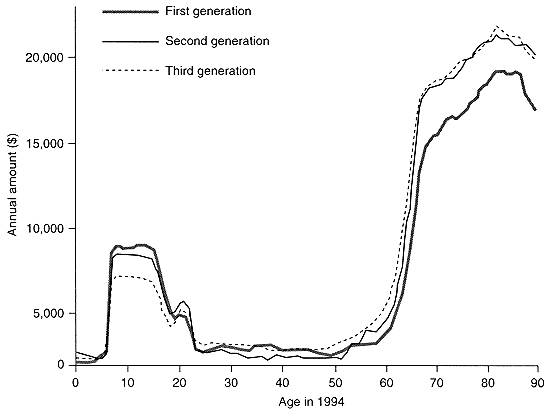
Figure 7.7
Combined estimated age profiles of benefits from all programs by immigrant generation. Note: Data are from the March Current Population Survey, 1994 and 1995. Data have been smoothed on a moving window of 1,000 observations using a local regression smoother.
for different programs is that, because the relation of immigrant to native costs varies so much from program to program, it is dangerous to draw general conclusions from the examination of any particular program. General conclusions must instead be based on a full and comprehensive consideration of all government programs and all levels of government.
Tax Profiles
The real difference between immigrants and natives lies in taxes rather than in benefits, as shown in Figure 7.8, which displays total taxes paid by the different immigrant generations in 1994. These plots combine state and federal income taxes, Federal Insurance Contributions Act (FICA) taxes, property taxes, and sales taxes. In addition, federal business taxes and excise taxes are allocated to individuals in proportion to their reported dividend, interest, and net rental income (the CPS does not have data on assets). In contrast to total benefits, there are large differences in taxes paid, with immigrants paying the least at each age, the second generation paying the most, and others paying intermediate amounts. The main reason the second generation pays higher taxes than the third is that it tends to live in states with higher incomes, as does the first generation.
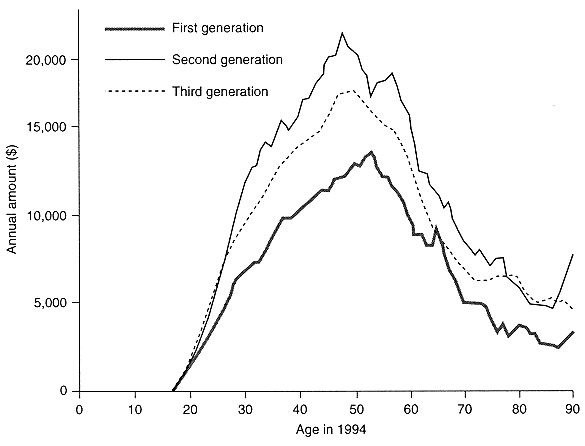
Figure 7.8
Estimated age profiles of taxes paid by immigrant generation. Note: Data are from the March Current Population Survey, 1994 and 1995. Data have been smoothed on a moving window of 1,000 observations using a local regression smoother.
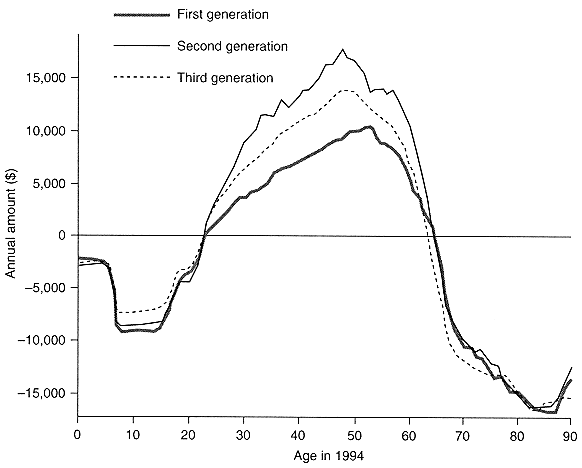
Figure 7.9
Estimated age profiles of the annual net fiscal impact of an individual by immigrant generation. Note: Data are from the March Current Population Survey, 1994 and 1995. Data have been smoothed on a moving window of 1,000 observations using a local regression smoother.
These age profiles for taxes are based largely on the CPS, as were those for benefits, and, like the benefit-age profiles, they have been adjusted to match totals given in the National Income and Product Accounts. The CPS imputes tax payments for individuals for federal income tax, FICA, state income taxes, and property taxes. We allocate 70 percent of property tax to renters and 30 percent to the owners of rental properties (for a discussion of the incidence of various kinds of taxes, see Chapter 6). The CPS does not impute state sales taxes. We assume that immigrant households remit $1,250 abroad that is not subject to sales tax (see literature reviewed in the California case study).14
In looking at the sum of the benefit profiles just discussed with the costs of government-provided private or congestible goods, a striking pattern emerges: net receipt of benefits in childhood and old age, with a period of net payment of taxes during the working years (see Figure 7.9). Because the variation across age
is so great, the age distribution of immigrants may matter a good deal to the net fiscal impact. It is also clear that the big difference between immigrants and natives is not in the net benefits received in childhood and old age, although differences exist, but rather in the level of the net tax payments during the working years.
For these unstratified results, it must be kept in mind that the second-generation immigrants who are over 30 are the children of immigrants who arrived before 1965, when the composition of the immigration stream was more largely European. There is a danger in treating the second generation as the children of the first-generation immigrants, as the calculations reported below do implicitly. Our actual estimates are based on data disaggregated by the education of the immigrant, and use estimated educational transition rates to project the education of the children and grandchildren of immigrants, depending on their own education.
Aggregate Cross-Sectional Fiscal Impacts of Immigrants and Their Children
Although our ultimate goal in this chapter is to estimate the long-term costs of immigrants and their descendants, the benefit and tax profiles just described can also be used to carry out the more common estimate of the net costs or contributions of the foreign-born and their young children in a given calendar year—essentially, the population living in households headed by immigrants. This kind of calculation is often thought to shed light on the current fiscal consequences of past immigration, including the way in which it has affected the age distribution of the population. When governments face constraints on borrowing, it may be particularly relevant compared with present-value calculations.
However, these kinds of calculations have certain conceptual problems, as noted earlier, and they are subject to a practical difficulty as well. When the immigrant population is defined as people living in households headed by immigrants, it is then limited to immigrants themselves and to their most costly descendants—young children. Older descendants of immigrants who have finished their educations and have become taxpayers are included only if they are foreign-born; U.S.-born children who are now adults are excluded, because they no longer live in households headed by immigrants. We illustrate the implications of this exclusion below.
The cross-sectional estimates are obtained by multiplying each age profile by the age distribution of the appropriate population, and summing to find the implied total taxes or benefits. Additional adjustments are made for the costs of providing congestible services at the state, local, and federal levels; at the state and local levels, all government services are treated as congestible. Table 7.1 indicates that the average first-generation immigrant has a substantial annual positive impact on the federal budget (+$1,310), reflecting the young age distri-
TABLE 7.1 Net Fiscal Impact Per Capita by Level of Government and Immigrant Generation (1996 dollars)
bution of the foreign-born, and a smaller positive impact at the state level (+$490), for an overall large positive impact of $1,800 in 1994 (these numbers are 1996 dollars).15 However, the category of immigrants does not include their young children born in the United States. These young children are members of the second generation under the age of 20. They are expensive at the federal level and even more so at the state and local level, for a large net negative impact of $6,390. Some studies report the net fiscal impact of households headed by immigrants. This group can be closely approximated by combining the immigrants and their young U.S.-born children, as is done in the third column of the table, which shows an overall impact of-$370. The next column shows that the remainder of the U.S.-born children of immigrants, that is, the older second generation, has an overall positive fiscal impact of +$910.
Note that, because these calculations are for incremental population members, whether immigrants or natives, no cost is allocated for public goods. This is consistent with the calculations reported in the previous chapter. If we were instead to ask whether immigrants were receiving a good deal, in the sense that the value of services they receive was high relative to the taxes they pay, then we would want to assign to them a pro rata share of expenditures on public goods. If immigrants valued these public goods at more than their net tax payments, then they would be receiving a good deal from government services even though the effect of a marginal immigrant would be a plus to the rest of us. Whether immigrants are better off, however, is not the question we ask here. Instead, we ask how an incremental immigrant would affect the taxes paid or benefits received by the existing population.
Fiscal Effects on the Native-Born Population
So far, we have expressed these impacts in terms of the amount per immigrant and child. But what is the cost to the native-born population? Dividing the total costs attributable to immigrants and their children by the balance of the population yields a cost per native-born of about $50. Thus, the average native-born paid about $50 in additional taxes in 1994 because of the 32 million immigrants and their young children in the United States, and the average U.S. household paid about $125 extra in taxes (= 2.5 times $50). (However, we shall see that there are problems in measuring fiscal impacts in this way.)
|
15 |
Public goods are treated as having zero marginal cost for all members of the population, so their costs are allocated to no one. Also, payments to service the federal debt are not allocated as costs to anyone. Thus, tax payments to pay for public goods and debt servicing will tend to make federal fiscal impacts, as measured in Table 7.1, positive. At the same time, the federal budget was in deficit for the relevant years, which will tend to make the measured federal fiscal impact of all people negative. The balance of these factors leads to the large net positive fiscal impact at the federal level for the total population. |
TABLE 7.2 Per Capita Total Benefits and Taxes for Selected Groups (1996 dollars)
|
|
Immigrants + Children < 20 |
Others (3rd+ generation) |
Total Population |
|
All taxes |
$5,650 |
$8,300 |
$8,170 |
|
All benefits |
6,010 |
6,270 |
6,480 |
|
Net impact |
-370 |
2,030 |
1,690 |
We can gain some further insight by examining the components of these net impact figures. The per capita benefits of immigrants plus their children are 96 percent as great as the benefits of the third and later generations, and only 93 percent of those for the total population (see Table 7.2). So immigrants and their children do not draw more heavily on benefits than does the general population, as indeed we could already judge from Figure 7.7 above. However, on average they pay only 68 percent of the taxes paid by the third and later generations, and a similar percentage of taxes paid by the total population.
To address one of the pointed questions about the fiscal impact of immigrants, Table 7.3 reports the effects on the Social Security system and on all other benefits, separately. The table shows that immigrants contribute $510 more per capita to Social Security and Medicare than they receive in benefits each year (making a total net contribution of $11.5 billion annually), and the third and later generations contribute $300 more per capita than they receive in benefits. These figures are in stark contrast to the second generation above age 20, which receives $3,700 more per capita each year than it pays into the system. The reason is that second-generation immigrants are on average very old and few work, because of the long period in which rates of immigration were low, and the large numbers of immigrants early in the century.
The difficulties in interpreting the cross-sectional measures of impacts can be illustrated using the numbers in Table 7.1. First, recall that immigrants (first generation) actually have a very positive fiscal impact in the cross section: the average immigrant pays $1,800 more in taxes than he or she imposes on the costs of benefits, and immigrants in total have a positive fiscal impact of $41 billion. Most people would find this figure misleading, however, because it does not include the fiscal impacts of the immigrants' young children born in the United States (second generation). To approximate the members of immigrant households, we can add the members of the second generation under age 20. Each such child has a large negative impact of -$6,390, due to the high costs of public schools. When these are averaged with immigrants, the result is a per capita fiscal impact of-$370. But the immigrants also have U.S.-born children who are
TABLE 7.3 Per Capita Net Taxes Minus Benefits for Old-age, Survivors, Disability, and Health Insurance (OASDHI) and for All Other Benefits (1996 dollars)
|
Taxes Minus Costs |
Immigrants (1st generation) |
Immigrants (2nd generation < 20) |
Children of 2nd Generation ≥ 20 |
Others (3rd+ generation) |
Total Population |
|
OASDHI |
$510 |
$0 |
-$3,700 |
$300 |
$110 |
|
Other |
1,300 |
-6,390 |
4,610 |
1,730 |
1,580 |
|
Total |
1,800 |
-6,390 |
910 |
2,030 |
1,690 |
older and who have grown up, gotten jobs, and begun to pay taxes. These children should also be counted, and, when they are, the per capita figure for net impact rises from -$370 to roughly zero.
What about the older members of the second generation, those over age 65? On reflection, it is clear that they could not possibly be children of the immigrants alive today; their parents would themselves be over age 85, and very few immigrants in the United States today are that old. So let us add just the members of the second generation who are under age 65. Now, the per capita fiscal impact becomes positive again, at more than a thousand dollars a person ($1,340). But not all of those in the second generation are actually children of current immigrants; many are children of former immigrants who have died. And many of these members of the second generation have themselves had children who are imposing costs of schooling. These considerations indicate that the results of cross-sectional calculations must be interpreted with caution.
Consistency with the Case Studies of California and New Jersey
The previous chapter reported on two careful case studies of the fiscal impact of immigrants in two states, California and New Jersey, based on the static, cross-sectional or annual methodology. How consistent are those results with the cross-sectional analysis reported in this chapter? We have reestimated the tax and benefit profiles for New Jersey and California, and adjusted them based on national aggregate underreporting for state and local items rather than adjusting them to match the specific totals for each of these two states (which would be preferable).16 We group together immigrants with their children under age 20
for purposes of comparison to the population living in households headed by immigrants, the basic unit of analysis in the case studies.
Consider the extrapolations to the national level reported in the previous chapter, for net impacts at the state and local level. Based on New Jersey and California, a national range of -$17.95 to -$23.34 billion was reported, in contrast with -$28.5 billion based on the national analysis (with adjustment of age profiles to the aggregate state and local totals reported in the NIPA). Thus the current chapter has additional costs of about $5 billion, compared with the extrapolation. But the case studies assume that the costs of education are the same for children in immigrant households and native children, whereas in this chapter we impute very substantial costs for bilingual education, amounting in the aggregate to $5.8 billion. If we were to delete this additional cost, the estimate in this chapter would be $22.7 billion, falling within the range of the Chapter 6 extrapolations, if closer to California than to New Jersey. Therefore, there is excellent agreement between the national study and these two case studies at the state and local level.
At the federal level, however, the situation is very different. There was no federal component to the New Jersey study, so the extrapolation to a national federal net impact of +$3.18 billion is based entirely on the California study. The direct national study, however, found a federal net impact of +$17.1 billion, or more than five times as great. This puts the combined fiscal impact from the national study at -$11.4 billion, outside the extrapolated range of -$14.8 to -$20.2 billion. Although this wide a disagreement in the combined impact is not too troubling, the discrepancy at the federal level merits closer scrutiny.
Concentrating on California, on which the federal extrapolation is based, we find excellent consistency between the numbers we generate and the state calculations:
|
|
Extrapolated from California case study |
Implied by national study |
|
Total federal taxes per household |
$10,644 |
$10,602 |
|
Total federal benefits per household |
10,517 |
10,282 |
|
Net fiscal impact per household |
127 |
320 |
Although the nationally based estimate of the net impact is more than twice the state-based one, the numerical difference is very small, and results from the small difference between the large numbers for taxes and benefits, which separately are in close agreement. The important point is that the results from methods and data used in this chapter agree with the California case study in implying
that the positive federal fiscal impact in California is very small, at the same time that a very much larger positive federal impact is found for the nation as a whole. California is simply too different from other states to permit extrapolating from its experience the national federal impact of immigrants. In fact, further exploration reveals that immigrants in California pay far less federal taxes than do those elsewhere, perhaps because they have substantially less schooling. Calculations show that, whereas immigrants in California pay $2,850 per capita in federal taxes, immigrants elsewhere pay $3,824, or nearly $1,000 more. At the same time, immigrants in California receive benefits costing $2,764, whereas immigrants in the rest of the country receive benefits costing $3,022, or about $360 more. This difference in benefits doubtless reflects the older age distribution of immigrants in the balance of the country, whereas the difference in taxes reflects both the age difference and the education difference. Thus, California immigrants have a federal fiscal impact of +$86 per capita, and immigrants in the rest of the country have a federal impact of +$802.
The extrapolation done in the previous chapter controlled for regional heterogeneity by taking ethnic composition into account. However, it turns out that this is not an adequate control, as illustrated by the following figures for federal income taxes paid by ethnic groups in California and in all other states combined:
|
Immigrant Ethnic Group |
California |
Other States |
|
White |
$1,938 |
$1,706 |
|
Asian |
1,533 |
2,132 |
|
Hispanic |
435 |
630 |
It is also possible to calculate the net fiscal impact by state from the data at hand, and the results are quite striking, as shown in Table 7.4. Whereas the average immigrant, plus her U.S.-born young children, has a negative impact of $369 for the United States as a whole, the total impact is actually substantially positive for New Jersey and is essentially zero for the immigrants in all other states besides California and New Jersey combined. For California, however, it is -$1,313. In California, compared with the United States as a whole (including California), impacts are $400 to $500 more negative at both the state and local and the federal level, adding up to about $950.
The figures for aggregate, rather than per capita, fiscal impacts are also striking. As reported earlier, the aggregate fiscal impact of immigrants and their young U.S.-born children amounts to -$11.4 billion. But the impact for California alone is -$14.3 billion, whereas New Jersey contributes +$2.4 billion and the other states contribute +$0.5 billion. In other words, California alone accounts for the entire national negative fiscal impact of immigrants (at the combined federal and state and local levels)—and then some. Of course, immigrants in some of the states that have been lumped together in ''other" may also be costly.
TABLE 7.4 Per Capita Net Fiscal Impacts of Immigrants and Their U.S.-Born Children < 20 (1996 dollars)
|
Government Level |
United States |
California |
New Jersey |
All Other States |
|
Federal |
$551 |
$86 |
$2,586 |
$671 |
|
State/local |
-920 |
-1,398 |
-870 |
-644 |
|
Total per capita |
-369 |
-1,313 |
1,716 |
27 |
As for the third and later generations in California and New Jersey, they have more than twice the positive fiscal impact compared with those in the United States as a whole.
This section has these implications:
- The analysis of this chapter is consistent with the case studies reported in the previous chapter.
- It is not possible to extrapolate from the experience of California to the nation; it is too atypical.
- Fiscal impacts, at both the federal and the state and local level, are substantially more negative or less positive in California than in the rest of the country, and, overall, California accounts for the entire negative net impact of immigrants and their young U.S.-born children in the country; in other regions taken together, immigrants and their children have an overall positive impact.
Constructing Longitudinal Age Profiles
These cross-sectional age profiles and their components from specific programs, with additional disaggregation by education and time since arrival for immigrants, form the building blocks for the longitudinal analysis. They are used to construct longitudinal age profiles on the assumption that each age profile shifts upward at the assumed rate of productivity growth, or I percent annually (based on the budget projection assumptions made by the Congressional Budget Office—CBO). 17 The real costs of Medicare and Medicaid per enrollee have been rising particularly rapidly, and are expected to continue to do so in the future. We follow CBO (1996) in using the projections by the trustees of Medi-
care, as described in their 1996 report (which is more recent than the 1995 report used by CBO), for both Medicare and Medicaid.18
Although the federal deficit is currently not very large relative to gross domestic product and is likely to be further reduced by the year 2002, long-term projections reveal that serious imbalances will emerge due to rising health care costs and to the aging of the population, ushered in by the retirement of the baby-boom generations between 2010 and 2030. Current federal taxes and benefits, even if adjusted to meet deficit-reduction targets over the next few years, will not be sustainable in the longer run, and far more substantial adjustments will be required to taxes, benefits, or both. For example, a recent report by the Congressional Budget Office concluded: "CBO projects that, if spending and revenue policies are not changed, deficits and debt will soar to unprecedented levels in the following 20 years. . . . Because the deficits and debt that would result if there are no changes in policy are not sustainable, such changes are inevitable" (p. xxv).
Figure 7.1 illustrated just how unsustainable current fiscal policies are by plotting out the ratio of debt to GDP under our federal budget projections if no changes are made. These projections indicate that if our age-specific profiles of taxes and benefits shift upward at 1 percent per year, the assumed rate of productivity growth (except for Medicare and Medicaid costs as noted), then the debt as a percentage of GDP will rise from its current level of about 60 percent to 100 percent in 2014, 200 percent in 2029, 300 percent in 2039 and 700 percent by 2071. In our baseline scenario, we assume that, starting in 2016, the debt/GDP ratio is frozen by a 50-50 combination of benefit cuts and tax increases.19 Between now and then, the debt changes according to the CBO budget projections. The implied adjustments shape our results in an important way. At the state and local level, we assume a constant ratio of aggregate state and local debt to GDP, starting in 1994.20 We assume that the real interest rate paid by all levels of
government on their debt is 3 percent per year, and this rate is also used to calculate the net present value of an incremental immigrant. Later we will test our results with different budgetary assumptions and with interest rates of 2, 4, 6, and 8 percent.
We assume that these same age profiles, shifted upward as described, also describe the tax payments and benefits received by descendants of immigrants. The descendants are projected based on the fertility of immigrants, which is assumed to converge in two generations to that of the general population, following the assumptions described in Chapter 3. Over their life cycles, 30 percent of immigrants are assumed to return to their countries of origin (Duleep, 1994), taking with them their children under the age of 20 born in the United States. We take into account that these return migrants may or may not be entitled to Social Security benefits, depending on the length of time spent in the United States.21
Baseline Results
Definition of Baseline Scenario and Alternative Scenarios
We will carry out the basic calculations for a baseline scenario, and then examine how results change when we vary certain assumptions, one at a time. Here are the baseline assumptions, and the variants (in parentheses):
- Starting in 2016, and thereafter, fiscal policy will hold the debt/GDP ratio constant at the level of 2016. (Alternatively, the ratio will be constant from now on, or it will never be constant, and taxes and benefits will simply rise with productivity at 1 percent per year.)
- This budgetary adjustment will be achieved by a 50-50 combination of raising taxes and reducing benefits. (Alternatively, all the adjustment will be made to taxes, or to benefits.)
- The real rate of interest is 3 percent. (Alternatively, we use 2 percent and
|
|
growth for the first few decades. Pension costs require special treatment. We assume that the current number of state/local pensioners was set by state/local employment 30 years ago, and we shift the age profiles of pension receipt upward each year between 1965 and 1994 by the ratio of state/local employees in each year to the number in 1965. (The difference between the mean age of Social Security beneficiaries and FICA taxpayers is 30 years.) The per capita number of state/local employees grows from 4.9 percent in 1970 to 6.1 percent in 1992, for example. After 1994, we allow the age profiles of state/local pensioners to shift upward at I percent per year along with all the other age profiles, assuming that growth of state/local government relative to the population size has run its course, and that further growth will just keep pace with population. |
- 4 percent. We have also used 6 percent and 8 percent as a rough reflection of the uncertainty of future tax revenues, and the asymmetric valuation placed on the consequences of upward and downward variations.)
- Immigrants continue to receive benefits as they do in 1994-95, for which we have CPS data. (Alternatively, they do not receive SSI, AFDC, Medicaid, food stamps, rent subsidies, energy assistance, public housing, or earned income tax credits during their first five-years in the United States, in accord with the welfare reform legislation of 1996 and assuming they become citizens after five-years).
- The taxes immigrants pay change as indicated by the cross-sectional data as their stay in the United States lengthens up to 10 years; after that, their taxes relative to the age-specific tax payments by natives are fixed. (Alternatively, their tax payments continue to change to the empirical estimate for durations in the United States of 10+ years.)
- Immigrants arriving after age 55 are allocated the OASDHI benefits estimated from the data. (Alternatively, immigrants arriving after age 55 are assumed to receive no OASDHI benefits, since they would not be able to qualify for them before age 65.)
- Thirty percent of immigrants later emigrate, taking with them all their young children. Consequently, 16 percent of those born in the second generation are assumed to emigrate with their parents. (Alternatively, none of these second-generation children emigrate, and only 20 percent of first-generation immigrants emigrate.)
- Costs of bilingual education raise the cost of educating immigrant and second-generation children by 22 percent and 16 percent, respectively (versus only half of these increases, or an additional 11 percent and 8 percent, respectively).
Net Present Values
Based on these baseline assumptions on the constructed longitudinal profiles and on the demographic assumptions, we can calculate the present value of the taxes paid by the marginal immigrant and his descendants minus the present value of all costs they impose. The effects further in the future have less importance today than do those closer to the present. The government can borrow or lend money, to be repaid in the future, at some real rate of interest, and future fiscal impacts should be discounted at this same rate. In some circumstances, discounting the future is also a way to reflect uncertainty about it, particularly when we care more about negative than about positive departures from our expectations. The net present value, or NPV, of an immigrant's future fiscal impacts is just the sum of all the discounted impacts.
The NPV is conditional on the age of arrival of the immigrant, since this strongly influences the benefits received, the taxes paid, and the number of his or
her descendants. It will also vary depending on the education of the immigrant, since this strongly influences earnings and therefore tax payments and the need for public transfers of various kinds. The NPV combines the effect of an immigrant during his own lifetime with the effects of all generations of his descendants born in the United States (children born before coming to the United States are treated as immigrants in their own right, with their own descendants). We consider these two components of the NPV separately for some purposes. We also compare the NPVs of immigrants for various ages at arrival with the NPVs of second and later generations, although in reality the native-born groups can be augmented only at birth, that is, at age zero.
As discussed below, we assign educational categories to children, including infants. There are two ways to do this: (1) according to the ultimate educational attainment of the children, so that the children we show are those who will eventually attain the educational category in which they are plotted or (2) according to the educational attainment of their parents. When the first method is used, the NPV age profiles are smooth with no discontinuities. However, the ultimate educational outcome must be assigned by a complicated procedure, based on the likely family origins of children who eventually attain the educational statuses indicated.22 We instead plot the results of the second method in our figures, a method that results in sharp discontinuities because the children of parents with low education have a good chance of attaining higher education than their parents, and therefore come to have much higher NPVs than their parents, who are assumed to remain in the low-education category for life. Both methods are valid and will give the same result if used appropriately.
Results
Figure 7.10 presents the NPVs by age and by education for immigrants, which are the core results of this project, indicating the total impact of an immigrant on the combined federal, state, and local budgets, now and in the future. In reading these figures, it should be kept in mind that their meaning is very different from that of the figures depicting cross-sectional age profiles. Here, each single point on the curve summarizes the entire future years for an immigrant arriving at the corresponding age. One cannot trace a given immigrant's impact across the life cycle by moving along the curves. Other points on the curve summarize the entire future years for other immigrants.
Panel A shows the total NPV, and Panels B and C show the NPV for the immigrant's own lifetime and for the immigrant's descendants, respectively.
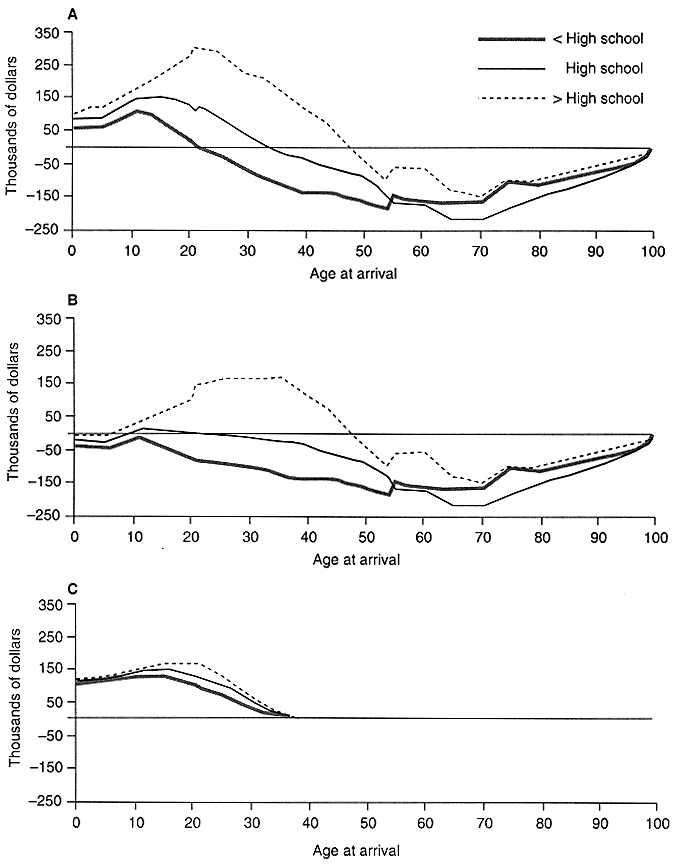
From Panel A we see that immigrants with more than a high school education (the dotted line) have a positive NPV for all ages of arrival up to the mid-forties, after which the NPV turns negative, reflecting the costs of old-age support programs and the short period of paying taxes before retirement. Note that at age 55 the NPV rises abruptly. This is because an immigrant arriving after that age is assumed not to have time to qualify for OASDHI benefits. For a high-education immigrant arriving at age 21, the NPV is $332,000; he is indeed a substantial contribution. For a high-education immigrant who arrives at age 70, the NPV drops to -$148,000; he is quite costly.
For an immigrant aged 21 years with a high school education, the NPV is $126,000. For arrivals after the mid-thirties, the NPV turns negative, reaching about -$224,000 for an immigrant arriving at age 70. For an immigrant arriving at age 21 with less than a high school education, the low-education category, the NPV is $9,000. Then NPV then turns negative, reaching -$166,000 for an immigrant arriving at age 70. For an infant, the NPV is +$61,000, which reflects the high upward mobility of immigrant children of low-education parents. Panel A makes it very clear that the fiscal impact of an immigrant depends heavily indeed on the immigrant's age and education at time of arrival.
It is also informative to consider Panels B and C together. From Panel C we see that the present value of the descendants of a current immigrant, plotted against the ancestral immigrant's age at arrival, is always positive, regardless of the immigrant's age at arrival and education level. The fiscal effects of descendants shown in Panel C do not reflect any difference in fertility by education. If they did, we would see larger positive impacts for the low-education group and smaller ones for the high-education group. An immigrant who arrives after age 40 or so will not have U.S.-born children, and so for ages above 40, the NPV for descendants drops to zero.23 From this we can infer that the NPV for the immigrant's own lifetime is going to be less positive or more negative than the total NPV figures of Panel A, an influence that is borne out by Panel B. That panel shows that if we focus on the fiscal effects from the lifetime of the immigrant, the NPVs are substantially negative for those with less than high school education, whatever their age at arrival, and for almost all of those with a high school education. Immigrants with more education who arrive up to their mid-forties still have positive NPV for their own lifetime, with a peak NPV of about $150,000, compared with more than $300,000 for the peak total fiscal impact.
One might be inclined to dismiss the contributions of these descendants to the NPV because they appear conjectural and far in the future. However, the
children of an immigrant make important economic contributions throughout much of the immigrant's lifetime. The descendants of an immigrant arriving at age 20, which is close to the modal age of arrival, will begin making contributions when the immigrant reaches the early forties, and will continue to make tax payments that offset the costs of the immigrant's Social Security, SSI, Medicare, and Medicaid benefits when the immigrant is old. We are counting the social costs of investing in the immigrant's children, and we should also count the social return on that investment (see MaCurdy et al., 1996:6-7).
Given the difficulties of forecasting anything very far into the future, some readers may be put off by the very long time horizon in the net present value calculations, and may be concerned that these calculations will be dominated by a variety of assumptions of uncertain validity. Such readers may prefer to skip to Figure 7.15 and the accompanying text, which plots the projected current fiscal consequences of an additional 100,000 immigrants per year without use of the net present value calculation and the long horizons that it entails. Figure 7.15 simply projects the consequences year by year into the future, expressed as a tax cost per U.S. resident, and the reader can consider as many years as he or she thinks relevant.
Figure 7.11 presents NPVs for the federal and state and local governments separately, in Panels A and B, respectively (compare these to the total NPV by the age and education of the immigrant, shown in Figure 7.10A). There is a striking difference between these panels. For the federal government, immigrants with all levels of education arriving early in life—say, before age 30 to 50, depending on education—have a substantial positive fiscal impact as measured by NPV. After these ages, however, they have a substantially negative impact, since the federal government provides entitlements for the elderly, most notably Social Security pensions and Medicare. At the state/local level, the situation is reversed. Young immigrants, regardless of their education, impose substantial net costs up to ages of arrival in the late teens or 30 or so, for the two higher-education categories. For the less educated, the fiscal impact remains negative regardless of age at arrival. At the state and local level, even those who arrive when they are elderly impose only slight fiscal costs, in contrast to the federal level.
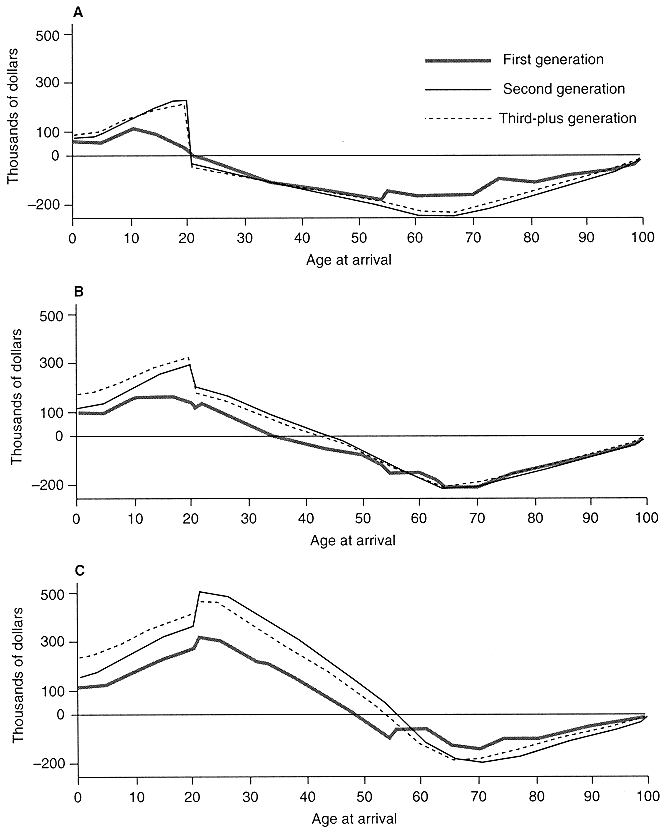
Figure 7.12 contrasts the NPVs of immigrants with those of the second and the third and later generations. There are two reasons for expecting that the NPVs of immigrants might be greater than those for natives for a given education level and age at "arrival." First, each immigrant has a 30 percent chance of returning to the country of origin after working for a few years in the United States, but before having become costly at school-age; even if she did have children, she would take them along when she returned to her country of origin. In either case, state and local governments would not have to pay for their education. Second, our empirical analysis showed that the children of immigrants with less than high school education tend to get considerably more education than do
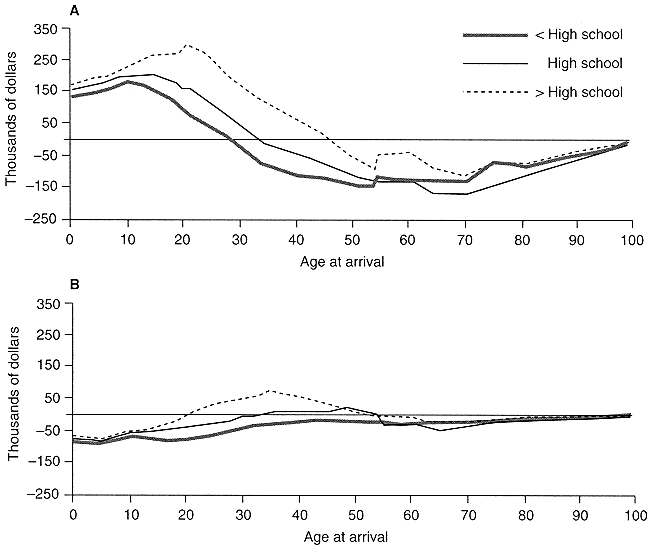
Figure 7.11
A, Net present value of federal fiscal impact: Generation 1 by age at arrival and education status, self and descendants; B, Net present value of state and local fiscal impact: Generation 1 by age at arrival and education status, self and descendants.
the children of low-education natives. This means that the descendants of low-education immigrants contribute more to the total NPV. Figure 7.12 reveals, however, that in general the NPVs of immigrants are somewhat lower than those for natives at each level of education, although this is not true for every age of arrival.
The Average Impact of an Incremental Immigrant
Because there is a different NPV for every age of arrival and every level of education, and because some of these are large positive numbers and others are large negative numbers, drawing a general conclusion about the fiscal impact of immigration is difficult. To paint the larger picture, we have calculated various kinds of weighted averages of the NPVs across age and education categories, in which the weights are the frequencies of immigrants with these characteristics
arriving in the United States in the past few years.24 This provides a convenient summary of the implications of the estimates. This idea is appealing, but it suffers from one complication. Children who arrive have not yet completed their education. For those under 20, we have projected the distribution of their completed educations based on the education of their parents, using our estimated probabilities of the upward educational mobility in later generations.
Immigration policy could be varied in terms of the characteristics of the immigrants admitted, or in terms of the numbers admitted, holding characteristics constant. These two different kinds of policy options are informed by different kinds of calculations of the net fiscal impact. We first consider the effects of varying the characteristics of immigrants, and then compare them with the effects of varying their numbers. Before doing so, let us assume for the moment that the only concern of immigration policy is to maximize the net fiscal surplus that immigrants provide to the native-born. To meet that goal we should accept all prospective immigrants who yield a positive fiscal surplus and reject those who impose a fiscal cost. The last immigrant we admit (the marginal immigrant) would cost as much in benefits received as she paid in taxes. In this case, the average fiscal surplus across all immigrants admitted would be a large positive number, since all of them would yield positive fiscal benefits, many of which would be quite large. Our estimates in this chapter show how net fiscal impacts vary with the characteristics of immigrants, but because our simulations contain no feedbacks through the general economy (as explained in the introduction), they do not reflect diminishing returns to immigrants as a result of their hypothetically increasing numbers, and so could not be used to identify the point at which the net fiscal contribution of an incremental immigrant becomes zero. We can, however, identify those immigrants whose characteristics yield a net fiscal impact of zero in the neighborhood of the current volume of immigration.
With this as background, we begin by considering the differences in average NPV by level of education, as shown in the first row of Table 7.5. We see that the average fiscal impact over the life of the immigrants and his descendants is slightly negative for those with less than a high school education; substantial and positive for those with a high school education, and strongly positive, at nearly $200,000 per immigrant, for those with more than a high school education. If the only policy goal were the maximization of the positive fiscal impact of immigrants, the way to accomplish it would be to admit only those with the highest education.25
TABLE 7.5 Average Fiscal Impact of an Immigrant Overall and by Education Level (1996 dollars)
|
|
Education Level of Immigrant |
|||
|
Group |
< High School |
High School |
> High School |
Overall |
|
Immigrants (baseline)a |
-$13,000 |
+$51,000 |
+$198,000 |
+$80,000 |
|
Immigrants themselves |
-89,000 |
-31,000 |
+105,000 |
-3,000 |
|
Descendants |
+76,000 |
+82,000 |
+93,000 |
+83,000 |
|
a Based on estimated educational transition probabilities. |
||||
Row 1 of the table shows the total impact of an immigrant, including the impacts of future descendants born in the United States, and rows 2 and 3 show the components attributable to the immigrant during her own lifetime and to her U.S.-born descendants, respectively. (Note that much of the impact of descendants is actually experienced during the lifetime of the immigrant.) We see that the impacts of the immigrants themselves vary widely by level of education and are substantially negative for all those with less than high school education. By contrast, their descendants have remarkably similar and highly positive effects across the education levels of the immigrant parent, reflecting the considerable upward educational mobility of the children of all immigrants.
Now consider differences in average NPV by age at arrival in the United States. Figure 7.13 shows the average across education levels of the age-specific NPVs, with weights at each age given by the distribution of recent immigrants by educational category. Here we see that, if the only policy goal were making the total fiscal impact as positive as possible, it could be achieved by admitting only
|
|
have zero marginal cost but are of value to the immigrant. Second, the fiscal impact of the immigrants themselves is far less positive or far more negative than the total impact, including the impacts of their descendants. Third, all that really matters to the economic incentives to emigrate is the difference between the expected lifetime value of after-tax earnings plus the value of government services received in the United States and those in the country of origin, and this is surely a very large incentive regardless of the fiscal impact. Fourth, potential immigrants may compare the fiscal ''deal" they would get in the United States to that they would get in other high-wage developed countries. The United States does not have particularly high taxes in the international context. All governments provide public goods, and this is a big part of the story. The current deficit contributes something to the positive NPVs, but only about half as much as defense spending, and the United States does not have a particularly high ratio of debt to GDP compared with other Western European countries. In other words, these high NPVs are most likely a fact of life for industrial nations. Potential immigrants cannot avoid this situation by shopping around; the United States probably looks better than most in this regard. |
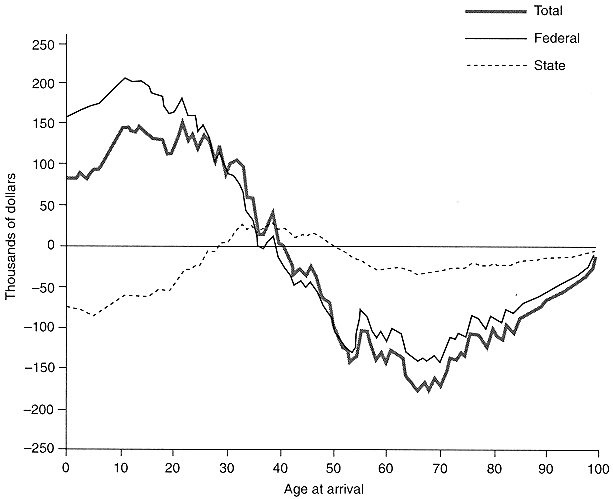
Figure 7.13
Net present value of average immigrant by age at arrival.
immigrants of ages 10 to 30. Less restrictively, but still with the narrow goal of avoiding negative NPVs, policy could simply avoid admitting immigrants at ages above 40 or 45. (Figures 7.10 to 7.12 can be consulted for the detail of age-education interactions.) Figure 7.13 also makes clear, however, that, ages at arrival that are good for the federal budget are bad for the state and local budgets, and vice versa.
The curves in Figure 7.13 all refer to individuals of different ages. However, it is a simple matter to constitute families by summing these estimates across the ages of family members at arrival for any desired family configuration. Looking at Figure 7.13 from another perspective, we see that a family with parents of any age at least up to the early forties, with younger children, would have a positive net fiscal impact. Inclusion of elderly family members would substantially reduce it.
These figures indicate the great variation in the fiscal surplus or burdens that immigrants impose. Less skilled or older immigrants are more likely to be fiscal burdens, and the higher-skilled and young adults are fiscal benefactors of the native-born. In fact, immigration policy has many goals other than purely economic ones, and the composition of current immigrants presumably reflects this diversity of purpose. For example, the less-educated immigrants who impose a
fiscal burden are the very same immigrants who provide the economic benefit reported in the labor market chapters.
To see the effect of continuing with this same mix, but increasing the number of immigrants, we consider the expected impact of admitting a randomly chosen immigrant from a pool similar to the pool of actual immigrant arrivals over the past few years. This number is an NPV of +$80,000 (from the last column of Table 7.5).
Of course, all of these numbers are based on a specific set of baseline assumptions, each of which may be questioned, so they should not be taken at face value. In order to investigate the sensitivity of the results to changes in these assumptions, we have redone the entire set of simulations under alternative assumptions, as discussed in the next section. In a subsequent section we present further experiments that will indicate the contributions of different factors to the results.
Alternative Scenarios
Earlier, we described variations on the baseline scenario. The voluminous results of these alternative calculations are presented in Appendix 7.B in tables 7.B1, 7.B2, and 7.B3, which present results for immigrants in each of the education categories. Each table gives the NPV for selected ages of arrival: 0, 20, 21, 40, and 70. Age 20 is close to the modal age of arrival and often has close to the peak NPV, and 70 is the age of arrival with the greatest negative value.26 The tables also give the corresponding NPVs of the third and later generations for comparison purposes, along with the difference between immigrant NPV and third-generation NPV. Because variation is so complex, it is difficult to form an impression of the overall effects of the different scenarios on the calculated fiscal impact of an immigrant. Table 7.5 presents NPVs averaged across age at arrival of immigrants, regardless of education, and Figure 7.13 presents NPVs of immigrants of various ages averaged across their education level—Table 7.6 takes both attributes into account. Using the age-education frequencies among recent immigrants, as reported in the 1994 and 1995 CPS, we can average individual immigrants with any combination of age and education.
In this exercise, the baseline results appear to be quite robust, at least regarding the sign of the outcomes. At the state/local level, the average fiscal impact is negative, with present value usually in the range of -$20,000 to -$30,000. At the federal level, however, the average fiscal impact is positive and typically quite large, mostly in the range of $60,000 to $130,000. The average total fiscal impact
TABLE 7.6 Average Fiscal Impact of an Immigrant (Net Present Value) by Scenario and Level of Government (1996 dollars)
is positive except for two cases, which are viewed as highly unlikely, and its level ranges widely. A few scenarios merit separate discussion.
Starting Year for Fixing the Debt/GDP Ratio
In the baseline scenario, the budget is adjusted starting in the year 2016. Here we consider two alternative scenarios: fixing the debt/GDP ratio starting immediately (which gives very similar results to fixing it starting in 2016), and not adjusting the budget at all, but rather continuing with the status quo, in which tax payments are assumed to grow at the rate of productivity growth, 1 percent
per year, as do benefits. It makes little difference whether taxes and benefits are adjusted to fix the debt/GDP ratio immediately or in 2016. Under the first alternative, the average federal NPV declines slightly, from $105,000 to $102,000. Two factors account for this reduction. First, the earlier adjustment may actually lead to lower taxes for a number of years. Second, dealing with the impending budget crisis earlier means that it is sufficiently less severe later on that later taxes will be substantially lower. Also, the relative numbers of immigrants and natives change over time, so altering the timing of tax increases alters the relative burdens between the present value of tax payments by immigrants (including their descendants) and natives.
However, if the debt is allowed to grow with neither tax increases nor benefit cuts, then the positive impact at the federal level is dominated by the state and local negative impact, resulting in a negative total impact. In the status quo scenario, the debt/GDP ratio rises to 3.9 by 2050, and to 11.7 by 2100. This scenario clearly leads to unrealistic debt levels. We believe that the baseline scenario, or perhaps the immediate-adjustment scenario, offers the most realistic basis for assessing the fiscal impacts of immigrants.
It might be thought that, since none of these scenarios involves repaying the debt, nor even preventing its further growth, the calculations must be missing the full contribution of immigrants to the debt burden. In fact this is not so. The present value of all implied interest payments does equal the initial stock of debt under the scenarios with a fixed debt/GDP ratio. Under the no-targets case, debt never has to be controlled, and all interest payments can be made by borrowing rather than by raising taxes, so the effects of debt sharing are inconsequential.
Fiscal Adjustments Entirely Through Taxes or Through Benefits
In the baseline scenario, starting in 2016 the budget is adjusted so that the debt/GDP ratio is held constant thenceforth. The baseline adjustments are shared 50-50 between changes in taxes and in benefits. Here we examine the implications, first, of making all adjustments in taxes while leaving benefit schedules unchanged, and next, of making all adjustments in benefits. It makes a moderate difference (±$13,000) which way government budgets are adjusted, but not enough to affect our conclusions. With higher tax rates, immigrants make a greater contribution to meeting the costs of the retirement of the baby-boom generations, and so have a more positive federal and total impact than they would if benefits were reduced.
Effects of the Welfare Reform Legislation of 1996
The Personal Responsibility and Work Opportunity Reconciliation Act of 1996 denies certain means-tested benefits to noncitizens. The legislation did not define these programs and to date they have not yet been defined by regulations.
TABLE 7.7 Increase in Net Present Value (NPV) of Immigrants Under the Welfare Reform Legislation of 1996, by Age of Arrival and Education (1996 dollars)
|
|
Increase in NPV Due to Welfare Reform Legislation of 1996 |
||||
|
|
Age at Arrival |
||||
|
Education |
0 |
20 |
21 |
40 |
70 |
|
< High school |
$5,000 |
$5,000 |
$5,000 |
$21,000 |
$15,000 |
|
High school |
6,000 |
6,000 |
6,000 |
9,000 |
24,000 |
|
> High school |
5,000 |
4,000 |
2,000 |
6,000 |
31,000 |
We take these means-tested programs to include SSI, AFDC, food stamps, non-emergency Medicaid, energy assistance, rent subsidies, and public housing. Since legal immigrants can become citizens after five-years of residence, we have implemented the provisions of this act by assuming that immigrants receive no benefits from the programs just listed during their first five-years in the country, and at longer stays receive benefits according to our estimates, as reflected in the baseline scenario. The results of this final scenario are summarized in Table 7.7, which is calculated from data in Tables 7.B1, 7.B2, and 7.B3 in Appendix 7.B. As expected, the NPVs are higher at every age. However, it is striking that, at the most important ages, around 20, the changes are modest.27 Only near or after retirement age is there a substantial effect. The effect generally declines with education at the younger ages, and it rises with education for arrival at age 70.
The 1996 act, by denying means-tested benefits to immigrants until they become citizens (here assumed to occur five-years after arrival), makes the fiscal impact slightly less negative at the state and local level, and makes the impact more positive at the federal level, for an increase of $8,000 per immigrant in the total fiscal impact.
Variations in Interest Rate
The interest rate determines the importance of descendants to NPV relative to the immigrant's own life cycle; the higher the interest rate, the less important are the descendants. We have already seen that, at a 3 percent rate, the NPV
contribution of the descendants is always positive, so we expect that lower interest rates will raise the NPV of immigrants overall, and higher ones will reduce it. The interest rate also determines the relative importance of the different stages of the immigrant's own economic life cycle. At low interest rates, childhood, working years, and retirement get similar weights. But as the interest rate rises, the importance of retirement declines relative to the working years, and the importance of the working years declines relative to childhood. For these reasons, we expect our results to be sensitive to variations in the assumed interest rate.
This expectation is borne out by the results shown in the Table 7.6. The interest rate makes a considerable difference to the fiscal impact, particularly when it is low. It is obvious that, as the interest rate is increased, the estimated impacts will sooner or later shrink toward zero for natives as well as immigrants. It is notable, however, that there are no changes of sign within the range of interest rates we have examined.
Assumed Trajectory for Immigrant Workers' Tax Payments
The baseline scenario assumed that the earnings of immigrants follow the empirically estimated trajectory according to "time since arrival" up to 10 years in the United States, and that thereafter the relation of the earnings of immigrants to those of native-born workers is fixed. This assumption was made because some research has found that the observed time-since-arrival trajectories in recent cross-sectional data overstate the amount of convergence toward native earnings that is found in longitudinal data. However, other research using the same CPS data we employ has found that the cross-sectional data on time since arrival accurately describe the longitudinal earnings growth of immigrants measured between successive waves of the CPS (Duleep and Regets, 1997). For this reason, we have also done an estimate in which the CPS time-since-arrival tax profiles are used for stays longer than 10 years, instead of the procedure described above.
This new assumption substantially raises the positive fiscal impact of immigrants because of higher tax payments. This change is seen across all educational levels and is stronger the younger the immigrant (Appendix 7.B).
The remaining scenarios are designed to test the special empirical assumptions on which the estimates were based. The main conclusion here is that these variations make little difference to the outcome.
Many assumptions have gone into these calculations. For some, we have done sensitivity analysis and generally found that none of the assumptions tested individually was decisive. However, there are other assumptions that we have not tested, and we have not tested combinations of departures from baseline.
The Timing of Fiscal Impacts
The weighted averages of the total NPV calculations shown in Table 7.6 were mostly positive. For example, in the baseline case, the weighted average of the NPV is +$80,000, composed of -$25,000 at the state and local level, and +$105,000 at the federal level. But how can we interpret such numbers in terms of a current impact on yearly budgets? One approach would be to convert these present values into equivalent equal annual flows. For example, this baseline, average NPV of -$25,000 at the state/local level can be converted into a perpetual negative annual flow of about -$750 per immigrant at 3 percent interest (750 = .03 x 25,000). Similarly, the perpetual annualized federal flow would be +$3,150, and the total would be +$2,400 per year. However, this method for converting the long-term present value into an annual impact conceals important features of the annual flows, and it turns out to be far more revealing to calculate these explicitly for each year, using all our information.
The Effects of a Single Immigrant
Consider the actual fiscal impact of an immigrant in each year following his arrival. Figure 7.14 plots the annual impacts discounted at 3 percent for an immigrant arriving in 1994; the NPV is then simply the sum of all the values shown in the figure for each level of government; because they are discounted,
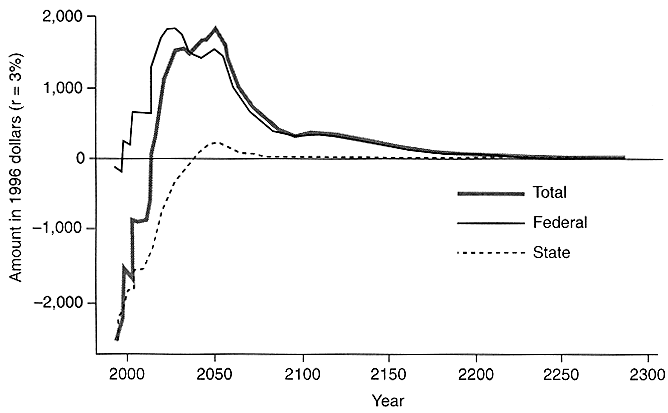
Figure 7.14
Present value of annual fiscal impacts: One immigrant arriving in 1994 (discounted at 3%).
they cannot be directly compared with the annualized stream). (The curves actually represent the averages of impacts for immigrants of different ages at arrival and education level, rather than representing any single age at arrival and education level; in all cases, length of time in the United States is taken into account, along with all descendants.) The state and local impact is substantially negative initially, at about -$2,270, and the federal impact is initially close to zero (-$120), for a total impact of about -$2,400. This is very different from the annualized total impact of +$2,430. Indeed, the total impact does not turn positive until 22 years after the arrival of this composite immigrant, and the state/ local impact does eventually turns positive, but only after about 40 years. (Note that the impact turns positive just after 2016 when, according to baseline assumptions, taxes are raised and benefits cut in order to control the debt/GDP ratio.) Evidently, even if immigrants have positive NPVs, they nonetheless impose substantial costs in their initial years in the United States.
The immigrants themselves more quickly have a positive fiscal impact at the state and local level; for example, by the 25th year, immigrants have a positive impact of +$910. However, they have also borne children who themselves have had children, and these descendants impose costs of more than $1,660 at the state and local level in the 25th year, so the total impact is still negative, at more than $700. At the federal level, the immigrant has a strong positive effect that is only very slightly offset by the costs of children, at $1,570. After 50 years, both the immigrant and the second generation are making sufficiently positive impacts to offset the substantial costs of the third generation, yielding a positive impact at the state and local level. At the federal level, the composite immigrant is now elderly and has become costly. These costs, however, are more than offset by the second generation, resulting in a strong positive total impact of $1,520.
The NPV calculations are based on projections that reach 300 years into the future, and it would be absurd to claim that the projections into the 23rd century are very reliable. How much do our NPV calculations depend on such long-run outcomes? Since we are discounting at 3 percent, the future is heavily discounted. At 25 years, the discount factor is 0.5; at 50 years, 0.22; at 75 years, 0.1; and at 100 years, 0.05. Calculation of truncated NPVs for varying time horizons shows how much the distant future affects the results. Table 7.8 gives the fraction of the full NPV (based on 300 years) that is achieved with different time horizons.
The approach to the ultimate value is not rapid. Although the total flow turns positive after 23 years, it takes 40 years for the total NPV to turn positive. By 75 years, the planning horizon used for Social Security, more than half the long-run NPV has been reached. It may seem that 50 or 75 years are unacceptably long horizons for measuring the fiscal impacts of immigrants, but reasonable calculations over any shorter period are scarcely possible, since it is very important to include the later-life cycle stage of immigrants in the calculations. But doing that brings in the second generation as schoolchildren, as taxpayers, and as parents
TABLE 7.8 How Quickly the Long-Term Impact of an Immigrant Is Approached
|
|
Percentage of Ultimate Net Present Value Reached by Each Horizon (r = .03%) |
||
|
Length of Time Horizon (years) |
State and Locala |
Federal |
Total |
|
0 |
0% |
0% |
0% |
|
25 |
172 |
10 |
-23 |
|
50 |
184 |
42 |
14 |
|
75 |
142 |
68 |
53 |
|
100 |
126 |
79 |
69 |
|
300 |
100 |
100 |
100 |
|
a The percentage for state and local is greater than 100 because early net present values do indeed exceed the terminal value. |
|||
and grandparents. Once again, letting the second generation reach its old age in our calculations seems necessary, and indeed a defensible time to stop is impossible to find. For this reason, it seems best to extend the time horizon far into the future, and let the discounting gradually reduce the influence of the future to nothing.
The Effects of a Stream of One Immigrant Per Year
What would happen if we added one immigrant every year henceforth? The fiscal impacts of this one-person immigrant stream can then be multiplied as desired to see the simulated effects of adding, say, 100,000 immigrants each year. Note that this experiment does not permit any feedback from the changed number of immigrants to the trajectory of taxes and benefits (although this could, in principle, be done), so it is most informative about the effects of small changes in the neighborhood of immigrant streams of the current size.
Figure 7.15 plots the fiscal effects of a stream of one composite immigrant per year; the composite is a weighted average of the effects of the various kinds of immigrants. The impact of this stream eventually comes to grow linearly, as does the stock of incremental immigrants. Rather than discounting this stream at 3 percent, as was done above, the figure instead shows the stream discounted at 1.57 percent, which is the long-term growth rate of GDP. Thus, the figure offers a visual sense of the importance of the fiscal impacts relative to the growing GDP. Although the figure gives an idea of the impact of changing immigration policy to admit more or fewer immigrants each year, it is more difficult to use it to get an idea of the current costs of past immigration. The size and composition
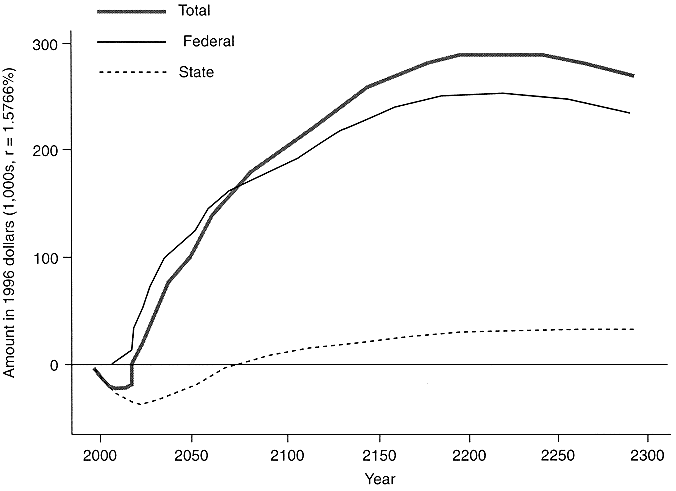
Figure 7.15
Undiscounted annual fiscal impacts of incremental stream of one immigrant per year, expressed relative to gross domestic product.
of the immigration stream have changed substantially over the course of this century, but immigrants who arrived early in the century, or before, still exert an influence on current public budgets through their descendants if not through their own old age.
At the state and local level, the fiscal impact remains negative for around 70 years, until late in the 21st century, reaching its most negative level after about 25 years, at around -$35,000. At the federal level, and in total, the effect of the assumed budget adjustment in 2016 is clearly apparent. After 2016, the total (current) fiscal impact turns positive, and very strongly so.
Interpreting the Results
What Accounts for Our Positive Estimates?
What factors drive our estimated results for net present values? To answer this question, we have concentrated on the weighted average NPV, which is +$80,000 for the baseline case (see Table 7.5 or 7.6). We carry out a series of experimental calculations, designed to show the relative contributions of different factors (see Table 7.9). We have not succeeded in coming up with an infor-
TABLE 7.9 What Accounts for the Positive Average Net Present Values: Experimental Calculations (1996 dollars)
mative way of separating and then adding up the roles of mutually exclusive factors; the entries in Table 7.9 count some influences in more than one way. For example, there are entries for tax profiles, benefit profiles, and education, yet education is the main determinant of those profiles. In general, this decomposition is quite rough. Its results depend on just how we formulate alternative scenarios, and often that formulation is somewhat arbitrary.28
It is interesting that so many different factors appear important in generating the result, and also that none of the experimental changes reported below is sufficient, in isolation, to produce a strongly negative estimate of fiscal impact. For example, if all the expenditures we categorize as provision of public goods (military expenditures are the leading case) were instead treated as private or congestible goods, so that a per capita cost is allocated to immigrants and their descendants, then the average NPV would drop from +$80,000 to -$5,000, just slightly negative, or by $85,000, thus identifying public goods as contributing powerfully to the result. A similar calculation shows that treating congestible goods (roads, police, and the like) as public goods with zero marginal costs would add $80,000 to the NPV, for a total of +$160,000. Readers can draw on their own views about whether various government services are public or private to come up with their own estimate of the overall fiscal impact. The fact that immigrants will pay taxes that go in part to make interest payments on the national debt contributes a sizable $49,000 to their positive average NPV.
We have adhered closely to the assumptions made by the CBO in projecting federal expenditures. One such assumption is that expenditures on the military and on other public goods grow at the rate of population growth plus the growth rate of productivity—that is, they remain a roughly constant share of GDP. This treatment of military expenditures in budget projections may appear inconsistent with our treatment of these as public goods in our fiscal accounting, in which the costs of military services are assumed not to rise with the size of the population. In fact, the two treatments of military are not necessarily inconsistent. As incomes rise, people may choose to spend more on the military, and as population increases, the price to individuals of a given level of military services declines proportionately, which may induce people to demand more.
However, we can show approximately how much difference it would make if we instead projected military expenditures to rise at the rate of productivity growth alone, rather than that plus the rate of population growth, through the following calculation: per capita expenditures on all public goods in the base year (1994) are about $1,400, and these are projected to increase either at 1 percent per year or at 1.5 percent per year, depending on the assumption. Over an infinite horizon, the NPV with growth at 1.5 percent per year would be 1,000/(.030 - .015) = 93,333. With growth at 1 percent per year it would be 1,000/(.03 - .01) = 70,000. The difference is 23,000. Table 7.9 shows that public goods contribute $85,000 to the net present value (NPV), quite close to the figure of 93,000 despite the crudeness of the calculation just described. A better approximation of the consequences of not including population growth in the growth of public goods would be .25 x 85,000 = 21,000 (.25 = 1 - 70,000/93,333). In other words, projecting public good expenditures to grow only at the rate of productivity growth would have an important effect on the estimated baseline NPV, reducing it from $80,000 to $59,000, but this would not change any of our conclusions. By the same line of reasoning we can see that the proportional effect of the change in assumptions declines as the discount rate rises. At a discount rate of 3
percent, the NPV was reduced by 25 percent. At a discount rate of 8 percent, the NPV would be reduced by only 7 percent.
Finally, it appears that the role immigrants play in bearing the cost of the aging of the baby-boom generations and of rising health costs, largely for the elderly, contributes very strongly to their overall positive impact, more so than does any other single factor. In the same way, the fact that natives also will help to meet these projected future cost increases also raises their NPVs. Were it not for the projected future costs arising from aging and health care, the federal budget would now need very little adjustment, and the debt/GDP ratio would remain much the same as it is under current tax and benefit policies. Although immigration does not emerge as an important factor in the Social Security Administration's sensitivity tests of long-run financial soundness (see Board of Trustees of the Federal Old-Age and Survivors Insurance and Disability Insurance Trust Funds, 1996) relative to fertility and mortality, on a per immigrant basis, these contributions are important. All the items just discussed apply to incremental natives as well as to incremental immigrants, although the precise amounts depend on taxpaying propensities.
How do immigrants and natives differ? We see that the relatively lower education of immigrants makes their fiscal impacts less positive, and their age distribution does the opposite. The fact that immigrants pay rather lower taxes than natives at each age substantially reduces their positive impact, although the differences between the benefits received by immigrants at each age and those received by natives actually work to make their impacts more positive, contrary to general belief (the reason can be seen in Figure 7.7).
Why Are NPVs So Negative at the State and Local Level and So Positive at the Federal Level?
When it comes to programs that are age-targeted, state and local governments invest heavily in children, particularly in their education, whereas federal government programs are overwhelmingly directed toward the elderly, for pensions and health care. There are important consequences. First, state and local investments in education pay off in higher tax payments later in life, although only a portion of the payoff is at the state and local level; the remainder is at the federal level, where tax payments are also raised. Second, at the state and local level, an individual or a household typically first receives costly services and transfers, particularly for education, and then in a sense pays for them later in life through taxes. Because of discounting, the future taxes receive a lower present value than the earlier benefits do, creating a negative NPV.29 At the federal
level, the opposite occurs: workers pay taxes first, and receive their pension and health care benefits about 30 years later on average. Discounting gives these benefits a lower present value than the present value of tax payments, creating a positive NPV. The state and local NPVs for natives at birth are themselves highly negative for these reasons, at -$45,000 (not shown).
Although the positive fiscal impacts of incremental immigrants are evenly shared by the entire population, the state and local negative impacts are restricted to states that receive immigrants. We cannot say, based on the calculations we have done, whether the total fiscal impact, summing at the federal, state, and local levels, is positive or negative for residents of high-immigration states such as California. We can say only that it is positive for the average U.S. resident under the baseline set of assumptions.
Large NPVs Translate Into Small Annual Effects for the Average Citizen
To understand the costs of immigration at a simple level, suppose that the annual immigrant flow were to increase by 100,000 while its composition remained the same.30 Further suppose that a payment of $25,000 were made by U.S. residents to cover the net state and local cost of each immigrant at the time they entered the country, for a total of $2.5 billion per year. This cost would be divided among the 260 million U.S. residents (including the foreign-born), each of whom would pay about $10 per year. However, for certain states, in particular California, the costs per individual and per household would be far higher, because of the concentration of immigrants and the special characteristics of these immigrants and of the states themselves.
Now, using the same approach, suppose that each immigrant deposits $105,000—the NPV at the federal level—with the federal government at the time of arrival; each new resident will gain $40 due to an increase of 100,000 in the size of the immigrant flow. Taking these numbers at face value, the federal, state and local taxes of the average resident would decline by about $30. For a household, the extra immigrants would mean a gain of about $80. Despite the large size of the NPVs we have calculated, the size of these annual flows is surprisingly small on a per person basis.
These calculations show how, over time, the large NPVs affect the average taxpayer only a little—but they do not capture the shift over time, whereby immigrants are costly in early years and may be net contributors in later years.
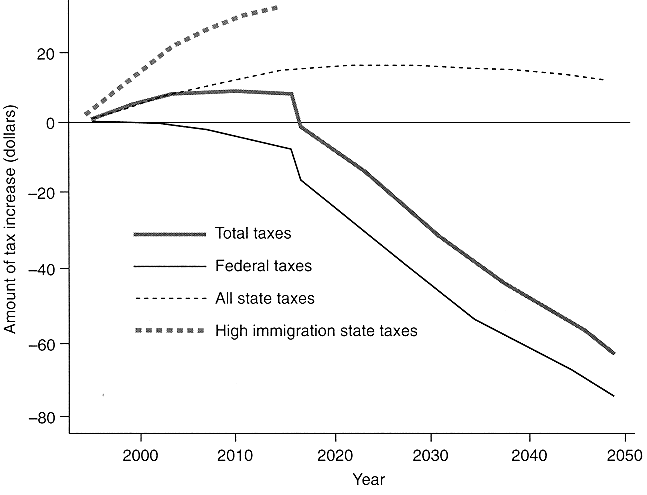
Figure 7.16
Per capita tax increases due to 100,000 additional immigrants per year.
Figure 7.16 reveals this pattern, using the same factors as the calculations just reported, aside from timing. It shows state and local costs of about $10 per U.S. resident, consistent with our earlier calculation. However, the federal effects are delayed, so the overall stream of combined favorable effects starts off near zero, lower than the $30 our calculations suggested, but soon grows to be larger than our calculations suggested. Figure 7.16 also shows the average state and local effect for the six states of high immigration, and it is more than twice the national average, for obvious reasons.
Summary
The most striking difference between immigrants and natives is not in benefits received, but rather in taxes paid. Because immigrants on average have less education, at each age they earn less and pay substantially lower taxes, of all kinds and to all levels of government. Nevertheless, the average immigrant pays nearly $1,800 more in taxes than he or she costs in benefits, due to the special age distribution of immigrants, which is heavily concentrated in the working years, with relatively few foreign-born children and relatively few elderly. However, it is more useful also to take account of native-born children—those under age 20—with immigrant parents. In this calculation, the average immigrant or child
pays nearly $370 less in taxes than he imposes in costs, in sharp contrast with the average native, who pays $2,030 more in taxes than he imposes in costs. Immigrants and their children form a relatively young population. Because it is federal government programs that assist the elderly, and there are relatively few elderly immigrants, the average immigrant (including native-born children under 20) has a positive federal balance of taxes and benefit costs of nearly $550. Because state and local governments provide for public education, the balance at this level is -$920.
Calculations of this sort are interesting, but they do not enable us to assess the fiscal impact of an incremental immigrant. To do this, we need to make a forward-looking calculation of the present value of taxes and costs over the lifetime of an immigrant, taking account of the taxes and costs associated with his or her descendants.
Such calculations reveal that the fiscal impact of an immigrant varies widely depending on age at arrival in the United States and on educational attainment. The fiscal impact typically rises with age from birth, peaking between ages 10 and 25 at positive values, and then declining gradually to a trough in the late sixties, at which point the impact is highly negative. This curve is higher, the higher the education of the immigrant. There are many immigrants who impose net fiscal burdens on the native-born, and many others who afford them net fiscal benefits. This diversity must be reviewed alongside estimates of average fiscal impact when formulating immigration policy.
Fiscal impacts are quite different by level of government. At the federal level, they are positive for immigrants in all educational categories from birth until the late twenties. After this, as old age draws nearer, they turn negative. At the state and local level, immigrants of all educational categories have negative impacts from birth until after school-age, and for low-education immigrants the balance never turns positive.
The descendants of immigrants make a considerable positive contribution to the fiscal impact for all education levels of immigrants, and they should be included in the calculation. The substantial costs of educating the children of immigrants are included, so it is important that the eventual social return in the form of taxes also be included. Taxpaying children overlap the life cycles of their immigrant parents and help to pay the public costs they impose as they age.
In all this detail, it is difficult to discern the larger picture. To show the overall implications of these estimates, we derive summary measures by averaging fiscal impacts (NPVs) across all ages, weighting by the actual age distribution of recent immigrants in each education category. Immigrants with less than a high school education have a fiscal impact of -$13,000, immigrants with a high school education have an impact of +$51,000, and those with more than high school have an impact of +$198,000.
In the same way, we can average the NPVs across education for each age at arrival, and in this way summarize the effect on NPVs of the age at arrival of
immigrants. Here, we see that immigrants arriving between their early teens and late twenties have the highest positive fiscal impacts, and immigrants arriving in their mid-sixties have equally large negative impacts.
When we simultaneously average across both age and education to get a single summary measure of net fiscal impact based on the characteristics of recent arrivals, under our baseline assumptions, we find an average value of +$80,000.
These summary measures mask important differences between the federal and the state and local levels. At the state and local level, the average NPV is -$25,000, and at the federal level it is +$105,000. Ages of arrival at which immigrants generate the most positive fiscal impacts at the federal level are the very ages at which they generate the most negative impacts at the state and local level. Although the positive impact at the federal level is shared evenly by the U.S. population, the negative state and local impact is highly concentrated in a few states, with a particularly heavy cost in California.
Because we project so far into the future and by necessity have to make so many assumptions, there is considerable uncertainty about exactly what these NPVs of immigrants will be. We tested the sensitivity of the analysis to variation in the assumed interest rate, the date of adjusting the federal budget, budget adjustments through tax changes or benefit changes, assumed trajectory of immigrants' tax payments with time since arrival in the United States, and a number of other assumptions. Under the reasonable set of baseline assumptions that the panel adopted (chosen before we knew what the answers would be), the average NPV of immigrants was positive. This is an important result because an exclusive reliance on annual budget impacts would have led us to the opposite conclusion. Under many other sets of assumptions, these NPVs remain positive. But there are other sets of plausible assumptions (slightly higher interest rates, less intergenerational assimilation in the future, a smaller share of public goods, marginal costs exceeding average costs, possible displacement effects of native workers) that are by no means implausible and would produce negative fiscal impacts of immigrants. This uncertainty is not surprising given how far we must project into an uncertain future. At a minimum, our results show that a reliance solely on annual budget accounting is an extremely shaky way to draw conclusions about the true fiscal impact of immigrants.
We also examined the effects of the Personal Responsibility and Work Opportunity Reconciliation Act of 1996, by assuming that in their first five-years in the United States, immigrants received no benefits from certain means-tested programs including SSI, Medicaid, food stamps, and AFDC. This new policy raises the fiscal impact per immigrant by $8,000, on average, making it more positive, or less negative.
Under the baseline assumption, a number of factors contribute to the positive average NPV: Allocating a pro rata cost to immigrants for public goods would change the average NPV to slightly negative, whereas ignoring the costs of
congestible goods would double the positive NPV. Help from immigrants in paying the substantial costs of future population aging and rising health care costs for the elderly is also a major factor. Special characteristics of immigrants also act to raise the NPV: they tend to arrive in the early working years; some of their children are likely to be educationally upwardly mobile, and they receive lower benefits than others. By contrast, that immigrants have lower education than natives, and consequently pay less in taxes, reduces the NPVs.
While the average long-term fiscal impacts of immigration are generally found to be positive, an increase in the annual flow of immigrants would, for a couple decades, have a negative fiscal impact overall. The timing and extent of such a period would depend on federal fiscal policy. At the state and local level, the annual fiscal impact would remain negative for many decades, and the overall NPV would be negative. At the federal level, the annual fiscal impact would be positive from the start.
We have also calculated the annual fiscal impact per U.S. resident of an increase of 100,000 per year in the immigrant flow under the baseline assumptions (change the sign for a decrease). We found it to be roughly +$30 per person, composed of +$40 at the federal level and -$10 per person at the state and local level. This average amount per person strikes us as rather low, despite the large NPVs. However, it should be kept in mind that an earlier period of greater deficits is followed by a later period of greater returns. With due account taken of the many uncertainties in our estimates, it appears unlikely that immigrants and their descendants impose worrisome costs at the combined federal and state and local levels for the average U.S. resident. Indeed, our calculations suggest that immigrants may instead, on average and in the long run, have a positive fiscal impact. Nonetheless, immigrants with certain characteristics, such as the elderly and those with little education, may be quite costly. And residents of certain states with large shares of immigrants without doubt bear higher costs that in some cases may not be offset by the broadly shared gains at the federal level.
Key Conclusions
- Households headed by immigrants include the native-born school-age children of immigrants, who incur high costs of public education. However, they do not include the working-age native-born children of immigrants, who typically have a positive fiscal impact. For this reason, cross-sectional or current fiscal impacts estimated for immigrant-headed households are biased toward negative numbers.
- The relative intensity of program use by immigrants and natives at the federal, state and local levels varies significantly from one program to another. For example, immigrants and their young children use bilingual education, SSI, public assistance, and Medicaid more heavily than others in the population, but they also use Social Security and Medicare more lightly than do others.
- The implication of this diversity is that we must be comprehensive in our examination of program use to obtain an accurate assessment of the fiscal impacts of immigration. We find that the pattern of per capita overall program use at each age is very similar for immigrants and others, with immigrants and their children imposing somewhat higher costs at the young ages, and lower costs above age 50. The cost of benefits used by immigrants and their young children is actually 8 percent less per capita than the costs of benefits used by the rest of the population, in part because their age distributions differ.
- On average, immigrants pay considerably lower taxes at each age than do others, and overall they and their native-born children under the age of 20 pay about one-third less than does the rest of the population, again due in part because of their age distribution.
- In assessing the long-term fiscal impact of immigrants, it is important to take into account the likely descendants of the immigrants, and the likely educational attainment of these descendants.
- The long-term (net present value) fiscal impact of an immigrant varies greatly across different types of immigrants. Some groups of immigrants bring net fiscal benefits to natives, and others impose net fiscal costs. Among other things, these fiscal effects depend heavily on the characteristics of immigrants, including age at arrival in the United States, educational attainment, and time spent in the United States. The net present value typically peaks for ages at arrival of 10 to 25, and then declines to a trough for those arriving in their late sixties. This curve is higher, the higher the education. Under our baseline assumptions, the average fiscal impact (net present value) of an immigrant with less than a high school education is -$13,000, and that for an immigrant with more than a high school education is +$198,000. Similarly, older immigrants impose significant fiscal burdens, and younger immigrants produce fiscal surpluses.
- Averaging across these characteristics, immigrants under our baseline scenario have a negative fiscal impact at the state and local level, but a larger, positive impact at the federal level, resulting in an overall positive impact for the United States.
- Under most scenarios, the long-run fiscal impact is strongly positive at the federal level, but substantially negative at the state and local level. The federal impact is shared evenly across the population, but these negative state and local impacts are concentrated in the few states that receive most of the immigrants.
- The average fiscal impact of immigrants under the baseline assumptions is positive in part because they tend to arrive at young working ages, in part because their descendants are expected to have higher skills and incomes, in part because they pay taxes for some items, such as national defense and interest on the federal debt, for which they do not impose costs, and in part because they will help to pay the public costs of the aging baby-boom generations.
- The 1996 Personal Responsibility and Work Opportunity Reconciliation Act, by prohibiting new immigrants from receiving means-tested benefits for a period after arrival, will make the long-term fiscal impact per immigrant more positive by about $8,000.
- If the long-term federal budget imbalance is not addressed—which is not a realistic policy option—the overall fiscal impact of immigrants will be slightly negative; if the debt/GDP ratio is held constant starting immediately, or starting in 2016, the overall fiscal impact will be positive. It will be more negative if discount rates are higher, and if budgetary imbalances are addressed by reducing benefits rather than by raising taxes.
- Although the average long-term fiscal impacts of immigration are generally found to be positive under most scenarios that we tried, the overall annual fiscal impact of an increase in the annual flow of immigrants would be negative for a couple of decades before it turned positive. The timing and extent of such a period would depend on federal fiscal policy.
References
Auerbach, A.J. 1994 The U.S. Fiscal Problem: Where We Are, How We Got Here, and Where We're Going. NBER working paper #4709. Cambridge, MA: National Bureau of Economic Research.
Auerbach, A.J., J. Gokhale, and L.J. Kotlikoff 1991 Generational accounts: A meaningful alternative to deficit accounting. Pp. 55-110 in David Bradford (editor), Tax Policy and the Economy. Cambridge, MA: MIT Press.
Board of Trustees of the Federal Old-Age and Survivors Insurance and Disability Insurance Trust Funds 1996 Annual Report of the Board of Trustees of the Federal Old-Age and Survivors Insurance and Disability Insurance Trust Funds. Washington: U.S. GPO.
Clark, R.L. 1994 The Costs of Providing Public Assistance and Education to Immigrants. PRIP-UI-34, Program for Research on Immigration Policy, The Urban Institute.
Congressional Budget Office of the United States 1996 The Economic and Budget Outlook: Fiscal Years 1997-2006 Available from U.S. Government Printing Office, Washington, D.C.
Duleep, H.O. 1994 Social security and the emigration of immigrants. Pp. 97-128 in Migration: A Worldwide Challenge for Social Security. Geneva: International Social Security Association.
Duleep, H.O., and M.C. Regets 1997 Measuring immigrant wage growth using matched CPS files. Demography 34(2):239-249.
MaCurdy, T., T. Nechyba, and J. Bhattacharya 1996 An Economic Framework for Assessing the Fiscal Impacts of Immigration. Paper prepared for the Panel. Department of Economics, Stanford University, September.
Sheffrin, S., and M. Dresch 1995 Estimating the Tax Burden in California. Berkeley, CA: California Policy Seminar.
U.S. Department of Commerce 1994 Fixed Reproducible Tangible Wealth in the United States: Revised Estimates for 1991-1993 and Summary Estimates for 1925-1993. Survey of Current Business, Bureau of Economic Analysis.
Appendix 7.A
Intergenerational Educational Mobility
The General Social Survey (GSS) has been carried out every year since 1972 by the National Opinion Research Center (NORC). It collects information on the nativity of the respondent's parents and grandparents, on the respondent's education, and on the education of the respondent's parents. We categorized all educational attainments as less than high school, high school, or more than high school. For a specific generation of respondent (first, second, or third, based on the nativity questions), we created a set of all linked pairs of parent-child educational attainments, using the information on education of respondent and of each parent of the respondent. We then treated the parents as the reference unit, and for each parental level of education, we calculated the proportional distribution of the children by educational attainment. Even within parental education categories, the children of higher-fertility parents have lower educational attainments. However, we did not weight for this, since the overrepresentation of such children in the sample simply reflects the higher fertility of their parents, which we wish to be reflected in the results for the average parent. We ignore differences in fertility by education of parent, which could bias the results in the optimistic direction.
It is well known that the characteristics of immigrants have been changing over the past several decades. Our controls for educational attainment may be insufficient to capture these changes. As a further control, we estimated separate transition matrices by ethnic origin group for Hispanics, Asians and all others, by immigrant generation and education group. We then formed a weighted average of these matrices for each generation and each education group, with weights equal to the ethnic shares in each generation. For first-generation immigrants we used the educational distribution of recent immigrant flows and base changes in the ethnic shares of subsequent generations on fertility differences between ethnic groups. These weighted average matrices were then used to project educational mobility in the analysis.
To estimate the transition matrices for Hispanics and others, we used educational outcomes for all children age at least 21 years, and born after 1960, in every GSS since 1972. For Asians, sample sizes were quite small, so we had to consider all children age at least 21 years and born after 1950. Even so, numbers were small, so we assumed that their dropout rates at each level of education were proportional to the corresponding dropout rates of others, with a different constant of proportionality estimated for each level of parental education. From these fitted dropout rates, we estimated the distribution of educational outcomes. The resulting matrices by immigrant generation, ethnicity, and educational attainment of parents were used as described in the preceding paragraph.
We also used an alternative procedure to estimate these transition matrices in which we weighted the sample in various ways. (1) Early-born cohorts are
represented in many different years of the survey, while later-born cohorts are represented fewer times (only once in the extreme case). We therefore weighted by the inverse of the number of times a cohort would be represented in the combined surveys. (2) Blacks were oversampled, and we have weighted to remove this effect. (3) Adults in households with more adults present are less likely to be represented, given our procedures, so we weighted by the number of adults. The various weighting procedures did not change the results in any important way.
The estimated distributions of each generation's education by the education of the original immigrant are shown in Figure 7.A1. It can be seen that there is substantial upward educational mobility for the children of low- and medium-education parents, and by the fourth generation (the great-grandchildren of immigrants), the implied educational distributions are essentially identical, regardless of the educational status of the original immigrant. Although in general it can be said that each generation is better educated than the one preceding it, an important exception is seen in the educational attainment of the grandchildren of immigrants. Grandchildren (third-generation immigrants) whose immigrant forebear had at least a high school education are less well educated than their parents (second generation immigrants). Compared with the general population, we find greater upward educational mobility for the children of first-generation immigrants. However, educational mobility for children of the second-generation immigrants is much lower than that found in the general population.
It would not be right to use the transition matrix estimated for U.S.-born children of immigrants to project the educational attainment of all the foreign-born children of immigrants, since they will have different English language skills and educational backgrounds. For a foreign-born child who arrives in the United States at a young age, this transition matrix is probably appropriate; but for one who arrives as a teenager, it would be much less so. Inspection of transition probabilities estimated from the GSS for foreign-born children shows that these have had somewhat less upward educational mobility than the transition matrices for U.S.-born children of immigrants would suggest. Presumably the ultimate educational attainment of foreign-born children will depend on their age at arrival in the United States. In order to take this into account, we have modified the educational transition probabilities that were estimated for first-generation children. For foreign-born children arriving at ages up to 12 years, we retain the estimated second-generation probabilities. From age 12 on, for children of low- or medium-education parents, we assume the probabilities of upward mobility decline linearly to 0 at age 20. For children of parents with higher education, we leave the probabilities as estimated. In this way we construct different transition matrices for foreign-born children, and for the U.S.-born children of foreign-born parents.
Figure 7.A1 shows that we project that 52 percent of the grandchildren of immigrants will attain more than a high school education (> HS) and a higher
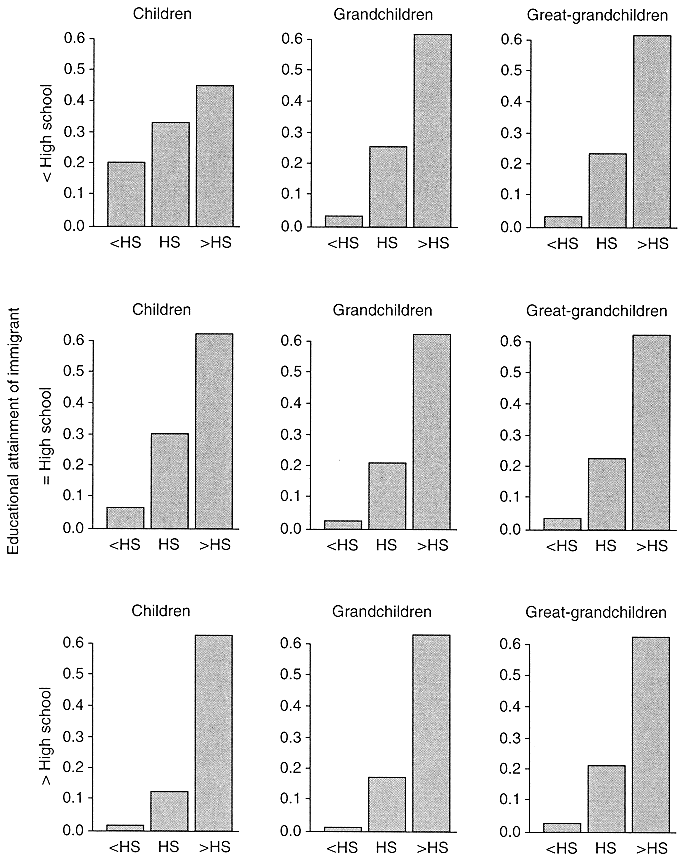
Figure 7.A1
Educational attainment of descendants of immigrant by educational attainment of original immigrant.
percentage (67) of the great-grandchildren. Currently, about 52 percent of the total U.S. population aged 25 to 34 years has more than a high school education (U.S. Statistical Abstract, 1995, Table 240:158). By coincidence, this figure is identical to our projection for the grandchildren of immigrants. It is somewhat lower than our projection of 67 percent for the great-grandchildren of immi-
grants. These figures are not really comparable since our projections refer to educational distributions 30 to 40 years in the future rather than the current levels. Average educational attainment in the U.S. has been rising and it is reasonable to assume that significantly more than 52 percent of the great-grandchildren of nonimmigrants will attain more than a high school education. Indeed, our analysis of the intergenerational educational matrices for the nonimmigrant population indicates a long-run educational distribution in which 72 percent of the population attains more than a high school education.
Appendix 7.B
Net Present Values for Immigrants and Natives, by Scenario
Tables 7.B1 to 7.B3 present data on the net present values for immigrants, by age of arrival and for native-born residents, in the third and later generations, at current ages, for various alternative assumptions.
TABLE 7.B1 Less Than High School Education
|
|
Immigrant Age at Arrival |
||||
|
Scenario |
0 |
20 |
21 |
40 |
70 |
|
Baseline |
60 |
33 |
7 |
-141 |
-166 |
|
2% discount |
298 |
228 |
181 |
-192 |
-181 |
|
4% discount |
-9 |
-12 |
-29 |
-104 |
-154 |
|
6% discount |
-43 |
-27 |
-36 |
-59 |
-133 |
|
8% discount |
-44 |
-24 |
-29 |
-35 |
-117 |
|
100% taxes |
87 |
52 |
23 |
-160 |
-167 |
|
100% benefits |
33 |
15 |
-8 |
-123 |
-166 |
|
Balance budget now |
51 |
25 |
-0 |
-140 |
-161 |
|
Never balance budget |
-56 |
-109 |
-129 |
-164 |
-167 |
|
Never balance budget + welfare reform |
-50 |
-105 |
-123 |
-143 |
-152 |
|
Duration 10+ taxes |
99 |
67 |
37 |
-119 |
-166 |
|
Duration 5-9 benefits |
62 |
36 |
9 |
-142 |
-166 |
|
Welfare reform act |
65 |
38 |
12 |
-120 |
-151 |
|
Elderly immigration with zero OASDHI |
60 |
33 |
7 |
-141 |
-73 |
|
No emigration 2nd gen |
72 |
50 |
23 |
-141 |
-166 |
|
Lower emigration |
103 |
47 |
14 |
-174 |
-189 |
|
Lower bilingual education |
65 |
35 |
8 |
-143 |
-168 |
|
|
Native (3rd + Generation) Current Age |
Difference |
||||||||
|
Scenario |
0 |
20 |
21 |
40 |
70 |
0 |
20 |
21 |
40 |
70 |
|
Baseline |
92 |
234 |
-54 |
-134 |
-223 |
-33 |
-200 |
61 |
-8 |
57 |
|
2% discount |
362 |
487 |
85 |
-190 |
-245 |
-64 |
-259 |
96 |
-2 |
65 |
|
4% discount |
12 |
147 |
-72 |
-92 |
-204 |
-21 |
-159 |
43 |
-12 |
50 |
|
6% discount |
-32 |
79 |
-60 |
-42 |
-173 |
-11 |
-106 |
24 |
-16 |
39 |
|
8% discount |
-39 |
51 |
-46 |
-17 |
-148 |
-6 |
-75 |
17 |
-18 |
31 |
|
100% taxes |
124 |
266 |
-47 |
-155 |
-224 |
-37 |
-213 |
70 |
-5 |
57 |
|
100% benefits |
61 |
202 |
-61 |
-112 |
-222 |
-28 |
-187 |
53 |
-11 |
56 |
|
Balance budget now |
83 |
229 |
-58 |
-129 |
-213 |
-32 |
-203 |
58 |
-10 |
53 |
|
Never balance budget |
-41 |
82 |
-183 |
-164 |
-225 |
-15 |
-191 |
55 |
-0 |
57 |
|
Never balance budget + welfare reform |
-41 |
82 |
-183 |
-164 |
-225 |
-9 |
-187 |
60 |
21 |
72 |
|
Duration 10+ taxes |
92 |
234 |
-54 |
-134 |
-223 |
7 |
-167 |
91 |
15 |
57 |
|
Duration 5-9 benefits |
92 |
234 |
-54 |
-134 |
-223 |
-30 |
-198 |
63 |
-9 |
57 |
|
Welfare reform act |
92 |
234 |
-54 |
-134 |
-223 |
-27 |
-196 |
66 |
13 |
72 |
|
Elderly immigration with zero OASDHI |
92 |
234 |
-54 |
-134 |
-223 |
-33 |
-200 |
61 |
-8 |
150 |
|
No emigration 2nd gen |
92 |
234 |
-54 |
-134 |
-223 |
-21 |
-184 |
77 |
-8 |
57 |
|
Lower emigration |
92 |
234 |
-54 |
-134 |
-223 |
11 |
-186 |
68 |
-40 |
34 |
|
Lower bilingual education |
92 |
234 |
-54 |
-134 |
-223 |
-27 |
-199 |
62 |
-9 |
55 |
TABLE 7.B2 High School Education
|
|
Immigrant Age at Arrival |
||||
|
Scenario |
0 |
20 |
21 |
40 |
70 |
|
Baseline |
92 |
146 |
126 |
-32 |
-225 |
|
2% discount |
353 |
391 |
351 |
-68 |
-248 |
|
4% discount |
10 |
70 |
58 |
-6 |
-205 |
|
6% discount |
-35 |
21 |
16 |
21 |
-172 |
|
8% discount |
-40 |
8 |
5 |
31 |
-146 |
|
100% taxes |
123 |
175 |
152 |
-48 |
-226 |
|
100% benefits |
61 |
117 |
100 |
-15 |
-224 |
|
Balance budget now |
83 |
138 |
118 |
-29 |
-216 |
|
Never balance budget |
-26 |
-2 |
-16 |
-56 |
-227 |
|
Never balance budget + welfare reform |
-21 |
4 |
-9 |
-47 |
-203 |
|
Duration 10+ taxes |
133 |
184 |
161 |
-0 |
-225 |
|
Duration 5-9 Benefits |
94 |
138 |
117 |
-44 |
-225 |
|
Welfare reform act |
98 |
152 |
132 |
-23 |
-201 |
|
Elderly immigration with zero OASDHI |
92 |
146 |
126 |
-32 |
-142 |
|
No emigration 2nd gen |
104 |
164 |
142 |
-31 |
-225 |
|
Lower emigration |
145 |
185 |
159 |
-44 |
-261 |
|
Lower bilingual education |
97 |
149 |
128 |
-31 |
-227 |
TABLE 7.B3 More Than High School Education
|
|
Immigrant Age at Arrival |
||||
|
Scenario |
0 |
20 |
21 |
40 |
70 |
|
Baseline |
117 |
288 |
333 |
132 |
-149 |
|
2% discount |
395 |
594 |
641 |
116 |
-163 |
|
4% discount |
26 |
174 |
211 |
140 |
-137 |
|
6% discount |
-28 |
80 |
107 |
140 |
-116 |
|
8% discount |
-37 |
44 |
64 |
131 |
-101 |
|
100% taxes |
152 |
332 |
379 |
119 |
-150 |
|
100% benefits |
82 |
245 |
287 |
144 |
-148 |
|
Balance budget now |
108 |
281 |
326 |
138 |
-142 |
|
Never balance budget |
-4 |
127 |
173 |
101 |
-150 |
|
Never balance budget + welfare reform |
1 |
130 |
176 |
107 |
-119 |
|
Duration 10+ taxes |
162 |
352 |
407 |
200 |
-149 |
|
Duration 5-9 Benefits |
120 |
294 |
343 |
147 |
-149 |
|
Welfare reform act |
122 |
292 |
335 |
138 |
-118 |
|
Elderly immigration with zero OASDHI |
117 |
288 |
333 |
132 |
-54 |
|
No emigration 2nd gen |
129 |
307 |
351 |
132 |
-149 |
|
Lower emigration |
177 |
364 |
418 |
149 |
-170 |
|
Lower bilingual education |
123 |
293 |
338 |
134 |
-150 |
|
|
Native (3rd + Generation) Current Age |
Difference |
||||||||
|
Scenario |
0 |
20 |
21 |
40 |
70 |
0 |
20 |
21 |
40 |
70 |
|
Baseline |
171 |
342 |
182 |
18 |
-209 |
-79 |
-195 |
-56 |
-49 |
-16 |
|
2% discount |
495 |
637 |
394 |
-19 |
-230 |
-142 |
-246 |
-43 |
-49 |
-18 |
|
4% discount |
61 |
228 |
115 |
43 |
-190 |
-51 |
-158 |
-57 |
-49 |
-15 |
|
6% discount |
-10 |
130 |
67 |
68 |
-160 |
-24 |
-108 |
-51 |
-47 |
-12 |
|
8% discount |
-28 |
85 |
47 |
75 |
-136 |
-13 |
-77 |
-42 |
-44 |
-10 |
|
100% taxes |
214 |
383 |
205 |
-1 |
-210 |
-91 |
-208 |
-54 |
-47 |
-16 |
|
100% benefits |
129 |
300 |
158 |
37 |
-208 |
-68 |
-183 |
-58 |
-52 |
-16 |
|
Balance budget now |
161 |
336 |
177 |
23 |
-197 |
-78 |
-198 |
-59 |
-52 |
-19 |
|
Never balance budget |
31 |
182 |
44 |
-16 |
-210 |
-57 |
-184 |
-60 |
-40 |
-16 |
|
Never balance budget + welfare reform |
31 |
182 |
44 |
-16 |
-210 |
-51 |
-178 |
-54 |
-31 |
7 |
|
Duration 10+ taxes |
171 |
342 |
182 |
18 |
-209 |
-38 |
-157 |
-21 |
-18 |
-16 |
|
Duration 5-9 Benefits |
171 |
342 |
182 |
18 |
-209 |
-78 |
-203 |
-65 |
-62 |
-16 |
|
Welfare reform act |
171 |
342 |
182 |
18 |
-209 |
-74 |
-190 |
-50 |
-41 |
7 |
|
Elderly immigration with zero OASDHI |
171 |
342 |
182 |
18 |
-209 |
-79 |
-195 |
-56 |
-49 |
67 |
|
No emigration 2nd gen |
171 |
342 |
182 |
18 |
-209 |
-67 |
-178 |
-40 |
-49 |
-16 |
|
Lower emigration |
171 |
342 |
182 |
18 |
-209 |
-26 |
-156 |
-23 |
-62 |
-52 |
|
Lower bilingual education |
171 |
342 |
182 |
18 |
-209 |
-74 |
-194 |
-54 |
-50 |
-18 |
|
|
Native (3rd + Generation) Current Age |
Difference |
||||||||
|
Scenario |
0 |
20 |
21 |
40 |
70 |
0 |
20 |
21 |
40 |
70 |
|
Baseline |
245 |
442 |
503 |
244 |
-191 |
-128 |
-154 |
-170 |
-112 |
42 |
|
2% discount |
621 |
780 |
846 |
235 |
-211 |
-226 |
-186 |
-205 |
-118 |
48 |
|
4% discount |
106 |
303 |
354 |
246 |
-173 |
-80 |
-129 |
-143 |
-107 |
37 |
|
6% discount |
9 |
174 |
212 |
236 |
-145 |
-37 |
-94 |
-105 |
-95 |
28 |
|
8% discount |
-18 |
115 |
143 |
217 |
-122 |
-19 |
-70 |
-79 |
-86 |
21 |
|
100% taxes |
298 |
494 |
557 |
231 |
-192 |
-146 |
-162 |
-179 |
-111 |
42 |
|
100% benefits |
192 |
391 |
448 |
257 |
-190 |
-110 |
-146 |
-161 |
-113 |
42 |
|
Balance budget now |
234 |
437 |
498 |
255 |
-176 |
-126 |
-157 |
-172 |
-117 |
35 |
|
Never balance budget |
95 |
273 |
334 |
199 |
-193 |
-100 |
-146 |
-161 |
-98 |
43 |
|
Never balance budget + welfare reform |
95 |
273 |
334 |
199 |
-193 |
-94 |
-143 |
-158 |
-92 |
73 |
|
Duration 10+ taxes |
245 |
442 |
503 |
244 |
-191 |
-82 |
-90 |
-96 |
-44 |
42 |
|
Duration 5-9 Benefits |
245 |
442 |
503 |
244 |
-191 |
-124 |
-149 |
-160 |
-97 |
42 |
|
Welfare reform act |
245 |
442 |
503 |
244 |
-191 |
-122 |
-151 |
-167 |
-106 |
73 |
|
Elderly immigration with zero OASDHI |
245 |
442 |
503 |
244 |
-191 |
-128 |
-154 |
-170 |
-112 |
137 |
|
No emigration 2nd gen |
245 |
442 |
503 |
244 |
-191 |
-115 |
-136 |
-152 |
-112 |
42 |
|
Lower emigration |
245 |
442 |
503 |
244 |
-191 |
-67 |
-78 |
-84 |
-95 |
20 |
|
Lower bilingual education |
245 |
442 |
503 |
244 |
-191 |
-123 |
-149 |
-165 |
-110 |
41 |
Appendix 7.C
Discussion Of Data Sets For The Study Of Fiscal Impacts
Most analyses of the use by immigrants of government entitlement programs are based on one of three data sets: the Public Use Microsample (PUMS) of the decennial U.S. Census of Population, the Survey of Income and Program Participation (SIPP), or the Current Population Survey (CPS). Each has advantages and disadvantages. PUMS is the largest sample, containing data on 12.5 million individuals in 1990, of whom about 9 percent, or about 1 million, are foreign-born. Because special efforts were made to include responses from illegal immigrants, it is possible that these are reasonably well represented in the sample. The large size of the PUMS means that estimates have relatively small sampling error and that it is possible to disaggregate by characteristics of immigrants such as education, time since arrival, country of origin, and place of residence in the United States. However, PUMS contains fewer of the necessary programmatic data items compared with SIPP or the March CPS, is updated only every 10 years along with the decennial census, and has limited possibilities for intergenerational analysis.
Compared with the decennial census and CPS, SIPP has a smaller sample size, and only by combining panels is it possible to get enough respondents to include an acceptable number of immigrants. In work for this report, Peter Brandon combined seven SIPP panels, 1986-93, to obtain a total sample size of 290,000 individuals, including 33,000 foreign-born. SIPP distinguishes foreign-born from native-born respondents, and for children up to age 15 reports whether their parents are immigrants. For older children, it does not provide this information. The real strengths of SIPP are that it contains more accurate monthly data on program participation and expenditures and richer information on wealth and income sources, than either PUMS or the March CPS.
CPS, starting in 1994, supports separate study of first and second-generation immigrants and the remainder of the population. The sample size is about 150,000. Combining the 1994 and 1995 surveys yields about 300,000 respondents, with about 30,000 foreign-born. Like SIPP, CPS provides rich detail about program use, but these data are thought to be less reliable than those in SIPP.
For our national-level longitudinal analysis, we have relied largely on CPS, viewing it as a good compromise between the sample size of PUMS and the detail of SIPP. Additional work for the panel pools seven waves of SIPP as a basis for assessing the national work done using CPS. The case study for California derives program participation rates from the March CPS but uses average costs per participant from other sources. The New Jersey case study was based on PUMS.


