4
Evolution and the National Science Education Standards
Over the last six years, several major documents have been released that describe what students from kindergarten through twelfth grade should know and be able to do as a result of their instruction in the sciences. These include the National Science Education Standards released by the National Research Council in 1996,1 the Benchmarks for Science Literacy released by the American Association for the Advancement of Science in 1993,2 and The Content Core: A Guide for Curriculum Designers released by the Scope, Sequence, Coordination project of the National Science Teachers Association in 1992.3
These documents agree that all students should leave biology class with an understanding of the basic concepts of biological evolution and of the limits, possibilities, and dynamics of science as a way of knowing. Benchmarks for Science Literacy, for example, states that ''the educational goal should be for all children to understand the concept of evolution by natural selection, the evidence and arguments that support it, and its importance in history." For biology educators, these documents offer significant support for the inclusion of evolution in school science programs.
Structure and Overview of the National Science Education Standards
This chapter focuses on the treatment of evolution in the National Science Education Standards. The Standards are divided into six broad sections. The first set of standards, the science teaching standards , describes what teachers of science at all grade levels should know and be able to do. The professional development standards describe the experiences necessary for teachers to gain the knowledge, understanding, and ability to implement the Standards. The assessment standards provide criteria against which to judge whether assessments are contributing fully to the goals outlined in the Standards. The science content standards outline what students should know, understand, and be able to do in the natural sciences. The science education program standards discuss the planning and actions needed to translate the Standards into programs that reflect local contexts and policies. And the science education system standards consist of criteria for judging the performance of the overall science education system.
The Standards rest on the premise that science is an active process. Learning science is something that students do, not something that is done to them. "Hands-on" activities, although essential, are not enough. Students must have "minds-on" experiences as well.
The Standards make inquiry a central part of science learning. When engaging in inquiry, students describe objects and events, ask questions, construct explanations, test those explanations against current scientific knowledge, and communicate their ideas to others. They identify their assumptions, use critical and logical thinking, and consider alternative explanations. In this way, students actively develop their understanding of science by combining scientific knowledge with reasoning and thinking skills.
The importance of inquiry does not imply that all teachers should pursue a single approach to teaching science. Just as inquiry has many different facets, so too do teachers need to use many different strategies to develop the understandings and abilities described in the Standards.
Nor should the Standards be seen as requiring a specific curriculum. A curriculum is the way content is organized and presented in the classroom. The content embodied in the Standards can be organized and presented with different emphases and perspectives in many different curricula.
Evolution and the Nature of Science in the National Science Education Standards
Evolution and the nature of science are major topics in the content standards. The first mention of evolution is in the initial content standard, entitled "Unifying Concepts and Processes." This standard points out that conceptual and procedural schemes unify science disciplines and provide students with powerful ideas to help them understand the natural world. It is the only standard that extends across all grades, because the understanding and abilities associated with this standard need to be developed over an entire education.
The standard is as follows:
As a result of activities in grades K–12, all students should develop understanding and abilities aligned with the following concepts and processes:
-
Systems, order, and organization
-
Evidence, models, and explanation
-
Constancy, change, and measurement
-
Evolution and equilibrium
-
Form and function
The guidance offered for the standard is to establish a broad context for thinking about evolution:
Evolution is a series of changes, some gradual and some sporadic, that accounts for the present form and function of objects, organisms, and natural and designed systems. The general idea of evolution is that the present arises from materials and forms of the past. Although evolution is most commonly associated with the biological theory explaining the process of descent with modification of organisms from common ancestors, evolution also describes changes in the universe.
With this unifying standard as a basis, the remaining content standards are organized by age group and discipline.
Grades K–4
The life science standard for grades K–4 is organized into the categories of characteristics of organisms, life cycles of organisms, and organisms and their environments. Evolution is not explicitly mentioned in these standards, but the text explains the basic things in life science that elementary school children ought to be able to understand and do:
During the elementary grades, children build understanding of biological concepts through direct experience with living things, their life cycles, and their habitats. These experiences emerge from the sense of wonder and natural interests of children who ask questions such as: "How do plants get food? How many different animals are there? Why do some animals eat other animals? What is the largest plant? Where did the dinosaurs go?" An understanding of the characteristics of organisms, life cycles of organisms, and of the complex interactions among all components of the natural environment begins with questions such as these and an understanding of how individual organisms maintain and continue life.
The intention of the K–4 standard is to develop the knowledge base that will be needed when the fundamental concepts of evolution are introduced in the middle and high school years.
Grades 5–8
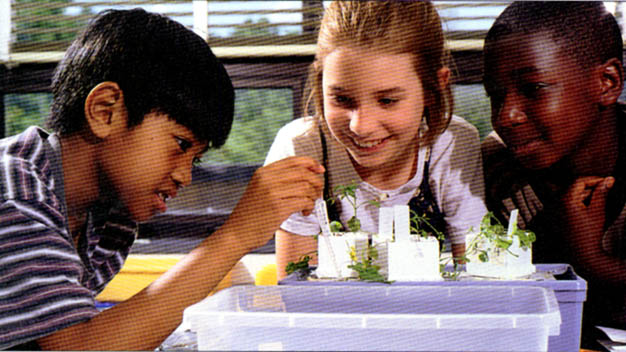
For grades 5–8, the life science standard is the following:
As a result of their activities in grades 5–8, all students should develop understanding of:
-
Structure and function in living systems
-
Reproduction and heredity
-
Regulation and behavior
-
Populations and ecosystems
-
Diversity and adaptations of organisms
The guidance for this standard defines regulation and behavior as follows:
An organism's behavior evolves through adaptation to its environment. How a species moves, obtains food, reproduces, and responds to danger are based in the species' evolutionary history.
The text discusses diversity and adaptations as follows:
Diversity and Adaptations of Organisms
Millions of species of animals, plants, and microorganisms are alive today. Although different species might look dissimilar, the unity among organisms becomes apparent from an analysis of internal structures, the similarity of their chemical processes, and the evidence of common ancestry.
Biological evolution accounts for the diversity of species developed through gradual processes over many generations. Species acquire many of their unique characteristics through biological adaptation, which involves the selection of naturally occurring variations in populations. Biological adaptations include changes in structures, behaviors, or physiology that enhance survival and reproductive success in a particular environment.
Extinction of a species occurs when the environment changes and the adaptive characteristics of a species are insufficient to allow its survival. Fossils indicate that many organisms that lived long ago are extinct. Extinction of species is common; most of the species that have lived on the earth no longer exist.
The text accompanying the standard also discusses some of the difficulties encountered in teaching about adaptation:
Understanding adaptation can be particularly troublesome at this level. Many students think adaptation means that individuals change in major ways in response to environmental changes (that is, if the environment changes, individual organisms deliberately adapt).
In fact, as described in Chapter 2 of this book, adaptation occurs through natural selection, a topic described under the life science standards for grades 9–12.
The content standards also treat evolution in grades 5–8 in the section on earth's history. The standard reads as follows:
As a result of their activities in grades 5–8, all students should develop an understanding of:
-
Structure of the earth system
-
Earth's history
-
Earth in the solar system
The text discusses the importance of teaching students about earth systems and their interactions.
A major goal of science in the middle grades is for students to develop an understanding of earth and the solar system as a set of closely coupled systems. The idea of systems provides a framework in which students can investigate the four major interacting components of the earth system—geosphere (crust, mantle, and core), hydrosphere (water), atmosphere (air), and the biosphere (the realm of all living things). In this holistic approach to studying the planet, physical, chemical, and biological processes act within and among the four components on a wide range of time scales to change continuously earth's crust, oceans, atmosphere, and living organisms. Their study of earth's history provides students with some evidence about co-evolution of the planet's main features—the distribution of land and sea, features of the crust, the composition of the atmosphere, global climate, and populations of living organisms in the biosphere.
The material offering guidance for the standard explicitly ties the earth's history to the history of life:
Earth's History
The earth processes we see today, including erosion, movement of lithospheric plates, and changes in atmospheric composition, are similar to those that occurred in the past. Earth's history is also influenced by occasional catastrophes, such as the impact of an asteroid or comet.
Fossils provide important evidence of how life and environmental conditions have changed.
The standards for grades 5–8 cover the nature of science in the section on the history and nature of science:
As a result of activities in grades 5–8, all students should develop an understanding of:
-
Science as a human endeavor
-
Nature of science
-
History of science
The guidance accompanying this standard offers the following discussion of these issues:
Nature of Science
Scientists formulate and test their explanations of nature using observation, experiments, and theoretical and mathematical models. Although all scientific ideas are tentative and subject to change and improvement in principle, for most major ideas in science, there is much experimental and observational confirmation. Those ideas are not likely to change greatly in the future. Scientists do and have changed their ideas about nature when they encounter new experimental evidence that does not match their existing explanations.
In areas where active research is being pursued and in which there is not a great deal of experimental or observational evidence and understanding, it is normal for scientists to differ with one another about the interpretation of the evidence or theory being considered. Different scientists might publish conflicting experimental results or might draw different conclusions from the same data. Ideally, scientists acknowledge such conflict and work towards finding evidence that will resolve their disagreement.
It is part of scientific inquiry to evaluate the results of scientific investigations, experiments, observations, theoretical models, and the explanations proposed by other scientists. Evaluation includes reviewing the experimental procedures, examining the evidence, identifying faulty reasoning, pointing out statements that go beyond the evidence, and suggesting alternative explanations for the same observations. Although scientists may disagree about explanations of phenomena, about interpretations of data, or about the value of rival theories, they do agree that questioning, response to criticism, and open communication are integral to the process of science. As scientific knowledge evolves, major disagreements are eventually resolved through such interactions between scientists.
History of Science
Many individuals have contributed to the traditions of science. Studying some of these individuals provides further understanding of scientific inquiry,
science as a human endeavor, the nature of science, and the relationships between science and society.
In historical perspective, science has been practiced by different individuals in different cultures. In looking at the history of many peoples, one finds that scientists and engineers of high achievement are considered to be among the most valued contributors to their culture.
Tracing the history of science can show how difficult it was for scientific innovators to break through the accepted ideas of their time to reach the conclusions that we currently take for granted.
Grades 9–12
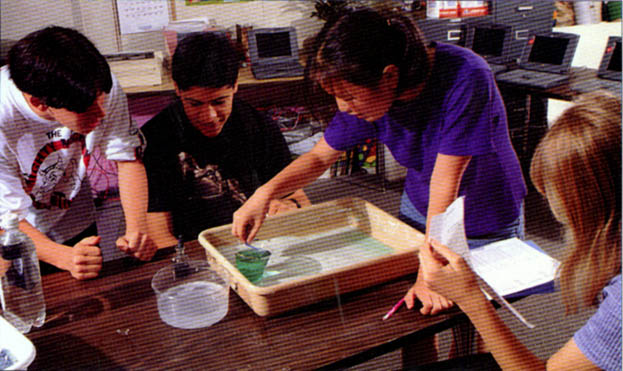
The life science standard for grades 9–12 directly addresses biological evolution. The standard reads as follows:
As a result of their activities in grades 9–12, all students should develop an understanding of:
-
The cell
-
Molecular basis of heredity
-
Biological evolution
-
Interdependence of organisms
-
Matter, energy, and organization in living systems
-
Behavior of organisms
The guidance for the life science standard describes the major themes of evolutionary theory:
Biological Evolution
Species evolve over time. Evolution is the consequence of the interactions of (1) the potential for a species to increase its numbers, (2) the genetic variability of offspring due to mutation and recombination of genes, (3) a finite supply of the resources required for life, and (4) the ensuing selection by the environment of those offspring better able to survive and leave offspring.
The great diversity of organisms is the result of more than 3.5 billion years of evolution that has filled every available niche with life forms.
Natural selection and its evolutionary consequences provide a scientific explanation for the fossil record of ancient life forms, as well as for the striking molecular similarities observed among the diverse species of living organisms.
The millions of different species of plants, animals, and microorganisms that live on earth today are related by descent from common ancestors.
Biological classifications are based on how organisms are related. Organisms are classified into a hierarchy of groups and subgroups based on similarities which reflect their evolutionary relationships. Species is the most fundamental unit of classification.
The text following the standard describes some of the difficulties that students can have in comprehending the basic concepts of evolution.
Students have difficulty with the fundamental concepts of evolution. For example, students often do not understand natural selection because they fail to make a conceptual connection between the occurrence of new variations in a population and the potential effect of those variations on the long-term survival of the species. One misconception that teachers may encounter involves students attributing new variations to an organism's need, environmental conditions, or use. With some help, students can understand that, in general, mutations occur randomly and are selected because they help some organisms survive and produce more offspring. Other misconceptions center on a lack of understanding of how a population changes as a result of differential reproduction (some individuals producing more offspring), as opposed to all individuals in a population changing. Many misconceptions about the process of natural selection can be changed through instruction.
Finally, evolution is discussed again in the guidance following the earth and space science standard:
As a result of their activities in grades 9–12, all students should develop an understanding of:
-
Energy in the earth system
-
Geochemical cycles
-
Origin and evolution of the earth system
-
Origin and evolution of the universe
The discussions of the origin and evolution of the earth system and the universe relate evolution to universal physical processes:
The Origin and Evolution of the Earth System
The sun, the earth, and the rest of the solar system formed from a nebular cloud of dust and gas 4.5 billion years ago. The early earth was very different from the planet we live on today.
Geologic time can be estimated by observing rock sequences and using fossils to correlate the sequences at various locations. Current methods include using the known decay rates of radioactive isotopes present in rocks to measure the time since the rock was formed.
Interactions among the solid earth, the oceans, the atmosphere, and organisms have resulted in the ongoing evolution of the earth system. We can observe some changes such as earthquakes and volcanic eruptions on a human time scale, but many processes such as mountain building and plate movements take place over hundreds of millions of years.
Evidence for one-celled forms of life—the bacteria—extends back more than 3.5 billion years. The evolution of life caused dramatic changes in the composition of the earth's atmosphere, which did not originally contain oxygen.
The Origin and Evolution of the Universe
The origin of the universe remains one of the greatest questions in science. The "big bang" theory places the origin between 10 and 20 billion years ago, when the universe began in a hot dense state; according to this theory, the universe has been expanding ever since.
Early in the history of the universe, matter, primarily the light atoms hydrogen and helium, clumped together by gravitational attraction to form countless trillions of stars. Billions of galaxies, each of which is a gravitationally bound cluster of billions of stars, now form most of the visible mass in the universe.
Stars produce energy from nuclear reactions, primarily the fusion of hydrogen to form helium. These and other processes in stars have led to the formation of all the other elements.
The standard for the history and nature of science elaborates on the knowledge established in previous years:
As a result of activities in grades 9–12, all students should develop an understanding of:
-
Science as a human endeavor
-
Nature of scientific knowledge
-
Historical perspectives
The discussion of this standard relates the nature of science explicitly to many of the problems that arise in the teaching of evolution.
Nature of Scientific Knowledge
Science distinguishes itself from other ways of
knowing and from other bodies of knowledge through the use of empirical standards, logical arguments, and skepticism, as scientists strive for the best possible explanations about the natural world.
Scientific explanations must meet certain criteria. First and foremost, they must be consistent with experimental and observational evidence about nature, and must make accurate predictions, when appropriate, about systems being studied. They should also be logical, respect the rules of evidence, be open to criticism, report methods and procedures, and make knowledge public. Explanations on how the natural world changes based on myths, personal beliefs, religious values, mystical inspiration, superstition, or authority may be personally useful and socially relevant, but they are not scientific.
Because all scientific ideas depend on experimental and observational confirmation, all scientific knowledge is, in principle, subject to change as new evidence becomes available. The core ideas of science such as the conservation of energy or the laws of motion have been subjected to a wide variety of confirmations and are therefore unlikely to change in the areas in which they have been tested. In areas where data or understanding are incomplete, such as the details of human evolution or questions surrounding global warming, new data may well lead to changes in current ideas or resolve current conflicts. In situations where information is still fragmentary, it is normal for scientific ideas to be incomplete, but this is also where the opportunity for making advances may be greatest.
Historical Perspectives
In history, diverse cultures have contributed scientific knowledge and technologic inventions. Modern science began to evolve rapidly in Europe several hundred years ago. During the past two centuries, it has contributed significantly to the industrialization of Western and non-Western cultures. However, other, non-European cultures have developed scientific ideas and solved human problems through technology.
Usually, changes in science occur as small modifications in extant knowledge. The daily work of science and engineering results in incremental advances in our understanding of the world and our ability to meet human needs and aspirations. Much can be learned about the internal workings of science and the nature of science from study of individual scientists, their daily work, and their efforts to advance scientific knowledge in their area of study.
Conclusion
The material addressing evolution in the National Science Education Standards is embedded within the full range of content standards describing what students should know, understand, and be able to do in the natural sciences. Used in conjunction with standards for other parts of the science education system, the content standards—and their treatment of evolution—point toward the levels of scientific literacy needed to meet the challenges of the twenty-first century.
NOTES
|
1. |
National Research Council. 1996. National Science Education Standards. Washington, DC: National Academy Press. www.nap.edu/readingroom/books/nses |
|
2. |
American Association for the Advancement of Science. 1993. Benchmarks for Science Literacy. Project 2061. New York: Oxford University Press. www.aaas.org |
|
3. |
National Science Teachers Association. 1993. Scope, Sequence, and Coordination of Secondary School Science. Vol. 1. The Content Core: A Guide for Curriculum Designers. rev. ed. Arlington, VA: NSTA. www.nsta.org |