1
Why Teach Evolution?
Why is it so important to teach evolution? After all, many questions in biology can be answered without mentioning evolution: How do birds fly? How can certain plants grow in the desert? Why do children resemble their parents? Each of these questions has an immediate answer involving aerodynamics, the storage and use of water by plants, or the mechanisms of heredity. Students ask about such things all the time.
The answers to these questions often raise deeper questions that are sometimes asked by students: How did things come to be that way? What is the advantage to birds of flying? How did desert plants come to differ from others? How did an individual organism come to have its particular genetic endowment? Answering questions like these requires a historical context—a framework of understanding that recognizes change through time.
People who study nature closely have always asked these kinds of questions. Over time, two observations have proved to be especially perplexing. The older of these has to do with the diversity of life: Why are there so many different kinds of plants and animals? The more we explore the world, the more impressed we are with the multiplicity of kinds of organisms. In the mid-nineteenth century, when Charles Darwin was writing On the Origin of Species, naturalists recognized several tens of thousands of different plant and animal species. By the middle of the twentieth century, biologists had paid more attention to less conspicuous forms of life, from insects to microorganisms, and the estimate was up to 1 or 2 million. Since then, investigations in tropical rain forests—the center of much of the world's biological diversity—have multiplied those estimates at least tenfold. What process has created this extraordinary variety of life?
The second question involves the inverse of life's diversity. How can the similarities among organisms be explained? Humans have always noticed the similarities among closely related species, but it gradually became apparent that even distantly related species share many anatomical and functional characteristics. The bones in a whale's front flippers are arranged in much the same way as the bones in our own arms. As organisms grow from fertilized egg cells into embryos, they pass through many similar developmental stages. Furthermore, as paleontologists studied the fossil record, they discovered countless extinct species that are clearly related in various ways to organisms living today.
This question has emerged with even greater force as modern experimental biology has focused on processes at the cellular and molecular level. From bacteria to yeast to mice to humans, all living things use the same biochemical machinery to carry out the basic processes of life. Many of the proteins that make up cells and catalyze chemical reactions in the body are virtually identical across species. Certain human genes that code for proteins differ little from the corresponding genes in fruit flies,

Investigations of forest ecosystems have helped reveal the incredible diversity of earth's living things.
mice, and primates. All living things use the same biochemical system to pass genetic information from one generation to another.
From a scientific standpoint, there is one compelling answer to questions about life's commonalities. Different kinds of organisms share so many characteristics of structure and function because they are related to one another. But how?
Solving the Puzzle
The concept of biological evolution addresses both of these fundamental questions. It accounts for the relatedness among organisms by explaining that the millions of different species of plants, animals, and microorganisms that live on earth today are related by descent from common ancestors—like distant cousins. Organisms in nature typically produce more offspring than can survive and reproduce given the constraints of food, space, and other resources in the environment. These offspring often differ from one another in ways that are heritable—that is, they can pass on the differences genetically to their own offspring. If competing offspring have traits that are advantageous in a given environment, they will survive and pass on those traits. As differences continue to accumulate over generations, populations of organisms diverge from their ancestors.
This straightforward process, which is a natural consequence of biologically reproducing organisms competing for limited resources, is responsible for one of the most magnificent chronicles known to science. Over billions of years, it has led the earliest organisms on earth to diversify into all of the plants, animals, and microorganisms that exist today. Though humans, fish, and bacteria would seem to be so different as to defy comparison, they all share some of the characteristics of their common ancestors.
Evolution also explains the great diversity of modern species. Populations of organisms
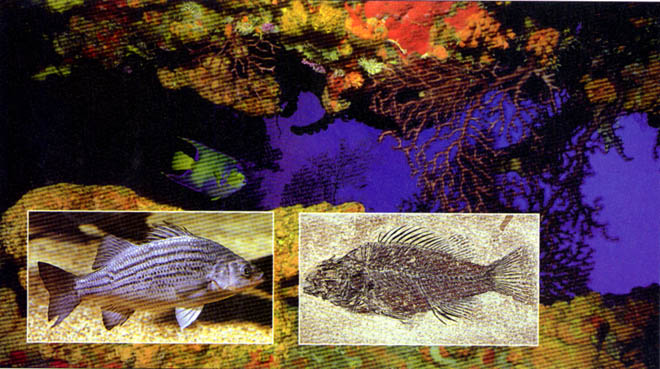
Living fish and fossil fish share many similarities, but the fossil fish clearly belongs to a different species that no longer exists. The progression of species found in the fossil record provides powerful evidence for evolution.
with characteristics enabling them to occupy ecological niches not occupied by similar organisms have a greater chance of surviving. Over time—as the next chapter discusses in more detail—species have diversified and have occupied more and more ecological niches to take advantage of new resources.
Evolution explains something else as well. During the billions of years that life has been on earth, it has played an increasingly important role in altering the planet's physical environment. For example, the composition of our atmosphere is partly a consequence of living systems. During photosynthesis, which is a product of evolution, green plants absorb carbon dioxide and water, produce organic compounds, and release oxygen. This process has created and continues to maintain an atmosphere rich in oxygen. Living communities also profoundly affect weather and the movement of water among the oceans, atmosphere, and land. Much of the rainfall in the forests of the western Amazon basin consists of water that has already made one or more recent trips through a living plant. In addition, plants and soil microorganisms exert important controls over global temperature by absorbing or emitting ''greenhouse gases" (such as carbon dioxide and methane) that increase the earth's capacity to retain heat.
In short, biological evolution accounts for three of the most fundamental features of the world around us: the similarities among living things, the diversity of life, and many features of the physical world we inhabit. Explanations of these phenomena in terms of evolution draw on results from physics, chemistry, geology, many areas of biology, and other sciences. Thus, evolution is the central organizing principle that biologists use to understand the world. To teach biology without explaining evolution deprives students of a powerful concept that brings great order and coherence to our understanding of life.
The teaching of evolution also has great practical value for students. Directly or indirectly, evolutionary biology has made many contributions to society. Evolution explains why many human pathogens have been developing resistance to formerly effective drugs and suggests ways of confronting this increasingly serious problem (this issue is discussed in greater detail in Chapter 2). Evolutionary biology has also
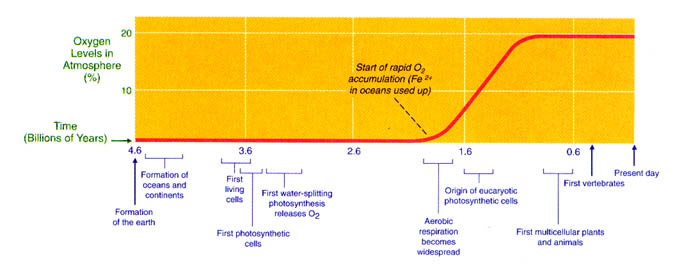
Living things have altered the earth's oceans, land surfaces, and atmosphere. For example, photosynthetic organisms are responsible for the oxygen that makes up about a fifth of the earth's atmosphere. The rapid accumulation of atmospheric oxygen about 2 billion years ago led to the evolution of more structured eucaryotic cells, which in turn gave rise to multicellular plants and animals.
contributed to many important agricultural advances by explaining the relationships among wild and domesticated plants and animals and their natural enemies. An understanding of evolution has been essential in finding and using natural resources, such as fossil fuels, and it will be indispensable as human societies strive to establish sustainable relationships with the natural environment.
Such examples can be multiplied many times. Evolutionary research is one of the most active fields of biology today, and discoveries with important practical applications occur on a regular basis.
Those who oppose the teaching of evolution in public schools sometimes ask that teachers present "the evidence against evolution." However, there is no debate within the scientific community over whether evolution occurred, and there is no evidence that evolution has not occurred. Some of the details of how evolution occurs are still being investigated. But scientists continue to debate only the particular mechanisms that result in evolution, not the overall accuracy of evolution as the explanation of life's history.
Evolution and the Nature of Science
Teaching about evolution has another important function. Because some people see evolution as conflicting with widely held beliefs, the teaching of evolution offers educators a superb opportunity to illuminate the nature of science and to differentiate science from other forms of human endeavor and understanding.
Chapter 3 describes the nature of science in detail. However, it is important from the outset to understand how the meanings of certain key words in science differ from the way that those words are used in everyday life.
Think, for example, of how people usually use the word "theory." Someone might refer to an idea and then add, "But that's only a theory." Or someone might preface a remark by saying, "My theory is …." In common usage, theory often means "guess" or ''hunch."
In science, the word "theory" means something quite different. It refers to an overarching explanation that has been well substantiated. Science has many other powerful theories besides evolution. Cell theory says that all living things are composed of
cells. The heliocentric theory says that the earth revolves around the sun rather than vice versa. Such concepts are supported by such abundant observational and experimental evidence that they are no longer questioned in science.
Sometimes scientists themselves use the word "theory" loosely and apply it to tentative explanations that lack well-established evidence. But it is important to distinguish these casual uses of the word "theory" with its use to describe concepts such as evolution that are supported by overwhelming evidence. Scientists might wish that they had a word other than "theory" to apply to such enduring explanations of the natural world, but the term is too deeply engrained in science to be discarded.
As with all scientific knowledge, a theory can be refined or even replaced by an alternative theory in light of new and compelling evidence. For example, Chapter 3 describes how the geocentric theory that the sun revolves around the earth was replaced by the heliocentric theory of the earth's rotation on its axis and revolution around the sun. However, ideas are not referred to as "theories" in science unless they are supported by bodies of evidence that make their subsequent abandonment very unlikely. When a theory is supported by as much evidence as evolution, it is held with a very high degree of confidence.
In science, the word "hypothesis" conveys the tentativeness inherent in the common use of the word "theory." A hypothesis is a testable statement about the natural world. Through experiment and observation, hypotheses can be supported or rejected. As the earliest level of understanding, hypotheses can be used to construct more complex inferences and explanations.
Like "theory," the word "fact" has a different meaning in science than it does in common usage. A scientific fact is an observation that has been confirmed over and over. However, observations are gathered by our senses, which can never be trusted entirely. Observations also can change with better technologies or with better ways of looking at data. For example, it was held as a scientific fact for many years that human cells have 24 pairs of chromosomes, until improved techniques of microscopy revealed that they actually have 23. Ironically, facts in science often are more susceptible to change than theories—which is one reason why the word "fact" is not much used in science.
Finally, "laws" in science are typically descriptions of how the physical world behaves under certain circumstances. For example, the laws of motion describe how objects move when subjected to certain forces. These laws can be very useful in supporting hypotheses and theories, but like all elements of science they can be altered with new information and observations.
|
Glossary of Terms Used in Teaching About the Nature of Science Fact: In science, an observation that has been repeatedly confirmed. Law: A descriptive generalization about how some aspect of the natural world behaves under stated circumstances. Hypothesis: A testable statement about the natural world that can be used to build more complex inferences and explanations. Theory: In science, a well-substantiated explanation of some aspect of the natural world that can incorporate facts, laws, inferences, and tested hypot |
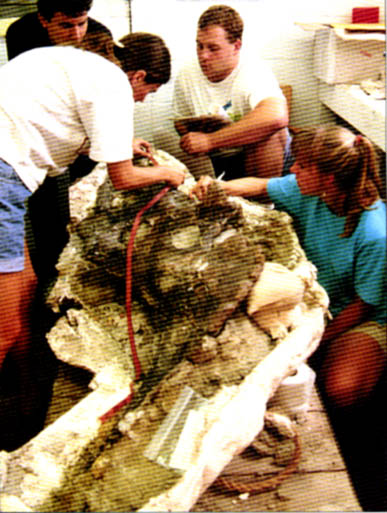
Scientists examining the head of Chasmosaurus mariscalensis hone their understanding of nature by comparing it against observations of the world. Clockwise from upper right: Prof. Paul Sereno, Univ. of Chicago; assistant Cathy Forster, Univ. of Chicago; students Hilary Tindle and Tom Evans, who discovered the skull in the field in March 1991 in Big Bend National Park, Texas.
Those who oppose the teaching of evolution often say that evolution should be taught as a "theory, not as a fact." This statement confuses the common use of these words with the scientific use. In science, theories do not turn into facts through the accumulation of evidence. Rather, theories are the end points of science. They are understandings that develop from extensive observation, experimentation, and creative reflection. They incorporate a large body of scientific facts, laws, tested hypotheses, and logical inferences. In this sense, evolution is one of the strongest and most useful scientific theories we have.
Evolution and Everyday Life
The concept of evolution has an importance in education that goes beyond its power as a scientific explanation. All of us live in a world where the pace of change is accelerating. Today's children will face more new experiences and different conditions than their parents or teachers have had to face in their lives.
The story of evolution is one chapter—perhaps the most important one—in a scientific revolution that has occupied much of the past four centuries. The central feature of this revolution has been the abandonment of one notion about stability after another: that the earth was the center of the universe, that the world's living things are unchangeable, that the continents of the earth are held rigidly in place, and so on. Fluidity and change have become central to our understanding of the world around us. To accept the probability of change—and to see change as an agent of opportunity rather than as a threat—is a silent message and challenge in the lesson of evolution.
The following dialogue dramatizes some of the problems educators encounter in teaching evolution and demonstrates ways of overcoming these obstacles. Chapter 2 returns to the basic themes that characterize evolutionary theory, and Chapter 3 takes a closer look at the nature of science.
Dialogue
THE CHALLENGE TO TEACHERS
Teaching evolution presents special challenges to science teachers. Sources of support upon which teachers can draw include high-quality curricula, adequate preparation, exposure to information useful in documenting the evidence for evolution, and resources and contacts provided by professional associations.
One important source of support for teachers is to share problems and explore solutions with other teachers. The following vignette illustrates how a group of teachers—in this case, three biology teachers at a large public high school—can work together to solve problems and learn from each other.
********
It is the first week of classes at Central High School. As the bell rings for third period, Karen, the newest teacher on the faculty, walks into the teachers' lounge. She greets her colleagues, Barbara and Doug.
"How are your first few days going?" asks Doug.
"Fine," Karen replies. "The second-period Biology I class is full, but it'll be okay. By the way, Barbara, thanks for letting me see your syllabus for Bio I. But I wanted to ask you about teaching evolution—I didn't see it there."
"You didn't see it on my syllabus because it's not a separate topic," Barbara says. "I use evolution as a theme to tie the course together, so it comes into just about every unit. You'll see a section called 'History of Life' on the second page, and there's a section called 'Natural Selection.' But I don't treat evolution separately because it is related to almost every other topic in biology."1
"Wait a minute, Barbara," Doug says. "Is that good advice for a new teacher? I mean, evolution is a controversial subject, and a lot of us just don't get around to teaching it. I don't. You do, but you're braver than most of us."
"It's not a matter of bravery, Doug," Barbara replies. "It's a matter of what needs to be taught if we want students to understand biology. Teaching biology without evolution would be like teaching civics and never mentioning the United States Constitution."
"But how can you be sure that evolution is all that important. Aren't there a lot of scientists who don't believe in evolution? Say it's too improbable?"
"The debate in science is over some of the details of how evolution occurred, not whether evolution happened or not. A lot of science and science education organizations have made statements about why it is important to teach evolution. …"2
"I saw a news report when I was a student," Karen interjects, "about a school district or state that put a disclaimer against evolution in all their biology textbooks. It said that students didn't need to believe in evolution because it wasn't a fact, only a theory. The argument was that no one really knows how life began or how it evolved because no one was there to see it happen."3
"If I taught evolution, I'd sure teach it as a theory—not a fact," says Doug.
"Just like gravity," Barbara says.
"Now, Barbara, gravity is a fact, not a theory."
"Not in scientific terms. The fact is that things fall. The explanation for why things fall is the theory of gravitation. Our problem is definitions. You're using 'fact' and 'theory' the way we use them in everyday life, but we need to use them as scientists use them. In science, a 'fact' is an observation that has
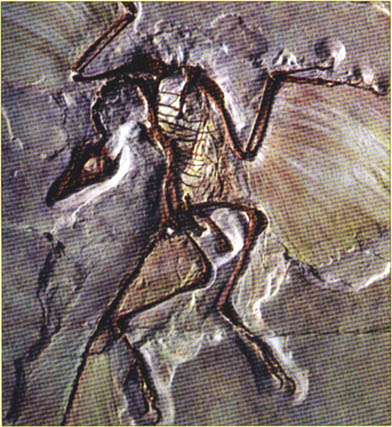
A fossil of Archaeopteryx, a bird that lived about 150 million years ago and had many reptilian characteristics, was discovered in 1861 and helped support the hypothesis of evolution proposed by Charles Darwin in The Origin of Species two years earlier.
been made so many times that it's assumed to be okay. How facts are explained is where theories come in: theories are explanations of what we observe. One place where students get confused about evolution is that they think of 'theory' as meaning 'guess' or 'hunch.' But evolution isn't a hunch. It's a scientific explanation, and a very good one."
"But how good a theory is it?" asks Doug. "We don't know everything about evolution."
"That's true," says Karen. "A student in one of my classes at the university told me that there are big gaps in the fossil record. Do you know anything about that?"
"Well, there's Archaeopteryx," says Doug. "It's a fossil that has feathers like a bird but the skeleton of a small dinosaur. It's one of those missing links that's not missing any more."
"In fact, there are good transitional fossils between primitive fish and amphibians and between reptiles and mammals," Barbara says. "Our knowledge of fossil intermediates is actually pretty good.4 And, Doug, it sounds like you know more about evolution than you're letting on. Why don't you teach it?"
"I don't want any trouble. Every time I teach evolution, I have a student announce that 'evolution is against his religion.'"
"But most of the major religious denominations have taken official positions that accept evolution," says Barbara. "One semester a friend of mine in the middle school started out her Life Science unit by having her students interview their ministers or priests or rabbis about their religion's views on evolution. She said that most of her students came back really surprised. 'Hey,' they said, 'evolution is okay.' It defused the controversy in her class."
"She didn't have Stanley in her class," says Doug.
"Who's Stanley?" asks Karen.
"The son of a school board member. Given his family's religious views, I'm sure he would not come back saying evolution was okay."
"That can be a hard situation," says Barbara. "But even if Stanley came back to class saying that his religion does not accept evolution, it could help a teacher show that there are many different religious views about evolution. That's the point: religious people can still accept evolution."
"Stanley will never believe in evolution."
"We talk about 'believing' in evolution, but that's not necessarily the right word. We accept evolution as the best scientific explanation for a lot of observations—about fossils and biochemistry and evolutionary changes we can actually see, like how bacteria become resistant to certain medicines. That's why people accepted the idea that the earth goes around the sun—because it accounted for many different observations that we make. In science, when a better explanation comes around, it replaces earlier ones."
"Does that mean that evolution will be replaced by a better theory some day?" asks Karen.
"It's not likely. Not all old theories are
replaced, and evolution has been tested and has a lot of evidence to support it. The point is that doing science requires being willing to refine our theories to be consistent with new information."
"But there's still Stanley," says Doug. "He doesn't even want to hear about evolution."
"I had Stanley's sister in AP biology one year," Barbara replies. "She raised a fuss about evolution, and I told her that I wasn't going to grade her on her opinion of evolution but on her knowledge of the facts and concepts. She seemed satisfied with that and actually got an A in the class."
"I still think that if you teach evolution, it's only fair to teach both."
"What do you mean by both?" asks Barbara. "If you mean both evolution and creationism, what kind of creationism do you want to teach? Will you teach evolution and the Bible? What about other religions like Buddhism or the views of Native Americans? It's hard to argue for 'both' when there are a whole lot more than two options."
"I can't teach a whole bunch of creation stories in my Bio class," says Doug.
"That's the point. We can't add subjects to the science curriculum to be fair to groups that hold certain beliefs. Teaching ecology isn't fair to the polluter, either. Biology is a science class, and what should be taught is science."
"But isn't there something called 'creation science'?" asks Karen. "Can creationism be made scientific?"
"That's an interesting story. 'Creation science' is the idea that scientific evidence can support a literal interpretation of Genesis—that the whole universe was created all at once about 10,000 years ago."
"It doesn't sound very likely."
"It's not. Scientists have looked at the arguments and have found they are not supported by verifiable data. Still, back in the early 1980s, some states passed laws requiring that 'creation science' be taught whenever evolution was taught. But the Supreme Court threw out 'equal time' laws, saying that because creationism was inherently a religious and not a scientific idea, it couldn't be presented as 'truth' in science classes in the public schools."5
"Well, I'm willing to teach evolution," says Karen, "and I'd like to try it your way, Barbara, as a theme that ties biology together. But I really don't know enough about evolution to do it. Do you have any suggestions about where I can get information?"
"Sure, I'd be glad to share what I have. But an important part of teaching evolution has to do with explaining the nature of science. I'm trying out a demonstration after school today that I'm going to use with my Bio I class tomorrow. Why don't you both come by and we can try it out?"
"Okay," say Karen and Doug. "We'll see you then."
********
Barbara, Doug, and Karen's discussion of evolution and the nature of science resumes following Chapter 2.
NOTES
|
1. |
The National Science Education Standards cite "evolution and equilibrium" as one of five central concepts that unify all of the sciences. (See www.nap.edu/readingroom/books/nses) |
|
2. |
Appendix C contains statements from science and science education organizations that support the need to teach evolution. |
|
3. |
In 1995, the Alabama board of education ordered that all biology textbooks in public schools carry inserts that read, in part, as follows: "This textbook discusses evolution, a controversial theory some scientists present as a scientific explanation for the origin of living things, such as plants, animals, and humans. No one was present when life first appeared on earth. Therefore, any statement about life's origins should be considered theory, not fact." Other districts have required similar disclaimers. |
|
4. |
The book From So Simple a Beginning: The Book of Evolution by Philip Whitfield (New York: Macmillan, 1993) presents a well-illustrated overview of evolutionary history. Evolution by Monroe W. Strickberger (Boston: Jones and Bartlett, 2nd edition, 1995) is a thorough text written at the undergraduate level. |
|
5. |
In the 1987 case Edwards v. Aguillard, the U.S. Supreme Court reaffirmed the 1982 decision of a federal district court that the teaching of "creation science" in public schools violates the First Amendment of the U.S. Constitution. |