6
Activities for Teaching About Evolution and the Nature of Science
Prior chapters in this volume answer the what and why questions of teaching about evolution and the nature of science. As every educator knows, such discussions only set a stage. The actual play occurs when science teachers act on the basic content and well-reasoned arguments for inclusion of evolution and the nature of science in school science programs.
This chapter goes beyond discussions of content and rationales. It presents, as examples of investigative teaching exercises, eight activities that science teachers can use as they begin developing students' understandings and abilities of evolution and the nature of science. The following descriptions briefly introduce each activity.
Activity 1: Introducing Inquiry and the Nature of Science
This activity introduces basic procedures involved in inquiry and concepts describing the nature of science. In the first portion of the activity the teacher uses a numbered cube to involve students in asking a question—what is on the unseen bottom of the cube?—and the students propose an explanation based on their observations. Then the teacher presents the students with a second cube and asks them to use the available evidence to propose an explanation for what is on the bottom of this cube. Finally, students design a cube that they exchange and use for an evaluation. This activity provides students with opportunities to learn the abilities and understandings aligned with science as inquiry and the nature of science as described in the National Science Education Standards.1 Designed for grades 5 through 12, the activity requires a total of four class periods to complete. Lower grade levels might only complete the first cube and the evaluation where students design a problem based on the cube activity.
Activity 2: The Formulation of Explanations: An Invitation to Inquiry on Natural Selection
This activity uses the concept of natural selection to introduce the idea of formulating and testing a scientific hypothesis. Through a focused discussion approach, the teacher provides information and allows students time to think, interact with peers, and propose explanations for observations described by the teacher. The teacher then provides more information, and the students continue their discussion based on the new information. This activity will help students in grades 5 through 8 develop abilities related to scientific inquiry and formulate understandings about the nature of science.
Activity 3: Investigating Natural Selection
In this activity, the students investigate one mechanism for evolution through a simulation that models the principles of natural selection and helps answer the question: How might biological change have occurred and been reinforced over time? The activity is designed for grades 9 through 12 and requires three class periods.
Activity 4: Investigating Common Descent: Formulating Explanations and Models
In this activity, students formulate explanations and models that simulate structural and biochemical
data as they investigate the misconception that humans evolved from apes. The investigations require two 45-minute periods. They are designed for use in grades 9 through 12.
Activity 5: Proposing Explanations for Fossil Footprints
In this investigation, students observe and interpret "fossil footprint" evidence. From the evidence, they are asked to construct defensible hypotheses or explanations for events that took place in the geologic past. Estimated time requirements for this activity: two class periods. This activity is designed for grades 5 through 8.
Activity 6: Understanding Earth's Changes Over Time
Comparing the magnitude of geologic time to spans of time within a person's own lifetime is difficult for many students. In this activity, students use a long paper strip and a reasonable scale to represent visually all of geologic time, including significant events in the development of life on earth as well as recent human events. The investigation requires two class periods and is appropriate for grades 5 through 12.
Activity 7: Proposing the Theory of Biological Evolution: Historical Perspective
This activity uses historical perspectives and the theme of evolution to introduce students to the nature of science. The teacher has students read short excerpts of original statements on evolution from Jean Lamarck, Charles Darwin, and Alfred Russel Wallace. These activities are intended as either supplements to other investigations or core activities. Designed for grades 9 through 12, the activities should be used as part of three class periods.
Activity 8: Connecting Population Growth and Biological Evolution
In this activity, students develop a model of the mathematical nature of population growth. The investigation provides an excellent opportunity for consideration of population growth of plant and animal species and the relationship to mechanisms promoting natural selection. This activity will require two class periods and is appropriate for grades 5 through 12.
The activities in this chapter do not represent a curriculum. They are directed, instead, toward other purposes.
First, they present examples of standards-based instructional materials. In this case, the level of organization is an activity—one to five days of lessons—and not a larger level of organization such as a unit of several weeks, a semester, or a year. Also, these exercises generally do not use biological materials, such as fruit flies, or computer simulations. The use of these instructional materials in the curriculum greatly expands the range of possible investigations.
Second, these activities demonstrate how existing exercises can be recast to emphasize the importance of inquiry and the fundamental concepts of evolution. Each of these exercises was derived from already existing activities that were revised to reflect the National Science Education Standards. For each exercise, student outcomes drawn from the Standards are listed to focus attention on the concepts and abilities that students are meant to develop.
Third, the activities demonstrate some, but not all, of the criteria for curricula to be described in Chapter 7. For example, several of the activities emphasize inquiry and the nature of science while others focus on concepts related to evolution. All activities use an instructional model, described in the next section, that increases coherence and enhances learning.
Finally, there remains a paucity of instructional materials for teaching evolution and the nature of science. Science teachers who recognize this need are encouraged to develop new materials and lessons to introduce the themes of evolution and the nature of science. (See http://www4.nas.edu/opus/evolve.nsf)
Developing Students' Understanding and Abilities: The Curriculum Perspective
For students to develop an understanding of evolution and the nature of science requires many years and a variety of educational experiences.
Teachers cannot rely on single lessons, chapters, or biology and earth science courses for students to integrate the ideas presented in this document into their own understanding. In early grades (K–4) students might learn the fundamental concepts associated with "characteristics of organisms," "life cycles," and "organisms and environments." In middle grades they learn more about ''reproduction and heredity" and "diversity and adaptation of organisms." Such learning experiences, as described in the National Science Education Standards, set a firm foundation for the study of biological evolution in grades 9–12.
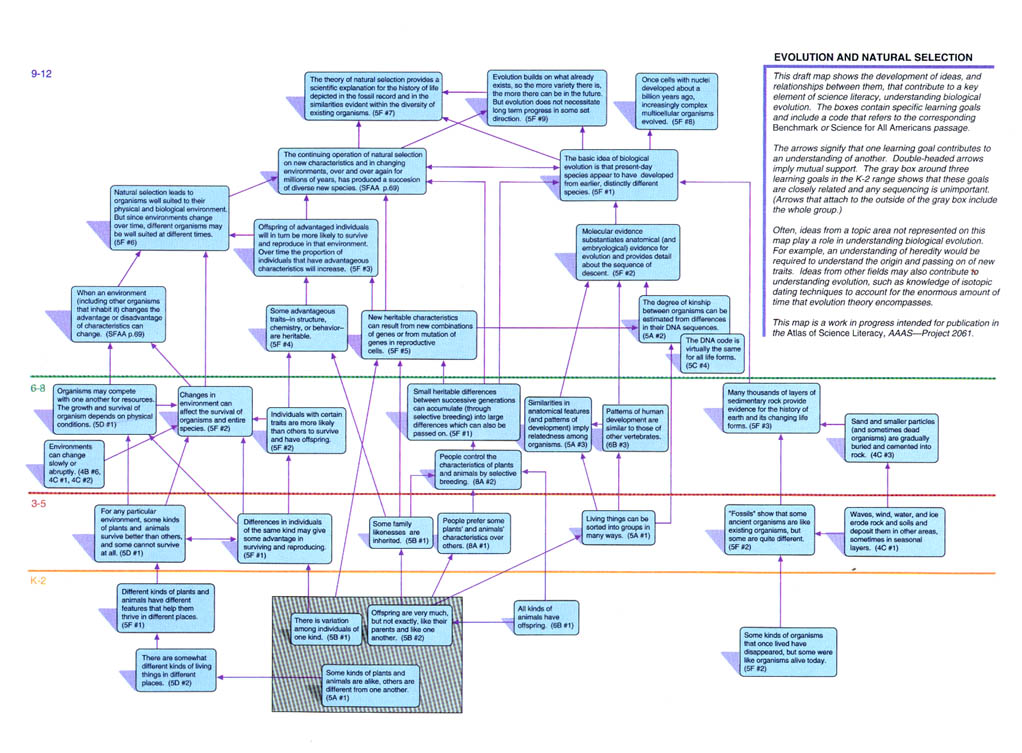
The slow and steady development of concepts such as evolution and related ideas such as natural selection and common descent requires careful consideration of the overall structure and sequence of learning experiences. Although this chapter does not propose a curriculum or a curriculum framework, current efforts by Project 2061 of the American Association for the Advancement of Science (AAAS) demonstrate the interrelated nature of students' understanding of science concepts and emphasize the importance of well-designed curricula at several levels of organization (for example, activities, units, and school science programs). The figure on the next page presents the "Growth-of-Understanding Map for Evolution and Natural Selection" based on Benchmarks for Science Literacy.2
Developing Student Understanding and Abilities: The Instructional Perspective
The activities in the chapter incorporate an instructional model, summarized in the accompanying box, that includes five steps: engagement, exploration, explanation, elaboration, and evaluation. Just as scientific investigations originate with a question that engages a scientist, so too must students engage in the activities of learning. The activities therefore begin with a strategic question that gets students thinking about the content of the lesson.
Once engaged, students need time to explore ideas before concepts begin to make sense. In this exploration phase, students try their ideas, ask questions, and look for possible answers to questions. Students use inquiry strategies; they try to
|
An Instructional Model ENGAGE This phase of the instructional model initiates the learning task. The activity should (1) make connections between past and present learning experiences and (2) anticipate activities and focus students' thinking on the learning outcomes of current activities. Students should become mentally engaged in the concept, process, or skill to be explored. EXPLORE This phase of the teaching model provides students with a common base of experiences within which they identify and develop current concepts, processes, and skills. During this phase,xxxxx students actively explore their environment or manipulate materials. EXPLAIN This phase of the instructional model focuses students' attention on a particular aspect of their engagement and exploration experiences and provides opportunities for them to develop explanations and hypotheses. This phase also provides opportunities for teachers to introduce a formal label or definition for a concept, process, skill, or behavior. ELABORATE This phase of the teaching model challenges and extends students' conceptual understanding and allows further opportunity for students to test hypotheses and practice desired skills and behaviors. Through new experiences, the students develop a deeper and broader understanding, acquire more information, and develop and refine skills. EVALUATE This phase of the teaching model encourages students to assess their understanding and abilities and provides opportunities for teachers to evaluate student progress toward achieving the educational objectives. |
relate their ideas to those of other students and to what scientists already know about evolution.
In the third step, students can propose answers and develop hypotheses. Also in this step, the teacher explains what scientists know about the questions. This is the step when teachers should make the major concepts explicit and clear to the students.
Educators understand that informing students about a concept does not necessarily result in their immediate comprehension and understanding of the idea. These activities therefore provide a step referred to as elaboration in which students have opportunities to apply their ideas in new and slightly different situations.
Finally, how well do students understand the concepts, or how successful are they at applying the desired skills? These are the questions to be answered during the evaluation phase. Ideally, evaluations are more than tests. Students should have opportunities to see if their ideas can be applied in new situations and to compare their understanding with scientific explanations of the same phenomena.
Activity 1
Introducing Inquiry and the Nature of Science
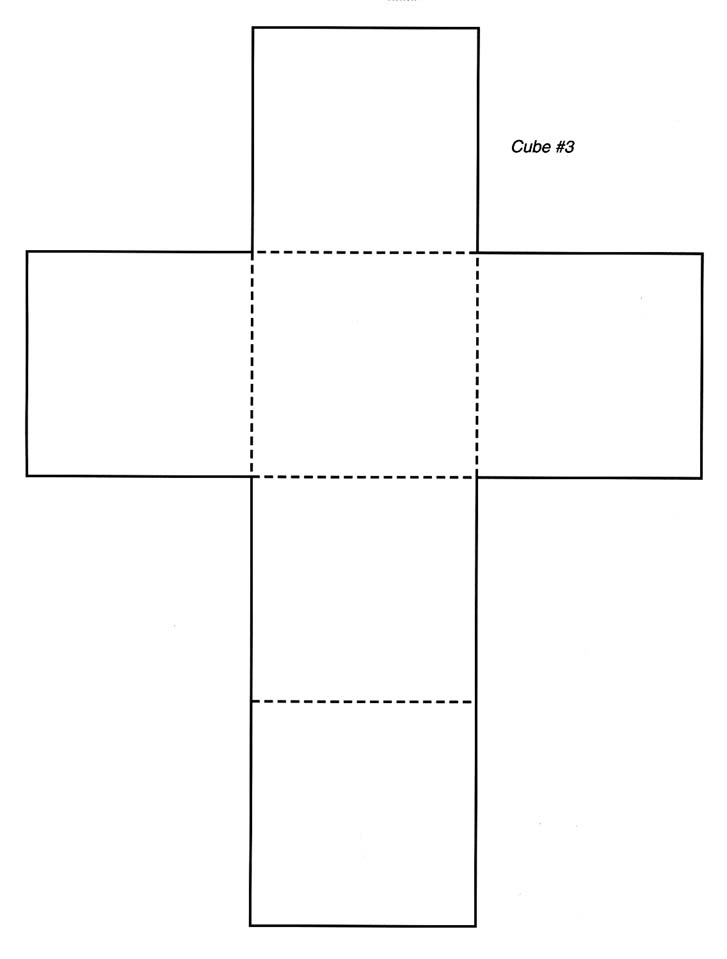
This activity introduces basic procedures involved in inquiry and concepts describing the nature of science. In the first portion of the activity the teacher uses a numbered cube to involve students in asking a question—what is on the bottom?— and the students propose an explanation based on their observations. Then the teacher presents the students with a second cube and asks them to use the available evidence to propose an explanation for what is on the bottom of this cube. Finally, students design a cube that they exchange and use for an evaluation. This activity provides students with opportunities to learn the abilities and understandings aligned with science as inquiry and the nature of science as described in the National Science Education Standards. Designed for grades 5 through 12, the activity requires a total of four class periods to complete. Lower grade levels might only complete the first cube and the evaluation where students design a problem based on the cube activity.
Standards-Based Outcomes
This activity provides all students with opportunities to develop abilities of scientific inquiry as described in the National Science Education Standards. Specifically, it enables them to:
-
identify questions that can be answered through scientific investigations,
-
design and conduct a scientific investigation,
-
use appropriate tools and techniques to gather, analyze, and interpret data,
-
develop descriptions, explanations, predictions, and models using evidence,
-
think critically and logically to make relationship between evidence and explanations,
-
recognize and analyze alternative explanations and predictions, and
-
communicate scientific procedures and explanations.
This activity also provides all students opportunities to develop understanding about inquiry and the nature of science as described in the National Science Education Standards. Specifically, it introduces the following concepts:
-
Different kinds of questions suggest different kinds of scientific investigations.
-
Current scientific knowledge and understanding guide scientific investigations.
-
Technology used to gather data enhances accuracy and allows scientists to analyze and quantify results of investigations.
-
Scientific explanations emphasize evidence, have logically consistent arguments, and use scientific principles, models, and theories.
-
Science distinguishes itself from other ways of knowing and from other bodies of knowledge through the use of empirical standards, logical arguments, and skepticism, as scientists strive for the best possible explanations about the natural world.
Science Background for Teachers
The pursuit of scientific explanations often begins with a question about a natural phenomenon. Science is a way of developing answers, or improving explanations, for observations or events in the natural world. The scientific question can emerge from a child's curiosity about where the dinosaurs went or why the sky is blue. Or the question can extend scientists' inquiries into the process of extinction or the chemistry of ozone depletion.
Once the question is asked, a process of scientific inquiry begins, and there eventually may be an answer or a proposed explanation. Critical aspects of science include curiosity and the freedom to pursue that curiosity. Other attitudes and habits of mind that characterize scientific inquiry and the activities of scientists include intelligence, honesty, skepticism, tolerance for ambiguity, openness to
new knowledge, and the willingness to share knowledge publicly.
Scientific inquiry includes systematic approaches to observing, collecting information, identifying significant variables, formulating and testing hypotheses, and taking precise, accurate, and reliable measurements. Understanding and designing experiments are also part of the inquiry process.
Scientific explanations are more than the results of collecting and organizing data. Scientists also engage in important processes such as constructing laws, elaborating models, and developing hypotheses based on data. These processes extend, clarify, and unite the observations and data and, very importantly, develop deeper and broader explanations. Examples include the taxonomy of organisms, the periodic table of the elements, and theories of common descent and natural selection.
One characteristic of science is that many explanations continually change. Two types of changes occur in scientific explanations: new explanations are developed, and old explanations are modified.
Just because someone asks a question about an object, organism, or event in nature does not necessarily mean that person is pursuing a scientific explanation. Among the conditions that must be met to make explanations scientific are the following:
-
Scientific explanations are based on empirical observations or experiments. The appeal to authority as a valid explanation does not meet the requirements of science. Observations are based on sense experiences or on an extension of the senses through technology.
-
Scientific explanations are made public. Scientists make presentations at scientific meetings or publish in professional journals, making knowledge public and available to other scientists.
-
Scientific explanations are tentative. Explanations can and do change. There are no scientific truths in an absolute sense.
-
Scientific explanations are historical. Past explanations are the basis for contemporary explanations, and those, in turn, are the basis for future explanations.
-
Scientific explanations are probabilistic. The statistical view of nature is evident implicitly or explicitly when stating scientific predictions of phenomena or explaining the likelihood of events in actual situations.
-
Scientific explanations assume cause-effect relationships. Much of science is directed toward determining causal relationships and developing explanations for interactions and linkages between objects, organisms, and events. Distinctions among causality, correlation, coincidence, and contingency separate science from pseudoscience.
-
Scientific explanations are limited. Scientific explanations sometimes are limited by technology, for example, the resolving power of microscopes and telescopes. New technologies can result in new fields of inquiry or extend current areas of study. The interactions between technology and advances in molecular biology and the role of technology in planetary explorations serve as examples.
Science cannot answer all questions. Some questions are simply beyond the parameters of science. Many questions involving the meaning of life, ethics, and theology are examples of questions that science cannot answer. Refer to the National Science Education Standards for Science as Inquiry (pages 145-148 for grades 5-8 and pages 175-176 for grades 9-12), History and Nature of Science Standards (pages 170-171 for grades 5-8 and pages 200-204 for grades 9-12), and Unifying Concepts and Processes (pages 116-118). Chapter 3 of this document also contains a discussion of the nature of science.
Materials and Equipment
-
1 cube for each group of four students (black-line masters are provided).
(Note: you may wish to complete the first portion of the activity as a demonstration for the class. If so, construct one large cube using a cardboard box. The sides should have the same numbers and markings as the black-line master.)
-
10 small probes such as tongue depressors or pencils.
-
10 small pocket mirrors.
Instructional Strategy
Engage Begin by asking the class to tell you what they know about how scientists do their work. How would they describe a scientific investigation? Get students thinking about the process of scientific
inquiry and the nature of science. This is also an opportunity for you to assess their current understanding of science. Accept student answers and record key ideas on the overhead or chalkboard.
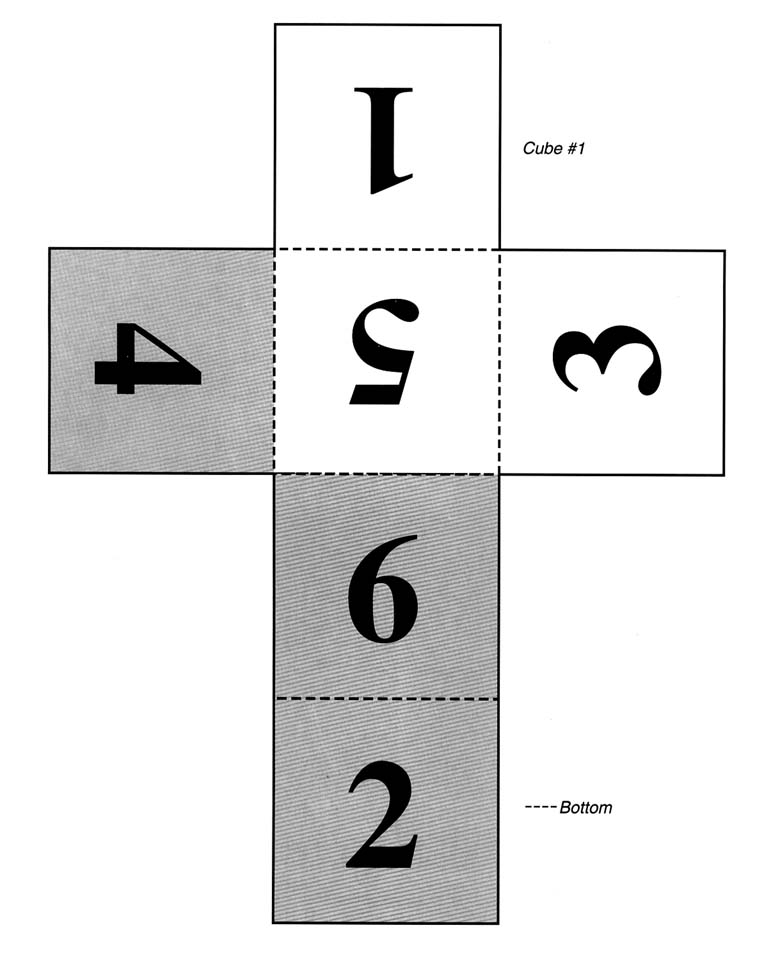
Explore (The first cube activity can be done as a demonstration if you construct a large cube and place it in the center of the room.) First, have the students form groups of three or four. Place the cubes in the center of the table where the students are working. The students should not touch, turn, lift, or open the cube. Tell the students they have to identify a question associated with the cube. Allow the students to state their questions. Likely questions include:
-
What is in the cube?
-
What is on the bottom of the cube?
-
What number is on the bottom?
You should direct students to the general question, what is on the bottom of the cube? Tell the students that they will have to answer the question by proposing an explanation, and that they will have to convince you and other students that their answer is based on evidence. (Evidence refers to observations the group can make about the visible sides of the cube.) Allow the students time to explore the cube and to develop answers to their question. Some observations or statements of fact that the students may make include:
-
The cube has six sides.
-
The cube has five exposed sides.
-
The numbers and dots are black.
-
The exposed sides have numbers 1, 3, 4, 5, and 6.
-
The opposite sides add up to seven.
-
The even-numbered sides are shaded.
-
The odd-numbered sides are white.
Ask the students to use their observations (the data) to propose an answer to the question: What is on the bottom of the cube? The student groups should be able to make a statement such as: We conclude there is a 2 on the bottom. Students should present their reasoning for this conclusion. For example, they might base their conclusion on the observation that the exposed sides are 1, 3, 4, 5, and 6, and because 2 is missing from the sequence, they conclude it is on the bottom.
Use this opportunity to have the students develop the idea that combining two different but logically related observations creates a stronger explanation. For example, 2 is missing in the sequence (that is, 1, _, 3, 4, 5, 6) and that opposite sides add up to 7 (that is, 1–6; 3–4; _–5) and because 5 is on top, and 5 and 2 equal 7, 2 could be on the bottom.
If done as a demonstration, you might put the cube away without showing the bottom or allowing students to dismantle it. Explain that scientists often are uncertain about their proposed answers, and often have no way of knowing the absolute answer to a scientific question. Examples such as the exact ages of stars and the reasons for the extinction of prehistoric organisms will support the point.
Explain Begin the class period with an explanation of how the activity simulates scientific inquiry and provides a model for science. Structure the discussion so students make the connections between their experiences with the cube and the key points (understandings) you wish to develop.
Key points from the Standards include the following:
-
Science originates in questions about the world.
-
Science uses observations to construct explanations (answers to the questions). The more observations you had that supported your proposed explanation, the stronger your explanation, even if you could not confirm the answer by examining the bottom of the cube.
-
Scientists make their explanations public through presentations at professional meetings and journals.
-
Scientists present their explanations and critique the explanations proposed by other scientists.
The activity does not explicitly describe "the scientific method." The students had to work to answer the question and probably did it in a less than systematic way. Identifiable elements of a method—such as observation, data, and hypotheses—were clear but not applied systematically. You can use the experiences to point out and clarify scientific uses of terms such as observation, hypotheses, and data.
For the remainder of the second class period you should introduce the "story" of an actual scientific discovery. Historic examples such as Charles Darwin would be ideal. You could also assign students to prepare brief reports that they present.
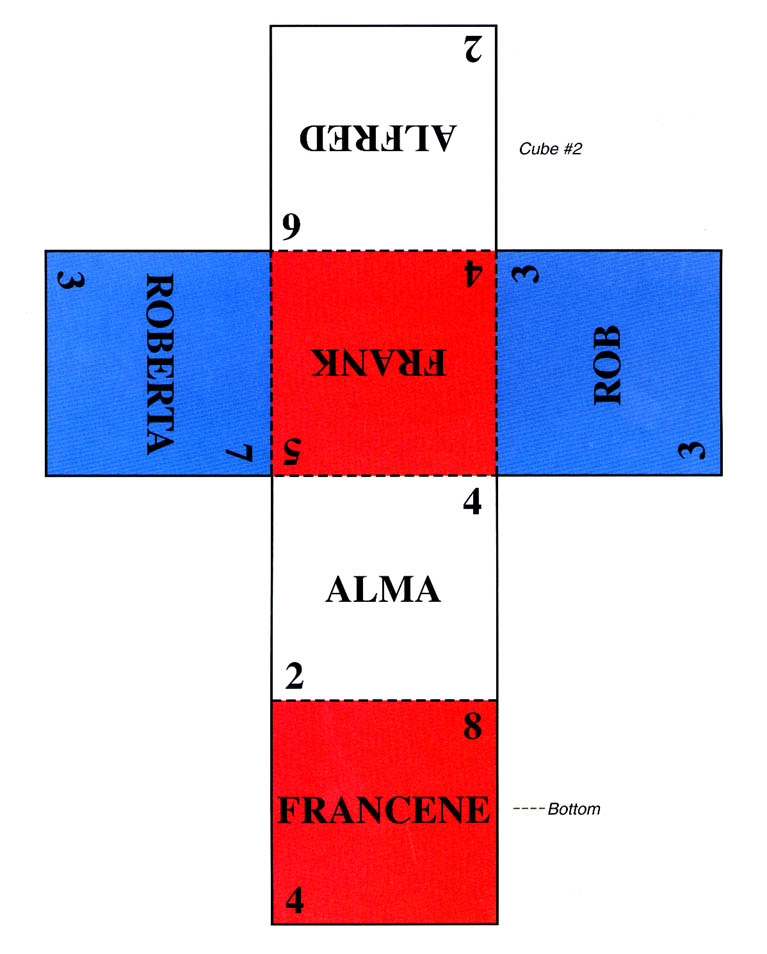
Elaborate The main purpose of the second cube is to extend the concepts and skills introduced in the earlier activities and to introduce the role of prediction, experiment, and the use of technology in scientific inquiry. The problem is the same as the first cube: What is on the bottom of the cube? Divide the class into groups of three and instruct them to make observations and propose an answer about the bottom of the cube. Student groups should record their factual statements about the second cube. Let students identify and organize their observations. If the students are becoming too frustrated, provide helpful suggestions. Essential data from the cube include the following (see black-line master):
-
Names and numbers are in black.
-
Exposed sides have either a male or female name.
-
Opposing sides have a male name on one side and a female name on the other.
-
Names on opposite sides begin with the same letters.
-
The number in the upper-right corner of each side corresponds to the number of letters in the name on that side.
-
The number in the lower-left corner of each side corresponds to the number of the first letter that the names on opposite sides have in common.
-
The number of letters in the names on the five exposed sides progresses from three (Rob) to seven (Roberta).
Four names, all female, could be on the bottom of the cube: Fran, Frances, Francene, and Francine. Because there are no data to show the exact name, groups might have different hypotheses. Tell the student groups that scientists use patterns in data to make predictions and then design an experiment to assess the accuracy of their prediction. This process also produces new data.
Tell groups to use their observations (the data) to make a prediction of the number in the upper-right corner of the bottom. The predictions will most likely be 4, 7, or 8. Have the team decide which corner of the bottom they wish to inspect and why they wish to inspect it. The students might find it difficult to determine which corner they should inspect. Let them struggle with this and even make a mistake—this is part of science! Have one student obtain a utensil, such as a tweezers, probe, or tongue depressor, and a mirror. The student may lift the designated corner less than one inch and use the mirror to look under the corner. This simulates the use of technology in a scientific investigation. The groups should describe the data they gained by the "experiment." Note that the students used technology to expand their observations and understanding about the cube, even if they did not identify the corner that revealed the most productive evidence.
If students observe the corner with the most productive information, they will discover an 8 on the bottom. This observation will confirm or refute the students' working hypotheses. Francine or Francene are the two possible names on the bottom. The students propose their answer to the question and design another experiment to answer the question. Put the cube away without revealing the bottom. Have each of the student groups present brief reports on their investigation.
Evaluate The final cube is an evaluation. There are two parts to the evaluation. First, in groups of three, students must create a cube that will be used as the evaluation exercise for other groups. After a class period to develop a cube, the student groups should exchange cubes. The groups should address the same question: What is on the bottom of the cube? They should follow the same rules—for example, they cannot pick up the cube. The groups should prepare a written report on the cube developed by their peers. (You may have the students present oral reports using the same format.) The report should include the following:
-
title,
-
the question they pursued,
-
observation—data,
-
experiment—new data,
-
proposed answer and supporting data,
-
a diagram of the bottom of the cube, and
-
suggested additional experiments.
Due to the multiple sources of data (information), this cube may be difficult for students. It may take more than one class period, and you may have to provide resources or help with some information.
Remember that this activity is an evaluation. You may give some helpful hints, especially for information, but since the evaluation is for inquiry and the nature of science you should limit the information you provide on those topics.
Student groups should complete and hand in their reports. If student groups cannot agree, you may wish to make provisions for individual or "minority reports." You may wish to have groups present oral reports (a scientific conference). You have two opportunities to evaluate students on this activity: you can evaluate their understanding of inquiry and the nature of science as they design a cube, and you can assess their abilities and understandings as they figure out the unknown cube.
Activity 2
The Formulation of Explanations: An Invitation to Inquiry on Natural Selection
This activity uses the concept of natural selection to introduce the idea of formulating and testing scientific hypotheses. Through a focused discussion approach, the teacher provides information and allows students time to think, interact with peers, and propose explanations for observations described by the teacher. The teacher then provides more information, and the students continue their discussion based on the new information. This activity will help students in grades 5 through 8 develop several abilities related to scientific inquiry and formulate understandings about the nature of science as presented in the National Science Education Standards. This activity is adapted with permission from BSCS: Biology Teachers' Handbook.3
Standards-Based Outcomes
This activity provides all students with opportunities to develop the abilities of scientific inquiry as described in the National Science Education Standards. Specifically, it enables them to:
-
identify questions that can be answered through scientific investigations,
-
design and conduct a scientific investigation,
-
use appropriate tools and techniques to gather, analyze, and interpret data,
-
develop descriptions, explanations, predictions, and models using evidence,
-
think critically and logically to make relationships between evidence and explanations,
-
recognize and analyze alternative explanations and predictions, and
-
communicate scientific procedures and explanations.
This activity also provides all students opportunities to develop understandings about inquiry, the nature of science, and biological evolution as described in the National Science Education Standards. Specifically, it conveys the following concepts:
-
Different kinds of questions suggest different kinds of scientific investigations.
-
Current scientific knowledge and understanding guide scientific investigations.
-
Technology used to gather data enhances accuracy and allows scientists to analyze and quantify results of investigations.
-
Scientific explanations emphasize evidence, have logically consistent arguments, and use scientific principles, models, and theories.
-
Species evolve over time. Evolution is the consequence of the interactions of (1) the potential for a species to increase its numbers, (2) the genetic variability of offspring due to mutation and recombination of genes, (3) a finite supply of the resources required for life, and (4) the ensuing selection of those offspring better able to survive and leave offspring in a particular environment.
Science Background for Teachers
Many biological theories can be thought of as developing in five interrelated and overlapping stages. The first is a period of extensive observation of nature or analyzing the results of experiments. Darwin's observations would be an example of the former. Second, these observations lead scientists to ponder questions of ''how" and "why." In the course of answering these questions, scientists infer explanations or make conjectures as working hypotheses. Third, in most cases, scientists submit hypotheses to formal, rigorous tests to check the validity of the hypotheses. At this point the hypotheses can be confirmed, falsified and rejected (not supported with evidence), or modified based on the evidence. This is a stage of experimentation. Fourth, scientists propose formal explanations by making public presentations at professional meetings or publishing their results in peer-reviewed journals. Finally, adoption of an explanation is recognized by other scientists as they begin referring to and using the explanation in their research and publications.
This activity focuses on the second and third stages in this brief summary of the development of biological theories. Chapters 2 and 3 of this document provide further discussion of these points. Review the "History and Nature of Science" and "Science as Inquiry" sections of the National Science Education Standards for further background on scientific investigations.
Materials and Equipment
None required.
Instructional Strategy
Engage Have the students work in groups of two or three. Begin by engaging the students with the problem and the basic information they will need to formulate a hypothesis.
TO THE STUDENTS: A farmer was working with dairy cattle at an agricultural experiment station. The population of flies in the barn where the cattle lived was so large that the animals' health was affected. So the farmer sprayed the barn and the cattle with a solution of insecticide A. The insecticide killed nearly all the flies.
Sometimes later, however, the number of flies was again large. The farmer again sprayed with the insecticide. The result was similar to that of the first spraying. Most, but not all, of the flies were killed.
Again within a short time the population of flies increased, and they were again sprayed with the insecticide. This sequence of events was repeated five times; then it became apparent that insecticide A was becoming less and less effective in killing the flies.
Explore Imagine that the farmer consulted a group of student researchers. Have the student groups discuss the problem and prepare several different hypotheses to account for the observations. They should share their results with the class. Students might propose explanations similar to the following:
-
Decomposition of insecticide A with age.
-
The insecticide is effective only under certain environmental conditions—for example, certain temperatures and levels of humidity—which changed in the course of the work.
-
The flies genetically most susceptible to the insecticide were selectively killed. (This item should not be elicited at this point or developed if suggested.)
TO THE STUDENTS: One farmer noted that one large batch of the insecticide solution had been made and used in all the sprayings. Therefore, he suggested the possibility that the insecticide solution decomposed with age.
Have the student groups suggest at least two different approaches to test this hypothesis. The students may propose that investigation of several different predictions of a hypothesis contributes to the reliability of the conclusions drawn. In the present instance, one approach would be to use sprays of different ages on different populations of flies. A quite different approach would consist simply of making a chemical analysis of fresh and old solutions to determine if changes had occurred.
TO THE STUDENTS: The student researchers made a fresh batch of insecticide A. They used it instead of the old batch on the renewed fly population at the farmer's barn. Nevertheless, despite the freshness of the solution, only a few of the flies died.
The same batch of the insecticide was then tried on a fly population at another barn several miles away. In this case, the results were like those originally seen at the experiment station—that is, most of the flies were killed. Here were two quite different results with a fresh batch of insecticide. Moreover, the weather conditions at the time of the effective spraying of the distant barn were the same as when the spray was used without success at the experiment station.
Stop and have the student groups analyze the observations and list the major components of the problem and subsequent hypotheses. They might list what they know, what they propose as explanations, and what they could do to test their explanations. Students might identify the following:
-
Something about the insecticide.
-
The conditions under which the insecticide was used.
-
The way in which the insecticide was used.
-
The organisms on which the insecticide was used.
TO THE STUDENTS: So far our hypotheses have had to do with just a few of these components. Which ones?
The hypotheses so far have concerned only "something about the insecticide" and "the condition under which the insecticide was used," items 1 and 2 above.
TO THE STUDENTS: The advantage of analyzing a problem, as we have done in our list, consists in the fact that it lets us see what possibilities we have not considered.
What possibilities in the list have we not considered in forming our hypotheses?
Item 3, "the way in which the insecticide was used," may be pursued as a further exercise if the teacher so wishes. However, emphasis should be placed on Item 4, "the organisms on which the insecticide was used." This item is developed next.
Explain TO THE STUDENTS: Let us see if we can investigate the interactions between insecticide A and the flies. From your knowledge of biology, think of something that might have happened within the fly population that would account for the decreasing effectiveness of insecticide A.
The students may need help here, even if they have learned something about evolution and natural selection. Here is one way to help:
Ask the students to remember that after the first spraying, most, but not all, of the flies were killed. Ask them where the new population of flies came from—that is, who were the parents of the next generation of flies? Were the parents among the flies more susceptible or more resistant to the effects of insecticide A? Then remind them that the barn was sprayed again. If there are differences in the population to insecticide A susceptibility, which individuals would be more likely to survive this spraying? Remind them that dead flies do not produce offspring—only living ones can. The students might thus be led to see that natural selection, in this case in an imposed environment (the presence of the insecticide), might have resulted in the survival of only those individuals that were best adapted to live in the new environment (one with the insecticide). Because this activity centers on the formulation of explanations, it is important to introduce students to the scientific process they have been using. Following is a discussion from the National Science Education Standards that can serve as the basis for the explanation phase of the activity.
|
Evidence, Models, and Explanation4 Evidence consists of observations and data on which to base scientific explanations. Using evidence to understand interactions allows individuals to predict changes in natural and designed systems. Models are tentative schemes or structures that correspond to real objects, events, or classes of events, and that have explanatory power. Models help scientists and engineers understand how things work. Models take many forms, including physical objects, plans, mental constructs, mathematical equations, and computer simulations. Scientific explanations incorporate existing scientific knowledge and new evidence from observations, experiments, or models into internally consistent, logical statements. Different terms, such as "hypothesis," "model," "law," "principle," ''theory," and "paradigm," are used to describe various types of scientific explanations. As students develop and as they understand more science concepts and processes, their explanations should become more sophisticated. That is, their scientific explanations should more frequently include a rich scientific knowledge base, evidence of logic, higher levels of analysis, greater tolerance of criticism and uncertainty, and a clearer demonstration of the relationship between logic, evidence, and current knowledge. |
Elaborate Give the students a new problem—for example one of the investigations from The Beak of the Finch5 or Darwin's Dreampond.6 Have them
work in groups to propose an explanation. The students should emphasize the role of hypotheses in the development of scientific explanations.
Evaluate Have the students consider the following case. Suppose a group of farmers notices the gradual acquisition of resistance to insecticide A over a period of months. They locate two other equally powerful although chemically unrelated insecticides, insecticides B and C. The local Agriculture Department sets up a program whereby all the farmers in the state will use only insecticide A for the current year. No one is to use insecticides B or C. The following year, everyone is directed to use insecticide B rather than insecticide A. The fly population, which had become resistant to insecticide A, is now susceptible to insecticide B and can be kept under control much more thoroughly than if the farmers had continued using insecticide A. At the beginning of the third year, all of the farmers begin using insecticide C, which again reduces the fly population greatly. As the fourth year begins, insecticide A is again used, and it proves to once again be extremely effective against the flies.
Have students analyze this situation and propose an explanation of what has happened. How would they design an investigation to support or reject their hypothesis?
Activity 3
Investigating Natural Selection
In this activity, the students experience one mechanism for evolution through a simulation that models the principles of natural selection and helps answer the question: How might biological change have occurred and been reinforced over time? The activity is designed for grades 9 through 12 and requires three class periods. This activity is adapted with permission from BSCS Biology: A Human Approach.7
Standards-Based Outcomes
This activity provides all students opportunities to develop understandings of biological evolution as described in the National Science Education Standards. Specifically, it conveys the concepts that:
-
Species evolve over time. Evolution is the consequence of the interaction of (1) the potential for a species to increase in number, (2) the genetic variability of offspring due to mutation and recombination of genes, (3) a finite supply of the resources required for life, and (4) the ensuing selection of those offspring better able to survive and leave offspring in a particular environment. Item 4 is the primary emphasis of this activity. Teachers can introduce the other factors as appropriate.
-
Natural selection and its evolutionary consequences provide a scientific explanation for the fossil record of ancient life forms, as well as for the striking molecular similarities observed among the diverse species of living organisms.
-
Some living organisms have the capacity to produce populations of almost infinite size, but environments and resources are finite. The fundamental tension has profound effects on the interactions among organisms.
Science Background for Teachers
Many students have difficulty with the fundamental concepts of evolution. For example, some students express misconceptions about natural selection because they do not understand the relationship between variations within a population and the potential effect of those variations as the population continues to grow in numbers in an environment with limited resources. This is a dynamic understanding that derives from the four ideas presented in the learning outcomes for this activity.
This activity emphasizes natural selection. In particular, it presents students with the predatorprey relationship as one example of how natural selection operates in nature.
Students should understand that the process of evolution has two steps, referred to as genetic variation and natural selection. The first step is the development of genetic variation through changes such as genetic recombination, gene flow, and mutations. The second step, and the point of this activity, is selection. Differential survival and reproduction of organisms is due to a variety of environmental factors such as predator-prey relationships, resource shortages, and change of habitat. In any generation only a small percentage of organisms survives. Survival depends on an organism's genetic constitution that will, given circumstances such as limited resources, give a greater probability of survival and reproduction.8
Materials and Preparation (per class of 32)
8 petri dish halves
8 36- x 44-in. pieces of fabric, 4 each of 2 different patterns
8 sheets of graph paper
8 zip-type plastic sandwich bags containing 120 paper dots, 20 each of 6 colors (labeled "Beginning Population")
8 sets of colored pencils with colors similar to the paper dot colors
8 zip-type plastic sandwich bags of spare paper dots in all colors
watch or clock with a second hand
computer with spreadsheet software program (optional)
24 forceps (optional)
Choose fabric patterns that simulate natural environments, such as floral, leaf, or fruit prints. The patterns should have several colors and be of intricate design; small prints work better than large blocky prints. Select two designs, each with a different predominant color. Label one design Fabric A and the other Fabric B. The use of two designs enables the students to demonstrate the evolution of different color types from the same starting population.
Use a paper punch to punch out quarter-inch paper dots from construction paper of six different colors. Select two light colors (including white) and two dark colors so that they will compete against each other. Include at least two colors that blend well with the fabrics. For each color, put 100 dots into each of 8 zip-type plastic sandwich bags. Put 20 dots of each color (for a total of 120 dots of 6 colors) into each of 24 additional bags. Label these bags "Beginning Population." Enlist student aides or ask for student volunteers to punch dots or stuff bags at home or after school. As an alternative to paper dots, you might try colored aquarium gravel or colored rice. Both are heavier than paper dots and are less likely to blow around the room. You could color the rice grains with food dyes according to the criteria specified above for the dots. You also might use gift-wrapping paper instead of the pieces of fabric.
Instructional Strategy
Engage Begin by asking students what they know about the theory of natural selection. Ask them what predator-prey relationships have to do with biological evolution. Use the discussion as a means to have them explain how they think evolution occurs and the role of predator-prey relations in the process. At this point in the lesson, accept the variety of student responses, and determine any misconceptions the students express. You could present a historical example (see the discussion of fossils in chapter 3 of this volume) or an example from The Beak of the Finch by Jonathan Weiner or Darwin's Dreampond by Tijs Goldschmidt.
Because the instructional procedures are complex for this activity, you will have to be fairly explicit about the process. Tell the students they will work in teams of four. (If your class does not divide evenly, use teams of five). The activity calls for half of the teams to use Fabric A and half of the teams to use Fabric B. It will help if you go through a "trial run" before students begin the activity.
Explore Step 1. Tell the students to pick a "game warden" from each group of four. The other group members will be the predators.
Step 2. Examine the paper dots in the bags labeled "starting Population" and record the number of individuals (dots) of each color. All of the dots represent individuals of a particular species, and the individuals can be one of six colors.
Step 3. Make certain that half of the teams use Fabric A and half use Fabric B. The procedures remain the same for both groups.
Steps 4 and 5. Tell the predators to turn away from the habitats. The game warden then spreads one of the bags of "Beginning Population" across the fabric and tells the predators to turn around and gather prey—i.e., the dots. The predators must stop hunting (picking up dots) when the game warden says "Stop" in 20 seconds. If the predators have difficulty picking up the paper dots, provide forceps.
Step 6. After the hunting is stopped, the students should carefully collect all of the dots that remain on the fabric and sort them by color. The game wardens are responsible for recording these data on the graph paper using the colored pencils corresponding to the dot colors.
Step 7. To simulate reproduction among the paper dots, add three paper dots for each remaining dot of that color. These paper dots, obtained from the bags containing extra dots, represent offspring.
Step 8. Repeat the predation using the second generation of dots. Again record the number of remaining dots in the second generation.
Step 9. Explain to the students that they do not have to simulate reproduction as they did before, but rather should calculate the number of individuals that would be in the third-generation beginning population.
Step 10. The construction and analysis of bar graphs is a critical and time-consuming part of this activity. Place the color of survivors on the horizontal axis and the number of the beginning population (or second generation) on the vertical axis of this activity. If you have ready access to computers and spreadsheet programs, you could incorporate the use of spreadsheets during this step.
Explain Step 11. Study the bar graphs of each generation. Discuss the following questions (possible student responses are included).
-
Which, if any, colors of paper dots survived better than others in the second- and third-generation beginning populations of paper dots?
Answers will vary depending on the color of the fabric that the students used. The beginning populations for the second and third generations should include more dots that are of colors similar to the fabric and fewer dots that are of colors that stand out against the fabric. The change between the first and third generations should be more dramatic than the change between the first and second generations.
-
What might be the reason that predators did not select these colors as much as they did other colors?
Some colors were better camouflaged than others—they blended into the environment.
-
What effect did capturing a particular color dot have on the numbers of that color in the following generations?
When an individual is removed from a population and dies, in this case through predation, that individual no longer reproduces. The students should realize that heavy predation leads to a decrease in the size of the population and in the size of the gene pool.
Step 12. Allow the students enough time to resort the colored dots into the appropriate bags. Be sure the students recount the dots in each bag and replace missing dots. Have a three-hole punch and construction paper on hand to replace lost dots.
Elaborate This portion of the activity provides you with an opportunity to assess the learners' understanding of evolution and the mechanisms by which it occurs. Before the students begin to work on these tasks, display a piece of Fabric A and a piece of Fabric B and ask the learners to post their third generation bar graphs beside the fabric that they used. The learners now will benefit by comparing their results with those from other teams that used the same fabric as well as with those from teams that used a different fabric. These comparisons will give them more data with which to construct explanations for the results that they see.
-
How well do the class data support your team's conclusions in Step 11?
Students need to be able to analyze the relationship between their response in Step 11 and the cumulative data. The specific response should address the relationship between the team data and the class data.
-
Imagine a real-life predator-prey relationship and write a paragraph that describes how one or more characteristics of the predator population or the prey population might change as a result of natural selection.
The students should explain that variation exists in populations. Individuals with certain characteristics are better adapted than other individuals to their environment, and consequently survive to produce offspring; less well-adapted individuals do not. The offspring, in turn, possess characteristics similar to those of their parents, and that makes them better adapted to the environment as well. These two concepts are the basis of natural selection, and they explain how populations evolve.
Little variation in a population of organisms would mean that fewer differences would be expressed in the offspring. Fewer differences would mean that individuals would have similar advantages and disadvantages in the prevailing environmental conditions. This similarity, in turn, would mean that their survival and reproductive rates would be similar, so few heritable differences then would be passed on to the next generation.
Evaluate Have the students write one paragraph that summarizes their understanding of biological evolution. Refer to the learning outcomes and the National Science Education Standards. Expect that students will describe that in a population of organisms, variation exists among characteristics that parents pass on to their offspring. Individuals with certain characteristics might have a slight advantage over other individuals and thus live longer and reproduce more. If this advantage remains, the difference would be more noticeable over time. These changes could eventually lead to new species. The process of natural selection, then, provides an explanation for the relatedness of organisms and for biological change across time.
Activity 4
Investigating Common Descent: Formulating Explanations And Models
In this activity, students formulate explanations and models that simulate structural and biochemical data as they investigate the misconception that humans evolved from apes. The activities require two 45-minute periods. They are designed for use in grades 9 through 12. This activity is adapted with permission from Evolution: Inquiries into Biology and Earth Science by BSCS.9
Standards-Based Outcomes
This activity provides opportunities for all students to develop abilities of scientific inquiry as described in the National Science Education Standards. Specifically, it enables them to:
-
formulate descriptions, explanations, predictions, and models using evidence,
-
think critically and logically to make relationships between evidence and explanations, and
-
recognize and analyze alternative explanations and predictions.
In addition, the activity provides all students opportunities to develop fundamental understandings in the life sciences as described in the National Science Education Standards. Specifically, it conveys the following concepts:
-
In all organisms, the instructions for specifying the characteristics of the organism are carried in DNA, a large polymer formed from subunits of four kinds (A, G, C, and T). The chemical and structural properties of DNA explain how the genetic information that underlies heredity is both encoded in genes (as a string of molecular "letters") and replicated (by a templating mechanism).
-
The millions of different species of plants, animals, and microorganisms that live on earth today are related by descent from common ancestors.
-
Biological classifications are based on how organisms are related. Organisms are classified into a hierarchy of groups and subgroups based on similarities that reflect their evolutionary relationships. The species is the most fundamental unit of classification.
Science Background For Teachers
One of the most common misconceptions about evolution is seen in the statement that "humans came from apes." This statement assumes that organisms evolve through a step-by-step progression from "lower" forms to "higher" forms of life and the direct transformation of one living species into another. Evolution, however, is not a progressive ladder. Furthermore, modern species are derived from, but are not the same as, organisms that lived in the past.
This activity has extensive historical roots. Few question the idea that Charles Darwin's Origin of Species in 1859 produced a scientific revolution. In essence, Darwin proposed a constellation of ideas that included: organisms of different kinds descended from a common ancestor (common descent); species multiply over time (speciation); evolution occurs through gradual changes in a population (gradualism); and competition among species for limited resources leads to differential survival and reproduction (natural selection). This activity centers on the theory of common descent.
The theory of common descent was revolutionary because it introduced the concept of gradual evolution based on natural mechanisms. The theory of common descent also replaced a model of straight-line evolution with that of a branching model based on a single origin of life and subsequent series of changes—branching—into different species.
Based on his observations during the voyage of the H.M.S. Beagle, Darwin concluded that three species of mockingbirds on the Galapagos Islands must have some connection to the single species of mockingbird on the South American mainland. Here is the intellectual connection between observations and explanation. A species could produce
multiple descendent species. Once this idea was realized, it was but a series of logical steps to the inferences that all birds, all vertebrates, and so on, had common ancestors.
Common descent has become a conceptual backbone for evolutionary biology. In large measure, this is so because common descent has significant explanatory power. Immediately, the idea found supporting evidence in comparative anatomy, comparative embryology, systematics, and biogeography. Recently, molecular biology has provided further support, as the students will discover in this activity. See Chapter 3 of this document and page 185 of the National Science Education Standards for more discussion of this topic.
This activity also introduces students to scientific evidence, models, and explanations as described in the accompanying excerpt drawn from the National Science Education Standards.
|
Evidence, Models, And Explanation10 Evidence consists of observations and data on which to base scientific explanations. Using evidence to understand interactions allows individuals to predict changes in natural and designed systems. Models are tentative schemes or structures that correspond to real objects, events, or classes of events, and that have explanatory power. Models help scientists and engineers understand how things work. Models take many forms, including physical objects, plans, mental constructs, mathematical equations, and computer simulations. Scientific explanations incorporate existing scientific knowledge and new evidence from observations, experiments, or models into internally consistent, logical statements. Different terms, such as "hypothesis," "model," "law," "principle," "theory,'' and "paradigm," are used to describe various types of scientific explanations. As students develop and as they understand more science concepts and processes, their explanations should become more sophisticated. That is, their scientific explanations should more frequently include a rich scientific knowledge base, evidence of logic, higher levels of analysis, greater tolerance of criticism and uncertainty, and a clearer demonstration of the relationship between logic, evidence, and current knowledge |
Materials And Equipment
For each student:
-
Notebook
-
Pencil
For each group of four students
-
4 sets of black, white, green, and red paper clips, each set with 35 paper clips
For the entire class:
-
Overhead transparencies of Characteristics of Apes and Humans, Table 1, and Morphological Tree, Figure 1
-
Overhead projector
Instructional Strategy: Part I
Engage Ask the students: When you hear the word "evolution," what do you think of first? Have the students explain what they understand about evolution. For many people, the first thing that comes to mind is often the statement "Humans evolved from apes." Did humans evolve from modern apes, or do modern apes and humans have a common ancestor? Do you understand the difference between these two questions? This activity will give you the opportunity to observe differences and similarities in the characteristics of humans and apes. The apes discussed in this activity are the chimpanzee and the gorilla.
Explore Review Table 1, Characteristics of Apes and Humans, with the class. Make sure the students know that gibbons, chimpanzees, gorillas, and orangutans are four groups included in the ape family. Chimpanzees and gorillas represent the African side of the family; gibbons and orangutans represent the Asian side of the family. We focus only on the chimpanzee and gorilla in this activity. The only modern representative of the human family is Homo sapiens, although paleontologists have
Table 1. Characteristics of Apes and Humans
|
Characteristics |
Apes |
Humans |
|
Posture |
Bent over or quadrupedal "knuckle-walking" common |
Upright or bipedal |
|
Leg and arm length |
Arms longer than legs; arms adapted for swinging, usually among trees |
Legs usually longer than arms; legs adapted for striding |
|
Feet |
Low arches; opposable big toes, capable of grasping |
High arches; big toes in line with other toes; adapted for walking |
|
Teeth |
Prominent teeth; large gaps between canines and nearby teeth |
Reduced teeth; gaps reduced or absent |
|
Skull |
Bent forward from spinal column; rugged surface; prominent brow ridges |
Held upright on spinal column; smooth surface |
|
Face |
Sloping; jaws jut out; wide nasal opening |
Vertical profile; distinct chin; narrow nasal opening |
|
Brain size |
280 to 705 cm3 (living species) |
400 to 2000 cm3 (fossil to present) |
|
Age at puberty |
Usually 10 to 13 years |
Usually 13 years or older |
|
Breeding season |
Estrus at various times |
Continual |
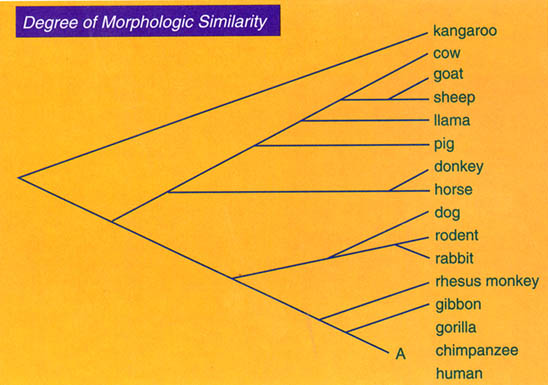
Figure 1. Evolutionary relationships among organisms derived from comparisons of skeletons and other characteristics
found fossil remains of other members, such as Australopithecus afarensis ("Lucy") and Homo sapiens neandertalensis.
Next discuss how the students can use the data to determine the relationships between humans, apes, and other animals. It might not be obvious that closely related organisms share more similarities than do distantly related organisms. Guide the students to the idea that structures might be similar because they carry out the same functions or because they were inherited from a common ancestor. Only those similarities that arise from a common ancestor can be used to determine evolutionary relationships.
Use the transparency of the Morphological Tree, Figure 1, for this discussion. Diagrams called branching trees illustrate relationships among organisms. One type of branching tree, called a morphological tree, is based on comparisons of skulls, jaws, skeletons, and other structures. Look carefully at the morphological tree.
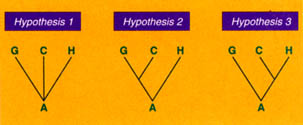
Explain Ask the students to find the part of the morphological tree that shows the relationships between gorillas, chimpanzees, and humans. They will notice that there are no lines showing relationships. They should work with partners and develop three hypotheses to explain how these organisms are related. On a sheet of notebook paper, they should make a diagram of their hypotheses by drawing lines from Point A to each of the three organisms (G = gorilla, C = chimpanzee, H = human, A = common ancestor).
Allow the students to develop their own hypotheses. Give them help only if you see they are not making any progress. Three hypotheses the students might propose are shown below (although not necessarily in the same order).
Possible evolutionary relationships:
Instructional Strategy: Part II
Elaborate Modern research techniques allow biologists to compare the DNA that codes for certain proteins and to make predictions about the relatedness of the organisms from which they took the DNA. Students will use models of these techniques to test their hypotheses and determine which one is best supported by the data they develop.
Procedure Step 1. Working in groups of four, "synthesize" strands of DNA according to the following specifications. Each different color of paper clip represents one of the four bases of DNA:
|
black = adenine (A) |
green = guanine (G) |
|
white = thymine (T) |
red = cytosine (C) |
Students should synthesize DNA strands by connecting paper clips in the proper sequence according to specifications listed for each group member. When they have completed the synthesis, attach a label to Position 1 and lay your strands on the table with Position 1 on the left.
Each student will synthesize one strand of DNA. Thirty-five paper clips of each color should provide an ample assortment. To save time, make sure all strands are synthesized simultaneously. Emphasize to the students that they are using models to test the hypotheses they developed in the first part of the investigation. Following are directions for the respective groups:
-
Group member 1
Synthesize a strand of DNA that has the following sequence:

Label this strand "human DNA." This strand represents a small section of the gene that codes for human hemoglobin protein.
-
Group member 2
Synthesize a strand of DNA that has the following sequence:

Label this strand "chimpanzee DNA." This strand represents a small section of the gene that codes for chimpanzee hemoglobin protein.
-
Group member 3
Synthesize a strand of DNA that has the following sequence:
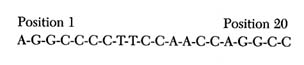
Label this strand "gorilla DNA." This strand represents a small section of the gene that codes for gorilla hemoglobin protein.
-
Group member 4
Synthesize a strand of DNA that has the following sequence:
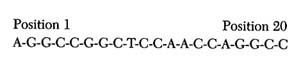
Label this strand "common ancestor DNA." This DNA strand represents a small section of the gene that codes for the hemoglobin protein of a common ancestor of the gorilla, chimpanzee, and human.
Hybridization data for human DNA
|
Human DNA compared to: |
Number of matches |
Unmatched bases |
|
Chimpanzee DNA |
|
|
|
Gorilla DNA |
|
|
|
Data for common ancestor DNA |
||
|
Common ancestor DNA compared to: |
Number of matches |
Unmatched bases |
|
Human DNA |
|
|
|
Chimpanzee DNA |
|
|
|
Gorilla DNA |
|
|
(You will use this strand in Part III.) Emphasize to students that they will be using a model constructed from hypothetical data in the case of the common ancestor, since no such DNA yet exists, but that the other three sequences are real.
Step 2. Students should compare the human DNA to the chimpanzee DNA by matching the strands base by base (paper clip by paper clip).
Step 3. Students should count the number of bases that are not the same. Record the data in a table. Repeat these steps with the human DNA and the gorilla DNA.
The data for the hybridizations are as follows: chimpanzee DNA, 5 unmatched bases; gorilla DNA, 10 unmatched bases. Be sure to ask the students to save all of their DNA strands for Part III.
Evaluate
-
How do the gorilla DNA and the chimpanzee DNA compare with the human DNA?
The human DNA is more similar to the chimpanzee DNA than the gorilla DNA.
-
What do these data suggest about the relationship between humans, gorillas, and chimpanzees?
The data suggest that humans are more closely related to the chimpanzee than they are to the gorilla.
-
Do the data support any of your hypotheses? Why or why not?
-
The data lend support to the hypothesis that the chimpanzee is more closely related to humans than the gorilla is.
-
What kinds of data might provide additional support for your hypotheses?
The students could test the hypotheses using additional data from DNA sequences or morphological features. They also could gather data from the fossil record.
Instructional Strategy: Part III
Begin this part by pointing out that biologists have determined that some mutations in DNA occur at a regular rate. They can use this rate as a "molecular clock" to predict when two organisms began to separate from a common ancestor. Most evolutionary biologists agree that humans, gorillas, and chimpanzees shared a common ancestor at one point in their evolutionary history. They disagree, however, on the specific relationships among these three species. In this part of the activity, you will use data from your paper-clip model to evaluate different hypotheses about the relationships between humans, gorillas, and chimpanzees.
Evolutionary biologists often disagree about the tempo of evolutionary change and about the exact nature of speciation and divergence. Reinforce the idea that models can be useful tools for testing hypotheses.
Procedure Step 1. Assume that the common ancestor DNA synthesized in Part II represents a section of the hemoglobin gene of a hypothetical common ancestor. Compare this common ancestor DNA to all three samples of DNA (gorilla, human, and chimpanzee), one sample at a time. Record the data in a table.
The data for the comparisons are as follows: human DNA, 10 unmatched bases; chimpanzee DNA, 8 unmatched bases; gorilla DNA, 3 unmatched bases.
Evaluate
-
Which DNA is most similar to the common-ancestor DNA?
Gorilla DNA is most similar to the common-ancestor DNA.
-
Which two DNAs were most similar in the way that they compared to the common-ancestor DNA?
Human DNA and chimpanzee DNA have similar patterns when compared to the common ancestor DNA.
-
Which of the hypotheses developed in Part I do your data best support?
Answers will vary.
-
Do your findings prove that this hypothesis is correct? Why or why not?
Data from the models do not prove the validity of a hypothesis, but they do provide some direction for additional research.
-
Based on the hypothesis that your data best supported, which of the following statements is most accurate? Explain your answer in a short paragraph.
-
Humans and apes have a common ancestor.
-
Humans evolved from apes.
-
-
The students should infer that humans and apes share a common ancestor, represented by a common branching point.
-
According to all the data collected, which of the following statements is most accurate? Explain your answer in a short paragraph.
-
Chimpanzees and humans have a common ancestor.
-
Chimpanzees are the direct ancestors of humans.
-
-
The students should infer that chimpanzees and humans share a common ancestor and that modern chimpanzees are not the direct ancestors of humans.
-
A comparison of many more DNA sequences indicates that human DNA and chimpanzee DNA are 98.8 percent identical. What parts of your data support this result?
The morphological tree and the DNA comparison data indicate that humans are closely related to chimpanzees.
-
What methods of science did you use in this activity?
Many answers are possible, including making observations, forming and testing hypotheses, and modeling.
Activity 5
Proposing Explanations for Fossil Footprints
In this activity, students observe and interpret "fossil footprint" evidence. From the evidence, they are asked to construct defensible hypotheses or explanations for events that took place in the geological past. The estimated time requirement for this activity is two class periods. This activity is designed for grades 5 through 8. The activity is adapted with permission from the Earth Science Curriculum Project.11
Standards-Based Outcomes
This activity provides all students an opportunity to develop the abilities of scientific inquiry and understanding of the nature of science as described in the National Science Education Standards. Specifically, it enables them to:
-
propose explanations and make predictions based on evidence,
-
recognize and analyze alternative explanations and predictions,
-
understand that scientific explanations are subject to change as new evidence becomes available,
-
understand that scientific explanations must meet certain criteria. First and foremost, they must be consistent with experimental and observational evidence about nature, and must make accurate predictions, when appropriate, about systems being studied. They should also be logical, respect the rules of evidence, be open to criticism, report methods and procedures, and make knowledge public. Explanations of how the natural world changes based on myths, personal beliefs, religious values, mystical inspiration, superstition, or authority may be personally useful and socially relevant, but they are not scientific.
Science Background for Teachers
This activity provides teachers with the opportunity to help students realize the differences between observations and inferences. In terms of the Standards, it centers on the development of explanations based on evidence. It encourages students to think critically about the inferences they make and about the logical relationships between cause and effect.
Observations or statements of observations should have agreement by all individuals: "These are fossil footprints," or "The dimensions of one of the footprints is 20 cm by 50 cm." Inferences are statements that propose possible explanations for observations: "The two sets of footprints represent a fight between the animals." If this is true, then what evidence could you look for to support the inference. Note that the primary emphasis for this activity is developing abilities and understandings for ''Science as Inquiry" as described in the Standards.12
Materials and Equipment
-
Make an overhead transparency of the footprint puzzle from the master provided on page 89. Have a blank piece of paper on hand to mask the puzzle when it is put on the projector.
Instructional Strategy
Engage Project position 1 of the footprints from the overhead by covering the other two positions with a blank piece of paper. Tell the students that tracks like these are common in parts of New England and in the southwestern United States. Point out to the students that they will be attempting to reconstruct happenings from the geological past by analyzing a set of fossilized tracks. Their problem is similar to that of a detective. They are to form defensible explanations of past events from limited evidence. As more evidence becomes available, their hypotheses must be modified or abandoned. The only clues are the footprints themselves. Ask the students: Can you tell anything about the size or nature of the organisms? Were all the tracks made at the same time? How many animals were involved? Can you reconstruct a series of events represented by this set of fossil tracks?
Have the students discuss each of the questions. Accept any reasonable explanations students offer. Try consistently to point out the difference between what they observe and what they infer. Ask them to suggest evidence that would support their proposed explanations.
Explore Reveal the second position of the puzzle and allow time for the students to consider the new information. Students will see that the first explanation may need to be modified and new ones added.
Next project the complete puzzle and ask students to interpret what happened. A key point for students to recognize is that any reasonable explanation must be based only on those proposed explanations that still apply when all of the puzzle is projected. Any interpretation that is consistent with all the evidence is acceptable.
Should it become necessary to challenge the students' thinking and stimulate the discussion, the following questions may help. Students should give evidence or suggest what they would look for as evidence to support their proposed explanations.
-
In what directions did the animals move?
-
Did they change their speed and direction?
-
What might have changed the footprint pattern?
-
Was the land level or irregular?
-
Was the soil moist or dry on the day these tracks were made?
-
In what kind of rock were the prints made?
-
Were the sediments coarse or fine where the tracks were made?
The environment of the track area also should be discussed. If dinosaurs made the tracks, the climate probably was warm and humid. If students propose that some sort of obstruction prevented the animals from seeing each other, this might suggest vegetation. Or perhaps the widened pace might suggest a slope. Speculate on the condition of the surface at the time the footprints were made. What conditions were necessary for their preservation?
Explain An imaginative student should be able to propose several possible explanations. One of the most common is that two animals met and fought. No real reason exists to assume that one animal attacked and ate the other. Ask students who propose this explanation to indicate the evidence. If they could visit the site, what evidence would they look for that would support their explanation. Certain lines of evidence—the quickened gaits, circular pattern, and disappearance of one set of tracks—could support the fight explanation. They might, however, support an explanation of a mother picking up her baby. The description and temperament of the animals involved are open to question. Indeed, we lack the evidence to say that the tracks were made at the same time. The intermingling shown in the middle section of the puzzle may be evidence that both tracks were made at one time, but it could be only a coincidence. Perhaps one animal passed by and left, and then the other arrived.
Discuss the expected learning outcomes related to scientific inquiry and the nature of science. To answer the questions posed by the set of fossil footprints, the students, like scientists, constructed reasonable explanations based solely on their logical interpretation of the available evidence. They recognized and analyzed alternative explanations by weighing the evidence and examining the logic to decide which explanations seemed most reasonable. Although there may have been several plausible explanations, they did not all have equal weight. In a manner similar to the way scientists work, students should be able to use scientific criteria to find, communicate, and defend the preferred explanation.
Elaborate You can have more discussions on interpreting series of events using animal prints students find outdoors and reproduce for the class. Do not forget to look for human footprints. Have students design a different fossil footprint puzzle. Choose several different ones and have student teams repeat the activity using the same learning goals.
Evaluate Describe a specific event involving two or more people or animals where footprint evidence remains. Ask the students, either in teams or individually, to diagram footprint evidence that could lead to several different, yet defensible, explanations regarding what took place. They should be able to explain the strengths and weaknesses of each explanation using their footprint puzzle.
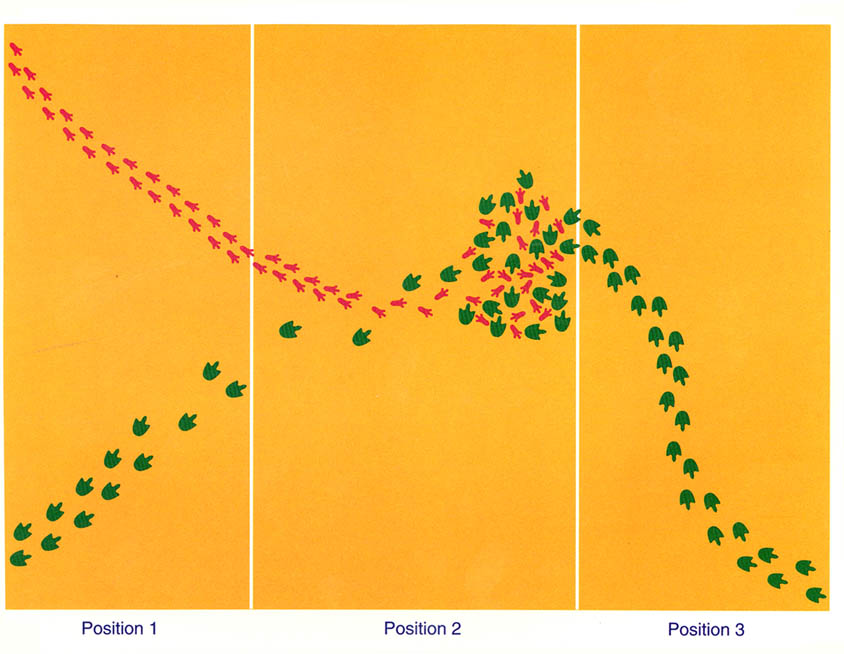
Activity 6
Understanding Earth's Changes Over Time
Comparing the magnitude of geologic time with spans of time in a person's lifetime is difficult for many students. In this activity, students use a long paper strip and a reasonable scale to represent visually all of geologic time, including significant events in the development of life on earth as well as recent human events. The investigation requires two class periods and is appropriate for grades 5 through 12. The activity is adapted with permission from the Earth Science Curriculum Project.13
Standards-Based Outcomes
This activity provides all students with an opportunity to develop understandings of the earth systems as described in the National Science Education Standards. Specifically, it introduces them to the following concepts:
-
A mathematical scale representing the length of geologic time.
-
The relationship of time between human events, events in earth's history, and the total age of the earth.
-
The formation of the sun, the earth, and the rest of the solar system from a nebular cloud of dust and gas 4.6 billion years ago.
-
The estimation of geologic time by observing rock sequences and using fossils to correlate the sequences at various locations. A current method of dating earth materials uses the known decay rates of radioactive isotopes present in rocks to measure the time since the rock was formed.
-
The ongoing evolution of the earth system resulting from interactions among the solid earth, the oceans, the atmosphere, and organisms.
-
The evidence for one-celled forms of life—the bacteria—extending back more than 3.5 billion years. The evolution of life caused dramatic changes in the composition of the earth's atmosphere, which did not originally contain oxygen.
Science Background for Teachers
Geologic time is largely subdivided on the basis of the evolution of life and on the amount and type of crustal activity that occurred in the past. Geologic time is ordered both relatively and absolutely. For relative dating the sequence in which rock strata formed is important; to explain the complete time scale for all of geologic history required correlating rock formations throughout the world. Fossils are important guides in this correlation as scientists assigned relative dates to the world's rocks according to a proposed sequence of life (fossil evidence).
Radiometric dating provides absolute ages for events in the earth's history. Radiometric dating techniques apply the decay rates of selected naturally radioactive isotopes to stable daughter isotopes to determine how long the unstable parent isotopes have been decaying. Fairly accurate dates have been determined for the events beginning in the Cambrian era; this comprises about 12 percent of the earth's history.
Materials and Equipment
The following materials will be needed by each group of two students:
-
A paper strip, such as adding machine tape or shelf paper,
-
A meter stick,
-
Masking or cellophane tape.
If students use the scale suggested—1 millimeter to 1 million years and 1 meter to 1 billion years—a paper strip 5 meters in length efficiently accommodates the 4.5-billion-year time scale. Make copies of Student Investigation Sheet A on page 91 ("Approximate Ages of Events in Years Before the Present"). Students will use this page to conduct their investigation.
Instructional Strategy
Engage Ask students how long a million years is. How would students count or measure a million of anything? Use this discussion to help students arrive at the question: How does a million years, or even the time since the last ice age, compare
|
Student Investigation Sheet A Approximate Ages of Events in Years Before the Present
Convert the following to years before the present:
|
with the age of the earth? Suppose you want to make a visual model showing a time line of the earth's history, how would you proceed?
Explore Provide students with Student Investigation Sheet A. Have them decide how to represent these events in a time-ordered sequence. Provide a roll of paper tape on which to plot the model.
Students might need help in understanding how to set up a scale that can be displayed in the classroom or adjacent hallway. A reasonable scale is 1 millimeter to 1 million years, 1 centimeter to 10 million years, and 1 meter to 1 billion years. Depending on available space, larger unit distances will be easier to work with. Regardless of the scale the students choose, the last million years will be difficult to plot. Allow students to work out a scale on their own. However, to avoid undue confusion and frustration for some, review student progress after the first few minutes and be ready to ask leading questions or make suggestions.
Allow students time to agree on a reasonable scale, mark the locations of each event on their time scale, and resolve the problem of trying to fit the events from the last 1 million years in the allotted space. When appropriate, encourage students to construct a separate, and larger, scale for marking the most recent events.
Explain Discuss the long period of time in the earth's history before evidence of simple life forms, such as algae, appear in the fossil record. Note that time spans between significant "firsts" become shorter and shorter as you move closer and closer to "today." Compare and discuss expanded scales used to show more detail in the recent past. Discuss the role of scale in helping visualize and better understand the extremely long time span of the geologic time scale and the connections to biological evolution.
Elaborate Challenge students to develop an extended time scale to mark special events in their own lifetime and that of their parents, grandparents, or another adult. Have them calculate the percentage of the earth's history for which there is evidence of life, the percentage of the earth's history for which there is fossil evidence of the first humanlike animals, or the percentage of the earth's history during which dinosaurs lived.
Evaluate Ask students to calculate the length of a paper strip necessary to represent all of geologic time when using the extended scale they used to show the most recent events. Have students write a short news article explaining their scale of geologic time and the evolutionary changes in the earth's lithosphere, atmosphere, and biosphere.
Activity 7
Proposing the Theory of Biological Evolution: Historical Perspective
This activity uses evolution to introduce students to historical perspectives and the nature of science. The teacher has students read short excerpts of original statements on evolution from Jean Lamarck, Charles Darwin, and Alfred Russel Wallace. This activity is intended as either a supplement to other investigations or as a core activity. Designed for grades 9 through 12, the activity requires a total of three class periods.
Standards-Based Outcomes
The activity provides all students with opportunities to develop understandings of the history and nature of science as described in the National Science Education Standards. Specifically, it conveys the following concepts:
-
Scientists are influenced by societal, cultural, and personal beliefs and ways of viewing the world. Science is not separate from society but rather a part of society.
-
Scientific explanations must meet certain criteria. First and foremost, they must be consistent with experimental and observational evidence about nature, and they must make accurate predictions, when appropriate, about the systems being studied. They should also be logical, respect the rules of evidence, be open to criticism, report methods and procedures, and make knowledge public. Explanations of how the natural world changes based on myths, personal beliefs, religious values, mystical inspiration, superstition, or authority may be personally useful and socially relevant, but they are not scientific.
-
Because all scientific ideas depend on experimental and observational confirmation, all scientific knowledge is in principle subject to change as new evidence becomes available. The core ideas of science, such as the conservation of energy or the laws of motion, have been subjected to a wide variety of confirmations and are therefore unlikely to change in the areas in which they have been tested. In areas where data or understanding are incomplete, such as the details of human evolution or questions surrounding global warming, new data may well lead to changes in current ideas or resolve current conflicts. In situations where information is still fragmentary, it is normal for scientific ideas to be incomplete, but this is also where the opportunity for making advances may be greatest.
-
Occasionally, there are advances in science and technology that have important and long-lasting effects on science and society.
-
The historical perspective of scientific explanations demonstrates how scientific knowledge changes by evolving over time, almost always building on earlier knowledge.
Science Background for Teachers
In historical perspective, explanations for the origin and diversity of life are not new and probably began when humans first began asking questions about the natural world. By the time of the Greeks, individuals such as Thales (624 to 548 B.C.) and Anaximander (611 to 547 B.C.) proposed explanations for life's origins and gradual changes.
In the 1800s three individuals proposed explanations for biological evolution—Jean Lamarck, Charles Darwin, and Alfred Russel Wallace. In the early years of the nineteenth century, a French biologist, Jean Lamarck (1744 to 1829), proposed a view of evolution that questioned the then popular idea that species did not change. Lamarck proposed the idea that changes do take place in animals over long periods of time, specifically through the use of organs and appendages. The popular example of Lamarck's idea is the long necks of giraffes that helped them feed higher in trees. Based on the extension and use of the neck, one generation of giraffes passed the longer neck to the next generation. (See the excerpt for this activity.)
Charles Darwin (1809 to 1882) was born in England and completed his formal education at Cambridge University. Darwin's main interests
centered on the study of nature and collecting a diversity of organisms. After graduation, Darwin's professor recommended him for the position of naturalist on H.M.S. Beagle. The voyage of the Beagle lasted five years (1831 to 1836) and provided the observations and evidence (in the form of specimens) that became the foundation for Darwin's theories. Of particular note in history is Darwin's observations on the Galapagos Islands located off the coast of Ecuador. Darwin's curiosity and insight led him to observe both similarities and differences among organisms and compare them on the mainland and the islands 600 miles offshore. Based on his observations, he wondered about the origin of different plants and animals, and the variations in species he recorded in similar organisms.
After returning to England, Darwin spent more than twenty years studying the specimens, experimenting, and reviewing the notes of his voyage. In 1858 he was surprised to find that Alfred Russel Wallace had formulated similar conclusions. In the same year, Darwin reported his and Wallace's work in a joint presentation to the Scientific Society in London. One year later, in 1859, Darwin published On the Origin of Species by Means of Natural Selection. This publication caused great debate and what is now viewed as a scientific revolution. Darwin's theories of evolution have also had considerable impact on society and our cultural views.
Alfred Russel Wallace (1823 to 1913) was also born in England. He became a teacher of English. He later developed an interest in collecting plants and insects. In 1848 he made an expedition to the Amazon River in Brazil to collect scientific materials. On a later expedition to the Malay Islands, Wallace observed some variations in organisms that engaged the same questions that Darwin posed—why did each island have different species? Wallace thought about the question for three years and in 1858 he proposed his theory.
Materials and Equipment
Excerpt from Zoological Philosophy by Jean Lamarck (provided)
Excerpt from On the Tendency of Varieties to Depart Indefinitely from the Original Type by Alfred Russel Wallace (provided)
Excerpt from On the Origin of Species by Charles Darwin (provided)
Instructional Strategy
These excerpts give the students an opportunity to read original statements by individuals who contributed to a major revolution in the history of biology. The instructional strategy is that of small-group discussions. Students read an original excerpt prior to class and discuss the reading in class.
Engage Introduce the sequence of readings by asking questions based on the learning outcomes:
-
How do you think the society in which scientists live might influence their views?
-
What makes a person's explanation scientific?
-
Can scientific explanations change? If so, how? Why? If not, why not?
-
Can you name some major theories in science? In biology?
Ask the students what they know about the theory of evolution. What do they know about Charles Darwin? When did he propose his theory? Did any other individuals propose theories about evolution? How did Darwin develop his theory of evolution? Questions such as these will set the stage for the first reading. Assign the reading by Jean Lamarck as homework.
Explore Students should work in groups of four to discuss Jean Lamarck's explanations of changes in organisms. Questions for student discussions include:
-
What is the role of the environment in Lamarck's explanation?
-
What scientific approach is suggested by Lamarck's statement: "Nothing of all this can be considered as hypothesis or private opinion; on the contrary, they are truths which, in order to be made clear, only require attention and the observation of facts."
-
Was Lamarck's explanation scientific? Why or why not?
-
Can you propose any other explanations for Lamarck's observations about the disuse and use of organs?
Explain Prior to this group discussion, assign the reading by Alfred Russel Wallace. With your guidance, this discussion should clarify for students
some of the fundamental concepts about science as a human endeavor and the nature of science. This should include discussion in groups of four followed by a full class summary of the learning outcomes.
-
How would you characterize Wallace's idea that "The life of wild animals is a struggle for existence?" How is Wallace's view scientific?
-
Wallace claims that "useful variations will tend to increase, unuseful or hurtful variations to diminish." How does this occur? What evidence does he cite?
-
How does Wallace's explanation differ from Lamarck's?
-
What do you think of Wallace's critique of Lamarck's hypotheses?
Elaborate Prior to this group discussion, assign the reading by Charles Darwin. In these discussions, students should apply concepts about the nature of science and the historical perspective developed during prior discussions. This discussion should demonstrate greater sophistication and understanding by the students.
-
What led Darwin to formulate his ideas about the origin of species?
-
On what did he base his explanations?
-
What did Darwin propose as the origin of species?
-
What was the relationship of Lamarck's and Wallace's work to Darwin's?
-
Was Darwin's explanation scientific? Why or why not?
-
How did Darwin attempt to determine how modifications of a species are accomplished?
-
How did Darwin explain the incomplete nature of his ideas?
Evaluate Have each student write a brief essay on the nature of scientific knowledge as demonstrated in the development of the theory of evolution. They should cite at least two quotes from the reading to support their discussion. The essays should incorporate the concepts of adaptation, natural selection, and descent from common ancestors.
|
Student Sheet Zoological Philosophy Jean Lamarck (1809) The environment affects the shape and organization of animals, that is to say that when the environment becomes very different, it produces in course of time corresponding modifications in the shape and organization of animals. If a new environment, which has become permanent for some race of animals, induces new habits in these animals, that is to say, leads them into new activities which become habitual, the result will be the use of some one part in preference to some other part, and in some cases the total disuse of some part no longer necessary. Nothing of all this can be considered as hypothesis or private opinion; on the contrary, they are truths which, in order to be made clear, only require attention and the observation of facts. Snakes have adopted the habit of crawling on the ground and hiding in the grass; so that their body, as a result of continually repeated efforts at elongation for the purpose of passing through narrow spaces, has acquired a considerable length, quite out of proportion to its size. Now, legs would have been quite useless to these animals and consequently unused. Long legs would have interfered with their need of crawling, and very short legs would have been incapable of moving their body, since they could only have had four. The disuse of these parts thus became permanent in the various races of these animals, and resulted in the complete disappearance of these same parts, although legs really belong to the plan or organization of the animals of this class. The frequent use of any organ, when confirmed by habit, increases the functions of that organ, leads to its development, and endows it with a size and power that it does not possess in animals which exercise it less. We have seen that the disuse of any organ modifies, reduces, and finally extinguishes it. I shall now prove that the constant use of any organ, accompanied by efforts to get the most out of it, strengthens and enlarges that organ, or creates new ones to carry on the functions that have become necessary. The bird which is drawn to the water by its need of finding there the prey on which it lives, separates the digits of its feet in trying to strike the water and move about on the surface. The skin which unites these digits at their base acquires the habit of being stretched by these continually repeated separations of the digits; thus in course of time there are formed large webs which unite the digits of ducks, geese, etc. as we actually find them. It is interesting to observe the result of habit in the peculiar shape and size of the giraffe; this animal, the largest of the mammals, is known to live in the interior of Africa in places where the soil is nearly always arid and barren, so that it is obliged to browse on the leaves of trees and to make constant efforts to reach them. From this habit long maintained in all its race, it has resulted that the animal's fore-legs have become longer than its hind legs, and that its neck is lengthened to such a degree that the giraffe, without standing up on its hind legs, attains a height of six metres (nearly twenty feet). Philosophie Zoologique. Paris. 1809. Translated by H. Elliott, Macmillan Company, London. 1914. |
|
Student Sheet On the Tendency of Varieties to Depart Indefinitely from the Original Type Alfred Russel Wallace (1858) The Struggle for Existence The life of wild animals is a struggle for existence. The full exertion of all their faculties and all their energies is required to preserve their own existence and provide for that of their infant offspring. The possibility of procuring food during the least favorable seasons and of escaping the attacks of their most dangerous enemies are the primary conditions which determine the existence both of individuals and of entire species. The numbers that die annually must be immense; and as the individual existence of each animal depends upon itself, those that die must be the weakest—the very young, the aged, and the diseased—while those that prolong their existence can only be the most perfect in health and vigor, those who are best able to obtain food regularly and avoid their numerous enemies. It is ''a struggle for existence," in which the weakest and least perfectly organized must always succumb. Useful Variations Will Tend to Increase, Unuseful or Hurtful Variations to Diminish Most or perhaps all the variations from the typical form of a species must have some definite effect, however slight, on the habits or capacities of the individuals. Even a change of color might, by rendering them more or less distinguishable, affect their safety; a greater or less development of hair might modify their habits. More important changes, such as an increase in the power or dimensions of the limbs or any of the external organs, would more or less affect their mode of procuring food or the range of country which they could inhabit. It is also evident that most changes would affect, either favorable or adversely, the powers of prolonging existence. An antelope with shorter or weaker legs must necessarily suffer more from the attacks of the feline carnivora; the passenger pigeon with less powerful wings would sooner or later be affected in its powers of procuring a regular supply of food; and in both cases the result must necessarily be a diminution of the population of the modified species. If, on the other hand, any species should produce a variety having slightly increased powers of preserving existence, that variety must inevitably in time acquire a superiority in numbers. Lamarck's Hypothesis Very Different from that Now Advanced The hypothesis of Lamarck—that progressive changes in species have been produced by the attempts of animals to increase the development of their own organs and thus modify their structure and habits—has been repeatedly and easily refuted by all writers on the subject of varieties and species. The giraffe did not acquire its long neck by desiring to reach the foliage of the more lofty shrubs and constantly stretching its neck for the purpose, but because any varieties which occurred among its ancestors with a longer neck than usual at once secured a fresh range of pasture over the same ground as their shorter-necked companions, and on the first scarcity of food were thereby enabled to outlive them. Journal of the Proceedings of the Linnean Society August 1858, London |
|
Student Sheet On the Origin of Species Charles Darwin (1859) Introduction When on board H.M.S. Beagle, as naturalist, I was much struck with certain facts in the distribution of the inhabitants of South America, and in the geological relations of the present to the past inhabitants of that continent. These facts seemed to me to throw some light on the origin of species—that mystery of mysteries, as it has been called by one of our greatest philosophers. On my return home, it occurred to me, in 1837, that something might perhaps be made out on this question by patiently accumulating and reflecting on all sorts of facts which could possibly have any bearing on it. After five years work I allowed myself to speculate on the subject, and drew up some short notes; these I enlarged in 1844 into a sketch of the conclusions, which then seemed to me probable; from that period to the present day I have steadily pursued the same object. I hope that I may be excused for entering on these personal details, as I give them to show that I have not been hasty in coming to a decision. My work is now nearly finished; but as it will take me two or three more years to complete it, and as my health is far from strong, I have been urged to publish this Abstract. I have more especially been induced to do this, as Mr. Wallace, who is now studying the natural history of the Malay archipelago, has arrived at almost exactly the same general conclusions that I have on the origin of species. Last year he sent to me a memoir on this subject, with a request that I would forward it to Sir Charles Lyell, who sent it to the Linnean Society, and it is published in the third volume of the Journal of that Society. Sir C. Lyell and Dr. Hooker, who both knew of my work—the latter having read my sketch of 1844—honoured me by thinking it advisable to publish, with Mr. Wallace's excellent memoir, some brief extracts from my manuscripts. In considering the Origin of Species, it is quite conceivable that a naturalist, reflecting on the mutual affinities of organic beings, on their embryological relations, their geographical distribution, geological succession, and other such facts, might come to the conclusion that each species had not been independently created, but had descended, like varieties, from other species. Nevertheless, such a conclusion, even if well founded, would be unsatisfactory, until it could be shown how the innumerable species inhabiting this world have been modified, so as to acquire that perfection of structure and coadaptation which most justly excites our admiration. Naturalists continually refer to external conditions, such as climate, food, etc., as the only possible cause of variation. In one very limited sense, as we shall hereafter see, this may be true; but it is preposterous to attribute to mere external conditions, the structure, for instance, of the woodpecker, with its feet, tail, beak, and tongue, so admirable adapted to catch insects under the bark of trees. In the case of the misseltoe, which draws its nourishment from certain trees, which has seeds that must be transported by certain birds, and which has flowers with separate sexes absolutely requiring the agency of certain insects to bring pollen from one flower to the other, it is equally preposterous to account for the structure of this parasite, with its relations to several distinct organic beings, by the effects of external conditions, or of habit, or of the volition of the plant itself. The author of the 'Vestiges of Creation' would, I presume, say that, after a certain unknown number of generations, some bird had given birth to a woodpecker, and some plant to the misseltoe, and that these had been produced perfect as we |
|
Student Sheet now see them; but this assumption seems to me to be no explanation, for it leaves the case of the coadaptations of organic beings to each other and to their physical condition of life, untouched and unexplained. It is, therefore, of the highest importance to gain a clear insight into the means of modification and coadaptation. At the commencement of my observations it seemed to me probable that a careful study of domesticated animals and of cultivated plants would offer the best chance of making out this obscure problem. Nor have I been disappointed; in this and in all other perplexing cases I have invariable found that our knowledge, imperfect though it be, of variation under domestication, afforded the best and safest clue. I may venture to express my conviction of the high value of such studies, although they have been very commonly neglected by naturalists. No one ought to feel surprise at much remaining as yet unexplained in regard to the origin of species and varieties, if he makes due allowance for our profound ignorance in regard to the mutual relations of all the beings which live around us. Who can explain why one species ranges widely and is very numerous, and why another allied species has a narrow range and is rare? Yet these relations are of the highest importance, for they determine the present welfare, and, as I believe, the future success and modification of every inhabitant of this world. Still less do we know of the mutual relations of the innumerable inhabitants of the world during the many past geological epochs in its history. Although much remains obscure, and will long remain obscure, I can entertain no doubt, after the most deliberate study and dispassionate judgment of which I am capable, that the view which most naturalists entertain, and which I formerly entertained—namely, that each species has been independently created—is erroneous. I am fully convinced that species are not immutable; but that those belonging to what are called the same genera are lineal descendants of some other and generally extinct species, in the same manner as the acknowledged varieties of any one species are the descendants of that species. Furthermore, I am convinced that Natural Selection has been the main but not exclusive means of modification. On the Origin of Species by Means of Natural Selection. London. 1859. |
Activity 8
Connecting Population Growth and Biological Evolution
In this activity, students develop a model of the mathematical nature of population growth. The investigation provides an excellent opportunity for consideration of the population growth of plant and animal species and the resultant stresses that contribute to natural selection. This activity will require two class periods and is appropriate for grades 5 through 12. The activity is based on an original activity from the Earth Science Curriculum Project. It is used with permission.14
Standards-Based Outcomes
This activity provides all students an opportunity to develop understandings about scientific inquiry and biological evolution as described in the National Science Education Standards. Specifically, it conveys the following concepts:
-
Mathematics is essential in scientific inquiry. Mathematical tools and models guide and improve the posing of questions, gathering data, constructing explanations, and communicating results.
-
Species evolve over time. Evolution is the consequence of (1) the potential for a species to increase its numbers, (2) the genetic variability of offspring due to mutation and recombination of genes, (3) a finite supply of the resources required for life, and (4) the ensuing selection of those offspring better able to survive and leave offspring in a particular environment. (Item 1 is the primary content emphasis of this activity. Teachers can introduce the other factors as appropriate.)
-
Populations grow or decline through the combined effects of births and deaths and through emigration and immigration into specific areas. Populations can increase through linear or exponential growth, with effects on resource use and on environmental pollution.
-
Populations can reach limits to growth. Carrying capacity is the maximum number of organisms that can be supported by a given environment.
-
Living organisms have the capacity to produce populations of arbitrarily large size, but environments and resources are finite. This fundamental tension has profound effects on the interactions between organisms.
Science Background for Teachers
The tension between expanding populations and limited resources was a fundamental point that Darwin came to understand when he read Thomas Malthus.15 This understanding subsequently had an important influence on the formulation of his theory of natural selection.
This activity extends the general idea of population growth to humans. Here the important point is that human beings live within the world's ecosystems. Increasingly, humans modify ecosystems as a result of population growth, technology, and consumption. Human destruction of habitats through direct harvesting, pollution, atmospheric changes, and other factors is threatening current global stability, and, if not addressed, ecosystems will be irreversibly affected.
The increase in the size of a population (such as the human population) is an example of exponential growth. The human population grew at the slow rate of only about 0.002 percent a year for the first several million years of our existence. Since then the average annual rate of human population has increased to an all-time high of 2.06 percent in 1970. As the base number of people undergoing growth has increased, it has taken less and less time to add each new billion people. It took 2 million years to add the first billion people; 130 years to add the second billion; 30 years to add the third billion; 15 years to add the fourth billion; and only 12 years to add the fifth billion. We are now approaching the sixth billion.
Materials and Equipment
Each group of three or four students will need:
-
Approximately 2,000 small, uniformly shaped objects (kernels of corn, dried beans, wooden markers, plastic beads)
-
10 paper cups or small beakers
-
A 250-ml or 400-ml beaker
Instructional Strategy
Engage Initiate a discussion on human population with such questions as: How long have humans been on the earth? How do you think the early rate of human population growth compares with the population growth rate today? Why did this rate change?
Tell students that this investigation represents a model of population growth rates.
Explore Have student groups complete the following activities.
-
Place the glass beakers on their desks. Begin by placing two objects (e.g., corn or plastic beads) in it. The beaker represents the limits of an ecosystem or ultimately the earth.
-
Place 10 cups in a row on their desk. In the first cup, place two objects. In the second cup, place twice as many objects as the first cup (four). Have students record the number of objects on the outside of the cup. Continue this procedure by placing twice as many objects as in the former cup, or doubling the number, in cups 3 through 10. Be sure students record the numbers on the cups.
-
Take the beaker and determine its height. Have students indicate the approximate percentage of volume that is without objects. Record this on the table as 0 time.
-
At timed intervals of 30 seconds, add the contents of cups 1 through 10. Students should record the total population and approximate percentage of volume in the beaker that is without objects.
-
Students should complete the procedure and graph their results as total population versus results.
Students may question the need for the 30-second intervals. The length of the time interval is arbitrary. Any time interval will do. Preparation of the graph can be assigned as homework.
Range of Results
The mathematics involved in answering the questions may challenge some students. Assist students when necessary to enable them to accomplish the objectives of the investigation. Table 1 shows the population and the percent of the beaker's volume without objects. A typical student graph is shown in Figure 1.
Explain Ask the students to explain the relationship between population growth and biological evolution in populations of microorganisms, plants, and animals. Through questions and discussion, help them develop the connections stated in the learning outcome for the activity. Evolution results from an interaction of factors related to the potential for species to increase in numbers, the genetic variability in a population, the supply of essential resources, and environmental pressures for selection of those offspring that are able to survive and reproduce.
Elaborate Begin by having students explain the results of their activity. During the discussion of the graph, have the students consider some of the following: Are there any limitations to the number of people the earth will support? Which factor might limit population growth first? How does this factor relate to human evolution? Are
Table 1 Population growth
|
Time Internal |
Population |
Percentage of empty volume (400-ml beaker) |
|
0 |
2 |
99% |
|
1 |
4 |
99% |
|
2 |
8 |
99% |
|
3 |
16 |
98% |
|
4 |
32 |
97% |
|
5 |
64 |
95% |
|
6 |
128 |
93% |
|
7 |
256 |
88% |
|
8 |
512 |
80% |
|
9 |
1024 |
70% |
|
10 |
2048 |
50% |
|
11 |
4096 |
0% |
Figure 1 Sample population growth graph
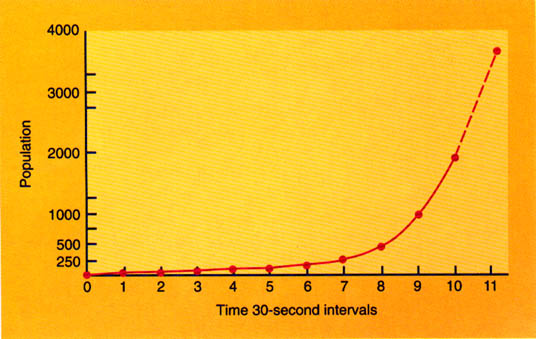
there areas in the world where these limits have been reached already? Have we gone beyond the earth's ideal population yet? What problems will we face if we overpopulate the earth? How might human influence on, for example, habitats affect biological evolution. Students' answers to these questions will vary, depending on their background and information. The outcome, however, should be an intense discussion of some vital problems and should provide opportunities to introduce the fundamental concepts from the National Science Education Standards.
Evaluation
-
Human population on the earth is thought to have had a slow start, with doubling periods as long as 1 million years. The current world population is thought to be doubling every 37 years. How would this growth rate compare with the rates found in your investigation?
Both the population in the investigation and on the earth increase in a geometric progression. This means the graphs have the same shape. You can substitute 37 years for every 30-second interval and the numbers will represent actual world population growth. The slope of the graph would remain the same.
-
What happens to populations when they reach the limits to growth?
The populations stop growing because death rates (or emigration) exceed birth rates (or immigration).
NOTES
|
1. |
National Research Council. 1996. National Science Education Standards. Washington, DC: National Academy Press. www.nap.edu/readingroom/books/nses |
|
2. |
A Draft Growth-of-Understanding Map derived from Benchmarks for Science Literacy (Jan. 1998), AAAS (American Association for the Advancement of Science) Project 2061. |
|
3. |
Biological Sciences Curriculum Study (BSCS). 1978. Biology Teachers' Handbook. 3rd ed. William V. Mayer, ed. New York: John Wiley and Sons, pp. 350-352. |
|
4. |
Standards, p. 117. |
|
5. |
Jonathan Weiner. 1994. The Beak of the Finch: A Story of Evolution in Our Time. New York: Alfred A. Knopf. |
|
6. |
Tijs Goldschmidt. 1996. Darwin's Dreampond: Drama in Lake Victoria. Cambridge, MA: MIT Press. |
|
7. |
BSCS Biology: A Human Approach. 1997. Dubuque, IA: Kendall/Hunt Publishing Co., pp. 47-49 and pp. 64-69. |
|
8. |
See Chapter 2 of this document for more discussion on genetic variation and natural selection, and pages 158 and 185 of the National Science Education Standards. |
|
9. |
Evolution: Inquiries into Biology and Earth Science by BSCS. 1992. Seattle: Videodiscovery, pp. 49-53 and pp. 211-221. |
|
10. |
Standards, p. 117. |
|
11. |
Earth Science Curriculum Project (ESCP). 1973. Investigating the Earth. rev. ed. Boston, MA: Houghton Mifflin. |
|
12. |
Please review pages 143-148 of the National Science Education Standards. |
|
13. |
Investigating the Earth. |
|
14. |
Investigating the Earth. |
|
15. |
Thomas Malthus. 1993. Essay on the Principle of Population. Geoffrey Gilbert, ed. Oxford: Oxford University Press. |