
APPENDIX G Freight Rate Mechanism in the Short Run: A Theoretical Approach
Tanker freight rates are highly volatile. The rates paid for very large crude carriers (VLCCs) over a 35-year period, for example, have shown variations of 1,000 percent (Figure G-1). Aside from irregular shocks resulting from unexpected weather changes and political developments, freight rate volatility can be attributed to two principal causes: (1) the character of tanker supply, and (2) seasonal variations in tanker demand.
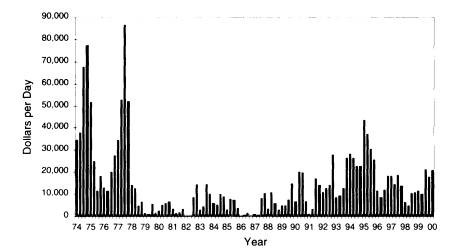
FIGURE G-1 Quarterly average of daily time charter rates for VLCCs operating from the Arabian Gulf to Rotterdam.
Character of Tanker Supply
The freight rate volatility in tanker markets is illustrated by the characteristic shape of the supply curve, sometimes referred to as a ''hockey stick" (Stopford, 1990). Figure G-2 shows a conceptual representation tracing the tanker capacity that owners are willing to supply at a given freight rate (Hettena and Ruchlin, 1969). Capacity utilization can be expressed as a percentage (as in Figure G-2) or given in cargo tonne-miles or in DWT requirements.
The supply curve is constructed by aggregating the capacity of individual tanker units and arranging them, in ascending order, according to their marginal cost. The marginal cost of a tanker, also called the "lay-up equivalent," is the tanker's operating cost minus the cost of lay-up. For a tanker owner it is the point of economic indifference between keeping the tanker in operation and laying it up. In the short run, the actual revenue falls well below the operating cost because the tanker owner usually resists a costly and disruptive lay-up in the expectation, or hope, that the market will soon recover.
It becomes apparent that the supply curve consists of a number of segments characterized by different elasticities that can be simplified as follows. If demand intersects supply at a point in the neighborhood of PO, elasticity is very high: a 5 percent increase in freight rate results in a 25 percent increase in the tonnage supplied. If demand is at P1, elasticity is close to unity: a 5 percent increase in freight rate results in a 5 percent increase in the tonnage supplied. If demand increases to P2, supply becomes inelastic: a 5 percent increase in freight rates
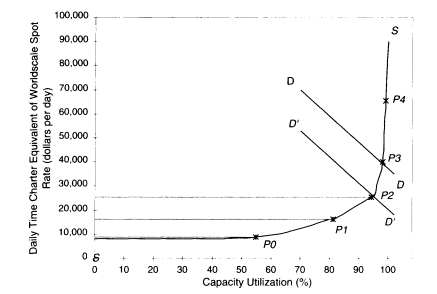
FIGURE G-2 Conceptual VLCC supply function.
results in a 1 percent increase in tonnage supplied. At P3, supply becomes highly inelastic: an 87 percent increase in freight rate results in only a 2 percent increase in the tonnage supplied. At P4 and higher, elasticity is close to zero; no more tankers can be pressed into service; charterers try to outbid each other, and the market turns into an auction. Freight rates can then reach very high levels.
When demand is at PO, freight rates are very low and the quantity of tanker tonnage supplied approaches 60 percent of total capacity. At this freight level, only the most efficient tankers operate and they do so at reduced speed, receiving a return at or below operating costs. Under these circumstances, combined carriers operate in the dry bulk trade.
When demand is at P1, freight rates are somewhat higher. Many tankers come out of lay-up, and a few combined carriers move to the oil trade. Capacity utilization rises to about 80 percent. Tankers continue to operate at slow speed, and although most tankers cover operating costs, none can cover capital costs.
When demand is at P2, freight rates are substantially higher. Almost all tankers come out of lay-up, and more combined carriers move to the oil trade. Most tankers operate at full speed, waiting time is cut down to a minimum, and capacity utilization rises to 95 percent. Most older tankers cover operating and capital costs; newer tankers cover only part of their capital costs.
When demand is at P3 and higher, freight rates rise to a still higher level. All combined carriers are now in the oil trade, and no further increase in the quantity of tonnage supplied is possible. All tankers operate at full speed, and owners are induced to defer dry-dockings and to reduce downtime to a minimum. The shortage causes many tankers to be utilized inefficiently. Capacity utilization is close to 100 percent, all tankers cover their full costs, and many realize a profit. If this condition continues for an extended period, charterers become concerned about tanker shortages and high freight rates. They seek to enter into long-term contracts and to commit for new tonnage. The tanker fleet can be expected to undergo expansion two or three years hence.
Effect of Seasonality of Tanker Demand on Freight Rates
In contrast to the short-term stability of supply, demand is subject to significant shifts under the impetus of seasonal fluctuations in the oil trade. Seasonal variation in tanker demand has a powerful impact on freight rates. In 1988 and 1989, seasonality accounted for as much as a 10 percent variation in tanker demand, causing VLCC weekly time charter equivalents to vary from about $7,000 per day during the low quarter to about $27,000 per day during the high quarters, as shown in Figure G-3 (Stopford, 1990).
The committee reviewed the degree of seasonal variation in the pattern of oceanborne oil shipments and freight rates in the major oil trades (Gassman, 1996). Seasonal variation indices were computed to identify the periodicity of
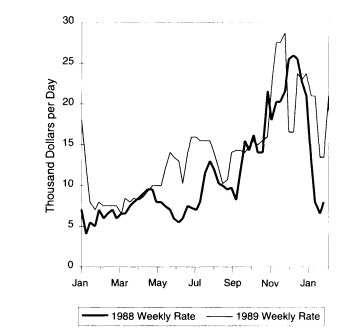
FIGURE G-3 VLCC time charter equivalent rates for 1988 and 1989. Source: Stopford, 1990.
freight rates in different tanker trades. The results of this review are provided in Appendix H.
Aside from seasonality, small shifts in short-term tanker demand are fairly common. As tanker markets approach full capacity utilization, the demand curve DD (Figure G-2) intersects the supply curve at its inelastic segment; hence, small changes in demand have a greatly magnified impact on freight rates. This leads to a condition in which the freight market becomes more and more unstable as demand approaches the limit of capacity. The instability can be precipitated or significantly compounded by seasonal shifts in tanker demand, which have a particularly strong effect on freight rates in periods of tight markets. The market is at its most stable when capacity utilization is low and freight rates are depressed.
References
Gassman, W. 1996. Seasonality Trends. Report prepared for the Committee on Oil Pollution Act of 1990 (Section 4115) Implementation Review. Cambridge, Mass.: Massachusetts Institute of Technology, Department of Ocean Engineering.
Hettena, R., and H.S. Ruchlin. 1969. The U.S. tanker industry: A structural and behavioral analysis. Journal of Industrial Economics 18(3):188-204.
Stopford, M. 1990. The supply, demand, and freight rates in the bulk shipping market. Presented at Shipping '90 Conference, Stamford, Connecticut, March 19.


