
2
Ship Safety and Protection of the Marine Environment
The first part of the committee's task was to determine whether the marine environment has been better protected as a result of the Oil Pollution Act of 1990 (P.L. 101-380) (OPA 90) and whether any increased protection, if identified, could be linked to Section 4115. To carry out this task, the committee analyzed historical data on oil spills from vessels to determine (1) the effect of Section 4115 in reducing oil spills in U.S. waters; (2) the effect on oil spillage in U.S. waters of changes in the international regulatory regime since the enactment of OPA 90; and (3) the extent to which other government and industry initiatives have had an impact on oil spillage in U.S. waters.
In each case, difficulties were encountered in trying to attribute observed trends to legislative action or other initiatives. These difficulties derived in part from the timing of legislative and other actions, many of which are just now beginning to be implemented. Data limitations also contributed to problems in linking cause and effect. The committee therefore undertook a comparative analysis of single-hull and double-hull tanker and barge designs to determine the extent to which reductions in oil spills in U.S. waters can be expected as a result of the double-hull mandate of OPA 90. Some of the results of this analysis are summarized in the present chapter. More details are provided in Chapter 6.
History and Causes of Spills
The committee examined closely U.S. Coast Guard (USCG) records of oil spill incidents in U.S. waters during 1973-1995. These data are not readily accessible to the public or to research organizations interested in assessing U.S. progress in reducing oil spills. The committee, its contractors, USCG personnel,
and others had to make extraordinary efforts to obtain adequate data for an assessment of oil spill trends, as required by the committee's charge. On close examination, it became clear that USCG data are not of uniform quality from year to year, and this problem was compounded by three major shifts in data system structure and emphasis over the years. Although many of the deficiencies pertained to the recording of smaller spills (less than 100 gallons), the committee also encountered problems in tracking larger spills. The USCG data were supplemented by information from the Minerals Management Service (MMS) of the U.S. Department of the Interior to assess several of the largest spills. The MMS database, although impressive in its overall quality, does not include information on spills of less than 1,000 barrels or spills from vessels other than tankers and barges. Thus, the MMS database is not a satisfactory substitute for a well-maintained and managed USCG database.
The committee's analysis revealed that spills from tank vessels (tankers and barges) have dominated the statistics over the years, accounting for 90 percent of the total volume of oil lost from all vessels since 1973 (see Figure 2-1).
Inspection of the tank vessel component of the spill data indicates that very large spills (those involving losses of more than 1 million gallons of oil) occurred with some regularity between 1973 and 1990 (see Figure 2-2). Out of a population of many thousands of smaller incidents, 18 spills, each of more than I million gallons, dominated the statistical pattern over the past two decades. One or two incidents could potentially have changed the overall statistical picture dramatically. However, there were no large spills involving losses of more than I million gallons during 1991-1995. USCG records dating back to 1973 indicate no similar period without a very large spill. Moreover, both the numbers of
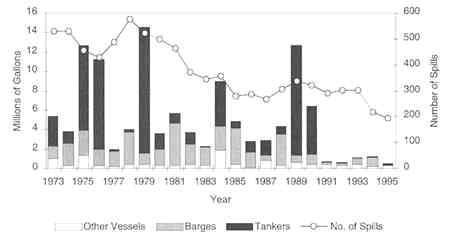
FIGURE 2-1 Number of oil spills and volume of spillage in U.S. waters, 1973-1995.
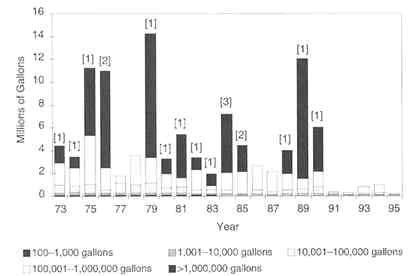
FIGURE 2-2 Volume of oil spilled from tankers and barges in U.S. waters, 1973-1995.
Note: Numbers in brackets are spills of more than 1 million gallons.
incidents and the volumes released were at historically low levels during the period from 1991 to 1995.
Figure 2-3 summarizes the main types of casualty that resulted in oil spills from tankers and barges during the period 1991 to 1995, as indicated by USCG data. In the case of tankers (Figure 2-3a), the data show that a relatively small fraction of recent oil spillage was the result of collisions and groundings. The barge picture (Figure 2-3b) is more complex, with little consistency in the cause of spillage from year to year. The data presented in Figure 2-3 indicate that between 1991 and 1995, the total volume of oil spilled from barges in U.S. waters was significantly greater than that spilled from tankers. Tankers accounted for about 10 percent of the spillage from vessels in U.S. waters during this period, whereas barges accounted for approximately half of the total spillage from vessels and were involved in the majority of spills.
Given the OPA 90 phaseout schedule for single-hull vessels and delays encountered by the USCG in implementing other provisions of Section 4115 (see below), it is clear that the reasons for the improvement in the oil spill picture since 1990 cannot be attributed to the implementation of Section 4115.1 The
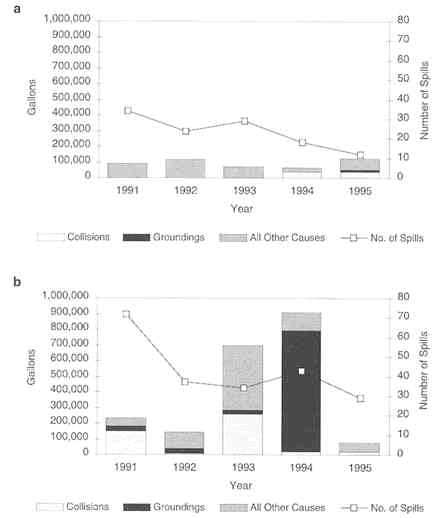
FIGURE 2-3 (a) Volume of oil spilled from tankers in U.S. waters and causes of spillage, 1991-1995. (b) Volume of oil spilled from barges in U.S. waters and causes of spillage, 1991-1995. Note: The data presented in Figure 2-3b include spills from both inland and oceangoing barges.
possible effects of international regulations and other government and industry initiatives are addressed below.
Despite the reduction in oil spilled over the past five years, the committee would caution against complacency. It is clear from the analysis presented above, as well as from practical experience with the Exxon Valdez incident, that the
TABLE 2-1 Section 4115 Phaseout Schedule for Vessels without Double Hulls by Age of Vessel
prevention of a single large spill can offer not only protection for the environment but also reduced costs for the vessel owner, the industry, and the nation as a whole. In addition to the vessel design issues identified in OPA 90 and addressed in this report, initiatives such as the USCG "Prevention Through People" program, which addresses the role of human factors in accident prevention, may further strengthen the ability to prevent the occasional, very large incident or to reduce its severity.
Section 4115 Requirements and Implementation
The principal requirements of Section 4115 that apply to vessels operating in U.S. waters are as follows:
- Single-hull vessels of 5,000 gross tons (GT) or more are excluded from U.S. waters beyond 2010. An exemption allows vessels without double hulls to operate to designated lightering areas or deepwater offshore oil ports until 2015.2
- Tankers with single hulls (or double bottoms or double sides) must be phased out according to a schedule that begins in 1995 and runs through 2015 (see Table 2-1).
- Existing tankers and barges without double hulls must comply with interim USCG regulations defining structural and operational requirements aimed at providing as substantial protection to the environment as is economically and technologically feasible.
Interim Structural and Operational Measures
The USCG has taken the following actions in developing and implementing the interim measures for single-hull vessels required by Section 4115.
A final rule defining requirements for emergency lightering equipment and the reporting of a vessel's International Maritime Organization (IMO) number prior to port entry was published on August 5, 1994 (Federal Register, 1994). This regulation is aimed primarily at ensuring that vessels carry minimum levels of lightering and deck cleanup equipment; it addresses after-the-fact spill actions rather than prevention or reduced outflows. A USCG final rule mandating operational measures to reduce oil spills from existing tank vessels without double hulls took effect on November 27, 1996 (Federal Register, 1996).3
A supplemental notice of proposed rule making (SNPRM) outlining several structural and operating alternatives under consideration by the USCG, such as hydrostatically balanced loading (HBL) and protectively located (PL) spaces,4 was issued in December 1995 (Federal Register, 1995). The USCG final rule on structural measures, issued in January 1997, does not require vessels without double hulls to undertake any new structural measures in the remaining years before they are phased out (Federal Register, 1997a). This rule reflects the USCG finding that no structural measures can be retrofitted on existing single-hull tank vessels in a manner that is both technologically and economically feasible. The committee did not assess the validity of the USCG finding.
Only the regulation defining requirements for emergency lightering equipment and the reporting of a vessel's IMO number has been fully implemented to date.
Projected Reduction in Outflow with Double Hulls
The relative effectiveness of vessels with single and double hulls in mitigating oil outflow was assessed through probabilistic oil outflow analysis. Details of the analysis are provided in Chapter 6 and Appendix K. Thirty-six tankers and oceangoing barges, both single hull and double hull, were evaluated. The resulting probabilities of zero outflow for tankers are shown in Figure 2-4. The probability of zero outflow is defined as the likelihood that a vessel will be involved in a collision or grounding breaching the outer hull and not spill any oil. The reader is referred to Chapter 6 for a discussion of other important spill characteristics, notably mean and extreme outflow.
Over the past 15 years, collisions and groundings have been responsible for approximately 70 percent of the oil spillage from tankers and tank barges. In assuming that the current fleet is composed predominantly of single-hull vessels that are all replaced by double-hull vessels, the following changes are projected:
- Four out of every five oil spills attributable to collisions and groundings would be eliminated.
- A two-thirds reduction would be realized in the total volume of oil spilled from collisions and groundings.
These estimates are based on theoretical analysis. Future oil spill statistics will depend on many factors, including the extent of cargo tank subdivision incorporated into designs of double-hull tankers and tank barges. However, the relative numbers obtained from the analysis imply that the double-hull mandate, when fully implemented, will have a significant and positive effect on reducing the risk and the severity of oil spills.
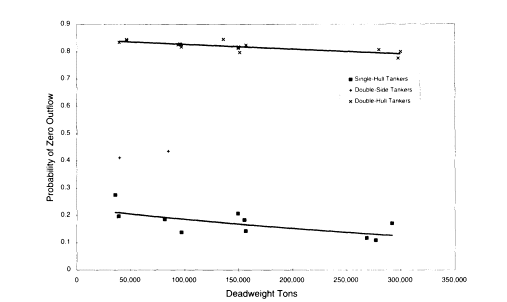
FIGURE 2-4 Probability of zero outflow for single-hull and double-hull tankers.
Source: Herbert Engineering Corporation, 1996.
International Regulatory Regime
Significant events and actions have taken place in the international arena since the grounding of the Exxon Valdez and the passage of OPA 90 that may complement or enhance the actions required under OPA 90. Changes have occurred both in the international regulatory regime and as a result of port-state and industry initiatives. The former are discussed below; a later section of this chapter addresses government and industry initiatives.
Marine Pollution Prevention Prior to OPA 90
The International Maritime Organization, an agency of the United Nations, regulates international shipping through the adoption of international conventions by its members. Conventions that regulate ship design for safety and pollution prevention include the 1996 International Convention on Load Lines (ICLL), the 1974 International Convention on Safety of Life at Sea (SOLAS), and the 1973 International Convention for the Prevention of Pollution from Ships as amended by the Protocol of 1978 (MARPOL 73/78).
ICLL established the deepest draft to which a ship could be loaded to ensure that ships were not so overloaded as to run the risk of sinking or creating unsafe working conditions. SOLAS addressed the safety of the crew, passengers, ship,
cargo, ports, and indirectly, the environment. Its principal provisions include general construction principles and requirements for ship subdivision and stability, safety equipment, fire protection, and radio telegraphy.
MARPOL 73/78 differs from ICLL and SOLAS in that it addresses the prevention of pollution from ships directly rather than indirectly. The 1973 convention required ballast to be carried only in clean or segregated ballast tanks (SBT),5 thereby avoiding the pollution that can occur when ballast water containing remnants of oil is discharged from cargo tanks or when tanks are cleaned. The convention was amended in 1978 to require that segregated ballast tanks be located so as to provide protection against collisions and groundings (protectively located segregated ballast tanks [PL/SBT]).
Changes in Marine Pollution Prevention Following OPA 90
In November 1990, the United States submitted a proposal to the thirtieth session of the IMO Marine Environment Protection Committee to establish an international requirement for double-hull tankers. This proposal eventually resulted in the adoption of MARPOL 73/78 Regulations I/13F and I/13G (MARPOL 13F and 13G). These regulations, which became effective in July 1993, apply to the vessels of all nations and are similar to the provisions of Section 4115 of OPA 90.
New Vessel Requirements
MARPOL 13F specifies the hull configuration requirements for new oil tankers contracted on or after July 6, 1993, of 600 deadweight ton (DWT) capacity or more. Oil tankers between 600 and 5,000 DWT must be fitted with double bottoms or double sides, and the capacity of each cargo tank is specifically restricted. Every oil tanker of more than 5,000 DWT is required to have a double hull (double bottom and double sides), a mid-deck with double sides, or an alternative arrangement specifically approved by IMO as being equivalent to the double-hull design. These requirements, along with those of OPA 90, are shown in Table 2-2.
MARPOL 13F specifies that other designs may be accepted as alternatives to double hulls, provided they give at least the same level of protection against the release of oil in the event of collision or grounding and are approved, in principle, by IMO's Marine Environment Protection Committee. IMO design guidelines employ a probabilistic outflow methodology for calculating oil outflow and a pollution prevention index to assess the equivalency of alternative designs (see Chapter 6).
TABLE 2-2 Requirements of OPA 90 and IMO Regulation 13F for New Vessels
|
|
Size |
Hull Requirements |
Enforcement Date |
|
OPA 90 Section 4115 |
< 5,000 GT |
Double-hull or double-containment systemsa |
Building contract placed after June 30, 1990 Delivered after January 1, 1994 |
|
|
> 5,000 GT |
Double hull |
Building contract placed after June 30, 1990 Delivered after January 1, 1994 |
|
IMO Regulation 13F |
< 600 DWT |
Not applicable |
|
|
|
600-5,000 DWT |
Double bottom or double sides |
Building contract placed after July 6, 1993 New construction or major renovation begun on or after January 6, 1994 Delivered after July 6, 1996 |
|
|
> 5,000 DWT |
Double hull, mid-deck with double sides, or equivalent |
Building contract placed after July 6, 1993 New construction or major renovation begun on or after January 6, 1994 Delivered after July 6, 1996 |
|
aThe double-containment system must be determined by the Secretary of Transportation to be as effective as a double hull in preventing a discharge of oil. As of this date, no double-containment system has been approved by the Secretary. |
|||
Existing Vessel Requirements
MARPOL 13G, which pertains to single-hull vessels, applies to crude oil tankers of 20,000 DWT or more, and to oil product carriers of 30,000 DWT or more. The regulation specifies a schedule for retrofitting (with double hulls or equivalent hull designs or operational measures) or retiring single-hull tank vessels 25 or 30 years after delivery. The differences between MARPOL 13G and OPA 90 are shown in Table 2-3.
Tankers not fitted with SBTs, or fitted with SBTs that are not protectively located, must designate protectively located double-side or double-bottom tanks or spaces when they reach 25 years of age. In appropriate locations, SBTs would be acceptable as protectively located spaces.
MARPOL 13G also permits HBL and other alternatives (operational or structural) to protectively located spaces. Tankers built in compliance with Regulation I (6) of MARPOL 73/78 (hereinafter referred to as MARPOL tankers) have protectively located ballast spaces and require no modification until
TABLE 2-3 Requirements of OPA 90 and MARPOL 13G for Existing Vessels
reaching 30 years of age. On reaching 30 years of age, all tankers in the oil trade must be converted to double hulls or an acceptable equivalent according to MARPOL 73/78, Regulation I/13F(5).
The United States has reserved its position on the loading and structural provisions of MARPOL 13G applicable to single-hull tank vessels. The recent rule promulgated by the USCG does not require structural modifications of single-hull vessels before they are phased out. MARPOL 13G also imposes a program of enhanced ship inspections during periodic, intermediate, and annual surveys. This same provision is included in the November 1996 USCG rule on operational measures (Federal Register, 1996).
The fact that the United States has reserved its position on the aforementioned provisions of 13G will have little effect on most vessels calling at U.S. ports and on the resulting protection of U.S. waters. OPA 90 requires most vessels to retire by age 25, and 13G comes into effect only when vessels reach 25 years of age. Thus, most vessels 25 or older—whether in international or coastwise trade—will be excluded from U.S. waters by OPA 90, regardless of the provisions of 13G. There is one notable exception to this situation, namely, larger vessels operating to lightering areas and the deepwater port under the OPA 90 exemption. Tankers up to 30 years of age that are in compliance with 13G will be allowed to trade in international waters. These same vessels will be allowed to trade to the United States under the OPA 90 exemption, regardless of the U.S. position on 13G. The committee's concerns about the combined effects of 13G
and the OPA 90 exemption, which together have virtually nullified the OPA 90 age requirement for large single-hull tankers, are addressed in Chapter 7.
Comparison of International Regulations with OPA 90, Section 4115
New Vessels
Section 4115 of OPA 90 and MARPOL 13F take different paths in addressing the change to double-hull construction. Section 4115 restricts oil trade to the United States by vessels without double hulls according to a schedule based on vessel age. MARPOL 13F takes a proactive approach by requiring all vessels constructed after a certain date to have double hulls or an approved alternative. MARPOL 13G allows existing vessels to trade for a longer period than that allowed under Section 4115 if they are of acceptable design. Figure 2-5 shows that Section 4115 is more restrictive in controlling vessels in the international fleet able to serve the United States.
Figure 2-6 shows the anticipated growth in petroleum tonnage carried in U.S. waters in double-hull vessels between 1990 and 2015 as a result of OPA 90 and
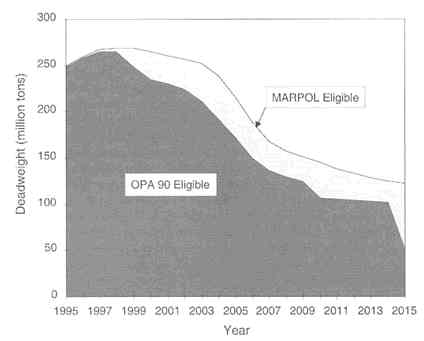
FIGURE 2-5 Effect of Section 4115 and IMO Regulations 13F and 13G on eligibility of existing vessels to operate in U.S. waters.
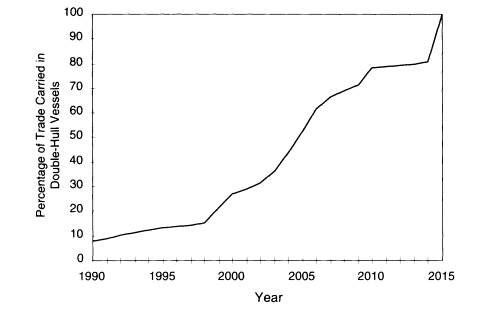
FIGURE 2-6 Increase in petroleum tonnage in U.S. waters carried in double-hull vessels. Note: The data used to generate this figure were obtained by the committee in the course of its study. Additional analysis was performed by individual committee members in the context of an ongoing study for the Volpe National Transportation Systems Center entitled Regulatory Impact Analysis of OPA 90.
MARPOL rules. The projection includes vessels in the international fleet trading to the United States and vessels in the domestic (Jones Act) fleet involved in coastal trade. Vessels without double hulls are assumed to trade until they reach 30 years of age (with an 8 percent loss of cargo capacity for those using HBL) unless they are excluded from U.S. waters by OPA 90. That is, the projection assumes that the deepwater port and lightering zone exemption to OPA 90 will extend the trading life of vessels without double hulls coming to U.S. waters to January 1,2015.
Existing Vessels
Table 2-4 summarizes the requirements of the OPA 90 interim regulations and the international regulations for existing single-hull vessels. As with Section 4115, changes in vessel safety and the protection of the marine environment could not be attributed to the international measures because of their newness.
TABLE 2-4 OPA 90 and International Regulations for Tank Vessels without Double Hulls
|
|
OPA, Section 4115(b) |
International |
|
Operational Measures |
||
|
Emergency lightering equipment |
Prohibits use of cast iron or malleable iron valves or fittings |
Flange specifications are IMO Universal Oil Transfer Connection specifications (33 CFR 154.500) |
|
Bridge resource management policy and procedures |
Written guidance to masters and officers in charge of navigational watch concerning need for continuously reassessing use of bridge-watch resources in accordance with bridge resource management principles |
Consistent with Convention for Standards for Training, Certification, and Watchkeeping (STCW) Code Section B, Chapter VIII, Part 3-1 |
|
Vessel-specific watch policy and procedures |
Written guidance to masters setting forth company policies and procedures to be followed to ensure all newly employed crew members are given a reasonable opportunity to become familiar with proper performance of their duties; on-the-job watch training for watchstanding personnel who assist the officer in charge of navigational watch |
Consistent with STCW Code Section A, Chapter I, Part 14 |
|
Enhanced survey requirements |
Dry-dock survey includes gauging report, visual inspection, and structure analysis; barge companies and smaller tankers allowed to have an alternative survey program with outside oversight or auditing |
Incorporates IMO Resolution A.744( IE) by reference; IMO standard applies to > 20,000 DWT crude carriers and > 30,000 DWT product tankers; consistent with MARPOL 13G |
|
Vital systems survey |
Survey of mooring and cargo systems done by senior personnel |
Incorporates International Safety Guide for Oil Tankers and Terminals (ISGOTT) guidance by reference: consistent with STCW Code Section A. Chapter V. Part I |
|
Autopilot alarm or indicator |
Automatic alarm on autopilot required on tank ships; indicator on tugs |
None |
|
|
OPA, Section 4115(b) |
International |
|
Maneuvering performance capability |
Existing tank ships must calculate and post maneuvering performance |
Incorporates IMO Resolution A.751(18) by reference; IMO resolution recommends that new vessels 100 meters or more in length meet performance standards; OPA 90 applies only to tank vessels > 5,000 GT |
|
Maneuvering and vessel status information |
Provide pilot cards and a wheel-house poster |
Incorporates IMO Resolution A.601(15) by reference |
|
Minimum underkeel clearance |
Plan, calculate, and log vessel's anticipated underkeel clearance prior to entering or departing port; liability cap is waived if done improperly |
Ability of master and officers in charge to calculate ship's underkeel clearance inferred in STCW Section A. Chapter II. Part I, but no specific underkeel clearance minimum required internationally |
|
Emergency steering capability |
Secondary steering system on primary towing vessels |
None |
|
Fendering system |
Primary towing vessels and any assisting towing vessels must have enough fendering to prevent metal to metal contact between tug and barge |
None |
|
Structural Measures |
||
|
Protectively located segregated ballast tanks (PL/SBT) |
None |
Required for all non-SBT tankers using HBL and all non-PL/SBT tankers under MARPOL 13G |
|
Alternatives to PL/SBT including HBL |
None |
Alternatives providing protection equivalent to PL/SBT subject to approval by member states under MARPOL 13G |
Government and Industry Initiatives
The recent U.S. and international regulations governing structural and operational practices in marine oil transportation are expected to have a significant long-term impact on oil spill prevention and the enhancement of ship safety. Port states and private organizations, including classification societies and industry groups, have developed programs unilaterally that have had a more immediate
impact and are possibly the major reasons for the changes in spill patterns witnessed since the passage of OPA 90. Major initiatives that have been undertaken or improved since the adoption of OPA 90 include port-state quality controls, vetting by charterers,6 and quality assurance programs.
Actions by Port States
Historically, port states (nations that have vessels calling at their ports) have not exercised substantial control over vessels that use their ports. Responsibility for vessel quality has been left to vessel owners, ship classification societies, and flag states (nations in which vessels are registered). However, in response to concerns that substandard vessels are still operating and increasing numbers of owners are registering their vessels in nations that do not meet their flag-state obligations, individual port states have intensified their control over shipping in recent years, aided by IMO and regional organizations. In 1994, more than 40,000 port-state control inspections were conducted in Europe, Canada, Australia, South America, and the United States.
Currently, four regional memoranda of understanding (MOU) have been signed to coordinate port-state programs: the Paris MOU (1982), the Acuerdo de Viña del Mar (1992), the Tokyo MOU (1993), and the Caribbean MOU (see Table 2-5).
IMO recently adopted port-state control guidelines that include criteria for qualifications and a code of conduct for port-state control officers.7 Compliance with the International Safety Management Code (ISM) and revisions to the Convention for Standards for Training, Certification, and Watchkeeping (STCW) will be incorporated into port-state control programs.
In the United States, the USCG has adopted a more aggressive posture as a port state. Like Australia, which published its report the Ships of Shame (Parliament, 1992), the United States is targeting vessels for additional port-state surveillance and is making the resulting information available to the public (see Box 2-1). A key feature of the regional MOUs and the U.S. and Australian programs is the sharing of information among port states.
In an attempt to evaluate information on the condition of vessels calling on U.S. ports, the committee investigated the availability of USCG data from the ports of Houston, Los Angeles-Long Beach, and New York, describing the effectiveness of the ship surveillance program. Data collected in 1990 did not include information on the total number of vessels inspected or on vessel type. Therefore, it was not possible to make meaningful comparisons with 1995 data, and the
TABLE 2-5 Major Features of Regional Port-State Control Agreements
|
Agreement |
Paris MOU |
Acuerdo de Viña del Mar |
Tokyo MOU |
Caribbean MOU |
|
Authorities that adhere to the MOU |
Belgium, Canada, Denmark, Finland, France, Greece, Ireland, Italy, the Netherlands, Norway, Poland, Portugal, Spain, Sweden, the United Kingdom |
Argentina, Brazil, Chile, Cuba, Uruguay |
Australia, Canada, China, Hong Kong, Japan, Korea, Malaysia, New Zealand, Papua New Guinea, Russian Federation, Singapore, Vanuatu |
Antigua and Barbuda, Aruba, the Bahamas, Barbados, Cayman Islands, Grenada, Jamaica, Netherland Antilles, St. Kitts and Nevis, Trinidad and Tobago |
|
Authorities that have signed but have not yet accepted the agreement |
|
Colombia, Ecuador, Mexico, Panama, Peru, Venezuela |
Fiji, Philippines, Solomon Islands, Thailand, Vietnam |
|
|
Cooperating authorities |
Croatia, Japan, Russian Federation, United States |
|
|
|
|
Observer authority |
United States |
|
United States |
Anguilla, Canada, Montserrat, The Netherlands, United States, Caribbean Community Secretariat, Viña del Mar Secretariat, Tokyo Secretariat |
|
Target inspection rate |
25% annual inspection rate per country within 3 years of effective date (1982) |
15% annual inspection rate per country within 3 years of effective date (1992) |
25% annual regional inspection rate by the year 2000 |
15% annual inspection rate per country within 3 years of effective date (1996) |
|
Governing body |
Port State Control Committee |
Port State Control Committee |
Port State Control Committee |
Port State Control Committee |
|
Secretariat |
Provided by the Netherlands Ministry of Transport and Public Works (Rijswijk) |
Provided by Prefectura Naval Argentina (Buenos Aires) |
Tokyo MOU Secretariat (Tokyo) |
Hosted by Barbados |
|
Database center |
Centre administratif des affaires maritime (CAAM) (Saint-Malo) |
Centro de informacion del acuerdo latinamerico (CIALA) (Buenos Aires) |
Asia-Pacific Computerized Information System (APCIS) (Ottawa) |
Caribbean Maritime Information Center |
|
Official language |
English, French |
Spanish, Portuguese |
English |
English |
|
Signed |
January 26, 1982 |
November 5, 1992 |
December 2, 1993 |
August 8, 1996 |
|
Effective date |
July 1, 1982 |
November 5, 1992 |
April 4, 1994 |
August 8, 1996, but signatories have 3 years to put an administration in place |
|
BOX 2-1 U.S. Port-State Control Initiative The USCG has established as a major part of its Port-State Control Initiative the goal of identifying and eliminating substandard foreign-flagged ships from U.S. waters while encouraging operators trading to the United States to adopt management philosophies that ensure compliance with accepted standards. The program pursues this goal by systematically targeting high-risk vessels for inspection. The targeting scheme places ships in one of four categories: Priority I = boarded at sea prior to being allowed into port Priority II = boarded after entry into port but prior to cargo transfer or passenger embarkation Priority III = boarded after entry into port without restrictions on cargo transfer or passenger embarkation Priority IV = not boarded Targeting criteria include type of vessel, accident record, owner history, flag history, classification society history or status, and boarding history, with special attention to previous interventions, incidents, and violations. |
committee was unable to prove or disprove the impression shared by a number of members of the maritime community that the quality of the fleet calling on U.S. ports has improved. In most of the other areas discussed below, the committee encountered similar data problems when attempting to draw comparisons between pre- and post-OPA 90 periods.
The committee identified several unilateral efforts by foreign countries to improve ship safety and decrease the potential for oil pollution. Japan has initiated a system designed to discourage the use of older ships for trade to that country. Vessels more than 15 years of age are approved for trade only after careful vetting. Korea has indicated that it will discourage ships over the age of 20 except for those with high condition assessment program (CAP) ratings. Finland gives a rebate on port charges to ships with double-bottom, double-side, and full double-hull designs.
Enhanced Surveys and Classification Society Activities
Enhanced surveys of vessels that comply with guidelines developed by IMO have been mandated by MARPOL 13G and are included in USCG regulations. Such enhanced surveys are applicable to 5-year periodic, 2.5-year intermediate,
and annual surveys. They entail increasingly strict inspections as vessels age and are intended to deter the operation of substandard ships that could result in oil spills due to structural failure.
The larger classification societies, notably members of the International Association of Classification Societies (IACS),8 have begun aggressive programs to ensure that vessels under their classification meet or exceed present requirements. IACS members, who together classify 42,000 ships that account for 90 percent of the world's merchant ship tonnage, have established initiatives that reflect an increasing attention to safety, as well as a willingness to share information within the maritime community. These initiatives are intended to reduce the number of substandard ships and include (1) the sharing of information with third-party organizations having a legitimate interest in the maintenance of safe shipping standards and their application; (2) revised procedures for the suspension of class if special surveys, annual surveys, or recommendations or conditions of class fall overdue; (3) employment, control, certification, and training of surveyors; (4) a transfer of classification agreement whereby no ship can be accepted for membership in a member society unless it has addressed unresolved issues from its previous society; (5) coordination of classification surveys with port-state control surveys; and (6) enhanced surveys.
Industry Initiatives
Charterer Vetting Programs
Major charterers have developed sophisticated vetting (audit and inspection) programs that they use prior to chartering a vessel. Such programs include vessel inspections, consideration of flagging history, and ownership and management qualification requirements. Some vetting programs have been in place for a number of years, whereas others are relatively recent. Information from such programs is now available to other charterers, terminal operators, port authorities, and government agencies through the SIRE Ship Inspection Program sponsored by the Oil Companies International Marine Forum (OCIMF) (see Box 2-2).
An indirect result of the adoption of OPA 90 has been an increased emphasis on safety in existing quality programs and an increased reliance among charterers on records of vessel adherence to these programs. Variations in the programs and their partly subjective nature precluded any assessment by the committee of their effect on the quality of the maritime oil transportation fleet.
|
BOX 2-2 Ship Inspection Report (SIRE) Program OCIMF has recently begun a voluntary information sharing program designed to help improve ship safety and promote efficiency. This program takes advantage of the information that has been gathered by manyof its members as part of their separate tanker vetting programs. Many member companies have been involved in tanker vetting for years, whereas others have become involved more recently. SIRE is designed to provide a readily accessible pool of technical information concerning the condition and operational procedures of tankers. The information is available not only to OCIMF members but also to companies and organizations chartering oil tankers, bulk oil terminal operators, port and canal authorities, and government agencies having flag or port-state responsibility for tanker safety. The information contained in SIRE is provided by participating OCIMF members from the information that they gather for their own vessel vetting. One copy is sent to the operator of the vessel inspected and another copy is submitted to OCIMF for posting in a computerized database. The tanker operator has 14 days to submit written comments for inclusion in the database. The information then becomes available to third parties. OCIMF also maintains a computerized index that gives information about the availability of reports and tanker operator comments. Most of the major oil companies that are members of OCIMF are voluntary program participants. Stated goals are (1) to expand the availability of tanker inspection information and, by so doing, enhance tanker safety with a consequent reduction in pollution; and (2) to reduce duplication of efforts by inspecting organizations and thus reduce the burden placed on tanker crews. There is no set format for inspection reports, but many members base their reports on the OCIMF publication Inspection Guidelines for Bulk Oil Carriers. These guidelines address questions of vessel safety and pollution prevention, manning levels, certification and competency, mooring equipment, navigation procedures, general condition, and other safety-related items. Reports made available by OCIMF reflect all the information submitted by the inspecting party. The reports do not contain an overall tanker rating or any indication of the inspecting company's view of the ship's acceptability. It is left to the user to determine whether a vessel is acceptable for its intended use. |
Quality, Criteria for Older Ships
Major charterers, such as Vela of Saudi Arabia, Norwegian Statoil, Norsk Hydro, and the government of Kuwait, require ships exceeding 20 years of age to achieve high ratings in the CAP of the ABS, Det Norske Veritas, and Lloyd's classification societies. On the basis of stringent inspections of each vessel, CAP assigns ratings on a scale jointly agreed to by the classification societies.9 Of significant interest to the United States is the fact that the fleet of ultralarge crude carriers (ULCCs) of more than 400,000 DWT, consisting of 25 ships used almost entirely in trade to the United States, has 20 ships that have gone through CAP with a Grade I rating.
Vessel Quality
Despite the significant number of new or enhanced programs now in place that are intended to reduce the number of substandard vessels in use (thereby reducing oil pollution and increasing safety), the committee was not able to document conclusively any changes in the quality of the fleet calling on the United States since the promulgation of OPA 90. The subjective nature of much of the available data, the lack of reliable evaluation information and quality rating data, and the difficulty of establishing comparisons between datasets for different years all contributed to the committee's inability to make a definitive statement about vessel quality.
Nonetheless, many of the presentations made to the committee suggested that the quality of the fleet trading to the United States has improved in recent years, a view echoed by committee members who work in the maritime community. Possible reasons for the perceived improvement cited by presenters were (1) an increased awareness of potential liability;10 (2) improvements in company operations; (3) increased familiarity with the harmful consequences of an oil spill as a result of mandatory planning and training in responding to spills; and (4) a greater emphasis placed on protecting the environment by several elements of the maritime community, including the IACS, protection and indemnity (P&I) clubs, port states, owners and operators, vessel crews, and individual U.S. states, including California, Texas, and Washington.
Although the lack of reliable and consistent data precluded any definitive assessment of changes in vessel quality and related safety, the committee anticipates that future assessments may be more conclusive. Data on the physical
condition of vessels, as well as on ships and owners with high incident records, are being collected in several of the initiatives described, notably the U.S. Port State Control Initiative and the charterer vetting programs. Such data might provide the basis for future analyses of vessel quality and safety.
Findings
Finding 1. During the period of 1990 to 1995, compared to earlier five-year periods, there was a decline in the quantity of oil spilled from vessels in U.S. waters, together with a reduction in the number of spills of more than 100 gallons.
- Since 1990, there have been no single oil spills of greater than I million gallons from tank vessels in U.S. waters. Such incidents have dominated oil spill statistics over the past two decades; even one incident has the potential to change the overall statistical picture dramatically.
- The majority of all oil spills in U.S. waters between 1990 and 1995 involved single-hull barges. Barges accounted for approximately 50 percent of the total oil spilled during this period, with tankers accounting for approximately 10 percent. Fishing vessels, passenger vessels, dry cargo carriers, and other types of ships accounted for the remaining 38 percent.
Finding 2. Because of the timing of its implementation, Section 4115 of OPA 90 did not have a major influence on the observed decline in the volume of oil spilled from vessels in U.S. waters between 1990 and 1995. The double-hull provisions are just beginning to be implemented, and during the period of study, the operational measures aimed at reducing the outflow of oil following incidents involving single-hull tank vessels had not been fully implemented.
Finding 3. Major international programs such as MARPOL 13F and 13G, port-state initiatives, and enhanced inspections by classification societies, are just now coming into effect and are not, in and of themselves, the reason for the reduction in oil spills for the period 1991 to 1995. However, some anecdotal information suggests that there has been an improvement in the quality of the fleet calling on U.S. ports because of an increased awareness of liability obligations and the cost of pollution liability insurance, enhanced planning and training for oil spills, improved audit and inspection programs by charterers and terminal operators, policies and procedures adopted by fleet or vessel operators, and increased rules imposed by port states (such as the U.S. Port State Control Initiative) and by individual U.S. states.
Finding 4. The passage of OPA 90 was a catalyst for international action, resulting in the addition of Regulations 13F and 13G to MARPOL and the worldwide adoption of a double-hull mandate for tank vessels.
Finding 5. The committee found the USCG oil spill database to be virtually inaccessible to the general public and of uneven quality from district to district. Major difficulties exist in the management of this important source of information on trends in and causes of oil spills, making specific analyses difficult. Extraordinary efforts were needed to obtain adequate data for the analysis of oil spill trends reported in Finding 1.
Finding 6. The USCG databases on port-state inspections for 1990 and 1995 cannot be used to make comparisons of fleet quality because the data for 1990 do not include information on the total number and type of vessels inspected. A new approach to port-state inspection now being used by the USCG could, over time, provide suitable data for future comparisons if the database is appropriately maintained by the USCG and includes information such as the total number of vessels making port calls and the number and type of vessels inspected.
Finding 7. Probabilistic outflow analysis of existing vessel designs (see Chapter 6) indicates that the complete conversion of the maritime oil transportation fleet of tankers and barges to effectively designed double hulls is expected to result in significantly improved protection of the marine environment. Reductions are anticipated in both the number of spills and the volume of oil spilled.
References
Federal Register. 1994. Emergency Lightering Equipment and Advanced Notice of Arrival Requirements for Existing Tank Vessels Without Double Hulls. Final Rule. FR 59(150):40186-40189. August 5.
Federal Register. 1995. Structural Measures to Reduce Oil Spills from Existing Tank Vessels Without Double Hulls . Supplemental Notice of Proposed Rule Making. FR 60(249):67226-67251, December 26.
Federal Register. 1996. Operational Measures to Reduce Oil Spills from Existing Tank Vessels Without Double Hulls. Final Rule. FR 61(147):39770-39794, July 30.
Federal Register. 1997a. Structural Measures to Reduce Oil Spills from Existing Tank Vessels Without Double Hulls. Final Rule. FR 62(7): 1622-1637, January 10.
Federal Register. 1997b. Operational Measures to Reduce Oil Spills from Existing Tank Vessels Without Double Hulls. Final Rule; Response to Petitions for Rulemaking. FR 62 (14):49603-49608. September 23.
Herbert Engineering Corporation. 1996. Comparative Study of Double-Hull vs. Single-Hull Tankers. Background paper prepared for the Marine Board Committee on OPA 90 (Section 4115) Implementation Review. San Francisco, Calif.: Herbert Engineering Corporation.
Parliament of the Commonwealth of Australia. 1992. Ships of Shame: Inquiry into Ship Safety. Report from the House of Representatives Standing Committee on Transport, Communications and Infrastructure. Canberra: Australian Government Publishing Service.
U.S. Coast Guard (USCG). 1993. OPA 90 Deepwater Ports Study. Washington, D.C.: U.S. Coast Guard Office of Marine Safety, Security and Environmental Protection.


