
4
Extravehicular Activity Systems
Introduction
Extravehicular activity (EVA) is essential to conducting complex work outside the pressurized volume of a crewed space vehicle or planetary base. EVA equipment consists of: the spacesuit itself; the primary life support system (PLSS), which provides the suit with pressurized oxygen and ventilation while removing carbon dioxide, water vapor, and trace contaminants; thermal conditioning; and the tools (including robotic tools) that enable the EVA crewmember to accomplish the necessary tasks. Taken together, the suit and life support system are called the extravehicular mobility unit (EMU).
An EMU is a unique design challenge because it is a miniature spacecraft that must sustain human life. Many space engineering disciplines are required to provide the needed independent life support, mobility, and communications. For the ISS, the EVA system may even incorporate a miniature propulsion system, the Simplified Aid for EVA Rescue (SAFER), which can be attached to the EMU.
The earliest U.S. spacesuits, for the Mercury and Gemini programs, were adaptations of the full pressure suits used for military aviation. They were air cooled, provided minimal mobility, and were only designed to permit the astronaut to operate spacecraft controls in the event of cabin depressurization. The first U.S. EVAs were performed from the Gemini spacecraft using this type of suit, with life support provided through an umbilical. However, limited mobility and the use of air-cooling greatly limited the effectiveness of these suits. A better suit was clearly needed for EVAs on the lunar surface.
The Apollo EMU was a great step forward. Mobility of the joints was improved, and the helmet was replaced with a dome-type helmet inside which the head could move freely, which increased the field of view. These new suits were
composed mostly of fabric and other soft materials and were custom fitted to each astronaut. The PLSS was back-mounted and completely independent of the spacecraft. An important new feature was the improved cooling system; the astronaut wore a liquid cooling garment (much like long underwear with tubing throughout the fabric) through which water was circulated, absorbing body heat and rejecting it through the primary heat sink, a sublimator in the PLSS. The Apollo EMUs met the requirements for a crewmember operating outside the confines of the Lunar Module spacecraft.
The current Space Shuttle EMU consists of a spacesuit assembly (SSA) and an integrated PLSS. The SSA is made of multiple layers of fabric and other flexible materials attached to a fiberglass unit called the ''hard upper torso." The hard upper torso is the primary structural member of the SSA; the helmet, arms, lower torso assembly, and PLSS are all mounted to it. The PLSS maintains a pressurized 29.6 kPa (4.3 psi), 100 percent oxygen environment for breathing and ventilation. The helmet protects the crewmember against ultraviolet light and provides light attenuation. The EMU also provides some protection from ionizing radiation and micrometeoroids. The PLSS controls the suit pressure, makes up losses from leakage and metabolism, circulates ventilation gas and cooling water to the crewmember, and provides power, communications, and caution and warning systems. The PLSS also removes carbon dioxide, water vapor, and trace contaminants released into the ventilation stream by the crewmember. The spacesuit gloves are the crewmember's interface with virtually all of the equipment and tools he or she uses. The EMU gloves include a pressure bladder, a restraint layer, and a thermal micrometeoroid garment outer layer. The spacesuit and life support system has a mass of approximately 118 kg (260 lb.) when fully charged with consumables for EVA. Tools contribute additional mass. EMU support equipment stays in the Space Shuttle airlock during an EVA; the primary functions of this support equipment are to replenish consumables and to assist the crewmember with donning and doffing the EMU.
For the precursor to the ISS, Space Station Freedom (SSF), a new zero prebreathe suit was initially envisioned.1 This suit was to be maintainable in orbit by the crew and last for one year of uses, i.e., up to 52 EVAs, without ground maintenance. This new EMU was to reduce the use of consumables, and would have necessitated rechargeable systems for cooling and CO2 removal on the space station. In 1989, The EVA Commonality Study (Hoffman et al., 1988) concluded
that the current Space Shuttle EMU, with enhancements, could meet the requirements on SSF. This initiated a program of gradually updating the Space Shuttle EMU to extend the number of uses between ground maintenance cycles. Plans call for the current EMU to be used on the ISS 13 times before being returned to Earth for maintenance, and the EMU has been certified for up to 25 uses. Rotation of EMUs from Earth to the ISS will occur during scheduled resupply missions, and will be coordinated to meet the requirement for as many as 52 EVAs per year.
Technical and Scientific Topics Related to Extravehicular Activity Systems
Outstanding technical issues and design trade-offs that continue to need attention for the development of advanced EMUs include: interior pressure levels; gloves that provide improved manual dexterity; enhanced mobility and locomotion capability; easy on-orbit maintenance; mass reduction; increased service life; improved environmental protection (including protection from dust on planetary surfaces and space debris in orbit); visual displays and other human factors concerns; and regenerable, low-mass life support systems. EMUs for planetary use must also be designed for improved locomotion, with particular attention to lower body mobility in partial gravity. Teleoperated end effectors that complement or take the place of gloves are also worthy of consideration.
The current Space Shuttle EMU, which will also be used on the ISS, operates at 29.6 kPa (4.3 psi). Certain measures are necessary to allow an EVA crewmember to go from the normal Space Shuttle pressure of 101.3 kPa a (14.7 psi, which is equal to sea-level atmospheric pressure on Earth) to the EMU pressure in order to avoid decompression sickness. In general, measures to avoid decompression sickness either (1) reduce the amount of dissolved nitrogen in the body by having the astronaut breath pure oxygen or another gas mixture lacking nitrogen for an extended period of time (denitrogenation via "prebreathe"), or (2) reduce the magnitude of the percentage change in pressure associated with the transition from a higher spacecraft pressure to a lower EMU pressure.
Current NASA procedures call for operating the Space Shuttle at sea-level pressure and for temporarily lowering the pressure to no less than 70.3 kPa (10.2 psi). This means that the only measures presently available to avoid decompression sickness are those using denitrogenation strategies. Present SSA and glove technologies do not permit a high enough internal pressure for the SSA to keep the percent reduction in ambient pressure to a level that reduces the probability of decompression sickness to an acceptable level. Studies have been conducted to evaluate increasing pressure for the current EMU.
Early spacesuits were constructed primarily of fabric and other "soft" materials, whereas current spacesuits include hard components (metal, composites, etc.). The Space Shuttle EMU is a hybrid of fabric and hard components, and
future EMUs are likely to be similar in this respect. Fabric components historically have offered advantages, such as lower mass and more sensory feedback to the crewmember. The use of rigid materials in components, like metals and fiberglass, are advantageous in that their engineering properties are well understood, and thus can contribute to ensuring greater control over quality and reliability.
The joint mechanics that govern suit mobility depend in part on the characteristics of the components that bound the interior volume. With fabric components, the interior volume changes slightly during crew motion; with rigid components, the volume remains constant. Flexing the fabric components reduces the interior volume, causing the interior pressure to increase. This causes the crewmember to use more force to flex suit components than is required for suits with constant-volume (rigid) components, which may contribute to fatigue. Current rigid, constant-volume components have no springback characteristics (i.e., no "memory") in the joints, so no force is required to maintain position once a joint is flexed.
Under pressurization, fabric components can support part of their own weight when used on a planetary surface. This weight-bearing capability is considered by some to be advantageous for planetary EVA spacesuits because it offers greater latitude in the design of the life support system and can make it easier for the crewmember to stand. Future bearing technology for use in EMUs with rigid components may also incorporate mechanical friction or springback mechanisms to help support their own weight. EMUs for future planetary use must provide for locomotion in partial gravity environments, suggesting the need for hip and ankle joints, which were features of the Apollo EMU.
The prolonged service life of SSA and PLSS equipment is of paramount importance for future ISS and planetary EVAs. Among the key factors for future EMU designs will be ease of on-orbit maintenance and cleaning. For example, Space Shuttle EMU maintenance can entail hundreds of hours of seam inspection, pressure leak checks, and PLSS processing after each Space Shuttle mission (0 to 3 EVAs). The frequency of ground maintenance will change because the EMU has been certified for up to 25 EVAs for ISS without ground maintenance. Storage space for spare parts aboard the ISS or in a planetary base will probably be limited, and neither is likely to be able to afford frequent resupply of EMU parts.
Crewmembers must be protected from harsh space or planetary environments during EVAs. For use on planetary surfaces, EMUs must have robust components and designs that are tolerant to continuous exposure to planetary dust. Planetary dust is composed of small, gritty mineral particles that might damage suits or the interiors of space habitats over the long term if special measures are not taken.
Advanced PLSS designs must be regenerable, low in mass, and easily maintainable. The heat rejection systems currently used for thermal control of an EVA astronaut consume between 0.5 and 1.0 kg of water per hour. Future mission scenarios requiring extensive EVAs will be penalized by the need for resupply;
therefore, minimal or no consumption of mass is desirable. Currently available regenerable thermal control systems are generally too large for the types of future missions being proposed. Self-contained thermal control systems without rejection to the environment (e.g., a fusible heat sink) are attractive for future mission scenarios.
Atmospheric control within the EMU involves providing a breathable atmosphere, removing waste gases such as CO2, controlling humidity, and removing trace gases and particulates. The atmospheric control subsystems must: minimize the use of expendables; minimize mass and volume by efficient packaging; reduce the need for maintenance through the use of robust designs; provide for on-site regeneration and repair; and maintain the atmosphere within desired ranges. Oxygen systems might be enhanced by considering cryogenic or chemical techniques for supply and storage. New technologies for removing CO2, as well as for controlling heat, humidity, and trace contaminants, look promising for planetary EVA. Real-time environmental monitoring systems and innovative display and vision systems may be incorporated, as well as improvements in battery technology. An evolvable design is presently advantageous, and commonality between the EVA life support systems and the vehicle/station life support systems should be sought whenever appropriate.
The factors of reliability and maintainability will assume immense importance as U.S. human spaceflight advances to extended operations in deep space, on the lunar surface, and on Mars. There will be no rapid return capability; resupply will be slow, difficult, and expensive; refurbishment now accomplished on the ground will have to be accomplished on site.
The development of hardware to meet the needs of missions like these must begin with a search for technologies that meet the basic requirements. A prime example in EVA systems is a suit cooling system with minimal or no use of consumables. Innovative chemical or physical methods for heat removal must be sought and tested, with the goal of proving the feasibility of one or more techniques for full development. This work can—and should—be done in advance of a commitment to the planetary program. Account also must be taken at this early stage of the harsh environments in which the operational system must function—loads, temperatures, pressures, radiation, dust, and so forth.
When hardware development begins, systems engineering is used to develop the actual configuration—defining the requirements in detail, specifying the final operating environments, and allocating functions to various parts of the system. Then hardware development can begin, and the desired characteristics of reliability, redundancy, and maintainability can be designed into the hardware and rigorously tested.
This report only addresses NASA's technology development programs, and not the hardware development phase. Nevertheless, in selecting and evaluating new technologies, priority must be given to those technologies with the potential to function reliably in operational systems.
Programmatic Topics Related to Extravehicular Activity
NASA Programs
In 1989, President Bush announced the Space Exploration Initiative (SEI), a long-range national goal for a return to the Moon and a human landing on Mars. One of the results of the SEI was an increased focus on advanced EVA systems. The SEI has since disappeared, but NASA's long-term plans, as stated in the 1996 NASA Strategic Plan, still call for missions beyond LEO.
In early 1996, a new EVA Project Office was established at JSC to coordinate all EVA work within NASA. This office has been given responsibility for the Space Shuttle and ISS EVA operations, for the development of all EVA hardware, and for advanced EVA R&D. All OLMSA and OSF funding for these purposes is to be directed by this office. The organization chart for the EVA Project Office is shown in Figure 4-1. One of the stated goals for the Advanced EVA R&D branch of this office is to manage the development of technologies for future EMUs. At the end of the committee's study, the Advanced EVA R&D branch had begun to consult with experts and other interested parties from government, industry, and academia to establish EVA requirements based on an approved set of reference missions, establish a technology road map, and set funding priorities. The office has stated that it will seek international cooperation and will work closely with the space medicine community in setting physiological parameters.
The research and technology goals of the Advanced EVA R&D branch currently concentrate on three potential uses for new technologies:
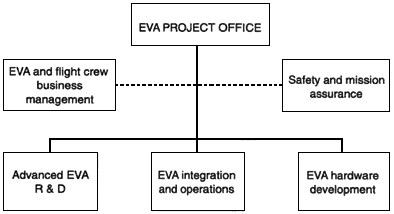
Figure 4-1
NASA EVA Project Office organizational chart. Source: NASA.
- a lunar surface EMU adapted for locomotion on the Moon, with an extremely simple, lightweight PLSS that relies on the availability of abundant oxygen from in situ lunar resources
- a Mars surface EMU adapted to that planet's colder environment, higher power requirements, and the presumed availability of hydrogen
- improvements to the current Space Shuttle and ISS EMU
Advanced R&D for EVA has suffered because there are no human lunar or Mars missions currently planned and because NASA has decided to use the Shuttle EMU for the ISS. NASA recognizes that its long-term goals will require improvements in EVA technology, but in recent years NASA's priority for EVA technology development has been low. Those who have been responsible for EVA R&D, at JSC and ARC, have attempted a number of times to stimulate the development of technologies needed for future programs. In 1993, the "Fast Track" zero-g EMU was proposed to OACT, but development was not funded. Later in 1993, after the Russians were made partners in the ISS, a common EMU between the U.S. and Russia was proposed at the Gore-Chernomyrdin level, but funding was short lived. In 1994, after responsibility for advanced EVA technologies was transferred to OLMSA, the "X-Suit" project met a similar fate. In 1995, the Office of the Chief Engineer at NASA headquarters recommended a next generation EMU development program, but it too was canceled. Like Alice's Red Queen,2 EVA has been running faster and faster, while staying in the same place.
Since 1995, NASA has been conducting internal studies of a human lunar return mission. The recent findings of possible traces of life in an Antarctic meteorite, thought to be of Martian origin, may increase support for sending an expedition to Mars in the foreseeable future. But today, NASA's goal of planetary exploration has little substance.
Currently Funded Research
The absence of a specific mission beyond the ISS is reflected in the history of funding for EVA advanced technology in recent years. In the mid-1980s, the Space Station Freedom program funded EVA research to make the station EMU feasible. Funding was about $8 million dollars in 1987. This figure dropped to $2.5 million in 1991 and has zigzagged since then with the false starts described above (see Figure 4-2). The amount for 1996 was approximately $2 million for advanced technology R&D, out of a total EVA budget of approximately
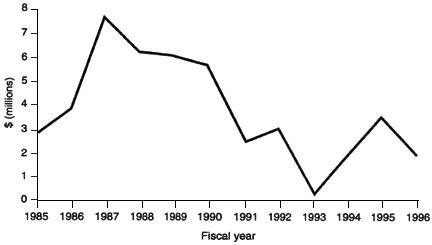
Figure 4-2
NASA funding for advanced EVA systems, 1985 to 1996. Source: NASA.
$100 million dollars. (The large majority of the $100 million was spent on operations for Shuttle and ISS EVA.)
Since 1994, most of the funding for advanced EVA R&D has come from OLMSA through the NRA process. OLMSA is now responsible for "human support" technologies in addition to its traditional responsibility for life sciences research and operations. This gave rise to the current situation where OSF is responsible for evolutionary capability improvements to the EMU, while OLMSA is responsible for long-term technology development. Other sources of funds for advanced EVA R&D are the SBIR program, center director discretionary funds at JSC, and IR&D funds from industrial companies. Tables 4-1 and 4-2 list the FY96 projects that have been proposed or are under way at JSC.
The objective of the projects described in Table 4-1 is to provide engineering solutions to real EVA problems. But many of these projects have not been funded, and the requests for future year funding greatly exceeds the current budget level. Despite the fact that for projects like these "faster is cheaper," many of these projects are stretched out from year to year due to inadequate and inconsistent funding. Some of the SBIR projects appear promising, but because EVA managers have not been involved in the final selection process (the SBIR program is run by another NASA office), there has been a tendency for these projects to be less than optimally focused on future NASA requirements.3 There are very few projects from universities (only one funded project) on the list.
Table 4-1 Current Evolutionary (or Zero-g EMU) Technology Projects
|
Project Description |
Funding Level (in $k) in FY96 |
FY the project would be completed if fully funded |
Total funding (Sk) necessary to complete project |
|
Dexterous gloves |
50 |
98 |
700 |
|
Mark III suit weight reduction |
0 |
98 |
350 |
|
Twin-bed regenerable CO2 removal |
150 |
97 |
300 |
|
Membrane CO2 removal |
0 |
99 |
300 |
|
Carbonic anhydrase CO2 removal |
0 |
99 |
300 |
|
Automatic cooling algorithm |
0 |
98 |
80 |
|
Composite water radiator |
50 |
97 |
100 |
|
Membrane water boiler cooling system |
140 |
97 |
160 |
|
Freezeable radiator |
0 |
98 |
400 |
|
Freezeable radiator (SBIR) |
0 |
96 |
70 |
|
Modular maintainable PLSS |
0 |
97 |
20 |
|
Oxygen ejector circulation |
0 |
98 |
20 |
|
Miniaturized air bearing fan electronics |
0 |
98 |
120 |
|
Membrane humidity control |
44 |
96 |
561 |
|
Small optical display |
SBIR |
97 |
700 |
|
Direct projection display |
SBIR |
96 |
70 |
|
Built-in helmet display |
SBIR |
96 |
70 |
|
Robust water pump |
SBIR |
96 |
500 |
|
Piezoelectric water pump |
SBIR |
96 |
500 |
|
Fluorescent gas sensors |
SBIR |
97 |
700 |
|
Totals |
434 |
|
6,021 |
High Priority Areas for Extravehicular Activity Technology Research and Development
Summary Finding. The NASA OLMSA program for developing advanced technology for EVA systems has recently been reorganized and does not yet have official priorities. The handful of advanced technology development projects in the present program are primarily directed at making evolutionary improvements to existing systems. Quantum advances through revolutionary technology development are not being vigorously pursued.
Finding. The first priority for developing advanced technology for EVA systems should be to help enable planetary surface missions—lunar or Martian. A good advanced technology development program for EVA should also improve the EMU and related systems that will be used on the ISS and increase the productivity of ISS maintenance and related activities.
TABLE 4-2 Current Revolutionary (or Lunar/Mars) Technology Projects
|
Project Description |
Funding level (in $k) in FY96 |
FY the project would be completed if funded |
Total funding ($k) necessary to complete project |
|
Planetary dust protection |
0 |
97 |
50 |
|
Mars thermal protection |
0 |
97 |
75 |
|
Planetary mobility of ISS and Mark III suits |
0 |
98 |
200 |
|
Ionization removal of CO2 and H2O |
0 |
99 |
200 |
|
Microencapsulated materials for cooling |
0 |
99 |
200 |
|
Metal hydride thermal control system |
80 |
96 |
516 |
|
Variable conductance heat rejection |
0 |
99 |
300 |
|
Increased thermoelectric module efficiency |
0 |
97 |
10 |
|
Convection/radiation radiator for Mars |
0 |
00 |
400 |
|
Lightweight fuel cell |
0 |
98 |
300 |
|
Minimum mass and volume airlock |
0 |
97 |
40 |
|
Liquid oxygen PLSS |
0 |
98 |
500 |
|
Variable pressure O2 regulator |
0 |
00 |
500 |
|
Carbon fullerene O2 storage |
0 |
99 |
250 |
|
Mars atmospheric pressure analysis |
0 |
97 |
40 |
|
Totals |
80 |
|
3,581 |
Recommendation 4-1. Improvements in areas where current technologies can meet mission requirements should be given lower priority. The emphasis should be placed on developing techniques that have the potential to make large improvements. In general, in the absence of a requirement for a new extravehicular mobility unit, the first priority of research and development should include the development of components and subsystems. The second priority should be systems integration, testing, and the packaging of technologies in prototypes. Specific high priorities for extravehicular activity research and development include (not in rank order):
- achieving zero prebreathe capability
- reducing the total mass of extravehicular mobility units
- minimizing consumables through advanced subsystem designs (thermal control, CO2 removal, humidity control)
- enabling adequate mobility on planetary surfaces
- protecting against dust contamination
- designing to fit multiple crewmembers
- increasing reliability and maintainability of extravehicular mobility units (e.g., possibly by using modular components and subsystems)
- improving gloves and end-effectors
Finding. Lower spacecraft/planetary base operating pressure would make the transition to EVA faster by eliminating the need for prebreathing (denitrogenation) and the risk of decompression sickness. Lower operating pressure would also have other beneficial effects for the space vehicle, such as requiring less strength in the structure, reducing atmospheric leakage to space, etc. Lower pressure would impose some requirements for heat rejection, etc., that will need to be kept in mind for the design of hardware, such as computers and compressors. On the ISS and Space Shuttle, sea-level pressure has been required to allow for the comparison of biomedical and biological data collected on orbit with data taken on the surface of the Earth.
Recommendation 4-2. For a mission to Mars or a long-duration lunar base, comparison of biomedical and biological data collected in space with data collected on the surface of the Earth will not be as important. Therefore, the requirements for sea-level operating pressure should be reconsidered.
Relationship between the Extravehicular Activity Program and the Success of Future NASA Missions
Summary Finding. Human planetary exploration is a stated future mission goal for NASA and, despite the current lack of a specific human mission beyond the ISS, NASA recognizes that improved EVA systems will be required to carry out its long-term goals.
Finding. EVA is an essential capability for planetary exploration. For a long-term planetary stay, EVAs will be required for the external maintenance of laboratories, habitats, power systems, thermal control systems, manufacturing facilities, and rovers, as well as for sample collection. The committee considers that achieving EVA capability for planetary missions is feasible, but not all of the engineering solutions needed are known, and new technologies will be required. The EVA technology development initiatives currently being pursued by NASA do not represent a complete program for producing new technology for a lunar or Mars EMU, even according to the cautious schedule projected in the 1996 NASA Strategic Plan.
Recommendation 4-3. Despite the consensus that there is no need for a new extravehicular mobility unit in the near future, NASA should identify and plan to develop the new technologies that will be crucial to the development of a lunar or Mars extravehicular mobility unit for use in the 2010 to 2020 time frame, at which time a new extravehicular mobility unit is likely to be necessary.
Program Objectives and Milestones
Summary Finding. Despite many studies, reviews, and proposals over the last several years, the advanced EVA technology program has lacked high-level
support, and NASA does not currently have specific technical objectives or milestones for the development of advanced EVA technology.
Finding. Previous planning documents (Callaway et al., 1994; Webbon, et al., 1994; NASA, 1994; NASA, 1995) show that NASA has a good understanding of the technology required for future missions. However, it is not clear that the program is currently addressing the most important needs. Neither schedules nor clear prioritization of technology needs and requirements, both of which are necessary to make prudent budgetary decisions, were available.
Recommendation 4-4. The new EVA Project Office should set specific, integrated technical objectives (with tasks assigned and scheduled) for the projects it sponsors and should work to transfer technological improvements as enhancements to the present extravehicular mobility unit where appropriate.
Overall Scientific and Technical Quality
Summary Finding. The NASA/industry/university EVA community is competent and capable of developing the technology for productive, cost-effective EMUs for microgravity, lunar surface, and Mars surface exploration. But until recently, interaction has been limited.
Finding. Most of the current work sponsored by NASA in advanced EVA technology is being done in-house, with limited industry, and very limited academic, involvement. This has restricted the awareness of complementary resources that might be available outside NASA. Many new technologies and findings by NASA related to EVA technology have not been disseminated to the external engineering and scientific communities. Few papers have been published describing NASA's ongoing work in this area.
Recommendation 4-5. NASA engineers and scientists working on extravehicular activities need to be encouraged to expand their associations with industry and universities, as well as with professional societies, through publication and attendance at national and international meetings. The advanced extravehicular activity program should also increase the participation of industry to ensure the best use of community resources and ensure that the knowledge base is present in industry to support NASA's long-term goals.
Program Requirements
Summary Finding. Studies in the last few years, as well as years of evolutionary technology improvements, indicate that the NASA/industry/university community understands the basic requirements for improvements in EVA technologies.
Finding. The current advanced EVA program has not identified a clear set of specific requirements to be used as a basis for the program. Some technologies are unique to EVA systems; the vacuum, thermal, and radiation operating environments impose unique design requirements on the PLSS, gloves, and spacesuits. However, some features of EVA suits and systems are not unique, but are based on technologies that are more likely to be advanced by non-NASA researchers, or even by NASA researchers not focusing on EVA applications, e.g., battery technology. Distinguishing between technologies unique to EVA needs and technologies that are not can be aided by the use of reference missions.
Recommendation 4-6. Extravehicular activity technology development requirements should be predicated on carefully developed reference missions to drive out the functional requirements. (Good design reference mission studies already exist and can be adapted and used by all related groups. The program should not spend significant resources on developing new reference missions but should focus its technology development efforts on unique extravehicular activity technologies.)
Recommendation 4-7. While NASA managers have already established strong lines of communication with the Wright Patterson Air Force Base Armstrong Laboratory, the program should also aggressively reach out to academic, government, and industrial sources for ideas and solutions. NASA should conduct a comprehensive search for suitable technologies that are not NASA-unique and should include active collaborations and consideration of organizations and agencies that are not generally associated with extravehicular activity research but that have relevant areas of expertise, such as the Bureau of Mines, the National Institute of Occupational Safety and Health, or the U.S. Navy.
Recommendation 4-8. NASA should direct its limited resources for extravehicular activity research on unique areas where advances are unlikely to be made by others. Outside of NASA, few organizations will be working on the design of portable life support systems, gloves, and suits for use in a space environment, while many will be working on advancing battery technologies.
Program Direction and Organization
Summary Finding. The new EVA Program Office at JSC, which now controls all NASA work related to EVA (including for the Space Shuttle and ISS), appears to have an organizational structure suited to the task. Consolidating all EVA work was a prudent step.
Finding. The current OLMSA program for developing advanced technology for EVA systems, approximately $2 million in FY96 (of approximately $100 million
spent annually on all NASA work related to EVA), is clearly too small to foster many significant technology breakthroughs for EVA systems. Furthermore, the committee was informed by program management that the first priority of the EVA Project Office is to enable present and near-term mission operations rather than to develop new technology for advanced EVA systems. This is understandable, especially considering the demands that will be associated with assembling the ISS. However, concentrating on immediate operational demands may have a deleterious effect on research responsibilities, which are also the charge of the EVA Project Office. Funding for EVA technology development appears to have four sources: OLMSA (primarily from NASA Research Announcements); the SBIR Program; the JSC director's discretionary funds; and IR&D funds from industry. Inappropriate duplication of effort does not seem to be prevalent.
Recommendation 4-9. NASA should make special efforts as it combines operations and advanced technology research under a single organization to ensure that advanced research and development receives consistent support in an organization whose top priority is to meet NASA's near-term mission needs.
Recommendation 4-10. The Advanced EVA Technology Project Office at the Johnson Space Center should increase efforts to include universities and industry in its programs (small companies have access to the program through the Small Business Innovative Research Program). The roles and tasks of all groups (NASA and non-NASA) performing extravehicular activity research and development sponsored by NASA should be defined. NASA should also make special efforts to take advantage of industry's willingness to spend its own funds on relevant research and development projects.
Synergism with Other Programs
Summary Finding. Some new and proposed cooperative projects appear promising, but there is still no apparent regular exchange of information between the EVA program and relevant work in areas such as robotics and human factors.
Recommendation 4-11. NASA's extravehicular activity systems and robotics technology development groups should increase their cooperation to maximize the efficiency of resources for accomplishing extravehicular tasks. One area where cooperation could be increased in the near-term to good effect is in maintenance and related activities of the International Space Station. New technologies and subsystems could also be tested on the International Space Station.
Recommendation 4-12. NASA should increase cooperation between the designers of extravehicular mobility unit hardware and the space human factors, advanced life support, and environmental monitoring and control communities
throughout the system design process (''concurrent engineering''). A combined effort between the EVA Project Office and the space human factors program should investigate the interaction between the human operator and the extravehicular activity system; the study should include anthropometry, suited and unsuited human performance, and human/machine interaction.
Dual-Use Technologies
Summary Finding. In the past, some EVA technologies have found use in other areas. For example, materials for liquid cooling garments and spacesuits have been used by firefighters and by people with an impaired ability to tolerate heat (such as some cases of dysautonomia and multiple sclerosis). It is possible, but not yet clear, that new portable life support technologies may find similar applications.
Recommendation 4-13. Technologies should be transferred to applications outside of NASA as appropriate, but this should be a dividend from a good project and not become a major emphasis of such a small technology development program.
References
Callaway, R., et al. 1994. EVA Assessment Report: Spring 1993–Fall 1994. The Purple Team, National Aeronautics and Space Administration. Washington, D.C.: NASA.
Hoffman, A., I. Isback, and W. Ayotte. 1988. NSTS/SS EMU Commonality Study. Hamilton Standard. Unpublished report.
NASA (National Aeronautics and Space Administration). 1994. Advanced EVA Systems Program Plan. Life and Biomedical Sciences and Application Division, Office of Life and Microgravity Sciences and Applications. Washington, D.C.: NASA.
NASA. 1995. X-Suit Study Team Report, December 1994–May 1995. Washington, D.C.: NASA.
Webbon, B., M. Rouen, and R. Callaway. 1994. Advanced EVA Systems Project Plan, Extravehicular Activity Systems Project. Washington, D.C.: NASA.


