
5
U.S.-Japan Technology and Competitiveness Trends in Key Industries
SUMMARY POINTS
-
The task force examined technology and competitiveness trends in the United States and Japan in several key industries. These case descriptions are based on discussions with industry experts at the January 1995 task force meeting and have been supplemented with background research.
-
In recent years U.S. companies in a number of industries have improved their competitive performance. In automobiles, U.S. companies have responded to pressure from Japanese competitors, and Japanese investments have contributed to overall U.S. capabilities. In biotechnology and health care, a strong fundamental research base and a financial structure enabling commercialization of technologies through the formation of new companies have been the most important factors. In semiconductor manufacturing equipment, a resurgence of the U.S. semiconductor device industry and improved cooperation between companies and with government have played major roles. In information industries, a strong research base and the dynamic U.S. market have enabled U.S. companies to play a leading role in setting de facto standards and architectures.
-
Japanese companies are still major competitors, and Japanese government and industry are still pursuing policies designed to attain global technological and market leadership. But changes are occurring as well. Japanese companies are more open to reciprocal relationships. Japanese markets are somewhat more open, particularly in consumer products. However, US-Japan differences in regulatory approaches, intellectual property protection, private-sector business practices, and other areas are likely to persist. How quickly opportunities to participate in Japanese and Asian high-technology markets expand will play a major role in determining whether the United States derives maximum economic benefit from science and technology cooperation.
AUTOMOBILES
Besides being a significant contributor to the U.S. and Japanese economies as the largest employer among manufacturing sectors, the automobile industry is increasingly a high-technology sector, owing to its growing utilization of electronics, advanced materials, and information systems. If production and engineering systems are included in the definition of "technology," it is clear that a great deal of U.S.-Japan technological interaction (competition, learning, technology transfer through direct investment) has occurred over the years and continues in this industry.
Market Access Asymmetries
The competitiveness setbacks suffered by the U.S. auto industry and the corresponding gains by Japanese manufacturers during the 1970s and 1980s have been extensively studied and documented.1 One advantage enjoyed by the Japanese auto industry from the early postwar rebuilding period is the asymmetry in market access between Japan and other major autoproducing and auto-consuming countries, most notably the United States. Although Japan committed to deregulate foreign capital and exchange controls upon joining the Organization for Economic Cooperation and Development and the International Monetary Fund in 1964, moves toward capital liberalization did not begin until the late 1960s.2 By this time the U.S. Big Three automakers were very interested in entering the Japanese market, but the Ministry of International Trade and Industry (MITI) and most of the domestic industry argued that the Japanese industry was still too weak and fragmented. Resistance by several second-tier firms to MITI's consolidation plan for the industry led to a partial opening. Chrysler and General Motors took minority equity stakes in Mitsubishi Motors and Isuzu. Ford purchased a minority share in Mazda in the late 1970s.3
These investments did not lead to significant market participation by the Big Three. The Japanese industry had already built considerable competitive strength in its protected domestic market. Before the U.S. companies could devote much effort to penetrating the Japanese market, Japanese autos were making considerable headway in the United States.
Japanese Industry Advantages
The Japanese auto industry's gains during the 1970s and 1980s were made possible by significant advantages it enjoyed over the U.S. industry in three areas.4 The first advantage was in management. General Motors and Ford were (and still are) the largest manufacturing companies in the world. Their competitive environment during the post-World War II period allowed them to focus on the lucrative U.S. market and on each other as competitors. This led to complacency and the development of organizational structures and management styles that were ill suited to the competitive environment that emerged in the U.S. market and globally in the 1970s. Relations between manufacturers and external suppliers, labor and management, and industry and government were at arms length and often adversarial.
During the late 1940s, the Japanese auto industry experienced severe business conditions and fierce labor disputes and nearly collapsed. Survival was ensured by U.S. military procurement of Japanese vehicles during the Korean War. With rapid recovery in the overall economy, Japanese companies were able to step in and meet rising demand, developing vehicle characteristics (such as smaller size) suited to the domestic market. During the industry's period of stress, companies such as Toyota became less vertically integrated and instead made greater use of external, but
often affiliated, suppliers as a cheaper alternative to direct control of the supplier chain. 5 This approach, taken out of necessity, led to the development of a more flexible auto production system, which has become popularly known as the Toyota Production System or "lean manufacturing." By the late 1970s, the manufacturing practices associated with this system ensured higher quality and productivity than the production systems of U.S. manufacturers. The quality difference was critical in allowing Japanese automakers to maintain and expand their inroads into the U.S. market during the 1980s, as consumers who had good experiences with their first Japanese cars developed strong loyalty.
A second advantage enjoyed by Japanese auto companies was in cost structure. Lower Japanese labor costs relative to the United States and the fact that wage increases lagged behind productivity gains gave Japanese auto companies a significant edge by the late 1970s. The gap was widened by a strengthening of the dollar in the early 1980s.
Several serendipitous trends in the global economy during the 1970s and 1980s also were favorable to the Japanese auto industry and hindered U.S. producers. The rapid rise in oil prices during the 1970s led to greater demand for small cars in the U.S. market, which Japanese companies were better equipped to fill. Simultaneous pressure to meet new environmental standards and increase fuel economy strained the engineering capabilities of the Big Three and contributed to declining quality and performance.
These conditions set the stage for the rapid gains made by Japanese auto companies in the U.S. market beginning in the late 1970s. The U.S. recession of the early 1980s combined with market share losses put severe stress on U.S. automakers. With the imposition of a voluntary restraint agreement in the early 1980s that limited the number of Japanese autos exported to the United States, Japanese manufacturers moved toward setting up U.S. production facilities. Table 5-1 shows trends in world auto production.
TABLE 5-1 Motor Vehicle Production
|
|
1977 |
1982 |
1987 |
1992 |
||||
|
World total (millions of vehicles) |
40.9 |
|
36.1 |
|
45.9 |
|
47.7 |
|
|
North America |
14.7 |
(36%) |
8.7 |
(24%) |
12.9 |
(28%) |
12.7 |
(27%) |
|
Europe |
15.9 |
(34%) |
14.8 |
(41%) |
17.5 |
(38%) |
17.5 |
(37%) |
|
Asia |
8.8 |
(22%) |
11.2 |
(31%) |
14.0 |
(31%) |
14.6 |
(31%) |
|
Japan |
8.5 |
(21%) |
10.7 |
(30%) |
12.2 |
(27%) |
12.5 |
(26%) |
|
Korea |
0 |
|
0.2 |
|
1.0 |
|
1.7 |
|
|
Other Asia |
0.3 |
|
0.3 |
|
0.8 |
|
0.4a |
|
|
Rest of the world |
|
1.5 |
|
1.4 |
|
1.5 |
|
2.9 |
|
a The 1992 figure does not include China. SOURCE: Compiled by the American Automobile Manufacturers Association. |
||||||||
|
5 |
Japan's auto industry provides support both for those who argue that Japanese industrial policy was a key to industrial development, and those who argue that it had a marginal impact. For an account of business-government relations in Japan's auto industry, see Genther, op. cit. Chapter 5 deals with the development of the Japanese auto parts industry. |
U.S. Resurgence
Over the past 15 years or so, the U.S. auto industry has been engaged in the sometimes slow and difficult effort of responding to Japanese competition and closing these gaps. Prompted by competitive pressure and, some have asserted, the demonstration effect of Japanese manufacturing operations in the United States, U.S. automakers and suppliers have made significant strides in manufacturing and product development performance.6 In the mid-1980s, the dollar depreciated significantly against the yen, and another large rise in the value of the yen occurred in 1993-1994. These currency trends reversed the cost advantage that had been enjoyed by vehicles built in Japan.
Trends external to the industry also contributed to a U.S. resurgence. The upward trend in oil prices was reversed in the mid-1980s, and oil has been moderately priced since that time. This has dulled the appetite of U.S. consumers for smaller vehicles and sparked increasing demand for larger vehicles such as minivans, light trucks, and sport utility vehicles, categories that U.S. companies pioneered and are better positioned than the Japanese to serve.
Over the 1993-1994 period, U.S. automakers reaped the benefits of these accumulated favorable trends, as rising demand produced record profits and market share gains. Chrysler's resurgence has been particularly conspicuous, while GM's market share has continued at a level far below that of the mid-1970s. At the same time, the Japanese auto industry suffered from sluggish demand in the domestic market and cost pressure on exports of vehicles and parts to the United States. Most Japanese automakers reported losses during this period. Some of the second tier Japanese producers, such as Mazda, have suffered a great deal during the downturn.7
More recently, the Japanese vehicle market has recovered somewhat, the dollar appreciated considerably during 1995 and 1996, and conditions for Japanese automakers have stabilized and improved. Even during the 1993-1994 period, Japanese automakers as a whole did not lose a significant amount of market share in the United States, particularly in passenger cars. Transplant production has played an important role.
Future Technology and Competitiveness Issues
The main issues for the world auto industry over the coming decade are (1) continuous improvement in manufacturing and product development performance to deliver value to customers—a fundamental competitive necessity for vehicle manufacturers and suppliers; (2) achieving effective participation in emerging markets, particularly in Asia, while balancing related technology and production transfer demands—a key determinant of growth; and (3) companies and national industries may create competitive advantage for the twenty-first century based on new technologies such as "intelligent" vehicles and highways. The Japanese and U.S. auto industries, and individual companies, bring different strengths to this competition.
Manufacturing and Product Development
High-quality manufacturing and effective product development performance are fundamental competitive necessities for auto manufacturers seeking to establish and maintain leading
positions in the most sophisticated and profitable markets. Although the top Japanese companies remain the world benchmarks in these areas, U.S. companies have made considerable strides in recent years.8 During the 1990s, for example, Chrysler adapted a number of lessons from Japanese "best practices" and improved its product development process considerably.
One of the most significant challenges faced by the Japanese auto industry in recent years has been to maintain manufacturing and product development excellence while reducing costs. Although the yen has stabilized and weakened recently, cost pressure has been acute, particularly in the U.S. market for cars exported from Japan. The Japanese industry has been aggressively adjusting to these imperatives. Shifting production to the United States, Asia, and elsewhere is one approach. Japanese companies have made modest efforts to procure components for their U.S.-assembled vehicles in Asia in order to cut costs. Table 5-2 shows several examples. For Japanese manufacturers and suppliers to retain long-term competitive advantage, it will be necessary to globalize manufacturing while maintaining productivity and quality.
Japanese companies also have sought to ensure the continued competitiveness of domestic operations by increasing the reusability of parts, cutting management staff, and in some cases slowing new product introduction cycles.9 Japanese automakers are encouraging their suppliers to sell to a broader base of customers to support higher volumes and lower costs, encouraging weaker suppliers to merge and increasing purchases from nontraditional suppliers.
Relationships between manufacturers and suppliers are critical to overall manufacturing and product development performance. Automobile value added is likely to come increasingly from the incorporation of electronics, new materials, and other innovations originating outside the automobile manufacturers themselves.10
TABLE 5-2 Examples of Asian Parts Utilized by Japanese Automakers in U.S.-Built Vehicles
|
Company |
Part |
Country |
|
Toyota |
Cylinder block |
Thailand |
|
Honda |
Cast and forged components |
Chinaa |
|
Mitsubishi |
Press components |
Korea |
|
Mazda |
Radiator |
Korea |
|
a Under consideration. SOURCE: Nihon Keizai Shimbun, September 15, 1995, p. 11. |
||
The U.S. supplier base is characterized by a relatively small number of large, technologically sophisticated companies that compete on a global basis and smaller second-and third-tier suppliers. In the decade or so since it entered the automotive seating business, Milwaukee-based Johnson Controls, Inc. (JCI) has established itself as a leading representative of the first-tier supplier group.11 JCI supplies each of the U.S. Big Three automakers with seats and supplies almost all of Toyota's vehicle programs outside Japan.12 JCI credits its relationship with Toyota with helping to hone its manufacturing and product development capabilities. Since being selected to supply seats to NUMMI, the Toyota-GM joint venture, JCI has worked to incorporate the lessons of continuous improvement into its overall manufacturing operations. JCI has also contributed to moves on the part of U.S. auto manufacturers, most notably Chrysler, toward adapting Japanese methods of product development that involve greater technological and engineering responsibilities for first-tier suppliers.13 For the future, JCI is focusing on incorporating higher levels of proprietary technology into its automotive seating systems and leveraging its capabilities to boost its presence outside the United States. It recently acquired Prince, an auto supplier with strong electronics technology.
Although a number of U.S. auto manufacturers and suppliers are pursuing continuous improvements in manufacturing and product development by adapting Japanese practices and have achieved world-class performance, many others, particularly smaller suppliers, have not yet implemented these approaches successfully. Recent studies indicate that Japanese auto suppliers remain the most productive and deliver the highest quality.14
Global Strategies and Approaches to Rapidly Growing Asian Markets
Tapping rapidly growing markets in Asia will be key to future growth for U.S. and Japanese automakers. Asia has long been a secondary overseas market focus (after the United States) for a number of Japanese auto companies. These efforts have given Toyota, Mitsubishi, and others a head start in several of the most important markets.15 In recent years, Japanese manufacturers have increased their investments and marketing activities in Asia. For example, Toyota hopes to build a leadership position in the rapidly growing Asian auto market through the development of its "Asia car."16
Japanese auto suppliers belonging to a particular group or keiretsu often invest in Asia as a group. For example, several of Toyota's suppliers have announced plans to launch manufacturing
facilities in China.17 In September 1995, 70 Japanese auto suppliers affiliated with Nissan announced plans to transfer technology to counterparts in Korea's Samsung group.18
Although it had appeared until recently that most of the U.S. auto industry had "written off' Asian markets besides China, the Big Three and a number of major suppliers are now pursuing more aggressive initiatives. With trade barriers in Asia likely to fall in coming years, concerns about tying up large fixed investments to serve several small segmented markets are receding. Leveraging their recent success in the domestic U.S. market and a desire on the part of some Asian nations to balance an already large Japanese direct investment presence, it appears much less likely at this writing that U.S.-based companies will be "left behind" in Asia.
During 1995, U.S. automakers stepped up plans to increase their presence in Asia. Ford, which has 11 existing plants and engineering sites in Asia, announced plans to invest $53 million in two component plants in Thailand.19 China's leading automaker chose General Motors for a $1 billion venture, and as of this writing GM was in the process of choosing a location for a large manufacturing operation in Southeast Asia. Chrysler, which has operations to assemble Jeep Cherokees from kits in Thailand, Malaysia, and Indonesia, is considering plans to build a small affordable car for Asian markets such as Vietnam and India.20 A number of U.S.-based auto suppliers also have announced various investment and joint venture plans in China.21
Although Japanese and U.S.-based companies are taking somewhat different approaches to investment and market participation in Asia, they will face similar challenges in managing technology transfer in order to ensure a long-term presence and avoid aiding potential competitors. Willingness to transfer technology was reportedly a factor in China's decision to choose GM as the foreign partner for its sedan venture.22 Proton, the Malaysian auto company, consistently requests expanded technology transfer from its Japanese partner, Mitsubishi Motors.23
Access to the Japanese market remains an issue for U.S. automakers and suppliers. Recently, there have been a number of indications that the Japanese market is becoming more open to imports. Sales of imported vehicles have grown rapidly in Japan in recent years, albeit from a very small base, partly due to the cost advantage enjoyed by imports.24 In 1995 the United States and Japan reached agreement on measures to increase sales of imported autos and auto parts in Japan after contentious negotiations.
The access problems of foreign auto suppliers are somewhat different than those of vehicle producers.25 Access to the Japanese replacement-parts market would likely be improved through
the elimination or easing of several specific regulatory requirements. In the original-equipment market, however, Japanese business practices may continue to act as a ceiling on foreign participation, regardless of price and quality considerations.26 Even in cases where Japanese automakers and first-tier suppliers purchase foreign-made components for vehicles intended for export or made in U.S. transplant facilities, they are reluctant to utilize the same parts for autos made and sold in Japan. Even during the 1994-1995 period, when many Japanese automakers were losing money and were eager to cut costs, proposals by U.S. suppliers that would have led to significant cost savings were reportedly rebuffed.27
Although many U.S. parts makers will continue to be largely shut out of the Japanese domestic OEM market, the experience of JCI and other U.S. suppliers indicates that a focus on supplying the production of Japanese companies outside Japan can deliver many of the market participation benefits—revenue for future technology development and learning from demanding customers—that contribute to maintaining and enhancing technological capabilities. Since the production of Japanese auto companies outside Japan is likely to grow much more quickly than production inside Japan, this will represent a significant growth market during the coming decade.
Advanced Technology
Advanced technology is increasingly incorporated into automobiles. One U.S. program aimed at speeding the development of new technologies and their incorporation into automobiles is the Partnership for a New Generation of Vehicles (PNGV). PNGV is a partnership between a number of U.S. government agencies and the Big Three automakers. The goals are to improve competitiveness in manufacturing, implement commercially viable innovations from ongoing research in conventional vehicles, and develop vehicles that can achieve up to three times the fuel efficiency of comparable 1994 family sedans.28
Over the next several decades there is a good possibility that more fundamental technological shifts will occur in the auto industry. These include increasing utilization of electric and other alternatively powered vehicles to reduce emissions and increase energy efficiency and advances to facilitate higher traffic volumes and greater safety through the use of advanced vehicle navigation and control systems.
Electric vehicles are one area of significant R&D effort in the United States and Japan. Table 5-3 compares the U.S. and Japanese approaches toward electric vehicles. In contrast to U.S. efforts, which have focused on research and development and mandates to establish a market, approaches by Japan and several other countries have placed relatively more emphasis on public demonstration projects for government and utility fleets that establish public recharging and maintenance facilities.29 The Japanese government also helps support the Japan Electric Vehicle Association (JEVA), which acts as an information clearinghouse and promoter.30
TABLE 5-3 Key Elements of Electric Vehicle Programs
|
|
United States |
Japan |
|
Number of electric vehicles in operation, December 1994 |
1,000 |
1,600 |
|
Goal for Year 2000 |
70,600 (based on state requirements) |
200,000 (national target) |
|
Purchase programs and incentives |
$4,000 federal tax credit for tax credit for fleets; some state incentives; California-type mandates (six states) |
50% national cost subsidy; various local sudsidies; reduced purchase and possession tax; 7% business tax credit; subsidized leasing |
|
Vehicle and infrastructure |
small fleet demonstrations |
Ecostation 2000; several national and local demonstrations |
|
Vehicle and battery research |
U.S. Advanced Battery Consortium |
Lithium battery project |
|
SOURCE: Adapted from U.S. Congress, General Accounting Office, Electric Vehicles: Likely Consequences of U.S. and Other Nations' Programs and Policies (Washington, D.C.: U.S. Government Printing Office, 1994) |
||
Electric vehicles face significant technological and market barriers. Current electric vehicles utilizing lead acid batteries require difficult trade-offs in performance, range, and ease of recharging. Batteries are therefore the focus of electric vehicle R&D efforts. The United States and Japan appear to be the only countries with large-scale publicly-funded advanced battery programs. In the United States the Big Three automakers formed the U.S. Advanced Battery Consortium (USABC) in 1991, and later that year reached agreement with the U.S. Department of Energy (DOE) and the electric utility industry to cooperate in support of research and testing of advanced batteries.31 The program has involved contracts with battery developers and cooperative research and development agreements with DOE labs to support a variety of approaches toward battery technology development and testing. As the name suggests, Japan's main battery research program, the Lithium Battery Electric Power Storage Research Association (LIBES), is also focused on lithium batteries.
There are several interesting differences between the U.S. and Japanese efforts. First, the USABC involves a significantly higher overall level of funding than LIBES, but the Japanese effort does not include development of intermediate technologies as USABC does. Second, in contrast to USABC, where participation by automakers is a central element of the program, auto
manufacturers are not direct participants in LIBES. Third, because the U.S. industrial base in rechargeable batteries is somewhat thin, several of the participating battery companies are non-U.S. firms, and most of the participating U.S. battery firms are either small or are not in the battery business, one exception being Duracell. No foreign-owned companies are participating in LIBES. Another interesting aspect of the Japanese program is that it does not include Sony, the current market leader in lithium ion batteries for portable electronics applications.
Japan currently leads the world in developing and mass producing rechargeable batteries.32 Research on a rechargeable lithium ion battery was first reported in a scientific conference in Japan in 1985.33 Although they have a number of advantages, and Japanese companies are already marketing small lithium ion batteries for use in a variety of portable electronic devices, making the technology feasible for use in electric vehicles is a difficult long-term proposition. Still, the Japanese government program encourages the makers of batteries to invest in long-term research. Even if lithium ion batteries are not widely used in future automobiles, this basic research could deliver benefits in consumer electronics and in other downstream sectors. Japanese battery makers also appear to be taking a global view toward marketing and partnerships. Although they have only been commercialized in the past few years, Japanese companies have already announced several joint ventures and other plans to produce lithium ion and other advanced batteries outside Japan.34
Intelligent vehicle and highway systems are also a focus of government and industry technology development efforts in the United States, Japan, and Europe. Efforts are driven by a common need to improve traffic flows and safety on increasingly crowded highways. Intelligent vehicle and highway systems are a huge potential market, not only in developed countries but in rapidly growing Asian economies where traffic congestion is already a major problem in large cities. Vehicles and systems will draw on a wide range of technologies, including sensors, electronics, radar, human interface, information systems, and image processing. The Japanese government has increased R&D in this area in recent years. Five ministries budgeted 62.5 billion yen for this effort in fiscal 1996 (over $500 million at current exchange rates), compared with U.S. government funding of $222.8 million.35
Outlook for 2007
-
While Japanese companies still hold a manufacturing and product development edge, the U.S. auto industry has made considerable progress in catching up. A more level playing field is emerging in the industry as access to the Japanese market improves and Japanese-owned manufacturing and R&D facilities in the United States make greater contributions to U.S. employment and living standards. Although the nationality of companies is becoming less of a differentiating factor in the auto industry, the US. economy still derives relatively greater benefit from the success of U.S.-based companies.
-
Japanese and U.S. companies will likely remain in the forefront of the global auto industry. Current production trends are likely to continue for at least the next few years. Although appreciation of the dollar in 1995 and 1996 slowed progress, the US. auto trade deficit with Japan will likely continue to shrink somewhat.
-
Asia will be a major competitive battleground of the global auto industry. The ability to invest will depend on strengths built in core developed-country markets as much as effective Asia strategies per se. It is likely that firms from neither country will be able to dominate.
-
The South Korean industry will be a major wild card over the next few years. South Korea is building significant capacity, and Korean companies could pose a challenge to U.S. and Japanese firms within the next decade. The European industry is likely to experience significant consolidation.
-
Both U.S. and Japanese companies will be prominent in the emerging global supplier base, although second-and third-tier companies in each country will face significant challenges. U.S. suppliers will need to make further progress in implementing the Toyota Production System, and Japanese suppliers will need to follow their customers offshore and develop new international business. The ability of foreign-based companies, particularly suppliers, to participate in the Japanese market is still an issue.
ADVANCED MATERIALS
The field of advanced materials is comprised of a diverse group of technologies, including high-performance glass and ceramics, polymers, specialty metals, precision coatings, and composite materials. They are applied in a wide range of industries, including chemicals, electronics, aerospace, and automobiles. A comprehensive evaluation of U.S.-Japan capabilities and cooperation is beyond the scope of this study. Fortunately, a number of evaluations of specific areas of advanced materials research and application have been done in recent years by the Japan Technology Evaluation Center.36 This section will review several general features of technology development and commercialization activities in the two countries and the implications for the future.
General U.S.-Japan Differences
The United States and Japan both possess strong capabilities in advanced materials R&D and commercialization. U.S.-based companies tend to be strong in such areas as gas membranes, polymers and polymer composites (although Japanese firms are strong in carbon fiber), specialty metals (particularly for aerospace applications), and utilization of modeling and simulation in the development of materials. Japanese firms are strong in coatings (as are German companies),
ceramics and ceramic composites, and primary metals. U.S. and Japanese companies are nearly equivalent in liquid membranes, optoelectronic materials, and superconducting materials.37
Relative U.S. and Japanese strengths have been shaped by factors in their respective business environments. For example, the strength of Japanese companies in electronics and the large potential market for blue lasers and light-emitting diodes in optical data storage and other areas has spurred Japanese companies to invest significant amounts in R&D to develop the enabling materials.38 U.S. strength in aerospace and large defense-related government investments in aerospace materials development underlie U.S. leadership in this area.
Japanese companies also have tended to be strong in materials fields that require a long-term investment focus, call for persistent efforts to lower costs and improve quality in manufacturing, and are not highly profitable. Long-term investment focus in relatively low-profit fields has been aided by the willingness of firms to accept lower profits, keiretsu and other close links between companies that lower market risks, and in some cases the preference of Japanese industrial customers for Japanese-made products, even when they cost more. U.S. companies, with very different incentives, are not able to operate in the same way. The business environment in Japan is changing to some extent, particularly in consumer-driven markets. There is less willingness to settle for low profits and buy Japanese products even where comparable products cost less. However, powerful interests still favor the status quo.
Concentrated Supply and Dependence
One very important application of advanced materials is ceramic semiconductor packages. The global market for these products is dominated by Japanese companies, with Kyocera being the largest. Only a few U.S.-owned suppliers remain. Coors Electronic Package Company, a division of ACX Technologies, sells products on the open market. IBM also is strong in this area but has traditionally been a captive supplier.
Several years ago the Department of Commerce conducted an investigation of the national security implications of U.S. dependence on Japan for ceramic packages.39 Ceramic packages are critical components in military systems. Ultimately, the U.S. government decided not to limit Japanese imports or directly subsidize increased U.S. production of ceramic packages but did launch an R&D program to strengthen the U.S. technology base. One of the possible economic risks for the United States of dependence on Japanese or other foreign sources of critical components, materials, and manufacturing equipment lies in the possibility that suppliers may delay or deny access to the most advance products to U.S. customers. This would give Japanese customers a competitive edge through preferred access.40 Although Japanese companies still control large global market shares in some critical supplier areas, particularly electronic materials, concern over this issue has declined somewhat in recent years as the Japanese industry's momentum in global electronics has slowed and competition has reappeared in some areas where Japanese companies had established dominance.
Another possible long-term risk arises from the potential for a given technology to become more important over time. If the United States does not possess capabilities in such an area, the U.S. economy may be at a disadvantage in developing next-generation products. Some experts believe, for example, that ceramic packages will increasingly shift from a passive role to a more active and critical role in electronics systems.41 In this context some experts believe that government investments to encourage vertical partnerships between U.S. ceramic users and suppliers can help maintain U.S. capabilities and ensure that U.S. companies are able to pursue technological and product opportunities made possible by more advanced packages.
Market Participation and Technological Capabilities
Just as suppliers of advanced materials can provide a competitive edge to their customers, makers of advanced materials benefit from close interaction with demanding users. Box 5-1 describes an important example and illustrates that the ability to participate in the Japanese market is a major determinant of whether the United States will derive maximum economic benefits from science and technology interaction with Japan. An expanded discussion of this point is included in Chapter 6.
Outlook for 2007
Because the advanced materials field is composed of such a wide variety of industries and technologies, it is difficult to characterize the outlook for the field in a general way. Since advanced materials are intermediate goods sold to businesses, shifts in markets and competition will be heavily influenced by general changes in business practice and culture in Japan. Key issues include whether the Japanese business climate will continue to allow companies to maintain long-term R&D investment in areas that are only marginally profitable, whether a new market in advanced materials emerges of a scale comparable to current demand for electronic ceramics or glass for fiber optic cables, and whether new competitors emerge from other countries.
BIOTECHNOLOGY AND HEALTH CARE
Broadly defined, biotechnology includes "any technique that uses living organisms (or parts of organisms) to make or modify products, to improve plants or animals, or to develop microorganisms for specific use."42 Today, biotechnology is applied in health care, agriculture, the environment, and other areas. Health care is a very broad industry category that includes pharmaceuticals, medical equipment and supplies, hospital management, and medical information management. The focus of this section is mainly on biotechnology, with some contextual discussion of health care markets and products outside biotechnology. As is the case with the information industries, the difficulty in formulating a neat definition illustrates the fast moving character of research and innovation in this field.
Background
Since Genentech was founded in 1976, there has been an explosion in research and commercialization in biotechnology, and the United States has been at the center of this activity. U.S. biotechnology companies number over 1,300, with nearly $13 billion in annual revenue and
|
Box 5-1 The Link Between Participation in the Japanese Market and U.S. Technological Capabilities: Glass for Flat Panel Displays Coming Inc., is the leading supplier of substrate glass for the production of active matrix liquid crystal displays (AMLCDs), the largest and most rapidly growing segment of the flat panel display market AMLCDs are widely utilized in laptop computers and a range of more specialized applications, including avionics. Japanese companies have pioneered the commercialization of AMLCDs and currently dominate the AMLCD market holding a 98 percent share in 1994. For Corning, establishing and maintaining a strong position in the glass substrate market, estimated to be about $250 million in 1996, has therefore depended on participation in the Japanese market. In light of the rapid advances in product and process technology that have characterized AMLCDs in recent years, close contact with customers and the incorporation of customer feedback into technology and product development efforts have been critical for Coming and will likely remain so. An example drawn from Corning's participation in the AMLCD glass substrate market illustrates the importance of market participation for maintaining the technological capabilities underlying competitiveness. This example shows how staying ahead in a technology often depends on seeking out and utilizing feedback from demanding customers. Manufacturing glass substrates for AMLCDs involves continuous improvement in achieving uniform thickness, eliminating particles, and minimizing warp. By the early 1990s, it had become clear to Coming that its existing glass composition had several drawbacks that would need to be addressed in order to meet the future anticipated needs of display makers. It was also clear that a number of competitors had launched aggressive development programs for next-generation AMLCD substrate glass. Developing the improved glass composition involved, at the outset an effort to specify the technical requirements of users and the necessary physical characteristics of the glass. Coming devised a demanding set of requirements for the new glass and toured R&D labs of display makers in the United States, Europe, and Japan to determine whether these specifications would meet the anticipated needs of customers. All of the companies visited except for one agreed that the specifications would meet their future needs. This customer, one of the largest Japanese display makers, recommended that Corning change one of the specifications. Corning reexamined its assumptions and decided to develop its glass with the specification suggested by this Japanese customer. Now that the improved Corning substrate and other glasses are coming onto the market, it is clear that the Japanese customer was right The performance enabled by the change distinguishes Corning's glass from competing products. SOURCE: Communication with Corning Inc., January 1996. |
over 100,000 employees.43 The U.S. pharmaceutical industry constitutes an even larger force, with shipments exceeding $60 billion per year.44 Japan has a significant pharmaceutical industry, but it has traditionally trailed the United States and Europe in sales and innovation.45
Several factors contribute to U.S. strength in biotechnology and health-care-related fields. Perhaps most important is the strong federal government support for fundamental research in biomedical fields over many years through the National Institutes of Health and other agencies. Scientific discoveries in biotechnology are more closely linked to product development than is the case in other fields, such as electronics.46 A second factor contributing to U.S. strength in biotechnology is a well-developed private equity market and institutions to support investment in commercializing technology through the creation of new firms. Business culture plays a role as well. In contrast to Japan or Western Europe, a U.S. entrepreneur whose high-risk commercial venture fails does not necessarily compromise her or his future career. To the contrary, such a failure may be seen as "paying one's dues." The United States also has a large and growing market for health care products and is relatively open to improved treatments and new technologies.
As the first U.S. "biotech boom" unfolded in the early 1980s, Japanese policymakers and industry were quick to see the area as one with significant future potential, and organized several government-industry initiatives to improve Japanese capabilities. At the same time, Japanese companies, both traditional pharmaceutical ones and nontraditional players from food, cosmetics, heavy equipment, and other sectors, formed a large number of linkages with emerging U.S. biotechnology companies to gain access to their technology.47 Japanese companies also formed links with U.S. research universities and institutes and established a number of R&D facilities in the United States.48 Japanese companies were not alone in these efforts. In recent years large European pharmaceutical companies have made significant direct investments in U.S. pharmaceutical and biotechnology companies. In 1993, 26 percent of R&D spending by foreign affiliated companies in the United States was in pharmaceuticals, and 38 percent of all U.S. industry R&D expenditures in pharmaceuticals were made by foreign affiliates.49
The early and mid-1990s witnessed something of an "internationalization pause" for Japanese companies.50 Several factors were responsible, including Japanese industry restructuring and retrenching during the post-bubble recession, the fact that only a few of the many links with U.S. companies and universities had resulted in significant payoffs, and a trend toward cheaper and less-risky deals as Japanese partners moved down the learning curve of collaborating with small U.S. companies developing unproven technologies. The U.S. biotechnology industry itself has experienced its own ups and downs, and expectations have
tended to oscillate wildly as particular biotechnology products become successful or produce disappointing results in clinical trials.
Today, the United States still enjoys broad leadership in biotechnology research and commercialization. Using a -1 to +1 scale, with zero being parity, a recent Japanese government report ranks Japan's level of basic research in life sciences as -0.9 compared with the United States and -0.5 compared with Europe.51 However, there are several U.S.-Japan issues and trends in areas such as investments in R&D capabilities and market participation that will have an impact on U.S. capability to derive maximum benefit from research and U.S.-Japan links in the future.
Current Issues
Research and Commercialization Capabilities
Although not conducting biomedical research on nearly the scale that the United States does, Japan is persisting in its efforts to improve its fundamental research base and is increasing support for targeted and innovative programs. One example with a significant track record is the Science and Technology Agency's Exploratory Research for Advanced Technology (ERATO) program, which has been in operation since the early 1980s. In a departure from traditional Japanese funding patterns in which small grants are funneled to senior researchers, ERATO provides five-year nonrenewable funding for high-risk, cross-disciplinary research by diverse teams primarily composed of younger researchers.52 Life sciences projects have become more prominent among ERATO efforts over the years. A recent U.S. evaluation of ERATO found that the project has supported a significant amount of high-quality research and has had an important and positive impact on Japan's research culture.53 Since 1995, the main Japanese research funding agencies have all launched large new programs to support basic research, and each of these has a significant biotechnology or life sciences emphasis.54
In addition to increased funding for innovative programs in Japan, international links, particularly to the United States, are still an important element in the strategies of Japanese companies and government agencies to improve capabilities in biotechnology. Although these linkages have not yet turned Japan into a commercial biotechnology powerhouse, a large number of Japanese life scientists have gained experience as visiting researchers at the National Institutes of Health.55 Japanese companies are continuing efforts to work with U.S. universities and U.S.
biotechnology companies. In the long run, the commercialization mindset and familiarity with high-performance research and product development practices is serving to upgrade skills in Japan. 56
Biotechnology has been a focus of concerns about asymmetrical participation in government supported R&D. The large number of Japanese and other foreign researchers at NIH contrasts with the small number of U.S. life science researchers in Japan. Assessing the cost and benefits, and developing approaches to bring about greater symmetry, are not straightforward exercises. For example, a scarcity of good opportunities for post doctoral fellowships in Japan lies behind the asymmetry, encouraging Japanese researchers to do their "post-docs" overseas, and discouraging foreign researchers from traveling to Japan. The training and experience that these researchers gain is undoubtedly a benefit for Japan.57 The United States benefits as well, since Japanese and other foreign researchers serve as a high quality, relatively low cost human resource, helping NIH to undertake its research missions more efficiently. The committee believes that the best way to redress this asymmetry is for Japan to continue efforts to improve its own research base and expand opportunities for "post-docs," and for the United States to continue to support programs that send U.S. researchers to Japan.
Japanese government support for life sciences and biotechnology research also has contributed to U.S. capabilities. The Human Frontier Science Program was established in 1989 with Japanese initiative and funding to support international collaboration in multidisciplinary brain research and molecular biology (see Box 2-2). The program provides support for about 20 U.S. research teams and 10 research fellows each year and may serve as a positive example of Japanese international scientific leadership. The ERATO programs also frequently involve U.S. researchers, and the Japanese government has increased support for a range of international research exchanges. As for corporate links, one of the most successful has been the alliance between Amgen and Kirin Brewery.58 Kirin's participation in a joint venture with Amgen was critical in the effort to commercialize Amgen's first two blockbuster products, Epogen and Neupogen. More recently, Kirin is reported to have made important technological contributions in the development of thrombopoietin, a blood platelet formation factor.59
Market Asymmetries: Regulation and Intellectual Property
U.S.-Japan competitiveness and cooperation in life sciences and biotechnology are also affected by market factors. Under the post-World War II Japanese policies of limiting imports and inward direct investment, the Japanese pharmaceutical industry was able to grow mainly by licensing foreign products and developing "me too" compounds. Under Japan's system the Ministry of Health and Welfare is responsible for drug approval and also sets the reimbursement schedule for drugs and medical procedures under Japan's national health insurance system. Since reimbursement levels for drugs have traditionally been more generous than those for medical
procedures and Japanese doctors rather than pharmacists dispense most drugs in Japan, there are strong incentives for doctors to prescribe medication.
In recent years the environment for foreign direct investment in Japan has improved, and the pricing system for drugs has been changed to reward more innovative treatments, with the reimbursement price declining every year after a drug is introduced.60 Since Japan is an affluent society whose population is aging rapidly, it is a very attractive pharmaceutical market. Large U.S. and European pharmaceutical companies have been active in recent years in acquiring Japanese companies, acquiring full ownership of marketing joint ventures with Japanese firms, and establishing R&D labs and other business infrastructure.61 In addition, the trend toward mergers between U.S. and European pharmaceutical companies has led to consolidation and streamlining of operations in Japan.
While larger U.S. and European companies are better able to access the Japanese market today than in the past, it is still difficult for smaller U.S. biotechnology firms. One issue is Japan's drug approval system. Although on average the system does not appear to be more onerous or difficult to deal with than the U.S. system, the unification of industry promotion and regulatory power within the Ministry of Health and Welfare has sometimes resulted in manipulation of the process to favor domestic corporate interests. One example is the Japanese government's delay in stopping the distribution of HIV-tainted blood in the early 1980s because screening and treatment of the products would have imposed higher costs on industry. About 2,000 people were infected and about 400 have died so far because of this negligence, which was only recently exposed.62 Conflicts of interest and lack of expertise are problems in the Japanese drug approval system, which sometimes leads to the approval of domestic drugs before risks are adequately understood or delays in approval of non-Japanese drugs whose benefits are evident.63 Although larger foreign pharmaceutical companies have the resources to overcome these obstacles, smaller U.S. biotechnology companies often find it difficult to establish an independent marketing presence in Japan.
Intellectual property protection is another key market access issue that is particularly important to biotechnology companies. Several features of the Japanese patent system, including the approval process and judicial enforcement, have posed difficulties for U.S. companies in the past. These include a pregrant opposition system that allows competitors to hold up or narrow the scope of a patent, lack of foreign language filing, and the general narrower scope of Japanese patents compared with U.S. patents.64 Due to the lengthy product development and approval process for pharmaceutical products, emerging U.S. biotechnology companies have to make substantial investments before realizing a revenue stream from their products, and a strong patent position is a key asset in gaining investment backing. When intellectual property protection in
Japan is problematic, the U.S. firm is in a weak position to participate in the Japanese market directly and feels pressure to license its product to a Japanese partner. Meanwhile, Japanese pharmaceutical companies have been active in patenting human genes in the United States.65
In 1994 the U.S. and Japanese governments signed two agreements to address intellectual property issues.66 Under the agreements, pregrant opposition by third parties would be ended, foreign language filing would be allowed, an accelerated examination system would be instituted, and the practice of awarding dependent compulsory licenses would be ended under the Japanese system. The United States was obligated to change its patent term from 17 to 20 years and to begin publication of pending applications 18 months after filing. In light of the importance of entrepreneurial companies in commercializing new technologies in the United States, and the critical role of intellectual property protection in determining whether U.S. innovators will be able to participate in the Japanese market on favorable terms, it will be important for the United States to monitor implementation of the agreements, and to continue efforts to improve intellectual property protection in rapidly growing markets.
Outlook for 2007
-
Japan's R&D strength in life sciences and biotechnology is likely to rise considerably. If the US. government and U.S. industry continue to invest in U.S. R&D and capability to access developments in Japan, it is possible that cooperation can build on positive examples, such as the Human Frontier Science Program, and deliver significant mutual benefits.
-
In pharmaceutical and biotechnology products, large foreign firms are likely to improve their position in Japan. Japanese firms will continue to be pressed. However, unless regulatory and intellectual property-related market barriers to small US. biotechnology companies are addressed, Japanese companies will continue to enjoy significant bargaining power vis-à-vis small US. biotechnology companies.
SEMICONDUCTOR MANUFACTURING EQUIPMENT
Closely linked to the rapid competitive advances made by the Japanese semiconductor device industry during the late 1970s and 1980s were parallel gains by Japanese firms in the semiconductor manufacturing equipment (SME) and materials sectors. Corresponding rapid market reversals suffered by U.S. equipment makers raised the possibility that there would be no competitive U.S.-based presence in some critical areas of the microelectronics supplier infrastructure. Some observers raised serious national security and economic concerns.67 Dependence on Japan for categories of semiconductor equipment could lead to aggravated problems for U.S. device makers if Japanese equipment companies denied or delayed access to advanced products already available to Japanese chipmakers.68
Beginning in the second half of the 1980s, the United States took several policy steps aimed at slowing or halting the decline in semiconductors and related areas. The 1986 Semiconductor Trade Agreement with Japan aimed to stop the dumping that occurred during the market slump of the mid-1980s and improve access to the Japanese market. In 1987 a group of U.S. semiconductor companies and the U.S. Department of Defense formed the SEMATECH R&D consortium.69
Because of the SME sector's role as a key supplier industry for electronics more broadly, trends in this sector will continue to be watched closely. It is particularly appropriate to assess U.S.-Japan competitiveness in SME for this study because the industry has been a focus of U.S. competitiveness policy debate and serves to illustrate many of the generic strengths and weaknesses of the industrial and technology development structures of the two countries. An examination of recent trends and possible future developments here could shed light on the sustainability of recent U.S. competitiveness gains and the effectiveness of policy and industry approaches that have been taken in recent years.
Industry Evolution
The development and competitive dynamics of the SME industry are tightly linked to conditions in its customer base, the semiconductor device industry. In the early days of the semiconductor industry—the late 1950s and early 1960s—device makers such as Texas Instruments grew their own materials and designed and built their own tools.70 This early period witnessed the growth of several specialized manufacturing equipment and materials companies such as Materials Research (sputtering equipment), Geophysics Corporation of America (step-and-repeat camera), and Thermco (diffusion oven).
However, it was only in the late 1960s and early 1970s that the SME industry truly emerged. Higher levels of device integration and performance, along with more stringent and sophisticated manufacturing demands, raised equipment development costs. At the same time, abundant technological opportunities and the availability of capital to fund ventures encouraged a stream of managers from existing device makers to form new firms. As capabilities grew in these dedicated equipment vendors, even large device makers increasingly turned to them for new process technology advances. Expanding business opportunities attracted market entry by existing manufacturers of other types of precision instruments, such as Varian Associates.
The environment in which the semiconductor and SME industries developed in the United States encouraged a ''commoditization" of capabilities and arms-length market transactions.71 Device makers would often modify equipment to improve performance, but these improvements were regarded as proprietary secrets and not shared with equipment makers. This discouraged long-term cooperative relationships and advance planning. By the mid-1970s, when a serious business slump hit the semiconductor market, the SME industry consisted of a few larger companies operating in several equipment segments (Varian, Perkin-Elmer, General Signal) and numerous small and financially vulnerable firms. The SME industry experienced a serious shakeout due to the slump, as chipmakers canceled equipment orders. When orders picked up again in the late 1970s, many equipment makers were wary of increasing production too quickly. Tight demand created crucial market opportunities for Japan's emerging SME companies.
Until the late 1970s, the U.S. SME industry experienced considerable success in penetrating the Japanese market, enjoying an 80 percent share in 1975. U.S. equipment makers often utilized trading companies to distribute their equipment and provide the extensive servicing infrastructure necessary. Tokyo Electron Limited (TEL), today the largest Japanese SME company, started as a specialized distributor of foreign-made equipment, gaining considerable marketing and technological expertise. Through links with U.S. companies in several product categories, TEL was able to move from a distribution role to licensed Japanese production of U.S. designs to the introduction of its own competitive products. Although TEL is not closely linked through financial ties to any of its major Japanese customers, other Japanese equipment makers started as subsidiaries or closely affiliated suppliers of the major Japanese semiconductor companies.
Despite rapid gains in consumer electronics through the 1960s, in the early 1970s Japan's electronics industry appeared to be falling behind the rapid pace of innovation set by the United States in key areas such as computers and advanced integrated circuits. The coordinated industry government strategy that was formulated at that time is today seen as one of the great success stories of Japan's industrial policy.
The VLSI (Very Large Scale Integration) project involved cooperation between MITI and Nippon Telephone and Telegraph, and focused on the development of capabilities needed to produce next-generation devices, particularly the necessary manufacturing equipment. R&D costs were split with industry, and activities included reverse engineering and incremental improvement of U.S. machinery.72 Through this process, Japanese SME vendors forged close ties with device makers and developed a range of competitive products.73
Japanese device makers used a conservative approach to product and process design in order to beat U.S. firms in the introduction of the 64K DRAM (dynamic random access memory) in the late 1970s. With success in the rapidly growing DRAM market, Japanese device makers expanded capacity and purchases of domestic machinery, while U.S. merchant semiconductor companies were hard pressed to invest in new equipment.
These trends set the stage for dramatic shifts in market share. By the mid-1980s, Japanese SME vendors were well positioned to expand their share in the U.S. market, particularly in lithography, advanced testers, and other product categories most critical to the manufacture of advanced memories. Between 1980 and 1988, the share of the world SME market held by Japanese companies rose from 18 to 39 percent, while the share held by U.S. companies fell from 75 to 49 percent.74 Just as Japanese gains in semiconductor devices were focused in DRAMs, a high-volume product known to drive advances in manufacturing processes, the competitive progress of Japanese SME firms was especially prominent in a few key product categories.
The foremost of these was lithography equipment used to transfer circuit patterns to silicon wafers.75 Lithography is the step in the wafer process that determines the integrated circuit's (IC) feature size and is therefore a limiting step to increased IC capacity. As a result, lithography is
widely considered to be the most important segment of the SME market. In optical wafer steppers, the largest lithography product category, the share of the world market held by U.S. manufacturers fell from 60 to 15 percent between 1984 and 1989, with Japanese share rising from 39 to 75 percent over the same period.76
By the late 1980s and early 1990s, Japanese SME firms were extending and consolidating their gains in the U.S. market through over 40 acquisitions of U.S. SME vendors.77 The deterioration of this key segment of the U.S. electronics supply base raised concerns among U.S. companies in downstream industries and government. During this period, IBM and other U.S. companies took steps to ensure that Perkin-Elmer's lithography division would remain U.S. owned.78 The sale of Semi-Gas Systems, a maker of gas-handling systems, to competitor Nippon Sanso was vocally opposed by some members of Congress and by the Bush administration on antitrust grounds.79
Market Trends and Market Access
As in other high-technology and manufacturing industries in which Japanese companies made rapid gains in the 1970s and 1980s, the situation in the SME industry has shifted considerably in recent years. The share of the world SME market held by U.S. vendors has recovered somewhat and stood at 53 percent in 1994, while the Japanese share stood at 42 percent of the roughly $17 billion global market.80 Although Japanese companies continue to dominate key areas such as lithography, even here a modest U.S. resurgence has been occurring. Several factors have contributed to halting the decline of the U.S. SME industry's competitive position in recent years.
The most obvious has been a shift in market trends. A consistent trend in semiconductor manufacturing has been the increase in minimum efficient scale. The cost of producing a square centimeter of silicon has gone down, but the entry cost for a new fabrication facility, or "fab," has gone up to an average of $1 billion. However, the payback on a billion-dollar fab now occurs in as little as three to five years. At the same time, the cost presented by equipment has risen from 40 to 70 percent of the total, partly due to the need to assure redundancy if equipment should break down.
Just as the earlier problems suffered by U.S. device makers contributed to the difficulties of domestic SME vendors, the improving position of the U.S. semiconductor industry over the past few years has helped fuel a U.S. SME rebound. In response to Japan's push in DRAMs, most U.S. merchant firms chose to exit the memory business and focus on higher-margin, more design-intensive logic devices. These segments of the market have grown considerably in recent years, particularly the microprocessor market, which is dominated by Intel. Consequently, capital
equipment spending by U.S. chipmakers has followed an upward trend. 81 Meanwhile, the 1993-1994 economic slump in Japan suppressed growth in the semiconductor market, while the share of foreign semiconductor makers in Japan has improved.
Perhaps the most important end-market development has been the breaking of Japan's dominance of the DRAM market by the entry of Samsung and other Korean conglomerates.82 The Korean market has been the most rapidly growing regional semiconductor equipment market in recent years, and U.S. SME vendors have enjoyed a higher market share in Korea than in Japan.
Although the rapid improvement in business climate enjoyed by U.S. SME vendors in the 1993-1995 period has leveled off, and some parts of the chip industry have suffered serious slumps, U.S. SME vendors should continue to enjoy relatively favorable market trends in the next few years. Particularly interesting is the trend toward increased investments by Japanese chipmakers in capacity outside Japan, including several facilities being built in partnership with U.S. companies. Some U.S. industry experts have expressed continuing concern about access to the Japanese market on the part of U.S. SME vendors. Since Japan is a major component of the overall market, participation there is necessary to gain a return on investment in new technologies. Box 5-2 develops a metric for associating market share and the ability to invest in technology development. A key question is whether Japanese-owned fabrication facilities outside Japan will bring increased opportunities for U.S. SME vendors with competitive equipment or whether Japanese chipmakers will find it desirable to maintain a high level of reliance on Japanese equipment vendors in their overseas facilities.83
One interesting example is Kulicke & Soffa (K&S), which holds 40 percent of the world market for wire bonders, which are used in chip assembly, despite its inability to crack the Japanese market. K&S responded to the challenge of Japanese rivals Kaijo Denki and Shinkawa in the U.S. market by focusing on the development of more innovative, higher-value-added products. K&S has also established leadership in rapidly growing non-Japanese Asian markets through investment in effective sales and support infrastructures.84
Technology and Manufacturing Trends
The Japanese semiconductor industry built its competitive advantage on high levels of investment and continuous improvement in manufacturing practices, which enabled higher yields and lower costs. By the mid-1980s, industry observers had noted a considerable gap in yields between Japanese and U.S. producers.85
U.S. device makers have put considerable effort in recent years into improving manufacturing performance and have made considerable progress. An ongoing study of semiconductor manufacturing performance by the University of California at Berkeley indicates
|
Box 5-2 The Impact of Market Access on Technology Investments The impact of continued difficulties in accessing the Japanese market on the ability of U.S. companies to invest in technology development was discussed in the context of the semiconductor manufacturing equipment (SME) industry. Here are the steps for calculating how improved participation in the Japanese market might affect R&D spending in the U.S. SME industry at the margin:
Although this estimation might be subject to biases in either direction, and is not intended as an overall model for R&D spending in this industry, it is a useful rough calculation of links between Japanese sales and R&D spending by one important high-technology industry at the margin. Expected accuracy could be improved with more complete data. |
that, while equipment and plant are of major importance, the biggest causes for differences in productivity between companies and fabs derive from differences in manufacturing practice and management.86 The study has found considerable disparity in yields and productivity between fabs using similar processes and equipment. Although some caution should be used in interpreting the interim results because of the small sample size, the study indicates that Japanese semiconductor manufacturers, through utilizing superior manufacturing practices, still achieve higher manufacturing performance relative to U.S. and European fabs.87
The practices associated with superior fabs include (1) strong information systems capability to provide process control and the collection and analysis of data, (2) organizational capability focused on problem recognition and solving, (3) necessary internal technical talent and vendor support to implement improvements continuously, and (4) effective procedures for managing the introduction of new process flows. These practices are easier to implement in the Japanese context because of the human resource environment of Japanese companies and because of the characteristic close working relationships between equipment vendors and device makers, which were discussed above. A new emphasis that appears to be paying considerable dividends is a shift from total quality management to total preventive maintenance (TPM), or from perfect product to perfect machine.88 The TPM approach emphasizes training to upgrade the skills of equipment operators so they are able to perform routine maintenance and deal with down equipment problems quickly.
In many areas of the SME market, U.S. companies have been able to maintain a technological edge in recent years and in some areas to extend it. Perhaps the best example is Applied Materials, which is now the largest SME vendor in the world.89 The firm manufactures equipment for chemical vapor deposition, physical vapor deposition, epitaxial and polysilicon deposition, plasma etching, and ion implantation. Because of its superior technology and investment in an independent sales and service structure in Japan, sales in Japan have grown rapidly, in line with overall performance.90
The Contributions and Limitations of Technology Policy Solutions
A number of experts and industry leaders in the semiconductor and SME sectors agree that SEMATECH, a consortium of leading semiconductor device makers and the U.S. Department of Defense, has made a significant contribution to encouraging closer customer-supplier ties in semiconductor manufacturing. The consortium's experience also illustrates the limits of policy solutions focused solely on technology development in maintaining or restoring U.S. capabilities in critical areas.
Lithography has been a key area of focus for SEMATECH. In its five-year, three-phase program aimed at demonstrating .35-micron manufacturing processes by the beginning of 1993, the consortium worked closely with Geophysics Corporation of America (GCA) and Silicon Valley Group (SVG) to develop advanced steppers. In addition to R&D contracts with both companies in which SEMATECH funded research, collaboration with GCA included the
purchase of a number of the firm's AutoStep 200 steppers for delivery to member firms for evaluation and joint development work.91
Despite successful development by GCA of the XLS 7000 and 7500 advanced steppers, judged by a number of industry observers to be superior to the latest generation of Nikon and Canon steppers, GCA succeeded in winning only one major production contract during the 1990-1991 investment period for sub-.5-micron processes. Potential customers, including many SEMATECH members, had doubts about GCA's viability as an ongoing concern. Because high quality support for lithography equipment is essential to chipmakers, these doubts discouraged purchases from the U.S. firm. In 1993 GCA was shut down after several efforts to spin the firm off from its parent, General Signal, failed.92 The case shows that even where public-private partnerships are successful in developing new technologies, ensuring a viable U.S.-owned and-based source for the technology may require additional steps to address market and business issues.93
An ironic and somewhat encouraging epilogue to the GCA story is provided by subsequent developments related to SVG's Micrascan II stepper. Although development of this tool involved some research funding by SEMATECH, the level of support was lower than was the case for GCA.94 In May 1993, SVG announced plans for a 10-year agreement with Canon that would have given the Japanese firm access to step-and-scan technology that appeared to be increasingly key to its ongoing competition with Nikon.
Although at the time some observers argued that the SVG-Canon agreement, in combination with GCA's closure, would eventually spell the end of U.S.-owned and-based capabilities in advanced production steppers, the situation appears different as this is written. Throughout 1994 semiconductor device makers announced new plans for expanded capacity. In this more favorable market environment the Canon alliance, which had not yet been finalized, appeared to do for SVG what links with SEMATECH could not do for GCA-allay potential customers' concerns about long-term viability and access to service and support. During 1994, SVG booked orders of over $70 million for the Micrascan.95 By the end of 1994, after over a year of negotiations, Canon and SVG ended their talks without reaching an agreement. However, SVG had booked enough orders to allow it to walk away from the agreement and not seriously impair its long-term prospects in the lithography business.
SEMATECH has announced that beginning in 1997 it will no longer require federal support. Its experience to date has illustrated several important lessons and highlighted unresolved questions about how U.S. public-private approaches to enhance U.S. competitiveness can be complicated by international alliance relationships. For example, as public-private supported R&D efforts move from the catch-up phase to the leading edge, there is likely to be greater concern about the distribution of benefits and proprietary advantage accruing from the results. The issue of foreign acquisition of SME companies that have worked extensively with SEMATECH has arisen in the past and may well again in the future.
Japanese industry and government appear to be learning lessons from SEMATECH as well. Several new public-private research programs have been launched in the past few years. With total funding of $190 million per year, these programs represent the largest-scale government-industry research effort in semiconductors since the 1970s.96
Outlook for 2007
-
The prospects for the U.S. SME industry will remain tightly linked to those of U.S.-based device makers. Due to its relatively small size and segmentation, the industry is likely to retain a more "national" character in terms of employment and technology base, compared with device makers that are increasingly global, and other industries examined in this report.
-
Despite considerable gains by US. companies, the management of Japanese device makers and their relations with equipment suppliers still deliver a manufacturing edge. This is likely to persist in the future.
-
The development of an independent Korean SME base and expanded cooperation between Korean, U.S,. and Japanese vendors are possible future trends.
-
Although the US. industry is in a much better position than it was a few years ago, access to the Japanese market is still a concern of all but the strongest companies, and limited access to Japanese-owned fabs outside Japan may raise additional problems in the future. Given the sudden onset of unfavorable circumstances, the industry could find itself in deep trouble once again.
-
SEMATECH appears to have facilitated better cooperation between U.S. device makers and SME vendors and can serve as a positive example for other industries, but the experience in lithography exposes the limitations of technology policy solutions in reestablishing a U.S.-based presence in key market segments.
INFORMATION INDUSTRIES
The information industries sector is somewhat difficult to define precisely because of rapid technological changes, market growth, and structural shifts. Fast-moving innovations are blurring the lines between industries that have been considered the primary information-related sectors (such as telecommunications services, computer hardware, and computer software) and other industries such as entertainment, consumer electronics, and publishing.97 Although the sector is so large and diverse that a comprehensive examination of U.S.-Japan competitiveness and technology trends would require an extensive study in itself, the Competitiveness Task Force
reviewed several key issues that have broader implications for the overall U.S.-Japan science and technology relationship.
Computers, Software, and the Development of U.S. and Japanese Capabilities
Most of the industries and technologies underlying the ongoing "information revolution" were pioneered in the United States, and U.S. institutions and companies still enjoy widespread leadership in research and commercialization.98 U.S. leadership was forged and extended during the Cold War period, with U.S. policies and market factors spurring technology development and diffusion, particularly in the areas of computer hardware and software.99 The U.S. government invested large amounts in computer and communications research and education, leading to the emergence of a broad human resource base for research and commercialization. The government was also a lead user of advanced information systems and enabling technologies, such as the SAGE air defense system in the 1950s and the space program in the 1960s, and promoted the diffusion of knowledge through its research support and antitrust policies. By the 1960s, a growing commercial market for data-processing equipment and services had emerged, and U.S. companies, most prominently IBM, had established themselves as the market and technological leaders. The mainframe computer was the central product, and business demand drove market growth.
The Japanese government and the integrated Japanese electronics firms were aware of the significance of mainframe computers from an early date. A catch-up strategy was developed, with one key priority being to control market participation by IBM and other foreign vendors while promoting the transfer of critical technologies. A government-subsidized leasing company was set up to match IBM's marketing edge, which lowered market risks for hardware makers and stoked demand for mainframes and data-processing services. A series of government-industry collaborative R&D projects was designed to strengthen the domestic technology base and eventually establish Japanese leadership in innovation.100
This strategy, combined with the decision by two of the three Japanese computer companies to adopt IBM-compatible architectures, was quite effective for a number of years. The Japanese computer makers were able to build sufficient capabilities to meet the needs of domestic users and gradually closed much of the technology and market gap with IBM and other U.S. companies. By the mid-1980s, Japan's IBM-compatible mainframes were competitive, and the Japanese computer industry was making important inroads in supercomputers. At the same time, spillovers between U.S. government computer procurement in defense and other areas and the fastest-growing commercial sectors had become less common. It began to appear that U.S. companies had to take Japanese competition seriously and that Japanese strength in associated components such as logic circuits, memory, and storage devices would allow the Japanese computer industry to compete effectively, while government-industry collaborative research programs such as the Fifth Generation Computer Project would establish technological leadership.
Several technological and market developments prevented this from happening. Continuing rapid innovation led to dramatic improvement in the cost performance characteristics of data
processing equipment during the 1970s and 1980s. With the advent of the minicomputer, workstation, and particularly the personal computer, the market for computers grew from its base in large businesses and government agencies to include a wider range of organizations and eventually individuals. Just as the Japanese computer industry was catching up with IBM and Cray, the center of gravity for information technologies markets shifted dramatically toward distributed computing, the development of packaged applications software for open architectures, and more recently to new business and entertainment applications enabled by the Internet.101
In this environment the continuing advantages of the U.S. system, including a strong human resource and university research base, financial institutions well adapted to support investment in the commercialization of new technologies, and most importantly an open and dynamic market for information technology products, have enabled innovative U.S. technologies and firms, both new and established ones, to flourish. In the case of key technologies such as the MS-DOS operating system and Intel's microprocessor architecture, a strengthening of U.S. intellectual property protection and the emergence of these products as de facto standards put U.S. firms in a stronger position than past U.S. innovators, such as RCA (in color television) and Fairchild (in basic semiconductor production technologies), which had been forced to license key technologies to Japanese industry in return for market access in the 1950s and 1960s.102 By contrast, the PC standards developed by Japanese companies remained fragmented and incompatible, the price performance characteristics of Japanese PCs did not improve as quickly as the U.S.-determined global standard, and the technology did not diffuse quickly within Japan until recently.
Structural features of the Japanese system, several of which provide sharp contrasts to characteristics of the U.S. system, also have hindered overall Japanese progress in information industries. Japan's strategy of utilizing government-industry cooperation to encourage inward technology transfer while developing domestic industry strengths has proven difficult to pursue effectively in the rapidly growing and largely unregulated markets centered on PCs. The government-industry collaborative R&D programs of the 1980s focused on several areas of information technology considered critical at the time, but these either failed to reach their technical goals or shifts in markets and participating company strategies rendered them irrelevant before they were completed.103 Japan lacked the education and advanced research base, financial infrastructure for commercializing new ideas, and dynamic open markets in information technology that pushed innovation in the United States. Japan's lower emphasis on software and its different approach to software development, described below, also have played a major role.
Finally, the patterns of globalization pursued by U.S. and Japanese companies also have had an impact. In the late 1980s it appeared that the collective strength of Japanese companies in many areas of computer hardware would be leveraged to gain greater control over global information technology markets. However, competition from companies based in Asia in
|
101 |
National Research Council, Realizing the Information Future: The Internet and Beyond (Washington, D.C.: National Academy Press, 1994), Appendix A, contains a primer on the development and key features of the Internet. See also National Research Council, Evolving the High-Performance Computing and Communications Initiative to Support the Nation's Information Infrastructure (Washington, D.C.: National Academy Press, 1995). |
|
102 |
It should be pointed out that the relationship between intellectual property protection, industry structure, and innovation are complex, particularly in these industries. Strong intellectual property protection encourages innovation, but may also contribute to the emergence of an industry structure that discourages new entry. Therefore, the impacts and interaction of intellectual property policy and competition (antitrust) policy are very important. See Robert P. Merges, "A Comparative Look at Intellectual Property Rights and the Software Industry," in Mowery, ed., op. cit. |
|
103 |
The MITI-led Fifth Generation and Supercomputer consortia, and the Ministry of Education, Science, and Culture-led TRON project are relevant here. These are described by Scott Callon in Divided Sun: MITI and the Breakdown of Japanese High-Tech Industrial Policy (Stanford, Calif.: Stanford University Press, 1995). As pointed out in other parts of the report, however, these programs probably produced less tangible benefits in the form of training and improved research infrastructure. |
hardware products created alternative sources for critical components. Different approaches to direct investment in Asia by U.S. and Japanese companies were largely responsible for this turn of events. 104 U.S. electronics investments in Asia have been aimed at the U.S. and global markets and have transferred significant capabilities to Asian manufacturers. This has created an alternative supply base and competition for Japanese firms. In contrast, Japanese investments in Asia have until recently tended to focus on local markets and to transfer less sophisticated products and processes.
Current Capabilities and Trends
As a result of their disparate development paths and institutional legacies, Japanese and U.S. information technology markets and capabilities are quite different. Several aspects of Japanese industry approaches and business practices are currently seen as disadvantages. The first is the lower level of diffusion of information technologies, particularly PCs, relative to the United States. Figure 5-1 shows trends in U.S. and Japanese investments in information-related products. Despite accelerated growth in recent years, Japan still lags the United States in the diffusion of PCs, particularly networked PCs used in business.105
Another characteristic of Japanese information industries is a relative emphasis on the development of custom versus packaged software. Experts have noted Japanese strength in developing customized software and the advantages of the ''software factory" as an organizational tool.106 However, the Japanese capability to produce custom software for proprietary systems represents the flip side of a dearth in capability to develop packaged applications software for open systems.107 According to one estimate, over 60 percent of Japan's total 1990 software production was accounted for by a combination of users' in-house capabilities and software houses spun off from, and still closely associated with, users.108
Japanese demand is likely to shift toward packaged software as distributed processing becomes more widespread. For Japanese users the cost differential between maintaining large investments in unique solutions (run mainly on mainframes) and switching to standardized solutions (run mainly on distributed open systems) is growing as the U.S. packaged software industry has grown more innovative. Adaptation of foreign-developed applications to run on Japanese systems also is becoming less expensive. A key turning point was the development of the Japanese version of Microsoft Windows, which has spurred rapid growth in the Japanese PC market and is spelling the demise of the closed proprietary PC standards maintained by Japan's leading computer manufacturers.
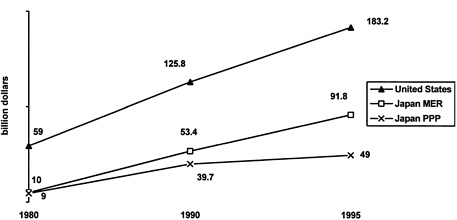
FIGURE 5-1 Information-related investment. NOTE: PPP (purchasing power parity) and MER (market exchange rates) from Organization for Economic Cooperation and Development. SOURCE: Nihon Keizai Shimbun, July 22, 1996, p. 34.
Today, Japanese companies are largely absent from the packaged software market, including operating systems as well as the most important and rapidly growing application segments for businesses and consumers such as groupware, Internet browsers, and relational databases.109 Japanese companies are only now beginning to develop strategies for the Internet and "intranets" that link corporations. However, it would be a mistake to make too much of these relative weaknesses or to downplay Japan's strengths. Japanese companies remain quite strong in significant areas of information technologies. These include computer and video games, high value-added hardware components of information systems (displays, optical storage), embedded software in products such as numeric control software for machine tools, and vector supercomputers. In these areas, differences in the structure of the Japanese market have not constituted a disadvantage. For example, fragmented standards have not been a major barrier to the diffusion of "stand-alone" systems like games and machine tools.110 The needs of supercomputer users are usually highly specialized, with applications software developed in house or by contractors, so purchasing decisions are largely determined by price and hardware capabilities.
Japanese companies and the Japanese government are also taking steps to adapt and become more competitive. For example, anecdotal evidence indicates that the large Japanese electronics companies are maintaining their investments in longer-term research and expanding their collaborative work with Japanese universities.111 Recent Japanese policy initiatives are aimed at
promoting the diffusion of information technologies and strengthening the university research base-areas where Japan is weak relative to the United States.112 In addition, Japanese companies have responded very rapidly and aggressively to the competitive challenges of the past few years, such as the assault on the Japanese PC market by Compaq and others, by rapidly globalizing their sourcing patterns. NEC, Fujitsu, and others are now positioned to reenter the U.S. PC market, which they had largely abandoned in the late 1980s.
There are also signs that the business culture in Japan is changing. One company that is pursuing a very different strategy toward information industries than other Japanese firms is Softbank Corporation. From its base in Japan as a software and peripherals distributor, Softbank has concluded a broad and dynamic array of acquisitions, minority investments, and strategic alliances, mainly involving U.S. firms, in the past several years (see Table 5-4). In contrast to traditional Japanese corporate strategies in this industry, which are focused on hardware, inward technology transfer, and catching up with U.S. front-runners, Softbank has moved to establish a dominant position in key areas of the infrastructure for information businesses, such as publishing and information technology trade shows. Also, a number of Softbank's alliances appear to be aimed at facilitating access by small-and medium-sized U.S. technology start-ups to the Japanese market. Softbank's ultimate degree of success remains to be seen, but the existence of a maverick Japanese firm pursuing high-risk strategies raises the possibility that U.S.-Japan cooperation and competition in this sector will be different than in the past. Although Softbank is something of an outlier in the Japanese context, Japanese companies are increasingly willing to engage in reciprocal relationships with U.S. partners, particularly in this industry.113 By the same token, some U.S. software firms are aggressively investing in Japan, as illustrated by Intuit's acquisition of Milky Way, a small Japanese software company, in 1996.
Despite current leadership in this industry by U.S. firms, particularly in establishing the most important information technology architectures and standards, U.S. advantages should not be overstated or taken for granted. For example, despite global market leadership by U.S. companies, the U.S. trade balance in information technology products moved from a small surplus in 1990 to a $20.9 billion deficit in 1994.114 Also, it appears that U.S. industrial R&D in these industries is increasingly focused on product development, while longer-term corporate R&D has been reduced.115 Events of the past decade show that today's winners in information industries can quickly become tomorrow's losers.116
TABLE 5-4 Selected Recent Softbank Acquisitions, Minority Investments, and Strategic Alliances
|
Partner |
Form of Partnership |
Business |
|
Interactive Marketing |
minority investment |
computer trade shows, publishing |
|
Yahoo! |
minority investment |
on-line services |
|
Ziff-Davis Publishing |
acquisition |
publishing |
|
Comdex |
acquisition |
computer trade shows |
|
CyberCash Inc. |
minority investment |
on-line services |
|
Unitech Telecom |
minority investment |
telecommunications |
|
Microsoft |
joint ventures |
games |
|
NTT |
joint venture |
on-line services |
|
Decisive Technology Corp. |
minority investment |
on-line services |
|
Kingston Technology |
acquisition |
memory boards |
|
I-Search |
minority investment |
on-line services |
|
Phoenix Publishing Systems Inc. |
acquisition |
publishing |
|
Firefly Network Inc. |
minority investment |
on-line services |
|
I/Pro |
minority investment |
on-line services |
|
US Web |
minority investment |
on-line services |
|
Trend Micro |
minority investment |
on-line services |
|
Live World Productions |
joint venture |
on-line services |
|
Chase Manhattan |
joint venture |
internet investments |
|
Time Warner/Intel |
joint venture |
on-line services |
|
Verisign |
minority investment |
on-line services |
|
News Corp. |
joint venture |
digital satellite television |
|
Iota Industries |
minority investment |
document search software |
|
Tabula Interactive |
minority investment |
on-line services |
|
Asymetrix |
minority investment |
on-line services |
|
Sega |
joint venture |
publishing |
|
Dentsu |
joint venture |
advertising |
|
SOURCE: Compiled by Office of Japan Affairs from news reports. |
||
Future Questions and Issues
Market Dynamism
The dynamic, rapidly growing U.S. market for information technology products will continue to be a strong force in driving innovation. One important question for the future is whether the Japanese market will come to play a similar role. Japan's competitive, dynamic market plays an important role in pushing new technology in areas such as consumer electronics and games. Despite the fact that Japan's markets in computing and communications are somewhat more open
and competitive than they were a few years ago, cost levels and regulatory barriers are still significantly higher than those of the United States (see Figure 5-2).117
Telecommunications services are particularly important. In contrast to the United States, where deregulation and the break-up of the Bell System has led to increased competition and lower costs, the Japanese market is still highly regulated. NTT still holds a dominant position in providing long distance and local service, and costs are still several times higher than in the United States. With the implementation of new legislation in 1996, the U.S. approach is moving further toward deregulation and open competition. Meanwhile, debate in Japan over deregulation of telecommunications markets and restructuring NTT has focused on how changes would
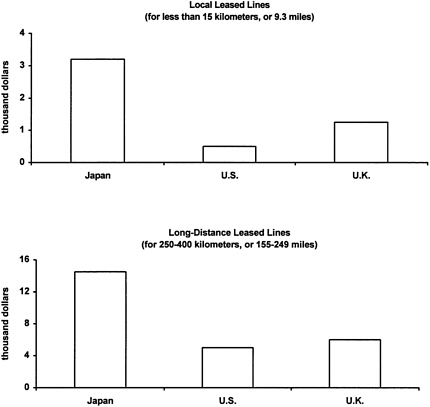
FIGURE 5-2 Annual cost of leased-line service for 1.5 Mbps service. SOURCE: Goldman Sachs & Co., as compiled in The Wall Street Journal, February 14, 1996, p. A 0.
impact international competitiveness.118 In December 1996 the Japanese government announced plans to divide NTT into three operating divisions, owned by a single holding company.119 Nevertheless, however Japan's policies and strategies change in coming years, it is very unlikely that a U.S.-style approach emphasizing openness and free competition will be instituted in the near future.120
Asian Markets and Technology Networks
Asian markets and technology networks will also play an increasing role in information technologies. The Asian market for personal computers, for example, is expected to grow by 20 to 30 percent a year until the end of the century.121 This growth presents significant opportunities and challenges for U.S. and Japanese companies. Although the Asian electronics production networks of U.S. and Japanese companies have served as valuable suppliers, balancing short-term demands for technology transfer and the longer-term risk of creating new competitors is a growing challenge.122 Asia will increasingly serve as a source of innovation and technology as well. Both U.S. and Japanese companies have been active in building R&D capabilities in Asia.123
As in regulation, U.S. and Japanese approaches to Asian markets and innovation show significant differences. The U.S. government tends to pursue liberalization in trade and regulation both bilaterally and through multilateral organizations.124 U.S. companies pursue their own strategies for accessing Asian markets and technological capabilities. The approach of Japanese government and industry to the Personal Handy-Phone System (PHS) is instructive by way of contrast. PHS is a digital mobile communications system developed collaboratively by the Ministry of Posts and Telecommunications and the private sector.125 NTT is now making aggressive efforts in Asia, including R&D cooperation, to establish PHS as an international standard to compete with cellular technologies.126 This is just one example of the comprehensive Japanese government and industry approach to science and technology cooperation in Asia.127
For the United States, balancing the long-and short-term interests of individual companies and the U.S. economy as a whole in trade and technology relationships with Asia will continue to be a challenge. Some experts assert that Japanese investment in Asia, particularly in electronics, represents a shift in the U.S. trade deficit with Japan to a deficit with Asia.128
Investments in R&D
Federal spending on basic research, advanced education, and leading applications of information technology have played an important role in U.S. leadership in information technologies.129 The High Performance Computing and Communications Initiative, an interagency initiative of the federal government, continues the tradition of strong federal support and has contributed to the development of technologies that have advanced U.S. competitiveness in information technologies, such as the Mosaic Internet browser.130 At the same time, the lack of a strong fundamental research base and advanced computer science and engineering training has been seen as one of Japan's primary weaknesses. As noted above, U.S. and Japanese investment patterns are changing in this industry. The U.S. federal government faces budget pressures, that will likely constrain overall R&D spending, and reductions in Department of Defense support for some areas of computer science R&D are already perceived to be having an impact.131 Meanwhile, the Japanese government is working to build a stronger fundamental research base. At this point, it is still difficult to predict the impact of these trends.
Intellectual Property Protection
As noted above, stronger U.S. intellectual property rights laws and enforcement have been an important factor in maintaining U.S. leadership in information technologies, particularly in setting the most important de facto standards and architectures. Since the United States is likely to remain the leading market for information technology products, and possession of a U.S. patent allows exclusion of infringing products, U.S. intellectual property rights laws are in many cases sufficient to discourage illegal copying and patent or copyright infringement efforts. A nascent Japanese plan to amend its copyright laws to allow unrestricted software decompilation, which might have allowed Japanese firms to reverse engineer U.S. software and market the copied product, was dropped after protests by the U.S. government and U.S. industry.132 U.S. government and industry criticism also caused Japanese standards-setting officials to drop plans for software quality standards that could have evolved into trade barriers.133 Indeed, the U.S. software industry is very active in pursuing its collective policy interests in Japan and other markets.
Protection from copyright infringement in the area of pirated products is another important issue.134 In this area, U.S. and Japanese interests may be moving toward greater confluence. For
example, Japanese companies that are victims of piracy are increasingly willing to pursue legal action to protect their rights.135 At the policy level, the Japanese government has been much less vocal than the U.S. government in pressing copyright issues with China and other developing countries, but has also embarked on a focused effort to cooperate with Asian countries as they develop their intellectual property protection systems.136 In the future it may be possible for the United States to work more closely with Japan and other producers of intellectual property to ensure that patents and copyrights are protected in Asia.
Outlook for 2007
-
Japan 's research base in industry and at universities is likely to become stronger and more important to the global shape of these industries. As was the case in mainframes and vector supercomputers, Japanese companies are likely to narrow the gap in parallel architecture, workstations, PC development, and perhaps even in software. Future market shifts, such as the rise of network computers that replace the PC, also could provide new opportunities for Japanese companies.
-
Both U.S. and Japanese-based information products manufacturers are likely to move more manufacturing offshore. Asian countries will increasingly be the source of components and subassemblies. Some Asian countries could also become the source of engineering development for multinational corporations, as India is today in some areas of software.
-
These trends will result in further intensification of global competition, resulting in consolidation, exit of weaker companies, emergence of important new Asian companies, and market share shifts between companies and countries that cannot be foreseen at this point.


