
DONALD WILLIAM KERST
November 1, 1911–August 19, 1993
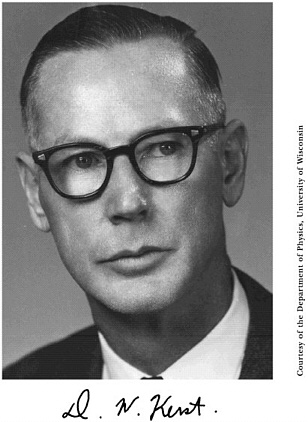
BY ANDREW M. SESSLER AND KEITH R. SYMON
DONALD WILLIAM KERST died on August 19, 1993, at the age of 81. On that day the country lost one of its most influential physicists, one with a remarkable breadth of interests. Kerst will long be remembered for his development of the betatron, but he also made very important contributions to the general design of particle accelerators, nuclear physics, medical physics, and plasma physics.
In addition to these scientific and technical contributions, his deep understanding of physics, his know-how, and his enthusiasm have been a source of education and inspiration both to his students and his colleagues. His many students and junior colleagues during the last forty years have continued to make their own contributions to these fields. He was an enthusiastic and effective mentor who worked hard and expected his students to do likewise, and they did. His students liked and admired him. Thirty-three students completed Ph.D. degrees in the betatron group at the University of Illinois over a period of thirty years. Forty-two students completed their doctorates in the plasma group at the University of Wisconsin during the seventeen years that he led the group. Over the last forty years many of the leading scientists in the fields of accelerator physics, nuclear
physics, medical physics, and plasma physics received their degrees under his direction.
Donald Kerst was born in Galena, Illinois, on November 1, 1911. He earned a bachelor's degree in 1934 and a doctorate in physics in 1937 at the University of Wisconsin. He was an instructor, assistant professor, and then professor at the University of Illinois from 1938 to 1957. He then was professor at the University of Wisconsin from 1962 to 1980. In short, except for some few years spent at the General Electric Company (1937–38 and 1940), at Los Alamos, New Mexico (1943–45), and at the General Atomic Laboratory, La Jolla (1957–62), he spent his life in the midwest.
THE BETATRON
Among the many investigators who attempted to accelerate electrons by magnetic induction, none were successful until Donald Kerst produced 2.3-MeV electrons in a betatron at the University of Illinois in 1940. He later constructed a number of betatrons of successively higher energies, culminating in the 300-MeV betatron at the University of Illinois. Kerst's success was due to a very careful theoretical analysis of the orbit dynamics in accelerators (including a study of the requirements for injection); to a preliminary analysis of all conceivable effects relevant to the operation of a betatron; and to a careful and detailed design of the magnet structure, vacuum system, and power supply. This was the first new accelerator to be constructed on the basis of a careful scientific analysis and a completely engineered design. Its success represented a turning point in the technology of particle accelerators from cut and try methods to scientifically engineered designs. All later accelerators, including the newest high energy synchrotrons, have been influenced by this early work of Kerst. It is only in the light of these later developments that we see the importance of
the betatron not merely as a valuable instrument in itself but as a milestone in the development of particle accelerators generally. For example, the radial and vertical oscillations of the beam in all particle accelerators are now universally called betatron oscillations after the pioneering work of Kerst and Robert Serber, who together in 1941 published the first theoretical analysis of such oscillations as they occur in the betatron.
The betatron was quickly put to use in industry, medicine, and nuclear physics research. It was the first accelerator to provide gamma rays for photo-nuclear studies. In the late 1940s and early 1950s the betatron was used for much of the experimental research on photo disintegration of the deuteron, on photo-nuclear reactions (including the discovery of the giant dipole resonances), and important early work on nuclear structure from electron scattering.
Of great importance was the pioneering use of megavolt electron beams for the production of energetic X rays for the therapeutic treatment of cancer. His fascinating depiction of this treatment included a description of the first use of phantoms and the intense activity precipitated by a student afflicted with brain tumor, heroic efforts that achieved much, but were unable to save the student.
Kerst took a one-year leave of absence from the University of Illinois (1940–41), designed a 20-MeV betatron and a 100-MeV betatron working with the engineering staff at General Electric. He oversaw the construction and operation of the 20-MeV betatron, which he brought back to Urbana.
During World War II days, Kerst built a 4-MeV portable betatron for inspecting bomb duds in situ and, most importantly, built a 20-MeV betatron at Los Alamos for study of bomb assembly implosions. His work was described in the
official history of Los Alamos as: ''The technical achievements are amongst the most impressive at Los Alamos."
After World War II Kerst built a 300-MeV betatron at the University of Illinois that was brought into operation in 1950 and provided a facility for studying high energy physics until it was superseded by synchrotrons and then by electron linacs.
THE MURA YEARS
From 1953 to 1957 Kerst served as technical director of the Midwestern Universities Research Association, working on advanced accelerator concepts. His deep understanding of the physics of electric and magnetic fields and of mechanics and his vigorous technical leadership were responsible in large part for the many contributions to accelerator technology made by the MURA group during that period. In addition, the knowledge and inspiration gained under his leadership marked the beginning of productive scientific careers for a number of young physicists who were associated with the group at that time. The spiral-sector focusing principle, which now finds application in many spiral ridge cyclotrons in operation around the world, was originated by Kerst.
Among the contributions to accelerator technology of the MURA group under his leadership was the invention and analysis of the process of beam stacking by means of radio frequency acceleration in fixed field machines. The possibility of achieving intense circulating beams by means of beam stacking led to the first practical proposals for achieving greatly increased center-of-mass energies through the utilization of colliding beams. The successful storage rings for colliding proton beams at CERN in Geneva, Switzerland, and at Fermilab in the United States are a direct outgrowth of the MURA proposals. It is now recognized
that colliding beams represent the major approach for further advances in experimental high energy physics.
PLASMA PHYSICS
In 1957 Kerst turned his attention to the area of plasma physics and its applications to the problems of developing controlled thermonuclear power. He brought to this field not only his deep physical insight into magnetic field structures but also his understanding, gained from his accelerator experience, of the importance of careful attention to detail in the design of magnetic structures so as to eliminate all possible sources of error and asymmetry in the magnetic fields. These are largely responsible for the success of the various toroidal machines that have been built under his direction, including a toroidal pinch device at General Atomic and a number of multipole machines (of which he was co-inventor with Tihiro Ohkawa). The first multipole machines were the toroidal octupoles completed at the University of Wisconsin under his direction and the toroidal octupole started by him and Ohkawa at General Atomic and completed by Ohkawa. These were the first magnetic confinement devices to achieve a quiet plasma undisturbed by the instabilities that had plagued previous machines. These were also the first machines to exhibit plasma lifetimes exceeding the Bohm diffusion limit.
PERSONAL DATA
Donald Kerst held honorary degrees from Lawrence College (1942), the University of Sao Paulo (1953), the University of Wisconsin (1961), and the University of Illinois (1989). He was awarded the Comstock prize by the National Academy of Sciences in 1945 and elected to membership in 1951. He received the John Scott Award of the City of Philadelphia in 1946; the John Price Wetherill Medal of the Franklin
Institute in 1950; the James Clerk Maxwell Prize in plasma physics from the American Physical Society in 1984; and the Robert R. Wilson Prize for accelerator physics in 1988. He was a member of the American Association for the Advancement of Science and the American Academy of Arts and Sciences, an honorary member of the American Association of Physicists in Medicine, and a fellow of the American Physical Society and the American Nuclear Society. In 1972–73 he chaired the Plasma Physics Division of the American Physical Society.
Donald Kerst was a well-rounded person. He was a sportsman who enjoyed skiing, deep-sea fishing, white-water canoeing, and ocean sailing. He had a low-key sense of humor that often delighted friends and colleagues. Even in recreation he remained the scientist. He taught a course in celestial navigation and wrote a program for his Hewlett Packard handheld calculator that provided location on the Earth to within a mile or so.
It would have been easy for one as accomplished as Donald Kerst to intimidate others, but that wasn't his style. He always treated graduate students as his equals. He found merit in even the craziest idea. He built others up; he did not put them down. He expected the best from people, and they worked hard to live up to his expectations.
He was a generous man. He always gave credit to those who worked for him. At scientific meetings he would let them give the talks. He seldom put his name on papers they wrote to describe the work done under his supervision. When important people from other laboratories visited, he would usually have the graduate students show them around and describe the machines and the research. And, of course, his love of physics was legendary. He got great pleasure from thinking about physics and in working out
problems. When he did, he had to tell someone; often there were late night calls or pages at airports.
Donald Kerst is survived by his wife, Dorothy Birkett Kerst, his children Marilyn E. Kerst and Stephen M. Kerst, his grandchildren Rosalind and Susanna Sipe and David and Anita Kerst, and by his brothers Herman S. Kerst, Richard N. Kerst, and Kenneth A. Kerst.
IN PREPARING THIS MEMOIR we have drawn freely upon obituaries in a number of newspapers, a resolution by the faculty of the University of Wisconsin, and remarks made at the memorial service by Keith Symon and J. Clinton Sprott. In addition, we have profited by letters of nomination written through the years for the Enrico Fermi Award and the National Medal of Science by Keith Symon and Heinz Barschall. We found most informative an article titled, "Historical development of the betatron" [Nature (London) 157(1946):90] and an article titled, "Betatron-Quastler era at the University of Illinois" [Med. Phys. 2(1975):297]. Finally, the photograph of Donald Kerst has been provided by the University of Illinois Archives (Donald W. Kerst papers, Record Series 11/10/30, box 5).
SELECTED BIBLIOGRAPHY
1937 With R. G. Herb and J. L. McKibben. Gamma-rays from light elements due to proton bombardment. Phys. Rev. 51:691–98.
1941 Acceleration of electrons by magnetic induction. Phys. Rev. 58:841; Letter to editor 60:47–53.
With R. Serber. Electronic orbits in the induction accelerator. Phys. Rev. 60:53–58.
1942 A new induction accelerator generating 20 MeV. Phys. Rev. 61:93 .
A 20-million-electron-volt betatron or induction accelerator. Rev. Sci. Instrum. 13:387–94.
1943 With H. W. Koch and P. Morrison. Experimental depth dose for 5, 10, 15 and 20 million-volt x-rays. Radiology 40:120–27.
1945 Method of increasing betatron energy. Phys. Rev. 68:233–34.
1946 With L. S. Skaggs, G. M. Almy, and L. H. Lanzl. Removal of the electron beam from the betatron. Phys. Rev. 70:95.
20-million volt betatron for industrial radiography. Iron Age 158(21):60–61; Steel 119(22):68–69, 92.
1948 With L. S. Skaggs, G. M. Almy, and L. H. Lanzl. Development of the betatron for electron therapy. Radiology 50:167–73.
A process aiding the capture of electrons injected into a betatron. Phys. Rev. 74:503–04.
With others. Techniques for application of the betatron to medical therapy. Am. J. Roentgenol. Radium Ther. Nucl. Med. 60:153–57.
1950 With G. D. Adams, H. W. Koch, and C. S. Robinson. Operation of a 300-MeV betatron. Phys. Rev. 78:2976.
1956 With others. Attainment of very high energy by means of intersecting beams of particles. Phys. Rev. 102(2):590–91.
With K. R. Symon, L. W. Jones, L. J. Laslett, and K. M. Terwilliger. Fixed-field alternating-gradient particle accelerators. Phys. Rev. 103(6):1837.
1957 With others. Operation of a spiral sector fixed field alternating gradient accelerator. Rev. Sci. Instrum. 28(11):970–71.
1960 With others. Electron model of a spiral sector accelerator. Rev. Sci. Instrum. 31:1076.
1961 With T. Ohkawa. Stable plasma confinement by multipole fields. Phys. Rev. Lett. 7:41.
With T. Ohkawa. Multipole magnetic field configurations for stable plasma confinement. IL Nuovo Cimento XXII:784.
1964 MURA: The importance of encouraging scientific enterprise. Science 143:1274.
1965 With R. A. Dory, W. E. Wilson, D. M. Meade, and C. W. Erickson. Motion of plasma and lifetimes of energetic ions in a toroidal octupole magnetic field. Phys. Rev. Lett. 15(9):396.
1966 With R. A. Dory, D. M. Meade, W. E. Wilson, and C. W. Erickson. Plasma motion and confinement in a toroidal octupole magnetic field. Phys. Fluids 9:997.
1969 With others. Plasma confinement in a toroidal octupole magnetic field. In Proceedings of the Third International Conference on Plasma Physics and Controlled Nuclear Fusion Research, vol. I, p. 313. Paper CN 24/C-1. Vienna: International Atomic Energy Agency.
1974 With others. Plasma heating and losses in toroidal multipole fields. In Plasma Physics and Controlled Nuclear Fusion Research, vol. 11, p. 89. Vienna: International Atomic Energy Agency.
1978 With E. J. Strait and J. C. Sprott. Experimental demonstration of  plasma divertor. Phys. Fluids 21:2342–45.


