
MILTON STANLEY LIVINGSTON
May 25, 1905–August 25, 1986
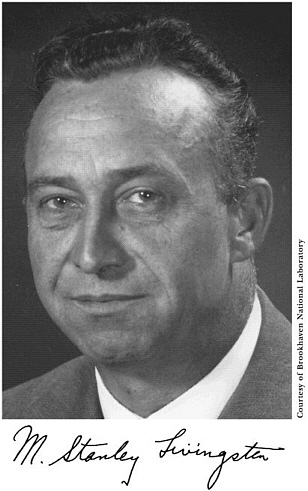
BY ERNEST D. COURANT
ON JANUARY 9, 1932, in Berkeley, California, a magnetic resonance accelerator (cyclotron) built by M. Stanley Livingston accelerated protons to 1.22 MeV (million electron volts), the first time that particles with energies exceeding one million volts had been produced by man. Twenty years later, in May 1952, the Cosmotron at Brookhaven National Laboratory, whose construction Livingston had initiated, became the world's first billion-volt (GeV) accelerator. By the time of his death in 1986 the world record had gone up by three more orders of magnitude to 900 GeV, thanks to an innovation by Livingston and others.
Milton Stanley Livingston was born in Broadhead, Wisconsin, on May 25, 1905, the son of Milton McWhorter Livingston and his wife Sarah Jane, née Ten Eyck. His father was a divinity student who soon became minister of a local church. When Stanley was about five years old the family moved to southern California, where his father became a high school teacher and later principal, having found that a minister's salary was inadequate to support a growing family. On the side he bought a 10-acre orange grove and ranch.
As the only son in the family—there were three sisters—Stanley
grew up learning and doing all the chores on the ranch. He became acquainted and fascinated with tools and farm machinery; these skills became the foundation of his ability as a designer and builder of complicated scientific systems throughout the rest of his life. On the other hand, as he said in an interview many years later, having three sisters, ''I never did a dish in my life." When Stanley was about twelve years old his mother died. His father remarried a few years later and continued to expand the family; as a result Stanley had five half-brothers.
After graduating from high school in 1921, Stanley went to Pomona College, initially majoring in chemistry. Toward the end of his years there his interest switched from chemistry to physics, stimulated by his college roommate Victor Neher and physics professor R. Tileston. He then went east to Dartmouth College, where he obtained a master's degree in physics and stayed on as an instructor for a year. To continue his graduate work he had a choice between Harvard and the University of California, and he chose California because it was close to home.
At Berkeley in the summer of 1930 he canvassed the professors of the Physics Department to look for a Ph.D. topic and chose one suggested by Ernest O. Lawrence. Lawrence had noted that ions of mass M and charge e moving in a uniform magnetic field B would circulate at a constant frequency ω = eB/Mc independent of energy, and therefore an applied radio-frequency field of that same frequency should be capable of accelerating the ions. If a radio-frequency electrode has a voltage V oscillating at the resonance frequency and a particle traverses it at the peak phase of the oscillation, the total energy gained by a particle in N traversals is N times e V. Thus, a small applied voltage V can lead to a large final energy. Lawrence suggested that Livingston verify this idea experimentally.
Another of Lawrence's students, Niels Edlefson, had made a preliminary attempt to find the resonance, but had obtained inconclusive results. Livingston used the 4-inch magnet previously used by Edlefson, built a metal vacuum chamber and installed a hollow D-shaped accelerating electrode in it, added an rf oscillator, and put the whole system together. With Lawrence's active help and supervision he first found evidence of resonant acceleration about November 1930. In January 1931 hydrogen molecular ions (H2+ ions) were accelerated to the maximum energy available with the magnet, namely 80 keV using an applied voltage of just 1 keV—an energy amplification factor of 80! This was enough for Lawrence to apply for grants to build a new device of this type capable of going up to energies useful for nuclear disintegration experiments. He prodded Livingston to write his thesis and get his Ph.D. degree as quickly as possible so he could become eligible for appointment to an instructorship for the following academic year. Livingston, who had recently married and needed a more secure job, needed no urging. He wrote up the thesis in two weeks and underwent his Ph.D. oral examination in April. He had been so busy in the lab that he had not studied much of the basic literature of nuclear physics, and some members of his examining committee were critical of his lack of general preparation. But Lawrence's enthusiasm and persuasiveness saved the day, and Livingston got his degree and the instructorship.
He immediately went to work on designing and building the next machine, an accelerator designed to go to one million volts, for which Lawrence had obtained funds. This one was based on a magnet with an 11-inch diameter and included an rf accelerating system capable of providing the resonance frequency for protons, which is twice as high as for H2+ ions. Acceleration took place in the gap between a
pair of hollow D-shaped electrodes with grids at the edges of the gap to confine the electric field to the space between the "dees." Lawrence had emphasized that it was important to have no electric field inside the dees.
A crucial step came serendipitously. During the summer, while Lawrence was away on a trip, Livingston decided to see what would happen if he removed the grids, since they necessarily intercepted some of the particles and tended to reduce the number of particles accelerated. Surprise! The resonance still worked and the beam intensity leapt up by a factor of 100—far more than could be accounted for by the beam loss from the grids. The reason—quite unanticipated by Livingston and Lawrence, but recognized almost immediately—was that the electric field inside the dees produced electric focusing, which kept the particles from flying off to the top or bottom of the chamber as they had done before. This effect was most important at the center of the device.
An equally important development was the discovery of magnetic focusing. To smooth out possible imperfections in the uniform magnetic field Livingston inserted magnetic "shims," thin iron plates, between the magnet poles and the vacuum chamber. He found that he got the best beam intensity when these shims were shaped to make the field a little stronger at the center than toward the outside. After this empirical discovery it became clear that the curved lines of magnetic force associated with the field becoming weaker toward the outside would focus the beam, imparting a downward component of force to particles above the median plane and vice versa. And this effect becomes more pronounced toward the outside of the orbits, complementing the electric focusing, which is strongest at the center.
So, on January 9, 1932, to quote Livingston, "I recall the day when I had adjusted the oscillator to a new high frequency, and, with Lawrence looking over my shoulder, tuned
the magnet through resonance. As the galvanometer spot swung across the scale, indicating that protons of 1-MeV energy were reaching the collector, Lawrence literally danced around the room with glee. The news quickly spread through the Berkeley laboratory, and we were busy all that day demonstrating million-volt protons to eager viewers." 1
Lawrence lost no time raising money for a bigger magnet, and by the time the 11-inch accelerator had achieved its million volts the new magnet with 27.5-inch pole faces was already installed on the campus. Livingston switched his attention to the task of building a cyclotron with this magnet (the term "cyclotron" for the circular magnetic resonance accelerator was coined sometime during those years, and soon came into general use). The new cyclotron got its first beam in the summer of 1932 and by the end of the year it accelerated H 2+ ions to 5 MeV.
As the Berkeley people were rejoicing in their world-record energy, news came that Cockcroft and Walton in England had accomplished the first artificial disintegration of nuclei with a high voltage generator of only half a million volts. Lawrence, Livingston, and the rest of the Berkeley crew immediately went to work bombarding all sorts of targets and duplicated and extended the Cockcroft-Walton results. An important contributor to this achievement was G. N. Lewis at Berkeley, who had found a way of producing substantial quantities of heavy hydrogen (deuterium) by electrolysis. He made deuterium available to the cyclotronists, and they found that deuterons were even better projectiles for nuclear disintegration work than protons. In addition neutrons were produced copiously by deuteron bombardment of many different targets. Lots of experiments were done with deuterons and neutrons, and the cyclotron's performance was continually improved, largely by Livingston's efforts. Livingston, together with Lawrence, M. G. White,
M. C. Henderson, and others, was an active participant in these nuclear physics experiments, as well as the cyclotron development work. They kept in constant touch with English and French groups doing nuclear disintegrations with radioactive sources and Cockcroft-Walton generators.
A big controversy arose. Livingston, Lawrence et al. had found protons of the same energy emitted when different elements, light or heavy, were bombarded with deuterons. They interpreted this as evidence for instability and spontaneous breakup of the deuteron and deduced a value for the mass of the neutron that was appreciably lower than the Europeans' value. Eventually it was found that the Berkeley result was due to target contamination, and the European value of the neutron mass turned out to be correct.
In early 1934 Berkeley was scooped again—this time by the discovery of artificial radioactivity by the Joliots in France. Again this was something they had overlooked. The moment they heard about it they also found radioactivity in their targets and, of course, the Berkeley cyclotron was the ideal instrument for studies of induced radioactivity and production of radioactive isotopes.
Altogether in the years 1932–34 Livingston was author or co-author of more than a dozen papers on nuclear physics and the apparatus. During this time he systematically compiled a file of all the nuclear reactions and radioactive isotopes that had been found.
After four years at Berkeley, Livingston decided it was time to be more independent. He felt he had not received as much recognition at Berkeley as was warranted. Lawrence, who had become world-famous for the cyclotron, did not generally credit Livingston much for his part in the development. He moved to Cornell, where he built a cyclotron on his own—the first successful cyclotron away from Berkeley, a 2-MeV machine. He did this with a grant of just $800
and with the help of the departmental shop and graduate students.
At Cornell, Livingston, together with Robert Bacher and Hans Bethe, established nuclear physics as a field of study in the department and Cornell as a major center of this discipline. Livingston's compilation of data he brought from Berkeley proved to be very useful for the monumental series of three review papers by Bethe, Bacher, and Livingston that appeared in Reviews of Modern Physics in 1936 and 1937, and have been reprinted many times since. Livingston credits Bethe with really broadening his understanding of nuclear physics. One of the significant accomplishments at Cornell was the demonstration that the neutron has a magnetic moment.
In 1938 Robley Evans at MIT began a project to build a large cyclotron, financed by the Markle Medical Foundation and intended for medical applications and nuclear physics. He persuaded Livingston to come to MIT to build this machine. So, even though he was in no way dissatisfied at Cornell, Livingston made another move. The MIT cyclotron was finished by 1940 and worked very well. Livingston continued his evolution into an all-around nuclear physicist and professor, teaching courses and supervising graduate students.
When many of his colleagues transferred to radar work or the Manhattan project, Livingston stayed with the cyclotron. It too had an important role to play in the war effort—the production of radioisotopes for medical purposes. Soon the cyclotron was running around the clock. In 1944 his senior colleague Philip Morse enlisted Livingston in his operations research effort with OSRD and the Navy Department. He spent two years in Washington and London working on antisubmarine radar and countermeasures.
Not long after Livingston returned to MIT, physicists from
Columbia, Harvard, MIT, and other universities explored the possibility of setting up a new laboratory for nuclear science somewhere in the northeast. By the middle of 1946 a site was chosen, namely the future Brookhaven National Laboratory on Long Island. Philip Morse became director of this new laboratory. Its mission was to establish research facilities on a scale too large for a single university and make those facilities available to researchers from all universities on a cooperative basis. The initial facilities were to be a nuclear reactor—the first one to be dedicated to research not associated with weapons—and a large particle accelerator. Morse persuaded his colleague Stan Livingston to take charge of the accelerator project at the new lab, and Stan took a leave of absence from MIT and moved to Bayport, Long Island.
What sort of accelerator should be built? At Berkeley, Lawrence had built a huge cyclotron with a 184-inch magnet, which was started in 1940, but was interrupted by the war. In fact, that machine turned out to be feasible only because in 1944 and 1945 Veksler in the Soviet Union and McMillan at Berkeley had come up with the principle of phase stability and synchronism, which overcomes a limitation on the energy that a cyclotron can attain. This principle had made it possible for the Berkeley cyclotron—now converted to a "synchrocyclotron" or frequency modulated cyclotron—to reach energies around 300 MeV. Several other synchrocyclotrons in that range were also being built at various universities, such as Columbia, Carnegie Institute of Technology, Rochester, Chicago, and Liverpool. Livingston felt that, with the resources available at Brookhaven, he could outdo Berkeley with a 600-700 MeV synchrocyclotron, and he began to assemble a staff to design and build it.
The Veksler-McMillan principle could also be applied to a ring accelerator for either electrons or protons. The ring
has the advantage that the magnet only needs to cover the orbit corresponding to the full energy of the machine, rather than the whole area inside that orbit; thus, higher energies are practicable. Lawrence and his people at Berkeley were exploring the possibility of a 10,000-MeV (10-GeV) ring proton synchrotron. I. I. Rabi in particular argued forcefully that this was also the way to go for Brookhaven. Livingston agreed, and soon the proton synchrotron became the primary focus of the Brookhaven accelerator project. The cyclotron was eventually dropped.
In the spring of 1947 Morse, Livingston, and Brookhaven's personnel director R. A. Patterson went on a recruiting trip that took them to Cornell among other places. I was in my first year of postdoctoral work in nuclear physics there, under Hans Bethe, and at Bethe's suggestion I had looked at some problems in connection with the dynamics of synchrotrons. Livingston offered me a summer job at Brookhaven, and I jumped at the opportunity.
Brookhaven in the summer of 1947 was an exhilarating and stimulating place. I was swept along by Livingston's enthusiasm, and found myself working on this marvelous new project. There were frequent meetings to discuss and explore all aspects of the project. The main thing I learned from working with Livingston that summer was how one field—say, theoretical orbit dynamics—can impact on a very different field, such as vacuum technology, and vice versa. I went back to Cornell for the academic year, but the next summer I joined Brookhaven for good.
Shooting for a 10-GeV proton synchrotron put Livingston and Brookhaven into direct competition with Lawrence and Berkeley. The government (i.e., the Atomic Energy Commission) was unwilling to underwrite two large projects, and a meeting took place at Berkeley to decide how to proceed. Brookhaven was represented by Livingston, Morse,
and Leland Haworth, the associate director for projects, and Berkeley by Lawrence, E. M. McMillan, and others. There was only enough money available for one 10-GeV machine. For both laboratories to get something, two smaller machines would have to be built—say, 6 and 2.5 GeV. Who would get which?
Haworth volunteered to take the smaller piece of the pie in the hope that Brookhaven would finish its record-breaking machine before Berkeley completed the more ambitious project. Then Brookhaven would be first in line for the next, even bigger, step. Livingston agreed reluctantly. In the end it turned out just that way. In later years Haworth often called this the best decision he ever made.
Livingston got the Brookhaven project going at full speed with a fresh and enthusiastic team made up of a number of young engineers and physicists; I was one of two theorists, and there were just two or three people besides Stanley Livingston who had any substantial experience. Somewhere along the line the name "Cosmotron" was coined to indicate that this machine would duplicate cosmic rays (well, almost). The design energy was upgraded from 2.5 to 3 GeV.
Stan had been on leave from MIT. By the end of 1948 this leave had stretched to two years, and he could not stay away any longer without forfeiting his tenure position. So he chose to return, leaving the cosmotron in what he hoped were capable hands. Back at MIT he Concentrated on teaching and supervising graduate students. At the same time he continued to think about accelerators and worked in other fields. In 1950 he participated in a Los Alamos experiment to investigate the lifetimes of short-lived fission products. He also began to explore the possibility of building a large accelerator in Cambridge as a joint effort of MIT and Harvard.
In May 1952 the Cosmotron at Brookhaven was finished and succeeded in accelerating a proton beam to a little over a billion volts—the first time such an energy had been reached in the laboratory. Soon it got to 2.5 GeV, close to the design energy of 3 GeV. (The larger Berkeley project was not yet finished, and was to take two more years).
Meanwhile, in Europe physicists from several countries began to explore the possibility of setting up an international laboratory for nuclear physics, aiming at a facility that might be beyond the reach of any one country but within the reach of all of them cooperatively. The concept was modeled on Brookhaven, which had been set up as a group effort by nine universities. In Europe it was to be twelve countries. The centerpiece was to be a new accelerator like the Cosmotron but bigger; the energy they had in mind was about 10 GeV.
The nascent Conseil Européen pour la Récherche Nucléaire (CERN) decided to send a team of experts to Brookhaven to see how we had done it, in the hope of getting some useful advice. Stan Livingston went to Brookhaven that summer to set up a study group to learn more about how the Cosmotron worked, what improvements might be suggested to the expected visitors, and to lay the groundwork for the Cambridge accelerator project.
One feature of the Cosmotron—designed into it by Livingston back when it was started—was that the magnet that had a C-shaped cross section with the iron yoke closing off the inside of the aperture but not the outside. This made it easy to get at the beam from the outside and for negatively charged secondary particles to emerge, but it led to an asymmetry in the magnetic field configuration that limited the useful part of the aperture (i.e., the space available for particles to circulate stably). Now it occurred to him that, if the ring were divided into sectors with the direction
of the C-shape reversed in half the ring (i.e., the magnet yoke on the outside in half the sectors and inside in the other half), the asymmetry in the field would even out so that the useful aperture might be increased. Furthermore, in the sectors where the opening was to the inside, positive secondaries would be just as accessible as negative ones in the other half.
I pointed out immediately that a parameter known as the focusing gradient n, which governs the orbit focusing properties first enunciated by Livingston and Lawrence in connection with the original cyclotron, would be different in the sectors with inside- and outside-facing C's. This might well weaken the overall orbit stability. But then I did some quantitative calculations, using a formalism I had previously used in connection with other orbit stability calculations, and I found that the alternation of n could enhance stability rather than weakening it. Without alternations it was well known (from work by Kerst and Serber) that n had to be between 0 and 1, and it had been chosen as 0.6 for the cosmotron.
Using values of n that alternated between +1.2 and 0 (averaging 0.6 as before) I found slightly enhanced stability. The next day I did the calculation for +10 and -10 with more alternations, and the results were even better (the average of 0.6 turned out to be irrelevant). One day later I found a general recipe: Alternate the gradients in N pairs of sectors with the value of n alternating between about +(N/2)2 and -(N/2)2. Then the stability of the oscillations is enhanced by a factor on the order of N/2 (i.e., the transverse space needed for oscillations is reduced by that factor). If N and n are made very large the reduction factor is also large. Hartland Snyder, another Brookhaven theorist, pointed out an analogy between this and optical focusing of light beams.
Stan Livingston recognized this as something qualitatively new that would make it possible to build new accelerators with more compact magnets. These compact magnets would be much less massive and were bound to be much cheaper than the behemoths of the Cosmotron and Berkeley, and it should be possible to think of much higher energies at reasonable cost. Stan and the rest of us put these new ideas together with the engineering and design principles that had gone into the Cosmotron and in less than two weeks we drafted a paper for the Physical Review.
This paper described the new ''strong focusing" principle and presented a conceptual design for a machine that could go to 30 GeV, ten times the Cosmotron's record and five times the energy of the coming Berkeley machine. For our example we took 120 pairs of sectors and n = ±3600. The space needed for the particles in the aperture of the magnet was calculated as less than an inch, as against 6 by 36 inches in the Cosmotron and 12 by 48 inches in the (more conservatively designed) Bevatron, the 6-GeV machine being built in Berkeley. In the same paper it was also recognized that the new focusing principle was quite separate from the problem of acceleration and it could be applied to beams of particles being guided in paths of any shape, keeping them focused with what came to be known as quadrupole lenses.
The CERN delegation arrived from Europe: Rolf Wideröe, whose concept of multiple acceleration has stimulated Lawrence to invent the cyclotron; Odd Dahl, who had worked on some early high-voltage machines in the 1930s, and F. K. Goward, the first to make the McMillan-Veksler synchrotron principle work. They found more in the way of ideas for their machine than they expected. Goward said, "I could kick myself for not having thought of that!" or words to that effect.
Our visitors left convinced that they should adopt this new principle for their laboratory and aim at 25–30 GeV rather than the 10 GeV originally planned. A study group had been set up in Europe even before the CERN laboratory was established in Geneva. In the course of their explorations they found that maybe we had been a bit overenthusiastic in our initial choice of numbers; a 1-inch aperture was too small, and a practical value of n should be closer to 300 than 3600. But it was still a big advance over the conventional ways.
Of course, Brookhaven went on with these studies and came up with the same conclusions and a design for 30 GeV. Stan went back to MIT after the summer and argued that the new principle now made it economically possible for a single university—or a pair, such as Harvard and MIT—to build its own multi-GeV accelerator at home. He got a number of talented people together to explore the possibility. So there were three groups: CERN, Brookhaven, and Stan's team at Harvard-MIT. We found that the best method of competition was complete openness and sharing of results. Reports produced at Brookhaven, CERN, or Cambridge were routinely and promptly sent to the other places. There was no secrecy!
This did not sit well with the Atomic Energy Commission (AEC). Accelerator physicists at Berkeley had been engaged in a classified project (known as MTA) to build accelerators for the production of plutonium for nuclear weapons (their preoccupation with that project was probably one of the reasons why the Berkeley Bevatron was two years behind the Cosmotron). Therefore, the reasoning went that innovative accelerators had to be classified and certainly should not be disclosed to foreign countries. Fortunately, Haworth (director of Brookhaven by that time) was able to put out that fire.
Early in 1953 an engineer from Greece, Nicholas Christofilos, appeared on the scene. He claimed he had invented the strong-focusing principle two years earlier and had sent a description of it to Berkeley. Indeed, people at Berkeley found his paper in their files. They had examined it superficially and dismissed it as one of the many crackpot letters that laboratories get. They and we were most embarrassed, and we published a letter in the Physical Review acknowledging Christofilos's priority. An agreement was reached with the AEC whereby he received a substantial payment, and he was hired to join the Brookhaven staff (he later left for Livermore).
Back at MIT, Stan embarked on a design study for a 15-GeV alternating-gradient proton synchrotron, which he hoped could be built there. A design study report, supervised by Stan and containing contributions by a dozen MIT and Harvard authors, came out in 1953. At Brookhaven we worked hard on a 30-GeV machine, and CERN embarked on a parallel study with the same goal.
In October 1953 a conference on "Theory and Design of an Alternating-Gradient Proton Synchrotron" was held at the University of Geneva. Stan and I and a few other Americans were invited. Numerous papers were presented showing that the new concept really seemed capable of fulfilling its promises. John and Hildred Blewett from Brookhaven had spent a few months with the CERN group, and also participated. On the weekend they took Stan and me on a drive around the Lake of Geneva, traversing mountain passes with magnificent views of the Alps. Stan exclaimed, "A mountain like Mont Blanc would really make Long Island," alluding to the fact that Brookhaven could hardly compete with CERN in the matter of scenic appeal.
Brookhaven applied to the AEC for authorization to build the 30-GeV alternating-gradient synchrotron (AGS) on which
our design explorations had converged. In early 1954 this proposal was approved. Stan's plan for a 15-GeV machine became moot; there seemed to be no point in doing almost the same thing as Brookhaven but on a smaller scale. Instead, he began to think about an electron synchrotron for Cambridge, a 6-GeV alternating-gradient machine much higher than any other electron accelerator, but not too big a bite for a university-based project.
It took a few years before the AEC approved funding, and the project to build the Cambridge electron accelerator (CEA) finally got under way in 1956. It was a joint Harvard-MIT project located on the Harvard campus. Livingston, as director, was in charge of building the accelerator; Norman Ramsey oversaw the experimental program and physics applications. Stan assembled a staff of talented physicists, and one of them (John Rees) described Livingston's leadership style:2
Stan's most important and noteworthy trait as director was his irrepressible enthusiasm. It was that characteristic that enabled him to attract so bright and promising a staff of young physicists to design and build the CEA: Tom Collins, Gerry Fischer, Ewan Paterson, Ken Robinson, Gus Voss, Herman Winick and the list goes on. Most of these people went on to brilliant and creative careers of their own… Stan did something that was of great importance to our development: he gave us responsibilities and the authority to go with them … That is essential to developing leaders.
During this time Stan welcomed visits, short- and long-term, from people who were embarked on similar projects in Daresbury, England; Hamburg, Germany; and Yerevan, Soviet Armenia. All of these built 4–6 GeV electron synchrotrons similar to the CEA.
The CEA went into operation in 1962, and it held the record for the highest energy electron and photon beams for several years until the Stanford two-mile linear accelerator came into operation. The accelerator was used for numerous
physics experiments, but a disaster happened when a beryllium window on a large liquid-hydrogen bubble chamber failed and the chamber exploded, killing one person and devastating the laboratory.
Fortunately, Livingston and his crew were able to rebuild and restore the laboratory. The crowning achievement was the installation of a beam bypass that made it possible to store counter-rotating beams of electrons and positrons in the ring and observe their collisions at 3 GeV per beam, the first multi-GeV colliding beams and the prototype for many electron-positron colliders that exist today.
By the time the Brookhaven and CERN proton synchrotrons had come into operation in the 30-GeV range in 1959–60, it was clear that the strong-focusing principle on which they were based could be stretched to much higher energies. Studies for a large proton synchrotron began in the early sixties, and in 1966 it was decided to build a new laboratory, the National Accelerator Laboratory, which was dedicated to the construction of a proton accelerator of at least 200 GeV. A site was eventually selected in the Chicago area, and R. R. Wilson became its director. Wilson recruited Stan Livingston as associate director, and in 1967 Stan moved to the new project, now known as Fermilab. He helped in setting up the new laboratory. The 200-GeV accelerator there has by now been upgraded to almost 1000 GeV (the Tevatron), and is still the highest energy accelerator in the world.
In 1970 Livingston retired. He and his wife had acquired a piece of land on the outskirts of Santa Fe, New Mexico, and had designed an imaginative, comfortable adobe house there. Stan proudly showed a model of it to visitors during his last years at Fermilab. In retirement he devoted himself to a newly acquired skill. He became an accomplished silversmith and created jewelry in the style of the local Indians. My wife's collection now includes a pair of Livingston
earrings and a matching brooch. He did not abandon physics altogether. He spent several years as a consultant to the nearby Los Alamos Laboratory and on occasion acted as an administrative judge for the U.S. Nuclear Regulatory Commission.
Stan was also interested in and concerned about the role of science in society at large. In the 1950s he became active in the Federation of American Scientists, working on the problems of the interaction between science and public policy. He served as chairman of the federation in 1954 and again in about 1959. He was particularly concerned with problems of undue secrecy classification of scientific knowledge, unjustified political harassment and persecution of some scientists, and international control of atomic energy.
Stanley Livingston received a number of honors, mostly late in life. He received honorary degrees from Dartmouth College (1963), Hamburg, Germany (1967), and Pomona College (1971). In 1970 he was elected to the National Academy of Sciences. In 1985 the U.S. Summer School on Particle Accelerators presented him with a citation signed by the directors of seven high-energy physics laboratories all over the world. In 1986 the U.S. Department of Energy decided to honor him (and me) with the Enrico Fermi Award, previously given to Fermi, Lawrence, Wigner, Oppenheimer, and other pioneers. Alas, he was never to know this. He died on the very day the award committee made its decision, and on December 18, 1986, the award was presented, posthumously for the first time, to Mrs. Lois Livingston.
Stanley Livingston married Lois Robinson in 1930, while he was a graduate student at Berkeley. They had two children, Diane (Dee), born in 1935, and Stephen, born in 1943. In 1949 Stan and Lois were divorced, and he married Margaret (Peggy) Hughes in 1952. But Peggy was in poor
health and died a few years later. In 1959 Stan and Lois were married again, followed by another twenty-seven years together. He remained in good health until his last year, but after a supposedly successful prostate cancer operation he never recovered completely. He gradually became sicker and sicker and after many difficult months he died on August 25, 1986.
Stanley Livingston's contributions—the cyclotron and the alternating-gradient synchrotron—have revolutionized modern physics and led to our present ability to probe not only nuclei but many esoteric particles—with promises of more to come.
I WANT TO EXPRESS my appreciation to Dee Livingston for sharing some of her memories with me and lending me her collection of her father's memorabilia. I also had instructive conversations with John Rees, Norman Ramsey, and Lois Livingston shortly before her death. The Niels Bohr Library of the American Institute of Physics made available a transcript of an interview with Stanley Livingston held in 1967. Robert Crease lent me a videotape of an interview conducted at Livingston's Santa Fe home in October 1982.
NOTES
SELECTED BIBLIOGRAPHY
1931 The production of high-velocity hydrogen ions without the use of high voltages. Ph.D. thesis. University of California, Berkeley.
1932 With E. O. Lawrence. The production of high-speed protons without the use of high voltages. Phys. Rev. 40:19–35.
With E. O. Lawrence and M. G. White. The disintegration of lithium by swiftly-moving protons. Phys. Rev. 42:150–51.
High-speed hydrogen ions. Phys. Rev. 42:441–42.
1933 With G. N. Lewis and E. O. Lawrence. The emission of alpha-particles from various targets bombarded by deutons of high speed. Phys. Rev. 44:55.
With E. O. Lawrence and G. N. Lewis. The emission of protons from various targets bombarded by deutons of high speed. Phys. Rev. 44:56.
With M. C. Henderson and E. O. Lawrence. Neutrons from beryllium bombarded by deutons. Phys. Rev. 44:782.
1934 With M. C. Henderson and E. O. Lawrence. Radioactivity artificially induced by neutron bombardment. Proc. Natl. Acad. Sci. U. S. A. 20:470–75.
With E. M. McMillan. Artificial radioactivity produced by the deuteron bombardment of nitrogen. Phys. Rev. 47:452–58.
With R. D. Evans. A correlation of nuclear disintegration processes. Rev. Mod. Phys. 7:229–36.
1936 The magnetic resonance accelerator. Rev. Sci. Instrum. 7:55–68.
1937 With J. G. Hoffman and H. A. Bethe. Some direct evidence on the magnetic moment of the neutron. Phys. Rev. 51:214–15.
With H. A. Bethe. Nuclear Physics: C. Nuclear Dynamics, Experimental. Rev. Mod. Phys. 8:245–390.
1938 With M. G. Holloway. Range and specific ionization of alpha particles. Phys. Rev. 54:18–37.
1944 The cyclotron. J. Appl. Phys. 15:2–19, 128–47.
1946 Ion sources for cyclotrons. Rev. Mod. Phys. 18:293.
1950 With J. P. Blewett, G. K. Green, and L. J. Haworth. Design study for a 3-BeV proton accelerator. Rev. Sci. Instrum. 21:7–22.
1952 High energy accelerators: Standard cyclotron; synchrocyclotron. Annu. Rev. Nucl. Sci. 1:157–74.
With E. D. Courant and H. S. Snyder. The strong focusing synchrotron—a new high energy accelerator. Phys. Rev. 88:1190–96.
1954 High-energy Accelerators. Interscience Tracts on Physics and Astronomy, no. 2. New York: Interscience Publishers.
1961 With W. A. Shurcliff. The Cambridge electron accelerator. Science 134:1186–93.
1962 With J. P. Blewett. Particle Accelerators. International Series in Physics. New York: McGraw-Hill.
1966 Energy limit for accelerators. In Perspectives in Modern Physics, ed. R. E. Marshak, pp. 245–56. New York: Interscience Publishers.


