
ALBERT DORFMAN
July 6, 1916–July 27, 1982
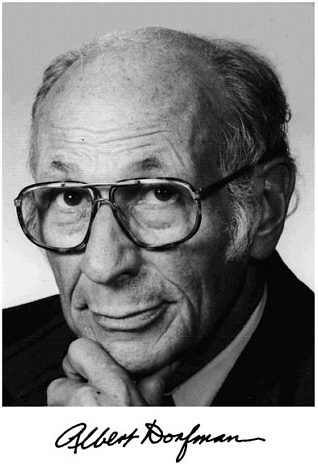
BY NANCY B. SCHWARTZ AND LENNART RODÉN
ALBERT DORFMAN'S RESEARCH for more than thirty-five years on the biosynthesis and chemistry of bacterial and connective tissue polysaccharides provided the basis for many medical advances in human biochemical genetics, as well as in prenatal diagnosis of genetic diseases that cause mental retardation. One of his many scientific accomplishments was discovering the cause of Hurler's syndrome, a genetic disease that affects the bones and cartilage and results in mental retardation.
Albert Dorfman was born and raised in Chicago, the third child of Russian Jewish immigrant parents. His father was manager of a metalware factory and his mother was a seamstress. Although his parents had received no formal education, they placed great emphasis on scholarship and instilled a love for learning in their children. Al's older sister was a pre-law and accounting student and an accomplished singer, which fostered a lifelong interest in music in her younger brother. His older brother Ralph I. Dorfman, who was also a member of the Academy, became interested in mathematics and science early in life and had a great influence on Al by emphasizing high academic achievement and kindling an interest in chemistry. His younger sister, Florence
Jacobson, became a mathematician and married Professor Nathan Jacobson, also a member of the Academy. In 1940 Al married Ethel Steinman, and they had two daughters, Abby and Julie.
Early schooling was a pleasant experience that Al pursued with an all consuming energy. While Al was in high school, his interest in science gradually matured as a result of the stimulation received from his brother, who was then majoring in chemistry at the University of Illinois. Since his high school years were during the depths of the Great Depression, higher education seemed impossible. This was all changed by a high school teacher who convinced Al to take the competitive scholarship examinations at the University of Chicago. Success in obtaining a scholarship opened a vista of higher education. When Al arrived at the University of Chicago, with the limited background of public schooling, the new college system was just getting underway. The intellectual stimulation was intoxicating, and during the first year, almost weekly, he was ready to change his career to such diverse fields as sociology, economics, and history. However, stimulation in the sciences was greatest largely as a result of the teaching by many great scientists in the introductory courses at the college.
Gradually, it became clear that Dorfman wished to pursue a career in medicine or chemistry; the conflict between the two was never to be completely resolved. Accordingly, after first pursuing a curriculum in chemistry, he switched to biochemistry and also entered the University of Chicago School of Medicine during his senior year in college. However, he found biochemistry so interesting that he began graduate work in this discipline and dropped out of medical school after two years. Early in his graduate work he came in contact with Felix Saunders, who was then interested in bacterial metabolism, a field yet in its infancy. This
talented but unrecognized scientist played a most important role in Dorfman's scientific and personal development. Saunders foresaw the great advantages microorganisms offered for the study of metabolism and was also an accomplished carbohydrate chemist. This early training was to be of great advantage when Dorfman subsequently became interested in carbohydrate-containing macromolecules. His Ph.D. thesis research was concerned with the identification of nicotinamide as a growth requirement for Shigella dysenteriae and the synthesis of various nicotinic acid derivatives to correlate structure with biological activity (1939). A microbiological method for nicotinamide was also devised based on these studies (1940).
After receiving the Ph.D. degree from the University of Chicago in 1939, Dorfman tried in vain to obtain a position or a postdoctoral fellowship to study elsewhere. During this period, he became intrigued with the beginning expansion of enzymology, resulting particularly from the studies of Warburg and von Euler. With stimulation and help from R. W. Gerard and E. Guzman-Barron, he learned some of the early techniques of enzymology and remained at the University of Chicago as a research associate, initiating studies on the role of bacterial growth factors in metabolism (by then known to be vitamins). These studies led to development of the technique of growing deficient cells to be used to determine the role of growth factors in metabolism. This short period was extremely productive and led to the discovery of the role of pantothenic acid in pyruvate metabolism (1942), the role of biotin in aspartic acid biosynthesis (1942), and one of the earliest suggestions that drugs may be competitive inhibitors in enzyme reactions (1942).
With the advent of World War II and lack of an academic position, Dorfman returned to medical school, graduating in 1944. Contrary to his expectations, exposure to clinical
studies immediately rekindled an interest in medicine, in particular pediatrics. An early encounter with a child with rheumatic fever stimulated an interest in the mechanism of action of aspirin and profoundly affected Dorfman's subsequent career. Following completion of medical school, an internship at Beth Israel Hospital in internal medicine, and a residency in pediatrics at the University of Chicago, Dorfman served two years in the U.S. Army. He was assigned to the Army Medical School and was able to take up a career in biochemistry. Because of a publication at this time by Guerra claiming that aspirin exerted its antirheumatic effect by inhibition of hyaluronidase, he initiated studies on connective tissue polysaccharides, an area of research which he pursued for the next thirty years. In particular, his earlier experiences in bacterial metabolism and carbohydrate chemistry served as an excellent background to pursue the biosynthesis of hyaluronic acid in Group A streptococci. These studies led to the development of quantitative methods for assays of hyaluronidase (1948), discovery that chondroitin sulfate was a substrate for testicular hyaluronidase (1951), and recognition that hyaluronidase was unusually stable to heat and acid pH (1954), special properties that were later recognized as those of lysosomal enzymes.
Upon returning to the University of Chicago, Dorfman initiated studies on the synthesis of hyaluronic acid with the goal of determining the origins of the fourteen unique carbon atoms of the polysaccharide, using specifically labeled precursors. At that time the biosynthetic reactions leading to formation of hexosamines and glucuronic acid were unknown. Together with Saul Roseman, [1-14C]-glucose, [6-14C]-glucose, and [1-14C]-acetic acid were synthesized. It was then established that glucose was converted to the glucosamine and glucuronic acid portions of the molecule
without scission of the carbon chain, that acetate was a precursor of the acetyl group of N-acetylglucosamine, and that glucosamine but not N-acetylglucosamine served as a precursor of the N-acetylglucosamine residue in hyaluronic acid. Neither glucuronic acid nor glucuronolactone was found to be direct precursors of the glucuronic acid residues in hyaluronic acid (1953,1954,1955). Besides Dorfman and Roseman, the participants in these investigations included Julio Ludowieg and his wife Frances Moses, whose grandmother on her father's side, Anna Mary Robertson Moses, is better known as Grandma Moses (1860–1961).
In parallel with this work similar studies were carried out on mammalian polysaccharides—hyaluronic acid and dermatan sulfate of rat and rabbit skin—with the added dimension that the turnover rates of these polysaccharides in vivo were also determined. In these studies, now part of the classical accomplishments in the field, it was established that the two polysaccharides have a surprisingly rapid turnover with half-lives of only a few days. Following the same pattern of experimentation, Sara Schiller and Dorfman subsequently carried out a number of studies on the effects of various hormones on the metabolism of the glycosaminoglycans.
The discovery of uridine nucleotide sugars by Luis Leloir suggested that these compounds may be intermediates in polysaccharide synthesis. The identification of certain uridine nucleotide sugars and the appreciation of their role in monosaccharide interconversions and as glycosyl donors then occurred in rapid succession. Together with J. A. Cifonelli, Dorfman established that streptococci contained the two uridine nucleotide sugars, UDP-N-acetylglucosamine and UDP-glucuronic acid, requisite for the biosynthesis of hyaluronic acid (1957). The chance observation of large amounts of UDP-glucuronic acid in one batch of streptococci
made it possible to prepare substrate amounts of labeled nucleotide sugar by the Wilzbach procedure. With the labeled nucleotide, synthesis of hyaluronic acid in a cell-free preparation of streptococci was then quickly demonstrated together with Alvin Markovitz and J. A. Cifonelli (1959). This work followed earlier studies by Glaser and Brown, who had obtained evidence for the formation of small hyaluronic acid oligosaccharides in a cell-free preparation of the Rous sarcoma, but the investigation by Dorfman and coworkers represented the first conclusive demonstration of the formation of macromolecular hyaluronic acid. Together, these investigations were the first to show the cell-free synthesis of a heterologous polysaccharide and established a basis for understanding the mechanism of synthesis of many other complex carbohydrates. In a farsighted prediction it was proposed that a single bifunctional enzyme catalyzes both glucuronyl and N-acetyl-glucosaminyl transfer, which we now know to be true. Attempts to solubilize the enzyme failed, but led to the important conclusion that the enzyme responsible for glycosyl transfer—in contrast to those required for nucleotide synthesis—was localized on the protoplast membrane (1962). This was one of the first observations relating macromolecular synthesis to membrane-associated enzymes. More than twenty years later Nancy B. Schwartz and Louis Philipson localized the mammalian hyaluronic acid synthetase to the inner side of the plasma membrane and proposed a mechanism for membrane bound synthesis of the HA polymer.
Dorfman also contributed significantly to the understanding of the biosynthesis of other glycosaminoglycans. The biosynthesis of sulfated glycosaminoglycans by eucaryotic cells required the study of additional reactions not necessary for hyaluronic acid formation because of the sulfate content and covalent linkage to protein. Together with Frank
K. Thorp, Robert L. Perlman, Alvin Telser, and H. C. Robinson, cell-free preparations of embryonic chick cartilage were developed that synthesized chondroitin sulfate, and glycosyl transfer from UDP-N-acetylgalactosamine and UDP-glucuronic acid to small acceptor oligosaccharides was demonstrated (1964,1966).
In addition to utility for subsequent enzyme purification, Dorfman's studies offered more conclusive evidence concerning the mechanism by which genetic information is translated to a specific monosaccharide sequence in carbohydrate-containing macromolecules. The individual glycosyltransferases were found to be specific for the transferred glycosyl group as well as for the nonreducing terminus of the acceptor molecule. Variation of structure of the penultimate monosaccharide of the acceptor did not abolish enzyme activity. The structural regularity of complex polysaccharides is accordingly determined by the specificity of the glycosyltransferases, which in turn are specified by the appropriate structural genes.
After the cell-free synthesis of the repeating disaccharide portion of the chondroitin sulfate chains had been accomplished, Dorfman turned his attention to the carbohydrate-protein linkage region of the chondroitin sulfate proteoglycans, the structure of which had been determined by Lindahl and Rodén in Dorfman's laboratory. The presence of a galactosylgalactosylxylosyl group, linked to serine hydroxyls in the core protein of the proteoglycan, suggested the participation of specific glycosyltransferases in the biosynthetic process. Initiation of biosynthetic studies on the linkage region was greatly aided when David S. Feingold and his coworkers synthesized UDP-[14C] xylose. Robinson and Telser showed the transfer of xylose and galactose from the respective UDP-sugars to endogenous acceptors in the particulate preparations obtained from embryonic chick
cartilage (1966). The formation of a xylosylserine linkage was established. These findings opened the way for more detailed studies of the biosynthesis of the linkage region, which were subsequently pursued by Torsten Helting and Lennart Rodén in Dorfman's laboratory. Purification of the individual enzymes was initiated by Allen L. Horwitz and Allen C. Stoolmiller (1972), with ultimate purification of the xylosyltransferase, as well as solubilization and partial purification of the rest of the glycosyltransferases accomplished by Nancy B. Schwartz and Lennart Rodén.
Recognizing the need of more knowledge about fundamental aspects of the chemistry of the glycosaminoglycans, Dorfman devoted a substantial part of his research program to studies of the structure of these polysaccharides. Not only did the pursuit of such investigations lead to important new basic knowledge, but on more than one occasion was there a stimulating, synergistic interaction between the structural chemists and other members of the team, which enhanced the productivity of the group as a whole and raised the quality of the individual contributions from the laboratory. An early example of the synergism in the Dorfman laboratory was the merger of the pioneering investigations of Martin B. Mathews on cartilage proteoglycans—the native form of the chondroitin sulfates in the tissues—with Dorfman's research on metabolism, resulting in early studies of the turnover of the protein and carbohydrate moieties of these complex carbohydrates.
While a medical student in the 1940s, Dorfman encountered a patient with the Hurler syndrome and, upon surveying the literature, found inconsistencies in the earlier data which had indicated that this condition was a lipid storage disease. Interest in Hurler's syndrome was rekindled by the publication of an intriguing abstract by Brante in 1952, which reported the isolation of chondroitin sulfate from the urine
of patients with this disease. However, no tissues from Hurler patients were available for study at that time. Several years later, a former resident, Eugene Diamond, provided a urine sample from a patient with Hurler's syndrome, and in a few hours Dorfman established that the concentration of mucopolysaccharides (glycosaminoglycans) was much higher than in a control sample from one of his daughters, who was of the same age as the patient. In collaboration with A. E. Lorincz this work was quickly extended to other patients, and more detailed analyses showed that the elevation was due to an increase in both dermatan sulfate and heparan sulfate (1957). The selective increase in the excretion of these two polysaccharides, as compared to chondroitin 4- and 6-sulfate, for example, could not be rationalized at the time, especially since dermatan sulfate and heparan sulfate were considered to be distinct entities without any common structural features. These studies, however, did lead eventually to the identification and delineation of a number of genetically distinct types of mucopolysaccharidoses.
After the discovery of glycosaminoglycans in the urine of Hurler patients, many years passed before the nature of the defect in Hurler's syndrome was finally elucidated by the study of cultured fibroblasts from afflicted individuals. The tissue culture technique had been used previously for the investigation of other diseases and was now applied to the study of the mucopolysaccharidoses by Reuben Matalon in Dorfman's laboratory. Danes and Bearn had demonstrated metachromasia in Hurler fibroblasts, and Matalon and Dorfman independently made the same observation and by quantitative analyses showed that the fibroblasts contained elevated amounts of dermatan sulfate (1966). Based on the finding that an increased incorporation of radioactivity into glycosaminoglycans occurred in Hurler fibroblasts cultured in the presence of labeled polysaccharide precursors, Matalon
and Dorfman first assumed that there was an overproduction in the cells from mucopolysaccharidosis patients. However, studies by Elizabeth Neufeld and her coworkers at the National Institutes of Health subsequently proved that the Hurler syndrome was due to a defect in the degradation of the glycosaminoglycans, which led to excessive accumulation of labeled polysaccharides in the afflicted cells.
By now, it was known that heparan sulfate, like heparin (1962), contains L-iduronic acid, which is also the major uronic acid constituent of dermatan sulfate. Dorfman therefore postulated that an α-L-iduronidase was required for the normal catabolism of the two polysaccharides and that the increased accumulation and excretion observed in Hurler patients was due to a deficiency in this enzyme. By the end of 1970 Matalon, Cifonelli, and Dorfman (1971) had established the existence of a α-L-iduronidase by demonstrating release of iduronic acid from desulfated dermatan sulfate upon incubation with an extract of normal fibroblasts, and preliminary experiments also showed a deficiency of the enzyme in Hurler cells. Conclusive evidence for the deficiency (1972) was subsequently obtained by use of a more specific iduronidase substrate, phenyl α-L-iduronide, which had been synthesized by B. Weissman in the meantime. This was the first enzyme defect established in the mucopolysaccharidoses. In a relatively short time the enzyme defects in the other mucopolysaccharidoses were identified largely as a result of the work in the Dorfman and Neufeld laboratories. Studies on the mucopolysaccharidoses highlighted the importance of the degradative enzymes and helped develop the concept of lysosomes, which led to a better understanding of the relationship of human genetic diseases to the dynamics of cell structure.
The finding by Cifonelli and Dorfman (1962) that heparin contains L-iduronic acid is perhaps the most significant
contribution from Dorfman's laboratory to our knowledge of the basic structure of the glycosaminoglycans. This discovery, which has had a profound impact in many areas of research, was initially met with skepticism or outright disbelief. The works of Maurice Maeterlinck come to mind: ''At every crossway on the road that leads to the future, each progressive spirit is opposed by a thousand men appointed to guard the past." Cifonelli and Dorfman never published a full paper on the subject, a circumstance that may have contributed to the widespread skepticism facing their discovery. But why say in many words what can be said in few?
Increasing knowledge of the structure, biosynthesis, and degradation of matrix components led naturally to an inquiry into more biological aspects of complex carbohydrates. Dorfman's biological studies were concerned primarily with the mechanisms that control the quantity and quality of glycosaminoglycans synthesized intracellularly but destined for export to the cell surface or extracellular matrix, and considered aspects of functional cyto-architecture as well as the mechanism of differentiation of eucaryotic cells (1972, 1974, 1975). Studies on growth of cartilage were stimulated during a sabbatical in the laboratory of Leo Sachs, at the Department of Genetics at the Weizmann Institute, which permitted an intensive firsthand experience with tissue culture methods. In addition to determining that chondrocytes multiply in soft agar, thereby providing a selective method for propagation of cartilage cells (1973), Dorfman established environmental conditions for promoting differentiation of mesenchyme to chondrocytes (1972). These kinds of studies, which originally appeared to be out of the mainstream of the revolutionary progress of biochemistry and cell physiology, illustrated the unappreciated importance of complex carbohydrates in a large number of vital functions
of eucaryotic cells; they also were the forerunners of understanding many aspects of the behavior of eucaryotic cells that are clearly governed by the interaction of cell surface glycoconjugates with substances that impinge on the cell surface.
Dorfman was always aware of the latest developments in the broadest spheres of biology. Thus, he was among the first to develop monoclonal antibody reagents and introduce immunohistochemistry (with B. Vertel) and quantitative RIA to the proteoglycan field (1978, 1979, 1980). He was also at the forefront of undertaking a new program on the molecular biology of connective tissue macromolecules and succeeded in developing a cell-free system for synthesis of proteoglycan core protein and type II collagen, and, finally, using recombinant DNA technology to isolate cDNA clones for type I and II collagen with William Upholt (1979).
During this latter period of scientific achievement, Dorfman was director of the Kennedy Mental Retardation Center, chairman of pediatrics and Richard T. Crane distinguished service professor at the University of Chicago, and director of La Rabida, a hospital and research center for children with chronic diseases. Thus, he was able to significantly influence clinical medicine, genetics, and developmental biology at the University of Chicago. He was instrumental in the construction of Wyler Children's Hospital and the establishment of the Joseph P. Kennedy Mental Retardation Research Center, one of the charter mental retardation research centers from the National Institute of Child Health and Human Development. After giving up most major administrative responsibilities in the late 1970s, he indulged more in his scientific efforts where his enjoyment and enthusiasm for research were infectious. This was also the period when he was most adventurous. Although never afraid to go beyond his own sphere of expertise to borrow and
apply new ideas and methodology to his own field, he was even more ready to speculate on mechanisms of differentiation and molecular genetics.
Dorfman cared deeply about the scientific enterprise and was very concerned about changes that had taken place and other pending changes that he considered detrimental to the future of the biomedical research endeavor. In his last years Dorfman always took the opportunity to complain about the constriction of research funding and was among the first to discuss the scientific, ethical, and social implications of genetic engineering and screening. Notably, the Ryerson Lectureship at the University of Chicago in 1978 and the address he presented when inducted as president of the Pediatric Society in 1979 contained pleas concerning the demise of basic research and controversies in these areas. The final paragraph from the Ryerson Lecture is particularly poignant:
It is possible that the technology that stems from curiosity will destroy mankind. Perhaps the mutation that produced intelligence is indeed lethal. If so, there are more likely vehicles for man's demise than research on human genetics. I would prefer to believe that the mutation which produced intelligence will lead to a continuing increase of wisdom and that the technology that results from curiosity will continue to enhance the quality of life.
WE APPRECIATE THE ADVICE and support of Albert Dorfman's wife Ethel Dorfman. We have also benefited from personal recollections cited in A. Dorfman's "Adventures in viscous solutions," Mol. Cell Biol. 4(1974):45–64 and "Answers without questions and questions without answers," Ryerson Lecture, University of Chicago Press, 1978.
SELECTED BIBLIOGRAPHY
1939 With S. A. Koser, K. F. Swingle, and F. Sanders. Nicotinamide and related compounds as essential growth substances for dysentery bacilli. J. Infect. Dis. 65:163.
1940 With S. A. Koser, M. K. Horwitt, S. Berman, and F. Saunders. Quantitative response of the dysentery bacillus to nicotinamide and related compounds. Proc. Soc. Exp. Biol. Med. 43:434.
1942 With B. F. Miller, R. Abrams, and M. Klein. Antibacterial properties of protamine and histone. Science 96:428.
With S. Berkman and S. A. Koser. Pantothenic acid in the metabolism of proteus morganii. J. Biol. Chem. 144:393.
With S. A. Koser and M. M. Weight. Aspartic acid as a partial substitute for the growth-stimulating effect of biotin on Torula cremoris. Proc. Soc. Exp. Biol. Med. 51:204.
1948 A turbidimetric method for the assay of hyaluronidase. J. Biol. Chem. 172:367.
1951 With M. B. Mathews and S. Roseman. Determination of the chondroitinase activity of bovine testicular preparations. J. Biol. Chem. 188:327–34.
1953 With S. Roseman, F. E. Moses, and J. Ludowieg. The biosynthesis of hyaluronic acid by group A streptococcus. J. Biol. Chem. 203:213–25.
1954 With M. Mathews. Effect of heat and pH on hyaluronidase. J. Biol. Chem. 206:143–49.
With S. Roseman, J. Ludowieg, and F. E. Moses. The biosynthesis of hyaluronic acid by group A streptococcus. II. Origin of the glucuronic acid. J. Biol. Chem. 206:665–69.
1955 With S. Roseman, F. E. Moses, J. Ludowieg, and M. Mayeda. The biosynthesis of hyaluronic acid by group A streptococcus. III. Origin of the N-acetylglucosamine moiety. J. Biol. Chem. 212:583–91.
1957 With J. A. Cifonelli. The isolation of nucleotides from streptococcus. J. Biol. Chem. 228:537–547.
With J. A.. Cifonelli. The biosynthesis of hyaluronic acid by group A streptococcus. V. The uridine nucleotides of group A streptococcus. J. Biol. Chem. 228:547–57.
With A. E. Lorincz. Occurrence of urinary acid mucopolysaccharides in the Hurler syndrome. Proc. Natl. Acad. Sci. U. S. A. 48:443–46.
1959 With A. Markovitz and J. A. Cifonelli. The biosynthesis of hyaluronic acid by group A streptococcus. VI. Biosynthesis from uridine nucleotides in cell-free extracts. J. Biol. Chem. 234:2343–2350.
1962 With A. Markovitz. Synthesis of capsular polysaccharide (hyaluronic acid) by protoplast membrane. Preparations of group A streptococcus. J. Biol. Chem. 237:273–79.
With J. A. Cifonelli. The uronic acid of heparin. Biochem. Biophys. Res. Commun. 7:41–45.
1964 With R. L. Perlman and A. Telser. The biosynthesis of chondroitin sulfate by a cell-free preparation. J. Biol. Chem. 239:3623–29.
1966 With A. Telser and H. C. Robinson. The biosynthesis of chondroitin sulfate. Arch. Biochem. Biophys. 116:458.
With H. C. Robinson and A. Telser. Studies on biosynthesis of the linkage region of chondroitin sulfate-protein complex. Proc. Natl. Acad. Sci. U. S. A. 56:1859–66.
With R. Matalon. Hurler's syndrome: Biosynthesis of acid mucopolysaccharides in tissue culture. Proc. Natl. Acad. Sci. U. S. A. 56:1310–16.
1970 With A. L. Horwitz. The growth of cartilage cells in soft agar and liquid suspension. J. Cell. Biol. 45:434–38.
1971 With R. Matalon and J. A. Cifonelli. L-iduronidase in cultured human fibroblasts and liver. Biochem Biophys. Res. Commun. 42:340–45.
1972 With A. C. Stoolmiller and A. L. Horwitz. Biosynthesis of the chondroitin sulfate proteoglycan: Purification and properties of xylosyltransferase. J. Biol. Chem. 247:3525–32.
With R. Matalon. An α-L-iduronidase deficiency. Res. Commun. 47:959–62.
With Z. Nevo and A. L. Horwitz. Synthesis of chondromucoprotein by chondrocytes in suspension culture. Dev. Biol. 28:219–28.
With D. Levitt. The irreversible inhibition of differentiation of limb bud mesenchyme by bromodeoxyuridine. Proc. Natl. Acad. Sci. U. S. A. 69:1253–57.
1974 With N. B. Schwartz, L. Galligani, and P.-L. Ho. Stimulation of synthesis of free chondroitin sulfate chains by beta-D-xylosides. Proc. Natl. Acad. Sci. U. S. A. 71:4047–51.
1975 With N. B. Schwartz. Stimulation of chondroitin sulfate proteoglycan production by chondrocytes in monolayer. Connect. Tissue Res. 3:115–22.
1978 With B. M. Vertel. An immunohistochemical study of extracellular matrix formation during chondrogenesis. Dev. Biol. 62:1–12.
1979 With B. M. Vertel. Simultaneous localization of type II collagen and core protein of chondroitin sulfate proteoglycan in individual chondrocytes. Proc. Natl. Acad. Sci. U.S.A. 76:1261–64.
With W. B. Upholt, B. Vertel, and P.-L. Ho. Cell-free synthesis of cartilage specific proteins. In Glycoconjugate Research, Proceedings of the Fourth International Symposium on Glycoconjugates, ed. R. Jeanloz, pp. 823–27. New York: Academic Press.
1980 With B. M. Vertel and N. B. Schwartz. Immunological methods in the study of chondroitin sulfate proteoglycans. Dev. Biol. 14:169–98.


